
每日更新
369 Posts

每日更新
全网热点每日更新
Open Trade

BTC Holder
Frequent Trader
8.6 Years
16 Following
96 Followers
79 Liked
Posts
Portfolio
🔥 $PONS update
24-hour fees:
USDT $16.1M
$PONS $9.05M
$UNI $8.29M
PUMP $3.55M
Higher than Uniswap.
Higher than Pump.fun. 🏠
The chart lags behind the fees.
This is trading. 👀
#PONS #Memecoin #Robinhood
24-hour fees:
USDT $16.1M
$PONS $9.05M
$UNI $8.29M
PUMP $3.55M
Higher than Uniswap.
Higher than Pump.fun. 🏠
The chart lags behind the fees.
This is trading. 👀
#PONS #Memecoin #Robinhood
$UNI paper
> This is the return of the EVM cycle (Robinhood, Monad, Ethereum, Base, HyperEVM, etc.)
> Uniswap changed its mechanism to redirect value back to the token—this is still overlooked
> Uniswap grew a lot in the last cycle, but it's still 90% below its all-time high
> An on-chain supercycle driven by outstanding on-chain user experience (FOMO, pumpfun, etc.)
Uniswap is at the center of everything
Let it take off
> This is the return of the EVM cycle (Robinhood, Monad, Ethereum, Base, HyperEVM, etc.)
> Uniswap changed its mechanism to redirect value back to the token—this is still overlooked
> Uniswap grew a lot in the last cycle, but it's still 90% below its all-time high
> An on-chain supercycle driven by outstanding on-chain user experience (FOMO, pumpfun, etc.)
Uniswap is at the center of everything
Let it take off
The market is teaching people how to do things again: when it’s rising, everyone is a cycle master; when it’s falling, no one dares to mention the words “DCA.” But in this round, the real gap isn’t who tops out more accurately—it’s who can still hold onto bullets and judgment in the midst of noise.
Lately, I haven’t been watching the K-line of a specific coin. Instead, I’ve been tracking the rhythm of capital flows between sectors—how the narratives around AI, RWA, and DePIN keep rotating faster and faster. The money isn’t disappearing; it’s repeatedly being swapped into different pockets. $BTC $ETH is the foundation, but the excess returns are most likely to come from the niche directions that no one has fully loaded into.
Don’t rush to go all-in, and don’t rush to leave. Wait until everyone has figured out the logic of a certain sector—by then, the odds will have already been leveled out. Can your current position structure withstand a 30% wick-insert? That matters far more than guessing tomorrow’s up or down.
$UNI
Lately, I haven’t been watching the K-line of a specific coin. Instead, I’ve been tracking the rhythm of capital flows between sectors—how the narratives around AI, RWA, and DePIN keep rotating faster and faster. The money isn’t disappearing; it’s repeatedly being swapped into different pockets. $BTC $ETH is the foundation, but the excess returns are most likely to come from the niche directions that no one has fully loaded into.
Don’t rush to go all-in, and don’t rush to leave. Wait until everyone has figured out the logic of a certain sector—by then, the odds will have already been leveled out. Can your current position structure withstand a 30% wick-insert? That matters far more than guessing tomorrow’s up or down.
$UNI
Many people don’t realize that the real cruelty of this bull market isn’t choosing the wrong coin—it’s that many people simply can’t hold the right ones. When it rises they’re afraid of a pullback, and when it drops they’re afraid of going to zero. After trading back and forth a few times, they only find near the end of the bull market that they’ve made just a small gain.
What will most likely widen the performance gap in the next cycle isn’t alpha coin selection, but rather how deeply you understand the cycle—and how disciplined you are with position management. You can watch $BTC
$UNI
What will most likely widen the performance gap in the next cycle isn’t alpha coin selection, but rather how deeply you understand the cycle—and how disciplined you are with position management. You can watch $BTC
$UNI
🚨 Whales are buying $UNI.
Reportedly, whale wallets tracked by Nansen added about 257,000 UNI in early September, worth roughly $1.6 million at the time.🐋
This is interesting because whale accumulation often signals growing confidence in a project before a broader market response.
But smart money isn’t always right.👀
🔥 Is $UNI quietly preparing for the next big move?
$UNI #Uniswap #DeFi #Crypto #Altcoins #Web3
Reportedly, whale wallets tracked by Nansen added about 257,000 UNI in early September, worth roughly $1.6 million at the time.🐋
This is interesting because whale accumulation often signals growing confidence in a project before a broader market response.
But smart money isn’t always right.👀
🔥 Is $UNI quietly preparing for the next big move?
$UNI #Uniswap #DeFi #Crypto #Altcoins #Web3
There has been an analysis comparing two token launchpad platforms, SOCK and PONS. Both are token launchpads and platform coins. They both use platform fees to repurchase tokens, and the base trading fee is 1%, of which 70% goes to the creators and 30% to the protocol. The protocol portion is mainly used to repurchase and burn the platform coin, creating a loop of “increased trading volume → higher buybacks → intensified deflation.” Both platforms lock liquidity and plan to combine new tokens with tokenized stocks (RWA).
Key differences: For SOCK, 30% of protocol revenue is entirely used to repurchase SOCK, with 75% directly burned and 25% airdropped to holders. If other tokens are received as fees, half is burned first, and the remaining half is used to buy SOCK. PONS uses 80% of protocol revenue to repurchase and burn PONS, while 20% is retained for infrastructure and the team. The repurchased portion is basically burned directly, with no additional airdrops.
In terms of products, SOCK is built on BNB Chain; a single token can be used to trade 2 to 10 stocks at the same time. PONS is built on RH Chain, which is closer to a traditional launchpad. Liquidity ultimately migrates to Uniswap V4 and supports stock token pairings such as NVDA and AAPL.
Some believe SOCK is more holder-friendly: all protocol revenue goes into the buyback loop. However, the team lacks operating budget, which could limit performance if trading volume declines during a Meme bear market. PONS is more corporate in its operations, retaining a budget to support V2 development and stock token integration, making it more resilient across cycles. Long-term performance still depends on whether the platform can continuously capture trading volume and sustain buybacks.
$SOCK $PONS
Key differences: For SOCK, 30% of protocol revenue is entirely used to repurchase SOCK, with 75% directly burned and 25% airdropped to holders. If other tokens are received as fees, half is burned first, and the remaining half is used to buy SOCK. PONS uses 80% of protocol revenue to repurchase and burn PONS, while 20% is retained for infrastructure and the team. The repurchased portion is basically burned directly, with no additional airdrops.
In terms of products, SOCK is built on BNB Chain; a single token can be used to trade 2 to 10 stocks at the same time. PONS is built on RH Chain, which is closer to a traditional launchpad. Liquidity ultimately migrates to Uniswap V4 and supports stock token pairings such as NVDA and AAPL.
Some believe SOCK is more holder-friendly: all protocol revenue goes into the buyback loop. However, the team lacks operating budget, which could limit performance if trading volume declines during a Meme bear market. PONS is more corporate in its operations, retaining a budget to support V2 development and stock token integration, making it more resilient across cycles. Long-term performance still depends on whether the platform can continuously capture trading volume and sustain buybacks.
$SOCK $PONS
While most people are still debating bull vs. bear, smart money has quietly started checking its “exit liquidity.”
The most dangerous moment in the market is often not the day of the sharp drop, but the second when you realize you want to sell yet can’t.
I’ve been thinking about a question again and again: in this cycle, the factor that truly widens the returns gap may not be coin-picking insight, but your perception of “turnover depth.” $BTC will attract a large amount of follow-through orders in a high-range area, but once the price falls back, the order book often thins out in an instant. Whoever is still holding leverage or low-liquidity assets at that moment is the one who becomes passive.
My suggestion: open the trading interface right now and look at the asset you’re most heavily weighted in. Check whether the order thickness at the daily level is sufficient, and whether the support level has real absorption—not just K-line patterns. By the time everyone realizes they need to “run fast,” the odds and your mindset will already be completely different.
That heaviest position you hold—right now, in this moment—are you truly sure you can exit easily?
$UNI
The most dangerous moment in the market is often not the day of the sharp drop, but the second when you realize you want to sell yet can’t.
I’ve been thinking about a question again and again: in this cycle, the factor that truly widens the returns gap may not be coin-picking insight, but your perception of “turnover depth.” $BTC will attract a large amount of follow-through orders in a high-range area, but once the price falls back, the order book often thins out in an instant. Whoever is still holding leverage or low-liquidity assets at that moment is the one who becomes passive.
My suggestion: open the trading interface right now and look at the asset you’re most heavily weighted in. Check whether the order thickness at the daily level is sufficient, and whether the support level has real absorption—not just K-line patterns. By the time everyone realizes they need to “run fast,” the odds and your mindset will already be completely different.
That heaviest position you hold—right now, in this moment—are you truly sure you can exit easily?
$UNI
Some analysis suggests that the tokenization of stocks narrative is becoming a mainline in the crypto market. After the RH chain went through early token issuance chaos, more legitimate developers are expected to move in. Going forward, you can keep an eye on iterative progress in DeFi protocols, distribution-style innovative applications, and the development of launchpad mechanisms. The Solana ecosystem may also leverage the U.S.-stock tokenization narrative to break through the previous limitations dominated by Pump-led MEMEs. With on-chain efficiency and throughput capacity, it could be active in RWA-type MEME projects and is expected to draw more capital and traffic to the crypto sector. By contrast, Base and BSC are still widely regarded as high-risk arenas for speculative games. Other reports also claim that the XLayer official may be preparing a major move, because this round of MEME hype has been redefined by a token-and-stock narrative.
$SOL $BTC
$SOL $BTC
The tipping point for the next round’s profits may have nothing to do with what coin you buy, but rather with when you decide to sell.
Most people spend all their effort looking for a 100x coin, but few draw a line for their own exit. When it rises, they can’t hold; when it falls, they can’t bring themselves to leave—until they end up taking just one ride on a roller coaster.
What’s truly worth researching isn’t the next hot spot, but the moment when your own position starts losing its asymmetry. When your unrealized gains exceed three times your initial capital, every minute of hesitation is effectively raising your real cost.
This may sound harsh: you don’t make money not because you got the direction wrong, but because you don’t have execution standards for yourself.
$BTC #Crypto Where do you think you’ll complete your all-in exit in the next cycle—at what price range? Think it through before answering.
$UNI
Most people spend all their effort looking for a 100x coin, but few draw a line for their own exit. When it rises, they can’t hold; when it falls, they can’t bring themselves to leave—until they end up taking just one ride on a roller coaster.
What’s truly worth researching isn’t the next hot spot, but the moment when your own position starts losing its asymmetry. When your unrealized gains exceed three times your initial capital, every minute of hesitation is effectively raising your real cost.
This may sound harsh: you don’t make money not because you got the direction wrong, but because you don’t have execution standards for yourself.
$BTC #Crypto Where do you think you’ll complete your all-in exit in the next cycle—at what price range? Think it through before answering.
$UNI
A way to ride the memecoin trend is to invest in the application that can profit the most.
For example, in the past month:
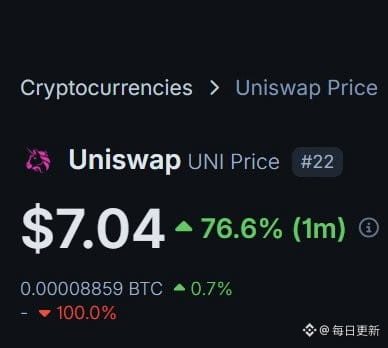
• $UNI is up 76%, because Uniswap saw a surge in trading volume on Robinhood Chain
• $ARB is up 107%, because Arbitrum received 10% of the Robinhood L2 revenue
In short: have a casino.
For example, in the past month:
• $UNI is up 76%, because Uniswap saw a surge in trading volume on Robinhood Chain
• $ARB is up 107%, because Arbitrum received 10% of the Robinhood L2 revenue
In short: have a casino.
When fear spreads, what are truly professional order-matching players doing? Quietly, they’re raising their tolerance for pricing “narrative-invalid assets.” This isn’t guessing the bottom—it’s preparing the odds for the recovery cycle.
While you watch the unrealized loss in your account, they’re watching the liquidity depth when you’re forced to cut your position.
What needs researching now isn’t the next hot coin, but which sector the most active smart money on-chain is sinking into—and which tokens show abnormal turnover resilience during a major selloff. That’s the footprint of concentrated holdings.
The window won’t last forever, but once everyone becomes optimistic again, the distribution of low-priced coins is already set in stone.
Go check the trend of capital inflows into those low-key infrastructure projects in the $SOL ecosystem—you may find the conclusion is completely opposite to what you imagine. #Crypto
$UNI
While you watch the unrealized loss in your account, they’re watching the liquidity depth when you’re forced to cut your position.
What needs researching now isn’t the next hot coin, but which sector the most active smart money on-chain is sinking into—and which tokens show abnormal turnover resilience during a major selloff. That’s the footprint of concentrated holdings.
The window won’t last forever, but once everyone becomes optimistic again, the distribution of low-priced coins is already set in stone.
Go check the trend of capital inflows into those low-key infrastructure projects in the $SOL ecosystem—you may find the conclusion is completely opposite to what you imagine. #Crypto
$UNI
Trading volume accounted for about 56.3%, and on record-setting days, Uniswap liquidity pools absorbed as much as 98% of the chain’s trading volume.
Measured in USD, this means that Uniswap V4 led Ethereum by about $901.5 million out of the $1.6 billion in daily trading volume across all networks, compared with Ethereum’s $465.5 million.
On September 4, Uniswap burned tokens worth roughly $1.15 million—184,000 UNI. This was its first burn day to reach seven digits—more than four-fifths of the tokens were funded by traders on Robinhood Chain.
Measured in USD, this means that Uniswap V4 led Ethereum by about $901.5 million out of the $1.6 billion in daily trading volume across all networks, compared with Ethereum’s $465.5 million.
On September 4, Uniswap burned tokens worth roughly $1.15 million—184,000 UNI. This was its first burn day to reach seven digits—more than four-fifths of the tokens were funded by traders on Robinhood Chain.

When the market is cold and quiet, what “smart money” is doing is often the opposite of what most people are doing. Don’t be fooled by how lifeless the order book looks right now—true turnover is happening quietly and without much noise. Those trapped chips from the previous round are being picked up bit by bit by patient players.
I’m not too concerned about short-term spikes. What I care about is this: when $BTC keeps grinding back and forth within the range, on-chain activity is steadily rising. What does that mean? Someone isn’t waiting for a bounce—they’re quietly building positions for the next cycle.
The gap is never widened by how loudly people call for “bull” in a bull market. It’s widened in this kind of phase where nobody pays attention: whether your position structure, cash flow, and staying power can hold out for an extra month compared with others. The window won’t stay open forever. By the time the on-chain data looks neat and volume finally surges, pricing power has already changed hands.
What makes you uncomfortable right now might be the most valuable entry certificate in the future. The key question is: do you still have “ammo” in your hands? #Crypto # Bitcoin
$UNI
I’m not too concerned about short-term spikes. What I care about is this: when $BTC keeps grinding back and forth within the range, on-chain activity is steadily rising. What does that mean? Someone isn’t waiting for a bounce—they’re quietly building positions for the next cycle.
The gap is never widened by how loudly people call for “bull” in a bull market. It’s widened in this kind of phase where nobody pays attention: whether your position structure, cash flow, and staying power can hold out for an extra month compared with others. The window won’t stay open forever. By the time the on-chain data looks neat and volume finally surges, pricing power has already changed hands.
What makes you uncomfortable right now might be the most valuable entry certificate in the future. The key question is: do you still have “ammo” in your hands? #Crypto # Bitcoin
$UNI
In this round, many people are watching who’s pumping hardest—but the real gap-maker might be this: “Who still has bullets when prices are dropping.” Have you ever calculated your effective position size in the past few pullbacks? Cash that truly lets you act in the panic zone is the core variable shaping your next round of returns.
By the time everyone has figured out a certain narrative, the odds are usually already under new ownership. Smart money has never been error-free; instead, they give themselves three chances to make mistakes.
Ask yourself: at this level right now, are you feeling comfortable and wanting to add, or anxious and wanting to uninstall the app? The answer itself is the signal.
Studying the odds of position management may be worth more than researching the odds of the next 100x coin.$BTC #Crypto
$UNI
By the time everyone has figured out a certain narrative, the odds are usually already under new ownership. Smart money has never been error-free; instead, they give themselves three chances to make mistakes.
Ask yourself: at this level right now, are you feeling comfortable and wanting to add, or anxious and wanting to uninstall the app? The answer itself is the signal.
Studying the odds of position management may be worth more than researching the odds of the next 100x coin.$BTC #Crypto
$UNI
Just now: Garrett Jin is now losing more than $24 million on this Zcash short position
$UNI $HYPE
$UNI $HYPE
Before each truly major market uptrend begins, the market usually doesn’t simply pull straight up with a single line.
Instead, it rises for a while, then falls for a while; after a breakout, it retraces again—grinding until you start doubting everything about life.
This is precisely what makes it so torturous.
When it drops a lot, everyone knows it’s a bear market;
when it goes wild upward, everyone knows the bull is coming.
The hardest time to judge is always the middle phase of the bull–bear transition.
The current market has that kind of feel:
Good news comes out and it rises, and capital starts to get active—yet it never forms a sustained, forced-buy squeeze;
when BTC dips slightly, the altcoins deflate right along with it;
today you see a breakout, tomorrow it gets smashed back down.
So many people end up thinking: it’s another teaser meant to lure you in.
But the issue lies right here.
A real major trend has never been about waiting until everyone has confirmed, “the bull market is here,” and then only afterward giving you a comfortable chance to board.
The market needs to churn and shake repeatedly—washing out the locked-in positions from the previous round, shaking off the short-term profit takers, while also making the shorts repeatedly think, “this is the top.”
$UNI $HYPE
Instead, it rises for a while, then falls for a while; after a breakout, it retraces again—grinding until you start doubting everything about life.
This is precisely what makes it so torturous.
When it drops a lot, everyone knows it’s a bear market;
when it goes wild upward, everyone knows the bull is coming.
The hardest time to judge is always the middle phase of the bull–bear transition.
The current market has that kind of feel:
Good news comes out and it rises, and capital starts to get active—yet it never forms a sustained, forced-buy squeeze;
when BTC dips slightly, the altcoins deflate right along with it;
today you see a breakout, tomorrow it gets smashed back down.
So many people end up thinking: it’s another teaser meant to lure you in.
But the issue lies right here.
A real major trend has never been about waiting until everyone has confirmed, “the bull market is here,” and then only afterward giving you a comfortable chance to board.
The market needs to churn and shake repeatedly—washing out the locked-in positions from the previous round, shaking off the short-term profit takers, while also making the shorts repeatedly think, “this is the top.”
$UNI $HYPE
Some point out that although $PONS has been widely promoted, retail investors in other tokens within the ecosystem generally lose money, while KOLs always manage to profit. This view challenges the alignment between KOLs and the public interest and calls for attention to the plight of ordinary investors.
Many people stare at the candlestick chart looking for the main force, yet they ignore that the real big whales are already changing lanes. The staking ratio of $ETH has been quietly climbing, and the ecosystem transaction volume of $SOL is showing signs of recovery—but neither matters as much as one overlooked signal worth pondering: the flow of stablecoins is starting to tilt.
The money in this cycle is no longer just the broadly rising tide; it’s being funneled in a structured way into specific application layers. What truly widens the gap isn’t who’s in the car, but who sees clearly the next sector that’s being priced in: AI agent payments, or the real yield of RWA?
By the time everyone figures it out, the odds are already off. What you should do now is to review whether your own positions are positioned along the path of where capital is migrating. Ask yourself: are you really earning the money from a trend, or just the difference created by your opponent’s mistakes?
$UNI
The money in this cycle is no longer just the broadly rising tide; it’s being funneled in a structured way into specific application layers. What truly widens the gap isn’t who’s in the car, but who sees clearly the next sector that’s being priced in: AI agent payments, or the real yield of RWA?
By the time everyone figures it out, the odds are already off. What you should do now is to review whether your own positions are positioned along the path of where capital is migrating. Ask yourself: are you really earning the money from a trend, or just the difference created by your opponent’s mistakes?
$UNI
Verified
The analysis reviews the rise of the PONS token and suggests that its market performance was not driven by a single event, but instead progressed gradually alongside the development of the RH Chain ecosystem. The analysis breaks the process into several stages: After RH Chain goes live, PONS—acting as its Meme Launchpad—addresses the problem of insufficient liquidity in the early days of a new chain, becoming the entry point for users and capital; then, rising trading volume validates its business model, with protocol revenues continuing to increase. PONS uses part of its revenue for buybacks and token burns. Data shows that its daily trading volume once reached about $544 million, with daily protocol revenue of roughly $1.2 million—of which around $880,000 was used for buybacks and burns. This is equivalent to approximately 0.25% of the total supply being burned in a day. Within a few days, the cumulative amount burned exceeded 1% of the total supply, and cumulative protocol revenue surpassed $10 million. The analysis believes that PONS’s valuation is closely tied to the overall activity level of RH Chain, and that RH Chain’s liquidity growth brings an ecosystem-wide beta effect to PONS. As more tokens are issued on PONS, network effects gradually take shape, and PONS is evolving from a Launchpad into the core trading infrastructure for RH Chain. Related analysis expects that PONS’s core narrative has shifted from a purely Meme-driven story to a bet on ongoing ecosystem growth and cash-flow rewards.
$PONS
$PONS
Log in to explore more content