
Crypto Trading Champ
273 Posts

Crypto Trading Champ
High-Frequency Trader
2.3 Years
59 Following
118 Followers
459 Liked
Posts
All
Quotes
$BTC v about 72k I'm pretty sure it's strong, no matter what, after the drop it came back up to 82k, then switched or crashed
#termmax @TermMax Previously, I viewed RWA in a fairly simple way: take a real-world asset onto the blockchain, tokenize ownership rights, and record everything on-chain. I thought that once ownership was made transparent, the biggest problem was almost solved.
But the way TermMax talks about physical delivery made me rethink that assumption.
Tokenization does not mean that a natural asset becomes liquid like ETH or stablecoins. When a loan runs into trouble, what matters is not only who owns the asset on the blockchain, but also how that asset can be handled and how value can be recovered in the real world.
That is why physical delivery has become noteworthy. In some structures, instead of requiring the lender to put the collateral asset into a secondary market to sell, the asset can be transferred directly to the lender. This highlights an important reality: blockchain can handle record-keeping, transfer, and making ownership rights transparent—but it cannot magically create liquidity for an asset that is already illiquid.
From that perspective, fixed-rate lending also becomes more interesting. With a loan that has a clear term, the lender doesn’t just look at APY or the interest rate level. They need to understand exactly what risks they will face if the borrower cannot repay.
So I started looking at TermMax from a different angle. Not just as a lending protocol, but as an experiment in how to build credit markets for assets with characteristics that are very different from crypto-native assets.
RWA may not expand as easily as many people expect. What I want to keep tracking next is how, when the asset base grows larger, TermMax will balance
But the way TermMax talks about physical delivery made me rethink that assumption.
Tokenization does not mean that a natural asset becomes liquid like ETH or stablecoins. When a loan runs into trouble, what matters is not only who owns the asset on the blockchain, but also how that asset can be handled and how value can be recovered in the real world.
That is why physical delivery has become noteworthy. In some structures, instead of requiring the lender to put the collateral asset into a secondary market to sell, the asset can be transferred directly to the lender. This highlights an important reality: blockchain can handle record-keeping, transfer, and making ownership rights transparent—but it cannot magically create liquidity for an asset that is already illiquid.
From that perspective, fixed-rate lending also becomes more interesting. With a loan that has a clear term, the lender doesn’t just look at APY or the interest rate level. They need to understand exactly what risks they will face if the borrower cannot repay.
So I started looking at TermMax from a different angle. Not just as a lending protocol, but as an experiment in how to build credit markets for assets with characteristics that are very different from crypto-native assets.
RWA may not expand as easily as many people expect. What I want to keep tracking next is how, when the asset base grows larger, TermMax will balance
#termmax @TermMax My personal perspective: RWA is not just a tokenization story
There’s one thing that changed the way I think about lending and RWA after learning about TermMax.
Before, I often thought that the more liquid the collateral, the easier the lending model would work. With ETH, BTC, or stablecoins, when a position runs into trouble, the protocol can liquidate and sell the assets on the market relatively quickly.
But the story turns out differently when the collateral is a real asset.
A token representing real estate, credit, or an illiquid asset can be put on the blockchain. However, if there aren’t enough buyers on the other side, “liquidating” it in practice is still a difficult problem.
And this is the point I find particularly noteworthy in TermMax’s physical delivery.
Instead of requiring every situation to end with selling the asset on the market, this mechanism opens up the possibility of transferring the asset directly to the lender in certain cases.
That made me realize that the RWA problem doesn’t stop at:
“How do we bring real-world assets on-chain?”
It’s also:
“When something goes wrong, how will we handle that asset?”
This is a fairly important difference.
Blockchain can help with tokenization, trading, and programming ownership rights. But blockchain can’t magically create liquidity for an asset that doesn’t have liquidity in the first place.
So I’ve also started looking at fixed-rate lending from a more practical perspective.
Lenders don’t just need to know what the APR is.
They need to know the loan term, the expected cash flows, and more importantly, what they actually have to protect the loan if the borrower fails to fulfill their obligations?
For me, this is the really interesting part of TermMax.
There’s one thing that changed the way I think about lending and RWA after learning about TermMax.
Before, I often thought that the more liquid the collateral, the easier the lending model would work. With ETH, BTC, or stablecoins, when a position runs into trouble, the protocol can liquidate and sell the assets on the market relatively quickly.
But the story turns out differently when the collateral is a real asset.
A token representing real estate, credit, or an illiquid asset can be put on the blockchain. However, if there aren’t enough buyers on the other side, “liquidating” it in practice is still a difficult problem.
And this is the point I find particularly noteworthy in TermMax’s physical delivery.
Instead of requiring every situation to end with selling the asset on the market, this mechanism opens up the possibility of transferring the asset directly to the lender in certain cases.
That made me realize that the RWA problem doesn’t stop at:
“How do we bring real-world assets on-chain?”
It’s also:
“When something goes wrong, how will we handle that asset?”
This is a fairly important difference.
Blockchain can help with tokenization, trading, and programming ownership rights. But blockchain can’t magically create liquidity for an asset that doesn’t have liquidity in the first place.
So I’ve also started looking at fixed-rate lending from a more practical perspective.
Lenders don’t just need to know what the APR is.
They need to know the loan term, the expected cash flows, and more importantly, what they actually have to protect the loan if the borrower fails to fulfill their obligations?
For me, this is the really interesting part of TermMax.
The other day, I reopened @TermMax and found 1,000 USDC sitting idle in the wallet, along with a question: how do you properly value this amount?
To be honest, I previously thought Lending was fairly straightforward.
What’s the APR?
If it’s high, I look longer. If it’s low, I skip it.
But the example of a Range Order has made me stop and think.
1,000 USDC is split into two parts: 80% in the 10%–15% range and 20% in the 15%–40% range.
So the first 800 USDC and the next 200 USDC are not valued the same.
The breakpoints of the Pricing Curve are (0, 10%), (800, 15%), (1000, 40%).
I stared at it for a while...
Why can the cost of capital stay flat when more and more liquidity is being consumed?
It shouldn’t stay flat.
The deeper the borrower matches, the farther the Actual Execution goes along the Pricing Curve.
Same pool, but the price differs depending on how far the demand is pushed.
Because a real market doesn’t keep prices fixed while demand keeps climbing, right? What to watch next time isn’t only XP or APY, but:
Real TVL → real volume → fee/revenue → liquidity → real users → RWA adoption → survivability through a bear market.
If these metrics grow sustainably, TermMax will become a noteworthy project in the fixed-rate DeFi space.
But if growth is mostly driven by incentives and point farming, the thesis will be significantly weaker.
So, TermMax is a project worth following — but it’s not yet a proven story. #termmax @TermMax
To be honest, I previously thought Lending was fairly straightforward.
What’s the APR?
If it’s high, I look longer. If it’s low, I skip it.
But the example of a Range Order has made me stop and think.
1,000 USDC is split into two parts: 80% in the 10%–15% range and 20% in the 15%–40% range.
So the first 800 USDC and the next 200 USDC are not valued the same.
The breakpoints of the Pricing Curve are (0, 10%), (800, 15%), (1000, 40%).
I stared at it for a while...
Why can the cost of capital stay flat when more and more liquidity is being consumed?
It shouldn’t stay flat.
The deeper the borrower matches, the farther the Actual Execution goes along the Pricing Curve.
Same pool, but the price differs depending on how far the demand is pushed.
Because a real market doesn’t keep prices fixed while demand keeps climbing, right? What to watch next time isn’t only XP or APY, but:
Real TVL → real volume → fee/revenue → liquidity → real users → RWA adoption → survivability through a bear market.
If these metrics grow sustainably, TermMax will become a noteworthy project in the fixed-rate DeFi space.
But if growth is mostly driven by incentives and point farming, the thesis will be significantly weaker.
So, TermMax is a project worth following — but it’s not yet a proven story. #termmax @TermMax

I’m paying attention to @TermMax because the way the project approaches the DeFi market is quite different, especially its products related to interest rates and maturity periods. There’s still a lot to keep an eye on, but I’m quite curious to see how TermMax will develop this ecosystem in the coming time. #TermMax #termmax @TermMax
A project worth expecting and with potential named: TermMax is a noteworthy DeFi project when it focuses on term-based financial products and fixed interest rates. What I’m interested in about TermMax is how the project aims to help users manage yield and borrowing costs in a more predictable way, instead of relying entirely on fluctuations in market interest rates. With its development direction toward lending, borrowing, and the interest-rate market in DeFi, TermMax has a rather distinct path. I will continue to follow new updates from @TermMax v and the development of the $TMX ecosystem in the coming time. #termmax @TermMax
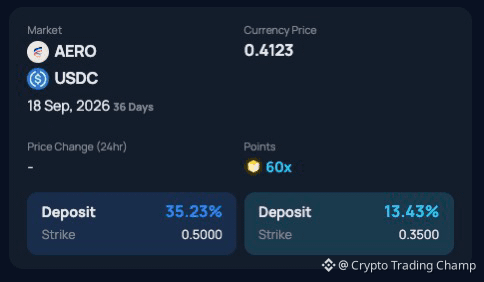
$NES The ability to divide people to buy the dip when the spring tide is heavy is too much on the boat 😅
$NEX This one has a reward pool on several other exchanges, it pumps and dumps, then distributes like a Bill.
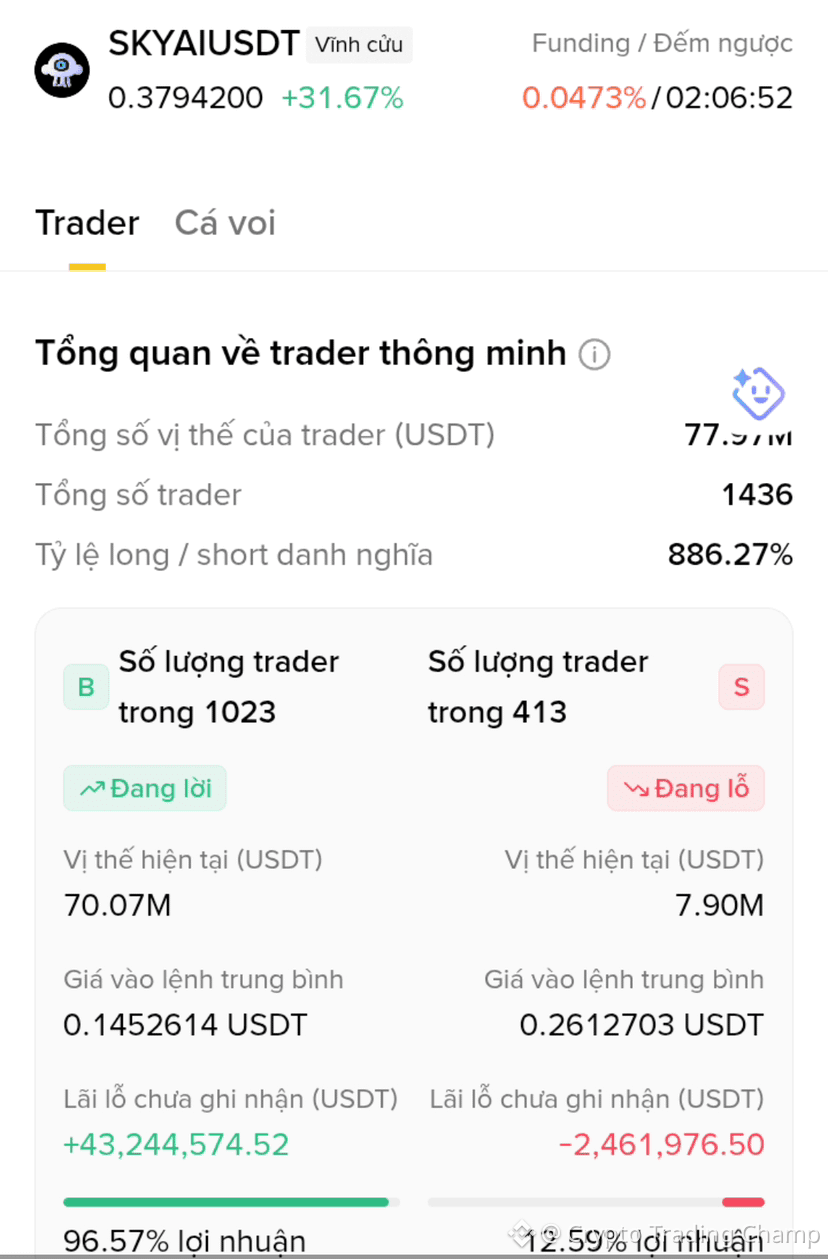
$SKYAI Get ready to long, as we’re about to hit the sweet spot to smash those shorts! Let’s go, $BTC
$SKYAI Whales are continuously placing long orders on Hyper while the dex shorts are getting wrecked with high volume, and they're about to get burned. If you don't go long now, you'll miss out on the opportunity. Free money is right here, so get into long positions at every possible entry to milk it, okay? $BTC
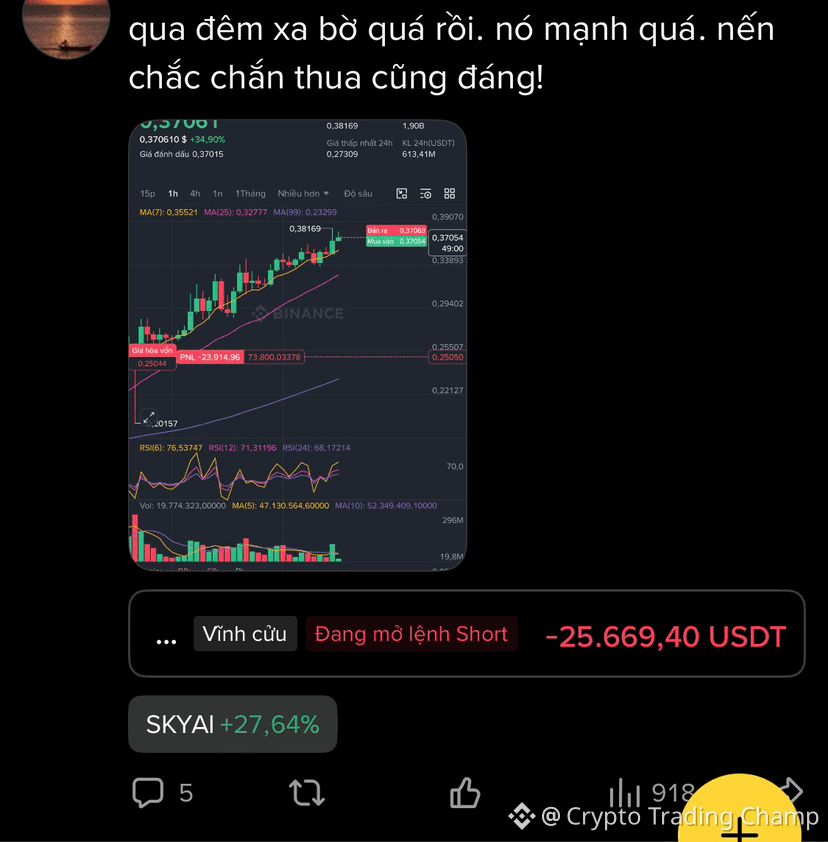
$SKYAI Everywhere you look, there are shorters with big volumes showing off their losses, at this rate it’ll take a while for us to confidently find a point to long up. 0.5 is the least we’re seeing today $BTC
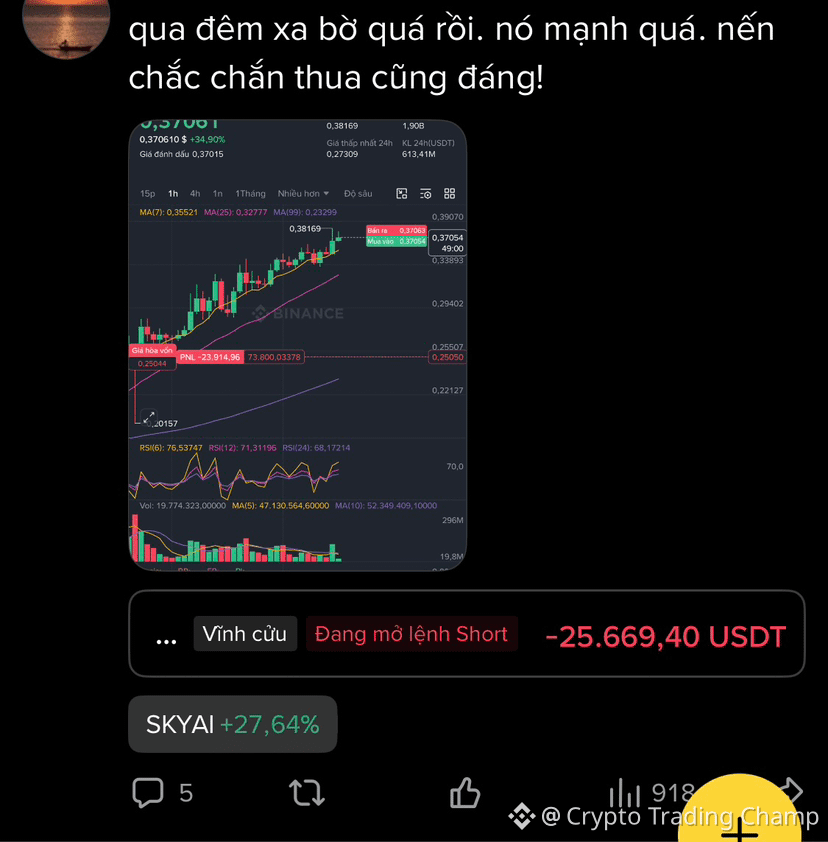
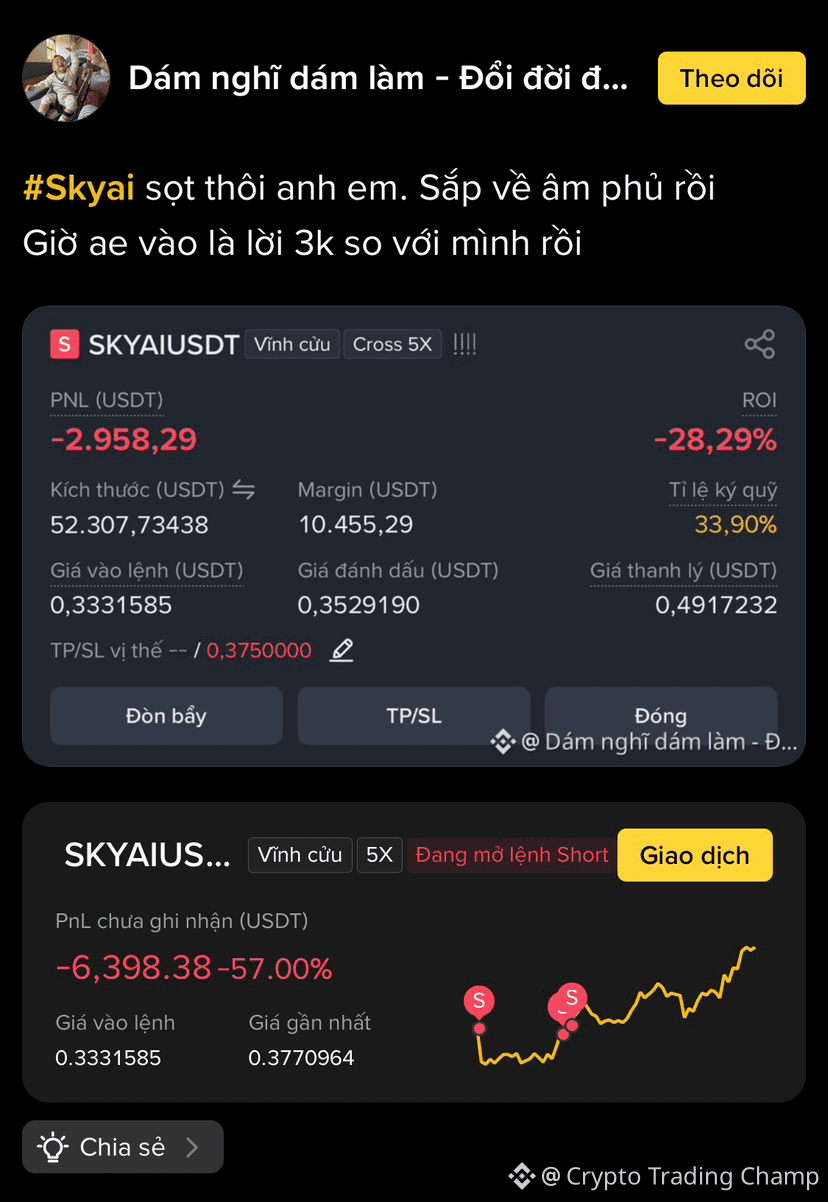
$SKYAI total supply matches Rave, longs vs whales are up 43 tr$. This move, even a small push, is equivalent to 1/10 of Rave, so it should reach at least 1u. Guys, feel confident to go long! $BTC
Log in to explore more content