

密智君 Crypto Plus AI
2k Posts

密智君 Crypto Plus AI
Report
Block User
分享AI Crypto创新洞见,AI实用工具 & 技巧分享,心得,热门话题探讨#CryptoAGI

BTC Holder
Occasional Trader
8.5 Years
112 Following
1.0K+ Followers
2.0K+ Liked
Posts
All
Quotes
Videos
Live
PINNED
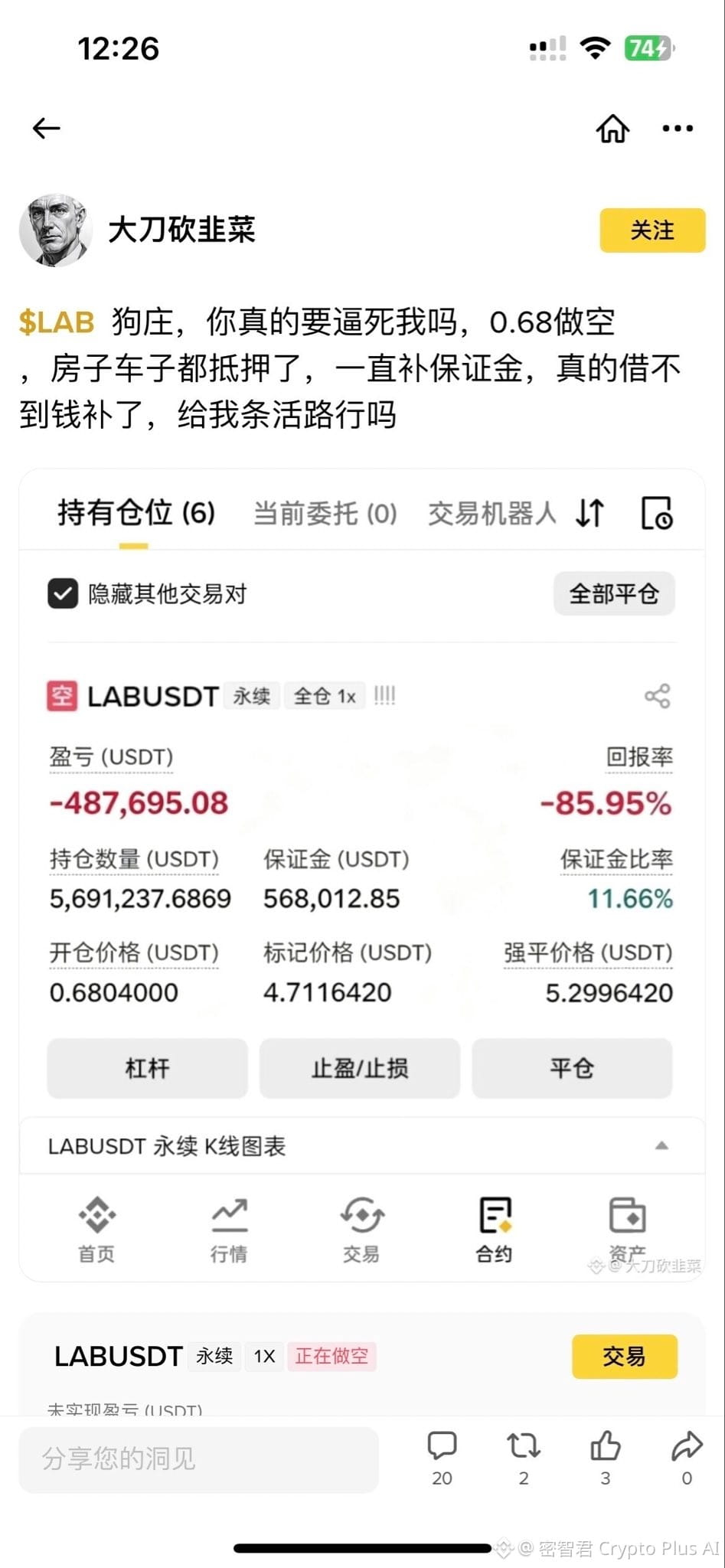
Whoa, I just saw this chart in the square, and I'm completely stunned. This isn't trading; it's practically a real-life 'suicidal attack'.
Brothers, did you see clearly? This dude went short on $LAB at 0.68, and now the price has skyrocketed to 4.7. He's sitting on a paper loss of $487,000, with a return rate of negative 85.95%. What's heartbreaking is his message: he's mortgaged his house and car, and has been margin-calling ever since; he really can't borrow any more money now. The liquidation price is at 5.29, just a step away from the current price.
Honestly, looking at this chart really reminds me of my past self. That desperate feeling of watching the price jump toward the liquidation line while being completely powerless is enough to drive anyone insane. This isn't shorting; it's like playing a 'life swap' game with the market makers. You thought 0.68 was a high point, but the market makers are telling you there's always a higher high.
What I admire (and feel sorry for) is his obsession. Going all-in short with 1x leverage, enduring nearly a 7x increase. That takes some serious 'courage' and a thick wallet, huh? But the trading market doesn’t care about tears, and definitely doesn’t believe in 'holding on for dear life'. You try to reason with the market makers, but they just want to drain your last drop of blood. $BTC #LAB
Whoa, I just saw this chart in the square, and I'm completely stunned. This isn't trading; it's practically a real-life 'suicidal attack'.
Brothers, did you see clearly? This dude went short on $LAB at 0.68, and now the price has skyrocketed to 4.7. He's sitting on a paper loss of $487,000, with a return rate of negative 85.95%. What's heartbreaking is his message: he's mortgaged his house and car, and has been margin-calling ever since; he really can't borrow any more money now. The liquidation price is at 5.29, just a step away from the current price.
Honestly, looking at this chart really reminds me of my past self. That desperate feeling of watching the price jump toward the liquidation line while being completely powerless is enough to drive anyone insane. This isn't shorting; it's like playing a 'life swap' game with the market makers. You thought 0.68 was a high point, but the market makers are telling you there's always a higher high.
What I admire (and feel sorry for) is his obsession. Going all-in short with 1x leverage, enduring nearly a 7x increase. That takes some serious 'courage' and a thick wallet, huh? But the trading market doesn’t care about tears, and definitely doesn’t believe in 'holding on for dear life'. You try to reason with the market makers, but they just want to drain your last drop of blood. $BTC #LAB
Brothers, did you see clearly? This dude went short on $LAB at 0.68, and now the price has skyrocketed to 4.7. He's sitting on a paper loss of $487,000, with a return rate of negative 85.95%. What's heartbreaking is his message: he's mortgaged his house and car, and has been margin-calling ever since; he really can't borrow any more money now. The liquidation price is at 5.29, just a step away from the current price.
Honestly, looking at this chart really reminds me of my past self. That desperate feeling of watching the price jump toward the liquidation line while being completely powerless is enough to drive anyone insane. This isn't shorting; it's like playing a 'life swap' game with the market makers. You thought 0.68 was a high point, but the market makers are telling you there's always a higher high.
What I admire (and feel sorry for) is his obsession. Going all-in short with 1x leverage, enduring nearly a 7x increase. That takes some serious 'courage' and a thick wallet, huh? But the trading market doesn’t care about tears, and definitely doesn’t believe in 'holding on for dear life'. You try to reason with the market makers, but they just want to drain your last drop of blood. $BTC #LAB
116
6
50
178.6k
PINNED
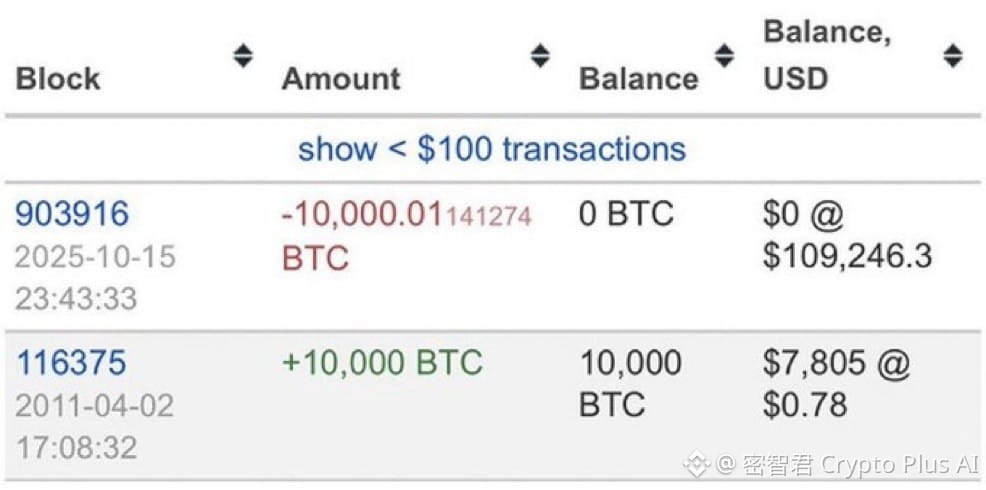
Wow, this guy made 140,000 times his investment in 14 years. Who else can be as awesome as him? In 2011, he spent less than $8,000 to buy 10,000 $BTC, when one Bitcoin was only $0.78.
So what happened? He just held on for 14 years! By October 2025, when Bitcoin broke through $109,000, he sold everything and cashed out over $1 billion. A 140,000 times return, this is not just investment, this is simply like cultivating immortality.
To be honest, what I admire most is not that he bought early, but that he was able to hold on. Over these 14 years, he experienced hundreds of crashes and endured four long bear markets lasting several years. How many times did the market halve, how many times did the media shout 'Bitcoin will go to zero', and he never wavered once. This kind of determination is really not something ordinary people can possess.
I used to have quite a few good stocks, but I sold when they rose two or three times, and cut losses when they fell by 20%. Seeing others get a 140,000 times increase, I can only mock myself: people like us who can't hold on deserve to miss out on big money.
Risk Warning: This kind of 'get rich quick myth' is an extreme case of survivor bias. Just because he made a fortune after 14 years, don’t think you can do the same. Investment requires caution; first, ask yourself if you can withstand a 90% drawdown.
What do you think? If you bought 10,000 Bitcoins in 2011, could you still hold on until now? Be honest in the comments, at which point would you get off the ride?
$BTC
Wow, this guy made 140,000 times his investment in 14 years. Who else can be as awesome as him? In 2011, he spent less than $8,000 to buy 10,000 $BTC , when one Bitcoin was only $0.78.
So what happened? He just held on for 14 years! By October 2025, when Bitcoin broke through $109,000, he sold everything and cashed out over $1 billion. A 140,000 times return, this is not just investment, this is simply like cultivating immortality.
To be honest, what I admire most is not that he bought early, but that he was able to hold on. Over these 14 years, he experienced hundreds of crashes and endured four long bear markets lasting several years. How many times did the market halve, how many times did the media shout 'Bitcoin will go to zero', and he never wavered once. This kind of determination is really not something ordinary people can possess.
I used to have quite a few good stocks, but I sold when they rose two or three times, and cut losses when they fell by 20%. Seeing others get a 140,000 times increase, I can only mock myself: people like us who can't hold on deserve to miss out on big money.
Risk Warning: This kind of 'get rich quick myth' is an extreme case of survivor bias. Just because he made a fortune after 14 years, don’t think you can do the same. Investment requires caution; first, ask yourself if you can withstand a 90% drawdown.
What do you think? If you bought 10,000 Bitcoins in 2011, could you still hold on until now? Be honest in the comments, at which point would you get off the ride?
$BTC
So what happened? He just held on for 14 years! By October 2025, when Bitcoin broke through $109,000, he sold everything and cashed out over $1 billion. A 140,000 times return, this is not just investment, this is simply like cultivating immortality.
To be honest, what I admire most is not that he bought early, but that he was able to hold on. Over these 14 years, he experienced hundreds of crashes and endured four long bear markets lasting several years. How many times did the market halve, how many times did the media shout 'Bitcoin will go to zero', and he never wavered once. This kind of determination is really not something ordinary people can possess.
I used to have quite a few good stocks, but I sold when they rose two or three times, and cut losses when they fell by 20%. Seeing others get a 140,000 times increase, I can only mock myself: people like us who can't hold on deserve to miss out on big money.
Risk Warning: This kind of 'get rich quick myth' is an extreme case of survivor bias. Just because he made a fortune after 14 years, don’t think you can do the same. Investment requires caution; first, ask yourself if you can withstand a 90% drawdown.
What do you think? If you bought 10,000 Bitcoins in 2011, could you still hold on until now? Be honest in the comments, at which point would you get off the ride?
$BTC
49
2
52
97.8k
Over $2 trillion—107% more than the last round: with $ANTHROPIC going public, who will pay that price?
Users vote every day on whether Claude is any good. Anthropic’s financing valuation announced in May was $965 billion. If its IPO valuation reaches $2 trillion, the price will have to climb by about 107% in just a few months.
The S-1 could be made public as early as October 26, U.S. Eastern Time. The SEC requires relevant registration materials to be available to the public at least 15 days in advance before the roadshow begins. After the filings are made public, the company will still need to go through the roadshow, pricing, and listing.
A draft previously reviewed by Reuters showed that the company had about $4.6 billion in revenue and an operating loss of about $8.06 billion in 2025, along with $518 billion in future commitments for cloud computing and infrastructure spending. How these figures are updated in the final public filing will directly affect how much of a premium investors are willing to pay.
As for Binance, trading on Anthropic’s price has already begun. An official announcement on June 2 said it would list the ANTHROPICUSDT Pre-IPO perpetual contract, settled in USDT, with leverage of up to 20x at launch. Holders get exposure to the price; the contract does not confer ownership of shares.
I’m willing to pay a premium for Claude’s growth, but I’d also ask: how much of that growth is already priced into $2 trillion? If it really goes public at that price, would you buy on day one, or, like me, wait for the first public earnings report?#股票财报季
Over $2 trillion—107% more than the last round: with $ANTHROPIC going public, who will pay that price?
Users vote every day on whether Claude is any good. Anthropic’s financing valuation announced in May was $965 billion. If its IPO valuation reaches $2 trillion, the price will have to climb by about 107% in just a few months.
The S-1 could be made public as early as October 26, U.S. Eastern Time. The SEC requires relevant registration materials to be available to the public at least 15 days in advance before the roadshow begins. After the filings are made public, the company will still need to go through the roadshow, pricing, and listing.
A draft previously reviewed by Reuters showed that the company had about $4.6 billion in revenue and an operating loss of about $8.06 billion in 2025, along with $518 billion in future commitments for cloud computing and infrastructure spending. How these figures are updated in the final public filing will directly affect how much of a premium investors are willing to pay.
As for Binance, trading on Anthropic’s price has already begun. An official announcement on June 2 said it would list the ANTHROPICUSDT Pre-IPO perpetual contract, settled in USDT, with leverage of up to 20x at launch. Holders get exposure to the price; the contract does not confer ownership of shares.
I’m willing to pay a premium for Claude’s growth, but I’d also ask: how much of that growth is already priced into $2 trillion? If it really goes public at that price, would you buy on day one, or, like me, wait for the first public earnings report?#股票财报季
Users vote every day on whether Claude is any good. Anthropic’s financing valuation announced in May was $965 billion. If its IPO valuation reaches $2 trillion, the price will have to climb by about 107% in just a few months.
The S-1 could be made public as early as October 26, U.S. Eastern Time. The SEC requires relevant registration materials to be available to the public at least 15 days in advance before the roadshow begins. After the filings are made public, the company will still need to go through the roadshow, pricing, and listing.
A draft previously reviewed by Reuters showed that the company had about $4.6 billion in revenue and an operating loss of about $8.06 billion in 2025, along with $518 billion in future commitments for cloud computing and infrastructure spending. How these figures are updated in the final public filing will directly affect how much of a premium investors are willing to pay.
As for Binance, trading on Anthropic’s price has already begun. An official announcement on June 2 said it would list the ANTHROPICUSDT Pre-IPO perpetual contract, settled in USDT, with leverage of up to 20x at launch. Holders get exposure to the price; the contract does not confer ownership of shares.
I’m willing to pay a premium for Claude’s growth, but I’d also ask: how much of that growth is already priced into $2 trillion? If it really goes public at that price, would you buy on day one, or, like me, wait for the first public earnings report?#股票财报季

77
October 26, 2026|Today’s latest market analysis: Oil retreats to $115, BTC keeps falling—who will step in to buy?
Crypto friends, as of today, oil prices have pulled back and U.S. stock futures are slightly higher, but the crypto market still hasn’t caught its breath.
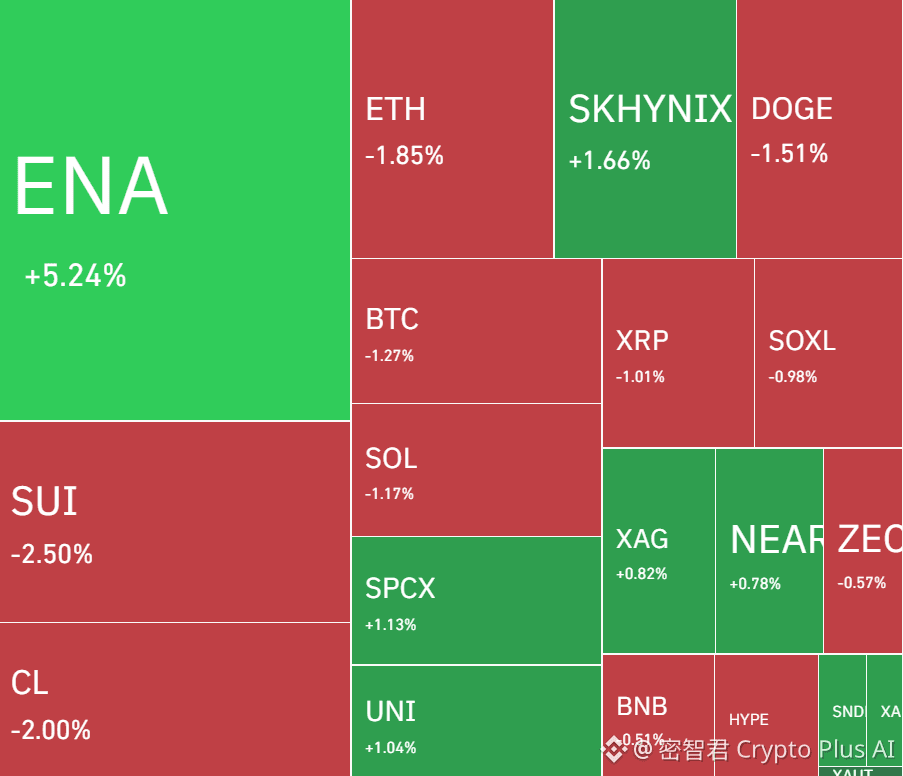
In this morning’s market snapshot, BTC fell 1.27%, ETH fell 1.85%, and $SUI fell 2.50%; $ENA
{spot}(ENAUSDT)
rose 5.24% against the trend. $ETH posted a bigger decline, showing that the foundation for a rebound spreading to altcoins remains weak, and that isolated gains look more like localized trading.
The new development today is a reprieve from energy pressures: Brent crude fell back to around $115 in early trading, though Middle East supply risks remain, and oil prices are still a long way from an environment of low inflation. Business costs, household spending, and risk-asset valuations continue to bear the brunt of the energy shock.
S&P 500 and Nasdaq futures each rose about 0.2% in early trading, while the 10-year U.S. Treasury yield remains near 5%. This week’s Fed meeting and tech giants’ earnings reports will test the cost of capital and returns on AI investment, respectively. If the U.S. stock market continues to recover while crypto prices keep weakening, selling pressure specific to crypto deserves even closer attention.
Gold (XAU) is fluctuating around $4,000. A sustained pullback in oil prices could ease interest-rate pressures, but gold still needs actual buying demand to support its price.
Today, I’m watching spot BTC trading volume, ETH/BTC, and ENA’s pullback. For ENA’s strength to continue, we’ll also need to track USDe’s size and protocol revenue; if only futures trading volume increases, chasing the rally could mean running into profit-taking. Are you still chasing ENA today?
I’m willing to wait for BTC to absorb the selling pressure first. Would you chase ENA’s 5% gain now, or wait for major coins to stabilize before making a move?
October 26, 2026|Today’s latest market analysis: Oil retreats to $115, BTC keeps falling—who will step in to buy?
Crypto friends, as of today, oil prices have pulled back and U.S. stock futures are slightly higher, but the crypto market still hasn’t caught its breath.
In this morning’s market snapshot, BTC fell 1.27%, ETH fell 1.85%, and $SUI fell 2.50%; $ENA
rose 5.24% against the trend. $ETH posted a bigger decline, showing that the foundation for a rebound spreading to altcoins remains weak, and that isolated gains look more like localized trading.
The new development today is a reprieve from energy pressures: Brent crude fell back to around $115 in early trading, though Middle East supply risks remain, and oil prices are still a long way from an environment of low inflation. Business costs, household spending, and risk-asset valuations continue to bear the brunt of the energy shock.
S&P 500 and Nasdaq futures each rose about 0.2% in early trading, while the 10-year U.S. Treasury yield remains near 5%. This week’s Fed meeting and tech giants’ earnings reports will test the cost of capital and returns on AI investment, respectively. If the U.S. stock market continues to recover while crypto prices keep weakening, selling pressure specific to crypto deserves even closer attention.
Gold (XAU) is fluctuating around $4,000. A sustained pullback in oil prices could ease interest-rate pressures, but gold still needs actual buying demand to support its price.
Today, I’m watching spot BTC trading volume, ETH/BTC, and ENA’s pullback. For ENA’s strength to continue, we’ll also need to track USDe’s size and protocol revenue; if only futures trading volume increases, chasing the rally could mean running into profit-taking. Are you still chasing ENA today?
I’m willing to wait for BTC to absorb the selling pressure first. Would you chase ENA’s 5% gain now, or wait for major coins to stabilize before making a move?
Crypto friends, as of today, oil prices have pulled back and U.S. stock futures are slightly higher, but the crypto market still hasn’t caught its breath.
In this morning’s market snapshot, BTC fell 1.27%, ETH fell 1.85%, and $SUI fell 2.50%; $ENA
rose 5.24% against the trend. $ETH posted a bigger decline, showing that the foundation for a rebound spreading to altcoins remains weak, and that isolated gains look more like localized trading.
The new development today is a reprieve from energy pressures: Brent crude fell back to around $115 in early trading, though Middle East supply risks remain, and oil prices are still a long way from an environment of low inflation. Business costs, household spending, and risk-asset valuations continue to bear the brunt of the energy shock.
S&P 500 and Nasdaq futures each rose about 0.2% in early trading, while the 10-year U.S. Treasury yield remains near 5%. This week’s Fed meeting and tech giants’ earnings reports will test the cost of capital and returns on AI investment, respectively. If the U.S. stock market continues to recover while crypto prices keep weakening, selling pressure specific to crypto deserves even closer attention.
Gold (XAU) is fluctuating around $4,000. A sustained pullback in oil prices could ease interest-rate pressures, but gold still needs actual buying demand to support its price.
Today, I’m watching spot BTC trading volume, ETH/BTC, and ENA’s pullback. For ENA’s strength to continue, we’ll also need to track USDe’s size and protocol revenue; if only futures trading volume increases, chasing the rally could mean running into profit-taking. Are you still chasing ENA today?
I’m willing to wait for BTC to absorb the selling pressure first. Would you chase ENA’s 5% gain now, or wait for major coins to stabilize before making a move?
423
I'm dying laughing. You'd have to be so open-minded for this! Korean movies are something else. Do you know which movie this is? $BNB
I'm dying laughing. You'd have to be so open-minded for this! Korean movies are something else. Do you know which movie this is? $BNB
108
The plight of today’s working people! A 53-year-old female day laborer in Majuqiao was sexually harassed by a contractor. After paying 3,760 yuan to learn AI-powered sales, she was asked to pay more: “If I could earn 200 yuan a day, I’d quit day laboring!”
On October 23, a blogger posted a short documentary about day laborers in Majuqiao, Beijing. Auntie Hu, 53, said she paid 3,760 yuan to learn how to use AI videos to sell products. She once got eight orders and saw over 30 yuan in commissions, but the money disappeared before she could withdraw it. Then someone called her, claiming they had brought in the orders by promoting her content, and demanded that she pay another 1,450 yuan.
Auntie Hu is from Qinhuangdao, Hebei, and gets by doing odd jobs. Her daughter graduated this year but still hasn’t found a job. She said she works over 20 days each month and doesn’t go home for Spring Festival because wages are higher then. She also described being sexually harassed: while a contractor was walking her past a basement, he put his arm around her and pushed her against the wall. She slapped him and warned him that she would call the police if he tried it again.
Asked why she paid to learn about AI, she said, “If I could earn 200 yuan a day, I’d quit day laboring.” Although her daughter warned her that it might be a scam, she still held on to hope: “I’ll just keep sticking it out. Maybe a miracle will happen.”
Comments from netizens:
“Getting fleeced by AI in the end really brings the whole story full circle.”
“Sometimes people keep going not because they’re determined, but because they have no other choice.”
#Aİ $NVDAB $AAPLB $MSFTB
The plight of today’s working people! A 53-year-old female day laborer in Majuqiao was sexually harassed by a contractor. After paying 3,760 yuan to learn AI-powered sales, she was asked to pay more: “If I could earn 200 yuan a day, I’d quit day laboring!”
On October 23, a blogger posted a short documentary about day laborers in Majuqiao, Beijing. Auntie Hu, 53, said she paid 3,760 yuan to learn how to use AI videos to sell products. She once got eight orders and saw over 30 yuan in commissions, but the money disappeared before she could withdraw it. Then someone called her, claiming they had brought in the orders by promoting her content, and demanded that she pay another 1,450 yuan.
Auntie Hu is from Qinhuangdao, Hebei, and gets by doing odd jobs. Her daughter graduated this year but still hasn’t found a job. She said she works over 20 days each month and doesn’t go home for Spring Festival because wages are higher then. She also described being sexually harassed: while a contractor was walking her past a basement, he put his arm around her and pushed her against the wall. She slapped him and warned him that she would call the police if he tried it again.
Asked why she paid to learn about AI, she said, “If I could earn 200 yuan a day, I’d quit day laboring.” Although her daughter warned her that it might be a scam, she still held on to hope: “I’ll just keep sticking it out. Maybe a miracle will happen.”
Comments from netizens:
“Getting fleeced by AI in the end really brings the whole story full circle.”
“Sometimes people keep going not because they’re determined, but because they have no other choice.”
#Aİ $NVDAB $AAPLB $MSFTB
On October 23, a blogger posted a short documentary about day laborers in Majuqiao, Beijing. Auntie Hu, 53, said she paid 3,760 yuan to learn how to use AI videos to sell products. She once got eight orders and saw over 30 yuan in commissions, but the money disappeared before she could withdraw it. Then someone called her, claiming they had brought in the orders by promoting her content, and demanded that she pay another 1,450 yuan.
Auntie Hu is from Qinhuangdao, Hebei, and gets by doing odd jobs. Her daughter graduated this year but still hasn’t found a job. She said she works over 20 days each month and doesn’t go home for Spring Festival because wages are higher then. She also described being sexually harassed: while a contractor was walking her past a basement, he put his arm around her and pushed her against the wall. She slapped him and warned him that she would call the police if he tried it again.
Asked why she paid to learn about AI, she said, “If I could earn 200 yuan a day, I’d quit day laboring.” Although her daughter warned her that it might be a scam, she still held on to hope: “I’ll just keep sticking it out. Maybe a miracle will happen.”
Comments from netizens:
“Getting fleeced by AI in the end really brings the whole story full circle.”
“Sometimes people keep going not because they’re determined, but because they have no other choice.”
#Aİ $NVDAB $AAPLB $MSFTB
121
October 25, 2026 | $4.91 billion in derivatives traded: How crowded is this ZEC rally?
The most notable altcoin anomaly to track today is the strength of privacy coins against the broader trend—and the scale of derivatives trading behind it.
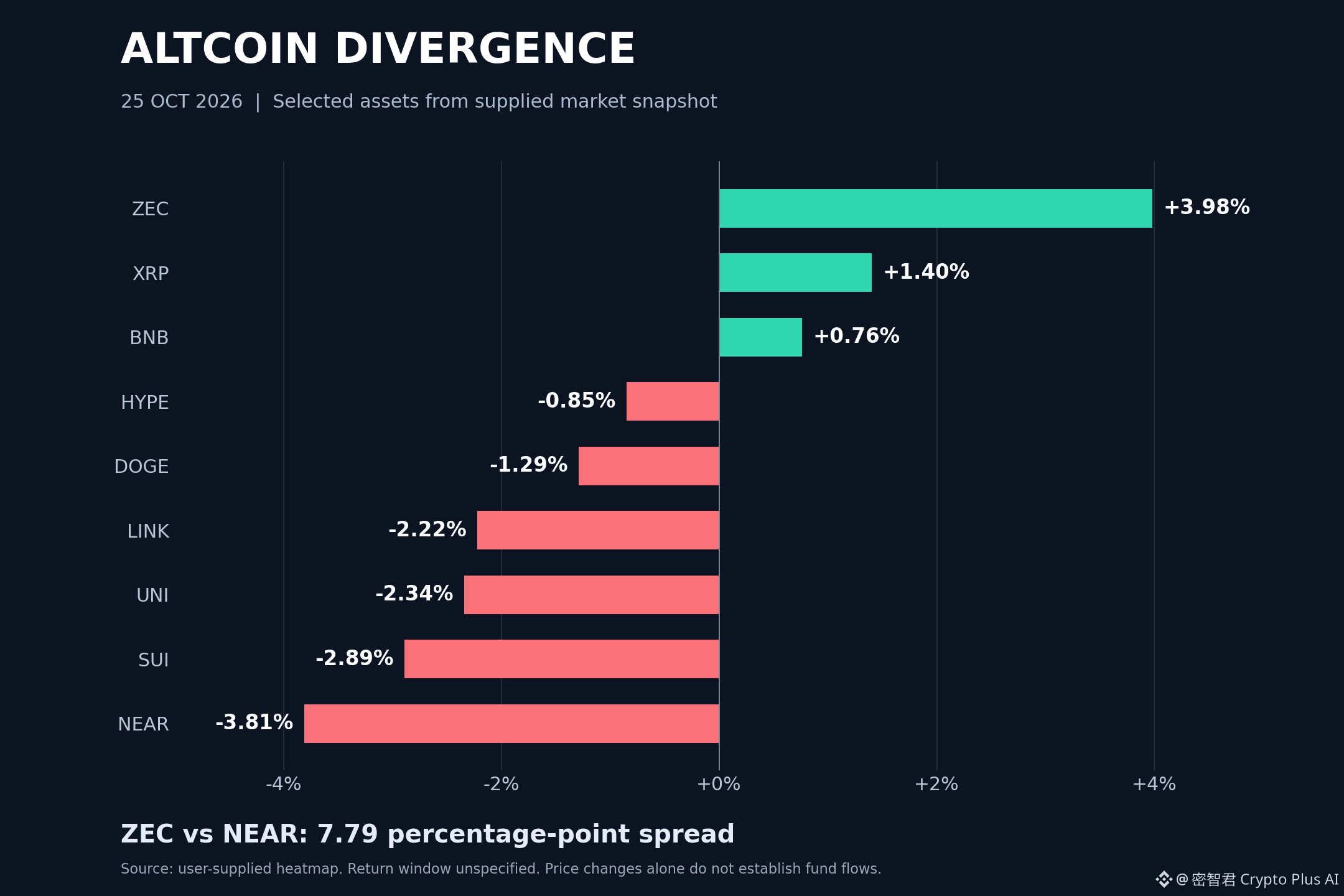
CoinMarketCap shows $XMR up about 6.6% and $ZEC up about 3.8%, with both among the top gainers. XMR also has a specific catalyst: Kraken withdrew a questionnaire asking some customers about their intended use of withdrawals and confirmed that it will continue offering XMR trading in supported regions, easing concerns about tighter access to trading channels.
The bigger risk with ZEC lies in its trading structure. Across markets covered by CoinGlass, 24-hour derivatives volume reached $4.91 billion, compared with $301 million in spot volume—about 16.3 times as much. Open interest stood at $2.36 billion. Such concentrated derivatives trading makes prices more sensitive to changes in margin requirements and forced liquidations. Complete funding-rate data, liquidation direction, and an open-interest trend are not yet available, so a short squeeze remains unconfirmed.
NEAR, meanwhile, is weakening. At the time of checking, it was quoted at $4.49, down about 3.4% over 24 hours. Derivatives volume over the same period was $1.83 billion, versus $281 million in spot volume, a ratio of about 6.5 to 1. Heavy derivatives turnover amid a falling price makes it worth watching whether open interest declines and spot selling eases. The drop alone offers little reliable basis for calling a bottom.
Today, I’ll be keeping an eye on ZEC and $NEAR together: Can spot volume follow through on ZEC’s rally, and will NEAR’s pullback come with a reduction in leverage?
I’m willing to wait for buyers to step in after a pullback. In a split market like this, would you chase the strongest privacy coin, or wait for the hardest-hit coin to find its footing first?#富兰克林邓普顿XRPL新增1.5亿美元份额
October 25, 2026 | $4.91 billion in derivatives traded: How crowded is this ZEC rally?
The most notable altcoin anomaly to track today is the strength of privacy coins against the broader trend—and the scale of derivatives trading behind it.
CoinMarketCap shows $XMR up about 6.6% and $ZEC up about 3.8%, with both among the top gainers. XMR also has a specific catalyst: Kraken withdrew a questionnaire asking some customers about their intended use of withdrawals and confirmed that it will continue offering XMR trading in supported regions, easing concerns about tighter access to trading channels.
The bigger risk with ZEC lies in its trading structure. Across markets covered by CoinGlass, 24-hour derivatives volume reached $4.91 billion, compared with $301 million in spot volume—about 16.3 times as much. Open interest stood at $2.36 billion. Such concentrated derivatives trading makes prices more sensitive to changes in margin requirements and forced liquidations. Complete funding-rate data, liquidation direction, and an open-interest trend are not yet available, so a short squeeze remains unconfirmed.
NEAR, meanwhile, is weakening. At the time of checking, it was quoted at $4.49, down about 3.4% over 24 hours. Derivatives volume over the same period was $1.83 billion, versus $281 million in spot volume, a ratio of about 6.5 to 1. Heavy derivatives turnover amid a falling price makes it worth watching whether open interest declines and spot selling eases. The drop alone offers little reliable basis for calling a bottom.
Today, I’ll be keeping an eye on ZEC and $NEAR together: Can spot volume follow through on ZEC’s rally, and will NEAR’s pullback come with a reduction in leverage?
I’m willing to wait for buyers to step in after a pullback. In a split market like this, would you chase the strongest privacy coin, or wait for the hardest-hit coin to find its footing first?#富兰克林邓普顿XRPL新增1.5亿美元份额
The most notable altcoin anomaly to track today is the strength of privacy coins against the broader trend—and the scale of derivatives trading behind it.
CoinMarketCap shows $XMR up about 6.6% and $ZEC up about 3.8%, with both among the top gainers. XMR also has a specific catalyst: Kraken withdrew a questionnaire asking some customers about their intended use of withdrawals and confirmed that it will continue offering XMR trading in supported regions, easing concerns about tighter access to trading channels.
The bigger risk with ZEC lies in its trading structure. Across markets covered by CoinGlass, 24-hour derivatives volume reached $4.91 billion, compared with $301 million in spot volume—about 16.3 times as much. Open interest stood at $2.36 billion. Such concentrated derivatives trading makes prices more sensitive to changes in margin requirements and forced liquidations. Complete funding-rate data, liquidation direction, and an open-interest trend are not yet available, so a short squeeze remains unconfirmed.
NEAR, meanwhile, is weakening. At the time of checking, it was quoted at $4.49, down about 3.4% over 24 hours. Derivatives volume over the same period was $1.83 billion, versus $281 million in spot volume, a ratio of about 6.5 to 1. Heavy derivatives turnover amid a falling price makes it worth watching whether open interest declines and spot selling eases. The drop alone offers little reliable basis for calling a bottom.
Today, I’ll be keeping an eye on ZEC and $NEAR together: Can spot volume follow through on ZEC’s rally, and will NEAR’s pullback come with a reduction in leverage?
I’m willing to wait for buyers to step in after a pullback. In a split market like this, would you chase the strongest privacy coin, or wait for the hardest-hit coin to find its footing first?#富兰克林邓普顿XRPL新增1.5亿美元份额
1
823
October 25, 2026 | Today’s latest market briefing: After $774 million flowed out, I’m not chasing this ZEC green candle just yet
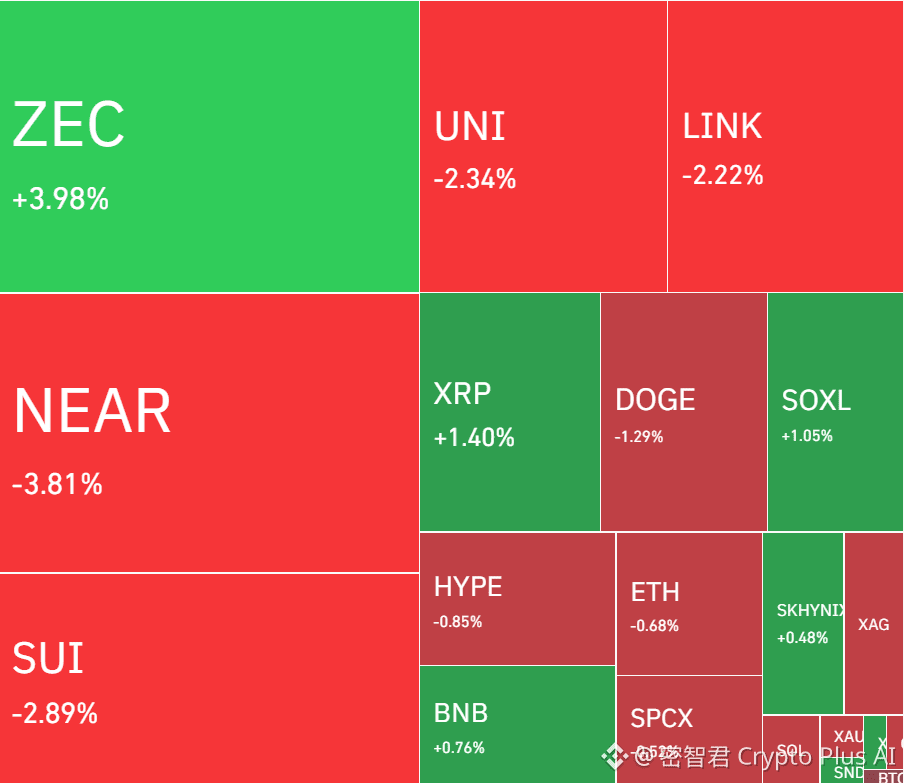
Happy weekend, crypto friends. Yesterday, $ZEC rose 3.98%, $NEAR fell 3.81%, $SUI fell 2.89%, and ETH fell 0.68%. Markets remain divided over the weekend: popular coins are flashing green, but money chasing the rally can easily get shaken out in the next rotation.
BTC ETFs reported combined net outflows of $774 million on the 22nd and 23rd, with some funds still missing reports for the 23rd. ETH ETFs provisionally recorded $4.4 million in inflows that same day, though some data is also missing. U.S. stock ETFs are closed over the weekend, so any crypto rebound will depend on follow-through from on-chain and exchange flows.
External pressure remains. Brent crude closed at $116.72 on Friday, the 10-year U.S. Treasury yield approached 5%, and the S&P 500 fell 0.5%. Middle East supply risks are driving up energy costs, narrowing the room for rate cuts and raising the opportunity cost of holding volatile assets.
Gold (XAU) fell below $4,000 intraday on Friday. Selling also came from margin calls triggered by the tech-stock decline. Spot gold is closed today, so we’ll have to wait for next week’s open to confirm its direction.
Today I’m watching to see whether spot buyers step in if BTC pulls back, whether ETH/BTC can stop falling, and what trading volume looks like after ZEC’s surge. If volume doesn’t follow through, chasing the rally remains risky. What about you—would you chase this 4% rebound, or wait with me for institutional flows to show their hand on Monday? #股票财报季 #韩国拟将稳定币纳入外汇法监管
October 25, 2026 | Today’s latest market briefing: After $774 million flowed out, I’m not chasing this ZEC green candle just yet
Happy weekend, crypto friends. Yesterday, $ZEC rose 3.98%, $NEAR fell 3.81%, $SUI fell 2.89%, and ETH fell 0.68%. Markets remain divided over the weekend: popular coins are flashing green, but money chasing the rally can easily get shaken out in the next rotation.
BTC ETFs reported combined net outflows of $774 million on the 22nd and 23rd, with some funds still missing reports for the 23rd. ETH ETFs provisionally recorded $4.4 million in inflows that same day, though some data is also missing. U.S. stock ETFs are closed over the weekend, so any crypto rebound will depend on follow-through from on-chain and exchange flows.
External pressure remains. Brent crude closed at $116.72 on Friday, the 10-year U.S. Treasury yield approached 5%, and the S&P 500 fell 0.5%. Middle East supply risks are driving up energy costs, narrowing the room for rate cuts and raising the opportunity cost of holding volatile assets.
Gold (XAU) fell below $4,000 intraday on Friday. Selling also came from margin calls triggered by the tech-stock decline. Spot gold is closed today, so we’ll have to wait for next week’s open to confirm its direction.
Today I’m watching to see whether spot buyers step in if BTC pulls back, whether ETH/BTC can stop falling, and what trading volume looks like after ZEC’s surge. If volume doesn’t follow through, chasing the rally remains risky. What about you—would you chase this 4% rebound, or wait with me for institutional flows to show their hand on Monday? #股票财报季 #韩国拟将稳定币纳入外汇法监管
Happy weekend, crypto friends. Yesterday, $ZEC rose 3.98%, $NEAR fell 3.81%, $SUI fell 2.89%, and ETH fell 0.68%. Markets remain divided over the weekend: popular coins are flashing green, but money chasing the rally can easily get shaken out in the next rotation.
BTC ETFs reported combined net outflows of $774 million on the 22nd and 23rd, with some funds still missing reports for the 23rd. ETH ETFs provisionally recorded $4.4 million in inflows that same day, though some data is also missing. U.S. stock ETFs are closed over the weekend, so any crypto rebound will depend on follow-through from on-chain and exchange flows.
External pressure remains. Brent crude closed at $116.72 on Friday, the 10-year U.S. Treasury yield approached 5%, and the S&P 500 fell 0.5%. Middle East supply risks are driving up energy costs, narrowing the room for rate cuts and raising the opportunity cost of holding volatile assets.
Gold (XAU) fell below $4,000 intraday on Friday. Selling also came from margin calls triggered by the tech-stock decline. Spot gold is closed today, so we’ll have to wait for next week’s open to confirm its direction.
Today I’m watching to see whether spot buyers step in if BTC pulls back, whether ETH/BTC can stop falling, and what trading volume looks like after ZEC’s surge. If volume doesn’t follow through, chasing the rally remains risky. What about you—would you chase this 4% rebound, or wait with me for institutional flows to show their hand on Monday? #股票财报季 #韩国拟将稳定币纳入外汇法监管
1
831
As expected of “Mian A”! The ChiNext has plunged 40% in about four months, with nearly 5,000 A-shares falling!
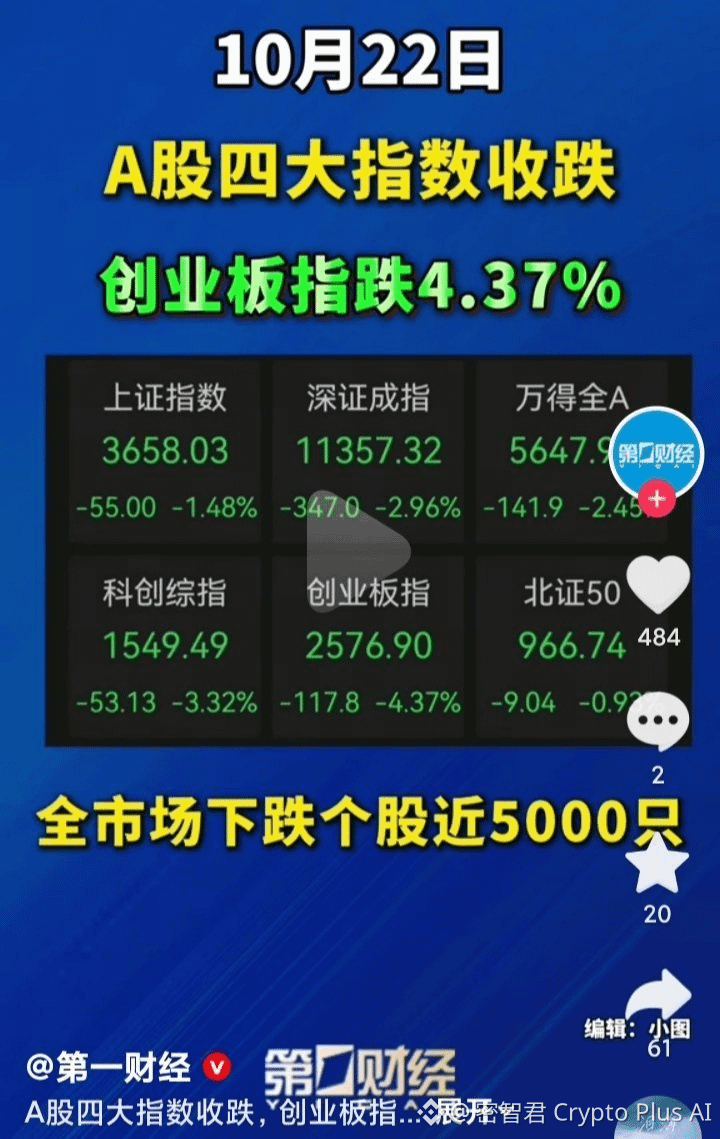
Submitted by a netizen: On October 22, all three major A-share indexes closed lower, with nearly 5,000 stocks across the market falling. The ChiNext Index dropped 4.37% to close at 2,576.90; the Shanghai Composite Index fell 1.48%, and the Shenzhen Component Index fell 2.96%.
From its intraday high of 4,380.41 on June 25 to the close on October 22, the ChiNext Index lost 41.17% over about four months. Do you still trade stocks? #币安神算子
{spot}(NVDABUSDT)
As expected of “Mian A”! The ChiNext has plunged 40% in about four months, with nearly 5,000 A-shares falling!
Submitted by a netizen: On October 22, all three major A-share indexes closed lower, with nearly 5,000 stocks across the market falling. The ChiNext Index dropped 4.37% to close at 2,576.90; the Shanghai Composite Index fell 1.48%, and the Shenzhen Component Index fell 2.96%.
From its intraday high of 4,380.41 on June 25 to the close on October 22, the ChiNext Index lost 41.17% over about four months. Do you still trade stocks? #币安神算子
Submitted by a netizen: On October 22, all three major A-share indexes closed lower, with nearly 5,000 stocks across the market falling. The ChiNext Index dropped 4.37% to close at 2,576.90; the Shanghai Composite Index fell 1.48%, and the Shenzhen Component Index fell 2.96%.
From its intraday high of 4,380.41 on June 25 to the close on October 22, the ChiNext Index lost 41.17% over about four months. Do you still trade stocks? #币安神算子
333
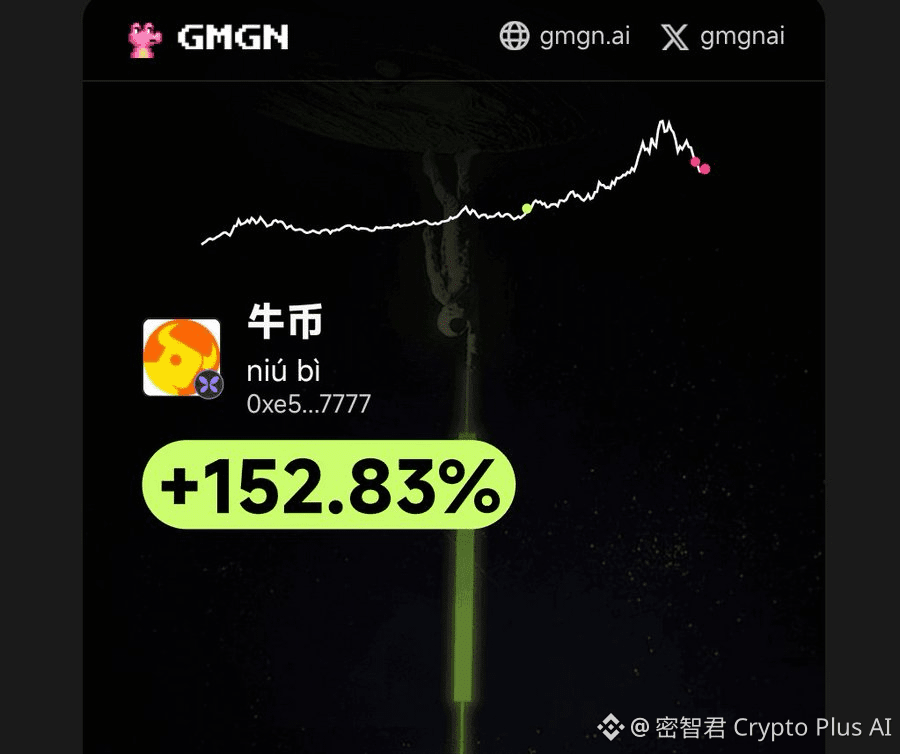
$牛来 152.83% return card aside, “Niu Coin” rode the buzz around Futu and CZ all the way to the moon!
Guys, this coin is absolutely ripping. The clues behind this rally are concentrated around “Futu news + Chinese meme virality + trading in a small liquidity pool.”
On October 23, Futu announced that it would open BNB deposits and withdrawals to eligible Hong Kong professional investors, and CZ reposted the announcement shortly afterward. The token’s name directly borrows the brand mentioned in the news, then adds the Chinese wordplay around “the bull is coming” and “Bull Coin”—a recipe for rapid spread.
Liquidity amplified the volatility. DEX Screener shows a market cap of about $330,000 and a pool of around $61,000. Trading volume over the past 24 hours was about $2.7 million, involving roughly 5,161 trading addresses. When concentrated buying hits a thin pool, prices can surge quickly; selling can just as easily result in severe slippage.
There’s also clear profit-taking after the rally: Bitget Wallet shows a 24-hour high of about $0.0008335, while the quote on the same page is around $0.0003251—about 61% below the high.
What I’m more interested in is how many new buyers will still be willing to step in once the Futu news fades. If I were holding these unrealized gains, would you take out your initial investment first, or stay in and wait for the hype to continue? #币安神算子
{spot}(MSFTBUSDT)
$牛来 152.83% return card aside, “Niu Coin” rode the buzz around Futu and CZ all the way to the moon!
Guys, this coin is absolutely ripping. The clues behind this rally are concentrated around “Futu news + Chinese meme virality + trading in a small liquidity pool.”
On October 23, Futu announced that it would open BNB deposits and withdrawals to eligible Hong Kong professional investors, and CZ reposted the announcement shortly afterward. The token’s name directly borrows the brand mentioned in the news, then adds the Chinese wordplay around “the bull is coming” and “Bull Coin”—a recipe for rapid spread.
Liquidity amplified the volatility. DEX Screener shows a market cap of about $330,000 and a pool of around $61,000. Trading volume over the past 24 hours was about $2.7 million, involving roughly 5,161 trading addresses. When concentrated buying hits a thin pool, prices can surge quickly; selling can just as easily result in severe slippage.
There’s also clear profit-taking after the rally: Bitget Wallet shows a 24-hour high of about $0.0008335, while the quote on the same page is around $0.0003251—about 61% below the high.
What I’m more interested in is how many new buyers will still be willing to step in once the Futu news fades. If I were holding these unrealized gains, would you take out your initial investment first, or stay in and wait for the hype to continue? #币安神算子
Guys, this coin is absolutely ripping. The clues behind this rally are concentrated around “Futu news + Chinese meme virality + trading in a small liquidity pool.”
On October 23, Futu announced that it would open BNB deposits and withdrawals to eligible Hong Kong professional investors, and CZ reposted the announcement shortly afterward. The token’s name directly borrows the brand mentioned in the news, then adds the Chinese wordplay around “the bull is coming” and “Bull Coin”—a recipe for rapid spread.
Liquidity amplified the volatility. DEX Screener shows a market cap of about $330,000 and a pool of around $61,000. Trading volume over the past 24 hours was about $2.7 million, involving roughly 5,161 trading addresses. When concentrated buying hits a thin pool, prices can surge quickly; selling can just as easily result in severe slippage.
There’s also clear profit-taking after the rally: Bitget Wallet shows a 24-hour high of about $0.0008335, while the quote on the same page is around $0.0003251—about 61% below the high.
What I’m more interested in is how many new buyers will still be willing to step in once the Futu news fades. If I were holding these unrealized gains, would you take out your initial investment first, or stay in and wait for the hype to continue? #币安神算子
1.5k
October 24, 2026|Today’s latest crypto market analysis: $BTC $1.075 billion in buying came in, then $636 million pulled out again in one day
Guys, the market has entered a choppy phase again. BTC ETFs attracted $1.075 billion over the first three days, then saw $636 million flow out on October 22—about 59% of the previous inflows. ETH ETFs saw $111 million in outflows on the same day.
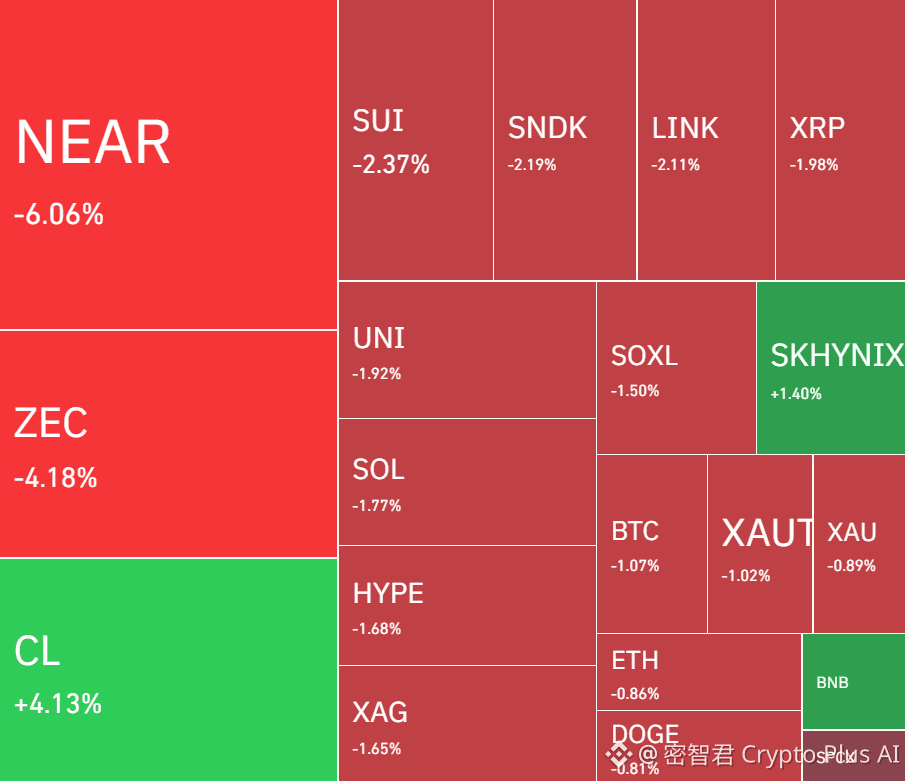
This morning’s market snapshot: BTC is down 1.07%, ETH is down 0.86%, $NEAR is down 6.06%, and $ZEC is down 4.18%. Losses among major coins have narrowed, while popular altcoins are still giving back gains. The risks facing dip buyers vary considerably.
The Nasdaq fell just 0.21% overnight, while the Dow dropped 1.23%, as pressure spread from tech stocks to financials and consumer stocks. Risks to energy supplies in the Middle East continue to push oil prices higher, squeezing both business costs and consumers’ purchasing power. The macro backdrop also offers little support for broad-based buying in crypto markets.
Gold (XAU) fell below $4,000 intraday, hitting a low of $3,975. Rising oil prices are fueling inflation expectations, while falling tech stocks have triggered margin calls. Gold is also being sold to raise cash.
Today, I’m watching spot demand for BTC and whether ETH/BTC can find a bottom. If the rebound is driven only by higher futures trading volume while ETF redemptions continue, chasing the rally could leave you stuck again. I have cash on hand, so I’m happy to wait for one more confirmation. What about you—would you buy BTC now, or keep waiting for NEAR and ZEC to finish their declines? #比特币算力创七个月新高
October 24, 2026|Today’s latest crypto market analysis: $BTC $1.075 billion in buying came in, then $636 million pulled out again in one day
Guys, the market has entered a choppy phase again. BTC ETFs attracted $1.075 billion over the first three days, then saw $636 million flow out on October 22—about 59% of the previous inflows. ETH ETFs saw $111 million in outflows on the same day.
This morning’s market snapshot: BTC is down 1.07%, ETH is down 0.86%, $NEAR is down 6.06%, and $ZEC is down 4.18%. Losses among major coins have narrowed, while popular altcoins are still giving back gains. The risks facing dip buyers vary considerably.
The Nasdaq fell just 0.21% overnight, while the Dow dropped 1.23%, as pressure spread from tech stocks to financials and consumer stocks. Risks to energy supplies in the Middle East continue to push oil prices higher, squeezing both business costs and consumers’ purchasing power. The macro backdrop also offers little support for broad-based buying in crypto markets.
Gold (XAU) fell below $4,000 intraday, hitting a low of $3,975. Rising oil prices are fueling inflation expectations, while falling tech stocks have triggered margin calls. Gold is also being sold to raise cash.
Today, I’m watching spot demand for BTC and whether ETH/BTC can find a bottom. If the rebound is driven only by higher futures trading volume while ETF redemptions continue, chasing the rally could leave you stuck again. I have cash on hand, so I’m happy to wait for one more confirmation. What about you—would you buy BTC now, or keep waiting for NEAR and ZEC to finish their declines? #比特币算力创七个月新高
Guys, the market has entered a choppy phase again. BTC ETFs attracted $1.075 billion over the first three days, then saw $636 million flow out on October 22—about 59% of the previous inflows. ETH ETFs saw $111 million in outflows on the same day.
This morning’s market snapshot: BTC is down 1.07%, ETH is down 0.86%, $NEAR is down 6.06%, and $ZEC is down 4.18%. Losses among major coins have narrowed, while popular altcoins are still giving back gains. The risks facing dip buyers vary considerably.
The Nasdaq fell just 0.21% overnight, while the Dow dropped 1.23%, as pressure spread from tech stocks to financials and consumer stocks. Risks to energy supplies in the Middle East continue to push oil prices higher, squeezing both business costs and consumers’ purchasing power. The macro backdrop also offers little support for broad-based buying in crypto markets.
Gold (XAU) fell below $4,000 intraday, hitting a low of $3,975. Rising oil prices are fueling inflation expectations, while falling tech stocks have triggered margin calls. Gold is also being sold to raise cash.
Today, I’m watching spot demand for BTC and whether ETH/BTC can find a bottom. If the rebound is driven only by higher futures trading volume while ETF redemptions continue, chasing the rally could leave you stuck again. I have cash on hand, so I’m happy to wait for one more confirmation. What about you—would you buy BTC now, or keep waiting for NEAR and ZEC to finish their declines? #比特币算力创七个月新高
1
1k
A college sophomore in Zhejiang, China, built an AI platform by hand and made 600,000 yuan in two months.
After being interviewed by reporters and getting a round of inspirational publicity, they were exposed for exploiting student education subsidies and reselling access through a proxy service.
I specifically searched for it on Douyin, and it really happened 😂!
A sophomore made 600,000 yuan running a proxy service and still dared to give a news interview. The media really has no clue.
Then the comments were all saying, “That’s seriously illegal.” $NVDAB #币安神算子
A college sophomore in Zhejiang, China, built an AI platform by hand and made 600,000 yuan in two months.
After being interviewed by reporters and getting a round of inspirational publicity, they were exposed for exploiting student education subsidies and reselling access through a proxy service.
I specifically searched for it on Douyin, and it really happened 😂!
A sophomore made 600,000 yuan running a proxy service and still dared to give a news interview. The media really has no clue.
Then the comments were all saying, “That’s seriously illegal.” $NVDAB #币安神算子
After being interviewed by reporters and getting a round of inspirational publicity, they were exposed for exploiting student education subsidies and reselling access through a proxy service.
I specifically searched for it on Douyin, and it really happened 😂!
A sophomore made 600,000 yuan running a proxy service and still dared to give a news interview. The media really has no clue.
Then the comments were all saying, “That’s seriously illegal.” $NVDAB #币安神算子

78
See translation
#nil $NIL @nillionnetwork 链上交易最尴尬的地方:交易还没成交,策略已经被别人看见了。
Nillion 的 Covenants 吸引人的地方,就是把“提前公开指令”这一步收起来。用户将指令加密,并绑定触发条件;条件满足后,节点网络释放解密所需的信息。Dusk 已在以太坊主网上线,把这套机制带进了真实应用环境。
可以设想,一笔密封竞价在拍卖结束时揭晓,AI Agent 的交易指令在条件触发前保持加密。用户获得的是策略保密空间,开发者则需要继续解决成交、滑点和执行可靠性。指令解密之后,交易仍要面对真实市场。
七个时代路线图里,更期待 Neon 和 Moonshine:前者计划让节点连触发条件也看不到,后者通过批量验证和更便宜的数据存储降低使用成本。这两步决定隐私能否从少数人的昂贵工具,变成普通用户和 Agent 的日常配置。目前它们仍属于后续规划。
接下来衡量 Covenants,应该看重复使用的应用、成功执行的指令,以及用户愿意支付的费用。
当保护策略需要额外付费,你愿意为隐私买单,还是继续让交易意图暴露在链上?
#nil $NIL @Nillion 链上交易最尴尬的地方:交易还没成交,策略已经被别人看见了。
Nillion 的 Covenants 吸引人的地方,就是把“提前公开指令”这一步收起来。用户将指令加密,并绑定触发条件;条件满足后,节点网络释放解密所需的信息。Dusk 已在以太坊主网上线,把这套机制带进了真实应用环境。
可以设想,一笔密封竞价在拍卖结束时揭晓,AI Agent 的交易指令在条件触发前保持加密。用户获得的是策略保密空间,开发者则需要继续解决成交、滑点和执行可靠性。指令解密之后,交易仍要面对真实市场。
七个时代路线图里,更期待 Neon 和 Moonshine:前者计划让节点连触发条件也看不到,后者通过批量验证和更便宜的数据存储降低使用成本。这两步决定隐私能否从少数人的昂贵工具,变成普通用户和 Agent 的日常配置。目前它们仍属于后续规划。
接下来衡量 Covenants,应该看重复使用的应用、成功执行的指令,以及用户愿意支付的费用。
当保护策略需要额外付费,你愿意为隐私买单,还是继续让交易意图暴露在链上?
Nillion 的 Covenants 吸引人的地方,就是把“提前公开指令”这一步收起来。用户将指令加密,并绑定触发条件;条件满足后,节点网络释放解密所需的信息。Dusk 已在以太坊主网上线,把这套机制带进了真实应用环境。
可以设想,一笔密封竞价在拍卖结束时揭晓,AI Agent 的交易指令在条件触发前保持加密。用户获得的是策略保密空间,开发者则需要继续解决成交、滑点和执行可靠性。指令解密之后,交易仍要面对真实市场。
七个时代路线图里,更期待 Neon 和 Moonshine:前者计划让节点连触发条件也看不到,后者通过批量验证和更便宜的数据存储降低使用成本。这两步决定隐私能否从少数人的昂贵工具,变成普通用户和 Agent 的日常配置。目前它们仍属于后续规划。
接下来衡量 Covenants,应该看重复使用的应用、成功执行的指令,以及用户愿意支付的费用。
当保护策略需要额外付费,你愿意为隐私买单,还是继续让交易意图暴露在链上?

119
Damn, the shameless media reports that children can help their parents pay pension insurance contributions. Netizens: “Can’t I just give the money directly to my parents?!”
On October 16, the “Yujian Hanshan” account of the Hanshan Media Center in Anhui posted a video explaining that after parents have paid their urban and rural residents’ pension insurance contributions for the year, their children can provide additional financial support. It also emphasized: “Even if parents choose a low or middle contribution tier, their children can still contribute at the highest tier.”
Comments from netizens:
“Can’t I just give the money directly to my parents?!”
“No need to go to the trouble of subsidizing it—just give them the money directly.”
Damn, the shameless media reports that children can help their parents pay pension insurance contributions. Netizens: “Can’t I just give the money directly to my parents?!”
On October 16, the “Yujian Hanshan” account of the Hanshan Media Center in Anhui posted a video explaining that after parents have paid their urban and rural residents’ pension insurance contributions for the year, their children can provide additional financial support. It also emphasized: “Even if parents choose a low or middle contribution tier, their children can still contribute at the highest tier.”
Comments from netizens:
“Can’t I just give the money directly to my parents?!”
“No need to go to the trouble of subsidizing it—just give them the money directly.”
On October 16, the “Yujian Hanshan” account of the Hanshan Media Center in Anhui posted a video explaining that after parents have paid their urban and rural residents’ pension insurance contributions for the year, their children can provide additional financial support. It also emphasized: “Even if parents choose a low or middle contribution tier, their children can still contribute at the highest tier.”
Comments from netizens:
“Can’t I just give the money directly to my parents?!”
“No need to go to the trouble of subsidizing it—just give them the money directly.”
145
October 23, 2026 | Today’s Market Analysis: Oil Prices Rise, Gold and Crypto Assets Fall; A16z Announces a New Crypto Investment—Is the Primary Market Dead?
Guys, gold and BTC both fell yesterday. Safe-haven demand driven by the war was outweighed by energy inflation and the cost of capital.
The Nasdaq fell 2.6% last night, and the semiconductor index dropped 6.7%. The Dow edged higher, and most U.S. stocks rose, with selling concentrated in the tech sector. Whether AI investment can deliver profits is facing increasingly rigorous scrutiny, while high-valuation crypto assets are also exposed to a pullback in risk appetite.
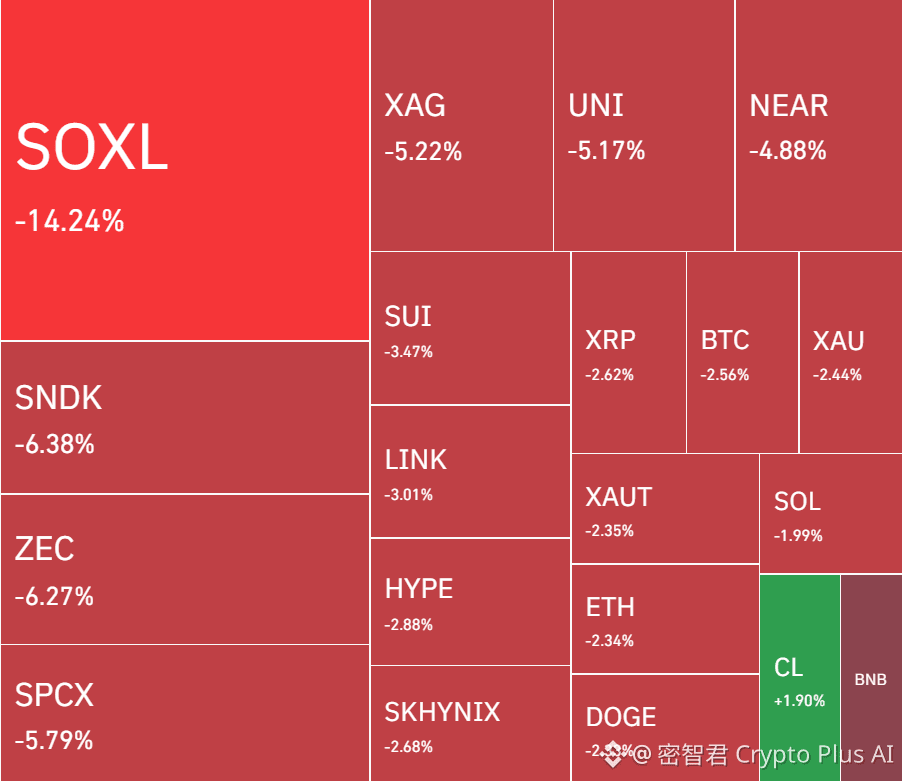
BTC fell 2.56%, and $ETH fell 2.34%; $UNI and $NEAR dropped nearly 5%, with altcoins under even greater pressure. Fund flows remain mixed: BTC ETFs saw combined inflows of $1.075 billion from October 19–21; ETH ETFs saw combined outflows of $129 million on October 19–20.
Gold (XAU) fell to around $4,041 during U.S. trading on the 22nd. Attacks in the Middle East pushed oil prices higher, extending expectations of high interest rates and weighing on non-yielding gold. The simultaneous weakness in gold, tech stocks, and crypto markets shows that even safe-haven money is being selective.
Today, watch for ETF demand after BTC’s pullback, whether ETH/BTC can find a floor, and buying interest around gold’s $4,000 level. If oil prices keep rising and none of the three finds support, who will bring in fresh capital for the next rebound? #股票财报季 #a16z合伙人AliYahya将离职创业
October 23, 2026 | Today’s Market Analysis: Oil Prices Rise, Gold and Crypto Assets Fall; A16z Announces a New Crypto Investment—Is the Primary Market Dead?
Guys, gold and BTC both fell yesterday. Safe-haven demand driven by the war was outweighed by energy inflation and the cost of capital.
The Nasdaq fell 2.6% last night, and the semiconductor index dropped 6.7%. The Dow edged higher, and most U.S. stocks rose, with selling concentrated in the tech sector. Whether AI investment can deliver profits is facing increasingly rigorous scrutiny, while high-valuation crypto assets are also exposed to a pullback in risk appetite.
BTC fell 2.56%, and $ETH fell 2.34%; $UNI and $NEAR dropped nearly 5%, with altcoins under even greater pressure. Fund flows remain mixed: BTC ETFs saw combined inflows of $1.075 billion from October 19–21; ETH ETFs saw combined outflows of $129 million on October 19–20.
Gold (XAU) fell to around $4,041 during U.S. trading on the 22nd. Attacks in the Middle East pushed oil prices higher, extending expectations of high interest rates and weighing on non-yielding gold. The simultaneous weakness in gold, tech stocks, and crypto markets shows that even safe-haven money is being selective.
Today, watch for ETF demand after BTC’s pullback, whether ETH/BTC can find a floor, and buying interest around gold’s $4,000 level. If oil prices keep rising and none of the three finds support, who will bring in fresh capital for the next rebound? #股票财报季 #a16z合伙人AliYahya将离职创业
Guys, gold and BTC both fell yesterday. Safe-haven demand driven by the war was outweighed by energy inflation and the cost of capital.
The Nasdaq fell 2.6% last night, and the semiconductor index dropped 6.7%. The Dow edged higher, and most U.S. stocks rose, with selling concentrated in the tech sector. Whether AI investment can deliver profits is facing increasingly rigorous scrutiny, while high-valuation crypto assets are also exposed to a pullback in risk appetite.
BTC fell 2.56%, and $ETH fell 2.34%; $UNI and $NEAR dropped nearly 5%, with altcoins under even greater pressure. Fund flows remain mixed: BTC ETFs saw combined inflows of $1.075 billion from October 19–21; ETH ETFs saw combined outflows of $129 million on October 19–20.
Gold (XAU) fell to around $4,041 during U.S. trading on the 22nd. Attacks in the Middle East pushed oil prices higher, extending expectations of high interest rates and weighing on non-yielding gold. The simultaneous weakness in gold, tech stocks, and crypto markets shows that even safe-haven money is being selective.
Today, watch for ETF demand after BTC’s pullback, whether ETH/BTC can find a floor, and buying interest around gold’s $4,000 level. If oil prices keep rising and none of the three finds support, who will bring in fresh capital for the next rebound? #股票财报季 #a16z合伙人AliYahya将离职创业
592
Holy shit, the fire in Indonesia is terrifying. Has it still not stopped? #印尼火灾
Holy shit, the fire in Indonesia is terrifying. Has it still not stopped? #印尼火灾
60
October 22, 2026 | $93.45 million $BTC transferred to new wallets as leveraged whales were liquidated on both sides
Today's anomaly: spot transfers and futures liquidations both intensified.
According to the latest disclosure from Lookonchain, four new wallets received 1,127 BTC from Wintermute, worth approximately $93.45 million. The traceable addresses are bc1q8scg…f7kyw, bc1qa289…j30x3, bc1qk0ng…xmca7, and bc1qru9x…xg4g. The recipients' identities and acquisition costs have not yet been disclosed; over-the-counter settlement and custody transfers still need to be investigated.
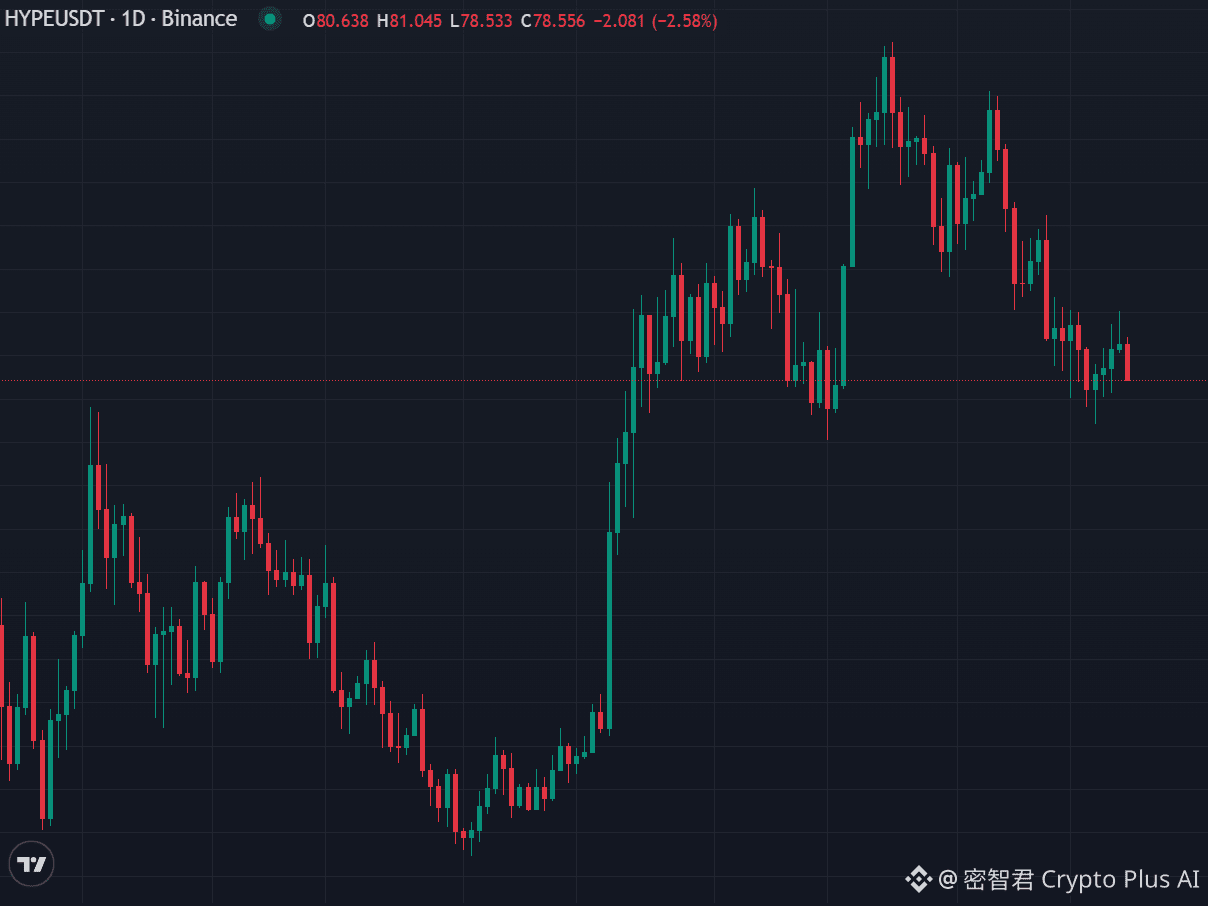
Things were more intense on the futures side. According to TradingBeats, six Hyperliquid whales with $HYPE were liquidated for a combined $25.91 million from last night through today, including $18.5 million in short positions and $7.41 million in long positions. The BTC long position of 0x1f25… was partially liquidated four times in a row. After 0x4b62… was liquidated on its short position, it still held a BTC short position worth approximately $29.19 million. These are monitoring snapshots; positions will continue to change.
Liquidations on both sides expose the fragility of leverage; the trend still depends on spot demand. Next, watch whether the four new wallets continue accumulating coins, whether they transfer them to exchanges, and whether the price can hold its rebound after liquidations cool. A single transfer cannot prove that new buying demand has emerged, and liquidation amounts reflect position sizes, not actual losses. $
In the next rally, would you rather follow wallets that keep accumulating coins, or chase a futures move that has just squeezed traders out? #比特币跌破8.4万美元
October 22, 2026 | $93.45 million $BTC transferred to new wallets as leveraged whales were liquidated on both sides
Today's anomaly: spot transfers and futures liquidations both intensified.
According to the latest disclosure from Lookonchain, four new wallets received 1,127 BTC from Wintermute, worth approximately $93.45 million. The traceable addresses are bc1q8scg…f7kyw, bc1qa289…j30x3, bc1qk0ng…xmca7, and bc1qru9x…xg4g. The recipients' identities and acquisition costs have not yet been disclosed; over-the-counter settlement and custody transfers still need to be investigated.
Things were more intense on the futures side. According to TradingBeats, six Hyperliquid whales with $HYPE were liquidated for a combined $25.91 million from last night through today, including $18.5 million in short positions and $7.41 million in long positions. The BTC long position of 0x1f25… was partially liquidated four times in a row. After 0x4b62… was liquidated on its short position, it still held a BTC short position worth approximately $29.19 million. These are monitoring snapshots; positions will continue to change.
Liquidations on both sides expose the fragility of leverage; the trend still depends on spot demand. Next, watch whether the four new wallets continue accumulating coins, whether they transfer them to exchanges, and whether the price can hold its rebound after liquidations cool. A single transfer cannot prove that new buying demand has emerged, and liquidation amounts reflect position sizes, not actual losses. $
In the next rally, would you rather follow wallets that keep accumulating coins, or chase a futures move that has just squeezed traders out? #比特币跌破8.4万美元
Today's anomaly: spot transfers and futures liquidations both intensified.
According to the latest disclosure from Lookonchain, four new wallets received 1,127 BTC from Wintermute, worth approximately $93.45 million. The traceable addresses are bc1q8scg…f7kyw, bc1qa289…j30x3, bc1qk0ng…xmca7, and bc1qru9x…xg4g. The recipients' identities and acquisition costs have not yet been disclosed; over-the-counter settlement and custody transfers still need to be investigated.
Things were more intense on the futures side. According to TradingBeats, six Hyperliquid whales with $HYPE were liquidated for a combined $25.91 million from last night through today, including $18.5 million in short positions and $7.41 million in long positions. The BTC long position of 0x1f25… was partially liquidated four times in a row. After 0x4b62… was liquidated on its short position, it still held a BTC short position worth approximately $29.19 million. These are monitoring snapshots; positions will continue to change.
Liquidations on both sides expose the fragility of leverage; the trend still depends on spot demand. Next, watch whether the four new wallets continue accumulating coins, whether they transfer them to exchanges, and whether the price can hold its rebound after liquidations cool. A single transfer cannot prove that new buying demand has emerged, and liquidation amounts reflect position sizes, not actual losses. $
In the next rally, would you rather follow wallets that keep accumulating coins, or chase a futures move that has just squeezed traders out? #比特币跌破8.4万美元
312
Damn, I’m ancient now. I must give off nothing but a tacky, old-fashioned vibe.$BNB
Damn, I’m ancient now. I must give off nothing but a tacky, old-fashioned vibe.$BNB

189
October 22, 2026 | Today’s latest market analysis: How much longer can $ZEC and $NEAR hold up?
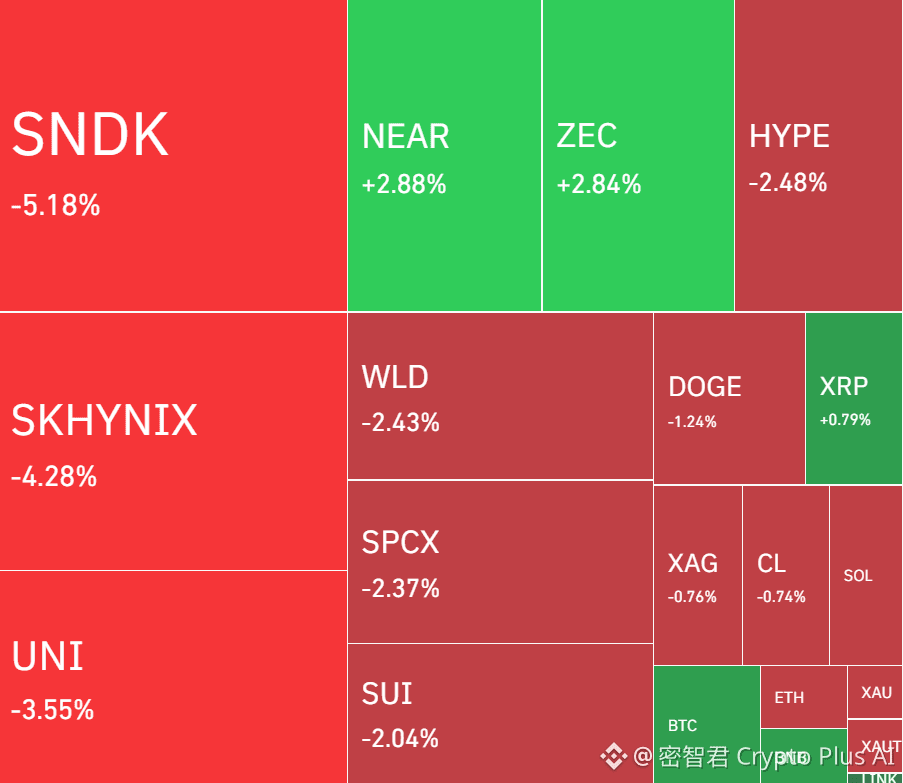
Guys, those who chased the rally yesterday are now facing a split market: NEAR is up 2.88% and ZEC is up 2.84%, while UNI is down 3.55%, WLD is down 2.43%, and SUI is down 2.04%. Capital rotation is becoming more evident.
BTC is slightly stronger now, while ETH is relatively weak, suggesting that even major assets lack a clear consensus on direction. ZEC and NEAR are holding on to their relative strength for now. If BTC continues to move sideways and the stronger coins start pulling back after surging, rotation could easily turn into profit-taking.
Stock-related quotes are also weakening: $SNDKB is down 5.18%, SKHYNIX is down 4.28%, and SPCX is down 2.37%. Technology assets and most altcoins are under pressure at the same time, which is another reason to view this recovery cautiously.
Gold (XAU), silver, and crude oil are all weak at the same time. Gold hasn’t risen, so at least for now, we’re not seeing the full combination of falling risk assets and a handoff to safe havens.
For now, let’s watch for choppy, divergent trading. A bullish scenario would require BTC to remain stable, ETH to strengthen, and more coins to follow suit. A bearish scenario would be BTC turning lower, with ZEC and NEAR also losing their relative strength. If only two or three coins are holding the market up, chasing the rally could mean buying at the tail end of the rotation.
Are you buying strength that can continue to attract buyers, or just coins that haven’t had their turn to fall yet? #Zcash开发者确认11月NU7升级 #OCC发布GENIUS法案首个最终规则
October 22, 2026 | Today’s latest market analysis: How much longer can $ZEC and $NEAR hold up?
Guys, those who chased the rally yesterday are now facing a split market: NEAR is up 2.88% and ZEC is up 2.84%, while UNI is down 3.55%, WLD is down 2.43%, and SUI is down 2.04%. Capital rotation is becoming more evident.
BTC is slightly stronger now, while ETH is relatively weak, suggesting that even major assets lack a clear consensus on direction. ZEC and NEAR are holding on to their relative strength for now. If BTC continues to move sideways and the stronger coins start pulling back after surging, rotation could easily turn into profit-taking.
Stock-related quotes are also weakening: $SNDKB is down 5.18%, SKHYNIX is down 4.28%, and SPCX is down 2.37%. Technology assets and most altcoins are under pressure at the same time, which is another reason to view this recovery cautiously.
Gold (XAU), silver, and crude oil are all weak at the same time. Gold hasn’t risen, so at least for now, we’re not seeing the full combination of falling risk assets and a handoff to safe havens.
For now, let’s watch for choppy, divergent trading. A bullish scenario would require BTC to remain stable, ETH to strengthen, and more coins to follow suit. A bearish scenario would be BTC turning lower, with ZEC and NEAR also losing their relative strength. If only two or three coins are holding the market up, chasing the rally could mean buying at the tail end of the rotation.
Are you buying strength that can continue to attract buyers, or just coins that haven’t had their turn to fall yet? #Zcash开发者确认11月NU7升级 #OCC发布GENIUS法案首个最终规则
Guys, those who chased the rally yesterday are now facing a split market: NEAR is up 2.88% and ZEC is up 2.84%, while UNI is down 3.55%, WLD is down 2.43%, and SUI is down 2.04%. Capital rotation is becoming more evident.
BTC is slightly stronger now, while ETH is relatively weak, suggesting that even major assets lack a clear consensus on direction. ZEC and NEAR are holding on to their relative strength for now. If BTC continues to move sideways and the stronger coins start pulling back after surging, rotation could easily turn into profit-taking.
Stock-related quotes are also weakening: $SNDKB is down 5.18%, SKHYNIX is down 4.28%, and SPCX is down 2.37%. Technology assets and most altcoins are under pressure at the same time, which is another reason to view this recovery cautiously.
Gold (XAU), silver, and crude oil are all weak at the same time. Gold hasn’t risen, so at least for now, we’re not seeing the full combination of falling risk assets and a handoff to safe havens.
For now, let’s watch for choppy, divergent trading. A bullish scenario would require BTC to remain stable, ETH to strengthen, and more coins to follow suit. A bearish scenario would be BTC turning lower, with ZEC and NEAR also losing their relative strength. If only two or three coins are holding the market up, chasing the rally could mean buying at the tail end of the rotation.
Are you buying strength that can continue to attract buyers, or just coins that haven’t had their turn to fall yet? #Zcash开发者确认11月NU7升级 #OCC发布GENIUS法案首个最终规则
1
1.4k
The most outrageous news of the year: telling a 93-year-old to pay social insurance contributions! I’ve never seen anyone so shameless. These people are squeezing ordinary folks for every last penny!
The most outrageous news of the year: telling a 93-year-old to pay social insurance contributions! I’ve never seen anyone so shameless. These people are squeezing ordinary folks for every last penny!

110
Log in to explore more content
Join global crypto users on Binance Square
⚡️ Get latest and useful information about crypto.
💬 Trusted by the world’s largest crypto exchange.
👍 Discover real insights from verified creators.
Email / Phone number
Trending Topics
BinancePick
2.5M views
136,994 Discussing
Join #EarningsSeason: Predict Earnings on Binance Pick, Share Your Take on Binance Square!
Binance Square Official
·399 Likes
·336.7k views
EarningsSeason
4.9M views
23,808 Discussing
ElectrumWalletBugLetRogueServersStealFunds
1,292 views
101 Discussing