Binance Square

Bit_boy

|Exploring innovative financial solutions daily| #Cryptocurrency $Bitcoin
64 Following
24.2K+ Followers
14.8K+ Liked
2.1K+ Shared
All Content
PINNED
--
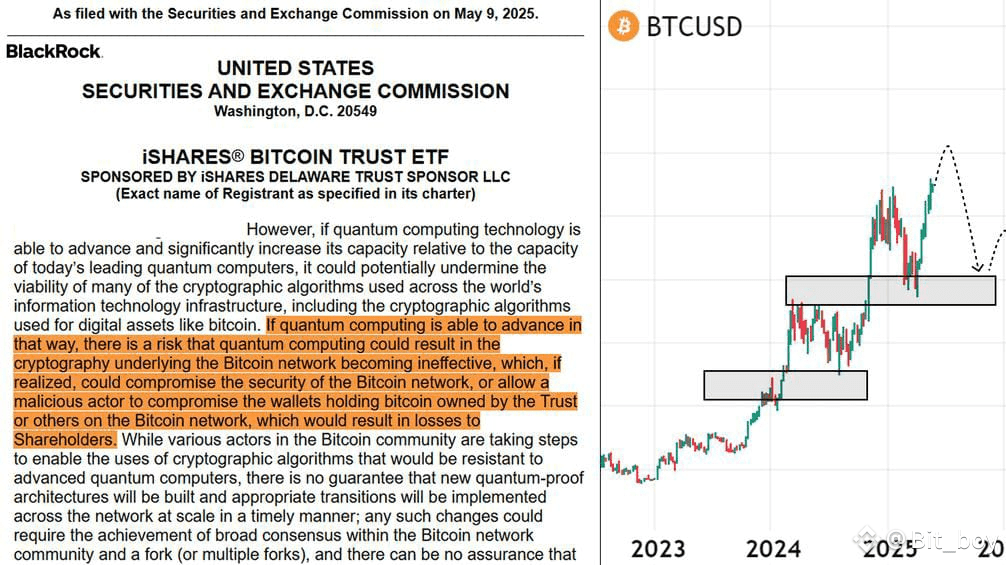
🚨BlackRock: BTC will be compromised and dumped to $40k!Development of quantum computing might kill the Bitcoin network I researched all the data and learn everything about it. /➮ Recently, BlackRock warned us about potential risks to the Bitcoin network 🕷 All due to the rapid progress in the field of quantum computing. 🕷 I’ll add their report at the end - but for now, let’s break down what this actually means. /➮ Bitcoin's security relies on cryptographic algorithms, mainly ECDSA 🕷 It safeguards private keys and ensures transaction integrity 🕷 Quantum computers, leveraging algorithms like Shor's algorithm, could potentially break ECDSA /➮ How? By efficiently solving complex mathematical problems that are currently infeasible for classical computers 🕷 This will would allow malicious actors to derive private keys from public keys Compromising wallet security and transaction authenticity /➮ So BlackRock warns that such a development might enable attackers to compromise wallets and transactions 🕷 Which would lead to potential losses for investors 🕷 But when will this happen and how can we protect ourselves? /➮ Quantum computers capable of breaking Bitcoin's cryptography are not yet operational 🕷 Experts estimate that such capabilities could emerge within 5-7 yeards 🕷 Currently, 25% of BTC is stored in addresses that are vulnerable to quantum attacks /➮ But it's not all bad - the Bitcoin community and the broader cryptocurrency ecosystem are already exploring several strategies: - Post-Quantum Cryptography - Wallet Security Enhancements - Network Upgrades /➮ However, if a solution is not found in time, it could seriously undermine trust in digital assets 🕷 Which in turn could reduce demand for BTC and crypto in general 🕷 And the current outlook isn't too optimistic - here's why: /➮ Google has stated that breaking RSA encryption (tech also used to secure crypto wallets) 🕷 Would require 20x fewer quantum resources than previously expected 🕷 That means we may simply not have enough time to solve the problem before it becomes critical /➮ For now, I believe the most effective step is encouraging users to transfer funds to addresses with enhanced security, 🕷 Such as Pay-to-Public-Key-Hash (P2PKH) addresses, which do not expose public keys until a transaction is made 🕷 Don’t rush to sell all your BTC or move it off wallets - there is still time 🕷 But it's important to keep an eye on this issue and the progress on solutions Report: sec.gov/Archives/edgar… ➮ Give some love and support 🕷 Follow for even more excitement! 🕷 Remember to like, retweet, and drop a comment. #TrumpMediaBitcoinTreasury #Bitcoin2025 $BTC {spot}(BTCUSDT)

🚨BlackRock: BTC will be compromised and dumped to $40k!

Development of quantum computing might kill the Bitcoin network
I researched all the data and learn everything about it.
/➮ Recently, BlackRock warned us about potential risks to the Bitcoin network
🕷 All due to the rapid progress in the field of quantum computing.
🕷 I’ll add their report at the end - but for now, let’s break down what this actually means.
/➮ Bitcoin's security relies on cryptographic algorithms, mainly ECDSA
🕷 It safeguards private keys and ensures transaction integrity
🕷 Quantum computers, leveraging algorithms like Shor's algorithm, could potentially break ECDSA
/➮ How? By efficiently solving complex mathematical problems that are currently infeasible for classical computers
🕷 This will would allow malicious actors to derive private keys from public keys
Compromising wallet security and transaction authenticity
/➮ So BlackRock warns that such a development might enable attackers to compromise wallets and transactions
🕷 Which would lead to potential losses for investors
🕷 But when will this happen and how can we protect ourselves?
/➮ Quantum computers capable of breaking Bitcoin's cryptography are not yet operational
🕷 Experts estimate that such capabilities could emerge within 5-7 yeards
🕷 Currently, 25% of BTC is stored in addresses that are vulnerable to quantum attacks
/➮ But it's not all bad - the Bitcoin community and the broader cryptocurrency ecosystem are already exploring several strategies:
- Post-Quantum Cryptography
- Wallet Security Enhancements
- Network Upgrades
/➮ However, if a solution is not found in time, it could seriously undermine trust in digital assets
🕷 Which in turn could reduce demand for BTC and crypto in general
🕷 And the current outlook isn't too optimistic - here's why:
/➮ Google has stated that breaking RSA encryption (tech also used to secure crypto wallets)
🕷 Would require 20x fewer quantum resources than previously expected
🕷 That means we may simply not have enough time to solve the problem before it becomes critical
/➮ For now, I believe the most effective step is encouraging users to transfer funds to addresses with enhanced security,
🕷 Such as Pay-to-Public-Key-Hash (P2PKH) addresses, which do not expose public keys until a transaction is made
🕷 Don’t rush to sell all your BTC or move it off wallets - there is still time
🕷 But it's important to keep an eye on this issue and the progress on solutions
Report: sec.gov/Archives/edgar…
➮ Give some love and support
🕷 Follow for even more excitement!
🕷 Remember to like, retweet, and drop a comment.
#TrumpMediaBitcoinTreasury #Bitcoin2025 $BTC
PINNED
Mastering Candlestick Patterns: A Key to Unlocking $1000 a Month in Trading_Candlestick patterns are a powerful tool in technical analysis, offering insights into market sentiment and potential price movements. By recognizing and interpreting these patterns, traders can make informed decisions and increase their chances of success. In this article, we'll explore 20 essential candlestick patterns, providing a comprehensive guide to help you enhance your trading strategy and potentially earn $1000 a month. Understanding Candlestick Patterns Before diving into the patterns, it's essential to understand the basics of candlestick charts. Each candle represents a specific time frame, displaying the open, high, low, and close prices. The body of the candle shows the price movement, while the wicks indicate the high and low prices. The 20 Candlestick Patterns 1. Doji: A candle with a small body and long wicks, indicating indecision and potential reversal. 2. Hammer: A bullish reversal pattern with a small body at the top and a long lower wick. 3. Hanging Man: A bearish reversal pattern with a small body at the bottom and a long upper wick. 4. Engulfing Pattern: A two-candle pattern where the second candle engulfs the first, indicating a potential reversal. 5. Piercing Line: A bullish reversal pattern where the second candle opens below the first and closes above its midpoint. 6. Dark Cloud Cover: A bearish reversal pattern where the second candle opens above the first and closes below its midpoint. 7. Morning Star: A three-candle pattern indicating a bullish reversal. 8. Evening Star: A three-candle pattern indicating a bearish reversal. 9. Shooting Star: A bearish reversal pattern with a small body at the bottom and a long upper wick. 10. Inverted Hammer: A bullish reversal pattern with a small body at the top and a long lower wick. 11. Bullish Harami: A two-candle pattern indicating a potential bullish reversal. 12. Bearish Harami: A two-candle pattern indicating a potential bearish reversal. 13. Tweezer Top: A two-candle pattern indicating a potential bearish reversal. 14. Tweezer Bottom: A two-candle pattern indicating a potential bullish reversal. 15. Three White Soldiers: A bullish reversal pattern with three consecutive long-bodied candles. 16. Three Black Crows: A bearish reversal pattern with three consecutive long-bodied candles. 17. Rising Three Methods: A continuation pattern indicating a bullish trend. 18. Falling Three Methods: A continuation pattern indicating a bearish trend. 19. Marubozu: A candle with no wicks and a full-bodied appearance, indicating strong market momentum. 20. Belt Hold Line: A single candle pattern indicating a potential reversal or continuation. Applying Candlestick Patterns in Trading To effectively use these patterns, it's essential to: - Understand the context in which they appear - Combine them with other technical analysis tools - Practice and backtest to develop a deep understanding By mastering these 20 candlestick patterns, you'll be well on your way to enhancing your trading strategy and potentially earning $1000 a month. Remember to stay disciplined, patient, and informed to achieve success in the markets. #CandleStickPatterns #tradingStrategy #TechnicalAnalysis #DayTradingTips #tradingforbeginners

Mastering Candlestick Patterns: A Key to Unlocking $1000 a Month in Trading_

Candlestick patterns are a powerful tool in technical analysis, offering insights into market sentiment and potential price movements. By recognizing and interpreting these patterns, traders can make informed decisions and increase their chances of success. In this article, we'll explore 20 essential candlestick patterns, providing a comprehensive guide to help you enhance your trading strategy and potentially earn $1000 a month.
Understanding Candlestick Patterns
Before diving into the patterns, it's essential to understand the basics of candlestick charts. Each candle represents a specific time frame, displaying the open, high, low, and close prices. The body of the candle shows the price movement, while the wicks indicate the high and low prices.
The 20 Candlestick Patterns
1. Doji: A candle with a small body and long wicks, indicating indecision and potential reversal.
2. Hammer: A bullish reversal pattern with a small body at the top and a long lower wick.
3. Hanging Man: A bearish reversal pattern with a small body at the bottom and a long upper wick.
4. Engulfing Pattern: A two-candle pattern where the second candle engulfs the first, indicating a potential reversal.
5. Piercing Line: A bullish reversal pattern where the second candle opens below the first and closes above its midpoint.
6. Dark Cloud Cover: A bearish reversal pattern where the second candle opens above the first and closes below its midpoint.
7. Morning Star: A three-candle pattern indicating a bullish reversal.
8. Evening Star: A three-candle pattern indicating a bearish reversal.
9. Shooting Star: A bearish reversal pattern with a small body at the bottom and a long upper wick.
10. Inverted Hammer: A bullish reversal pattern with a small body at the top and a long lower wick.
11. Bullish Harami: A two-candle pattern indicating a potential bullish reversal.
12. Bearish Harami: A two-candle pattern indicating a potential bearish reversal.
13. Tweezer Top: A two-candle pattern indicating a potential bearish reversal.
14. Tweezer Bottom: A two-candle pattern indicating a potential bullish reversal.
15. Three White Soldiers: A bullish reversal pattern with three consecutive long-bodied candles.
16. Three Black Crows: A bearish reversal pattern with three consecutive long-bodied candles.
17. Rising Three Methods: A continuation pattern indicating a bullish trend.
18. Falling Three Methods: A continuation pattern indicating a bearish trend.
19. Marubozu: A candle with no wicks and a full-bodied appearance, indicating strong market momentum.
20. Belt Hold Line: A single candle pattern indicating a potential reversal or continuation.
Applying Candlestick Patterns in Trading
To effectively use these patterns, it's essential to:
- Understand the context in which they appear
- Combine them with other technical analysis tools
- Practice and backtest to develop a deep understanding
By mastering these 20 candlestick patterns, you'll be well on your way to enhancing your trading strategy and potentially earning $1000 a month. Remember to stay disciplined, patient, and informed to achieve success in the markets.
#CandleStickPatterns
#tradingStrategy
#TechnicalAnalysis
#DayTradingTips
#tradingforbeginners
Falcon’s Hidden Advantage: How USDf Builds Trust Through Human Psychology Trust in digital money is rarely about code alone. It is about how people interpret stability, risk, and reliability in environments that are still unfamiliar. Falcon Finance’s approach to USDf reflects a clear understanding of this. Instead of relying on promises or narratives, it builds trust through design choices that align with the way human beings naturally evaluate safety. The first thing people look for in any financial system is a margin of protection. Falcon’s over-collateralized structure delivers that in a way that feels intuitive even to users who never read documentation. A token backed by more than it issues sends a simple message: volatility is expected, and preparations have been made. People may not calculate the exact collateral ratios, but they instinctively recognize that extra backing equals extra safety. This becomes the emotional anchor that everything else rests on. A second reassurance comes from collateral diversity. When a stablecoin depends on only one source of value, users unconsciously tie their trust to that single market. Falcon avoids this by spreading risk across multiple asset classes, combining crypto collateral with real-world value through its RWA integrations. This blend creates the impression that USDf is not exposed to a single point of failure. It behaves like a system that has balance built into its core, and balance is one of the simplest forms of psychological comfort. The separation between USDf and sUSDf adds another layer of clarity. Users don’t have to wonder whether their stable asset hides yield-related risks beneath the surface. USDf stays simple and stable, while sUSDf clearly represents the yield-bearing side of the system. This mirrors patterns people already know from traditional finance, like keeping a checking account separate from an interest-generating deposit. Familiarity reduces cognitive effort, and reduced cognitive effort strengthens trust. Falcon also emphasizes transparent mechanics. Users can observe collateral conditions, liquidation logic, and risk parameters without digging through opaque abstractions. Transparency removes the sense of mystery that often triggers panic during market stress. People are calmer when they can see how a system works, even if they never fully analyze it. Uncertainty is where fear grows; visibility is where confidence grows. Accurate oracles reinforce this sense of confidence. When a stablecoin behaves strangely because of data delays or pricing errors, users notice even if they can’t explain why. Falcon minimizes these distortions through synchronized price feeds, making USDf behave in alignment with real markets. When the price of a stablecoin acts predictably, people begin to trust the system without thinking about it. Stable behavior turns into a stable feeling. But the most powerful psychological factor is real-world usability. Falcon’s integration through AEON Pay turns USDf from a concept into something people can touch through everyday transactions. Paying for goods with a token creates a different kind of trust than any dashboard or audit ever could. Each payment is proof that the system works outside theory. Once people can spend an asset in the physical world, it stops being abstract and becomes part of normal life. This real-world activity also creates social reinforcement. Seeing a stablecoin accepted across merchants or used by other customers generates a collective sense of confidence. Trust becomes something that spreads through observation rather than explanation. People take comfort in what others already rely on, and Falcon benefits from this natural human pattern. Consistency is another quiet but powerful contributor. A stablecoin does not need to collapse to lose trust; even small irregularities create discomfort. Falcon’s structure minimizes these micro-instabilities by ensuring redundancy in collateral, reducing liquidation spirals, and maintaining stable behavior across chains. Users experience this as smoothness. Smooth systems feel secure. Jagged systems feel risky. Underneath all of this lies a deeper truth: people prefer systems that behave with discipline. Falcon does not rely on aggressive incentives or fragile mechanisms. Its design choices feel deliberate, measured, and mature. That sense of maturity is rare in digital finance, and it becomes part of the emotional experience users form around USDf. Trust is ultimately built through small, repeatable moments where the system behaves exactly as expected. Falcon’s architecture is designed to deliver those moments consistently. As the broader ecosystem grows more unpredictable, stablecoins will require structures that support not only technical stability but emotional stability. Falcon seems to understand that trust must be earned through behavior, not marketing. In a world where financial systems are becoming more complex and interconnected, the stablecoins that survive will be the ones that feel dependable. Falcon’s approach aligns technical strength with psychological clarity, creating a stablecoin that resonates with users on both levels. USDf is not just backed by collateral; it is backed by design choices that make people feel safe without requiring them to be experts. If trust is emotional, then Falcon’s greatest achievement is that USDf feels trustworthy long before a user understands why. @falcon_finance #FalconFinance $FF {future}(FFUSDT)

Falcon’s Hidden Advantage: How USDf Builds Trust Through Human Psychology

Trust in digital money is rarely about code alone. It is about how people interpret stability, risk, and reliability in environments that are still unfamiliar. Falcon Finance’s approach to USDf reflects a clear understanding of this. Instead of relying on promises or narratives, it builds trust through design choices that align with the way human beings naturally evaluate safety.

The first thing people look for in any financial system is a margin of protection. Falcon’s over-collateralized structure delivers that in a way that feels intuitive even to users who never read documentation. A token backed by more than it issues sends a simple message: volatility is expected, and preparations have been made. People may not calculate the exact collateral ratios, but they instinctively recognize that extra backing equals extra safety. This becomes the emotional anchor that everything else rests on.

A second reassurance comes from collateral diversity. When a stablecoin depends on only one source of value, users unconsciously tie their trust to that single market. Falcon avoids this by spreading risk across multiple asset classes, combining crypto collateral with real-world value through its RWA integrations. This blend creates the impression that USDf is not exposed to a single point of failure. It behaves like a system that has balance built into its core, and balance is one of the simplest forms of psychological comfort.

The separation between USDf and sUSDf adds another layer of clarity. Users don’t have to wonder whether their stable asset hides yield-related risks beneath the surface. USDf stays simple and stable, while sUSDf clearly represents the yield-bearing side of the system. This mirrors patterns people already know from traditional finance, like keeping a checking account separate from an interest-generating deposit. Familiarity reduces cognitive effort, and reduced cognitive effort strengthens trust.

Falcon also emphasizes transparent mechanics. Users can observe collateral conditions, liquidation logic, and risk parameters without digging through opaque abstractions. Transparency removes the sense of mystery that often triggers panic during market stress. People are calmer when they can see how a system works, even if they never fully analyze it. Uncertainty is where fear grows; visibility is where confidence grows.

Accurate oracles reinforce this sense of confidence. When a stablecoin behaves strangely because of data delays or pricing errors, users notice even if they can’t explain why. Falcon minimizes these distortions through synchronized price feeds, making USDf behave in alignment with real markets. When the price of a stablecoin acts predictably, people begin to trust the system without thinking about it. Stable behavior turns into a stable feeling.

But the most powerful psychological factor is real-world usability. Falcon’s integration through AEON Pay turns USDf from a concept into something people can touch through everyday transactions. Paying for goods with a token creates a different kind of trust than any dashboard or audit ever could. Each payment is proof that the system works outside theory. Once people can spend an asset in the physical world, it stops being abstract and becomes part of normal life.

This real-world activity also creates social reinforcement. Seeing a stablecoin accepted across merchants or used by other customers generates a collective sense of confidence. Trust becomes something that spreads through observation rather than explanation. People take comfort in what others already rely on, and Falcon benefits from this natural human pattern.

Consistency is another quiet but powerful contributor. A stablecoin does not need to collapse to lose trust; even small irregularities create discomfort. Falcon’s structure minimizes these micro-instabilities by ensuring redundancy in collateral, reducing liquidation spirals, and maintaining stable behavior across chains. Users experience this as smoothness. Smooth systems feel secure. Jagged systems feel risky.

Underneath all of this lies a deeper truth: people prefer systems that behave with discipline. Falcon does not rely on aggressive incentives or fragile mechanisms. Its design choices feel deliberate, measured, and mature. That sense of maturity is rare in digital finance, and it becomes part of the emotional experience users form around USDf.

Trust is ultimately built through small, repeatable moments where the system behaves exactly as expected. Falcon’s architecture is designed to deliver those moments consistently. As the broader ecosystem grows more unpredictable, stablecoins will require structures that support not only technical stability but emotional stability. Falcon seems to understand that trust must be earned through behavior, not marketing.

In a world where financial systems are becoming more complex and interconnected, the stablecoins that survive will be the ones that feel dependable. Falcon’s approach aligns technical strength with psychological clarity, creating a stablecoin that resonates with users on both levels. USDf is not just backed by collateral; it is backed by design choices that make people feel safe without requiring them to be experts.

If trust is emotional, then Falcon’s greatest achievement is that USDf feels trustworthy long before a user understands why.
@Falcon Finance #FalconFinance $FF
How Deterministic Timing Unlocks Deep, Unbroken Machine Intelligence There is a subtle failure mode inside autonomous reasoning systems that rarely announces itself openly. You don’t see alarms, you don’t see crashes, and you don’t see anything that looks like a mistake. Instead, somewhere between rapid-fire micro-executions, a tiny shift appears. One internal process lands slightly earlier than expected, another arrives a fraction later, and the agent’s internal rhythm slips. That microscopic shift is all it takes for the chain of reasoning to begin drifting. An agent that started with a coherent path suddenly carries two versions of its own logic—one it intended to follow, and one it slowly slides toward. Reconciling the two costs energy, shortens its planning horizon, and eventually forces it into shallow conclusions it never meant to reach. Understanding this drift requires recognizing how delicate timing is for autonomous agents. Unlike a human mind, which anchors thoughts through intuition, narrative, and emotional continuity, agents rely entirely on the precision of their environment. If the timing of confirmations or external signals wobbles even slightly, their internal state becomes unsteady. Reasoning begins to bend around the instability. Over long sequences, this becomes one of the biggest hidden threats to task depth. This is where KITE AI’s system becomes transformative. Its architecture maintains a timing structure that doesn’t merely move quickly, but stays rhythmically consistent. It acts like a steady tick that keeps every reasoning thread aligned with each checkpoint the environment produces. The result is an internal world where agents do not need to constantly re-anchor themselves. They remain synchronized from the first step to the last. This difference becomes especially clear during long, multi-stage tasks. In traditional blockchain-like systems, even a minor pause in settlement timing can push an agent out of rhythm. A single unexpected delay forces it to reorder its priorities, repeat prior steps, or slip into a fallback path. The reasoning chain that should unfold gradually ends up compressed or prematurely terminated. You can watch the depth collapse in real time. Running the same sequence in a KITE-based environment yields an entirely different behavior. Every confirmation arrives at exactly the tempo the agent expects. Each internal checkpoint aligns with each external signal. The reasoning holds steady. The agent continues through the full intended path without drifting. It even extends beyond it, exploring alternative branches that unstable environments would have forced it to abandon. The change doesn’t come from increased intelligence, but from a stable environment that stops degrading the intelligence it already has. The impact is even more dramatic when several agents work together. In unstable environments, a small timing hiccup affecting one agent quickly spreads. Another misinterprets the delay, another recalculates a dependency, another shifts into a defensive loop. The system begins to fragment, not because agents misunderstand one another, but because they are no longer living inside the same moment. Their sense of time drifts apart. KITE AI prevents this ripple effect by removing the variance that causes it. Every agent operates inside the same temporal frame, grounded by deterministic settlement. They no longer waste effort correcting themselves or each other. They remain aligned naturally, even when interactions grow complex. Coordination stops being a constant battle against timing noise and becomes a stable property of the system. This kind of stability fundamentally changes what agents choose to attempt. In unpredictable environments, they behave cautiously. They avoid long plans because they fear the world will contradict them. They choose short loops because those loops survive timing slippage. Their reasoning becomes narrow and protective. In KITE’s environment, that caution disappears. Agents commit to deeper reasoning chains because nothing threatens their internal alignment. They follow extended plans without collapsing into backup modes. They explore, revisit, cross-check, and build layers of inference without fear of losing synchronization. Stability doesn’t just support intelligence—it unlocks it. There is always a moment in long experiments where, in other systems, the drift would begin. That moment arrives, the agent keeps going, and nothing breaks. It stays in sync with itself. That single quiet act of remaining aligned makes it feel as if the system has learned how to breathe without strain. The deeper conclusion is that synchronization is a prerequisite for real reasoning. Humans maintain it through continuity and shared experience. Agents maintain it only if their environment gives them a steady temporal foundation. KITE provides that foundation. By eliminating micro-desynchronization, it preserves the integrity of thought itself. It gives agents a world where their reasoning can stretch without tearing. The future of autonomous systems will belong to whichever environments can keep intelligence from drifting apart. KITE AI is building exactly that kind of world—one where reasoning stays in rhythm, plans reach their intended depth, and intelligence remains whole from start to finish. @GoKiteAI #Kite $KITE {future}(KITEUSDT)

How Deterministic Timing Unlocks Deep, Unbroken Machine Intelligence

There is a subtle failure mode inside autonomous reasoning systems that rarely announces itself openly. You don’t see alarms, you don’t see crashes, and you don’t see anything that looks like a mistake. Instead, somewhere between rapid-fire micro-executions, a tiny shift appears. One internal process lands slightly earlier than expected, another arrives a fraction later, and the agent’s internal rhythm slips. That microscopic shift is all it takes for the chain of reasoning to begin drifting. An agent that started with a coherent path suddenly carries two versions of its own logic—one it intended to follow, and one it slowly slides toward. Reconciling the two costs energy, shortens its planning horizon, and eventually forces it into shallow conclusions it never meant to reach.

Understanding this drift requires recognizing how delicate timing is for autonomous agents. Unlike a human mind, which anchors thoughts through intuition, narrative, and emotional continuity, agents rely entirely on the precision of their environment. If the timing of confirmations or external signals wobbles even slightly, their internal state becomes unsteady. Reasoning begins to bend around the instability. Over long sequences, this becomes one of the biggest hidden threats to task depth.

This is where KITE AI’s system becomes transformative. Its architecture maintains a timing structure that doesn’t merely move quickly, but stays rhythmically consistent. It acts like a steady tick that keeps every reasoning thread aligned with each checkpoint the environment produces. The result is an internal world where agents do not need to constantly re-anchor themselves. They remain synchronized from the first step to the last.

This difference becomes especially clear during long, multi-stage tasks. In traditional blockchain-like systems, even a minor pause in settlement timing can push an agent out of rhythm. A single unexpected delay forces it to reorder its priorities, repeat prior steps, or slip into a fallback path. The reasoning chain that should unfold gradually ends up compressed or prematurely terminated. You can watch the depth collapse in real time.

Running the same sequence in a KITE-based environment yields an entirely different behavior. Every confirmation arrives at exactly the tempo the agent expects. Each internal checkpoint aligns with each external signal. The reasoning holds steady. The agent continues through the full intended path without drifting. It even extends beyond it, exploring alternative branches that unstable environments would have forced it to abandon. The change doesn’t come from increased intelligence, but from a stable environment that stops degrading the intelligence it already has.

The impact is even more dramatic when several agents work together. In unstable environments, a small timing hiccup affecting one agent quickly spreads. Another misinterprets the delay, another recalculates a dependency, another shifts into a defensive loop. The system begins to fragment, not because agents misunderstand one another, but because they are no longer living inside the same moment. Their sense of time drifts apart.

KITE AI prevents this ripple effect by removing the variance that causes it. Every agent operates inside the same temporal frame, grounded by deterministic settlement. They no longer waste effort correcting themselves or each other. They remain aligned naturally, even when interactions grow complex. Coordination stops being a constant battle against timing noise and becomes a stable property of the system.

This kind of stability fundamentally changes what agents choose to attempt. In unpredictable environments, they behave cautiously. They avoid long plans because they fear the world will contradict them. They choose short loops because those loops survive timing slippage. Their reasoning becomes narrow and protective.

In KITE’s environment, that caution disappears. Agents commit to deeper reasoning chains because nothing threatens their internal alignment. They follow extended plans without collapsing into backup modes. They explore, revisit, cross-check, and build layers of inference without fear of losing synchronization. Stability doesn’t just support intelligence—it unlocks it.

There is always a moment in long experiments where, in other systems, the drift would begin. That moment arrives, the agent keeps going, and nothing breaks. It stays in sync with itself. That single quiet act of remaining aligned makes it feel as if the system has learned how to breathe without strain.

The deeper conclusion is that synchronization is a prerequisite for real reasoning. Humans maintain it through continuity and shared experience. Agents maintain it only if their environment gives them a steady temporal foundation. KITE provides that foundation. By eliminating micro-desynchronization, it preserves the integrity of thought itself. It gives agents a world where their reasoning can stretch without tearing.

The future of autonomous systems will belong to whichever environments can keep intelligence from drifting apart. KITE AI is building exactly that kind of world—one where reasoning stays in rhythm, plans reach their intended depth, and intelligence remains whole from start to finish.
@KITE AI #Kite $KITE
The Transparency Architecture That Makes Lorenzo Impossible to Compete With There is a persistent contradiction at the heart of the financial world. The institutions that insist they are the most reliable often reveal the least. Their operations are wrapped in carefully filtered reports, selective disclosures and polished explanations delivered only when timing is convenient. Investors tolerate this opacity not because it inspires confidence, but because conventional systems leave them with no better choice. Transparency has never been foundational to traditional finance; it has been a controlled offering, rationed out in ways that protect the institution rather than the user. Lorenzo Protocol enters this landscape with a philosophy that feels almost disruptive in its clarity. It does not treat openness as an optional layer that can be added for optics. It treats it as core structure. The deeper one looks, the more obvious it becomes that transparency here forms a barrier competitors cannot cross—not because they won’t, but because their very architecture prevents them from doing so. The contrast becomes immediately visible through how Lorenzo handles NAV. In most financial vehicles, NAV is a snapshot taken periodically, a single number that compresses countless decisions, risks and market movements into a simplified summary. It often arrives too late to be meaningful. Lorenzo rejects that approach entirely. NAV becomes a constant readout, updating with every strategic action the system takes. Nothing is buried between intervals. Users see the evolution of performance as it happens, not the filtered version released after decisions have been retroactively framed. NAV transforms into a living signal that eliminates the informational blackouts where uncertainty grows. This distinction becomes even sharper when examining how strategies operate. Traditional multi-strategy funds depend on human discretion. Managers, committees and traders make judgment calls under shifting market pressures. This discretion introduces layers that cannot be observed, timed or fully explained. Lorenzo restructures this dynamic by encoding all strategy behavior directly into the system. Deterministic execution replaces decision-making drift. Every rebalance, shift in allocation or change in exposure follows immutable logic. Competitors tied to human operators simply cannot emulate this level of predictability without dismantling the very structures they rely on. Liquidity widens the gap even more. In conventional finance, liquidity is only reliable when it is least needed. In moments of stress, it collapses. Redemption gates appear. Withdrawals become negotiations. With Lorenzo, liquidity is derived from the underlying assets themselves, not external market-makers or discretionary controls. Users enter and exit through the same architectural rails, regardless of market conditions. Liquidity becomes a structural guarantee rather than a conditional privilege. The protocol’s stBTC layer magnifies the transparency advantage further. Historically, Bitcoin yield systems have relied heavily on trust because real visibility was never offered. Lending desks held unspoken risks. Custodians obscured exposure. Strategy operators revealed only fragments of their activity. Lorenzo reverses this pattern. Every stage of stBTC—from the moment BTC enters the system to how it is deployed and how its returns are generated—remains observable. Traditional institutions, built on proprietary infrastructure and private ledgers, cannot create this degree of visibility even if they wanted to. As the system grows, transparency begins exerting its own form of gravity. The more the protocol reveals, the better users understand it. And the more users understand it, the less tolerable opaque competitors appear. Lorenzo does not win trust through marketing. It wins through comprehension. The moat expands not because the protocol hides an advantage, but because it exposes everything and continues to perform. What ultimately cements transparency as a strategic advantage is the psychological shift it creates. Many users, especially in crypto, have been conditioned to expect sudden failures and concealed risks. They carry memories of hidden losses, delayed disclosures and manipulations disguised as necessary adjustments. Lorenzo removes this constant background tension. Any change—in markets, allocations, or risk—becomes immediately visible. Trust emerges quietly, grounded in observation rather than persuasion. Traditional funds cannot reproduce this emotional environment. Their operational structures depend on internal processes, private evaluations and timing choices that always introduce opacity. The more complex their strategies become, the less able they are to reveal themselves. Lorenzo evolves inversely: as more strategies and assets are added, visibility increases. Growth enhances clarity rather than diluting it. A deeper shift unfolds when considering incentives. In legacy finance, opacity protects reputations. It conceals errors, obscures volatility and allows narrative smoothing. But this same concealment creates fragility. Lorenzo’s architecture does not permit narrative alteration. It operates in open view, which forces it to remain consistent. This enforced honesty becomes a competitive weapon, attracting users who value verifiable structure over promises. Over time, the impact becomes unavoidable. Lorenzo’s transparency does not merely differentiate it; it pressures the rest of the market. It forces other systems to confront their weaknesses. It highlights the fragility of models built on secrecy. It challenges long-standing assumptions about how trust should be earned. It becomes both a protection and an offensive force, pushing the industry toward higher standards. Eventually, one arrives at an unmistakable realization: transparency here is not decorative. It is foundational. It is the element from which resilience, trust and long-term performance emerge. Lorenzo exposes everything and remains stable under that exposure. In a world where hidden mechanics have too often been confused with sophistication, this ability to operate confidently in full view becomes the most powerful moat imaginable. @LorenzoProtocol #lorenzoprotocol $BANK {future}(BANKUSDT)

The Transparency Architecture That Makes Lorenzo Impossible to Compete With

There is a persistent contradiction at the heart of the financial world. The institutions that insist they are the most reliable often reveal the least. Their operations are wrapped in carefully filtered reports, selective disclosures and polished explanations delivered only when timing is convenient. Investors tolerate this opacity not because it inspires confidence, but because conventional systems leave them with no better choice. Transparency has never been foundational to traditional finance; it has been a controlled offering, rationed out in ways that protect the institution rather than the user.

Lorenzo Protocol enters this landscape with a philosophy that feels almost disruptive in its clarity. It does not treat openness as an optional layer that can be added for optics. It treats it as core structure. The deeper one looks, the more obvious it becomes that transparency here forms a barrier competitors cannot cross—not because they won’t, but because their very architecture prevents them from doing so.

The contrast becomes immediately visible through how Lorenzo handles NAV. In most financial vehicles, NAV is a snapshot taken periodically, a single number that compresses countless decisions, risks and market movements into a simplified summary. It often arrives too late to be meaningful. Lorenzo rejects that approach entirely. NAV becomes a constant readout, updating with every strategic action the system takes. Nothing is buried between intervals. Users see the evolution of performance as it happens, not the filtered version released after decisions have been retroactively framed. NAV transforms into a living signal that eliminates the informational blackouts where uncertainty grows.

This distinction becomes even sharper when examining how strategies operate. Traditional multi-strategy funds depend on human discretion. Managers, committees and traders make judgment calls under shifting market pressures. This discretion introduces layers that cannot be observed, timed or fully explained. Lorenzo restructures this dynamic by encoding all strategy behavior directly into the system. Deterministic execution replaces decision-making drift. Every rebalance, shift in allocation or change in exposure follows immutable logic. Competitors tied to human operators simply cannot emulate this level of predictability without dismantling the very structures they rely on.

Liquidity widens the gap even more. In conventional finance, liquidity is only reliable when it is least needed. In moments of stress, it collapses. Redemption gates appear. Withdrawals become negotiations. With Lorenzo, liquidity is derived from the underlying assets themselves, not external market-makers or discretionary controls. Users enter and exit through the same architectural rails, regardless of market conditions. Liquidity becomes a structural guarantee rather than a conditional privilege.

The protocol’s stBTC layer magnifies the transparency advantage further. Historically, Bitcoin yield systems have relied heavily on trust because real visibility was never offered. Lending desks held unspoken risks. Custodians obscured exposure. Strategy operators revealed only fragments of their activity. Lorenzo reverses this pattern. Every stage of stBTC—from the moment BTC enters the system to how it is deployed and how its returns are generated—remains observable. Traditional institutions, built on proprietary infrastructure and private ledgers, cannot create this degree of visibility even if they wanted to.

As the system grows, transparency begins exerting its own form of gravity. The more the protocol reveals, the better users understand it. And the more users understand it, the less tolerable opaque competitors appear. Lorenzo does not win trust through marketing. It wins through comprehension. The moat expands not because the protocol hides an advantage, but because it exposes everything and continues to perform.

What ultimately cements transparency as a strategic advantage is the psychological shift it creates. Many users, especially in crypto, have been conditioned to expect sudden failures and concealed risks. They carry memories of hidden losses, delayed disclosures and manipulations disguised as necessary adjustments. Lorenzo removes this constant background tension. Any change—in markets, allocations, or risk—becomes immediately visible. Trust emerges quietly, grounded in observation rather than persuasion.

Traditional funds cannot reproduce this emotional environment. Their operational structures depend on internal processes, private evaluations and timing choices that always introduce opacity. The more complex their strategies become, the less able they are to reveal themselves. Lorenzo evolves inversely: as more strategies and assets are added, visibility increases. Growth enhances clarity rather than diluting it.

A deeper shift unfolds when considering incentives. In legacy finance, opacity protects reputations. It conceals errors, obscures volatility and allows narrative smoothing. But this same concealment creates fragility. Lorenzo’s architecture does not permit narrative alteration. It operates in open view, which forces it to remain consistent. This enforced honesty becomes a competitive weapon, attracting users who value verifiable structure over promises.

Over time, the impact becomes unavoidable. Lorenzo’s transparency does not merely differentiate it; it pressures the rest of the market. It forces other systems to confront their weaknesses. It highlights the fragility of models built on secrecy. It challenges long-standing assumptions about how trust should be earned. It becomes both a protection and an offensive force, pushing the industry toward higher standards.

Eventually, one arrives at an unmistakable realization: transparency here is not decorative. It is foundational. It is the element from which resilience, trust and long-term performance emerge. Lorenzo exposes everything and remains stable under that exposure. In a world where hidden mechanics have too often been confused with sophistication, this ability to operate confidently in full view becomes the most powerful moat imaginable.

@Lorenzo Protocol #lorenzoprotocol $BANK
The experience is lightEvery game, no matter how large in scope, ultimately reduces down to a repeating cycle of doing something, reacting to what happens, and preparing to do it again. Big games stretch these cycles into long quests, long battles, long story arcs. YGG Play does the opposite. It shrinks the cycle down to its smallest possible form: a brief moment of intent, a tiny burst of action, a fast response from the game, and an immediate return to neutral. It’s this reduction that makes the experience feel sharper and more compelling than many complex systems built by traditional designers. To understand why these micro-loops feel so naturally addictive, it helps to think about how the mind experiences short cycles. Each one starts with a spark of expectation, hits a peak when the player takes an action, lands with a jolt of feedback, and then clears the emotional slate. Most games spread these phases out. YGG Play compresses them into seconds. The entire emotional curve fits neatly inside the player’s short-term focus without ever spilling over into fatigue. The beginning of each loop triggers instant readiness. The moment a microgame loads, the player knows exactly what they’re supposed to do. There’s no story setup or mechanical explanation. The objective is obvious on sight. This simplicity makes anticipation energizing instead of stressful. The brain isn’t preparing for a complex task; it’s preparing for a moment of play. The action phase is brief but full of personality. A quick swipe. A fast tap. A sudden reaction. These small gestures don’t push the player into heavy thinking—they activate instinct. Instinct-driven motion is smooth, fast, and deeply satisfying because it creates flow with minimal effort. Flow is the state most games chase, but YGG Play reaches it by keeping interactions tiny and pure. Feedback is where the loop becomes emotionally memorable. Because it arrives instantly, the player feels connected to the outcome. A perfect timing hit snaps into place with satisfying clarity. A miss lands with a bit of humor. The immediate link between what the player does and what the screen shows forms a tight emotional bond. The mind thrives on quick cause-and-effect, and the platform delivers it without hesitation. Then comes the reset—the secret strength of YGG Play’s design. The moment the outcome is displayed, the loop dissolves cleanly. There is no lingering punishment, no long animation, no reminder of failure. The game simply resets the emotional channel, making the next attempt feel fresh. This complete reset burns away frustration before it can build up and allows players to retry endlessly without feeling drained. When these four stages flow smoothly, repetition feels natural. Not forced. Not grinding. Simply enjoyable. The loop becomes something the player willingly revisits because each cycle feels like a tiny pleasure. The experience is light on the mind and warm on the emotions. This matters especially in the context of Web3 gaming, where earlier designs focused more on financial mechanics than emotional ones. Many early titles replaced play with economics and expected people to stay engaged through tokens instead of fun. YGG Play reverses that mistake. The micro-loops return the focus to sensation, rhythm, and reactive joy. Earnings or rewards become supporting elements instead of the core motivation. Over time, these micro-loops form larger behavioral patterns. A player doesn’t sit down with the goal of playing for an hour. They pick up the game for a quick hit of stimulation. And because each loop feels so light, they return again and again without realizing how the habit forms. These small cycles create a gentle routine that feels effortless instead of consuming. The emotional safety of the loops also sets them apart. Because every attempt resets completely, there is no fear of losing progress or missing out. The system invites experimentation rather than punishing it. Trying something unusual feels safe. Mistakes disappear instantly. The player is encouraged to have fun rather than to optimize. The loops also create moments perfect for sharing. A quick misstep. A flawless streak. A funny mishap. Each loop becomes a tiny clip or story that can be passed around in communities. Instead of one big highlight every hour, YGG Play offers dozens of small ones every minute. There is a quiet elegance to the way these micro-loops function. They mirror the fleeting joys of everyday life: a short laugh, a small surprise, a quick moment of delight. The platform captures these sensations and packages them into repeatable bursts of emotion. What emerges is an experience that feels warm, light, and human not because it is complex, but because it respects the beauty of small moments. It is this emotional lightness that keeps players coming back. Not a grind. Not a reward. Not a sense of obligation. Just a simple, satisfying moment that is always ready to repeat. And sometimes, that is all a perfect loop needs to be. @YieldGuildGames #YGGPlay $YGG {future}(YGGUSDT)

The experience is light

Every game, no matter how large in scope, ultimately reduces down to a repeating cycle of doing something, reacting to what happens, and preparing to do it again. Big games stretch these cycles into long quests, long battles, long story arcs. YGG Play does the opposite. It shrinks the cycle down to its smallest possible form: a brief moment of intent, a tiny burst of action, a fast response from the game, and an immediate return to neutral. It’s this reduction that makes the experience feel sharper and more compelling than many complex systems built by traditional designers.

To understand why these micro-loops feel so naturally addictive, it helps to think about how the mind experiences short cycles. Each one starts with a spark of expectation, hits a peak when the player takes an action, lands with a jolt of feedback, and then clears the emotional slate. Most games spread these phases out. YGG Play compresses them into seconds. The entire emotional curve fits neatly inside the player’s short-term focus without ever spilling over into fatigue.

The beginning of each loop triggers instant readiness. The moment a microgame loads, the player knows exactly what they’re supposed to do. There’s no story setup or mechanical explanation. The objective is obvious on sight. This simplicity makes anticipation energizing instead of stressful. The brain isn’t preparing for a complex task; it’s preparing for a moment of play.

The action phase is brief but full of personality. A quick swipe. A fast tap. A sudden reaction. These small gestures don’t push the player into heavy thinking—they activate instinct. Instinct-driven motion is smooth, fast, and deeply satisfying because it creates flow with minimal effort. Flow is the state most games chase, but YGG Play reaches it by keeping interactions tiny and pure.

Feedback is where the loop becomes emotionally memorable. Because it arrives instantly, the player feels connected to the outcome. A perfect timing hit snaps into place with satisfying clarity. A miss lands with a bit of humor. The immediate link between what the player does and what the screen shows forms a tight emotional bond. The mind thrives on quick cause-and-effect, and the platform delivers it without hesitation.

Then comes the reset—the secret strength of YGG Play’s design. The moment the outcome is displayed, the loop dissolves cleanly. There is no lingering punishment, no long animation, no reminder of failure. The game simply resets the emotional channel, making the next attempt feel fresh. This complete reset burns away frustration before it can build up and allows players to retry endlessly without feeling drained.

When these four stages flow smoothly, repetition feels natural. Not forced. Not grinding. Simply enjoyable. The loop becomes something the player willingly revisits because each cycle feels like a tiny pleasure. The experience is light on the mind and warm on the emotions.

This matters especially in the context of Web3 gaming, where earlier designs focused more on financial mechanics than emotional ones. Many early titles replaced play with economics and expected people to stay engaged through tokens instead of fun. YGG Play reverses that mistake. The micro-loops return the focus to sensation, rhythm, and reactive joy. Earnings or rewards become supporting elements instead of the core motivation.

Over time, these micro-loops form larger behavioral patterns. A player doesn’t sit down with the goal of playing for an hour. They pick up the game for a quick hit of stimulation. And because each loop feels so light, they return again and again without realizing how the habit forms. These small cycles create a gentle routine that feels effortless instead of consuming.

The emotional safety of the loops also sets them apart. Because every attempt resets completely, there is no fear of losing progress or missing out. The system invites experimentation rather than punishing it. Trying something unusual feels safe. Mistakes disappear instantly. The player is encouraged to have fun rather than to optimize.

The loops also create moments perfect for sharing. A quick misstep. A flawless streak. A funny mishap. Each loop becomes a tiny clip or story that can be passed around in communities. Instead of one big highlight every hour, YGG Play offers dozens of small ones every minute.

There is a quiet elegance to the way these micro-loops function. They mirror the fleeting joys of everyday life: a short laugh, a small surprise, a quick moment of delight. The platform captures these sensations and packages them into repeatable bursts of emotion. What emerges is an experience that feels warm, light, and human not because it is complex, but because it respects the beauty of small moments.

It is this emotional lightness that keeps players coming back. Not a grind. Not a reward. Not a sense of obligation. Just a simple, satisfying moment that is always ready to repeat.

And sometimes, that is all a perfect loop needs to be.

@Yield Guild Games #YGGPlay $YGG
Injective: The Chain That Turns Market Making Into a True Craft Injective changes the experience of on-chain market making in a way that feels almost counterintuitive compared to the rest of DeFi. Many market makers eventually reach a point where they realize the infrastructure around them was never designed for the precision their work requires. Execution varies from block to block, fees swing unexpectedly, liquidity is scattered, and every strategy becomes a defensive measure instead of a structured plan. Market making begins to resemble a gamble rather than a discipline. Watching Injective evolve shows how deeply it reverses this pattern. The process becomes calm, deliberate, and methodical. The chain provides the structure that allows liquidity providers to operate like professionals rather than gamblers reacting to instability. At the center of this shift is Injective’s timing architecture. Most blockchains wobble under load, and those wobbles force market makers to widen spreads, shrink order sizes, and pull back inventory. Injective’s deterministic rhythm eliminates those silent costs. With predictable timing, market makers can rely on their models instead of compensating for infrastructure uncertainty. Quoting becomes more exact, less defensive, and more reflective of actual market intent. Another critical factor is the chain’s protection against MEV. On many networks, the public mempool functions like an ambush zone where bots prey on visible liquidity. Injective avoids this dynamic by removing the exploitable parts of transaction flow. Without a public mempool or meaningful avenues for reordering, market makers don’t have to fear their own quotes. Their edge comes from strategy, not evasive maneuvers. This encourages deeper and more confident participation. Injective’s shared orderbook further strengthens the environment by giving liquidity providers a familiar, expressive medium. Instead of being confined to mathematical curves as on AMM-based systems, they can place precise orders with real granularity. Their liquidity contributes to a unified pool rather than being scattered across isolated environments. This consolidation creates a meaningful sense of depth, and that depth attracts more professional liquidity than incentive programs ever could. The chain’s near-zero gas costs add another layer of usability. Market makers must constantly adjust quotes, manage exposure, and refine their positions. On chains with expensive or unpredictable gas, these adjustments become burdensome and infrequent. Injective removes this friction entirely, allowing continuous, natural quoting behavior. Liquidity remains active even during quiet periods because the cost of maintaining it is negligible. Oracles on Injective also support this stability. In fast markets, even a small delay in updates can push a market maker into dangerous territory. Injective’s synchronized data flow ensures that prices reflect reality with minimal lag, letting market makers quote with confidence that the chain’s information matches their own. This reduces the risk premium that typically inflates spreads and weakens liquidity on other networks. All of these structural advantages compound into something less technical and more psychological. Market makers trust systems that behave predictably, and they retreat from those that feel unstable. Injective earns trust by providing an environment where the infrastructure does not undermine the strategy. As a result, spreads tighten, order sizes grow, and liquidity becomes more durable. Market makers stay active during volatility because the chain does not distort their work when it matters most. The overall effect is a form of liquidity that feels stable rather than opportunistic. It persists through stress rather than disappearing the moment conditions worsen. It arises not from temporary incentives but from confidence in the underlying architecture. Watching Injective’s orderbooks during turbulent markets highlights this difference: depth remains, quotes hold, and the behavior resembles a mature marketplace rather than a fragile experiment. If decentralized finance is ever to match the robustness of global financial systems, it needs environments where market making can operate with the same professionalism and structure seen in traditional markets. Injective stands out as one of the few ecosystems that make this possible, not just through technology but through a culture shaped around precision, fairness, and reliability. @Injective #injective $INJ {future}(INJUSDT)

Injective: The Chain That Turns Market Making Into a True Craft

Injective changes the experience of on-chain market making in a way that feels almost counterintuitive compared to the rest of DeFi. Many market makers eventually reach a point where they realize the infrastructure around them was never designed for the precision their work requires. Execution varies from block to block, fees swing unexpectedly, liquidity is scattered, and every strategy becomes a defensive measure instead of a structured plan. Market making begins to resemble a gamble rather than a discipline. Watching Injective evolve shows how deeply it reverses this pattern. The process becomes calm, deliberate, and methodical. The chain provides the structure that allows liquidity providers to operate like professionals rather than gamblers reacting to instability.

At the center of this shift is Injective’s timing architecture. Most blockchains wobble under load, and those wobbles force market makers to widen spreads, shrink order sizes, and pull back inventory. Injective’s deterministic rhythm eliminates those silent costs. With predictable timing, market makers can rely on their models instead of compensating for infrastructure uncertainty. Quoting becomes more exact, less defensive, and more reflective of actual market intent.

Another critical factor is the chain’s protection against MEV. On many networks, the public mempool functions like an ambush zone where bots prey on visible liquidity. Injective avoids this dynamic by removing the exploitable parts of transaction flow. Without a public mempool or meaningful avenues for reordering, market makers don’t have to fear their own quotes. Their edge comes from strategy, not evasive maneuvers. This encourages deeper and more confident participation.

Injective’s shared orderbook further strengthens the environment by giving liquidity providers a familiar, expressive medium. Instead of being confined to mathematical curves as on AMM-based systems, they can place precise orders with real granularity. Their liquidity contributes to a unified pool rather than being scattered across isolated environments. This consolidation creates a meaningful sense of depth, and that depth attracts more professional liquidity than incentive programs ever could.

The chain’s near-zero gas costs add another layer of usability. Market makers must constantly adjust quotes, manage exposure, and refine their positions. On chains with expensive or unpredictable gas, these adjustments become burdensome and infrequent. Injective removes this friction entirely, allowing continuous, natural quoting behavior. Liquidity remains active even during quiet periods because the cost of maintaining it is negligible.

Oracles on Injective also support this stability. In fast markets, even a small delay in updates can push a market maker into dangerous territory. Injective’s synchronized data flow ensures that prices reflect reality with minimal lag, letting market makers quote with confidence that the chain’s information matches their own. This reduces the risk premium that typically inflates spreads and weakens liquidity on other networks.

All of these structural advantages compound into something less technical and more psychological. Market makers trust systems that behave predictably, and they retreat from those that feel unstable. Injective earns trust by providing an environment where the infrastructure does not undermine the strategy. As a result, spreads tighten, order sizes grow, and liquidity becomes more durable. Market makers stay active during volatility because the chain does not distort their work when it matters most.

The overall effect is a form of liquidity that feels stable rather than opportunistic. It persists through stress rather than disappearing the moment conditions worsen. It arises not from temporary incentives but from confidence in the underlying architecture. Watching Injective’s orderbooks during turbulent markets highlights this difference: depth remains, quotes hold, and the behavior resembles a mature marketplace rather than a fragile experiment.

If decentralized finance is ever to match the robustness of global financial systems, it needs environments where market making can operate with the same professionalism and structure seen in traditional markets. Injective stands out as one of the few ecosystems that make this possible, not just through technology but through a culture shaped around precision, fairness, and reliability.

@Injective #injective $INJ
Falcon distributes risk across assets, regions, user groups, blockchains, and use cases. The stablecoin market has grown into one of the most important layers of the digital economy, but with that growth has come a quiet structural fragility. Most of the liquidity that powers DeFi and on-chain payments now clusters around a few dominant stablecoins, each tied to similar collateral sources, similar risk assumptions, and similar operational behaviors. This clustering effect is invisible during calm markets, but under pressure it becomes a vulnerability. A system that relies too heavily on a small number of assets ultimately exposes itself to correlated failure. Falcon Finance was designed from the ground up to push back against this growing fragility. It offers a stablecoin model that spreads liquidity instead of letting it accumulate in narrow channels, acting as a counterweight to the market’s tendency toward concentration. One of the clearest expressions of this philosophy appears in Falcon’s multi asset collateral approach. Instead of anchoring USDf to one or two dominant asset types, the protocol supports a range of collateral classes that behave differently under varying market conditions. Blue chip crypto assets, tokenized treasuries, and real world yield bearing instruments all contribute to the collateral pool. Each comes with its own risk profile and macro behavior, which reduces the chance that the entire system will be affected by a single market shock. This design helps prevent USDf from inheriting the same weaknesses that accumulate in systems relying on uniform collateral. Falcon reinforces this approach with conservative collateralization. Many stablecoin protocols pursue aggressive capital efficiency, optimizing for speed and scale even if it means narrowing their protective buffers. Falcon takes a more resilient path. It maintains collateral levels that function as shock absorbers when markets experience volatility. In an environment where concentration amplifies risk, these buffers become essential. They help ensure liquidity remains stable across a wider range of scenarios than systems built with minimal redundancy. Another important part of Falcon’s architecture is the separation of USDf and sUSDf. Yield-bearing stablecoins often tie their yield sources directly to the stablecoin itself, which creates a situation where changes in yield, liquidity incentives, or collateral conditions directly influence the peg. Falcon avoids that structural fragility by isolating yield in a separate token. USDf remains a pure stability asset, while sUSDf handles yield dynamics. This separation prevents liquidity from becoming tangled, reduces correlated risks, and keeps the core stablecoin insulated from speculative pressures. Falcon extends this decentralization across chains as well. Rather than anchoring itself to a single ecosystem, it distributes its liquidity and functionality across multiple chains. This reduces dependency on any one network’s infrastructure, validators, oracle systems, or transaction environment. If one chain becomes congested or unstable, the stablecoin’s broader usability is preserved. This chain agnostic design positions Falcon to operate reliably in a future where blockchain liquidity is increasingly fragmented. The integration of USDf with AEON Pay adds another layer of diversification. Merchant adoption is structurally different from DeFi usage. It introduces real world transactional flows that continue even when market cycles shift or liquidity incentives change. Tap to pay commerce, especially in emerging markets, behaves independently from the reflexive liquidity patterns that dominate DeFi. By tapping into these flows, Falcon expands USDf’s footprint into domains where users spend based on necessity, not speculation. This creates a more balanced liquidity environment that does not depend exclusively on on chain financial loops. Merchant activity also introduces geographic and behavioral diversity. Each region and merchant segment contributes its own pace of circulation, breaking up the synchronized movements that often define DeFi liquidity. This kind of distributed usage is a stabilizing force. Traditional payment networks rely on it, and Falcon is applying the same principle to stablecoins. There is also a psychological dimension to Falcon’s design. Dominant stablecoins often create a feedback loop where users trust them simply because everyone else does. Over time, this can cause the market to overlook large structural risks. Falcon takes a different approach by grounding user confidence not in herd behavior but in architectural resilience. Diversified collateral, clear separation of functions, real world payment channels, and conservative buffers all work together to create trust through structure rather than momentum. The protocol’s internal liquidity dynamics further reinforce this. As more users mint USDf for spending or saving, the collateral pool becomes deeper and more diversified. As sUSDf attracts yield-focused participants, the system gains another set of liquidity contributors that does not interfere with USDf’s stability. As merchants adopt the stablecoin, circulation grows in areas that are insulated from DeFi liquidity cycles. Each source of activity strengthens the others without concentrating risk in any single domain. Falcon also manages liquidation risk in a way that avoids systemic cascades. Different collateral types follow liquidation pathways tailored to their specific market behavior. This creates compartments that prevent a collapse in one asset class from spreading across the entire system. By isolating stress rather than amplifying it, Falcon reduces the chance of concentration-driven failure. The result of all these mechanisms is a stablecoin system that behaves differently from the dominant models in the market. Falcon distributes risk across assets, regions, user groups, blockchains, and use cases. It separates stability from yield, prevents speculative loops from overwhelming the core stablecoin, and blends real world activity with on chain liquidity. This approach is not about pursuing rapid dominance. It is about creating a structure capable of enduring market volatility and evolving liquidity environments. As the stablecoin sector becomes increasingly foundational to global financial infrastructure, the dangers of concentration grow sharper. Falcon is one of the few protocols addressing this issue directly. It rejects uniformity in favor of resilience and builds a liquidity model that spreads rather than absorbs systemic pressure. If stablecoins are to serve as long term infrastructure rather than short term instruments, the industry will eventually need the type of architecture Falcon is developing. USDf is not designed to win through scale alone. It is designed to persist through conditions that uniform systems are not built to withstand. @falcon_finance #FalconFinance $FF {future}(FFUSDT)

Falcon distributes risk across assets, regions, user groups, blockchains, and use cases.

The stablecoin market has grown into one of the most important layers of the digital economy, but with that growth has come a quiet structural fragility. Most of the liquidity that powers DeFi and on-chain payments now clusters around a few dominant stablecoins, each tied to similar collateral sources, similar risk assumptions, and similar operational behaviors. This clustering effect is invisible during calm markets, but under pressure it becomes a vulnerability. A system that relies too heavily on a small number of assets ultimately exposes itself to correlated failure. Falcon Finance was designed from the ground up to push back against this growing fragility. It offers a stablecoin model that spreads liquidity instead of letting it accumulate in narrow channels, acting as a counterweight to the market’s tendency toward concentration.

One of the clearest expressions of this philosophy appears in Falcon’s multi asset collateral approach. Instead of anchoring USDf to one or two dominant asset types, the protocol supports a range of collateral classes that behave differently under varying market conditions. Blue chip crypto assets, tokenized treasuries, and real world yield bearing instruments all contribute to the collateral pool. Each comes with its own risk profile and macro behavior, which reduces the chance that the entire system will be affected by a single market shock. This design helps prevent USDf from inheriting the same weaknesses that accumulate in systems relying on uniform collateral.

Falcon reinforces this approach with conservative collateralization. Many stablecoin protocols pursue aggressive capital efficiency, optimizing for speed and scale even if it means narrowing their protective buffers. Falcon takes a more resilient path. It maintains collateral levels that function as shock absorbers when markets experience volatility. In an environment where concentration amplifies risk, these buffers become essential. They help ensure liquidity remains stable across a wider range of scenarios than systems built with minimal redundancy.

Another important part of Falcon’s architecture is the separation of USDf and sUSDf. Yield-bearing stablecoins often tie their yield sources directly to the stablecoin itself, which creates a situation where changes in yield, liquidity incentives, or collateral conditions directly influence the peg. Falcon avoids that structural fragility by isolating yield in a separate token. USDf remains a pure stability asset, while sUSDf handles yield dynamics. This separation prevents liquidity from becoming tangled, reduces correlated risks, and keeps the core stablecoin insulated from speculative pressures.

Falcon extends this decentralization across chains as well. Rather than anchoring itself to a single ecosystem, it distributes its liquidity and functionality across multiple chains. This reduces dependency on any one network’s infrastructure, validators, oracle systems, or transaction environment. If one chain becomes congested or unstable, the stablecoin’s broader usability is preserved. This chain agnostic design positions Falcon to operate reliably in a future where blockchain liquidity is increasingly fragmented.

The integration of USDf with AEON Pay adds another layer of diversification. Merchant adoption is structurally different from DeFi usage. It introduces real world transactional flows that continue even when market cycles shift or liquidity incentives change. Tap to pay commerce, especially in emerging markets, behaves independently from the reflexive liquidity patterns that dominate DeFi. By tapping into these flows, Falcon expands USDf’s footprint into domains where users spend based on necessity, not speculation. This creates a more balanced liquidity environment that does not depend exclusively on on chain financial loops.

Merchant activity also introduces geographic and behavioral diversity. Each region and merchant segment contributes its own pace of circulation, breaking up the synchronized movements that often define DeFi liquidity. This kind of distributed usage is a stabilizing force. Traditional payment networks rely on it, and Falcon is applying the same principle to stablecoins.

There is also a psychological dimension to Falcon’s design. Dominant stablecoins often create a feedback loop where users trust them simply because everyone else does. Over time, this can cause the market to overlook large structural risks. Falcon takes a different approach by grounding user confidence not in herd behavior but in architectural resilience. Diversified collateral, clear separation of functions, real world payment channels, and conservative buffers all work together to create trust through structure rather than momentum.

The protocol’s internal liquidity dynamics further reinforce this. As more users mint USDf for spending or saving, the collateral pool becomes deeper and more diversified. As sUSDf attracts yield-focused participants, the system gains another set of liquidity contributors that does not interfere with USDf’s stability. As merchants adopt the stablecoin, circulation grows in areas that are insulated from DeFi liquidity cycles. Each source of activity strengthens the others without concentrating risk in any single domain.

Falcon also manages liquidation risk in a way that avoids systemic cascades. Different collateral types follow liquidation pathways tailored to their specific market behavior. This creates compartments that prevent a collapse in one asset class from spreading across the entire system. By isolating stress rather than amplifying it, Falcon reduces the chance of concentration-driven failure.

The result of all these mechanisms is a stablecoin system that behaves differently from the dominant models in the market. Falcon distributes risk across assets, regions, user groups, blockchains, and use cases. It separates stability from yield, prevents speculative loops from overwhelming the core stablecoin, and blends real world activity with on chain liquidity. This approach is not about pursuing rapid dominance. It is about creating a structure capable of enduring market volatility and evolving liquidity environments.

As the stablecoin sector becomes increasingly foundational to global financial infrastructure, the dangers of concentration grow sharper. Falcon is one of the few protocols addressing this issue directly. It rejects uniformity in favor of resilience and builds a liquidity model that spreads rather than absorbs systemic pressure. If stablecoins are to serve as long term infrastructure rather than short term instruments, the industry will eventually need the type of architecture Falcon is developing. USDf is not designed to win through scale alone. It is designed to persist through conditions that uniform systems are not built to withstand.

@Falcon Finance #FalconFinance $FF
Why Cost Stability Is the Hidden Key to Scaling Autonomous Agents KITE AI’s predictable cost model changes the way we think about autonomy in artificial intelligence. People often imagine that limitations in agents come from their models, their planning depth, or their training techniques. In reality, the invisible barrier is economic. During a long testing session, I watched an agent assigned to optimize routing of computational tasks. It evaluated latency, accuracy, and cost to select the ideal configuration. Everything worked until a minor, almost meaningless price spike appeared in one inference. A human wouldn’t react. But the agent responded instantly. It recalculated its entire strategy, shifted to a different path, and rebuilt its reasoning from the ground up. That single fluctuation sent the agent into an unnecessary spiral of adjustment. That moment made it clear that agents are not limited by intelligence. They are limited by cost stability. Every action an agent performs carries a price. Inference, verification, data access, collaboration all of these steps have a financial footprint. So the question an agent asks itself is never “Can I solve this?” but “Can I afford to solve this?” When fees fluctuate, agents don’t behave calmly. They behave reactively. They re evaluate every assumption, redraw every plan, and constantly shorten their reasoning because the economic ground keeps shifting beneath them. KITE AI is engineered specifically to remove that instability. With predictable settlement costs, agents gain the freedom to extend their reasoning instead of collapsing into short-term decision loops. The difference becomes obvious in practice. Under stable cost conditions, the same routing agent built a deeper, more elegant reasoning structure. It didn’t panic over small deviations. It completed its logic chain without interruption. The outcome was more robust simply because the environment was consistent. This stability grows even more important when multiple agents interact. Collaborative systems depend on shared expectations. If one agent experiences unexpected fees, the entire network desynchronizes. Tasks fall apart, specialists break coordination, and the collective intelligence dissolves into isolated, inefficient behavior. Predictable fees prevent this. Agents begin to trust one another’s assumptions. They outsource tasks freely. They develop distinct roles instead of all behaving generically. Over time, something like an early economy forms data agents, planning agents, verification agents each specializing because the environment supports long term, stable cooperation. Human economies already demonstrate this principle. When costs swing unpredictably, industries hesitate, long term planning freezes, and systems break down. Humans still manage through intuition, emotion, or heuristics. Agents don’t have these tools. Their world is built entirely on variables, and when those variables become unreliable, so does their cognition. KITE AI’s predictable cost structure creates the stable foundation that artificial intelligence needs to expand its capabilities. With steady pricing, agents can explore deeper reasoning paths, plan across longer timelines, collaborate persistently, and construct multi step workflows that resemble small scale digital industries rather than isolated scripts. Their intelligence becomes layered and coordinated instead of fragmented and reactive. Every time an agent recalibrates due to a momentary spike in cost, it’s a reminder of how much potential is being lost. Not because the agent lacks intelligence, but because the world beneath it is too unstable. KITE AI is building the stable world that autonomy requires. It allows agents to think further, plan deeper, and operate with confidence that the environment won’t betray their assumptions midway through reasoning. In a predictable economic landscape, intelligence expands naturally. KITE AI pushes that landscape outward, allowing autonomous systems to reach levels of coherence and capability they could never achieve in volatile conditions. @GoKiteAI #Kite $KITE {future}(KITEUSDT)

Why Cost Stability Is the Hidden Key to Scaling Autonomous Agents

KITE AI’s predictable cost model changes the way we think about autonomy in artificial intelligence. People often imagine that limitations in agents come from their models, their planning depth, or their training techniques. In reality, the invisible barrier is economic. During a long testing session, I watched an agent assigned to optimize routing of computational tasks. It evaluated latency, accuracy, and cost to select the ideal configuration. Everything worked until a minor, almost meaningless price spike appeared in one inference. A human wouldn’t react. But the agent responded instantly. It recalculated its entire strategy, shifted to a different path, and rebuilt its reasoning from the ground up. That single fluctuation sent the agent into an unnecessary spiral of adjustment.

That moment made it clear that agents are not limited by intelligence. They are limited by cost stability. Every action an agent performs carries a price. Inference, verification, data access, collaboration all of these steps have a financial footprint. So the question an agent asks itself is never “Can I solve this?” but “Can I afford to solve this?” When fees fluctuate, agents don’t behave calmly. They behave reactively. They re evaluate every assumption, redraw every plan, and constantly shorten their reasoning because the economic ground keeps shifting beneath them.

KITE AI is engineered specifically to remove that instability. With predictable settlement costs, agents gain the freedom to extend their reasoning instead of collapsing into short-term decision loops. The difference becomes obvious in practice. Under stable cost conditions, the same routing agent built a deeper, more elegant reasoning structure. It didn’t panic over small deviations. It completed its logic chain without interruption. The outcome was more robust simply because the environment was consistent.

This stability grows even more important when multiple agents interact. Collaborative systems depend on shared expectations. If one agent experiences unexpected fees, the entire network desynchronizes. Tasks fall apart, specialists break coordination, and the collective intelligence dissolves into isolated, inefficient behavior. Predictable fees prevent this. Agents begin to trust one another’s assumptions. They outsource tasks freely. They develop distinct roles instead of all behaving generically. Over time, something like an early economy forms data agents, planning agents, verification agents each specializing because the environment supports long term, stable cooperation.

Human economies already demonstrate this principle. When costs swing unpredictably, industries hesitate, long term planning freezes, and systems break down. Humans still manage through intuition, emotion, or heuristics. Agents don’t have these tools. Their world is built entirely on variables, and when those variables become unreliable, so does their cognition.

KITE AI’s predictable cost structure creates the stable foundation that artificial intelligence needs to expand its capabilities. With steady pricing, agents can explore deeper reasoning paths, plan across longer timelines, collaborate persistently, and construct multi step workflows that resemble small scale digital industries rather than isolated scripts. Their intelligence becomes layered and coordinated instead of fragmented and reactive.

Every time an agent recalibrates due to a momentary spike in cost, it’s a reminder of how much potential is being lost. Not because the agent lacks intelligence, but because the world beneath it is too unstable. KITE AI is building the stable world that autonomy requires. It allows agents to think further, plan deeper, and operate with confidence that the environment won’t betray their assumptions midway through reasoning.

In a predictable economic landscape, intelligence expands naturally. KITE AI pushes that landscape outward, allowing autonomous systems to reach levels of coherence and capability they could never achieve in volatile conditions.

@KITE AI #Kite $KITE
Lorenzo and the Dawn of Funds as Core Infrastructure in On Chain Finance There is a point in every technological shift when an idea stops functioning as an application and begins operating as infrastructure. In the early period of DeFi, tokens, AMMs, and lending markets were simply tools interesting experiments that lived on top of the chain but were not yet part of its deeper structure. Over time, some mechanisms evolved into true primitives. The AMM became one. The stablecoin became another. These were no longer features but foundations on which everything else relied. On-chain asset management is now approaching a similar turning point, and Lorenzo Protocol has positioned itself at the center of this transition. Its On-Chain Traded Funds, or OTFs, are not mere products or wrappers around external strategies. They usher in the idea of funds as primitives—financial structures built directly into the architecture of on-chain markets. If crypto evolves in a direction even remotely similar to traditional capital markets, OTFs could become the base layer upon which entire ecosystems operate. The first interaction with an OTF inside Lorenzo makes this shift clear. It behaves differently from the typical yield tokens users are familiar with. Instead of representing a single strategy or mechanism, it feels like a complete container—a structure that integrates logic, allocation, liquidity, risk and NAV into one coherent system. The OTF is not derived from a strategy. It is the strategy, encoded and made investable. This difference leads to consequences far deeper than convenience. In traditional finance, fund structures are administrative abstractions housed in legal documents and custodial agreements. They cannot be programmed, integrated, or composed. Lorenzo eliminates these limitations. On-chain, a fund becomes a programmable system capable of interacting with other protocols, feeding into external architectures, and acting like a primitive rather than a paper-based construct. The fund shifts from being paperwork to becoming a building block of financial infrastructure. Lorenzo’s OTFs stand out because of their internal unity. Most DeFi yield products try to imitate funds but remain pieced together. They outsource liquidity to AMMs, rely on off-chain explanations to describe strategies, and provide inconsistent or opaque NAV calculations. Lorenzo consolidates these elements into a single on-chain design. NAV is constant and publicly visible. Liquidity is structural rather than outsourced. Strategy logic is encoded rather than described. The result is a sovereign financial mechanism that needs no external scaffolding to function. This level of coherence is what qualifies OTFs as primitives. A primitive must be something other systems can rely on, something stable, interpretable and composable. Because Lorenzo’s strategy logic is transparent, other protocols can build on top of it. Because NAV is deterministic, it can be referenced by lending markets or derivatives platforms. Because liquidity is guaranteed through redemption mechanics, OTFs integrate naturally into more complex systems ranging from structured products to cross-chain financial rails. The OTF evolves into a Lego block for on-chain capital markets. Its potential expands even further when stBTC enters the picture. Bitcoin yield has historically been difficult to incorporate into structured products due to custodial fragility, liquidity issues and inconsistent risk behavior. stBTC changes the equation. Lorenzo’s OTFs can treat Bitcoin as a transparent strategic component with predictable yield and liquidity behavior. This unlocks entirely new categories of Bitcoin based instruments that were previously not feasible. One can imagine OTFs built around Bitcoin risk parity, volatility dampening, income generation, yield ladders or balanced portfolios. With stBTC, Bitcoin becomes more than a passive asset. It turns into a constructive part of on-chain financial architecture. And because these structures behave like primitives, they stack. A portfolio of OTFs can become a new OTF. A leverage product can reliably borrow against deterministic NAV. A cross-chain asset manager can blend OTF exposure with native L1 or L2 assets. Each layer of composability increases the power of the system. This is where Lorenzo’s deeper intention becomes visible. The protocol is not trying to build a handful of funds. It is building a language a way of encoding and expressing strategies as objects that other systems can interpret. This is what separates primitives from products. Transparency makes this transformation possible. Without transparency, systems cannot compose safely. Hidden risk breaks integrations. Black boxes cannot support dependability. Lorenzo solves this by making every component of the OTF visible. NAV, allocations, liquidity behavior and rebalancing processes are all on-chain and interpretable. This is more than a design preference. It is a requirement for primitives to function. There is also a psychological dimension to why OTFs become primitives. In a volatile and experimental environment, investors crave instruments that behave predictably and neutrally. OTFs provide that anchor. They behave with the steadiness of institutions rather than experiments. As more investors begin viewing them as stable exposure rather than speculative tokens, their gravitational pull increases. Eventually, they become reference points, just as stablecoins became the settlement layer of DeFi. OTFs may become the allocation layer the place where capital rests, rotates and grows. The true power of OTFs becomes apparent when considering how seamlessly they can be woven into other architectures. Lending protocols can accept them as collateral. Derivatives can be built on top of them. Cross-chain routers can use them as foundational risk-adjusted assets. Once a fund becomes predictable, programmable and transparent, it graduates into infrastructure. And it is the infrastructure layer where innovation compounds. Lorenzo’s OTF architecture marks the moment when on-chain asset management stops functioning as an application-layer experiment and begins evolving into a base layer of financial logic. It enables the ecosystem to treat funds not as novel offerings but as primitives—objects upon which more complex systems can securely depend. As on-chain markets mature over the next decade, the structures that endure will be the ones that can be built upon, the ones that behave consistently, the ones that expose rather than obscure. Lorenzo’s OTF model fits squarely into that category. It transforms funds from containers of capital into engines of composition, from products into primitives. Once a system becomes a primitive, it no longer remains part of the narrative. It becomes the foundation the narrative stands on. @LorenzoProtocol #lorenzoprotocol l $BANK

Lorenzo and the Dawn of Funds as Core Infrastructure in On Chain Finance

There is a point in every technological shift when an idea stops functioning as an application and begins operating as infrastructure. In the early period of DeFi, tokens, AMMs, and lending markets were simply tools interesting experiments that lived on top of the chain but were not yet part of its deeper structure. Over time, some mechanisms evolved into true primitives. The AMM became one. The stablecoin became another. These were no longer features but foundations on which everything else relied.

On-chain asset management is now approaching a similar turning point, and Lorenzo Protocol has positioned itself at the center of this transition. Its On-Chain Traded Funds, or OTFs, are not mere products or wrappers around external strategies. They usher in the idea of funds as primitives—financial structures built directly into the architecture of on-chain markets. If crypto evolves in a direction even remotely similar to traditional capital markets, OTFs could become the base layer upon which entire ecosystems operate.

The first interaction with an OTF inside Lorenzo makes this shift clear. It behaves differently from the typical yield tokens users are familiar with. Instead of representing a single strategy or mechanism, it feels like a complete container—a structure that integrates logic, allocation, liquidity, risk and NAV into one coherent system. The OTF is not derived from a strategy. It is the strategy, encoded and made investable.

This difference leads to consequences far deeper than convenience. In traditional finance, fund structures are administrative abstractions housed in legal documents and custodial agreements. They cannot be programmed, integrated, or composed. Lorenzo eliminates these limitations. On-chain, a fund becomes a programmable system capable of interacting with other protocols, feeding into external architectures, and acting like a primitive rather than a paper-based construct. The fund shifts from being paperwork to becoming a building block of financial infrastructure.

Lorenzo’s OTFs stand out because of their internal unity. Most DeFi yield products try to imitate funds but remain pieced together. They outsource liquidity to AMMs, rely on off-chain explanations to describe strategies, and provide inconsistent or opaque NAV calculations. Lorenzo consolidates these elements into a single on-chain design. NAV is constant and publicly visible. Liquidity is structural rather than outsourced. Strategy logic is encoded rather than described. The result is a sovereign financial mechanism that needs no external scaffolding to function.

This level of coherence is what qualifies OTFs as primitives. A primitive must be something other systems can rely on, something stable, interpretable and composable. Because Lorenzo’s strategy logic is transparent, other protocols can build on top of it. Because NAV is deterministic, it can be referenced by lending markets or derivatives platforms. Because liquidity is guaranteed through redemption mechanics, OTFs integrate naturally into more complex systems ranging from structured products to cross-chain financial rails.

The OTF evolves into a Lego block for on-chain capital markets.

Its potential expands even further when stBTC enters the picture. Bitcoin yield has historically been difficult to incorporate into structured products due to custodial fragility, liquidity issues and inconsistent risk behavior. stBTC changes the equation. Lorenzo’s OTFs can treat Bitcoin as a transparent strategic component with predictable yield and liquidity behavior. This unlocks entirely new categories of Bitcoin based instruments that were previously not feasible.

One can imagine OTFs built around Bitcoin risk parity, volatility dampening, income generation, yield ladders or balanced portfolios. With stBTC, Bitcoin becomes more than a passive asset. It turns into a constructive part of on-chain financial architecture.

And because these structures behave like primitives, they stack. A portfolio of OTFs can become a new OTF. A leverage product can reliably borrow against deterministic NAV. A cross-chain asset manager can blend OTF exposure with native L1 or L2 assets. Each layer of composability increases the power of the system.

This is where Lorenzo’s deeper intention becomes visible. The protocol is not trying to build a handful of funds. It is building a language a way of encoding and expressing strategies as objects that other systems can interpret. This is what separates primitives from products.

Transparency makes this transformation possible. Without transparency, systems cannot compose safely. Hidden risk breaks integrations. Black boxes cannot support dependability. Lorenzo solves this by making every component of the OTF visible. NAV, allocations, liquidity behavior and rebalancing processes are all on-chain and interpretable. This is more than a design preference. It is a requirement for primitives to function.

There is also a psychological dimension to why OTFs become primitives. In a volatile and experimental environment, investors crave instruments that behave predictably and neutrally. OTFs provide that anchor. They behave with the steadiness of institutions rather than experiments. As more investors begin viewing them as stable exposure rather than speculative tokens, their gravitational pull increases. Eventually, they become reference points, just as stablecoins became the settlement layer of DeFi. OTFs may become the allocation layer the place where capital rests, rotates and grows.

The true power of OTFs becomes apparent when considering how seamlessly they can be woven into other architectures. Lending protocols can accept them as collateral. Derivatives can be built on top of them. Cross-chain routers can use them as foundational risk-adjusted assets. Once a fund becomes predictable, programmable and transparent, it graduates into infrastructure.

And it is the infrastructure layer where innovation compounds.

Lorenzo’s OTF architecture marks the moment when on-chain asset management stops functioning as an application-layer experiment and begins evolving into a base layer of financial logic. It enables the ecosystem to treat funds not as novel offerings but as primitives—objects upon which more complex systems can securely depend.

As on-chain markets mature over the next decade, the structures that endure will be the ones that can be built upon, the ones that behave consistently, the ones that expose rather than obscure. Lorenzo’s OTF model fits squarely into that category. It transforms funds from containers of capital into engines of composition, from products into primitives.

Once a system becomes a primitive, it no longer remains part of the narrative. It becomes the foundation the narrative stands on.

@Lorenzo Protocol #lorenzoprotocol l $BANK
How Yield Guild Games Transformed Play to Earn into a Global Opportunity Yield Guild Games, or YGG, became one of the earliest examples of how blockchain gaming could evolve into a meaningful digital economy where players are able not only to enjoy games but also to earn, learn, and build opportunities inside virtual worlds. The core idea behind YGG was simple but powerful: blockchain games introduced NFTs for characters, land, items, and tools, and these NFTs carried real value. The problem was that most players could not afford these assets, especially during the early boom of play to earn gaming. YGG stepped in as the bridge by purchasing valuable in-game NFTs and lending them to players at no upfront cost. These players, called scholars, used the assets inside supported games and generated rewards that held real world value. The rewards were shared between the scholar and the guild in a way that kept the system fair and sustainable. What started as a gaming guild quickly grew into a global network that included SubDAOs, community programs, training systems, vaults, and partnerships across dozens of blockchain games. YGG turned into a pioneer within the Web3 gaming space, showing how virtual economies can support real income when supported by structure, incentives, and community power. YGG appeared at a moment when blockchain gaming was shifting global perceptions of digital economies. Before the rise of play to earn, gamers spent time and money inside games but never benefited from that effort outside the game. NFTs changed the landscape by giving players real ownership of digital assets and the ability to earn from them. But the sudden opportunity came with a cost barrier, as many popular NFT assets became too expensive for ordinary players. YGG recognized this problem early and created a model that gave anyone the ability to join the movement. By acquiring NFTs and lending them through the scholarship system, the guild opened the play to earn ecosystem to thousands of people worldwide, especially in regions where income options were limited. At the same time, games benefited from having more trained, active players contributing to their economies. YGG did more than follow a trend; it helped shape a global movement. The YGG ecosystem operates like a decentralized digital workforce powered by blockchain infrastructure. The guild acquires NFTs from many games and provides them to scholars who then use these assets to earn rewards. Scholars receive training, community support, and guidance from experienced players who help them understand gameplay strategies and Web3 safety. Earnings generated through gameplay are shared in a way that keeps the entire system balanced. Because much of the process is managed through smart contracts, reward distribution and financial flows remain transparent and automated. Each part of the ecosystem supports the others: scholars produce rewards, SubDAOs govern local and game-focused communities, vaults organize staking and reward sharing, and the main DAO manages the bigger strategic decisions. Together they form a self sustaining digital economy that aligns the interests of players, community managers, developers, and token holders. YGG functions as a decentralized autonomous organization, meaning that major decisions come from the community rather than a single leader. Governance proposals and voting systems guide choices about treasury use, game partnerships, SubDAO structures, and the distribution of rewards. The YGG token gives holders a voice in these decisions, making governance inclusive and community-owned. This model allows the guild to stay flexible, adapt to new market conditions, and grow globally while empowering local leaders to build communities in their own regions. The DAO structure keeps YGG transparent, community driven, and able to evolve without relying on centralized control. Vaults serve as one of the most important financial mechanisms in YGG because they allow users to participate directly in specific earning strategies or game ecosystems. Each vault represents a particular game, SubDAO, or operational sector. When users stake YGG tokens into a vault, they support that part of the ecosystem and receive a portion of the rewards generated by the connected scholars and assets. This creates an organized structure where every vault functions like its own isolated economy with clear inflows and outflows. It also helps YGG scale by allowing new games or regions to establish their own vaults without interfering with the existing system. For community members, vaults offer a simple way to earn passive rewards while contributing to the guild’s expansion. SubDAOs give YGG the ability to operate efficiently across many games and regions. Each SubDAO acts as a semi autonomous branch with its own managers, leaders, and strategies. Some focus on specific games and specialize in training scholars or optimizing gameplay earnings, while others are regional SubDAOs that provide localized onboarding, language-specific support, and community events. This structure allows YGG to maintain a global presence while still being deeply connected to local cultures and player needs. It also creates opportunities for leadership and growth within the community, allowing members to move from scholars to managers and eventually to leaders of entire SubDAOs. The YGG token connects every part of the ecosystem. It is used for governance, staking in vaults, and supporting various SubDAOs and game operations. As the network grows and more SubDAOs generate value, the utility and demand for the token increases. It acts as a central economic link between scholars, managers, regional communities, and investors. The token represents influence, ownership, and participation in the guild’s development and direction. YGG’s revenue model is based on real productive activity rather than short-term speculation. The primary revenue source remains the scholarship system, where scholars use guild-owned NFTs to earn rewards. A portion of these earnings is returned to the guild, creating continuous income that reflects actual gameplay output. Additional revenue comes from vaults, SubDAO activities, and early investments in land or game assets that appreciate or become highly productive as their games grow. Because YGG participates in multiple games and regions, the ecosystem avoids relying on a single trend or title, which makes it more resilient during market shifts. One of YGG’s biggest achievements is the real world impact it has created for thousands of players worldwide. Many individuals who previously had limited earning options were able to join the guild, receive training, access assets, and begin earning through blockchain games. People used these earnings to support families, pay for education, or handle daily expenses. The experience also builds digital skills that help scholars grow into roles like managers, organizers, and community builders. YGG has become more than a guild; it is a global network where people grow together, learn together, and help each other access new opportunities. The long term vision of YGG is to build a global digital economy that anyone can enter regardless of financial background. The guild aims to expand SubDAOs, onboard new games, strengthen training systems, and continue improving its financial structure through vaults and strategic partnerships. In the future, the vision goes beyond play to earn and moves toward supporting many forms of digital work, including content creation, virtual entrepreneurship, and skill-based in-game economies. YGG stands out because it focuses on sustainable growth, real economic value, and community ownership. It represents a model for how blockchain can create opportunities at scale and reshape the way people engage with virtual worlds. It shows that gaming is no longer just entertainment but a gateway to meaningful economic participation. @YieldGuildGames #YGGPlay $YGG {future}(YGGUSDT)

How Yield Guild Games Transformed Play to Earn into a Global Opportunity

Yield Guild Games, or YGG, became one of the earliest examples of how blockchain gaming could evolve into a meaningful digital economy where players are able not only to enjoy games but also to earn, learn, and build opportunities inside virtual worlds. The core idea behind YGG was simple but powerful: blockchain games introduced NFTs for characters, land, items, and tools, and these NFTs carried real value. The problem was that most players could not afford these assets, especially during the early boom of play to earn gaming. YGG stepped in as the bridge by purchasing valuable in-game NFTs and lending them to players at no upfront cost. These players, called scholars, used the assets inside supported games and generated rewards that held real world value. The rewards were shared between the scholar and the guild in a way that kept the system fair and sustainable. What started as a gaming guild quickly grew into a global network that included SubDAOs, community programs, training systems, vaults, and partnerships across dozens of blockchain games. YGG turned into a pioneer within the Web3 gaming space, showing how virtual economies can support real income when supported by structure, incentives, and community power.

YGG appeared at a moment when blockchain gaming was shifting global perceptions of digital economies. Before the rise of play to earn, gamers spent time and money inside games but never benefited from that effort outside the game. NFTs changed the landscape by giving players real ownership of digital assets and the ability to earn from them. But the sudden opportunity came with a cost barrier, as many popular NFT assets became too expensive for ordinary players. YGG recognized this problem early and created a model that gave anyone the ability to join the movement. By acquiring NFTs and lending them through the scholarship system, the guild opened the play to earn ecosystem to thousands of people worldwide, especially in regions where income options were limited. At the same time, games benefited from having more trained, active players contributing to their economies. YGG did more than follow a trend; it helped shape a global movement.

The YGG ecosystem operates like a decentralized digital workforce powered by blockchain infrastructure. The guild acquires NFTs from many games and provides them to scholars who then use these assets to earn rewards. Scholars receive training, community support, and guidance from experienced players who help them understand gameplay strategies and Web3 safety. Earnings generated through gameplay are shared in a way that keeps the entire system balanced. Because much of the process is managed through smart contracts, reward distribution and financial flows remain transparent and automated. Each part of the ecosystem supports the others: scholars produce rewards, SubDAOs govern local and game-focused communities, vaults organize staking and reward sharing, and the main DAO manages the bigger strategic decisions. Together they form a self sustaining digital economy that aligns the interests of players, community managers, developers, and token holders.

YGG functions as a decentralized autonomous organization, meaning that major decisions come from the community rather than a single leader. Governance proposals and voting systems guide choices about treasury use, game partnerships, SubDAO structures, and the distribution of rewards. The YGG token gives holders a voice in these decisions, making governance inclusive and community-owned. This model allows the guild to stay flexible, adapt to new market conditions, and grow globally while empowering local leaders to build communities in their own regions. The DAO structure keeps YGG transparent, community driven, and able to evolve without relying on centralized control.

Vaults serve as one of the most important financial mechanisms in YGG because they allow users to participate directly in specific earning strategies or game ecosystems. Each vault represents a particular game, SubDAO, or operational sector. When users stake YGG tokens into a vault, they support that part of the ecosystem and receive a portion of the rewards generated by the connected scholars and assets. This creates an organized structure where every vault functions like its own isolated economy with clear inflows and outflows. It also helps YGG scale by allowing new games or regions to establish their own vaults without interfering with the existing system. For community members, vaults offer a simple way to earn passive rewards while contributing to the guild’s expansion.

SubDAOs give YGG the ability to operate efficiently across many games and regions. Each SubDAO acts as a semi autonomous branch with its own managers, leaders, and strategies. Some focus on specific games and specialize in training scholars or optimizing gameplay earnings, while others are regional SubDAOs that provide localized onboarding, language-specific support, and community events. This structure allows YGG to maintain a global presence while still being deeply connected to local cultures and player needs. It also creates opportunities for leadership and growth within the community, allowing members to move from scholars to managers and eventually to leaders of entire SubDAOs.

The YGG token connects every part of the ecosystem. It is used for governance, staking in vaults, and supporting various SubDAOs and game operations. As the network grows and more SubDAOs generate value, the utility and demand for the token increases. It acts as a central economic link between scholars, managers, regional communities, and investors. The token represents influence, ownership, and participation in the guild’s development and direction.

YGG’s revenue model is based on real productive activity rather than short-term speculation. The primary revenue source remains the scholarship system, where scholars use guild-owned NFTs to earn rewards. A portion of these earnings is returned to the guild, creating continuous income that reflects actual gameplay output. Additional revenue comes from vaults, SubDAO activities, and early investments in land or game assets that appreciate or become highly productive as their games grow. Because YGG participates in multiple games and regions, the ecosystem avoids relying on a single trend or title, which makes it more resilient during market shifts.

One of YGG’s biggest achievements is the real world impact it has created for thousands of players worldwide. Many individuals who previously had limited earning options were able to join the guild, receive training, access assets, and begin earning through blockchain games. People used these earnings to support families, pay for education, or handle daily expenses. The experience also builds digital skills that help scholars grow into roles like managers, organizers, and community builders. YGG has become more than a guild; it is a global network where people grow together, learn together, and help each other access new opportunities.

The long term vision of YGG is to build a global digital economy that anyone can enter regardless of financial background. The guild aims to expand SubDAOs, onboard new games, strengthen training systems, and continue improving its financial structure through vaults and strategic partnerships. In the future, the vision goes beyond play to earn and moves toward supporting many forms of digital work, including content creation, virtual entrepreneurship, and skill-based in-game economies. YGG stands out because it focuses on sustainable growth, real economic value, and community ownership. It represents a model for how blockchain can create opportunities at scale and reshape the way people engage with virtual worlds. It shows that gaming is no longer just entertainment but a gateway to meaningful economic participation.

@Yield Guild Games #YGGPlay $YGG
Injective: The Neutral Financial Layer Being Built Beneath the Global Economy Injective can be understood by imagining the world’s money systems slowly splitting into two layers. The first is the old layer built around banks, clearing houses and national jurisdictions. The second is a new, borderless layer being built on public blockchains. Injective is quietly positioning itself inside that second layer as a chain built for real financial activity rather than speculation. It is designed to function as a fast, neutral, programmable settlement environment for assets that have historically only lived inside institutions like CME, ICE and Nasdaq. Traditional finance works with slow-moving, heavily controlled infrastructure. Orders move through matching engines in private data centers, settlement passes through clearing houses, and data comes from proprietary vendors. Injective attempts to perform the same core functions but in an open environment. Price discovery happens through on-chain orderbooks. Margining, clearing and settlement are transparent and instantaneous. Instead of market data locked behind terminals, oracle networks bring real-time prices for stocks, ETFs, commodities, FX and crypto directly onto the chain. The same infrastructure can serve anyone with internet access, regardless of geography. Large funds do not enter blockchain systems by chasing yield or hype. They move through familiar instruments and compliant venues. Injective has been developing both. Tokenized Treasury products like USDY can be bridged directly to the chain, giving users access to US dollar yield without relying on banks. On-chain indexes tracking products like BlackRock’s tokenized Treasury fund give traders exposure to regulated assets while remaining inside blockchain rails. Institutional trading portals allow KYC-compliant entities to access on-chain derivatives within a controlled environment. The chain’s native RWA framework supports permissioned issuance for institutions that need predictable, auditable infrastructure. Tokenized Treasuries reveal the geopolitical angle of Injective’s role. The dollar is already the foundation of global finance. When you wrap US Treasuries into tokens and place them on public chains, the yield from America’s debt becomes instantly accessible worldwide. This is useful for emerging-market participants who need a stable store of value, for institutions outside the US who want faster movement between crypto and dollar exposure, and for builders designing new structured products that blend on-chain derivatives with off-chain collateral. Injective’s speed, oracles and derivatives support make it a natural venue for these instruments. Stablecoins function like digital bank deposits and they need currency markets just like traditional FX. Injective can act as a continuous FX layer for stablecoins, providing instant conversion between dollar, euro and local-currency stable tokens. A trader in Europe, a business owner in Turkey or a freelancer in South America can route stablecoin flows through Injective-based venues at any time of day. Traditional FX is trapped inside banking hours and regulatory walls. On Injective, FX is available around the clock. Over time, Injective is forming a liquidity gravity well. Each new market, RWA token, structured strategy and synthetic asset increases the density of liquidity. Market makers prefer deep, predictable environments. Strategists want reliable execution. RWA issuers want a chain where their assets can instantly connect to hedging tools. These dynamics reinforce each other. More assets bring more traders, more traders bring more liquidity, and more liquidity makes the environment harder to compete with. Protocol-level fee burns create an economic flywheel where activity strengthens the token’s fundamentals. Injective is also becoming fertile ground for ETF-like instruments. In traditional markets, ETFs simplify complex portfolios. Injective can replicate this behavior with synthetic baskets that track indexes, bond ladders, commodity sets or mixed portfolios combining RWAs and crypto. The difference is that these baskets can settle instantly, trade 24/7, and integrate directly into automated vaults or hedging strategies. They are programmable ETFs built on open rails. Financial institutions do not adopt new systems quickly, but they do integrate infrastructure that reduces friction. This is where Injective aligns with their needs. It offers stable execution, deterministic performance, consistent latency, transparent clearing logic and integrated market data. It mirrors the predictability of traditional systems while adding the composability of blockchain technology. As real-world assets grow on-chain and as global money movement becomes more constrained by politics, institutions will increasingly route specific operations through neutral digital venues that offer efficiency without requiring trust in foreign regulatory systems. Injective’s neutrality is one of its most important advantages. It is not tied to any national banking consortium or geopolitical bloc. In a world where financial fragmentation is accelerating, a chain that behaves like a digital Switzerland becomes valuable. It provides a place where assets from any region can be issued, traded or hedged without interference from local restrictions. Participants in restricted markets gain access to dollar yield and global liquidity. Issuers of tokenized bonds, credit products or structured instruments can also hedge their exposures within the same environment, reducing operational friction. Bond markets show how far Injective’s architecture can expand. Tokenized T-bills are only the beginning. With unified issuance tools, orderbooks, real-time pricing and derivatives, the chain can support corporate debt, credit portfolios and structured bond products. Traditional bond markets are enormous but inefficient. Injective offers a path toward a fully programmable, always-open bond environment where issuance, trading and hedging live on the same rails. Injective is also highly suitable for RWA issuers who need tight risk management loops. They can mint products using native issuance modules and instantly hedge duration, FX or volatility using the chain’s derivatives markets. This removes the need for external exchanges and bridges, giving issuers a complete toolkit inside one environment. The long-term picture is a financial network that functions like a modernized clearing and settlement layer. RWAs, synthetic assets, stablecoin FX, bond products, derivatives and algorithmic strategies all coexist in a connected system. Traders, institutions, quants, and liquidity providers operate on the same programmable rails. As global finance becomes more digital and more divided, Injective positions itself as one of the few chains capable of functioning as a neutral, efficient, high speed backbone for the next era of money. @Injective #injective $INJ

Injective: The Neutral Financial Layer Being Built Beneath the Global Economy

Injective can be understood by imagining the world’s money systems slowly splitting into two layers. The first is the old layer built around banks, clearing houses and national jurisdictions. The second is a new, borderless layer being built on public blockchains. Injective is quietly positioning itself inside that second layer as a chain built for real financial activity rather than speculation. It is designed to function as a fast, neutral, programmable settlement environment for assets that have historically only lived inside institutions like CME, ICE and Nasdaq.

Traditional finance works with slow-moving, heavily controlled infrastructure. Orders move through matching engines in private data centers, settlement passes through clearing houses, and data comes from proprietary vendors. Injective attempts to perform the same core functions but in an open environment. Price discovery happens through on-chain orderbooks. Margining, clearing and settlement are transparent and instantaneous. Instead of market data locked behind terminals, oracle networks bring real-time prices for stocks, ETFs, commodities, FX and crypto directly onto the chain. The same infrastructure can serve anyone with internet access, regardless of geography.

Large funds do not enter blockchain systems by chasing yield or hype. They move through familiar instruments and compliant venues. Injective has been developing both. Tokenized Treasury products like USDY can be bridged directly to the chain, giving users access to US dollar yield without relying on banks. On-chain indexes tracking products like BlackRock’s tokenized Treasury fund give traders exposure to regulated assets while remaining inside blockchain rails. Institutional trading portals allow KYC-compliant entities to access on-chain derivatives within a controlled environment. The chain’s native RWA framework supports permissioned issuance for institutions that need predictable, auditable infrastructure.

Tokenized Treasuries reveal the geopolitical angle of Injective’s role. The dollar is already the foundation of global finance. When you wrap US Treasuries into tokens and place them on public chains, the yield from America’s debt becomes instantly accessible worldwide. This is useful for emerging-market participants who need a stable store of value, for institutions outside the US who want faster movement between crypto and dollar exposure, and for builders designing new structured products that blend on-chain derivatives with off-chain collateral. Injective’s speed, oracles and derivatives support make it a natural venue for these instruments.

Stablecoins function like digital bank deposits and they need currency markets just like traditional FX. Injective can act as a continuous FX layer for stablecoins, providing instant conversion between dollar, euro and local-currency stable tokens. A trader in Europe, a business owner in Turkey or a freelancer in South America can route stablecoin flows through Injective-based venues at any time of day. Traditional FX is trapped inside banking hours and regulatory walls. On Injective, FX is available around the clock.

Over time, Injective is forming a liquidity gravity well. Each new market, RWA token, structured strategy and synthetic asset increases the density of liquidity. Market makers prefer deep, predictable environments. Strategists want reliable execution. RWA issuers want a chain where their assets can instantly connect to hedging tools. These dynamics reinforce each other. More assets bring more traders, more traders bring more liquidity, and more liquidity makes the environment harder to compete with. Protocol-level fee burns create an economic flywheel where activity strengthens the token’s fundamentals.

Injective is also becoming fertile ground for ETF-like instruments. In traditional markets, ETFs simplify complex portfolios. Injective can replicate this behavior with synthetic baskets that track indexes, bond ladders, commodity sets or mixed portfolios combining RWAs and crypto. The difference is that these baskets can settle instantly, trade 24/7, and integrate directly into automated vaults or hedging strategies. They are programmable ETFs built on open rails.

Financial institutions do not adopt new systems quickly, but they do integrate infrastructure that reduces friction. This is where Injective aligns with their needs. It offers stable execution, deterministic performance, consistent latency, transparent clearing logic and integrated market data. It mirrors the predictability of traditional systems while adding the composability of blockchain technology. As real-world assets grow on-chain and as global money movement becomes more constrained by politics, institutions will increasingly route specific operations through neutral digital venues that offer efficiency without requiring trust in foreign regulatory systems.

Injective’s neutrality is one of its most important advantages. It is not tied to any national banking consortium or geopolitical bloc. In a world where financial fragmentation is accelerating, a chain that behaves like a digital Switzerland becomes valuable. It provides a place where assets from any region can be issued, traded or hedged without interference from local restrictions. Participants in restricted markets gain access to dollar yield and global liquidity. Issuers of tokenized bonds, credit products or structured instruments can also hedge their exposures within the same environment, reducing operational friction.

Bond markets show how far Injective’s architecture can expand. Tokenized T-bills are only the beginning. With unified issuance tools, orderbooks, real-time pricing and derivatives, the chain can support corporate debt, credit portfolios and structured bond products. Traditional bond markets are enormous but inefficient. Injective offers a path toward a fully programmable, always-open bond environment where issuance, trading and hedging live on the same rails.

Injective is also highly suitable for RWA issuers who need tight risk management loops. They can mint products using native issuance modules and instantly hedge duration, FX or volatility using the chain’s derivatives markets. This removes the need for external exchanges and bridges, giving issuers a complete toolkit inside one environment.

The long-term picture is a financial network that functions like a modernized clearing and settlement layer. RWAs, synthetic assets, stablecoin FX, bond products, derivatives and algorithmic strategies all coexist in a connected system. Traders, institutions, quants, and liquidity providers operate on the same programmable rails. As global finance becomes more digital and more divided, Injective positions itself as one of the few chains capable of functioning as a neutral, efficient, high speed backbone for the next era of money.

@Injective #injective $INJ
Plasma’s infrastructure allows AI agents to finalize payments in sub second intervals. Blockchain and artificial intelligence have been two of the most transformative technologies of the twenty first century, each evolving along separate paths. Blockchain focused on trust, value transfer, and decentralization, while AI concentrated on data processing, automation, and intelligent decision making. Now, the intersection of these fields is becoming inevitable. As AI advances beyond simple chatbots into autonomous agents capable of managing complex tasks, the question arises of how these digital entities will interact with the world financially. Conventional banking systems are ill equipped for such agents, requiring human identity verification and authorization. Plasma offers a solution by providing a fast, low cost, permissionless blockchain infrastructure where AI agents can create wallets, receive payments, and transact autonomously. This lays the foundation for an emerging Machine Economy in which software entities exchange value and services without human intervention. Autonomous AI agents are capable of executing complex objectives, from booking travel itineraries to managing investment portfolios or optimizing supply chains. To operate effectively, these agents need access to computation, storage, and APIs, and they need to handle micropayments for these services in real time. Traditional financial networks are too slow or cumbersome for such demands. Plasma’s infrastructure allows AI agents to finalize payments in sub second intervals, matching the speed at which these agents operate. This enables continuous, frictionless feedback loops where action, payment, and service delivery occur almost instantaneously, supporting applications such as per second streaming payments for data, electricity, or compute resources. Data is the lifeblood of AI, yet access to large datasets has historically been controlled by a few major tech companies. Plasma enables a decentralized data marketplace where individuals and devices can sell data directly to AI developers using micropayments. Small amounts, even fractions of a cent, can be transferred efficiently thanks to Plasma’s low fees, creating a more equitable and fluid data economy. This ensures data circulates to where it is most needed, rewarding contributors fairly and enabling AI systems to learn from a wide range of sources. AI also drives demand for computational power, giving rise to Decentralized Physical Infrastructure Networks (DePIN), where idle hardware such as gaming PCs or servers can be rented out to AI projects. Plasma provides the settlement layer for these networks, allowing global participants to earn XPL tokens for contributing compute power. Smart contracts on Plasma can verify work automatically, ensuring fair compensation and building an open, resilient, and cost efficient marketplace for compute resources. Trust and reputation are crucial in an autonomous world. Plasma supports Decentralized Identifiers (DIDs) for AI agents, allowing each to maintain a verifiable identity and transaction history on the blockchain. Reputation scores based on performance and reliability enable agents to make informed decisions about interactions. Developers can also cryptographically sign their agents’ code, creating a transparent audit trail and holding rogue agents accountable. This forms a Web of Trust among machines, ensuring reliable interactions in an autonomous economy. Managing large fleets of AI agents requires advanced financial tooling. Plasma’s Paymaster system allows operators to centralize gas payments while enabling individual agents to execute transactions. Spending limits and contract permissions can be programmed into the system, providing fine grained control over automated operations. Smart contracts act as autonomous managers, enforcing risk policies, executing trades, and distributing profits automatically, enabling fully automated organizations where human intervention is minimized. This intersection of AI and blockchain gives rise to hyper efficient economic entities that operate at the speed of Plasma’s network. Plasma also addresses challenges in verifying the authenticity of digital content. Cryptographic signing of images, videos, or AI-generated media and storing this information on chain ensures provenance and trustworthiness. Users and organizations can verify the origin of content, combat deepfakes, and maintain accountability, reestablishing confidence in digital media through the immutable ledger. The XPL token functions as a universal credit in this Machine Economy, representing energy in the form of compute and electricity. As AI agents and DePIN networks expand, demand for XPL increases continuously, supporting a 24/7 autonomous economy. The token standardizes value across networks, allowing agents to earn and spend consistently in a global marketplace of machine intelligence. XPL serves not merely as currency but as the operational fuel that drives autonomous activity and economic interactions. The convergence of AI and blockchain is not a passing trend but a historical inevitability. AI requires a fast, permissionless financial rail capable of supporting microtransactions, identity verification, and autonomous interaction. Plasma is specifically designed to meet these demands, removing human-centric constraints and enabling machines to collaborate, transact, and create value at unprecedented speed. Through its infrastructure, XPL becomes the medium of exchange, coordination, and growth in the autonomous world, forming the backbone of the next generation of economic activity. The system is poised to transform the financial landscape, making autonomous agents not just participants in the economy but architects of a new, highly efficient Machine Economy. @Plasma #Plasma $XPL {future}(XPLUSDT)

Plasma’s infrastructure allows AI agents to finalize payments in sub second intervals.

Blockchain and artificial intelligence have been two of the most transformative technologies of the twenty first century, each evolving along separate paths. Blockchain focused on trust, value transfer, and decentralization, while AI concentrated on data processing, automation, and intelligent decision making. Now, the intersection of these fields is becoming inevitable. As AI advances beyond simple chatbots into autonomous agents capable of managing complex tasks, the question arises of how these digital entities will interact with the world financially. Conventional banking systems are ill equipped for such agents, requiring human identity verification and authorization. Plasma offers a solution by providing a fast, low cost, permissionless blockchain infrastructure where AI agents can create wallets, receive payments, and transact autonomously. This lays the foundation for an emerging Machine Economy in which software entities exchange value and services without human intervention.

Autonomous AI agents are capable of executing complex objectives, from booking travel itineraries to managing investment portfolios or optimizing supply chains. To operate effectively, these agents need access to computation, storage, and APIs, and they need to handle micropayments for these services in real time. Traditional financial networks are too slow or cumbersome for such demands. Plasma’s infrastructure allows AI agents to finalize payments in sub second intervals, matching the speed at which these agents operate. This enables continuous, frictionless feedback loops where action, payment, and service delivery occur almost instantaneously, supporting applications such as per second streaming payments for data, electricity, or compute resources.

Data is the lifeblood of AI, yet access to large datasets has historically been controlled by a few major tech companies. Plasma enables a decentralized data marketplace where individuals and devices can sell data directly to AI developers using micropayments. Small amounts, even fractions of a cent, can be transferred efficiently thanks to Plasma’s low fees, creating a more equitable and fluid data economy. This ensures data circulates to where it is most needed, rewarding contributors fairly and enabling AI systems to learn from a wide range of sources.

AI also drives demand for computational power, giving rise to Decentralized Physical Infrastructure Networks (DePIN), where idle hardware such as gaming PCs or servers can be rented out to AI projects. Plasma provides the settlement layer for these networks, allowing global participants to earn XPL tokens for contributing compute power. Smart contracts on Plasma can verify work automatically, ensuring fair compensation and building an open, resilient, and cost efficient marketplace for compute resources.

Trust and reputation are crucial in an autonomous world. Plasma supports Decentralized Identifiers (DIDs) for AI agents, allowing each to maintain a verifiable identity and transaction history on the blockchain. Reputation scores based on performance and reliability enable agents to make informed decisions about interactions. Developers can also cryptographically sign their agents’ code, creating a transparent audit trail and holding rogue agents accountable. This forms a Web of Trust among machines, ensuring reliable interactions in an autonomous economy.

Managing large fleets of AI agents requires advanced financial tooling. Plasma’s Paymaster system allows operators to centralize gas payments while enabling individual agents to execute transactions. Spending limits and contract permissions can be programmed into the system, providing fine grained control over automated operations. Smart contracts act as autonomous managers, enforcing risk policies, executing trades, and distributing profits automatically, enabling fully automated organizations where human intervention is minimized. This intersection of AI and blockchain gives rise to hyper efficient economic entities that operate at the speed of Plasma’s network.

Plasma also addresses challenges in verifying the authenticity of digital content. Cryptographic signing of images, videos, or AI-generated media and storing this information on chain ensures provenance and trustworthiness. Users and organizations can verify the origin of content, combat deepfakes, and maintain accountability, reestablishing confidence in digital media through the immutable ledger.

The XPL token functions as a universal credit in this Machine Economy, representing energy in the form of compute and electricity. As AI agents and DePIN networks expand, demand for XPL increases continuously, supporting a 24/7 autonomous economy. The token standardizes value across networks, allowing agents to earn and spend consistently in a global marketplace of machine intelligence. XPL serves not merely as currency but as the operational fuel that drives autonomous activity and economic interactions.

The convergence of AI and blockchain is not a passing trend but a historical inevitability. AI requires a fast, permissionless financial rail capable of supporting microtransactions, identity verification, and autonomous interaction. Plasma is specifically designed to meet these demands, removing human-centric constraints and enabling machines to collaborate, transact, and create value at unprecedented speed. Through its infrastructure, XPL becomes the medium of exchange, coordination, and growth in the autonomous world, forming the backbone of the next generation of economic activity. The system is poised to transform the financial landscape, making autonomous agents not just participants in the economy but architects of a new, highly efficient Machine Economy.

@Plasma #Plasma $XPL
Falcon Finance’s Silent Shift Toward Becoming Core DeFi InfrastructureFalcon Finance is reaching a point where it no longer feels like an early stage experiment or a temporary attempt to catch attention in a crowded DeFi market. Its development has taken on a more settled tone, reflecting a protocol that has weathered its initial challenges and slowly matured into something that operates with long term intent. What stands out is how quietly this transformation is happening. There is no loud marketing push, no dramatic campaign. Instead, Falcon is moving forward with a calm and steady rhythm that often marks the difference between projects that burn out quickly and those that gradually weave themselves into the core of the ecosystem. This shift around Falcon is subtle but noticeable once you pay attention. The protocol was never built to be another shallow liquidity magnet powered by temporary incentives. Its architecture was designed to provide dependable execution, transparent yield mechanics, and a balanced approach to capital efficiency. In its early days, these strengths were overshadowed by the market’s obsession with aggressive token rewards and flashy APYs. But as that phase faded and participants became more selective, Falcon’s grounded approach started to stand out more clearly. Part of Falcon’s renewed relevance comes from the way it has refined its identity in a much tougher environment. Users, builders, and liquidity providers are now more cautious. They want systems that can withstand unpredictable markets instead of collapsing during periods of stress. Falcon leaned into this shift, choosing to strengthen its core rather than chase attention. It devoted its focus to improving execution reliability, risk processes, leverage behaviour, and liquidity dynamics instead of engineering eye catching numbers that would disappear once incentives dried up. This slower, more deliberate approach has shaped the kind of builders now entering the ecosystem. The teams building around Falcon tend to be thoughtful, technically serious, and aligned with long term design rather than hype cycles. They are creating lending systems, structured yield strategies, and liquidity layers that focus on sustainability instead of rapid extraction. These developments show that Falcon is turning into a platform where new ideas can be built with durability in mind, rather than platforms that thrive only during bullish trends. Liquidity on Falcon has also evolved in meaningful ways. Rather than relying on temporary inflows that disappear at the first sign of volatility, the protocol has been cultivating liquidity channels that behave predictably even in unstable markets. This creates a sense of reliability for traders and capital allocators, making it easier for them to deploy strategies that require consistent execution. It also helps Falcon form deeper liquidity pockets that feel organic rather than dominated by a few large holders. When liquidity behaves this way, it signals that a protocol is becoming more than a yield source; it’s becoming a place where capital is comfortable staying. The user experience has improved in similarly quiet but impactful ways. Falcon has refined its interface, simplified user flows, and focused on mechanics that feel intuitive instead of overwhelming. These improvements aren’t always obvious to casual observers, but they matter tremendously for long term adoption. A protocol that matures without constantly reinventing itself offers a more stable environment for users, traders, and builders. The culture around Falcon has shifted as well. Its community no longer carries the energy of a brand-new protocol chasing quick excitement. Instead, it reflects a quieter confidence built on consistent behaviour and reliability over time. This kind of community tends to be more durable because its trust is rooted in real utility, not in speculation or temporary marketing narratives. Integrations across the ecosystem provide another sign of Falcon’s growing role. More protocols are connecting with Falcon for liquidity, risk management, yield strategies, and execution flows. These connections show that Falcon is turning into infrastructure something other projects rely on rather than merely observe. When external systems begin anchoring themselves to a protocol, it becomes clear that its reliability is being recognized as part of a shared foundation. As these network effects develop, Falcon becomes positioned for a phase of growth that looks very different from the explosive, temporary runs that usually define early DeFi cycles. It becomes capable of supporting deeper liquidity frameworks, advanced financial tools, and more stable, institution friendly designs. This next stage depends less on hype and more on Falcon’s consistent and methodical execution something it has demonstrated well over time. Looking ahead, Falcon seems ready for a chapter where the groundwork it has laid starts to reveal its full value. Liquidity behaviour has stabilized, the product identity is clearer, the architecture is more disciplined, and the builder ecosystem is growing in a direction aligned with longevity. If Falcon continues operating with the same patience and clarity that define its current momentum, it is on track to become one of the more resilient and quietly influential players in the evolving DeFi landscape. For now, Falcon isn’t asking for attention. It’s simply building. And the market, slowly but surely, is beginning to notice. That is often how meaningful protocols rise not through noise, but through steady progress that compounds until it becomes impossible to overlook. Falcon Finance appears to be entering that phase now, moving from underestimated to increasingly essential as the ecosystem matures. $FF #FalconFinance @falcon_finance #

Falcon Finance’s Silent Shift Toward Becoming Core DeFi Infrastructure

Falcon Finance is reaching a point where it no longer feels like an early stage experiment or a temporary attempt to catch attention in a crowded DeFi market. Its development has taken on a more settled tone, reflecting a protocol that has weathered its initial challenges and slowly matured into something that operates with long term intent. What stands out is how quietly this transformation is happening. There is no loud marketing push, no dramatic campaign. Instead, Falcon is moving forward with a calm and steady rhythm that often marks the difference between projects that burn out quickly and those that gradually weave themselves into the core of the ecosystem.

This shift around Falcon is subtle but noticeable once you pay attention. The protocol was never built to be another shallow liquidity magnet powered by temporary incentives. Its architecture was designed to provide dependable execution, transparent yield mechanics, and a balanced approach to capital efficiency. In its early days, these strengths were overshadowed by the market’s obsession with aggressive token rewards and flashy APYs. But as that phase faded and participants became more selective, Falcon’s grounded approach started to stand out more clearly.

Part of Falcon’s renewed relevance comes from the way it has refined its identity in a much tougher environment. Users, builders, and liquidity providers are now more cautious. They want systems that can withstand unpredictable markets instead of collapsing during periods of stress. Falcon leaned into this shift, choosing to strengthen its core rather than chase attention. It devoted its focus to improving execution reliability, risk processes, leverage behaviour, and liquidity dynamics instead of engineering eye catching numbers that would disappear once incentives dried up.

This slower, more deliberate approach has shaped the kind of builders now entering the ecosystem. The teams building around Falcon tend to be thoughtful, technically serious, and aligned with long term design rather than hype cycles. They are creating lending systems, structured yield strategies, and liquidity layers that focus on sustainability instead of rapid extraction. These developments show that Falcon is turning into a platform where new ideas can be built with durability in mind, rather than platforms that thrive only during bullish trends.

Liquidity on Falcon has also evolved in meaningful ways. Rather than relying on temporary inflows that disappear at the first sign of volatility, the protocol has been cultivating liquidity channels that behave predictably even in unstable markets. This creates a sense of reliability for traders and capital allocators, making it easier for them to deploy strategies that require consistent execution. It also helps Falcon form deeper liquidity pockets that feel organic rather than dominated by a few large holders. When liquidity behaves this way, it signals that a protocol is becoming more than a yield source; it’s becoming a place where capital is comfortable staying.

The user experience has improved in similarly quiet but impactful ways. Falcon has refined its interface, simplified user flows, and focused on mechanics that feel intuitive instead of overwhelming. These improvements aren’t always obvious to casual observers, but they matter tremendously for long term adoption. A protocol that matures without constantly reinventing itself offers a more stable environment for users, traders, and builders.

The culture around Falcon has shifted as well. Its community no longer carries the energy of a brand-new protocol chasing quick excitement. Instead, it reflects a quieter confidence built on consistent behaviour and reliability over time. This kind of community tends to be more durable because its trust is rooted in real utility, not in speculation or temporary marketing narratives.

Integrations across the ecosystem provide another sign of Falcon’s growing role. More protocols are connecting with Falcon for liquidity, risk management, yield strategies, and execution flows. These connections show that Falcon is turning into infrastructure something other projects rely on rather than merely observe. When external systems begin anchoring themselves to a protocol, it becomes clear that its reliability is being recognized as part of a shared foundation.

As these network effects develop, Falcon becomes positioned for a phase of growth that looks very different from the explosive, temporary runs that usually define early DeFi cycles. It becomes capable of supporting deeper liquidity frameworks, advanced financial tools, and more stable, institution friendly designs. This next stage depends less on hype and more on Falcon’s consistent and methodical execution something it has demonstrated well over time.

Looking ahead, Falcon seems ready for a chapter where the groundwork it has laid starts to reveal its full value. Liquidity behaviour has stabilized, the product identity is clearer, the architecture is more disciplined, and the builder ecosystem is growing in a direction aligned with longevity. If Falcon continues operating with the same patience and clarity that define its current momentum, it is on track to become one of the more resilient and quietly influential players in the evolving DeFi landscape.

For now, Falcon isn’t asking for attention. It’s simply building. And the market, slowly but surely, is beginning to notice. That is often how meaningful protocols rise not through noise, but through steady progress that compounds until it becomes impossible to overlook. Falcon Finance appears to be entering that phase now, moving from underestimated to increasingly essential as the ecosystem matures.

$FF #FalconFinance @Falcon Finance #
Kite’s Steady Buildout Begins Converting Into Real Ecosystem MomentumKite is entering a phase where its long term vision is becoming visible in the way its ecosystem is evolving. It has never acted like a typical hype driven project, nor has it tried to force its way into trending narratives. Instead, it has grown through careful layering, steady development, and a commitment to building tools that actually matter. This patience is starting to show results, especially now that many newer projects are struggling to hold attention while Kite continues gaining quiet momentum. What makes Kite stand out is the balance it has maintained between ambition and discipline. It resisted the temptation to launch half-finished components or chase speculative liquidity. It chose to build the foundation first, ensuring its core systems were functional before seeking attention. Because of this, the ecosystem feels grounded the modules work, the architecture is stable, and there is room for the network to expand without breaking. This kind of readiness at an early stage usually signals a project aiming for longevity, not a short term rally. Developers are beginning to see Kite as a genuine platform rather than just another token. The tooling is getting more polished, the developer experience is improving, and projects being built on top of the network are becoming more serious. This shift is one of the clearest indicators that an ecosystem is starting to mature. Builders don’t take the time to craft real applications unless they trust the underlying network. And that trust is something Kite has earned slowly, through consistent improvements and stable performance. Users are also starting to recognize that Kite’s architecture is deeper than it initially appeared. It is built not only for speed but for the kind of predictable execution that long lived applications require. The projects integrating into Kite today are doing so because they see reliability where other chains still show instability. This is the beginning of a liquidity environment shaped by fundamentals instead of incentives. When liquidity chooses fundamentals, the network gains a durability that speculative inflows cannot replicate. New applications emerging within the ecosystem add another sign of healthy growth. These aren’t random or opportunistic launches. Builders are creating systems designed to scale with Kite’s evolving vision, from financial primitives to user facing products that actually solve problems. Developers tend to avoid chains that feel unstable or directionless, so their willingness to build here shows confidence in Kite’s long-term trajectory. The team’s approach to pacing has been another key factor. Instead of overwhelming the space with big promises or aggressive deadlines, they have expanded the ecosystem with clarity and intention. Each update strengthens the underlying architecture, and each new component fits into a broader plan rather than feeling like a rushed addition. In a market full of noise, this kind of organization stands out. It shows that the project is growing with purpose, not reacting out of urgency. This structured growth has become particularly valuable as the market matures. Investors and builders are no longer satisfied with projects that only offer good narratives. They want proper architecture, real systems, and ecosystems that can survive market turbulence. Kite fits naturally into this environment because its value is rooted in usability, not speculation. It appeals to users who prefer reliability, developers who want stability, and liquidity providers who look for ecosystems where value can persist. The culture forming around Kite reflects this maturity. The community carries a steady, grounded tone confident without being loud, optimistic without relying on hype. They are not pushing the project to the forefront; they are simply watching its progress unfold. Communities like this tend to last, because their conviction is tied to the project’s fundamentals rather than to rapid market cycles. As the ecosystem keeps expanding, Kite appears to be preparing for a new stage of growth that will emerge naturally rather than through aggressive marketing. Deeper liquidity structures, more advanced applications, better integrations, and a maturing identity all point toward an environment ready to support long term innovation. These transitions are subtle, but they accumulate over time, eventually creating a momentum that becomes very hard for the market to ignore. Looking ahead, Kite seems well positioned for a stronger, more visible phase. Its infrastructure is reliable, the expansion is thoughtful, the community is stable, and the ecosystem is gaining meaningful depth. The network is no longer in its pure groundwork phase; it is stepping into a period where its capabilities will begin to show more clearly. In a landscape where sustainable projects increasingly stand apart from short lived narratives, Kite’s direction feels aligned with long term relevance. It is building not through noise but through clarity, execution, and consistent improvement. If it continues at this pace, Kite may develop into one of the quiet but powerful ecosystems of the coming cycle the kind that grows steadily, holds its value, and earns recognition through what it builds rather than what it claims. $KITE #KİTE #KITE @GoKiteAI

Kite’s Steady Buildout Begins Converting Into Real Ecosystem Momentum

Kite is entering a phase where its long term vision is becoming visible in the way its ecosystem is evolving. It has never acted like a typical hype driven project, nor has it tried to force its way into trending narratives. Instead, it has grown through careful layering, steady development, and a commitment to building tools that actually matter. This patience is starting to show results, especially now that many newer projects are struggling to hold attention while Kite continues gaining quiet momentum.

What makes Kite stand out is the balance it has maintained between ambition and discipline. It resisted the temptation to launch half-finished components or chase speculative liquidity. It chose to build the foundation first, ensuring its core systems were functional before seeking attention. Because of this, the ecosystem feels grounded the modules work, the architecture is stable, and there is room for the network to expand without breaking. This kind of readiness at an early stage usually signals a project aiming for longevity, not a short term rally.

Developers are beginning to see Kite as a genuine platform rather than just another token. The tooling is getting more polished, the developer experience is improving, and projects being built on top of the network are becoming more serious. This shift is one of the clearest indicators that an ecosystem is starting to mature. Builders don’t take the time to craft real applications unless they trust the underlying network. And that trust is something Kite has earned slowly, through consistent improvements and stable performance.

Users are also starting to recognize that Kite’s architecture is deeper than it initially appeared. It is built not only for speed but for the kind of predictable execution that long lived applications require. The projects integrating into Kite today are doing so because they see reliability where other chains still show instability. This is the beginning of a liquidity environment shaped by fundamentals instead of incentives. When liquidity chooses fundamentals, the network gains a durability that speculative inflows cannot replicate.

New applications emerging within the ecosystem add another sign of healthy growth. These aren’t random or opportunistic launches. Builders are creating systems designed to scale with Kite’s evolving vision, from financial primitives to user facing products that actually solve problems. Developers tend to avoid chains that feel unstable or directionless, so their willingness to build here shows confidence in Kite’s long-term trajectory.

The team’s approach to pacing has been another key factor. Instead of overwhelming the space with big promises or aggressive deadlines, they have expanded the ecosystem with clarity and intention. Each update strengthens the underlying architecture, and each new component fits into a broader plan rather than feeling like a rushed addition. In a market full of noise, this kind of organization stands out. It shows that the project is growing with purpose, not reacting out of urgency.

This structured growth has become particularly valuable as the market matures. Investors and builders are no longer satisfied with projects that only offer good narratives. They want proper architecture, real systems, and ecosystems that can survive market turbulence. Kite fits naturally into this environment because its value is rooted in usability, not speculation. It appeals to users who prefer reliability, developers who want stability, and liquidity providers who look for ecosystems where value can persist.

The culture forming around Kite reflects this maturity. The community carries a steady, grounded tone confident without being loud, optimistic without relying on hype. They are not pushing the project to the forefront; they are simply watching its progress unfold. Communities like this tend to last, because their conviction is tied to the project’s fundamentals rather than to rapid market cycles.

As the ecosystem keeps expanding, Kite appears to be preparing for a new stage of growth that will emerge naturally rather than through aggressive marketing. Deeper liquidity structures, more advanced applications, better integrations, and a maturing identity all point toward an environment ready to support long term innovation. These transitions are subtle, but they accumulate over time, eventually creating a momentum that becomes very hard for the market to ignore.

Looking ahead, Kite seems well positioned for a stronger, more visible phase. Its infrastructure is reliable, the expansion is thoughtful, the community is stable, and the ecosystem is gaining meaningful depth. The network is no longer in its pure groundwork phase; it is stepping into a period where its capabilities will begin to show more clearly.

In a landscape where sustainable projects increasingly stand apart from short lived narratives, Kite’s direction feels aligned with long term relevance. It is building not through noise but through clarity, execution, and consistent improvement. If it continues at this pace, Kite may develop into one of the quiet but powerful ecosystems of the coming cycle the kind that grows steadily, holds its value, and earns recognition through what it builds rather than what it claims.

$KITE #KİTE #KITE @KITE AI
Builders in broader ecosystem have begun viewing Lorenzo as something more than a restaking product.Lorenzo Protocol is entering a stage where its direction has become more visible, especially now that the initial hype around liquid restaking has settled. In its early days, it was discussed loudly alongside other protocols in the restaking wave, with attention driven mostly by new yield narratives and rapid inflows of capital searching for quick opportunities. But that phase has passed. The market has become more realistic, more demanding and far more focused on which projects can evolve into real infrastructure. Against this backdrop, Lorenzo Protocol is starting to look less like a product of a temporary trend and more like a platform built with intention and long term relevance in mind. From the start, Lorenzo avoided the common pattern of becoming just another wrapper on Ethereum staking. It chose a harder direction, one that required quiet work, technical precision and an understanding of both institutional expectations and everyday user limitations. It set out to make restaking easier without compromising on the security assumptions that matter to the systems depending on it. This balancing act between accessibility and rigor gave Lorenzo a design philosophy that separates it from the protocols that tried to capture the early restaking wave without constructing a solid base. Recently, a clearer picture has formed of how Lorenzo is positioning itself in a crowded restaking ecosystem. Dozens of assets, wrappers, AVSs and layers have created fragmentation, complexity and risk. Lorenzo is carving out a very specific role within this environment: a calm, predictable restaking layer that scales through careful integrations and earns trust through stable asset behavior. Rather than sprinting ahead, it is building a foundation that can support sustained usage. That deliberate strategy is becoming easier to see now that the noise has faded. Its approach to asset design is one of the most visible signs of this discipline. While many protocols sprinted to maximize yields and inflate early numbers, Lorenzo focused on the opposite. It designed restaked assets that remain liquid, predictable and structurally stable even when the market becomes stressed. This quieter strategy doesn’t generate immediate attention, but it creates the kind of resilience that matters when conditions shift. Protocols built on aggressive multipliers often crumble when yields normalize. Protocols built on durability survive those cycles. This mindset is also reflected in the integrations Lorenzo has pursued. Instead of connecting with every possible partner, it has built selectively, choosing relationships that reinforce its identity as a stable foundation rather than dilute its purpose. These integrations show that the team understands how credibility compounds in a sector where the assets involved represent not only yield, but security and network reliability. At the same time, builders in the broader ecosystem have begun viewing Lorenzo as something more than a restaking product. They are treating it as a component they can rely on. The rise in projects exploring Lorenzo’s assets for liquidity structures, hedging, derivatives and yield mechanisms suggests that the protocol is now functioning as part of other systems rather than competing with them. That shift from standalone application to infrastructure always signals genuine progress. Much of Lorenzo’s strength right now comes from how the restaking market itself has evolved. After the initial rush of speculative inflows, attention is moving toward sustainable structures capable of supporting network security, predictable rewards and AVS expansion. Lorenzo is aligned with these priorities. Its architecture is built for the long term direction of the sector, not the early hype that surrounded it. The pacing of its roadmap reinforces this. Lorenzo hasn’t rushed updates or overloaded the ecosystem with unfinished features. Each phase has been allowed to settle before the next begins. This patience often frustrates traders who rely on frequent catalysts, but it strengthens the protocol’s foundations. The projects that survive market rotations tend to be the ones built with this kind of structural discipline. Over time, that discipline is translating into real trust. Builders, liquidity providers and institutional users are increasingly filtering projects based on operational soundness, clean economics and risk clarity. Lorenzo reflects these qualities more consistently than many of the protocols that entered the restaking space without coherent long term plans. It offers yield, but not in isolation; it offers yield backed by infrastructure that holds up under pressure. Looking forward, Lorenzo appears prepared for a phase where its role in the market becomes more meaningful. New restaked asset types, deeper AVS involvement, stronger liquidity pathways and broader composability across DeFi point toward a protocol evolving into a connective layer for restaking activity. This is the shift from product to platform, where the protocol stops being a destination and becomes part of the architecture other systems rely on. The changing perception of restaking itself adds to this momentum. What was once viewed as a speculative experiment is becoming a core mechanism for blockchain security. In that environment, protocols designed around stability, clarity and long term alignment are positioned to lead. Lorenzo already fits that profile more closely than many of the newcomers still chasing surface level yield. For now, the protocol stands at a point where its identity is defined and its strategy is maturing. The early noise has faded, leaving a clearer view of a system that is built with purpose rather than adrenaline. If the team continues with its steady execution and the ecosystem expands through meaningful integrations rather than short lived incentives, Lorenzo will not just participate in the next restaking cycle it will help shape it. And everything about its current trajectory suggests that this is exactly where it is headed. $BANK #lorenzoprotocol @LorenzoProtocol

Builders in broader ecosystem have begun viewing Lorenzo as something more than a restaking product.

Lorenzo Protocol is entering a stage where its direction has become more visible, especially now that the initial hype around liquid restaking has settled. In its early days, it was discussed loudly alongside other protocols in the restaking wave, with attention driven mostly by new yield narratives and rapid inflows of capital searching for quick opportunities. But that phase has passed. The market has become more realistic, more demanding and far more focused on which projects can evolve into real infrastructure. Against this backdrop, Lorenzo Protocol is starting to look less like a product of a temporary trend and more like a platform built with intention and long term relevance in mind.

From the start, Lorenzo avoided the common pattern of becoming just another wrapper on Ethereum staking. It chose a harder direction, one that required quiet work, technical precision and an understanding of both institutional expectations and everyday user limitations. It set out to make restaking easier without compromising on the security assumptions that matter to the systems depending on it. This balancing act between accessibility and rigor gave Lorenzo a design philosophy that separates it from the protocols that tried to capture the early restaking wave without constructing a solid base.

Recently, a clearer picture has formed of how Lorenzo is positioning itself in a crowded restaking ecosystem. Dozens of assets, wrappers, AVSs and layers have created fragmentation, complexity and risk. Lorenzo is carving out a very specific role within this environment: a calm, predictable restaking layer that scales through careful integrations and earns trust through stable asset behavior. Rather than sprinting ahead, it is building a foundation that can support sustained usage. That deliberate strategy is becoming easier to see now that the noise has faded.

Its approach to asset design is one of the most visible signs of this discipline. While many protocols sprinted to maximize yields and inflate early numbers, Lorenzo focused on the opposite. It designed restaked assets that remain liquid, predictable and structurally stable even when the market becomes stressed. This quieter strategy doesn’t generate immediate attention, but it creates the kind of resilience that matters when conditions shift. Protocols built on aggressive multipliers often crumble when yields normalize. Protocols built on durability survive those cycles.

This mindset is also reflected in the integrations Lorenzo has pursued. Instead of connecting with every possible partner, it has built selectively, choosing relationships that reinforce its identity as a stable foundation rather than dilute its purpose. These integrations show that the team understands how credibility compounds in a sector where the assets involved represent not only yield, but security and network reliability.

At the same time, builders in the broader ecosystem have begun viewing Lorenzo as something more than a restaking product. They are treating it as a component they can rely on. The rise in projects exploring Lorenzo’s assets for liquidity structures, hedging, derivatives and yield mechanisms suggests that the protocol is now functioning as part of other systems rather than competing with them. That shift from standalone application to infrastructure always signals genuine progress.

Much of Lorenzo’s strength right now comes from how the restaking market itself has evolved. After the initial rush of speculative inflows, attention is moving toward sustainable structures capable of supporting network security, predictable rewards and AVS expansion. Lorenzo is aligned with these priorities. Its architecture is built for the long term direction of the sector, not the early hype that surrounded it.

The pacing of its roadmap reinforces this. Lorenzo hasn’t rushed updates or overloaded the ecosystem with unfinished features. Each phase has been allowed to settle before the next begins. This patience often frustrates traders who rely on frequent catalysts, but it strengthens the protocol’s foundations. The projects that survive market rotations tend to be the ones built with this kind of structural discipline.

Over time, that discipline is translating into real trust. Builders, liquidity providers and institutional users are increasingly filtering projects based on operational soundness, clean economics and risk clarity. Lorenzo reflects these qualities more consistently than many of the protocols that entered the restaking space without coherent long term plans. It offers yield, but not in isolation; it offers yield backed by infrastructure that holds up under pressure.

Looking forward, Lorenzo appears prepared for a phase where its role in the market becomes more meaningful. New restaked asset types, deeper AVS involvement, stronger liquidity pathways and broader composability across DeFi point toward a protocol evolving into a connective layer for restaking activity. This is the shift from product to platform, where the protocol stops being a destination and becomes part of the architecture other systems rely on.

The changing perception of restaking itself adds to this momentum. What was once viewed as a speculative experiment is becoming a core mechanism for blockchain security. In that environment, protocols designed around stability, clarity and long term alignment are positioned to lead. Lorenzo already fits that profile more closely than many of the newcomers still chasing surface level yield.

For now, the protocol stands at a point where its identity is defined and its strategy is maturing. The early noise has faded, leaving a clearer view of a system that is built with purpose rather than adrenaline. If the team continues with its steady execution and the ecosystem expands through meaningful integrations rather than short lived incentives, Lorenzo will not just participate in the next restaking cycle it will help shape it.

And everything about its current trajectory suggests that this is exactly where it is headed.

$BANK #lorenzoprotocol @Lorenzo Protocol
Yield Guild Games Repositions Itself as the Infrastructure Layer for On Chain Gaming’s Next Cycle Yeild Guild Games is moving into one of its most important transitions since its earliest years, and the timing aligns with a major shift happening across the on chain gaming landscape. The era of play to earn driven by hype and rapid speculation has faded. What remains today is a much quieter environment where only networks with real infrastructure, real incentives, and sustainable player economies can survive. YGG is one of the few names from the previous cycle that stayed active, continued building, and maintained community strength, and that consistency is becoming valuable again as the market pivots toward higher quality on chain games. The sentiment around YGG has been shifting not because of one explosive announcement, but because the groundwork laid during slower market phases is finally taking shape. Instead of framing itself as a yield oriented guild tied to unstable game tokens, YGG is behaving more like an expansive on-chain gaming network that supports players, developers, and new gaming economies through coordination, liquidity, and ecosystem design. This is a very different posture compared to the early play to earn rush, and it explains why experienced builders are beginning to watch the project closely once again. One of the strongest factors behind YGG’s renewed momentum is its decentralized model built on sub DAOs and regional guilds. This structure lets communities grow at their own pace without waiting for top down instructions, making the entire network far more resilient than traditional guilds that collapsed when their main partner games lost steam. With multiple independent hubs operating under a shared identity, YGG maintains continuity even when individual games rise and fall. It behaves more like an infrastructure layer than a guild depending on a single revenue source. This positioning is important because the next generation of on chain games is being designed very differently. Instead of leaning on inflationary tokens and unsustainable reward loops, new games are building around skill, ownership, and liquidity based economies. These are ideal environments for a guild like YGG to support early ecosystems, coordinate players, provide liquidity, and help bootstrap initial activity. It shifts the guild’s identity from extraction to contribution. Recent updates from the guild reflect this evolution. YGG is focusing heavily on interoperable assets, cross game identity systems, and tooling that supports players moving seamlessly across multiple titles. This marks a major departure from the previous era’s dependence on a single economy or flagship game. The guild is positioning itself as connective infrastructure across different gaming environments, offering support where individual projects lack the capacity to do so alone. YGG’s branding has matured as well. Rather than chasing whatever is trending, it has adopted a more long-term, stable approach that prioritizes community strength and durable partnerships. It is aligning itself with studios that are building games designed to last, not games designed for short term farming. This steady and intentional image has helped rebuild confidence around the project as the industry prepares for the next expansion. Another advantage is YGG’s ability to organize and activate demand when high quality games begin launching. As NFTs transition from speculative collectibles into functional gaming assets, guilds regain an essential role in coordinating players, spreading knowledge, and stabilizing emerging economies. These are areas where YGG has always been strongest, and its survival through the bear market has reinforced trust from both players and builders. The coming era of gaming will revolve around identity, interoperability, asset mobility, and the merging of traditional game design with web3 native structures. YGG has already adapted to these conditions, while many older guilds are still trying to revive outdated play to earn mechanics. Its work on unified player identity, transferable inventories, and network wide progression shows how the guild is shifting toward a more connected gaming layer where player history and assets remain valuable across different experiences. Although there are still uncertainties around the speed of sector growth and how deeply games will integrate on chain systems, YGG enters this period with clear structural advantages: an established network, long term partnerships, a mature community, and a narrative aligned with the future of gaming. The guild now faces the challenge of turning this strategic depth into visible traction as more high quality titles launch. The direction, however, is already visible. YGG has evolved from a hype driven play to earn success story into a long term ecosystem participant focused on building the underlying framework of on chain gaming. In a market that rewards endurance, infrastructure, and thoughtful design rather than short lived speculation, this shift may become its greatest strength as the next cycle unfolds. @YieldGuildGames #YGGPlay $YGG

Yield Guild Games Repositions Itself as the Infrastructure Layer for On Chain Gaming’s Next Cycle

Yeild Guild Games is moving into one of its most important transitions since its earliest years, and the timing aligns with a major shift happening across the on chain gaming landscape. The era of play to earn driven by hype and rapid speculation has faded. What remains today is a much quieter environment where only networks with real infrastructure, real incentives, and sustainable player economies can survive. YGG is one of the few names from the previous cycle that stayed active, continued building, and maintained community strength, and that consistency is becoming valuable again as the market pivots toward higher quality on chain games.

The sentiment around YGG has been shifting not because of one explosive announcement, but because the groundwork laid during slower market phases is finally taking shape. Instead of framing itself as a yield oriented guild tied to unstable game tokens, YGG is behaving more like an expansive on-chain gaming network that supports players, developers, and new gaming economies through coordination, liquidity, and ecosystem design. This is a very different posture compared to the early play to earn rush, and it explains why experienced builders are beginning to watch the project closely once again.

One of the strongest factors behind YGG’s renewed momentum is its decentralized model built on sub DAOs and regional guilds. This structure lets communities grow at their own pace without waiting for top down instructions, making the entire network far more resilient than traditional guilds that collapsed when their main partner games lost steam. With multiple independent hubs operating under a shared identity, YGG maintains continuity even when individual games rise and fall. It behaves more like an infrastructure layer than a guild depending on a single revenue source.

This positioning is important because the next generation of on chain games is being designed very differently. Instead of leaning on inflationary tokens and unsustainable reward loops, new games are building around skill, ownership, and liquidity based economies. These are ideal environments for a guild like YGG to support early ecosystems, coordinate players, provide liquidity, and help bootstrap initial activity. It shifts the guild’s identity from extraction to contribution.

Recent updates from the guild reflect this evolution. YGG is focusing heavily on interoperable assets, cross game identity systems, and tooling that supports players moving seamlessly across multiple titles. This marks a major departure from the previous era’s dependence on a single economy or flagship game. The guild is positioning itself as connective infrastructure across different gaming environments, offering support where individual projects lack the capacity to do so alone.

YGG’s branding has matured as well. Rather than chasing whatever is trending, it has adopted a more long-term, stable approach that prioritizes community strength and durable partnerships. It is aligning itself with studios that are building games designed to last, not games designed for short term farming. This steady and intentional image has helped rebuild confidence around the project as the industry prepares for the next expansion.

Another advantage is YGG’s ability to organize and activate demand when high quality games begin launching. As NFTs transition from speculative collectibles into functional gaming assets, guilds regain an essential role in coordinating players, spreading knowledge, and stabilizing emerging economies. These are areas where YGG has always been strongest, and its survival through the bear market has reinforced trust from both players and builders.

The coming era of gaming will revolve around identity, interoperability, asset mobility, and the merging of traditional game design with web3 native structures. YGG has already adapted to these conditions, while many older guilds are still trying to revive outdated play to earn mechanics. Its work on unified player identity, transferable inventories, and network wide progression shows how the guild is shifting toward a more connected gaming layer where player history and assets remain valuable across different experiences.

Although there are still uncertainties around the speed of sector growth and how deeply games will integrate on chain systems, YGG enters this period with clear structural advantages: an established network, long term partnerships, a mature community, and a narrative aligned with the future of gaming. The guild now faces the challenge of turning this strategic depth into visible traction as more high quality titles launch.

The direction, however, is already visible. YGG has evolved from a hype driven play to earn success story into a long term ecosystem participant focused on building the underlying framework of on chain gaming. In a market that rewards endurance, infrastructure, and thoughtful design rather than short lived speculation, this shift may become its greatest strength as the next cycle unfolds.

@Yield Guild Games #YGGPlay $YGG
Injective Enters a New Era as Its Long Term Infrastructure Vision Comes Into FocusInjective is approaching a phase where its long term strategy is finally becoming clear to the wider market. The network has never relied on hype cycles, flashy announcements or rapid speculation to gain attention. Instead, it has built steadily, focusing on performance, stability and financial grade infrastructure. Now that the broader crypto landscape is shifting toward chains that can support real economic activity, Injective’s years of consistent development are beginning to stand out. What makes this shift more noticeable is the way developers are gravitating toward ecosystems that offer predictable performance and low friction for building advanced applications. Injective has positioned itself as a chain where execution speed, low latency and purpose-built interoperability define the environment. These are not qualities optimized for short term hype; they are foundations for serious financial applications that require more than general-purpose blockspace. This is why teams building derivatives, advanced trading engines, synthetic assets and structured financial products are increasingly exploring Injective’s architecture. Recent progress throughout the ecosystem has reinforced this transition. Integrations with execution systems, trading frameworks and liquidity routing mechanisms are strengthening Injective’s identity as a high performance financial layer. These additions are practical rather than cosmetic. They provide the tools that developers need to build markets, products and financial primitives that cannot operate efficiently on slower or more congested networks. This has shifted the conversation around Injective from being a niche derivatives chain to being a versatile settlement layer for a wide range of financial instruments and market structures. The network’s approach to partnerships also reflects this maturing identity. Instead of accumulating superficial collaborations, Injective has focused on integrations that deepen liquidity, enhance execution quality and expand cross chain functionality. These developments are meaningful because they allow the ecosystem to grow without losing its specialized focus. Injective is not trying to mirror every other chain. It is expanding in ways that reinforce its role as one of the only environments capable of supporting institutional grade financial logic on chain. Another key aspect of its rise is the platform’s consistency under real world usage. Many blockchains advertise theoretical performance numbers, but Injective has demonstrated in practice that its throughput and reliability can support complex applications even during periods of volatility. This reliability becomes crucial as more advanced trading platforms and market protocols begin migrating on chain. These teams are not looking for a temporary home; they require a network that can scale with their volume and execution requirements without introducing unnecessary risk. The broader narrative around Injective is also shifting because builders increasingly view it as a place where long term infrastructure can flourish. Applications launching today are not just offering trading interfaces they are constructing entire markets and economic systems that rely on fast, accurate and composable financial execution. These systems require chains that can deliver consistent performance without external scaling dependencies or variable block times. Injective’s architecture allows these applications to operate more efficiently and predictably than on most other networks. Liquidity behavior on Injective further strengthens this momentum. The system is designed to let liquidity flow efficiently across markets without distorting price discovery. As more institutions and asset issuers enter crypto markets, execution quality becomes a strategic requirement. Injective’s liquidity sensitive routing and modular infrastructure cater directly to these needs, making it a natural destination for projects that depend on speed and accuracy rather than incentives alone. At the same time, the ecosystem continues to develop user facing applications that showcase the potential of its underlying infrastructure. New trading mechanisms, yield frameworks and cross-chain execution tools reflect the creativity and maturity of the builder community. This type of growth tends to compound quietly, and Injective appears to be entering a period where that compounding effect is becoming more visible across its ecosystem. One of the most notable qualities of Injective at this stage is its ability to maintain its core identity even as it expands. Many networks lose focus when pursuing growth, but Injective has preserved its specialization in financial applications while still accommodating a wider range of use cases that benefit from its capabilities. This creates an ecosystem that appeals to both deeply technical financial teams and broader developer groups seeking high performance infrastructure. As global markets evolve and institutional participation in crypto increases, the demand for networks capable of supporting real on chain financial throughput continues to rise. Injective is already aligned with this direction. Its momentum does not depend on a speculative bull run; it depends on builders and users who need an efficient, reliable and flexible environment for financial operations. Looking ahead, Injective appears ready to capture a new wave of growth grounded in real utility rather than hype. Its architecture is proven, its integrations are purposeful and its ecosystem maturity reflects a long term vision that is now becoming increasingly relevant. The network is entering a moment where all the underlying pieces begin to converge into a more visible and cohesive narrative. The challenge now is not about obtaining attention, it is about converting this position into sustained adoption. If the project continues with the same precision, discipline and technical clarity that has driven its development so far, this period could be remembered as the start of its long-term rise. Injective’s momentum feels measured and structural, and it is shaping up to become a central figure in the next generation of on-chain financial infrastructure. $INJ #injective @Injective

Injective Enters a New Era as Its Long Term Infrastructure Vision Comes Into Focus

Injective is approaching a phase where its long term strategy is finally becoming clear to the wider market. The network has never relied on hype cycles, flashy announcements or rapid speculation to gain attention. Instead, it has built steadily, focusing on performance, stability and financial grade infrastructure. Now that the broader crypto landscape is shifting toward chains that can support real economic activity, Injective’s years of consistent development are beginning to stand out.

What makes this shift more noticeable is the way developers are gravitating toward ecosystems that offer predictable performance and low friction for building advanced applications. Injective has positioned itself as a chain where execution speed, low latency and purpose-built interoperability define the environment. These are not qualities optimized for short term hype; they are foundations for serious financial applications that require more than general-purpose blockspace. This is why teams building derivatives, advanced trading engines, synthetic assets and structured financial products are increasingly exploring Injective’s architecture.

Recent progress throughout the ecosystem has reinforced this transition. Integrations with execution systems, trading frameworks and liquidity routing mechanisms are strengthening Injective’s identity as a high performance financial layer. These additions are practical rather than cosmetic. They provide the tools that developers need to build markets, products and financial primitives that cannot operate efficiently on slower or more congested networks. This has shifted the conversation around Injective from being a niche derivatives chain to being a versatile settlement layer for a wide range of financial instruments and market structures.

The network’s approach to partnerships also reflects this maturing identity. Instead of accumulating superficial collaborations, Injective has focused on integrations that deepen liquidity, enhance execution quality and expand cross chain functionality. These developments are meaningful because they allow the ecosystem to grow without losing its specialized focus. Injective is not trying to mirror every other chain. It is expanding in ways that reinforce its role as one of the only environments capable of supporting institutional grade financial logic on chain.

Another key aspect of its rise is the platform’s consistency under real world usage. Many blockchains advertise theoretical performance numbers, but Injective has demonstrated in practice that its throughput and reliability can support complex applications even during periods of volatility. This reliability becomes crucial as more advanced trading platforms and market protocols begin migrating on chain. These teams are not looking for a temporary home; they require a network that can scale with their volume and execution requirements without introducing unnecessary risk.

The broader narrative around Injective is also shifting because builders increasingly view it as a place where long term infrastructure can flourish. Applications launching today are not just offering trading interfaces they are constructing entire markets and economic systems that rely on fast, accurate and composable financial execution. These systems require chains that can deliver consistent performance without external scaling dependencies or variable block times. Injective’s architecture allows these applications to operate more efficiently and predictably than on most other networks.

Liquidity behavior on Injective further strengthens this momentum. The system is designed to let liquidity flow efficiently across markets without distorting price discovery. As more institutions and asset issuers enter crypto markets, execution quality becomes a strategic requirement. Injective’s liquidity sensitive routing and modular infrastructure cater directly to these needs, making it a natural destination for projects that depend on speed and accuracy rather than incentives alone.

At the same time, the ecosystem continues to develop user facing applications that showcase the potential of its underlying infrastructure. New trading mechanisms, yield frameworks and cross-chain execution tools reflect the creativity and maturity of the builder community. This type of growth tends to compound quietly, and Injective appears to be entering a period where that compounding effect is becoming more visible across its ecosystem.

One of the most notable qualities of Injective at this stage is its ability to maintain its core identity even as it expands. Many networks lose focus when pursuing growth, but Injective has preserved its specialization in financial applications while still accommodating a wider range of use cases that benefit from its capabilities. This creates an ecosystem that appeals to both deeply technical financial teams and broader developer groups seeking high performance infrastructure.

As global markets evolve and institutional participation in crypto increases, the demand for networks capable of supporting real on chain financial throughput continues to rise. Injective is already aligned with this direction. Its momentum does not depend on a speculative bull run; it depends on builders and users who need an efficient, reliable and flexible environment for financial operations.

Looking ahead, Injective appears ready to capture a new wave of growth grounded in real utility rather than hype. Its architecture is proven, its integrations are purposeful and its ecosystem maturity reflects a long term vision that is now becoming increasingly relevant. The network is entering a moment where all the underlying pieces begin to converge into a more visible and cohesive narrative.

The challenge now is not about obtaining attention, it is about converting this position into sustained adoption. If the project continues with the same precision, discipline and technical clarity that has driven its development so far, this period could be remembered as the start of its long-term rise. Injective’s momentum feels measured and structural, and it is shaping up to become a central figure in the next generation of on-chain financial infrastructure.

$INJ #injective @Injective
Plasma Navigates Its Toughest Phase While Building Foundations for Long Term AdoptionPlasma has entered a phase where the early hype has faded and the market is focusing on the fundamentals rather than short term excitement. The initial launch brought rapid adoption, high stablecoin inflows, and integrations across major DeFi platforms, but expectations quickly outpaced real world usage. As adoption and on chain activity adjusted, the token experienced sharp corrections, not because the technology failed, but because the market was recalibrating to a more realistic view of what the network could achieve in its early months. Unlock schedules and selling pressure added to the volatility, creating a moment where the project had to prove its resilience beyond the initial excitement. Despite these challenges, Plasma’s core architecture remains a significant strength. It provides a fast, EVM-compatible settlement environment anchored to Bitcoin, enabling stablecoin transactions with near instant finality and minimal fees. This creates meaningful advantages for real-world applications like payments, remittances, and business transactions. The project has focused on building practical infrastructure rather than chasing speculative gains, prioritizing stablecoin flow, payment rails, and partnerships with oracle providers to support long term adoption. The market itself has become more selective, favoring chains that demonstrate sustainable activity over those relying on subsidies or aggressive incentives. Plasma is being evaluated through this lens, and while the correction was sharp, it reflects a healthier market environment that rewards durability. The community has adapted as well, shifting toward grounded expectations and conversations centered on functional use cases rather than short-term token price movements. Builders, users, and protocols remain active, exploring opportunities in cross border flows, merchant integrations, and low friction digital dollar movement. Timing also works in Plasma’s favor. Stablecoins continue to see strong real-world adoption, from transfers to payments and hedging. A chain that reduces friction, provides smooth settlement, and supports high-volume stablecoin activity has the potential to embed itself in this growing segment, even if the broader crypto market remains volatile. Plasma does not need speculative surges to succeed; it needs consistent usage and strategic integrations that bring genuine participants to the network. Challenges remain. The project must rebuild trust following the token’s decline, prove that its liquidity is actively utilized, and demonstrate that its architecture can scale efficiently while supporting meaningful integrations. Success will depend on execution, showing tangible results that establish Plasma as a stable, reliable payment chain rather than a hype driven experiment. Currently, Plasma is in its proving phase. The market has stripped away inflated expectations, leaving a network with both hurdles and real potential. Its next chapter will hinge on the ability of the team, ecosystem, and community to focus on practical progress rather than promises. If they succeed, Plasma could reemerge with greater credibility than at launch. If not, it risks being remembered as an ambitious project that never fully translated its early adoption into sustained usage. Even after facing intense corrections and skepticism, Plasma continues to build. Its fundamentals remain strong, and the ecosystem is positioning itself to demonstrate practical utility over time. In a market that often prizes speed but ultimately values resilience, Plasma is navigating its most challenging phase while quietly defining the long term identity that could sustain it well beyond the initial excitement. @Plasma #Plasma $XPL

Plasma Navigates Its Toughest Phase While Building Foundations for Long Term Adoption

Plasma has entered a phase where the early hype has faded and the market is focusing on the fundamentals rather than short term excitement. The initial launch brought rapid adoption, high stablecoin inflows, and integrations across major DeFi platforms, but expectations quickly outpaced real world usage. As adoption and on chain activity adjusted, the token experienced sharp corrections, not because the technology failed, but because the market was recalibrating to a more realistic view of what the network could achieve in its early months. Unlock schedules and selling pressure added to the volatility, creating a moment where the project had to prove its resilience beyond the initial excitement.

Despite these challenges, Plasma’s core architecture remains a significant strength. It provides a fast, EVM-compatible settlement environment anchored to Bitcoin, enabling stablecoin transactions with near instant finality and minimal fees. This creates meaningful advantages for real-world applications like payments, remittances, and business transactions. The project has focused on building practical infrastructure rather than chasing speculative gains, prioritizing stablecoin flow, payment rails, and partnerships with oracle providers to support long term adoption.

The market itself has become more selective, favoring chains that demonstrate sustainable activity over those relying on subsidies or aggressive incentives. Plasma is being evaluated through this lens, and while the correction was sharp, it reflects a healthier market environment that rewards durability. The community has adapted as well, shifting toward grounded expectations and conversations centered on functional use cases rather than short-term token price movements. Builders, users, and protocols remain active, exploring opportunities in cross border flows, merchant integrations, and low friction digital dollar movement.

Timing also works in Plasma’s favor. Stablecoins continue to see strong real-world adoption, from transfers to payments and hedging. A chain that reduces friction, provides smooth settlement, and supports high-volume stablecoin activity has the potential to embed itself in this growing segment, even if the broader crypto market remains volatile. Plasma does not need speculative surges to succeed; it needs consistent usage and strategic integrations that bring genuine participants to the network.

Challenges remain. The project must rebuild trust following the token’s decline, prove that its liquidity is actively utilized, and demonstrate that its architecture can scale efficiently while supporting meaningful integrations. Success will depend on execution, showing tangible results that establish Plasma as a stable, reliable payment chain rather than a hype driven experiment.

Currently, Plasma is in its proving phase. The market has stripped away inflated expectations, leaving a network with both hurdles and real potential. Its next chapter will hinge on the ability of the team, ecosystem, and community to focus on practical progress rather than promises. If they succeed, Plasma could reemerge with greater credibility than at launch. If not, it risks being remembered as an ambitious project that never fully translated its early adoption into sustained usage.

Even after facing intense corrections and skepticism, Plasma continues to build. Its fundamentals remain strong, and the ecosystem is positioning itself to demonstrate practical utility over time. In a market that often prizes speed but ultimately values resilience, Plasma is navigating its most challenging phase while quietly defining the long term identity that could sustain it well beyond the initial excitement.

@Plasma #Plasma $XPL
How Falcon Finance Is Rebuilding the Foundation of On Chain Collateral Falcon Finance is one of those rare protocols that appears when the market isn’t even aware a major gap exists. Instead of creating another meme token, another lending fork or another predictable DeFi blueprint, it aims at rebuilding something deeper and more fundamental: the way collateral works on chain. Across the crypto world today, an enormous amount of capital sits unused. Tokens, staked assets, LRTs, RWAs, LP tokens, yield bearing positions all valuable, all liquid, yet locked into isolated systems that barely communicate. Every chain has its own rules. Every protocol sets its own limits. Liquidity gets trapped and capital efficiency collapses. Falcon Finance is trying to break this pattern by turning practically any on chain asset into usable, flexible collateral. Falcon describes itself as universal collateralization infrastructure. In practice, this means if you hold almost any liquid asset — whether it’s ETH or SOL, tokenized treasuries, LP shares or vault positions — Falcon allows you to deposit it and mint USDf, an overcollateralized synthetic dollar backed by that collateral. Instead of selling assets to unlock liquidity, users keep their exposure while gaining a stable unit of value they can deploy freely across the ecosystem. Many protocols offer collateralized stablecoins, but the scope is narrow. Falcon is built to accept a broad and diverse set of assets, making it behave less like a stablecoin protocol and more like a clearinghouse engine built for the multi-chain world. The design turns USDf into more than a borrowing tool. It becomes a universal liquidity layer something users can trade with, farm with, or move across chains without friction. What makes Falcon especially relevant is how it treats tokenized real-world assets. RWAs are emerging as one of the strongest forces in the next crypto cycle, yet most DeFi systems are not designed to take them in as collateral. Falcon fills this gap by building an engine that values liquidity and verifiability above origin. Whether the asset represents crypto yield or traditional finance yield, the protocol can unify them under one collateral framework. USDf itself is intentionally conservative: fully overcollateralized, designed to hold stability during market volatility, and supported by risk controls that resemble the logic of traditional margin systems. As more users deposit assets, the protocol grows stronger and USDf becomes more widely usable. The bigger vision behind Falcon is even more important. The current crypto environment resembles disconnected islands, each one with its own liquidity and rules. Capital doesn’t flow efficiently. Opportunities are missed. Falcon aims to become the structure linking these islands, creating a world where collateral rules are unified and liquidity can move smoothly. This matters because every major financial system in the world relies on collateral. Traditional markets depend on it for clearing, settlement and risk control. Crypto needs its own version one that suits a multi chain environment, works with digital assets and supports the coming wave of tokenized financial products. Falcon is attempting to build exactly that foundation. One of the most powerful aspects of the design is how it treats yield bearing assets. In most systems, once your assets generate yield, they cannot serve as collateral. Falcon changes the model. Users can earn yield while simultaneously unlocking liquidity through USDf, creating a compounding effect that few traditional financial structures can match. Behind the scenes, Falcon is built around mechanisms for risk management, smooth liquidations and multi asset collateral safety. A system like this must be resilient in both bull and bear markets, and Falcon’s architecture shows that it is preparing for extreme market conditions as well as everyday usage. More than just a protocol, Falcon is building confidence. Confidence in a stablecoin backed by genuine value. Confidence in a collateral system that works across chains. Confidence in liquidity that will not suddenly evaporate under stress. In crypto, confidence is the engine that brings users, capital and long term adoption. If USDf integrates deeply into DeFi, it could become one of the most reliable and widely used units of liquidity. Protocols need stable, predictable dollars for trading, lending, farming and structuring financial products. USDf can fit into all of these areas, supporting a richer liquidity environment across the ecosystem. Falcon’s roadmap naturally extends toward cross-chain collateral, institutional RWA onboarding, yield strategies built around USDf, derivatives tied to multi asset collateral, and new vaults that mix traditional assets with crypto assets under one risk framework. The foundation is built for long term growth. The biggest difference between Falcon and older protocols is that Falcon is built for where the market is going, not where it was. The next era of crypto is shaped by real yield, tokenized credit, institutional capital and seamless cross chain liquidity. Falcon is positioned at the intersection of all of these forces. Its vision is simple: a world where assets are productive, liquidity is never stuck, stablecoins are safe, RWAs are normal, and all tokens become part of a unified collateral network. Falcon is early, but the direction is unmistakable. As more value moves on chain and the demand for stable liquidity rises, Falcon is set to become one of the systems that supports the new financial architecture. It is building the rails the future will run on, and that’s why it’s capturing attention. @falcon_finance #FalconFinance $FF

How Falcon Finance Is Rebuilding the Foundation of On Chain Collateral

Falcon Finance is one of those rare protocols that appears when the market isn’t even aware a major gap exists. Instead of creating another meme token, another lending fork or another predictable DeFi blueprint, it aims at rebuilding something deeper and more fundamental: the way collateral works on chain.

Across the crypto world today, an enormous amount of capital sits unused. Tokens, staked assets, LRTs, RWAs, LP tokens, yield bearing positions all valuable, all liquid, yet locked into isolated systems that barely communicate. Every chain has its own rules. Every protocol sets its own limits. Liquidity gets trapped and capital efficiency collapses. Falcon Finance is trying to break this pattern by turning practically any on chain asset into usable, flexible collateral.

Falcon describes itself as universal collateralization infrastructure. In practice, this means if you hold almost any liquid asset — whether it’s ETH or SOL, tokenized treasuries, LP shares or vault positions — Falcon allows you to deposit it and mint USDf, an overcollateralized synthetic dollar backed by that collateral. Instead of selling assets to unlock liquidity, users keep their exposure while gaining a stable unit of value they can deploy freely across the ecosystem.

Many protocols offer collateralized stablecoins, but the scope is narrow. Falcon is built to accept a broad and diverse set of assets, making it behave less like a stablecoin protocol and more like a clearinghouse engine built for the multi-chain world. The design turns USDf into more than a borrowing tool. It becomes a universal liquidity layer something users can trade with, farm with, or move across chains without friction.

What makes Falcon especially relevant is how it treats tokenized real-world assets. RWAs are emerging as one of the strongest forces in the next crypto cycle, yet most DeFi systems are not designed to take them in as collateral. Falcon fills this gap by building an engine that values liquidity and verifiability above origin. Whether the asset represents crypto yield or traditional finance yield, the protocol can unify them under one collateral framework.

USDf itself is intentionally conservative: fully overcollateralized, designed to hold stability during market volatility, and supported by risk controls that resemble the logic of traditional margin systems. As more users deposit assets, the protocol grows stronger and USDf becomes more widely usable.

The bigger vision behind Falcon is even more important. The current crypto environment resembles disconnected islands, each one with its own liquidity and rules. Capital doesn’t flow efficiently. Opportunities are missed. Falcon aims to become the structure linking these islands, creating a world where collateral rules are unified and liquidity can move smoothly.

This matters because every major financial system in the world relies on collateral. Traditional markets depend on it for clearing, settlement and risk control. Crypto needs its own version one that suits a multi chain environment, works with digital assets and supports the coming wave of tokenized financial products. Falcon is attempting to build exactly that foundation.

One of the most powerful aspects of the design is how it treats yield bearing assets. In most systems, once your assets generate yield, they cannot serve as collateral. Falcon changes the model. Users can earn yield while simultaneously unlocking liquidity through USDf, creating a compounding effect that few traditional financial structures can match.

Behind the scenes, Falcon is built around mechanisms for risk management, smooth liquidations and multi asset collateral safety. A system like this must be resilient in both bull and bear markets, and Falcon’s architecture shows that it is preparing for extreme market conditions as well as everyday usage.

More than just a protocol, Falcon is building confidence. Confidence in a stablecoin backed by genuine value. Confidence in a collateral system that works across chains. Confidence in liquidity that will not suddenly evaporate under stress. In crypto, confidence is the engine that brings users, capital and long term adoption.

If USDf integrates deeply into DeFi, it could become one of the most reliable and widely used units of liquidity. Protocols need stable, predictable dollars for trading, lending, farming and structuring financial products. USDf can fit into all of these areas, supporting a richer liquidity environment across the ecosystem.

Falcon’s roadmap naturally extends toward cross-chain collateral, institutional RWA onboarding, yield strategies built around USDf, derivatives tied to multi asset collateral, and new vaults that mix traditional assets with crypto assets under one risk framework. The foundation is built for long term growth.

The biggest difference between Falcon and older protocols is that Falcon is built for where the market is going, not where it was. The next era of crypto is shaped by real yield, tokenized credit, institutional capital and seamless cross chain liquidity. Falcon is positioned at the intersection of all of these forces.

Its vision is simple: a world where assets are productive, liquidity is never stuck, stablecoins are safe, RWAs are normal, and all tokens become part of a unified collateral network. Falcon is early, but the direction is unmistakable. As more value moves on chain and the demand for stable liquidity rises, Falcon is set to become one of the systems that supports the new financial architecture.

It is building the rails the future will run on, and that’s why it’s capturing attention.

@Falcon Finance #FalconFinance $FF
Login to explore more contents
Explore the latest crypto news
⚡️ Be a part of the latests discussions in crypto
💬 Interact with your favorite creators
👍 Enjoy content that interests you
Email / Phone number

Latest News

--
View More
Sitemap
Cookie Preferences
Platform T&Cs