Binance Square

CryptoChan

Bitcoin on-chain & cycle analysis,比特币链上行情分析 || 不收费,无投资理财建议 || X:@0xCryptoChan
12 Following
19.8K+ Followers
37.5K+ Liked
2.9K+ Shared
Posts
PINNED
·
--
Let’s take a look at two pieces of data from the Bitcoin market value to realized market value ratio indicator (#Bitcoin: Market Value to Realized Value Ratio) in different periods (the two pieces of data started from the day when Bitcoin production was halved in 2016/20 respectively). At this moment, #BTC will explode in the next 1-4 months.
Let’s take a look at two pieces of data from the Bitcoin market value to realized market value ratio indicator (#Bitcoin: Market Value to Realized Value Ratio) in different periods (the two pieces of data started from the day when Bitcoin production was halved in 2016/20 respectively).

At this moment, #BTC will explode in the next 1-4 months.
【Four-Year Cycle Series Update📊】 The peak value of this indicator in June 2015 differed from the peak value in March 2019 by 1385 days. The peak value of this indicator in March 2019 differed from the peak value in January 2023 by 1380 days. The peak value of this indicator in January 2023 has been 1135 days ago.
【Four-Year Cycle Series Update📊】

The peak value of this indicator in June 2015 differed from the peak value in March 2019 by 1385 days.
The peak value of this indicator in March 2019 differed from the peak value in January 2023 by 1380 days.
The peak value of this indicator in January 2023 has been 1135 days ago.
CryptoChan
·
--
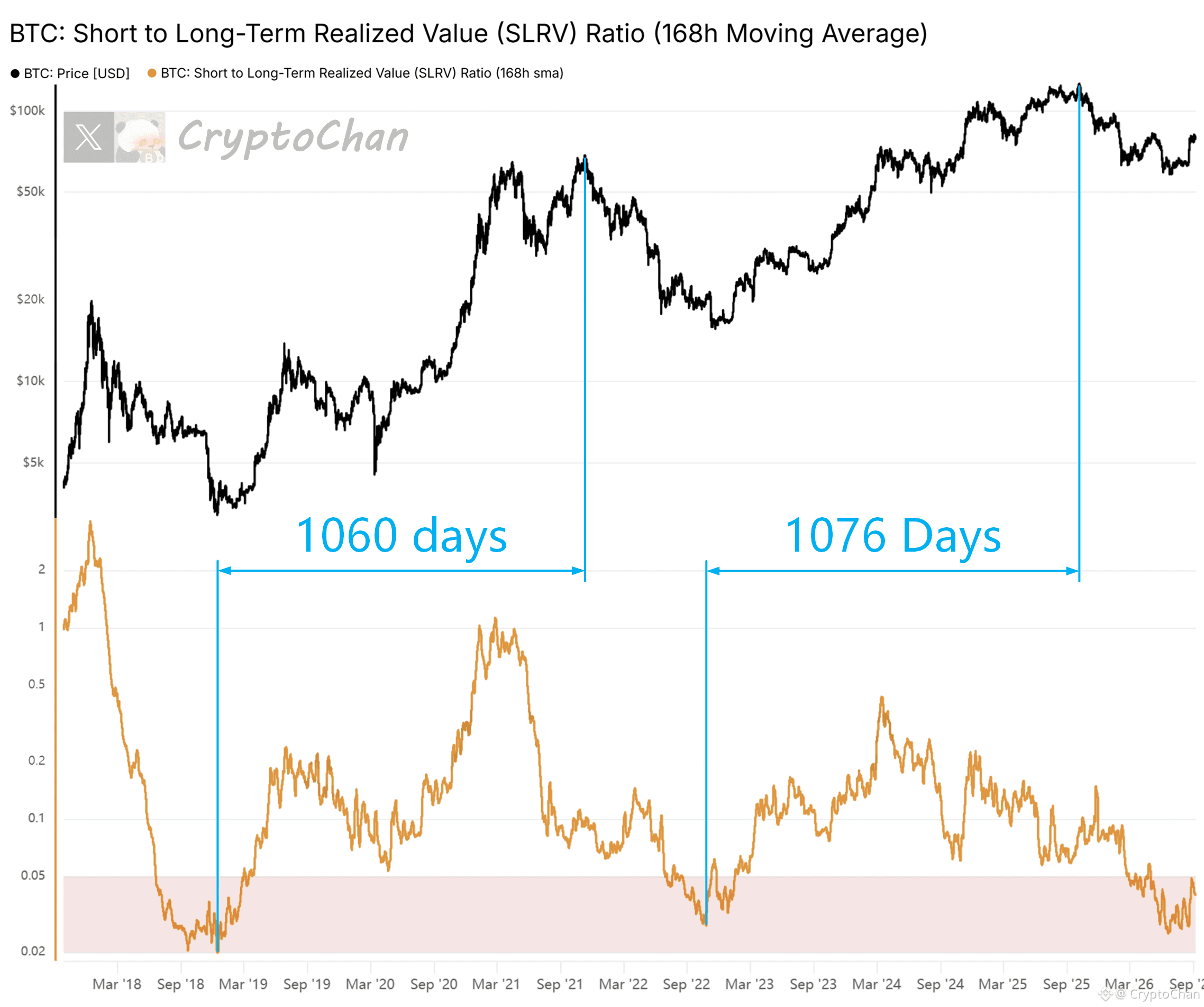
【Four-Year Cycle Total Engraving Series (17)】

The peak value of this indicator in June 2015 differs from the peak value of this indicator in March 2019 by 1385 days.
The peak value of this indicator in March 2019 differs from the peak value of this indicator in January 2023 by 1380 days.
The peak value of this indicator has passed 1068 days since January 2023.

The indicator at the top of the chart is the BTC price; the indicators at the bottom are the ratio of the "on-chain long-term holders' average purchase price" to the "on-chain short-term holders' average purchase price."
BTC $60k This wave, the median MVRV of Bitcoin dropped to a low of 1.008 It is worth mentioning that in 2022, during the $17.6k wave, this indicator dropped to a low of 0.998 ┌── 📑 𝗗𝗲𝗲𝗽 𝗗𝗶𝘃𝗲 | Indicator Explanation ──┐ Median MVRV (Median MVRV) = Current Market Price / Median Realized Price Median Realized Price: This is the median price of all tokens in Bitcoin's supply at the last on-chain movement (half of the bitcoins moved above this price; half moved below this price). Unlike the average, it takes the middle value, which better resists the influence of extreme values (such as large whale transactions), representing the acquisition cost of the 'median' holder (the current median realized price is $62,449) Median MVRV captures the perspective of retail or medium-sized holders better than Standard MVRV, because the median ignores extreme high/low values Median MVRV > 1: Market price is above the median acquisition price, indicating that the asset may be overvalued, and holders overall have unrealized profits, with potential selling pressure increasing Median MVRV < 1: Market price is below the median acquisition price, indicating undervaluation, many holders are in a state of loss, which may attract buying or accumulation
BTC $60k This wave, the median MVRV of Bitcoin dropped to a low of 1.008

It is worth mentioning that in 2022, during the $17.6k wave, this indicator dropped to a low of 0.998

┌── 📑 𝗗𝗲𝗲𝗽 𝗗𝗶𝘃𝗲 | Indicator Explanation ──┐

Median MVRV (Median MVRV) = Current Market Price / Median Realized Price

Median Realized Price: This is the median price of all tokens in Bitcoin's supply at the last on-chain movement (half of the bitcoins moved above this price; half moved below this price). Unlike the average, it takes the middle value, which better resists the influence of extreme values (such as large whale transactions), representing the acquisition cost of the 'median' holder (the current median realized price is $62,449)

Median MVRV captures the perspective of retail or medium-sized holders better than Standard MVRV, because the median ignores extreme high/low values

Median MVRV > 1: Market price is above the median acquisition price, indicating that the asset may be overvalued, and holders overall have unrealized profits, with potential selling pressure increasing
Median MVRV < 1: Market price is below the median acquisition price, indicating undervaluation, many holders are in a state of loss, which may attract buying or accumulation
【Four-Year Cycle Series Update】The current indicator in the chart has fallen to 1.40 In 2014, when this indicator fell to 1.40, it took 70 days to reach the bear bottom ($0.15k) In 2018, when this indicator fell to 1.40, it took 73 days to reach the bear bottom ($3.1k) In 2022, when this indicator fell to 1.40, it took 22 days to reach the secondary bear bottom ($17.6k)
【Four-Year Cycle Series Update】The current indicator in the chart has fallen to 1.40

In 2014, when this indicator fell to 1.40, it took 70 days to reach the bear bottom ($0.15k)
In 2018, when this indicator fell to 1.40, it took 73 days to reach the bear bottom ($3.1k)
In 2022, when this indicator fell to 1.40, it took 22 days to reach the secondary bear bottom ($17.6k)
CryptoChan
·
--
【Four-Year Cycle Total Engraving Series (18)】The current indicator in the chart has dropped to 1.42

In 2014, the indicator dropped to 1.42, and after 76 days, it reached the bear bottom ($0.15k)
In 2018, the indicator dropped to 1.42, and after 82 days, it reached the bear bottom ($3.1k)
In 2022, the indicator dropped to 1.42, and after 26 days, it reached the secondary bear bottom ($17.6k)

The gray line at the top of the chart represents the BTC price; the yellow line represents the average cost price of short-term BTC holders; the magenta line represents the average cost price of long-term BTC holders (excluding holdings for more than 10 years)
The indicator at the bottom of the chart is the ratio of "Average Cost Price of Short-Term BTC Holders" to "Average Cost Price of Long-Term BTC Holders (excluding >10y holdings)" (i.e., yellow line / magenta line)

The definition of the average cost price of short-term BTC holders: the average cost of investors holding Bitcoin for less than 155 days. Meaning: Reflects the cost basis of recent buyers, who are sensitive to price fluctuations and are likely to sell during downturns. It is often used as a short-term market sentiment indicator — prices above this average in a bull market, and falling below it in a bear market may exacerbate selling

The definition of the average cost price of long-term BTC holders: the average cost of investors holding Bitcoin for more than 155 days, but excluding holdings for more than 10 years (these may be lost or never moved, like Satoshi's coins). Meaning: Focuses on "active" long-term holders, providing a more realistic cost basis. It is often used as a reference for market support levels — it may become a price bottom in a bear market

The ratio of the two (short-term average / long-term average) means: Reflects the market cycle stage and participant behavior:
Ratio > 1: Short-term buyer cost is high (new funds entering at high prices), sentiment is optimistic but may be overheated
Ratio < 1: Bear market or bottom signal, short-term buyer cost is low (entering at low prices), weak hands are cleared out, and the market may recover
Overall trend: Ratio rising = bull market continuation; falling = bear market or distribution phase. Excluding holdings for more than 10 years makes the ratio more accurately capture cycle turns; historically, < 1 has often been a long-term buying opportunity.
Further research results generally conform to intuition. As the elimination of long-term holdings progresses, the degree to which BTC: MVRV breaks through the lower line deepens. Interestingly, the degree to which MVRV breaks through the lower line when excluding coins held for more than 5 years has weakened. This may indicate that overly pursuing the effect of elimination may backfire.
Further research results generally conform to intuition. As the elimination of long-term holdings progresses, the degree to which BTC: MVRV breaks through the lower line deepens.

Interestingly, the degree to which MVRV breaks through the lower line when excluding coins held for more than 5 years has weakened. This may indicate that overly pursuing the effect of elimination may backfire.
CryptoChan
·
--
The -1 standard deviation (bottom line) of the std-adjusted MVRV over a 4-year rolling time window indeed broke through $6w this time.

If we use MVRV excluding holders for >10y/7y/5y, there may be more nuanced effects worth further research.
The -1 standard deviation (bottom line) of the std-adjusted MVRV over a 4-year rolling time window indeed broke through $6w this time. If we use MVRV excluding holders for >10y/7y/5y, there may be more nuanced effects worth further research.
The -1 standard deviation (bottom line) of the std-adjusted MVRV over a 4-year rolling time window indeed broke through $6w this time.

If we use MVRV excluding holders for >10y/7y/5y, there may be more nuanced effects worth further research.
【Four-Year Cycle Series Update】The current indicator in the chart has dropped to 1.41 In 2014, the indicator dropped to 1.41 and after 73 days reached the bear bottom ($0.15k) In 2018, the indicator dropped to 1.41 and after 78 days reached the bear bottom ($3.1k) In 2022, the indicator dropped to 1.41 and after 23 days reached the secondary bear bottom ($17.6k)
【Four-Year Cycle Series Update】The current indicator in the chart has dropped to 1.41

In 2014, the indicator dropped to 1.41 and after 73 days reached the bear bottom ($0.15k)
In 2018, the indicator dropped to 1.41 and after 78 days reached the bear bottom ($3.1k)
In 2022, the indicator dropped to 1.41 and after 23 days reached the secondary bear bottom ($17.6k)
CryptoChan
·
--
【Four-Year Cycle Total Engraving Series (18)】The current indicator in the chart has dropped to 1.42

In 2014, the indicator dropped to 1.42, and after 76 days, it reached the bear bottom ($0.15k)
In 2018, the indicator dropped to 1.42, and after 82 days, it reached the bear bottom ($3.1k)
In 2022, the indicator dropped to 1.42, and after 26 days, it reached the secondary bear bottom ($17.6k)

The gray line at the top of the chart represents the BTC price; the yellow line represents the average cost price of short-term BTC holders; the magenta line represents the average cost price of long-term BTC holders (excluding holdings for more than 10 years)
The indicator at the bottom of the chart is the ratio of "Average Cost Price of Short-Term BTC Holders" to "Average Cost Price of Long-Term BTC Holders (excluding >10y holdings)" (i.e., yellow line / magenta line)

The definition of the average cost price of short-term BTC holders: the average cost of investors holding Bitcoin for less than 155 days. Meaning: Reflects the cost basis of recent buyers, who are sensitive to price fluctuations and are likely to sell during downturns. It is often used as a short-term market sentiment indicator — prices above this average in a bull market, and falling below it in a bear market may exacerbate selling

The definition of the average cost price of long-term BTC holders: the average cost of investors holding Bitcoin for more than 155 days, but excluding holdings for more than 10 years (these may be lost or never moved, like Satoshi's coins). Meaning: Focuses on "active" long-term holders, providing a more realistic cost basis. It is often used as a reference for market support levels — it may become a price bottom in a bear market

The ratio of the two (short-term average / long-term average) means: Reflects the market cycle stage and participant behavior:
Ratio > 1: Short-term buyer cost is high (new funds entering at high prices), sentiment is optimistic but may be overheated
Ratio < 1: Bear market or bottom signal, short-term buyer cost is low (entering at low prices), weak hands are cleared out, and the market may recover
Overall trend: Ratio rising = bull market continuation; falling = bear market or distribution phase. Excluding holdings for more than 10 years makes the ratio more accurately capture cycle turns; historically, < 1 has often been a long-term buying opportunity.
Before the last drop of the bear market in 2018, Bitcoin MVRV fell to a low of 1.15 Currently, this wave at $60,000, Bitcoin MVRV fell to a low of 1.14
Before the last drop of the bear market in 2018, Bitcoin MVRV fell to a low of 1.15

Currently, this wave at $60,000, Bitcoin MVRV fell to a low of 1.14
CryptoChan
·
--
"Bottom callback at the end of June" carved
"Mid-August stage top" carved
"Bottom callback at the end of August - beginning of September" carved
"Final bull top from mid-September to mid-October" or also carved

This round is complete, carving finished!😎
【Four-Year Cycle Total Engraving Series (18)】The current indicator in the chart has dropped to 1.42 In 2014, the indicator dropped to 1.42, and after 76 days, it reached the bear bottom ($0.15k) In 2018, the indicator dropped to 1.42, and after 82 days, it reached the bear bottom ($3.1k) In 2022, the indicator dropped to 1.42, and after 26 days, it reached the secondary bear bottom ($17.6k) The gray line at the top of the chart represents the BTC price; the yellow line represents the average cost price of short-term BTC holders; the magenta line represents the average cost price of long-term BTC holders (excluding holdings for more than 10 years) The indicator at the bottom of the chart is the ratio of "Average Cost Price of Short-Term BTC Holders" to "Average Cost Price of Long-Term BTC Holders (excluding >10y holdings)" (i.e., yellow line / magenta line) The definition of the average cost price of short-term BTC holders: the average cost of investors holding Bitcoin for less than 155 days. Meaning: Reflects the cost basis of recent buyers, who are sensitive to price fluctuations and are likely to sell during downturns. It is often used as a short-term market sentiment indicator — prices above this average in a bull market, and falling below it in a bear market may exacerbate selling The definition of the average cost price of long-term BTC holders: the average cost of investors holding Bitcoin for more than 155 days, but excluding holdings for more than 10 years (these may be lost or never moved, like Satoshi's coins). Meaning: Focuses on "active" long-term holders, providing a more realistic cost basis. It is often used as a reference for market support levels — it may become a price bottom in a bear market The ratio of the two (short-term average / long-term average) means: Reflects the market cycle stage and participant behavior: Ratio > 1: Short-term buyer cost is high (new funds entering at high prices), sentiment is optimistic but may be overheated Ratio < 1: Bear market or bottom signal, short-term buyer cost is low (entering at low prices), weak hands are cleared out, and the market may recover Overall trend: Ratio rising = bull market continuation; falling = bear market or distribution phase. Excluding holdings for more than 10 years makes the ratio more accurately capture cycle turns; historically, < 1 has often been a long-term buying opportunity.
【Four-Year Cycle Total Engraving Series (18)】The current indicator in the chart has dropped to 1.42

In 2014, the indicator dropped to 1.42, and after 76 days, it reached the bear bottom ($0.15k)
In 2018, the indicator dropped to 1.42, and after 82 days, it reached the bear bottom ($3.1k)
In 2022, the indicator dropped to 1.42, and after 26 days, it reached the secondary bear bottom ($17.6k)

The gray line at the top of the chart represents the BTC price; the yellow line represents the average cost price of short-term BTC holders; the magenta line represents the average cost price of long-term BTC holders (excluding holdings for more than 10 years)
The indicator at the bottom of the chart is the ratio of "Average Cost Price of Short-Term BTC Holders" to "Average Cost Price of Long-Term BTC Holders (excluding >10y holdings)" (i.e., yellow line / magenta line)

The definition of the average cost price of short-term BTC holders: the average cost of investors holding Bitcoin for less than 155 days. Meaning: Reflects the cost basis of recent buyers, who are sensitive to price fluctuations and are likely to sell during downturns. It is often used as a short-term market sentiment indicator — prices above this average in a bull market, and falling below it in a bear market may exacerbate selling

The definition of the average cost price of long-term BTC holders: the average cost of investors holding Bitcoin for more than 155 days, but excluding holdings for more than 10 years (these may be lost or never moved, like Satoshi's coins). Meaning: Focuses on "active" long-term holders, providing a more realistic cost basis. It is often used as a reference for market support levels — it may become a price bottom in a bear market

The ratio of the two (short-term average / long-term average) means: Reflects the market cycle stage and participant behavior:
Ratio > 1: Short-term buyer cost is high (new funds entering at high prices), sentiment is optimistic but may be overheated
Ratio < 1: Bear market or bottom signal, short-term buyer cost is low (entering at low prices), weak hands are cleared out, and the market may recover
Overall trend: Ratio rising = bull market continuation; falling = bear market or distribution phase. Excluding holdings for more than 10 years makes the ratio more accurately capture cycle turns; historically, < 1 has often been a long-term buying opportunity.
CryptoChan
·
--
【Four-Year Cycle Total Engraving Series (17)】

The peak value of this indicator in June 2015 differs from the peak value of this indicator in March 2019 by 1385 days.
The peak value of this indicator in March 2019 differs from the peak value of this indicator in January 2023 by 1380 days.
The peak value of this indicator has passed 1068 days since January 2023.

The indicator at the top of the chart is the BTC price; the indicators at the bottom are the ratio of the "on-chain long-term holders' average purchase price" to the "on-chain short-term holders' average purchase price."
【BTC Five-Line Chart (MVRV Standard Deviation Version) Update】Current—— Line 1: $52,187 Line 2: $74,627 Line 3: $97,066 Line 4: $141,944 Line 5: $186,823 The indicators in the chart are based on the statistical standard deviation of the Bitcoin MVRV valuation price model. This model processes Bitcoin MVRV using statistical standard deviation by introducing cumulative arithmetic averages and cumulative standard deviations, employing 5 lines (-1.0σ, -0.5σ, 0σ, +1.0σ, +2.0σ for a total of 5 dimensions) to completely encompass and categorize Bitcoin's historical prices from peak to trough.
【BTC Five-Line Chart (MVRV Standard Deviation Version) Update】Current——

Line 1: $52,187
Line 2: $74,627
Line 3: $97,066
Line 4: $141,944
Line 5: $186,823

The indicators in the chart are based on the statistical standard deviation of the Bitcoin MVRV valuation price model. This model processes Bitcoin MVRV using statistical standard deviation by introducing cumulative arithmetic averages and cumulative standard deviations, employing 5 lines (-1.0σ, -0.5σ, 0σ, +1.0σ, +2.0σ for a total of 5 dimensions) to completely encompass and categorize Bitcoin's historical prices from peak to trough.
【Four-Year Cycle Series Update】The current indicator in the chart has dropped to 1.43 In 2014, this indicator fell from 1.43 to 1, taking 108 days In 2018, this indicator fell from 1.43 to 1, taking 130 days In 2022, this indicator fell from 1.43 to 1, taking 117 days Note: The indicator reaching 1 indicates a basic bear bottom
【Four-Year Cycle Series Update】The current indicator in the chart has dropped to 1.43

In 2014, this indicator fell from 1.43 to 1, taking 108 days
In 2018, this indicator fell from 1.43 to 1, taking 130 days
In 2022, this indicator fell from 1.43 to 1, taking 117 days

Note: The indicator reaching 1 indicates a basic bear bottom
CryptoChan
·
--
The current index in the chart has dropped to 1.45

In 2014, this index dropped from 1.45 to 1, taking 119 days
In 2018, this index dropped from 1.45 to 1, taking 147 days
In 2022, this index dropped from 1.45 to 1, taking 123 days

Note: An index of 1 generally indicates a bear bottom

The gray line above in the chart represents the BTC price; the yellow line represents the average cost price of short-term BTC holders; the magenta line represents the average cost price of long-term BTC holders (excluding coins held for more than 10 years)

The indicator at the bottom of the chart is the ratio of “average cost price of short-term BTC holders” to “average cost price of long-term BTC holders” (yellow line / magenta line)

The average cost price of short-term BTC holders is defined as investors or entities holding Bitcoin for less than 155 days. This indicator reflects the cost basis of recent market entrants, who are often more sensitive to price fluctuations and more likely to sell positions during market volatility or downturns. It is often viewed as a barometer of short-term market sentiment and momentum: in a bull market, prices are usually above this average cost price; in a bear market, prices falling below this level may trigger additional selling pressure.

The average cost price of long-term BTC holders is defined as investors or entities holding Bitcoin for more than 155 days. This indicator excludes coins held for more than 10 years to focus on a more “active” group of long-term holders. The cost of these extremely long-held coins is very low and they rarely move, thus excluding them provides a more realistic LTH cost basis that reflects the average holding price of long-term investors who may actually participate in buying and selling during market cycles. This indicator is often regarded as a reference for market support levels: in a bear market, it may act as a potential price bottom.

The ratio of the two reflects the phases of the Bitcoin market cycle and the dynamics of participant behavior:
Ratio > 1: Indicates that the average cost of short-term holders is higher than that of adjusted long-term holders. This usually occurs in bull markets, where recent entrants buy at higher prices, while long-term holders have a lower cost basis. This suggests optimistic market sentiment and strong inflow of new funds, but may also indicate speculative overheating or potential pullbacks.
Ratio < 1: Indicates that the average cost of short-term holders is lower than that of adjusted long-term holders. This is common in bear markets or market bottoms, where recent entrants buy at lower prices, while long-term holders have a higher cost basis. This often signals capitulation, suggesting that weak hands have been cleared out, and the market may be turning towards recovery or the start of a bull market.
Eternal Cycle💎
Eternal Cycle💎
CryptoChan
·
--
"Bottom callback at the end of June" carved
"Mid-August stage top" carved
"Bottom callback at the end of August - beginning of September" carved
"Final bull top from mid-September to mid-October" or also carved

This round is complete, carving finished!😎
【Four-Year Cycle Series Update】The current index in the chart has fallen to 2.56 In 2014, this index dropped from 2.56 to 1, taking 99 days In 2018, this index dropped from 2.56 to 1, taking 180 days In 2022, this index dropped from 2.56 to 1, taking 262 days Note: The index reaching 1 indicates a basic bear bottom
【Four-Year Cycle Series Update】The current index in the chart has fallen to 2.56

In 2014, this index dropped from 2.56 to 1, taking 99 days
In 2018, this index dropped from 2.56 to 1, taking 180 days
In 2022, this index dropped from 2.56 to 1, taking 262 days

Note: The index reaching 1 indicates a basic bear bottom
CryptoChan
·
--
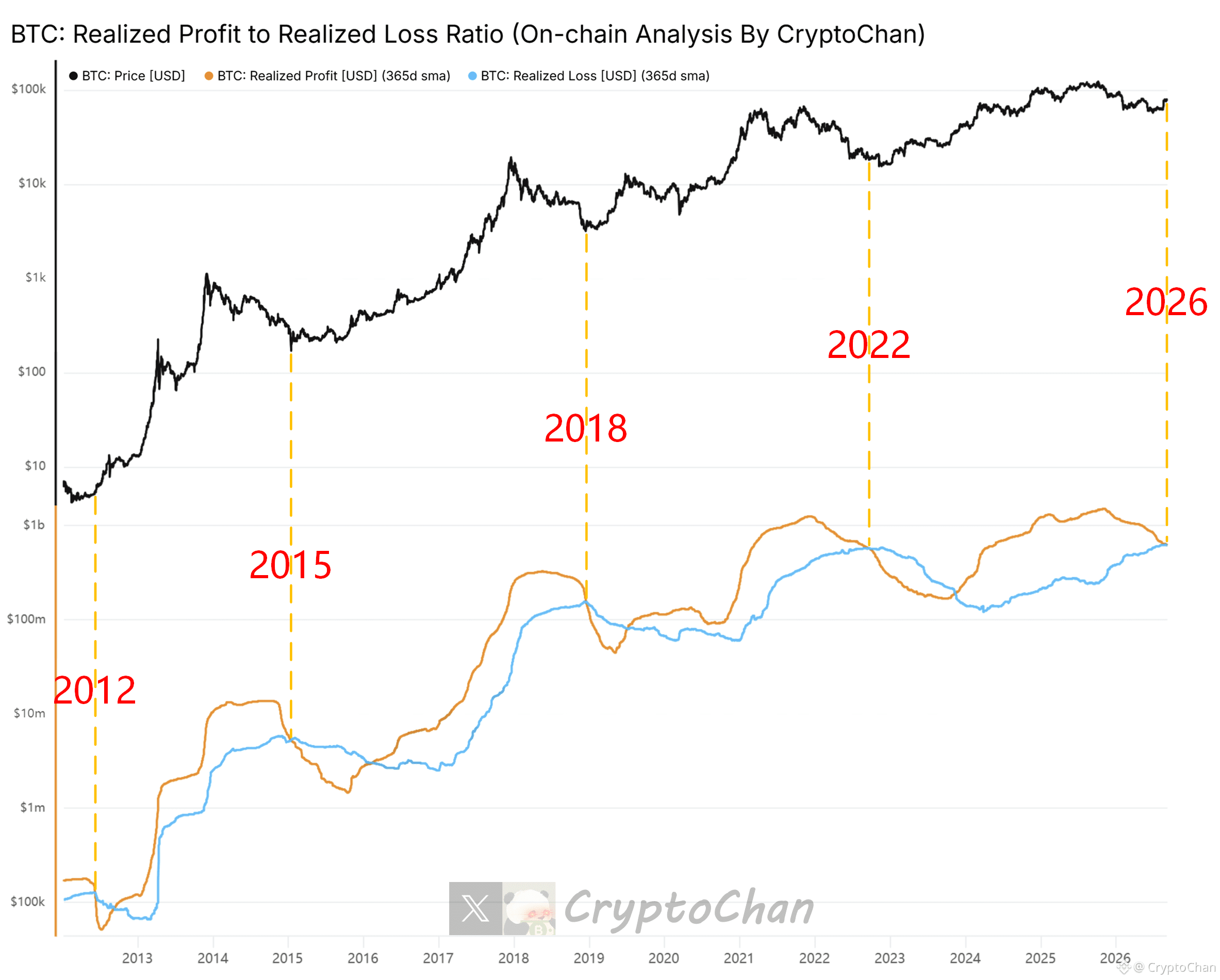
【Four-Year Cycle Total Record Series (13)】

In February 2016, Bitcoin's realized profit (365-day MA) exceeded realized losses (365-day MA) after 673 days, reaching the peak of the realized profit-loss ratio, with a 2-day error from the bull market peak in 2017.

In July 2019, Bitcoin's realized profit (365-day MA) exceeded realized losses (365-day MA) after 650 days, reaching the peak of the realized profit-loss ratio, with a 2-day error from the peak in the first half of 2021.

In November 2023, Bitcoin's realized profit (365-day MA) exceeded realized losses (365-day MA) after 694 days, reaching the peak of the realized profit-loss ratio, with a 1-day error from $126k in 2025.

The three indicators at the top of the chart are BTC price; Bitcoin's realized profit (365-day MA); and Bitcoin's realized losses (365-day MA). The indicator at the bottom of the chart is the ratio of Bitcoin's realized profit (365-day MA) to Bitcoin's realized losses (365-day MA), also known as the "Realized Profit-Loss Ratio (365-day MA)."

This ratio reflects the overall profit and loss status of market participants by comparing the moving average of investors' realized profits (the portion where the selling price is higher than the buying price) and losses (the portion where the selling price is lower than the buying price) over the past 365 days.

In a bull market, the profit-loss ratio is usually higher because investors tend to lock in profits at high prices.
In a bear market, this ratio is usually lower because investors may sell at a loss, reflecting market panic or capitulation behavior.

Using the 365-day moving average smooths short-term fluctuations and highlights long-term trends. This indicator is suitable for assessing whether the market is in a state of overheating (high ratio) or excessive panic (low ratio), making it a powerful tool for evaluating market cycles and trends.
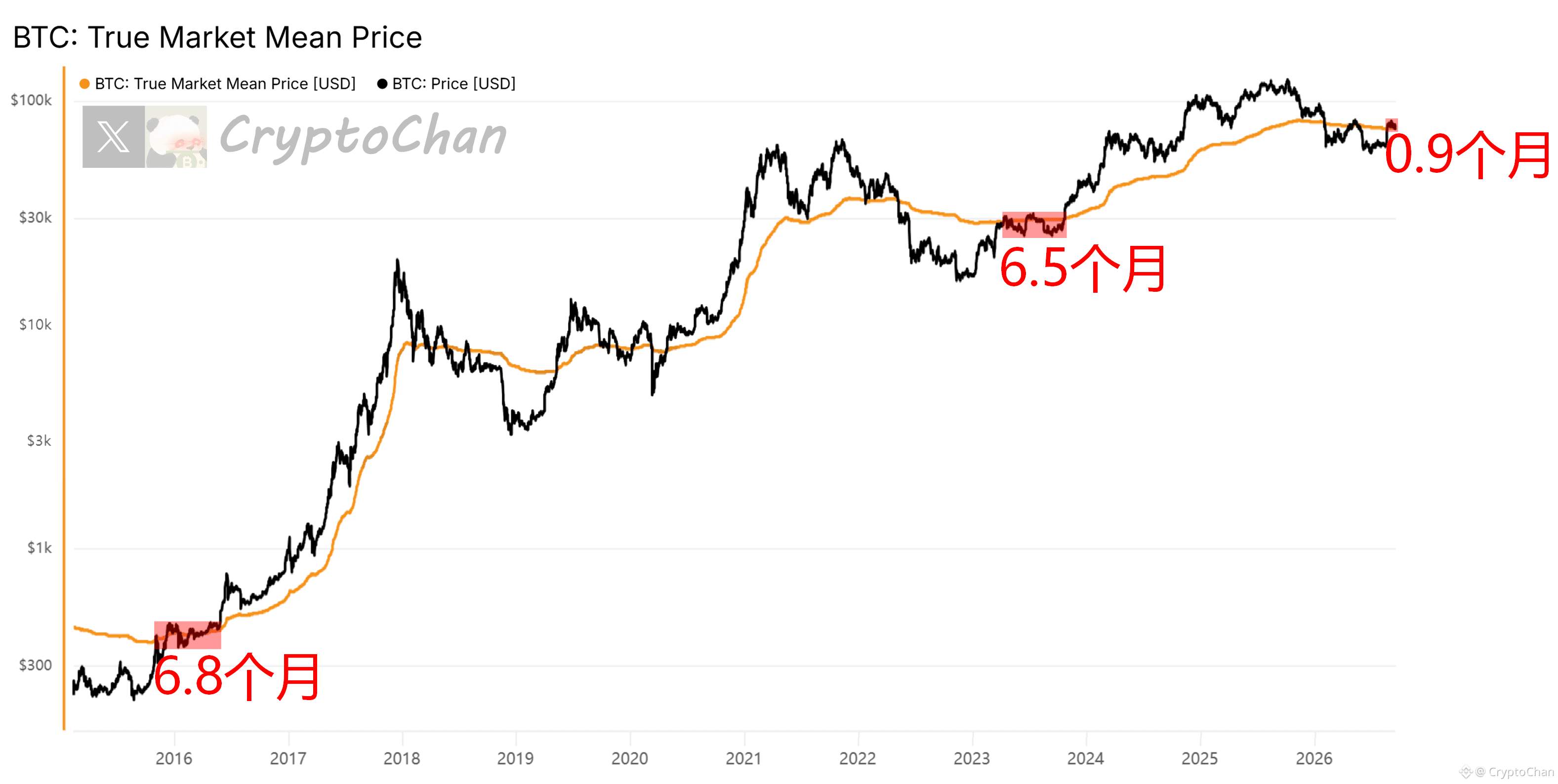
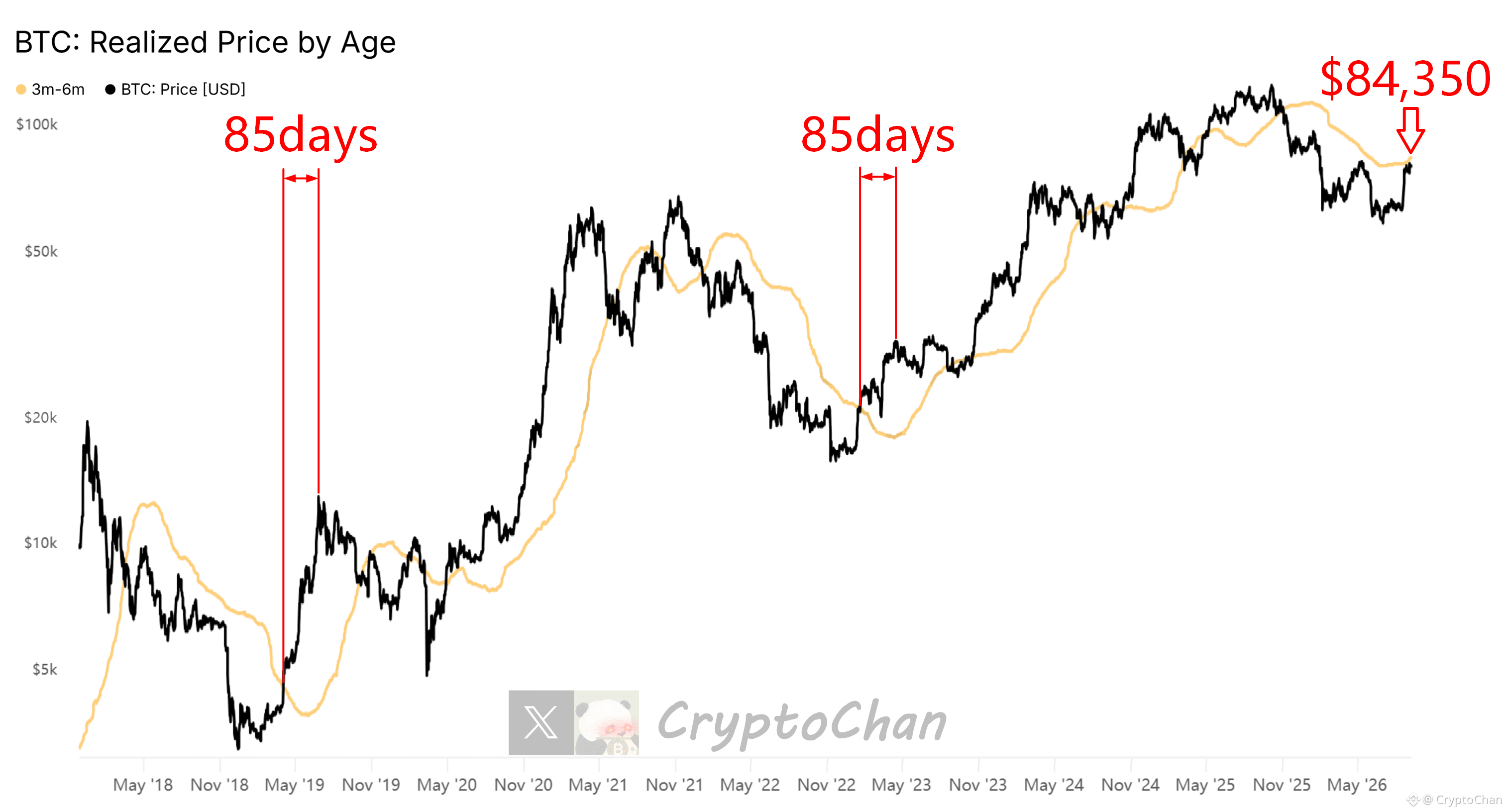
【Four-Year Cycle Series Update】Underwater activities are in full swing Note: Current BTC: <7y Realized Price value is $71,962
【Four-Year Cycle Series Update】Underwater activities are in full swing

Note: Current BTC: <7y Realized Price value is $71,962
CryptoChan
·
--
【Four-Year Cycle Total Engraving Series (16)】

Previous round coin price above total of 1136 days
Last round coin price above total of 1143 days
This round coin price above total has been 988 days

The indicators in the figure are BTC price and BTC: Realized Price (modified, excluding coins held for more than 7 years from the calculation), coin price > Realized Price is counted as above

BTC: Realized Price is an on-chain indicator that excludes those bitcoins held for more than 7 years when calculating (these coins are often seen as very long-term holdings, lost, or inactive supply, and will not easily enter market circulation)

This indicator reflects the average buying price of chips. Specifically, it represents the average cost price of relatively more active market participants (those holding coins for less than 7 years), which can better capture current market dynamics, potential selling pressure, and investor sentiment.
The current index in the chart has dropped to 1.45 In 2014, this index dropped from 1.45 to 1, taking 119 days In 2018, this index dropped from 1.45 to 1, taking 147 days In 2022, this index dropped from 1.45 to 1, taking 123 days Note: An index of 1 generally indicates a bear bottom The gray line above in the chart represents the BTC price; the yellow line represents the average cost price of short-term BTC holders; the magenta line represents the average cost price of long-term BTC holders (excluding coins held for more than 10 years) The indicator at the bottom of the chart is the ratio of “average cost price of short-term BTC holders” to “average cost price of long-term BTC holders” (yellow line / magenta line) The average cost price of short-term BTC holders is defined as investors or entities holding Bitcoin for less than 155 days. This indicator reflects the cost basis of recent market entrants, who are often more sensitive to price fluctuations and more likely to sell positions during market volatility or downturns. It is often viewed as a barometer of short-term market sentiment and momentum: in a bull market, prices are usually above this average cost price; in a bear market, prices falling below this level may trigger additional selling pressure. The average cost price of long-term BTC holders is defined as investors or entities holding Bitcoin for more than 155 days. This indicator excludes coins held for more than 10 years to focus on a more “active” group of long-term holders. The cost of these extremely long-held coins is very low and they rarely move, thus excluding them provides a more realistic LTH cost basis that reflects the average holding price of long-term investors who may actually participate in buying and selling during market cycles. This indicator is often regarded as a reference for market support levels: in a bear market, it may act as a potential price bottom. The ratio of the two reflects the phases of the Bitcoin market cycle and the dynamics of participant behavior: Ratio > 1: Indicates that the average cost of short-term holders is higher than that of adjusted long-term holders. This usually occurs in bull markets, where recent entrants buy at higher prices, while long-term holders have a lower cost basis. This suggests optimistic market sentiment and strong inflow of new funds, but may also indicate speculative overheating or potential pullbacks. Ratio < 1: Indicates that the average cost of short-term holders is lower than that of adjusted long-term holders. This is common in bear markets or market bottoms, where recent entrants buy at lower prices, while long-term holders have a higher cost basis. This often signals capitulation, suggesting that weak hands have been cleared out, and the market may be turning towards recovery or the start of a bull market.
The current index in the chart has dropped to 1.45

In 2014, this index dropped from 1.45 to 1, taking 119 days
In 2018, this index dropped from 1.45 to 1, taking 147 days
In 2022, this index dropped from 1.45 to 1, taking 123 days

Note: An index of 1 generally indicates a bear bottom

The gray line above in the chart represents the BTC price; the yellow line represents the average cost price of short-term BTC holders; the magenta line represents the average cost price of long-term BTC holders (excluding coins held for more than 10 years)

The indicator at the bottom of the chart is the ratio of “average cost price of short-term BTC holders” to “average cost price of long-term BTC holders” (yellow line / magenta line)

The average cost price of short-term BTC holders is defined as investors or entities holding Bitcoin for less than 155 days. This indicator reflects the cost basis of recent market entrants, who are often more sensitive to price fluctuations and more likely to sell positions during market volatility or downturns. It is often viewed as a barometer of short-term market sentiment and momentum: in a bull market, prices are usually above this average cost price; in a bear market, prices falling below this level may trigger additional selling pressure.

The average cost price of long-term BTC holders is defined as investors or entities holding Bitcoin for more than 155 days. This indicator excludes coins held for more than 10 years to focus on a more “active” group of long-term holders. The cost of these extremely long-held coins is very low and they rarely move, thus excluding them provides a more realistic LTH cost basis that reflects the average holding price of long-term investors who may actually participate in buying and selling during market cycles. This indicator is often regarded as a reference for market support levels: in a bear market, it may act as a potential price bottom.

The ratio of the two reflects the phases of the Bitcoin market cycle and the dynamics of participant behavior:
Ratio > 1: Indicates that the average cost of short-term holders is higher than that of adjusted long-term holders. This usually occurs in bull markets, where recent entrants buy at higher prices, while long-term holders have a lower cost basis. This suggests optimistic market sentiment and strong inflow of new funds, but may also indicate speculative overheating or potential pullbacks.
Ratio < 1: Indicates that the average cost of short-term holders is lower than that of adjusted long-term holders. This is common in bear markets or market bottoms, where recent entrants buy at lower prices, while long-term holders have a higher cost basis. This often signals capitulation, suggesting that weak hands have been cleared out, and the market may be turning towards recovery or the start of a bull market.
【Big Bold Conjecture of the 'Little Bear Bottom'】 Everyone has become increasingly proficient at predicting the bear bottom price, but there seems to be a lack of a certain voice in the market, namely: If this bull peak has not reached the historical expected level, then will the bear bottom still drop to the historical expected level? Coincidentally, I have a price model based on the BTC: MVRV indicator, which statistically normalizes the MVRV by introducing cumulative arithmetic mean and cumulative standard deviation, using 5 lines to completely encompass and divide Bitcoin's historical prices Historically, under normal circumstances, the transition from bear to bull and then back to bear would see the price rise from Line 1 to Line 5 and then drop back to Line 1 (taking about 4 years) However, the 'little bull market' in 2019 was an exception, where the price rose from Line 1 to Line 4 and then dropped to Line 2 The similarity in this bull market is that the price also rose from Line 1 to Line 4 and then dropped to Line 2 (currently, the price at Line 2 is $75,268) Therefore, this cat proposes a Big Bold Conjecture: Since this bull peak has not risen to the historical expected height (Line 5), then the bear bottom will not drop to the historical expected depth (Line 1) Perhaps this bull market is just an elongated version of the 'little bull'? Perhaps 74k is the 'little bear bottom'? Everything awaits time and the cycle to provide answers.
【Big Bold Conjecture of the 'Little Bear Bottom'】

Everyone has become increasingly proficient at predicting the bear bottom price, but there seems to be a lack of a certain voice in the market, namely: If this bull peak has not reached the historical expected level, then will the bear bottom still drop to the historical expected level?

Coincidentally, I have a price model based on the BTC: MVRV indicator, which statistically normalizes the MVRV by introducing cumulative arithmetic mean and cumulative standard deviation, using 5 lines to completely encompass and divide Bitcoin's historical prices

Historically, under normal circumstances, the transition from bear to bull and then back to bear would see the price rise from Line 1 to Line 5 and then drop back to Line 1 (taking about 4 years)

However, the 'little bull market' in 2019 was an exception, where the price rose from Line 1 to Line 4 and then dropped to Line 2

The similarity in this bull market is that the price also rose from Line 1 to Line 4 and then dropped to Line 2 (currently, the price at Line 2 is $75,268)

Therefore, this cat proposes a Big Bold Conjecture: Since this bull peak has not risen to the historical expected height (Line 5), then the bear bottom will not drop to the historical expected depth (Line 1)

Perhaps this bull market is just an elongated version of the 'little bull'? Perhaps 74k is the 'little bear bottom'? Everything awaits time and the cycle to provide answers.
At present, the last round of bull market is over, and the bear market has just begun. The gray line in the chart represents the BTC price; the yellow line represents the average cost price for short-term holders of BTC; the magenta line represents the average cost price for long-term holders of BTC (excluding coins held for more than 10 years). Indicator Introduction—— The average cost price indicator for short-term holders of BTC: the average entry cost for short-term holders (holding coins for less than 155 days) (the price at the last transfer). It reflects the profit/loss status of the short-term group; when the price is above the average price, profits are made, making it easy to hold; when below, losses occur, which may lead to selling pressure or support levels, identifying the bottom of the mid-to-short term market. The average cost price for long-term holders of BTC (excluding coins held for more than 10 years) indicator: the average entry cost for long-term holders (holding coins for more than 155 days, excluding those held for more than 10 years), focusing on active long-term groups to avoid zombie coins distortions. It reflects the profit/loss status of the long-term group; when the price is above the average price, profits are made, making it easy to take profits and create upward resistance; when below, losses occur but provide downward support, determining the bottom of the bear market or cyclical turning points.
At present, the last round of bull market is over, and the bear market has just begun.

The gray line in the chart represents the BTC price; the yellow line represents the average cost price for short-term holders of BTC; the magenta line represents the average cost price for long-term holders of BTC (excluding coins held for more than 10 years).

Indicator Introduction——
The average cost price indicator for short-term holders of BTC: the average entry cost for short-term holders (holding coins for less than 155 days) (the price at the last transfer). It reflects the profit/loss status of the short-term group; when the price is above the average price, profits are made, making it easy to hold; when below, losses occur, which may lead to selling pressure or support levels, identifying the bottom of the mid-to-short term market.

The average cost price for long-term holders of BTC (excluding coins held for more than 10 years) indicator: the average entry cost for long-term holders (holding coins for more than 155 days, excluding those held for more than 10 years), focusing on active long-term groups to avoid zombie coins distortions. It reflects the profit/loss status of the long-term group; when the price is above the average price, profits are made, making it easy to take profits and create upward resistance; when below, losses occur but provide downward support, determining the bottom of the bear market or cyclical turning points.
【Four-Year Cycle Total Engraving Series Update】Underwater is in full swing Note: Current BTC: <7y Realized Price is $72,162
【Four-Year Cycle Total Engraving Series Update】Underwater is in full swing

Note: Current BTC: <7y Realized Price is $72,162
CryptoChan
·
--
【Four-Year Cycle Total Engraving Series (16)】

Previous round coin price above total of 1136 days
Last round coin price above total of 1143 days
This round coin price above total has been 988 days

The indicators in the figure are BTC price and BTC: Realized Price (modified, excluding coins held for more than 7 years from the calculation), coin price > Realized Price is counted as above

BTC: Realized Price is an on-chain indicator that excludes those bitcoins held for more than 7 years when calculating (these coins are often seen as very long-term holdings, lost, or inactive supply, and will not easily enter market circulation)

This indicator reflects the average buying price of chips. Specifically, it represents the average cost price of relatively more active market participants (those holding coins for less than 7 years), which can better capture current market dynamics, potential selling pressure, and investor sentiment.
【BTC On-chain Indicator Update】 The previous round's price over the water totaled 1136 days The last round's price over the water totaled 1143 days This round's price over the water has totaled 1058 days Note: Current <7y Realized Price value is $72,252
【BTC On-chain Indicator Update】

The previous round's price over the water totaled 1136 days
The last round's price over the water totaled 1143 days
This round's price over the water has totaled 1058 days

Note: Current <7y Realized Price value is $72,252
CryptoChan
·
--
【Four-Year Cycle Total Engraving Series (16)】

Previous round coin price above total of 1136 days
Last round coin price above total of 1143 days
This round coin price above total has been 988 days

The indicators in the figure are BTC price and BTC: Realized Price (modified, excluding coins held for more than 7 years from the calculation), coin price > Realized Price is counted as above

BTC: Realized Price is an on-chain indicator that excludes those bitcoins held for more than 7 years when calculating (these coins are often seen as very long-term holdings, lost, or inactive supply, and will not easily enter market circulation)

This indicator reflects the average buying price of chips. Specifically, it represents the average cost price of relatively more active market participants (those holding coins for less than 7 years), which can better capture current market dynamics, potential selling pressure, and investor sentiment.
【BTC On-Chain Indicator Update】The current indicator in the chart has fallen to 2.75 In 2014, this indicator fell from 2.75 to 1, taking 113 days In 2018, this indicator fell from 2.75 to 1, taking 208 days In 2022, this indicator fell from 2.75 to 1, taking 269 days Note: The indicator reaching 1 indicates a basic bear bottom
【BTC On-Chain Indicator Update】The current indicator in the chart has fallen to 2.75

In 2014, this indicator fell from 2.75 to 1, taking 113 days
In 2018, this indicator fell from 2.75 to 1, taking 208 days
In 2022, this indicator fell from 2.75 to 1, taking 269 days

Note: The indicator reaching 1 indicates a basic bear bottom
CryptoChan
·
--
The current indicator in the chart has dropped to 3.16

In 2014, this indicator fell from 3.16 to 1, taking 285 days
In 2018, this indicator dropped from 3.16 to 1, taking 274 days
In 2022, this indicator fell from 3.16 to 1, taking 296 days

The upper indicator in the chart represents the BTC price;
The middle indicator in the chart represents the realized profit of Bitcoin (365-day MA) and the realized loss of Bitcoin (365-day MA);
The lower indicator in the chart is the ratio of the realized profit of Bitcoin (365-day MA) to the realized loss of Bitcoin (365-day MA), also known as the 'Realized Profit and Loss Ratio (365-day MA)'

This ratio reflects the overall profit and loss status of market participants by comparing the moving average of the profits realized by investors (the portion where the selling price is higher than the buying price) and the losses (the portion where the selling price is lower than the buying price) over the past 365 days

In a bull market, the profit and loss ratio is usually higher, as investors tend to lock in profits at high prices
In a bear market, this ratio is usually lower, as investors may sell at a loss, reflecting market panic or capitulation behavior

The 365-day moving average smooths out short-term fluctuations and highlights long-term trends. This indicator is suitable for determining whether the market is in a state of overheating (high ratio) or excessive panic (low ratio), making it a powerful tool for assessing market cycles and trends.
Login to explore more contents
Explore the latest crypto news
⚡️ Be a part of the latests discussions in crypto
💬 Interact with your favorite creators
👍 Enjoy content that interests you
Email / Phone number
Sitemap
Cookie Preferences
Platform T&Cs