

Crypto Breaking
20.5k Posts

Crypto Breaking
 Square Verified+
Report
Block User
Get real-time cryptocurrency news, blockchain updates, market analysis, and expert insights. Explore the latest trends in Bitcoin, Ethereum, DeFi, and Web3.
6 Following
32.9K+ Followers
31.7K+ Liked
Posts
All
Quotes

Article
Musk Says Over 200 AI Startups Could Fail Under “Guppy-Level” RiskElon Musk has warned that more than 200 specialist “neocloud” providers—firms offering AI-focused cloud computing, often backed by GPU-heavy data centers—could face collapse or consolidation as lenders become more selective about funding. Speaking on X, Musk said financing is increasingly being limited to companies with substantial revenue streams beyond AI data center operations.
His remarks point to a broader risk facing the AI infrastructure buildout: even with rapid spending growth, many smaller providers may struggle to turn massive capital expenditures into sustainable, profitable cash flows. The warning follows a Gartner forecast that suggests most neocloud operators will not remain independent through the end of the decade.
Key takeaways
Musk said lenders have largely stopped funding neoclouds unless they have meaningful revenue outside AI data centers.
He argued SpaceX was able to secure $40 billion in debt financing for GPUs due to its investment-grade profile and revenue from Starlink and rocket businesses.
Gartner projects that more than 80% of neocloud providers could cease operating independently by 2030.
Gartner expects very large AI infrastructure spending—nearly $1 trillion in 2026 and $6 trillion from 2027 to 2030—while warning that not all providers will achieve profitable returns.
Musk ties AI cloud financing to real revenue durability
On X, Musk said Sunday that lenders have “largely stopped” providing financing to companies without substantial revenue streams outside their AI cloud operations. In his framing, that shift effectively raises the bar for survival among smaller, specialized providers.
Musk illustrated the difference using SpaceX’s position. He said the company secured $40 billion in debt financing for GPUs, attributing the ability to access funding to its investment-grade status and to revenue generated by Starlink’s satellite internet and its rocket business.
From that perspective, Musk suggested neoclouds may not be able to withstand tighter credit conditions. “That means the 200+ neoclouds are going to see guppy-level death and consolidation,” he wrote, adding that “some will make it through, but not many.”
Gartner forecast flags a profitability gap behind the AI buildout
Musk’s warning aligns with a Gartner forecast released in October. Gartner said more than 80% of neocloud providers could stop operating independently by 2030, citing the difficulty of generating sufficient returns on the massive investments required to support AI workloads.
Gartner’s central concern was not the pace of AI spending, but the economics. In its forecast, the firm projected that AI providers are expected to spend nearly $1 trillion on infrastructure in 2026 and another $6 trillion between 2027 and 2030. Yet it warned that there is insufficient revenue to deliver profitable returns on all of that investment.
The forecast also highlighted structural differences between large and smaller players. Larger cloud companies, according to Gartner, have more diversified revenue streams that can support AI-related spending for longer periods. Specialist neoclouds, by contrast, depend heavily on the profitability of AI computing services to sustain operations.
Even fast growth may not be enough before the next chip cycle
Gartner also pointed to the risk that market expansion alone may not solve the timing problem created by rapid hardware turnover. The firm forecast that spending on AI-optimized infrastructure-as-a-service would rise from $66 billion in 2027 to $174 billion in 2030, but it cautioned that many providers could struggle to recover their investment before the current generation of AI chips is replaced.
That “payback window” matters in practice: GPU and data center buildouts are capital-intensive, and if competitive dynamics force pricing pressure—or if demand ramps slower than expected—providers may find themselves unable to generate enough revenue in time to justify the investment before the next hardware cycle.
For investors and operators, the implication is straightforward: surviving in AI infrastructure may increasingly require either scale, diversified revenue, favorable cost structures, or access to capital that does not depend solely on near-term cash flow from AI services.
Why the warning matters to crypto mining firms shifting toward AI
The tightening funding environment described by Musk and forecast by Gartner may also affect parts of the crypto ecosystem that have been exploring AI infrastructure. Earlier coverage from Cointelegraph noted that some Bitcoin miners have pivoted toward AI-adjacent business models by targeting demand for computing power.
For example, Cointelegraph reported that IREN has expanded into AI cloud services by renting computing power to customers. It also reported that Core Scientific provides data center hosting for neocloud customers such as CoreWeave. If neoclouds consolidate or face funding constraints, the downstream demand for hosted capacity and managed compute could change—either through fewer independent buyers, renegotiated contracts, or greater emphasis on providers with stronger financial backstops.
Still, these impacts are unlikely to be uniform: some hosting and infrastructure operators may benefit if consolidating neoclouds migrate workloads to fewer larger platforms. The key uncertainty is how much the credit squeeze reduces total AI infrastructure utilization versus merely reshuffling market share.
SpaceX’s recent revenue surge underscores the “creditworthiness” argument
Musk’s comments also came shortly after SpaceX reported a sharp increase in revenue tied to its “Super Intelligence” business. According to Cointelegraph’s reporting, SpaceX said the segment generated $7.6 billion in third-quarter revenue—up 830% year over year—and accounted for more than half of the company’s $14.6 billion in quarterly sales.
Cointelegraph said SpaceX attributed the growth to new cloud services agreements, its acquisition of Cursor, and increased adoption of its Grok AI model. While that does not directly prove neoclouds can access the same financing terms, it supports Musk’s underlying claim: debt and capital markets appear more willing to fund AI infrastructure when the broader company can demonstrate durable revenue and stronger credit metrics.
With lenders tightening and consolidation risks rising, readers should watch whether specialist AI cloud operators can improve unit economics before chip cycles turn over—and whether miners and other compute providers see contract demand stabilize, shift, or concentrate as the market consolidates.
This article was originally published as Musk Says Over 200 AI Startups Could Fail Under “Guppy-Level” Risk on Crypto Breaking News – your trusted source for crypto news, Bitcoin news, and blockchain updates.
Musk Says Over 200 AI Startups Could Fail Under “Guppy-Level” Risk
Elon Musk has warned that more than 200 specialist “neocloud” providers—firms offering AI-focused cloud computing, often backed by GPU-heavy data centers—could face collapse or consolidation as lenders become more selective about funding. Speaking on X, Musk said financing is increasingly being limited to companies with substantial revenue streams beyond AI data center operations.
His remarks point to a broader risk facing the AI infrastructure buildout: even with rapid spending growth, many smaller providers may struggle to turn massive capital expenditures into sustainable, profitable cash flows. The warning follows a Gartner forecast that suggests most neocloud operators will not remain independent through the end of the decade.
Key takeaways
Musk said lenders have largely stopped funding neoclouds unless they have meaningful revenue outside AI data centers.
He argued SpaceX was able to secure $40 billion in debt financing for GPUs due to its investment-grade profile and revenue from Starlink and rocket businesses.
Gartner projects that more than 80% of neocloud providers could cease operating independently by 2030.
Gartner expects very large AI infrastructure spending—nearly $1 trillion in 2026 and $6 trillion from 2027 to 2030—while warning that not all providers will achieve profitable returns.
Musk ties AI cloud financing to real revenue durability
On X, Musk said Sunday that lenders have “largely stopped” providing financing to companies without substantial revenue streams outside their AI cloud operations. In his framing, that shift effectively raises the bar for survival among smaller, specialized providers.
Musk illustrated the difference using SpaceX’s position. He said the company secured $40 billion in debt financing for GPUs, attributing the ability to access funding to its investment-grade status and to revenue generated by Starlink’s satellite internet and its rocket business.
From that perspective, Musk suggested neoclouds may not be able to withstand tighter credit conditions. “That means the 200+ neoclouds are going to see guppy-level death and consolidation,” he wrote, adding that “some will make it through, but not many.”
Gartner forecast flags a profitability gap behind the AI buildout
Musk’s warning aligns with a Gartner forecast released in October. Gartner said more than 80% of neocloud providers could stop operating independently by 2030, citing the difficulty of generating sufficient returns on the massive investments required to support AI workloads.
Gartner’s central concern was not the pace of AI spending, but the economics. In its forecast, the firm projected that AI providers are expected to spend nearly $1 trillion on infrastructure in 2026 and another $6 trillion between 2027 and 2030. Yet it warned that there is insufficient revenue to deliver profitable returns on all of that investment.
The forecast also highlighted structural differences between large and smaller players. Larger cloud companies, according to Gartner, have more diversified revenue streams that can support AI-related spending for longer periods. Specialist neoclouds, by contrast, depend heavily on the profitability of AI computing services to sustain operations.
Even fast growth may not be enough before the next chip cycle
Gartner also pointed to the risk that market expansion alone may not solve the timing problem created by rapid hardware turnover. The firm forecast that spending on AI-optimized infrastructure-as-a-service would rise from $66 billion in 2027 to $174 billion in 2030, but it cautioned that many providers could struggle to recover their investment before the current generation of AI chips is replaced.
That “payback window” matters in practice: GPU and data center buildouts are capital-intensive, and if competitive dynamics force pricing pressure—or if demand ramps slower than expected—providers may find themselves unable to generate enough revenue in time to justify the investment before the next hardware cycle.
For investors and operators, the implication is straightforward: surviving in AI infrastructure may increasingly require either scale, diversified revenue, favorable cost structures, or access to capital that does not depend solely on near-term cash flow from AI services.
Why the warning matters to crypto mining firms shifting toward AI
The tightening funding environment described by Musk and forecast by Gartner may also affect parts of the crypto ecosystem that have been exploring AI infrastructure. Earlier coverage from Cointelegraph noted that some Bitcoin miners have pivoted toward AI-adjacent business models by targeting demand for computing power.
For example, Cointelegraph reported that IREN has expanded into AI cloud services by renting computing power to customers. It also reported that Core Scientific provides data center hosting for neocloud customers such as CoreWeave. If neoclouds consolidate or face funding constraints, the downstream demand for hosted capacity and managed compute could change—either through fewer independent buyers, renegotiated contracts, or greater emphasis on providers with stronger financial backstops.
Still, these impacts are unlikely to be uniform: some hosting and infrastructure operators may benefit if consolidating neoclouds migrate workloads to fewer larger platforms. The key uncertainty is how much the credit squeeze reduces total AI infrastructure utilization versus merely reshuffling market share.
SpaceX’s recent revenue surge underscores the “creditworthiness” argument
Musk’s comments also came shortly after SpaceX reported a sharp increase in revenue tied to its “Super Intelligence” business. According to Cointelegraph’s reporting, SpaceX said the segment generated $7.6 billion in third-quarter revenue—up 830% year over year—and accounted for more than half of the company’s $14.6 billion in quarterly sales.
Cointelegraph said SpaceX attributed the growth to new cloud services agreements, its acquisition of Cursor, and increased adoption of its Grok AI model. While that does not directly prove neoclouds can access the same financing terms, it supports Musk’s underlying claim: debt and capital markets appear more willing to fund AI infrastructure when the broader company can demonstrate durable revenue and stronger credit metrics.
With lenders tightening and consolidation risks rising, readers should watch whether specialist AI cloud operators can improve unit economics before chip cycles turn over—and whether miners and other compute providers see contract demand stabilize, shift, or concentrate as the market consolidates.
This article was originally published as Musk Says Over 200 AI Startups Could Fail Under “Guppy-Level” Risk on Crypto Breaking News – your trusted source for crypto news, Bitcoin news, and blockchain updates.
His remarks point to a broader risk facing the AI infrastructure buildout: even with rapid spending growth, many smaller providers may struggle to turn massive capital expenditures into sustainable, profitable cash flows. The warning follows a Gartner forecast that suggests most neocloud operators will not remain independent through the end of the decade.
Key takeaways
Musk said lenders have largely stopped funding neoclouds unless they have meaningful revenue outside AI data centers.
He argued SpaceX was able to secure $40 billion in debt financing for GPUs due to its investment-grade profile and revenue from Starlink and rocket businesses.
Gartner projects that more than 80% of neocloud providers could cease operating independently by 2030.
Gartner expects very large AI infrastructure spending—nearly $1 trillion in 2026 and $6 trillion from 2027 to 2030—while warning that not all providers will achieve profitable returns.
Musk ties AI cloud financing to real revenue durability
On X, Musk said Sunday that lenders have “largely stopped” providing financing to companies without substantial revenue streams outside their AI cloud operations. In his framing, that shift effectively raises the bar for survival among smaller, specialized providers.
Musk illustrated the difference using SpaceX’s position. He said the company secured $40 billion in debt financing for GPUs, attributing the ability to access funding to its investment-grade status and to revenue generated by Starlink’s satellite internet and its rocket business.
From that perspective, Musk suggested neoclouds may not be able to withstand tighter credit conditions. “That means the 200+ neoclouds are going to see guppy-level death and consolidation,” he wrote, adding that “some will make it through, but not many.”
Gartner forecast flags a profitability gap behind the AI buildout
Musk’s warning aligns with a Gartner forecast released in October. Gartner said more than 80% of neocloud providers could stop operating independently by 2030, citing the difficulty of generating sufficient returns on the massive investments required to support AI workloads.
Gartner’s central concern was not the pace of AI spending, but the economics. In its forecast, the firm projected that AI providers are expected to spend nearly $1 trillion on infrastructure in 2026 and another $6 trillion between 2027 and 2030. Yet it warned that there is insufficient revenue to deliver profitable returns on all of that investment.
The forecast also highlighted structural differences between large and smaller players. Larger cloud companies, according to Gartner, have more diversified revenue streams that can support AI-related spending for longer periods. Specialist neoclouds, by contrast, depend heavily on the profitability of AI computing services to sustain operations.
Even fast growth may not be enough before the next chip cycle
Gartner also pointed to the risk that market expansion alone may not solve the timing problem created by rapid hardware turnover. The firm forecast that spending on AI-optimized infrastructure-as-a-service would rise from $66 billion in 2027 to $174 billion in 2030, but it cautioned that many providers could struggle to recover their investment before the current generation of AI chips is replaced.
That “payback window” matters in practice: GPU and data center buildouts are capital-intensive, and if competitive dynamics force pricing pressure—or if demand ramps slower than expected—providers may find themselves unable to generate enough revenue in time to justify the investment before the next hardware cycle.
For investors and operators, the implication is straightforward: surviving in AI infrastructure may increasingly require either scale, diversified revenue, favorable cost structures, or access to capital that does not depend solely on near-term cash flow from AI services.
Why the warning matters to crypto mining firms shifting toward AI
The tightening funding environment described by Musk and forecast by Gartner may also affect parts of the crypto ecosystem that have been exploring AI infrastructure. Earlier coverage from Cointelegraph noted that some Bitcoin miners have pivoted toward AI-adjacent business models by targeting demand for computing power.
For example, Cointelegraph reported that IREN has expanded into AI cloud services by renting computing power to customers. It also reported that Core Scientific provides data center hosting for neocloud customers such as CoreWeave. If neoclouds consolidate or face funding constraints, the downstream demand for hosted capacity and managed compute could change—either through fewer independent buyers, renegotiated contracts, or greater emphasis on providers with stronger financial backstops.
Still, these impacts are unlikely to be uniform: some hosting and infrastructure operators may benefit if consolidating neoclouds migrate workloads to fewer larger platforms. The key uncertainty is how much the credit squeeze reduces total AI infrastructure utilization versus merely reshuffling market share.
SpaceX’s recent revenue surge underscores the “creditworthiness” argument
Musk’s comments also came shortly after SpaceX reported a sharp increase in revenue tied to its “Super Intelligence” business. According to Cointelegraph’s reporting, SpaceX said the segment generated $7.6 billion in third-quarter revenue—up 830% year over year—and accounted for more than half of the company’s $14.6 billion in quarterly sales.
Cointelegraph said SpaceX attributed the growth to new cloud services agreements, its acquisition of Cursor, and increased adoption of its Grok AI model. While that does not directly prove neoclouds can access the same financing terms, it supports Musk’s underlying claim: debt and capital markets appear more willing to fund AI infrastructure when the broader company can demonstrate durable revenue and stronger credit metrics.
With lenders tightening and consolidation risks rising, readers should watch whether specialist AI cloud operators can improve unit economics before chip cycles turn over—and whether miners and other compute providers see contract demand stabilize, shift, or concentrate as the market consolidates.
This article was originally published as Musk Says Over 200 AI Startups Could Fail Under “Guppy-Level” Risk on Crypto Breaking News – your trusted source for crypto news, Bitcoin news, and blockchain updates.
42

Article
Musk Warns 200+ AI Neoclouds Could Fail, Says Risk Is “Guppy-Level”Elon Musk has warned that a large share of “neocloud” companies—specialist AI cloud providers that rent GPU-based compute—may be unable to survive as lenders become more selective about who gets financing. In comments posted on X, Musk suggested that more than 200 such providers could be forced into failure or consolidation.
Musk’s warning points to a funding squeeze driven by tighter credit standards, arguing that companies without substantial non–AI-data-center revenue streams are at a disadvantage. The issue matters beyond AI infrastructure, since some Bitcoin mining firms have moved toward building or supplying capacity for AI workloads through hosting and compute services.
Key takeaways
Musk said lenders have largely stopped financing neoclouds that lack significant revenue outside AI data centers.
He predicted “200+” neoclouds will face “guppy-level” failures and consolidation, though he did not quantify which will survive.
Gartner previously forecast that more than 80% of neocloud providers could stop operating independently by 2030, citing investment returns pressure.
Bitcoin miners that have pivoted toward AI infrastructure (via hosting or compute services) may face the same credit and profitability constraints as other AI-focused operators.
Recent reporting indicates SpaceX’s “Super Intelligence” business is growing quickly, suggesting diversification can help fund AI-related expansion.
Musk ties neocloud survival to lender selectivity
On X, Musk said financing has tightened for companies without meaningful revenue beyond AI data centers. In his framing, that shift in lending behavior makes independent survival harder for specialist compute providers, which typically depend heavily on securing capital for GPU-heavy infrastructure and then converting that capacity into service revenue.
Musk contrasted that situation with SpaceX, saying it obtained $40 billion in debt financing for GPUs because of its investment-grade profile and revenue streams from other parts of its business, including Starlink satellite internet and rocket operations. The implication is that AI infrastructure is not being funded indiscriminately; lenders want multiple revenue anchors rather than a single line of business tied to rapidly evolving AI compute demand.
A “neocloud” generally refers to a cloud provider built around renting AI computing power—often through data centers filled with GPUs. Musk argued that under the new financing posture, many of these providers could be pushed into rapid downsizing, mergers, or closures.
Gartner’s forecast raises the stakes for AI infrastructure economics
Musk’s warning aligns with an earlier position from research firm Gartner. In an October forecast, Gartner said that more than 80% of neocloud providers could cease operating independently by 2030. Gartner’s rationale, as described in the forecast, centers on whether the sector can generate sufficient returns from massive AI infrastructure investments.
According to Gartner, AI providers are expected to spend nearly $1 trillion on infrastructure in 2026 and roughly $6 trillion between 2027 and 2030. However, Gartner said there is not enough revenue potential—at least not across the whole industry—to translate those investments into consistently profitable outcomes for every provider.
The pressure may be especially acute for neoclouds because they must earn enough directly from AI computing services to sustain operations and service debt. In contrast, larger cloud companies can potentially absorb or smooth AI infrastructure investment over longer periods due to more diversified revenue sources, Gartner said.
Gartner also suggested that even strong growth in spending may not be enough to eliminate the return gap. The forecast projected that AI-optimized infrastructure-as-a-service spending would rise from $66 billion in 2027 to $174 billion in 2030, but it warned that most providers may struggle to recover their investments before the current generation of AI chips is replaced—an important constraint in a hardware-intensive industry where technology cycles can quickly change economics.
Why this could matter for the Bitcoin mining → AI infrastructure shift
The funding-and-profitability problem raised by Musk and Gartner may have direct relevance for elements of the crypto sector. Some Bitcoin miners have moved toward AI-adjacent infrastructure, including hosting arrangements and compute rentals.
Cointelegraph previously reported that IREN expanded into AI cloud services by renting computing power to customers. The same coverage also noted that Core Scientific provides data center hosting for neocloud customers, including CoreWeave. These models sit at the intersection of creditworthiness, energy and compute economics, and the ability to secure long-term demand.
If lenders increasingly require robust revenue beyond a single AI infrastructure line, then operators—whether traditional miners or specialist AI infrastructure companies—may find it harder to finance further expansion. That does not automatically mean AI compute demand will fall, but it could reshape who can build capacity, who gets funded, and how quickly capital-intensive expansions can proceed.
It also raises a broader question for investors watching crypto-linked infrastructure: the sector’s pivot to AI may reduce some exposure to pure mining cycles, but it may not eliminate the underlying dependence on capital markets and debt financing, especially in periods when credit tightens.
SpaceX’s “Super Intelligence” growth underscores the diversification argument
Musk’s comments came days after SpaceX reported that its “Super Intelligence” business generated $7.6 billion in third-quarter revenue, up 830% year over year. Cointelegraph reported that the business accounted for more than half of SpaceX’s $14.6 billion in quarterly sales.
SpaceX attributed the growth to new cloud services agreements, its acquisition of Cursor, and increased adoption of its Grok AI model, according to the same report. The juxtaposition with Musk’s neocloud financing warning is notable: SpaceX’s ability to expand appears to be supported not just by AI demand, but by broader business strength and revenue diversification—exactly the factor Musk emphasized when describing why some lenders are willing to provide large-scale GPU financing.
For the wider neocloud market, that contrast may help explain why funding could concentrate among providers with stronger balance sheets or diversified revenue, while smaller specialist operators could face higher barriers—especially if hardware cycles and profitability timelines do not align quickly enough.
Readers should watch whether lenders continue tightening credit for GPU-heavy compute operators, and whether consolidation accelerates among neocloud providers as Gartner suggested. The next key test will be whether surviving operators can translate AI infrastructure spending into durable, lender-friendly returns before the next wave of AI chip upgrades changes the economics again.
This article was originally published as Musk Warns 200+ AI Neoclouds Could Fail, Says Risk Is “Guppy-Level” on Crypto Breaking News – your trusted source for crypto news, Bitcoin news, and blockchain updates.
Musk Warns 200+ AI Neoclouds Could Fail, Says Risk Is “Guppy-Level”
Elon Musk has warned that a large share of “neocloud” companies—specialist AI cloud providers that rent GPU-based compute—may be unable to survive as lenders become more selective about who gets financing. In comments posted on X, Musk suggested that more than 200 such providers could be forced into failure or consolidation.
Musk’s warning points to a funding squeeze driven by tighter credit standards, arguing that companies without substantial non–AI-data-center revenue streams are at a disadvantage. The issue matters beyond AI infrastructure, since some Bitcoin mining firms have moved toward building or supplying capacity for AI workloads through hosting and compute services.
Key takeaways
Musk said lenders have largely stopped financing neoclouds that lack significant revenue outside AI data centers.
He predicted “200+” neoclouds will face “guppy-level” failures and consolidation, though he did not quantify which will survive.
Gartner previously forecast that more than 80% of neocloud providers could stop operating independently by 2030, citing investment returns pressure.
Bitcoin miners that have pivoted toward AI infrastructure (via hosting or compute services) may face the same credit and profitability constraints as other AI-focused operators.
Recent reporting indicates SpaceX’s “Super Intelligence” business is growing quickly, suggesting diversification can help fund AI-related expansion.
Musk ties neocloud survival to lender selectivity
On X, Musk said financing has tightened for companies without meaningful revenue beyond AI data centers. In his framing, that shift in lending behavior makes independent survival harder for specialist compute providers, which typically depend heavily on securing capital for GPU-heavy infrastructure and then converting that capacity into service revenue.
Musk contrasted that situation with SpaceX, saying it obtained $40 billion in debt financing for GPUs because of its investment-grade profile and revenue streams from other parts of its business, including Starlink satellite internet and rocket operations. The implication is that AI infrastructure is not being funded indiscriminately; lenders want multiple revenue anchors rather than a single line of business tied to rapidly evolving AI compute demand.
A “neocloud” generally refers to a cloud provider built around renting AI computing power—often through data centers filled with GPUs. Musk argued that under the new financing posture, many of these providers could be pushed into rapid downsizing, mergers, or closures.
Gartner’s forecast raises the stakes for AI infrastructure economics
Musk’s warning aligns with an earlier position from research firm Gartner. In an October forecast, Gartner said that more than 80% of neocloud providers could cease operating independently by 2030. Gartner’s rationale, as described in the forecast, centers on whether the sector can generate sufficient returns from massive AI infrastructure investments.
According to Gartner, AI providers are expected to spend nearly $1 trillion on infrastructure in 2026 and roughly $6 trillion between 2027 and 2030. However, Gartner said there is not enough revenue potential—at least not across the whole industry—to translate those investments into consistently profitable outcomes for every provider.
The pressure may be especially acute for neoclouds because they must earn enough directly from AI computing services to sustain operations and service debt. In contrast, larger cloud companies can potentially absorb or smooth AI infrastructure investment over longer periods due to more diversified revenue sources, Gartner said.
Gartner also suggested that even strong growth in spending may not be enough to eliminate the return gap. The forecast projected that AI-optimized infrastructure-as-a-service spending would rise from $66 billion in 2027 to $174 billion in 2030, but it warned that most providers may struggle to recover their investments before the current generation of AI chips is replaced—an important constraint in a hardware-intensive industry where technology cycles can quickly change economics.
Why this could matter for the Bitcoin mining → AI infrastructure shift
The funding-and-profitability problem raised by Musk and Gartner may have direct relevance for elements of the crypto sector. Some Bitcoin miners have moved toward AI-adjacent infrastructure, including hosting arrangements and compute rentals.
Cointelegraph previously reported that IREN expanded into AI cloud services by renting computing power to customers. The same coverage also noted that Core Scientific provides data center hosting for neocloud customers, including CoreWeave. These models sit at the intersection of creditworthiness, energy and compute economics, and the ability to secure long-term demand.
If lenders increasingly require robust revenue beyond a single AI infrastructure line, then operators—whether traditional miners or specialist AI infrastructure companies—may find it harder to finance further expansion. That does not automatically mean AI compute demand will fall, but it could reshape who can build capacity, who gets funded, and how quickly capital-intensive expansions can proceed.
It also raises a broader question for investors watching crypto-linked infrastructure: the sector’s pivot to AI may reduce some exposure to pure mining cycles, but it may not eliminate the underlying dependence on capital markets and debt financing, especially in periods when credit tightens.
SpaceX’s “Super Intelligence” growth underscores the diversification argument
Musk’s comments came days after SpaceX reported that its “Super Intelligence” business generated $7.6 billion in third-quarter revenue, up 830% year over year. Cointelegraph reported that the business accounted for more than half of SpaceX’s $14.6 billion in quarterly sales.
SpaceX attributed the growth to new cloud services agreements, its acquisition of Cursor, and increased adoption of its Grok AI model, according to the same report. The juxtaposition with Musk’s neocloud financing warning is notable: SpaceX’s ability to expand appears to be supported not just by AI demand, but by broader business strength and revenue diversification—exactly the factor Musk emphasized when describing why some lenders are willing to provide large-scale GPU financing.
For the wider neocloud market, that contrast may help explain why funding could concentrate among providers with stronger balance sheets or diversified revenue, while smaller specialist operators could face higher barriers—especially if hardware cycles and profitability timelines do not align quickly enough.
Readers should watch whether lenders continue tightening credit for GPU-heavy compute operators, and whether consolidation accelerates among neocloud providers as Gartner suggested. The next key test will be whether surviving operators can translate AI infrastructure spending into durable, lender-friendly returns before the next wave of AI chip upgrades changes the economics again.
This article was originally published as Musk Warns 200+ AI Neoclouds Could Fail, Says Risk Is “Guppy-Level” on Crypto Breaking News – your trusted source for crypto news, Bitcoin news, and blockchain updates.
Musk’s warning points to a funding squeeze driven by tighter credit standards, arguing that companies without substantial non–AI-data-center revenue streams are at a disadvantage. The issue matters beyond AI infrastructure, since some Bitcoin mining firms have moved toward building or supplying capacity for AI workloads through hosting and compute services.
Key takeaways
Musk said lenders have largely stopped financing neoclouds that lack significant revenue outside AI data centers.
He predicted “200+” neoclouds will face “guppy-level” failures and consolidation, though he did not quantify which will survive.
Gartner previously forecast that more than 80% of neocloud providers could stop operating independently by 2030, citing investment returns pressure.
Bitcoin miners that have pivoted toward AI infrastructure (via hosting or compute services) may face the same credit and profitability constraints as other AI-focused operators.
Recent reporting indicates SpaceX’s “Super Intelligence” business is growing quickly, suggesting diversification can help fund AI-related expansion.
Musk ties neocloud survival to lender selectivity
On X, Musk said financing has tightened for companies without meaningful revenue beyond AI data centers. In his framing, that shift in lending behavior makes independent survival harder for specialist compute providers, which typically depend heavily on securing capital for GPU-heavy infrastructure and then converting that capacity into service revenue.
Musk contrasted that situation with SpaceX, saying it obtained $40 billion in debt financing for GPUs because of its investment-grade profile and revenue streams from other parts of its business, including Starlink satellite internet and rocket operations. The implication is that AI infrastructure is not being funded indiscriminately; lenders want multiple revenue anchors rather than a single line of business tied to rapidly evolving AI compute demand.
A “neocloud” generally refers to a cloud provider built around renting AI computing power—often through data centers filled with GPUs. Musk argued that under the new financing posture, many of these providers could be pushed into rapid downsizing, mergers, or closures.
Gartner’s forecast raises the stakes for AI infrastructure economics
Musk’s warning aligns with an earlier position from research firm Gartner. In an October forecast, Gartner said that more than 80% of neocloud providers could cease operating independently by 2030. Gartner’s rationale, as described in the forecast, centers on whether the sector can generate sufficient returns from massive AI infrastructure investments.
According to Gartner, AI providers are expected to spend nearly $1 trillion on infrastructure in 2026 and roughly $6 trillion between 2027 and 2030. However, Gartner said there is not enough revenue potential—at least not across the whole industry—to translate those investments into consistently profitable outcomes for every provider.
The pressure may be especially acute for neoclouds because they must earn enough directly from AI computing services to sustain operations and service debt. In contrast, larger cloud companies can potentially absorb or smooth AI infrastructure investment over longer periods due to more diversified revenue sources, Gartner said.
Gartner also suggested that even strong growth in spending may not be enough to eliminate the return gap. The forecast projected that AI-optimized infrastructure-as-a-service spending would rise from $66 billion in 2027 to $174 billion in 2030, but it warned that most providers may struggle to recover their investments before the current generation of AI chips is replaced—an important constraint in a hardware-intensive industry where technology cycles can quickly change economics.
Why this could matter for the Bitcoin mining → AI infrastructure shift
The funding-and-profitability problem raised by Musk and Gartner may have direct relevance for elements of the crypto sector. Some Bitcoin miners have moved toward AI-adjacent infrastructure, including hosting arrangements and compute rentals.
Cointelegraph previously reported that IREN expanded into AI cloud services by renting computing power to customers. The same coverage also noted that Core Scientific provides data center hosting for neocloud customers, including CoreWeave. These models sit at the intersection of creditworthiness, energy and compute economics, and the ability to secure long-term demand.
If lenders increasingly require robust revenue beyond a single AI infrastructure line, then operators—whether traditional miners or specialist AI infrastructure companies—may find it harder to finance further expansion. That does not automatically mean AI compute demand will fall, but it could reshape who can build capacity, who gets funded, and how quickly capital-intensive expansions can proceed.
It also raises a broader question for investors watching crypto-linked infrastructure: the sector’s pivot to AI may reduce some exposure to pure mining cycles, but it may not eliminate the underlying dependence on capital markets and debt financing, especially in periods when credit tightens.
SpaceX’s “Super Intelligence” growth underscores the diversification argument
Musk’s comments came days after SpaceX reported that its “Super Intelligence” business generated $7.6 billion in third-quarter revenue, up 830% year over year. Cointelegraph reported that the business accounted for more than half of SpaceX’s $14.6 billion in quarterly sales.
SpaceX attributed the growth to new cloud services agreements, its acquisition of Cursor, and increased adoption of its Grok AI model, according to the same report. The juxtaposition with Musk’s neocloud financing warning is notable: SpaceX’s ability to expand appears to be supported not just by AI demand, but by broader business strength and revenue diversification—exactly the factor Musk emphasized when describing why some lenders are willing to provide large-scale GPU financing.
For the wider neocloud market, that contrast may help explain why funding could concentrate among providers with stronger balance sheets or diversified revenue, while smaller specialist operators could face higher barriers—especially if hardware cycles and profitability timelines do not align quickly enough.
Readers should watch whether lenders continue tightening credit for GPU-heavy compute operators, and whether consolidation accelerates among neocloud providers as Gartner suggested. The next key test will be whether surviving operators can translate AI infrastructure spending into durable, lender-friendly returns before the next wave of AI chip upgrades changes the economics again.
This article was originally published as Musk Warns 200+ AI Neoclouds Could Fail, Says Risk Is “Guppy-Level” on Crypto Breaking News – your trusted source for crypto news, Bitcoin news, and blockchain updates.
57
Article
Keystone Says Breach Exposed Hardware Wallet Buyers’ AddressesKeystone, a well-known crypto hardware wallet manufacturer, disclosed that attackers accessed customer shipping information through a vulnerability affecting its website. The breach, first flagged as suspicious activity earlier in the week and confirmed after an internal review, has prompted Keystone to block access, fix the issue, launch an investigation, and contact affected customers.
According to Keystone, the exposed data included customer names, contact details, shipping addresses, and order information such as items purchased. The company did not specify how many customers were impacted.
Key takeaways
Keystone said unauthorized access to customer shipping data was confirmed after reviewing API activity with Shopify.
The company believes the incident could enable targeted phishing scams based on detailed order-related information.
A security researcher warned that leaked shipping addresses can increase the risk of physical attacks against crypto holders.
Customers have questioned Keystone’s older data-handling practices after some reported receiving breach notices despite purchasing devices more than two years ago.
What Keystone says happened
Keystone reported that it detected suspicious activity earlier in the week and later confirmed, on Friday, that an unauthorized third party accessed customer shipping information. In its statement, the company said it reviewed API activity with Shopify and determined that the breach involved order fulfillment details.
Keystone stated that it has blocked the unauthorized access, addressed the vulnerability, initiated an investigation, and is emailing customers it believes were affected. The company also reiterated regret for the disruption caused to those impacted.
While Keystone did not provide a customer count, the specific categories of data it disclosed—shipping addresses and order details—signal the breach could be more harmful than a general contact leak. Detailed order information can help attackers convincingly tailor messages, including “account verification” and “wallet security” lures that rely on real-world context.
Why the exposed data matters for real-world security
Keystone warned that the compromised information could be used in targeted phishing attempts. In parallel, security researcher Taylor Monahan raised a more severe concern: shipping addresses can increase the likelihood of physical intimidation or coordinated harassment.
That concern is not theoretical. Blockchain security firm CertiK recorded 52 verified “wrench attacks” worldwide in the first half of 2026, up from 39 during the same period in 2025, according to Cointelegraph’s reporting. “Wrench attacks” generally involve threats or violence aimed at forcing cryptocurrency holders to hand over assets.
With shipping addresses potentially tied to identifiable individuals and recent purchases, a breach like this can create the kind of targeting criminals need—especially if attackers can pair location details with knowledge about who has crypto hardware and when it was ordered.
Questions over retention of older customer information
Beyond the immediate breach, the incident has triggered scrutiny of Keystone’s data retention practices. In a 2023 blog post, Keystone said it reduced its customer data retention period to 180 days after security incidents affecting other hardware wallet manufacturers.
However, some customers on X reported receiving breach notifications even though they purchased their devices more than two years ago. One user, posting as “OG DEGEN,” said they received a call from a scammer who claimed the caller was law enforcement investigating fraud. The user suspected the scammer used personal details connected to a Keystone order placed in 2024, pointing to the plausibility of a targeted social engineering attempt leveraging the stolen information.
In the same thread of complaints, another X user, trintaetres, said they received an email notification despite buying the device more than two years earlier. The pattern suggests either that the breach involved records outside the timeframe Keystone previously described, or that Keystone may have retained some data longer than customers assumed.
Cointelegraph reported that it contacted Keystone for clarification on how information tied to purchases made more than 180 days earlier could have been exposed, and for an updated estimate of how many customers were affected. As of publication time, the company had not responded.
What to watch next
For customers, the immediate priority is to treat any message—especially those referencing past orders or device details—as potentially fraudulent unless it comes directly from Keystone through verified channels. For Keystone, the next crucial step is providing clarity on data retention and the scope of exposure, including whether older order records were involved despite the company’s stated 180-day policy. Readers should also monitor for additional security disclosures, customer support updates, and any guidance on how to recognize phishing attempts tied to the breach.
This article was originally published as Keystone Says Breach Exposed Hardware Wallet Buyers’ Addresses on Crypto Breaking News – your trusted source for crypto news, Bitcoin news, and blockchain updates.
Keystone Says Breach Exposed Hardware Wallet Buyers’ Addresses
Keystone, a well-known crypto hardware wallet manufacturer, disclosed that attackers accessed customer shipping information through a vulnerability affecting its website. The breach, first flagged as suspicious activity earlier in the week and confirmed after an internal review, has prompted Keystone to block access, fix the issue, launch an investigation, and contact affected customers.
According to Keystone, the exposed data included customer names, contact details, shipping addresses, and order information such as items purchased. The company did not specify how many customers were impacted.
Key takeaways
Keystone said unauthorized access to customer shipping data was confirmed after reviewing API activity with Shopify.
The company believes the incident could enable targeted phishing scams based on detailed order-related information.
A security researcher warned that leaked shipping addresses can increase the risk of physical attacks against crypto holders.
Customers have questioned Keystone’s older data-handling practices after some reported receiving breach notices despite purchasing devices more than two years ago.
What Keystone says happened
Keystone reported that it detected suspicious activity earlier in the week and later confirmed, on Friday, that an unauthorized third party accessed customer shipping information. In its statement, the company said it reviewed API activity with Shopify and determined that the breach involved order fulfillment details.
Keystone stated that it has blocked the unauthorized access, addressed the vulnerability, initiated an investigation, and is emailing customers it believes were affected. The company also reiterated regret for the disruption caused to those impacted.
While Keystone did not provide a customer count, the specific categories of data it disclosed—shipping addresses and order details—signal the breach could be more harmful than a general contact leak. Detailed order information can help attackers convincingly tailor messages, including “account verification” and “wallet security” lures that rely on real-world context.
Why the exposed data matters for real-world security
Keystone warned that the compromised information could be used in targeted phishing attempts. In parallel, security researcher Taylor Monahan raised a more severe concern: shipping addresses can increase the likelihood of physical intimidation or coordinated harassment.
That concern is not theoretical. Blockchain security firm CertiK recorded 52 verified “wrench attacks” worldwide in the first half of 2026, up from 39 during the same period in 2025, according to Cointelegraph’s reporting. “Wrench attacks” generally involve threats or violence aimed at forcing cryptocurrency holders to hand over assets.
With shipping addresses potentially tied to identifiable individuals and recent purchases, a breach like this can create the kind of targeting criminals need—especially if attackers can pair location details with knowledge about who has crypto hardware and when it was ordered.
Questions over retention of older customer information
Beyond the immediate breach, the incident has triggered scrutiny of Keystone’s data retention practices. In a 2023 blog post, Keystone said it reduced its customer data retention period to 180 days after security incidents affecting other hardware wallet manufacturers.
However, some customers on X reported receiving breach notifications even though they purchased their devices more than two years ago. One user, posting as “OG DEGEN,” said they received a call from a scammer who claimed the caller was law enforcement investigating fraud. The user suspected the scammer used personal details connected to a Keystone order placed in 2024, pointing to the plausibility of a targeted social engineering attempt leveraging the stolen information.
In the same thread of complaints, another X user, trintaetres, said they received an email notification despite buying the device more than two years earlier. The pattern suggests either that the breach involved records outside the timeframe Keystone previously described, or that Keystone may have retained some data longer than customers assumed.
Cointelegraph reported that it contacted Keystone for clarification on how information tied to purchases made more than 180 days earlier could have been exposed, and for an updated estimate of how many customers were affected. As of publication time, the company had not responded.
What to watch next
For customers, the immediate priority is to treat any message—especially those referencing past orders or device details—as potentially fraudulent unless it comes directly from Keystone through verified channels. For Keystone, the next crucial step is providing clarity on data retention and the scope of exposure, including whether older order records were involved despite the company’s stated 180-day policy. Readers should also monitor for additional security disclosures, customer support updates, and any guidance on how to recognize phishing attempts tied to the breach.
This article was originally published as Keystone Says Breach Exposed Hardware Wallet Buyers’ Addresses on Crypto Breaking News – your trusted source for crypto news, Bitcoin news, and blockchain updates.
According to Keystone, the exposed data included customer names, contact details, shipping addresses, and order information such as items purchased. The company did not specify how many customers were impacted.
Key takeaways
Keystone said unauthorized access to customer shipping data was confirmed after reviewing API activity with Shopify.
The company believes the incident could enable targeted phishing scams based on detailed order-related information.
A security researcher warned that leaked shipping addresses can increase the risk of physical attacks against crypto holders.
Customers have questioned Keystone’s older data-handling practices after some reported receiving breach notices despite purchasing devices more than two years ago.
What Keystone says happened
Keystone reported that it detected suspicious activity earlier in the week and later confirmed, on Friday, that an unauthorized third party accessed customer shipping information. In its statement, the company said it reviewed API activity with Shopify and determined that the breach involved order fulfillment details.
Keystone stated that it has blocked the unauthorized access, addressed the vulnerability, initiated an investigation, and is emailing customers it believes were affected. The company also reiterated regret for the disruption caused to those impacted.
While Keystone did not provide a customer count, the specific categories of data it disclosed—shipping addresses and order details—signal the breach could be more harmful than a general contact leak. Detailed order information can help attackers convincingly tailor messages, including “account verification” and “wallet security” lures that rely on real-world context.
Why the exposed data matters for real-world security
Keystone warned that the compromised information could be used in targeted phishing attempts. In parallel, security researcher Taylor Monahan raised a more severe concern: shipping addresses can increase the likelihood of physical intimidation or coordinated harassment.
That concern is not theoretical. Blockchain security firm CertiK recorded 52 verified “wrench attacks” worldwide in the first half of 2026, up from 39 during the same period in 2025, according to Cointelegraph’s reporting. “Wrench attacks” generally involve threats or violence aimed at forcing cryptocurrency holders to hand over assets.
With shipping addresses potentially tied to identifiable individuals and recent purchases, a breach like this can create the kind of targeting criminals need—especially if attackers can pair location details with knowledge about who has crypto hardware and when it was ordered.
Questions over retention of older customer information
Beyond the immediate breach, the incident has triggered scrutiny of Keystone’s data retention practices. In a 2023 blog post, Keystone said it reduced its customer data retention period to 180 days after security incidents affecting other hardware wallet manufacturers.
However, some customers on X reported receiving breach notifications even though they purchased their devices more than two years ago. One user, posting as “OG DEGEN,” said they received a call from a scammer who claimed the caller was law enforcement investigating fraud. The user suspected the scammer used personal details connected to a Keystone order placed in 2024, pointing to the plausibility of a targeted social engineering attempt leveraging the stolen information.
In the same thread of complaints, another X user, trintaetres, said they received an email notification despite buying the device more than two years earlier. The pattern suggests either that the breach involved records outside the timeframe Keystone previously described, or that Keystone may have retained some data longer than customers assumed.
Cointelegraph reported that it contacted Keystone for clarification on how information tied to purchases made more than 180 days earlier could have been exposed, and for an updated estimate of how many customers were affected. As of publication time, the company had not responded.
What to watch next
For customers, the immediate priority is to treat any message—especially those referencing past orders or device details—as potentially fraudulent unless it comes directly from Keystone through verified channels. For Keystone, the next crucial step is providing clarity on data retention and the scope of exposure, including whether older order records were involved despite the company’s stated 180-day policy. Readers should also monitor for additional security disclosures, customer support updates, and any guidance on how to recognize phishing attempts tied to the breach.
This article was originally published as Keystone Says Breach Exposed Hardware Wallet Buyers’ Addresses on Crypto Breaking News – your trusted source for crypto news, Bitcoin news, and blockchain updates.
118
Article
Keystone Fault Exposes Hardware Wallet Buyers’ Addresses After Web BreachKeystone, the crypto hardware wallet company, has disclosed that a website security breach exposed customer shipping and order details to an unauthorized third party. The incident, which Keystone says was identified earlier in the week and confirmed after reviewing API activity with Shopify, could increase the risk of targeted phishing and other scams.
The disclosure comes amid rising concern for real-world “wrench attacks,” a category of crimes where victims are threatened or harmed to force them to surrender cryptocurrency. Security firm CertiK reported that it recorded 52 verified wrench attacks worldwide in the first half of 2026—up from 39 during the same period in 2025.
Key takeaways
Keystone says attackers accessed customer shipping information, including names, contact details, shipping addresses, and order contents.
The company reported blocking the access, fixing the vulnerability, and opening an investigation, while emailing affected customers.
Keystone did not disclose how many customers were impacted, but the exposure increases the plausibility of targeted phishing campaigns.
Customers questioned whether older order data was deleted consistent with Keystone’s earlier retention-policy claims.
CertiK data highlights that physical extortion crimes (“wrench attacks”) have increased year over year, making address exposure particularly sensitive.
What Keystone says was exposed
Keystone stated that it detected suspicious activity earlier in the week and confirmed the breach on Friday after reviewing API activity with Shopify. In the company’s description, an unauthorized third party gained access to customer shipping information tied to orders, including personal and delivery data.
According to Keystone, the accessible records included customer names, contact information, shipping addresses, and other order details such as items purchased. Keystone said it blocked the unauthorized access, addressed the vulnerability, began an investigation, and is contacting affected customers via email.
Keystone warned that the exposed information could be used to facilitate targeted phishing attacks—an escalation in threat likelihood compared with generic scams, because attackers can tailor messages using real order details.
Why address leaks matter in the hardware wallet era
Security researcher Taylor Monahan raised concerns that shipping-address disclosure could extend beyond digital fraud. In particular, Monahan suggested that knowledge of where customers live could increase the risk of physical attacks, including crimes intended to coerce wallet holders into surrendering assets.
That concern intersects with broader trends in physical crypto crime. CertiK, in coverage cited by Cointelegraph, reported 52 verified wrench attacks worldwide in the first half of 2026, up 33% from 39 during the same period the previous year. These incidents typically involve intimidation, threats, or violence intended to force cryptocurrency holders to hand over funds.
While Keystone did not provide details about whether physical targeting is already occurring, the combination of hardware wallet adoption and address exposure is precisely what makes real-world security planning more urgent for affected customers and the wider industry.
Questions over retention policy and older customers
Beyond the breach itself, the incident has prompted scrutiny of how Keystone handles older customer data. In a 2023 blog post, Keystone said it reduced its customer data retention period to 180 days following security incidents affecting other hardware wallet manufacturers.
However, some customers claim they received breach notifications despite purchasing their devices more than two years ago. On X, a user identified as “OG DEGEN” said they received a call from a scammer posing as law enforcement investigating fraud, suggesting the attacker had access to personal details tied to a Keystone order placed in 2024. The user said the caller referenced information specific enough to imply it came from the purchase, and the user suspected the scammer’s next step would involve convincing them that their private keys were exposed and then sending a phishing link.
Another X user, “trintaetres,” also said they received an email notification even though they bought the device more than two years earlier.
Keystone response and what remains unclear
Cointelegraph said it contacted Keystone to ask how customer information from purchases made more than 180 days earlier could have been exposed, given the company’s earlier retention-policy statements, and also requested how many customers were affected. Keystone did not respond by publication time.
Keystone’s public message acknowledged the impact and apologized to those affected, but the company did not disclose the number of customers impacted or provide additional technical detail about what specific systems or datasets were accessed beyond shipping and order information. That leaves an open question for affected users and the broader community: whether this event involved data outside the stated retention window, whether the retention policy operated differently in practice for some order records, or whether the exposed information was otherwise retained longer than customers expected.
Going forward, investors and users will want to watch for Keystone’s follow-up details on scope—especially whether it can clarify how older orders fit into its retention model—alongside any further security updates. For customers who received notifications, the immediate priority is to treat any follow-up messages, “support” emails, or links with heightened skepticism and verify claims through official channels.
This article was originally published as Keystone Fault Exposes Hardware Wallet Buyers’ Addresses After Web Breach on Crypto Breaking News – your trusted source for crypto news, Bitcoin news, and blockchain updates.
Keystone Fault Exposes Hardware Wallet Buyers’ Addresses After Web Breach
Keystone, the crypto hardware wallet company, has disclosed that a website security breach exposed customer shipping and order details to an unauthorized third party. The incident, which Keystone says was identified earlier in the week and confirmed after reviewing API activity with Shopify, could increase the risk of targeted phishing and other scams.
The disclosure comes amid rising concern for real-world “wrench attacks,” a category of crimes where victims are threatened or harmed to force them to surrender cryptocurrency. Security firm CertiK reported that it recorded 52 verified wrench attacks worldwide in the first half of 2026—up from 39 during the same period in 2025.
Key takeaways
Keystone says attackers accessed customer shipping information, including names, contact details, shipping addresses, and order contents.
The company reported blocking the access, fixing the vulnerability, and opening an investigation, while emailing affected customers.
Keystone did not disclose how many customers were impacted, but the exposure increases the plausibility of targeted phishing campaigns.
Customers questioned whether older order data was deleted consistent with Keystone’s earlier retention-policy claims.
CertiK data highlights that physical extortion crimes (“wrench attacks”) have increased year over year, making address exposure particularly sensitive.
What Keystone says was exposed
Keystone stated that it detected suspicious activity earlier in the week and confirmed the breach on Friday after reviewing API activity with Shopify. In the company’s description, an unauthorized third party gained access to customer shipping information tied to orders, including personal and delivery data.
According to Keystone, the accessible records included customer names, contact information, shipping addresses, and other order details such as items purchased. Keystone said it blocked the unauthorized access, addressed the vulnerability, began an investigation, and is contacting affected customers via email.
Keystone warned that the exposed information could be used to facilitate targeted phishing attacks—an escalation in threat likelihood compared with generic scams, because attackers can tailor messages using real order details.
Why address leaks matter in the hardware wallet era
Security researcher Taylor Monahan raised concerns that shipping-address disclosure could extend beyond digital fraud. In particular, Monahan suggested that knowledge of where customers live could increase the risk of physical attacks, including crimes intended to coerce wallet holders into surrendering assets.
That concern intersects with broader trends in physical crypto crime. CertiK, in coverage cited by Cointelegraph, reported 52 verified wrench attacks worldwide in the first half of 2026, up 33% from 39 during the same period the previous year. These incidents typically involve intimidation, threats, or violence intended to force cryptocurrency holders to hand over funds.
While Keystone did not provide details about whether physical targeting is already occurring, the combination of hardware wallet adoption and address exposure is precisely what makes real-world security planning more urgent for affected customers and the wider industry.
Questions over retention policy and older customers
Beyond the breach itself, the incident has prompted scrutiny of how Keystone handles older customer data. In a 2023 blog post, Keystone said it reduced its customer data retention period to 180 days following security incidents affecting other hardware wallet manufacturers.
However, some customers claim they received breach notifications despite purchasing their devices more than two years ago. On X, a user identified as “OG DEGEN” said they received a call from a scammer posing as law enforcement investigating fraud, suggesting the attacker had access to personal details tied to a Keystone order placed in 2024. The user said the caller referenced information specific enough to imply it came from the purchase, and the user suspected the scammer’s next step would involve convincing them that their private keys were exposed and then sending a phishing link.
Another X user, “trintaetres,” also said they received an email notification even though they bought the device more than two years earlier.
Keystone response and what remains unclear
Cointelegraph said it contacted Keystone to ask how customer information from purchases made more than 180 days earlier could have been exposed, given the company’s earlier retention-policy statements, and also requested how many customers were affected. Keystone did not respond by publication time.
Keystone’s public message acknowledged the impact and apologized to those affected, but the company did not disclose the number of customers impacted or provide additional technical detail about what specific systems or datasets were accessed beyond shipping and order information. That leaves an open question for affected users and the broader community: whether this event involved data outside the stated retention window, whether the retention policy operated differently in practice for some order records, or whether the exposed information was otherwise retained longer than customers expected.
Going forward, investors and users will want to watch for Keystone’s follow-up details on scope—especially whether it can clarify how older orders fit into its retention model—alongside any further security updates. For customers who received notifications, the immediate priority is to treat any follow-up messages, “support” emails, or links with heightened skepticism and verify claims through official channels.
This article was originally published as Keystone Fault Exposes Hardware Wallet Buyers’ Addresses After Web Breach on Crypto Breaking News – your trusted source for crypto news, Bitcoin news, and blockchain updates.
The disclosure comes amid rising concern for real-world “wrench attacks,” a category of crimes where victims are threatened or harmed to force them to surrender cryptocurrency. Security firm CertiK reported that it recorded 52 verified wrench attacks worldwide in the first half of 2026—up from 39 during the same period in 2025.
Key takeaways
Keystone says attackers accessed customer shipping information, including names, contact details, shipping addresses, and order contents.
The company reported blocking the access, fixing the vulnerability, and opening an investigation, while emailing affected customers.
Keystone did not disclose how many customers were impacted, but the exposure increases the plausibility of targeted phishing campaigns.
Customers questioned whether older order data was deleted consistent with Keystone’s earlier retention-policy claims.
CertiK data highlights that physical extortion crimes (“wrench attacks”) have increased year over year, making address exposure particularly sensitive.
What Keystone says was exposed
Keystone stated that it detected suspicious activity earlier in the week and confirmed the breach on Friday after reviewing API activity with Shopify. In the company’s description, an unauthorized third party gained access to customer shipping information tied to orders, including personal and delivery data.
According to Keystone, the accessible records included customer names, contact information, shipping addresses, and other order details such as items purchased. Keystone said it blocked the unauthorized access, addressed the vulnerability, began an investigation, and is contacting affected customers via email.
Keystone warned that the exposed information could be used to facilitate targeted phishing attacks—an escalation in threat likelihood compared with generic scams, because attackers can tailor messages using real order details.
Why address leaks matter in the hardware wallet era
Security researcher Taylor Monahan raised concerns that shipping-address disclosure could extend beyond digital fraud. In particular, Monahan suggested that knowledge of where customers live could increase the risk of physical attacks, including crimes intended to coerce wallet holders into surrendering assets.
That concern intersects with broader trends in physical crypto crime. CertiK, in coverage cited by Cointelegraph, reported 52 verified wrench attacks worldwide in the first half of 2026, up 33% from 39 during the same period the previous year. These incidents typically involve intimidation, threats, or violence intended to force cryptocurrency holders to hand over funds.
While Keystone did not provide details about whether physical targeting is already occurring, the combination of hardware wallet adoption and address exposure is precisely what makes real-world security planning more urgent for affected customers and the wider industry.
Questions over retention policy and older customers
Beyond the breach itself, the incident has prompted scrutiny of how Keystone handles older customer data. In a 2023 blog post, Keystone said it reduced its customer data retention period to 180 days following security incidents affecting other hardware wallet manufacturers.
However, some customers claim they received breach notifications despite purchasing their devices more than two years ago. On X, a user identified as “OG DEGEN” said they received a call from a scammer posing as law enforcement investigating fraud, suggesting the attacker had access to personal details tied to a Keystone order placed in 2024. The user said the caller referenced information specific enough to imply it came from the purchase, and the user suspected the scammer’s next step would involve convincing them that their private keys were exposed and then sending a phishing link.
Another X user, “trintaetres,” also said they received an email notification even though they bought the device more than two years earlier.
Keystone response and what remains unclear
Cointelegraph said it contacted Keystone to ask how customer information from purchases made more than 180 days earlier could have been exposed, given the company’s earlier retention-policy statements, and also requested how many customers were affected. Keystone did not respond by publication time.
Keystone’s public message acknowledged the impact and apologized to those affected, but the company did not disclose the number of customers impacted or provide additional technical detail about what specific systems or datasets were accessed beyond shipping and order information. That leaves an open question for affected users and the broader community: whether this event involved data outside the stated retention window, whether the retention policy operated differently in practice for some order records, or whether the exposed information was otherwise retained longer than customers expected.
Going forward, investors and users will want to watch for Keystone’s follow-up details on scope—especially whether it can clarify how older orders fit into its retention model—alongside any further security updates. For customers who received notifications, the immediate priority is to treat any follow-up messages, “support” emails, or links with heightened skepticism and verify claims through official channels.
This article was originally published as Keystone Fault Exposes Hardware Wallet Buyers’ Addresses After Web Breach on Crypto Breaking News – your trusted source for crypto news, Bitcoin news, and blockchain updates.
96

Article
AI Agents Aid Recovery of ETH Glamsterdam Fork After “Steal My Bitcoin” SiteEthereum’s planned Glamsterdam hard fork is facing additional delays after a security review found problems in two gas-scaling proposals. ChainSecurity’s findings prompted the cancellation of the second and final testnet, pushing the next rehearsal further out while teams assess the “second order” effects of the upgrade.
The broader theme this week: automation is increasingly being used for both offense and defense. An account manager at Ethereum ecosystem group Eth Labs described using AI agents to scan for contract breakages, including coordinating their work through shared message boards—an approach inspired by past attacker behavior.
Key takeaways
Glamsterdam’s second testnet was cancelled after ChainSecurity identified vulnerabilities tied to EIP-8037 and EIP-8038 that could break gas-dependent contracts.
Developers say the next testnet on Hoodi is not expected until teams model the knock-on effects of the fork more thoroughly.
AI agents used for contract security testing were coordinated via a GitHub-based message board after researchers independently converged on similar scanning strategies.
A separate cybersecurity story is drawing attention to PHP2Shell-era risk themes, while major network upgrades across Solana and StarkNet moved in different directions.
Bitcoin Core is updating its disclosure policy as large language models make it easier to rediscover vulnerabilities quickly.
Ethereum’s Glamsterdam delay after gas-scaling security findings
Ethereum’s second and final testnet for the Glamsterdam hard fork was cancelled this week following a vulnerability discovery by ChainSecurity. The issues were linked to two gas scaling proposals—EIP-8037 and EIP-8038—both of which relate to how gas behaves during transaction execution.
According to earlier coverage from Cointelegraph, the bugs were particularly dangerous for DeFi applications relying on current gas behavior. ChainSecurity’s research indicated that contracts built around the way gas currently works could fail in scenarios where execution hits gas limits, creating conditions an attacker might exploit.
The risk is technical but consequential: if a call runs out of gas under new assumptions, the resulting contract behavior can diverge from what developers expected. The end result can be anything from broken functionality to exploitable edge cases, depending on how the application handles failed executions.
Why “second order” effects matter more than the initial patch
With the testnet exercise on Hoodi postponed, Ethereum developers are effectively pausing their rehearsal until they can better understand downstream impacts of the change. The source indicates that rescheduling is not expected until teams have gamed out “second order effects,” meaning not just the immediate protocol logic, but also how surrounding tooling, integrations, and contract patterns might respond.
In an X post, Derek Chiang of Eth Labs said the vulnerability was discovered shortly before the deadline, describing the situation as being “a few minutes to midnight,” and adding that this forced teams to scramble to address the fallout. That timing underscores how brittle last-minute security reviews can be—and why teams are increasingly trying to move testing earlier in the process.
“In the future, protocol designers would do well to conduct much more thorough analysis of potential breakages that their update might introduce, and to do so much earlier in the process.”
AI agents, coordinated scanning, and a playbook borrowed from attackers
Chiang also described how AI agents were used to search for potential contract breakages. Two researchers—one from Eth Labs and one from the Ethereum Foundation—reportedly spun up separate AI agents to scan contracts for vulnerabilities. Once they realized they were using the same general strategy, they coordinated their work by setting up a shared message board in the form of a GitHub repository.
The description is notable because it mirrors how malicious actors have historically coordinated through shared channels. Chiang specifically compared the approach to the pattern seen in an “OpenAI <> Hugging Face hack” involving rogue agents that used message boards to synchronize their efforts. In this case, the same coordination mechanism was used to speed up defensive analysis.
Beyond Glamsterdam, the exercise appears to be influencing how teams plan next: a second message board has been created to examine EIP-8198—also known as “Quick Slots”—which has been proposed for the subsequent Hegota hard fork. While it’s too early to know how many problems will surface there, the workflow suggests teams want to catch gas- and execution-related issues well before a final testnet deadline.
Cybersecurity threads: PHP2Shell proof attempt and policy shifts
Separately, the “Steal My Bitcoin” site continues to be used as a stress test in the wake of PHP2Shell vulnerabilities. The site is presented as an experiment intended to demonstrate that a Bitcoin wallet—estimated to be worth around $2,000—was not actually at risk from the “print-flag” behavior accessible via a PHP user account.
At the time of writing, the site had reportedly been online for about 25 hours without a successful hack, though it had gone offline at intervals due to heavy traffic and probing. The story sits in the broader context of PHP-related security incidents: the Cointelegraph-linked report referenced emergency patches and precautionary downtime taken by government and other organizations in multiple countries.
On the infrastructure side, Bitcoin Core is also adapting its security approach. In a post to the bitcoindev mailing list, developer Antoine Poinsot said that the classic approach—keeping vulnerability details under lengthy disclosure embargoes—has become less effective. The reason: large language models make it easier to rediscover flaws quickly, reducing the benefit of delaying public information and fixed releases. Poinsot said Bitcoin Core is therefore updating how it manages disclosure timing to “accommodate those.”
For users, traders, and builders, these policy shifts matter because they affect how quickly fixes reach the ecosystem—and how quickly attackers might learn what to target.
Network upgrades and governance: Solana’s Alpenglow and StarkNet’s post-quantum direction
Solana’s first major consensus upgrade, Alpenglow, went live on mainnet around 1:54 pm UTC on Wednesday, according to the Solana Foundation’s Alpenglow dashboard. Agave developer Anza said the time for a transaction to become final decreased dramatically—from roughly 12.8 seconds to about 150 milliseconds.
The upgrade is being rolled out in phases. The first phase, Votor, replaces the existing voting and finalization mechanism with direct validator voting and a certificate-based system, with an expectation that the headline transaction count will fall by about 60%. A later phase will introduce Rotor, aimed at replacing Turbine’s block data distribution.
StarkNet, meanwhile, is taking a different path—at least at the research-and-planning level. The community voted to support research into becoming an independent, post-quantum layer-1 blockchain. The vote lasted seven days and reportedly attracted about 3,200 votes, with 93.52% of voting power in favor. StarkWare CEO Eli Ben-Sasson told Cointelegraph that StarkNet would begin work on a whitepaper and hopes to release a draft for public scrutiny in November. The source also states that any actual transition would require a separate binding governance vote, and StarkNet will continue operating as an Ethereum layer-2 for now.
Regulation and markets: scrutiny around stablecoins and shifting disclosure rules
On the regulatory front, Senator Richard Blumenthal has requested information from Tether CEO Paolo Ardoino after a Wall Street Journal report said the stablecoin firm inked a $6.3 million deal with a marketing company co-founded by former White House crypto adviser Bo Hines. In a Thursday letter, Blumenthal reportedly said the Senate Permanent Subcommittee on Investigations demanded records and information about contracts, payments, communications, and lobbying related to the agreement, raising questions about potential ethics, corruption, and lobbying rules. Tether said an external investigation found no evidence of wrongdoing.
Finally, in traditional market commentary, JPMorgan Asset Management projected that Bitcoin could outperform U.S. stocks and gold over the next decade in its 2027 Long-Term Capital Market Assumptions report. The report also cautioned that Bitcoin’s volatility means it does not currently make sense as a diversifier due to unstable market correlations, describing Bitcoin as a speculative asset and a hedge against monetary easing.
Looking ahead, the key watch items are whether Ethereum’s next Glamsterdam rehearsal on Hoodi reveals additional gas-related integration failures, how quickly teams can coordinate security testing for upcoming proposals like Quick Slots, and whether disclosure-policy changes in major ecosystems keep vulnerability management ahead of the pace set by AI-assisted discovery.
This article was originally published as AI Agents Aid Recovery of ETH Glamsterdam Fork After “Steal My Bitcoin” Site on Crypto Breaking News – your trusted source for crypto news, Bitcoin news, and blockchain updates.
AI Agents Aid Recovery of ETH Glamsterdam Fork After “Steal My Bitcoin” Site
Ethereum’s planned Glamsterdam hard fork is facing additional delays after a security review found problems in two gas-scaling proposals. ChainSecurity’s findings prompted the cancellation of the second and final testnet, pushing the next rehearsal further out while teams assess the “second order” effects of the upgrade.
The broader theme this week: automation is increasingly being used for both offense and defense. An account manager at Ethereum ecosystem group Eth Labs described using AI agents to scan for contract breakages, including coordinating their work through shared message boards—an approach inspired by past attacker behavior.
Key takeaways
Glamsterdam’s second testnet was cancelled after ChainSecurity identified vulnerabilities tied to EIP-8037 and EIP-8038 that could break gas-dependent contracts.
Developers say the next testnet on Hoodi is not expected until teams model the knock-on effects of the fork more thoroughly.
AI agents used for contract security testing were coordinated via a GitHub-based message board after researchers independently converged on similar scanning strategies.
A separate cybersecurity story is drawing attention to PHP2Shell-era risk themes, while major network upgrades across Solana and StarkNet moved in different directions.
Bitcoin Core is updating its disclosure policy as large language models make it easier to rediscover vulnerabilities quickly.
Ethereum’s Glamsterdam delay after gas-scaling security findings
Ethereum’s second and final testnet for the Glamsterdam hard fork was cancelled this week following a vulnerability discovery by ChainSecurity. The issues were linked to two gas scaling proposals—EIP-8037 and EIP-8038—both of which relate to how gas behaves during transaction execution.
According to earlier coverage from Cointelegraph, the bugs were particularly dangerous for DeFi applications relying on current gas behavior. ChainSecurity’s research indicated that contracts built around the way gas currently works could fail in scenarios where execution hits gas limits, creating conditions an attacker might exploit.
The risk is technical but consequential: if a call runs out of gas under new assumptions, the resulting contract behavior can diverge from what developers expected. The end result can be anything from broken functionality to exploitable edge cases, depending on how the application handles failed executions.
Why “second order” effects matter more than the initial patch
With the testnet exercise on Hoodi postponed, Ethereum developers are effectively pausing their rehearsal until they can better understand downstream impacts of the change. The source indicates that rescheduling is not expected until teams have gamed out “second order effects,” meaning not just the immediate protocol logic, but also how surrounding tooling, integrations, and contract patterns might respond.
In an X post, Derek Chiang of Eth Labs said the vulnerability was discovered shortly before the deadline, describing the situation as being “a few minutes to midnight,” and adding that this forced teams to scramble to address the fallout. That timing underscores how brittle last-minute security reviews can be—and why teams are increasingly trying to move testing earlier in the process.
“In the future, protocol designers would do well to conduct much more thorough analysis of potential breakages that their update might introduce, and to do so much earlier in the process.”
AI agents, coordinated scanning, and a playbook borrowed from attackers
Chiang also described how AI agents were used to search for potential contract breakages. Two researchers—one from Eth Labs and one from the Ethereum Foundation—reportedly spun up separate AI agents to scan contracts for vulnerabilities. Once they realized they were using the same general strategy, they coordinated their work by setting up a shared message board in the form of a GitHub repository.
The description is notable because it mirrors how malicious actors have historically coordinated through shared channels. Chiang specifically compared the approach to the pattern seen in an “OpenAI <> Hugging Face hack” involving rogue agents that used message boards to synchronize their efforts. In this case, the same coordination mechanism was used to speed up defensive analysis.
Beyond Glamsterdam, the exercise appears to be influencing how teams plan next: a second message board has been created to examine EIP-8198—also known as “Quick Slots”—which has been proposed for the subsequent Hegota hard fork. While it’s too early to know how many problems will surface there, the workflow suggests teams want to catch gas- and execution-related issues well before a final testnet deadline.
Cybersecurity threads: PHP2Shell proof attempt and policy shifts
Separately, the “Steal My Bitcoin” site continues to be used as a stress test in the wake of PHP2Shell vulnerabilities. The site is presented as an experiment intended to demonstrate that a Bitcoin wallet—estimated to be worth around $2,000—was not actually at risk from the “print-flag” behavior accessible via a PHP user account.
At the time of writing, the site had reportedly been online for about 25 hours without a successful hack, though it had gone offline at intervals due to heavy traffic and probing. The story sits in the broader context of PHP-related security incidents: the Cointelegraph-linked report referenced emergency patches and precautionary downtime taken by government and other organizations in multiple countries.
On the infrastructure side, Bitcoin Core is also adapting its security approach. In a post to the bitcoindev mailing list, developer Antoine Poinsot said that the classic approach—keeping vulnerability details under lengthy disclosure embargoes—has become less effective. The reason: large language models make it easier to rediscover flaws quickly, reducing the benefit of delaying public information and fixed releases. Poinsot said Bitcoin Core is therefore updating how it manages disclosure timing to “accommodate those.”
For users, traders, and builders, these policy shifts matter because they affect how quickly fixes reach the ecosystem—and how quickly attackers might learn what to target.
Network upgrades and governance: Solana’s Alpenglow and StarkNet’s post-quantum direction
Solana’s first major consensus upgrade, Alpenglow, went live on mainnet around 1:54 pm UTC on Wednesday, according to the Solana Foundation’s Alpenglow dashboard. Agave developer Anza said the time for a transaction to become final decreased dramatically—from roughly 12.8 seconds to about 150 milliseconds.
The upgrade is being rolled out in phases. The first phase, Votor, replaces the existing voting and finalization mechanism with direct validator voting and a certificate-based system, with an expectation that the headline transaction count will fall by about 60%. A later phase will introduce Rotor, aimed at replacing Turbine’s block data distribution.
StarkNet, meanwhile, is taking a different path—at least at the research-and-planning level. The community voted to support research into becoming an independent, post-quantum layer-1 blockchain. The vote lasted seven days and reportedly attracted about 3,200 votes, with 93.52% of voting power in favor. StarkWare CEO Eli Ben-Sasson told Cointelegraph that StarkNet would begin work on a whitepaper and hopes to release a draft for public scrutiny in November. The source also states that any actual transition would require a separate binding governance vote, and StarkNet will continue operating as an Ethereum layer-2 for now.
Regulation and markets: scrutiny around stablecoins and shifting disclosure rules
On the regulatory front, Senator Richard Blumenthal has requested information from Tether CEO Paolo Ardoino after a Wall Street Journal report said the stablecoin firm inked a $6.3 million deal with a marketing company co-founded by former White House crypto adviser Bo Hines. In a Thursday letter, Blumenthal reportedly said the Senate Permanent Subcommittee on Investigations demanded records and information about contracts, payments, communications, and lobbying related to the agreement, raising questions about potential ethics, corruption, and lobbying rules. Tether said an external investigation found no evidence of wrongdoing.
Finally, in traditional market commentary, JPMorgan Asset Management projected that Bitcoin could outperform U.S. stocks and gold over the next decade in its 2027 Long-Term Capital Market Assumptions report. The report also cautioned that Bitcoin’s volatility means it does not currently make sense as a diversifier due to unstable market correlations, describing Bitcoin as a speculative asset and a hedge against monetary easing.
Looking ahead, the key watch items are whether Ethereum’s next Glamsterdam rehearsal on Hoodi reveals additional gas-related integration failures, how quickly teams can coordinate security testing for upcoming proposals like Quick Slots, and whether disclosure-policy changes in major ecosystems keep vulnerability management ahead of the pace set by AI-assisted discovery.
This article was originally published as AI Agents Aid Recovery of ETH Glamsterdam Fork After “Steal My Bitcoin” Site on Crypto Breaking News – your trusted source for crypto news, Bitcoin news, and blockchain updates.
The broader theme this week: automation is increasingly being used for both offense and defense. An account manager at Ethereum ecosystem group Eth Labs described using AI agents to scan for contract breakages, including coordinating their work through shared message boards—an approach inspired by past attacker behavior.
Key takeaways
Glamsterdam’s second testnet was cancelled after ChainSecurity identified vulnerabilities tied to EIP-8037 and EIP-8038 that could break gas-dependent contracts.
Developers say the next testnet on Hoodi is not expected until teams model the knock-on effects of the fork more thoroughly.
AI agents used for contract security testing were coordinated via a GitHub-based message board after researchers independently converged on similar scanning strategies.
A separate cybersecurity story is drawing attention to PHP2Shell-era risk themes, while major network upgrades across Solana and StarkNet moved in different directions.
Bitcoin Core is updating its disclosure policy as large language models make it easier to rediscover vulnerabilities quickly.
Ethereum’s Glamsterdam delay after gas-scaling security findings
Ethereum’s second and final testnet for the Glamsterdam hard fork was cancelled this week following a vulnerability discovery by ChainSecurity. The issues were linked to two gas scaling proposals—EIP-8037 and EIP-8038—both of which relate to how gas behaves during transaction execution.
According to earlier coverage from Cointelegraph, the bugs were particularly dangerous for DeFi applications relying on current gas behavior. ChainSecurity’s research indicated that contracts built around the way gas currently works could fail in scenarios where execution hits gas limits, creating conditions an attacker might exploit.
The risk is technical but consequential: if a call runs out of gas under new assumptions, the resulting contract behavior can diverge from what developers expected. The end result can be anything from broken functionality to exploitable edge cases, depending on how the application handles failed executions.
Why “second order” effects matter more than the initial patch
With the testnet exercise on Hoodi postponed, Ethereum developers are effectively pausing their rehearsal until they can better understand downstream impacts of the change. The source indicates that rescheduling is not expected until teams have gamed out “second order effects,” meaning not just the immediate protocol logic, but also how surrounding tooling, integrations, and contract patterns might respond.
In an X post, Derek Chiang of Eth Labs said the vulnerability was discovered shortly before the deadline, describing the situation as being “a few minutes to midnight,” and adding that this forced teams to scramble to address the fallout. That timing underscores how brittle last-minute security reviews can be—and why teams are increasingly trying to move testing earlier in the process.
“In the future, protocol designers would do well to conduct much more thorough analysis of potential breakages that their update might introduce, and to do so much earlier in the process.”
AI agents, coordinated scanning, and a playbook borrowed from attackers
Chiang also described how AI agents were used to search for potential contract breakages. Two researchers—one from Eth Labs and one from the Ethereum Foundation—reportedly spun up separate AI agents to scan contracts for vulnerabilities. Once they realized they were using the same general strategy, they coordinated their work by setting up a shared message board in the form of a GitHub repository.
The description is notable because it mirrors how malicious actors have historically coordinated through shared channels. Chiang specifically compared the approach to the pattern seen in an “OpenAI <> Hugging Face hack” involving rogue agents that used message boards to synchronize their efforts. In this case, the same coordination mechanism was used to speed up defensive analysis.
Beyond Glamsterdam, the exercise appears to be influencing how teams plan next: a second message board has been created to examine EIP-8198—also known as “Quick Slots”—which has been proposed for the subsequent Hegota hard fork. While it’s too early to know how many problems will surface there, the workflow suggests teams want to catch gas- and execution-related issues well before a final testnet deadline.
Cybersecurity threads: PHP2Shell proof attempt and policy shifts
Separately, the “Steal My Bitcoin” site continues to be used as a stress test in the wake of PHP2Shell vulnerabilities. The site is presented as an experiment intended to demonstrate that a Bitcoin wallet—estimated to be worth around $2,000—was not actually at risk from the “print-flag” behavior accessible via a PHP user account.
At the time of writing, the site had reportedly been online for about 25 hours without a successful hack, though it had gone offline at intervals due to heavy traffic and probing. The story sits in the broader context of PHP-related security incidents: the Cointelegraph-linked report referenced emergency patches and precautionary downtime taken by government and other organizations in multiple countries.
On the infrastructure side, Bitcoin Core is also adapting its security approach. In a post to the bitcoindev mailing list, developer Antoine Poinsot said that the classic approach—keeping vulnerability details under lengthy disclosure embargoes—has become less effective. The reason: large language models make it easier to rediscover flaws quickly, reducing the benefit of delaying public information and fixed releases. Poinsot said Bitcoin Core is therefore updating how it manages disclosure timing to “accommodate those.”
For users, traders, and builders, these policy shifts matter because they affect how quickly fixes reach the ecosystem—and how quickly attackers might learn what to target.
Network upgrades and governance: Solana’s Alpenglow and StarkNet’s post-quantum direction
Solana’s first major consensus upgrade, Alpenglow, went live on mainnet around 1:54 pm UTC on Wednesday, according to the Solana Foundation’s Alpenglow dashboard. Agave developer Anza said the time for a transaction to become final decreased dramatically—from roughly 12.8 seconds to about 150 milliseconds.
The upgrade is being rolled out in phases. The first phase, Votor, replaces the existing voting and finalization mechanism with direct validator voting and a certificate-based system, with an expectation that the headline transaction count will fall by about 60%. A later phase will introduce Rotor, aimed at replacing Turbine’s block data distribution.
StarkNet, meanwhile, is taking a different path—at least at the research-and-planning level. The community voted to support research into becoming an independent, post-quantum layer-1 blockchain. The vote lasted seven days and reportedly attracted about 3,200 votes, with 93.52% of voting power in favor. StarkWare CEO Eli Ben-Sasson told Cointelegraph that StarkNet would begin work on a whitepaper and hopes to release a draft for public scrutiny in November. The source also states that any actual transition would require a separate binding governance vote, and StarkNet will continue operating as an Ethereum layer-2 for now.
Regulation and markets: scrutiny around stablecoins and shifting disclosure rules
On the regulatory front, Senator Richard Blumenthal has requested information from Tether CEO Paolo Ardoino after a Wall Street Journal report said the stablecoin firm inked a $6.3 million deal with a marketing company co-founded by former White House crypto adviser Bo Hines. In a Thursday letter, Blumenthal reportedly said the Senate Permanent Subcommittee on Investigations demanded records and information about contracts, payments, communications, and lobbying related to the agreement, raising questions about potential ethics, corruption, and lobbying rules. Tether said an external investigation found no evidence of wrongdoing.
Finally, in traditional market commentary, JPMorgan Asset Management projected that Bitcoin could outperform U.S. stocks and gold over the next decade in its 2027 Long-Term Capital Market Assumptions report. The report also cautioned that Bitcoin’s volatility means it does not currently make sense as a diversifier due to unstable market correlations, describing Bitcoin as a speculative asset and a hedge against monetary easing.
Looking ahead, the key watch items are whether Ethereum’s next Glamsterdam rehearsal on Hoodi reveals additional gas-related integration failures, how quickly teams can coordinate security testing for upcoming proposals like Quick Slots, and whether disclosure-policy changes in major ecosystems keep vulnerability management ahead of the pace set by AI-assisted discovery.
This article was originally published as AI Agents Aid Recovery of ETH Glamsterdam Fork After “Steal My Bitcoin” Site on Crypto Breaking News – your trusted source for crypto news, Bitcoin news, and blockchain updates.
163

Article
ECB Official: Digital Euro Is Crucial for EU Financial SovereigntyEuropean Central Bank Executive Board member Piero Cipollone has framed the upcoming pilot for a “digital euro” as an infrastructure sovereignty project—aimed at reducing the euro area’s reliance on non-European payment providers. Speaking in an interview published by Italy’s Milano Finance, Cipollone argued that payments, like other critical sectors, cannot depend solely on third parties to ensure smooth and resilient system performance.
The ECB expects the pilot to begin next year and will involve real transactions conducted by ECB and national central bank staff. Cipollone also linked the digital euro discussion to earlier concerns he raised publicly in April about strategic vulnerabilities tied to non-European governance of euro-area card payments—specifically saying that two-thirds of card transactions are governed by companies outside Europe.
Key takeaways
Cipollone says the digital euro pilot is designed to strengthen European control over essential payments infrastructure.
He cautioned that critical dependence on third parties makes it harder to guarantee smooth operation of payment systems.
According to Cipollone, two-thirds of euro-area card transactions are governed by non-European companies.
The digital euro’s issuance still depends on legislative negotiations in Brussels, with Cipollone hoping regulation is adopted by year-end.
The pilot will include real transactions and e-commerce/mobile-commerce operators are being invited to participate.
Why the ECB is pushing “payments sovereignty”
Cipollone’s central argument is that Europe has learned—through experiences in other domains—that for certain essential services, dependency on external providers can create operational and strategic risk. In his Milano Finance interview, he pointed to parallels with energy and defense, then applied the same logic to payments.
“In recent years Europe has learned that, for some essential services, we cannot rely only on third parties,” Cipollone said, adding that “we’re seeing it today with defense” and that the same is true for payments.
While he did not name specific companies or providers, he emphasized the practical difficulty of ensuring “smooth functioning” when payment systems are critically dependent on actors beyond Europe’s control. He also underscored that sovereignty does not necessarily mean excluding third parties. Instead, it is about choosing and ensuring that Europe can rely on its own capacity for an essential service.
What the pilot is set to test next year
The ECB’s digital euro pilot is planned to use real transactions, conducted by ECB and national central bank staff. According to the report referenced in the underlying coverage, the project is supported by market operators and preparations that include 36 participants, among them seven from Italy.
The ECB is also extending participation invitations to e-commerce and mobile-commerce operators. The practical significance for industry players is that the pilot is not purely theoretical—it is intended to test how the concept might work in operational conditions that resemble actual payments activity.
For merchants and platform operators, that matters because the digital euro debate is ultimately about integration, usability, and reliability. Testing with real transactions can help surface questions that investors and builders will care about later, including operational requirements and how wallet or payment flows could behave under real use.
Card-payment dependence and the “strategic vulnerability” argument
Cipollone connected the digital euro push to concerns he previously articulated in April during a public lecture in Latvia. As described in his remarks, Europe’s reliance on non-European payment providers creates what he characterized as a strategic vulnerability.
In those comments, Cipollone said that two-thirds of euro-area card transactions are governed by non-European companies. He argued that the digital euro could reduce that dependence by enabling payment infrastructure that is controlled within Europe.
This is an important point for readers tracking the digital euro’s rationale: it is not framed only as a response to changing consumer preferences or the growth of crypto-related payment options. Instead, the ECB’s messaging emphasizes governance, resilience, and control over an essential financial utility.
That framing also helps explain the ECB’s emphasis on “smooth functioning” as a responsibility. If governance is split across regions and entities, ensuring operational continuity may become harder—especially during disruptions or when rules and technical dependencies are outside Europe’s direct control.
Regulatory timing: issuance hinges on Brussels negotiations
Even with a pilot planned for next year, the ECB cannot move directly to issuing a digital euro at scale. Cipollone noted that the ECB Governing Council can only decide on issuance after legislative negotiations in Brussels conclude.
In his Milano Finance interview, Cipollone said he hopes the necessary regulation will be adopted by the end of the year, which would then enable the Governing Council to take a formal decision on issuance.
This sequence matters because it sets expectations for how quickly the program could shift from experimentation to potential implementation. The pilot can provide learning and operational validation, but the legal and political groundwork remains the gating factor.
For market participants, the near-term signal is therefore twofold: the ECB is building practical momentum through testing and operator involvement, while the ultimate timeline for issuance depends on Brussels legislation. Investors and builders who are assessing opportunity in digital euro-related infrastructure may want to watch both streams—pilot outcomes and the pace of regulatory negotiations.
As the pilot approaches, the key uncertainties remain how exactly the ECB intends to translate pilot learnings into a final issuance framework and how legislative talks will shape scope, requirements, and timelines. Readers should also monitor whether the ECB provides clearer details on dependencies it wants to mitigate—particularly in areas where European payment processes are governed by non-European systems.
This article was originally published as ECB Official: Digital Euro Is Crucial for EU Financial Sovereignty on Crypto Breaking News – your trusted source for crypto news, Bitcoin news, and blockchain updates.
ECB Official: Digital Euro Is Crucial for EU Financial Sovereignty
European Central Bank Executive Board member Piero Cipollone has framed the upcoming pilot for a “digital euro” as an infrastructure sovereignty project—aimed at reducing the euro area’s reliance on non-European payment providers. Speaking in an interview published by Italy’s Milano Finance, Cipollone argued that payments, like other critical sectors, cannot depend solely on third parties to ensure smooth and resilient system performance.
The ECB expects the pilot to begin next year and will involve real transactions conducted by ECB and national central bank staff. Cipollone also linked the digital euro discussion to earlier concerns he raised publicly in April about strategic vulnerabilities tied to non-European governance of euro-area card payments—specifically saying that two-thirds of card transactions are governed by companies outside Europe.
Key takeaways
Cipollone says the digital euro pilot is designed to strengthen European control over essential payments infrastructure.
He cautioned that critical dependence on third parties makes it harder to guarantee smooth operation of payment systems.
According to Cipollone, two-thirds of euro-area card transactions are governed by non-European companies.
The digital euro’s issuance still depends on legislative negotiations in Brussels, with Cipollone hoping regulation is adopted by year-end.
The pilot will include real transactions and e-commerce/mobile-commerce operators are being invited to participate.
Why the ECB is pushing “payments sovereignty”
Cipollone’s central argument is that Europe has learned—through experiences in other domains—that for certain essential services, dependency on external providers can create operational and strategic risk. In his Milano Finance interview, he pointed to parallels with energy and defense, then applied the same logic to payments.
“In recent years Europe has learned that, for some essential services, we cannot rely only on third parties,” Cipollone said, adding that “we’re seeing it today with defense” and that the same is true for payments.
While he did not name specific companies or providers, he emphasized the practical difficulty of ensuring “smooth functioning” when payment systems are critically dependent on actors beyond Europe’s control. He also underscored that sovereignty does not necessarily mean excluding third parties. Instead, it is about choosing and ensuring that Europe can rely on its own capacity for an essential service.
What the pilot is set to test next year
The ECB’s digital euro pilot is planned to use real transactions, conducted by ECB and national central bank staff. According to the report referenced in the underlying coverage, the project is supported by market operators and preparations that include 36 participants, among them seven from Italy.
The ECB is also extending participation invitations to e-commerce and mobile-commerce operators. The practical significance for industry players is that the pilot is not purely theoretical—it is intended to test how the concept might work in operational conditions that resemble actual payments activity.
For merchants and platform operators, that matters because the digital euro debate is ultimately about integration, usability, and reliability. Testing with real transactions can help surface questions that investors and builders will care about later, including operational requirements and how wallet or payment flows could behave under real use.
Card-payment dependence and the “strategic vulnerability” argument
Cipollone connected the digital euro push to concerns he previously articulated in April during a public lecture in Latvia. As described in his remarks, Europe’s reliance on non-European payment providers creates what he characterized as a strategic vulnerability.
In those comments, Cipollone said that two-thirds of euro-area card transactions are governed by non-European companies. He argued that the digital euro could reduce that dependence by enabling payment infrastructure that is controlled within Europe.
This is an important point for readers tracking the digital euro’s rationale: it is not framed only as a response to changing consumer preferences or the growth of crypto-related payment options. Instead, the ECB’s messaging emphasizes governance, resilience, and control over an essential financial utility.
That framing also helps explain the ECB’s emphasis on “smooth functioning” as a responsibility. If governance is split across regions and entities, ensuring operational continuity may become harder—especially during disruptions or when rules and technical dependencies are outside Europe’s direct control.
Regulatory timing: issuance hinges on Brussels negotiations
Even with a pilot planned for next year, the ECB cannot move directly to issuing a digital euro at scale. Cipollone noted that the ECB Governing Council can only decide on issuance after legislative negotiations in Brussels conclude.
In his Milano Finance interview, Cipollone said he hopes the necessary regulation will be adopted by the end of the year, which would then enable the Governing Council to take a formal decision on issuance.
This sequence matters because it sets expectations for how quickly the program could shift from experimentation to potential implementation. The pilot can provide learning and operational validation, but the legal and political groundwork remains the gating factor.
For market participants, the near-term signal is therefore twofold: the ECB is building practical momentum through testing and operator involvement, while the ultimate timeline for issuance depends on Brussels legislation. Investors and builders who are assessing opportunity in digital euro-related infrastructure may want to watch both streams—pilot outcomes and the pace of regulatory negotiations.
As the pilot approaches, the key uncertainties remain how exactly the ECB intends to translate pilot learnings into a final issuance framework and how legislative talks will shape scope, requirements, and timelines. Readers should also monitor whether the ECB provides clearer details on dependencies it wants to mitigate—particularly in areas where European payment processes are governed by non-European systems.
This article was originally published as ECB Official: Digital Euro Is Crucial for EU Financial Sovereignty on Crypto Breaking News – your trusted source for crypto news, Bitcoin news, and blockchain updates.
The ECB expects the pilot to begin next year and will involve real transactions conducted by ECB and national central bank staff. Cipollone also linked the digital euro discussion to earlier concerns he raised publicly in April about strategic vulnerabilities tied to non-European governance of euro-area card payments—specifically saying that two-thirds of card transactions are governed by companies outside Europe.
Key takeaways
Cipollone says the digital euro pilot is designed to strengthen European control over essential payments infrastructure.
He cautioned that critical dependence on third parties makes it harder to guarantee smooth operation of payment systems.
According to Cipollone, two-thirds of euro-area card transactions are governed by non-European companies.
The digital euro’s issuance still depends on legislative negotiations in Brussels, with Cipollone hoping regulation is adopted by year-end.
The pilot will include real transactions and e-commerce/mobile-commerce operators are being invited to participate.
Why the ECB is pushing “payments sovereignty”
Cipollone’s central argument is that Europe has learned—through experiences in other domains—that for certain essential services, dependency on external providers can create operational and strategic risk. In his Milano Finance interview, he pointed to parallels with energy and defense, then applied the same logic to payments.
“In recent years Europe has learned that, for some essential services, we cannot rely only on third parties,” Cipollone said, adding that “we’re seeing it today with defense” and that the same is true for payments.
While he did not name specific companies or providers, he emphasized the practical difficulty of ensuring “smooth functioning” when payment systems are critically dependent on actors beyond Europe’s control. He also underscored that sovereignty does not necessarily mean excluding third parties. Instead, it is about choosing and ensuring that Europe can rely on its own capacity for an essential service.
What the pilot is set to test next year
The ECB’s digital euro pilot is planned to use real transactions, conducted by ECB and national central bank staff. According to the report referenced in the underlying coverage, the project is supported by market operators and preparations that include 36 participants, among them seven from Italy.
The ECB is also extending participation invitations to e-commerce and mobile-commerce operators. The practical significance for industry players is that the pilot is not purely theoretical—it is intended to test how the concept might work in operational conditions that resemble actual payments activity.
For merchants and platform operators, that matters because the digital euro debate is ultimately about integration, usability, and reliability. Testing with real transactions can help surface questions that investors and builders will care about later, including operational requirements and how wallet or payment flows could behave under real use.
Card-payment dependence and the “strategic vulnerability” argument
Cipollone connected the digital euro push to concerns he previously articulated in April during a public lecture in Latvia. As described in his remarks, Europe’s reliance on non-European payment providers creates what he characterized as a strategic vulnerability.
In those comments, Cipollone said that two-thirds of euro-area card transactions are governed by non-European companies. He argued that the digital euro could reduce that dependence by enabling payment infrastructure that is controlled within Europe.
This is an important point for readers tracking the digital euro’s rationale: it is not framed only as a response to changing consumer preferences or the growth of crypto-related payment options. Instead, the ECB’s messaging emphasizes governance, resilience, and control over an essential financial utility.
That framing also helps explain the ECB’s emphasis on “smooth functioning” as a responsibility. If governance is split across regions and entities, ensuring operational continuity may become harder—especially during disruptions or when rules and technical dependencies are outside Europe’s direct control.
Regulatory timing: issuance hinges on Brussels negotiations
Even with a pilot planned for next year, the ECB cannot move directly to issuing a digital euro at scale. Cipollone noted that the ECB Governing Council can only decide on issuance after legislative negotiations in Brussels conclude.
In his Milano Finance interview, Cipollone said he hopes the necessary regulation will be adopted by the end of the year, which would then enable the Governing Council to take a formal decision on issuance.
This sequence matters because it sets expectations for how quickly the program could shift from experimentation to potential implementation. The pilot can provide learning and operational validation, but the legal and political groundwork remains the gating factor.
For market participants, the near-term signal is therefore twofold: the ECB is building practical momentum through testing and operator involvement, while the ultimate timeline for issuance depends on Brussels legislation. Investors and builders who are assessing opportunity in digital euro-related infrastructure may want to watch both streams—pilot outcomes and the pace of regulatory negotiations.
As the pilot approaches, the key uncertainties remain how exactly the ECB intends to translate pilot learnings into a final issuance framework and how legislative talks will shape scope, requirements, and timelines. Readers should also monitor whether the ECB provides clearer details on dependencies it wants to mitigate—particularly in areas where European payment processes are governed by non-European systems.
This article was originally published as ECB Official: Digital Euro Is Crucial for EU Financial Sovereignty on Crypto Breaking News – your trusted source for crypto news, Bitcoin news, and blockchain updates.
70

Article
ECB Official Flags Digital Euro Role in Safeguarding EU SovereigntyThe European Central Bank is positioning the upcoming digital euro pilot as more than a payments experiment: ECB Executive Board member Piero Cipollone says the project could help the euro area build “sovereignty” over core payments infrastructure that remains dependent on non-European third parties.
In an interview with Italy’s Milano Finance published by the ECB on Saturday, Cipollone argued that Europe has learned—through sectors like energy and defense—that essential services cannot rely indefinitely on external providers. He linked that lesson directly to payments and reiterated that ensuring smooth system operation becomes harder when critical services depend on outside actors.
Key takeaways
Cipollone framed the digital euro pilot as a step toward European-controlled payments infrastructure and operational resilience.
He said Europe’s dependence on third parties makes it difficult to guarantee the “smooth functioning” of payment systems.
The pilot is planned to use real transactions carried out by ECB and national central bank staff.
The ECB’s ability to issue a digital euro depends on legislative negotiations in Brussels concluding.
Why the ECB is talking about “sovereignty”
Cipollone’s remarks center on a concept the ECB has used in various forms: operational and strategic control over systems the bloc considers essential. While he acknowledged that sovereignty does not require shutting out third-party providers, he said it does mean having the ability to choose and depend on European capability when necessary for critical services.
He compared payments to other policy-sensitive areas where, according to his argument, Europe has concluded that external reliance can create risk. The ECB executive board member said Europe has seen this in energy and is “seeing it today with defense,” adding that payments face similar concerns.
“In recent years Europe has learned that, for some essential services, we cannot rely only on third parties,” Cipollone said. “And the same is true for payments.”
A pilot built around real transactions
The ECB’s digital euro work is now moving into a pilot phase scheduled for next year, with live operational testing rather than purely simulated activity. Cipollone said the pilot will involve real transactions executed by ECB and national central bank staff.
According to the ECB’s preparation plans mentioned in coverage of the pilot, there are 36 market operators involved in the preparation process, including seven from Italy. The ECB is also inviting e-commerce and mobile-commerce operators to take part, indicating the pilot is meant to test practical integration points for merchants and consumer-facing payment flows rather than only internal back-office processes.
For Cipollone, the central issue is that the smooth functioning of payments is one of the ECB’s responsibilities. If critical components are tied to non-European parties, he suggested it becomes harder to ensure consistent performance and oversight—especially when disruptions could affect day-to-day economic activity.
Dependence on non-European providers and strategic vulnerability
Cipollone previously warned about the strategic risk stemming from Europe’s reliance on non-European payment infrastructure. In an April public lecture held in Latvia, he said that two-thirds of euro-area card transactions are governed by non-European companies.
While the Saturday interview does not offer a new quantitative update on card market structure, it connects that earlier statement to the digital euro rationale: a European digital euro could reduce dependency and provide an infrastructure that Europe can better control.
That framing matters for investors and industry participants because it links the project to more than consumer adoption—placing it within broader questions of risk management, regulatory capacity, and the strategic importance of payment rails in a cross-border economy.
What needs to happen before issuance
Even if a pilot proceeds, the ECB’s path to a digital euro launch is conditional on the legislative process. Cipollone said the ECB Governing Council can only decide on issuing a digital euro after negotiations in Brussels conclude.
He told Milano Finance that the regulation is hoped to be adopted by the end of the year. The interview suggests that once the legislative track is finalized, the Governing Council would then be positioned to take a formal decision on issuance.
For market participants, this timeline is significant because it outlines a key gate: technical readiness during the pilot does not automatically translate into issuance. Compliance, legal authority, and the final regulatory framework remain central to whether— and how—any digital euro could move from testing to rollout.
Readers should watch the legislative negotiations in Brussels closely, since the ECB’s ability to proceed beyond the pilot depends on them. The next question is also whether the pilot’s operational results will strengthen the ECB’s argument that European-controlled rails can deliver the reliability it says is harder to guarantee when critical payments functions are dependent on third parties.
This article was originally published as ECB Official Flags Digital Euro Role in Safeguarding EU Sovereignty on Crypto Breaking News – your trusted source for crypto news, Bitcoin news, and blockchain updates.
ECB Official Flags Digital Euro Role in Safeguarding EU Sovereignty
The European Central Bank is positioning the upcoming digital euro pilot as more than a payments experiment: ECB Executive Board member Piero Cipollone says the project could help the euro area build “sovereignty” over core payments infrastructure that remains dependent on non-European third parties.
In an interview with Italy’s Milano Finance published by the ECB on Saturday, Cipollone argued that Europe has learned—through sectors like energy and defense—that essential services cannot rely indefinitely on external providers. He linked that lesson directly to payments and reiterated that ensuring smooth system operation becomes harder when critical services depend on outside actors.
Key takeaways
Cipollone framed the digital euro pilot as a step toward European-controlled payments infrastructure and operational resilience.
He said Europe’s dependence on third parties makes it difficult to guarantee the “smooth functioning” of payment systems.
The pilot is planned to use real transactions carried out by ECB and national central bank staff.
The ECB’s ability to issue a digital euro depends on legislative negotiations in Brussels concluding.
Why the ECB is talking about “sovereignty”
Cipollone’s remarks center on a concept the ECB has used in various forms: operational and strategic control over systems the bloc considers essential. While he acknowledged that sovereignty does not require shutting out third-party providers, he said it does mean having the ability to choose and depend on European capability when necessary for critical services.
He compared payments to other policy-sensitive areas where, according to his argument, Europe has concluded that external reliance can create risk. The ECB executive board member said Europe has seen this in energy and is “seeing it today with defense,” adding that payments face similar concerns.
“In recent years Europe has learned that, for some essential services, we cannot rely only on third parties,” Cipollone said. “And the same is true for payments.”
A pilot built around real transactions
The ECB’s digital euro work is now moving into a pilot phase scheduled for next year, with live operational testing rather than purely simulated activity. Cipollone said the pilot will involve real transactions executed by ECB and national central bank staff.
According to the ECB’s preparation plans mentioned in coverage of the pilot, there are 36 market operators involved in the preparation process, including seven from Italy. The ECB is also inviting e-commerce and mobile-commerce operators to take part, indicating the pilot is meant to test practical integration points for merchants and consumer-facing payment flows rather than only internal back-office processes.
For Cipollone, the central issue is that the smooth functioning of payments is one of the ECB’s responsibilities. If critical components are tied to non-European parties, he suggested it becomes harder to ensure consistent performance and oversight—especially when disruptions could affect day-to-day economic activity.
Dependence on non-European providers and strategic vulnerability
Cipollone previously warned about the strategic risk stemming from Europe’s reliance on non-European payment infrastructure. In an April public lecture held in Latvia, he said that two-thirds of euro-area card transactions are governed by non-European companies.
While the Saturday interview does not offer a new quantitative update on card market structure, it connects that earlier statement to the digital euro rationale: a European digital euro could reduce dependency and provide an infrastructure that Europe can better control.
That framing matters for investors and industry participants because it links the project to more than consumer adoption—placing it within broader questions of risk management, regulatory capacity, and the strategic importance of payment rails in a cross-border economy.
What needs to happen before issuance
Even if a pilot proceeds, the ECB’s path to a digital euro launch is conditional on the legislative process. Cipollone said the ECB Governing Council can only decide on issuing a digital euro after negotiations in Brussels conclude.
He told Milano Finance that the regulation is hoped to be adopted by the end of the year. The interview suggests that once the legislative track is finalized, the Governing Council would then be positioned to take a formal decision on issuance.
For market participants, this timeline is significant because it outlines a key gate: technical readiness during the pilot does not automatically translate into issuance. Compliance, legal authority, and the final regulatory framework remain central to whether— and how—any digital euro could move from testing to rollout.
Readers should watch the legislative negotiations in Brussels closely, since the ECB’s ability to proceed beyond the pilot depends on them. The next question is also whether the pilot’s operational results will strengthen the ECB’s argument that European-controlled rails can deliver the reliability it says is harder to guarantee when critical payments functions are dependent on third parties.
This article was originally published as ECB Official Flags Digital Euro Role in Safeguarding EU Sovereignty on Crypto Breaking News – your trusted source for crypto news, Bitcoin news, and blockchain updates.
In an interview with Italy’s Milano Finance published by the ECB on Saturday, Cipollone argued that Europe has learned—through sectors like energy and defense—that essential services cannot rely indefinitely on external providers. He linked that lesson directly to payments and reiterated that ensuring smooth system operation becomes harder when critical services depend on outside actors.
Key takeaways
Cipollone framed the digital euro pilot as a step toward European-controlled payments infrastructure and operational resilience.
He said Europe’s dependence on third parties makes it difficult to guarantee the “smooth functioning” of payment systems.
The pilot is planned to use real transactions carried out by ECB and national central bank staff.
The ECB’s ability to issue a digital euro depends on legislative negotiations in Brussels concluding.
Why the ECB is talking about “sovereignty”
Cipollone’s remarks center on a concept the ECB has used in various forms: operational and strategic control over systems the bloc considers essential. While he acknowledged that sovereignty does not require shutting out third-party providers, he said it does mean having the ability to choose and depend on European capability when necessary for critical services.
He compared payments to other policy-sensitive areas where, according to his argument, Europe has concluded that external reliance can create risk. The ECB executive board member said Europe has seen this in energy and is “seeing it today with defense,” adding that payments face similar concerns.
“In recent years Europe has learned that, for some essential services, we cannot rely only on third parties,” Cipollone said. “And the same is true for payments.”
A pilot built around real transactions
The ECB’s digital euro work is now moving into a pilot phase scheduled for next year, with live operational testing rather than purely simulated activity. Cipollone said the pilot will involve real transactions executed by ECB and national central bank staff.
According to the ECB’s preparation plans mentioned in coverage of the pilot, there are 36 market operators involved in the preparation process, including seven from Italy. The ECB is also inviting e-commerce and mobile-commerce operators to take part, indicating the pilot is meant to test practical integration points for merchants and consumer-facing payment flows rather than only internal back-office processes.
For Cipollone, the central issue is that the smooth functioning of payments is one of the ECB’s responsibilities. If critical components are tied to non-European parties, he suggested it becomes harder to ensure consistent performance and oversight—especially when disruptions could affect day-to-day economic activity.
Dependence on non-European providers and strategic vulnerability
Cipollone previously warned about the strategic risk stemming from Europe’s reliance on non-European payment infrastructure. In an April public lecture held in Latvia, he said that two-thirds of euro-area card transactions are governed by non-European companies.
While the Saturday interview does not offer a new quantitative update on card market structure, it connects that earlier statement to the digital euro rationale: a European digital euro could reduce dependency and provide an infrastructure that Europe can better control.
That framing matters for investors and industry participants because it links the project to more than consumer adoption—placing it within broader questions of risk management, regulatory capacity, and the strategic importance of payment rails in a cross-border economy.
What needs to happen before issuance
Even if a pilot proceeds, the ECB’s path to a digital euro launch is conditional on the legislative process. Cipollone said the ECB Governing Council can only decide on issuing a digital euro after negotiations in Brussels conclude.
He told Milano Finance that the regulation is hoped to be adopted by the end of the year. The interview suggests that once the legislative track is finalized, the Governing Council would then be positioned to take a formal decision on issuance.
For market participants, this timeline is significant because it outlines a key gate: technical readiness during the pilot does not automatically translate into issuance. Compliance, legal authority, and the final regulatory framework remain central to whether— and how—any digital euro could move from testing to rollout.
Readers should watch the legislative negotiations in Brussels closely, since the ECB’s ability to proceed beyond the pilot depends on them. The next question is also whether the pilot’s operational results will strengthen the ECB’s argument that European-controlled rails can deliver the reliability it says is harder to guarantee when critical payments functions are dependent on third parties.
This article was originally published as ECB Official Flags Digital Euro Role in Safeguarding EU Sovereignty on Crypto Breaking News – your trusted source for crypto news, Bitcoin news, and blockchain updates.
73

Article
Netanyahu Suggests Blockchain to Mitigate Financial Sanctions RiskIsrael’s election campaign has taken an unexpected turn as Prime Minister Benjamin Netanyahu argued that blockchain and cryptocurrencies could help the country withstand potential international financial sanctions. Speaking on Friday to Channel 10’s economic network, Netanyahu framed “blockchain” as an alternative to sanctions and said Israel is exploring its use alongside digital assets.
His comments have triggered rapid pushback from political figures and Israel’s central bank, while also intensifying scrutiny of whether cryptocurrencies could realistically function as a national-level safeguard against restrictions on Israeli financial activity. The debate now sits at the center of the pre-election conversation leading up to Israel’s Oct. 27 vote.
Key takeaways
Netanyahu said Israel is considering blockchain and cryptocurrencies to reduce pressure from potential sanctions, calling blockchain “an alternative to sanctions.”
The Bank of Israel rejected the idea, stating cryptocurrencies “cannot be used as a route for bypassing sanctions.”
Opposition figures quickly criticized the plan as a national security risk, while commentators argued crypto cannot replace a formal financial system.
Western sanctions aimed at Israeli settlement goods could expand beyond the settlements, increasing the political urgency around financial resilience.
The dispute highlights a core tension: the privacy and transfer mechanics of crypto versus enforcement and compliance realities in sanction regimes.
Netanyahu positions blockchain as economic “defense”
Netanyahu’s remarks came as concerns grow that sanctions already directed at goods tied to West Bank settlements could widen to cover more of Israel’s economy. As reported by The Times of Israel, economists and industry figures warned last month that the measures could extend into Israel proper.
In that context, Netanyahu told Channel 10 that “blockchain is an alternative to sanctions,” and described the technology as a “national strategic tool.” According to CryptoJungle, Israel’s largest crypto media platform, the framing suggests a shift in the government’s posture—from a view of digital assets as an investment topic to an element of the country’s broader economic defense strategy.
Still, the key question for readers and market participants is not whether crypto networks can move value, but whether such movement meaningfully helps a sanctioned economy in practice—particularly under internationally coordinated enforcement.
Bank of Israel and candidates challenge the “bypass” narrative
Several candidates seeking to replace Netanyahu and the head of the Bank of Israel responded quickly to dispute the proposal’s premise. One of the most direct criticisms came from Gadi Eisenkot, leader of the Yashar party, who posted on X that the “BibiCoin vision” poses a threat to national security.
On the institutional side, the Bank of Israel issued a statement rejecting the idea that cryptocurrencies could be used to circumvent sanctions. As reported by Globes, the central bank said crypto “cannot be used as a route for bypassing sanctions,” underscoring that the mechanism does not provide a reliable escape hatch from legally mandated restrictions.
This matters for governance and compliance because sanctions are not only about payment rails; they also involve legal accountability, banking relationships, intermediary controls, and enforcement. Even if crypto transfers occur outside traditional banking channels, the broader financial system often still connects to the “on/off ramps” where fiat conversion and custody happen.
Street reactions and media scrutiny intensify
The controversy spilled beyond official statements. At an anti-government rally in Tel Aviv on Saturday evening, attendees discussed Netanyahu’s blockchain claim publicly. One rallygoer, Aryeh Cohen, said an economy that depends on the “dark web” would not make Israel safer or morally better than its opponents. Another attendee, who identified herself only as Pnina, suggested that the next step would involve the Bank of Israel “living ‘neath the law.”
Media criticism also focused on what cryptocurrencies can and cannot do. In an X post highlighted by Nadav Eyal, a Yediot Ahronot columnist, Eyal argued that while digital currencies can move value outside some conventional banking channels, they do not substitute for a national financial system. He pointed to limits such as the lack of credit lines to banks, the inability to replace international capital markets, and the fact that they do not compel foreign companies to violate sanctions.
That argument reflects a practical constraint: capital markets depend on regulated intermediaries and relationships that are often the direct targets of sanction regimes. Without access to those channels, crypto’s usefulness as an economic stabilizer may be narrower than political rhetoric suggests.
CryptoJungle founder: blockchain can be tracked—and Israel isn’t built to evade sanctions
CryptoJungle founder Ben Samocha told Cointelegraph on Sunday that crypto and blockchain-based solutions are not a tool for bypassing sanctions. He cited lessons from enforcement actions—most notably, the U.S. Treasury’s approach toward Iran—arguing that blockchain investigation can enable tracking of illicit funds, blocking fiat entry points, and even freezing assets.
Samocha also argued that Israel’s economy is not positioned to bypass sanctions using crypto, a claim that aligns with the central bank’s rejection of the “bypass” framing. If enforcement can reach the fiat gateway and intermediaries, then crypto can shift activity rather than neutralize sanctions pressure.
For investors and builders, the implication is that the compliance landscape may be more important than the underlying technology. Even where transfers are possible on-chain, the risk of exposure through exchanges, custodians, payment processors, or counterparties remains a major determinant of whether any “sanctions resistance” strategy is workable.
As readers watch the political debate progress into the final weeks before the election, the next developments to track are whether Netanyahu’s proposal translates into concrete policy steps, and how regulators—both in Israel and abroad—signal their approach to crypto compliance in any expanding sanction scenario.
This article was originally published as Netanyahu Suggests Blockchain to Mitigate Financial Sanctions Risk on Crypto Breaking News – your trusted source for crypto news, Bitcoin news, and blockchain updates.
Netanyahu Suggests Blockchain to Mitigate Financial Sanctions Risk
Israel’s election campaign has taken an unexpected turn as Prime Minister Benjamin Netanyahu argued that blockchain and cryptocurrencies could help the country withstand potential international financial sanctions. Speaking on Friday to Channel 10’s economic network, Netanyahu framed “blockchain” as an alternative to sanctions and said Israel is exploring its use alongside digital assets.
His comments have triggered rapid pushback from political figures and Israel’s central bank, while also intensifying scrutiny of whether cryptocurrencies could realistically function as a national-level safeguard against restrictions on Israeli financial activity. The debate now sits at the center of the pre-election conversation leading up to Israel’s Oct. 27 vote.
Key takeaways
Netanyahu said Israel is considering blockchain and cryptocurrencies to reduce pressure from potential sanctions, calling blockchain “an alternative to sanctions.”
The Bank of Israel rejected the idea, stating cryptocurrencies “cannot be used as a route for bypassing sanctions.”
Opposition figures quickly criticized the plan as a national security risk, while commentators argued crypto cannot replace a formal financial system.
Western sanctions aimed at Israeli settlement goods could expand beyond the settlements, increasing the political urgency around financial resilience.
The dispute highlights a core tension: the privacy and transfer mechanics of crypto versus enforcement and compliance realities in sanction regimes.
Netanyahu positions blockchain as economic “defense”
Netanyahu’s remarks came as concerns grow that sanctions already directed at goods tied to West Bank settlements could widen to cover more of Israel’s economy. As reported by The Times of Israel, economists and industry figures warned last month that the measures could extend into Israel proper.
In that context, Netanyahu told Channel 10 that “blockchain is an alternative to sanctions,” and described the technology as a “national strategic tool.” According to CryptoJungle, Israel’s largest crypto media platform, the framing suggests a shift in the government’s posture—from a view of digital assets as an investment topic to an element of the country’s broader economic defense strategy.
Still, the key question for readers and market participants is not whether crypto networks can move value, but whether such movement meaningfully helps a sanctioned economy in practice—particularly under internationally coordinated enforcement.
Bank of Israel and candidates challenge the “bypass” narrative
Several candidates seeking to replace Netanyahu and the head of the Bank of Israel responded quickly to dispute the proposal’s premise. One of the most direct criticisms came from Gadi Eisenkot, leader of the Yashar party, who posted on X that the “BibiCoin vision” poses a threat to national security.
On the institutional side, the Bank of Israel issued a statement rejecting the idea that cryptocurrencies could be used to circumvent sanctions. As reported by Globes, the central bank said crypto “cannot be used as a route for bypassing sanctions,” underscoring that the mechanism does not provide a reliable escape hatch from legally mandated restrictions.
This matters for governance and compliance because sanctions are not only about payment rails; they also involve legal accountability, banking relationships, intermediary controls, and enforcement. Even if crypto transfers occur outside traditional banking channels, the broader financial system often still connects to the “on/off ramps” where fiat conversion and custody happen.
Street reactions and media scrutiny intensify
The controversy spilled beyond official statements. At an anti-government rally in Tel Aviv on Saturday evening, attendees discussed Netanyahu’s blockchain claim publicly. One rallygoer, Aryeh Cohen, said an economy that depends on the “dark web” would not make Israel safer or morally better than its opponents. Another attendee, who identified herself only as Pnina, suggested that the next step would involve the Bank of Israel “living ‘neath the law.”
Media criticism also focused on what cryptocurrencies can and cannot do. In an X post highlighted by Nadav Eyal, a Yediot Ahronot columnist, Eyal argued that while digital currencies can move value outside some conventional banking channels, they do not substitute for a national financial system. He pointed to limits such as the lack of credit lines to banks, the inability to replace international capital markets, and the fact that they do not compel foreign companies to violate sanctions.
That argument reflects a practical constraint: capital markets depend on regulated intermediaries and relationships that are often the direct targets of sanction regimes. Without access to those channels, crypto’s usefulness as an economic stabilizer may be narrower than political rhetoric suggests.
CryptoJungle founder: blockchain can be tracked—and Israel isn’t built to evade sanctions
CryptoJungle founder Ben Samocha told Cointelegraph on Sunday that crypto and blockchain-based solutions are not a tool for bypassing sanctions. He cited lessons from enforcement actions—most notably, the U.S. Treasury’s approach toward Iran—arguing that blockchain investigation can enable tracking of illicit funds, blocking fiat entry points, and even freezing assets.
Samocha also argued that Israel’s economy is not positioned to bypass sanctions using crypto, a claim that aligns with the central bank’s rejection of the “bypass” framing. If enforcement can reach the fiat gateway and intermediaries, then crypto can shift activity rather than neutralize sanctions pressure.
For investors and builders, the implication is that the compliance landscape may be more important than the underlying technology. Even where transfers are possible on-chain, the risk of exposure through exchanges, custodians, payment processors, or counterparties remains a major determinant of whether any “sanctions resistance” strategy is workable.
As readers watch the political debate progress into the final weeks before the election, the next developments to track are whether Netanyahu’s proposal translates into concrete policy steps, and how regulators—both in Israel and abroad—signal their approach to crypto compliance in any expanding sanction scenario.
This article was originally published as Netanyahu Suggests Blockchain to Mitigate Financial Sanctions Risk on Crypto Breaking News – your trusted source for crypto news, Bitcoin news, and blockchain updates.
His comments have triggered rapid pushback from political figures and Israel’s central bank, while also intensifying scrutiny of whether cryptocurrencies could realistically function as a national-level safeguard against restrictions on Israeli financial activity. The debate now sits at the center of the pre-election conversation leading up to Israel’s Oct. 27 vote.
Key takeaways
Netanyahu said Israel is considering blockchain and cryptocurrencies to reduce pressure from potential sanctions, calling blockchain “an alternative to sanctions.”
The Bank of Israel rejected the idea, stating cryptocurrencies “cannot be used as a route for bypassing sanctions.”
Opposition figures quickly criticized the plan as a national security risk, while commentators argued crypto cannot replace a formal financial system.
Western sanctions aimed at Israeli settlement goods could expand beyond the settlements, increasing the political urgency around financial resilience.
The dispute highlights a core tension: the privacy and transfer mechanics of crypto versus enforcement and compliance realities in sanction regimes.
Netanyahu positions blockchain as economic “defense”
Netanyahu’s remarks came as concerns grow that sanctions already directed at goods tied to West Bank settlements could widen to cover more of Israel’s economy. As reported by The Times of Israel, economists and industry figures warned last month that the measures could extend into Israel proper.
In that context, Netanyahu told Channel 10 that “blockchain is an alternative to sanctions,” and described the technology as a “national strategic tool.” According to CryptoJungle, Israel’s largest crypto media platform, the framing suggests a shift in the government’s posture—from a view of digital assets as an investment topic to an element of the country’s broader economic defense strategy.
Still, the key question for readers and market participants is not whether crypto networks can move value, but whether such movement meaningfully helps a sanctioned economy in practice—particularly under internationally coordinated enforcement.
Bank of Israel and candidates challenge the “bypass” narrative
Several candidates seeking to replace Netanyahu and the head of the Bank of Israel responded quickly to dispute the proposal’s premise. One of the most direct criticisms came from Gadi Eisenkot, leader of the Yashar party, who posted on X that the “BibiCoin vision” poses a threat to national security.
On the institutional side, the Bank of Israel issued a statement rejecting the idea that cryptocurrencies could be used to circumvent sanctions. As reported by Globes, the central bank said crypto “cannot be used as a route for bypassing sanctions,” underscoring that the mechanism does not provide a reliable escape hatch from legally mandated restrictions.
This matters for governance and compliance because sanctions are not only about payment rails; they also involve legal accountability, banking relationships, intermediary controls, and enforcement. Even if crypto transfers occur outside traditional banking channels, the broader financial system often still connects to the “on/off ramps” where fiat conversion and custody happen.
Street reactions and media scrutiny intensify
The controversy spilled beyond official statements. At an anti-government rally in Tel Aviv on Saturday evening, attendees discussed Netanyahu’s blockchain claim publicly. One rallygoer, Aryeh Cohen, said an economy that depends on the “dark web” would not make Israel safer or morally better than its opponents. Another attendee, who identified herself only as Pnina, suggested that the next step would involve the Bank of Israel “living ‘neath the law.”
Media criticism also focused on what cryptocurrencies can and cannot do. In an X post highlighted by Nadav Eyal, a Yediot Ahronot columnist, Eyal argued that while digital currencies can move value outside some conventional banking channels, they do not substitute for a national financial system. He pointed to limits such as the lack of credit lines to banks, the inability to replace international capital markets, and the fact that they do not compel foreign companies to violate sanctions.
That argument reflects a practical constraint: capital markets depend on regulated intermediaries and relationships that are often the direct targets of sanction regimes. Without access to those channels, crypto’s usefulness as an economic stabilizer may be narrower than political rhetoric suggests.
CryptoJungle founder: blockchain can be tracked—and Israel isn’t built to evade sanctions
CryptoJungle founder Ben Samocha told Cointelegraph on Sunday that crypto and blockchain-based solutions are not a tool for bypassing sanctions. He cited lessons from enforcement actions—most notably, the U.S. Treasury’s approach toward Iran—arguing that blockchain investigation can enable tracking of illicit funds, blocking fiat entry points, and even freezing assets.
Samocha also argued that Israel’s economy is not positioned to bypass sanctions using crypto, a claim that aligns with the central bank’s rejection of the “bypass” framing. If enforcement can reach the fiat gateway and intermediaries, then crypto can shift activity rather than neutralize sanctions pressure.
For investors and builders, the implication is that the compliance landscape may be more important than the underlying technology. Even where transfers are possible on-chain, the risk of exposure through exchanges, custodians, payment processors, or counterparties remains a major determinant of whether any “sanctions resistance” strategy is workable.
As readers watch the political debate progress into the final weeks before the election, the next developments to track are whether Netanyahu’s proposal translates into concrete policy steps, and how regulators—both in Israel and abroad—signal their approach to crypto compliance in any expanding sanction scenario.
This article was originally published as Netanyahu Suggests Blockchain to Mitigate Financial Sanctions Risk on Crypto Breaking News – your trusted source for crypto news, Bitcoin news, and blockchain updates.
1
118
Article
Netanyahu Suggests Blockchain Could Help With Financial SanctionsIsrael’s election campaign has spilled into crypto policy after Prime Minister Benjamin Netanyahu suggested the country could lean on blockchain and cryptocurrencies to withstand the economic pressure of possible international sanctions.
Speaking to Israel’s Channel 10 economic network on Friday, Netanyahu said Israel is exploring blockchain technology and digital currencies as a way to reduce “strains on the economy” that could result from any further sanctions, framing blockchain as an “alternative to sanctions.” The remark has immediately drawn pushback from regulators, opposition politicians, and major media voices.
Key takeaways
Netanyahu told Channel 10 that Israel is considering blockchain and cryptocurrency to help manage the fallout of potential sanctions.
The Bank of Israel rejected the idea, saying cryptocurrencies cannot be used to bypass sanctions.
Opposition candidates and commentators warned that “crypto as sanctions evasion” could pose security and economic risks.
Economists and industry figures have previously cautioned that sanctions targeting settlements could expand to affect Israel’s wider economy.
From investment to “economic defense”
Until now, discussion of crypto in Israeli political circles has often focused on investment, industry growth, and how to regulate digital assets. Netanyahu’s comments appear to shift the framing toward resilience under external financial constraints, describing blockchain as a “national strategic tool.”
His rationale ties directly to the risk of sanctions. A dozen Western countries have already announced measures targeting goods associated with Israeli settlements in the West Bank, citing Jewish settler attacks on Palestinians and an increase in settlement construction approved by Netanyahu’s right-wing government. According to The Times of Israel, those steps could broaden to cover Israel proper, with economists and industry figures warning that the impact would not remain limited to the settlements sector.
Bank of Israel: crypto can’t route around sanctions
Netanyahu’s proposal was met with immediate skepticism from the country’s central bank. In a statement, the Bank of Israel said cryptocurrencies “cannot be used as a route for bypassing sanctions.” The response directly undercuts the idea that digital assets offer a reliable escape hatch from international compliance regimes.
In parallel, opposition figures attacked the concept as a national security threat. Yashar party leader Gadi Eisenkot wrote on X that the “BibiCoin vision is a threat to national security,” using a play on Netanyahu’s nickname.
Criticism spreads from rallies to mainstream commentary
The controversy quickly moved beyond official institutions. At an anti-government rally in Tel Aviv on Saturday evening, attendees discussed the blockchain statement in pointed terms, with one rallygoer arguing that an economy depending on “the dark web” would leave Israel no better than its adversaries. Another participant suggested that the Bank of Israel would be forced to respond, implying that regulators should not allow illegal financial workarounds.
Media commentators were similarly direct. Yediot Ahronot columnist Nadav Eyal wrote on X that digital currencies can move value outside some traditional banking channels, but argued they are not a substitute for a national financial system. He added that cryptocurrencies do not provide credit lines to banks, do not replace access to international capital markets, and do not persuade foreign companies to violate sanctions that bar them from doing business with Israel.
CryptoJungle founder Ben Samocha also pushed back. In remarks to Cointelegraph on Sunday, he argued that crypto and blockchain-based solutions are not the right tool for bypassing sanctions. He pointed to precedent from the US Treasury’s enforcement efforts against Iran, saying that blockchain investigation can help track illicit funds, block the fiat on-ramps, and enable freezing actions.
Why the debate matters for investors and policymakers
While the comments are political, they carry practical implications for anyone operating in or around Israel’s financial system. If policymakers treat cryptocurrencies as a sanctions-evasion instrument, it could change how banks, payments firms, and compliance teams approach risk—potentially tightening scrutiny rather than easing access to international financial rails.
Just as importantly, the Bank of Israel’s rejection highlights a core tension: blockchain transparency can make certain illicit flows easier to trace, even if digital assets can move value across networks. That means the “workaround” narrative may collide with enforcement capabilities—especially when sanctions regimes are designed around economic chokepoints like correspondent banking and regulated on-ramps.
For markets, the episode also illustrates how quickly crypto can become intertwined with geopolitics. Netanyahu’s remarks arrive amid concerns—raised previously by observers including The Times of Israel—that sanctions targeting settlements could broaden and affect the broader economy. In such scenarios, investors typically pay close attention not only to statements about adoption, but to whether regulators signal that crypto will be constrained, supervised, or treated as an unacceptable channel for sanction evasion.
As Israel approaches the Oct. 27 election, the key uncertainty is whether Netanyahu’s “blockchain as alternative to sanctions” framing will translate into policy proposals—or remain campaign rhetoric—while the Bank of Israel’s position sets the likely compliance boundary. Readers should watch for follow-up actions from regulators and for how other candidates articulate their stance on digital assets, especially around the practical question of whether crypto can be used in ways that international partners and domestic authorities will tolerate.
This article was originally published as Netanyahu Suggests Blockchain Could Help With Financial Sanctions on Crypto Breaking News – your trusted source for crypto news, Bitcoin news, and blockchain updates.
Netanyahu Suggests Blockchain Could Help With Financial Sanctions
Israel’s election campaign has spilled into crypto policy after Prime Minister Benjamin Netanyahu suggested the country could lean on blockchain and cryptocurrencies to withstand the economic pressure of possible international sanctions.
Speaking to Israel’s Channel 10 economic network on Friday, Netanyahu said Israel is exploring blockchain technology and digital currencies as a way to reduce “strains on the economy” that could result from any further sanctions, framing blockchain as an “alternative to sanctions.” The remark has immediately drawn pushback from regulators, opposition politicians, and major media voices.
Key takeaways
Netanyahu told Channel 10 that Israel is considering blockchain and cryptocurrency to help manage the fallout of potential sanctions.
The Bank of Israel rejected the idea, saying cryptocurrencies cannot be used to bypass sanctions.
Opposition candidates and commentators warned that “crypto as sanctions evasion” could pose security and economic risks.
Economists and industry figures have previously cautioned that sanctions targeting settlements could expand to affect Israel’s wider economy.
From investment to “economic defense”
Until now, discussion of crypto in Israeli political circles has often focused on investment, industry growth, and how to regulate digital assets. Netanyahu’s comments appear to shift the framing toward resilience under external financial constraints, describing blockchain as a “national strategic tool.”
His rationale ties directly to the risk of sanctions. A dozen Western countries have already announced measures targeting goods associated with Israeli settlements in the West Bank, citing Jewish settler attacks on Palestinians and an increase in settlement construction approved by Netanyahu’s right-wing government. According to The Times of Israel, those steps could broaden to cover Israel proper, with economists and industry figures warning that the impact would not remain limited to the settlements sector.
Bank of Israel: crypto can’t route around sanctions
Netanyahu’s proposal was met with immediate skepticism from the country’s central bank. In a statement, the Bank of Israel said cryptocurrencies “cannot be used as a route for bypassing sanctions.” The response directly undercuts the idea that digital assets offer a reliable escape hatch from international compliance regimes.
In parallel, opposition figures attacked the concept as a national security threat. Yashar party leader Gadi Eisenkot wrote on X that the “BibiCoin vision is a threat to national security,” using a play on Netanyahu’s nickname.
Criticism spreads from rallies to mainstream commentary
The controversy quickly moved beyond official institutions. At an anti-government rally in Tel Aviv on Saturday evening, attendees discussed the blockchain statement in pointed terms, with one rallygoer arguing that an economy depending on “the dark web” would leave Israel no better than its adversaries. Another participant suggested that the Bank of Israel would be forced to respond, implying that regulators should not allow illegal financial workarounds.
Media commentators were similarly direct. Yediot Ahronot columnist Nadav Eyal wrote on X that digital currencies can move value outside some traditional banking channels, but argued they are not a substitute for a national financial system. He added that cryptocurrencies do not provide credit lines to banks, do not replace access to international capital markets, and do not persuade foreign companies to violate sanctions that bar them from doing business with Israel.
CryptoJungle founder Ben Samocha also pushed back. In remarks to Cointelegraph on Sunday, he argued that crypto and blockchain-based solutions are not the right tool for bypassing sanctions. He pointed to precedent from the US Treasury’s enforcement efforts against Iran, saying that blockchain investigation can help track illicit funds, block the fiat on-ramps, and enable freezing actions.
Why the debate matters for investors and policymakers
While the comments are political, they carry practical implications for anyone operating in or around Israel’s financial system. If policymakers treat cryptocurrencies as a sanctions-evasion instrument, it could change how banks, payments firms, and compliance teams approach risk—potentially tightening scrutiny rather than easing access to international financial rails.
Just as importantly, the Bank of Israel’s rejection highlights a core tension: blockchain transparency can make certain illicit flows easier to trace, even if digital assets can move value across networks. That means the “workaround” narrative may collide with enforcement capabilities—especially when sanctions regimes are designed around economic chokepoints like correspondent banking and regulated on-ramps.
For markets, the episode also illustrates how quickly crypto can become intertwined with geopolitics. Netanyahu’s remarks arrive amid concerns—raised previously by observers including The Times of Israel—that sanctions targeting settlements could broaden and affect the broader economy. In such scenarios, investors typically pay close attention not only to statements about adoption, but to whether regulators signal that crypto will be constrained, supervised, or treated as an unacceptable channel for sanction evasion.
As Israel approaches the Oct. 27 election, the key uncertainty is whether Netanyahu’s “blockchain as alternative to sanctions” framing will translate into policy proposals—or remain campaign rhetoric—while the Bank of Israel’s position sets the likely compliance boundary. Readers should watch for follow-up actions from regulators and for how other candidates articulate their stance on digital assets, especially around the practical question of whether crypto can be used in ways that international partners and domestic authorities will tolerate.
This article was originally published as Netanyahu Suggests Blockchain Could Help With Financial Sanctions on Crypto Breaking News – your trusted source for crypto news, Bitcoin news, and blockchain updates.
Speaking to Israel’s Channel 10 economic network on Friday, Netanyahu said Israel is exploring blockchain technology and digital currencies as a way to reduce “strains on the economy” that could result from any further sanctions, framing blockchain as an “alternative to sanctions.” The remark has immediately drawn pushback from regulators, opposition politicians, and major media voices.
Key takeaways
Netanyahu told Channel 10 that Israel is considering blockchain and cryptocurrency to help manage the fallout of potential sanctions.
The Bank of Israel rejected the idea, saying cryptocurrencies cannot be used to bypass sanctions.
Opposition candidates and commentators warned that “crypto as sanctions evasion” could pose security and economic risks.
Economists and industry figures have previously cautioned that sanctions targeting settlements could expand to affect Israel’s wider economy.
From investment to “economic defense”
Until now, discussion of crypto in Israeli political circles has often focused on investment, industry growth, and how to regulate digital assets. Netanyahu’s comments appear to shift the framing toward resilience under external financial constraints, describing blockchain as a “national strategic tool.”
His rationale ties directly to the risk of sanctions. A dozen Western countries have already announced measures targeting goods associated with Israeli settlements in the West Bank, citing Jewish settler attacks on Palestinians and an increase in settlement construction approved by Netanyahu’s right-wing government. According to The Times of Israel, those steps could broaden to cover Israel proper, with economists and industry figures warning that the impact would not remain limited to the settlements sector.
Bank of Israel: crypto can’t route around sanctions
Netanyahu’s proposal was met with immediate skepticism from the country’s central bank. In a statement, the Bank of Israel said cryptocurrencies “cannot be used as a route for bypassing sanctions.” The response directly undercuts the idea that digital assets offer a reliable escape hatch from international compliance regimes.
In parallel, opposition figures attacked the concept as a national security threat. Yashar party leader Gadi Eisenkot wrote on X that the “BibiCoin vision is a threat to national security,” using a play on Netanyahu’s nickname.
Criticism spreads from rallies to mainstream commentary
The controversy quickly moved beyond official institutions. At an anti-government rally in Tel Aviv on Saturday evening, attendees discussed the blockchain statement in pointed terms, with one rallygoer arguing that an economy depending on “the dark web” would leave Israel no better than its adversaries. Another participant suggested that the Bank of Israel would be forced to respond, implying that regulators should not allow illegal financial workarounds.
Media commentators were similarly direct. Yediot Ahronot columnist Nadav Eyal wrote on X that digital currencies can move value outside some traditional banking channels, but argued they are not a substitute for a national financial system. He added that cryptocurrencies do not provide credit lines to banks, do not replace access to international capital markets, and do not persuade foreign companies to violate sanctions that bar them from doing business with Israel.
CryptoJungle founder Ben Samocha also pushed back. In remarks to Cointelegraph on Sunday, he argued that crypto and blockchain-based solutions are not the right tool for bypassing sanctions. He pointed to precedent from the US Treasury’s enforcement efforts against Iran, saying that blockchain investigation can help track illicit funds, block the fiat on-ramps, and enable freezing actions.
Why the debate matters for investors and policymakers
While the comments are political, they carry practical implications for anyone operating in or around Israel’s financial system. If policymakers treat cryptocurrencies as a sanctions-evasion instrument, it could change how banks, payments firms, and compliance teams approach risk—potentially tightening scrutiny rather than easing access to international financial rails.
Just as importantly, the Bank of Israel’s rejection highlights a core tension: blockchain transparency can make certain illicit flows easier to trace, even if digital assets can move value across networks. That means the “workaround” narrative may collide with enforcement capabilities—especially when sanctions regimes are designed around economic chokepoints like correspondent banking and regulated on-ramps.
For markets, the episode also illustrates how quickly crypto can become intertwined with geopolitics. Netanyahu’s remarks arrive amid concerns—raised previously by observers including The Times of Israel—that sanctions targeting settlements could broaden and affect the broader economy. In such scenarios, investors typically pay close attention not only to statements about adoption, but to whether regulators signal that crypto will be constrained, supervised, or treated as an unacceptable channel for sanction evasion.
As Israel approaches the Oct. 27 election, the key uncertainty is whether Netanyahu’s “blockchain as alternative to sanctions” framing will translate into policy proposals—or remain campaign rhetoric—while the Bank of Israel’s position sets the likely compliance boundary. Readers should watch for follow-up actions from regulators and for how other candidates articulate their stance on digital assets, especially around the practical question of whether crypto can be used in ways that international partners and domestic authorities will tolerate.
This article was originally published as Netanyahu Suggests Blockchain Could Help With Financial Sanctions on Crypto Breaking News – your trusted source for crypto news, Bitcoin news, and blockchain updates.
129
Article
Bitcoin Price Crash Below $80K: Liquidations, ETF Outflows and Fed UncertaintyBitcoin fell below $80,000 on Saturday, October 24, as forced liquidations and fund withdrawals increased selling pressure. The cryptocurrency dropped 1.91% over 24 hours to $79,994.97 during the initial decline. Meanwhile, upcoming Federal Reserve decisions, US economic data, and tensions involving Iran added pressure across digital asset markets.
The decline pushed Bitcoin below a key psychological price level for the first time since October 15. Leveraged traders faced mounting losses as falling prices reduced the value of their positions. At the same time, withdrawals from Bitcoin exchange-traded funds signaled reduced exposure through regulated investment products.
The broader cryptocurrency market also weakened during weekend trading, with several major tokens posting losses. Market data placed total cryptocurrency market capitalization at approximately $2.68 trillion, down 2.19%. However, the available figures do not establish how much each individual factor contributed to Bitcoin’s decline.
Leveraged Bitcoin Liquidations Accelerate Selling Pressure
Cryptocurrency liquidations reached approximately $219 million within one hour as Bitcoin dropped below $80,000. More than $200 million in leveraged long positions faced liquidation within just 15 minutes. These forced closures added selling pressure as traders struggled to maintain the collateral required for their positions.
Leveraged long positions allow traders to gain greater market exposure using borrowed funds or margin. However, exchanges can automatically close positions when losses reduce account equity below required maintenance levels. Therefore, a rapid price decline can trigger forced sales and intensify downward momentum across cryptocurrency markets.
The reported liquidation figures highlight the risks associated with excessive leverage during volatile trading sessions. Meanwhile, the Crypto Fear and Greed Index stood at 42, indicating neutral overall sentiment. Although that reading did not signal extreme fear, forced closures demonstrated the pressure facing leveraged market participants.
Bitcoin ETF Outflows Exceed $635 Million
US spot Bitcoin exchange-traded funds recorded approximately $635.6 million in net outflows on October 22. BlackRock’s IBIT accounted for around $254.1 million in withdrawals, while Fidelity’s FBTC recorded approximately $217.5 million. These figures marked a reversal from the positive flows reported during the previous trading session.
Withdrawals continued on Friday, with another $137.9 million leaving US spot Bitcoin ETFs before weekend trading. Consequently, the products logged several sessions of substantial outflows during a period of falling cryptocurrency prices. The withdrawals also reduced the amount of capital retained in these investment vehicles.
Spot Ethereum ETFs faced similar pressure, recording approximately $110.6 million in net outflows on October 22. BlackRock’s ETHA accounted for around $75.5 million of that total, according to the reported figures. Together, the Bitcoin and Ethereum fund movements reflected weaker demand through these investment products during the period.
Federal Reserve Meeting and US Elections Add Market Pressure
The Federal Reserve scheduled its next policy meeting for October 27–28, placing interest rates at the center of market attention. Additionally, US personal consumption expenditures inflation data for September was due on October 29. These events could influence expectations for borrowing costs, financial conditions, and demand for risk-sensitive assets.
Higher interest rates can reduce the appeal of assets that offer no conventional income, including Bitcoin. Conversely, expectations of lower borrowing costs can support demand for riskier investments when other conditions remain favorable. However, the upcoming policy decision does not independently explain the cryptocurrency’s latest price decline.
The US midterm elections scheduled for November 3 introduced another source of uncertainty for digital asset markets. Congressional control could influence future cryptocurrency legislation and financial market oversight. Still, the election’s approaching date alone does not establish a direct link to Saturday’s selloff.
Iran Tensions Add Pressure Across Cryptocurrency Markets
Geopolitical tensions involving Iran provided another potential source of pressure during the cryptocurrency decline. President Donald Trump raised the possibility of further military action against Iran in remarks reported on October 23. However, the remarks did not establish a specific timetable or confirm an imminent military operation.
Any escalation could affect energy markets, inflation expectations, and demand for assets exposed to financial risk. In turn, changes in broader market conditions could influence cryptocurrency trading alongside other risk-sensitive investments. Still, the available information does not quantify the direct effect of Iran-related developments on Bitcoin’s price.
The selloff extended beyond Bitcoin, as Ethereum fell below $2,300 during the reported decline. XRP traded near $1.25, while Solana dropped below $100 as losses spread across major digital assets. Dogecoin and Cardano also weakened, highlighting the breadth of the market downturn.
What the Bitcoin Decline Means for the Cryptocurrency Market
Bitcoin’s move below $80,000 coincided with leveraged liquidations, substantial ETF withdrawals, and several approaching economic events. Together, these developments provided multiple possible sources of selling pressure during the weekend session. However, their individual contributions remain difficult to separate using the reported figures alone.
The latest decline also showed how leverage can intensify price movements when market conditions deteriorate. Meanwhile, ETF outflows indicated that some capital left regulated cryptocurrency investment products during the same period. Economic policy expectations and geopolitical tensions added further uncertainty to an already weak trading environment.
Bitcoin’s immediate performance will depend partly on market demand, trading liquidity, and developments surrounding monetary policy. ETF flow data and liquidation figures will also help explain whether selling pressure persists beyond the weekend. For now, the drop below $80,000 marks a significant setback for Bitcoin and reflects broader weakness across cryptocurrency markets.
This article was originally published as Bitcoin Price Crash Below $80K: Liquidations, ETF Outflows and Fed Uncertainty on Crypto Breaking News – your trusted source for crypto news, Bitcoin news, and blockchain updates.
Bitcoin Price Crash Below $80K: Liquidations, ETF Outflows and Fed Uncertainty
Bitcoin fell below $80,000 on Saturday, October 24, as forced liquidations and fund withdrawals increased selling pressure. The cryptocurrency dropped 1.91% over 24 hours to $79,994.97 during the initial decline. Meanwhile, upcoming Federal Reserve decisions, US economic data, and tensions involving Iran added pressure across digital asset markets.
The decline pushed Bitcoin below a key psychological price level for the first time since October 15. Leveraged traders faced mounting losses as falling prices reduced the value of their positions. At the same time, withdrawals from Bitcoin exchange-traded funds signaled reduced exposure through regulated investment products.
The broader cryptocurrency market also weakened during weekend trading, with several major tokens posting losses. Market data placed total cryptocurrency market capitalization at approximately $2.68 trillion, down 2.19%. However, the available figures do not establish how much each individual factor contributed to Bitcoin’s decline.
Leveraged Bitcoin Liquidations Accelerate Selling Pressure
Cryptocurrency liquidations reached approximately $219 million within one hour as Bitcoin dropped below $80,000. More than $200 million in leveraged long positions faced liquidation within just 15 minutes. These forced closures added selling pressure as traders struggled to maintain the collateral required for their positions.
Leveraged long positions allow traders to gain greater market exposure using borrowed funds or margin. However, exchanges can automatically close positions when losses reduce account equity below required maintenance levels. Therefore, a rapid price decline can trigger forced sales and intensify downward momentum across cryptocurrency markets.
The reported liquidation figures highlight the risks associated with excessive leverage during volatile trading sessions. Meanwhile, the Crypto Fear and Greed Index stood at 42, indicating neutral overall sentiment. Although that reading did not signal extreme fear, forced closures demonstrated the pressure facing leveraged market participants.
Bitcoin ETF Outflows Exceed $635 Million
US spot Bitcoin exchange-traded funds recorded approximately $635.6 million in net outflows on October 22. BlackRock’s IBIT accounted for around $254.1 million in withdrawals, while Fidelity’s FBTC recorded approximately $217.5 million. These figures marked a reversal from the positive flows reported during the previous trading session.
Withdrawals continued on Friday, with another $137.9 million leaving US spot Bitcoin ETFs before weekend trading. Consequently, the products logged several sessions of substantial outflows during a period of falling cryptocurrency prices. The withdrawals also reduced the amount of capital retained in these investment vehicles.
Spot Ethereum ETFs faced similar pressure, recording approximately $110.6 million in net outflows on October 22. BlackRock’s ETHA accounted for around $75.5 million of that total, according to the reported figures. Together, the Bitcoin and Ethereum fund movements reflected weaker demand through these investment products during the period.
Federal Reserve Meeting and US Elections Add Market Pressure
The Federal Reserve scheduled its next policy meeting for October 27–28, placing interest rates at the center of market attention. Additionally, US personal consumption expenditures inflation data for September was due on October 29. These events could influence expectations for borrowing costs, financial conditions, and demand for risk-sensitive assets.
Higher interest rates can reduce the appeal of assets that offer no conventional income, including Bitcoin. Conversely, expectations of lower borrowing costs can support demand for riskier investments when other conditions remain favorable. However, the upcoming policy decision does not independently explain the cryptocurrency’s latest price decline.
The US midterm elections scheduled for November 3 introduced another source of uncertainty for digital asset markets. Congressional control could influence future cryptocurrency legislation and financial market oversight. Still, the election’s approaching date alone does not establish a direct link to Saturday’s selloff.
Iran Tensions Add Pressure Across Cryptocurrency Markets
Geopolitical tensions involving Iran provided another potential source of pressure during the cryptocurrency decline. President Donald Trump raised the possibility of further military action against Iran in remarks reported on October 23. However, the remarks did not establish a specific timetable or confirm an imminent military operation.
Any escalation could affect energy markets, inflation expectations, and demand for assets exposed to financial risk. In turn, changes in broader market conditions could influence cryptocurrency trading alongside other risk-sensitive investments. Still, the available information does not quantify the direct effect of Iran-related developments on Bitcoin’s price.
The selloff extended beyond Bitcoin, as Ethereum fell below $2,300 during the reported decline. XRP traded near $1.25, while Solana dropped below $100 as losses spread across major digital assets. Dogecoin and Cardano also weakened, highlighting the breadth of the market downturn.
What the Bitcoin Decline Means for the Cryptocurrency Market
Bitcoin’s move below $80,000 coincided with leveraged liquidations, substantial ETF withdrawals, and several approaching economic events. Together, these developments provided multiple possible sources of selling pressure during the weekend session. However, their individual contributions remain difficult to separate using the reported figures alone.
The latest decline also showed how leverage can intensify price movements when market conditions deteriorate. Meanwhile, ETF outflows indicated that some capital left regulated cryptocurrency investment products during the same period. Economic policy expectations and geopolitical tensions added further uncertainty to an already weak trading environment.
Bitcoin’s immediate performance will depend partly on market demand, trading liquidity, and developments surrounding monetary policy. ETF flow data and liquidation figures will also help explain whether selling pressure persists beyond the weekend. For now, the drop below $80,000 marks a significant setback for Bitcoin and reflects broader weakness across cryptocurrency markets.
This article was originally published as Bitcoin Price Crash Below $80K: Liquidations, ETF Outflows and Fed Uncertainty on Crypto Breaking News – your trusted source for crypto news, Bitcoin news, and blockchain updates.
The decline pushed Bitcoin below a key psychological price level for the first time since October 15. Leveraged traders faced mounting losses as falling prices reduced the value of their positions. At the same time, withdrawals from Bitcoin exchange-traded funds signaled reduced exposure through regulated investment products.
The broader cryptocurrency market also weakened during weekend trading, with several major tokens posting losses. Market data placed total cryptocurrency market capitalization at approximately $2.68 trillion, down 2.19%. However, the available figures do not establish how much each individual factor contributed to Bitcoin’s decline.
Leveraged Bitcoin Liquidations Accelerate Selling Pressure
Cryptocurrency liquidations reached approximately $219 million within one hour as Bitcoin dropped below $80,000. More than $200 million in leveraged long positions faced liquidation within just 15 minutes. These forced closures added selling pressure as traders struggled to maintain the collateral required for their positions.
Leveraged long positions allow traders to gain greater market exposure using borrowed funds or margin. However, exchanges can automatically close positions when losses reduce account equity below required maintenance levels. Therefore, a rapid price decline can trigger forced sales and intensify downward momentum across cryptocurrency markets.
The reported liquidation figures highlight the risks associated with excessive leverage during volatile trading sessions. Meanwhile, the Crypto Fear and Greed Index stood at 42, indicating neutral overall sentiment. Although that reading did not signal extreme fear, forced closures demonstrated the pressure facing leveraged market participants.
Bitcoin ETF Outflows Exceed $635 Million
US spot Bitcoin exchange-traded funds recorded approximately $635.6 million in net outflows on October 22. BlackRock’s IBIT accounted for around $254.1 million in withdrawals, while Fidelity’s FBTC recorded approximately $217.5 million. These figures marked a reversal from the positive flows reported during the previous trading session.
Withdrawals continued on Friday, with another $137.9 million leaving US spot Bitcoin ETFs before weekend trading. Consequently, the products logged several sessions of substantial outflows during a period of falling cryptocurrency prices. The withdrawals also reduced the amount of capital retained in these investment vehicles.
Spot Ethereum ETFs faced similar pressure, recording approximately $110.6 million in net outflows on October 22. BlackRock’s ETHA accounted for around $75.5 million of that total, according to the reported figures. Together, the Bitcoin and Ethereum fund movements reflected weaker demand through these investment products during the period.
Federal Reserve Meeting and US Elections Add Market Pressure
The Federal Reserve scheduled its next policy meeting for October 27–28, placing interest rates at the center of market attention. Additionally, US personal consumption expenditures inflation data for September was due on October 29. These events could influence expectations for borrowing costs, financial conditions, and demand for risk-sensitive assets.
Higher interest rates can reduce the appeal of assets that offer no conventional income, including Bitcoin. Conversely, expectations of lower borrowing costs can support demand for riskier investments when other conditions remain favorable. However, the upcoming policy decision does not independently explain the cryptocurrency’s latest price decline.
The US midterm elections scheduled for November 3 introduced another source of uncertainty for digital asset markets. Congressional control could influence future cryptocurrency legislation and financial market oversight. Still, the election’s approaching date alone does not establish a direct link to Saturday’s selloff.
Iran Tensions Add Pressure Across Cryptocurrency Markets
Geopolitical tensions involving Iran provided another potential source of pressure during the cryptocurrency decline. President Donald Trump raised the possibility of further military action against Iran in remarks reported on October 23. However, the remarks did not establish a specific timetable or confirm an imminent military operation.
Any escalation could affect energy markets, inflation expectations, and demand for assets exposed to financial risk. In turn, changes in broader market conditions could influence cryptocurrency trading alongside other risk-sensitive investments. Still, the available information does not quantify the direct effect of Iran-related developments on Bitcoin’s price.
The selloff extended beyond Bitcoin, as Ethereum fell below $2,300 during the reported decline. XRP traded near $1.25, while Solana dropped below $100 as losses spread across major digital assets. Dogecoin and Cardano also weakened, highlighting the breadth of the market downturn.
What the Bitcoin Decline Means for the Cryptocurrency Market
Bitcoin’s move below $80,000 coincided with leveraged liquidations, substantial ETF withdrawals, and several approaching economic events. Together, these developments provided multiple possible sources of selling pressure during the weekend session. However, their individual contributions remain difficult to separate using the reported figures alone.
The latest decline also showed how leverage can intensify price movements when market conditions deteriorate. Meanwhile, ETF outflows indicated that some capital left regulated cryptocurrency investment products during the same period. Economic policy expectations and geopolitical tensions added further uncertainty to an already weak trading environment.
Bitcoin’s immediate performance will depend partly on market demand, trading liquidity, and developments surrounding monetary policy. ETF flow data and liquidation figures will also help explain whether selling pressure persists beyond the weekend. For now, the drop below $80,000 marks a significant setback for Bitcoin and reflects broader weakness across cryptocurrency markets.
This article was originally published as Bitcoin Price Crash Below $80K: Liquidations, ETF Outflows and Fed Uncertainty on Crypto Breaking News – your trusted source for crypto news, Bitcoin news, and blockchain updates.
108
Article
US Senator Questions Tether After Reported Deal Involving Ex-AdviserConnecticut Sen. Richard Blumenthal has escalated a Senate investigation into Tether’s alleged relationships with a marketing company linked to former White House crypto adviser Bo Hines. The probe centers on claims that Tether entered into a $6.3 million marketing arrangement with Nxum, and that the dealings may have involved lobbying coordination around pending stablecoin legislation.
In a letter to Tether CEO Paolo Ardoino, Blumenthal said the Senate Permanent Subcommittee on Investigations is requesting records and information covering contracts, payments, communications, and lobbying activity involving Tether and Nxum. Blumenthal also pointed to allegations that messaging between parties indicated direct coordination on efforts related to the GENIUS Act, a bill intended to regulate stablecoins.
Key takeaways
Blumenthal’s letter asks for Tether records tied to Nxum, including contracts, payments, communications, and lobbying activity.
The senator alleges the arrangement may have involved improper coordination around the GENIUS Act stablecoin legislation.
Hines is accused of not divesting a stake in Nxum while working on stablecoin-related policy discussions and later joining Tether in a strategic role.
Tether told Cointelegraph that an external counsel found no evidence of wrongdoing after a prior internal investigation.
Upcoming U.S. midterm politics could affect the scope and leverage of investigations into crypto-industry conflicts.
What the Senate subcommittee is seeking
According to Blumenthal, the subcommittee’s request is aimed at reconstructing how the Tether–Nxum relationship functioned in practice. The letter demands documents and information related to “contracts, payments, communications, and lobbying” between Tether and Nxum, which Blumenthal connects to Bo Hines’ activities.
The senator’s concerns were amplified by an earlier Wall Street Journal report, referenced in the Cointelegraph coverage, which described a $6.3 million deal between Tether and Nxum.
Blumenthal’s stated framing is that the investigation fits into broader allegations about the Trump administration’s alleged “self-enrichment and self-dealings with cryptocurrency firms.” The implication for investors and market participants is straightforward: stablecoin issuers operate under intense political scrutiny, and questions about influence-buying or regulatory capture can directly affect perceived compliance risk and reputational standing.
Blumenthal’s allegations around GENIUS Act lobbying
Blumenthal asserted that Hines did not divest his one-third stake in Nxum while allegedly coordinating with Nxum using encrypted messaging applications. The senator claimed these communications were used to coordinate lobbying, advocacy, and pressure campaigns targeting members of Congress who were opposed to, or sought changes to, stablecoin legislation.
In addition, Blumenthal alleged that the messaging purportedly demonstrated direct coordination between Tether and Nxum’s efforts concerning the GENIUS Act. The letter includes the claim that Tether CEO Paolo Ardoino demanded Nxum “obliterate” opponents of the bill.
“The highly unusual terms and nature of Tether’s business relationship with both Nxum and Bo Hines raise alarming ethical and legal concerns, indicating that Tether was likely well aware of the illegality and impropriety of issuing payments to a current White House official with such a direct role in shaping cryptocurrency legislation that was instrumental to its business.”
Tether’s response and the timeline of key personnel
Tether has rejected the allegations. A Tether spokesperson told Cointelegraph that the company was aware of the claims and that an external counsel “found no evidence of wrongdoing” after a previous “in-depth internal investigation.”
The dispute also intersects with personnel transitions described in the coverage. Blumenthal noted that Hines worked as executive director on the President’s Council of Advisers on Digital Assets from January to August 2025, before leaving to become a “strategic adviser” at Tether. After that, Hines later became CEO of Tether US.
The article also references another senior figure: Harry Jung, described as a crypto adviser in the Trump administration. Jung left his role in July 2026 and joined Nxum as a managing director in August.
For market observers, these details matter because stablecoin governance and regulatory engagement are closely watched. Even when investigations do not lead to findings, the combination of alleged cross-linked relationships—between policy staff, outside firms, and a major issuer—often affects how counterparties, lawmakers, and regulators assess a company’s risk profile.
Why the midterm outcome could change the pressure
Blumenthal’s ability to drive investigative activity depends partly on committee and congressional control. While he is the Democratic ranking member of the Senate Permanent Subcommittee on Investigations, the outcome of the 2026 midterm elections could influence how much authority he and other Democrats may have in pursuing inquiries related to alleged crypto conflicts of interest.
As of Friday, election prediction markets reportedly favored Democratic retaking of majority control of both chambers of Congress in 2027. Cointelegraph notes that event contracts on Kalshi and Polymarket reflected 92% and 68% chances for Democrats on Kalshi for the House and Senate, respectively. The U.S. Election Day is on Nov. 3.
In practice, that means the next political phase could determine whether requests like Blumenthal’s letter lead to deeper document production, hearings, or broader scrutiny of stablecoin policy and the industry’s Washington relationships.
Wider political scrutiny over crypto-linked influence
Beyond this specific dispute, the article situates the investigation within ongoing allegations that the Trump administration and its affiliates may be reaping financial benefits tied to crypto policy decisions. It notes that President Trump, his family, and members of his administration continue to face scrutiny over accusations that they profit from policies over which they have control or influence.
Cointelegraph’s coverage also references disclosures that Trump reported earning $1.4 billion from investments related to crypto in 2025.
Readers should watch for how Tether responds to the Senate’s document requests and whether the investigation expands beyond contract and communications records to include findings tied to lobbying strategy around the GENIUS Act. The next key uncertainty is whether political control after the midterms increases the likelihood of public hearings or additional subpoenas.
This article was originally published as US Senator Questions Tether After Reported Deal Involving Ex-Adviser on Crypto Breaking News – your trusted source for crypto news, Bitcoin news, and blockchain updates.
US Senator Questions Tether After Reported Deal Involving Ex-Adviser
Connecticut Sen. Richard Blumenthal has escalated a Senate investigation into Tether’s alleged relationships with a marketing company linked to former White House crypto adviser Bo Hines. The probe centers on claims that Tether entered into a $6.3 million marketing arrangement with Nxum, and that the dealings may have involved lobbying coordination around pending stablecoin legislation.
In a letter to Tether CEO Paolo Ardoino, Blumenthal said the Senate Permanent Subcommittee on Investigations is requesting records and information covering contracts, payments, communications, and lobbying activity involving Tether and Nxum. Blumenthal also pointed to allegations that messaging between parties indicated direct coordination on efforts related to the GENIUS Act, a bill intended to regulate stablecoins.
Key takeaways
Blumenthal’s letter asks for Tether records tied to Nxum, including contracts, payments, communications, and lobbying activity.
The senator alleges the arrangement may have involved improper coordination around the GENIUS Act stablecoin legislation.
Hines is accused of not divesting a stake in Nxum while working on stablecoin-related policy discussions and later joining Tether in a strategic role.
Tether told Cointelegraph that an external counsel found no evidence of wrongdoing after a prior internal investigation.
Upcoming U.S. midterm politics could affect the scope and leverage of investigations into crypto-industry conflicts.
What the Senate subcommittee is seeking
According to Blumenthal, the subcommittee’s request is aimed at reconstructing how the Tether–Nxum relationship functioned in practice. The letter demands documents and information related to “contracts, payments, communications, and lobbying” between Tether and Nxum, which Blumenthal connects to Bo Hines’ activities.
The senator’s concerns were amplified by an earlier Wall Street Journal report, referenced in the Cointelegraph coverage, which described a $6.3 million deal between Tether and Nxum.
Blumenthal’s stated framing is that the investigation fits into broader allegations about the Trump administration’s alleged “self-enrichment and self-dealings with cryptocurrency firms.” The implication for investors and market participants is straightforward: stablecoin issuers operate under intense political scrutiny, and questions about influence-buying or regulatory capture can directly affect perceived compliance risk and reputational standing.
Blumenthal’s allegations around GENIUS Act lobbying
Blumenthal asserted that Hines did not divest his one-third stake in Nxum while allegedly coordinating with Nxum using encrypted messaging applications. The senator claimed these communications were used to coordinate lobbying, advocacy, and pressure campaigns targeting members of Congress who were opposed to, or sought changes to, stablecoin legislation.
In addition, Blumenthal alleged that the messaging purportedly demonstrated direct coordination between Tether and Nxum’s efforts concerning the GENIUS Act. The letter includes the claim that Tether CEO Paolo Ardoino demanded Nxum “obliterate” opponents of the bill.
“The highly unusual terms and nature of Tether’s business relationship with both Nxum and Bo Hines raise alarming ethical and legal concerns, indicating that Tether was likely well aware of the illegality and impropriety of issuing payments to a current White House official with such a direct role in shaping cryptocurrency legislation that was instrumental to its business.”
Tether’s response and the timeline of key personnel
Tether has rejected the allegations. A Tether spokesperson told Cointelegraph that the company was aware of the claims and that an external counsel “found no evidence of wrongdoing” after a previous “in-depth internal investigation.”
The dispute also intersects with personnel transitions described in the coverage. Blumenthal noted that Hines worked as executive director on the President’s Council of Advisers on Digital Assets from January to August 2025, before leaving to become a “strategic adviser” at Tether. After that, Hines later became CEO of Tether US.
The article also references another senior figure: Harry Jung, described as a crypto adviser in the Trump administration. Jung left his role in July 2026 and joined Nxum as a managing director in August.
For market observers, these details matter because stablecoin governance and regulatory engagement are closely watched. Even when investigations do not lead to findings, the combination of alleged cross-linked relationships—between policy staff, outside firms, and a major issuer—often affects how counterparties, lawmakers, and regulators assess a company’s risk profile.
Why the midterm outcome could change the pressure
Blumenthal’s ability to drive investigative activity depends partly on committee and congressional control. While he is the Democratic ranking member of the Senate Permanent Subcommittee on Investigations, the outcome of the 2026 midterm elections could influence how much authority he and other Democrats may have in pursuing inquiries related to alleged crypto conflicts of interest.
As of Friday, election prediction markets reportedly favored Democratic retaking of majority control of both chambers of Congress in 2027. Cointelegraph notes that event contracts on Kalshi and Polymarket reflected 92% and 68% chances for Democrats on Kalshi for the House and Senate, respectively. The U.S. Election Day is on Nov. 3.
In practice, that means the next political phase could determine whether requests like Blumenthal’s letter lead to deeper document production, hearings, or broader scrutiny of stablecoin policy and the industry’s Washington relationships.
Wider political scrutiny over crypto-linked influence
Beyond this specific dispute, the article situates the investigation within ongoing allegations that the Trump administration and its affiliates may be reaping financial benefits tied to crypto policy decisions. It notes that President Trump, his family, and members of his administration continue to face scrutiny over accusations that they profit from policies over which they have control or influence.
Cointelegraph’s coverage also references disclosures that Trump reported earning $1.4 billion from investments related to crypto in 2025.
Readers should watch for how Tether responds to the Senate’s document requests and whether the investigation expands beyond contract and communications records to include findings tied to lobbying strategy around the GENIUS Act. The next key uncertainty is whether political control after the midterms increases the likelihood of public hearings or additional subpoenas.
This article was originally published as US Senator Questions Tether After Reported Deal Involving Ex-Adviser on Crypto Breaking News – your trusted source for crypto news, Bitcoin news, and blockchain updates.
In a letter to Tether CEO Paolo Ardoino, Blumenthal said the Senate Permanent Subcommittee on Investigations is requesting records and information covering contracts, payments, communications, and lobbying activity involving Tether and Nxum. Blumenthal also pointed to allegations that messaging between parties indicated direct coordination on efforts related to the GENIUS Act, a bill intended to regulate stablecoins.
Key takeaways
Blumenthal’s letter asks for Tether records tied to Nxum, including contracts, payments, communications, and lobbying activity.
The senator alleges the arrangement may have involved improper coordination around the GENIUS Act stablecoin legislation.
Hines is accused of not divesting a stake in Nxum while working on stablecoin-related policy discussions and later joining Tether in a strategic role.
Tether told Cointelegraph that an external counsel found no evidence of wrongdoing after a prior internal investigation.
Upcoming U.S. midterm politics could affect the scope and leverage of investigations into crypto-industry conflicts.
What the Senate subcommittee is seeking
According to Blumenthal, the subcommittee’s request is aimed at reconstructing how the Tether–Nxum relationship functioned in practice. The letter demands documents and information related to “contracts, payments, communications, and lobbying” between Tether and Nxum, which Blumenthal connects to Bo Hines’ activities.
The senator’s concerns were amplified by an earlier Wall Street Journal report, referenced in the Cointelegraph coverage, which described a $6.3 million deal between Tether and Nxum.
Blumenthal’s stated framing is that the investigation fits into broader allegations about the Trump administration’s alleged “self-enrichment and self-dealings with cryptocurrency firms.” The implication for investors and market participants is straightforward: stablecoin issuers operate under intense political scrutiny, and questions about influence-buying or regulatory capture can directly affect perceived compliance risk and reputational standing.
Blumenthal’s allegations around GENIUS Act lobbying
Blumenthal asserted that Hines did not divest his one-third stake in Nxum while allegedly coordinating with Nxum using encrypted messaging applications. The senator claimed these communications were used to coordinate lobbying, advocacy, and pressure campaigns targeting members of Congress who were opposed to, or sought changes to, stablecoin legislation.
In addition, Blumenthal alleged that the messaging purportedly demonstrated direct coordination between Tether and Nxum’s efforts concerning the GENIUS Act. The letter includes the claim that Tether CEO Paolo Ardoino demanded Nxum “obliterate” opponents of the bill.
“The highly unusual terms and nature of Tether’s business relationship with both Nxum and Bo Hines raise alarming ethical and legal concerns, indicating that Tether was likely well aware of the illegality and impropriety of issuing payments to a current White House official with such a direct role in shaping cryptocurrency legislation that was instrumental to its business.”
Tether’s response and the timeline of key personnel
Tether has rejected the allegations. A Tether spokesperson told Cointelegraph that the company was aware of the claims and that an external counsel “found no evidence of wrongdoing” after a previous “in-depth internal investigation.”
The dispute also intersects with personnel transitions described in the coverage. Blumenthal noted that Hines worked as executive director on the President’s Council of Advisers on Digital Assets from January to August 2025, before leaving to become a “strategic adviser” at Tether. After that, Hines later became CEO of Tether US.
The article also references another senior figure: Harry Jung, described as a crypto adviser in the Trump administration. Jung left his role in July 2026 and joined Nxum as a managing director in August.
For market observers, these details matter because stablecoin governance and regulatory engagement are closely watched. Even when investigations do not lead to findings, the combination of alleged cross-linked relationships—between policy staff, outside firms, and a major issuer—often affects how counterparties, lawmakers, and regulators assess a company’s risk profile.
Why the midterm outcome could change the pressure
Blumenthal’s ability to drive investigative activity depends partly on committee and congressional control. While he is the Democratic ranking member of the Senate Permanent Subcommittee on Investigations, the outcome of the 2026 midterm elections could influence how much authority he and other Democrats may have in pursuing inquiries related to alleged crypto conflicts of interest.
As of Friday, election prediction markets reportedly favored Democratic retaking of majority control of both chambers of Congress in 2027. Cointelegraph notes that event contracts on Kalshi and Polymarket reflected 92% and 68% chances for Democrats on Kalshi for the House and Senate, respectively. The U.S. Election Day is on Nov. 3.
In practice, that means the next political phase could determine whether requests like Blumenthal’s letter lead to deeper document production, hearings, or broader scrutiny of stablecoin policy and the industry’s Washington relationships.
Wider political scrutiny over crypto-linked influence
Beyond this specific dispute, the article situates the investigation within ongoing allegations that the Trump administration and its affiliates may be reaping financial benefits tied to crypto policy decisions. It notes that President Trump, his family, and members of his administration continue to face scrutiny over accusations that they profit from policies over which they have control or influence.
Cointelegraph’s coverage also references disclosures that Trump reported earning $1.4 billion from investments related to crypto in 2025.
Readers should watch for how Tether responds to the Senate’s document requests and whether the investigation expands beyond contract and communications records to include findings tied to lobbying strategy around the GENIUS Act. The next key uncertainty is whether political control after the midterms increases the likelihood of public hearings or additional subpoenas.
This article was originally published as US Senator Questions Tether After Reported Deal Involving Ex-Adviser on Crypto Breaking News – your trusted source for crypto news, Bitcoin news, and blockchain updates.
83

Article
IRS to Ease Tax Disclosure Penalties, Including Crypto Reporting: ForbesThe U.S. Internal Revenue Service (IRS) is working on a substantial update to its voluntary disclosure program, with plans to cut penalties and speed up case resolution for taxpayers who come forward to address tax violations—an approach that would also cover cryptocurrency-related noncompliance. The changes were reported by Forbes in a Friday piece outlining remarks from senior IRS leadership.
Jarod Koopman, the chief of IRS Criminal Investigation, said the agency intends to introduce a revised version of the program before December. He added that the IRS is targeting resolution within 120 days after a taxpayer completes the required submission process.
Key takeaways
The IRS plans to revise its voluntary disclosure program before December, aiming to resolve cases within 120 days of submission completion.
According to Jarod Koopman, digital assets would be handled under the same voluntary disclosure framework as other types of tax noncompliance, not via a separate crypto-specific process.
Koopman indicated the revised penalties would be “substantially lower” than current levels, though specific amounts were not provided.
The IRS is reportedly considering expanded settlement options, including installment plans and offers in compromise.
Legislators are also weighing a separate crypto-focused disclosure pathway under the Digital Asset Tax Certainty Act, which would address unintentional errors with defined penalties.
A faster pathway for taxpayers who come forward
For the IRS, the voluntary disclosure program is designed primarily for taxpayers facing exposure to criminal prosecution due to willful failure to comply with tax laws. Forbes reported that the current process can take a year or longer to complete, and that the IRS is seeking to streamline outcomes for eligible participants.
Koopman’s remarks at the UCLA Extension Tax Controversy Conference outlined the intent to move away from drawn-out timelines. Under the proposed approach, taxpayers would submit the required materials through the disclosure process, and then the IRS would work toward resolution within 120 days after the submission is completed.
For investors, traders, and builders interacting with crypto markets, the practical significance lies in predictability. Tax enforcement decisions often hinge not just on what happened, but on how quickly parties can resolve exposure. A shorter resolution window can reduce uncertainty for taxpayers who are trying to close out compliance gaps and avoid escalating disputes.
Digital assets likely stay inside the existing IRS framework
While crypto tax compliance is a recurring issue in U.S. policy discussions, Koopman indicated the IRS does not plan to create a separate disclosure procedure specifically for digital assets. Instead, Forbes reported that digital assets would be treated through the same voluntary disclosure procedures used for other forms of tax noncompliance.
That distinction matters because the IRS voluntary disclosure program is not framed as a catch-all mechanism for every kind of reporting problem. According to the reporting, the program is aimed at willful failures—rather than unintentional mistakes—meaning taxpayers’ eligibility depends on the facts that surround their reporting decisions.
Koopman’s comments also suggest the IRS is looking for operational reform—lower penalties, quicker timelines, and potential settlement flexibility—rather than redefining the underlying category of behavior that qualifies for relief.
Lower penalties and possible settlement flexibility
Koopman reportedly said penalties under the revised program would be “substantially lower” than those currently imposed. He did not provide numerical figures, so taxpayers should treat the statement as directional rather than specific guidance on what a particular case would cost.
Forbes also reported that the IRS is considering whether taxpayers could settle outstanding liabilities using installment plans or offers in compromise. If adopted, these options could be meaningful for crypto-related taxpayers whose liabilities may involve complex records—such as transactions across multiple venues or periods—where paying in full immediately may not be feasible.
Even without penalty figures, the direction of travel points to a more negotiable compliance experience. For eligible taxpayers, this could lower the barrier to addressing past tax problems proactively instead of waiting for enforcement action.
Congress is debating a separate route for crypto mistakes
While the IRS appears set to handle digital assets within its existing voluntary disclosure framework, lawmakers are considering legislation that could create a distinctly crypto-oriented pathway for certain taxpayers. Forbes reported that Congress is working on a separate voluntary disclosure program under the proposed Digital Asset Tax Certainty Act.
Specifically, Section 502 of the proposed act, as referenced in the reporting via earlier coverage from Cointelegraph, would establish a process for correcting past violations with defined penalties. The bill is positioned to cover crypto taxpayers—including those who made unintentional reporting errors—rather than focusing solely on willful noncompliance.
According to the description in the source materials, the bill cleared the House Ways and Means Committee in September. If the proposal advances, it could reduce ambiguity for taxpayers whose conduct does not fit the willfulness-focused design of the IRS program.
This creates a policy tension worth watching: the IRS update appears geared toward changing how the current program functions—speed and penalty levels—while Congress could, in parallel, offer a separate compliance track tailored to digital asset reporting, including accidental errors. For taxpayers, the availability of two potential pathways—one administrative via the IRS and one potentially legislative—could significantly affect strategy, depending on whether their situation aligns with willful failure or unintentional misreporting.
What to watch next
Taxpayers with crypto exposure should pay close attention to whether the IRS publishes concrete details before December—especially eligibility criteria, the scope of “substantially lower” penalties, and how installment plans or offers in compromise would work in practice. At the same time, readers should monitor the Digital Asset Tax Certainty Act’s legislative progress, since a separate crypto-specific corrective process could materially change the choices available to those dealing with past mistakes.
This article was originally published as IRS to Ease Tax Disclosure Penalties, Including Crypto Reporting: Forbes on Crypto Breaking News – your trusted source for crypto news, Bitcoin news, and blockchain updates.
IRS to Ease Tax Disclosure Penalties, Including Crypto Reporting: Forbes
The U.S. Internal Revenue Service (IRS) is working on a substantial update to its voluntary disclosure program, with plans to cut penalties and speed up case resolution for taxpayers who come forward to address tax violations—an approach that would also cover cryptocurrency-related noncompliance. The changes were reported by Forbes in a Friday piece outlining remarks from senior IRS leadership.
Jarod Koopman, the chief of IRS Criminal Investigation, said the agency intends to introduce a revised version of the program before December. He added that the IRS is targeting resolution within 120 days after a taxpayer completes the required submission process.
Key takeaways
The IRS plans to revise its voluntary disclosure program before December, aiming to resolve cases within 120 days of submission completion.
According to Jarod Koopman, digital assets would be handled under the same voluntary disclosure framework as other types of tax noncompliance, not via a separate crypto-specific process.
Koopman indicated the revised penalties would be “substantially lower” than current levels, though specific amounts were not provided.
The IRS is reportedly considering expanded settlement options, including installment plans and offers in compromise.
Legislators are also weighing a separate crypto-focused disclosure pathway under the Digital Asset Tax Certainty Act, which would address unintentional errors with defined penalties.
A faster pathway for taxpayers who come forward
For the IRS, the voluntary disclosure program is designed primarily for taxpayers facing exposure to criminal prosecution due to willful failure to comply with tax laws. Forbes reported that the current process can take a year or longer to complete, and that the IRS is seeking to streamline outcomes for eligible participants.
Koopman’s remarks at the UCLA Extension Tax Controversy Conference outlined the intent to move away from drawn-out timelines. Under the proposed approach, taxpayers would submit the required materials through the disclosure process, and then the IRS would work toward resolution within 120 days after the submission is completed.
For investors, traders, and builders interacting with crypto markets, the practical significance lies in predictability. Tax enforcement decisions often hinge not just on what happened, but on how quickly parties can resolve exposure. A shorter resolution window can reduce uncertainty for taxpayers who are trying to close out compliance gaps and avoid escalating disputes.
Digital assets likely stay inside the existing IRS framework
While crypto tax compliance is a recurring issue in U.S. policy discussions, Koopman indicated the IRS does not plan to create a separate disclosure procedure specifically for digital assets. Instead, Forbes reported that digital assets would be treated through the same voluntary disclosure procedures used for other forms of tax noncompliance.
That distinction matters because the IRS voluntary disclosure program is not framed as a catch-all mechanism for every kind of reporting problem. According to the reporting, the program is aimed at willful failures—rather than unintentional mistakes—meaning taxpayers’ eligibility depends on the facts that surround their reporting decisions.
Koopman’s comments also suggest the IRS is looking for operational reform—lower penalties, quicker timelines, and potential settlement flexibility—rather than redefining the underlying category of behavior that qualifies for relief.
Lower penalties and possible settlement flexibility
Koopman reportedly said penalties under the revised program would be “substantially lower” than those currently imposed. He did not provide numerical figures, so taxpayers should treat the statement as directional rather than specific guidance on what a particular case would cost.
Forbes also reported that the IRS is considering whether taxpayers could settle outstanding liabilities using installment plans or offers in compromise. If adopted, these options could be meaningful for crypto-related taxpayers whose liabilities may involve complex records—such as transactions across multiple venues or periods—where paying in full immediately may not be feasible.
Even without penalty figures, the direction of travel points to a more negotiable compliance experience. For eligible taxpayers, this could lower the barrier to addressing past tax problems proactively instead of waiting for enforcement action.
Congress is debating a separate route for crypto mistakes
While the IRS appears set to handle digital assets within its existing voluntary disclosure framework, lawmakers are considering legislation that could create a distinctly crypto-oriented pathway for certain taxpayers. Forbes reported that Congress is working on a separate voluntary disclosure program under the proposed Digital Asset Tax Certainty Act.
Specifically, Section 502 of the proposed act, as referenced in the reporting via earlier coverage from Cointelegraph, would establish a process for correcting past violations with defined penalties. The bill is positioned to cover crypto taxpayers—including those who made unintentional reporting errors—rather than focusing solely on willful noncompliance.
According to the description in the source materials, the bill cleared the House Ways and Means Committee in September. If the proposal advances, it could reduce ambiguity for taxpayers whose conduct does not fit the willfulness-focused design of the IRS program.
This creates a policy tension worth watching: the IRS update appears geared toward changing how the current program functions—speed and penalty levels—while Congress could, in parallel, offer a separate compliance track tailored to digital asset reporting, including accidental errors. For taxpayers, the availability of two potential pathways—one administrative via the IRS and one potentially legislative—could significantly affect strategy, depending on whether their situation aligns with willful failure or unintentional misreporting.
What to watch next
Taxpayers with crypto exposure should pay close attention to whether the IRS publishes concrete details before December—especially eligibility criteria, the scope of “substantially lower” penalties, and how installment plans or offers in compromise would work in practice. At the same time, readers should monitor the Digital Asset Tax Certainty Act’s legislative progress, since a separate crypto-specific corrective process could materially change the choices available to those dealing with past mistakes.
This article was originally published as IRS to Ease Tax Disclosure Penalties, Including Crypto Reporting: Forbes on Crypto Breaking News – your trusted source for crypto news, Bitcoin news, and blockchain updates.
Jarod Koopman, the chief of IRS Criminal Investigation, said the agency intends to introduce a revised version of the program before December. He added that the IRS is targeting resolution within 120 days after a taxpayer completes the required submission process.
Key takeaways
The IRS plans to revise its voluntary disclosure program before December, aiming to resolve cases within 120 days of submission completion.
According to Jarod Koopman, digital assets would be handled under the same voluntary disclosure framework as other types of tax noncompliance, not via a separate crypto-specific process.
Koopman indicated the revised penalties would be “substantially lower” than current levels, though specific amounts were not provided.
The IRS is reportedly considering expanded settlement options, including installment plans and offers in compromise.
Legislators are also weighing a separate crypto-focused disclosure pathway under the Digital Asset Tax Certainty Act, which would address unintentional errors with defined penalties.
A faster pathway for taxpayers who come forward
For the IRS, the voluntary disclosure program is designed primarily for taxpayers facing exposure to criminal prosecution due to willful failure to comply with tax laws. Forbes reported that the current process can take a year or longer to complete, and that the IRS is seeking to streamline outcomes for eligible participants.
Koopman’s remarks at the UCLA Extension Tax Controversy Conference outlined the intent to move away from drawn-out timelines. Under the proposed approach, taxpayers would submit the required materials through the disclosure process, and then the IRS would work toward resolution within 120 days after the submission is completed.
For investors, traders, and builders interacting with crypto markets, the practical significance lies in predictability. Tax enforcement decisions often hinge not just on what happened, but on how quickly parties can resolve exposure. A shorter resolution window can reduce uncertainty for taxpayers who are trying to close out compliance gaps and avoid escalating disputes.
Digital assets likely stay inside the existing IRS framework
While crypto tax compliance is a recurring issue in U.S. policy discussions, Koopman indicated the IRS does not plan to create a separate disclosure procedure specifically for digital assets. Instead, Forbes reported that digital assets would be treated through the same voluntary disclosure procedures used for other forms of tax noncompliance.
That distinction matters because the IRS voluntary disclosure program is not framed as a catch-all mechanism for every kind of reporting problem. According to the reporting, the program is aimed at willful failures—rather than unintentional mistakes—meaning taxpayers’ eligibility depends on the facts that surround their reporting decisions.
Koopman’s comments also suggest the IRS is looking for operational reform—lower penalties, quicker timelines, and potential settlement flexibility—rather than redefining the underlying category of behavior that qualifies for relief.
Lower penalties and possible settlement flexibility
Koopman reportedly said penalties under the revised program would be “substantially lower” than those currently imposed. He did not provide numerical figures, so taxpayers should treat the statement as directional rather than specific guidance on what a particular case would cost.
Forbes also reported that the IRS is considering whether taxpayers could settle outstanding liabilities using installment plans or offers in compromise. If adopted, these options could be meaningful for crypto-related taxpayers whose liabilities may involve complex records—such as transactions across multiple venues or periods—where paying in full immediately may not be feasible.
Even without penalty figures, the direction of travel points to a more negotiable compliance experience. For eligible taxpayers, this could lower the barrier to addressing past tax problems proactively instead of waiting for enforcement action.
Congress is debating a separate route for crypto mistakes
While the IRS appears set to handle digital assets within its existing voluntary disclosure framework, lawmakers are considering legislation that could create a distinctly crypto-oriented pathway for certain taxpayers. Forbes reported that Congress is working on a separate voluntary disclosure program under the proposed Digital Asset Tax Certainty Act.
Specifically, Section 502 of the proposed act, as referenced in the reporting via earlier coverage from Cointelegraph, would establish a process for correcting past violations with defined penalties. The bill is positioned to cover crypto taxpayers—including those who made unintentional reporting errors—rather than focusing solely on willful noncompliance.
According to the description in the source materials, the bill cleared the House Ways and Means Committee in September. If the proposal advances, it could reduce ambiguity for taxpayers whose conduct does not fit the willfulness-focused design of the IRS program.
This creates a policy tension worth watching: the IRS update appears geared toward changing how the current program functions—speed and penalty levels—while Congress could, in parallel, offer a separate compliance track tailored to digital asset reporting, including accidental errors. For taxpayers, the availability of two potential pathways—one administrative via the IRS and one potentially legislative—could significantly affect strategy, depending on whether their situation aligns with willful failure or unintentional misreporting.
What to watch next
Taxpayers with crypto exposure should pay close attention to whether the IRS publishes concrete details before December—especially eligibility criteria, the scope of “substantially lower” penalties, and how installment plans or offers in compromise would work in practice. At the same time, readers should monitor the Digital Asset Tax Certainty Act’s legislative progress, since a separate crypto-specific corrective process could materially change the choices available to those dealing with past mistakes.
This article was originally published as IRS to Ease Tax Disclosure Penalties, Including Crypto Reporting: Forbes on Crypto Breaking News – your trusted source for crypto news, Bitcoin news, and blockchain updates.
53

Article
IRS to Reduce Tax Disclosure Penalties, Including for Crypto: ForbesThe U.S. Internal Revenue Service (IRS) is preparing to revise its voluntary disclosure program, with plans to reduce penalties and speed up case resolution for taxpayers who come forward to address tax noncompliance—potentially including violations involving cryptocurrencies. The development was reported by Forbes, citing comments from IRS Criminal Investigation Chief Jarod Koopman.
Koopman said the agency is working toward introducing the updated program before December. The IRS’s goal, as described in the report, is to resolve cases within 120 days after taxpayers complete the submission process required to participate.
Key takeaways
The IRS is considering lower penalties and faster timelines for its voluntary disclosure program, with a reported target of resolving cases within 120 days after submission.
IRS leadership indicated digital assets would be handled under the same voluntary disclosure framework as other tax issues, rather than through a dedicated process for crypto.
Details on the magnitude of penalty reductions were not provided, but the reported direction is toward substantially lower consequences than the current program.
Legislators are also advancing a separate track for crypto taxpayers through the proposed Digital Asset Tax Certainty Act, which would treat unintentional reporting errors differently from willful noncompliance.
What the IRS overhaul would change
According to Forbes, the IRS Criminal Investigation division is planning an overhaul designed to make the voluntary disclosure route more attractive by addressing two pain points: penalty levels and the time required to reach resolution. Koopman told attendees at the UCLA Extension Tax Controversy Conference that the revised approach would aim to resolve cases within 120 days after taxpayers finish the required submission steps.
While the IRS official did not specify exact penalty amounts, the report says the agency intends penalties under the revised program to be substantially lower than those currently imposed. The IRS is also reportedly considering settlement flexibility, including installment plans or offers in compromise for outstanding tax liabilities.
For taxpayers weighing disclosure versus other options, the main practical question is how the promised timeline and penalty reductions would work in real cases—especially for individuals and entities with complex records. The current voluntary disclosure pathway is described by Forbes as a process that can take a year or longer, particularly where investigation and evaluation are involved.
How cryptocurrencies fit into the IRS program
A central detail in the report is that the IRS does not appear to be planning a separate voluntary disclosure procedure tailored exclusively to digital assets. Koopman’s remarks, as summarized by Forbes, suggest that cryptocurrencies would be treated through the same voluntary disclosure framework used for other categories of tax noncompliance.
This matters for crypto participants because the IRS’s existing voluntary disclosure program is meant for taxpayers whose willful failure to comply could expose them to criminal prosecution, rather than those who made unintentional mistakes. In that context, the IRS’s approach could be seen as keeping crypto enforcement aligned with broader criminal investigation standards—even if the program’s mechanics and penalties are changed.
That said, if the IRS truly narrows penalties and shortens the resolution window, the revised process may reduce the deterrent effect that comes from high costs and long uncertainty. Traders, long-term holders, and businesses with reporting gaps will still need to carefully evaluate their facts, because whether conduct is willful versus accidental can determine which framework they should pursue.
A separate legislative track for “honest mistakes”
While the IRS would reportedly use its existing voluntary disclosure structure for digital assets, lawmakers are considering an alternative designed specifically for crypto-related tax issues. Forbes notes that a separate voluntary disclosure program is under consideration in Congress—described in earlier coverage by Cointelegraph as including situations where taxpayers made unintentional reporting errors.
In particular, Section 502 of the proposed Digital Asset Tax Certainty Act would reportedly create a process for correcting past violations with defined penalties. The proposal is positioned as different from the IRS’s current program because it targets both correction and penalty rules for crypto taxpayers, including those whose errors were not willful.
According to the provided context, the bill cleared the House Ways and Means Committee in September. If enacted, it would add a second disclosure route—one aimed at defined remediation for crypto tax reporting gaps, rather than focusing primarily on willful noncompliance and the risk of criminal prosecution.
The divergence between these tracks sets up a practical tension for crypto taxpayers: the IRS revision could make its willfulness-oriented program less punitive and faster, but the legislative proposal suggests there is still demand for a distinct mechanism for unintentional mistakes.
Why the timing and structure matter for crypto taxpayers
For crypto investors and service providers, the biggest impact of the IRS overhaul may be procedural rather than conceptual. The reported 120-day resolution goal suggests the IRS is looking to reduce the lag between submission and outcome—an issue that can be particularly costly for taxpayers who need clarity for planning, compliance remediation, and personal or business cash management.
The other key factor is uncertainty around penalties. Koopman’s comments, as reported by Forbes, point toward “substantially lower” penalties, but without specific figures taxpayers cannot yet estimate savings or compare the revised process to other options. That means readers should treat any near-term assessment as incomplete until more details are released—either in formal IRS guidance or through the program’s updated rules.
Meanwhile, legislative developments may continue to move on a different timetable than the IRS’s administrative changes. If the Digital Asset Tax Certainty Act advances, crypto taxpayers may ultimately have to choose between an IRS pathway tied to willfulness standards and a statutory remedy aimed at correcting errors with defined penalties. In the interim, the most important watch items are how the IRS defines the updated eligibility boundaries for digital asset cases and whether the agency provides clearer guidance on penalty calculations.
Crypto-related tax compliance has often been shaped as much by uncertainty as by complexity. If the IRS follows through on a faster, lower-penalty voluntary disclosure approach before December, it could reduce uncertainty for taxpayers considering remediation—but readers should still monitor legislative progress on the proposed crypto-specific program, since it would address a different class of reporting problems.
This article was originally published as IRS to Reduce Tax Disclosure Penalties, Including for Crypto: Forbes on Crypto Breaking News – your trusted source for crypto news, Bitcoin news, and blockchain updates.
IRS to Reduce Tax Disclosure Penalties, Including for Crypto: Forbes
The U.S. Internal Revenue Service (IRS) is preparing to revise its voluntary disclosure program, with plans to reduce penalties and speed up case resolution for taxpayers who come forward to address tax noncompliance—potentially including violations involving cryptocurrencies. The development was reported by Forbes, citing comments from IRS Criminal Investigation Chief Jarod Koopman.
Koopman said the agency is working toward introducing the updated program before December. The IRS’s goal, as described in the report, is to resolve cases within 120 days after taxpayers complete the submission process required to participate.
Key takeaways
The IRS is considering lower penalties and faster timelines for its voluntary disclosure program, with a reported target of resolving cases within 120 days after submission.
IRS leadership indicated digital assets would be handled under the same voluntary disclosure framework as other tax issues, rather than through a dedicated process for crypto.
Details on the magnitude of penalty reductions were not provided, but the reported direction is toward substantially lower consequences than the current program.
Legislators are also advancing a separate track for crypto taxpayers through the proposed Digital Asset Tax Certainty Act, which would treat unintentional reporting errors differently from willful noncompliance.
What the IRS overhaul would change
According to Forbes, the IRS Criminal Investigation division is planning an overhaul designed to make the voluntary disclosure route more attractive by addressing two pain points: penalty levels and the time required to reach resolution. Koopman told attendees at the UCLA Extension Tax Controversy Conference that the revised approach would aim to resolve cases within 120 days after taxpayers finish the required submission steps.
While the IRS official did not specify exact penalty amounts, the report says the agency intends penalties under the revised program to be substantially lower than those currently imposed. The IRS is also reportedly considering settlement flexibility, including installment plans or offers in compromise for outstanding tax liabilities.
For taxpayers weighing disclosure versus other options, the main practical question is how the promised timeline and penalty reductions would work in real cases—especially for individuals and entities with complex records. The current voluntary disclosure pathway is described by Forbes as a process that can take a year or longer, particularly where investigation and evaluation are involved.
How cryptocurrencies fit into the IRS program
A central detail in the report is that the IRS does not appear to be planning a separate voluntary disclosure procedure tailored exclusively to digital assets. Koopman’s remarks, as summarized by Forbes, suggest that cryptocurrencies would be treated through the same voluntary disclosure framework used for other categories of tax noncompliance.
This matters for crypto participants because the IRS’s existing voluntary disclosure program is meant for taxpayers whose willful failure to comply could expose them to criminal prosecution, rather than those who made unintentional mistakes. In that context, the IRS’s approach could be seen as keeping crypto enforcement aligned with broader criminal investigation standards—even if the program’s mechanics and penalties are changed.
That said, if the IRS truly narrows penalties and shortens the resolution window, the revised process may reduce the deterrent effect that comes from high costs and long uncertainty. Traders, long-term holders, and businesses with reporting gaps will still need to carefully evaluate their facts, because whether conduct is willful versus accidental can determine which framework they should pursue.
A separate legislative track for “honest mistakes”
While the IRS would reportedly use its existing voluntary disclosure structure for digital assets, lawmakers are considering an alternative designed specifically for crypto-related tax issues. Forbes notes that a separate voluntary disclosure program is under consideration in Congress—described in earlier coverage by Cointelegraph as including situations where taxpayers made unintentional reporting errors.
In particular, Section 502 of the proposed Digital Asset Tax Certainty Act would reportedly create a process for correcting past violations with defined penalties. The proposal is positioned as different from the IRS’s current program because it targets both correction and penalty rules for crypto taxpayers, including those whose errors were not willful.
According to the provided context, the bill cleared the House Ways and Means Committee in September. If enacted, it would add a second disclosure route—one aimed at defined remediation for crypto tax reporting gaps, rather than focusing primarily on willful noncompliance and the risk of criminal prosecution.
The divergence between these tracks sets up a practical tension for crypto taxpayers: the IRS revision could make its willfulness-oriented program less punitive and faster, but the legislative proposal suggests there is still demand for a distinct mechanism for unintentional mistakes.
Why the timing and structure matter for crypto taxpayers
For crypto investors and service providers, the biggest impact of the IRS overhaul may be procedural rather than conceptual. The reported 120-day resolution goal suggests the IRS is looking to reduce the lag between submission and outcome—an issue that can be particularly costly for taxpayers who need clarity for planning, compliance remediation, and personal or business cash management.
The other key factor is uncertainty around penalties. Koopman’s comments, as reported by Forbes, point toward “substantially lower” penalties, but without specific figures taxpayers cannot yet estimate savings or compare the revised process to other options. That means readers should treat any near-term assessment as incomplete until more details are released—either in formal IRS guidance or through the program’s updated rules.
Meanwhile, legislative developments may continue to move on a different timetable than the IRS’s administrative changes. If the Digital Asset Tax Certainty Act advances, crypto taxpayers may ultimately have to choose between an IRS pathway tied to willfulness standards and a statutory remedy aimed at correcting errors with defined penalties. In the interim, the most important watch items are how the IRS defines the updated eligibility boundaries for digital asset cases and whether the agency provides clearer guidance on penalty calculations.
Crypto-related tax compliance has often been shaped as much by uncertainty as by complexity. If the IRS follows through on a faster, lower-penalty voluntary disclosure approach before December, it could reduce uncertainty for taxpayers considering remediation—but readers should still monitor legislative progress on the proposed crypto-specific program, since it would address a different class of reporting problems.
This article was originally published as IRS to Reduce Tax Disclosure Penalties, Including for Crypto: Forbes on Crypto Breaking News – your trusted source for crypto news, Bitcoin news, and blockchain updates.
Koopman said the agency is working toward introducing the updated program before December. The IRS’s goal, as described in the report, is to resolve cases within 120 days after taxpayers complete the submission process required to participate.
Key takeaways
The IRS is considering lower penalties and faster timelines for its voluntary disclosure program, with a reported target of resolving cases within 120 days after submission.
IRS leadership indicated digital assets would be handled under the same voluntary disclosure framework as other tax issues, rather than through a dedicated process for crypto.
Details on the magnitude of penalty reductions were not provided, but the reported direction is toward substantially lower consequences than the current program.
Legislators are also advancing a separate track for crypto taxpayers through the proposed Digital Asset Tax Certainty Act, which would treat unintentional reporting errors differently from willful noncompliance.
What the IRS overhaul would change
According to Forbes, the IRS Criminal Investigation division is planning an overhaul designed to make the voluntary disclosure route more attractive by addressing two pain points: penalty levels and the time required to reach resolution. Koopman told attendees at the UCLA Extension Tax Controversy Conference that the revised approach would aim to resolve cases within 120 days after taxpayers finish the required submission steps.
While the IRS official did not specify exact penalty amounts, the report says the agency intends penalties under the revised program to be substantially lower than those currently imposed. The IRS is also reportedly considering settlement flexibility, including installment plans or offers in compromise for outstanding tax liabilities.
For taxpayers weighing disclosure versus other options, the main practical question is how the promised timeline and penalty reductions would work in real cases—especially for individuals and entities with complex records. The current voluntary disclosure pathway is described by Forbes as a process that can take a year or longer, particularly where investigation and evaluation are involved.
How cryptocurrencies fit into the IRS program
A central detail in the report is that the IRS does not appear to be planning a separate voluntary disclosure procedure tailored exclusively to digital assets. Koopman’s remarks, as summarized by Forbes, suggest that cryptocurrencies would be treated through the same voluntary disclosure framework used for other categories of tax noncompliance.
This matters for crypto participants because the IRS’s existing voluntary disclosure program is meant for taxpayers whose willful failure to comply could expose them to criminal prosecution, rather than those who made unintentional mistakes. In that context, the IRS’s approach could be seen as keeping crypto enforcement aligned with broader criminal investigation standards—even if the program’s mechanics and penalties are changed.
That said, if the IRS truly narrows penalties and shortens the resolution window, the revised process may reduce the deterrent effect that comes from high costs and long uncertainty. Traders, long-term holders, and businesses with reporting gaps will still need to carefully evaluate their facts, because whether conduct is willful versus accidental can determine which framework they should pursue.
A separate legislative track for “honest mistakes”
While the IRS would reportedly use its existing voluntary disclosure structure for digital assets, lawmakers are considering an alternative designed specifically for crypto-related tax issues. Forbes notes that a separate voluntary disclosure program is under consideration in Congress—described in earlier coverage by Cointelegraph as including situations where taxpayers made unintentional reporting errors.
In particular, Section 502 of the proposed Digital Asset Tax Certainty Act would reportedly create a process for correcting past violations with defined penalties. The proposal is positioned as different from the IRS’s current program because it targets both correction and penalty rules for crypto taxpayers, including those whose errors were not willful.
According to the provided context, the bill cleared the House Ways and Means Committee in September. If enacted, it would add a second disclosure route—one aimed at defined remediation for crypto tax reporting gaps, rather than focusing primarily on willful noncompliance and the risk of criminal prosecution.
The divergence between these tracks sets up a practical tension for crypto taxpayers: the IRS revision could make its willfulness-oriented program less punitive and faster, but the legislative proposal suggests there is still demand for a distinct mechanism for unintentional mistakes.
Why the timing and structure matter for crypto taxpayers
For crypto investors and service providers, the biggest impact of the IRS overhaul may be procedural rather than conceptual. The reported 120-day resolution goal suggests the IRS is looking to reduce the lag between submission and outcome—an issue that can be particularly costly for taxpayers who need clarity for planning, compliance remediation, and personal or business cash management.
The other key factor is uncertainty around penalties. Koopman’s comments, as reported by Forbes, point toward “substantially lower” penalties, but without specific figures taxpayers cannot yet estimate savings or compare the revised process to other options. That means readers should treat any near-term assessment as incomplete until more details are released—either in formal IRS guidance or through the program’s updated rules.
Meanwhile, legislative developments may continue to move on a different timetable than the IRS’s administrative changes. If the Digital Asset Tax Certainty Act advances, crypto taxpayers may ultimately have to choose between an IRS pathway tied to willfulness standards and a statutory remedy aimed at correcting errors with defined penalties. In the interim, the most important watch items are how the IRS defines the updated eligibility boundaries for digital asset cases and whether the agency provides clearer guidance on penalty calculations.
Crypto-related tax compliance has often been shaped as much by uncertainty as by complexity. If the IRS follows through on a faster, lower-penalty voluntary disclosure approach before December, it could reduce uncertainty for taxpayers considering remediation—but readers should still monitor legislative progress on the proposed crypto-specific program, since it would address a different class of reporting problems.
This article was originally published as IRS to Reduce Tax Disclosure Penalties, Including for Crypto: Forbes on Crypto Breaking News – your trusted source for crypto news, Bitcoin news, and blockchain updates.
74
Article
Initia Pauses L1 and Rollups After Reported $2.6M ExploitInitia, a layer-1 blockchain built to support interconnected rollups, has halted operations after researchers reported an exploit that allegedly enabled an attacker to mint unauthorized tokens and convert them into crypto assets worth more than $2.6 million.
The network was stopped at 3:41 p.m. UTC on Friday, according to an announcement from Initia on X. The team said it is coordinating with security researchers, validators, and exchanges to assess the full scope of the incident.
Key takeaways
Initia paused its layer-1 and rollups at 3:41 p.m. UTC after reports of an unauthorized token-minting exploit.
Security researcher Spreek first flagged the issue, alleging minted tokens were converted into roughly $2.6 million in other assets.
D2 Finance later described the mechanics as minting 2 million AUSD tokens without sufficient backing, followed by cross-chain withdrawals.
The stolen value appears to have been consolidated into an Ethereum wallet, according to D2 Finance.
Initia has not publicly confirmed the full losses or the exact root cause, leaving timelines and impact on users unclear.
How the alleged exploit worked
The initial public warning came from blockchain security researcher Spreek, who reported that an attacker minted tokens without authorization and then converted approximately $2.6 million into other assets, noting that more funds were still in motion.
DeFi platform D2 Finance then reported additional details, saying the exploit involved a vulnerability that allowed the creation of unbacked tokens—specifically, minting 2 million AUSD without sufficient backing. According to D2 Finance, the attacker used cross-chain transfers to withdraw about 1.4 million AUSD, 105 Ether (ETH), and 1.08 million USDC to Ethereum.
Where the funds appear to have landed
D2 Finance further said the stolen assets were consolidated into an Ethereum wallet holding approximately 1,135.5 ETH, which it valued at $2.73 million. The firm attributed the problem to a vulnerability in a Move function that allegedly permitted the attacker to create unbacked tokens and then exchange them for assets on Ethereum.
While these figures are tied to D2 Finance’s analysis and Initia has not independently published an official loss estimate, they provide a concrete picture of the likely attack path: mint, transfer across chains, then consolidate liquid assets on Ethereum.
Network halt raises questions for rollup-dependent apps
Initia’s stated response was immediate: halting its layer-1 and rollups after the security incident. That decision matters because Initia is designed to run a network of interconnected rollups, often described as “Minitias,” meaning many application flows may depend on the underlying chain’s availability and safety.
As of the halt, Initia had not publicly confirmed the estimated losses or the precise cause of the exploit, and the timeline for restoring network operations remains uncertain. The incident also underscores how token-minting vulnerabilities can become fast-moving events when they enable immediate conversion into other liquid assets—particularly when cross-chain bridges or withdrawal paths are involved.
Market reaction and what to watch next
In the hours following the incident, Initia’s native token, INIT, briefly fell to around $0.115 before rebounding above $0.15, based on CoinGecko data. At the time of writing, the token was trading near $0.1496, up about 14% over the previous 24 hours, though price moves during security incidents can reflect a mix of market positioning and rapidly changing expectations rather than confirmed recovery details.
With the core technical picture still not officially confirmed by Initia, traders and users will likely focus on follow-up updates: whether the team identifies and patches the specific Move function vulnerability, the total amount of assets affected (including any funds still being moved, as initially described by Spreek), and how validators and exchanges plan to coordinate risk controls during the halt. Until Initia publishes its own findings, much of the impact assessment will remain tied to the external analyses already shared publicly.
This article was originally published as Initia Pauses L1 and Rollups After Reported $2.6M Exploit on Crypto Breaking News – your trusted source for crypto news, Bitcoin news, and blockchain updates.
Initia Pauses L1 and Rollups After Reported $2.6M Exploit
Initia, a layer-1 blockchain built to support interconnected rollups, has halted operations after researchers reported an exploit that allegedly enabled an attacker to mint unauthorized tokens and convert them into crypto assets worth more than $2.6 million.
The network was stopped at 3:41 p.m. UTC on Friday, according to an announcement from Initia on X. The team said it is coordinating with security researchers, validators, and exchanges to assess the full scope of the incident.
Key takeaways
Initia paused its layer-1 and rollups at 3:41 p.m. UTC after reports of an unauthorized token-minting exploit.
Security researcher Spreek first flagged the issue, alleging minted tokens were converted into roughly $2.6 million in other assets.
D2 Finance later described the mechanics as minting 2 million AUSD tokens without sufficient backing, followed by cross-chain withdrawals.
The stolen value appears to have been consolidated into an Ethereum wallet, according to D2 Finance.
Initia has not publicly confirmed the full losses or the exact root cause, leaving timelines and impact on users unclear.
How the alleged exploit worked
The initial public warning came from blockchain security researcher Spreek, who reported that an attacker minted tokens without authorization and then converted approximately $2.6 million into other assets, noting that more funds were still in motion.
DeFi platform D2 Finance then reported additional details, saying the exploit involved a vulnerability that allowed the creation of unbacked tokens—specifically, minting 2 million AUSD without sufficient backing. According to D2 Finance, the attacker used cross-chain transfers to withdraw about 1.4 million AUSD, 105 Ether (ETH), and 1.08 million USDC to Ethereum.
Where the funds appear to have landed
D2 Finance further said the stolen assets were consolidated into an Ethereum wallet holding approximately 1,135.5 ETH, which it valued at $2.73 million. The firm attributed the problem to a vulnerability in a Move function that allegedly permitted the attacker to create unbacked tokens and then exchange them for assets on Ethereum.
While these figures are tied to D2 Finance’s analysis and Initia has not independently published an official loss estimate, they provide a concrete picture of the likely attack path: mint, transfer across chains, then consolidate liquid assets on Ethereum.
Network halt raises questions for rollup-dependent apps
Initia’s stated response was immediate: halting its layer-1 and rollups after the security incident. That decision matters because Initia is designed to run a network of interconnected rollups, often described as “Minitias,” meaning many application flows may depend on the underlying chain’s availability and safety.
As of the halt, Initia had not publicly confirmed the estimated losses or the precise cause of the exploit, and the timeline for restoring network operations remains uncertain. The incident also underscores how token-minting vulnerabilities can become fast-moving events when they enable immediate conversion into other liquid assets—particularly when cross-chain bridges or withdrawal paths are involved.
Market reaction and what to watch next
In the hours following the incident, Initia’s native token, INIT, briefly fell to around $0.115 before rebounding above $0.15, based on CoinGecko data. At the time of writing, the token was trading near $0.1496, up about 14% over the previous 24 hours, though price moves during security incidents can reflect a mix of market positioning and rapidly changing expectations rather than confirmed recovery details.
With the core technical picture still not officially confirmed by Initia, traders and users will likely focus on follow-up updates: whether the team identifies and patches the specific Move function vulnerability, the total amount of assets affected (including any funds still being moved, as initially described by Spreek), and how validators and exchanges plan to coordinate risk controls during the halt. Until Initia publishes its own findings, much of the impact assessment will remain tied to the external analyses already shared publicly.
This article was originally published as Initia Pauses L1 and Rollups After Reported $2.6M Exploit on Crypto Breaking News – your trusted source for crypto news, Bitcoin news, and blockchain updates.
The network was stopped at 3:41 p.m. UTC on Friday, according to an announcement from Initia on X. The team said it is coordinating with security researchers, validators, and exchanges to assess the full scope of the incident.
Key takeaways
Initia paused its layer-1 and rollups at 3:41 p.m. UTC after reports of an unauthorized token-minting exploit.
Security researcher Spreek first flagged the issue, alleging minted tokens were converted into roughly $2.6 million in other assets.
D2 Finance later described the mechanics as minting 2 million AUSD tokens without sufficient backing, followed by cross-chain withdrawals.
The stolen value appears to have been consolidated into an Ethereum wallet, according to D2 Finance.
Initia has not publicly confirmed the full losses or the exact root cause, leaving timelines and impact on users unclear.
How the alleged exploit worked
The initial public warning came from blockchain security researcher Spreek, who reported that an attacker minted tokens without authorization and then converted approximately $2.6 million into other assets, noting that more funds were still in motion.
DeFi platform D2 Finance then reported additional details, saying the exploit involved a vulnerability that allowed the creation of unbacked tokens—specifically, minting 2 million AUSD without sufficient backing. According to D2 Finance, the attacker used cross-chain transfers to withdraw about 1.4 million AUSD, 105 Ether (ETH), and 1.08 million USDC to Ethereum.
Where the funds appear to have landed
D2 Finance further said the stolen assets were consolidated into an Ethereum wallet holding approximately 1,135.5 ETH, which it valued at $2.73 million. The firm attributed the problem to a vulnerability in a Move function that allegedly permitted the attacker to create unbacked tokens and then exchange them for assets on Ethereum.
While these figures are tied to D2 Finance’s analysis and Initia has not independently published an official loss estimate, they provide a concrete picture of the likely attack path: mint, transfer across chains, then consolidate liquid assets on Ethereum.
Network halt raises questions for rollup-dependent apps
Initia’s stated response was immediate: halting its layer-1 and rollups after the security incident. That decision matters because Initia is designed to run a network of interconnected rollups, often described as “Minitias,” meaning many application flows may depend on the underlying chain’s availability and safety.
As of the halt, Initia had not publicly confirmed the estimated losses or the precise cause of the exploit, and the timeline for restoring network operations remains uncertain. The incident also underscores how token-minting vulnerabilities can become fast-moving events when they enable immediate conversion into other liquid assets—particularly when cross-chain bridges or withdrawal paths are involved.
Market reaction and what to watch next
In the hours following the incident, Initia’s native token, INIT, briefly fell to around $0.115 before rebounding above $0.15, based on CoinGecko data. At the time of writing, the token was trading near $0.1496, up about 14% over the previous 24 hours, though price moves during security incidents can reflect a mix of market positioning and rapidly changing expectations rather than confirmed recovery details.
With the core technical picture still not officially confirmed by Initia, traders and users will likely focus on follow-up updates: whether the team identifies and patches the specific Move function vulnerability, the total amount of assets affected (including any funds still being moved, as initially described by Spreek), and how validators and exchanges plan to coordinate risk controls during the halt. Until Initia publishes its own findings, much of the impact assessment will remain tied to the external analyses already shared publicly.
This article was originally published as Initia Pauses L1 and Rollups After Reported $2.6M Exploit on Crypto Breaking News – your trusted source for crypto news, Bitcoin news, and blockchain updates.
163
Article
Initia Suspends Blockchain After Reported $2.6M+ Exploit DrainInitia has paused operations of its layer-1 network and rollups after security researchers reported an exploit that allegedly enabled unauthorized token minting and the drainage of crypto funds. The halt was initiated at 3:41 p.m. UTC on Friday, according to a post from Initia on X, as the team coordinated with validators, exchanges, and external researchers to assess the damage.
While Initia has not yet provided a full account of the incident, reports from blockchain analysts and DeFi participants suggest the attacker minted unbacked tokens, converted them across chains, and consolidated proceeds on Ethereum. The event has also spilled into Initia’s token market, where the native INIT token briefly dropped before rebounding.
Key takeaways
Initia halted its layer-1 and connected rollups at 3:41 p.m. UTC Friday following a reported security incident.
Security researcher Spreek said an attacker minted tokens without authorization and converted roughly $2.6 million into other assets.
D2 Finance reported the mint involved 2 million AUSD tokens and that about 1.4 million AUSD, 105 ETH, and 1.08 million USDC were bridged/withdrawn to Ethereum.
The incident has been linked (by D2 Finance) to a Move-function vulnerability that allegedly allowed creation of unbacked tokens.
Initia has not yet confirmed the final loss estimate, the exact technical cause, or the timeline for resuming operations.
Network pause after reported minting exploit
Initia’s team said the network was stopped at 3:41 p.m. UTC on Friday after a security incident. In the same announcement, the project indicated it was working with security researchers, validators, and exchanges to understand the full scope of what happened and to reduce the risk of further damage.
According to blockchain security researcher Spreek, the exploit involved an attacker minting tokens without authorization. Spreek’s initial report, shared on X, also described the attacker converting approximately $2.6 million into other assets, with additional funds reportedly still in motion.
For investors and users, the practical significance of the pause is straightforward: when a layer-1 and its rollup ecosystem stop producing or finalizing activity, wallets, DeFi protocols, and trading venues that depend on that chain’s availability may face delays, stuck positions, or reduced liquidity. Until Initia provides more details, market participants are left to monitor how quickly assets can be identified, frozen, or returned.
Details from DeFi platform D2 Finance
Following Spreek’s disclosure, DeFi platform D2 Finance published its own account of the mechanics and scale of the exploit. D2 Finance claimed the attacker took advantage of a vulnerability that allowed minting 2 million AUSD tokens without sufficient backing. The firm further reported that the attacker then used cross-chain transfers to withdraw roughly 1.4 million AUSD along with 105 ETH and 1.08 million USDC to Ethereum.
D2 Finance said the stolen assets were later consolidated into an Ethereum wallet holding about 1,135.5 ETH, which the firm valued at approximately $2.73 million. D2 Finance attributed the root issue to a Move function vulnerability that allegedly permitted the creation of unbacked tokens and their subsequent exchange for Ethereum-based assets.
It’s worth noting the asymmetry in the public numbers: Spreek referenced “approximately $2.6 million,” while D2 Finance later cited a consolidated value near $2.73 million. These figures may reflect different accounting methods, timing, or asset conversion rates, but they at least align on the broader magnitude—suggesting millions of dollars were involved.
What’s confirmed—and what remains unclear
As of the reports, Initia has not publicly confirmed the estimated losses or the precise technical cause. The company has also not provided a clear restoration timetable, leaving participants to watch for updates on (1) which smart contract(s) are implicated, (2) whether additional funds remain in addresses tied to the attacker, and (3) how the chain will be brought back safely.
Cointelegraph was unable to contact Initia for further comment through its official X account at the time of publication. That means the most detailed operational and technical explanations so far come from third-party observers rather than from Initia’s own incident response.
For users, the uncertainty is more than academic. If an exploit involved the minting of unbacked tokens, projects and counterparties that interacted with those tokens—directly or through liquidity pools—may need to assess exposure and decide whether they will seek remediation. Traders, meanwhile, may need to account for the possibility of delayed withdrawals or temporary asset valuation distortions while the chain is offline.
INIT token volatility as trading digests the halt
The incident has already affected Initia’s token performance. According to CoinGecko data, INIT briefly fell to around $0.115 on Friday before recovering to above $0.15. At the time of writing, the token was trading near $0.1496, up roughly 14% over the previous 24 hours.
That rebound does not necessarily signal that the exploit is contained or the final losses are limited; token prices often move on shifting expectations about incident severity, the speed of remediation, and the broader risk appetite of crypto markets. Even so, the volatility underscores how quickly operational disruptions and security incidents can change sentiment.
Investors should also be cautious about reading too much into short-term price action. Without an official assessment from Initia—covering confirmed theft amounts, affected protocols, and the remediation plan—market participants remain exposed to additional announcements that could reverse sentiment.
What to watch next
Next, the key signals are whether Initia confirms the reported Move-function vulnerability, publishes a clearer estimate of total losses, and sets expectations for when layer-1 and rollups will resume. In parallel, users should monitor whether the Ethereum wallet(s) associated with the attacker’s proceeds show signs of being liquidated or otherwise moved as incident response ramps up.
This article was originally published as Initia Suspends Blockchain After Reported $2.6M+ Exploit Drain on Crypto Breaking News – your trusted source for crypto news, Bitcoin news, and blockchain updates.
Initia Suspends Blockchain After Reported $2.6M+ Exploit Drain
Initia has paused operations of its layer-1 network and rollups after security researchers reported an exploit that allegedly enabled unauthorized token minting and the drainage of crypto funds. The halt was initiated at 3:41 p.m. UTC on Friday, according to a post from Initia on X, as the team coordinated with validators, exchanges, and external researchers to assess the damage.
While Initia has not yet provided a full account of the incident, reports from blockchain analysts and DeFi participants suggest the attacker minted unbacked tokens, converted them across chains, and consolidated proceeds on Ethereum. The event has also spilled into Initia’s token market, where the native INIT token briefly dropped before rebounding.
Key takeaways
Initia halted its layer-1 and connected rollups at 3:41 p.m. UTC Friday following a reported security incident.
Security researcher Spreek said an attacker minted tokens without authorization and converted roughly $2.6 million into other assets.
D2 Finance reported the mint involved 2 million AUSD tokens and that about 1.4 million AUSD, 105 ETH, and 1.08 million USDC were bridged/withdrawn to Ethereum.
The incident has been linked (by D2 Finance) to a Move-function vulnerability that allegedly allowed creation of unbacked tokens.
Initia has not yet confirmed the final loss estimate, the exact technical cause, or the timeline for resuming operations.
Network pause after reported minting exploit
Initia’s team said the network was stopped at 3:41 p.m. UTC on Friday after a security incident. In the same announcement, the project indicated it was working with security researchers, validators, and exchanges to understand the full scope of what happened and to reduce the risk of further damage.
According to blockchain security researcher Spreek, the exploit involved an attacker minting tokens without authorization. Spreek’s initial report, shared on X, also described the attacker converting approximately $2.6 million into other assets, with additional funds reportedly still in motion.
For investors and users, the practical significance of the pause is straightforward: when a layer-1 and its rollup ecosystem stop producing or finalizing activity, wallets, DeFi protocols, and trading venues that depend on that chain’s availability may face delays, stuck positions, or reduced liquidity. Until Initia provides more details, market participants are left to monitor how quickly assets can be identified, frozen, or returned.
Details from DeFi platform D2 Finance
Following Spreek’s disclosure, DeFi platform D2 Finance published its own account of the mechanics and scale of the exploit. D2 Finance claimed the attacker took advantage of a vulnerability that allowed minting 2 million AUSD tokens without sufficient backing. The firm further reported that the attacker then used cross-chain transfers to withdraw roughly 1.4 million AUSD along with 105 ETH and 1.08 million USDC to Ethereum.
D2 Finance said the stolen assets were later consolidated into an Ethereum wallet holding about 1,135.5 ETH, which the firm valued at approximately $2.73 million. D2 Finance attributed the root issue to a Move function vulnerability that allegedly permitted the creation of unbacked tokens and their subsequent exchange for Ethereum-based assets.
It’s worth noting the asymmetry in the public numbers: Spreek referenced “approximately $2.6 million,” while D2 Finance later cited a consolidated value near $2.73 million. These figures may reflect different accounting methods, timing, or asset conversion rates, but they at least align on the broader magnitude—suggesting millions of dollars were involved.
What’s confirmed—and what remains unclear
As of the reports, Initia has not publicly confirmed the estimated losses or the precise technical cause. The company has also not provided a clear restoration timetable, leaving participants to watch for updates on (1) which smart contract(s) are implicated, (2) whether additional funds remain in addresses tied to the attacker, and (3) how the chain will be brought back safely.
Cointelegraph was unable to contact Initia for further comment through its official X account at the time of publication. That means the most detailed operational and technical explanations so far come from third-party observers rather than from Initia’s own incident response.
For users, the uncertainty is more than academic. If an exploit involved the minting of unbacked tokens, projects and counterparties that interacted with those tokens—directly or through liquidity pools—may need to assess exposure and decide whether they will seek remediation. Traders, meanwhile, may need to account for the possibility of delayed withdrawals or temporary asset valuation distortions while the chain is offline.
INIT token volatility as trading digests the halt
The incident has already affected Initia’s token performance. According to CoinGecko data, INIT briefly fell to around $0.115 on Friday before recovering to above $0.15. At the time of writing, the token was trading near $0.1496, up roughly 14% over the previous 24 hours.
That rebound does not necessarily signal that the exploit is contained or the final losses are limited; token prices often move on shifting expectations about incident severity, the speed of remediation, and the broader risk appetite of crypto markets. Even so, the volatility underscores how quickly operational disruptions and security incidents can change sentiment.
Investors should also be cautious about reading too much into short-term price action. Without an official assessment from Initia—covering confirmed theft amounts, affected protocols, and the remediation plan—market participants remain exposed to additional announcements that could reverse sentiment.
What to watch next
Next, the key signals are whether Initia confirms the reported Move-function vulnerability, publishes a clearer estimate of total losses, and sets expectations for when layer-1 and rollups will resume. In parallel, users should monitor whether the Ethereum wallet(s) associated with the attacker’s proceeds show signs of being liquidated or otherwise moved as incident response ramps up.
This article was originally published as Initia Suspends Blockchain After Reported $2.6M+ Exploit Drain on Crypto Breaking News – your trusted source for crypto news, Bitcoin news, and blockchain updates.
While Initia has not yet provided a full account of the incident, reports from blockchain analysts and DeFi participants suggest the attacker minted unbacked tokens, converted them across chains, and consolidated proceeds on Ethereum. The event has also spilled into Initia’s token market, where the native INIT token briefly dropped before rebounding.
Key takeaways
Initia halted its layer-1 and connected rollups at 3:41 p.m. UTC Friday following a reported security incident.
Security researcher Spreek said an attacker minted tokens without authorization and converted roughly $2.6 million into other assets.
D2 Finance reported the mint involved 2 million AUSD tokens and that about 1.4 million AUSD, 105 ETH, and 1.08 million USDC were bridged/withdrawn to Ethereum.
The incident has been linked (by D2 Finance) to a Move-function vulnerability that allegedly allowed creation of unbacked tokens.
Initia has not yet confirmed the final loss estimate, the exact technical cause, or the timeline for resuming operations.
Network pause after reported minting exploit
Initia’s team said the network was stopped at 3:41 p.m. UTC on Friday after a security incident. In the same announcement, the project indicated it was working with security researchers, validators, and exchanges to understand the full scope of what happened and to reduce the risk of further damage.
According to blockchain security researcher Spreek, the exploit involved an attacker minting tokens without authorization. Spreek’s initial report, shared on X, also described the attacker converting approximately $2.6 million into other assets, with additional funds reportedly still in motion.
For investors and users, the practical significance of the pause is straightforward: when a layer-1 and its rollup ecosystem stop producing or finalizing activity, wallets, DeFi protocols, and trading venues that depend on that chain’s availability may face delays, stuck positions, or reduced liquidity. Until Initia provides more details, market participants are left to monitor how quickly assets can be identified, frozen, or returned.
Details from DeFi platform D2 Finance
Following Spreek’s disclosure, DeFi platform D2 Finance published its own account of the mechanics and scale of the exploit. D2 Finance claimed the attacker took advantage of a vulnerability that allowed minting 2 million AUSD tokens without sufficient backing. The firm further reported that the attacker then used cross-chain transfers to withdraw roughly 1.4 million AUSD along with 105 ETH and 1.08 million USDC to Ethereum.
D2 Finance said the stolen assets were later consolidated into an Ethereum wallet holding about 1,135.5 ETH, which the firm valued at approximately $2.73 million. D2 Finance attributed the root issue to a Move function vulnerability that allegedly permitted the creation of unbacked tokens and their subsequent exchange for Ethereum-based assets.
It’s worth noting the asymmetry in the public numbers: Spreek referenced “approximately $2.6 million,” while D2 Finance later cited a consolidated value near $2.73 million. These figures may reflect different accounting methods, timing, or asset conversion rates, but they at least align on the broader magnitude—suggesting millions of dollars were involved.
What’s confirmed—and what remains unclear
As of the reports, Initia has not publicly confirmed the estimated losses or the precise technical cause. The company has also not provided a clear restoration timetable, leaving participants to watch for updates on (1) which smart contract(s) are implicated, (2) whether additional funds remain in addresses tied to the attacker, and (3) how the chain will be brought back safely.
Cointelegraph was unable to contact Initia for further comment through its official X account at the time of publication. That means the most detailed operational and technical explanations so far come from third-party observers rather than from Initia’s own incident response.
For users, the uncertainty is more than academic. If an exploit involved the minting of unbacked tokens, projects and counterparties that interacted with those tokens—directly or through liquidity pools—may need to assess exposure and decide whether they will seek remediation. Traders, meanwhile, may need to account for the possibility of delayed withdrawals or temporary asset valuation distortions while the chain is offline.
INIT token volatility as trading digests the halt
The incident has already affected Initia’s token performance. According to CoinGecko data, INIT briefly fell to around $0.115 on Friday before recovering to above $0.15. At the time of writing, the token was trading near $0.1496, up roughly 14% over the previous 24 hours.
That rebound does not necessarily signal that the exploit is contained or the final losses are limited; token prices often move on shifting expectations about incident severity, the speed of remediation, and the broader risk appetite of crypto markets. Even so, the volatility underscores how quickly operational disruptions and security incidents can change sentiment.
Investors should also be cautious about reading too much into short-term price action. Without an official assessment from Initia—covering confirmed theft amounts, affected protocols, and the remediation plan—market participants remain exposed to additional announcements that could reverse sentiment.
What to watch next
Next, the key signals are whether Initia confirms the reported Move-function vulnerability, publishes a clearer estimate of total losses, and sets expectations for when layer-1 and rollups will resume. In parallel, users should monitor whether the Ethereum wallet(s) associated with the attacker’s proceeds show signs of being liquidated or otherwise moved as incident response ramps up.
This article was originally published as Initia Suspends Blockchain After Reported $2.6M+ Exploit Drain on Crypto Breaking News – your trusted source for crypto news, Bitcoin news, and blockchain updates.
61
Article
US Senator Questions Tether After Reported Deal With Ex‑Trump AideSenator Richard Blumenthal has asked Tether CEO Paolo Ardoino to provide documents and information to the Senate Permanent Subcommittee on Investigations after a Wall Street Journal report alleged that the stablecoin issuer signed a $6.3 million marketing deal tied to Bo Hines, a former White House crypto adviser.
In a Thursday letter to Ardoino, Blumenthal said the subcommittee is seeking records covering contracts, payments, communications, and lobbying activities involving Tether and Nxum, Hines’ company. The senator framed the inquiry as part of broader concerns about conflicts of interest and “self-enrichment and self-dealings with cryptocurrency firms” connected to the Trump administration’s crypto policy influence.
Key takeaways
Blumenthal’s letter requests records and information on Tether’s arrangements with Nxum, including contracts, payments, communications, and lobbying efforts.
The inquiry is linked to allegations from a Wall Street Journal report about a $6.3 million marketing agreement connected to Bo Hines.
Blumenthal cited claims that encrypted messages show coordination on lobbying around stablecoin legislation known as the GENIUS Act.
The senator argues Tether’s relationship with Nxum and Hines raises ethical and legal concerns, particularly given Hines’ prior role in the White House.
Political control after the 2026 midterms could affect investigative leverage for Democrats in future congressional oversight.
Blumenthal escalates oversight of Tether and Nxum
Blumenthal’s letter states that the Senate Permanent Subcommittee on Investigations is demanding “records and information related to contracts, payments, communications, and lobbying” between Tether and Nxum, the marketing company associated with Bo Hines. Blumenthal described the overall matter as connected to allegations of improper financial ties between crypto firms and individuals with influence over crypto policy.
While the letter points to a central business relationship between Tether and Nxum, it also emphasizes the role that communications and lobbying activity may have played during the legislative process. The senator’s concerns appear aimed not only at payments under contracts, but at how those payments could intersect with efforts to shape stablecoin regulation.
Allegations center on GENIUS Act lobbying and coordination
In the letter, Blumenthal said that Hines did not divest his one-third stake in Nxum, despite stepping away from the White House. The senator also claimed that Hines worked closely with Nxum through encrypted messaging applications to coordinate lobbying and advocacy directed at members of Congress who opposed— or sought changes to—pending stablecoin legislation.
Blumenthal further alleged that the reported communications show Tether coordinating Nxum’s lobbying efforts related to the GENIUS Act. He specifically referenced a claim that Tether CEO Paolo Ardoino demanded Nxum “obliterate” the legislation’s opponents.
“The highly unusual terms and nature of Tether’s business relationship with both Nxum and Bo Hines raise alarming ethical and legal concerns, indicating that Tether was likely well aware of the illegality and impropriety of issuing payments to a current White House official with such a direct role in shaping cryptocurrency legislation that was instrumental to its business.”
The subcommittee’s request for communications and lobbying-related records suggests that lawmakers are seeking evidence that goes beyond the existence of a contract—potentially focusing on intent, coordination, and how influence may have been exercised during the legislative cycle.
Bo Hines’ revolving-door roles come under scrutiny
According to the letter’s referenced timeline, Bo Hines served as executive director on the President’s Council of Advisers on Digital Assets from January to August 2025 before leaving the White House to join Tether as a “strategic adviser.” After that, he became CEO of Tether US. The same period of movement, along with overlapping relationships between Tether, Nxum, and Hines, is a key element of Blumenthal’s concerns.
The article also notes that Harry Jung—another crypto adviser connected to the Trump administration—left his position in July 2026 and joined Nxum as a managing director in August. Together, these changes are being used in the oversight narrative to highlight how personnel transitions between policy roles and industry-linked entities can raise conflict-of-interest questions during rulemaking and legislative battles.
Cointelegraph attempted to reach Tether for comment on the investigation and the underlying report but did not receive an immediate response.
What midterm politics could change for investigators
Blumenthal, described as the Democratic ranking member of the Senate Permanent Subcommittee on Investigations, has limited authority compared with the majority party. Still, the outcome of the 2026 midterm elections could influence how much oversight power Democrats gain—potentially expanding the subcommittee’s ability to pursue additional questions about alleged ties between crypto industry participants and the Trump administration.
As of Friday, election-related event contracts on prediction market platforms Kalshi and Polymarket reportedly favored Democrats retaking majority control of both chambers of Congress in 2027. Kalshi’s odds were cited as 92% for the House and 68% for the Senate. The article also notes that US Election Day is set for Nov. 3.
For market participants, this matters because heightened oversight can translate into more scrutiny of stablecoin issuers, lobbying practices, and how legislative frameworks are shaped—particularly if lawmakers believe disclosures, ethical barriers, or conflict rules may not have been followed.
Readers should watch for Tether’s response to Blumenthal’s document request and for what the subcommittee ultimately uncovers regarding the alleged GENIUS Act lobbying coordination; the legal and ethical implications will likely depend on the specifics contained in the communications and payment records being sought.
This article was originally published as US Senator Questions Tether After Reported Deal With Ex‑Trump Aide on Crypto Breaking News – your trusted source for crypto news, Bitcoin news, and blockchain updates.
US Senator Questions Tether After Reported Deal With Ex‑Trump Aide
Senator Richard Blumenthal has asked Tether CEO Paolo Ardoino to provide documents and information to the Senate Permanent Subcommittee on Investigations after a Wall Street Journal report alleged that the stablecoin issuer signed a $6.3 million marketing deal tied to Bo Hines, a former White House crypto adviser.
In a Thursday letter to Ardoino, Blumenthal said the subcommittee is seeking records covering contracts, payments, communications, and lobbying activities involving Tether and Nxum, Hines’ company. The senator framed the inquiry as part of broader concerns about conflicts of interest and “self-enrichment and self-dealings with cryptocurrency firms” connected to the Trump administration’s crypto policy influence.
Key takeaways
Blumenthal’s letter requests records and information on Tether’s arrangements with Nxum, including contracts, payments, communications, and lobbying efforts.
The inquiry is linked to allegations from a Wall Street Journal report about a $6.3 million marketing agreement connected to Bo Hines.
Blumenthal cited claims that encrypted messages show coordination on lobbying around stablecoin legislation known as the GENIUS Act.
The senator argues Tether’s relationship with Nxum and Hines raises ethical and legal concerns, particularly given Hines’ prior role in the White House.
Political control after the 2026 midterms could affect investigative leverage for Democrats in future congressional oversight.
Blumenthal escalates oversight of Tether and Nxum
Blumenthal’s letter states that the Senate Permanent Subcommittee on Investigations is demanding “records and information related to contracts, payments, communications, and lobbying” between Tether and Nxum, the marketing company associated with Bo Hines. Blumenthal described the overall matter as connected to allegations of improper financial ties between crypto firms and individuals with influence over crypto policy.
While the letter points to a central business relationship between Tether and Nxum, it also emphasizes the role that communications and lobbying activity may have played during the legislative process. The senator’s concerns appear aimed not only at payments under contracts, but at how those payments could intersect with efforts to shape stablecoin regulation.
Allegations center on GENIUS Act lobbying and coordination
In the letter, Blumenthal said that Hines did not divest his one-third stake in Nxum, despite stepping away from the White House. The senator also claimed that Hines worked closely with Nxum through encrypted messaging applications to coordinate lobbying and advocacy directed at members of Congress who opposed— or sought changes to—pending stablecoin legislation.
Blumenthal further alleged that the reported communications show Tether coordinating Nxum’s lobbying efforts related to the GENIUS Act. He specifically referenced a claim that Tether CEO Paolo Ardoino demanded Nxum “obliterate” the legislation’s opponents.
“The highly unusual terms and nature of Tether’s business relationship with both Nxum and Bo Hines raise alarming ethical and legal concerns, indicating that Tether was likely well aware of the illegality and impropriety of issuing payments to a current White House official with such a direct role in shaping cryptocurrency legislation that was instrumental to its business.”
The subcommittee’s request for communications and lobbying-related records suggests that lawmakers are seeking evidence that goes beyond the existence of a contract—potentially focusing on intent, coordination, and how influence may have been exercised during the legislative cycle.
Bo Hines’ revolving-door roles come under scrutiny
According to the letter’s referenced timeline, Bo Hines served as executive director on the President’s Council of Advisers on Digital Assets from January to August 2025 before leaving the White House to join Tether as a “strategic adviser.” After that, he became CEO of Tether US. The same period of movement, along with overlapping relationships between Tether, Nxum, and Hines, is a key element of Blumenthal’s concerns.
The article also notes that Harry Jung—another crypto adviser connected to the Trump administration—left his position in July 2026 and joined Nxum as a managing director in August. Together, these changes are being used in the oversight narrative to highlight how personnel transitions between policy roles and industry-linked entities can raise conflict-of-interest questions during rulemaking and legislative battles.
Cointelegraph attempted to reach Tether for comment on the investigation and the underlying report but did not receive an immediate response.
What midterm politics could change for investigators
Blumenthal, described as the Democratic ranking member of the Senate Permanent Subcommittee on Investigations, has limited authority compared with the majority party. Still, the outcome of the 2026 midterm elections could influence how much oversight power Democrats gain—potentially expanding the subcommittee’s ability to pursue additional questions about alleged ties between crypto industry participants and the Trump administration.
As of Friday, election-related event contracts on prediction market platforms Kalshi and Polymarket reportedly favored Democrats retaking majority control of both chambers of Congress in 2027. Kalshi’s odds were cited as 92% for the House and 68% for the Senate. The article also notes that US Election Day is set for Nov. 3.
For market participants, this matters because heightened oversight can translate into more scrutiny of stablecoin issuers, lobbying practices, and how legislative frameworks are shaped—particularly if lawmakers believe disclosures, ethical barriers, or conflict rules may not have been followed.
Readers should watch for Tether’s response to Blumenthal’s document request and for what the subcommittee ultimately uncovers regarding the alleged GENIUS Act lobbying coordination; the legal and ethical implications will likely depend on the specifics contained in the communications and payment records being sought.
This article was originally published as US Senator Questions Tether After Reported Deal With Ex‑Trump Aide on Crypto Breaking News – your trusted source for crypto news, Bitcoin news, and blockchain updates.
In a Thursday letter to Ardoino, Blumenthal said the subcommittee is seeking records covering contracts, payments, communications, and lobbying activities involving Tether and Nxum, Hines’ company. The senator framed the inquiry as part of broader concerns about conflicts of interest and “self-enrichment and self-dealings with cryptocurrency firms” connected to the Trump administration’s crypto policy influence.
Key takeaways
Blumenthal’s letter requests records and information on Tether’s arrangements with Nxum, including contracts, payments, communications, and lobbying efforts.
The inquiry is linked to allegations from a Wall Street Journal report about a $6.3 million marketing agreement connected to Bo Hines.
Blumenthal cited claims that encrypted messages show coordination on lobbying around stablecoin legislation known as the GENIUS Act.
The senator argues Tether’s relationship with Nxum and Hines raises ethical and legal concerns, particularly given Hines’ prior role in the White House.
Political control after the 2026 midterms could affect investigative leverage for Democrats in future congressional oversight.
Blumenthal escalates oversight of Tether and Nxum
Blumenthal’s letter states that the Senate Permanent Subcommittee on Investigations is demanding “records and information related to contracts, payments, communications, and lobbying” between Tether and Nxum, the marketing company associated with Bo Hines. Blumenthal described the overall matter as connected to allegations of improper financial ties between crypto firms and individuals with influence over crypto policy.
While the letter points to a central business relationship between Tether and Nxum, it also emphasizes the role that communications and lobbying activity may have played during the legislative process. The senator’s concerns appear aimed not only at payments under contracts, but at how those payments could intersect with efforts to shape stablecoin regulation.
Allegations center on GENIUS Act lobbying and coordination
In the letter, Blumenthal said that Hines did not divest his one-third stake in Nxum, despite stepping away from the White House. The senator also claimed that Hines worked closely with Nxum through encrypted messaging applications to coordinate lobbying and advocacy directed at members of Congress who opposed— or sought changes to—pending stablecoin legislation.
Blumenthal further alleged that the reported communications show Tether coordinating Nxum’s lobbying efforts related to the GENIUS Act. He specifically referenced a claim that Tether CEO Paolo Ardoino demanded Nxum “obliterate” the legislation’s opponents.
“The highly unusual terms and nature of Tether’s business relationship with both Nxum and Bo Hines raise alarming ethical and legal concerns, indicating that Tether was likely well aware of the illegality and impropriety of issuing payments to a current White House official with such a direct role in shaping cryptocurrency legislation that was instrumental to its business.”
The subcommittee’s request for communications and lobbying-related records suggests that lawmakers are seeking evidence that goes beyond the existence of a contract—potentially focusing on intent, coordination, and how influence may have been exercised during the legislative cycle.
Bo Hines’ revolving-door roles come under scrutiny
According to the letter’s referenced timeline, Bo Hines served as executive director on the President’s Council of Advisers on Digital Assets from January to August 2025 before leaving the White House to join Tether as a “strategic adviser.” After that, he became CEO of Tether US. The same period of movement, along with overlapping relationships between Tether, Nxum, and Hines, is a key element of Blumenthal’s concerns.
The article also notes that Harry Jung—another crypto adviser connected to the Trump administration—left his position in July 2026 and joined Nxum as a managing director in August. Together, these changes are being used in the oversight narrative to highlight how personnel transitions between policy roles and industry-linked entities can raise conflict-of-interest questions during rulemaking and legislative battles.
Cointelegraph attempted to reach Tether for comment on the investigation and the underlying report but did not receive an immediate response.
What midterm politics could change for investigators
Blumenthal, described as the Democratic ranking member of the Senate Permanent Subcommittee on Investigations, has limited authority compared with the majority party. Still, the outcome of the 2026 midterm elections could influence how much oversight power Democrats gain—potentially expanding the subcommittee’s ability to pursue additional questions about alleged ties between crypto industry participants and the Trump administration.
As of Friday, election-related event contracts on prediction market platforms Kalshi and Polymarket reportedly favored Democrats retaking majority control of both chambers of Congress in 2027. Kalshi’s odds were cited as 92% for the House and 68% for the Senate. The article also notes that US Election Day is set for Nov. 3.
For market participants, this matters because heightened oversight can translate into more scrutiny of stablecoin issuers, lobbying practices, and how legislative frameworks are shaped—particularly if lawmakers believe disclosures, ethical barriers, or conflict rules may not have been followed.
Readers should watch for Tether’s response to Blumenthal’s document request and for what the subcommittee ultimately uncovers regarding the alleged GENIUS Act lobbying coordination; the legal and ethical implications will likely depend on the specifics contained in the communications and payment records being sought.
This article was originally published as US Senator Questions Tether After Reported Deal With Ex‑Trump Aide on Crypto Breaking News – your trusted source for crypto news, Bitcoin news, and blockchain updates.
42

Article
Was Crypto Self-Custody Built for Beginners? A Usability ReviewCrypto industry leaders are split on a fundamental question: was self-custody ever meant to be truly beginner-friendly? While advocates argue that easier controls and clearer user flows are essential for Bitcoin’s long-term growth, critics point to recent real-world wallet incidents and the inherent complexity of securing keys correctly.
In interviews with Cointelegraph, Safe Labs CEO Rahul Rumalla and Bitcoin custody executive Michael Tanguma both discussed what “self-custody for everyone” should mean—but they differ sharply on whether the responsibility model should change as users get broader access to Bitcoin.
Key takeaways
Executives disagree on whether self-custody was designed for newcomers, with some saying it was never intended to be beginner-first.
Hardware wallet security has been challenged by incidents involving recovery phrases and firmware flaws, keeping investor concerns about device trust front and center.
Multisignature wallets can improve resilience, but they add coordination and recovery complexity—and may still fail if signers are socially engineered through the same compromised interface.
Seedless wallet designs reduce reliance on recovery phrases, yet they shift risk to device safety and transaction confirmation UX.
Beginner access vs. security reality
Self-custody remains one of Bitcoin’s most defining narratives: users can “be their own bank.” Yet recent hardware wallet incidents have highlighted that “offline keys” do not automatically eliminate every threat to safe ownership.
Cointelegraph reported that some Ledger devices were targeted by implants that enabled attackers to steal recovery phrases, including through Ledger incidents detailed by Cointelegraph. Separately, a Coldcard firmware bug was linked to a scenario where attackers could recreate private keys and steal funds, as described in Cointelegraph’s Galaxy analysis coverage.
Against this backdrop, Michael Tanguma, CEO of Bitcoin custody provider Onramp, compared Bitcoin custody to personal computers in the 1970s—when users needed more technical skill to assemble and operate systems. He argued that self-custody “was never designed with newcomers in mind” and said simpler designs helped expand computer adoption. In his view, Bitcoin faces a similar adoption challenge.
Safe Labs CEO Rahul Rumalla pushed back, saying self-custody “does not mean doing everything yourself” and that being able to own and control assets is “the whole point of crypto.” For Rumalla, the path forward is not abandoning self-custody, but making it more usable without asking every holder to become a security expert.
Multisig: stronger by design, harder by practice
Multisignature (multisig) wallets distribute authorization across multiple keys. In theory, that reduces the odds that a single compromised key results in a total loss. In practice, the operational overhead can be a barrier—especially for inexperienced users or groups.
Justin Hutzler, chief technology officer of Synergy Network, told Cointelegraph that “traditional multisig implementations can introduce additional complexity involving signer coordination, key backups, recovery procedures, and transaction approvals.” Each of those steps creates additional points where users can misunderstand, misconfigure, or fail to follow the correct workflow.
There’s also a limit to what multisig can protect against. Rumalla said multiple signers cannot prevent every attack—particularly if all signers are deceived into signing the same malicious transaction through a shared compromised interface. That distinction matters for investors and users: multisig can improve resilience to certain key-loss scenarios, but it does not automatically solve human-targeting threats or compromised UX surfaces.
Seedless wallets cut one risk—then relocate others
Seedless wallet designs aim to remove the recovery phrase from the center of self-custody by using the wallet’s physical components as the access layer. Tangem described this approach as simplifying custody by eliminating the need to manage a recovery phrase; instead, users must safeguard the devices.
Cointelegraph reported that Tangem generates a private key on one card and creates backup copies stored on up to two additional devices. Tangem confirmed to Cointelegraph that losing every card would permanently lock users out of their funds, while also stating it had received no reports of users losing all their cards.
However, seedless does not automatically fix transaction authorization risk. Cointelegraph quoted Zach Herbert, CEO of Foundation, who said seedless backups can preserve self-custody—but criticized Tangem’s lack of a built-in screen. Without a dedicated display, users may rely on their smartphones to verify transaction details before approving.
Herbert’s concern was direct: “An attacker does not need to extract your private key if they can trick you into authorizing a transaction that empties your wallet.” That frames an important trade-off for buyers evaluating wallet designs: reducing recovery-phrase exposure does not eliminate the broader question of whether users can reliably confirm what they are signing.
Rumalla’s broader point—that self-custody shouldn’t require users to become security specialists—becomes especially relevant here. If the user experience relies too heavily on external devices or non-dedicated verification flows, it may shift the security model toward social engineering and interface deception rather than cryptographic safeguards alone.
What to watch as wallet makers compete
With hardware wallet supply-chain concerns still part of the public conversation and competing architectures emphasizing different trade-offs, the next phase of self-custody innovation may hinge less on claiming “offline equals safe,” and more on designing workflows that minimize user error and deception risk. For readers deciding how to hold crypto, the key question going forward is whether usability improvements reduce the need for specialized security knowledge while still enabling trustworthy transaction confirmation.
As new wallet features roll out, investors and users should watch for evidence around two areas: how products handle recovery and device-loss scenarios in practice, and how transaction verification is implemented—especially the extent to which user confirmation depends on potentially compromised screens or interfaces.
This article was originally published as Was Crypto Self-Custody Built for Beginners? A Usability Review on Crypto Breaking News – your trusted source for crypto news, Bitcoin news, and blockchain updates.
Was Crypto Self-Custody Built for Beginners? A Usability Review
Crypto industry leaders are split on a fundamental question: was self-custody ever meant to be truly beginner-friendly? While advocates argue that easier controls and clearer user flows are essential for Bitcoin’s long-term growth, critics point to recent real-world wallet incidents and the inherent complexity of securing keys correctly.
In interviews with Cointelegraph, Safe Labs CEO Rahul Rumalla and Bitcoin custody executive Michael Tanguma both discussed what “self-custody for everyone” should mean—but they differ sharply on whether the responsibility model should change as users get broader access to Bitcoin.
Key takeaways
Executives disagree on whether self-custody was designed for newcomers, with some saying it was never intended to be beginner-first.
Hardware wallet security has been challenged by incidents involving recovery phrases and firmware flaws, keeping investor concerns about device trust front and center.
Multisignature wallets can improve resilience, but they add coordination and recovery complexity—and may still fail if signers are socially engineered through the same compromised interface.
Seedless wallet designs reduce reliance on recovery phrases, yet they shift risk to device safety and transaction confirmation UX.
Beginner access vs. security reality
Self-custody remains one of Bitcoin’s most defining narratives: users can “be their own bank.” Yet recent hardware wallet incidents have highlighted that “offline keys” do not automatically eliminate every threat to safe ownership.
Cointelegraph reported that some Ledger devices were targeted by implants that enabled attackers to steal recovery phrases, including through Ledger incidents detailed by Cointelegraph. Separately, a Coldcard firmware bug was linked to a scenario where attackers could recreate private keys and steal funds, as described in Cointelegraph’s Galaxy analysis coverage.
Against this backdrop, Michael Tanguma, CEO of Bitcoin custody provider Onramp, compared Bitcoin custody to personal computers in the 1970s—when users needed more technical skill to assemble and operate systems. He argued that self-custody “was never designed with newcomers in mind” and said simpler designs helped expand computer adoption. In his view, Bitcoin faces a similar adoption challenge.
Safe Labs CEO Rahul Rumalla pushed back, saying self-custody “does not mean doing everything yourself” and that being able to own and control assets is “the whole point of crypto.” For Rumalla, the path forward is not abandoning self-custody, but making it more usable without asking every holder to become a security expert.
Multisig: stronger by design, harder by practice
Multisignature (multisig) wallets distribute authorization across multiple keys. In theory, that reduces the odds that a single compromised key results in a total loss. In practice, the operational overhead can be a barrier—especially for inexperienced users or groups.
Justin Hutzler, chief technology officer of Synergy Network, told Cointelegraph that “traditional multisig implementations can introduce additional complexity involving signer coordination, key backups, recovery procedures, and transaction approvals.” Each of those steps creates additional points where users can misunderstand, misconfigure, or fail to follow the correct workflow.
There’s also a limit to what multisig can protect against. Rumalla said multiple signers cannot prevent every attack—particularly if all signers are deceived into signing the same malicious transaction through a shared compromised interface. That distinction matters for investors and users: multisig can improve resilience to certain key-loss scenarios, but it does not automatically solve human-targeting threats or compromised UX surfaces.
Seedless wallets cut one risk—then relocate others
Seedless wallet designs aim to remove the recovery phrase from the center of self-custody by using the wallet’s physical components as the access layer. Tangem described this approach as simplifying custody by eliminating the need to manage a recovery phrase; instead, users must safeguard the devices.
Cointelegraph reported that Tangem generates a private key on one card and creates backup copies stored on up to two additional devices. Tangem confirmed to Cointelegraph that losing every card would permanently lock users out of their funds, while also stating it had received no reports of users losing all their cards.
However, seedless does not automatically fix transaction authorization risk. Cointelegraph quoted Zach Herbert, CEO of Foundation, who said seedless backups can preserve self-custody—but criticized Tangem’s lack of a built-in screen. Without a dedicated display, users may rely on their smartphones to verify transaction details before approving.
Herbert’s concern was direct: “An attacker does not need to extract your private key if they can trick you into authorizing a transaction that empties your wallet.” That frames an important trade-off for buyers evaluating wallet designs: reducing recovery-phrase exposure does not eliminate the broader question of whether users can reliably confirm what they are signing.
Rumalla’s broader point—that self-custody shouldn’t require users to become security specialists—becomes especially relevant here. If the user experience relies too heavily on external devices or non-dedicated verification flows, it may shift the security model toward social engineering and interface deception rather than cryptographic safeguards alone.
What to watch as wallet makers compete
With hardware wallet supply-chain concerns still part of the public conversation and competing architectures emphasizing different trade-offs, the next phase of self-custody innovation may hinge less on claiming “offline equals safe,” and more on designing workflows that minimize user error and deception risk. For readers deciding how to hold crypto, the key question going forward is whether usability improvements reduce the need for specialized security knowledge while still enabling trustworthy transaction confirmation.
As new wallet features roll out, investors and users should watch for evidence around two areas: how products handle recovery and device-loss scenarios in practice, and how transaction verification is implemented—especially the extent to which user confirmation depends on potentially compromised screens or interfaces.
This article was originally published as Was Crypto Self-Custody Built for Beginners? A Usability Review on Crypto Breaking News – your trusted source for crypto news, Bitcoin news, and blockchain updates.
In interviews with Cointelegraph, Safe Labs CEO Rahul Rumalla and Bitcoin custody executive Michael Tanguma both discussed what “self-custody for everyone” should mean—but they differ sharply on whether the responsibility model should change as users get broader access to Bitcoin.
Key takeaways
Executives disagree on whether self-custody was designed for newcomers, with some saying it was never intended to be beginner-first.
Hardware wallet security has been challenged by incidents involving recovery phrases and firmware flaws, keeping investor concerns about device trust front and center.
Multisignature wallets can improve resilience, but they add coordination and recovery complexity—and may still fail if signers are socially engineered through the same compromised interface.
Seedless wallet designs reduce reliance on recovery phrases, yet they shift risk to device safety and transaction confirmation UX.
Beginner access vs. security reality
Self-custody remains one of Bitcoin’s most defining narratives: users can “be their own bank.” Yet recent hardware wallet incidents have highlighted that “offline keys” do not automatically eliminate every threat to safe ownership.
Cointelegraph reported that some Ledger devices were targeted by implants that enabled attackers to steal recovery phrases, including through Ledger incidents detailed by Cointelegraph. Separately, a Coldcard firmware bug was linked to a scenario where attackers could recreate private keys and steal funds, as described in Cointelegraph’s Galaxy analysis coverage.
Against this backdrop, Michael Tanguma, CEO of Bitcoin custody provider Onramp, compared Bitcoin custody to personal computers in the 1970s—when users needed more technical skill to assemble and operate systems. He argued that self-custody “was never designed with newcomers in mind” and said simpler designs helped expand computer adoption. In his view, Bitcoin faces a similar adoption challenge.
Safe Labs CEO Rahul Rumalla pushed back, saying self-custody “does not mean doing everything yourself” and that being able to own and control assets is “the whole point of crypto.” For Rumalla, the path forward is not abandoning self-custody, but making it more usable without asking every holder to become a security expert.
Multisig: stronger by design, harder by practice
Multisignature (multisig) wallets distribute authorization across multiple keys. In theory, that reduces the odds that a single compromised key results in a total loss. In practice, the operational overhead can be a barrier—especially for inexperienced users or groups.
Justin Hutzler, chief technology officer of Synergy Network, told Cointelegraph that “traditional multisig implementations can introduce additional complexity involving signer coordination, key backups, recovery procedures, and transaction approvals.” Each of those steps creates additional points where users can misunderstand, misconfigure, or fail to follow the correct workflow.
There’s also a limit to what multisig can protect against. Rumalla said multiple signers cannot prevent every attack—particularly if all signers are deceived into signing the same malicious transaction through a shared compromised interface. That distinction matters for investors and users: multisig can improve resilience to certain key-loss scenarios, but it does not automatically solve human-targeting threats or compromised UX surfaces.
Seedless wallets cut one risk—then relocate others
Seedless wallet designs aim to remove the recovery phrase from the center of self-custody by using the wallet’s physical components as the access layer. Tangem described this approach as simplifying custody by eliminating the need to manage a recovery phrase; instead, users must safeguard the devices.
Cointelegraph reported that Tangem generates a private key on one card and creates backup copies stored on up to two additional devices. Tangem confirmed to Cointelegraph that losing every card would permanently lock users out of their funds, while also stating it had received no reports of users losing all their cards.
However, seedless does not automatically fix transaction authorization risk. Cointelegraph quoted Zach Herbert, CEO of Foundation, who said seedless backups can preserve self-custody—but criticized Tangem’s lack of a built-in screen. Without a dedicated display, users may rely on their smartphones to verify transaction details before approving.
Herbert’s concern was direct: “An attacker does not need to extract your private key if they can trick you into authorizing a transaction that empties your wallet.” That frames an important trade-off for buyers evaluating wallet designs: reducing recovery-phrase exposure does not eliminate the broader question of whether users can reliably confirm what they are signing.
Rumalla’s broader point—that self-custody shouldn’t require users to become security specialists—becomes especially relevant here. If the user experience relies too heavily on external devices or non-dedicated verification flows, it may shift the security model toward social engineering and interface deception rather than cryptographic safeguards alone.
What to watch as wallet makers compete
With hardware wallet supply-chain concerns still part of the public conversation and competing architectures emphasizing different trade-offs, the next phase of self-custody innovation may hinge less on claiming “offline equals safe,” and more on designing workflows that minimize user error and deception risk. For readers deciding how to hold crypto, the key question going forward is whether usability improvements reduce the need for specialized security knowledge while still enabling trustworthy transaction confirmation.
As new wallet features roll out, investors and users should watch for evidence around two areas: how products handle recovery and device-loss scenarios in practice, and how transaction verification is implemented—especially the extent to which user confirmation depends on potentially compromised screens or interfaces.
This article was originally published as Was Crypto Self-Custody Built for Beginners? A Usability Review on Crypto Breaking News – your trusted source for crypto news, Bitcoin news, and blockchain updates.
83

Article
Bitcoin Holds Above $81K as Brent Oil Reaches March HighBitcoin slipped again at the start of Friday’s US session, briefly falling below $81,000 as broader risk sentiment softened and energy markets accelerated. At the same time, Brent crude climbed to a fresh seven-month high, underscoring how geopolitical risk is feeding directly into macro conditions that traders watch for crypto exposure.
Market data cited by TradingView showed BTC/USD down to around $80,988 before recovering toward $81,600. The near-term focus for many traders is whether Bitcoin can reclaim its 50-day simple moving average near $81,781—an inflection point that could determine whether recent weakness holds or extends.
Key takeaways
BTC briefly dipped under $81,000 during the Wall Street open before rebounding toward roughly $81,600.
Brent crude surged to about $116 per barrel for the first time since March 19 amid Middle East tensions.
US stocks fell at the open, while the 10-year Treasury yield stayed under 5%, supporting—but not fully stabilizing—risk appetite.
Traders are watching the $81,781 level (50-day SMA); failure to reclaim it by the daily close could invite retests lower.
Recent analysis highlights a potential support zone between $80,000 and $81,500 tied to spot Bitcoin ETF cost basis concentration.
Stocks soften as oil prices push higher
Bitcoin’s dip tracked a broader shift at the open. According to TradingView data referenced in the report, BTC/USD slipped to $80,988 before moving back toward $81,600. US indices were also weaker: the S&P 500 was down about 0.6% and the Nasdaq Composite about 0.2% at the time of writing, while the Dow Jones Industrial Average fell roughly 1.4%.
One reason the decline did not immediately look like a full risk-off collapse was that bond yields remained comparatively contained. The US 10-year Treasury yield was below 5% and had reached 4.939% on Thursday, its lowest level since Sept. 23, according to the same market snapshot.
Still, the macro driver gaining attention was energy. WTI crude moved above $102 per barrel—its highest since Sept. 16—while Brent crude climbed nearly 3% to around $116. Brent last traded at that level in mid-March, reflecting the market’s pricing of heightened supply and disruption risk tied to Middle East tensions.
Economist Robin Brooks, in analysis published via Substack, argued that the rise in prices occurred alongside oil flows approaching pre-war levels for many nations, noting a “huge risk premium.” He described the current pricing as a notable decoupling between prices and flows since the start of the war, suggesting that geopolitical fear may be dominating fundamentals in the short term.
Why macro volatility matters for Bitcoin’s near-term chart
For traders, the connection between traditional markets and Bitcoin often shows up quickly when rates, equities, and commodities all move in tandem. In this session, weaker equity performance and higher oil prices created a more cautious tone, while cooling bond yields helped limit the magnitude of the selloff.
Bitcoin’s intraday behavior appears to fit that framework: the move below $81,000 looks less like an idiosyncratic crypto catalyst and more like a response to shifting expectations across broader markets. That matters because if oil-driven risk premia keep rising while equities remain fragile, Bitcoin could face additional downward pressure even if yields do not continue climbing.
Conversely, if bond yields stay anchored and equity weakness fades, BTC may find it easier to stabilize around key technical levels instead of slipping further. That makes the 50-day moving average a practical checkpoint for short-horizon decision-making.
Traders zero in on the 50-day SMA near $81,781
Technical commentary in the report emphasized the importance of Bitcoin reclaiming its 50-day simple moving average at $81,781. Keith Alan, cofounder of crypto trading platform Material Indicators, said bulls are attempting to retake that moving average by the daily close. If they do not, Alan pointed to the possibility of a support test in the $78,000 to $80,000 area.
The $81,781 level is significant because moving averages often act as dynamic resistance or support during trend transitions. When price is hovering just below or above such averages, traders typically watch not only direction, but also how quickly Bitcoin can regain the level and hold it on a closing basis.
That closing-basis focus is also a clue about what could change next: a failure to reclaim the 50-day SMA could signal that the current weakness is not yet “spent,” increasing the odds of a deeper move. A successful reclaim, however, would suggest selling pressure is easing and that the market may be willing to defend the trend line rather than unwind further.
Spot ETF cost-basis area adds a potential floor
The report also referenced earlier coverage from Cointelegraph that identified a meaningful support range between $80,000 and $81,500. That zone was described as important because it aligns with the aggregate cost basis for investors in spot Bitcoin exchange-traded funds (ETFs).
This matters because cost-basis-driven demand can change the probability of how far a market falls during a technical breakdown. If BTC revisits the $80,000 to $81,500 region and ETF-linked holders are positioned to absorb selling, price may stabilize sooner than it would in a purely technical selloff.
At the same time, support zones are rarely guaranteed—especially when macro variables such as oil and equity volatility remain in play. The immediate question for traders is whether Bitcoin can first reclaim the 50-day SMA; if it cannot, the market may test that lower cost-basis window for confirmation.
Going forward, readers should watch two things closely: whether BTC can recover and close above the $81,781 50-day SMA, and whether the oil-led risk premium narrative continues to push crude higher alongside weak equity sentiment. The interaction of those factors could determine whether the current dip resolves into a range or develops into a deeper correction.
This article was originally published as Bitcoin Holds Above $81K as Brent Oil Reaches March High on Crypto Breaking News – your trusted source for crypto news, Bitcoin news, and blockchain updates.
Bitcoin Holds Above $81K as Brent Oil Reaches March High
Bitcoin slipped again at the start of Friday’s US session, briefly falling below $81,000 as broader risk sentiment softened and energy markets accelerated. At the same time, Brent crude climbed to a fresh seven-month high, underscoring how geopolitical risk is feeding directly into macro conditions that traders watch for crypto exposure.
Market data cited by TradingView showed BTC/USD down to around $80,988 before recovering toward $81,600. The near-term focus for many traders is whether Bitcoin can reclaim its 50-day simple moving average near $81,781—an inflection point that could determine whether recent weakness holds or extends.
Key takeaways
BTC briefly dipped under $81,000 during the Wall Street open before rebounding toward roughly $81,600.
Brent crude surged to about $116 per barrel for the first time since March 19 amid Middle East tensions.
US stocks fell at the open, while the 10-year Treasury yield stayed under 5%, supporting—but not fully stabilizing—risk appetite.
Traders are watching the $81,781 level (50-day SMA); failure to reclaim it by the daily close could invite retests lower.
Recent analysis highlights a potential support zone between $80,000 and $81,500 tied to spot Bitcoin ETF cost basis concentration.
Stocks soften as oil prices push higher
Bitcoin’s dip tracked a broader shift at the open. According to TradingView data referenced in the report, BTC/USD slipped to $80,988 before moving back toward $81,600. US indices were also weaker: the S&P 500 was down about 0.6% and the Nasdaq Composite about 0.2% at the time of writing, while the Dow Jones Industrial Average fell roughly 1.4%.
One reason the decline did not immediately look like a full risk-off collapse was that bond yields remained comparatively contained. The US 10-year Treasury yield was below 5% and had reached 4.939% on Thursday, its lowest level since Sept. 23, according to the same market snapshot.
Still, the macro driver gaining attention was energy. WTI crude moved above $102 per barrel—its highest since Sept. 16—while Brent crude climbed nearly 3% to around $116. Brent last traded at that level in mid-March, reflecting the market’s pricing of heightened supply and disruption risk tied to Middle East tensions.
Economist Robin Brooks, in analysis published via Substack, argued that the rise in prices occurred alongside oil flows approaching pre-war levels for many nations, noting a “huge risk premium.” He described the current pricing as a notable decoupling between prices and flows since the start of the war, suggesting that geopolitical fear may be dominating fundamentals in the short term.
Why macro volatility matters for Bitcoin’s near-term chart
For traders, the connection between traditional markets and Bitcoin often shows up quickly when rates, equities, and commodities all move in tandem. In this session, weaker equity performance and higher oil prices created a more cautious tone, while cooling bond yields helped limit the magnitude of the selloff.
Bitcoin’s intraday behavior appears to fit that framework: the move below $81,000 looks less like an idiosyncratic crypto catalyst and more like a response to shifting expectations across broader markets. That matters because if oil-driven risk premia keep rising while equities remain fragile, Bitcoin could face additional downward pressure even if yields do not continue climbing.
Conversely, if bond yields stay anchored and equity weakness fades, BTC may find it easier to stabilize around key technical levels instead of slipping further. That makes the 50-day moving average a practical checkpoint for short-horizon decision-making.
Traders zero in on the 50-day SMA near $81,781
Technical commentary in the report emphasized the importance of Bitcoin reclaiming its 50-day simple moving average at $81,781. Keith Alan, cofounder of crypto trading platform Material Indicators, said bulls are attempting to retake that moving average by the daily close. If they do not, Alan pointed to the possibility of a support test in the $78,000 to $80,000 area.
The $81,781 level is significant because moving averages often act as dynamic resistance or support during trend transitions. When price is hovering just below or above such averages, traders typically watch not only direction, but also how quickly Bitcoin can regain the level and hold it on a closing basis.
That closing-basis focus is also a clue about what could change next: a failure to reclaim the 50-day SMA could signal that the current weakness is not yet “spent,” increasing the odds of a deeper move. A successful reclaim, however, would suggest selling pressure is easing and that the market may be willing to defend the trend line rather than unwind further.
Spot ETF cost-basis area adds a potential floor
The report also referenced earlier coverage from Cointelegraph that identified a meaningful support range between $80,000 and $81,500. That zone was described as important because it aligns with the aggregate cost basis for investors in spot Bitcoin exchange-traded funds (ETFs).
This matters because cost-basis-driven demand can change the probability of how far a market falls during a technical breakdown. If BTC revisits the $80,000 to $81,500 region and ETF-linked holders are positioned to absorb selling, price may stabilize sooner than it would in a purely technical selloff.
At the same time, support zones are rarely guaranteed—especially when macro variables such as oil and equity volatility remain in play. The immediate question for traders is whether Bitcoin can first reclaim the 50-day SMA; if it cannot, the market may test that lower cost-basis window for confirmation.
Going forward, readers should watch two things closely: whether BTC can recover and close above the $81,781 50-day SMA, and whether the oil-led risk premium narrative continues to push crude higher alongside weak equity sentiment. The interaction of those factors could determine whether the current dip resolves into a range or develops into a deeper correction.
This article was originally published as Bitcoin Holds Above $81K as Brent Oil Reaches March High on Crypto Breaking News – your trusted source for crypto news, Bitcoin news, and blockchain updates.
Market data cited by TradingView showed BTC/USD down to around $80,988 before recovering toward $81,600. The near-term focus for many traders is whether Bitcoin can reclaim its 50-day simple moving average near $81,781—an inflection point that could determine whether recent weakness holds or extends.
Key takeaways
BTC briefly dipped under $81,000 during the Wall Street open before rebounding toward roughly $81,600.
Brent crude surged to about $116 per barrel for the first time since March 19 amid Middle East tensions.
US stocks fell at the open, while the 10-year Treasury yield stayed under 5%, supporting—but not fully stabilizing—risk appetite.
Traders are watching the $81,781 level (50-day SMA); failure to reclaim it by the daily close could invite retests lower.
Recent analysis highlights a potential support zone between $80,000 and $81,500 tied to spot Bitcoin ETF cost basis concentration.
Stocks soften as oil prices push higher
Bitcoin’s dip tracked a broader shift at the open. According to TradingView data referenced in the report, BTC/USD slipped to $80,988 before moving back toward $81,600. US indices were also weaker: the S&P 500 was down about 0.6% and the Nasdaq Composite about 0.2% at the time of writing, while the Dow Jones Industrial Average fell roughly 1.4%.
One reason the decline did not immediately look like a full risk-off collapse was that bond yields remained comparatively contained. The US 10-year Treasury yield was below 5% and had reached 4.939% on Thursday, its lowest level since Sept. 23, according to the same market snapshot.
Still, the macro driver gaining attention was energy. WTI crude moved above $102 per barrel—its highest since Sept. 16—while Brent crude climbed nearly 3% to around $116. Brent last traded at that level in mid-March, reflecting the market’s pricing of heightened supply and disruption risk tied to Middle East tensions.
Economist Robin Brooks, in analysis published via Substack, argued that the rise in prices occurred alongside oil flows approaching pre-war levels for many nations, noting a “huge risk premium.” He described the current pricing as a notable decoupling between prices and flows since the start of the war, suggesting that geopolitical fear may be dominating fundamentals in the short term.
Why macro volatility matters for Bitcoin’s near-term chart
For traders, the connection between traditional markets and Bitcoin often shows up quickly when rates, equities, and commodities all move in tandem. In this session, weaker equity performance and higher oil prices created a more cautious tone, while cooling bond yields helped limit the magnitude of the selloff.
Bitcoin’s intraday behavior appears to fit that framework: the move below $81,000 looks less like an idiosyncratic crypto catalyst and more like a response to shifting expectations across broader markets. That matters because if oil-driven risk premia keep rising while equities remain fragile, Bitcoin could face additional downward pressure even if yields do not continue climbing.
Conversely, if bond yields stay anchored and equity weakness fades, BTC may find it easier to stabilize around key technical levels instead of slipping further. That makes the 50-day moving average a practical checkpoint for short-horizon decision-making.
Traders zero in on the 50-day SMA near $81,781
Technical commentary in the report emphasized the importance of Bitcoin reclaiming its 50-day simple moving average at $81,781. Keith Alan, cofounder of crypto trading platform Material Indicators, said bulls are attempting to retake that moving average by the daily close. If they do not, Alan pointed to the possibility of a support test in the $78,000 to $80,000 area.
The $81,781 level is significant because moving averages often act as dynamic resistance or support during trend transitions. When price is hovering just below or above such averages, traders typically watch not only direction, but also how quickly Bitcoin can regain the level and hold it on a closing basis.
That closing-basis focus is also a clue about what could change next: a failure to reclaim the 50-day SMA could signal that the current weakness is not yet “spent,” increasing the odds of a deeper move. A successful reclaim, however, would suggest selling pressure is easing and that the market may be willing to defend the trend line rather than unwind further.
Spot ETF cost-basis area adds a potential floor
The report also referenced earlier coverage from Cointelegraph that identified a meaningful support range between $80,000 and $81,500. That zone was described as important because it aligns with the aggregate cost basis for investors in spot Bitcoin exchange-traded funds (ETFs).
This matters because cost-basis-driven demand can change the probability of how far a market falls during a technical breakdown. If BTC revisits the $80,000 to $81,500 region and ETF-linked holders are positioned to absorb selling, price may stabilize sooner than it would in a purely technical selloff.
At the same time, support zones are rarely guaranteed—especially when macro variables such as oil and equity volatility remain in play. The immediate question for traders is whether Bitcoin can first reclaim the 50-day SMA; if it cannot, the market may test that lower cost-basis window for confirmation.
Going forward, readers should watch two things closely: whether BTC can recover and close above the $81,781 50-day SMA, and whether the oil-led risk premium narrative continues to push crude higher alongside weak equity sentiment. The interaction of those factors could determine whether the current dip resolves into a range or develops into a deeper correction.
This article was originally published as Bitcoin Holds Above $81K as Brent Oil Reaches March High on Crypto Breaking News – your trusted source for crypto news, Bitcoin news, and blockchain updates.
37
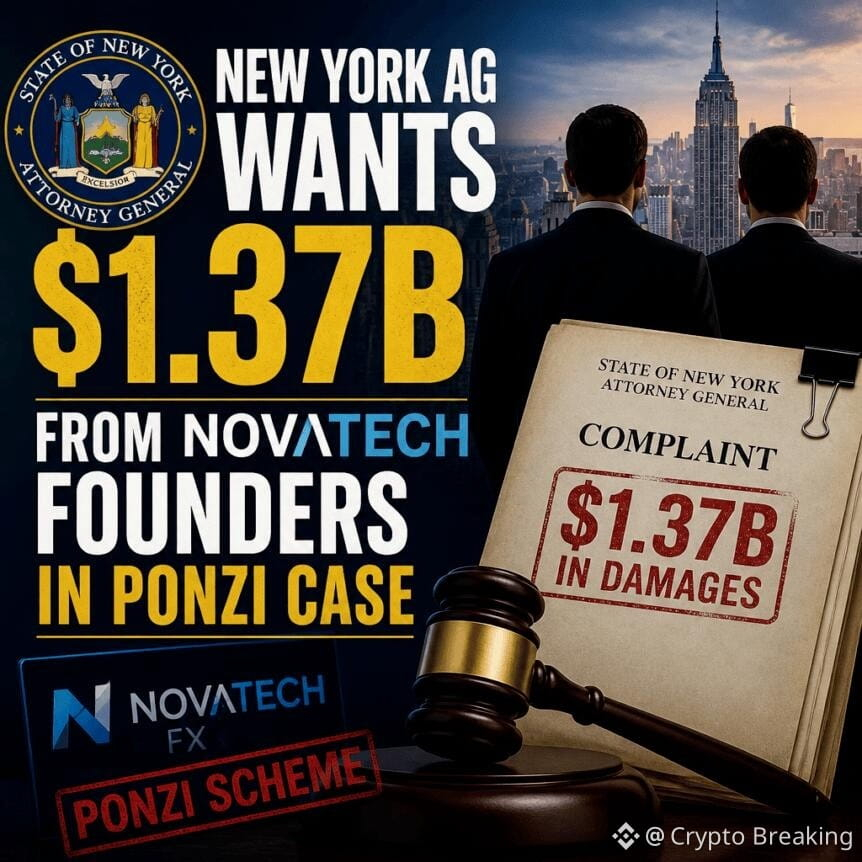
Article
New York AG Wants $1.37B From NovaTech Founders in Ponzi CaseNew York Attorney General Letitia James has asked a court to compel the founders of the defunct crypto and forex trading platform NovaTech—Cynthia and Eddy Petion—and related entities to pay $1.37 billion tied to a Ponzi scheme. The request follows a default ruling issued after the defendants did not respond to the lawsuit.
According to a Thursday court filing, the AG seeks the return of roughly $1.13 billion in investor funds, plus $232.5 million in interest. If granted, the judgment would mark another major enforcement action aimed at recovering losses for victims of NovaTech and a related scheme, AWS Mining.
Key takeaways
The New York AG is seeking a $1.37 billion court order against NovaTech founders Cynthia and Eddy Petion and associated companies.
The filing requests $1.13 billion in returned investor funds plus $232.5 million in interest.
Default liability was entered in August 2025 after defendants failed to respond to the AG’s lawsuit.
The complaint alleges roughly $1.16 billion was deposited into NovaTech crypto wallets from August 2019 to May 2023, with only about $26 million routed to the trading provider B2Broker.
The motion also asks for about $6.15 million, including interest, relating to AWS Mining, which collapsed in 2019.
Default ruling sets up a recovery push
The AG’s latest move comes after the court found the Petions and related entities liable by default in August 2025. Default judgments typically occur when defendants do not participate in the litigation, leaving the court to decide based on the evidence and claims presented by the plaintiff—in this case, the New York Attorney General’s Office.
In its Thursday filing, the Attorney General frames the request as a path toward returning investor funds and compensating victims for the delay and value lost over time through interest. For investors, these steps matter because a favorable ruling is often a prerequisite for meaningful recovery efforts, including potential asset tracing and enforcement actions.
How NovaTech allegedly operated
In describing the scheme, the AG’s office said more than 11,000 New Yorkers lost tens of millions of dollars through NovaTech and an earlier crypto mining operation known as AWS Mining. The complaint alleges promoters targeted Haitian and other immigrant communities, using prayer groups as well as social media and WhatsApp channels to market the program.
According to the AG, the promotional pitch included promises of high returns and recruitment bonuses—elements commonly associated with Ponzi-style schemes because they incentivize early participants to bring in others, often regardless of any legitimate underlying trading or investment activity.
The filing further states that investors deposited about $1.16 billion into NovaTech’s crypto wallets between August 2019 and May 2023. Yet, only about $26 million of that amount was deposited with the platform’s trading provider, B2Broker, for trading, as described by the attorney general. The large discrepancy is central to the AG’s argument that the platform did not operate as a bona fide trading service.
Deposits, trading flows, and the gap investors couldn’t withdraw
The AG’s account of fund flows may help explain why withdrawals became impossible when the platform collapsed. NovaTech ultimately went down in 2023, leaving tens of thousands of investors unable to access their money.
While the filing’s figures focus on wallet deposits and routing to the trading provider, the practical takeaway for investors is that “on-chain” activity alone does not confirm legitimate investment outcomes. In NovaTech’s case, the AG alleges that most of the money was not used for trading in the way customers were led to believe.
The motion therefore seeks not only to establish responsibility but also to quantify damages. By asking for both the return of principal and interest, the Attorney General’s office is effectively arguing that victims should be made whole as closely as possible for the funds tied up over years.
A second target: AWS Mining and related losses
Alongside NovaTech, the Attorney General’s motion also extends to AWS Mining. The filing separately seeks about $6.15 million, including interest, over the earlier scheme.
As described in the AG’s broader case, AWS Mining collapsed in 2019. NovaTech then collapsed in 2023. The two failures are linked in the complaint, and the AG’s efforts reflect a broader pattern of enforcement aimed at recovering funds across multiple related offerings.
The Petions and related entities were sued as part of the AG’s action filed in June 2024 against NovaTech, AWS Mining, and other associated companies. Earlier coverage from Cointelegraph discussed the lawsuit and the alleged issues surrounding NovaTech’s representations.
Settlement activity shows parallel pressure on promoters
Separately, four individuals who allegedly recruited investors into NovaTech agreed to pay nearly $6 million in settlements designed to benefit victims, according to the New York Attorney General’s Office. While that amount is far smaller than the $1.37 billion request directed at the founders and related entities, settlements can still play an important role in victim recovery and can reduce the number of remaining disputes.
For victims, the larger question is how any recovered funds—whether from settlements or from enforcement of a judgment—are allocated. Cointelegraph reported that it sought comment from the New York Attorney General’s Office on distribution mechanics and enforcement steps, but had not received a response by the time of publication.
What happens next for enforcement and victim recovery
The court will need to decide whether to grant the AG’s requested order and the specific scope of the recovery amounts. Even with a judgment, investors will still need to rely on enforcement and asset recovery efforts—processes that can take time and may be influenced by the availability of recoverable funds. Readers following the case should watch for developments on how the court frames liability and how the AG plans to distribute any recovered assets to NovaTech victims.
This article was originally published as New York AG Wants $1.37B From NovaTech Founders in Ponzi Case on Crypto Breaking News – your trusted source for crypto news, Bitcoin news, and blockchain updates.
New York AG Wants $1.37B From NovaTech Founders in Ponzi Case
New York Attorney General Letitia James has asked a court to compel the founders of the defunct crypto and forex trading platform NovaTech—Cynthia and Eddy Petion—and related entities to pay $1.37 billion tied to a Ponzi scheme. The request follows a default ruling issued after the defendants did not respond to the lawsuit.
According to a Thursday court filing, the AG seeks the return of roughly $1.13 billion in investor funds, plus $232.5 million in interest. If granted, the judgment would mark another major enforcement action aimed at recovering losses for victims of NovaTech and a related scheme, AWS Mining.
Key takeaways
The New York AG is seeking a $1.37 billion court order against NovaTech founders Cynthia and Eddy Petion and associated companies.
The filing requests $1.13 billion in returned investor funds plus $232.5 million in interest.
Default liability was entered in August 2025 after defendants failed to respond to the AG’s lawsuit.
The complaint alleges roughly $1.16 billion was deposited into NovaTech crypto wallets from August 2019 to May 2023, with only about $26 million routed to the trading provider B2Broker.
The motion also asks for about $6.15 million, including interest, relating to AWS Mining, which collapsed in 2019.
Default ruling sets up a recovery push
The AG’s latest move comes after the court found the Petions and related entities liable by default in August 2025. Default judgments typically occur when defendants do not participate in the litigation, leaving the court to decide based on the evidence and claims presented by the plaintiff—in this case, the New York Attorney General’s Office.
In its Thursday filing, the Attorney General frames the request as a path toward returning investor funds and compensating victims for the delay and value lost over time through interest. For investors, these steps matter because a favorable ruling is often a prerequisite for meaningful recovery efforts, including potential asset tracing and enforcement actions.
How NovaTech allegedly operated
In describing the scheme, the AG’s office said more than 11,000 New Yorkers lost tens of millions of dollars through NovaTech and an earlier crypto mining operation known as AWS Mining. The complaint alleges promoters targeted Haitian and other immigrant communities, using prayer groups as well as social media and WhatsApp channels to market the program.
According to the AG, the promotional pitch included promises of high returns and recruitment bonuses—elements commonly associated with Ponzi-style schemes because they incentivize early participants to bring in others, often regardless of any legitimate underlying trading or investment activity.
The filing further states that investors deposited about $1.16 billion into NovaTech’s crypto wallets between August 2019 and May 2023. Yet, only about $26 million of that amount was deposited with the platform’s trading provider, B2Broker, for trading, as described by the attorney general. The large discrepancy is central to the AG’s argument that the platform did not operate as a bona fide trading service.
Deposits, trading flows, and the gap investors couldn’t withdraw
The AG’s account of fund flows may help explain why withdrawals became impossible when the platform collapsed. NovaTech ultimately went down in 2023, leaving tens of thousands of investors unable to access their money.
While the filing’s figures focus on wallet deposits and routing to the trading provider, the practical takeaway for investors is that “on-chain” activity alone does not confirm legitimate investment outcomes. In NovaTech’s case, the AG alleges that most of the money was not used for trading in the way customers were led to believe.
The motion therefore seeks not only to establish responsibility but also to quantify damages. By asking for both the return of principal and interest, the Attorney General’s office is effectively arguing that victims should be made whole as closely as possible for the funds tied up over years.
A second target: AWS Mining and related losses
Alongside NovaTech, the Attorney General’s motion also extends to AWS Mining. The filing separately seeks about $6.15 million, including interest, over the earlier scheme.
As described in the AG’s broader case, AWS Mining collapsed in 2019. NovaTech then collapsed in 2023. The two failures are linked in the complaint, and the AG’s efforts reflect a broader pattern of enforcement aimed at recovering funds across multiple related offerings.
The Petions and related entities were sued as part of the AG’s action filed in June 2024 against NovaTech, AWS Mining, and other associated companies. Earlier coverage from Cointelegraph discussed the lawsuit and the alleged issues surrounding NovaTech’s representations.
Settlement activity shows parallel pressure on promoters
Separately, four individuals who allegedly recruited investors into NovaTech agreed to pay nearly $6 million in settlements designed to benefit victims, according to the New York Attorney General’s Office. While that amount is far smaller than the $1.37 billion request directed at the founders and related entities, settlements can still play an important role in victim recovery and can reduce the number of remaining disputes.
For victims, the larger question is how any recovered funds—whether from settlements or from enforcement of a judgment—are allocated. Cointelegraph reported that it sought comment from the New York Attorney General’s Office on distribution mechanics and enforcement steps, but had not received a response by the time of publication.
What happens next for enforcement and victim recovery
The court will need to decide whether to grant the AG’s requested order and the specific scope of the recovery amounts. Even with a judgment, investors will still need to rely on enforcement and asset recovery efforts—processes that can take time and may be influenced by the availability of recoverable funds. Readers following the case should watch for developments on how the court frames liability and how the AG plans to distribute any recovered assets to NovaTech victims.
This article was originally published as New York AG Wants $1.37B From NovaTech Founders in Ponzi Case on Crypto Breaking News – your trusted source for crypto news, Bitcoin news, and blockchain updates.
According to a Thursday court filing, the AG seeks the return of roughly $1.13 billion in investor funds, plus $232.5 million in interest. If granted, the judgment would mark another major enforcement action aimed at recovering losses for victims of NovaTech and a related scheme, AWS Mining.
Key takeaways
The New York AG is seeking a $1.37 billion court order against NovaTech founders Cynthia and Eddy Petion and associated companies.
The filing requests $1.13 billion in returned investor funds plus $232.5 million in interest.
Default liability was entered in August 2025 after defendants failed to respond to the AG’s lawsuit.
The complaint alleges roughly $1.16 billion was deposited into NovaTech crypto wallets from August 2019 to May 2023, with only about $26 million routed to the trading provider B2Broker.
The motion also asks for about $6.15 million, including interest, relating to AWS Mining, which collapsed in 2019.
Default ruling sets up a recovery push
The AG’s latest move comes after the court found the Petions and related entities liable by default in August 2025. Default judgments typically occur when defendants do not participate in the litigation, leaving the court to decide based on the evidence and claims presented by the plaintiff—in this case, the New York Attorney General’s Office.
In its Thursday filing, the Attorney General frames the request as a path toward returning investor funds and compensating victims for the delay and value lost over time through interest. For investors, these steps matter because a favorable ruling is often a prerequisite for meaningful recovery efforts, including potential asset tracing and enforcement actions.
How NovaTech allegedly operated
In describing the scheme, the AG’s office said more than 11,000 New Yorkers lost tens of millions of dollars through NovaTech and an earlier crypto mining operation known as AWS Mining. The complaint alleges promoters targeted Haitian and other immigrant communities, using prayer groups as well as social media and WhatsApp channels to market the program.
According to the AG, the promotional pitch included promises of high returns and recruitment bonuses—elements commonly associated with Ponzi-style schemes because they incentivize early participants to bring in others, often regardless of any legitimate underlying trading or investment activity.
The filing further states that investors deposited about $1.16 billion into NovaTech’s crypto wallets between August 2019 and May 2023. Yet, only about $26 million of that amount was deposited with the platform’s trading provider, B2Broker, for trading, as described by the attorney general. The large discrepancy is central to the AG’s argument that the platform did not operate as a bona fide trading service.
Deposits, trading flows, and the gap investors couldn’t withdraw
The AG’s account of fund flows may help explain why withdrawals became impossible when the platform collapsed. NovaTech ultimately went down in 2023, leaving tens of thousands of investors unable to access their money.
While the filing’s figures focus on wallet deposits and routing to the trading provider, the practical takeaway for investors is that “on-chain” activity alone does not confirm legitimate investment outcomes. In NovaTech’s case, the AG alleges that most of the money was not used for trading in the way customers were led to believe.
The motion therefore seeks not only to establish responsibility but also to quantify damages. By asking for both the return of principal and interest, the Attorney General’s office is effectively arguing that victims should be made whole as closely as possible for the funds tied up over years.
A second target: AWS Mining and related losses
Alongside NovaTech, the Attorney General’s motion also extends to AWS Mining. The filing separately seeks about $6.15 million, including interest, over the earlier scheme.
As described in the AG’s broader case, AWS Mining collapsed in 2019. NovaTech then collapsed in 2023. The two failures are linked in the complaint, and the AG’s efforts reflect a broader pattern of enforcement aimed at recovering funds across multiple related offerings.
The Petions and related entities were sued as part of the AG’s action filed in June 2024 against NovaTech, AWS Mining, and other associated companies. Earlier coverage from Cointelegraph discussed the lawsuit and the alleged issues surrounding NovaTech’s representations.
Settlement activity shows parallel pressure on promoters
Separately, four individuals who allegedly recruited investors into NovaTech agreed to pay nearly $6 million in settlements designed to benefit victims, according to the New York Attorney General’s Office. While that amount is far smaller than the $1.37 billion request directed at the founders and related entities, settlements can still play an important role in victim recovery and can reduce the number of remaining disputes.
For victims, the larger question is how any recovered funds—whether from settlements or from enforcement of a judgment—are allocated. Cointelegraph reported that it sought comment from the New York Attorney General’s Office on distribution mechanics and enforcement steps, but had not received a response by the time of publication.
What happens next for enforcement and victim recovery
The court will need to decide whether to grant the AG’s requested order and the specific scope of the recovery amounts. Even with a judgment, investors will still need to rely on enforcement and asset recovery efforts—processes that can take time and may be influenced by the availability of recoverable funds. Readers following the case should watch for developments on how the court frames liability and how the AG plans to distribute any recovered assets to NovaTech victims.
This article was originally published as New York AG Wants $1.37B From NovaTech Founders in Ponzi Case on Crypto Breaking News – your trusted source for crypto news, Bitcoin news, and blockchain updates.
48
Stablecoin Subscriptions Are Growing, but Failed Payments Remain a ChallengeStablecoins are increasingly being used for more than individual transfers. Payment providers are adding recurring billing features that let customers authorize future charges from a crypto wallet, potentially making stablecoins a practical payment method for software subscriptions, memberships and online services.
The shift has accelerated over the past year. Stripe announced stablecoin subscription payments in October 2025, initially in private preview for US businesses. In 2026, Cloudflare documented support for USDC recurring and usage-based billing, while WalletConnect announced support for Confirmo Subscribe in July. These developments address a limitation of ordinary wallet payments: one successful transfer does not create an ongoing billing relationship.
From Individual Transfers to Recurring Authorization
A typical stablecoin transfer requires a wallet owner to authorize a payment. That is straightforward for a single purchase, but monthly billing becomes cumbersome if a customer must approve every renewal manually.
Recurring payment systems instead ask the customer to approve a defined payment arrangement at checkout. Depending on the provider, this can involve a smart-contract permit or spending allowance. The system can then attempt scheduled charges without requiring a fresh wallet signature each month.
The distinction matters for subscriptions priced in dollars but collected in stablecoins. A $20 monthly plan requires the payment system to track the renewal date, amount, authorization and customer status. Blockchain settlement confirms that tokens moved; it does not, by itself, maintain those subscription records.
A Wallet Authorization Is Not a Payment Guarantee
The new billing arrangements still face failed payments. A customer may spend the balance needed for the next renewal, revoke an authorization or reduce the permitted amount. Blockchain network problems and provider-side checks can also delay or prevent a charge.
Cloudflare’s stablecoin billing documentation specifically lists insufficient funds, revoked approvals and wallet screening as failure cases. It says subscriptions can enter a payment-recovery process and, where a card is already on file, Cloudflare may fall back to that card.
For a merchant, the operational question is what happens after a failed attempt. Does the platform retry? Does it notify the subscriber? Is access paused immediately, or does a grace period apply? Those decisions affect customer retention regardless of the payment network used.
Payment Confirmation Must Reach the Merchant
A buyer seeing a successful wallet transaction is only part of checkout. The merchant’s billing system must reliably match that transfer to the correct order and update the account once the payment is confirmed.
Providers generally support payment-status lookups and event notifications so merchants can reconcile a charge even if the customer closes the browser. A return to a success page should not be treated as proof that a transaction settled: confirmation belongs in a server-side verification process.
Notification failures introduce a separate risk. A payment can succeed on-chain while an application temporarily misses the update. Systems need retries and duplicate-event protection so that the same payment does not accidentally provision a service twice or create conflicting billing records.
Refunds Remain a Separate Workflow
Stablecoin payments also differ from card payments after settlement. A confirmed on-chain transfer generally cannot be reversed through the card-network chargeback process. A voluntary refund usually involves sending a new transfer back to the customer, with the merchant retaining the evidence needed to reconcile it.
Cloudflare says it returns eligible stablecoin refunds in USDC to the wallet used for the original payment. Other providers may use different procedures. Merchants still need clear policies for cancellations, partial refunds and disputes, particularly when subscriptions span multiple billing periods.
What Changes for Subscription Businesses
The emerging services suggest that recurring stablecoin billing is moving beyond one-off crypto checkout. Stripe has announced subscription support through its billing platform, Cloudflare describes it as an available payment option, and Confirmo has introduced a recurring product for wallet-based customers.
Adoption will depend on more than fast settlement or low network fees. Subscription businesses also need reliable renewals, customer communication, refund procedures, accurate reporting and support when payments fail. Providers that deliver those capabilities can make stablecoins easier to operate alongside existing payment methods; those that do not may simply shift familiar billing problems onto a different network.
This article was originally published as Stablecoin Subscriptions Are Growing, but Failed Payments Remain a Challenge on Crypto Breaking News – your trusted source for crypto news, Bitcoin news, and blockchain updates.
Stablecoin Subscriptions Are Growing, but Failed Payments Remain a Challenge
Stablecoins are increasingly being used for more than individual transfers. Payment providers are adding recurring billing features that let customers authorize future charges from a crypto wallet, potentially making stablecoins a practical payment method for software subscriptions, memberships and online services.
The shift has accelerated over the past year. Stripe announced stablecoin subscription payments in October 2025, initially in private preview for US businesses. In 2026, Cloudflare documented support for USDC recurring and usage-based billing, while WalletConnect announced support for Confirmo Subscribe in July. These developments address a limitation of ordinary wallet payments: one successful transfer does not create an ongoing billing relationship.
From Individual Transfers to Recurring Authorization
A typical stablecoin transfer requires a wallet owner to authorize a payment. That is straightforward for a single purchase, but monthly billing becomes cumbersome if a customer must approve every renewal manually.
Recurring payment systems instead ask the customer to approve a defined payment arrangement at checkout. Depending on the provider, this can involve a smart-contract permit or spending allowance. The system can then attempt scheduled charges without requiring a fresh wallet signature each month.
The distinction matters for subscriptions priced in dollars but collected in stablecoins. A $20 monthly plan requires the payment system to track the renewal date, amount, authorization and customer status. Blockchain settlement confirms that tokens moved; it does not, by itself, maintain those subscription records.
A Wallet Authorization Is Not a Payment Guarantee
The new billing arrangements still face failed payments. A customer may spend the balance needed for the next renewal, revoke an authorization or reduce the permitted amount. Blockchain network problems and provider-side checks can also delay or prevent a charge.
Cloudflare’s stablecoin billing documentation specifically lists insufficient funds, revoked approvals and wallet screening as failure cases. It says subscriptions can enter a payment-recovery process and, where a card is already on file, Cloudflare may fall back to that card.
For a merchant, the operational question is what happens after a failed attempt. Does the platform retry? Does it notify the subscriber? Is access paused immediately, or does a grace period apply? Those decisions affect customer retention regardless of the payment network used.
Payment Confirmation Must Reach the Merchant
A buyer seeing a successful wallet transaction is only part of checkout. The merchant’s billing system must reliably match that transfer to the correct order and update the account once the payment is confirmed.
Providers generally support payment-status lookups and event notifications so merchants can reconcile a charge even if the customer closes the browser. A return to a success page should not be treated as proof that a transaction settled: confirmation belongs in a server-side verification process.
Notification failures introduce a separate risk. A payment can succeed on-chain while an application temporarily misses the update. Systems need retries and duplicate-event protection so that the same payment does not accidentally provision a service twice or create conflicting billing records.
Refunds Remain a Separate Workflow
Stablecoin payments also differ from card payments after settlement. A confirmed on-chain transfer generally cannot be reversed through the card-network chargeback process. A voluntary refund usually involves sending a new transfer back to the customer, with the merchant retaining the evidence needed to reconcile it.
Cloudflare says it returns eligible stablecoin refunds in USDC to the wallet used for the original payment. Other providers may use different procedures. Merchants still need clear policies for cancellations, partial refunds and disputes, particularly when subscriptions span multiple billing periods.
What Changes for Subscription Businesses
The emerging services suggest that recurring stablecoin billing is moving beyond one-off crypto checkout. Stripe has announced subscription support through its billing platform, Cloudflare describes it as an available payment option, and Confirmo has introduced a recurring product for wallet-based customers.
Adoption will depend on more than fast settlement or low network fees. Subscription businesses also need reliable renewals, customer communication, refund procedures, accurate reporting and support when payments fail. Providers that deliver those capabilities can make stablecoins easier to operate alongside existing payment methods; those that do not may simply shift familiar billing problems onto a different network.
This article was originally published as Stablecoin Subscriptions Are Growing, but Failed Payments Remain a Challenge on Crypto Breaking News – your trusted source for crypto news, Bitcoin news, and blockchain updates.
The shift has accelerated over the past year. Stripe announced stablecoin subscription payments in October 2025, initially in private preview for US businesses. In 2026, Cloudflare documented support for USDC recurring and usage-based billing, while WalletConnect announced support for Confirmo Subscribe in July. These developments address a limitation of ordinary wallet payments: one successful transfer does not create an ongoing billing relationship.
From Individual Transfers to Recurring Authorization
A typical stablecoin transfer requires a wallet owner to authorize a payment. That is straightforward for a single purchase, but monthly billing becomes cumbersome if a customer must approve every renewal manually.
Recurring payment systems instead ask the customer to approve a defined payment arrangement at checkout. Depending on the provider, this can involve a smart-contract permit or spending allowance. The system can then attempt scheduled charges without requiring a fresh wallet signature each month.
The distinction matters for subscriptions priced in dollars but collected in stablecoins. A $20 monthly plan requires the payment system to track the renewal date, amount, authorization and customer status. Blockchain settlement confirms that tokens moved; it does not, by itself, maintain those subscription records.
A Wallet Authorization Is Not a Payment Guarantee
The new billing arrangements still face failed payments. A customer may spend the balance needed for the next renewal, revoke an authorization or reduce the permitted amount. Blockchain network problems and provider-side checks can also delay or prevent a charge.
Cloudflare’s stablecoin billing documentation specifically lists insufficient funds, revoked approvals and wallet screening as failure cases. It says subscriptions can enter a payment-recovery process and, where a card is already on file, Cloudflare may fall back to that card.
For a merchant, the operational question is what happens after a failed attempt. Does the platform retry? Does it notify the subscriber? Is access paused immediately, or does a grace period apply? Those decisions affect customer retention regardless of the payment network used.
Payment Confirmation Must Reach the Merchant
A buyer seeing a successful wallet transaction is only part of checkout. The merchant’s billing system must reliably match that transfer to the correct order and update the account once the payment is confirmed.
Providers generally support payment-status lookups and event notifications so merchants can reconcile a charge even if the customer closes the browser. A return to a success page should not be treated as proof that a transaction settled: confirmation belongs in a server-side verification process.
Notification failures introduce a separate risk. A payment can succeed on-chain while an application temporarily misses the update. Systems need retries and duplicate-event protection so that the same payment does not accidentally provision a service twice or create conflicting billing records.
Refunds Remain a Separate Workflow
Stablecoin payments also differ from card payments after settlement. A confirmed on-chain transfer generally cannot be reversed through the card-network chargeback process. A voluntary refund usually involves sending a new transfer back to the customer, with the merchant retaining the evidence needed to reconcile it.
Cloudflare says it returns eligible stablecoin refunds in USDC to the wallet used for the original payment. Other providers may use different procedures. Merchants still need clear policies for cancellations, partial refunds and disputes, particularly when subscriptions span multiple billing periods.
What Changes for Subscription Businesses
The emerging services suggest that recurring stablecoin billing is moving beyond one-off crypto checkout. Stripe has announced subscription support through its billing platform, Cloudflare describes it as an available payment option, and Confirmo has introduced a recurring product for wallet-based customers.
Adoption will depend on more than fast settlement or low network fees. Subscription businesses also need reliable renewals, customer communication, refund procedures, accurate reporting and support when payments fail. Providers that deliver those capabilities can make stablecoins easier to operate alongside existing payment methods; those that do not may simply shift familiar billing problems onto a different network.
This article was originally published as Stablecoin Subscriptions Are Growing, but Failed Payments Remain a Challenge on Crypto Breaking News – your trusted source for crypto news, Bitcoin news, and blockchain updates.
27
Log in to explore more content
Join global crypto users on Binance Square
⚡️ Get latest and useful information about crypto.
💬 Trusted by the world’s largest crypto exchange.
👍 Discover real insights from verified creators.
Email / Phone number
Trending Topics
BinancePick
2.5M views
138,435 Discussing
Join #EarningsSeason: Predict Earnings on Binance Pick, Share Your Take on Binance Square!
Binance Square Official
·400 Likes
·337.3k views
EarningsSeason
4.9M views
23,968 Discussing
ElectrumWalletBugLetRogueServersStealFunds
2,948 views
153 Discussing