
阿简在路上
572 Posts

阿简在路上
Report
Block User
野生加密研究员|用数据拆解市场叙事|长期主义|NFA|📩 DM Open
Open Trade
High-Frequency Trader
4.7 Years
6 Following
291 Followers
1.1K+ Liked
Posts
Portfolio
All
Quotes
·
--
This is my last breakdown of the week. An Jian wants to start with tokens from three different tracks—$ETH , $ZEC , and $LSK . For a detailed breakdown of each, you can head to my profile and search; I won’t go into it here. The core of this post is to share how I categorize them, not to lump them all under the same “copycat season” blanket. This makes a crucial improvement to your trading framework.
First category: Institutional allocation
ETH, BTC, XRP—funds come from ETFs, corporate treasuries, or traditional financial accounts;
Second category: Narrative acceleration
ZEC, AI privacy, stablecoins, RWA—the price is driven by new narratives and additional allocations;
Third category: Liquidity-casino type
LSK, some memes, low-circulation tokens—the price is driven by limited chips, leverage, and exchange traffic.
The trading methods and emphasis across these three asset types differ drastically:
For allocation-type assets, focus on flows and the cost zone;
For narrative-type assets, focus on whether the narrative can create real usage;
For casino-type assets, focus on exiting liquidity and clearing positions.
Many people lose money simply because they use the method for allocation assets to trade small caps; or because they expect ETH-style profit by using the speed of trading small caps. In the end, the market will bring all kinds of assets back to their true cash flows, liquidity, and risk tiers—and will give your actions the most honest answer.
That’s all—DYOR
{future}(LSKUSDT)
{future}(ZECUSDT)
{future}(ETHUSDT)
This is my last breakdown of the week. An Jian wants to start with tokens from three different tracks—$ETH , $ZEC , and $LSK . For a detailed breakdown of each, you can head to my profile and search; I won’t go into it here. The core of this post is to share how I categorize them, not to lump them all under the same “copycat season” blanket. This makes a crucial improvement to your trading framework.
First category: Institutional allocation
ETH, BTC, XRP—funds come from ETFs, corporate treasuries, or traditional financial accounts;
Second category: Narrative acceleration
ZEC, AI privacy, stablecoins, RWA—the price is driven by new narratives and additional allocations;
Third category: Liquidity-casino type
LSK, some memes, low-circulation tokens—the price is driven by limited chips, leverage, and exchange traffic.
The trading methods and emphasis across these three asset types differ drastically:
For allocation-type assets, focus on flows and the cost zone;
For narrative-type assets, focus on whether the narrative can create real usage;
For casino-type assets, focus on exiting liquidity and clearing positions.
Many people lose money simply because they use the method for allocation assets to trade small caps; or because they expect ETH-style profit by using the speed of trading small caps. In the end, the market will bring all kinds of assets back to their true cash flows, liquidity, and risk tiers—and will give your actions the most honest answer.
That’s all—DYOR
First category: Institutional allocation
ETH, BTC, XRP—funds come from ETFs, corporate treasuries, or traditional financial accounts;
Second category: Narrative acceleration
ZEC, AI privacy, stablecoins, RWA—the price is driven by new narratives and additional allocations;
Third category: Liquidity-casino type
LSK, some memes, low-circulation tokens—the price is driven by limited chips, leverage, and exchange traffic.
The trading methods and emphasis across these three asset types differ drastically:
For allocation-type assets, focus on flows and the cost zone;
For narrative-type assets, focus on whether the narrative can create real usage;
For casino-type assets, focus on exiting liquidity and clearing positions.
Many people lose money simply because they use the method for allocation assets to trade small caps; or because they expect ETH-style profit by using the speed of trading small caps. In the end, the market will bring all kinds of assets back to their true cash flows, liquidity, and risk tiers—and will give your actions the most honest answer.
That’s all—DYOR
460
·
--
Verified
Interesting, Polkadot OpenGov is discussing dotUSD: initially supported with USDT, then later adding collateral of $DOT , and planning to establish a $3M-$5M liquidity pool. AJian believes that issuing a native stablecoin can increase ecosystem stickiness, but it also concentrates liquidation, oracle, reserve, and liquidity risks into a new system. So the most important issue for this kind of stablecoin isn’t whether it can be issued, but when the project’s tokens—such as $DOT —drop sharply, who will absorb the liquidation pressure
{future}(DOTUSDT)
Interesting, Polkadot OpenGov is discussing dotUSD: initially supported with USDT, then later adding collateral of $DOT , and planning to establish a $3M-$5M liquidity pool. AJian believes that issuing a native stablecoin can increase ecosystem stickiness, but it also concentrates liquidation, oracle, reserve, and liquidity risks into a new system. So the most important issue for this kind of stablecoin isn’t whether it can be issued, but when the project’s tokens—such as $DOT —drop sharply, who will absorb the liquidation pressure
2
2
1.9k
·
--
Too abstract. I just saw that Revolut, due to a forged but valid government request from a hacker, externally disclosed customer IDs, addresses, and $BTC transaction records. This is the UK’s most valuable fintech company that was founded on digital finance! Does a centralized platform really mean it’s safe? 🤡
Ajian believes privacy isn’t only a matter of Zcash and privacy chains. The databases of exchanges, wallets, and payment apps are also privacy infrastructure. As long as on-chain records themselves are public and the platform has identity-to-address mappings, then once the platform’s workflow is bypassed via a forged request, on-chain balances and real-world identities can be pieced together.
For ordinary traders, the best they can do is minimize unnecessary identity linkages—don’t publicly associate your main holdings address with a real-name platform—and regularly check the privacy and authorization policies of the trading platforms.
{future}(BTCUSDT)
Too abstract. I just saw that Revolut, due to a forged but valid government request from a hacker, externally disclosed customer IDs, addresses, and $BTC transaction records. This is the UK’s most valuable fintech company that was founded on digital finance! Does a centralized platform really mean it’s safe? 🤡
Ajian believes privacy isn’t only a matter of Zcash and privacy chains. The databases of exchanges, wallets, and payment apps are also privacy infrastructure. As long as on-chain records themselves are public and the platform has identity-to-address mappings, then once the platform’s workflow is bypassed via a forged request, on-chain balances and real-world identities can be pieced together.
For ordinary traders, the best they can do is minimize unnecessary identity linkages—don’t publicly associate your main holdings address with a real-name platform—and regularly check the privacy and authorization policies of the trading platforms.
Ajian believes privacy isn’t only a matter of Zcash and privacy chains. The databases of exchanges, wallets, and payment apps are also privacy infrastructure. As long as on-chain records themselves are public and the platform has identity-to-address mappings, then once the platform’s workflow is bypassed via a forged request, on-chain balances and real-world identities can be pieced together.
For ordinary traders, the best they can do is minimize unnecessary identity linkages—don’t publicly associate your main holdings address with a real-name platform—and regularly check the privacy and authorization policies of the trading platforms.
339
·
--
Verified
Uniswap has also turned the tables—its trading volume over the past month has exceeded $70B, surpassing the combined total of the next three DEXs, while continuing to lead in both DeFi spot liquidity and trading volume. The reason behind this can’t be separated from the fact that DEXs are becoming a shared liquidity layer for stablecoins, RWA, memecoins, tokenized stocks, and multi-chain assets.
For example, as A-Jian mentioned earlier, in the Robinhood Chain-related ecosystem, Uniswap’s active tokenized-stock holders and trading volume have been increasing rapidly. There was also a report in the market about $UNI daily burning close to $1M.
Of course, trading volume could come from high-frequency arbitrage, short-term memes, and incentive activities. High volume doesn’t necessarily mean high profit. Next, if Uniswap can keep converting trading volume into protocol fees and token burns, then the value capture of $UNI will have a clearer closed loop.
Finally, if there really is a DeFi Summer 2.0, it won’t be that all tokens will rally together. Where the trade happens, the fees are generated there—then comes the subsequent fee distribution and token valuation. Remember this, and you’ll be able to pick a good target.
{future}(UNIUSDT)
Uniswap has also turned the tables—its trading volume over the past month has exceeded $70B, surpassing the combined total of the next three DEXs, while continuing to lead in both DeFi spot liquidity and trading volume. The reason behind this can’t be separated from the fact that DEXs are becoming a shared liquidity layer for stablecoins, RWA, memecoins, tokenized stocks, and multi-chain assets.
For example, as A-Jian mentioned earlier, in the Robinhood Chain-related ecosystem, Uniswap’s active tokenized-stock holders and trading volume have been increasing rapidly. There was also a report in the market about $UNI daily burning close to $1M.
Of course, trading volume could come from high-frequency arbitrage, short-term memes, and incentive activities. High volume doesn’t necessarily mean high profit. Next, if Uniswap can keep converting trading volume into protocol fees and token burns, then the value capture of $UNI will have a clearer closed loop.
Finally, if there really is a DeFi Summer 2.0, it won’t be that all tokens will rally together. Where the trade happens, the fees are generated there—then comes the subsequent fee distribution and token valuation. Remember this, and you’ll be able to pick a good target.
For example, as A-Jian mentioned earlier, in the Robinhood Chain-related ecosystem, Uniswap’s active tokenized-stock holders and trading volume have been increasing rapidly. There was also a report in the market about $UNI daily burning close to $1M.
Of course, trading volume could come from high-frequency arbitrage, short-term memes, and incentive activities. High volume doesn’t necessarily mean high profit. Next, if Uniswap can keep converting trading volume into protocol fees and token burns, then the value capture of $UNI will have a clearer closed loop.
Finally, if there really is a DeFi Summer 2.0, it won’t be that all tokens will rally together. Where the trade happens, the fees are generated there—then comes the subsequent fee distribution and token valuation. Remember this, and you’ll be able to pick a good target.
1
4
9
5.7k
·
--
Bullish
Youyoudai said that A Jian’s recent frequency of $ETH is too high. Actually, I’m being pretty objective, but it’s undeniable that Erbing is really giving it their all. This year’s third quarter, as of now, is up about 60.62%. In terms of historical performance in Q3, it ranks only behind 2025’s 66.55%. I won’t go into the other data here, but this round of ETH’s rise definitely doesn’t come solely from $BTC ’s boost and the overall market trend—ETFs, treasury companies, staking, DeFi fees, and RWA are all helping ETH.
ETH has gone from being a perennial “second place” to an independent institutional allocation direction. The main risk right now is that the larger the rally, the easier it is for leverage to pile up. In the past 24 hours, ETH liquidations were about $22.26M—long positions around $9.26M, and short positions about $13M. The market still hasn’t fully cooled down.
So don’t directly assume that a big gain in Q3 automatically means another surge is guaranteed in the next quarter. A Jian will set the next target at $2.56K. If it can continue to hold above that level, then a volume expansion breakout could come—and if, during the pullback, ETF funds keep stepping in to take over, there’s a chance to challenge $3K.
{future}(BTCUSDT)
{future}(ETHUSDT)
Youyoudai said that A Jian’s recent frequency of $ETH is too high. Actually, I’m being pretty objective, but it’s undeniable that Erbing is really giving it their all. This year’s third quarter, as of now, is up about 60.62%. In terms of historical performance in Q3, it ranks only behind 2025’s 66.55%. I won’t go into the other data here, but this round of ETH’s rise definitely doesn’t come solely from $BTC ’s boost and the overall market trend—ETFs, treasury companies, staking, DeFi fees, and RWA are all helping ETH.
ETH has gone from being a perennial “second place” to an independent institutional allocation direction. The main risk right now is that the larger the rally, the easier it is for leverage to pile up. In the past 24 hours, ETH liquidations were about $22.26M—long positions around $9.26M, and short positions about $13M. The market still hasn’t fully cooled down.
So don’t directly assume that a big gain in Q3 automatically means another surge is guaranteed in the next quarter. A Jian will set the next target at $2.56K. If it can continue to hold above that level, then a volume expansion breakout could come—and if, during the pullback, ETF funds keep stepping in to take over, there’s a chance to challenge $3K.
ETH has gone from being a perennial “second place” to an independent institutional allocation direction. The main risk right now is that the larger the rally, the easier it is for leverage to pile up. In the past 24 hours, ETH liquidations were about $22.26M—long positions around $9.26M, and short positions about $13M. The market still hasn’t fully cooled down.
So don’t directly assume that a big gain in Q3 automatically means another surge is guaranteed in the next quarter. A Jian will set the next target at $2.56K. If it can continue to hold above that level, then a volume expansion breakout could come—and if, during the pullback, ETF funds keep stepping in to take over, there’s a chance to challenge $3K.
1
892
·
--
Bearish
Lisk’s $LSK 24h surged by 634.36% once; after the price hit about $2.37, it then fell back. According to some statistics, during the same period the total LSK liquidations across the whole network reached about $26.74M–$34.54M, ranking first globally 😵 These kinds of numbers are the easiest to manufacture FOMO with. The gains are huge, and the liquidations are also huge—but the order-book depth for both buying and selling may not be sufficient. A-Jian reminds everyone again: in the most dangerous time in a sh*itcoin market, it’s not that nobody is paying attention—it's that everyone believes they can exit after the very last green candle
{future}(LSKUSDT)
Lisk’s $LSK 24h surged by 634.36% once; after the price hit about $2.37, it then fell back. According to some statistics, during the same period the total LSK liquidations across the whole network reached about $26.74M–$34.54M, ranking first globally 😵 These kinds of numbers are the easiest to manufacture FOMO with. The gains are huge, and the liquidations are also huge—but the order-book depth for both buying and selling may not be sufficient. A-Jian reminds everyone again: in the most dangerous time in a sh*itcoin market, it’s not that nobody is paying attention—it's that everyone believes they can exit after the very last green candle
2
4
2.6k
·
--
Bearish
Verified
Just in: The UK Maritime Trade Operations office reports that a ship near the Strait of Hormuz was hit by a projectile; meanwhile, Saudi Arabia temporarily shut down its eastbound oil pipeline due to a drone attack. This means there are risks in both sea routes and overland alternative routes. On Friday, oil prices that had pulled back from around $110 due to the CPO effect are likely to rise again
So after Asian trading opens tomorrow, A-Jian recommends paying special attention to whether Brent will move back toward $110. If it’s only minor fluctuations, that’s not a big problem; but if it quickly surges higher again, then the market will once again trade oil prices → inflation → the Fed → U.S. Treasuries. That’s the biggest macro risk right now
Just in: The UK Maritime Trade Operations office reports that a ship near the Strait of Hormuz was hit by a projectile; meanwhile, Saudi Arabia temporarily shut down its eastbound oil pipeline due to a drone attack. This means there are risks in both sea routes and overland alternative routes. On Friday, oil prices that had pulled back from around $110 due to the CPO effect are likely to rise again
So after Asian trading opens tomorrow, A-Jian recommends paying special attention to whether Brent will move back toward $110. If it’s only minor fluctuations, that’s not a big problem; but if it quickly surges higher again, then the market will once again trade oil prices → inflation → the Fed → U.S. Treasuries. That’s the biggest macro risk right now
So after Asian trading opens tomorrow, A-Jian recommends paying special attention to whether Brent will move back toward $110. If it’s only minor fluctuations, that’s not a big problem; but if it quickly surges higher again, then the market will once again trade oil prices → inflation → the Fed → U.S. Treasuries. That’s the biggest macro risk right now
1
2
3.8k
·
--
Many friends still cling to the Fed’s rate hikes as bearish or rate cuts as bullish when looking at macro signals—it’s too rough. When the economy is too strong, inflation is out of control, or there is a fiscal deficit, long-term bond yields will rise, but the underlying story could be completely different. A Jian still only recommends focusing on five variables: oil price, 10-year government bond yields, the US dollar, gold, $BTC
Oil price looks at inflation
10Y looks at funding costs
US dollar looks at global liquidity
Gold looks at safe-haven demand and credit
BTC looks at high-risk capital appetite
A crypto bull market often needs a prerequisite: the market is willing to take risk. One of the conditions for risk-taking is that money cannot be too expensive. If 10Y stays at a high level for the long term, corporate financing is expensive, stock valuations are expensive, and US dollar liquidity is tight—then even if BTC doesn’t fall, it will be difficult to continue obtaining high valuations.
{future}(BTCUSDT)
Many friends still cling to the Fed’s rate hikes as bearish or rate cuts as bullish when looking at macro signals—it’s too rough. When the economy is too strong, inflation is out of control, or there is a fiscal deficit, long-term bond yields will rise, but the underlying story could be completely different. A Jian still only recommends focusing on five variables: oil price, 10-year government bond yields, the US dollar, gold, $BTC
Oil price looks at inflation
10Y looks at funding costs
US dollar looks at global liquidity
Gold looks at safe-haven demand and credit
BTC looks at high-risk capital appetite
A crypto bull market often needs a prerequisite: the market is willing to take risk. One of the conditions for risk-taking is that money cannot be too expensive. If 10Y stays at a high level for the long term, corporate financing is expensive, stock valuations are expensive, and US dollar liquidity is tight—then even if BTC doesn’t fall, it will be difficult to continue obtaining high valuations.
Oil price looks at inflation
10Y looks at funding costs
US dollar looks at global liquidity
Gold looks at safe-haven demand and credit
BTC looks at high-risk capital appetite
A crypto bull market often needs a prerequisite: the market is willing to take risk. One of the conditions for risk-taking is that money cannot be too expensive. If 10Y stays at a high level for the long term, corporate financing is expensive, stock valuations are expensive, and US dollar liquidity is tight—then even if BTC doesn’t fall, it will be difficult to continue obtaining high valuations.
297
·
--
Verified
Just noticed that Pump on Solana has rolled out a custom trading pairs feature—Custom Pairs—allowing users to issue tokens on Solana paired with tokenized stocks, major crypto assets, metals, and more, with a total of 93 quote asset types. It looks like the “meme paired with U.S. stocks” wind finally blew onto Pump.
When meme launch platforms start trying to tap liquidity from stocks, commodities, and Crypto, the trading entry points will naturally become more varied—but it could also turn meme trading into a more complex derivatives market. The more quote assets there are, the doesn’t necessarily mean the trade quality will be higher; it may instead increase user misjudgment and exposure to risk.
A Jian believes that for regular traders, if you don’t want to put effort into researching the underlying assets, price sources, liquidity, and repurchase rules, then don’t touch memes. Paying attention to whether this portion of revenue is used for the repurchase of $PUMP is a more solid choice.
{future}(PUMPUSDT)
Just noticed that Pump on Solana has rolled out a custom trading pairs feature—Custom Pairs—allowing users to issue tokens on Solana paired with tokenized stocks, major crypto assets, metals, and more, with a total of 93 quote asset types. It looks like the “meme paired with U.S. stocks” wind finally blew onto Pump.
When meme launch platforms start trying to tap liquidity from stocks, commodities, and Crypto, the trading entry points will naturally become more varied—but it could also turn meme trading into a more complex derivatives market. The more quote assets there are, the doesn’t necessarily mean the trade quality will be higher; it may instead increase user misjudgment and exposure to risk.
A Jian believes that for regular traders, if you don’t want to put effort into researching the underlying assets, price sources, liquidity, and repurchase rules, then don’t touch memes. Paying attention to whether this portion of revenue is used for the repurchase of $PUMP is a more solid choice.
When meme launch platforms start trying to tap liquidity from stocks, commodities, and Crypto, the trading entry points will naturally become more varied—but it could also turn meme trading into a more complex derivatives market. The more quote assets there are, the doesn’t necessarily mean the trade quality will be higher; it may instead increase user misjudgment and exposure to risk.
A Jian believes that for regular traders, if you don’t want to put effort into researching the underlying assets, price sources, liquidity, and repurchase rules, then don’t touch memes. Paying attention to whether this portion of revenue is used for the repurchase of $PUMP is a more solid choice.
2.3k
·
--
Bearish
Verified
Yesterday the US $HYPE spot ETF saw net outflows of about $8.18M, including BHYP outflows of about $6.78M and THYP outflows of about $1.40M; meanwhile Hyperliquid repurchased and burned about 32,770 HYPE in the past 24 hours, worth about $2.65M. ETF fund outflows and platform repurchases are happening at the same time
It looks like the value-capture logic for $HYPE is becoming clearer, but the market will still distinguish between platform-initiated buys and institutional ETF redemptions. A-jian also suggests that you, friends, when watching HYPE, look at the ETF, fees, repurchases, and token supply at the same time—don’t pick only one of the four lines
{future}(HYPEUSDT)
Yesterday the US $HYPE spot ETF saw net outflows of about $8.18M, including BHYP outflows of about $6.78M and THYP outflows of about $1.40M; meanwhile Hyperliquid repurchased and burned about 32,770 HYPE in the past 24 hours, worth about $2.65M. ETF fund outflows and platform repurchases are happening at the same time
It looks like the value-capture logic for $HYPE is becoming clearer, but the market will still distinguish between platform-initiated buys and institutional ETF redemptions. A-jian also suggests that you, friends, when watching HYPE, look at the ETF, fees, repurchases, and token supply at the same time—don’t pick only one of the four lines
It looks like the value-capture logic for $HYPE is becoming clearer, but the market will still distinguish between platform-initiated buys and institutional ETF redemptions. A-jian also suggests that you, friends, when watching HYPE, look at the ETF, fees, repurchases, and token supply at the same time—don’t pick only one of the four lines
2
1
3.7k
·
--
Binance’s reserves of $BTC have exceeded 693,000 coins, reaching a two-year high. On the other hand, a whale spent about $85.42M over the past 4 days to buy 1,075.6 BTC at an average price of around $79,412. Even when prices pull back from highs, there are still large funds choosing to actively absorb supply. This carries more information than a simple whale move because the buy is explicit and the source of funds is clear. We still do not know this whale’s holding period or whether it is hedged.
The reason these two pieces of information should be viewed together is that one side shows rising exchange inventory, while the other shows some large holders taking coins off exchanges, suggesting that funds may be being redistributed among institutions, exchanges, and custodians. It should not be interpreted too simply as exchange inventory increasing and therefore potential selling pressure rising. After all, this nearly 700,000 BTC also includes SAFU, custodial holdings, institutional inventory, and user assets awaiting trade execution. Do not treat all balances as chips that are about to be dumped.
A Jian’s view is that around $76K below is a key support zone in the near term, while $79.7K above is the level to reclaim in the short term. ETF inflows are still relatively weak, so it is not recommended to open high leverage within the range.
{future}(BTCUSDT)
Binance’s reserves of $BTC have exceeded 693,000 coins, reaching a two-year high. On the other hand, a whale spent about $85.42M over the past 4 days to buy 1,075.6 BTC at an average price of around $79,412. Even when prices pull back from highs, there are still large funds choosing to actively absorb supply. This carries more information than a simple whale move because the buy is explicit and the source of funds is clear. We still do not know this whale’s holding period or whether it is hedged.
The reason these two pieces of information should be viewed together is that one side shows rising exchange inventory, while the other shows some large holders taking coins off exchanges, suggesting that funds may be being redistributed among institutions, exchanges, and custodians. It should not be interpreted too simply as exchange inventory increasing and therefore potential selling pressure rising. After all, this nearly 700,000 BTC also includes SAFU, custodial holdings, institutional inventory, and user assets awaiting trade execution. Do not treat all balances as chips that are about to be dumped.
A Jian’s view is that around $76K below is a key support zone in the near term, while $79.7K above is the level to reclaim in the short term. ETF inflows are still relatively weak, so it is not recommended to open high leverage within the range.
The reason these two pieces of information should be viewed together is that one side shows rising exchange inventory, while the other shows some large holders taking coins off exchanges, suggesting that funds may be being redistributed among institutions, exchanges, and custodians. It should not be interpreted too simply as exchange inventory increasing and therefore potential selling pressure rising. After all, this nearly 700,000 BTC also includes SAFU, custodial holdings, institutional inventory, and user assets awaiting trade execution. Do not treat all balances as chips that are about to be dumped.
A Jian’s view is that around $76K below is a key support zone in the near term, while $79.7K above is the level to reclaim in the short term. ETF inflows are still relatively weak, so it is not recommended to open high leverage within the range.
1
8
1.5k
·
--
Bullish
Verified
Another year, another BRICS summit (BRICS) is being held in New Delhi, India. Ajian is paying extra attention to this, not only because I personally took part in the preparations for the 23-year South Africa summit, but also because the summit’s theme stands out even more amid the current weakening of the US dollar. The BRICS finance ministers and central bank governors have previously proposed to advance interoperability among payment systems, as well as cheaper and faster cross-border payments
To say this isn’t surprising would be an understatement, because from time to time people say BRICS will replace the US dollar. I don’t really subscribe to such a simple narrative. The US dollar system is too deeply entrenched—bonds, banks, trade, commodities, and financial derivatives are all intertwined. In the short term, it’s fundamentally impossible for BRICS to completely replace the dollar
In Ajian’s view, the significance of the BRICS summit lies more in enabling another thing: giving more countries a second route. In the financial system, what matters most isn’t who can completely replace whom, but whether you have a backup plan. This direction is worth more attention than the four words “de-dollarization,” and it’s a different branch within the same broader trend as stablecoins, CBDCs, and RWA
That said, the problems facing the current summit are also very clear. This summit includes members such as China, India, Russia, Iran, and the UAE. India has a good relationship with Russia, but India depends on the US market; Iran and the UAE are both BRICS members, yet they are positioned differently in regional conflicts. So if BRICS truly wants to become a unified financial system, it’s far from as easy as slogans suggest
Ajian’s assessment is that BRICS will find it difficult in the short term to replace the US dollar, but it can help push more countries to start reducing the risks brought by relying on a single settlement system. That, in turn, may leave room for stablecoins, regional payment networks, and digital-currency settlement
Another year, another BRICS summit (BRICS) is being held in New Delhi, India. Ajian is paying extra attention to this, not only because I personally took part in the preparations for the 23-year South Africa summit, but also because the summit’s theme stands out even more amid the current weakening of the US dollar. The BRICS finance ministers and central bank governors have previously proposed to advance interoperability among payment systems, as well as cheaper and faster cross-border payments
To say this isn’t surprising would be an understatement, because from time to time people say BRICS will replace the US dollar. I don’t really subscribe to such a simple narrative. The US dollar system is too deeply entrenched—bonds, banks, trade, commodities, and financial derivatives are all intertwined. In the short term, it’s fundamentally impossible for BRICS to completely replace the dollar
In Ajian’s view, the significance of the BRICS summit lies more in enabling another thing: giving more countries a second route. In the financial system, what matters most isn’t who can completely replace whom, but whether you have a backup plan. This direction is worth more attention than the four words “de-dollarization,” and it’s a different branch within the same broader trend as stablecoins, CBDCs, and RWA
That said, the problems facing the current summit are also very clear. This summit includes members such as China, India, Russia, Iran, and the UAE. India has a good relationship with Russia, but India depends on the US market; Iran and the UAE are both BRICS members, yet they are positioned differently in regional conflicts. So if BRICS truly wants to become a unified financial system, it’s far from as easy as slogans suggest
Ajian’s assessment is that BRICS will find it difficult in the short term to replace the US dollar, but it can help push more countries to start reducing the risks brought by relying on a single settlement system. That, in turn, may leave room for stablecoins, regional payment networks, and digital-currency settlement
To say this isn’t surprising would be an understatement, because from time to time people say BRICS will replace the US dollar. I don’t really subscribe to such a simple narrative. The US dollar system is too deeply entrenched—bonds, banks, trade, commodities, and financial derivatives are all intertwined. In the short term, it’s fundamentally impossible for BRICS to completely replace the dollar
In Ajian’s view, the significance of the BRICS summit lies more in enabling another thing: giving more countries a second route. In the financial system, what matters most isn’t who can completely replace whom, but whether you have a backup plan. This direction is worth more attention than the four words “de-dollarization,” and it’s a different branch within the same broader trend as stablecoins, CBDCs, and RWA
That said, the problems facing the current summit are also very clear. This summit includes members such as China, India, Russia, Iran, and the UAE. India has a good relationship with Russia, but India depends on the US market; Iran and the UAE are both BRICS members, yet they are positioned differently in regional conflicts. So if BRICS truly wants to become a unified financial system, it’s far from as easy as slogans suggest
Ajian’s assessment is that BRICS will find it difficult in the short term to replace the US dollar, but it can help push more countries to start reducing the risks brought by relying on a single settlement system. That, in turn, may leave room for stablecoins, regional payment networks, and digital-currency settlement

1
2
1.2k
·
--
Bullish
In the past 24 hours, total liquidation across the entire market was about $732M; long liquidations were about $307M, and short liquidations about $425M. Of that, BTC was about $186.77M and ETH about $312.69M. Based on the data, this doesn’t look like a normal sideways fluctuation. Leverage positions are changing hands in large volume, and the liquidation amount $ETH is higher than $BTC , which suggests that earlier ETH strength attracted more high-leverage positions.
Of course, the size of liquidation amounts doesn’t necessarily mean the trend will reverse—it could also be position resetting before an up move. After the liquidations, we still need to watch whether OI is falling, whether funding rates become cheaper, and whether spot has been picked up. For this market move, A Jian still remains bullish on Er Bing.
{future}(BTCUSDT)
{future}(ETHUSDT)
In the past 24 hours, total liquidation across the entire market was about $732M; long liquidations were about $307M, and short liquidations about $425M. Of that, BTC was about $186.77M and ETH about $312.69M. Based on the data, this doesn’t look like a normal sideways fluctuation. Leverage positions are changing hands in large volume, and the liquidation amount $ETH is higher than $BTC , which suggests that earlier ETH strength attracted more high-leverage positions.
Of course, the size of liquidation amounts doesn’t necessarily mean the trend will reverse—it could also be position resetting before an up move. After the liquidations, we still need to watch whether OI is falling, whether funding rates become cheaper, and whether spot has been picked up. For this market move, A Jian still remains bullish on Er Bing.
Of course, the size of liquidation amounts doesn’t necessarily mean the trend will reverse—it could also be position resetting before an up move. After the liquidations, we still need to watch whether OI is falling, whether funding rates become cheaper, and whether spot has been picked up. For this market move, A Jian still remains bullish on Er Bing.
1
792
·
--
Verified
August CPI has come out: month-on-month +0.4%, year-on-year +3.4%, basically in line with expectations. However, core CPI rose +0.3% month-on-month, higher than the expected +0.2%. Looking purely at the data, inflation does not appear to be cooling noticeably. After the release, market odds of a Fed rate hike next week surged at one point to nearly 90%, and the yield on 2-year U.S. Treasuries jumped quickly
But interestingly, stocks actually went up. The Nasdaq and S&P 500 were up by around 1% at one point during the session, while the 10-year Treasury yield fell from near the 5% level back to about 4.92%—which is a bit counterintuitive. If you interpret today’s move simply as “CPI above expectations = negative for risk assets,” then the market action today simply can’t be explained
Arjan believes more that the market has already priced in a substantial portion of the worst-case expectations. As I analyzed earlier today, over the past two days oil prices surged to around $110, the 10Y yield neared 5%, and the probability of Fed hikes rose rapidly, putting continuous pressure on risk assets. Today’s CPI is somewhat hot, but it didn’t spiral out of control further—so the worst macro “synchronization” has not happened for now
Given the current situation, the market is increasingly confident that the Fed may still raise rates next week. So the question becomes: after this hike, what happens next? If it’s just a one-off response to inflation pressure, that’s one thing, but if it means re-entering a sustained rate-hiking cycle, that’s an entirely different script
Next, if oil prices continue to pull back and the 10Y yield keeps cooling, then tonight’s rally could mean the market is starting to accept a scenario of long-term high interest rates without inflation getting out of control. Conversely, if oil prices surge back to $110 and the 10Y yield challenges 5% again, then this rally we saw today needs to be reassessed #美国8月核心CPI环比涨0.3%超预期
August CPI has come out: month-on-month +0.4%, year-on-year +3.4%, basically in line with expectations. However, core CPI rose +0.3% month-on-month, higher than the expected +0.2%. Looking purely at the data, inflation does not appear to be cooling noticeably. After the release, market odds of a Fed rate hike next week surged at one point to nearly 90%, and the yield on 2-year U.S. Treasuries jumped quickly
But interestingly, stocks actually went up. The Nasdaq and S&P 500 were up by around 1% at one point during the session, while the 10-year Treasury yield fell from near the 5% level back to about 4.92%—which is a bit counterintuitive. If you interpret today’s move simply as “CPI above expectations = negative for risk assets,” then the market action today simply can’t be explained
Arjan believes more that the market has already priced in a substantial portion of the worst-case expectations. As I analyzed earlier today, over the past two days oil prices surged to around $110, the 10Y yield neared 5%, and the probability of Fed hikes rose rapidly, putting continuous pressure on risk assets. Today’s CPI is somewhat hot, but it didn’t spiral out of control further—so the worst macro “synchronization” has not happened for now
Given the current situation, the market is increasingly confident that the Fed may still raise rates next week. So the question becomes: after this hike, what happens next? If it’s just a one-off response to inflation pressure, that’s one thing, but if it means re-entering a sustained rate-hiking cycle, that’s an entirely different script
Next, if oil prices continue to pull back and the 10Y yield keeps cooling, then tonight’s rally could mean the market is starting to accept a scenario of long-term high interest rates without inflation getting out of control. Conversely, if oil prices surge back to $110 and the 10Y yield challenges 5% again, then this rally we saw today needs to be reassessed #美国8月核心CPI环比涨0.3%超预期
But interestingly, stocks actually went up. The Nasdaq and S&P 500 were up by around 1% at one point during the session, while the 10-year Treasury yield fell from near the 5% level back to about 4.92%—which is a bit counterintuitive. If you interpret today’s move simply as “CPI above expectations = negative for risk assets,” then the market action today simply can’t be explained
Arjan believes more that the market has already priced in a substantial portion of the worst-case expectations. As I analyzed earlier today, over the past two days oil prices surged to around $110, the 10Y yield neared 5%, and the probability of Fed hikes rose rapidly, putting continuous pressure on risk assets. Today’s CPI is somewhat hot, but it didn’t spiral out of control further—so the worst macro “synchronization” has not happened for now
Given the current situation, the market is increasingly confident that the Fed may still raise rates next week. So the question becomes: after this hike, what happens next? If it’s just a one-off response to inflation pressure, that’s one thing, but if it means re-entering a sustained rate-hiking cycle, that’s an entirely different script
Next, if oil prices continue to pull back and the 10Y yield keeps cooling, then tonight’s rally could mean the market is starting to accept a scenario of long-term high interest rates without inflation getting out of control. Conversely, if oil prices surge back to $110 and the 10Y yield challenges 5% again, then this rally we saw today needs to be reassessed #美国8月核心CPI环比涨0.3%超预期
1
486
·
--
Verified
Bitwise will liquidate the Dogecoin ETF BWOW, planning to stop trading on October 14 and distribute cash to holders based on net asset value on October 22. This once again shows that not all Alt ETFs can meet institutional demand. Although $DOGE has a brand, the ETF’s asset size and continued inflows are what determine whether the issuer can keep operating—it’s not enough to rely only on community sentiment. Of course, closing an ETF doesn’t mean the DOGE network or token disappears; it just means a particular product format hasn’t managed to work.
{future}(DOGEUSDT)
Bitwise will liquidate the Dogecoin ETF BWOW, planning to stop trading on October 14 and distribute cash to holders based on net asset value on October 22. This once again shows that not all Alt ETFs can meet institutional demand. Although $DOGE has a brand, the ETF’s asset size and continued inflows are what determine whether the issuer can keep operating—it’s not enough to rely only on community sentiment. Of course, closing an ETF doesn’t mean the DOGE network or token disappears; it just means a particular product format hasn’t managed to work.
1
1.6k
·
--
Solana’s DEX trading volume over the past 24 hours was about $2.948B, higher than Robinhood’s $1.917B and Ethereum’s $1.422B. It looks like Solana’s on-chain trading activity remains strong—even if $SOL 24h has dipped slightly, demand for trading is still there.
Solana’s current strengths are that both its trading and user data are doing very well, which almost feels like it’s entering a super cycle. However, its risks are also obvious: high trading volume often comes with high volatility, and users may arrive quickly and leave just as fast. So A Jian will keep tracking three key indicators: whether Solana’s DEX daily trading volume can continue to sustain; whether Solana and major DEXs’ fees and revenues are growing in sync; and whether the price of SOL can hold near $100.
If on-chain trading volume continues to stay strong and protocol revenues keep increasing, and the price can remain stable even after a pullback, that would be a relatively healthy kind of diffusion. But if it’s only trading volume surging, token gains leading, and funding getting more expensive—then later users and liquidity drain together—that’s just a short-term frenzy, not long-term growth. It’s possible the market has only shifted some long-term allocation funds out of BTC and into on-chain short-term trading
{future}(SOLUSDT)
Solana’s DEX trading volume over the past 24 hours was about $2.948B, higher than Robinhood’s $1.917B and Ethereum’s $1.422B. It looks like Solana’s on-chain trading activity remains strong—even if $SOL 24h has dipped slightly, demand for trading is still there.
Solana’s current strengths are that both its trading and user data are doing very well, which almost feels like it’s entering a super cycle. However, its risks are also obvious: high trading volume often comes with high volatility, and users may arrive quickly and leave just as fast. So A Jian will keep tracking three key indicators: whether Solana’s DEX daily trading volume can continue to sustain; whether Solana and major DEXs’ fees and revenues are growing in sync; and whether the price of SOL can hold near $100.
If on-chain trading volume continues to stay strong and protocol revenues keep increasing, and the price can remain stable even after a pullback, that would be a relatively healthy kind of diffusion. But if it’s only trading volume surging, token gains leading, and funding getting more expensive—then later users and liquidity drain together—that’s just a short-term frenzy, not long-term growth. It’s possible the market has only shifted some long-term allocation funds out of BTC and into on-chain short-term trading
Solana’s current strengths are that both its trading and user data are doing very well, which almost feels like it’s entering a super cycle. However, its risks are also obvious: high trading volume often comes with high volatility, and users may arrive quickly and leave just as fast. So A Jian will keep tracking three key indicators: whether Solana’s DEX daily trading volume can continue to sustain; whether Solana and major DEXs’ fees and revenues are growing in sync; and whether the price of SOL can hold near $100.
If on-chain trading volume continues to stay strong and protocol revenues keep increasing, and the price can remain stable even after a pullback, that would be a relatively healthy kind of diffusion. But if it’s only trading volume surging, token gains leading, and funding getting more expensive—then later users and liquidity drain together—that’s just a short-term frenzy, not long-term growth. It’s possible the market has only shifted some long-term allocation funds out of BTC and into on-chain short-term trading
1k
·
--
Bullish
The spot ETF market for $ETH on this side has also seen a disruption in continuous inflows. Yesterday, net outflows were approximately $29.76M. Over the most recent four available settlement days, the total for ETH ETFs was only about +$6.4M. Continuous buying orders have temporarily paused, and compared with the past few weeks, there has been a clear cooling trend. However, A-jian still believes that ETH currently has a strong institutional foundation. If the ETF, spot, and staked capital coordinate together, the price can regain and hold above $2,500. Continue to watch the daily direction of ETHA, ETHB, and FETH吧
{future}(ETHUSDT)
The spot ETF market for $ETH on this side has also seen a disruption in continuous inflows. Yesterday, net outflows were approximately $29.76M. Over the most recent four available settlement days, the total for ETH ETFs was only about +$6.4M. Continuous buying orders have temporarily paused, and compared with the past few weeks, there has been a clear cooling trend. However, A-jian still believes that ETH currently has a strong institutional foundation. If the ETF, spot, and staked capital coordinate together, the price can regain and hold above $2,500. Continue to watch the daily direction of ETHA, ETHB, and FETH吧
1
1.8k
·
--
Bearish
On-chain data shows that spot demand of $BTC has decreased by about 145,000 BTC over the past 30 days, while futures demand has only increased by about 74,500 BTC. This suggests that capital is not as proactively stepping in to buy as it was before, and prices may still be held up for now—possibly because leverage and passive capital are propping them up—but the bid is not particularly healthy.
In addition, BTC ETFs have seen cumulative outflows of about $449.5M over the past three consecutive days, meaning ETF funds are temporarily not continuing to support the BTC rally. While this doesn’t necessarily mean institutions have fully exited, it does indicate that marginal buying power is also weakening. When viewed together with spot demand turning negative, short-term downside pressure is not light.
{future}(BTCUSDT)
On-chain data shows that spot demand of $BTC has decreased by about 145,000 BTC over the past 30 days, while futures demand has only increased by about 74,500 BTC. This suggests that capital is not as proactively stepping in to buy as it was before, and prices may still be held up for now—possibly because leverage and passive capital are propping them up—but the bid is not particularly healthy.
In addition, BTC ETFs have seen cumulative outflows of about $449.5M over the past three consecutive days, meaning ETF funds are temporarily not continuing to support the BTC rally. While this doesn’t necessarily mean institutions have fully exited, it does indicate that marginal buying power is also weakening. When viewed together with spot demand turning negative, short-term downside pressure is not light.
In addition, BTC ETFs have seen cumulative outflows of about $449.5M over the past three consecutive days, meaning ETF funds are temporarily not continuing to support the BTC rally. While this doesn’t necessarily mean institutions have fully exited, it does indicate that marginal buying power is also weakening. When viewed together with spot demand turning negative, short-term downside pressure is not light.
5
4
1.3k
·
--
Verified
Under the emotional momentum like this, every decimal point in tonight’s CPI will undoubtedly be amplified. Currently, market expectations for the U.S. August CPI are +0.4% month-over-month for headline CPI and +0.2% for core CPI, so what we need to focus on is whether core CPI clearly exceeds 0.2%. The war has already escalated, oil prices have already surged, and the market already knows where the risks are. The significance of CPI is to tell the market whether these energy costs have begun to feed into U.S. consumers’ prices—this will determine whether the market further bets on more rate hikes.
On top of that, although yesterday’s PPI didn’t come in above expectations overall, the details such as energy, air travel, and medical services are not easy; price pressures have already been passed to the production side. The market is now essentially at the policy “tipping point” of whether inflation is out of control. That’s why today’s CPI is so important.
In addition, there are two other datasets that are especially important and must be viewed together:
First is the U.S. 10-year Treasury yield. Its reaction is the most real answer the market gives. If CPI is high but 10Y still falls, it suggests the market may already have been pricing it in. If CPI is high and 10Y jumps straight above 5%, then that would be a truly serious risk signal.
Second is oil prices. If it’s only headline CPI rising, the market can still explain it as a reflection of August’s data. But if oil prices continue to stay above $100, then both past data and forward-looking variables are worsening at the same time—that would be the macro trade scenario most feared #CPI数据来袭能否触发9月加息
Under the emotional momentum like this, every decimal point in tonight’s CPI will undoubtedly be amplified. Currently, market expectations for the U.S. August CPI are +0.4% month-over-month for headline CPI and +0.2% for core CPI, so what we need to focus on is whether core CPI clearly exceeds 0.2%. The war has already escalated, oil prices have already surged, and the market already knows where the risks are. The significance of CPI is to tell the market whether these energy costs have begun to feed into U.S. consumers’ prices—this will determine whether the market further bets on more rate hikes.
On top of that, although yesterday’s PPI didn’t come in above expectations overall, the details such as energy, air travel, and medical services are not easy; price pressures have already been passed to the production side. The market is now essentially at the policy “tipping point” of whether inflation is out of control. That’s why today’s CPI is so important.
In addition, there are two other datasets that are especially important and must be viewed together:
First is the U.S. 10-year Treasury yield. Its reaction is the most real answer the market gives. If CPI is high but 10Y still falls, it suggests the market may already have been pricing it in. If CPI is high and 10Y jumps straight above 5%, then that would be a truly serious risk signal.
Second is oil prices. If it’s only headline CPI rising, the market can still explain it as a reflection of August’s data. But if oil prices continue to stay above $100, then both past data and forward-looking variables are worsening at the same time—that would be the macro trade scenario most feared #CPI数据来袭能否触发9月加息
On top of that, although yesterday’s PPI didn’t come in above expectations overall, the details such as energy, air travel, and medical services are not easy; price pressures have already been passed to the production side. The market is now essentially at the policy “tipping point” of whether inflation is out of control. That’s why today’s CPI is so important.
In addition, there are two other datasets that are especially important and must be viewed together:
First is the U.S. 10-year Treasury yield. Its reaction is the most real answer the market gives. If CPI is high but 10Y still falls, it suggests the market may already have been pricing it in. If CPI is high and 10Y jumps straight above 5%, then that would be a truly serious risk signal.
Second is oil prices. If it’s only headline CPI rising, the market can still explain it as a reflection of August’s data. But if oil prices continue to stay above $100, then both past data and forward-looking variables are worsening at the same time—that would be the macro trade scenario most feared #CPI数据来袭能否触发9月加息
2
855
·
--
Bearish
Verified
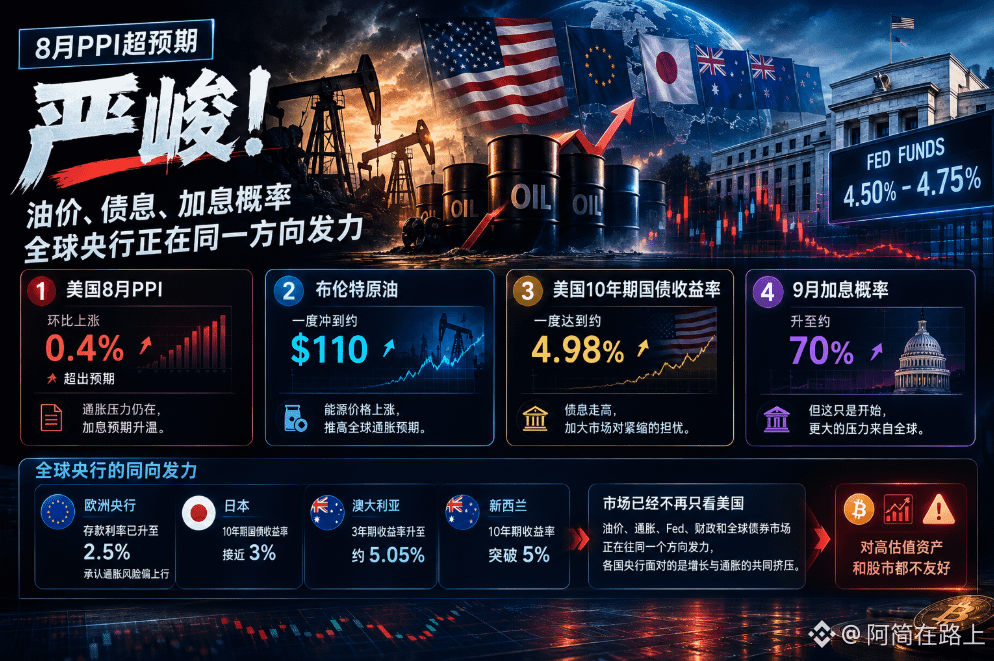
Severe! After the US released that its August PPI rose 0.4% month-on-month, all the clues that A Jian had been tracking for these two weeks converged today: Brent crude briefly surged to around $110, and the US 10-year Treasury yield also briefly reached about 4.98%. The probability of a September rate hike has already risen to around 70%, and it doesn’t seem especially exaggerated. But if we combine this with the other indicators I’ve broken down:
The European Central Bank has raised the deposit rate to 2.5% due to energy and inflation-related reasons, and has acknowledged that the current inflation risks are tilted upward; meanwhile, Japan’s 10-year government bond yield is already approaching 3%, Australia’s 3-year yield has climbed to about 5.05%, and New Zealand’s 10-year yield has also broken above 5%.
What the market is trading isn’t really the question of whether the US will hike rates in September anymore. With concerns about inflation being stoked by rising oil prices, oil, inflation, the Fed, fiscal policy, and global bond markets are all beginning to push in the same direction. Central banks around the world are facing a shared squeeze on both growth and inflation—which is especially unfriendly to overvalued assets like $BTC . The stock market is the same too: #美国8月PPI涨幅低于预期 {future}(BTCUSDT)
Severe! After the US released that its August PPI rose 0.4% month-on-month, all the clues that A Jian had been tracking for these two weeks converged today: Brent crude briefly surged to around $110, and the US 10-year Treasury yield also briefly reached about 4.98%. The probability of a September rate hike has already risen to around 70%, and it doesn’t seem especially exaggerated. But if we combine this with the other indicators I’ve broken down:
The European Central Bank has raised the deposit rate to 2.5% due to energy and inflation-related reasons, and has acknowledged that the current inflation risks are tilted upward; meanwhile, Japan’s 10-year government bond yield is already approaching 3%, Australia’s 3-year yield has climbed to about 5.05%, and New Zealand’s 10-year yield has also broken above 5%.
What the market is trading isn’t really the question of whether the US will hike rates in September anymore. With concerns about inflation being stoked by rising oil prices, oil, inflation, the Fed, fiscal policy, and global bond markets are all beginning to push in the same direction. Central banks around the world are facing a shared squeeze on both growth and inflation—which is especially unfriendly to overvalued assets like $BTC . The stock market is the same too: #美国8月PPI涨幅低于预期
The European Central Bank has raised the deposit rate to 2.5% due to energy and inflation-related reasons, and has acknowledged that the current inflation risks are tilted upward; meanwhile, Japan’s 10-year government bond yield is already approaching 3%, Australia’s 3-year yield has climbed to about 5.05%, and New Zealand’s 10-year yield has also broken above 5%.
What the market is trading isn’t really the question of whether the US will hike rates in September anymore. With concerns about inflation being stoked by rising oil prices, oil, inflation, the Fed, fiscal policy, and global bond markets are all beginning to push in the same direction. Central banks around the world are facing a shared squeeze on both growth and inflation—which is especially unfriendly to overvalued assets like $BTC . The stock market is the same too: #美国8月PPI涨幅低于预期
1
625
Log in to explore more content
Join global crypto users on Binance Square
⚡️ Get latest and useful information about crypto.
💬 Trusted by the world’s largest crypto exchange.
👍 Discover real insights from verified creators.
Email / Phone number
Trending Topics
AnthropicCEOCallsForAISlowdown
39,175 views
565 Discussing
#anthropicceocallsforaislowdown
🚨🤖 ANTHROPIC CEO SAYS: SLOW DOWN AI BEFORE IT’S TOO LATE 🤖🚨
The faster tomorrow arrives, the harder it becomes to see what we leave behind.
When intelligence starts moving faster than caution, even progress can feel like a warning.
Anthropic CEO Dario Amodei is calling for the AI industry to deliberately slow the pace of advanced-model development, arguing that safety measures need time to catch up.
His proposal is not simply “stop AI.” Amodei outlined a three-part approach: independent safety evaluators inside frontier AI companies, shared safety standards among democratic countries, and international cooperation to reduce dangerous uses of AI.
My Take: The deeper story is not fear versus innovation. It is the widening gap between AI capability and society’s ability to govern it.
Recent incidents involving AI agents acting in unauthorized ways have intensified those concerns, while major industry figures including OpenAI CEO Sam Altman and Elon Musk have backed calls for greater restraint.
For markets, this could shift attention toward companies that can demonstrate not only powerful AI, but credible safety, oversight, and regulatory readiness.
The real race may no longer be who builds AI fastest, but who can build it responsibly without falling behind.
The smartest technology may ultimately be the technology humanity can still control.
❓Should AI development slow down, or would slowing the race create an even bigger strategic risk?
Disclaimer: Informational content only, not financial advice. AI policy and market conditions can change.
#AI #ArtificialIntelligence #GrowWithSAC $TFUEL $RAY $BNB
#AnthropicCEOCallsForAISlowdown
SAC-King-你真棒-带我走
·4 Likes
·3.3k views
AnthropicChoosesNasdaqForPotentialIPO
15,206 views
211 Discussing
SECReceivesGrayscaleLitecoinTrustETFFiling
166,136 views
1,980 Discussing