
三思交易
586 Posts
三思交易
Report
Block User
公众号:三思交易; x:@bn6813; 币安20%自动返佣邀请码:bn2017 学习SNR,ICT,SMC交易,肯特通道线战法,与君共勉!
Open Trade
High-Frequency Trader
7.2 Years
20 Following
794 Followers
1.4K+ Liked
Posts
Portfolio
All
Quotes
PINNED
·
--
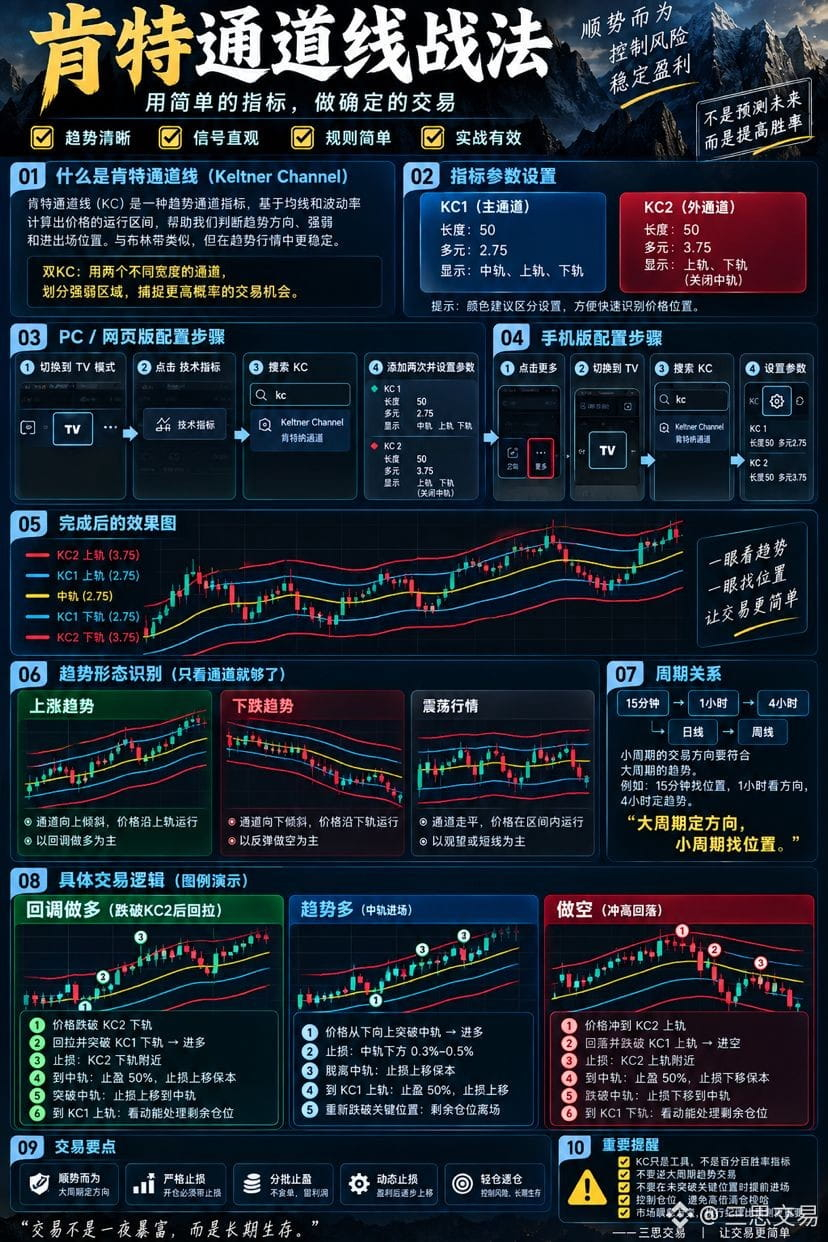
☆ Kent Channel Line Trading Strategy
Indicator: Keltner Channel (KC)
Parameters:
KC1: Length 50, multiplier 2.75
KC2: Length 50, multiplier 3.75, turn off the midline
The core is just one sentence: The larger time frame determines the direction; the smaller time frame finds the entry position.
Time-frame relationship:
15m looks at 1H → 1H looks at 4H → 4H looks at the daily chart → the daily chart looks at the weekly chart
When the larger time frame is trending up, only look for longs.
When the larger time frame is trending down, only look for shorts.
The smaller time frame runs opposite to the larger time frame—treat it as a retracement first.
1. Buy on Pullbacks
Prerequisite: The larger time frame cannot be a clearly bearish trend.
Price breaks below the KC2 lower band → then pulls back and breaks above the KC1 lower band → enter long.
Stop loss: Near the KC2 lower band.
After departing from the lower band: Move stop loss to break-even.
To the midline: Take profit 50%.
Break above the midline: Move stop loss to the midline.
To the KC1 upper band: Manage the remaining position based on momentum.
2. Trend Longs
In a strong uptrend, it is likely that price won’t give you an opportunity to reach the KC2 lower band—then focus on the midline.
Price breaks above the midline from below → enter long.
Stop loss: About 0.3%–0.5% below the midline.
After leaving the midline → protect profit (move stop to break-even).
To the KC1 upper band → take profit 50%, and simultaneously move the stop loss up.
If it falls back below the key level again → exit the remaining position.
3. Shorting
The logic is completely the opposite.
Price rallies to the KC2 upper band → then pulls back and breaks below the KC1 upper band → enter short.
Stop loss: Near the KC2 upper band.
If it doesn’t break below the KC1 upper band, don’t try to top-tick early.
In a strong trend, the easiest way to lose money is to see “it’s gone up too much” and open a short immediately.
Finally, remember these 4 rules:
The larger time frame sets the direction; the smaller time frame finds the entry.
KC1 is for the first target; KC2 is for extreme areas.
Whenever you open a position, you must have a stop loss; after you’re in profit, gradually move the stop loss up.
Light position sizing, staged entries—better to miss than to hold a losing position.
KC helps me judge trend, position, and momentum—not a 100% win-rate indicator.
In the market, living longer matters more than making more profit on any single trade.
$BTC
{future}(BTCUSDT)
$ETH
{future}(ETHUSDT)
$HYPE
{future}(HYPEUSDT)
#MichaelSaylor暗示增持BTC
☆ Kent Channel Line Trading Strategy
Indicator: Keltner Channel (KC)
Parameters:
KC1: Length 50, multiplier 2.75
KC2: Length 50, multiplier 3.75, turn off the midline
The core is just one sentence: The larger time frame determines the direction; the smaller time frame finds the entry position.
Time-frame relationship:
15m looks at 1H → 1H looks at 4H → 4H looks at the daily chart → the daily chart looks at the weekly chart
When the larger time frame is trending up, only look for longs.
When the larger time frame is trending down, only look for shorts.
The smaller time frame runs opposite to the larger time frame—treat it as a retracement first.
1. Buy on Pullbacks
Prerequisite: The larger time frame cannot be a clearly bearish trend.
Price breaks below the KC2 lower band → then pulls back and breaks above the KC1 lower band → enter long.
Stop loss: Near the KC2 lower band.
After departing from the lower band: Move stop loss to break-even.
To the midline: Take profit 50%.
Break above the midline: Move stop loss to the midline.
To the KC1 upper band: Manage the remaining position based on momentum.
2. Trend Longs
In a strong uptrend, it is likely that price won’t give you an opportunity to reach the KC2 lower band—then focus on the midline.
Price breaks above the midline from below → enter long.
Stop loss: About 0.3%–0.5% below the midline.
After leaving the midline → protect profit (move stop to break-even).
To the KC1 upper band → take profit 50%, and simultaneously move the stop loss up.
If it falls back below the key level again → exit the remaining position.
3. Shorting
The logic is completely the opposite.
Price rallies to the KC2 upper band → then pulls back and breaks below the KC1 upper band → enter short.
Stop loss: Near the KC2 upper band.
If it doesn’t break below the KC1 upper band, don’t try to top-tick early.
In a strong trend, the easiest way to lose money is to see “it’s gone up too much” and open a short immediately.
Finally, remember these 4 rules:
The larger time frame sets the direction; the smaller time frame finds the entry.
KC1 is for the first target; KC2 is for extreme areas.
Whenever you open a position, you must have a stop loss; after you’re in profit, gradually move the stop loss up.
Light position sizing, staged entries—better to miss than to hold a losing position.
KC helps me judge trend, position, and momentum—not a 100% win-rate indicator.
In the market, living longer matters more than making more profit on any single trade.
$BTC
$ETH
$HYPE
#MichaelSaylor暗示增持BTC
Indicator: Keltner Channel (KC)
Parameters:
KC1: Length 50, multiplier 2.75
KC2: Length 50, multiplier 3.75, turn off the midline
The core is just one sentence: The larger time frame determines the direction; the smaller time frame finds the entry position.
Time-frame relationship:
15m looks at 1H → 1H looks at 4H → 4H looks at the daily chart → the daily chart looks at the weekly chart
When the larger time frame is trending up, only look for longs.
When the larger time frame is trending down, only look for shorts.
The smaller time frame runs opposite to the larger time frame—treat it as a retracement first.
1. Buy on Pullbacks
Prerequisite: The larger time frame cannot be a clearly bearish trend.
Price breaks below the KC2 lower band → then pulls back and breaks above the KC1 lower band → enter long.
Stop loss: Near the KC2 lower band.
After departing from the lower band: Move stop loss to break-even.
To the midline: Take profit 50%.
Break above the midline: Move stop loss to the midline.
To the KC1 upper band: Manage the remaining position based on momentum.
2. Trend Longs
In a strong uptrend, it is likely that price won’t give you an opportunity to reach the KC2 lower band—then focus on the midline.
Price breaks above the midline from below → enter long.
Stop loss: About 0.3%–0.5% below the midline.
After leaving the midline → protect profit (move stop to break-even).
To the KC1 upper band → take profit 50%, and simultaneously move the stop loss up.
If it falls back below the key level again → exit the remaining position.
3. Shorting
The logic is completely the opposite.
Price rallies to the KC2 upper band → then pulls back and breaks below the KC1 upper band → enter short.
Stop loss: Near the KC2 upper band.
If it doesn’t break below the KC1 upper band, don’t try to top-tick early.
In a strong trend, the easiest way to lose money is to see “it’s gone up too much” and open a short immediately.
Finally, remember these 4 rules:
The larger time frame sets the direction; the smaller time frame finds the entry.
KC1 is for the first target; KC2 is for extreme areas.
Whenever you open a position, you must have a stop loss; after you’re in profit, gradually move the stop loss up.
Light position sizing, staged entries—better to miss than to hold a losing position.
KC helps me judge trend, position, and momentum—not a 100% win-rate indicator.
In the market, living longer matters more than making more profit on any single trade.
$BTC
$ETH
$HYPE
#MichaelSaylor暗示增持BTC
1
266
PINNED
·
--
Binance old users: update on the invite code fill-in feature📢
When registering for Binance previously, some users did not fill in an invite code, or those who did not meet the requirements in the last promotion may want to check out this update.
The account re-linking feature has been optimized. Some users who meet the criteria may be able to bind quickly.
Participation requirements (reference):
✅ Completed KYC verification
✅ The current account has not bound any invitation relationship
✅ Total cumulative trading volume in the past 90 days does not exceed 5000 USDT
✅ Reach the specified trading volume requirement within 30 days after submitting the application
Users who meet the requirements can try to apply.
Invite code: ethan888
[申请链接](https://www.bsmkweb.cc/activity/referral/bind-ref):
For specific rules, please refer to what is shown on the Binance page. Please pay attention to risks when trading and arrange funds reasonably.
$BTC
Binance old users: update on the invite code fill-in feature📢
When registering for Binance previously, some users did not fill in an invite code, or those who did not meet the requirements in the last promotion may want to check out this update.
The account re-linking feature has been optimized. Some users who meet the criteria may be able to bind quickly.
Participation requirements (reference):
✅ Completed KYC verification
✅ The current account has not bound any invitation relationship
✅ Total cumulative trading volume in the past 90 days does not exceed 5000 USDT
✅ Reach the specified trading volume requirement within 30 days after submitting the application
Users who meet the requirements can try to apply.
Invite code: ethan888
申请链接:
For specific rules, please refer to what is shown on the Binance page. Please pay attention to risks when trading and arrange funds reasonably.
$BTC
When registering for Binance previously, some users did not fill in an invite code, or those who did not meet the requirements in the last promotion may want to check out this update.
The account re-linking feature has been optimized. Some users who meet the criteria may be able to bind quickly.
Participation requirements (reference):
✅ Completed KYC verification
✅ The current account has not bound any invitation relationship
✅ Total cumulative trading volume in the past 90 days does not exceed 5000 USDT
✅ Reach the specified trading volume requirement within 30 days after submitting the application
Users who meet the requirements can try to apply.
Invite code: ethan888
申请链接:
For specific rules, please refer to what is shown on the Binance page. Please pay attention to risks when trading and arrange funds reasonably.
$BTC
792
·
--
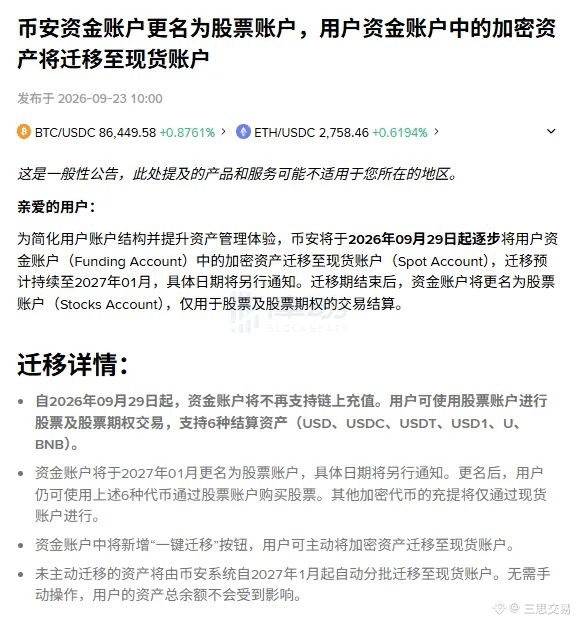
Binance is making major changes to its account structure this time—if you’re doing C2C/P2P, take note.
Starting September 29, the crypto assets in your Funding Account will be gradually moved to the Spot Account.
Key points:
1. From September 29 onward, the Funding Account will no longer support on-chain deposits.
2. The Funding Account will be renamed to “Stock Account” in January 2027. Going forward, it will mainly be used for stock and stock options settlement.
3. A new “One-Click Transfer” feature will be added to accounts. If you want to transfer in advance, you can do it yourself.
4. Don’t panic if you don’t migrate proactively. Starting January 2027, the system will automatically migrate your assets in batches to the Spot Account, and your total asset balance won’t be affected.
5. In the future, deposits and withdrawals for most cryptocurrencies will basically be routed through the Spot Account.
From what I’ve reviewed, Binance is essentially re-sorting the account responsibilities this time:
Crypto assets go to the Spot Account,
Stocks go to the Stock Account.
For brothers who use Binance a lot, remember to update the app after September 29—so you don’t end up searching for the asset entry for ages.
$BTC $ETH $HYPE #比特币突破8.7万美元创八个月新高
Binance is making major changes to its account structure this time—if you’re doing C2C/P2P, take note.
Starting September 29, the crypto assets in your Funding Account will be gradually moved to the Spot Account.
Key points:
1. From September 29 onward, the Funding Account will no longer support on-chain deposits.
2. The Funding Account will be renamed to “Stock Account” in January 2027. Going forward, it will mainly be used for stock and stock options settlement.
3. A new “One-Click Transfer” feature will be added to accounts. If you want to transfer in advance, you can do it yourself.
4. Don’t panic if you don’t migrate proactively. Starting January 2027, the system will automatically migrate your assets in batches to the Spot Account, and your total asset balance won’t be affected.
5. In the future, deposits and withdrawals for most cryptocurrencies will basically be routed through the Spot Account.
From what I’ve reviewed, Binance is essentially re-sorting the account responsibilities this time:
Crypto assets go to the Spot Account,
Stocks go to the Stock Account.
For brothers who use Binance a lot, remember to update the app after September 29—so you don’t end up searching for the asset entry for ages.
$BTC $ETH $HYPE #比特币突破8.7万美元创八个月新高
Starting September 29, the crypto assets in your Funding Account will be gradually moved to the Spot Account.
Key points:
1. From September 29 onward, the Funding Account will no longer support on-chain deposits.
2. The Funding Account will be renamed to “Stock Account” in January 2027. Going forward, it will mainly be used for stock and stock options settlement.
3. A new “One-Click Transfer” feature will be added to accounts. If you want to transfer in advance, you can do it yourself.
4. Don’t panic if you don’t migrate proactively. Starting January 2027, the system will automatically migrate your assets in batches to the Spot Account, and your total asset balance won’t be affected.
5. In the future, deposits and withdrawals for most cryptocurrencies will basically be routed through the Spot Account.
From what I’ve reviewed, Binance is essentially re-sorting the account responsibilities this time:
Crypto assets go to the Spot Account,
Stocks go to the Stock Account.
For brothers who use Binance a lot, remember to update the app after September 29—so you don’t end up searching for the asset entry for ages.
$BTC $ETH $HYPE #比特币突破8.7万美元创八个月新高
78
·
--
I just completed a new trade! Copy my investment portfolio with one click👇
I just completed a new trade! Copy my investment portfolio with one click👇
三思交易
Open Position
ETHUSDTLong 10x
Position Size(USDT)
1.816
Entry Price
2753
21
·
--
I just completed a new trade! Copy my investment portfolio with one click👇
I just completed a new trade! Copy my investment portfolio with one click👇
三思交易
Open Position
1000PEPEUSDTLong 10x
Position Size(USDT)
402819
Entry Price
0.0049642
17
·
--
I just completed a new trade! Copy my investment portfolio with one click👇
I just completed a new trade! Copy my investment portfolio with one click👇
三思交易
Close Position
HYPEUSDT
PNL(USDT)
+111.19
Close Price
97.062
16
·
--
#trump Tomorrow the China-U.S. leaders meet. Will it be a boost for Trump?
#trump Tomorrow the China-U.S. leaders meet. Will it be a boost for Trump?
239
·
--
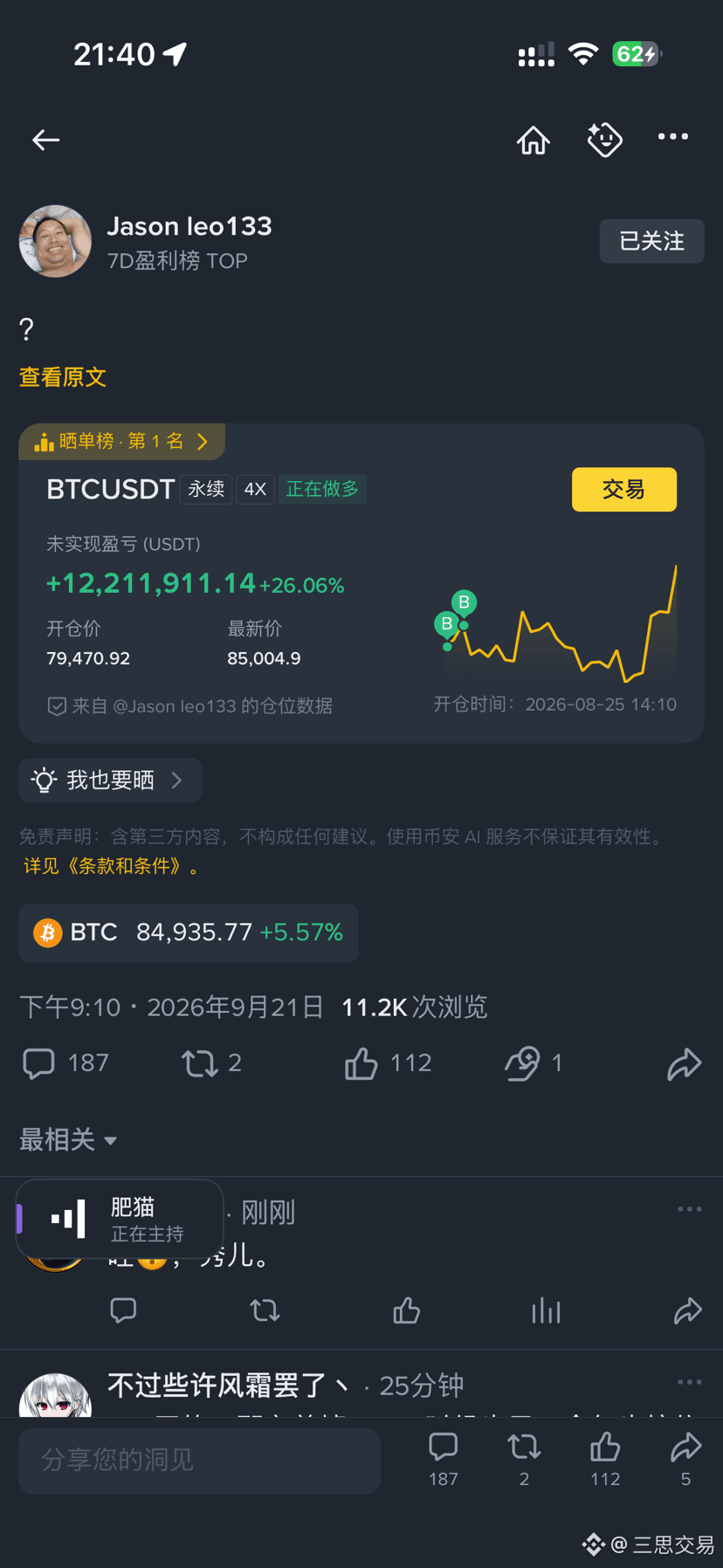
“Talk about ‘Setting 10 Big Goals’—he’s back again.”
Today the big boy broke through 85,000. He said that he had already warned before:
A strategy of continuous buying is itself a signal worth watching.
Coincidentally, on Strategy last week it also bought 950 units of the big boy, spending about $75.7 million, with an average cost of $79,670. At the moment, its holdings have returned to 846,000 units.
This guy previously said to hold at 80,000 to reach 100,000—and now he’s getting ready to move the trend position up to 120,000.
Lately, he really has called quite a few things right.$BTC
{future}(BTCUSDT)
#比特币突破8.5万美元
“Talk about ‘Setting 10 Big Goals’—he’s back again.”
Today the big boy broke through 85,000. He said that he had already warned before:
A strategy of continuous buying is itself a signal worth watching.
Coincidentally, on Strategy last week it also bought 950 units of the big boy, spending about $75.7 million, with an average cost of $79,670. At the moment, its holdings have returned to 846,000 units.
This guy previously said to hold at 80,000 to reach 100,000—and now he’s getting ready to move the trend position up to 120,000.
Lately, he really has called quite a few things right.$BTC
#比特币突破8.5万美元
Today the big boy broke through 85,000. He said that he had already warned before:
A strategy of continuous buying is itself a signal worth watching.
Coincidentally, on Strategy last week it also bought 950 units of the big boy, spending about $75.7 million, with an average cost of $79,670. At the moment, its holdings have returned to 846,000 units.
This guy previously said to hold at 80,000 to reach 100,000—and now he’s getting ready to move the trend position up to 120,000.
Lately, he really has called quite a few things right.$BTC
#比特币突破8.5万美元
2.7k
·
--
I just completed a new transaction! One-click copy my investment portfolio👇
I just completed a new transaction! One-click copy my investment portfolio👇
三思交易
Open Position
HYPEUSDTLong 10x
Position Size(USDT)
52.65
Entry Price
94.95
27
·
--
I just completed a new transaction! One-click copy my investment portfolio👇
I just completed a new transaction! One-click copy my investment portfolio👇
三思交易
Close Position
SPCXUSDT
PNL(USDT)
+64.92
Close Price
156
27
·
--
Verified
Strategy Last week increased holdings by 950 BTC and repurchased $174 million of STRC. The average purchase price per BTC was $79,670. Total Bitcoin holdings increased to 846,000 BTC.$BTC
{future}(BTCUSDT)
#比特币突破8.5万美元
Strategy Last week increased holdings by 950 BTC and repurchased $174 million of STRC. The average purchase price per BTC was $79,670. Total Bitcoin holdings increased to 846,000 BTC.$BTC
#比特币突破8.5万美元
#比特币突破8.5万美元
1.3k
·
--
I just completed a new transaction! One-click copy my investment portfolio👇
I just completed a new transaction! One-click copy my investment portfolio👇
三思交易
Open Position
SPCXUSDTLong 10x
Position Size(USDT)
32.46
Entry Price
154
19
·
--
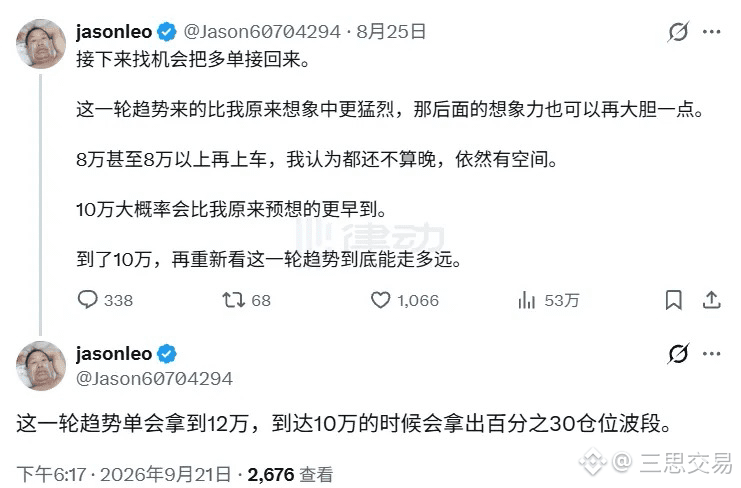
The giant whale “has updated his thinking again after setting 10 big targets.”
This round’s trend-only setup is aiming to reach 120,000.
When the coin (big bet) gets to 100,000, he takes 30% of the position to do swing trades, and keeps the rest holding.
This guy started saying back in late August:
“Once you stabilize at 80,000, the target is 100,000. Even if you only get in again after 80,000 is achieved, it’s not too late.”
Now as the big bet climbs step by step, he hasn’t rushed to exit. Instead, he’s raised the target to 120,000.
I really like how he handled it this time.
First take some profit at 100,000, and let the trend run with the remaining portion.
It’s not hard to be right about the direction.
The real difficulty is being able to hold on. $BTC
The giant whale “has updated his thinking again after setting 10 big targets.”
This round’s trend-only setup is aiming to reach 120,000.
When the coin (big bet) gets to 100,000, he takes 30% of the position to do swing trades, and keeps the rest holding.
This guy started saying back in late August:
“Once you stabilize at 80,000, the target is 100,000. Even if you only get in again after 80,000 is achieved, it’s not too late.”
Now as the big bet climbs step by step, he hasn’t rushed to exit. Instead, he’s raised the target to 120,000.
I really like how he handled it this time.
First take some profit at 100,000, and let the trend run with the remaining portion.
It’s not hard to be right about the direction.
The real difficulty is being able to hold on. $BTC
This round’s trend-only setup is aiming to reach 120,000.
When the coin (big bet) gets to 100,000, he takes 30% of the position to do swing trades, and keeps the rest holding.
This guy started saying back in late August:
“Once you stabilize at 80,000, the target is 100,000. Even if you only get in again after 80,000 is achieved, it’s not too late.”
Now as the big bet climbs step by step, he hasn’t rushed to exit. Instead, he’s raised the target to 120,000.
I really like how he handled it this time.
First take some profit at 100,000, and let the trend run with the remaining portion.
It’s not hard to be right about the direction.
The real difficulty is being able to hold on. $BTC
1.4k
·
--
I just completed a new trade! Copy my investment portfolio with one click👇
I just completed a new trade! Copy my investment portfolio with one click👇
三思交易
Close Position
HYPEUSDT
PNL(USDT)
+56.27
Close Price
95.695
9
·
--
I just completed a new trade! Copy my investment portfolio with one click👇
I just completed a new trade! Copy my investment portfolio with one click👇
三思交易
Open Position
HYPEUSDTLong 10x
Position Size(USDT)
54.92
Entry Price
95.6
12
·
--
Bullish
Big Brother Ma Ji just cashed back up again.
As the Big Cake and the Little Cake rise, all three of his long positions are currently in profit. His total unrealized profit is $5.66 million, with a return rate of 110%.
Little Cake: 25x long, position size $88.39 million, unrealized profit $4.5 million
Big Cake: 40x long, position size $27 million, unrealized profit $0.88 million
HYPE: 10x long, position size $9.01 million, unrealized profit $0.27 million
That adds up to $125 million in long positions.
The most brutal one is the Little Cake—one trade is holding up more than $88 million.
This guy Ma Ji really doesn’t change his style.
While others use high leverage for trading, he uses high leverage like clocking in for work.
This round has, for now, let him take the win back.$HYPE
Big Brother Ma Ji just cashed back up again.
As the Big Cake and the Little Cake rise, all three of his long positions are currently in profit. His total unrealized profit is $5.66 million, with a return rate of 110%.
Little Cake: 25x long, position size $88.39 million, unrealized profit $4.5 million
Big Cake: 40x long, position size $27 million, unrealized profit $0.88 million
HYPE: 10x long, position size $9.01 million, unrealized profit $0.27 million
That adds up to $125 million in long positions.
The most brutal one is the Little Cake—one trade is holding up more than $88 million.
This guy Ma Ji really doesn’t change his style.
While others use high leverage for trading, he uses high leverage like clocking in for work.
This round has, for now, let him take the win back.$HYPE
As the Big Cake and the Little Cake rise, all three of his long positions are currently in profit. His total unrealized profit is $5.66 million, with a return rate of 110%.
Little Cake: 25x long, position size $88.39 million, unrealized profit $4.5 million
Big Cake: 40x long, position size $27 million, unrealized profit $0.88 million
HYPE: 10x long, position size $9.01 million, unrealized profit $0.27 million
That adds up to $125 million in long positions.
The most brutal one is the Little Cake—one trade is holding up more than $88 million.
This guy Ma Ji really doesn’t change his style.
While others use high leverage for trading, he uses high leverage like clocking in for work.
This round has, for now, let him take the win back.$HYPE
518
·
--
Sudden surge in the afternoon—could it be because the leaders of China and the U.S. met…?
Sudden surge in the afternoon—could it be because the leaders of China and the U.S. met…?
884
·
--
Bullish
Ordinary people really don’t need to study short-term trading every day.
You think your opponent is Old Wang next door—but in fact, on the other side of the table are the exchange, huge whales, market makers, and a whole bunch of professional quantitative teams.
You race machines for speed, you race big funds for information, and in the end you still have to pay fees first.
The higher the frequency, the more often you make mistakes—and the more fees you pay.
And then there are those KOLs who draw resistance levels and support levels every day, telling you what’s full here and what’s empty there in the candles.
If they were really that amazing, they’d already be quietly making money.
With smaller capital, the most common mistake ordinary people make is trying to rapidly grow their principal by using high leverage.
With 10,000 as the principal, they can’t help but try to produce 1,000,000 in returns.
In the end, the principal doesn’t grow—first it’s the leverage that wipes out the account.
The more I think about it, the more I feel that the real advantage ordinary people have is:
Fewer trades, lower leverage, DCA, and holding long term.
If your capital is small, find ways to earn more principal in real life.
Don’t expect 100x leverage to solve poverty.
What it amplifies is never just returns.
It also amplifies your greed and your mistakes.
$BTC
Ordinary people really don’t need to study short-term trading every day.
You think your opponent is Old Wang next door—but in fact, on the other side of the table are the exchange, huge whales, market makers, and a whole bunch of professional quantitative teams.
You race machines for speed, you race big funds for information, and in the end you still have to pay fees first.
The higher the frequency, the more often you make mistakes—and the more fees you pay.
And then there are those KOLs who draw resistance levels and support levels every day, telling you what’s full here and what’s empty there in the candles.
If they were really that amazing, they’d already be quietly making money.
With smaller capital, the most common mistake ordinary people make is trying to rapidly grow their principal by using high leverage.
With 10,000 as the principal, they can’t help but try to produce 1,000,000 in returns.
In the end, the principal doesn’t grow—first it’s the leverage that wipes out the account.
The more I think about it, the more I feel that the real advantage ordinary people have is:
Fewer trades, lower leverage, DCA, and holding long term.
If your capital is small, find ways to earn more principal in real life.
Don’t expect 100x leverage to solve poverty.
What it amplifies is never just returns.
It also amplifies your greed and your mistakes.
$BTC
You think your opponent is Old Wang next door—but in fact, on the other side of the table are the exchange, huge whales, market makers, and a whole bunch of professional quantitative teams.
You race machines for speed, you race big funds for information, and in the end you still have to pay fees first.
The higher the frequency, the more often you make mistakes—and the more fees you pay.
And then there are those KOLs who draw resistance levels and support levels every day, telling you what’s full here and what’s empty there in the candles.
If they were really that amazing, they’d already be quietly making money.
With smaller capital, the most common mistake ordinary people make is trying to rapidly grow their principal by using high leverage.
With 10,000 as the principal, they can’t help but try to produce 1,000,000 in returns.
In the end, the principal doesn’t grow—first it’s the leverage that wipes out the account.
The more I think about it, the more I feel that the real advantage ordinary people have is:
Fewer trades, lower leverage, DCA, and holding long term.
If your capital is small, find ways to earn more principal in real life.
Don’t expect 100x leverage to solve poverty.
What it amplifies is never just returns.
It also amplifies your greed and your mistakes.
$BTC
216
·
--
Bullish
Kalshi has been exposed pretty seriously this time.
Yesterday, it publicly announced trading volume of $1.91 billion. Some traders rechecked and believe the actual trading volume could be as low as $136 million.
Where is the gap?
It mainly comes down to how “parlay” bets are counted.
If you spend $1 to buy a parlay ticket that pays $14.1 for hitting all selections, Kalshi may simply count the volume as $14.1.
Even more extreme: in these combination tickets, nearly half of the positions are tied to 11 or more events.
In addition, other traders estimated that if calculated on a monthly basis, the real trading volume might be around $4.0 billion, vs. $57.0 billion on the books—a huge discrepancy.
No wonder the community has been in an uproar these past few days.
If these estimates and counting methods are ultimately confirmed to be correct, then this “trading volume” from Kalshi will really need to be discounted and reconsidered going forward.$BTC $ETH
Kalshi has been exposed pretty seriously this time.
Yesterday, it publicly announced trading volume of $1.91 billion. Some traders rechecked and believe the actual trading volume could be as low as $136 million.
Where is the gap?
It mainly comes down to how “parlay” bets are counted.
If you spend $1 to buy a parlay ticket that pays $14.1 for hitting all selections, Kalshi may simply count the volume as $14.1.
Even more extreme: in these combination tickets, nearly half of the positions are tied to 11 or more events.
In addition, other traders estimated that if calculated on a monthly basis, the real trading volume might be around $4.0 billion, vs. $57.0 billion on the books—a huge discrepancy.
No wonder the community has been in an uproar these past few days.
If these estimates and counting methods are ultimately confirmed to be correct, then this “trading volume” from Kalshi will really need to be discounted and reconsidered going forward.$BTC $ETH
Yesterday, it publicly announced trading volume of $1.91 billion. Some traders rechecked and believe the actual trading volume could be as low as $136 million.
Where is the gap?
It mainly comes down to how “parlay” bets are counted.
If you spend $1 to buy a parlay ticket that pays $14.1 for hitting all selections, Kalshi may simply count the volume as $14.1.
Even more extreme: in these combination tickets, nearly half of the positions are tied to 11 or more events.
In addition, other traders estimated that if calculated on a monthly basis, the real trading volume might be around $4.0 billion, vs. $57.0 billion on the books—a huge discrepancy.
No wonder the community has been in an uproar these past few days.
If these estimates and counting methods are ultimately confirmed to be correct, then this “trading volume” from Kalshi will really need to be discounted and reconsidered going forward.$BTC $ETH
22
·
--
Verified
Next week we’re doing a “copycat” rollout—first, let’s jot down this unlock schedule.
This time the most eye-catching one is XPL.
September 25, 20:00:
XPL unlocks about 1.76 billion tokens, worth about $158 million, accounting for roughly 63.2% of the current circulating supply.
That ratio is indeed a bit scary—I’ll keep a close watch.
I’ll also note the others:
September 22: ID, MBG
September 23: SOON
September 24: SOSO
September 25: H, BIGTIME, XPL
September 26: STBL
Among these, BIGTIME’s unlocked amount is about 13.34% of circulating supply, H about 7.34%, and SOSO about 5.97%.
I have a habit when doing “copycats”:
When it’s a big unlock week like this, first check the unlock ratio, then check the receiving addresses and whether there’s any subsequent transfer to an exchange.
Unlock ≠ guaranteed sell-off.
But if a large batch of tokens suddenly appears, at the very least I need to know who received them and whether they might sell.
Especially for something like XPL, which unlocks more than 60% of circulating supply at once—I’d rather take another look or two than rush in blindly.
$BTC
{future}(BTCUSDT)
$XPL
{future}(XPLUSDT)
$HYPE
{future}(HYPEUSDT)
#以太坊突破2700美元
Next week we’re doing a “copycat” rollout—first, let’s jot down this unlock schedule.
This time the most eye-catching one is XPL.
September 25, 20:00:
XPL unlocks about 1.76 billion tokens, worth about $158 million, accounting for roughly 63.2% of the current circulating supply.
That ratio is indeed a bit scary—I’ll keep a close watch.
I’ll also note the others:
September 22: ID, MBG
September 23: SOON
September 24: SOSO
September 25: H, BIGTIME, XPL
September 26: STBL
Among these, BIGTIME’s unlocked amount is about 13.34% of circulating supply, H about 7.34%, and SOSO about 5.97%.
I have a habit when doing “copycats”:
When it’s a big unlock week like this, first check the unlock ratio, then check the receiving addresses and whether there’s any subsequent transfer to an exchange.
Unlock ≠ guaranteed sell-off.
But if a large batch of tokens suddenly appears, at the very least I need to know who received them and whether they might sell.
Especially for something like XPL, which unlocks more than 60% of circulating supply at once—I’d rather take another look or two than rush in blindly.
$BTC
$XPL
$HYPE
#以太坊突破2700美元
This time the most eye-catching one is XPL.
September 25, 20:00:
XPL unlocks about 1.76 billion tokens, worth about $158 million, accounting for roughly 63.2% of the current circulating supply.
That ratio is indeed a bit scary—I’ll keep a close watch.
I’ll also note the others:
September 22: ID, MBG
September 23: SOON
September 24: SOSO
September 25: H, BIGTIME, XPL
September 26: STBL
Among these, BIGTIME’s unlocked amount is about 13.34% of circulating supply, H about 7.34%, and SOSO about 5.97%.
I have a habit when doing “copycats”:
When it’s a big unlock week like this, first check the unlock ratio, then check the receiving addresses and whether there’s any subsequent transfer to an exchange.
Unlock ≠ guaranteed sell-off.
But if a large batch of tokens suddenly appears, at the very least I need to know who received them and whether they might sell.
Especially for something like XPL, which unlocks more than 60% of circulating supply at once—I’d rather take another look or two than rush in blindly.
$BTC
$XPL
$HYPE
#以太坊突破2700美元
1
412
Log in to explore more content
Join global crypto users on Binance Square
⚡️ Get latest and useful information about crypto.
💬 Trusted by the world’s largest crypto exchange.
👍 Discover real insights from verified creators.
Email / Phone number
Trending Topics
AIStocksWhatNext
550,435 views
4,118 Discussing
Share & Win Traffic Reward in our Trending Hashtag Campaign
✨Topic: What Other Investment Opportunities Remain as AI Stocks Keep Rising?
👉How to Join:
Publish a short post or article with hashtag #AIStocksWhatNext
Share whether you’re bullish or bearish, and post your AI stock holdings or trade — using the trade widget may improve your eligibility.
You can also strengthen your post by sharing data or charts, and avoiding AI-generated images.
✍️Create content based on the below angles:
- Nvidia says chip sales will double next year, and top AI companies keep hitting record revenue, the compute spend behind it is just as staggering. Is AI demand really taking off? And how long can it last? AI stocks are up across the board. Is this a real breakout, or just a short-term bounce?
- Industry leaders are calling to slow down AI development, while Trump plans to build an “AI Force”, claiming AI could account for 25% of U.S. GDP in the future. Whose side are you on? Will state-level backing be a long-term win for AI stocks?
- Are you buying AI stocks? Share your AI-related trade/holdings with our trade sharing widget.
⏰Campaign Period:
- 2026-09-22 7:00 - 2026-09-24 4:00 UTC
🎁Reward:
- Qualified posts that comply with the above guidelines and contain more than 100 words will be reviewed and may receive a random traffic boost of 500 to 3,000 views. You will receive a notification from your feed secretary if your post is selected.
- Get a chance to have your article featured on Binance Square Official
Need ideas for your post? Visit the topic page #AIStocksWhatNext or the Square Guide on How to Post for Better Reach.
Binance Square Official
·445 Likes
·1.2M views
21SharesLaunchesEuropesFirstZcashETP
197 views
31 Discussing
CardanoJoinsX402PaymentStandard
438 views
56 Discussing