
CoinFoundCN
124 Posts

CoinFoundCN
Report
Block User
0 Following
865 Followers
707 Liked
Posts
PINNED
·
--
Article
Insights into RWA Market Fund Flow — Counter-Bear Market Growth, Structural Differentiation, and Market WinnersTakeaway
1. Currently, the cryptocurrency market is in a slump, with the market value falling back to 2.4 trillion USD. This bear market and panic sentiment can be traced back to the '1011' event on October 11, 2025: after '1011', the crypto market rapidly deteriorated: in that month, DAT's monthly net inflow dropped by over 75%, falling below 3 billion USD; in the following month, cryptocurrency ETFs reversed from six months of monthly net inflows to nearly 5 billion USD in monthly net outflows. Subsequently, the cryptocurrency market value continued to decline under macro uncertainty.
2. However, we are in a tentative recovery period following the '1011' event. From the monthly data, DAT is recovering purchases, ETF net outflows are decreasing, and the data is slowly 'recovering'. Meanwhile, the market value of stablecoins remains at 300 billion USD, and this part of the funds has not yet left, waiting and observing.
Insights into RWA Market Fund Flow — Counter-Bear Market Growth, Structural Differentiation, and Market Winners
Takeaway
1. Currently, the cryptocurrency market is in a slump, with the market value falling back to 2.4 trillion USD. This bear market and panic sentiment can be traced back to the '1011' event on October 11, 2025: after '1011', the crypto market rapidly deteriorated: in that month, DAT's monthly net inflow dropped by over 75%, falling below 3 billion USD; in the following month, cryptocurrency ETFs reversed from six months of monthly net inflows to nearly 5 billion USD in monthly net outflows. Subsequently, the cryptocurrency market value continued to decline under macro uncertainty.
2. However, we are in a tentative recovery period following the '1011' event. From the monthly data, DAT is recovering purchases, ETF net outflows are decreasing, and the data is slowly 'recovering'. Meanwhile, the market value of stablecoins remains at 300 billion USD, and this part of the funds has not yet left, waiting and observing.
1. Currently, the cryptocurrency market is in a slump, with the market value falling back to 2.4 trillion USD. This bear market and panic sentiment can be traced back to the '1011' event on October 11, 2025: after '1011', the crypto market rapidly deteriorated: in that month, DAT's monthly net inflow dropped by over 75%, falling below 3 billion USD; in the following month, cryptocurrency ETFs reversed from six months of monthly net inflows to nearly 5 billion USD in monthly net outflows. Subsequently, the cryptocurrency market value continued to decline under macro uncertainty.
2. However, we are in a tentative recovery period following the '1011' event. From the monthly data, DAT is recovering purchases, ETF net outflows are decreasing, and the data is slowly 'recovering'. Meanwhile, the market value of stablecoins remains at 300 billion USD, and this part of the funds has not yet left, waiting and observing.
1
4
9.9k
·
--
Is the stock RWA actually growing, or is it cooling down?
The answer might be: Both are true.
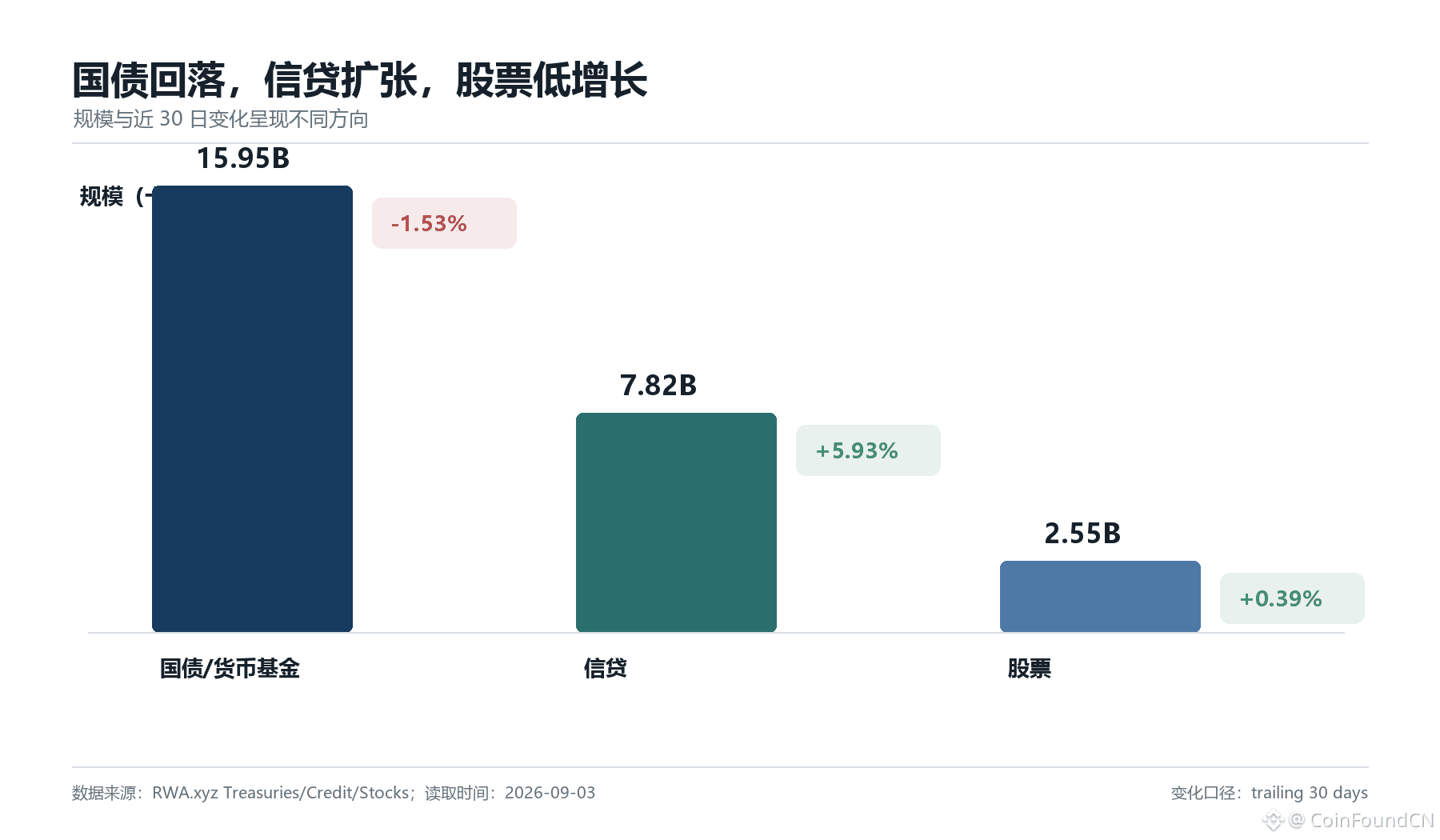
Over the past 30 days:
• Holders +155%
• Transfer Volume +31%
• Asset Size +0.39%
But at the same time:
Monthly Active Addresses -89.65%.
This means:
Increased reach does not necessarily mean real usage is increasing in parallel.
Product launches, asset migration, market making, and cross-chain activity
can all boost certain metrics.
What’s truly worth持续关注的,
still is real trading, repeat users, and sustained liquidity.
📖 #CoinFound Full in-depth research report:
https://app.coinfound.org/zh/research/monthly-202608
Is the stock RWA actually growing, or is it cooling down?
The answer might be: Both are true.
Over the past 30 days:
• Holders +155%
• Transfer Volume +31%
• Asset Size +0.39%
But at the same time:
Monthly Active Addresses -89.65%.
This means:
Increased reach does not necessarily mean real usage is increasing in parallel.
Product launches, asset migration, market making, and cross-chain activity
can all boost certain metrics.
What’s truly worth持续关注的,
still is real trading, repeat users, and sustained liquidity.
📖 #CoinFound Full in-depth research report:
https://app.coinfound.org/zh/research/monthly-202608
The answer might be: Both are true.
Over the past 30 days:
• Holders +155%
• Transfer Volume +31%
• Asset Size +0.39%
But at the same time:
Monthly Active Addresses -89.65%.
This means:
Increased reach does not necessarily mean real usage is increasing in parallel.
Product launches, asset migration, market making, and cross-chain activity
can all boost certain metrics.
What’s truly worth持续关注的,
still is real trading, repeat users, and sustained liquidity.
📖 #CoinFound Full in-depth research report:
https://app.coinfound.org/zh/research/monthly-202608
300
·
--
Many people say that RWA has entered a phase of rapid growth.
But first, we need to answer one question:
Which kind of RWA are we talking about?
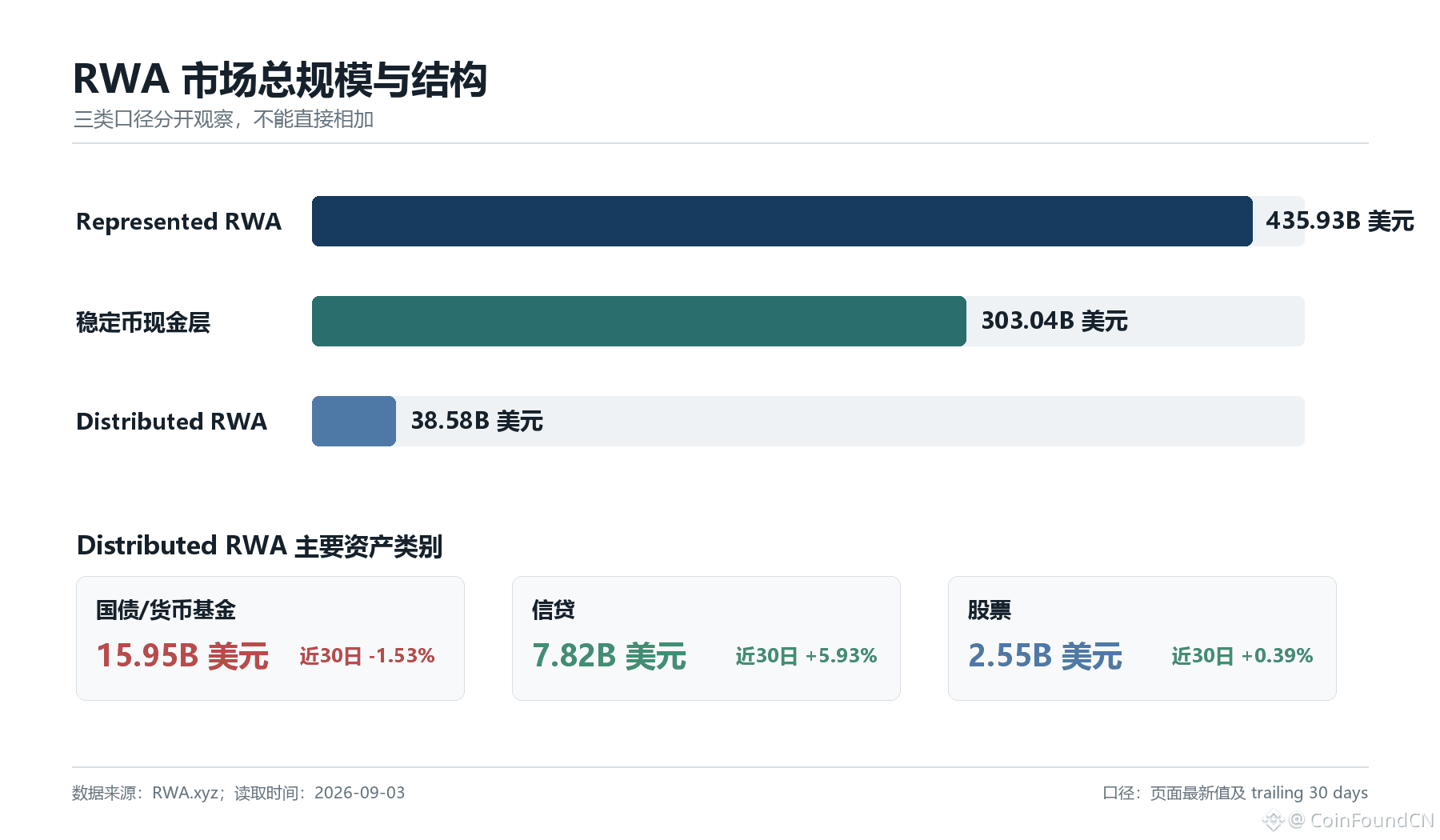
In its latest monthly report, CoinFound breaks the market into three different perspectives:
• Represented RWA: $435.93B
• Stablecoin Cash Layer: $303.04B
• Distributed RWA: $38.58B
These refer to different layers of assets.
They cannot be added directly, nor can they be substituted for one another.
To truly understand the RWA market,
the first step isn’t to look at which numbers are larger,
but to understand what each number actually represents.
Data Defines Value.
📖 Full Chinese Version:
https://app.coinfound.org/zh/research/monthly-202608
Many people say that RWA has entered a phase of rapid growth.
But first, we need to answer one question:
Which kind of RWA are we talking about?
In its latest monthly report, CoinFound breaks the market into three different perspectives:
• Represented RWA: $435.93B
• Stablecoin Cash Layer: $303.04B
• Distributed RWA: $38.58B
These refer to different layers of assets.
They cannot be added directly, nor can they be substituted for one another.
To truly understand the RWA market,
the first step isn’t to look at which numbers are larger,
but to understand what each number actually represents.
Data Defines Value.
📖 Full Chinese Version:
https://app.coinfound.org/zh/research/monthly-202608
But first, we need to answer one question:
Which kind of RWA are we talking about?
In its latest monthly report, CoinFound breaks the market into three different perspectives:
• Represented RWA: $435.93B
• Stablecoin Cash Layer: $303.04B
• Distributed RWA: $38.58B
These refer to different layers of assets.
They cannot be added directly, nor can they be substituted for one another.
To truly understand the RWA market,
the first step isn’t to look at which numbers are larger,
but to understand what each number actually represents.
Data Defines Value.
📖 Full Chinese Version:
https://app.coinfound.org/zh/research/monthly-202608
1
1
801
·
--
#RWA Market Continues to Grow.
But the real change isn’t the size anymore—it’s the source of growth.
#CoinFound ’s latest《RWA Market Monthly Report for August 2026》 finds that:
• Credit is becoming the fastest-growing asset class, with the size of government bond holdings showing its first decline;
• Equity products are expanding continuously, but capital flows and actual utilization have not improved in sync;
• Market attention is shifting from asset scale to regulatory, payment, and settlement infrastructure.
As RWA moves from “on-chain assets” into a “product competition” phase,
what will truly determine the next round of growth
may no longer be how many assets can be issued—but rather who can build a more complete system for liquidity, access, and settlement.
CoinFound—define value with data.
🔗 Full Chinese version:
https://app.coinfound.org/zh/research/monthly-202608
#RWA Market Continues to Grow.
But the real change isn’t the size anymore—it’s the source of growth.
#CoinFound ’s latest《RWA Market Monthly Report for August 2026》 finds that:
• Credit is becoming the fastest-growing asset class, with the size of government bond holdings showing its first decline;
• Equity products are expanding continuously, but capital flows and actual utilization have not improved in sync;
• Market attention is shifting from asset scale to regulatory, payment, and settlement infrastructure.
As RWA moves from “on-chain assets” into a “product competition” phase,
what will truly determine the next round of growth
may no longer be how many assets can be issued—but rather who can build a more complete system for liquidity, access, and settlement.
CoinFound—define value with data.
🔗 Full Chinese version:
https://app.coinfound.org/zh/research/monthly-202608
But the real change isn’t the size anymore—it’s the source of growth.
#CoinFound ’s latest《RWA Market Monthly Report for August 2026》 finds that:
• Credit is becoming the fastest-growing asset class, with the size of government bond holdings showing its first decline;
• Equity products are expanding continuously, but capital flows and actual utilization have not improved in sync;
• Market attention is shifting from asset scale to regulatory, payment, and settlement infrastructure.
As RWA moves from “on-chain assets” into a “product competition” phase,
what will truly determine the next round of growth
may no longer be how many assets can be issued—but rather who can build a more complete system for liquidity, access, and settlement.
CoinFound—define value with data.
🔗 Full Chinese version:
https://app.coinfound.org/zh/research/monthly-202608
1.2k
·
--
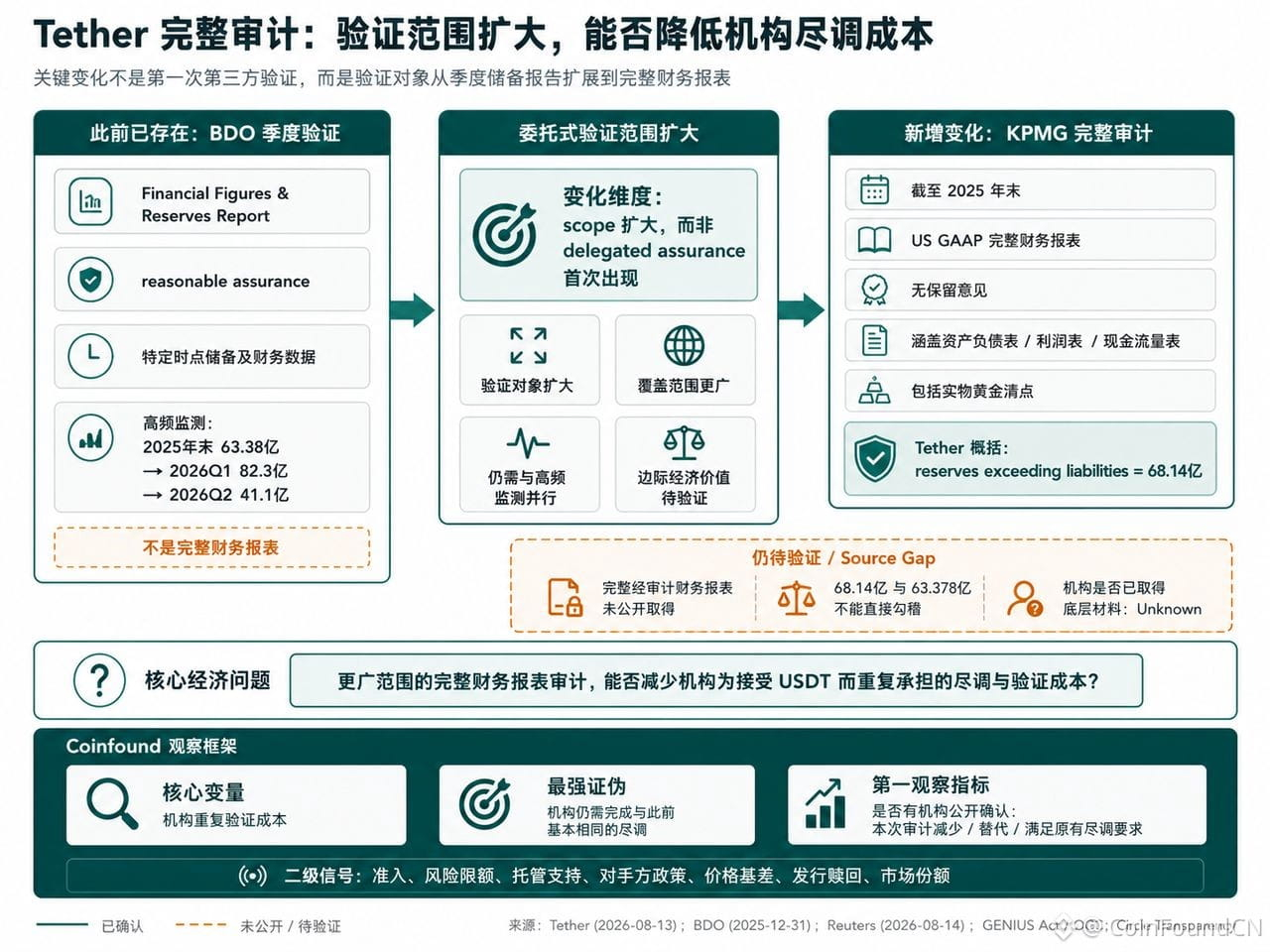
The key change in Tether is not that it is the first time accepting third-party verification, but that the verification scope has been expanded to full financial statements.
KPMG’s complete audit supplements the quarterly reserve assurance previously provided by BDO, but this does not mean that the institution’s due diligence cost has automatically decreased.
CoinFound focuses on the real questions that are worth verifying:
Has the broader audit scope reduced the institution’s repeated due diligence?
Has it affected the onboarding and risk policies of banks, custodians, and trading platforms?
Has any institution publicly stated that existing due diligence requirements have therefore been replaced or satisfied?
What truly needs to be observed is not whether an audit was “completed,” but whether the institution’s behavior has actually changed afterward.
CoinFound, where data definitions have value. Full analysis👇
View original: [Tether 完整审计:更广的验证,能否降低机构尽调成本](https://www.binance.com/zh-CN/square/post/357633493932129)
The key change in Tether is not that it is the first time accepting third-party verification, but that the verification scope has been expanded to full financial statements.
KPMG’s complete audit supplements the quarterly reserve assurance previously provided by BDO, but this does not mean that the institution’s due diligence cost has automatically decreased.
CoinFound focuses on the real questions that are worth verifying:
Has the broader audit scope reduced the institution’s repeated due diligence?
Has it affected the onboarding and risk policies of banks, custodians, and trading platforms?
Has any institution publicly stated that existing due diligence requirements have therefore been replaced or satisfied?
What truly needs to be observed is not whether an audit was “completed,” but whether the institution’s behavior has actually changed afterward.
CoinFound, where data definitions have value. Full analysis👇
View original: Tether 完整审计:更广的验证,能否降低机构尽调成本
KPMG’s complete audit supplements the quarterly reserve assurance previously provided by BDO, but this does not mean that the institution’s due diligence cost has automatically decreased.
CoinFound focuses on the real questions that are worth verifying:
Has the broader audit scope reduced the institution’s repeated due diligence?
Has it affected the onboarding and risk policies of banks, custodians, and trading platforms?
Has any institution publicly stated that existing due diligence requirements have therefore been replaced or satisfied?
What truly needs to be observed is not whether an audit was “completed,” but whether the institution’s behavior has actually changed afterward.
CoinFound, where data definitions have value. Full analysis👇
View original: Tether 完整审计:更广的验证,能否降低机构尽调成本
529
·
--

Article
Tether’s Full Audit: Broader Verification—Can It Reduce Institutional Due Diligence Costs?On August 13, Tether announced that KPMG U.S. completed an independent audit of Tether International, S.A. de C.V.’s complete financial statements as of the end of 2025 and issued an unqualified opinion. The audit covered the balance sheet, income statement, statement of changes in equity, and cash flow statement, and included an inventory of the physical gold it holds. Tether also clarified that this full audit is a supplement to the existing quarterly reserve reports, not a replacement.
This message is likely to be understood as Tether “finally becoming more transparent.” But as of a Reuters report on August 14, the audit at the time was not made public; KPMG U.S. confirmed that it issued an unqualified opinion and declined further comment on the grounds of client confidentiality. This article’s research also did not obtain complete audited financial statements. As for whether the full statements were provided to banks or other counterpart institutions under confidentiality arrangements, there is currently no reliable public material to confirm it.
Tether’s Full Audit: Broader Verification—Can It Reduce Institutional Due Diligence Costs?
On August 13, Tether announced that KPMG U.S. completed an independent audit of Tether International, S.A. de C.V.’s complete financial statements as of the end of 2025 and issued an unqualified opinion. The audit covered the balance sheet, income statement, statement of changes in equity, and cash flow statement, and included an inventory of the physical gold it holds. Tether also clarified that this full audit is a supplement to the existing quarterly reserve reports, not a replacement.
This message is likely to be understood as Tether “finally becoming more transparent.” But as of a Reuters report on August 14, the audit at the time was not made public; KPMG U.S. confirmed that it issued an unqualified opinion and declined further comment on the grounds of client confidentiality. This article’s research also did not obtain complete audited financial statements. As for whether the full statements were provided to banks or other counterpart institutions under confidentiality arrangements, there is currently no reliable public material to confirm it.
This message is likely to be understood as Tether “finally becoming more transparent.” But as of a Reuters report on August 14, the audit at the time was not made public; KPMG U.S. confirmed that it issued an unqualified opinion and declined further comment on the grounds of client confidentiality. This article’s research also did not obtain complete audited financial statements. As for whether the full statements were provided to banks or other counterpart institutions under confidentiality arrangements, there is currently no reliable public material to confirm it.
396
·
--
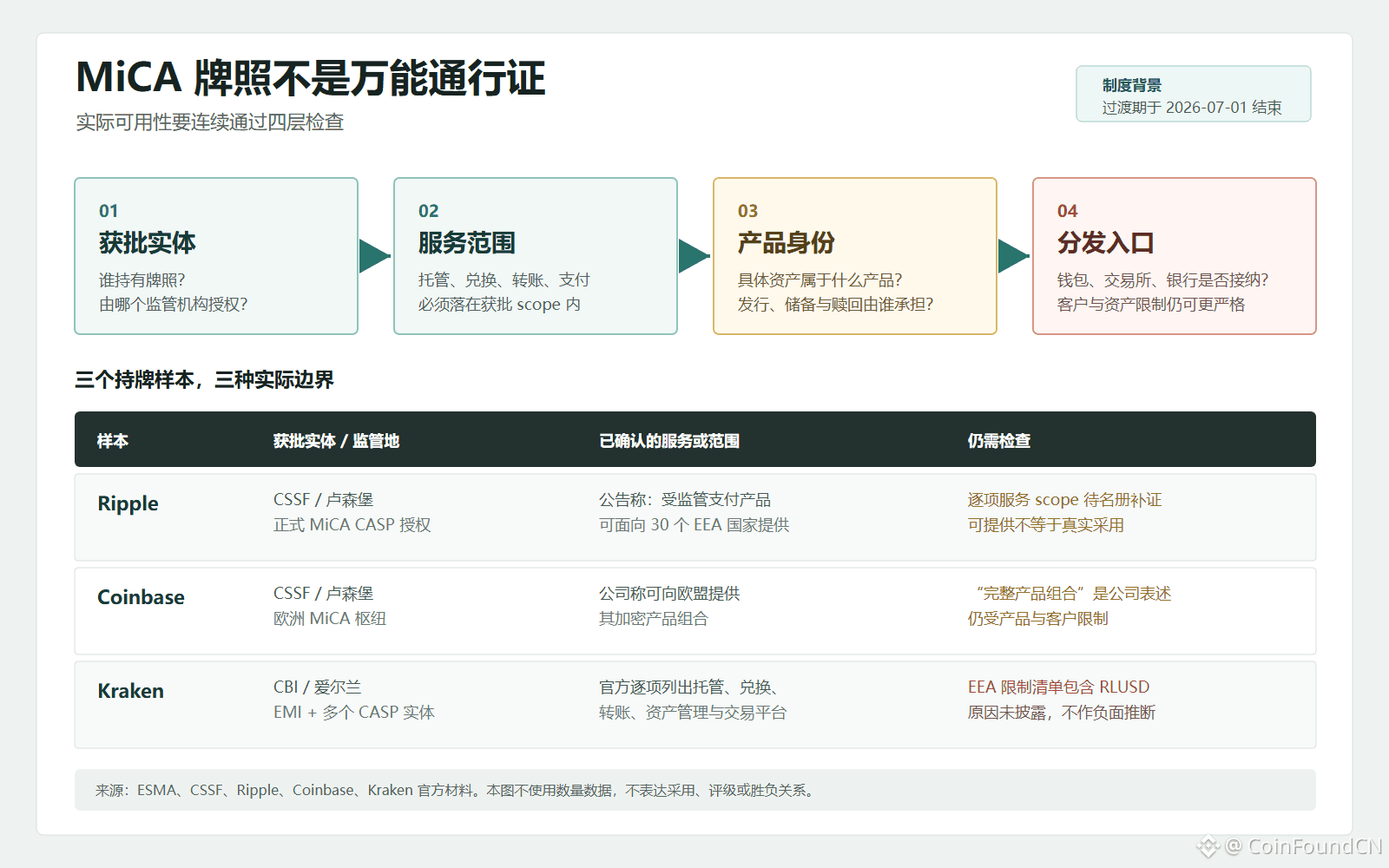
MiCA licenses are not a universal pass.
Just because a platform has MiCA authorization does not mean all of its services and all of its assets can be launched directly across Europe.
In practice, usability must be checked continuously across at least four layers:
• Who holds the license
• What services are covered by the approved scope
• What specific assets belong to which product
• Whether wallets, exchanges, or banks accept distribution
Ripple, Coinbase, and Kraken have all established compliant pathways for Europe, but the approved entities, service scopes, product limitations, and distribution entry points are not the same.
So, determining whether a product is “compliantly usable” cannot be based solely on whether the company has a MiCA license. Licenses address market entry; product and distribution boundaries determine real-world usability.
CoinFound defines data value.
[MiCA 牌照打开的是哪一扇门?](https://www.binance.com/zh-CN/square/post/344528482136354)
MiCA licenses are not a universal pass.
Just because a platform has MiCA authorization does not mean all of its services and all of its assets can be launched directly across Europe.
In practice, usability must be checked continuously across at least four layers:
• Who holds the license
• What services are covered by the approved scope
• What specific assets belong to which product
• Whether wallets, exchanges, or banks accept distribution
Ripple, Coinbase, and Kraken have all established compliant pathways for Europe, but the approved entities, service scopes, product limitations, and distribution entry points are not the same.
So, determining whether a product is “compliantly usable” cannot be based solely on whether the company has a MiCA license. Licenses address market entry; product and distribution boundaries determine real-world usability.
CoinFound defines data value.
MiCA 牌照打开的是哪一扇门?
Just because a platform has MiCA authorization does not mean all of its services and all of its assets can be launched directly across Europe.
In practice, usability must be checked continuously across at least four layers:
• Who holds the license
• What services are covered by the approved scope
• What specific assets belong to which product
• Whether wallets, exchanges, or banks accept distribution
Ripple, Coinbase, and Kraken have all established compliant pathways for Europe, but the approved entities, service scopes, product limitations, and distribution entry points are not the same.
So, determining whether a product is “compliantly usable” cannot be based solely on whether the company has a MiCA license. Licenses address market entry; product and distribution boundaries determine real-world usability.
CoinFound defines data value.
MiCA 牌照打开的是哪一扇门?
9
7.5k
·
--
Which Door Does a MiCA License Open?On July 6, Ripple announced that it had received formal MiCA authorization from the Luxembourg financial regulator CSSF as a crypto-asset service provider (CASP). The company described this as a compliance foundation covering 30 countries in the European Economic Area, and said that regulated crypto payment products can be offered to local financial institutions and enterprises.
This message can be most easily condensed into one sentence: Ripple has gotten the “European passport.” But if you directly equate a license with RLUSD, XRP, or the availability of all Ripple services across Europe, you skip several key steps.
A more accurate judgment is that what MiCA authorization opens up is a regulatory pathway for approved entities to cross-border provide approved services. Whether a product ultimately reaches users depends, in sequence, on the scope of services, the product identity, and the distribution entry point. A license is a necessary condition, but it is not the complete answer to whether a product is reachable.
Which Door Does a MiCA License Open?
On July 6, Ripple announced that it had received formal MiCA authorization from the Luxembourg financial regulator CSSF as a crypto-asset service provider (CASP). The company described this as a compliance foundation covering 30 countries in the European Economic Area, and said that regulated crypto payment products can be offered to local financial institutions and enterprises.
This message can be most easily condensed into one sentence: Ripple has gotten the “European passport.” But if you directly equate a license with RLUSD, XRP, or the availability of all Ripple services across Europe, you skip several key steps.
A more accurate judgment is that what MiCA authorization opens up is a regulatory pathway for approved entities to cross-border provide approved services. Whether a product ultimately reaches users depends, in sequence, on the scope of services, the product identity, and the distribution entry point. A license is a necessary condition, but it is not the complete answer to whether a product is reachable.
This message can be most easily condensed into one sentence: Ripple has gotten the “European passport.” But if you directly equate a license with RLUSD, XRP, or the availability of all Ripple services across Europe, you skip several key steps.
A more accurate judgment is that what MiCA authorization opens up is a regulatory pathway for approved entities to cross-border provide approved services. Whether a product ultimately reaches users depends, in sequence, on the scope of services, the product identity, and the distribution entry point. A license is a necessary condition, but it is not the complete answer to whether a product is reachable.
8
4.4k
·
--
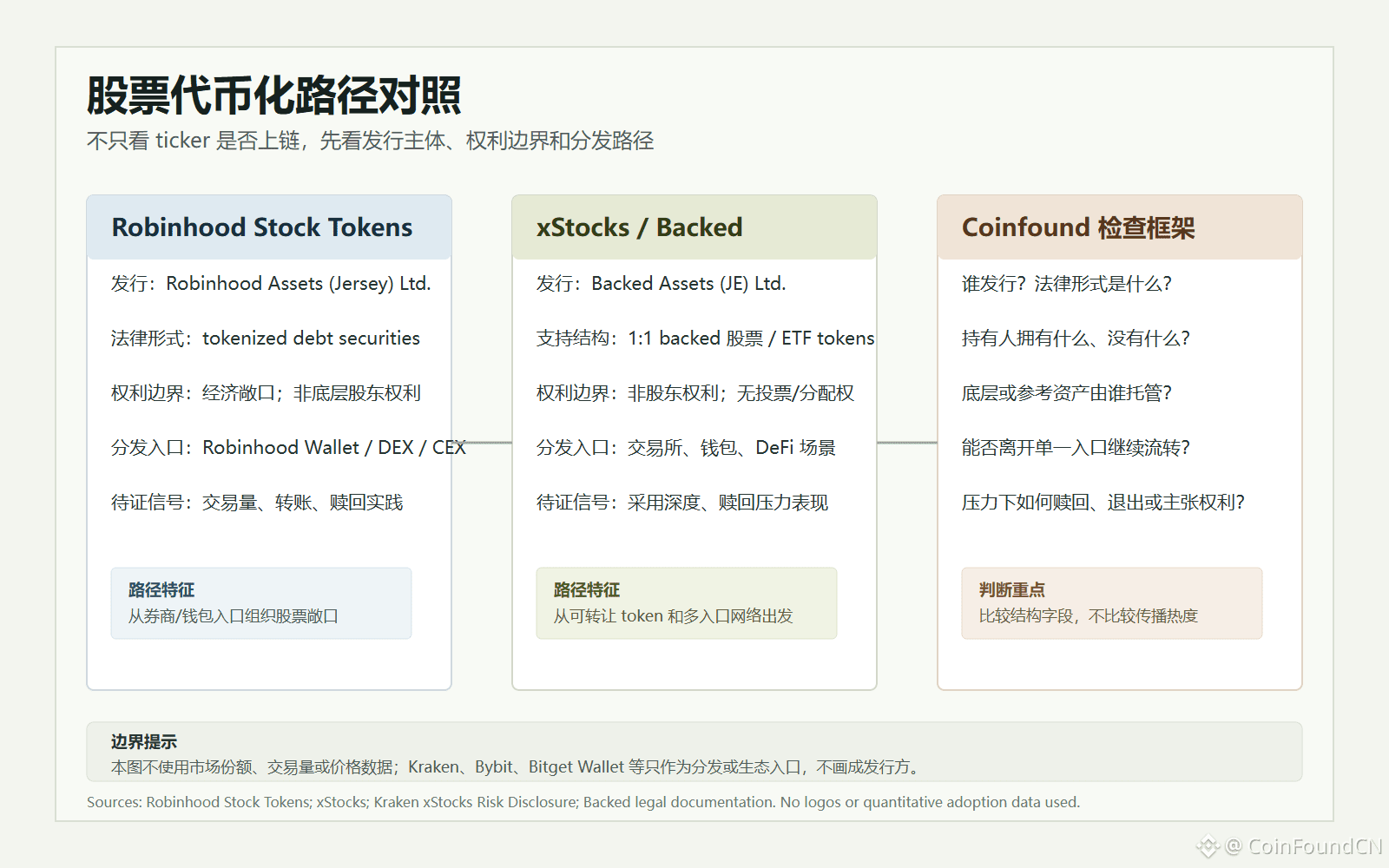
Stock Tokenization: Don’t Just Look at Whether There’s a Ticker or a Listing on the Chain.
Robinhood Stock Tokens and xStocks both appear to represent “on-chain stock exposure,” but their structures are not the same:
• Different issuing entities
• Different legal forms
• Different holder rights
• Different distribution channels
A token can track a stock price, but that doesn’t mean the token holder has full shareholder rights.
So the real question isn’t whether Apple, Tesla, or NVIDIA has been listed on-chain.
Instead, it is:
- Who issues it?
- What is the legal form?
- What exactly do holders have?
- Who custody/holds the underlying assets?
- Under pressure, how can you redeem or exit?
In stock tokenization, structure matters more than the ticker.
#CoinFound, Data Defines Value.
View Original Text: [股票代币化不能只看 ticker 上链](https://www.binance.com/zh-CN/square/post/342746148789201)
Stock Tokenization: Don’t Just Look at Whether There’s a Ticker or a Listing on the Chain.
Robinhood Stock Tokens and xStocks both appear to represent “on-chain stock exposure,” but their structures are not the same:
• Different issuing entities
• Different legal forms
• Different holder rights
• Different distribution channels
A token can track a stock price, but that doesn’t mean the token holder has full shareholder rights.
So the real question isn’t whether Apple, Tesla, or NVIDIA has been listed on-chain.
Instead, it is:
- Who issues it?
- What is the legal form?
- What exactly do holders have?
- Who custody/holds the underlying assets?
- Under pressure, how can you redeem or exit?
In stock tokenization, structure matters more than the ticker.
#CoinFound, Data Defines Value.
View Original Text: 股票代币化不能只看 ticker 上链
Robinhood Stock Tokens and xStocks both appear to represent “on-chain stock exposure,” but their structures are not the same:
• Different issuing entities
• Different legal forms
• Different holder rights
• Different distribution channels
A token can track a stock price, but that doesn’t mean the token holder has full shareholder rights.
So the real question isn’t whether Apple, Tesla, or NVIDIA has been listed on-chain.
Instead, it is:
- Who issues it?
- What is the legal form?
- What exactly do holders have?
- Who custody/holds the underlying assets?
- Under pressure, how can you redeem or exit?
In stock tokenization, structure matters more than the ticker.
#CoinFound, Data Defines Value.
View Original Text: 股票代币化不能只看 ticker 上链
1
5
8.7k
·
--
Stock tokenization can’t be judged only by a ticker being on-chainRobinhood stock tokens are easy to turn into a smooth storyline: mainstream brokers move U.S. stocks on-chain, and ordinary users can trade stock tokens in their wallets afterward. This entry point is compelling and shareable, but if you only write along that direction, the analysis will stop too early at the four words “stocks on-chain.”
More worth comparing is that within the same category of narratives, there is already more than one path. xStocks / Backed are also turning U.S. stocks and ETFs into on-chain tokens and distributing them across exchanges, wallets, and DeFi scenarios. Robinhood and xStocks both make stock price exposure feel more like an on-chain asset, but they shouldn’t be lumped into the same conclusion: looking like a stock doesn’t mean token holders have received full shareholder rights; being able to circulate through more entry points doesn’t mean the risk boundaries automatically disappear.
Stock tokenization can’t be judged only by a ticker being on-chain
Robinhood stock tokens are easy to turn into a smooth storyline: mainstream brokers move U.S. stocks on-chain, and ordinary users can trade stock tokens in their wallets afterward. This entry point is compelling and shareable, but if you only write along that direction, the analysis will stop too early at the four words “stocks on-chain.”
More worth comparing is that within the same category of narratives, there is already more than one path. xStocks / Backed are also turning U.S. stocks and ETFs into on-chain tokens and distributing them across exchanges, wallets, and DeFi scenarios. Robinhood and xStocks both make stock price exposure feel more like an on-chain asset, but they shouldn’t be lumped into the same conclusion: looking like a stock doesn’t mean token holders have received full shareholder rights; being able to circulate through more entry points doesn’t mean the risk boundaries automatically disappear.
More worth comparing is that within the same category of narratives, there is already more than one path. xStocks / Backed are also turning U.S. stocks and ETFs into on-chain tokens and distributing them across exchanges, wallets, and DeFi scenarios. Robinhood and xStocks both make stock price exposure feel more like an on-chain asset, but they shouldn’t be lumped into the same conclusion: looking like a stock doesn’t mean token holders have received full shareholder rights; being able to circulate through more entry points doesn’t mean the risk boundaries automatically disappear.
1
6
3.7k
·
--
Verified
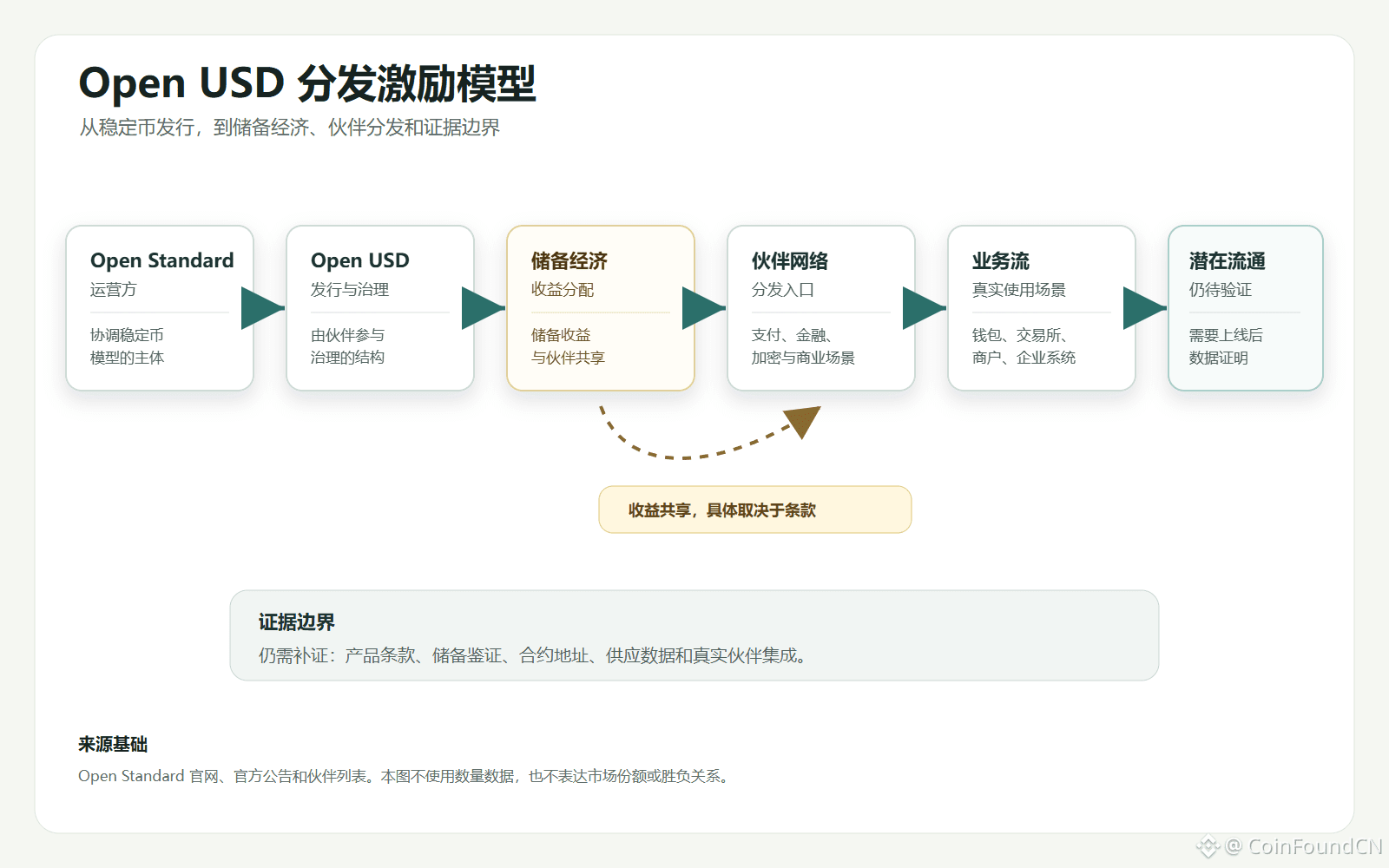
Open USD may not be “yet another stablecoin.” It’s more like an experiment in stablecoin distribution incentives.
This time, Open Standard isn’t just providing a new dollar-pegged stablecoin, but a whole new set of design logic:
• Free minting / redemption
• Reserve returns shared with partners
• Partners’ participation in governance
This means that stablecoin competition may be shifting from issuer-credit competition to distribution-network incentive competition.
What the market will ask next may no longer be only: who issues the stablecoin, and who receives reserve returns?
Instead, it may be: who is responsible for distribution, who participates in governance, and who shares the economic benefits generated by circulation?
But boundaries are just as important.
A list of 140+ partners doesn’t equal real adoption.
Sharing returns doesn’t equal proof of security.
What still needs to be verified is:
the issuing entity, reserve disclosure, assurance/attestation arrangements, contract addresses, supply data, and whether partners are truly integrated into payment, settlement, and account use cases.
So, Open USD is worth paying attention to—but for now, it’s more appropriate to view it as an experiment in stablecoin distribution networks, rather than a proven new king that will reshape the landscape.
CoinFound, data defines value.
🔗: https://app.coinfound.org/zh/rwa/dashboard
Original: [Open USD 不是又一个稳定币,而是一次分发激励实验](https://www.binance.com/zh-CN/square/post/342416226488002)
Open USD may not be “yet another stablecoin.” It’s more like an experiment in stablecoin distribution incentives.
This time, Open Standard isn’t just providing a new dollar-pegged stablecoin, but a whole new set of design logic:
• Free minting / redemption
• Reserve returns shared with partners
• Partners’ participation in governance
This means that stablecoin competition may be shifting from issuer-credit competition to distribution-network incentive competition.
What the market will ask next may no longer be only: who issues the stablecoin, and who receives reserve returns?
Instead, it may be: who is responsible for distribution, who participates in governance, and who shares the economic benefits generated by circulation?
But boundaries are just as important.
A list of 140+ partners doesn’t equal real adoption.
Sharing returns doesn’t equal proof of security.
What still needs to be verified is:
the issuing entity, reserve disclosure, assurance/attestation arrangements, contract addresses, supply data, and whether partners are truly integrated into payment, settlement, and account use cases.
So, Open USD is worth paying attention to—but for now, it’s more appropriate to view it as an experiment in stablecoin distribution networks, rather than a proven new king that will reshape the landscape.
CoinFound, data defines value.
🔗: https://app.coinfound.org/zh/rwa/dashboard
Original: Open USD 不是又一个稳定币,而是一次分发激励实验
This time, Open Standard isn’t just providing a new dollar-pegged stablecoin, but a whole new set of design logic:
• Free minting / redemption
• Reserve returns shared with partners
• Partners’ participation in governance
This means that stablecoin competition may be shifting from issuer-credit competition to distribution-network incentive competition.
What the market will ask next may no longer be only: who issues the stablecoin, and who receives reserve returns?
Instead, it may be: who is responsible for distribution, who participates in governance, and who shares the economic benefits generated by circulation?
But boundaries are just as important.
A list of 140+ partners doesn’t equal real adoption.
Sharing returns doesn’t equal proof of security.
What still needs to be verified is:
the issuing entity, reserve disclosure, assurance/attestation arrangements, contract addresses, supply data, and whether partners are truly integrated into payment, settlement, and account use cases.
So, Open USD is worth paying attention to—but for now, it’s more appropriate to view it as an experiment in stablecoin distribution networks, rather than a proven new king that will reshape the landscape.
CoinFound, data defines value.
🔗: https://app.coinfound.org/zh/rwa/dashboard
Original: Open USD 不是又一个稳定币,而是一次分发激励实验
2
1
7
6.7k
·
--
Verified
Open USD is not just another stablecoin—it’s an experiment in distribution incentivesOpen USD is most easily written by the market into a familiar story: more than 140 institutions and companies stand on the same list, and a new dollar-pegged stablecoin is ready to challenge USDC and USDT.
This claim has traction, but it’s also the easiest to mislead. As of now, the more certain facts are not that Open USD has already formed real adoption, nor that it has proven it can disrupt the existing stablecoin landscape. Instead, Open Standard has published a new set of stablecoin design principles: free minting and redemption, directing more of the reserve earnings to partners who help drive adoption, and an independent corporate structure where governance is carried out with partner participation.
Open USD is not just another stablecoin—it’s an experiment in distribution incentives
Open USD is most easily written by the market into a familiar story: more than 140 institutions and companies stand on the same list, and a new dollar-pegged stablecoin is ready to challenge USDC and USDT.
This claim has traction, but it’s also the easiest to mislead. As of now, the more certain facts are not that Open USD has already formed real adoption, nor that it has proven it can disrupt the existing stablecoin landscape. Instead, Open Standard has published a new set of stablecoin design principles: free minting and redemption, directing more of the reserve earnings to partners who help drive adoption, and an independent corporate structure where governance is carried out with partner participation.
This claim has traction, but it’s also the easiest to mislead. As of now, the more certain facts are not that Open USD has already formed real adoption, nor that it has proven it can disrupt the existing stablecoin landscape. Instead, Open Standard has published a new set of stablecoin design principles: free minting and redemption, directing more of the reserve earnings to partners who help drive adoption, and an independent corporate structure where governance is carried out with partner participation.
6
5.9k
·
--
Verified
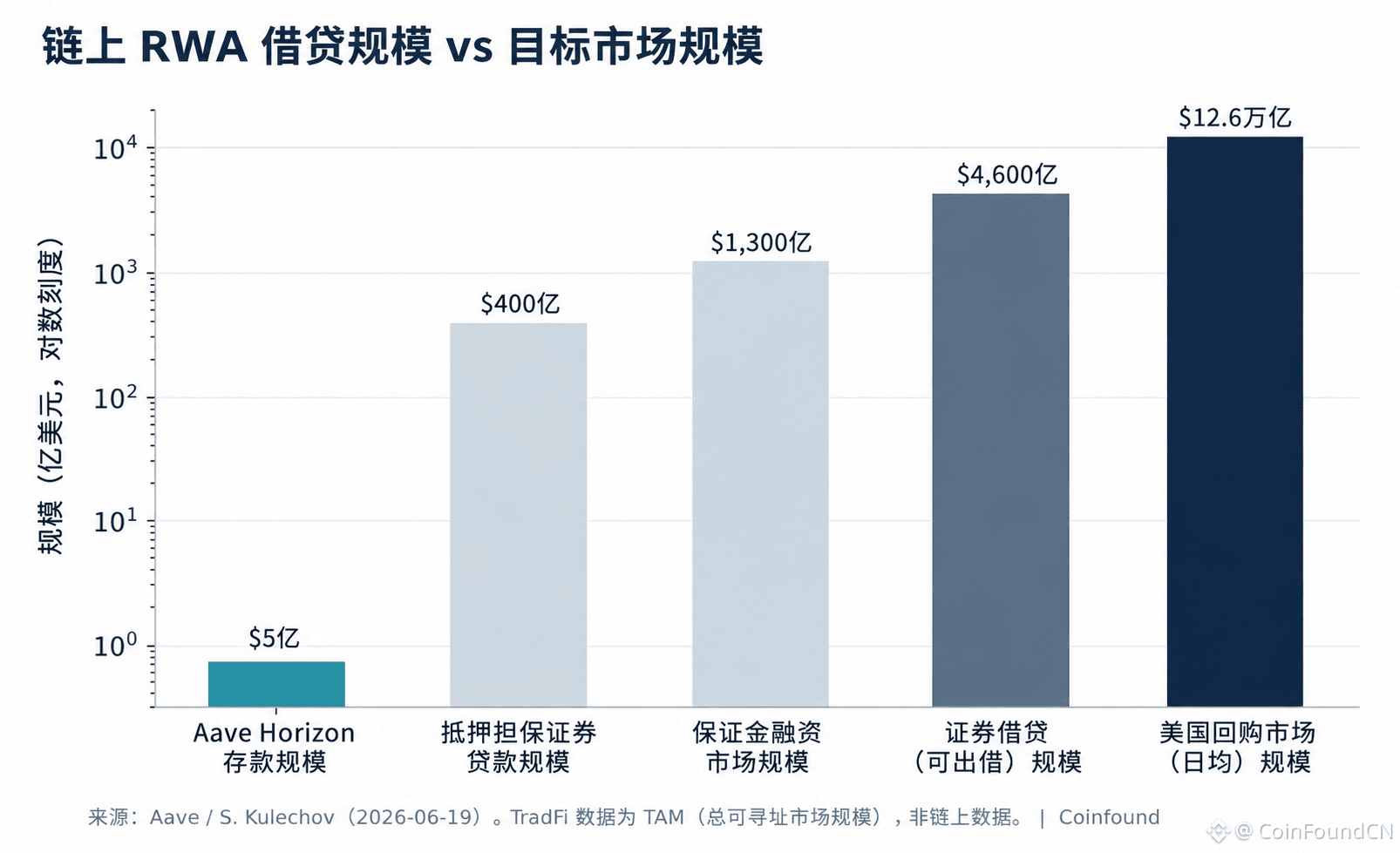
What Aave V4 needs to do is no longer just “enabling RWA to borrow and lend.” It’s about bringing Wall Street’s securities financing on-chain.
Currently, Horizon deposits are around $500 million, but the markets it’s targeting are:
• U.S. repo: $12.6 trillion
• Securities lending: $4.6 trillion
• Margin finance: $1.3 trillion
What’s truly worth paying attention to isn’t just how big the TAM is. It’s the shift in risk dynamics once U.S. Treasuries, private credit, CLOs, and tokenized equities are all integrated into a single collateral framework—where risk moves from a single asset level to a composability layer: how collateral is priced, how liquidity is shared, how it’s liquidated, and how risk is transmitted throughout the entire pool.
The next phase of RWA lending isn’t simply more assets being put on-chain.
It’s that on-chain securities financing begins to take shape, and new risks start to be amplified at the systemic level.
🔗 View original: [Aave V4 要把华尔街证券融资搬上链:可组合性层从风险点变成主干](https://www.binance.com/zh-CN/square/post/340807370977761)
What Aave V4 needs to do is no longer just “enabling RWA to borrow and lend.” It’s about bringing Wall Street’s securities financing on-chain.
Currently, Horizon deposits are around $500 million, but the markets it’s targeting are:
• U.S. repo: $12.6 trillion
• Securities lending: $4.6 trillion
• Margin finance: $1.3 trillion
What’s truly worth paying attention to isn’t just how big the TAM is. It’s the shift in risk dynamics once U.S. Treasuries, private credit, CLOs, and tokenized equities are all integrated into a single collateral framework—where risk moves from a single asset level to a composability layer: how collateral is priced, how liquidity is shared, how it’s liquidated, and how risk is transmitted throughout the entire pool.
The next phase of RWA lending isn’t simply more assets being put on-chain.
It’s that on-chain securities financing begins to take shape, and new risks start to be amplified at the systemic level.
🔗 View original: Aave V4 要把华尔街证券融资搬上链:可组合性层从风险点变成主干
Currently, Horizon deposits are around $500 million, but the markets it’s targeting are:
• U.S. repo: $12.6 trillion
• Securities lending: $4.6 trillion
• Margin finance: $1.3 trillion
What’s truly worth paying attention to isn’t just how big the TAM is. It’s the shift in risk dynamics once U.S. Treasuries, private credit, CLOs, and tokenized equities are all integrated into a single collateral framework—where risk moves from a single asset level to a composability layer: how collateral is priced, how liquidity is shared, how it’s liquidated, and how risk is transmitted throughout the entire pool.
The next phase of RWA lending isn’t simply more assets being put on-chain.
It’s that on-chain securities financing begins to take shape, and new risks start to be amplified at the systemic level.
🔗 View original: Aave V4 要把华尔街证券融资搬上链:可组合性层从风险点变成主干
5
8.6k
·
--
Verified
Aave V4 to bring Wall Street securities financing on-chain: the composability layer turns from a risk point into the backboneOn June 19, Aave founder Kulechov positioned the upcoming Aave V4 as an on-chain alternative to Wall Street securities financing, targeting the US daily average of about $126 billion in repos, $46 billion in lendable securities for securities lending, and the margin financing market. He proposed three product types: securities-backed loans, repos (atomic settlement), and securities lending. The institutional RWA lending market Horizon, since going live in August 2025, has accumulated roughly $440 million to $550 million in deposits, with a goal to exceed $1 billion in 2026. This turns “RWA as collateral” from a product into a narrative of “on-chain securities financing infrastructure.”
Aave V4 to bring Wall Street securities financing on-chain: the composability layer turns from a risk point into the backbone
On June 19, Aave founder Kulechov positioned the upcoming Aave V4 as an on-chain alternative to Wall Street securities financing, targeting the US daily average of about $126 billion in repos, $46 billion in lendable securities for securities lending, and the margin financing market. He proposed three product types: securities-backed loans, repos (atomic settlement), and securities lending. The institutional RWA lending market Horizon, since going live in August 2025, has accumulated roughly $440 million to $550 million in deposits, with a goal to exceed $1 billion in 2026. This turns “RWA as collateral” from a product into a narrative of “on-chain securities financing infrastructure.”
2
4.9k
·
--
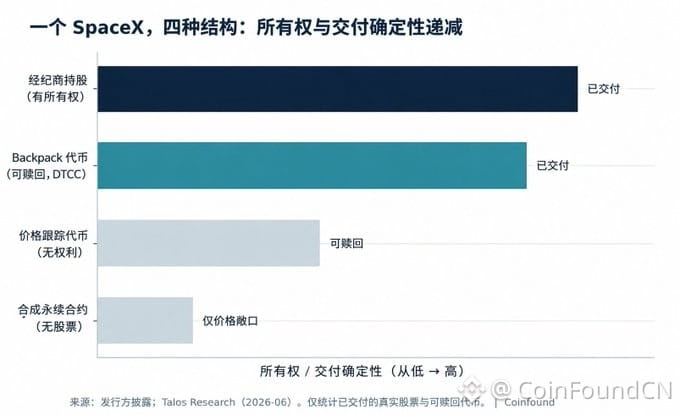
The same SpaceX, four token structures, corresponding to four completely different rights.
The biggest risk of tokenized stocks isn’t the company itself.
It’s what you actually end up buying.
From real stocks, to redeemable tokens, to tracking certificates, and synthetic perpetuals, the certainty of ownership and delivery declines step by step.
When the next big hot IPO arrives, the real question the market needs to answer isn’t:
- Can you buy tokens?
But rather:
- Can you ultimately truly get the stock in hand?
As tokenized stocks develop rapidly, ownership and delivery risks may become a more值得关注 risk than the stock price itself.
#CoinFound, define value with data.
🔗 Read the full article: [同一个 SpaceX,四种代币、权利递减:IPO 那天,先裂开的是交付层](https://www.binance.com/zh-CN/square/post/340273408376034)
The same SpaceX, four token structures, corresponding to four completely different rights.
The biggest risk of tokenized stocks isn’t the company itself.
It’s what you actually end up buying.
From real stocks, to redeemable tokens, to tracking certificates, and synthetic perpetuals, the certainty of ownership and delivery declines step by step.
When the next big hot IPO arrives, the real question the market needs to answer isn’t:
- Can you buy tokens?
But rather:
- Can you ultimately truly get the stock in hand?
As tokenized stocks develop rapidly, ownership and delivery risks may become a more值得关注 risk than the stock price itself.
#CoinFound, define value with data.
🔗 Read the full article: 同一个 SpaceX,四种代币、权利递减:IPO 那天,先裂开的是交付层
The biggest risk of tokenized stocks isn’t the company itself.
It’s what you actually end up buying.
From real stocks, to redeemable tokens, to tracking certificates, and synthetic perpetuals, the certainty of ownership and delivery declines step by step.
When the next big hot IPO arrives, the real question the market needs to answer isn’t:
- Can you buy tokens?
But rather:
- Can you ultimately truly get the stock in hand?
As tokenized stocks develop rapidly, ownership and delivery risks may become a more值得关注 risk than the stock price itself.
#CoinFound, define value with data.
🔗 Read the full article: 同一个 SpaceX,四种代币、权利递减:IPO 那天,先裂开的是交付层
3
8.7k
·
--
The same SpaceX, four kinds of tokens, declining rights: on the IPO day, the first thing to split was the delivery layerJune 12, SpaceX went public on the Nasdaq at $135 per share, issuing about 555.6 million shares and raising roughly $75 billion, with the stock surging to $164 on the first day. Around this most eagerly awaited IPO in recent years, there are more than four types of "SpaceX" that retail investors could buy before the listing, with similar-sounding codes but entirely different legal natures. The market has been telling the story of tokenized IPO allocations as "a velvet rope gets torn open for retail investors—everyone can participate," but what this week truly exposed is the fragility of the tokenization category at the delivery layer: subscription collections that rely on xStocks’ distribution saw collective cancellations and refunds, while a synthetic perpetual that holds no equity at all continued to function normally.
The same SpaceX, four kinds of tokens, declining rights: on the IPO day, the first thing to split was the delivery layer
June 12, SpaceX went public on the Nasdaq at $135 per share, issuing about 555.6 million shares and raising roughly $75 billion, with the stock surging to $164 on the first day. Around this most eagerly awaited IPO in recent years, there are more than four types of "SpaceX" that retail investors could buy before the listing, with similar-sounding codes but entirely different legal natures. The market has been telling the story of tokenized IPO allocations as "a velvet rope gets torn open for retail investors—everyone can participate," but what this week truly exposed is the fragility of the tokenization category at the delivery layer: subscription collections that rely on xStocks’ distribution saw collective cancellations and refunds, while a synthetic perpetual that holds no equity at all continued to function normally.
SPCX-1.14%
SPCXUS-2.57%
1
4
6.2k
·
--
Partly True
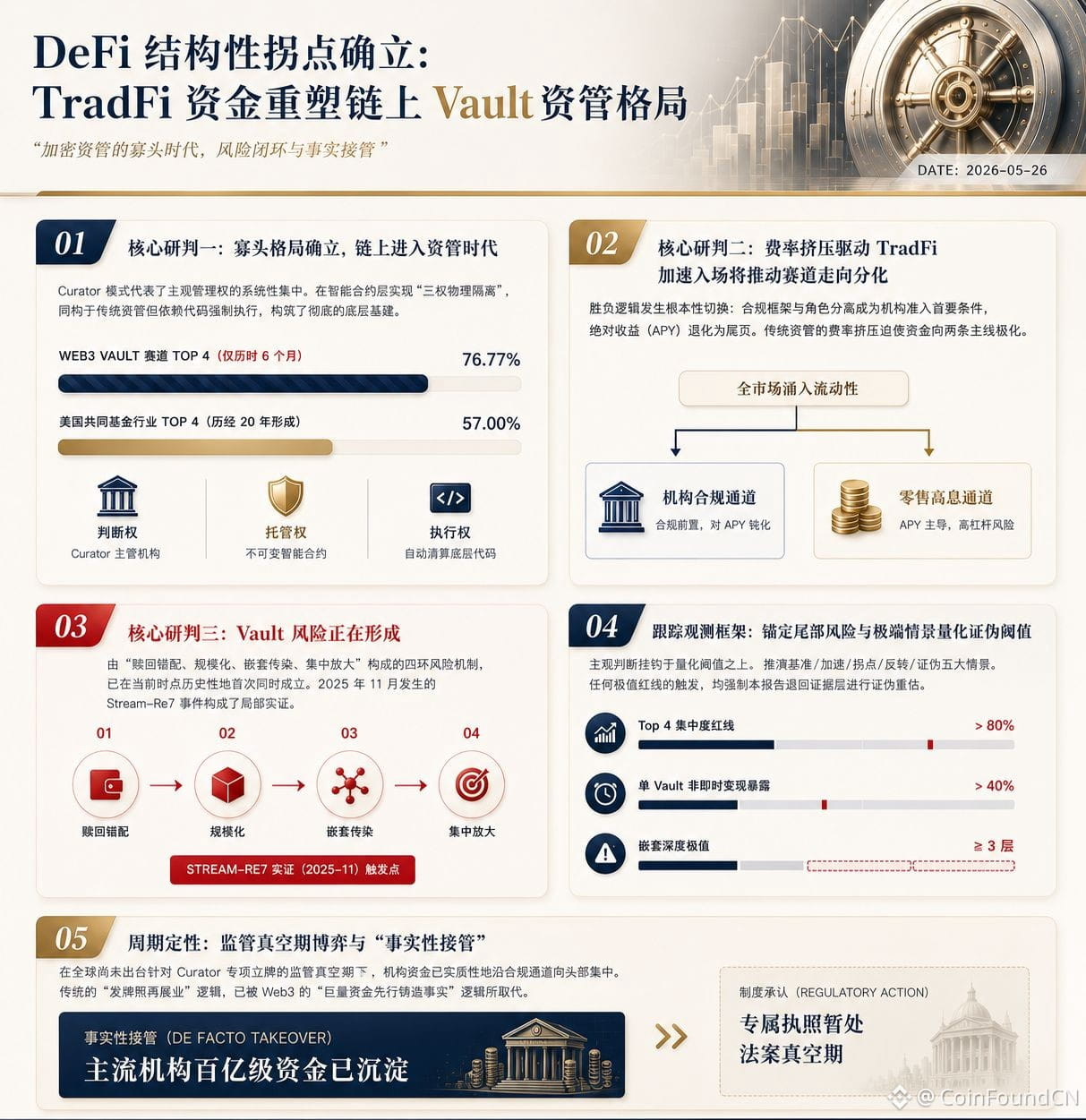
#DeFi's competitive standards are shifting.
In the past, it was all about APY;
now, it's about asset management capabilities, compliance structures, and institutional access.
#CoinFound's latest research reveals that Vaults are becoming the 'fund vehicles' of the on-chain world, while Curators are evolving into on-chain asset managers.
As TradFi funds begin to flood into the on-chain space, the market's focus is no longer solely on yields but rather on who can establish institutional-level trust, risk isolation, and capital allocation abilities.
This might mean: DeFi is transitioning from the trading era into the asset management era.
Data Defines Value. CoinFound, defining value with data.
🔗 Get the full research report link: https://bit.ly/4vZ1pcL
#DeFi's competitive standards are shifting.
In the past, it was all about APY;
now, it's about asset management capabilities, compliance structures, and institutional access.
#CoinFound's latest research reveals that Vaults are becoming the 'fund vehicles' of the on-chain world, while Curators are evolving into on-chain asset managers.
As TradFi funds begin to flood into the on-chain space, the market's focus is no longer solely on yields but rather on who can establish institutional-level trust, risk isolation, and capital allocation abilities.
This might mean: DeFi is transitioning from the trading era into the asset management era.
Data Defines Value. CoinFound, defining value with data.
🔗 Get the full research report link: https://bit.ly/4vZ1pcL
In the past, it was all about APY;
now, it's about asset management capabilities, compliance structures, and institutional access.
#CoinFound's latest research reveals that Vaults are becoming the 'fund vehicles' of the on-chain world, while Curators are evolving into on-chain asset managers.
As TradFi funds begin to flood into the on-chain space, the market's focus is no longer solely on yields but rather on who can establish institutional-level trust, risk isolation, and capital allocation abilities.
This might mean: DeFi is transitioning from the trading era into the asset management era.
Data Defines Value. CoinFound, defining value with data.
🔗 Get the full research report link: https://bit.ly/4vZ1pcL
4.4k
·
--
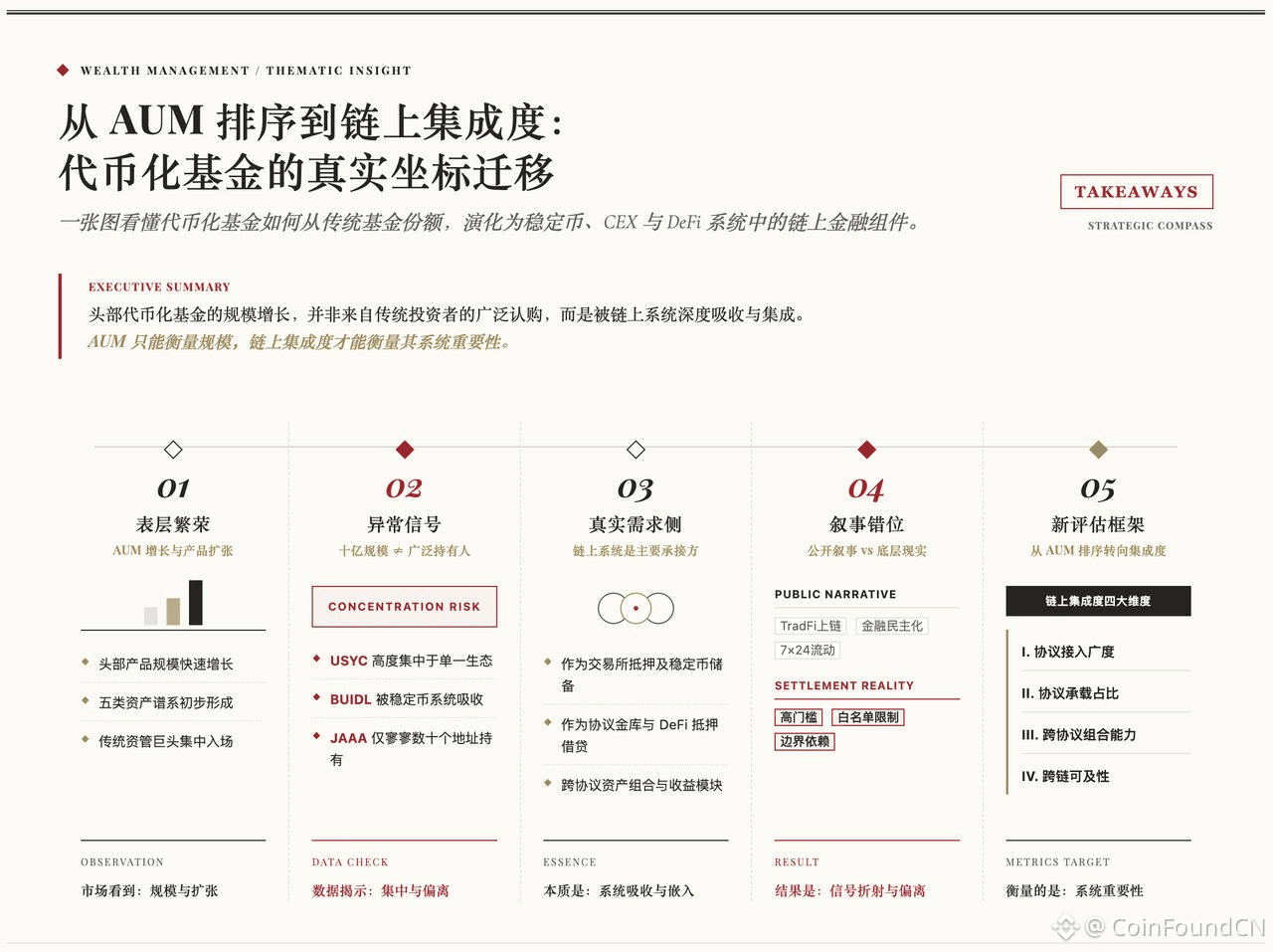
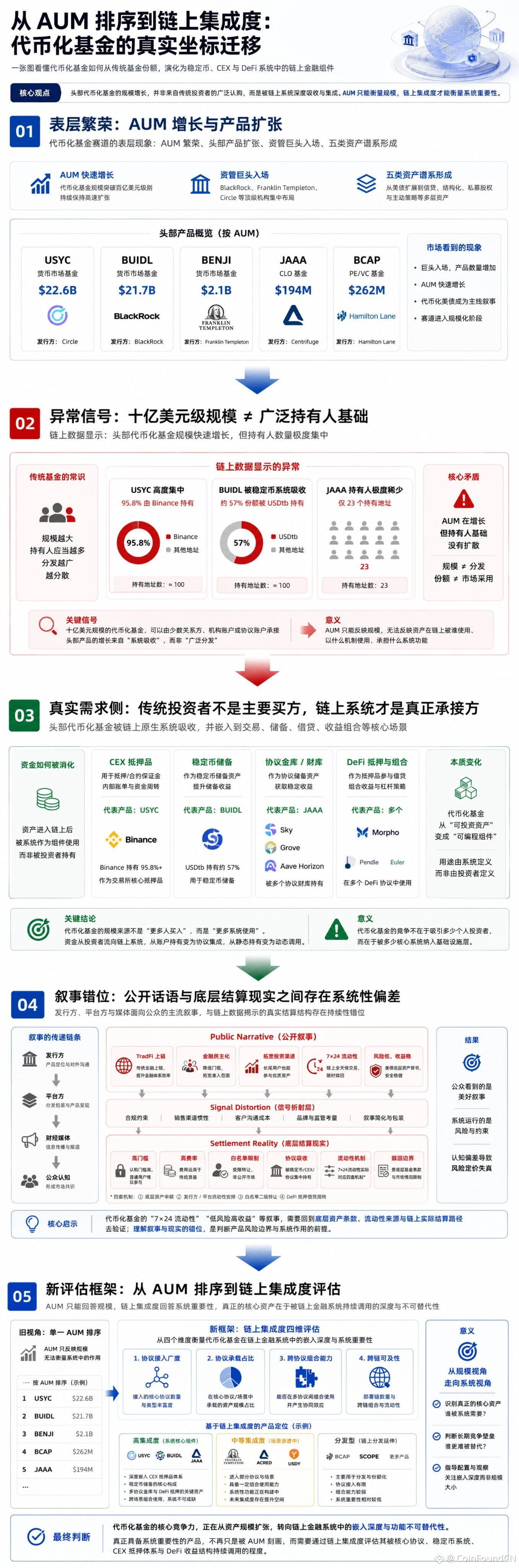
🔥 AUM rankings are becoming obsolete. What really determines the status of tokenized funds has shifted to "on-chain integration level."
#CoinFound's latest deep dive report highlights:
1️⃣ The growth of leading tokenized funds isn't driven by widespread buying from traditional investors, but rather by stablecoins, CEX, and deep absorption within DeFi systems.
2️⃣ Products like USYC, BUIDL, and JAAA are becoming:
• Stablecoin reserves
• Protocol treasuries
• DeFi collateral
• On-chain yield modules
3️⃣ Tokenized funds are evolving from "on-chain fund shares" to "on-chain financial components."
4️⃣ The next phase's core metrics are no longer just AUM, but:
• Protocol integration breadth
• Protocol utilization ratio
• Cross-protocol composability
• Cross-chain accessibility
📖 "Penetrating Tokenized Funds: The Obsolescence of AUM and a New Framework for On-Chain Integration" https://bit.ly/4uXQ4c8
🔥 AUM rankings are becoming obsolete. What really determines the status of tokenized funds has shifted to "on-chain integration level."
#CoinFound's latest deep dive report highlights:
1️⃣ The growth of leading tokenized funds isn't driven by widespread buying from traditional investors, but rather by stablecoins, CEX, and deep absorption within DeFi systems.
2️⃣ Products like USYC, BUIDL, and JAAA are becoming:
• Stablecoin reserves
• Protocol treasuries
• DeFi collateral
• On-chain yield modules
3️⃣ Tokenized funds are evolving from "on-chain fund shares" to "on-chain financial components."
4️⃣ The next phase's core metrics are no longer just AUM, but:
• Protocol integration breadth
• Protocol utilization ratio
• Cross-protocol composability
• Cross-chain accessibility
📖 "Penetrating Tokenized Funds: The Obsolescence of AUM and a New Framework for On-Chain Integration" https://bit.ly/4uXQ4c8
#CoinFound's latest deep dive report highlights:
1️⃣ The growth of leading tokenized funds isn't driven by widespread buying from traditional investors, but rather by stablecoins, CEX, and deep absorption within DeFi systems.
2️⃣ Products like USYC, BUIDL, and JAAA are becoming:
• Stablecoin reserves
• Protocol treasuries
• DeFi collateral
• On-chain yield modules
3️⃣ Tokenized funds are evolving from "on-chain fund shares" to "on-chain financial components."
4️⃣ The next phase's core metrics are no longer just AUM, but:
• Protocol integration breadth
• Protocol utilization ratio
• Cross-protocol composability
• Cross-chain accessibility
📖 "Penetrating Tokenized Funds: The Obsolescence of AUM and a New Framework for On-Chain Integration" https://bit.ly/4uXQ4c8
2
2
4.1k
·
--
Verified
Can AUM still represent real influence?
In the tokenized fund arena, more and more assets are being:
→ absorbed by stablecoin systems
→ used as collateral on CEX
→ called upon by DeFi protocols
→ allocated in protocol treasuries
What truly determines a product's standing is no longer just AUM, but rather:
• on-chain integration
• protocol invocation depth
• collateral functionality
• cross-protocol composability
The growth of $USYC, BUIDL, and JAAA essentially reflects the on-chain financial system's demand for 'programmable yield-bearing assets' rather than just traditional fund distribution.
Shifting from 'asset size' to 'real on-chain utility' redefines the evaluation framework for tokenized funds.
🔗 #CoinFound's latest in-depth research report 'Penetrating Tokenized Funds: The Limits of AUM and a New Framework for On-Chain Integration': https://bit.ly/4uXQ4c8
Can AUM still represent real influence?
In the tokenized fund arena, more and more assets are being:
→ absorbed by stablecoin systems
→ used as collateral on CEX
→ called upon by DeFi protocols
→ allocated in protocol treasuries
What truly determines a product's standing is no longer just AUM, but rather:
• on-chain integration
• protocol invocation depth
• collateral functionality
• cross-protocol composability
The growth of $USYC, BUIDL, and JAAA essentially reflects the on-chain financial system's demand for 'programmable yield-bearing assets' rather than just traditional fund distribution.
Shifting from 'asset size' to 'real on-chain utility' redefines the evaluation framework for tokenized funds.
🔗 #CoinFound's latest in-depth research report 'Penetrating Tokenized Funds: The Limits of AUM and a New Framework for On-Chain Integration': https://bit.ly/4uXQ4c8
In the tokenized fund arena, more and more assets are being:
→ absorbed by stablecoin systems
→ used as collateral on CEX
→ called upon by DeFi protocols
→ allocated in protocol treasuries
What truly determines a product's standing is no longer just AUM, but rather:
• on-chain integration
• protocol invocation depth
• collateral functionality
• cross-protocol composability
The growth of $USYC, BUIDL, and JAAA essentially reflects the on-chain financial system's demand for 'programmable yield-bearing assets' rather than just traditional fund distribution.
Shifting from 'asset size' to 'real on-chain utility' redefines the evaluation framework for tokenized funds.
🔗 #CoinFound's latest in-depth research report 'Penetrating Tokenized Funds: The Limits of AUM and a New Framework for On-Chain Integration': https://bit.ly/4uXQ4c8
4.3k
·
--
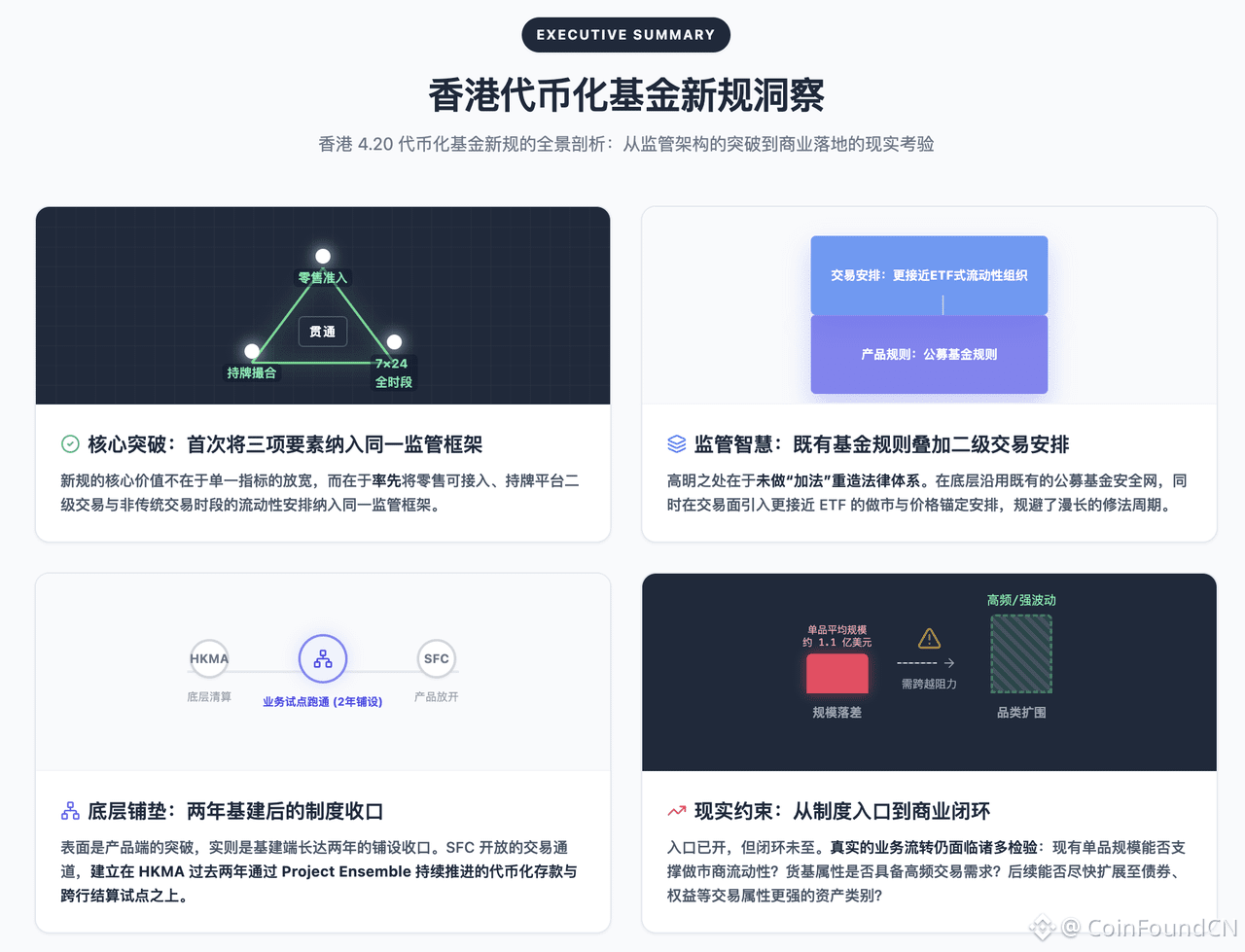
Hong Kong's new tokenized fund regulations really change not whether trading is possible, but rather the method of trading.
For the first time, it integrates retail access + secondary matching + 24/7 liquidity
into the same regulatory framework.
More crucially:
it's not about reinventing the rules, but directly applying the ETF mechanism.
This means one thing:
RWA is no longer just 'on-chain asset mapping',
but is starting to enter the 'standardized trading market'.
However, the issue is clear:
the framework is in place, but the market hasn't caught up yet.
Scale, liquidity, and asset structure
are the real variables for the next phase.
Read the original: [香港新规落地:代币化基金二级交易通道开启,产品走向ETF化](https://www.binance.com/zh-CN/square/post/316887280859185)
Hong Kong's new tokenized fund regulations really change not whether trading is possible, but rather the method of trading.
For the first time, it integrates retail access + secondary matching + 24/7 liquidity
into the same regulatory framework.
More crucially:
it's not about reinventing the rules, but directly applying the ETF mechanism.
This means one thing:
RWA is no longer just 'on-chain asset mapping',
but is starting to enter the 'standardized trading market'.
However, the issue is clear:
the framework is in place, but the market hasn't caught up yet.
Scale, liquidity, and asset structure
are the real variables for the next phase.
Read the original: 香港新规落地:代币化基金二级交易通道开启,产品走向ETF化
For the first time, it integrates retail access + secondary matching + 24/7 liquidity
into the same regulatory framework.
More crucially:
it's not about reinventing the rules, but directly applying the ETF mechanism.
This means one thing:
RWA is no longer just 'on-chain asset mapping',
but is starting to enter the 'standardized trading market'.
However, the issue is clear:
the framework is in place, but the market hasn't caught up yet.
Scale, liquidity, and asset structure
are the real variables for the next phase.
Read the original: 香港新规落地:代币化基金二级交易通道开启,产品走向ETF化
4
4.9k
Log in to explore more content
Join global crypto users on Binance Square
⚡️ Get latest and useful information about crypto.
💬 Trusted by the world’s largest crypto exchange.
👍 Discover real insights from verified creators.
Email / Phone number
Trending Topics
BitcoinCrosses$78000
971 views
71 Discussing
$BTC urgent Update 🚨 Big Opportunity ‼️Get Ready for Short 📉
BTC is bouncing as expected .Now you can scale your entry upto 78000 because this bounce can extend upto 78,000 ..
Stop-loss: 79,200
Targets 🎯
TP1: 77,150
TP2: 76,450
TP3: 75,750
TP4: 75,000
$SOL and $ETH will follow Bitcoin..And then dump as predicted 🔥
Always DYOR and never invest all in one trade
short here 👇
#SECReceivesGrayscaleLitecoinTrustETFFiling #ClarityActFacesProceduralVoteSept15 #US10YearTreasuryYieldNears5%
Panda Traders
·14 Likes
·5.8k views
AvalancheIntegratesIntoUAEPassDigitalVault
987 views
75 Discussing
UKSeeksViewsOnTokenizingGold
475 views
41 Discussing