
ETH蟹老板
36 Posts
ETH蟹老板
📍专注ETH.[-只分享ETH行情·讲解短线打法-]🔸职业短线交易员【五折反佣需要的进聊天室】ID:1260600801欢迎大家一起探讨交流
17 Following
1.1K+ Followers
105 Liked
Posts
All
Live
PINNED
The stock market is the best place to recognize yourself. Chasing highs is because of your greed, selling into lows is because of your anger and fear, going all-in is because of your gambling nature, and getting deeply trapped is because you don’t dare to admit failure. Every trade reflects the true color of your personality, and every gain or loss is the consequence of your fate.
When you’re no longer constantly entering and exiting, but patiently waiting for certainty to appear, you break free from impulsiveness. When you’re willing to miss a hundred opportunities just to wait for that moment that fits your rhythm, you truly understand trading.
As long as you keep a grateful heart, don’t be greedy or impatient, have patience, and are willing to admit mistakes, you’ll know that stock trading isn’t a gift—it’s a form of practice.
When you’re no longer constantly entering and exiting, but patiently waiting for certainty to appear, you break free from impulsiveness. When you’re willing to miss a hundred opportunities just to wait for that moment that fits your rhythm, you truly understand trading.
As long as you keep a grateful heart, don’t be greedy or impatient, have patience, and are willing to admit mistakes, you’ll know that stock trading isn’t a gift—it’s a form of practice.

·
--
🎙️ Brothers who don’t have orders with short-term trading—come in and make some money
End
05 h 15 m 26 s
523
0
That BNB last year that left everyone stunned has somewhat returned.
Remember last year?
BNB went from being ignored by nobody to accelerating all the way—then it directly pushed to *$1,000**.
Back then, many people’s states were pretty much the same:
600: Too high. Wait for a pullback.
700: It’s gone up so much already—won’t chase.
800: It can’t go on much longer, right?
1000: Oh wow, why is it still rising?😂
And the real big market usually starts ramping up crazy when everyone thinks, “It’s already gone up a lot.”
Now take a look at BNB.
In the past 7 days, it’s already up **16%+**. And today, its intraday high once again surged to around **719 USDT**.
Also, this time it’s not like there’s nothing to hype.
BNB Chain just completed the **Pasteur hard fork upgrade** today. Network security, cross-chain verification, and transaction processing capabilities are all continuing to improve. Add to that the recent recovery across the whole crypto market over the past few days, and you can clearly see funds starting to concentrate into mainstream coins and strong performers.
So right now, I’m actually more concerned about one question:
Is this just a normal rebound for BNB, or is that same “the flavor of a big-market start” from last year showing up again?**
I can’t say BNB will definitely repeat last year.
But one thing I’m getting more and more certain about:
In crypto, what’s truly worth paying attention to usually isn’t the coins that have already dropped a lot—ones that everyone keeps shouting to buy the dip on.
Instead, it’s coins like this—
Ones that have already started rising, and where money keeps flowing in.
When BNB broke through $1,000 last year, many people regretted not buying in at 600 or 700.
Will history repeat itself again this year?
I don’t know.
But this time, I’ll be watching BNB closely.
Do you think this round of BNB can reach back up to $1,000 again?
#bnb #Binance #BNBChain #BTC #加密货币
Remember last year?
BNB went from being ignored by nobody to accelerating all the way—then it directly pushed to *$1,000**.
Back then, many people’s states were pretty much the same:
600: Too high. Wait for a pullback.
700: It’s gone up so much already—won’t chase.
800: It can’t go on much longer, right?
1000: Oh wow, why is it still rising?😂
And the real big market usually starts ramping up crazy when everyone thinks, “It’s already gone up a lot.”
Now take a look at BNB.
In the past 7 days, it’s already up **16%+**. And today, its intraday high once again surged to around **719 USDT**.
Also, this time it’s not like there’s nothing to hype.
BNB Chain just completed the **Pasteur hard fork upgrade** today. Network security, cross-chain verification, and transaction processing capabilities are all continuing to improve. Add to that the recent recovery across the whole crypto market over the past few days, and you can clearly see funds starting to concentrate into mainstream coins and strong performers.
So right now, I’m actually more concerned about one question:
Is this just a normal rebound for BNB, or is that same “the flavor of a big-market start” from last year showing up again?**
I can’t say BNB will definitely repeat last year.
But one thing I’m getting more and more certain about:
In crypto, what’s truly worth paying attention to usually isn’t the coins that have already dropped a lot—ones that everyone keeps shouting to buy the dip on.
Instead, it’s coins like this—
Ones that have already started rising, and where money keeps flowing in.
When BNB broke through $1,000 last year, many people regretted not buying in at 600 or 700.
Will history repeat itself again this year?
I don’t know.
But this time, I’ll be watching BNB closely.
Do you think this round of BNB can reach back up to $1,000 again?
#bnb #Binance #BNBChain #BTC #加密货币

ETH has something for sure this time.
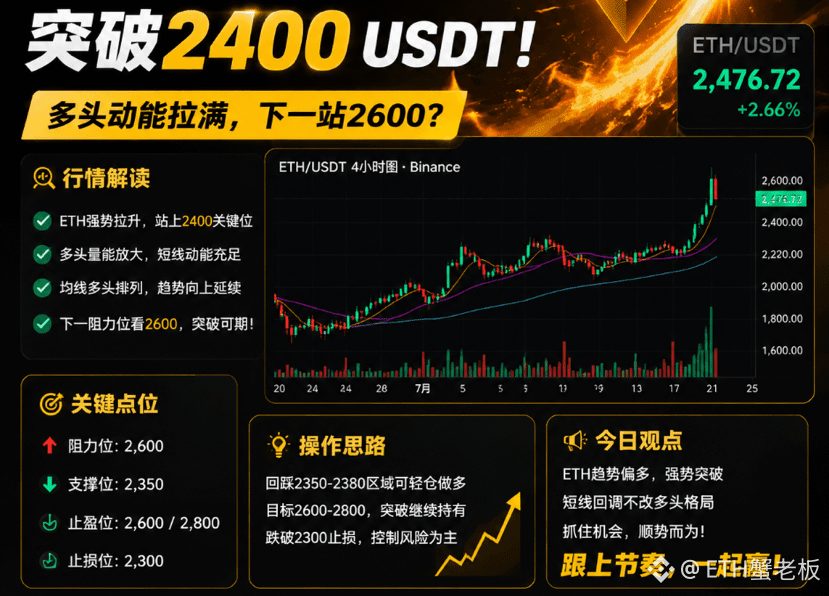
Earlier, it churned around 1900 for so long, but once it started, it released continuous volume straight away, and 2400 didn’t even hesitate before it surged past. Now the price has already pushed up to around 2470.
What I’m most focused on right now is the **2500 level**.
If 2500 can hold with strong volume, then this leg of the market likely isn’t over yet—it's possible to imagine a move to 2600 and even higher afterward. But if 2500 keeps failing to break through, you should be careful in the short term; a pullback to the 2400–2350 area could be the next move to shake things out.
So my thinking is simple right now:
**The trend is still bullish, but this is not a spot to blindly chase.**
If you’re already on the train, you can keep observing. If you haven’t boarded yet, I’d actually rather wait for a pullback to confirm.
Recently, ETH has been clearly more active than it was in the earlier period. Next, we’ll see whether 2500 is the final stop—or the starting point for the next wave.
Do you think this round of ETH can go straight to 2600?
#ETH #Ethereum #BinanceSquare #Crypto #MarketAnalysis
Earlier, it churned around 1900 for so long, but once it started, it released continuous volume straight away, and 2400 didn’t even hesitate before it surged past. Now the price has already pushed up to around 2470.
What I’m most focused on right now is the **2500 level**.
If 2500 can hold with strong volume, then this leg of the market likely isn’t over yet—it's possible to imagine a move to 2600 and even higher afterward. But if 2500 keeps failing to break through, you should be careful in the short term; a pullback to the 2400–2350 area could be the next move to shake things out.
So my thinking is simple right now:
**The trend is still bullish, but this is not a spot to blindly chase.**
If you’re already on the train, you can keep observing. If you haven’t boarded yet, I’d actually rather wait for a pullback to confirm.
Recently, ETH has been clearly more active than it was in the earlier period. Next, we’ll see whether 2500 is the final stop—or the starting point for the next wave.
Do you think this round of ETH can go straight to 2600?
#ETH #Ethereum #BinanceSquare #Crypto #MarketAnalysis
If you’re currently in cash with no spot holdings, no long positions, and no short positions being held, then the best approach is to wait. Right now, the risks of going long or going short are both extremely high—it's purely gambling. Win and you get lucky; lose and you end up doing hard work.
Opening a trade must be done at key levels, otherwise being trapped will distort your mindset. Those “screw-up” moves like holding positions through drawdowns, adding against the trend, and opening trades randomly can directly cut your account in half or even bring it to zero.
Never allow yourself to be constantly stuck in the market. Being in cash sometimes lets you see the market’s next direction more clearly.
If you’re currently holding short positions, you probably want this wave of上涨 to be a tease—a fakeout. You might even hope for one final drop.
But that’s not necessarily wrong, because the human nature is that position size determines one’s stance.
Opening a trade must be done at key levels, otherwise being trapped will distort your mindset. Those “screw-up” moves like holding positions through drawdowns, adding against the trend, and opening trades randomly can directly cut your account in half or even bring it to zero.
Never allow yourself to be constantly stuck in the market. Being in cash sometimes lets you see the market’s next direction more clearly.
If you’re currently holding short positions, you probably want this wave of上涨 to be a tease—a fakeout. You might even hope for one final drop.
But that’s not necessarily wrong, because the human nature is that position size determines one’s stance.
$BNB $ETH Crypto Market Weekly Report: Is this surge a “bull run returning fast,” or just a fleeting spike?
Brothers, this week’s price action has been wild, right? Bitcoin surged to 79,400 USD, up 24% on the week—its strongest weekly performance since March 2023. A lot of people are calling it a “bull run returning fast.”
This violent rally was sparked by the U.S. Treasury conducting bond repurchases, effectively pumping liquidity into the market. When the water comes, the dollar falls—and Bitcoin, that “dry-land duck,” immediately starts paddling. From a technical standpoint, the “head-and-shoulders bottom” drawn up from the 57,750 USD bottom has a target around 76,000 USD. This time it hit with impressive precision, which is a perfect outcome for the technical crowd. But after rallying to 79,400, it pulled back to 76,900, and the RSI has also entered the overbought zone—so in the short term, it may need to catch its breath and shake out the market.
Now the most critical indicator is that on-chain “spot demand” is rapidly turning positive—this is the first time since February 2022! Historically, when this signal appears, the average price increase over the next 60 days is 18%, with a win rate of nearly 80%. But pay attention: the signal hasn’t fully turned “green” yet, and this rally is largely driven by a short squeeze (33,000,0000,000 USD liquidated on Wednesday), meaning this “upward path” is paved by the “corpses of shorts.”
So where does the script go next? Two key points: first, whether spot demand can fully flip positive so real buyers with real money can take over; second, don’t rush into FOMO—watch whether this pullback can hold above 70,000. If it holds, a trend-driven market may be on the cards; if it doesn’t, it could turn into a spectacular “bear market rebound” show. Remember CZ’s words: DCA every month—don’t YOLO; survive first!
Brothers, this week’s price action has been wild, right? Bitcoin surged to 79,400 USD, up 24% on the week—its strongest weekly performance since March 2023. A lot of people are calling it a “bull run returning fast.”
This violent rally was sparked by the U.S. Treasury conducting bond repurchases, effectively pumping liquidity into the market. When the water comes, the dollar falls—and Bitcoin, that “dry-land duck,” immediately starts paddling. From a technical standpoint, the “head-and-shoulders bottom” drawn up from the 57,750 USD bottom has a target around 76,000 USD. This time it hit with impressive precision, which is a perfect outcome for the technical crowd. But after rallying to 79,400, it pulled back to 76,900, and the RSI has also entered the overbought zone—so in the short term, it may need to catch its breath and shake out the market.
Now the most critical indicator is that on-chain “spot demand” is rapidly turning positive—this is the first time since February 2022! Historically, when this signal appears, the average price increase over the next 60 days is 18%, with a win rate of nearly 80%. But pay attention: the signal hasn’t fully turned “green” yet, and this rally is largely driven by a short squeeze (33,000,0000,000 USD liquidated on Wednesday), meaning this “upward path” is paved by the “corpses of shorts.”
So where does the script go next? Two key points: first, whether spot demand can fully flip positive so real buyers with real money can take over; second, don’t rush into FOMO—watch whether this pullback can hold above 70,000. If it holds, a trend-driven market may be on the cards; if it doesn’t, it could turn into a spectacular “bear market rebound” show. Remember CZ’s words: DCA every month—don’t YOLO; survive first!
继续看涨
可以做空
1 day(s) left
Not long ago, a friend asked me: “I only have 3,000 yuan in hand—am I still suitable to enter the crypto market?” I told him: the funds aren’t much, but it’s not like there’s no opportunity. If we convert it to U, it’s about 400+ U. The biggest value of a small amount of capital isn’t making money in the short term—it’s using a lower cost to train your trading skills.
Many people with small capital lose money not because there are fewer opportunities, but because they’re too impatient. With a small principal, they want to double quickly. The moment they open a position, they go all-in on a direction. When they profit, they think they’re great; when they lose, they’re急 to flip back. In the end, they don’t lose because of the market—they lose to their emotions.
Later, the first thing I asked him to do was to split his capital. Divide the funds into several parts, and use only a small portion for each trade. That way, even if your judgment is wrong, it won’t affect the overall situation, and you can still keep learning and adjusting.
When there’s no good setup, wait—don’t chase highs just because others are making money. Real good opportunities usually show up when the market calms down and the trend becomes clearer.
Once you reach your goals, take profit in batches—don’t fantasize about selling at the very top. First, turn the money you’ve earned into results, then consider the next opportunity.
Whether 3,000 yuan can change someone’s life is hard to say.
But it’s enough to teach a person an important lesson: manage capital with rules, not be controlled by emotions.
If you also want to avoid detours and steady your comeback,
come find me anytime—we’ll put the method into practice together.$ETH
Many people with small capital lose money not because there are fewer opportunities, but because they’re too impatient. With a small principal, they want to double quickly. The moment they open a position, they go all-in on a direction. When they profit, they think they’re great; when they lose, they’re急 to flip back. In the end, they don’t lose because of the market—they lose to their emotions.
Later, the first thing I asked him to do was to split his capital. Divide the funds into several parts, and use only a small portion for each trade. That way, even if your judgment is wrong, it won’t affect the overall situation, and you can still keep learning and adjusting.
When there’s no good setup, wait—don’t chase highs just because others are making money. Real good opportunities usually show up when the market calms down and the trend becomes clearer.
Once you reach your goals, take profit in batches—don’t fantasize about selling at the very top. First, turn the money you’ve earned into results, then consider the next opportunity.
Whether 3,000 yuan can change someone’s life is hard to say.
But it’s enough to teach a person an important lesson: manage capital with rules, not be controlled by emotions.
If you also want to avoid detours and steady your comeback,
come find me anytime—we’ll put the method into practice together.$ETH
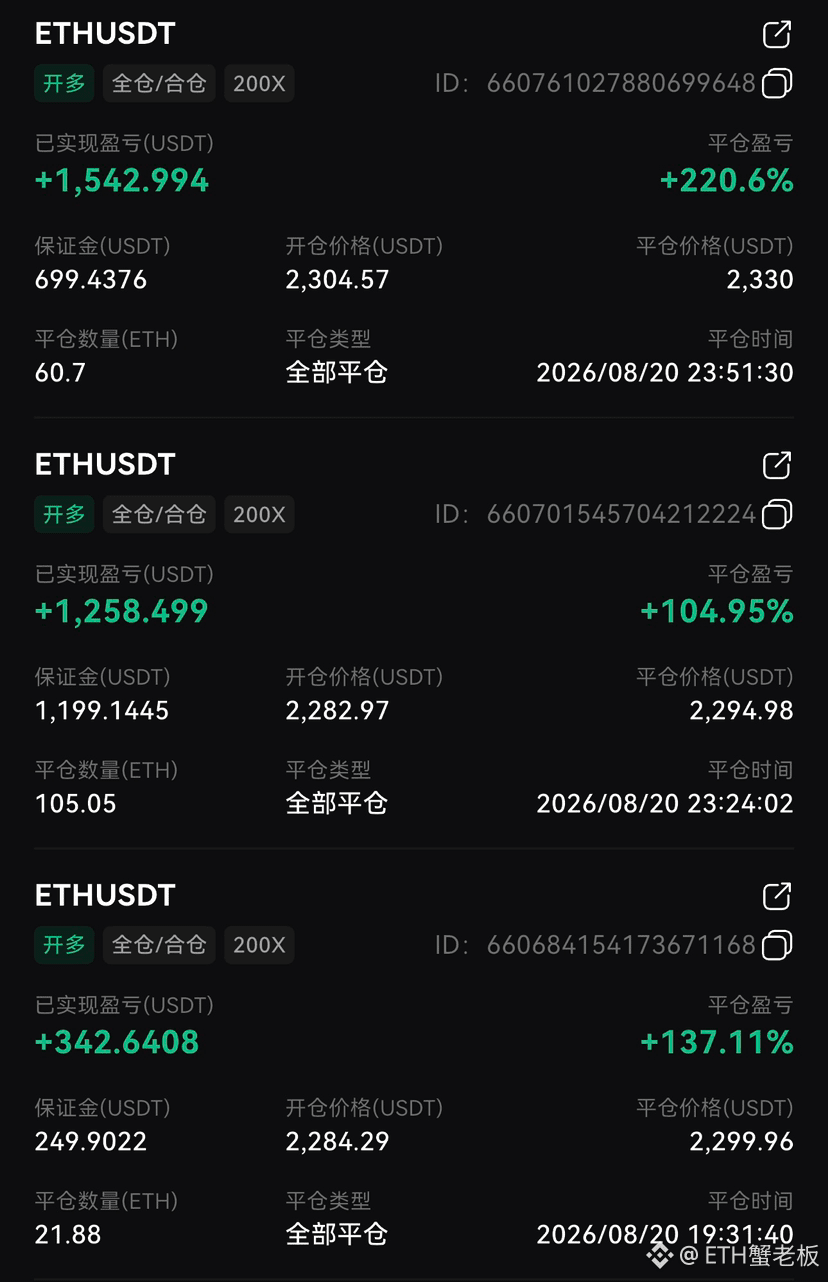
Many people ask me:
Is there really a chance to build something with a small amount of capital?
My answer is:
Yes, but it’s not about luck, and it’s not about chasing hot topics every day.
What truly allows an account to grow slowly over time is often a method that’s so simple it looks like it has “no technical content.”$BTC
Two years ago, I also entered the market with 1000U.
At first, I was just as confused—reading the news, chasing strong coins, studying all kinds of indicators.
But later, I realized that what really matters in the market isn’t how many things you know.
It’s whether you can find a set of rules that suits you, and then execute it consistently for the long term.
My method mainly has four steps.
First, filter for strong directions.
The market is never short of coins, but not every coin has capital paying attention.
I prefer observing targets that have strong recent performance, active trading, and sustained participation from funds.
As for coins that keep weakening and see shrinking trading volume—no matter how good the story sounds—let them go first.
Where the capital leaves, there’s no need to waste time.
Second, look at the trend on a larger timeframe.
Many people like to watch the hourly chart or the minute chart, getting carried away by short-term fluctuations.
But the real big trend is usually hidden in a larger timeframe.
Don’t rush to place bets until the monthly trend turns strong.
Wait for the market to give a clear direction before considering entry.
Third, wait for confirmation at key positions.$ETH
A good entry point isn’t where you chase in when the price is at its wildest.
Instead, after the trend is confirmed, you wait for a pullback to key support.
For example, when the price returns near an important moving average, and at the same time you see trading volume aligning with and a stabilization signal.
Only decide again after confirming that the funds are back in.
Fourth, and this is the most important step:
Always leave yourself a way out.
Protect profits in portions during an uptrend.
Exit promptly when the trend is broken.
Don’t forget risk just because you were right once;
And don’t start fantasizing just because you’re temporarily down.
Many people lose money not because they can’t find opportunities.
But because they don’t have a set of rules to protect themselves.
In the end, trading isn’t about who makes the most accurate predictions.
It’s about who can stay in the market.
Follow the trend, follow the pace of the capital, and use discipline to hold on to your principal.
The method can be simple.
But execution must be firm.
The market offers opportunities to everyone.
The difference is: some people wait until they get the opportunity, while others have already left before the opportunity even arrives.
Is there really a chance to build something with a small amount of capital?
My answer is:
Yes, but it’s not about luck, and it’s not about chasing hot topics every day.
What truly allows an account to grow slowly over time is often a method that’s so simple it looks like it has “no technical content.”$BTC
Two years ago, I also entered the market with 1000U.
At first, I was just as confused—reading the news, chasing strong coins, studying all kinds of indicators.
But later, I realized that what really matters in the market isn’t how many things you know.
It’s whether you can find a set of rules that suits you, and then execute it consistently for the long term.
My method mainly has four steps.
First, filter for strong directions.
The market is never short of coins, but not every coin has capital paying attention.
I prefer observing targets that have strong recent performance, active trading, and sustained participation from funds.
As for coins that keep weakening and see shrinking trading volume—no matter how good the story sounds—let them go first.
Where the capital leaves, there’s no need to waste time.
Second, look at the trend on a larger timeframe.
Many people like to watch the hourly chart or the minute chart, getting carried away by short-term fluctuations.
But the real big trend is usually hidden in a larger timeframe.
Don’t rush to place bets until the monthly trend turns strong.
Wait for the market to give a clear direction before considering entry.
Third, wait for confirmation at key positions.$ETH
A good entry point isn’t where you chase in when the price is at its wildest.
Instead, after the trend is confirmed, you wait for a pullback to key support.
For example, when the price returns near an important moving average, and at the same time you see trading volume aligning with and a stabilization signal.
Only decide again after confirming that the funds are back in.
Fourth, and this is the most important step:
Always leave yourself a way out.
Protect profits in portions during an uptrend.
Exit promptly when the trend is broken.
Don’t forget risk just because you were right once;
And don’t start fantasizing just because you’re temporarily down.
Many people lose money not because they can’t find opportunities.
But because they don’t have a set of rules to protect themselves.
In the end, trading isn’t about who makes the most accurate predictions.
It’s about who can stay in the market.
Follow the trend, follow the pace of the capital, and use discipline to hold on to your principal.
The method can be simple.
But execution must be firm.
The market offers opportunities to everyone.
The difference is: some people wait until they get the opportunity, while others have already left before the opportunity even arrives.

Many people say the crypto market is like a casino, but those who can truly stay for the long term don’t rely on luck. They rely on whether they have a set of rules they can execute consistently.
Let me give you an example from someone around me. A brother who had just entered the market at the time only had 1,800 U. He didn’t plan to make it huge at first. Later, by following a fairly simple trading method, he gradually built it up. In three months, his account reached 29,000 U. After that, the highest he got was 58,000 U, and throughout the entire process, he never experienced a liquidation.
What he truly did right comes down to three things.
First, separate your position size—don’t let a single trade decide the life or death of your whole account. I had him split his 1,800 U into three parts: one part for short-term trades. Once it reached his target, he would close the position. He wasn’t trying to grab extra points by constantly fiddling. Another part was specifically reserved to wait for trending market conditions. If there was no opportunity, the funds simply stayed put. The last part was backup capital—unless a genuinely suitable opportunity appears, he would never move it lightly. What small capital fears most isn’t making money slowly—it’s putting all your chips on the very same trade from the start. $ETH
Second, don’t repeatedly drain yourself during choppy, range-bound markets. Most of the time, the market doesn’t continuously move in one direction. Many times it looks like there are lots of opportunities, but in reality, they’re just repeatedly sweeping stop-losses back and forth. Frequent trading eventually grinds down your profits together with your fees. Trade only when a real trend shows up—it’s actually easier to hold onto a complete stretch of the market. And once you have profits, take some off first. Don’t let the numbers in your account always stay stuck in unrealized gains.
Third, use pre-written rules to replace on-the-spot emotions. Before every trade, decide the stop-loss and take-profit in advance. Once you hit the stop-loss level, admit the mistake. When profits reach the plan, reduce your position first. If your judgment is wrong, don’t try to average down endlessly to spread out the cost. Many people aren’t incapable of analyzing the market. It’s just that when the market changes, their original plan changes with it too—until eventually they can’t follow any rules at all.
Going from 1,800 U to 58,000 U doesn’t prove much by itself. What’s truly worth learning is that he didn’t treat every market move as a chance to turn things around. He put risk, position sizing, and execution ahead of profit.
In the crypto market, the real gap is usually not between who is more willing to gamble, but between who can stick to simple rules for longer. #US reportedly seeks to pressure other countries to choose sides between the US-China AI alliances
Let me give you an example from someone around me. A brother who had just entered the market at the time only had 1,800 U. He didn’t plan to make it huge at first. Later, by following a fairly simple trading method, he gradually built it up. In three months, his account reached 29,000 U. After that, the highest he got was 58,000 U, and throughout the entire process, he never experienced a liquidation.
What he truly did right comes down to three things.
First, separate your position size—don’t let a single trade decide the life or death of your whole account. I had him split his 1,800 U into three parts: one part for short-term trades. Once it reached his target, he would close the position. He wasn’t trying to grab extra points by constantly fiddling. Another part was specifically reserved to wait for trending market conditions. If there was no opportunity, the funds simply stayed put. The last part was backup capital—unless a genuinely suitable opportunity appears, he would never move it lightly. What small capital fears most isn’t making money slowly—it’s putting all your chips on the very same trade from the start. $ETH
Second, don’t repeatedly drain yourself during choppy, range-bound markets. Most of the time, the market doesn’t continuously move in one direction. Many times it looks like there are lots of opportunities, but in reality, they’re just repeatedly sweeping stop-losses back and forth. Frequent trading eventually grinds down your profits together with your fees. Trade only when a real trend shows up—it’s actually easier to hold onto a complete stretch of the market. And once you have profits, take some off first. Don’t let the numbers in your account always stay stuck in unrealized gains.
Third, use pre-written rules to replace on-the-spot emotions. Before every trade, decide the stop-loss and take-profit in advance. Once you hit the stop-loss level, admit the mistake. When profits reach the plan, reduce your position first. If your judgment is wrong, don’t try to average down endlessly to spread out the cost. Many people aren’t incapable of analyzing the market. It’s just that when the market changes, their original plan changes with it too—until eventually they can’t follow any rules at all.
Going from 1,800 U to 58,000 U doesn’t prove much by itself. What’s truly worth learning is that he didn’t treat every market move as a chance to turn things around. He put risk, position sizing, and execution ahead of profit.
In the crypto market, the real gap is usually not between who is more willing to gamble, but between who can stick to simple rules for longer. #US reportedly seeks to pressure other countries to choose sides between the US-China AI alliances

August 14, Trump stood at a podium on Long Island, New York, and let out a faint chuckle.
“After we completely defeat Iran, I will soon declare the Strait of Hormuz as U.S. territory.”
After he finished, he added, “That’s true.”
The next day, August 15, Iran’s Foreign Ministry spokesperson, Baghai, announced:
Iran has reached an agreement with Oman on passage arrangements for the Strait of Hormuz.
Baghai made a point of emphasizing one line—“There was no U.S. involvement in the consultations.”
One says, “I’m going to turn it into U.S. territory.” Another says, “I signed an agreement with my neighbor—nothing to do with you.”
The same strait, two entirely different narratives.
Trump’s lie is—“I’ve already won.”
Iran’s lie is—“We’re only doing this for navigation.”
What Trump wants is a short-term narrative—before the midterm election, telling voters, “I’ve taken care of Iran.”
What Iran wants is a long-term bargaining chip—so long as the strait isn’t opened, the country is essentially being choked by inflation every day. As long as oil prices keep hovering around $100, the White House is the one that’s anxious.
One is fighting for “face,” the other for “substance.”
Over the weekend, oil futures markets were closed, and these newly added risks had not yet been repriced by the market.
Brent crude closed last Friday at $88.52—but that’s the price of “old news.” Trump’s “U.S. territory” remarks, Iran’s claim that the agreement has been signed, and the five conditions—everything was fermented over the weekend.
When the market opens on Monday, it will have to rebalance and settle the accounts again.
Bitcoin is currently hovering around $63,000—geopolitical risk premium is driving gold to hit a two-month high, but the flow of safe-haven capital is going to gold, not BTC.
BTC is in an awkward position right now—
Oil prices rise → inflation expectations increase → the Fed dares not cut rates → the U.S. dollar strengthens → BTC comes under pressure.
But if oil prices really spiral out of control → a fiat-currency credit crisis → BTC could once again become that “last safe-haven option.”
The market hasn’t decided whether BTC is a “risk asset” or a “safe-haven asset.”
And this game of “who is lying” is pushing the market to make a choice.
“After we completely defeat Iran, I will soon declare the Strait of Hormuz as U.S. territory.”
After he finished, he added, “That’s true.”
The next day, August 15, Iran’s Foreign Ministry spokesperson, Baghai, announced:
Iran has reached an agreement with Oman on passage arrangements for the Strait of Hormuz.
Baghai made a point of emphasizing one line—“There was no U.S. involvement in the consultations.”
One says, “I’m going to turn it into U.S. territory.” Another says, “I signed an agreement with my neighbor—nothing to do with you.”
The same strait, two entirely different narratives.
Trump’s lie is—“I’ve already won.”
Iran’s lie is—“We’re only doing this for navigation.”
What Trump wants is a short-term narrative—before the midterm election, telling voters, “I’ve taken care of Iran.”
What Iran wants is a long-term bargaining chip—so long as the strait isn’t opened, the country is essentially being choked by inflation every day. As long as oil prices keep hovering around $100, the White House is the one that’s anxious.
One is fighting for “face,” the other for “substance.”
Over the weekend, oil futures markets were closed, and these newly added risks had not yet been repriced by the market.
Brent crude closed last Friday at $88.52—but that’s the price of “old news.” Trump’s “U.S. territory” remarks, Iran’s claim that the agreement has been signed, and the five conditions—everything was fermented over the weekend.
When the market opens on Monday, it will have to rebalance and settle the accounts again.
Bitcoin is currently hovering around $63,000—geopolitical risk premium is driving gold to hit a two-month high, but the flow of safe-haven capital is going to gold, not BTC.
BTC is in an awkward position right now—
Oil prices rise → inflation expectations increase → the Fed dares not cut rates → the U.S. dollar strengthens → BTC comes under pressure.
But if oil prices really spiral out of control → a fiat-currency credit crisis → BTC could once again become that “last safe-haven option.”
The market hasn’t decided whether BTC is a “risk asset” or a “safe-haven asset.”
And this game of “who is lying” is pushing the market to make a choice.

$BTC Binance has announced that it will stop processing transactions related to platforms such as HTX, and that funds transferred from sanctioned platforms such as HTX may indeed face the risk of being frozen or undergoing additional compliance reviews!🔥🔥
Due to recent regulatory developments (mainly related to EU sanctions against Russia), Binance will stop processing transactions involving certain crypto asset service providers. Effective now: Shelbit and Aban Tether Exchange (from August 7); PilotFinance Ltd, A7 Africa, and A7 Nigeria (from August 13). The list that becomes effective on August 23 (11 entities total): Rapira, ABCeX, Aifory Pro, WhiteBird, Tradex, NoOnecrypto, Monease, BitPapa, HTX (Huobi Global SA), Exnode, and EXMO Ltd.
This measure is not a unilateral action by Binance. Instead, it fully aligns with the latest EU sanctions list and is a necessary step under the global compliance trend. For ordinary users, this means that if you currently hold an HTX account or plan to trade on that platform, you should plan your asset transfer route in advance to avoid funds being stuck or operations failing after August 23 due to channel closures. This also reflects that the crypto industry is accelerating its move toward the compliance standards of traditional finance, and similar “platform isolation” measures may become more frequent in the future.
Due to recent regulatory developments (mainly related to EU sanctions against Russia), Binance will stop processing transactions involving certain crypto asset service providers. Effective now: Shelbit and Aban Tether Exchange (from August 7); PilotFinance Ltd, A7 Africa, and A7 Nigeria (from August 13). The list that becomes effective on August 23 (11 entities total): Rapira, ABCeX, Aifory Pro, WhiteBird, Tradex, NoOnecrypto, Monease, BitPapa, HTX (Huobi Global SA), Exnode, and EXMO Ltd.
This measure is not a unilateral action by Binance. Instead, it fully aligns with the latest EU sanctions list and is a necessary step under the global compliance trend. For ordinary users, this means that if you currently hold an HTX account or plan to trade on that platform, you should plan your asset transfer route in advance to avoid funds being stuck or operations failing after August 23 due to channel closures. This also reflects that the crypto industry is accelerating its move toward the compliance standards of traditional finance, and similar “platform isolation” measures may become more frequent in the future.
64,450 touched—breakthrough didn’t come.
After $BTC surged and hit a high, it returned to around 63,400. What’s strange is that while the price was falling, the contract open interest increased from about 109,000 BTC to 110,800 BTC, and the long account share also rose to nearly 64%.
This suggests that not many people are exiting—there are actually more people betting on the next breakout.
The news flow isn’t bad either: Russia continues to推进 compliant crypto trading, and Goldman Sachs is also expanding its Bitcoin ETF lineup. But the current issue isn’t whether there are good signals—it’s who is willing to keep picking up the market above 64,000.
For now, I’m treating 64,450 as the market’s “test zone”:
A breakout only counts if it holds with higher volume;
If it pushes higher again but then falls back, the crowded longs may end up paying the tuition first.
As for 63,200, it’s best not to break. Once that level is lost, the market will likely clear leverage first, and only then discuss direction.
What people are chasing right now isn’t price, but certainty—and certainty is usually the most expensive.
$BTC #Bitcoin #BTC行情 #加密市场
For personal market record only; not investment advice.
After $BTC surged and hit a high, it returned to around 63,400. What’s strange is that while the price was falling, the contract open interest increased from about 109,000 BTC to 110,800 BTC, and the long account share also rose to nearly 64%.
This suggests that not many people are exiting—there are actually more people betting on the next breakout.
The news flow isn’t bad either: Russia continues to推进 compliant crypto trading, and Goldman Sachs is also expanding its Bitcoin ETF lineup. But the current issue isn’t whether there are good signals—it’s who is willing to keep picking up the market above 64,000.
For now, I’m treating 64,450 as the market’s “test zone”:
A breakout only counts if it holds with higher volume;
If it pushes higher again but then falls back, the crowded longs may end up paying the tuition first.
As for 63,200, it’s best not to break. Once that level is lost, the market will likely clear leverage first, and only then discuss direction.
What people are chasing right now isn’t price, but certainty—and certainty is usually the most expensive.
$BTC #Bitcoin #BTC行情 #加密市场
For personal market record only; not investment advice.

BTC, the most worth watching for now isn’t the bearish news—it’s that there is an increasing amount of good news, but the price still hasn’t risen.
Weekly ETF net inflows are about $850 million. The number of messages about institutional allocation and national-level adoption is also growing; but $BTC is still trading sideways around $63,600, down about 0.6% over the past 24 hours.
More subtly: roughly 64% of ordinary futures contract accounts are bullish, and the top traders’ positions are also about 62% long. Open interest is still slowly increasing.
Money is coming in, and so are plenty of longs, yet the price has failed to reclaim $64,000 for a long time—this doesn’t look like strength; it looks more like the market is waiting for a leverage wipeout.
I only watch two levels:
If $63,200 holds, there is a chance to rebound to $64,470;
If $63,200 breaks, the so-called “institutional bullish news” may not be able to save the price in the short term.
A real bull run shouldn’t rely on news to explain why it didn’t go up.
Do you think this is the main players accumulating, or are they intentionally keeping sentiment steady before a drop?
#BTC #Bitcoin #CryptoMarket #MarketAnalysis
Weekly ETF net inflows are about $850 million. The number of messages about institutional allocation and national-level adoption is also growing; but $BTC is still trading sideways around $63,600, down about 0.6% over the past 24 hours.
More subtly: roughly 64% of ordinary futures contract accounts are bullish, and the top traders’ positions are also about 62% long. Open interest is still slowly increasing.
Money is coming in, and so are plenty of longs, yet the price has failed to reclaim $64,000 for a long time—this doesn’t look like strength; it looks more like the market is waiting for a leverage wipeout.
I only watch two levels:
If $63,200 holds, there is a chance to rebound to $64,470;
If $63,200 breaks, the so-called “institutional bullish news” may not be able to save the price in the short term.
A real bull run shouldn’t rely on news to explain why it didn’t go up.
Do you think this is the main players accumulating, or are they intentionally keeping sentiment steady before a drop?
#BTC #Bitcoin #CryptoMarket #MarketAnalysis

Grayscale just pulled the ETF plans for ADA, DOT, and HBAR.
This wasn’t because the SEC rejected them.
It was Grayscale itself that decided not to continue pushing it.
These three ETFs hadn’t even been truly listed yet, and no shares had been sold. In plain terms, the projects were only halfway there, and the institutions first withdrew the applications.
The most painful part, I think, is this:
People often say, “Just wait for the ETF,” “wait for institutions to step in.”
But when the institutions are finally ready to launch the product, the market realizes that not every coin has enough people willing to buy.
Of course, that doesn’t mean ADA, DOT, and HBAR are gone.
One ETF application shouldn’t determine the life or death of a project.
But “there’s an ETF expectation” and “the ETF plan was voluntarily abandoned” are two different things.
Out of these three, who do you think is the most regrettable?
#ADA #DOT #HBAR #ETF #加密新闻
This wasn’t because the SEC rejected them.
It was Grayscale itself that decided not to continue pushing it.
These three ETFs hadn’t even been truly listed yet, and no shares had been sold. In plain terms, the projects were only halfway there, and the institutions first withdrew the applications.
The most painful part, I think, is this:
People often say, “Just wait for the ETF,” “wait for institutions to step in.”
But when the institutions are finally ready to launch the product, the market realizes that not every coin has enough people willing to buy.
Of course, that doesn’t mean ADA, DOT, and HBAR are gone.
One ETF application shouldn’t determine the life or death of a project.
But “there’s an ETF expectation” and “the ETF plan was voluntarily abandoned” are two different things.
Out of these three, who do you think is the most regrettable?
#ADA #DOT #HBAR #ETF #加密新闻

🚨 $853 million has entered the market—why hasn’t BTC yet exploded?
Last week, net inflows into Bitcoin spot ETFs were approximately $853 million, the strongest single-week performance since mid-April. However, BTC is still hovering around $65,000.
The capital is back, but the price hasn’t surged immediately.
This usually suggests the market is going through a crucial rotation: some have positioned early, while others are looking to exit on the rebound. What truly determines the next leg’s direction isn’t how hot the news is, but whether BTC can complete a price breakout.
📊 Key levels to watch in the short term:
🔹 $64,700: Intraday defense zone
🔹 $65,300: The current breakout threshold
🔹 Holding above $65,300: There’s a chance to keep challenging $66,000
🔹 Falling below $64,700: Be cautious about a retest near $64,000
My view: This is not the right time to chase blindly. It’s better to wait for confirmation of the breakout. The return of funds is a good sign, but the trend only truly “starts” when price follows.
Do you think BTC will break through this time, or is it another bull trap?
$BTC #BTC #Bitcoin #CryptoMarket #MarketAnalysis
For reference only and does not constitute investment advice. The market is risky—trade with caution.
Last week, net inflows into Bitcoin spot ETFs were approximately $853 million, the strongest single-week performance since mid-April. However, BTC is still hovering around $65,000.
The capital is back, but the price hasn’t surged immediately.
This usually suggests the market is going through a crucial rotation: some have positioned early, while others are looking to exit on the rebound. What truly determines the next leg’s direction isn’t how hot the news is, but whether BTC can complete a price breakout.
📊 Key levels to watch in the short term:
🔹 $64,700: Intraday defense zone
🔹 $65,300: The current breakout threshold
🔹 Holding above $65,300: There’s a chance to keep challenging $66,000
🔹 Falling below $64,700: Be cautious about a retest near $64,000
My view: This is not the right time to chase blindly. It’s better to wait for confirmation of the breakout. The return of funds is a good sign, but the trend only truly “starts” when price follows.
Do you think BTC will break through this time, or is it another bull trap?
$BTC #BTC #Bitcoin #CryptoMarket #MarketAnalysis
For reference only and does not constitute investment advice. The market is risky—trade with caution.

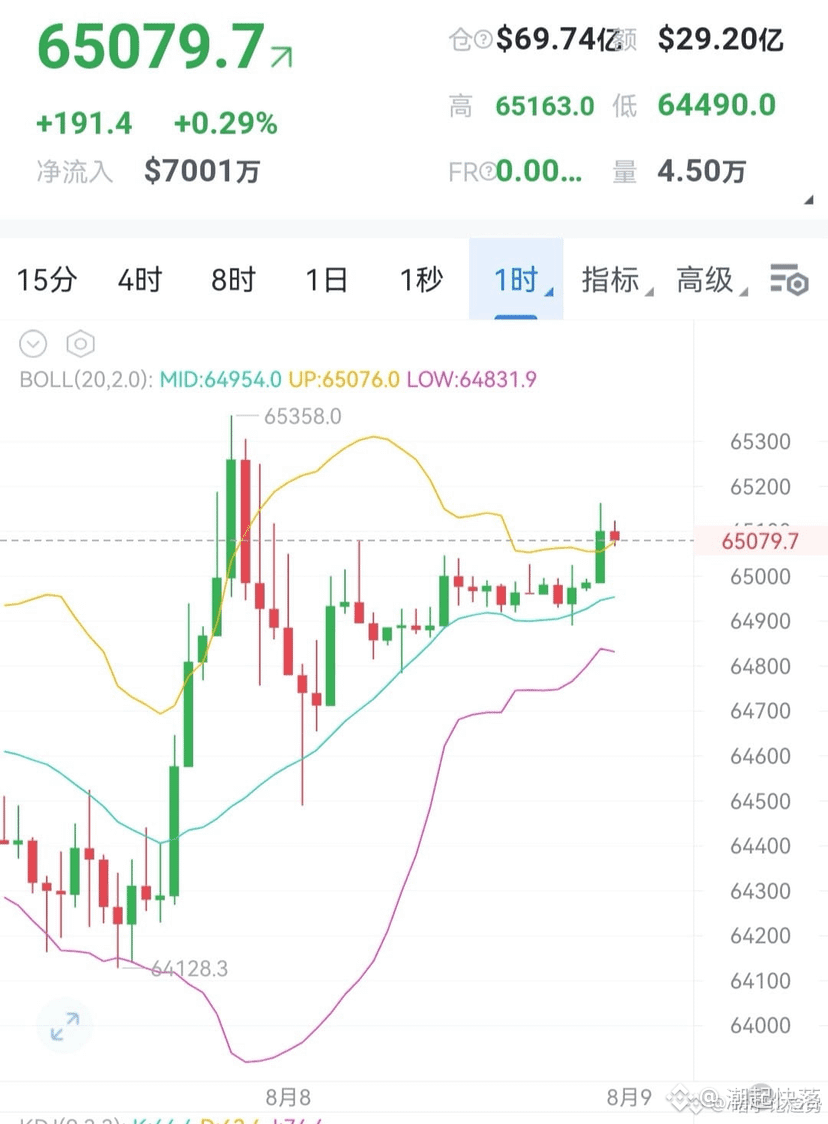
$BTC $ETH #U.S. July Nonfarm Payrolls unexpectedly fell. Trading was sluggish over the weekend, with price action staying in a tight range just below 65,000. Although the overall oscillation structure hasn’t changed, the available volatility has been compressed, making it difficult to find an ideal risk-reward setup. At this stage, it’s better to stay on the sidelines rather than rush to enter the market to bet on a move.
From last night’s U.S. session, we can see that the broader trend remains upward in an oscillating manner; however, the strength of the bulls’ push has already been greatly reduced, so it’s unlikely to see a strong rally in the near term. The expectation for the next leg is still mainly an oscillating upward lift. Current price is around the middle of the range, so the trading approach should mainly focus on pulling back to support and going long.
Go long on BTC around 64,500, target around 65,500
Go long on ETH around 1,905, target around 1,950#SpaceX’s market value reached $1.613 trillion, surpassing Meta
From last night’s U.S. session, we can see that the broader trend remains upward in an oscillating manner; however, the strength of the bulls’ push has already been greatly reduced, so it’s unlikely to see a strong rally in the near term. The expectation for the next leg is still mainly an oscillating upward lift. Current price is around the middle of the range, so the trading approach should mainly focus on pulling back to support and going long.
Go long on BTC around 64,500, target around 65,500
Go long on ETH around 1,905, target around 1,950#SpaceX’s market value reached $1.613 trillion, surpassing Meta
This weekend, the world was played by Trump again.
Last Friday, he was still calling for “a severe strike” on Iran. The U.S. State Department issued a direct evacuation warning to American citizens in the Middle East. Israeli Prime Minister Netanyahu was even ready to coordinate a joint strike.
Guess what happened?
Netanyahu learned that the strike was called off on Trump’s “real social.”
A prime minister only finds out through social media that his ally won’t strike. Netflix wouldn’t dare write a plot like that.
Brent crude briefly plunged 7.3%, falling to $81.55. WTI crude dropped below the $80 mark.
Gold surged above $4,080. U.S. stock futures rose across the board. Bitcoin jumped past $63,000.
Trump said: The Strait of Hormuz already has an agreement, and a deal on denuclearization will also be reached.
Then Iran said: “This is a new lie”—the Strait of Hormuz “will never return to its pre-war state.”
Trump’s “flip-flopping” has become a hallmark of this five-month-long conflict.
Volatility has surged again. In the short term, BTC, as “digital gold,” is getting safe-haven buying.
But what about the medium term? High oil prices → high inflation → high interest rates. The Fed doesn’t dare to cut rates; liquidity is drained, and BTC is held down hard.
By 2026, BTC doesn’t buy the “war narrative” anymore. What it eats is dollar liquidity. $
Last Friday, he was still calling for “a severe strike” on Iran. The U.S. State Department issued a direct evacuation warning to American citizens in the Middle East. Israeli Prime Minister Netanyahu was even ready to coordinate a joint strike.
Guess what happened?
Netanyahu learned that the strike was called off on Trump’s “real social.”
A prime minister only finds out through social media that his ally won’t strike. Netflix wouldn’t dare write a plot like that.
Brent crude briefly plunged 7.3%, falling to $81.55. WTI crude dropped below the $80 mark.
Gold surged above $4,080. U.S. stock futures rose across the board. Bitcoin jumped past $63,000.
Trump said: The Strait of Hormuz already has an agreement, and a deal on denuclearization will also be reached.
Then Iran said: “This is a new lie”—the Strait of Hormuz “will never return to its pre-war state.”
Trump’s “flip-flopping” has become a hallmark of this five-month-long conflict.
Volatility has surged again. In the short term, BTC, as “digital gold,” is getting safe-haven buying.
But what about the medium term? High oil prices → high inflation → high interest rates. The Fed doesn’t dare to cut rates; liquidity is drained, and BTC is held down hard.
By 2026, BTC doesn’t buy the “war narrative” anymore. What it eats is dollar liquidity. $
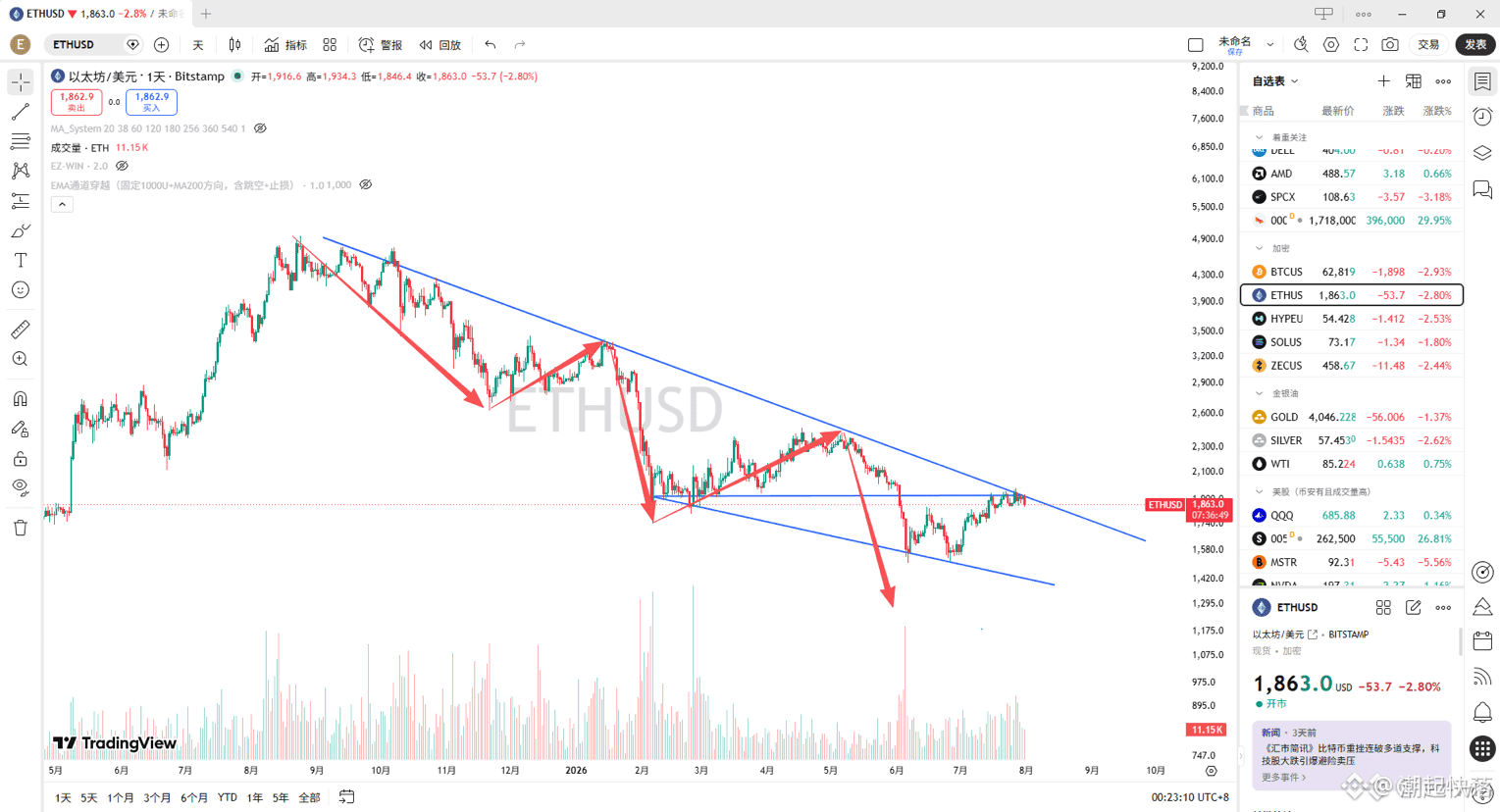
$ETH Encryption is largely similar—taking Ethereum as an example, in my personal view the fifth wave hasn’t finished yet; the price should make a stop around 1400.
Unless it quickly rallies up and holds above 2000, then perhaps it can be seen as a reversal.
September should bring a very good market.
Unless it quickly rallies up and holds above 2000, then perhaps it can be seen as a reversal.
September should bring a very good market.
Log in to explore more content