
聚财资本
3.4k Posts

聚财资本
公众号:胖虎交易日记 X:@lmf8848
八年职业交易员,专注合约波段操作,日内波段盈利,胜率稳定在90%-95%。 现货策略:周期性埋伏潜力币,熊市低吸,牛市高抛,把握市场趋势。
29 Following
4.3K+ Followers
2.6K+ Liked
Posts
All
Quotes
PINNED
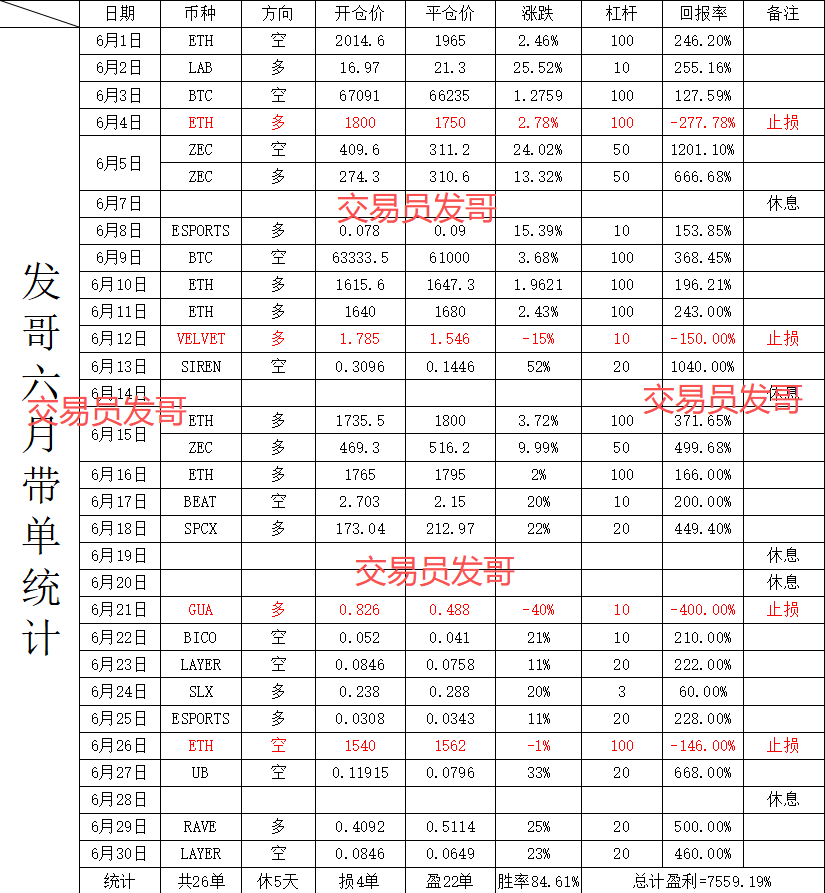
Brother Ge’s June contract live trading summary is here👇
In June, we executed 26 trades and rested for 5 days.
We had 4 stop losses, 22 winning trades, for a win rate of 84.61%, and a cumulative return of 7559.19%.
Trading isn’t about how much you make from one or two trades—it’s about whether you can consistently and steadily profit in the long run.
The results delivered in June are the best proof.
The market presents opportunities every day—just steadily capture the share of profit that belongs to you.
Keep working hard in July, and keep going!💪
If you’re still chasing and killing, or you don’t know how to judge when to enter and when to exit, come to the chat room and talk to me.
In June, we executed 26 trades and rested for 5 days.
We had 4 stop losses, 22 winning trades, for a win rate of 84.61%, and a cumulative return of 7559.19%.
Trading isn’t about how much you make from one or two trades—it’s about whether you can consistently and steadily profit in the long run.
The results delivered in June are the best proof.
The market presents opportunities every day—just steadily capture the share of profit that belongs to you.
Keep working hard in July, and keep going!💪
If you’re still chasing and killing, or you don’t know how to judge when to enter and when to exit, come to the chat room and talk to me.

PINNED
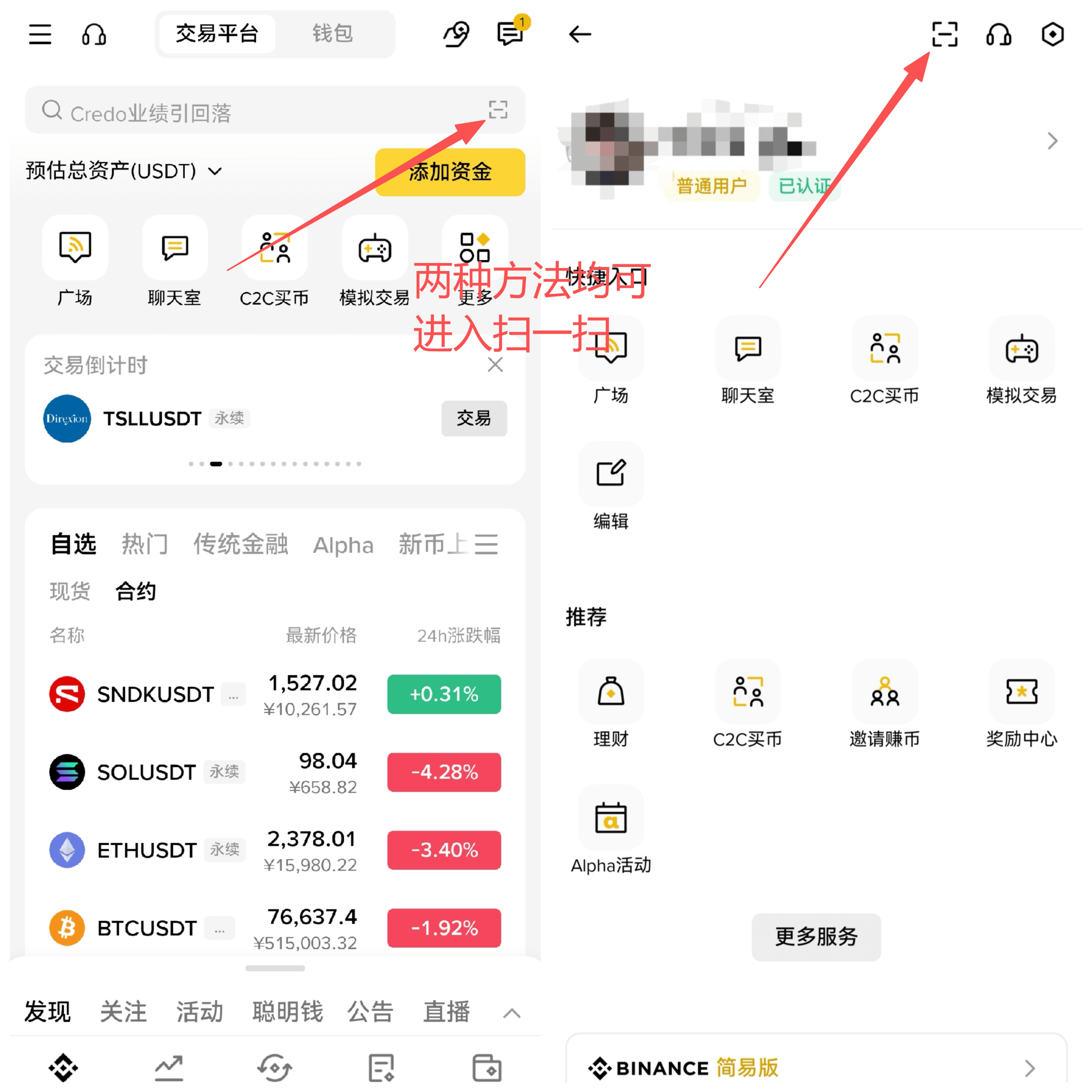
Binance has now launched a new feature— you can chat with other users via private messages directly within the platform.
If you need to connect or have questions, you can scan the QR code below to add.
Your profile bio also includes a chat ID—search by the ID to add “Gege.”
Trading follow-up discussions: Binance official chat room👇
If you need to connect or have questions, you can scan the QR code below to add.
Your profile bio also includes a chat ID—search by the ID to add “Gege.”
Trading follow-up discussions: Binance official chat room👇

I just remembered, I remembered everything. I'm not a Wall Street wolf at all, I'm a minor, I want a refund $USELESS
I’ve heard that in the crypto world, one day is like a year on earth. In the same market, others make a fortune while I keep losing money. $MARSCOIN
Today I’m sharing a snowball strategy that even the market makers fear. Last year, I used this method to turn 50,000 in capital into 200,000. $TRIA
The core is the simple and stubborn 10% rule. Strategies that can truly make money are often very simple.
Five-slice method
No matter whether your capital is 10,000 or 100,000, split the funds into five equal parts. Using 50,000 as an example, each part is 10,000. First, use the first portion to enter a mainstream coin. If it drops 10%, put in the next portion; if it rises 10%, immediately sell one portion and lock in the profit. Repeat this cycle continuously, like a trading ATM that keeps producing output.
The advantage of this approach is very practical: even if the coin gets cut in half, you won’t be completely passive, and sideways markets are even where it shines. When the market makers shake out weak hands, they actually end up feeding us returns; with counter-trend operations, it’s not easy to lose composure.
Once you become skilled, you can level up by narrowing the volatility threshold from 10% to 5%, further improving capital efficiency.
At its core, this is not betting on direction, not blindly buying the dip, and not chasing highs, but relying on phased entries and exits with rhythm to snowball returns. It sounds simple, but most people are obsessed with getting rich overnight, so it’s hard to stick with the execution. There is no shortcut to turning things around; profits come from accumulating little by little, so you can capture the benefits of a major market move.
If you’re feeling a bit lost right now, or need more guidance, feel free to come find me anytime, and I’ll provide you with a detailed analysis!#美国8月平均时薪同比增3.1% #Adobe宣布换帅股价盘前跌3% #日经225指数上涨1.26%
I’ve heard that in the crypto world, one day is like a year on earth. In the same market, others make a fortune while I keep losing money. $MARSCOIN
Today I’m sharing a snowball strategy that even the market makers fear. Last year, I used this method to turn 50,000 in capital into 200,000. $TRIA
The core is the simple and stubborn 10% rule. Strategies that can truly make money are often very simple.
Five-slice method
No matter whether your capital is 10,000 or 100,000, split the funds into five equal parts. Using 50,000 as an example, each part is 10,000. First, use the first portion to enter a mainstream coin. If it drops 10%, put in the next portion; if it rises 10%, immediately sell one portion and lock in the profit. Repeat this cycle continuously, like a trading ATM that keeps producing output.
The advantage of this approach is very practical: even if the coin gets cut in half, you won’t be completely passive, and sideways markets are even where it shines. When the market makers shake out weak hands, they actually end up feeding us returns; with counter-trend operations, it’s not easy to lose composure.
Once you become skilled, you can level up by narrowing the volatility threshold from 10% to 5%, further improving capital efficiency.
At its core, this is not betting on direction, not blindly buying the dip, and not chasing highs, but relying on phased entries and exits with rhythm to snowball returns. It sounds simple, but most people are obsessed with getting rich overnight, so it’s hard to stick with the execution. There is no shortcut to turning things around; profits come from accumulating little by little, so you can capture the benefits of a major market move.
If you’re feeling a bit lost right now, or need more guidance, feel free to come find me anytime, and I’ll provide you with a detailed analysis!#美国8月平均时薪同比增3.1% #Adobe宣布换帅股价盘前跌3% #日经225指数上涨1.26%

From losing 1 million to turning 30,000 into 50x: The brutal path to redemption through position pyramiding $MAGMA
In 2022, one market move wiped out 1 million. The account went from huge unrealized gains to almost nothing, and in the end only 30,000 U was left. $USELESS
During that time, I was filled with despair, and at one point I thought my trading journey had come to an end. Unwilling to leave like that, I completely overturned my old trading habits and settled down to review and adjust. In just half a year, I turned 30,000 U into 1.32 million U. Today I’m sharing this pyramiding method. Whether you can get results depends entirely on execution. $MARSCOIN
✅ Keep the first position strictly under 10%, and cut losses decisively at 5%. Taking 3000 U as an example, if you lose 150 U, you must exit. Never fantasize about winning back losses in one trade; going all in will directly destroy your chance of a turnaround.
✅ First recover your principal with profits, and only use profits to add positions in a rolling manner. When profit reaches 30%, calculate the add-on position as 1.5 times the profit. If 3000 U makes 900 U in profit, then add 1350 U. Only attack after two consecutive profitable trades, and raise the stop loss at the same time.
✅ Use a trailing take profit and refuse to stubbornly hold through rebounds. Each time the market rises 15%, move the stop loss up by 12%. Even if the trend has not broken below it, you must exit when the stop loss is triggered. You need to stay flexible, especially in rebound行情.
Most people struggle to turn things around for just three reasons: after losing, they rush to win it back in one trade; when making money, they dare not add positions and miss compounding; they have no trading plan and are completely controlled by emotions.
For this strategy to work, you need to execute stop losses mechanically, dare to attack when profitable, and use only profits to take on risk. The crypto market does not believe in tears; it only rewards those who strictly follow the rules.
If you are feeling a bit lost right now, or need more guidance, feel free to reach out to me anytime, and I will provide you with a detailed analysis!#美国8月非农数据今日公布 #比特币以太坊触及数月高点 #Adobe宣布换帅股价盘前跌3%
In 2022, one market move wiped out 1 million. The account went from huge unrealized gains to almost nothing, and in the end only 30,000 U was left. $USELESS
During that time, I was filled with despair, and at one point I thought my trading journey had come to an end. Unwilling to leave like that, I completely overturned my old trading habits and settled down to review and adjust. In just half a year, I turned 30,000 U into 1.32 million U. Today I’m sharing this pyramiding method. Whether you can get results depends entirely on execution. $MARSCOIN
✅ Keep the first position strictly under 10%, and cut losses decisively at 5%. Taking 3000 U as an example, if you lose 150 U, you must exit. Never fantasize about winning back losses in one trade; going all in will directly destroy your chance of a turnaround.
✅ First recover your principal with profits, and only use profits to add positions in a rolling manner. When profit reaches 30%, calculate the add-on position as 1.5 times the profit. If 3000 U makes 900 U in profit, then add 1350 U. Only attack after two consecutive profitable trades, and raise the stop loss at the same time.
✅ Use a trailing take profit and refuse to stubbornly hold through rebounds. Each time the market rises 15%, move the stop loss up by 12%. Even if the trend has not broken below it, you must exit when the stop loss is triggered. You need to stay flexible, especially in rebound行情.
Most people struggle to turn things around for just three reasons: after losing, they rush to win it back in one trade; when making money, they dare not add positions and miss compounding; they have no trading plan and are completely controlled by emotions.
For this strategy to work, you need to execute stop losses mechanically, dare to attack when profitable, and use only profits to take on risk. The crypto market does not believe in tears; it only rewards those who strictly follow the rules.
If you are feeling a bit lost right now, or need more guidance, feel free to reach out to me anytime, and I will provide you with a detailed analysis!#美国8月非农数据今日公布 #比特币以太坊触及数月高点 #Adobe宣布换帅股价盘前跌3%

Losing money to the point of being unable to sleep all night, now I earn a steady 1000U every day, without relying on luck$UAI
I once stared at the K-line charts until 3 a.m., unable to sleep all night—not because I was waiting for an opportunity, but because of the panic brought on by losses, with my head buzzing.$MARSCOIN
Liquidations, blindly buying the dip, adding to losing positions—I've almost made every kind of mistake in trading. An account worth several hundred thousand shrank to just a few thousand U. At my worst, I was liquidated three times in one day; I couldn’t sleep at night, and during the day I was mentally dazed. I once wanted to completely leave the market.$USELESS
This painful experience woke me up: in crypto, trading isn’t about emotions; it’s about logic, strategy, and execution.
I started over, insisting on daily reviews to refine my trading system. I no longer chase pumps, and I never hold onto losing trades; I only enter when there is a high-probability opportunity. I strictly control position size, putting survival first; profits are taken in stages, and side positions are locked in and realized in time; if there is no signal that meets the standard, I stay out and watch from the sidelines. Every trade must have a basis.
From making a few dozen a day, I gradually moved up to a few hundred. Now my daily income starts at 1000U. When the market is hot, the returns are even higher; when the market is quiet, I can still keep my mindset stable.
It’s not that I’m especially gifted—I've simply stepped into every major pitfall and personally experienced liquidation and collapse. This path can be walked through; finding the right method and executing it steadily is what truly matters.
If you’re feeling a bit lost right now, or need more guidance, feel free to come find me anytime, and I’ll provide you with a detailed analysis!#比特币以太坊触及数月高点 #美国初请失业金人数升至20.6万 #韩国KOSPI连续第二日上涨1.6%
I once stared at the K-line charts until 3 a.m., unable to sleep all night—not because I was waiting for an opportunity, but because of the panic brought on by losses, with my head buzzing.$MARSCOIN
Liquidations, blindly buying the dip, adding to losing positions—I've almost made every kind of mistake in trading. An account worth several hundred thousand shrank to just a few thousand U. At my worst, I was liquidated three times in one day; I couldn’t sleep at night, and during the day I was mentally dazed. I once wanted to completely leave the market.$USELESS
This painful experience woke me up: in crypto, trading isn’t about emotions; it’s about logic, strategy, and execution.
I started over, insisting on daily reviews to refine my trading system. I no longer chase pumps, and I never hold onto losing trades; I only enter when there is a high-probability opportunity. I strictly control position size, putting survival first; profits are taken in stages, and side positions are locked in and realized in time; if there is no signal that meets the standard, I stay out and watch from the sidelines. Every trade must have a basis.
From making a few dozen a day, I gradually moved up to a few hundred. Now my daily income starts at 1000U. When the market is hot, the returns are even higher; when the market is quiet, I can still keep my mindset stable.
It’s not that I’m especially gifted—I've simply stepped into every major pitfall and personally experienced liquidation and collapse. This path can be walked through; finding the right method and executing it steadily is what truly matters.
If you’re feeling a bit lost right now, or need more guidance, feel free to come find me anytime, and I’ll provide you with a detailed analysis!#比特币以太坊触及数月高点 #美国初请失业金人数升至20.6万 #韩国KOSPI连续第二日上涨1.6%

Three-step multi-cycle candlestick method—stop chasing and killing at the wrong time $TRIA
Many friends tell me that reading candlestick charts gives them headaches: they enter impulsively, panic out, and as they trade more, their actions get more and more chaotic. Small wins and big losses become the norm.
Let me share the multi-timeframe candlestick approach I’ve been using: it’s simple—three steps to sort out the market and find the right entry points. $MARSCOIN
✅ 4-hour candlesticks set the big direction
Filter out noisy short-term clutter on the chart. When the swing highs and swing lows rise together, it forms an uptrend—look for pullbacks as low-entry opportunities. If swing highs and lows keep shifting downward, it’s a downtrend—on rallies, sell in line with the trend. If the market is ranging/sideways with consolidation, just stand by and avoid being chopped up by whipsaw action. $USELESS
✅ 1-hour candlesticks define key zones
After the bigger trend is confirmed, mark out support and resistance. You can consider entering on a retest of support. When price reaches resistance, plan for scaling out and set take-profit targets.
✅ 15-minute candlesticks precisely capture entry timing
This timeframe doesn’t determine the big trend—it’s for catching entry signals. When key levels show reversal patterns such as engulfing candles or bullish/bearish divergences (e.g., bottom divergence), then act. For breakouts, you must check volume—breakouts without volume are often false-break traps that lure traders in.
4-hour sets direction → 1-hour finds the zone → 15-minute captures the moment.
When signals across different timeframes conflict, choose to stay in cash rather than forcing trades. Any execution on the lower timeframe must include a stop-loss to prevent being harvested by price action.
Trading’s essence is combining trend (direction), position (where you enter), and timing (when you enter). Keep your mindset stable and don’t get swept away by the chart’s emotions—only then can you read the market’s rhythm.
If you feel a bit lost right now, or if you need more guidance, feel free to reach out anytime—I’ll provide a detailed analysis for you! #比特币以太坊触及数月高点 #Adobe宣布换帅股价盘前跌3% #美国初请失业金人数升至20.6万
Many friends tell me that reading candlestick charts gives them headaches: they enter impulsively, panic out, and as they trade more, their actions get more and more chaotic. Small wins and big losses become the norm.
Let me share the multi-timeframe candlestick approach I’ve been using: it’s simple—three steps to sort out the market and find the right entry points. $MARSCOIN
✅ 4-hour candlesticks set the big direction
Filter out noisy short-term clutter on the chart. When the swing highs and swing lows rise together, it forms an uptrend—look for pullbacks as low-entry opportunities. If swing highs and lows keep shifting downward, it’s a downtrend—on rallies, sell in line with the trend. If the market is ranging/sideways with consolidation, just stand by and avoid being chopped up by whipsaw action. $USELESS
✅ 1-hour candlesticks define key zones
After the bigger trend is confirmed, mark out support and resistance. You can consider entering on a retest of support. When price reaches resistance, plan for scaling out and set take-profit targets.
✅ 15-minute candlesticks precisely capture entry timing
This timeframe doesn’t determine the big trend—it’s for catching entry signals. When key levels show reversal patterns such as engulfing candles or bullish/bearish divergences (e.g., bottom divergence), then act. For breakouts, you must check volume—breakouts without volume are often false-break traps that lure traders in.
4-hour sets direction → 1-hour finds the zone → 15-minute captures the moment.
When signals across different timeframes conflict, choose to stay in cash rather than forcing trades. Any execution on the lower timeframe must include a stop-loss to prevent being harvested by price action.
Trading’s essence is combining trend (direction), position (where you enter), and timing (when you enter). Keep your mindset stable and don’t get swept away by the chart’s emotions—only then can you read the market’s rhythm.
If you feel a bit lost right now, or if you need more guidance, feel free to reach out anytime—I’ll provide a detailed analysis for you! #比特币以太坊触及数月高点 #Adobe宣布换帅股价盘前跌3% #美国初请失业金人数升至20.6万

90% of people who “trade for coins” end up losing money—the root cause is that they don’t know how to hunt for effective information $MARSCOIN
Do you know why nine out of ten players in the crypto圈 ultimately end up closing at a loss? The key isn’t that the technology isn’t good—it’s that they don’t know how to hunt for useful information. $USELESS
Last year, at 2 a.m., I went through my seventh liquidation. Watching my account balance, my heart was filled with mixed feelings. By chance, I came across a strategy. I carried it out with half belief and half doubt—and after six months, I turned 3,000U into 287,000U. $UAI
For small capital to turn things around, absolutely don’t rely on a hundredfold leverage bet. That’s basically choosing risk on purpose. First, stop the bleeding. Split the principal into three parts: the majority goes into allocating top mainstream coin holdings; a smaller portion is used for arbitrage; the remaining funds are kept as emergency capital—to let the account recover slowly.
After the account rebounds, start hedged arbitrage: capture opportunities in price spreads and funding-rate differentials, and earn triple benefits from spreads, fees/rates, and volatility. When the account capital reaches 20,000, enter “hunting” mode—dig into newly listed coin types that the market hasn’t priced in well yet. If you catch the rhythm correctly, you can obtain solid returns.
From a small principal to big gains, it’s all about information advantages plus unwavering execution. Don’t get obsessed with fantasies of becoming rich overnight. If you want a comeback, you must learn patience—wait for opportunities, and follow the rules before taking action.
If you’re feeling a bit lost right now, or you need more guidance, feel free to reach out anytime. I’ll provide a detailed analysis for you! #比特币以太坊触及数月高点 #日经225指数上涨1.26% #美国初请失业金人数升至20.6万
Do you know why nine out of ten players in the crypto圈 ultimately end up closing at a loss? The key isn’t that the technology isn’t good—it’s that they don’t know how to hunt for useful information. $USELESS
Last year, at 2 a.m., I went through my seventh liquidation. Watching my account balance, my heart was filled with mixed feelings. By chance, I came across a strategy. I carried it out with half belief and half doubt—and after six months, I turned 3,000U into 287,000U. $UAI
For small capital to turn things around, absolutely don’t rely on a hundredfold leverage bet. That’s basically choosing risk on purpose. First, stop the bleeding. Split the principal into three parts: the majority goes into allocating top mainstream coin holdings; a smaller portion is used for arbitrage; the remaining funds are kept as emergency capital—to let the account recover slowly.
After the account rebounds, start hedged arbitrage: capture opportunities in price spreads and funding-rate differentials, and earn triple benefits from spreads, fees/rates, and volatility. When the account capital reaches 20,000, enter “hunting” mode—dig into newly listed coin types that the market hasn’t priced in well yet. If you catch the rhythm correctly, you can obtain solid returns.
From a small principal to big gains, it’s all about information advantages plus unwavering execution. Don’t get obsessed with fantasies of becoming rich overnight. If you want a comeback, you must learn patience—wait for opportunities, and follow the rules before taking action.
If you’re feeling a bit lost right now, or you need more guidance, feel free to reach out anytime. I’ll provide a detailed analysis for you! #比特币以太坊触及数月高点 #日经225指数上涨1.26% #美国初请失业金人数升至20.6万

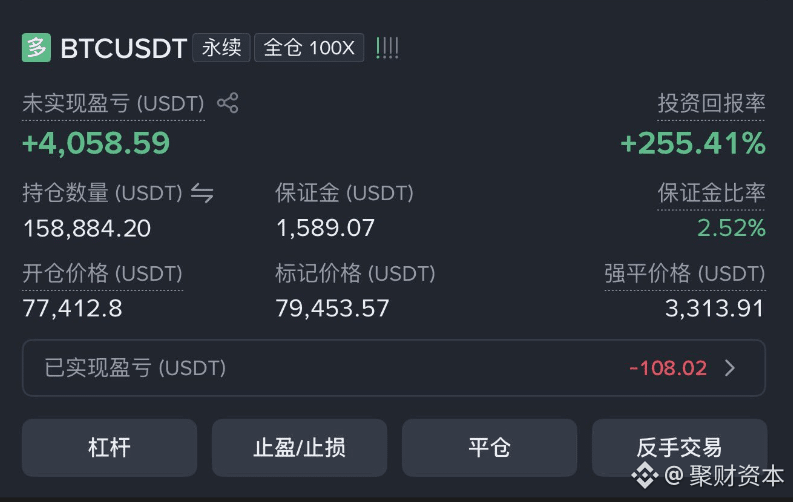
I remember now—I remember everything. I’m not “The Wolf of Wall Street.” I’m a minor. I’m requesting a refund $EDGE
Liquidated and lost 40,000 U, leaving only 1,560 U—how to turn the tide and make a comeback against the odds $UAI
A few days ago, a follower came to see me. He had been consecutively liquidated and lost nearly 40,000 U; his account had only 1,560 U left. He didn’t even have the courage to open a large position. He urgently wanted to get back to even—getting back even half would already satisfy him. $USELESS
I told him that if he didn’t do random trades and just focused on getting back, there was a real chance. But compared with short-term profits, mastering a trading method is the real foundation.
We first did a complete review of his past losses and pinpointed the core problems: loving to gamble on the market and stubbornly refusing to cut losses. Then we proceeded steadily and slowly. For the first wave, I decisively entered him on an ETH long, helping him regain trading confidence; for the second wave, I rode the trend and had him take a BNB short, steadily locking in 3,200 U. After that, the BTC signals were clear—set up short positions in batches, and on one trade, he took down 7,916 U.
After just a few trades, he finally came to his senses: it wasn’t that the market had become simple; it was that he was no longer impulsively gambling. He learned to keep a cash position and observe, not participate in markets he couldn’t understand, and bring every trade under a system. Each trade controlled 70% of the position size, with stop-loss and take-profit set in advance; after opening the position, he didn’t make casual changes.
Going from loss to profit is only the final result—it shouldn’t be the only goal. How much principal you have is secondary; the key is whether you can learn from your mistakes after a liquidation.
If you’re feeling a bit lost right now, or if you need more guidance, feel free to come find me anytime—I’ll provide a detailed analysis for you! #比特币以太坊触及数月高点 #Adobe宣布换帅股价盘前跌3% #美国初请失业金人数升至20.6万
Liquidated and lost 40,000 U, leaving only 1,560 U—how to turn the tide and make a comeback against the odds $UAI
A few days ago, a follower came to see me. He had been consecutively liquidated and lost nearly 40,000 U; his account had only 1,560 U left. He didn’t even have the courage to open a large position. He urgently wanted to get back to even—getting back even half would already satisfy him. $USELESS
I told him that if he didn’t do random trades and just focused on getting back, there was a real chance. But compared with short-term profits, mastering a trading method is the real foundation.
We first did a complete review of his past losses and pinpointed the core problems: loving to gamble on the market and stubbornly refusing to cut losses. Then we proceeded steadily and slowly. For the first wave, I decisively entered him on an ETH long, helping him regain trading confidence; for the second wave, I rode the trend and had him take a BNB short, steadily locking in 3,200 U. After that, the BTC signals were clear—set up short positions in batches, and on one trade, he took down 7,916 U.
After just a few trades, he finally came to his senses: it wasn’t that the market had become simple; it was that he was no longer impulsively gambling. He learned to keep a cash position and observe, not participate in markets he couldn’t understand, and bring every trade under a system. Each trade controlled 70% of the position size, with stop-loss and take-profit set in advance; after opening the position, he didn’t make casual changes.
Going from loss to profit is only the final result—it shouldn’t be the only goal. How much principal you have is secondary; the key is whether you can learn from your mistakes after a liquidation.
If you’re feeling a bit lost right now, or if you need more guidance, feel free to come find me anytime—I’ll provide a detailed analysis for you! #比特币以太坊触及数月高点 #Adobe宣布换帅股价盘前跌3% #美国初请失业金人数升至20.6万

Contract traders must read and understand: your losses may not be because of the market $ZEC
To all the brothers trading contracts, read carefully— it might help you avoid massive losses.
Doesn't it often happen that the moment you open a position the market reverses, and as soon as you cut loss the price immediately surges up? After you close the position, it just takes off. You were right about the big direction, yet in the end you still lose terribly. $MARSCOIN
Many people blame bad luck, but actually you’re being harvested by the rule set of the contract game. A contract is fundamentally a betting agreement; your profit and loss comes from the counterparty.
Don’t ignore the funding rate. When it stays at a high level with a consistently positive funding rate, it often lures longs into the market, only to be followed by a wave of reverse liquidation. $USELESS
Don’t be naive and think that with 10x leverage, a 10% drop is what triggers liquidation. The liquidation price and various fees will steadily consume your position in advance. You may not even need a major market drop—the rules will drain you before you realize it. Leverage amplifies not only your gains, but also fees, risk, and psychological pressure.
Rolling positions (rolling over) also hides traps. Many people put all their profits into the next trade. With just one pullback, profits are wiped out—and even your principal gets dragged in too. The right approach: keep half your profit to continue trading, and save the other half as life-saving capital.
If you keep complaining that you’re being “targeted and blown up,” it’s mostly because you haven’t seen through the underlying logic. To survive in crypto contract trading, first give up fantasies of getting rich overnight. Understand the rules of the game, and don’t keep paying tuition with real money over and over.
If you’re feeling confused right now, or you need more guidance, feel free to come find me anytime. I’ll provide a detailed analysis for you! #美国初请失业金人数升至20.6万 #日经225指数上涨1.26% #希音港股上市后跌17.5%
To all the brothers trading contracts, read carefully— it might help you avoid massive losses.
Doesn't it often happen that the moment you open a position the market reverses, and as soon as you cut loss the price immediately surges up? After you close the position, it just takes off. You were right about the big direction, yet in the end you still lose terribly. $MARSCOIN
Many people blame bad luck, but actually you’re being harvested by the rule set of the contract game. A contract is fundamentally a betting agreement; your profit and loss comes from the counterparty.
Don’t ignore the funding rate. When it stays at a high level with a consistently positive funding rate, it often lures longs into the market, only to be followed by a wave of reverse liquidation. $USELESS
Don’t be naive and think that with 10x leverage, a 10% drop is what triggers liquidation. The liquidation price and various fees will steadily consume your position in advance. You may not even need a major market drop—the rules will drain you before you realize it. Leverage amplifies not only your gains, but also fees, risk, and psychological pressure.
Rolling positions (rolling over) also hides traps. Many people put all their profits into the next trade. With just one pullback, profits are wiped out—and even your principal gets dragged in too. The right approach: keep half your profit to continue trading, and save the other half as life-saving capital.
If you keep complaining that you’re being “targeted and blown up,” it’s mostly because you haven’t seen through the underlying logic. To survive in crypto contract trading, first give up fantasies of getting rich overnight. Understand the rules of the game, and don’t keep paying tuition with real money over and over.
If you’re feeling confused right now, or you need more guidance, feel free to come find me anytime. I’ll provide a detailed analysis for you! #美国初请失业金人数升至20.6万 #日经225指数上涨1.26% #希音港股上市后跌17.5%

From 10,000 to 50,000, a rollover trading playbook that avoided liquidation for three months—rules $UAI
In the crypto rollover market, doing it right is a money-printing machine; doing it wrong is a money-shredder. Last year, in 127 days, I turned 13,000 into 97,000—the core comes down to these three iron rules. $MARSCOIN
Leverage Red Lines: Absolutely refuse full-capital positions. The most deadly move for beginners is chasing a surge with high leverage full-size—when the market fluctuates slightly, you get liquidated. The first-position formula is fixed: initial entry = total capital × 3% ÷ (leverage multiple × volatility). Strictly control the initial position size, and even if the market swings violently, the account can still survive. $USELESS
Break the death spiral with a pyramid add-on approach. Don’t blindly go all-in at once—add in layers according to the breakout. Positions are reduced layer by layer, and each layer simultaneously raises the take-profit level. Most of the excess returns come from later add-on positions, so the timing and rhythm of adding is the top priority.
Life-Saving Golden Bell Protection: Dynamic stop-loss to save yourself. Every rollover trade must be set with an ATR dynamic stop-loss. When profit reaches 50%, raise the stop-loss to the breakeven line; after doubling, activate a trailing stop-loss. For every 2% the market rises, the stop-loss follows up by 1%.
With this model, I previously captured 73% gains in the market. The real killer move of rollover trading is a hidden indicator that locks in profits before a major crash arrives.
If you’re feeling a bit lost right now, or you need more guidance, feel free to reach out to me anytime—I’ll do a detailed analysis for you! #美国初请失业金人数升至20.6万 #日经225指数上涨1.26% #雪花公司财报超预期股价涨24%
In the crypto rollover market, doing it right is a money-printing machine; doing it wrong is a money-shredder. Last year, in 127 days, I turned 13,000 into 97,000—the core comes down to these three iron rules. $MARSCOIN
Leverage Red Lines: Absolutely refuse full-capital positions. The most deadly move for beginners is chasing a surge with high leverage full-size—when the market fluctuates slightly, you get liquidated. The first-position formula is fixed: initial entry = total capital × 3% ÷ (leverage multiple × volatility). Strictly control the initial position size, and even if the market swings violently, the account can still survive. $USELESS
Break the death spiral with a pyramid add-on approach. Don’t blindly go all-in at once—add in layers according to the breakout. Positions are reduced layer by layer, and each layer simultaneously raises the take-profit level. Most of the excess returns come from later add-on positions, so the timing and rhythm of adding is the top priority.
Life-Saving Golden Bell Protection: Dynamic stop-loss to save yourself. Every rollover trade must be set with an ATR dynamic stop-loss. When profit reaches 50%, raise the stop-loss to the breakeven line; after doubling, activate a trailing stop-loss. For every 2% the market rises, the stop-loss follows up by 1%.
With this model, I previously captured 73% gains in the market. The real killer move of rollover trading is a hidden indicator that locks in profits before a major crash arrives.
If you’re feeling a bit lost right now, or you need more guidance, feel free to reach out to me anytime—I’ll do a detailed analysis for you! #美国初请失业金人数升至20.6万 #日经225指数上涨1.26% #雪花公司财报超预期股价涨24%

Crypto Trading K-Line Secret Codes Revealed: 3 Secrets the Market Makers Won’t Tell You $MARSCOIN
An identical K-line chart looks like nothing but up or down to retail traders. But experts can read the traps laid by the money. Using this chart-logic, I once successfully escaped the top 12 hours before BTC crashed. $USELESS
✅ Spot Fake Breakouts and Avoid the “Fishing Line” Trap When the chart breaks above the prior high, it lures retail traders into chasing. Then, it immediately dumps. That’s the classic fake breakout to lure longs. For a truly effective breakout, the trading volume must be more than double the 3-day average, and two consecutive 4-hour K-lines must close firmly above the resistance level. When ETH broke above 2100 before, the volume was severely lacking—then within the next 24 hours it dropped 15% straight. $AKE
✅ Catch the Signals of Hidden Accumulation by Market Makers Long lower wicks combined with shrinking volume: while the price is being pushed down, there’s secretly money quietly buying. After long sideways consolidation, a sudden surge into a big bullish candle is often a sign the move is about to start. The daily “three-needle” probing low: the support level is tested repeatedly but not broken—plus on-chain giant whales increasing holdings, making the opportunity more credible.
✅ The Death Reversal Pattern: Key Signals for Escaping the Top Hanging man and the evening star are clear top-confirmation patterns. Once a top pattern appears, and futures open interest surges sharply at the same time, the probability of a downturn exceeds 80%. Earlier, when BTC formed a double top pattern, it quickly fell from 38,000 to 35,000.
K-lines are only the foundation. When you further overlay predictions using dark-pool large orders, you can plan ahead—positioning yourself before good news fully takes effect—then wait for the market to rally. Understanding signals is important, but execution matters even more.
If you’re feeling a bit lost right now, or need more guidance, feel free to come find me anytime—I’ll provide a detailed analysis for you! #美国初请失业金人数升至20.6万 #OpenAI发布GPT-6Astra #OpenAI发布GPT-6Astra
An identical K-line chart looks like nothing but up or down to retail traders. But experts can read the traps laid by the money. Using this chart-logic, I once successfully escaped the top 12 hours before BTC crashed. $USELESS
✅ Spot Fake Breakouts and Avoid the “Fishing Line” Trap When the chart breaks above the prior high, it lures retail traders into chasing. Then, it immediately dumps. That’s the classic fake breakout to lure longs. For a truly effective breakout, the trading volume must be more than double the 3-day average, and two consecutive 4-hour K-lines must close firmly above the resistance level. When ETH broke above 2100 before, the volume was severely lacking—then within the next 24 hours it dropped 15% straight. $AKE
✅ Catch the Signals of Hidden Accumulation by Market Makers Long lower wicks combined with shrinking volume: while the price is being pushed down, there’s secretly money quietly buying. After long sideways consolidation, a sudden surge into a big bullish candle is often a sign the move is about to start. The daily “three-needle” probing low: the support level is tested repeatedly but not broken—plus on-chain giant whales increasing holdings, making the opportunity more credible.
✅ The Death Reversal Pattern: Key Signals for Escaping the Top Hanging man and the evening star are clear top-confirmation patterns. Once a top pattern appears, and futures open interest surges sharply at the same time, the probability of a downturn exceeds 80%. Earlier, when BTC formed a double top pattern, it quickly fell from 38,000 to 35,000.
K-lines are only the foundation. When you further overlay predictions using dark-pool large orders, you can plan ahead—positioning yourself before good news fully takes effect—then wait for the market to rally. Understanding signals is important, but execution matters even more.
If you’re feeling a bit lost right now, or need more guidance, feel free to come find me anytime—I’ll provide a detailed analysis for you! #美国初请失业金人数升至20.6万 #OpenAI发布GPT-6Astra #OpenAI发布GPT-6Astra

How big is your courage, how wide is the stage. If you’re timid, you can only go hungry; if you dare to charge, you’ll have meat to eat. $USELESS
From 6000 rolling it into 100,000, 6000 turned to 100,000—an on-the-ground rolling-strategy for crypto-circle survivors $TRIA
The method to roll from 6000 all the way to 100,000 with your followers, given to those who got wiped out and are determined to turn things around.
Let me say something harsh but true: in the 2022 bear market, I got liquidated six times in total, repeatedly reducing a 6000 principal to zero. Later, I finally understood—most high-profit opportunities are born in moments of extreme market panic or extreme greed. $MARSCOIN
The essence of rolling is using small positions to capture big trends. Split your principal into three portions and enter in batches—refuse to go all-in at once. Keep leverage at 10–20x; too high makes liquidation easy, too low makes it hard to amplify returns. After the account doubles, withdraw the principal immediately, and continue trading using only the profits.
Wait for certainty signals before acting: when the market panics and crashes hard, liquidation data spikes, and the funding rate stays persistently negative—after indicators become oversold, don’t rush to bottom-fish; wait for the price action to stabilize.
Never stubbornly hold losses. Once you hit your loss threshold, exit decisively. Don’t reinvest all profits either—lock half of the profit in hand immediately. When the market starts accelerating and surging upward, that’s the signal to scale out and take profit in batches.
Back then, the ETH low-level run was done step by step from 6000 to 100,000 using this exact rhythm. It’s not betting on luck; it’s strategy, timing, and execution.
The crypto world never lacks opportunities. If you want to turn things around, the prerequisite is always to survive first.
If you feel a bit lost right now, or you need more guidance, feel free to come find me at any time—I’ll do a detailed analysis for you! #美国初请失业金人数升至20.6万 #美国10年期国债收益率创2023年11月新高 #英伟达129亿美元收购HuggingFace
From 6000 rolling it into 100,000, 6000 turned to 100,000—an on-the-ground rolling-strategy for crypto-circle survivors $TRIA
The method to roll from 6000 all the way to 100,000 with your followers, given to those who got wiped out and are determined to turn things around.
Let me say something harsh but true: in the 2022 bear market, I got liquidated six times in total, repeatedly reducing a 6000 principal to zero. Later, I finally understood—most high-profit opportunities are born in moments of extreme market panic or extreme greed. $MARSCOIN
The essence of rolling is using small positions to capture big trends. Split your principal into three portions and enter in batches—refuse to go all-in at once. Keep leverage at 10–20x; too high makes liquidation easy, too low makes it hard to amplify returns. After the account doubles, withdraw the principal immediately, and continue trading using only the profits.
Wait for certainty signals before acting: when the market panics and crashes hard, liquidation data spikes, and the funding rate stays persistently negative—after indicators become oversold, don’t rush to bottom-fish; wait for the price action to stabilize.
Never stubbornly hold losses. Once you hit your loss threshold, exit decisively. Don’t reinvest all profits either—lock half of the profit in hand immediately. When the market starts accelerating and surging upward, that’s the signal to scale out and take profit in batches.
Back then, the ETH low-level run was done step by step from 6000 to 100,000 using this exact rhythm. It’s not betting on luck; it’s strategy, timing, and execution.
The crypto world never lacks opportunities. If you want to turn things around, the prerequisite is always to survive first.
If you feel a bit lost right now, or you need more guidance, feel free to come find me at any time—I’ll do a detailed analysis for you! #美国初请失业金人数升至20.6万 #美国10年期国债收益率创2023年11月新高 #英伟达129亿美元收购HuggingFace

That’s it—I remember everything. I’m not the “Wolf of Wall Street.” I’m a minor. I’m applying for a refund $USELESS
A wage worker with a monthly salary of 5,000… using a side hustle in the crypto world to double my income
In my followers, there’s an ordinary guy. He earns only five thousand a month. During the day he goes to work and exhausts himself, and at night he still wants to fight for an extra income in crypto. $MARSCOIN
When he first entered, he was in the standard newbie mode: making a little profit and panicking to take profit quickly, afraid of giving it all back; losing money and then stubbornly holding on, waiting hard for a rebound. He often stayed up late and got carried away. On weekends, he frequently got liquidated, and all his hard-earned money was wasted. $EDGE
I didn’t teach him complicated indicators. I only helped him rebuild his trading rhythm: open just 1–2 trades per day, set a daily loss limit, and stop immediately if it’s exceeded. Only trade when the market signal is confirmed—don’t guess the market or bet on a direction. Keep position size strictly under 10%, and if the price action becomes abnormal, leave decisively.
At first he complained that the progress was too slow. I told him: we’re pursuing a stable side hustle, not gambling everything on a single make-or-break win.
After three months of persistence, the anxious wage worker was already able to earn trading profits several times his salary.
If wage workers want to do a crypto side hustle, be especially careful not to let fantasies of getting rich overnight drag you along. A rhythm that suits you, and iron-discipline—that’s the confidence ordinary people have to turn things around.
If you’re feeling a bit lost right now, or you need more guidance, feel free to come find me anytime—I’ll give you a detailed analysis! #美国初请失业金人数升至20.6万 #众议院促参议院推进CLARITY法案 #美国10年期国债收益率创2023年11月新高
A wage worker with a monthly salary of 5,000… using a side hustle in the crypto world to double my income
In my followers, there’s an ordinary guy. He earns only five thousand a month. During the day he goes to work and exhausts himself, and at night he still wants to fight for an extra income in crypto. $MARSCOIN
When he first entered, he was in the standard newbie mode: making a little profit and panicking to take profit quickly, afraid of giving it all back; losing money and then stubbornly holding on, waiting hard for a rebound. He often stayed up late and got carried away. On weekends, he frequently got liquidated, and all his hard-earned money was wasted. $EDGE
I didn’t teach him complicated indicators. I only helped him rebuild his trading rhythm: open just 1–2 trades per day, set a daily loss limit, and stop immediately if it’s exceeded. Only trade when the market signal is confirmed—don’t guess the market or bet on a direction. Keep position size strictly under 10%, and if the price action becomes abnormal, leave decisively.
At first he complained that the progress was too slow. I told him: we’re pursuing a stable side hustle, not gambling everything on a single make-or-break win.
After three months of persistence, the anxious wage worker was already able to earn trading profits several times his salary.
If wage workers want to do a crypto side hustle, be especially careful not to let fantasies of getting rich overnight drag you along. A rhythm that suits you, and iron-discipline—that’s the confidence ordinary people have to turn things around.
If you’re feeling a bit lost right now, or you need more guidance, feel free to come find me anytime—I’ll give you a detailed analysis! #美国初请失业金人数升至20.6万 #众议院促参议院推进CLARITY法案 #美国10年期国债收益率创2023年11月新高


Is it really difficult for an 8000U to reach 100,000U? $MARSCOIN
Many followers ask me: with a small capital, is it realistic to achieve tenfold returns? It’s hard, but it’s also simple—the key is choosing the right strategy.$ETH
Stick to the mainstream coins and you’ll have limited volatility, so high-multiple gains are hard to achieve. Real explosive potential is concentrated in coins whose contracts just launched—during the first few days after listing, volatility is huge. It’s easy to ride a big move, but you must also screen the targets: don’t participate if there are no whale accumulation signals.$AKE
Add to your position against your instincts—never go all-in at the start. For the first trade, use only 5% of your capital as a test. After the profit reaches 30%, then add with half of the profit, and keep the original principal safe. For stop-losses, avoid the liquidation price zone, place hidden limit orders, and be extra cautious about main players “poking” the price during the early-morning hours.
When the market surges violently, you can also use a hedging mindset: longs benefit from the rally, shorts benefit from liquidations, and you can earn staking rewards at the same time—achieving gains on both sides.
With the same unrealized profit, different ways of trading can lead to completely different outcomes. If small capital wants to break out, it’s not about betting on luck—it’s about learning to spot the main-player signals from the chart.
If you’re feeling a bit confused right now, or you need more guidance, feel free to reach out anytime—I’ll help you with a detailed analysis!#美国初请失业金人数升至20.6万 #美国10年期国债收益率创2023年11月新高
Many followers ask me: with a small capital, is it realistic to achieve tenfold returns? It’s hard, but it’s also simple—the key is choosing the right strategy.$ETH
Stick to the mainstream coins and you’ll have limited volatility, so high-multiple gains are hard to achieve. Real explosive potential is concentrated in coins whose contracts just launched—during the first few days after listing, volatility is huge. It’s easy to ride a big move, but you must also screen the targets: don’t participate if there are no whale accumulation signals.$AKE
Add to your position against your instincts—never go all-in at the start. For the first trade, use only 5% of your capital as a test. After the profit reaches 30%, then add with half of the profit, and keep the original principal safe. For stop-losses, avoid the liquidation price zone, place hidden limit orders, and be extra cautious about main players “poking” the price during the early-morning hours.
When the market surges violently, you can also use a hedging mindset: longs benefit from the rally, shorts benefit from liquidations, and you can earn staking rewards at the same time—achieving gains on both sides.
With the same unrealized profit, different ways of trading can lead to completely different outcomes. If small capital wants to break out, it’s not about betting on luck—it’s about learning to spot the main-player signals from the chart.
If you’re feeling a bit confused right now, or you need more guidance, feel free to reach out anytime—I’ll help you with a detailed analysis!#美国初请失业金人数升至20.6万 #美国10年期国债收益率创2023年11月新高

What can you rely on to buy low and sell high—this motto is behind steady profits in the crypto world?$MARSCOIN
Actually, you have no idea when “low” really is
Yesterday someone asked me: Bro, is this the bottom? I want to jump in on it$USELESS
I only replied: Stop dreaming—this is gambling-dog logic
People who truly make money never rely on prediction. They rely on timing
I never guess the direction. Every day I just watch two or three key opportunities$AKE
I steadily take profits of 1000U–2000U and then clock out
Others watch 20 coins a day; I watch just 3
Others wait for it to pump and then chase. I’ve already been lurking before the signal even appears
Opportunities are always there. Most people can’t make money—not because the market isn’t good
It’s because they don’t know when to get on the train, and when they absolutely must get off
Once it starts making money, they go all-in to add positions. Once it goes wrong, they stubbornly hold and refuse to leave
With this kind of playstyle, even if you give you ten chances, you’ll just end up back to zero
When someone sees my daily returns are pretty stable, they ask what indicators and what strategies I use
I can only say: strategies aren’t the key. Method + timing + execution are the real make-or-break
If you understand, you already know what to do now
If you don’t understand, you’ll always end up chasing pumps and selling at the worst times
If you’re feeling a bit lost right now, or you need more guidance, feel free to reach out anytime. I’ll provide a detailed analysis for you!#美国初请失业金人数升至20.6万 #英伟达129亿美元收购HuggingFace
Actually, you have no idea when “low” really is
Yesterday someone asked me: Bro, is this the bottom? I want to jump in on it$USELESS
I only replied: Stop dreaming—this is gambling-dog logic
People who truly make money never rely on prediction. They rely on timing
I never guess the direction. Every day I just watch two or three key opportunities$AKE
I steadily take profits of 1000U–2000U and then clock out
Others watch 20 coins a day; I watch just 3
Others wait for it to pump and then chase. I’ve already been lurking before the signal even appears
Opportunities are always there. Most people can’t make money—not because the market isn’t good
It’s because they don’t know when to get on the train, and when they absolutely must get off
Once it starts making money, they go all-in to add positions. Once it goes wrong, they stubbornly hold and refuse to leave
With this kind of playstyle, even if you give you ten chances, you’ll just end up back to zero
When someone sees my daily returns are pretty stable, they ask what indicators and what strategies I use
I can only say: strategies aren’t the key. Method + timing + execution are the real make-or-break
If you understand, you already know what to do now
If you don’t understand, you’ll always end up chasing pumps and selling at the worst times
If you’re feeling a bit lost right now, or you need more guidance, feel free to reach out anytime. I’ll provide a detailed analysis for you!#美国初请失业金人数升至20.6万 #英伟达129亿美元收购HuggingFace

Many people get obsessed with researching all kinds of flashy indicator-based trading strategies, only to end up with their account stuck in place. In the crypto market, the real gap is never about how accurately you can predict the market—it’s about execution power when you actually put plans into action. $AKE
Sharing ten “stupid but effective” rules from three years of hands-on experience—no clever tricks, just iron discipline:
① If a strong asset keeps falling for 9 consecutive days and the selling pressure has been fully released, you can look for an entry; $MARSCOIN
② No matter how hot the market is, trim positions after two up days—prioritize locking in profits;
③ If the daily gain exceeds 7%, don’t rush to enter the next day. After big rallies, harsh shakeouts often follow; ④ Don’t chase the climax in popular coins. When the hype fades, that’s when the better time to buy dips arrives; $USELESS
⑤ If there’s zero volatility for three consecutive days, wait at most another three trading days. If it still doesn’t move, switch positions decisively—don’t keep wasting time;
⑥ If you enter and the next day you fail to recover your cost, exit immediately—refuse to cling to subjective fantasies about holding on;
⑦ Remember the 3‑5‑7 rhythm: participate on pullbacks during the first two consecutive up days. On the fifth day, it’s often a stage-selling point; ⑧ Keep a close eye on trading volume: higher volume at low levels is an opportunity, but if volume surges at high levels and price stalls, exit decisively;
⑨ Only trade in an uptrend—different moving-average periods correspond to short-term trades, medium-term moves, the main upswing, and long-term bull runs;
⑩ Even small capital can grow gradually—refuse to go full-time or trade with borrowed money.
The crypto market never lacks opportunities; what it lacks is people who strictly execute rules. Same rules, different execution, and the outcomes can be worlds apart.
The market moves in an instant. I’ll update key signals as soon as possible. If you want to keep up with the pace and catch opportunities, remember to follow—don’t miss the next wave. #美国初请失业金人数升至20.6万 #雪花公司财报超预期股价涨24%
Sharing ten “stupid but effective” rules from three years of hands-on experience—no clever tricks, just iron discipline:
① If a strong asset keeps falling for 9 consecutive days and the selling pressure has been fully released, you can look for an entry; $MARSCOIN
② No matter how hot the market is, trim positions after two up days—prioritize locking in profits;
③ If the daily gain exceeds 7%, don’t rush to enter the next day. After big rallies, harsh shakeouts often follow; ④ Don’t chase the climax in popular coins. When the hype fades, that’s when the better time to buy dips arrives; $USELESS
⑤ If there’s zero volatility for three consecutive days, wait at most another three trading days. If it still doesn’t move, switch positions decisively—don’t keep wasting time;
⑥ If you enter and the next day you fail to recover your cost, exit immediately—refuse to cling to subjective fantasies about holding on;
⑦ Remember the 3‑5‑7 rhythm: participate on pullbacks during the first two consecutive up days. On the fifth day, it’s often a stage-selling point; ⑧ Keep a close eye on trading volume: higher volume at low levels is an opportunity, but if volume surges at high levels and price stalls, exit decisively;
⑨ Only trade in an uptrend—different moving-average periods correspond to short-term trades, medium-term moves, the main upswing, and long-term bull runs;
⑩ Even small capital can grow gradually—refuse to go full-time or trade with borrowed money.
The crypto market never lacks opportunities; what it lacks is people who strictly execute rules. Same rules, different execution, and the outcomes can be worlds apart.
The market moves in an instant. I’ll update key signals as soon as possible. If you want to keep up with the pace and catch opportunities, remember to follow—don’t miss the next wave. #美国初请失业金人数升至20.6万 #雪花公司财报超预期股价涨24%

In the crypto world for 8 years, I made it to tens of millions using the “most stupid method” $BTR
This year I’m 35, a Hunan native, now living in Shenzhen. Two apartments—one for my family, one for myself
None of this was made by doing business, and it wasn’t from stock trading. It’s what I ground out in the crypto market over 8 years with real money—$MARSCOIN
Starting capital: 300,000. At the lowest point, it drew down to just 60,000
But I stuck to one “idiot-proof method,” and still rolled it up to tens of millions—$USELESS
The most intense run: from a bottom position for 4 months to a 400x return, straight up making 20 million
Does this sound like I’m bragging?
Behind it is 2,880 days of real combat—full of pits and scars
Some of my experience, I’ll share with you:
Don’t randomly pick coins during a bull market
Not everything that flies is gold
I only focus on one sector—I only eat the main uptrend
For example, if the AI sector explodes, I only study who the real true leader is, and who will catch the rebound/late surge. If you catch one, that’s enough to fill your plate
Buy the new, don’t buy the old
Old coins look cheap, but many of them are basically worthless coins
The market loves new stories; old coins only cut your emotions
If you can avoid it, don’t touch contracts
I’ve played them, I’ve made eight-figure profits, and I’ve also been liquidated countless times
If you really want to play, remember three things:
① Don’t go all-in
② Don’t use high leverage (above 5x you’re basically bleeding on the knife edge)
③ Stop-losses should be as natural as breathing
Cycles are iron law
One cycle every four years—near the end of the bull market, you must clear out the “mountain寨” (copycat) plays
When delivery riders and convenience store owners are talking about which coin can 10x—then you’ve reached the top
If you don’t run, the bear market will show you the hell of a 90% drawdown
The real “stupid method” is actually very simple:
Don’t chase the hot spot of a nationwide frenzy; only pick projects that the market recognizes, but that haven’t yet become everybody’s obsession
For sectors, choose only a few coins: one reliable leader, and one high-upside gamble
In a bear market, hide and wait; in a bull market, add slowly; at the end of the bull, cut with one sword
In crypto, it’s not the smart ones who win—it’s those who can outlast the cycle and hold the tempo who survive
I’m an example—no gambling, no insider info, just riding the rhythm, and I’ve lived very well
If you’re still searching everywhere for direction in the crypto world right now, you can learn my “most stupid strategy”
It’s not hard—the hard part is whether you’re willing to slow down and not make decisions in the heat of emotions
The crypto market doesn’t lack opportunities; it lacks people who can stay alive
If you’re still chasing pumps and panic-selling, or you don’t know how to judge entry and exit points, come to the chat room and talk with me. #雪花公司财报超预期股价涨24%
This year I’m 35, a Hunan native, now living in Shenzhen. Two apartments—one for my family, one for myself
None of this was made by doing business, and it wasn’t from stock trading. It’s what I ground out in the crypto market over 8 years with real money—$MARSCOIN
Starting capital: 300,000. At the lowest point, it drew down to just 60,000
But I stuck to one “idiot-proof method,” and still rolled it up to tens of millions—$USELESS
The most intense run: from a bottom position for 4 months to a 400x return, straight up making 20 million
Does this sound like I’m bragging?
Behind it is 2,880 days of real combat—full of pits and scars
Some of my experience, I’ll share with you:
Don’t randomly pick coins during a bull market
Not everything that flies is gold
I only focus on one sector—I only eat the main uptrend
For example, if the AI sector explodes, I only study who the real true leader is, and who will catch the rebound/late surge. If you catch one, that’s enough to fill your plate
Buy the new, don’t buy the old
Old coins look cheap, but many of them are basically worthless coins
The market loves new stories; old coins only cut your emotions
If you can avoid it, don’t touch contracts
I’ve played them, I’ve made eight-figure profits, and I’ve also been liquidated countless times
If you really want to play, remember three things:
① Don’t go all-in
② Don’t use high leverage (above 5x you’re basically bleeding on the knife edge)
③ Stop-losses should be as natural as breathing
Cycles are iron law
One cycle every four years—near the end of the bull market, you must clear out the “mountain寨” (copycat) plays
When delivery riders and convenience store owners are talking about which coin can 10x—then you’ve reached the top
If you don’t run, the bear market will show you the hell of a 90% drawdown
The real “stupid method” is actually very simple:
Don’t chase the hot spot of a nationwide frenzy; only pick projects that the market recognizes, but that haven’t yet become everybody’s obsession
For sectors, choose only a few coins: one reliable leader, and one high-upside gamble
In a bear market, hide and wait; in a bull market, add slowly; at the end of the bull, cut with one sword
In crypto, it’s not the smart ones who win—it’s those who can outlast the cycle and hold the tempo who survive
I’m an example—no gambling, no insider info, just riding the rhythm, and I’ve lived very well
If you’re still searching everywhere for direction in the crypto world right now, you can learn my “most stupid strategy”
It’s not hard—the hard part is whether you’re willing to slow down and not make decisions in the heat of emotions
The crypto market doesn’t lack opportunities; it lacks people who can stay alive
If you’re still chasing pumps and panic-selling, or you don’t know how to judge entry and exit points, come to the chat room and talk with me. #雪花公司财报超预期股价涨24%


Many follower accounts have only a few hundred U or a few thousand U. They spend every day searching for “ten-bagger” coins, chasing every kind of trend and fantasizing about getting rich overnight. $ETH
After all the tinkering, they don’t see any returns—but the principal keeps shrinking.
After observing for all these years, the biggest trump card for small funds is actually time. With a small principal, there’s no need to endure massive psychological pressure, and you’re not forced into being trapped by the obsession to break even. $BTC
Many people look down on DCA, complaining that progress is too slow. A single investment amount may look insignificant, but the power of compounding brought by time should not be underestimated. $MARSCOIN
When a bull market comes, many people mistakenly think profits come from frequent trading. In reality, it’s the dividends of long-term holding. Constantly switching coins, always thinking the next opportunity will be better, jumping into the market everywhere—but still can’t hold on to any of them. By contrast, those who focus on a small number of mainstream assets often manage to take the full run of a market cycle.
Small funds should especially avoid repeatedly messing around. Chasing hot trends, changing narratives, switching tracks—busy for an entire year—yet the returns often can’t even beat simply holding mainstream coins steadily.
With limited principal, there’s no need to be fixated on rapidly multiplying it. The primary goal is to stay active in the market, deeply cultivate a small number of assets you understand, control your position sizing, and wait patiently for the market.
Many profitable outcomes don’t come from how many times you execute perfectly—they come from making as few mistakes as possible. Large gains are mostly a gift from time, and time is precisely the most valuable “chip” for small funds.
If you’re still chasing rallies and panic-selling, or you don’t know how to judge the entry and exit points, come to the chat room and talk with me. #美国初请失业金人数升至20.6万 #英伟达129亿美元收购HuggingFace #雪花公司财报超预期股价涨24%
After all the tinkering, they don’t see any returns—but the principal keeps shrinking.
After observing for all these years, the biggest trump card for small funds is actually time. With a small principal, there’s no need to endure massive psychological pressure, and you’re not forced into being trapped by the obsession to break even. $BTC
Many people look down on DCA, complaining that progress is too slow. A single investment amount may look insignificant, but the power of compounding brought by time should not be underestimated. $MARSCOIN
When a bull market comes, many people mistakenly think profits come from frequent trading. In reality, it’s the dividends of long-term holding. Constantly switching coins, always thinking the next opportunity will be better, jumping into the market everywhere—but still can’t hold on to any of them. By contrast, those who focus on a small number of mainstream assets often manage to take the full run of a market cycle.
Small funds should especially avoid repeatedly messing around. Chasing hot trends, changing narratives, switching tracks—busy for an entire year—yet the returns often can’t even beat simply holding mainstream coins steadily.
With limited principal, there’s no need to be fixated on rapidly multiplying it. The primary goal is to stay active in the market, deeply cultivate a small number of assets you understand, control your position sizing, and wait patiently for the market.
Many profitable outcomes don’t come from how many times you execute perfectly—they come from making as few mistakes as possible. Large gains are mostly a gift from time, and time is precisely the most valuable “chip” for small funds.
If you’re still chasing rallies and panic-selling, or you don’t know how to judge the entry and exit points, come to the chat room and talk with me. #美国初请失业金人数升至20.6万 #英伟达129亿美元收购HuggingFace #雪花公司财报超预期股价涨24%

People who have less than 1,000 U usually love doing this the most: researching the Hundredfold Coin and fantasizing about getting rich overnight
Unfortunately, these two things are also often the fastest reasons why accounts end up at zero.$BTR
With only a few hundred U in hand, when you see others showing doubled returns, it’s hard not to feel restless inside. But be clear: most of what people post are profitable trades—the losing parts are rarely shown to the public.$AKE
Many people with 500 U want to make 5,000, and with 1,000 U dream of a gamble to 100,000. They keep swapping coins chasing every hot trend, and in the end the principal is what gets depleted first. The biggest advantage of small capital is actually the low cost of trial and error—so you should cherish the “bullets” you already have.$EDGE
Refuse to go all-in on a single hand, and don’t use your living expenses to gamble on outcomes. Split 1,000 U into five parts, and only use 200 U per trade. If one trade goes wrong, you still have four more chances. Once a full-hand gamble fails, there’s no room to maneuver.
Don’t fantasize that one particular coin can rewrite your fate. Many people don’t even understand the basic situation of the project. They follow the hype and rush in, only to end up as the bag holder.
For small capital, the primary skill to cultivate isn’t advanced technical ability—it’s trading discipline. Control your position size, set strict stop-losses, and restrain the urge to place trades too frequently. Let go of the obsession with doubling overnight, and first make sure you survive in the market. As long as your principal is still there, opportunities will keep coming; once the principal hits zero, no matter how good the行情 is, it has nothing to do with you.
Don’t bet your life with a small principal. Accumulate patiently—time is your greatest advantage.
If you’re still confused, you’re also welcome to chat. I’ve always been here. If you want to make progress, I’ll be here to walk with you forward.
Unfortunately, these two things are also often the fastest reasons why accounts end up at zero.$BTR
With only a few hundred U in hand, when you see others showing doubled returns, it’s hard not to feel restless inside. But be clear: most of what people post are profitable trades—the losing parts are rarely shown to the public.$AKE
Many people with 500 U want to make 5,000, and with 1,000 U dream of a gamble to 100,000. They keep swapping coins chasing every hot trend, and in the end the principal is what gets depleted first. The biggest advantage of small capital is actually the low cost of trial and error—so you should cherish the “bullets” you already have.$EDGE
Refuse to go all-in on a single hand, and don’t use your living expenses to gamble on outcomes. Split 1,000 U into five parts, and only use 200 U per trade. If one trade goes wrong, you still have four more chances. Once a full-hand gamble fails, there’s no room to maneuver.
Don’t fantasize that one particular coin can rewrite your fate. Many people don’t even understand the basic situation of the project. They follow the hype and rush in, only to end up as the bag holder.
For small capital, the primary skill to cultivate isn’t advanced technical ability—it’s trading discipline. Control your position size, set strict stop-losses, and restrain the urge to place trades too frequently. Let go of the obsession with doubling overnight, and first make sure you survive in the market. As long as your principal is still there, opportunities will keep coming; once the principal hits zero, no matter how good the行情 is, it has nothing to do with you.
Don’t bet your life with a small principal. Accumulate patiently—time is your greatest advantage.
If you’re still confused, you’re also welcome to chat. I’ve always been here. If you want to make progress, I’ll be here to walk with you forward.

Don’t worship candlestick charts. $AKE
I’ve been in this industry for ten years, climbing through hardship—I don’t rely on drawing charts and lines. The key is to read the volume properly, manage your emotions, and patiently wait until the market delivers. There’s no such thing as trading talent—what you have is experience built up through real practice. $BTR
A sharp spike up with a slow grind lower is often a shakeout. Don’t easily hand over your shares—if you panic and exit, you’ll lose the profits you were supposed to capture. A sharp drop followed by a slow rise is often a distribution phase. It looks tempting, but in reality there are traps everywhere—don’t rush into the market blindly. $MarsCoin
When there’s no volume at high levels, you should exit as soon as possible. A low-volume sideways range isn’t necessarily buildup—many times it’s a sign that a breakdown is about to happen. Reliable signals come from heavy accumulation of volume at the bottom. One bullish candle can be an illusion; it’s the sustained increase in volume that shows real capital is truly moving in.
Prices can be used to create illusions, but trading volume is much harder to fake. In the end, trading isn’t just a competition of technique—it’s more about emotional resilience. If you can stay steady and hold your nerve, you can get through the volatility and beat most people in the market.
I don’t draw empty fantasies—I only share experience from personally stepping into pitfalls and the lessons I’ve learned. If this helps you avoid some detours, then this content is worth it.
If you’re still confused, feel free to talk to me. I’ve always been here. If you want to improve, I’ll go forward with you.
I’ve been in this industry for ten years, climbing through hardship—I don’t rely on drawing charts and lines. The key is to read the volume properly, manage your emotions, and patiently wait until the market delivers. There’s no such thing as trading talent—what you have is experience built up through real practice. $BTR
A sharp spike up with a slow grind lower is often a shakeout. Don’t easily hand over your shares—if you panic and exit, you’ll lose the profits you were supposed to capture. A sharp drop followed by a slow rise is often a distribution phase. It looks tempting, but in reality there are traps everywhere—don’t rush into the market blindly. $MarsCoin
When there’s no volume at high levels, you should exit as soon as possible. A low-volume sideways range isn’t necessarily buildup—many times it’s a sign that a breakdown is about to happen. Reliable signals come from heavy accumulation of volume at the bottom. One bullish candle can be an illusion; it’s the sustained increase in volume that shows real capital is truly moving in.
Prices can be used to create illusions, but trading volume is much harder to fake. In the end, trading isn’t just a competition of technique—it’s more about emotional resilience. If you can stay steady and hold your nerve, you can get through the volatility and beat most people in the market.
I don’t draw empty fantasies—I only share experience from personally stepping into pitfalls and the lessons I’ve learned. If this helps you avoid some detours, then this content is worth it.
If you’re still confused, feel free to talk to me. I’ve always been here. If you want to improve, I’ll go forward with you.

Log in to explore more content