
智哥币发
1.1k Posts

智哥币发
Report
Block User
粉丝福利,币安八折手续费折扣邀请码:AA6868。关注智哥获取更多资讯;公众号:智哥币发(招募助力人比例45)
Open Trade

BTC Holder
Frequent Trader
5.6 Years
16 Following
2.1K+ Followers
1.5K+ Liked
Posts
Portfolio
All
Quotes
Videos
PINNED
·
--
🔥 The market is moving—don’t waste the trading-fee cashback!
Recently, the market has seen a decent rebound, with more trading opportunities. Especially for friends who trade futures/contracts frequently, the fees that accumulate over the long run add up to a significant cost.
New users and eligible existing users can both bind the cashback below👇
Existing users only need to meet these 3 conditions:
1️⃣ Registered for more than 90 days, and no trading records in the past 90 days
2️⃣ Currently not bound to someone else’s cashback relationship
3️⃣ Personal account, not an institutional account
Invitation code: AA6868
🔗 https://www.bsmkweb.cc/register?ref=AA6868
If you can get cashback on the fees, don’t pay them for nothing.
1
199
PINNED
·
--
Focusing on macro and cryptocurrency trends | Focusing on BTC and ETH market logic
Daily analysis of capital flows and policy signals 💹
Add friends to learn about the latest cryptocurrency news and exclusive insights 👇
$BTC $ETH
Focusing on macro and cryptocurrency trends | Focusing on BTC and ETH market logic
Daily analysis of capital flows and policy signals 💹
Add friends to learn about the latest cryptocurrency news and exclusive insights 👇
$BTC $ETH
Daily analysis of capital flows and policy signals 💹
Add friends to learn about the latest cryptocurrency news and exclusive insights 👇
$BTC $ETH

1
413
·
--
🔥 The market momentum is here—don’t short for now!
This hard-won rally is underway. BTC is surging strongly, and short-term bullish sentiment is clearly heating up.
Next, pay close attention to whether Bitcoin can continue to break higher. Meanwhile, altcoins from all directions have also begun to move.
📈 When the trend is here, go with the flow—don’t wait until it has already pumped and then regret missing the ride!
378
·
--
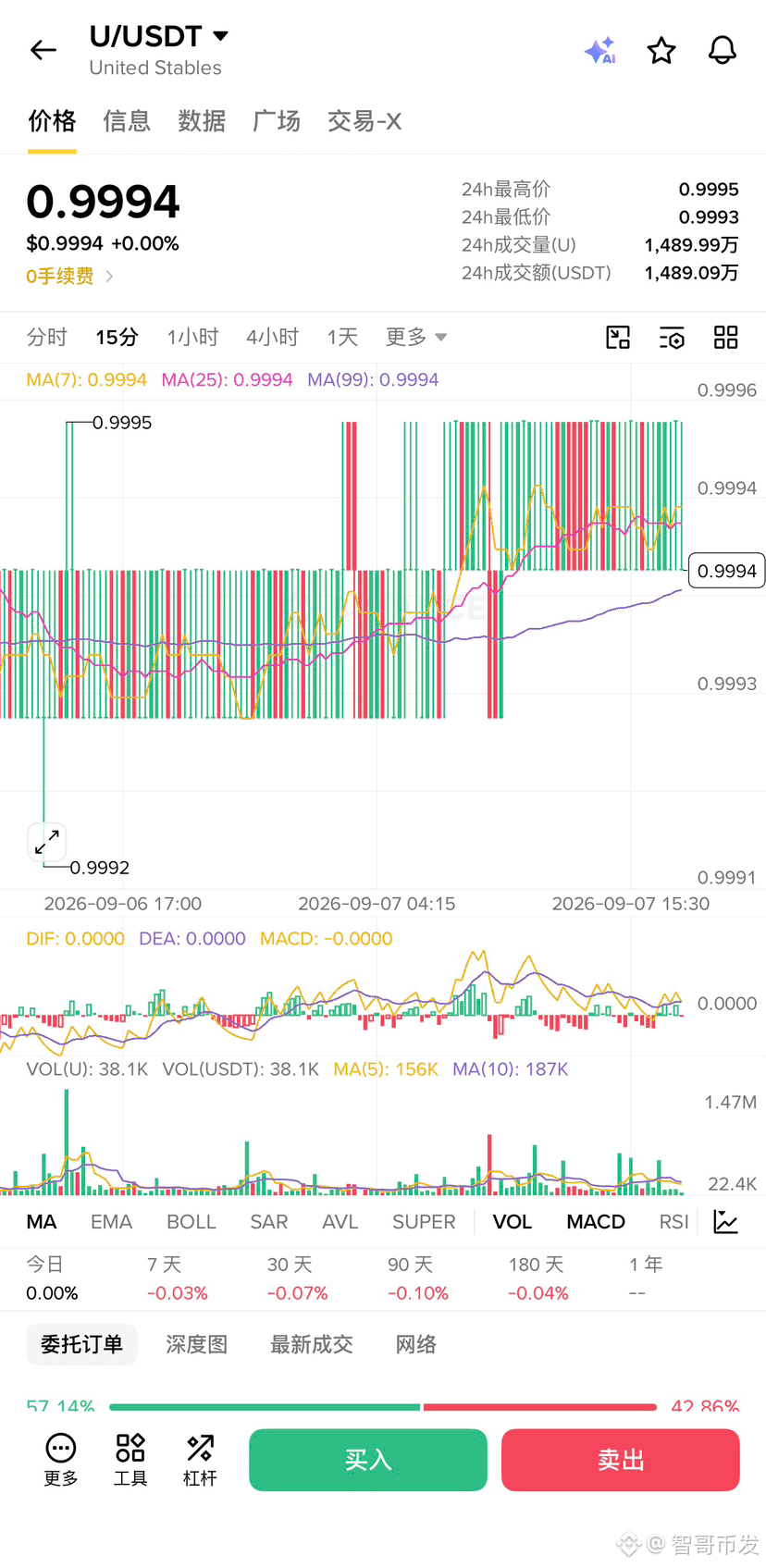
Is U/USDT stable? Can I buy it for wealth management?
Is U/USDT stable? Can I buy it for wealth management?
502
·
--
The dumbest method is actually the most profitable? This set of 'slow trading' logic is the key
The core of your system can actually be summarized in one sentence:
It's not about predicting, it's about executing.
When many people see 'making eight figures in six years', their first reaction is that the method is impressive,
but the truly difficult part has never been the method, but whether one can consistently follow the same set of rules.
If you break down your logic, it’s actually very clear:
First, filter
Only look at the daily level, combined with MACD golden cross, waiting for signs that the trend is starting to strengthen.
Then, confirm
The price stands above the daily moving average, and the volume is in sync, essentially confirming that 'it’s not a false rebound'.
Then execute
Once the conditions are met, jump in without hesitation.
Lastly, the key
Take profits in batches + exit when the rules are broken.
What’s truly valuable here isn’t the indicators, but two points:
First, you don’t chase highs.
You only look for opportunities after a continuous decline, essentially going against human nature.
Second, you have an exit mechanism.
Sell in batches when it rises, exit directly when it falls, don’t give yourself any room for fantasy.
But I have to remind you of a very realistic issue:
When you say 'almost every time you can make a profit', if this sentence is taken literally, most people will get into trouble.
Because this method has a prerequisite:
👉 It must be in a market cycle with overall liquidity and a rebound structure.
Once entering a one-sided decline or a liquidity drought phase:
• MACD golden cross will become ineffective.
• Daily moving average will frequently show false breakouts.
• A 7-day decline will become the 'beginning of continued decline'.
In other words, this is not a 'sure profit method', but rather:
A disciplined system with a higher win rate during specific cycles.
$BTC
{future}(BTCUSDT)
The dumbest method is actually the most profitable? This set of 'slow trading' logic is the key
The core of your system can actually be summarized in one sentence:
It's not about predicting, it's about executing.
When many people see 'making eight figures in six years', their first reaction is that the method is impressive,
but the truly difficult part has never been the method, but whether one can consistently follow the same set of rules.
If you break down your logic, it’s actually very clear:
First, filter
Only look at the daily level, combined with MACD golden cross, waiting for signs that the trend is starting to strengthen.
Then, confirm
The price stands above the daily moving average, and the volume is in sync, essentially confirming that 'it’s not a false rebound'.
Then execute
Once the conditions are met, jump in without hesitation.
Lastly, the key
Take profits in batches + exit when the rules are broken.
What’s truly valuable here isn’t the indicators, but two points:
First, you don’t chase highs.
You only look for opportunities after a continuous decline, essentially going against human nature.
Second, you have an exit mechanism.
Sell in batches when it rises, exit directly when it falls, don’t give yourself any room for fantasy.
But I have to remind you of a very realistic issue:
When you say 'almost every time you can make a profit', if this sentence is taken literally, most people will get into trouble.
Because this method has a prerequisite:
👉 It must be in a market cycle with overall liquidity and a rebound structure.
Once entering a one-sided decline or a liquidity drought phase:
• MACD golden cross will become ineffective.
• Daily moving average will frequently show false breakouts.
• A 7-day decline will become the 'beginning of continued decline'.
In other words, this is not a 'sure profit method', but rather:
A disciplined system with a higher win rate during specific cycles.
$BTC
179
·
--
Can Microsoft, Broadcom, and Alibaba use USDT for contracts? Do you really understand this wave of 'on-chain'?
If this matter is implemented, the focus is not on 'adding a few more targets', but on - the trading boundaries have been opened up.
Directly trading the price fluctuations of traditional tech giants with USDT essentially does one thing:
👉 Move traditional assets into the rhythm of the crypto market.
What does this mean?
First, trading time is extended.
No longer restricted by U.S. stock market opening hours, funds can compete on emotions and expectations 24 hours a day.
Second, leverage and liquidity play migrate.
The familiar U-based contract mechanism is tied to targets like Microsoft, Broadcom, and Alibaba,
fluctuations are no longer just 'fundamentally driven', but will also be amplified by sentiment in the crypto circle.
Third, funds start to arbitrage across markets.
The same asset is priced in two markets:
One on traditional exchanges, one on crypto platforms.
As long as there is a price difference, funds will come in to arbitrage.
But don't just look at opportunities; risks are more crucial:
The most likely scenario for such products is -
👉 Price decoupling + Sentiment amplification + Leverage liquidation
Especially at major news nodes,
the amplification effect in the crypto circle may cause fluctuations to far exceed the 'stock logic' you are familiar with.
So this set of things is essentially not 'easier to make money',
but rather - a more efficient gaming tool.
If you ask whether you should play, the answer is simple:
If you are doing short-term trading, understand contracts, and have discipline
👉 It can be seen as a new battlefield.
If you prefer stability and are used to stock rhythms
👉 You can easily be overwhelmed by the volatility rhythm of the crypto circle.
In summary:
This does not make stocks simpler; rather, it turns stocks into 'faster crypto'. $BTC
{future}(BTCUSDT)
Can Microsoft, Broadcom, and Alibaba use USDT for contracts? Do you really understand this wave of 'on-chain'?
If this matter is implemented, the focus is not on 'adding a few more targets', but on - the trading boundaries have been opened up.
Directly trading the price fluctuations of traditional tech giants with USDT essentially does one thing:
👉 Move traditional assets into the rhythm of the crypto market.
What does this mean?
First, trading time is extended.
No longer restricted by U.S. stock market opening hours, funds can compete on emotions and expectations 24 hours a day.
Second, leverage and liquidity play migrate.
The familiar U-based contract mechanism is tied to targets like Microsoft, Broadcom, and Alibaba,
fluctuations are no longer just 'fundamentally driven', but will also be amplified by sentiment in the crypto circle.
Third, funds start to arbitrage across markets.
The same asset is priced in two markets:
One on traditional exchanges, one on crypto platforms.
As long as there is a price difference, funds will come in to arbitrage.
But don't just look at opportunities; risks are more crucial:
The most likely scenario for such products is -
👉 Price decoupling + Sentiment amplification + Leverage liquidation
Especially at major news nodes,
the amplification effect in the crypto circle may cause fluctuations to far exceed the 'stock logic' you are familiar with.
So this set of things is essentially not 'easier to make money',
but rather - a more efficient gaming tool.
If you ask whether you should play, the answer is simple:
If you are doing short-term trading, understand contracts, and have discipline
👉 It can be seen as a new battlefield.
If you prefer stability and are used to stock rhythms
👉 You can easily be overwhelmed by the volatility rhythm of the crypto circle.
In summary:
This does not make stocks simpler; rather, it turns stocks into 'faster crypto'. $BTC
164
·
--
Are you still shorting $BTC? The question isn't whether you can win, it's whether you can survive until the other side.
Let me be straightforward about your current mindset:
In this phase, stubbornly shorting isn't about judgment, it's about survival.
The current structure of BTC isn't a one-sided decline, but rather
👉 a strong consolidation with the potential for a rapid upward surge at any moment.
What is most likely to happen in this market?
It's that short positions get "lifted" in segments.
You might tolerate one or two pullbacks,
but as long as you don't cut losses in time,
a single surge is enough to wipe out all previous profits.
The current issue isn't about "can it drop",
but rather— the space for a drop and the risk of a rise are completely unbalanced.
Downward, it might be consolidation or a pullback;
but upward, once it breaks through, it's an acceleration phase driven by emotion and capital resonance.
When you ask "can I reach the other side",
it's essentially asking:
👉 Can I hold on until the market moves as I expect?
The answer is very realistic:
The market won't cater to anyone's obsession.
If you must short, you can, but you need to be clear:
This is a game of chance, not following the trend.
Here's the most important reminder:
Make money with the trend, survive against the trend; stubbornness will only lead to being educated by the market. $BTC
Are you still shorting $BTC ? The question isn't whether you can win, it's whether you can survive until the other side.
Let me be straightforward about your current mindset:
In this phase, stubbornly shorting isn't about judgment, it's about survival.
The current structure of BTC isn't a one-sided decline, but rather
👉 a strong consolidation with the potential for a rapid upward surge at any moment.
What is most likely to happen in this market?
It's that short positions get "lifted" in segments.
You might tolerate one or two pullbacks,
but as long as you don't cut losses in time,
a single surge is enough to wipe out all previous profits.
The current issue isn't about "can it drop",
but rather— the space for a drop and the risk of a rise are completely unbalanced.
Downward, it might be consolidation or a pullback;
but upward, once it breaks through, it's an acceleration phase driven by emotion and capital resonance.
When you ask "can I reach the other side",
it's essentially asking:
👉 Can I hold on until the market moves as I expect?
The answer is very realistic:
The market won't cater to anyone's obsession.
If you must short, you can, but you need to be clear:
This is a game of chance, not following the trend.
Here's the most important reminder:
Make money with the trend, survive against the trend; stubbornness will only lead to being educated by the market. $BTC
350
·
--
Chip on the chain = are we going to continue to pull? Don't just look at the surface this time, the key is how to exit
$Binance Life
Your judgment is partially correct, but the conclusion is a bit too optimistic.
The big player moving coins onto the chain usually indicates a preparatory action, but this action doesn't necessarily mean 'continuing to pull'; it could also mean — exiting more flexibly.
Many people might think:
The on-chain liquidity is poor, the pool is only a few million, while the big player has over 80 million chips, so it definitely can't be dumped, hence it can only continue to pull.
But the reality is, big players never 'dump all at once'.
They are better at:
Pulling while exiting, releasing in batches, using volatility to exchange for liquidity.
You are right that everyone is watching this batch of chips,
but also because everyone is watching —
once there is a sudden movement, it is easier to trigger a panic sell-off.
The key point is not 'can it exit' but 'how to exit'.
At this stage, it feels more like:
There is still space, but it's not clean.
There might be a continued pull for a while, creating higher expectations,
but each rise is essentially preparing for subsequent liquidity.
So the strategy is simple:
It's not about blindly holding on, nor is it about immediately turning bearish,
but — holding while observing the rhythm, and taking profits in batches during the rise.
In summary:
The market may not be over, but the big player is already thinking 'how to go', and you should also start thinking 'when to go'. $币安人生
{future}(币安人生USDT)
Chip on the chain = are we going to continue to pull? Don't just look at the surface this time, the key is how to exit
$Binance Life
Your judgment is partially correct, but the conclusion is a bit too optimistic.
The big player moving coins onto the chain usually indicates a preparatory action, but this action doesn't necessarily mean 'continuing to pull'; it could also mean — exiting more flexibly.
Many people might think:
The on-chain liquidity is poor, the pool is only a few million, while the big player has over 80 million chips, so it definitely can't be dumped, hence it can only continue to pull.
But the reality is, big players never 'dump all at once'.
They are better at:
Pulling while exiting, releasing in batches, using volatility to exchange for liquidity.
You are right that everyone is watching this batch of chips,
but also because everyone is watching —
once there is a sudden movement, it is easier to trigger a panic sell-off.
The key point is not 'can it exit' but 'how to exit'.
At this stage, it feels more like:
There is still space, but it's not clean.
There might be a continued pull for a while, creating higher expectations,
but each rise is essentially preparing for subsequent liquidity.
So the strategy is simple:
It's not about blindly holding on, nor is it about immediately turning bearish,
but — holding while observing the rhythm, and taking profits in batches during the rise.
In summary:
The market may not be over, but the big player is already thinking 'how to go', and you should also start thinking 'when to go'. $币安人生
978
·
--
74K is just the starting point? BTC's rebound this time hinges on how to navigate this crucial step
Your judgment this time is actually not off, but let me give you a more direct conclusion:
Now is not the time to "blindly wait for 80K," but rather we are in a "critical choice zone."
The rebound from 71K to 74K+ essentially consists of two overlapping factors:
First, the easing of geopolitical risks and emotional recovery;
Second, ETF funds have not withdrawn, providing support at the bottom.
But the issue is—at the 74K-75K level, this is not just ordinary resistance, but a zone of concentrated positions.
What will happen here?
Either there will be a direct surge breaking through, market sentiment aligns, and bulls accelerate;
Or there will be repeated fluctuations to wash out those chasing highs, and then decide on the direction.
The points you mentioned are correct:
The ETF is still attracting capital, indicating that large funds have not left;
The funding rate is relatively weak, which is indeed beneficial for subsequent increases;
But what really matters is not these, but rather—
Whether there is "volume" during the breakout, and whether there is continuity.
So a more realistic strategy now is:
If you are holding spot positions
You can continue to hold, but do not blindly increase your position; wait for confirmation of a breakout before acting.
If you are short-term trading
This position is more suitable for "waiting for a pullback," rather than chasing highs.
If you want to increase your position
Just focus on two levels:
Can 73.5K hold steady?
Can 75.3K break out with volume?
In short, now is not the time to test faith, but to execute.
In summary:
Breakthrough is the market trend; until there is a breakthrough, everything is just fluctuation.
275
·
--
1500U to 120,000U: It's not luck; it's following the "risk control iron rules"
Six months ago, I brought a "gifted" novice.
She entered with 1500U, didn't understand candlesticks, didn't watch news, and couldn't clearly explain long or short logic.
But two months later, she reached 48,000U,
now her account is securely locked at 120,000U+, and—throughout the process, zero liquidation.
Many people's first reaction is: good luck.
But I can clearly say—
luck can at most let you win once or twice, it absolutely cannot allow you to survive continuously.
What truly helped her succeed were not skills, but three things:
First, never fully invest.
Even in a certain market, only use a portion of funds to test, always leave yourself an exit route.
Second, admit mistakes immediately.
Do not hold onto losing positions, do not fantasize, do not give the market a second chance to harm you.
Third, lock in a portion of profits first.
Profit is not just a number on paper; cashing out is what truly belongs to you.
She is not smart, but she is obedient.
And in this market, those who "obediently follow the rules" often go further than those who "think they are smart."
I went from 4300U all the way to 8 digits, and it wasn't through miraculous operations,
it was this seemingly simple yet rarely adhered to risk control system.
Simply put:
The cryptocurrency world is not about who makes money faster, but about who survives longer.
304
·
--
From 0.73 to 0.09, a drop of 87%: shouting "to the moon", yet back to the ground
$DOGE
Peak at 0.7376 dollars, now only 0.09 dollars,
a back and forth, directly dropping 87%.
This round of trend is actually very typical:
When emotions peak, everyone shouts "to the moon";
and when the heat fades, the price begins to return to reality.
Elon Musk has been constantly mentioning DOGE this year, even coming up with a "Department of Government Efficiency" (DOGE) joke, which once ignited the market's emotions.
But the problem is — emotions can drive prices, but cannot sustain them.
Every shout for buying brings a wave of short-term fluctuations,
but when the funds no longer continue to relay, the trend has only one result: a decline.
You will notice a very realistic rule:
It’s lively when shouting, but quiet when falling.
DOGE has never been a coin driven by fundamentals,
it relies on emotions, heat, and consensus.
And emotions come quickly, and leave even faster.
To put it bluntly:
Shouting for buying can give you hope, but what determines your profit and loss is your entry position. $DOGE
{future}(DOGEUSDT)
From 0.73 to 0.09, a drop of 87%: shouting "to the moon", yet back to the ground
$DOGE
Peak at 0.7376 dollars, now only 0.09 dollars,
a back and forth, directly dropping 87%.
This round of trend is actually very typical:
When emotions peak, everyone shouts "to the moon";
and when the heat fades, the price begins to return to reality.
Elon Musk has been constantly mentioning DOGE this year, even coming up with a "Department of Government Efficiency" (DOGE) joke, which once ignited the market's emotions.
But the problem is — emotions can drive prices, but cannot sustain them.
Every shout for buying brings a wave of short-term fluctuations,
but when the funds no longer continue to relay, the trend has only one result: a decline.
You will notice a very realistic rule:
It’s lively when shouting, but quiet when falling.
DOGE has never been a coin driven by fundamentals,
it relies on emotions, heat, and consensus.
And emotions come quickly, and leave even faster.
To put it bluntly:
Shouting for buying can give you hope, but what determines your profit and loss is your entry position. $DOGE
856
·
--
95% Position Exposure: This wave is not about pumping, it's about teaching you how to take over the position
$Binance Life
First, let's look at the on-chain data, 🐶 The whale's holdings have already dropped to 95.46%.
What does it mean? It's simple—most of the goods have already been sold off.
At this point, if they give you another pump, do you think they are 'making you money', or are they looking for someone to take the last baton?
Many people only see the rise but do not see the changes in the chips behind it.
The real key is not whether it goes up or down, but—who is selling, and who is buying.
Those tokens that still have over 99% holdings are strongly controlled by the whales, and there is room to pump them up.
But at this position, the chips have already loosened, and further pumping seems more like the last segment of inducing buying to offload.
You think it's an opportunity, but it's actually a rhythm.
If the whale has already realized part of the profits,
what he really wants to do is not to continue raising the price, but—to sell the remaining goods to the most excited people.
To put it bluntly:
If they really want to pump, it's to offload; if you rush in, you're helping them complete the last step.
Think clearly about one thing:
🐶 The whale has already made money, why would he give you more money? $币安人生
{future}(币安人生USDT)
95% Position Exposure: This wave is not about pumping, it's about teaching you how to take over the position
$Binance Life
First, let's look at the on-chain data, 🐶 The whale's holdings have already dropped to 95.46%.
What does it mean? It's simple—most of the goods have already been sold off.
At this point, if they give you another pump, do you think they are 'making you money', or are they looking for someone to take the last baton?
Many people only see the rise but do not see the changes in the chips behind it.
The real key is not whether it goes up or down, but—who is selling, and who is buying.
Those tokens that still have over 99% holdings are strongly controlled by the whales, and there is room to pump them up.
But at this position, the chips have already loosened, and further pumping seems more like the last segment of inducing buying to offload.
You think it's an opportunity, but it's actually a rhythm.
If the whale has already realized part of the profits,
what he really wants to do is not to continue raising the price, but—to sell the remaining goods to the most excited people.
To put it bluntly:
If they really want to pump, it's to offload; if you rush in, you're helping them complete the last step.
Think clearly about one thing:
🐶 The whale has already made money, why would he give you more money? $币安人生
3
2
1.7k
·
--
Tonight at 9 PM, the big show is coming: for those who don't understand, are still shorting
$Binance Life
It was already made very clear at noon —
buying on dips, there will be movement tonight.
Looking back now, is the market already giving answers?
Some people are still stubbornly shorting, talking tough,
but the market won't care about your feelings, it only speaks direction.
Tonight at 9 PM, CZ's live broadcast itself is a strong signal.
At this level of nodes, along with the capital rhythm, it is very normal to create a wave of sentiment.
You may not believe it, but the market funds will tell you the answer with candlesticks.
The most crucial point now is:
the accumulation hasn't ended, the rhythm is still there.
When it really takes off,
chasing after will not be an 'opportunity,' but 'picking up the tab.'
Many people don't not understand, they just don't want to admit they were wrong.
In a word:
the position is still there, the rhythm is still there, and the direction has already been given.
What's left is to see if you dare to get on board.
3
2
781
·
--
From 3000 to 7 figures: The true trajectory of an ordinary worker who changed his fate on Binance
At first, he was just an ordinary guy.
His salary was barely enough for living, and by the end of the month, he was basically out of money, repeating the daily routine of working, commuting, and scrolling through his phone.
Later, he heard a friend mention the cryptocurrency circle and casually downloaded Binance.
At that time, he couldn't even understand the candlestick charts; he only knew: if it went up, he was happy, and if it went down, he was anxious.
The result was quite real—
In one month, his account went from 10,000 down to only 3,000.
That night, he stared at his phone in a daze for a long time.
He had thought about giving up, but he was unwilling to.
After that, he changed.
He stopped chasing prices blindly, no longer acted impulsively based on group messages, and started to look at $BTC 's cycles, studying why it went up and why it went down.
While others were coming in and out every day, he became increasingly “slow.”
He bought slowly, waited patiently, and sometimes didn’t make a move for a week or two.
Until that round of market started.
At first, no one believed it; the market was still hesitating, but he had already quietly filled his positions.
When $BTC started climbing with candlestick after candlestick, his account began to skyrocket.
30,000, 50,000, 100,000…
For the first time, he realized:
Money could actually grow at this speed.
During that time, almost every day, the first thing he did after waking up was to check his account.
The numbers kept refreshing, yet he became increasingly calm.
When the people around him started frantically asking “Can we still buy?”
He was already reducing his positions while smiling at the market.
Eventually, he grew his account to seven figures.
Many people thought he was just lucky.
But only he knew—
He wasn’t the one who rushed in during the most frenzied times,
but rather the one who didn’t leave during the most desperate times.
The cruelest thing about the cryptocurrency circle is:
You think you are battling with the market,
but in reality, you are gambling with “your own emotions.”
And he won by not exiting early.
179
·
--
He was originally just an ordinary office worker, working from nine to six every day, with not a high salary and a life without much turbulence.
By chance, he downloaded Binance, just wanting to see "what the crypto world that everyone is talking about really is."
At first, he also suffered losses.
Chasing prices, panic selling, being repeatedly educated by the market, and at one point his account only had a few thousand.
But he didn't leave the market.
He began to seriously study the cycle of $BTC , paying attention to macro trends, observing capital flow, and gradually stopped making frequent trades, instead learning to wait. While others were busy trading back and forth in the short term, he began to do just one thing—buying in batches when the market was panicking.
The real turning point was when that round of market activity started.
$BTC broke through a key position, and market sentiment changed from doubt to frenzy, causing the positions in his hands to continuously expand.
That year, he was the first to break the six-figure mark in his account.
Later, it was seven figures.
People around him were still asking, "Can we still get in?" He was already considering exiting part of his position to lock in profits.
Many people thought he was just lucky.
But only he knows—
It wasn't because he seized every opportunity,
but because he stayed in the market when others couldn't hold on.
The crypto world is never short of stories of getting rich quickly,
what it lacks is those who can survive until the end.
229
·
--
$BTC
Ridiculous, this 'pension whale' operation really dares.
Using pension users' money to short $BTC and $ETH, the result was a loss of 6 million dollars.
The market has never been merciful because of the nature of money,
Whether you are a retail investor or an institution, betting long-term money on short-term directions is essentially running naked.
Walking by the river often, how can you not get your shoes wet,
but the crypto circle is even harsher—once you're wet, it's basically a direct take away.
381
·
--
$BTC The current situation, like you said, "monkey market", is essentially high volatility, low trend, and frequent harvesting. You will feel like you are jumping up and down, with no continuity; just when you look bullish, it drops, and just when you look bearish, it rises. Many times, even the technical aspects start to fail.
This does not mean that liquidity is gone, but rather that liquidity has been taken by smarter money. The market is now dominated not by retail sentiment, but by institutions, market makers, and quantitative funds. Their core focus is not to pump the market, but to create volatility, using back-and-forth fluctuations to eat away at sentiment and leverage.
Moreover, with too many contracts and high leverage now, there are large stop-loss and liquidation positions on both sides, so what you see in the market is essentially a machine of mutual destruction for both bulls and bears.
Another critical point is that the big trend has not ended, but we have entered a short-term consolidation phase. This phase is often the hardest to navigate, as there is no clear direction and the volatility is particularly high, specifically designed to wash out those without patience.
When you say, "you can only find targets for long-term holding", this thought is actually correct, but you need to pay attention to the method. Don’t go all in at once, but rather allocate in batches, leaving room to cope with volatility, while trying to choose assets with certain logic.
To put it more directly, the market is not denying opportunities, but rather denying opportunities to those who are eager to make money. If you have already started to feel uncomfortable and frequently face setbacks, then you are likely in a position that is easiest to be harvested.
156
·
--
$BTC After two weeks of ceasefire + reopening of the Strait of Hormuz, the real signal has arrived: BTC is about to move
Many people in the market are still hesitating, but the key signals have already appeared.
A two-week ceasefire and a two-week reopening of the Strait of Hormuz is not a coincidence, but a clear signal of "risk release."
What has been the core variable weighing on the market during the past period?
It is not the technical aspect, nor single capital, but rather—liquidity suppression caused by geopolitical risks.
Once the conflict eases, shipping resumes, and energy channels reopen, what does it mean?
👉 The "black swan" that the market is most worried about is being removed.
What capital fears the most is not bad news, but uncertainty.
Now that the two-week window is given, it essentially tells the market:
In the short term, there will be no further deterioration.
At this point, capital will do one thing:
Reprice risk assets.
And among all risk assets, Bitcoin's reaction is often the fastest.
Why?
• It is one of the most sensitive assets to global liquidity
• No geographical restrictions, with the highest efficiency in capital inflow and outflow
• During the emotional recovery phase, it is easiest to form a "rush to run" market
In other words:
When panic recedes, BTC often raises its head first.
Many people are still waiting for "complete certainty,"
But the market never rises only after certainty.
The real opportunity always appears when:
Risks have just eased, but most people still do not dare to believe it.
{spot}(BTCUSDT)
$BTC After two weeks of ceasefire + reopening of the Strait of Hormuz, the real signal has arrived: BTC is about to move
Many people in the market are still hesitating, but the key signals have already appeared.
A two-week ceasefire and a two-week reopening of the Strait of Hormuz is not a coincidence, but a clear signal of "risk release."
What has been the core variable weighing on the market during the past period?
It is not the technical aspect, nor single capital, but rather—liquidity suppression caused by geopolitical risks.
Once the conflict eases, shipping resumes, and energy channels reopen, what does it mean?
👉 The "black swan" that the market is most worried about is being removed.
What capital fears the most is not bad news, but uncertainty.
Now that the two-week window is given, it essentially tells the market:
In the short term, there will be no further deterioration.
At this point, capital will do one thing:
Reprice risk assets.
And among all risk assets, Bitcoin's reaction is often the fastest.
Why?
• It is one of the most sensitive assets to global liquidity
• No geographical restrictions, with the highest efficiency in capital inflow and outflow
• During the emotional recovery phase, it is easiest to form a "rush to run" market
In other words:
When panic recedes, BTC often raises its head first.
Many people are still waiting for "complete certainty,"
But the market never rises only after certainty.
The real opportunity always appears when:
Risks have just eased, but most people still do not dare to believe it.
206
·
--
Is the sleeping king about to wake up? Ethereum may usher in a true bull market!
While the market's spotlight remains on Bitcoin, the real "engine"—Ethereum, is quietly building momentum.
Recently, Ethereum's performance seems unremarkable, even labeled by many as "weaker than the market." But seasoned players understand that ETH has never relied on emotional outbursts; it is driven by structural trends. Once it starts, it often leads to not just small rises, but sustained bull runs.
On-chain data has already released unusual signals: the number of staked ETH continues to hit new highs, and the circulating supply is continually locked up; Layer 2 ecosystem activity is soaring, and funds and users are flowing back in. To put it simply—there are fewer and fewer "sellable chips" in the market.
More critically, Ethereum's narrative is upgrading. From DeFi to NFTs, and now to the integration of AI and blockchain, it has always been at the center of the storm. This means that as market sentiment warms up, ETH is very likely to become the core battlefield for capital's second assault.
Do not overlook a pattern: in every bull market, Bitcoin opens the space, but Ethereum is the one that truly determines the height.
The current sideways movement is not weakness, but suppression. Once it breaks through key ranges, sidelined funds will rush in, and the market may enter "acceleration mode," even leading to extreme upward trends.
However, opportunities often come with divergence. While most are still doubting whether ETH "can rise again," the real trend may already be on its way.
In the next round of the market,
will you continue to focus on the leading assets that have already risen,
or will you preemptively position yourself in this "core that hasn't fully exploded yet"? $ETH
{future}(ETHUSDT)
Is the sleeping king about to wake up? Ethereum may usher in a true bull market!
While the market's spotlight remains on Bitcoin, the real "engine"—Ethereum, is quietly building momentum.
Recently, Ethereum's performance seems unremarkable, even labeled by many as "weaker than the market." But seasoned players understand that ETH has never relied on emotional outbursts; it is driven by structural trends. Once it starts, it often leads to not just small rises, but sustained bull runs.
On-chain data has already released unusual signals: the number of staked ETH continues to hit new highs, and the circulating supply is continually locked up; Layer 2 ecosystem activity is soaring, and funds and users are flowing back in. To put it simply—there are fewer and fewer "sellable chips" in the market.
More critically, Ethereum's narrative is upgrading. From DeFi to NFTs, and now to the integration of AI and blockchain, it has always been at the center of the storm. This means that as market sentiment warms up, ETH is very likely to become the core battlefield for capital's second assault.
Do not overlook a pattern: in every bull market, Bitcoin opens the space, but Ethereum is the one that truly determines the height.
The current sideways movement is not weakness, but suppression. Once it breaks through key ranges, sidelined funds will rush in, and the market may enter "acceleration mode," even leading to extreme upward trends.
However, opportunities often come with divergence. While most are still doubting whether ETH "can rise again," the real trend may already be on its way.
In the next round of the market,
will you continue to focus on the leading assets that have already risen,
or will you preemptively position yourself in this "core that hasn't fully exploded yet"? $ETH
159
·
--
"Has Musk stopped making calls? Dogecoin is brewing a bigger storm!"
When everyone is laughing at Dogecoin as just a "joke coin," it often slaps the market in the face with the most extreme market conditions.
Recently, Dogecoin appears to be in a "weak oscillation," even experiencing continuous pullbacks and increased liquidations, but this is precisely a dangerous signal — it’s not done falling, but rather someone is "controlling the rhythm." Data shows that recently DOGE bulls have been massively liquidated, and market sentiment has clearly turned bearish. Historical experience tells you: when most people start to look bearish, the market often moves in the opposite direction.
More importantly, Dogecoin has never risen based on "fundamentals," but rather on three things: sentiment, hot topics, and key figures. In the past, a single tweet from Elon Musk could cause it to surge instantly. Now the question is — while everyone is waiting for him to speak, the real money has already started to position itself in advance.
Another overlooked signal is: institutions are quietly "cleaning up" Dogecoin. From fund products to ETF attempts, it is transitioning from a "meme coin" to a "mainstream speculative asset." What does this mean? It means that once the sentiment ignites, its upward potential will no longer be limited to retail investors, but may be driven by larger funds.
But you must be clear about one point — Dogecoin has no supply cap and lacks real application support, making it inherently possess the double-edged sword attribute of "surging can also lead to crashing."
In simple terms:
It may not rise steadily, but once it starts, it is often the most insane one.
In the next wave of market, Dogecoin will not notify you in advance —
By the time you see it trending, it may have already risen halfway. $DOGE
{future}(DOGEUSDT)
"Has Musk stopped making calls? Dogecoin is brewing a bigger storm!"
When everyone is laughing at Dogecoin as just a "joke coin," it often slaps the market in the face with the most extreme market conditions.
Recently, Dogecoin appears to be in a "weak oscillation," even experiencing continuous pullbacks and increased liquidations, but this is precisely a dangerous signal — it’s not done falling, but rather someone is "controlling the rhythm." Data shows that recently DOGE bulls have been massively liquidated, and market sentiment has clearly turned bearish. Historical experience tells you: when most people start to look bearish, the market often moves in the opposite direction.
More importantly, Dogecoin has never risen based on "fundamentals," but rather on three things: sentiment, hot topics, and key figures. In the past, a single tweet from Elon Musk could cause it to surge instantly. Now the question is — while everyone is waiting for him to speak, the real money has already started to position itself in advance.
Another overlooked signal is: institutions are quietly "cleaning up" Dogecoin. From fund products to ETF attempts, it is transitioning from a "meme coin" to a "mainstream speculative asset." What does this mean? It means that once the sentiment ignites, its upward potential will no longer be limited to retail investors, but may be driven by larger funds.
But you must be clear about one point — Dogecoin has no supply cap and lacks real application support, making it inherently possess the double-edged sword attribute of "surging can also lead to crashing."
In simple terms:
It may not rise steadily, but once it starts, it is often the most insane one.
In the next wave of market, Dogecoin will not notify you in advance —
By the time you see it trending, it may have already risen halfway. $DOGE
944
Log in to explore more content
Join global crypto users on Binance Square
⚡️ Get latest and useful information about crypto.
💬 Trusted by the world’s largest crypto exchange.
👍 Discover real insights from verified creators.
Email / Phone number
Trending Topics
HuangExitNvidiaStrategyInFocus
31,980 views
600 Discussing
STOCKS | Nvidia’s Jensen Huang Resigns, Colette Kress Named as Interim CEO
Binance News
·14 Likes
·17.9k views
AnthropicRejectsIPODelayValuationinQuestion
603,170 views
4,938 Discussing
BitMineReports$6.3BNetLossForFiscal2026
3,918 views
79 Discussing