
404_U
3.4k Posts

404_U
Report
Block User
热门话题分析 | 市场宏观分析 | 用我邀请码永久打折手续费,邀请码4040U自动反佣到自己账户。
20 Following
2.1K+ Followers
2.0K+ Liked
Posts
PINNED
·
--
Various ways to save trading fees!
Why do you need to bind an invitation code? It’s simple—save money long-term.
During registration, bind my invitation code ([4040U](https://www.bsmkweb.cc/register?ref=4040U)), and you can enjoy a permanent 20% fee discount
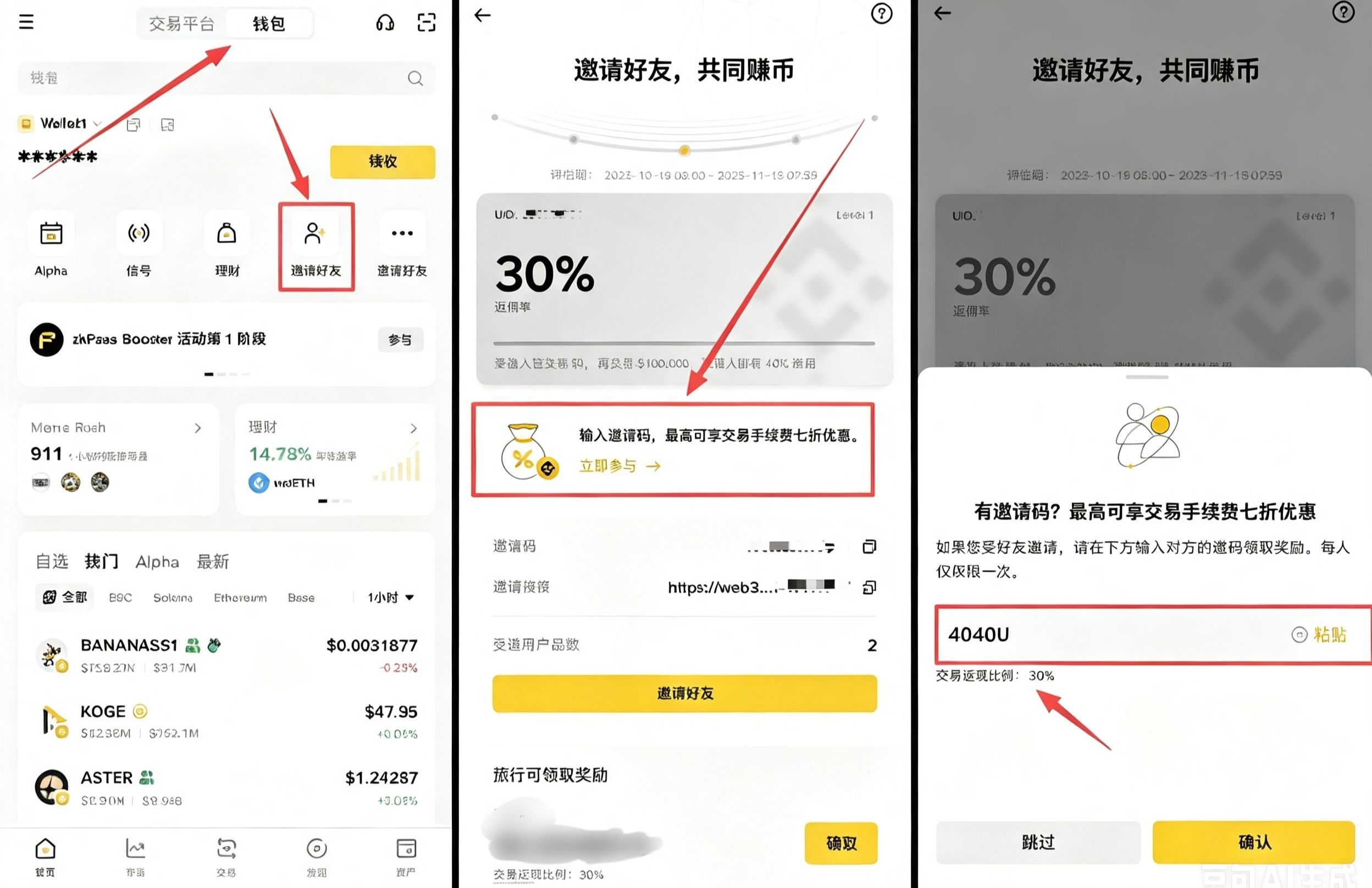
Binance Wallet invitation code: 4040U. After binding, you’ll get a 30% fee reduction, or [点击这里一键绑定](https://web3.binance.com/referral?ref=4040U)
Participating in Swap/cross-chain and other operations usually incurs platform service fees/routing fees and network fees
Enable cashback/rebates = get back part of the fees you would have paid. The more you use it, the more you save
Various ways to save trading fees!
Why do you need to bind an invitation code? It’s simple—save money long-term.
During registration, bind my invitation code (4040U), and you can enjoy a permanent 20% fee discount
Binance Wallet invitation code: 4040U. After binding, you’ll get a 30% fee reduction, or 点击这里一键绑定
Participating in Swap/cross-chain and other operations usually incurs platform service fees/routing fees and network fees
Enable cashback/rebates = get back part of the fees you would have paid. The more you use it, the more you save
Why do you need to bind an invitation code? It’s simple—save money long-term.
During registration, bind my invitation code (4040U), and you can enjoy a permanent 20% fee discount
Binance Wallet invitation code: 4040U. After binding, you’ll get a 30% fee reduction, or 点击这里一键绑定
Participating in Swap/cross-chain and other operations usually incurs platform service fees/routing fees and network fees
Enable cashback/rebates = get back part of the fees you would have paid. The more you use it, the more you save
2.2k
7
75
2.2k
·
--
Partly True
#美国中期选举落幕,美伊局势或迎新变数 2026年11月3日美国中期选举投票结束,11月4日前后媒体确认民主党重夺参众两院,美伊局势随即进入“选举后窗口期”。
成因有两条:一是选民用选票惩罚高油价与伊朗战事,共和党因冲突推升能源价格、生活成本承压而失利;二是新国会要到2027年1月3日才履职,白宫在过渡期仍握有军事与外交主动权,但后续拨款、战争授权将被国会制衡。当前分歧卡在制裁解除顺序、高浓铀处置与霍尔木兹通航,谈判有信号但未落地。
盘面看,11月5日WTI(CL)报86.93美元/桶、布伦特(BZ)报93.81美元/桶,地缘溢价快速回吐。 短期:边打边谈、油轮触雷与有限打击风险仍在,CL/BZ 震荡偏空但回撤有底线——短线📉。中期:国会制衡压低升级概率,霍尔木兹若恢复通航,战争溢价继续出清,CL/BZ 中期📉。联动上,天然气(NG)随供应风险回落偏📉,黄金(GC)受实际利率与避险拉扯,中期📈。
谈判破裂或有限军事打击重现,油价可快速反弹;以上为事件驱动判断,非投资建议。
$CL
{future}(CLUSDT)
$BZ
{future}(BZUSDT)
#美国中期选举落幕,美伊局势或迎新变数 2026年11月3日美国中期选举投票结束,11月4日前后媒体确认民主党重夺参众两院,美伊局势随即进入“选举后窗口期”。
成因有两条:一是选民用选票惩罚高油价与伊朗战事,共和党因冲突推升能源价格、生活成本承压而失利;二是新国会要到2027年1月3日才履职,白宫在过渡期仍握有军事与外交主动权,但后续拨款、战争授权将被国会制衡。当前分歧卡在制裁解除顺序、高浓铀处置与霍尔木兹通航,谈判有信号但未落地。
盘面看,11月5日WTI(CL)报86.93美元/桶、布伦特(BZ)报93.81美元/桶,地缘溢价快速回吐。 短期:边打边谈、油轮触雷与有限打击风险仍在,CL/BZ 震荡偏空但回撤有底线——短线📉。中期:国会制衡压低升级概率,霍尔木兹若恢复通航,战争溢价继续出清,CL/BZ 中期📉。联动上,天然气(NG)随供应风险回落偏📉,黄金(GC)受实际利率与避险拉扯,中期📈。
谈判破裂或有限军事打击重现,油价可快速反弹;以上为事件驱动判断,非投资建议。
$CL
$BZ
成因有两条:一是选民用选票惩罚高油价与伊朗战事,共和党因冲突推升能源价格、生活成本承压而失利;二是新国会要到2027年1月3日才履职,白宫在过渡期仍握有军事与外交主动权,但后续拨款、战争授权将被国会制衡。当前分歧卡在制裁解除顺序、高浓铀处置与霍尔木兹通航,谈判有信号但未落地。
盘面看,11月5日WTI(CL)报86.93美元/桶、布伦特(BZ)报93.81美元/桶,地缘溢价快速回吐。 短期:边打边谈、油轮触雷与有限打击风险仍在,CL/BZ 震荡偏空但回撤有底线——短线📉。中期:国会制衡压低升级概率,霍尔木兹若恢复通航,战争溢价继续出清,CL/BZ 中期📉。联动上,天然气(NG)随供应风险回落偏📉,黄金(GC)受实际利率与避险拉扯,中期📈。
谈判破裂或有限军事打击重现,油价可快速反弹;以上为事件驱动判断,非投资建议。
$CL
$BZ
1
2.7k
·
--
Partly True
#原油价格跌破100美元 Crude oil broke above $100 from November 2–5, 2026. Signals from the U.S. and Iran that negotiations could take place, along with hopes that shipping through the Strait of Hormuz would resume, quickly squeezed out the geopolitical risk premium. On November 4, Brent (BZ) settled at $94.62 per barrel, while WTI (CL) fell to around $88. The cumulative weekly decline was nearly 20%, the largest weekly drop since 2020.
There were three main reasons:
Geopolitical tensions eased: A diplomatic window opened between the U.S. and Iran, and markets bet that the conflict would end sooner than expected, prompting a concentrated unwinding of the “war premium” that had pushed prices above $100;
Supply expectations improved: Expectations for resumed passage through the Strait of Hormuz recovered, and Saudi Arabia’s eastbound pipeline gradually restarted, easing the physical supply tightness at the margin;
A rush for the exits: Trend-following CTA funds cut their positions, with BZ long positions falling from 73% to 55%; technical factors amplified the decline.
But fundamentals are not loose—the global inventory is about 1 billion barrels below its pre-conflict level, diesel inventories are low, and OPEC+ is maintaining production cuts, limiting the room for a deep drop in oil prices.
Short term 📉: Until expectations for negotiations are disproved, CL may test support at $85, while BZ may test the $90 level;
Medium to long term 📈: Low inventories and recurring geopolitical tensions mean that if negotiations collapse, the premium will return, making it difficult for prices to remain below $90 for long.
Middle East news is highly market-sensitive; two-way daily swings can reach 5%+. Don’t chase shorts without protection.
$CL
{future}(CLUSDT)
$BZ
{future}(BZUSDT)
#原油价格跌破100美元 Crude oil broke above $100 from November 2–5, 2026. Signals from the U.S. and Iran that negotiations could take place, along with hopes that shipping through the Strait of Hormuz would resume, quickly squeezed out the geopolitical risk premium. On November 4, Brent (BZ) settled at $94.62 per barrel, while WTI (CL) fell to around $88. The cumulative weekly decline was nearly 20%, the largest weekly drop since 2020.
There were three main reasons:
Geopolitical tensions eased: A diplomatic window opened between the U.S. and Iran, and markets bet that the conflict would end sooner than expected, prompting a concentrated unwinding of the “war premium” that had pushed prices above $100;
Supply expectations improved: Expectations for resumed passage through the Strait of Hormuz recovered, and Saudi Arabia’s eastbound pipeline gradually restarted, easing the physical supply tightness at the margin;
A rush for the exits: Trend-following CTA funds cut their positions, with BZ long positions falling from 73% to 55%; technical factors amplified the decline.
But fundamentals are not loose—the global inventory is about 1 billion barrels below its pre-conflict level, diesel inventories are low, and OPEC+ is maintaining production cuts, limiting the room for a deep drop in oil prices.
Short term 📉: Until expectations for negotiations are disproved, CL may test support at $85, while BZ may test the $90 level;
Medium to long term 📈: Low inventories and recurring geopolitical tensions mean that if negotiations collapse, the premium will return, making it difficult for prices to remain below $90 for long.
Middle East news is highly market-sensitive; two-way daily swings can reach 5%+. Don’t chase shorts without protection.
$CL
$BZ
There were three main reasons:
Geopolitical tensions eased: A diplomatic window opened between the U.S. and Iran, and markets bet that the conflict would end sooner than expected, prompting a concentrated unwinding of the “war premium” that had pushed prices above $100;
Supply expectations improved: Expectations for resumed passage through the Strait of Hormuz recovered, and Saudi Arabia’s eastbound pipeline gradually restarted, easing the physical supply tightness at the margin;
A rush for the exits: Trend-following CTA funds cut their positions, with BZ long positions falling from 73% to 55%; technical factors amplified the decline.
But fundamentals are not loose—the global inventory is about 1 billion barrels below its pre-conflict level, diesel inventories are low, and OPEC+ is maintaining production cuts, limiting the room for a deep drop in oil prices.
Short term 📉: Until expectations for negotiations are disproved, CL may test support at $85, while BZ may test the $90 level;
Medium to long term 📈: Low inventories and recurring geopolitical tensions mean that if negotiations collapse, the premium will return, making it difficult for prices to remain below $90 for long.
Middle East news is highly market-sensitive; two-way daily swings can reach 5%+. Don’t chase shorts without protection.
$CL
$BZ
1.3k
·
--
#非农就业数据推升加息预期 Blowout nonfarm payrolls reignite rate hike bets, weighing on crypto in the short term
The event took place on November 6, 2026: the U.S. Bureau of Labor Statistics reported 165,000 new jobs in October, far exceeding market expectations of around 60,000–70,000. The unemployment rate fell to 4.1%, average hourly earnings rose 0.4% month over month, and figures for August and September were revised up by a combined 84,000. All three indicators came in hotter than expected, prompting traders to raise the probability of a 25-bp Fed rate hike in December from around 75% to 80%–85%. Two-year Treasury yields jumped, and the dollar strengthened.
Key drivers: The labor market has not cooled as expected, and sticky wages could feed into services inflation. Combined with demand-side inflationary pressure from AI investment, the Fed’s “fight inflation” stance has regained the upper hand, pushing rate-cut expectations decisively further out.
Short term 📉: Expectations of tighter liquidity directly weigh on risk assets. After the data was released, BTC fell below $76,000, losing nearly 5% on the day. More than 230,000 traders were liquidated across the market, while ETH and SOL also plunged.
Mid-term divergence: If the rate hike is implemented and inflation peaks, BTC and BNB, as highly liquid core assets, may be first to recover 📈; high-valuation altcoins such as XRP still need to shed excess froth 📉.
Bearish in the short term, structurally bullish in the long run—the broader crypto market is likely to remain weak until rate hike expectations have been fully priced in. Once the rate path becomes clearer, capital will flow back into leading assets.
Macroeconomic data can reverse quickly. Use caution with leveraged positions; volatility has risen sharply since the nonfarm payrolls report.
$BTC
{future}(BTCUSDT)
$ETH
{future}(ETHUSDT)
$SOL
{future}(SOLUSDT)
#非农就业数据推升加息预期 Blowout nonfarm payrolls reignite rate hike bets, weighing on crypto in the short term
The event took place on November 6, 2026: the U.S. Bureau of Labor Statistics reported 165,000 new jobs in October, far exceeding market expectations of around 60,000–70,000. The unemployment rate fell to 4.1%, average hourly earnings rose 0.4% month over month, and figures for August and September were revised up by a combined 84,000. All three indicators came in hotter than expected, prompting traders to raise the probability of a 25-bp Fed rate hike in December from around 75% to 80%–85%. Two-year Treasury yields jumped, and the dollar strengthened.
Key drivers: The labor market has not cooled as expected, and sticky wages could feed into services inflation. Combined with demand-side inflationary pressure from AI investment, the Fed’s “fight inflation” stance has regained the upper hand, pushing rate-cut expectations decisively further out.
Short term 📉: Expectations of tighter liquidity directly weigh on risk assets. After the data was released, BTC fell below $76,000, losing nearly 5% on the day. More than 230,000 traders were liquidated across the market, while ETH and SOL also plunged.
Mid-term divergence: If the rate hike is implemented and inflation peaks, BTC and BNB, as highly liquid core assets, may be first to recover 📈; high-valuation altcoins such as XRP still need to shed excess froth 📉.
Bearish in the short term, structurally bullish in the long run—the broader crypto market is likely to remain weak until rate hike expectations have been fully priced in. Once the rate path becomes clearer, capital will flow back into leading assets.
Macroeconomic data can reverse quickly. Use caution with leveraged positions; volatility has risen sharply since the nonfarm payrolls report.
$BTC
$ETH
$SOL
The event took place on November 6, 2026: the U.S. Bureau of Labor Statistics reported 165,000 new jobs in October, far exceeding market expectations of around 60,000–70,000. The unemployment rate fell to 4.1%, average hourly earnings rose 0.4% month over month, and figures for August and September were revised up by a combined 84,000. All three indicators came in hotter than expected, prompting traders to raise the probability of a 25-bp Fed rate hike in December from around 75% to 80%–85%. Two-year Treasury yields jumped, and the dollar strengthened.
Key drivers: The labor market has not cooled as expected, and sticky wages could feed into services inflation. Combined with demand-side inflationary pressure from AI investment, the Fed’s “fight inflation” stance has regained the upper hand, pushing rate-cut expectations decisively further out.
Short term 📉: Expectations of tighter liquidity directly weigh on risk assets. After the data was released, BTC fell below $76,000, losing nearly 5% on the day. More than 230,000 traders were liquidated across the market, while ETH and SOL also plunged.
Mid-term divergence: If the rate hike is implemented and inflation peaks, BTC and BNB, as highly liquid core assets, may be first to recover 📈; high-valuation altcoins such as XRP still need to shed excess froth 📉.
Bearish in the short term, structurally bullish in the long run—the broader crypto market is likely to remain weak until rate hike expectations have been fully priced in. Once the rate path becomes clearer, capital will flow back into leading assets.
Macroeconomic data can reverse quickly. Use caution with leveraged positions; volatility has risen sharply since the nonfarm payrolls report.
$BTC
$ETH
$SOL
816
·
--
#俄央行为非合格投资者列明BTC等 The Russian central bank gives retail investors a “list”: this is not a blanket liberalization, but regulated access with guardrails
The latest development came on November 6: according to TASS, the Bank of Russia has officially approved a list of crypto assets that may be made available to non-qualified investors. It includes only BTC, ETH, and USDT. The relevant directive will take effect on November 17, allowing exchanges to trade them publicly. The legal basis is the Law on Digital Currency and Digital Rights, signed by Putin on August 4 and in force since September 1.
The screening criteria are strict: high market capitalization, high average daily trading volume, at least five years of pricing history on overseas platforms, and full transparency and traceability. Privacy coins and assets deemed insufficiently liquid are excluded. Two safeguards also apply: retail investors may buy no more than 300,000 rubles (about $3,800) per year through any one licensed intermediary, and must pass a knowledge test. Crypto payments remain prohibited domestically; the ruble is the only legal tender.
The move is driven by three overlapping factors: the need for cross-border settlement and asset channels amid sanctions pressure; demand for collateralized financing in a high-interest-rate environment (14%); and efforts to bring the gray market into a regulatory framework and reduce systemic risk.
Short term 📈: compliant funding channels open up, with expectations for improved BTC and ETH liquidity;
Long term 📉: spending limits, a three-coin ceiling, volatility, and geopolitical and sanctions risks make a full-scale bull market unlikely. SOL, XRP, and others remain off-limits to retail investors for now.
The policy could tighten at any time amid sanctions maneuvering. Ruble payment channels and compliant custody remain uncertain, so don’t mistake “access” for “blindly bullish.”
$BTC
{future}(BTCUSDT)
$ETH
{future}(ETHUSDT)
$SOL
{future}(SOLUSDT)
#俄央行为非合格投资者列明BTC等 The Russian central bank gives retail investors a “list”: this is not a blanket liberalization, but regulated access with guardrails
The latest development came on November 6: according to TASS, the Bank of Russia has officially approved a list of crypto assets that may be made available to non-qualified investors. It includes only BTC, ETH, and USDT. The relevant directive will take effect on November 17, allowing exchanges to trade them publicly. The legal basis is the Law on Digital Currency and Digital Rights, signed by Putin on August 4 and in force since September 1.
The screening criteria are strict: high market capitalization, high average daily trading volume, at least five years of pricing history on overseas platforms, and full transparency and traceability. Privacy coins and assets deemed insufficiently liquid are excluded. Two safeguards also apply: retail investors may buy no more than 300,000 rubles (about $3,800) per year through any one licensed intermediary, and must pass a knowledge test. Crypto payments remain prohibited domestically; the ruble is the only legal tender.
The move is driven by three overlapping factors: the need for cross-border settlement and asset channels amid sanctions pressure; demand for collateralized financing in a high-interest-rate environment (14%); and efforts to bring the gray market into a regulatory framework and reduce systemic risk.
Short term 📈: compliant funding channels open up, with expectations for improved BTC and ETH liquidity;
Long term 📉: spending limits, a three-coin ceiling, volatility, and geopolitical and sanctions risks make a full-scale bull market unlikely. SOL, XRP, and others remain off-limits to retail investors for now.
The policy could tighten at any time amid sanctions maneuvering. Ruble payment channels and compliant custody remain uncertain, so don’t mistake “access” for “blindly bullish.”
$BTC
$ETH
$SOL
The latest development came on November 6: according to TASS, the Bank of Russia has officially approved a list of crypto assets that may be made available to non-qualified investors. It includes only BTC, ETH, and USDT. The relevant directive will take effect on November 17, allowing exchanges to trade them publicly. The legal basis is the Law on Digital Currency and Digital Rights, signed by Putin on August 4 and in force since September 1.
The screening criteria are strict: high market capitalization, high average daily trading volume, at least five years of pricing history on overseas platforms, and full transparency and traceability. Privacy coins and assets deemed insufficiently liquid are excluded. Two safeguards also apply: retail investors may buy no more than 300,000 rubles (about $3,800) per year through any one licensed intermediary, and must pass a knowledge test. Crypto payments remain prohibited domestically; the ruble is the only legal tender.
The move is driven by three overlapping factors: the need for cross-border settlement and asset channels amid sanctions pressure; demand for collateralized financing in a high-interest-rate environment (14%); and efforts to bring the gray market into a regulatory framework and reduce systemic risk.
Short term 📈: compliant funding channels open up, with expectations for improved BTC and ETH liquidity;
Long term 📉: spending limits, a three-coin ceiling, volatility, and geopolitical and sanctions risks make a full-scale bull market unlikely. SOL, XRP, and others remain off-limits to retail investors for now.
The policy could tighten at any time amid sanctions maneuvering. Ruble payment channels and compliant custody remain uncertain, so don’t mistake “access” for “blindly bullish.”
$BTC
$ETH
$SOL
365
·
--
#估值承压下Anthropic还能如期上市吗 Anthropic’s “valuation under pressure” is the latest turmoil, which has just unfolded: the company filed its S-1 on October 26, 2026, with a roadshow originally scheduled for the week of November 9 and a listing before Thanksgiving. But after a bloodbath in U.S. tech stocks on November 5–6, institutional investors collectively questioned the $1.5 trillion target valuation. Some bids were revised down to $1.2–1 trillion, and the probability of a listing this year fell from 84% to 60%.
There are three main sources of pressure: first, the macro backdrop—after the midterm elections, the Nasdaq fell more than 5% in a single day, sharply intensifying risk aversion toward AI assets; second, fundamentals—third-quarter revenue surged to $16.96 billion, but operating profit swung to a loss, while commitments to computing-power spending have approached $900 billion, with fixed bills far exceeding free cash flow; third, a shift in pricing logic—private markets priced the company based on “narrative + growth,” while public markets have begun reassessing it based on the cost of capital and the payback period.
For crypto markets, cooling enthusiasm for AI equities could spill over into risk appetite: in the short term, AI-related tokens and high-beta assets are under pressure, with BTC, ETH, SOL, and LINK leaning bearish 📉; if Anthropic completes a discounted offering and its valuation anchor stabilizes, liquidity expectations could recover over the medium term, and BTC and ETH would still look bullish 📈.
IPO pricing and macro interest-rate shocks are highly uncertain, and crypto correlations can bring sharp volatility. This is not investment advice.
$BTC
{future}(BTCUSDT)
$ETH
{future}(ETHUSDT)
$ANTHROPIC
{future}(ANTHROPICUSDT)
#估值承压下Anthropic还能如期上市吗 Anthropic’s “valuation under pressure” is the latest turmoil, which has just unfolded: the company filed its S-1 on October 26, 2026, with a roadshow originally scheduled for the week of November 9 and a listing before Thanksgiving. But after a bloodbath in U.S. tech stocks on November 5–6, institutional investors collectively questioned the $1.5 trillion target valuation. Some bids were revised down to $1.2–1 trillion, and the probability of a listing this year fell from 84% to 60%.
There are three main sources of pressure: first, the macro backdrop—after the midterm elections, the Nasdaq fell more than 5% in a single day, sharply intensifying risk aversion toward AI assets; second, fundamentals—third-quarter revenue surged to $16.96 billion, but operating profit swung to a loss, while commitments to computing-power spending have approached $900 billion, with fixed bills far exceeding free cash flow; third, a shift in pricing logic—private markets priced the company based on “narrative + growth,” while public markets have begun reassessing it based on the cost of capital and the payback period.
For crypto markets, cooling enthusiasm for AI equities could spill over into risk appetite: in the short term, AI-related tokens and high-beta assets are under pressure, with BTC, ETH, SOL, and LINK leaning bearish 📉; if Anthropic completes a discounted offering and its valuation anchor stabilizes, liquidity expectations could recover over the medium term, and BTC and ETH would still look bullish 📈.
IPO pricing and macro interest-rate shocks are highly uncertain, and crypto correlations can bring sharp volatility. This is not investment advice.
$BTC
$ETH
$ANTHROPIC
There are three main sources of pressure: first, the macro backdrop—after the midterm elections, the Nasdaq fell more than 5% in a single day, sharply intensifying risk aversion toward AI assets; second, fundamentals—third-quarter revenue surged to $16.96 billion, but operating profit swung to a loss, while commitments to computing-power spending have approached $900 billion, with fixed bills far exceeding free cash flow; third, a shift in pricing logic—private markets priced the company based on “narrative + growth,” while public markets have begun reassessing it based on the cost of capital and the payback period.
For crypto markets, cooling enthusiasm for AI equities could spill over into risk appetite: in the short term, AI-related tokens and high-beta assets are under pressure, with BTC, ETH, SOL, and LINK leaning bearish 📉; if Anthropic completes a discounted offering and its valuation anchor stabilizes, liquidity expectations could recover over the medium term, and BTC and ETH would still look bullish 📈.
IPO pricing and macro interest-rate shocks are highly uncertain, and crypto correlations can bring sharp volatility. This is not investment advice.
$BTC
$ETH
$ANTHROPIC
631
·
--
#比特币反弹至7.5万美元芯片股领涨 U.S. October nonfarm payrolls rose by 165,000, far exceeding expectations of 65,000, while the unemployment rate fell to 4.1%. After the data release, traders increased their bets on a Fed rate hike in December. But the market instead staged a “bad news is fully priced in” rally: the Nasdaq rose nearly 2%, the Philadelphia Semiconductor Index briefly surged more than 6%, NVDA added about 2 trillion yuan in market value in a single day, AMD and MU gained over 7%, optical communications and memory chip stocks rallied across the board, and SpaceX rose more than 6%.
Crypto followed the rally, but with greater volatility: BTC seesawed between $75,000 and $77,000, most recently trading around $75,700. More than 230,000 traders were liquidated across the market in the past 24 hours, suggesting that the unwinding of leveraged positions is not over yet.
The market narrative follows a single chain: strong macro data → confirmation of economic resilience → dip-buying in tech stocks → spillover of risk appetite into crypto. Renewed repricing of expectations for AI computing-capacity spending is the key driver behind chip stocks’ leadership. BTC is following along on the strength of its dual identity as “digital gold” and a risk asset, rather than moving independently.
Short term 📉: Rate-hike expectations and the aftershocks of liquidations could keep the $75,000 level volatile;
Medium term 📈: The semiconductor upcycle and AI infrastructure thesis remain intact, and BTC may hold support at $74,000;
Long term 📈: If the Fed turns dovish and institutional funds return, $85,000+ is in view by year-end.
Reversals in macro data, leveraged liquidations, and sudden regulatory shifts can all upend the market. Don’t bet on direction with highly leveraged contracts.
$BTC
{future}(BTCUSDT)
$NVDA
{future}(NVDAUSDT)
$MU
{future}(MUUSDT)
#比特币反弹至7.5万美元芯片股领涨 U.S. October nonfarm payrolls rose by 165,000, far exceeding expectations of 65,000, while the unemployment rate fell to 4.1%. After the data release, traders increased their bets on a Fed rate hike in December. But the market instead staged a “bad news is fully priced in” rally: the Nasdaq rose nearly 2%, the Philadelphia Semiconductor Index briefly surged more than 6%, NVDA added about 2 trillion yuan in market value in a single day, AMD and MU gained over 7%, optical communications and memory chip stocks rallied across the board, and SpaceX rose more than 6%.
Crypto followed the rally, but with greater volatility: BTC seesawed between $75,000 and $77,000, most recently trading around $75,700. More than 230,000 traders were liquidated across the market in the past 24 hours, suggesting that the unwinding of leveraged positions is not over yet.
The market narrative follows a single chain: strong macro data → confirmation of economic resilience → dip-buying in tech stocks → spillover of risk appetite into crypto. Renewed repricing of expectations for AI computing-capacity spending is the key driver behind chip stocks’ leadership. BTC is following along on the strength of its dual identity as “digital gold” and a risk asset, rather than moving independently.
Short term 📉: Rate-hike expectations and the aftershocks of liquidations could keep the $75,000 level volatile;
Medium term 📈: The semiconductor upcycle and AI infrastructure thesis remain intact, and BTC may hold support at $74,000;
Long term 📈: If the Fed turns dovish and institutional funds return, $85,000+ is in view by year-end.
Reversals in macro data, leveraged liquidations, and sudden regulatory shifts can all upend the market. Don’t bet on direction with highly leveraged contracts.
$BTC
$NVDA
$MU
Crypto followed the rally, but with greater volatility: BTC seesawed between $75,000 and $77,000, most recently trading around $75,700. More than 230,000 traders were liquidated across the market in the past 24 hours, suggesting that the unwinding of leveraged positions is not over yet.
The market narrative follows a single chain: strong macro data → confirmation of economic resilience → dip-buying in tech stocks → spillover of risk appetite into crypto. Renewed repricing of expectations for AI computing-capacity spending is the key driver behind chip stocks’ leadership. BTC is following along on the strength of its dual identity as “digital gold” and a risk asset, rather than moving independently.
Short term 📉: Rate-hike expectations and the aftershocks of liquidations could keep the $75,000 level volatile;
Medium term 📈: The semiconductor upcycle and AI infrastructure thesis remain intact, and BTC may hold support at $74,000;
Long term 📈: If the Fed turns dovish and institutional funds return, $85,000+ is in view by year-end.
Reversals in macro data, leveraged liquidations, and sudden regulatory shifts can all upend the market. Don’t bet on direction with highly leveraged contracts.
$BTC
$NVDA
$MU
1.3k
·
--
#美国11月密歇根预期指数初值50.9 The University of Michigan's preliminary November Consumer Expectations Index was released on November 6, 2026, at 50.9, above expectations of 49.5 and the previous reading of 48.8. The preliminary overall sentiment index was 51.0, while 1-year inflation expectations fell from 4.7% to 4.3%. The survey period ran from October 20 to November 2, so it does not yet fully reflect post-election sentiment.
Breakdown of factors: First, inflation expectations cooled marginally, but 4.3% remains elevated, and 57% of respondents still believe high prices are eroding their standard of living. Second, improvement was concentrated among lower- and middle-income groups and independent voters; confidence among high-net-worth individuals fell by 5% amid earlier stock market volatility. Third, concerns about an "AI bubble" emerged, alongside a rise in market pricing for Fed rate hikes (the probability of a December hike is about 77%), weighing on rate-sensitive assets.
Market implications: In the short term, leading consumer and tech stocks face pressure from the double hit of "high interest rates + high valuations." NVDA 📉, AAPL 📉, and AMZN 📉 are under pressure and consolidating. However, if inflation expectations continue to fall and wage resilience holds, easing pressure on the discount-rate side over the medium term could prompt a re-rating of assets with more certain earnings, such as MSFT 📈 and TSLA 📈.
The preliminary reading is an interim estimate and may be revised in the final reading on November 20. Geopolitical conflicts and a rebound in energy prices are the biggest sources of potential surprises.
$NVDA
{future}(NVDAUSDT)
$AAPL
{future}(AAPLUSDT)
$AMZN
{future}(AMZNUSDT)
#美国11月密歇根预期指数初值50.9 The University of Michigan's preliminary November Consumer Expectations Index was released on November 6, 2026, at 50.9, above expectations of 49.5 and the previous reading of 48.8. The preliminary overall sentiment index was 51.0, while 1-year inflation expectations fell from 4.7% to 4.3%. The survey period ran from October 20 to November 2, so it does not yet fully reflect post-election sentiment.
Breakdown of factors: First, inflation expectations cooled marginally, but 4.3% remains elevated, and 57% of respondents still believe high prices are eroding their standard of living. Second, improvement was concentrated among lower- and middle-income groups and independent voters; confidence among high-net-worth individuals fell by 5% amid earlier stock market volatility. Third, concerns about an "AI bubble" emerged, alongside a rise in market pricing for Fed rate hikes (the probability of a December hike is about 77%), weighing on rate-sensitive assets.
Market implications: In the short term, leading consumer and tech stocks face pressure from the double hit of "high interest rates + high valuations." NVDA 📉, AAPL 📉, and AMZN 📉 are under pressure and consolidating. However, if inflation expectations continue to fall and wage resilience holds, easing pressure on the discount-rate side over the medium term could prompt a re-rating of assets with more certain earnings, such as MSFT 📈 and TSLA 📈.
The preliminary reading is an interim estimate and may be revised in the final reading on November 20. Geopolitical conflicts and a rebound in energy prices are the biggest sources of potential surprises.
$NVDA
$AAPL
$AMZN
Breakdown of factors: First, inflation expectations cooled marginally, but 4.3% remains elevated, and 57% of respondents still believe high prices are eroding their standard of living. Second, improvement was concentrated among lower- and middle-income groups and independent voters; confidence among high-net-worth individuals fell by 5% amid earlier stock market volatility. Third, concerns about an "AI bubble" emerged, alongside a rise in market pricing for Fed rate hikes (the probability of a December hike is about 77%), weighing on rate-sensitive assets.
Market implications: In the short term, leading consumer and tech stocks face pressure from the double hit of "high interest rates + high valuations." NVDA 📉, AAPL 📉, and AMZN 📉 are under pressure and consolidating. However, if inflation expectations continue to fall and wage resilience holds, easing pressure on the discount-rate side over the medium term could prompt a re-rating of assets with more certain earnings, such as MSFT 📈 and TSLA 📈.
The preliminary reading is an interim estimate and may be revised in the final reading on November 20. Geopolitical conflicts and a rebound in energy prices are the biggest sources of potential surprises.
$NVDA
$AAPL
$AMZN
341
·
--
#美股一夜蒸发超2万亿,多家对冲基金面临清算 U.S. Eastern Time, November 5, 2026 — U.S. stocks suffered a “Black Thursday”: the Nasdaq 100 plunged 6.4% in a single day, wiping out about $2.3 trillion in market value across the market, while the VIX fear index surged 70%.
The immediate trigger was concern after the midterm elections that the new Congress would tighten regulation of AI data centers, forcing a repricing of the “unlimited expansion of AI infrastructure” narrative. The deeper cause of the crash was a leveraged unwind: highly leveraged AI positions at hedge funds such as Walleye faced margin calls; CTAs and volatility-targeting funds mechanically cut exposure; and retail investors fled at the same time. With buyers nowhere to be found, the selling fed on itself.
NVDA 📉 Short term: High-level leveraged positions have yet to fully unwind; bearish. Long term: AI computing power remains in structural demand; bullish 📈
MSFT / AMZN / GOOGL 📉 Short term: Cloud capex expectations are under pressure; bearish. Long term: Their cash-flow advantages remain intact; bullish 📈
TSLA 📉 Short term: Swept down in a wave of negative sentiment; bearish. Long term: Depends on deliveries and the AI narrative; neutral to moderately bullish 📈
Systematic selling pressure has yet to fully clear in the short term. Volatility-targeting funds still have room to cut positions by hundreds of billions over the next 24–48 hours. But the AI industry trend remains intact, and a recovery may follow the sharp selloff—though this is no longer a one-way market where you can buy tech with your eyes closed.
Hawkish Fed expectations, combined with successive rounds of deleveraging by leveraged funds, mean you should be cautious about adding leverage before a bottom is confirmed. Beware of cascading margin calls and liquidations.
$MSFT
{future}(MSFTUSDT)
$NVDA
{future}(NVDAUSDT)
$TSLA
{future}(TSLAUSDT)
#美股一夜蒸发超2万亿,多家对冲基金面临清算 U.S. Eastern Time, November 5, 2026 — U.S. stocks suffered a “Black Thursday”: the Nasdaq 100 plunged 6.4% in a single day, wiping out about $2.3 trillion in market value across the market, while the VIX fear index surged 70%.
The immediate trigger was concern after the midterm elections that the new Congress would tighten regulation of AI data centers, forcing a repricing of the “unlimited expansion of AI infrastructure” narrative. The deeper cause of the crash was a leveraged unwind: highly leveraged AI positions at hedge funds such as Walleye faced margin calls; CTAs and volatility-targeting funds mechanically cut exposure; and retail investors fled at the same time. With buyers nowhere to be found, the selling fed on itself.
NVDA 📉 Short term: High-level leveraged positions have yet to fully unwind; bearish. Long term: AI computing power remains in structural demand; bullish 📈
MSFT / AMZN / GOOGL 📉 Short term: Cloud capex expectations are under pressure; bearish. Long term: Their cash-flow advantages remain intact; bullish 📈
TSLA 📉 Short term: Swept down in a wave of negative sentiment; bearish. Long term: Depends on deliveries and the AI narrative; neutral to moderately bullish 📈
Systematic selling pressure has yet to fully clear in the short term. Volatility-targeting funds still have room to cut positions by hundreds of billions over the next 24–48 hours. But the AI industry trend remains intact, and a recovery may follow the sharp selloff—though this is no longer a one-way market where you can buy tech with your eyes closed.
Hawkish Fed expectations, combined with successive rounds of deleveraging by leveraged funds, mean you should be cautious about adding leverage before a bottom is confirmed. Beware of cascading margin calls and liquidations.
$MSFT
$NVDA
$TSLA
The immediate trigger was concern after the midterm elections that the new Congress would tighten regulation of AI data centers, forcing a repricing of the “unlimited expansion of AI infrastructure” narrative. The deeper cause of the crash was a leveraged unwind: highly leveraged AI positions at hedge funds such as Walleye faced margin calls; CTAs and volatility-targeting funds mechanically cut exposure; and retail investors fled at the same time. With buyers nowhere to be found, the selling fed on itself.
NVDA 📉 Short term: High-level leveraged positions have yet to fully unwind; bearish. Long term: AI computing power remains in structural demand; bullish 📈
MSFT / AMZN / GOOGL 📉 Short term: Cloud capex expectations are under pressure; bearish. Long term: Their cash-flow advantages remain intact; bullish 📈
TSLA 📉 Short term: Swept down in a wave of negative sentiment; bearish. Long term: Depends on deliveries and the AI narrative; neutral to moderately bullish 📈
Systematic selling pressure has yet to fully clear in the short term. Volatility-targeting funds still have room to cut positions by hundreds of billions over the next 24–48 hours. But the AI industry trend remains intact, and a recovery may follow the sharp selloff—though this is no longer a one-way market where you can buy tech with your eyes closed.
Hawkish Fed expectations, combined with successive rounds of deleveraging by leveraged funds, mean you should be cautious about adding leverage before a bottom is confirmed. Beware of cascading margin calls and liquidations.
$MSFT
$NVDA
$TSLA
494
·
--
#美国拟收紧数据中心监管,AI扩张或面临新约束 The latest turning point in the tightening regulation of U.S. data centers came after the November 3, 2026 midterm elections: Democrats retook both chambers of Congress and won gubernatorial races in key states including Texas, Georgia, and Nevada. Texas Governor-elect Hinojosa called for “a pause on permits for new data centers until legislation is passed.” Combined with New York State’s one-year moratorium in July and Texas’s freeze on interconnection approvals in September, regulation has moved from federal initiatives to binding state-level restrictions.
The root cause is “not enough power, and public dissatisfaction.” A single AI data center can consume hundreds of megawatts of electricity, putting pressure on household power bills and water resources and sparking widespread community opposition. More than 550 local moratoriums are in effect nationwide, and Goldman Sachs estimates that planned capacity affected by tighter restrictions accounts for about 45% of the national total. The policy is not fundamentally about halting AI, but about shifting the costs of power generation, transmission, and grid interconnection from taxpayers back to developers.
Short term 📉: AI infrastructure faces pressure. Approvals will take longer and CAPEX spending will be pushed back. Projects without financing are most at risk after 2028, while expectations for data-center REIT-style developers and power-equipment orders are being revised downward.
Medium to long term 📈: Leading cloud providers and computing-power giants may benefit from supply scarcity. NVDA (essential AI computing demand), MSFT (in-house nuclear power and tighter project risk controls), GOOGL (shifting investment overseas to Malaysia, at a cost of $15 billion), and AMZN (securing new power sources through commitments to protect electricity prices) are positioned to pass on costs.
Regulation is raising the “barrier to entry,” not “killing AI”—it weighs on valuations in the short term 📉, while concentrating long-term competitive advantages among the leaders 📈.
Watch the pace of state legislation, the Texas legislative session extending into May 2027, and whether a rebound in household electricity prices could trigger even stricter limits on construction.
$NVDA
{future}(NVDAUSDT)
$MSFT
{future}(MSFTUSDT)
$GOOGL
{future}(GOOGLUSDT)
#美国拟收紧数据中心监管,AI扩张或面临新约束 The latest turning point in the tightening regulation of U.S. data centers came after the November 3, 2026 midterm elections: Democrats retook both chambers of Congress and won gubernatorial races in key states including Texas, Georgia, and Nevada. Texas Governor-elect Hinojosa called for “a pause on permits for new data centers until legislation is passed.” Combined with New York State’s one-year moratorium in July and Texas’s freeze on interconnection approvals in September, regulation has moved from federal initiatives to binding state-level restrictions.
The root cause is “not enough power, and public dissatisfaction.” A single AI data center can consume hundreds of megawatts of electricity, putting pressure on household power bills and water resources and sparking widespread community opposition. More than 550 local moratoriums are in effect nationwide, and Goldman Sachs estimates that planned capacity affected by tighter restrictions accounts for about 45% of the national total. The policy is not fundamentally about halting AI, but about shifting the costs of power generation, transmission, and grid interconnection from taxpayers back to developers.
Short term 📉: AI infrastructure faces pressure. Approvals will take longer and CAPEX spending will be pushed back. Projects without financing are most at risk after 2028, while expectations for data-center REIT-style developers and power-equipment orders are being revised downward.
Medium to long term 📈: Leading cloud providers and computing-power giants may benefit from supply scarcity. NVDA (essential AI computing demand), MSFT (in-house nuclear power and tighter project risk controls), GOOGL (shifting investment overseas to Malaysia, at a cost of $15 billion), and AMZN (securing new power sources through commitments to protect electricity prices) are positioned to pass on costs.
Regulation is raising the “barrier to entry,” not “killing AI”—it weighs on valuations in the short term 📉, while concentrating long-term competitive advantages among the leaders 📈.
Watch the pace of state legislation, the Texas legislative session extending into May 2027, and whether a rebound in household electricity prices could trigger even stricter limits on construction.
$NVDA
$MSFT
$GOOGL
The root cause is “not enough power, and public dissatisfaction.” A single AI data center can consume hundreds of megawatts of electricity, putting pressure on household power bills and water resources and sparking widespread community opposition. More than 550 local moratoriums are in effect nationwide, and Goldman Sachs estimates that planned capacity affected by tighter restrictions accounts for about 45% of the national total. The policy is not fundamentally about halting AI, but about shifting the costs of power generation, transmission, and grid interconnection from taxpayers back to developers.
Short term 📉: AI infrastructure faces pressure. Approvals will take longer and CAPEX spending will be pushed back. Projects without financing are most at risk after 2028, while expectations for data-center REIT-style developers and power-equipment orders are being revised downward.
Medium to long term 📈: Leading cloud providers and computing-power giants may benefit from supply scarcity. NVDA (essential AI computing demand), MSFT (in-house nuclear power and tighter project risk controls), GOOGL (shifting investment overseas to Malaysia, at a cost of $15 billion), and AMZN (securing new power sources through commitments to protect electricity prices) are positioned to pass on costs.
Regulation is raising the “barrier to entry,” not “killing AI”—it weighs on valuations in the short term 📉, while concentrating long-term competitive advantages among the leaders 📈.
Watch the pace of state legislation, the Texas legislative session extending into May 2027, and whether a rebound in household electricity prices could trigger even stricter limits on construction.
$NVDA
$MSFT
$GOOGL
227
·
--
#非农就业数据推升加息预期 The U.S. announced that nonfarm payrolls increased by 165,000 in October, far exceeding market expectations of around 60,000, while the unemployment rate fell to 4.1%.
Exceptionally strong employment data, combined with upward revisions to previous figures, points to a highly resilient labor market. This overturned expectations of rate cuts, as markets worried that inflation would prove difficult to bring down. Traders are now betting heavily that the Fed will resume raising rates in December. Expectations of higher interest rates sent Treasury yields soaring, putting tech stocks under significant valuation pressure.
In the short term, rising interest rate risk is weighing on high-valuation tech stocks 📉. However, core AI plays such as chips (including Micron (MU), TSMC (TSM), and Nvidia (NVDA)) are still rebounding before the market opens. In the long run, leading tech stocks continue to have upside momentum, supported by strong fundamentals 📈.
$MU
{future}(MUUSDT)
$NVDA
{future}(NVDAUSDT)
$TSM
{future}(TSMUSDT)
#非农就业数据推升加息预期 The U.S. announced that nonfarm payrolls increased by 165,000 in October, far exceeding market expectations of around 60,000, while the unemployment rate fell to 4.1%.
Exceptionally strong employment data, combined with upward revisions to previous figures, points to a highly resilient labor market. This overturned expectations of rate cuts, as markets worried that inflation would prove difficult to bring down. Traders are now betting heavily that the Fed will resume raising rates in December. Expectations of higher interest rates sent Treasury yields soaring, putting tech stocks under significant valuation pressure.
In the short term, rising interest rate risk is weighing on high-valuation tech stocks 📉. However, core AI plays such as chips (including Micron (MU), TSMC (TSM), and Nvidia (NVDA)) are still rebounding before the market opens. In the long run, leading tech stocks continue to have upside momentum, supported by strong fundamentals 📈.
$MU
$NVDA
$TSM
Exceptionally strong employment data, combined with upward revisions to previous figures, points to a highly resilient labor market. This overturned expectations of rate cuts, as markets worried that inflation would prove difficult to bring down. Traders are now betting heavily that the Fed will resume raising rates in December. Expectations of higher interest rates sent Treasury yields soaring, putting tech stocks under significant valuation pressure.
In the short term, rising interest rate risk is weighing on high-valuation tech stocks 📉. However, core AI plays such as chips (including Micron (MU), TSMC (TSM), and Nvidia (NVDA)) are still rebounding before the market opens. In the long run, leading tech stocks continue to have upside momentum, supported by strong fundamentals 📈.
$MU
$NVDA
$TSM
402
·
--
#Chainalysis遭攻击致密码哈希及令牌泄露 Chainalysis first disclosed an external breach on October 30, 2026, initially stating only that users’ basic information had been accessed. On November 4, the company upgraded its notice: the names, usernames, password hashes, and live tokens of all users had been exposed. Core compliance products such as KYT and Reactor were temporarily taken offline across the board, with phased restoration via an allowlist beginning on November 6.
The primary cause was an external attacker using “offensive agentic techniques” to breach internal systems, compounded by an on-path attack (a man-in-the-middle interception along the communication path). This resulted in some plaintext passwords and stored credentials being read. The initial conclusion that “no credential leaks had been found” was overturned by the company’s own investigation within five days.
Short term 📉: Trust in compliance infrastructure has been damaged. Combined with the recent fallout from the Binance theft, sentiment around BTC, ETH, and SOL is under pressure, and capital is tilting toward safe havens, while interest in privacy coins such as XMR is rising again.
Long term 📈: If Chainalysis completes key rotation and audits, institutional security spending will increase. Compliance channels for stablecoins such as USDT may actually be strengthened, and after the industry addresses intermediary-related risks, the outlook could return to neutral-to-bullish.
The simultaneous leak of password hashes and live tokens means the risks of credential stuffing and impersonation during investigations are extremely high; withdrawal friction at related exchanges could amplify volatility.
$BTC
{future}(BTCUSDT)
$ETH
{future}(ETHUSDT)
$SOL
{future}(SOLUSDT)
#Chainalysis遭攻击致密码哈希及令牌泄露 Chainalysis first disclosed an external breach on October 30, 2026, initially stating only that users’ basic information had been accessed. On November 4, the company upgraded its notice: the names, usernames, password hashes, and live tokens of all users had been exposed. Core compliance products such as KYT and Reactor were temporarily taken offline across the board, with phased restoration via an allowlist beginning on November 6.
The primary cause was an external attacker using “offensive agentic techniques” to breach internal systems, compounded by an on-path attack (a man-in-the-middle interception along the communication path). This resulted in some plaintext passwords and stored credentials being read. The initial conclusion that “no credential leaks had been found” was overturned by the company’s own investigation within five days.
Short term 📉: Trust in compliance infrastructure has been damaged. Combined with the recent fallout from the Binance theft, sentiment around BTC, ETH, and SOL is under pressure, and capital is tilting toward safe havens, while interest in privacy coins such as XMR is rising again.
Long term 📈: If Chainalysis completes key rotation and audits, institutional security spending will increase. Compliance channels for stablecoins such as USDT may actually be strengthened, and after the industry addresses intermediary-related risks, the outlook could return to neutral-to-bullish.
The simultaneous leak of password hashes and live tokens means the risks of credential stuffing and impersonation during investigations are extremely high; withdrawal friction at related exchanges could amplify volatility.
$BTC
$ETH
$SOL
The primary cause was an external attacker using “offensive agentic techniques” to breach internal systems, compounded by an on-path attack (a man-in-the-middle interception along the communication path). This resulted in some plaintext passwords and stored credentials being read. The initial conclusion that “no credential leaks had been found” was overturned by the company’s own investigation within five days.
Short term 📉: Trust in compliance infrastructure has been damaged. Combined with the recent fallout from the Binance theft, sentiment around BTC, ETH, and SOL is under pressure, and capital is tilting toward safe havens, while interest in privacy coins such as XMR is rising again.
Long term 📈: If Chainalysis completes key rotation and audits, institutional security spending will increase. Compliance channels for stablecoins such as USDT may actually be strengthened, and after the industry addresses intermediary-related risks, the outlook could return to neutral-to-bullish.
The simultaneous leak of password hashes and live tokens means the risks of credential stuffing and impersonation during investigations are extremely high; withdrawal friction at related exchanges could amplify volatility.
$BTC
$ETH
$SOL
290
·
--
#欧洲央行目标2029年发行数字欧元 Latest developments in the European Central Bank’s “digital euro”: targeting 2029, pressure on crypto in the short term, divergence in the long term
The latest update came in October 2026, when the deputy governor of the Banque de France revealed at the Bund Summit that, if EU legislation proceeds smoothly, the digital euro will be piloted in the second half of 2027 and fully launched in 2029. The European Central Bank had previously confirmed that the preparation phase was complete, with legislative approval in 2026 as the main bottleneck.
There are three reasons behind the push: First, cash transactions in the euro area fell from 68% in 2019 to 40% in 2024, leaving a gap in public digital payment tools. Second, Visa and Mastercard account for around 70% of card payments in Europe, while dollar stablecoins dominate the market—so Europe wants to reclaim its payment sovereignty. Third, compliant fiat alternatives can hedge against the use of highly volatile assets like BTC and ETH for payments.
Short term 📉: The digital euro puts pressure on private stablecoins and crypto payment narratives, weighing on the “cross-border settlement” stories for XRP and SOL. Funds may be drawn away into compliant channels.
Long term 📈: If the ECB adopts a public-chain upgrade (there have previously been discussions about integrating Ethereum technology), underlying infrastructure such as ETH could benefit from expectations of institutional-grade orders. BTC, as a non-sovereign store of value, would not be directly displaced.
In a nutshell: The digital euro is not the end of crypto; it’s about putting the “wild child” behind a regulatory fence. Sentiment may come under pressure in the short term, while compliant market leaders could benefit in the long term.
Legislative delays, privacy concerns, and a backlash over deposit outflows from the banking system could all slow the 2029 timeline.
$BTC
{future}(BTCUSDT)
$XRP
{future}(XRPUSDT)
$SOL
{future}(SOLUSDT)
#欧洲央行目标2029年发行数字欧元 Latest developments in the European Central Bank’s “digital euro”: targeting 2029, pressure on crypto in the short term, divergence in the long term
The latest update came in October 2026, when the deputy governor of the Banque de France revealed at the Bund Summit that, if EU legislation proceeds smoothly, the digital euro will be piloted in the second half of 2027 and fully launched in 2029. The European Central Bank had previously confirmed that the preparation phase was complete, with legislative approval in 2026 as the main bottleneck.
There are three reasons behind the push: First, cash transactions in the euro area fell from 68% in 2019 to 40% in 2024, leaving a gap in public digital payment tools. Second, Visa and Mastercard account for around 70% of card payments in Europe, while dollar stablecoins dominate the market—so Europe wants to reclaim its payment sovereignty. Third, compliant fiat alternatives can hedge against the use of highly volatile assets like BTC and ETH for payments.
Short term 📉: The digital euro puts pressure on private stablecoins and crypto payment narratives, weighing on the “cross-border settlement” stories for XRP and SOL. Funds may be drawn away into compliant channels.
Long term 📈: If the ECB adopts a public-chain upgrade (there have previously been discussions about integrating Ethereum technology), underlying infrastructure such as ETH could benefit from expectations of institutional-grade orders. BTC, as a non-sovereign store of value, would not be directly displaced.
In a nutshell: The digital euro is not the end of crypto; it’s about putting the “wild child” behind a regulatory fence. Sentiment may come under pressure in the short term, while compliant market leaders could benefit in the long term.
Legislative delays, privacy concerns, and a backlash over deposit outflows from the banking system could all slow the 2029 timeline.
$BTC
$XRP
$SOL
The latest update came in October 2026, when the deputy governor of the Banque de France revealed at the Bund Summit that, if EU legislation proceeds smoothly, the digital euro will be piloted in the second half of 2027 and fully launched in 2029. The European Central Bank had previously confirmed that the preparation phase was complete, with legislative approval in 2026 as the main bottleneck.
There are three reasons behind the push: First, cash transactions in the euro area fell from 68% in 2019 to 40% in 2024, leaving a gap in public digital payment tools. Second, Visa and Mastercard account for around 70% of card payments in Europe, while dollar stablecoins dominate the market—so Europe wants to reclaim its payment sovereignty. Third, compliant fiat alternatives can hedge against the use of highly volatile assets like BTC and ETH for payments.
Short term 📉: The digital euro puts pressure on private stablecoins and crypto payment narratives, weighing on the “cross-border settlement” stories for XRP and SOL. Funds may be drawn away into compliant channels.
Long term 📈: If the ECB adopts a public-chain upgrade (there have previously been discussions about integrating Ethereum technology), underlying infrastructure such as ETH could benefit from expectations of institutional-grade orders. BTC, as a non-sovereign store of value, would not be directly displaced.
In a nutshell: The digital euro is not the end of crypto; it’s about putting the “wild child” behind a regulatory fence. Sentiment may come under pressure in the short term, while compliant market leaders could benefit in the long term.
Legislative delays, privacy concerns, and a backlash over deposit outflows from the banking system could all slow the 2029 timeline.
$BTC
$XRP
$SOL
283
·
--
#香港拟推税务优惠涵盖数字资产 Hong Kong’s digital asset tax measures have recently been implemented in quick succession: on November 4, 2026, the Legislative Council passed the Inland Revenue (Amendment) (Tax Reporting Framework for Crypto-Assets and Amended Common Reporting Standard) Bill 2026 at its third reading. Two tracks are being advanced in parallel: “crypto-asset reporting + CARF international information exchange” and “expanded tax concessions for family offices/funds.” The former will take effect from 2027, with information exchanges with other jurisdictions beginning in 2028; the latter will include digital assets as eligible investments and apply retroactively from the 2025/26 tax year.
The reasons are clear: first, to align with the OECD’s global standards for crypto-tax transparency and avoid being labeled a “tax haven”; second, to build institutional trust through clear rules—family offices and long-term investors have been reluctant to make substantial investments, with cross-border tax and compliance uncertainty being their chief concerns; and third, to complement the Stablecoins Ordinance and virtual asset licensing regime, positioning Hong Kong as a compliant digital finance hub.
At the asset level, major assets such as BTC, ETH, USDT, and SOL are being brought within a framework for identification, reporting, and custody, lifting their long-term liquidity premium.
Outlook: bullish 📈 in the long term, with regulatory certainty as the key positive; cautiously bullish 📈 in the short term, but with 📉 volatility—higher reporting and compliance costs, along with the cleanup of shell accounts and gray-market funds, may bring temporary selling pressure and reshape liquidity.
The pace of policy implementation, the scope of cross-border information exchange, and the criteria for the whitelist of compliant tokens may still tighten. Non-compliant assets will not qualify for tax concessions.
$BTC
{future}(BTCUSDT)
$ETH
{future}(ETHUSDT)
$BNB
{future}(BNBUSDT)
#香港拟推税务优惠涵盖数字资产 Hong Kong’s digital asset tax measures have recently been implemented in quick succession: on November 4, 2026, the Legislative Council passed the Inland Revenue (Amendment) (Tax Reporting Framework for Crypto-Assets and Amended Common Reporting Standard) Bill 2026 at its third reading. Two tracks are being advanced in parallel: “crypto-asset reporting + CARF international information exchange” and “expanded tax concessions for family offices/funds.” The former will take effect from 2027, with information exchanges with other jurisdictions beginning in 2028; the latter will include digital assets as eligible investments and apply retroactively from the 2025/26 tax year.
The reasons are clear: first, to align with the OECD’s global standards for crypto-tax transparency and avoid being labeled a “tax haven”; second, to build institutional trust through clear rules—family offices and long-term investors have been reluctant to make substantial investments, with cross-border tax and compliance uncertainty being their chief concerns; and third, to complement the Stablecoins Ordinance and virtual asset licensing regime, positioning Hong Kong as a compliant digital finance hub.
At the asset level, major assets such as BTC, ETH, USDT, and SOL are being brought within a framework for identification, reporting, and custody, lifting their long-term liquidity premium.
Outlook: bullish 📈 in the long term, with regulatory certainty as the key positive; cautiously bullish 📈 in the short term, but with 📉 volatility—higher reporting and compliance costs, along with the cleanup of shell accounts and gray-market funds, may bring temporary selling pressure and reshape liquidity.
The pace of policy implementation, the scope of cross-border information exchange, and the criteria for the whitelist of compliant tokens may still tighten. Non-compliant assets will not qualify for tax concessions.
$BTC
$ETH
$BNB
The reasons are clear: first, to align with the OECD’s global standards for crypto-tax transparency and avoid being labeled a “tax haven”; second, to build institutional trust through clear rules—family offices and long-term investors have been reluctant to make substantial investments, with cross-border tax and compliance uncertainty being their chief concerns; and third, to complement the Stablecoins Ordinance and virtual asset licensing regime, positioning Hong Kong as a compliant digital finance hub.
At the asset level, major assets such as BTC, ETH, USDT, and SOL are being brought within a framework for identification, reporting, and custody, lifting their long-term liquidity premium.
Outlook: bullish 📈 in the long term, with regulatory certainty as the key positive; cautiously bullish 📈 in the short term, but with 📉 volatility—higher reporting and compliance costs, along with the cleanup of shell accounts and gray-market funds, may bring temporary selling pressure and reshape liquidity.
The pace of policy implementation, the scope of cross-border information exchange, and the criteria for the whitelist of compliant tokens may still tighten. Non-compliant assets will not qualify for tax concessions.
$BTC
$ETH
$BNB
26
·
--
#韩国推迟加密货币征税至2029年 On November 5, 2026, South Korea's Finance Minister Lee Hyeong-il publicly confirmed plans to postpone the cryptocurrency gains tax once again, from its original start date of January 2027 to January 2029. This would be the fourth delay since the tax was enacted in 2020, and still requires an amendment to pass through the National Assembly.
CARF data-exchange timing gap—Under the OECD framework, South Korea can begin exchanging data in 2027, but the United States will not join until 2029. If the tax is introduced earlier, users of domestic exchanges will be taxed precisely, while trades on overseas platforms (especially US-based ones) will be difficult to trace, creating an unfair imbalance of “strict at home, lax abroad.”
Regulatory framework not ready—The Digital Assets Act has yet to be enacted, and rules for exchange compliance, private-key wallet checks, and loss carryforwards are still being drafted.
Pressure from young voters—South Korea's crypto investors are predominantly young, and public support for taxation is low, so policymakers have opted to go with the flow.
Short term 📈: The delay removes expectations of selling pressure over the next two years, encouraging retail investors to keep their funds invested and improving sentiment.
Medium term 📈: Progress on South Korea's Digital Assets Act could marginally improve capital flows in East Asia, but the 2027 legislative milestone in the National Assembly warrants close attention.
Long term, neutral to bullish: Taxation will ultimately begin in 2029. The combined tax rate of 22% (including local taxes) remains a sword hanging overhead, and compliance costs will reshape the structure of trading.
The delay is still only “proposed.” Political negotiations in the National Assembly, CARF progress, or sudden geopolitical regulatory shifts could all change the timeline. Crypto assets are highly volatile; this is event-driven analysis, not investment advice.
$BTC
{future}(BTCUSDT)
$ETH
{future}(ETHUSDT)
$SOL
{future}(SOLUSDT)
#韩国推迟加密货币征税至2029年 On November 5, 2026, South Korea's Finance Minister Lee Hyeong-il publicly confirmed plans to postpone the cryptocurrency gains tax once again, from its original start date of January 2027 to January 2029. This would be the fourth delay since the tax was enacted in 2020, and still requires an amendment to pass through the National Assembly.
CARF data-exchange timing gap—Under the OECD framework, South Korea can begin exchanging data in 2027, but the United States will not join until 2029. If the tax is introduced earlier, users of domestic exchanges will be taxed precisely, while trades on overseas platforms (especially US-based ones) will be difficult to trace, creating an unfair imbalance of “strict at home, lax abroad.”
Regulatory framework not ready—The Digital Assets Act has yet to be enacted, and rules for exchange compliance, private-key wallet checks, and loss carryforwards are still being drafted.
Pressure from young voters—South Korea's crypto investors are predominantly young, and public support for taxation is low, so policymakers have opted to go with the flow.
Short term 📈: The delay removes expectations of selling pressure over the next two years, encouraging retail investors to keep their funds invested and improving sentiment.
Medium term 📈: Progress on South Korea's Digital Assets Act could marginally improve capital flows in East Asia, but the 2027 legislative milestone in the National Assembly warrants close attention.
Long term, neutral to bullish: Taxation will ultimately begin in 2029. The combined tax rate of 22% (including local taxes) remains a sword hanging overhead, and compliance costs will reshape the structure of trading.
The delay is still only “proposed.” Political negotiations in the National Assembly, CARF progress, or sudden geopolitical regulatory shifts could all change the timeline. Crypto assets are highly volatile; this is event-driven analysis, not investment advice.
$BTC
$ETH
$SOL
CARF data-exchange timing gap—Under the OECD framework, South Korea can begin exchanging data in 2027, but the United States will not join until 2029. If the tax is introduced earlier, users of domestic exchanges will be taxed precisely, while trades on overseas platforms (especially US-based ones) will be difficult to trace, creating an unfair imbalance of “strict at home, lax abroad.”
Regulatory framework not ready—The Digital Assets Act has yet to be enacted, and rules for exchange compliance, private-key wallet checks, and loss carryforwards are still being drafted.
Pressure from young voters—South Korea's crypto investors are predominantly young, and public support for taxation is low, so policymakers have opted to go with the flow.
Short term 📈: The delay removes expectations of selling pressure over the next two years, encouraging retail investors to keep their funds invested and improving sentiment.
Medium term 📈: Progress on South Korea's Digital Assets Act could marginally improve capital flows in East Asia, but the 2027 legislative milestone in the National Assembly warrants close attention.
Long term, neutral to bullish: Taxation will ultimately begin in 2029. The combined tax rate of 22% (including local taxes) remains a sword hanging overhead, and compliance costs will reshape the structure of trading.
The delay is still only “proposed.” Political negotiations in the National Assembly, CARF progress, or sudden geopolitical regulatory shifts could all change the timeline. Crypto assets are highly volatile; this is event-driven analysis, not investment advice.
$BTC
$ETH
$SOL
44
·
--
#俄调查委提议加密纳入反洗钱 Russia’s Investigative Committee proposes bringing crypto under anti-money-laundering rules: timing, causes, and bullish/bearish outlook
November 6, 2026 — At a United Nations asset-recovery conference in Vienna, Russia’s Investigative Committee formally proposed incorporating crypto assets into the country’s anti-money-laundering infrastructure. The proposal would task financial intelligence agency Rosfinmonitoring with tracking on-chain transactions, strengthening cross-border cooperation, and recovering illicit proceeds.
There are three main reasons: First, amid sanctions, crypto has become a channel for cross-border settlements and gray-market funds, with average daily crypto trading volume in Russia at about $648 million. Second, unlicensed exchanges, cash-to-crypto conversions, and fraud-related money-laundering networks are widespread; the FSB previously raided nine underground exchange offices in Moscow. Third, after Putin signed the country’s first digital assets law in August, regulation needs to move from “legislation” to “end-to-end enforcement.”
Short term 📉: Mandatory KYC/TIN linking, reporting requirements starting at 60,000 rubles, and pressure on privacy coins—with assets such as XMR, known for their anonymity, first in the firing line. OTC and cross-border liquidity will be constrained.
Long term 📈: Regulation may instead strengthen BTC and ETH’s status as mainstream assets, while demand for USDT in controlled cross-border settlements remains. Russia’s “use, don’t hold” approach is clear; compliant, state-level channels could support broader institutional adoption.
Regulatory arbitrage will shrink, and anonymous coins and unlicensed platforms face being driven out; amid geopolitical tensions, the boundaries of compliance could still shift abruptly.
$BTC
{future}(BTCUSDT)
$ETH
{future}(ETHUSDT)
$USDT
#俄调查委提议加密纳入反洗钱 Russia’s Investigative Committee proposes bringing crypto under anti-money-laundering rules: timing, causes, and bullish/bearish outlook
November 6, 2026 — At a United Nations asset-recovery conference in Vienna, Russia’s Investigative Committee formally proposed incorporating crypto assets into the country’s anti-money-laundering infrastructure. The proposal would task financial intelligence agency Rosfinmonitoring with tracking on-chain transactions, strengthening cross-border cooperation, and recovering illicit proceeds.
There are three main reasons: First, amid sanctions, crypto has become a channel for cross-border settlements and gray-market funds, with average daily crypto trading volume in Russia at about $648 million. Second, unlicensed exchanges, cash-to-crypto conversions, and fraud-related money-laundering networks are widespread; the FSB previously raided nine underground exchange offices in Moscow. Third, after Putin signed the country’s first digital assets law in August, regulation needs to move from “legislation” to “end-to-end enforcement.”
Short term 📉: Mandatory KYC/TIN linking, reporting requirements starting at 60,000 rubles, and pressure on privacy coins—with assets such as XMR, known for their anonymity, first in the firing line. OTC and cross-border liquidity will be constrained.
Long term 📈: Regulation may instead strengthen BTC and ETH’s status as mainstream assets, while demand for USDT in controlled cross-border settlements remains. Russia’s “use, don’t hold” approach is clear; compliant, state-level channels could support broader institutional adoption.
Regulatory arbitrage will shrink, and anonymous coins and unlicensed platforms face being driven out; amid geopolitical tensions, the boundaries of compliance could still shift abruptly.
$BTC
$ETH
$USDT
November 6, 2026 — At a United Nations asset-recovery conference in Vienna, Russia’s Investigative Committee formally proposed incorporating crypto assets into the country’s anti-money-laundering infrastructure. The proposal would task financial intelligence agency Rosfinmonitoring with tracking on-chain transactions, strengthening cross-border cooperation, and recovering illicit proceeds.
There are three main reasons: First, amid sanctions, crypto has become a channel for cross-border settlements and gray-market funds, with average daily crypto trading volume in Russia at about $648 million. Second, unlicensed exchanges, cash-to-crypto conversions, and fraud-related money-laundering networks are widespread; the FSB previously raided nine underground exchange offices in Moscow. Third, after Putin signed the country’s first digital assets law in August, regulation needs to move from “legislation” to “end-to-end enforcement.”
Short term 📉: Mandatory KYC/TIN linking, reporting requirements starting at 60,000 rubles, and pressure on privacy coins—with assets such as XMR, known for their anonymity, first in the firing line. OTC and cross-border liquidity will be constrained.
Long term 📈: Regulation may instead strengthen BTC and ETH’s status as mainstream assets, while demand for USDT in controlled cross-border settlements remains. Russia’s “use, don’t hold” approach is clear; compliant, state-level channels could support broader institutional adoption.
Regulatory arbitrage will shrink, and anonymous coins and unlicensed platforms face being driven out; amid geopolitical tensions, the boundaries of compliance could still shift abruptly.
$BTC
$ETH
$USDT
307
·
--
#AnthropicIPO估值遭大型投资者质疑 Anthropic IPO “price cut”: The AI myth is starting to face the numbers
On the evening of November 5 U.S. Eastern Time—and November 6 Beijing Time—Reuters and The Wall Street Journal reported simultaneously that major institutions participating in Anthropic’s (ticker: ANT) IPO no longer accepted a $1.5 trillion valuation. Some buyers pushed it down to around $1 trillion, casting uncertainty over the planned listing during the week of November 16.
The core conflict has three layers: First, tech stocks lost about $2.5 trillion in market value in a single day on November 5, shifting the AI narrative from a “growth premium” to a “risk discount.” Second, Q3 revenue surged to $17 billion, but the company posted a net loss of $23.3 billion and an operating loss of $567 million, while quarter-over-quarter growth fell from 144% to 47%. Third, the $895 billion in firm commitments for computing capacity and infrastructure disclosed in the S-1 locks in future cash flows, while October revenue figures were omitted, making institutions wary of buying in.
Crypto markets are under pressure too: BTC, ETH, and SOL fell in the short term, while sentiment cooled around RNDR and LINK, which are linked to AI computing capacity.
View: Bearish on high-valuation AI assets in the short term 📉, with higher odds of a disappointing debut or delay. Still bullish over the long term on foundational large language models and decentralized computing networks 📈, but pricing power has returned to the “reality of cash flows.”
A delayed IPO or a disappointing debut could trigger a chain reaction of deleveraging across the AI sector, amplifying volatility in high-beta crypto assets. Don’t use leverage to bet on a single event.
$ANTHROPIC
{future}(ANTHROPICUSDT)
$BTC
{future}(BTCUSDT)
$ETH
{future}(ETHUSDT)
#AnthropicIPO估值遭大型投资者质疑 Anthropic IPO “price cut”: The AI myth is starting to face the numbers
On the evening of November 5 U.S. Eastern Time—and November 6 Beijing Time—Reuters and The Wall Street Journal reported simultaneously that major institutions participating in Anthropic’s (ticker: ANT) IPO no longer accepted a $1.5 trillion valuation. Some buyers pushed it down to around $1 trillion, casting uncertainty over the planned listing during the week of November 16.
The core conflict has three layers: First, tech stocks lost about $2.5 trillion in market value in a single day on November 5, shifting the AI narrative from a “growth premium” to a “risk discount.” Second, Q3 revenue surged to $17 billion, but the company posted a net loss of $23.3 billion and an operating loss of $567 million, while quarter-over-quarter growth fell from 144% to 47%. Third, the $895 billion in firm commitments for computing capacity and infrastructure disclosed in the S-1 locks in future cash flows, while October revenue figures were omitted, making institutions wary of buying in.
Crypto markets are under pressure too: BTC, ETH, and SOL fell in the short term, while sentiment cooled around RNDR and LINK, which are linked to AI computing capacity.
View: Bearish on high-valuation AI assets in the short term 📉, with higher odds of a disappointing debut or delay. Still bullish over the long term on foundational large language models and decentralized computing networks 📈, but pricing power has returned to the “reality of cash flows.”
A delayed IPO or a disappointing debut could trigger a chain reaction of deleveraging across the AI sector, amplifying volatility in high-beta crypto assets. Don’t use leverage to bet on a single event.
$ANTHROPIC
$BTC
$ETH
On the evening of November 5 U.S. Eastern Time—and November 6 Beijing Time—Reuters and The Wall Street Journal reported simultaneously that major institutions participating in Anthropic’s (ticker: ANT) IPO no longer accepted a $1.5 trillion valuation. Some buyers pushed it down to around $1 trillion, casting uncertainty over the planned listing during the week of November 16.
The core conflict has three layers: First, tech stocks lost about $2.5 trillion in market value in a single day on November 5, shifting the AI narrative from a “growth premium” to a “risk discount.” Second, Q3 revenue surged to $17 billion, but the company posted a net loss of $23.3 billion and an operating loss of $567 million, while quarter-over-quarter growth fell from 144% to 47%. Third, the $895 billion in firm commitments for computing capacity and infrastructure disclosed in the S-1 locks in future cash flows, while October revenue figures were omitted, making institutions wary of buying in.
Crypto markets are under pressure too: BTC, ETH, and SOL fell in the short term, while sentiment cooled around RNDR and LINK, which are linked to AI computing capacity.
View: Bearish on high-valuation AI assets in the short term 📉, with higher odds of a disappointing debut or delay. Still bullish over the long term on foundational large language models and decentralized computing networks 📈, but pricing power has returned to the “reality of cash flows.”
A delayed IPO or a disappointing debut could trigger a chain reaction of deleveraging across the AI sector, amplifying volatility in high-beta crypto assets. Don’t use leverage to bet on a single event.
$ANTHROPIC
$BTC
$ETH
379
·
--
#美国中期选举落幕,美伊局势或迎新变数 Markets are still digesting the new “election ends—US-Iran policy shifts” variable.
The cause is straightforward: the US-Iran conflict, now in its eighth month, has driven up oil prices and inflation. Voters used their ballots to express war fatigue and frustration with the cost of living. Vance bluntly said, “The reason we lost was the war.” After Democrats take control of Congress, they will use their power over funding and legislation on war powers to constrain the White House and push to end the conflict. But Trump still retains the military option, shipping through the Strait of Hormuz has not resumed, and key disagreements in negotiations—lifting sanctions, nuclear activity, and control of the strait—remain unresolved. In the short term, this could instead make the “lame-duck window” a period of heightened escalation risk.
Brent crude futures (BZ) are supported in the short term by risks around the strait and sporadic attacks, with geopolitical premiums prone to recurring fluctuations; the near-term outlook is volatile with an upward bias 📈. If peace talks make substantive progress after the new Congress takes office in January 2027, supply could recover in the medium term, putting pressure on oil prices 📉. Defense stocks RTX and HII could rise 📈 in the short term on conflict premiums, but may turn lower 📉 in the medium term if a troop withdrawal takes effect. Energy stock XOM is highly correlated with oil prices and may diverge in the short term, tracking BZ fluctuations.
A breakdown in US-Iran negotiations or another closure of the strait could trigger sharp moves in both oil prices and defense stocks, so keep leverage under control.
$CL
{future}(CLUSDT)
$BZ
{future}(BZUSDT)
$XOM
{future}(XOMUSDT)
#美国中期选举落幕,美伊局势或迎新变数 Markets are still digesting the new “election ends—US-Iran policy shifts” variable.
The cause is straightforward: the US-Iran conflict, now in its eighth month, has driven up oil prices and inflation. Voters used their ballots to express war fatigue and frustration with the cost of living. Vance bluntly said, “The reason we lost was the war.” After Democrats take control of Congress, they will use their power over funding and legislation on war powers to constrain the White House and push to end the conflict. But Trump still retains the military option, shipping through the Strait of Hormuz has not resumed, and key disagreements in negotiations—lifting sanctions, nuclear activity, and control of the strait—remain unresolved. In the short term, this could instead make the “lame-duck window” a period of heightened escalation risk.
Brent crude futures (BZ) are supported in the short term by risks around the strait and sporadic attacks, with geopolitical premiums prone to recurring fluctuations; the near-term outlook is volatile with an upward bias 📈. If peace talks make substantive progress after the new Congress takes office in January 2027, supply could recover in the medium term, putting pressure on oil prices 📉. Defense stocks RTX and HII could rise 📈 in the short term on conflict premiums, but may turn lower 📉 in the medium term if a troop withdrawal takes effect. Energy stock XOM is highly correlated with oil prices and may diverge in the short term, tracking BZ fluctuations.
A breakdown in US-Iran negotiations or another closure of the strait could trigger sharp moves in both oil prices and defense stocks, so keep leverage under control.
$CL
$BZ
$XOM
The cause is straightforward: the US-Iran conflict, now in its eighth month, has driven up oil prices and inflation. Voters used their ballots to express war fatigue and frustration with the cost of living. Vance bluntly said, “The reason we lost was the war.” After Democrats take control of Congress, they will use their power over funding and legislation on war powers to constrain the White House and push to end the conflict. But Trump still retains the military option, shipping through the Strait of Hormuz has not resumed, and key disagreements in negotiations—lifting sanctions, nuclear activity, and control of the strait—remain unresolved. In the short term, this could instead make the “lame-duck window” a period of heightened escalation risk.
Brent crude futures (BZ) are supported in the short term by risks around the strait and sporadic attacks, with geopolitical premiums prone to recurring fluctuations; the near-term outlook is volatile with an upward bias 📈. If peace talks make substantive progress after the new Congress takes office in January 2027, supply could recover in the medium term, putting pressure on oil prices 📉. Defense stocks RTX and HII could rise 📈 in the short term on conflict premiums, but may turn lower 📉 in the medium term if a troop withdrawal takes effect. Energy stock XOM is highly correlated with oil prices and may diverge in the short term, tracking BZ fluctuations.
A breakdown in US-Iran negotiations or another closure of the strait could trigger sharp moves in both oil prices and defense stocks, so keep leverage under control.
$CL
$BZ
$XOM
1.2k
·
--
Verified
#纳斯达克100期货上涨1.4% On the previous trading day (November 5), the Nasdaq 100 spot index plunged 6.36%, while overnight futures hit a low near 26,366. Around 4:14 a.m. on the 6th, Nasdaq 100 futures rebounded about 1.48% (what the market called a “1.4% gain”); NVDA rose 2.4% overnight, AMD and MU gained over 5%, and AVGO also recovered.
The plunge was driven by three sources of pressure: ① After the midterm elections, Democrats took control of Congress, raising concerns that AI regulation and data center expansion could be restricted; ② WTI climbed above $90 and Brent neared $99, reviving inflation expectations, while CME pricing put the probability of a December rate hike above 65%–80%; ③ Doubts over whether massive AI capital expenditures will pay off triggered a wave of panic selling.
The rebound, meanwhile, was driven by bargain hunting after the sell-off, relief from regulatory fears after Texas said it had “approved data centers to continue construction,” and a recovery in the chip sector.
Outlook: Short term 📉—with the jobs report approaching, volatility still elevated, and futures below the 50- and 200-day moving averages, the rebound looks more like a dead-cat bounce. Long term 📈—the AI infrastructure and cloud capex cycle remains intact, and the core narratives for NVDA, AMD, AVGO, and MU are still in place.
Stronger-than-expected hawkish macro data or the actual implementation of regulations could trigger another round of valuation declines.
$MU
{future}(MUUSDT)
$NVDA
{future}(NVDAUSDT)
$AMD
{future}(AMDUSDT)
#纳斯达克100期货上涨1.4% On the previous trading day (November 5), the Nasdaq 100 spot index plunged 6.36%, while overnight futures hit a low near 26,366. Around 4:14 a.m. on the 6th, Nasdaq 100 futures rebounded about 1.48% (what the market called a “1.4% gain”); NVDA rose 2.4% overnight, AMD and MU gained over 5%, and AVGO also recovered.
The plunge was driven by three sources of pressure: ① After the midterm elections, Democrats took control of Congress, raising concerns that AI regulation and data center expansion could be restricted; ② WTI climbed above $90 and Brent neared $99, reviving inflation expectations, while CME pricing put the probability of a December rate hike above 65%–80%; ③ Doubts over whether massive AI capital expenditures will pay off triggered a wave of panic selling.
The rebound, meanwhile, was driven by bargain hunting after the sell-off, relief from regulatory fears after Texas said it had “approved data centers to continue construction,” and a recovery in the chip sector.
Outlook: Short term 📉—with the jobs report approaching, volatility still elevated, and futures below the 50- and 200-day moving averages, the rebound looks more like a dead-cat bounce. Long term 📈—the AI infrastructure and cloud capex cycle remains intact, and the core narratives for NVDA, AMD, AVGO, and MU are still in place.
Stronger-than-expected hawkish macro data or the actual implementation of regulations could trigger another round of valuation declines.
$MU
$NVDA
$AMD
The plunge was driven by three sources of pressure: ① After the midterm elections, Democrats took control of Congress, raising concerns that AI regulation and data center expansion could be restricted; ② WTI climbed above $90 and Brent neared $99, reviving inflation expectations, while CME pricing put the probability of a December rate hike above 65%–80%; ③ Doubts over whether massive AI capital expenditures will pay off triggered a wave of panic selling.
The rebound, meanwhile, was driven by bargain hunting after the sell-off, relief from regulatory fears after Texas said it had “approved data centers to continue construction,” and a recovery in the chip sector.
Outlook: Short term 📉—with the jobs report approaching, volatility still elevated, and futures below the 50- and 200-day moving averages, the rebound looks more like a dead-cat bounce. Long term 📈—the AI infrastructure and cloud capex cycle remains intact, and the core narratives for NVDA, AMD, AVGO, and MU are still in place.
Stronger-than-expected hawkish macro data or the actual implementation of regulations could trigger another round of valuation declines.
$MU
$NVDA
$AMD
1
1.3k
·
--
#美国中期选举落幕,美伊局势或迎新变数 The U.S. 2026 midterm elections took place on November 3 local time, with results gradually becoming clear from November 4. Democrats retook both chambers of Congress, and the election has now concluded.
The trigger was straightforward: more than eight months of ongoing conflict between the U.S. and Iran drove up oil prices and inflation. Gasoline prices rose more than 34% year over year, and voters punished the party in power at the ballot box. “End the war + lower the cost of living” became the central demand. After the midterms, Congress controls the “purse strings,” giving Democrats the power to use appropriations to constrain further military action by the White House and opening a window for U.S.-Iran negotiations. However, Iran still effectively controls the Strait of Hormuz, and the red lines on the nuclear issue remain unresolved. In addition, during the “lame-duck” period (until the new Congress takes office next January), the White House may still try to apply military pressure while it has time. The situation is shaping up as “short-term turmoil, long-term talks.”
Energy: WTI and Brent are supported in the short term by a geopolitical risk premium. XOM (Exxon Mobil) 📈 bullish in the short term / 📉 bearish in the medium term (if a peace deal is reached, oil prices may give back their gains); CVX (Chevron) is in the same boat.
Defense: RTX (Raytheon) and LMT (Lockheed Martin) 📈 bullish in the short term, with strong expectations for arms and reconstruction orders.
Large-cap tech: Geopolitical uncertainty is pushing up Treasury yields and inflation expectations, putting NVDA (NVIDIA) 📉 under pressure in the short term.
Conclusion: In the short term, “conflict + negotiations” will be a tug-of-war, driving bursts of activity in energy and defense stocks. In the medium term, if a ceasefire takes hold, the oil premium may unwind and defense stocks may retreat.
A sudden change in Strait of Hormuz shipping, an unexpected military escalation, or a breakdown in negotiations could alter this outlook. The above is event-driven analysis, not investment advice.
$WTI.US
{stock_us}(WTI.US)
$XOM
{future}(XOMUSDT)
$NVDA
{future}(NVDAUSDT)
#美国中期选举落幕,美伊局势或迎新变数 The U.S. 2026 midterm elections took place on November 3 local time, with results gradually becoming clear from November 4. Democrats retook both chambers of Congress, and the election has now concluded.
The trigger was straightforward: more than eight months of ongoing conflict between the U.S. and Iran drove up oil prices and inflation. Gasoline prices rose more than 34% year over year, and voters punished the party in power at the ballot box. “End the war + lower the cost of living” became the central demand. After the midterms, Congress controls the “purse strings,” giving Democrats the power to use appropriations to constrain further military action by the White House and opening a window for U.S.-Iran negotiations. However, Iran still effectively controls the Strait of Hormuz, and the red lines on the nuclear issue remain unresolved. In addition, during the “lame-duck” period (until the new Congress takes office next January), the White House may still try to apply military pressure while it has time. The situation is shaping up as “short-term turmoil, long-term talks.”
Energy: WTI and Brent are supported in the short term by a geopolitical risk premium. XOM (Exxon Mobil) 📈 bullish in the short term / 📉 bearish in the medium term (if a peace deal is reached, oil prices may give back their gains); CVX (Chevron) is in the same boat.
Defense: RTX (Raytheon) and LMT (Lockheed Martin) 📈 bullish in the short term, with strong expectations for arms and reconstruction orders.
Large-cap tech: Geopolitical uncertainty is pushing up Treasury yields and inflation expectations, putting NVDA (NVIDIA) 📉 under pressure in the short term.
Conclusion: In the short term, “conflict + negotiations” will be a tug-of-war, driving bursts of activity in energy and defense stocks. In the medium term, if a ceasefire takes hold, the oil premium may unwind and defense stocks may retreat.
A sudden change in Strait of Hormuz shipping, an unexpected military escalation, or a breakdown in negotiations could alter this outlook. The above is event-driven analysis, not investment advice.
$WTI.US
$XOM
$NVDA
The trigger was straightforward: more than eight months of ongoing conflict between the U.S. and Iran drove up oil prices and inflation. Gasoline prices rose more than 34% year over year, and voters punished the party in power at the ballot box. “End the war + lower the cost of living” became the central demand. After the midterms, Congress controls the “purse strings,” giving Democrats the power to use appropriations to constrain further military action by the White House and opening a window for U.S.-Iran negotiations. However, Iran still effectively controls the Strait of Hormuz, and the red lines on the nuclear issue remain unresolved. In addition, during the “lame-duck” period (until the new Congress takes office next January), the White House may still try to apply military pressure while it has time. The situation is shaping up as “short-term turmoil, long-term talks.”
Energy: WTI and Brent are supported in the short term by a geopolitical risk premium. XOM (Exxon Mobil) 📈 bullish in the short term / 📉 bearish in the medium term (if a peace deal is reached, oil prices may give back their gains); CVX (Chevron) is in the same boat.
Defense: RTX (Raytheon) and LMT (Lockheed Martin) 📈 bullish in the short term, with strong expectations for arms and reconstruction orders.
Large-cap tech: Geopolitical uncertainty is pushing up Treasury yields and inflation expectations, putting NVDA (NVIDIA) 📉 under pressure in the short term.
Conclusion: In the short term, “conflict + negotiations” will be a tug-of-war, driving bursts of activity in energy and defense stocks. In the medium term, if a ceasefire takes hold, the oil premium may unwind and defense stocks may retreat.
A sudden change in Strait of Hormuz shipping, an unexpected military escalation, or a breakdown in negotiations could alter this outlook. The above is event-driven analysis, not investment advice.
$WTI.US
$XOM
$NVDA
3.6k
Log in to explore more content
Join global crypto users on Binance Square
⚡️ Get latest and useful information about crypto.
💬 Trusted by the world’s largest crypto exchange.
👍 Discover real insights from verified creators.
Email / Phone number
Trending Topics
NvidiaInvestigatesAfterHuang’sAffairApology
205,124 views
1,681 Discussing
Nvidia Board Opens Probe Into Whether Huang Was Target of Foreign Intelligence Effort
Binance News
·21 Likes
·55k views
BitcoinFiveWeeklyLosses
232,665 views
2,149 Discussing
AIChipSlumpNasdaq
127,283 views
1,324 Discussing