


Today I will continue to share a project, which can be regarded as a depin track. No certificate has been issued yet, but the overall data and project aspects are okay. It is the same as the RNDR previously mentioned, using idle GPU resources to carry out It’s for cloud gaming, so you can pay attention to this project.
background
GPUs have become a vital and rapidly expanding part of the global technology market. As artificial intelligence booms, demand for high-performance GPUs has surged, far exceeding supply. This increased demand for GPUs, critical to the development and operations of artificial intelligence, has resulted in significant supply shortages, impacting cost and availability. Despite high demand, this shortage has created procurement challenges, affecting various industries that rely on these technologies (e.g. artificial intelligence, gaming, IoT, etc.). Despite strong growth in the sector, markets are signaling that progress in these sectors will slow if this issue is not addressed. These overarching trends have prompted widespread discussion about the impact of major AI advancements and the capabilities of the semiconductor industry. In particular, the rate at which the complexity of large language models (LLMs), such as ChatGPT, grows exponentially, while progress in GPU chipsets remains linear. Given these circumstances, and not ignoring the geopolitical importance of Taiwan’s semiconductor manufacturing, it is critical to find alternative solutions to address computing resource shortages and continue to support the expansion growth of GPU-reliant industries like artificial intelligence and gaming.
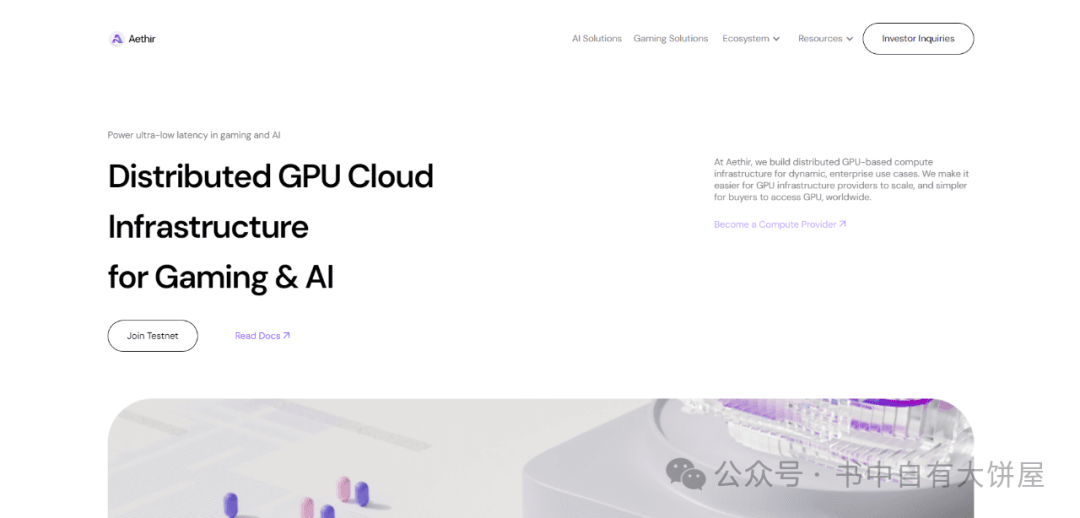
Introduction to Aethir
Aethir provides a disruptive yet highly feasible solution to this complex global problem. Our network aggregates and intelligently reallocates new and idle GPUs from enterprises, data centers, cryptocurrency mining operations, and consumers. Considering the average U.S. data center GPU utilization is only 10-15%, the market opportunity for improved GPU capacity reallocation is huge. Aethir's solution will provide greater access to current supply, reduce the risk of new investments, and have the ability to increase global GPU compute availability by more than 10x.
Aethir provides a cloud platform built on a distributed GPU framework, specifically designed to meet the demanding processing needs of industries like gaming, AI model training, and inference. This architecture seamlessly integrates different GPU clusters into a unified network, significantly increasing cluster size, improving reliability and infrastructure resiliency. This makes Aethir ideal for unifying geographically dispersed resources to handle large-scale AI workloads, reducing global dependence on existing cloud leaders.
Aethir’s commitment to decentralization extends beyond resource ownership. Its geographically distributed infrastructure transcends the limitations inherent in centralized solutions, ensuring broader accessibility and laying the foundation for the necessary evolution and maturation of the GPU Cloud.
Essentially, Aethir represents a paradigm shift in the future of computing resource allocation. Its core principles—decentralized ownership, cooperative operations across clusters, and scalable regional deployment—pave the way for a new wave of economic and technological advancement. Aethir is not just changing the cloud computing landscape; it is actively shaping a more connected, efficient and innovation-driven global GPU cloud economy.
A key feature of Aethir DCI is its focus on repurposing existing idle resources rather than requiring participants to purchase new hardware. Estimates of underutilized GPU capacity range from 50-75%, indicating the existence of vast untapped digital resources. Aethir DCI aims to take advantage of this abundance of idle resources by targeting small and medium-sized data centers and enterprises.

Aethir network
The Aethir network is driven by five key actors: miners, developers, users, token holders and the Aethir DAO. There are three types of miners: containers, inspectors, and indexers. Together, these roles promote network consensus and efficient rendering services. The lifeblood of the network is the ATH token, which plays a key role in incentivizing user participation, supporting the development of diverse applications within the ecosystem, and expanding our user base. This dynamic creates a self-sustaining cycle that encourages continued growth and development of the Aethir network.
Architecture design
The Aethir network integrates three key roles to support its operations: containers, indexers, and inspectors. The main function of containers is to provide real-time remote rendering services, which is crucial for achieving a seamless cloud experience. The indexer facilitates the connection between users and the most suitable container, ensuring that the application's requirements are optimally matched with it. The inspector role plays a vital role in assessing the performance and quality of service of a container, ensuring reliable and efficient operation. The Layer 2 Arbitrum network is the foundation of the Aethir ecosystem, providing a decentralized settlement layer that enhances user experience through ATH tokens. It records transaction information efficiently and solves key challenges in blockchain systems such as scalability, transaction speed, and high fees. As blockchain technology evolves, Aethir is poised to expand these capabilities within a fully decentralized framework.
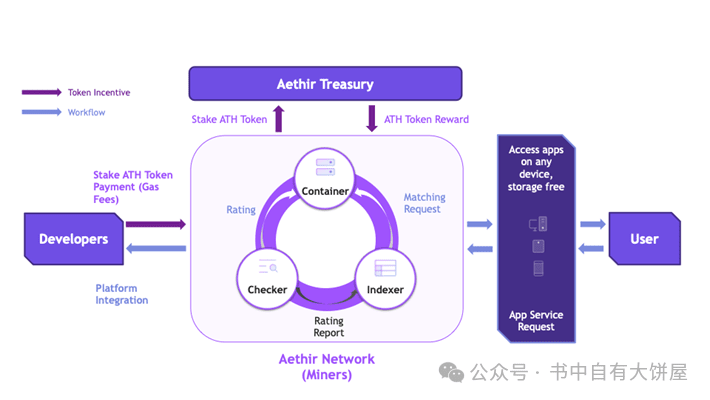
1.The role of the indexer
Indexers play a central role in the Aethir network, matching consumers with appropriate containers to ensure rapid launch of cloud applications and services. The goal is to provide a "second-to-second" service - the transition from the consumer's request to the actual delivery (for example, a player making a request to the game screen) should be completed in the shortest possible time. This requires concise signaling and efficient scheduling.
Scheduling considerations:
Container status: Must be on standby.
Service deployment: Cloud services should be pre-installed in containers.
Resource requirements: The specifications of the container must meet the hardware and network requirements of the cloud service.
Latency: The distance between the container and the consumer or enterprise should be within acceptable latency limits.
Service fees: The cost of containers should not exceed the developer's budget.
Selection criteria: Indexers prioritize containers based on lowest service fee, best experience, or best overall rating metrics.
Decentralization and fraud prevention: To maintain decentralization and improve user experience, indexers are randomly selected. This approach helps mitigate potential fraud risks and minimizes signaling delays due to protocol complexity.
2. The role of the inspector
Checkers ensure the integrity and performance of containers in the Aethir network. Validating the container specifications provided by the container vendor is critical to maintaining the quality of service (QoS) of the network.
Checking process:
On registration: When the container registers on the Aethir network.
Standby state: Conduct random checks on containers in standby state.
During rendering state: Collect and evaluate service information to determine the actual service state.
test result:
Registration verification: Confirm container specifications and successful registration.
Scheduling impact: Affects the indexer's scheduling opportunities and priorities for containers.
Quality Control: Determines penalties for poor service quality.
Inspection Method:
Performance parameters: Directly read the performance data of the container.
Mock testing: Test the application in the role of a consumer and analyze interactions to ensure claimed specifications are met.
Checker deployment: Initially deployed by Aethir, with plans to gradually decentralize.
3 How containers work
Containers can be in several different states, which determine how they function in our network:
1. Pending configuration: When the container is brand new, it is like waiting for instructions. At this stage, the correct configuration and information is set.
2. Waiting for inspection: Once set up, the container waits for the inspector to confirm that everything is OK.
3. Checked and ready: If the checker gives positive feedback, the container is ready for use in the network.
4. Recheck required: If a problem occurs, the container will be checked again.
5. Connected and healthy: The container needs to show that it is well connected and functioning properly. This is like a normal heartbeat, indicating that it is still active.
6. Maintenance Lockdown: Sometimes, containers need to be adjusted or upgraded. During this time, it is unavailable.
7. Quality Control: We always monitor the working quality of our containers. If it is not up to standard, it will need to be inspected and repaired.
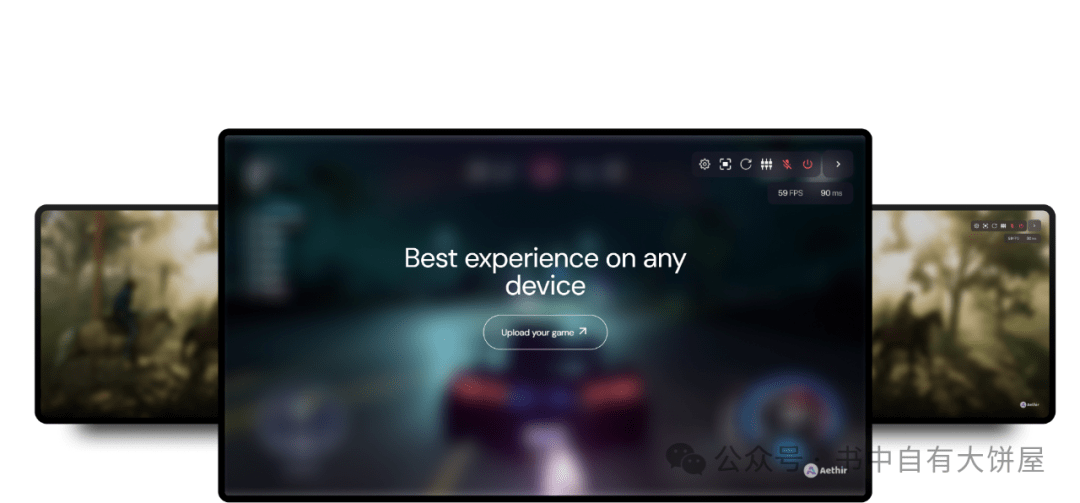
Render proof
Unlike ordinary blockchain networks, the Aethir network uses a special operating method. Here, nodes (think of them as independent workers) take on two main tasks:
Proof of Rendering Ability: Every 15 minutes, a group of these workers are randomly selected to validate transactions (like checking that everything is compliant). The more they invest (in the form of tokens), the better their service quality is, and the fewer times they have been chosen before, the more likely they are to be chosen.
project data
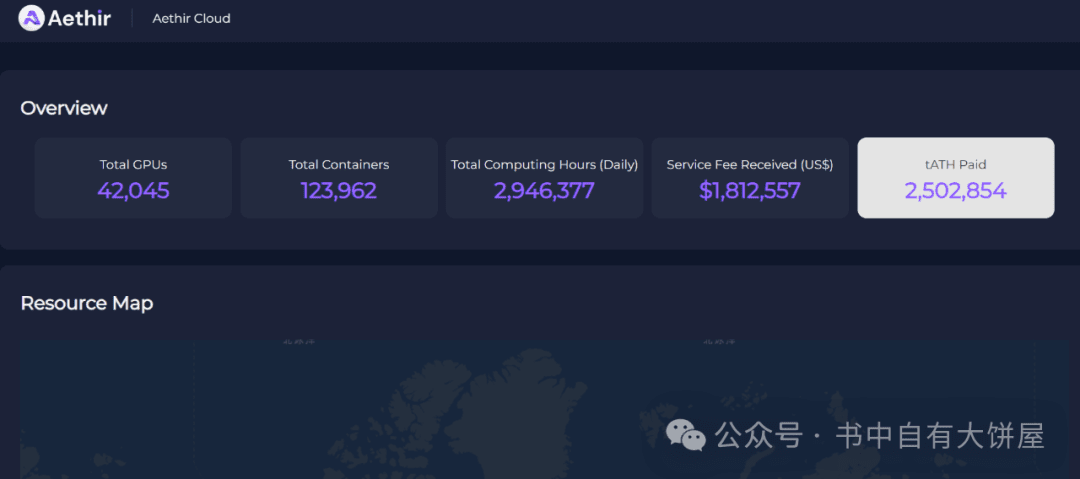
1. Currently there are 200,000 users and 40,000 GPUs. 1.8 million USD was received and 2.5 million was paid by tATH.
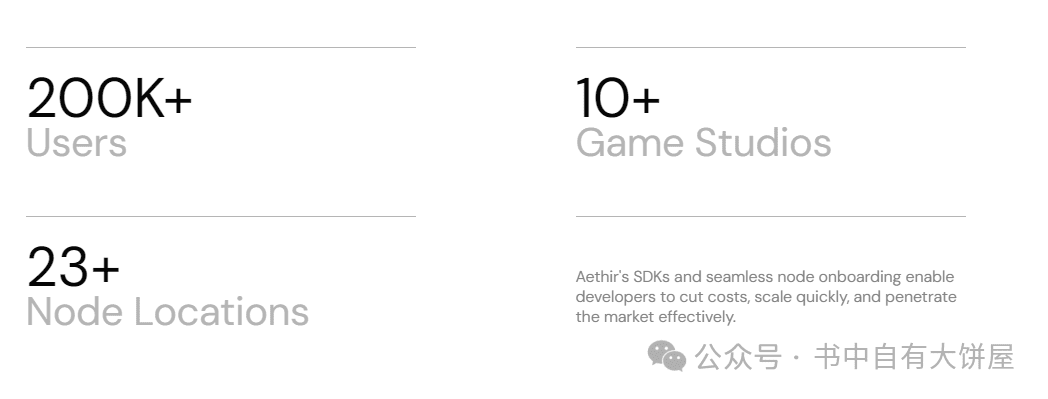
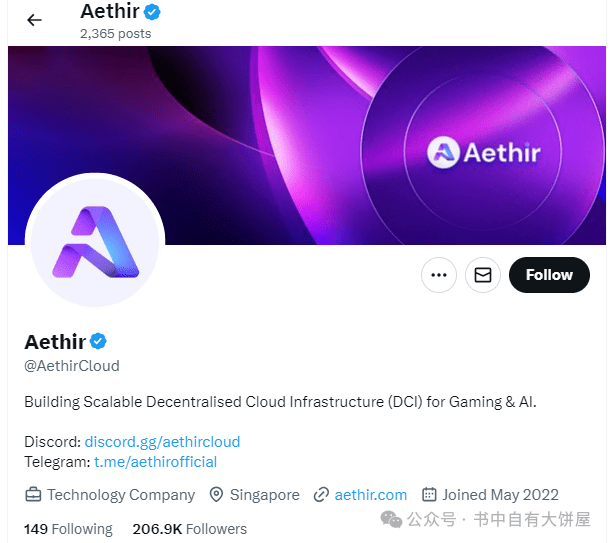
2. Currently there are 200,000 fans on Twitter and 60,000 on discord.
Team situation
CEO mark seems to have a relatively general introduction. COO daniel wang holds positions in IVC (partner), YGG E2 (chief information officer), Riot Games (head of international publishing) and Riot Games China (chief operating officer). Dan is a game and Web3 Experienced leaders in the industry. CTO Kyle previously served as CEO and General Manager of Ericsson's IoT, Automotive and Security businesses, CEO of Edge Gravity, and Chief Network Officer of Verizon Media.

Financing situation
US$150 million in Series A pre-financing.
Aethir Token Economics
At the heart of the Aethir ecosystem is the ATH token, a multi-faceted asset designed not only for transactions, but also for governance, incentives, and platform development.
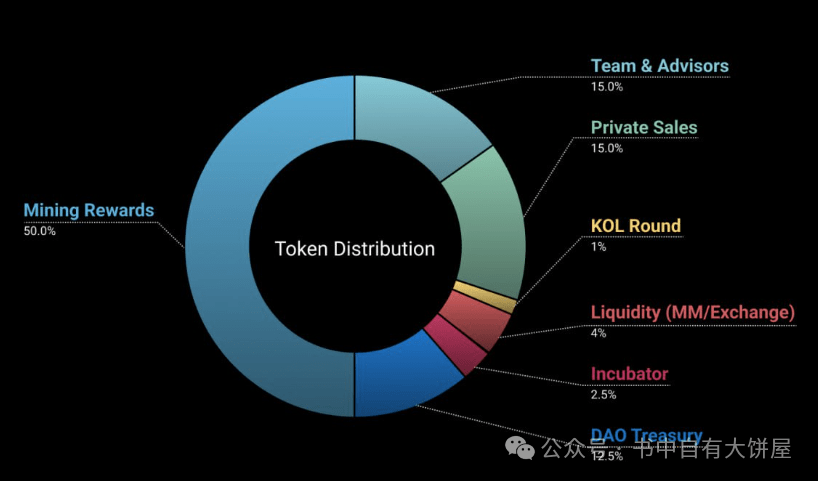
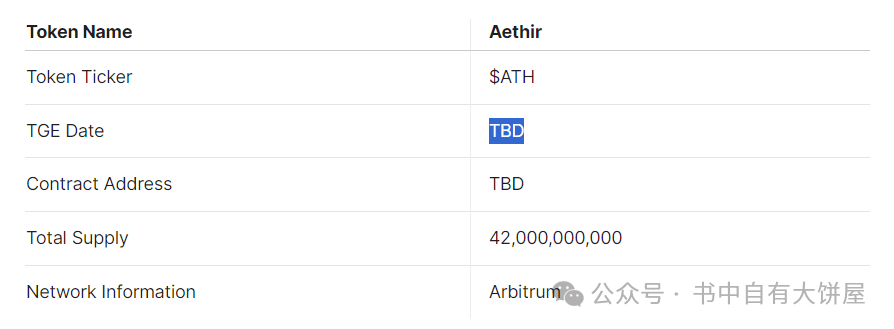
Aethir has issued a total of 42 billion tokens, which are currently being issued on the arb chain. The distribution is as follows: 15% for the team, 15% for private sales, 50% for mining rewards, 17.5% for the DAO Foundation, and 4% for liquidity.
To sum up, this project is not yet online yet. It is also a GPU rental, but it is in the direction of cloud gaming. In fact, it is similar to RNDR, AKT, clore, etc. The concept of cloud gaming was actually proposed many years ago. Yes, but that’s it. It’s just that depin has become so popular recently. This project actually started in 2022 and has been in progress for 2 years. The progress is still relatively slow. Then the token has not been online yet. At present Judging from the number of fans, it's okay, and then it's no problem on the track. The arrival of the AI era requires a lot of computing power. It is recommended to watch NVIDIA's GTC conference, so you can pay attention to this project. Currently Projects can only be mined by buying nodes, there is no other way to earn money. #热门话题