


Original title: 12 Best Layer 1 Crypto Projects of 2024 – The Leaders of Blockchain
Original author: Kane Pepi
Original source: techopedia
Compiled by: Vernacular Blockchain
Layer 1 cryptocurrencies play a vital role in the cryptocurrency world, providing the framework for blockchain networks and offering scalability, security, and decentralization.
As we look ahead to 2024, understanding the dynamics of these platforms will be critical for investors seeking growth potential in the cryptocurrency industry.
This article lists the best Layer 1 cryptocurrency projects for 2024, exploring their unique features and the advantages they offer.

1. List of Layer1 Cryptocurrencies
For anyone interested in Layer 1 projects, here is a short list of Layer 1 blockchains:
Bitcoin (BTC): As the world's first and largest cryptocurrency with the highest market capitalization, Bitcoin remains the best Layer 1 project. Bitcoin's limited supply of only 21 million tokens makes it an ideal store of value. Bitcoin will usher in its next halving event in April 2024, which may trigger a long-lasting bull market. Bitcoin is also expected to receive the first ETF approval from the U.S. Securities and Exchange Commission.
Ethereum (ETH): Thousands of secondary tokens operate on the Ethereum blockchain, making it the most popular Layer 1 blockchain for developers. Ethereum has everything from the metaverse and play-to-earn games to a decentralized financial ecosystem. Despite Ethereum's huge market cap, many analysts believe its actual value is only a small fraction of its future potential.
Solana (SOL): This Layer 1 blockchain offers a great alternative to Ethereum in terms of speed, cost-effectiveness, and scalability. Solana can handle smart contracts and decentralized applications without sacrificing security or energy efficiency.
BNB (BNB): Supporting the world's largest cryptocurrency ecosystem, BNB is Binance's Layer 1 blockchain. Settling transaction fees on the BNB chain is mandatory and provides a 25% discount on Binance fees. BNB is a deflationary Layer 1 project; Binance frequently removes tokens from the circulating supply. Investors can purchase BNB at a price 66% lower than its all-time high.
Ripple (XRP): This Layer 1 blockchain facilitates cross-currency transactions between financial institutions. XRP provides a real-time liquidity bridge, ensuring it has solid long-term utility. Ripple is used by some of the world's largest banks, which means it could eventually replace the SWIFT network. XRP is up 60% in the past 12 months, but is down 84% from its all-time high.
Cosmos (ATOM): Launched in 2019, Cosmos developed the Inter-Blockchain Communication Protocol. This allows rival blockchains to communicate and share data without the need for a centralized provider. ATOM is the Layer 1 cryptocurrency that powers Cosmos. Currently, it is trading 78% below its all-time high. ATOM has a market cap of over $3.7 billion.
Avalanche (AVAX): A Layer 1 blockchain network that claims to enable unlimited scalability, Avalanche provides nearly instant transaction confirmations. Avalanche also enables ERC-20 projects to bridge to its network, charging 0.025% of the bridged amount. Its native cryptocurrency AVAX is trading 85% below its 2021 all-time high.
Cronos (CRO): Supporting Crypto.com exchange, Cronos is a Layer 1 blockchain with high scalability and low fees. The Cronos network supports smart contracts and dApps, and transaction fees are paid in CROToken. The point is, CRO gives you exposure to Crypto.com exchange, which aims to increase its market share in the next bull run.
Stellar (XLM): Launched in 2014, Stellar is a Layer 1 blockchain that supports fast, cheap and scalable cross-border transactions. It has partnered with IBM, MoneyGram and other well-known entities. XML is the project's native cryptocurrency and currently has a market cap of $3.4 billion. Today, investors can enjoy an 86% discount to its all-time high.
Polkadot (DOT): Another top Layer 1 blockchain that is driving the development of network interoperability, Polkadot hopes to become the "blockchain of blockchains" in the Web 3.0 era. As one of the most energy-efficient Layer 1 protocols, Polkadot's market capitalization is close to $8 billion. DOT, its native token, has fallen 90% from its all-time high.
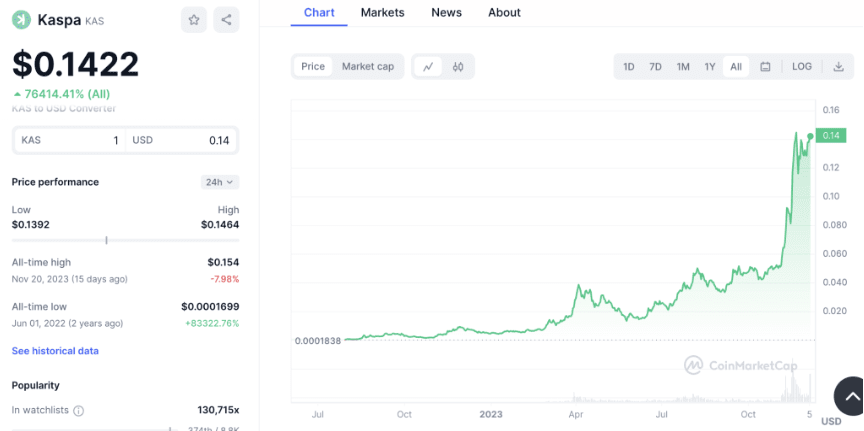
Kaspa (KAS): One of the fastest growing cryptocurrencies, Kaspa has gained over 7000% since its launch in July 2022. This Layer 1 cryptocurrency has grown over 1800% over the past 12 months. Kaspa uses a proof-of-work model but can confirm transactions within seconds.
Sei (SEI): This is a new Layer 1 project that was launched in August 2023. Since then, Sei has risen by more than 3,400%, making it one of the best performing cryptocurrencies this year. The Sei blockchain can process up to 20,000 transactions per second with a finality speed of 380 milliseconds.
2. Best Layer 1 Cryptocurrency Projects - Comprehensive Analysis
The following sections will help you understand the long-term potential of each of the above-mentioned Layer 1 cryptocurrencies. Read on to discover the best Layer 1 tokens for your portfolio.
1) Bitcoin (BTC): Overall Best Layer 1 Blockchain for Long-term Investors
Although the short-term gains may be mild compared to other cryptocurrencies, we still believe Bitcoin is the best overall pick. It is the original Layer 1 blockchain launched in 2009. Bitcoin has the largest market cap of all cryptocurrencies. At its peak, it was valued at over $1.4 trillion.
This was at a time when Bitcoin was trading near $69,000. Last year Bitcoin fell to below $16,000 but has since recovered to over $61,000.
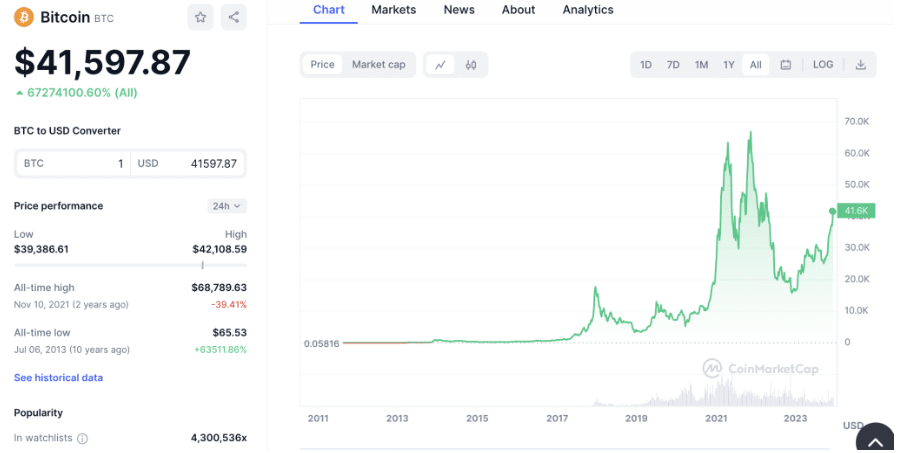
There is a lot of bullish sentiment surrounding Bitcoin right now. First, analysts predict that the U.S. Securities and Exchange Commission will approve the first Bitcoin exchange-traded fund (ETF) in 2024. This could trigger an influx of massive institutional investment.
Also of interest is Bitcoin’s next halving event; expected to occur in April 2024. This will reduce the 10-minute supply of new Bitcoins by 50%, down to 3.125 BTC. Ultimately, while some analysts believe Bitcoin could break $100,000 next year, this could just be the beginning. As such, we feel confident that Bitcoin is one of the top Layer 1 cryptocurrency projects for long-term holders.
2) Ethereum (ETH): The most popular Layer 1 blockchain, favored by dApp developers
Ethereum is the most popular Layer 1 cryptocurrency project favored by decentralized application (dApp) developers. Although most dApps are inactive, there are hundreds of thousands of secondary tokens on the Ethereum network. Those active tokens represent some of the largest cryptocurrencies by market capitalization. These include metaverse projects such as The Sandbox, Axie Infinity, and Decentraland.
Ethereum also hosts some of the best decentralized exchanges, including Uniswap and Sushiswap. Decentralized financial platforms also prefer Ethereum, whether it's Aave, Yearn.finance or Compound. Crucially, every project on the Ethereum network uses ETH to pay transaction fees, ensuring that the world's second-largest cryptocurrency remains in strong demand.
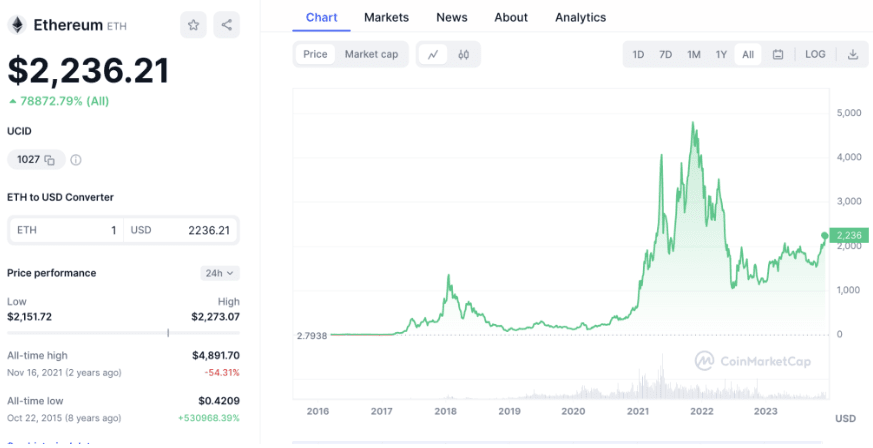
Although Ethereum faces increased competition from other Layer 1 blockchains, it still dominates the vast majority of the dApp market. After all, Ethereum was the first project to launch a smart contract platform, which gave it a huge first-mover advantage. In terms of valuation, Ethereum's current market capitalization exceeds $350 billion.
Now, it’s trading at over $2,900, higher than it was 12 months ago. However, like most of the top Layer 1 blockchains, Ethereum is still trading at an attractive discount. Those who invest today will be buying it at a 58% discount to its all-time high of nearly $5,000. Considering that BlackRock recently filed an application for an Ethereum ETF with the SEC, this could be the start of the next bull run.
3) Solana (SOL): One of the most worthy Layer 1 blockchains for long-term investment
Solana is the best Layer 1 cryptocurrency project for long-term investors. The key question that analysts are watching is whether Solana will take a significant market share from Ethereum. According to CoinMarketCap, there are only 218 cryptocurrencies in the Solana ecosystem. In comparison, Ethereum has thousands.
In addition, most of the projects based on Solana are cryptocurrencies with tiny market caps and limited trading volumes. Despite this, Solana is a better Layer 1 blockchain in terms of performance. This is a crucial metric because dApp developers want their projects to run on the fastest and most efficient blockchain.
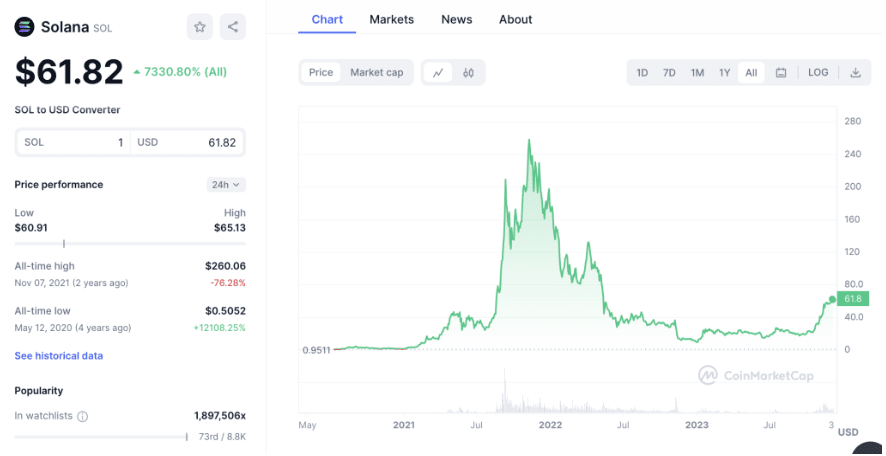
While Ethereum can handle about 30 transactions per second, Solana has successfully processed more than 65,000 transactions during its testing phase. This makes it more suitable for handling large transaction throughput. In addition, Solana's transaction fees are also much cheaper than Ethereum, with the average transaction fee equivalent to only $0.00025 SOL.
So what is Solana’s upside potential? Currently, Solana is one of the best performing cryptocurrencies. In the past 12 months, SOLToken has grown by more than 360%. Since the beginning of 2020, SOLToken has grown by more than 7,300%. However, you can still enter the market at a huge discount; Solana is currently trading at $116.25.
4) BNB (BNB): Layer 1 blockchain supporting the Binance ecosystem
BNB, the third-ranked Layer 1 cryptocurrency by market cap, is also worth considering. This blockchain network supports the Binance ecosystem. Like Ethereum and Solana, the BNB chain supports smart contracts and dApps. There are thousands of projects operating on BNB, known as BEP-20 tokens.
When settling fees, BEP-20 projects need to use BNB as a trading token. BNB also has a use on the Binance exchange; it provides a 25% discount on standard trading commissions. BNB is also a deflationary Layer 1 cryptocurrency. This is because Binance frequently destroys BNB tokens, meaning they are removed from the circulating supply.
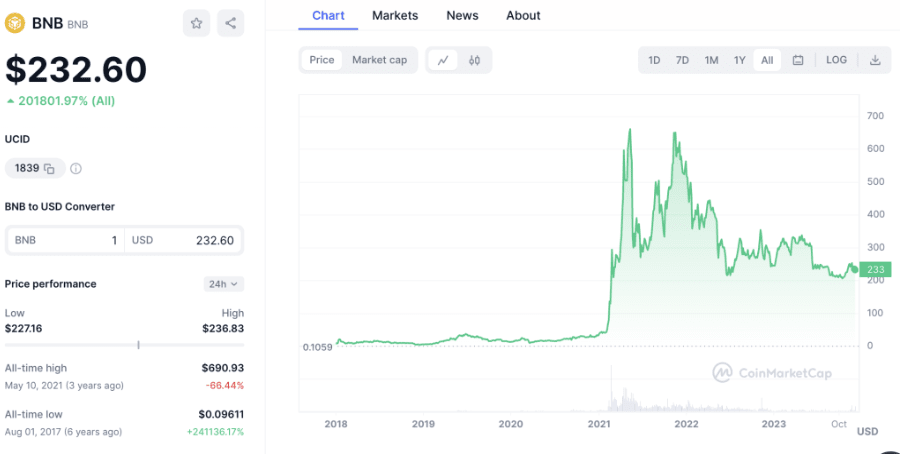
In terms of price action, BNB has gained more than 20,000% since its launch in late 2017. Nonetheless, BNB is down 20% over the past 12 months. Furthermore, BNB’s current price of $376.90 is about 46% lower than its previous all-time high of around $690. Ultimately, Binance is the largest cryptocurrency exchange by volume, so BNB offers investors exposure to its growth.
5) Ripple (XRP): Layer 1 payment network for cross-currency transactions
Ripple is one of the earliest Layer 1 blockchains; the network was launched in 2012. The technology is aimed at large financial institutions that need to conduct international transactions. Ripple simplifies the process, and cross-border transfers can be processed in less than five seconds.
Additionally, fees are typically less than a cent, and the network can process up to 1,500 transactions per second. Ripple is particularly useful for cross-currency transactions, especially when transferring funds to emerging countries. Its native cryptocurrency XRP provides real-time liquidity.

This means that financial institutions no longer need to use SWIFT, which usually relies on a corresponding bank network. Since some of the world's largest banks are already using Ripple, XRP is one of the best Layer 1 cryptocurrency projects to consider. The price of XRP in February 2024 is $0.5359.
6) Cosmos (ATOM): Allows Layer 1 network to share data Inter-Blockchain Communication
Cosmos is a Layer 1 cryptocurrency project that has developed an Inter-Blockchain Communication protocol. In simple terms, this enables two or more blockchain networks to share data without using a centralized provider. For example, consider Kava and Cronos, which specialize in decentralized finance and trading services.
The two blockchains operate independently, which means they have their own consensus methods and underlying code. Normally, the Kava and Cronos blockchains cannot communicate. However, when the Cosmos protocol is deployed, Kava and Cronos will be able to share data in real time. This means that the use cases for Cosmos are very broad.
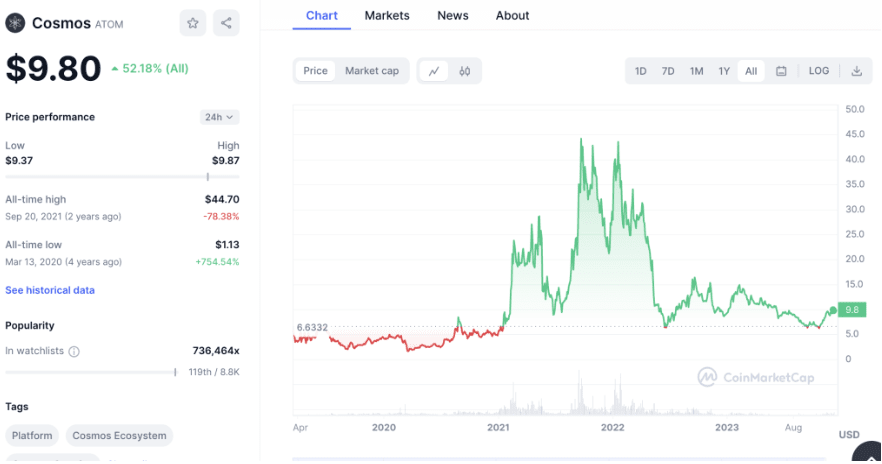
Cosmos has a native Layer 1 cryptocurrency, ATOM. It is required when using the Inter-Blockchain Communication Protocol. ATOM has a market cap of over $3.8 billion. The growth has been relatively modest; ATOM is up just 52% since 2019. Moreover, ATOM’s price is down 78% from its all-time high of almost $45.
7) Avalanche (AVAX): High-performance Layer 1 network with unlimited scalability
Avalanche is another high-performance blockchain that aims to gradually eat into Ethereum’s market share. It claims to offer “infinite scalability,” meaning it can handle an unlimited number of transactions without compromising security. It also offers nearly instant transactions, making it ideal for smart contracts and dApps.
Another feature of Avalanche is its ability to support ERC-20 projects. Avalanche charges a fee of 0.025% on the bridge amount, with a minimum of $3. According to CoinMarketCap, 282 projects have been bridged to Avalanche, including Tether, Chainlink, Dai, SushiSwap, and Frax.
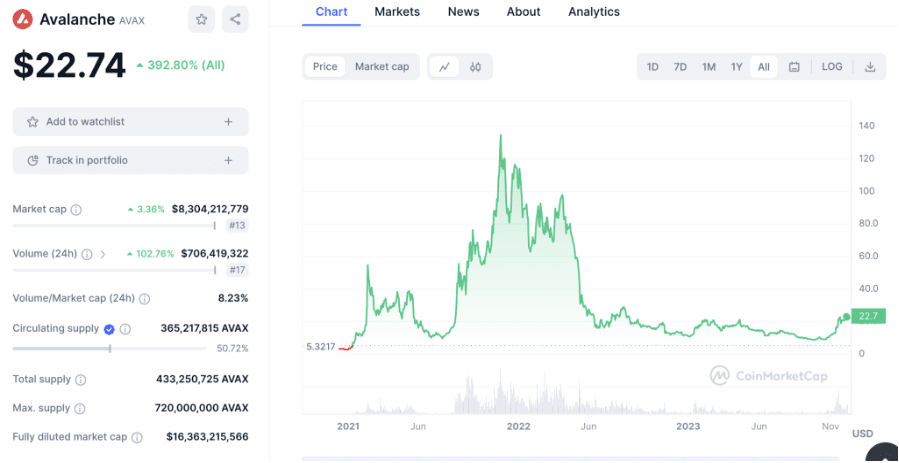
In terms of price performance, Avalanche is up 63%. While this is below the industry average, Avalanche is trading 85% below its 2021 all-time high. Therefore, investors can get an attractive discount before the next altcoin season arrives. Avalanche has a market cap of just over $13 billion, so there is still plenty of room for growth.
8) Cronos (CRO): Crypto.com’s Layer 1 network, trading at a 90% discount
Launched in November 2021, Cronos is one of the new Layer 1 blockchain projects entering the market. It achieves scalability, low transaction fees, and can host smart contracts and dApps. That being said, Cronos is well known for its association with Crypto.com. Crypto.com, considered one of the best cryptocurrency trading platforms, offers some of the lowest trading commissions on the market.
Crypto.com has processed over $1 billion in trading volume. This is only a small portion of the $18 billion that is traded on Binance. However, considering Binance was recently fined $4 billion for money laundering, Crypto.com will be confident that it will be able to increase its market share. Therefore, those who invest in the Cronos blockchain will gain exposure to Crypto.com’s growth.
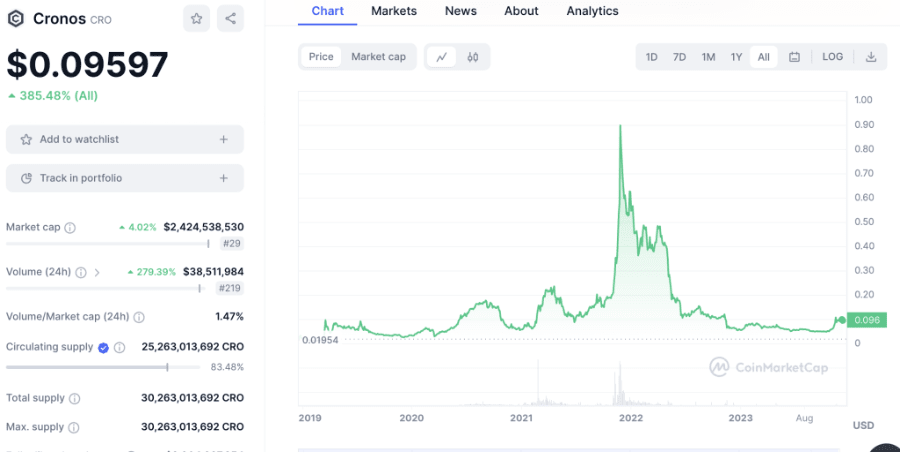
Cronos’ native cryptocurrency, CRO, is currently valued at just $2.4 billion. In comparison, Binance’s BNB is valued at over $35 billion. CROToken has gained 42% in trading over the past 12 months. However, they are trading 90% below their all-time high, which offers a significant discount.
9) Stellar (XLM): A cross-border payment network for individuals and businesses
Stellar is an open-source Layer 1 blockchain that uses a proof-of-agreement consensus mechanism. Stellar is not only energy efficient, but also provides extremely fast confirmation times. On average, it is completed in 5-6 seconds. Stellar also provides low fees and can scale to 1,500 transactions per second.
Stellar aims to become the de facto payment network for global remittances, thereby “banking the unbanked”. That being said, it also enables businesses to process cheap cross-border transactions. To achieve this end, it has partnered with IBM, MoneyGram, and other well-known entities. XLM is the project’s native cryptocurrency that was launched in 2014.
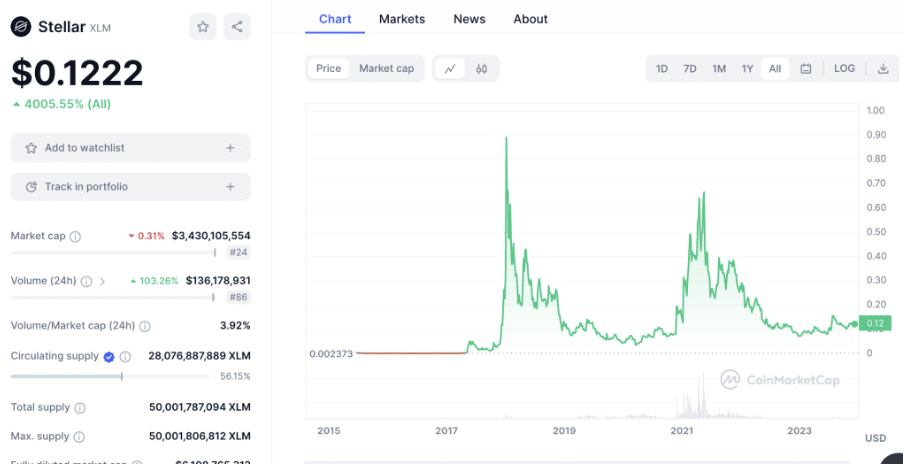
XLM has gone through several bull and bear cycles. Despite this, the Token is up 4000% since its launch. Compared to its previous all-time high, someone who buys XLM today will receive an 86% discount. XLM has a market cap of $3.2 billion.
10) Polkadot (DOT): Leading interoperability in the Web 3.0 era
Polkadot is another Layer 1 blockchain focused on interoperability. Its proprietary network is designed to connect competing blockchains to adapt to the Web 3.0 era. This means that cross-blockchain transfers can be made while maintaining decentralization. Polkadot achieves this with a high level of efficiency.
Through its nominated proof-of-stake consensus model, the Polkadot blockchain consumes as much energy as 6.6 American households. Polkadot's native Layer 1 Token DOT has three main functions. First, DOT is a governance token that enables holders to vote on protocol upgrades and fixes. Second, DOT is also one of the best staking coins.
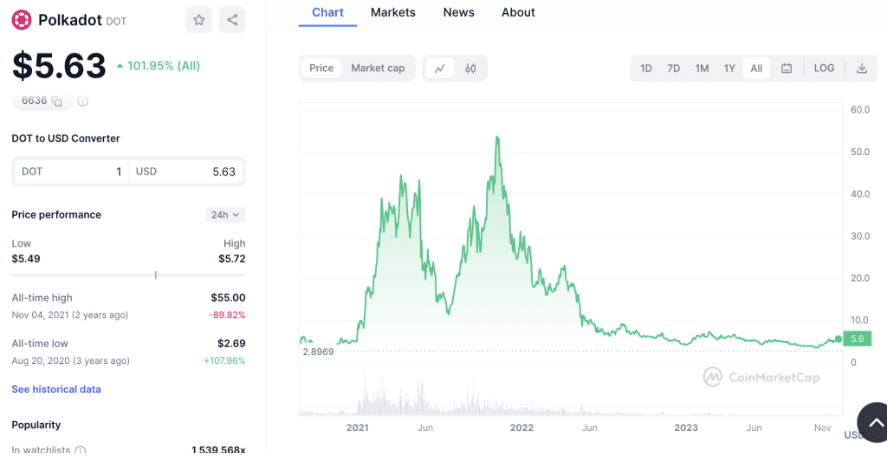
Third, DOT is used for "bonding," which is a way to facilitate cross-blockchain transactions. According to CoinMarketCap, Polkadot has a market cap of over $9.4 billion. Over the past 12 months, DOTToken has not fluctuated much, with only a slight loss of less than 1%. Based on current prices, DOT is trading 90% below its all-time high.
11) Kaspa (KAS): Proof-of-Work consensus model with single-second confirmation time
Kaspa is one of the fastest growing cryptocurrencies in 2024. Its native Token KAS has grown by more than 1800% in the past 12 months of trading. Since the launch of KAS in July 2022, the Token has grown by more than 7600%.
That being said, Kaspa has a market cap of just $3 billion, so its upward trajectory is likely to continue as we enter a bull run. In addition, there is a slight 8% discount compared to its previous all-time high. In terms of practicality, Kaspa is a Layer 1 blockchain that uses a Proof of Work (PoW) consensus mechanism.
However, unlike other proof-of-work networks such as Bitcoin, transactions are very fast. Kaspa transactions are typically processed within seconds without compromising security. One of Kaspa's main goals is to increase scalability across the globe. It currently processes one block confirmation per second, but this rate will increase over time.
12) Sei (SEI): A new Layer 1 cryptocurrency that has grown 3400% since August 2023
Sei is one of the hottest cryptocurrencies as we head into 2024. Crucially, this is one of the newest Layer 1 blockchains on the market. According to CoinMarketCap, Sei launched its native cryptocurrency, SEI, in August 2023.
Since its launch, SEI Token has grown by over 3,400%. In the last month alone, SEI has grown by 137%. Despite this, SEI’s market cap is just over $2.1 million. Considering that other Layer 1 blockchains discussed today have multi-billion dollar valuations, this provides a good entry point for new investors.
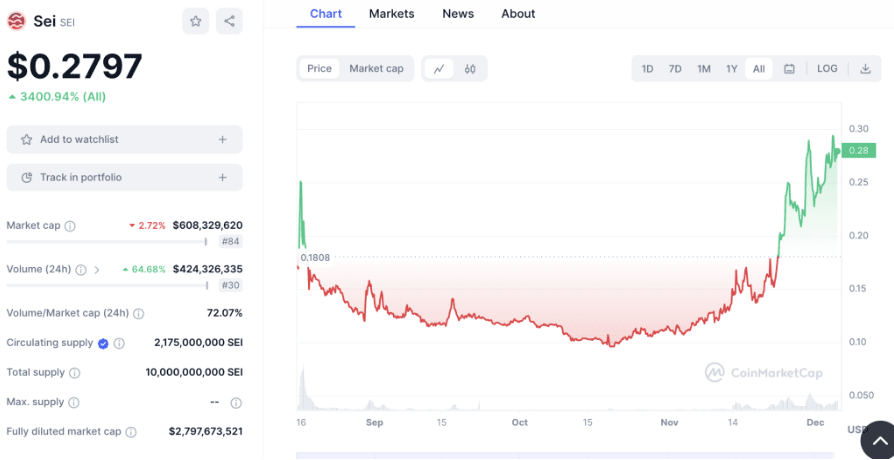
So why is Sei so popular now? Simply put, this Layer 1 network can handle up to 20,000 transactions per second. It can complete transaction confirmation in just 380 milliseconds. In addition, the network has been tested for more than 100 million transactions to date, demonstrating extremely high efficiency.
3. Basics of Layer 1 Cryptocurrency
In simple terms, Layer 1 cryptocurrencies run on proprietary blockchain networks. They have unique underlying code and their own consensus mechanisms. From an investment perspective, Layer 1 cryptocurrencies are an attractive option.
After all, very few active cryptocurrencies are considered Layer 1. In contrast, the vast majority of tokens run on a secondary network. For example, consider that there are more than 450,000 tokens built on the Ethereum blockchain. These include Decentraland, Dai, Sandbox, and Tether.
These secondary tokens follow the ERC-20 standard and have no impact on how the Ethereum blockchain operates. Therefore, any changes made to Ethereum - whether positive or negative - will directly affect how ERC-20 tokens operate.
The Difference Between Layer 1 and Layer 2 Blockchains
Blockchain terminology can be confusing. Here’s a quick overview between Layer 1 and 2 blockchains:
Layer 1 blockchain: Layer 1 blockchains are the foundation of the decentralized web. They handle all aspects of the blockchain, including consensus mechanisms, security, and transaction processing. Examples of Layer 1 blockchains include Bitcoin, Ethereum, Solana, and BNB.
Layer 2 blockchain: Layer 2 blockchain aims to improve the shortcomings of Layer 1. This usually means increased scalability, lower fees, and faster transactions. For example, Polygon is the best Layer 2 solution for ERC-20Token, ensuring that projects can operate more efficiently. Layer 2 networks can also help Layer 1 cryptocurrencies increase their use cases, such as supporting smart contracts and dApps.
Both Layer 1 and 2 blockchains play a role in the broader cryptocurrency market. However, ultimately, Layer 1 networks are more favored in the eyes of long-term investors.
4 Conclusion
In conclusion, the importance of Layer 1 cryptocurrencies is self-evident, providing a framework for a variety of applications and assets. Our review of the best Layer 1 cryptocurrency projects highlights the reasons for their popularity, as well as their profit potential as an investment.
However, we must note that the cryptocurrency market is extremely volatile, so thorough research should be performed before investing in any crypto asset.