


By Xiao Bing
In Bangkok, there’s a simple way to tell whether CZ has arrived: look at where the crowd is surging.
When you see a crowd surging toward someone, chances are CZ has arrived.
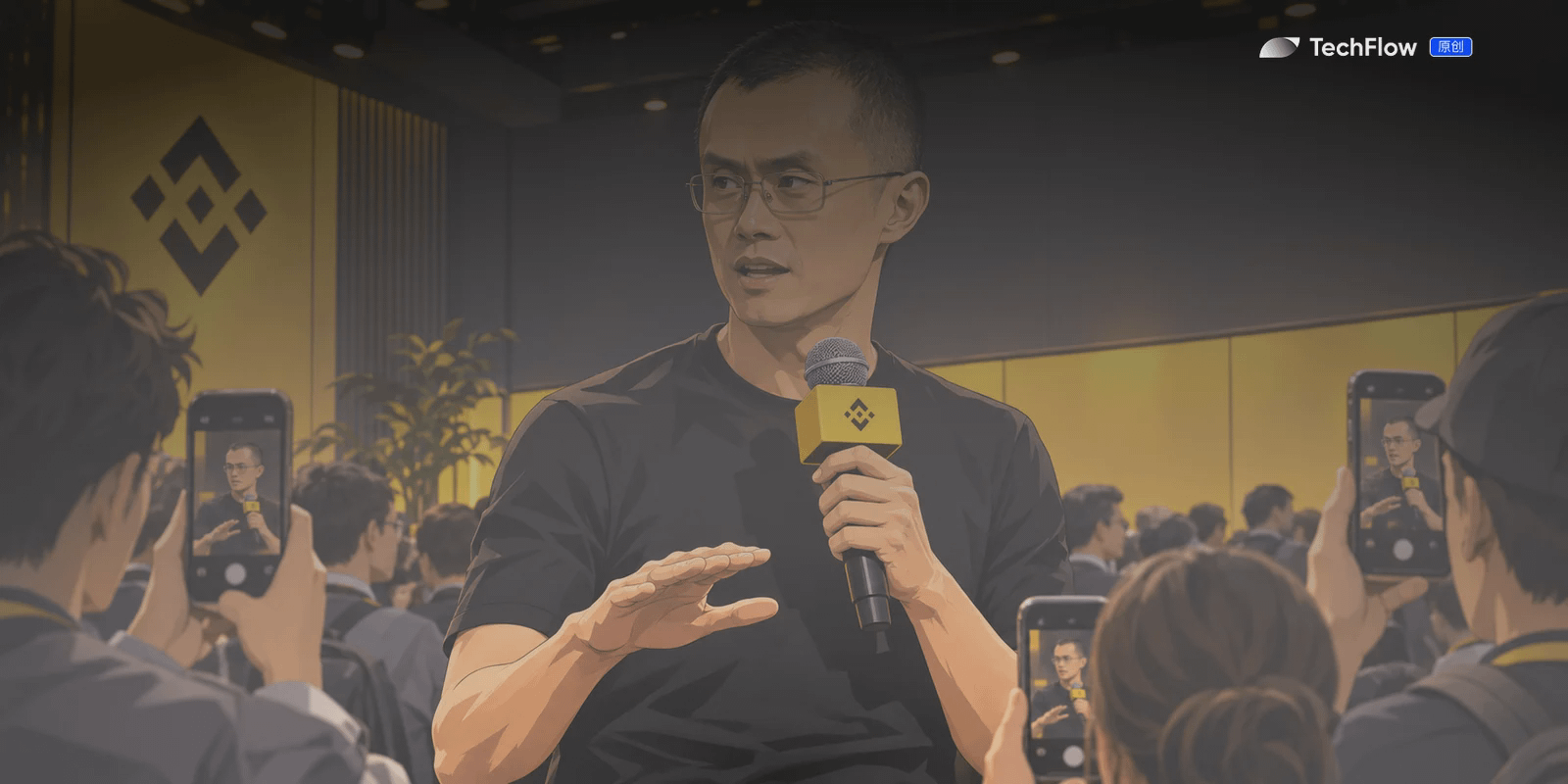
People drinking water set down their cups; people chatting fall silent. Phones rise one by one above everyone’s heads. In seconds, a circle takes shape: those on the outside stretch up on tiptoe, while those on the inside jostle to get a little closer. At the center, the person in question takes his time, posing for photos with one person after another.
Just a month had passed since the roughly $6.3 billion theft, and the market was bitterly cold. Around the time of BBW, CZ made at least four public appearances. Crowds pressed in around him, but what he kept telling everyone was to stop and check their computers first.
A little complacent
The main-stage conversation revolved almost entirely around the hack.
CZ didn’t defend Binance. “In my view, the Binance team and ecosystem had grown a little complacent.” After years without a major incident, everyone had gotten too comfortable, and security procedures hadn’t been continuously upgraded. Senior executives were busy with other things and weren’t paying enough attention to security. “A lot of things are important, but security is always the most important.” In his view, this incident could have been completely avoided.
The attack path he recounted showed more patience than many had imagined.
The hackers used legitimate recruitment consultants to approach more than a thousand employees under the guise of interviews. They started with non-technical staff, tricking them into downloading malware disguised as a “Zoom update.” Then they moved laterally through the internal network, targeting security engineers, operations staff, and production deployment personnel. Once they had the source code, the hackers used AI to analyze it. “What used to take an ordinary person six months to analyze, AI can now do in a day.”
Unable to breach the hot wallet directly, they instead exploited a weakness in Ethereum’s EIP-7702 signature mechanism.
Alongside acknowledging mistakes, he also praised Binance’s response: users were fully informed, VIPs and partners didn’t panic en masse, and the exchange covered the losses. “This carries on the principle I had as a founder: we must protect users.” According to an account from the event, he said Binance drew on roughly half of both the SAFU fund and its futures insurance fund, and stressed that from a risk-management perspective, the platform must retain enough resources to cover even the most extreme scenarios.
Make Binance the warning
More important than the postmortem were the conclusions he drew from it.
The first conclusion: “security through obscurity” no longer works. Hackers are using all kinds of AI to scan your source code; they don’t care about your privacy. Offense and defense have never been symmetrical: defenders have to find and fix every problem, while attackers only need to find one.
The second conclusion: the industry has to work together.
He’s already discussed forming an industry security alliance with peers. It would focus on three things: rapid response, sharing best practices, and cross-checking one another’s systems.
“I don’t care what it’s called. What matters to me is that there are things we should do together.” During the recovery of the stolen funds, Circle, Tether, the US Secret Service, and the FBI all took part in freezing funds. In his view, this is an opportunity for the industry to work closely with law enforcement agencies around the world. Who should lead the effort? He’d rather someone else did. “If it has to be me, I’ll make it happen.”
The moderator compared it to accident investigations in the aviation industry. CZ’s response was straightforward: sharing openly means others don’t have to learn the same lesson at their own expense, and he also hopes Binance can learn from others’ mistakes. Then came the most vivid line of the conversation: “Make Binance the warning. Don’t let this happen to you.”
His ask was specific, too. Over the next few months, people in the industry should spend at least 30% to 50% of their time on security. “Sadly, most people are quite complacent until they’re victims themselves.” He expects the industry to face another 6 to 12 months of heightened risk. There are already 5 to 10 reported attacks a day, and many more go unreported.
During the community AMA, he also offered a few down-to-earth tips:
Patch software vulnerabilities as quickly as possible. Use monitoring tools to block outbound connections from computers; that alone could cut off more than 70% to 80% of malware communications. Then use AI to scan your own code. In a technical team of more than ten people, you’re almost certain to find API keys in the source code, possibly even production keys.
On the day of the conference, he also posted on X, asking several Binance-affiliated and BNB ecosystem apps to show upgrade warnings to users on older versions of iOS, and urging other crypto apps to do the same.
Taken together, these actions turned Binance from “the biggest victim” into “the biggest alarm bell.” Now that AI has caused the cost of attacks to plummet, no organization can guard its own gates alone.
When fear is near its peak
Another unavoidable question at this conference was price.
CZ answered with the calm of someone who’s lived through several cycles. He compared Bitcoin’s lows in previous cycles: around $150 in 2015, around $3,100 in 2018, and around $16,000 in 2022. People think $60,000 is terrible now, but in historical context, it isn’t extreme. At Demo Night, he put it more bluntly: $60,000 is already a good price; $120,000 would just be better.
“The market only bottoms when fear is at its highest. I think we’re already quite close.” He refused to make any price predictions. His logic runs counter to the crowd: a lot of hot money has gone into AI, and precisely because of that, “now is actually the best time to invest in crypto.”
He doesn’t think AI will displace blockchain. In his adult life, he’s experienced three transformative technologies— the internet, blockchain, and AI—and none has replaced the others. “AI won’t replace money either. AI will need a lot more money and transactions.” People need money, agents need money, and technology related to money isn’t going away. He used SpaceX and Starlink as examples: new players can still emerge in a mature industry.
AI, new L1s, and lessons for entrepreneurs
At the helm of YZi Labs, CZ’s investment focus hasn’t changed: crypto, AI, and biotech.
Crypto investments tend to be early-stage, with a focus on incubation and hackathons. AI investments are more mid- to late-stage, with larger checks, because the industry is “highly concentrated and highly centralized”: only a handful of players can get tens of thousands to hundreds of thousands of chips to compete at the frontier. He’s a heavy user of the latest generation of models himself, and particularly favors open-source models for security scans because they have fewer guardrails and can scan code more deeply.
Another major announcement: BNB Chain will launch a new L1, but without issuing a new token. It will use the same token to serve needs existing chains can’t meet, such as high throughput, micropayments, and AI agent transactions. He believes there may be fewer than fifty truly useful major L1s. There could be another L1 boom, but right now, hot money is flowing into AI. For blockchain to attract good capital, it needs to offer genuinely good underlying design. He also predicts that prediction markets “will be big,” though he can’t say how quickly.
His advice to entrepreneurs was notably humble. He’s only ever built one successful company, and he no longer runs it. AI has made coding easy; the hard parts are understanding users, building integrations, and figuring out cross-border payments, regulations, and licenses. To judge whether a product is valuable, just ask three questions: Does it save people time? Does it save them money? Does it make them happy?
He was equally pragmatic about policymakers: politicians are too busy to spend more than five minutes on any given topic, so you can’t expect them to fully understand technology. The only way forward is to keep meeting with them, build think tanks, and write accessible materials. “There’s no shortcut. You have to do the homework yourself.”
Back founders, not government intervention
Another unexpected topic came up on the main stage: Jensen Huang.
CZ said he’s “always been pro-founder” and believes it was a mistake to push Jensen Huang out. Without him, Nvidia might keep moving forward on momentum for a while, but the chance of problems would be high. And Nvidia’s near-monopoly in chip design is a major benefit to the US and the world. “A company and its founder often live and die together.” He added that founders should aim to build a company that can keep running after they leave.
In principle, he opposes government intervention in business: outside forces intervening in the market amounts to propping up weaker players and depriving the market of its ability to pick the best companies and weed out the worst.
Those words carry a particular meaning coming from CZ. He’s a founder who has left his own company, and Binance is now run by co-CEOs. Between “A company and its founder often live and die together” and “A company should keep running after its founder leaves” lies the reality Binance has faced in recent years.
A show, and perceptions from outside the industry
The main-stage conversation opened with The Altruists, a Netflix series about FTX that had just premiered. CZ is portrayed as the villain.
“I’m really unhappy with how they portrayed me, so we’ll see what the lawyers can do.” He said he’d only seen clips on X and didn’t understand why they made him the villain and SBF the good guy. To him, it was “basically defamation.”
He’s probably met SBF about five times. The other man was “basically a competitor.” Asked what he could do about a “fictional series based on true events,” he said he wasn’t sure yet and was still taking advice.
He also offered a take he explicitly labeled as “speculation”: the series might be shaping public opinion in preparation for a future pardon for SBF. “Maybe in two years, maybe six, maybe ten. I don’t know.”
What he really cares about is how people outside the industry see it. “People in the industry know, so it doesn’t matter what I say on Twitter. But they’re targeting people outside the industry, and unfortunately, we don’t have that kind of reach.”
In crypto, CZ is a name that draws a crowd. Outside the industry, he’s defined by streaming platforms and Hollywood.
Back to that circle of people from the beginning.
Some of the people crowding around CZ wanted a photo; others wanted to ask, “Can I buy now?” The answers he gave over the past two days were the opposite of all that excitement: get security right first; people will be hacked every day over the next six months to a year; the market is close to peak fear, but he won’t predict where the bottom is.
Perhaps the image most worth remembering from this weekend in Bangkok is this: the person best at generating excitement in the industry, standing right at its center, repeatedly telling everyone to calm down a little.