

#twentyonecapitaladds172.25btc
A formal Corporate Treasury Investment Policy (TIP) for Bitcoin translates high-level strategic intent into board-approved operational guardrails. Given Bitcoin's 24/7 market structure, non-reversible transactions, and unique balance-sheet volatility, a robust TIP requires clear structural sections and multi-layered internal controls.
1. Essential Sections of a Bitcoin Treasury Policy
Section 1: Executive Summary & Policy Scope
Purpose & Mandate: Explicitly state the objective of holding Bitcoin (e.g., long-term store-of-value reserve, inflation hedge, strategic cash balance diversification).
Entity Applicability: Define which legal entities, subsidiaries, or business units are governed by the policy.
Section 2: Portfolio Limits & Allocation Caps
Max Balance Sheet Allocation: Cap Bitcoin holdings as a strict percentage of excess corporate cash reserves (typically 1%–10%).
Liquidity Floor Buffer: Establish a strict mandate that core operating capital (e.g., 12 to 18 months of operating expenses, working capital, and debt obligations) must remain strictly in primary fiat liquidity or short-term Treasury bills.
Rebalancing Triggers: Define parameters for periodic rebalancing or profit-taking if Bitcoin appreciates beyond defined asset allocation caps.
Section 3: Approved Execution & Trading Venues
Onboarding & Execution: Limit purchases and sales to pre-approved institutional OTC desks, regulated brokers, or primary exchanges.
Slippage & Execution Limits: Set maximum transaction sizes, execution timeframes, and slippage thresholds for large orders.
Section 4: Custody Architecture & Key Management
Custody Type: Mandate institutional-grade Qualified Custodians (SOC 1/SOC 2 Type II certified with specie insurance) or an internal Multi-Signature (Multisig) / Multi-Party Computation (MPC) cold storage architecture.
Disaster Recovery & Key Ceremonies: Document emergency key recovery procedures, succession protocols for key personnel, and annual key test rehearsals.
Section 5: Accounting, Reporting & Compliance
Accounting Framework: Specify reporting standards under FASB ASU 2023-08 (Fair Value Accounting with unrealized gains/losses hitting net income) or IFRS (IAS 38 / IAS 2) depending on jurisdiction.
Audit Readiness & Valuation: Require monthly on-chain cryptographic proofs of reserve, external custodian attestations, and FIFO/weighted-average tax lot tracking.
Board & Committee Reporting Frequency: Mandate monthly or quarterly treasury reports to the Audit Committee detailing position size, cost basis, unrealized gain/loss, and key performance indicators.
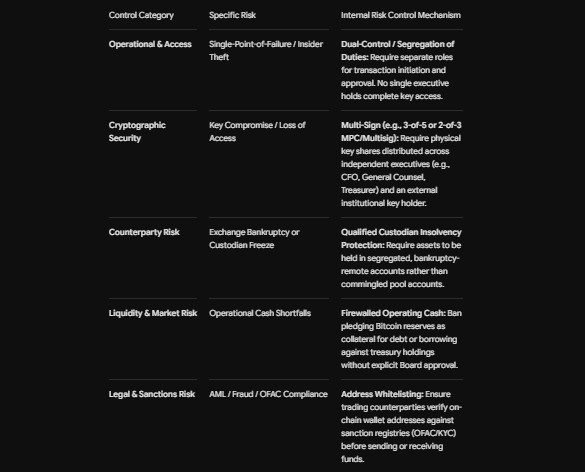
2. Essential Risk Controls & Internal Guardrails
3. Governance Approval Matrix
A standard Treasury Investment Policy utilizes an explicit signing authority threshold:
Board of Directors / Audit Committee: Approves initial policy creation, total balance sheet allocation percentage caps, custodial model selection, and any policy amendments.
Chief Financial Officer (CFO) & Treasurer: Authorizes strategic execution within approved allocation caps, selects OTC counterparties, and signs off on periodic rebalancing.
Treasury Analyst / Operations Controller: Initiates wire transactions, reconciles daily wallet balances, and maintains audit documentation.