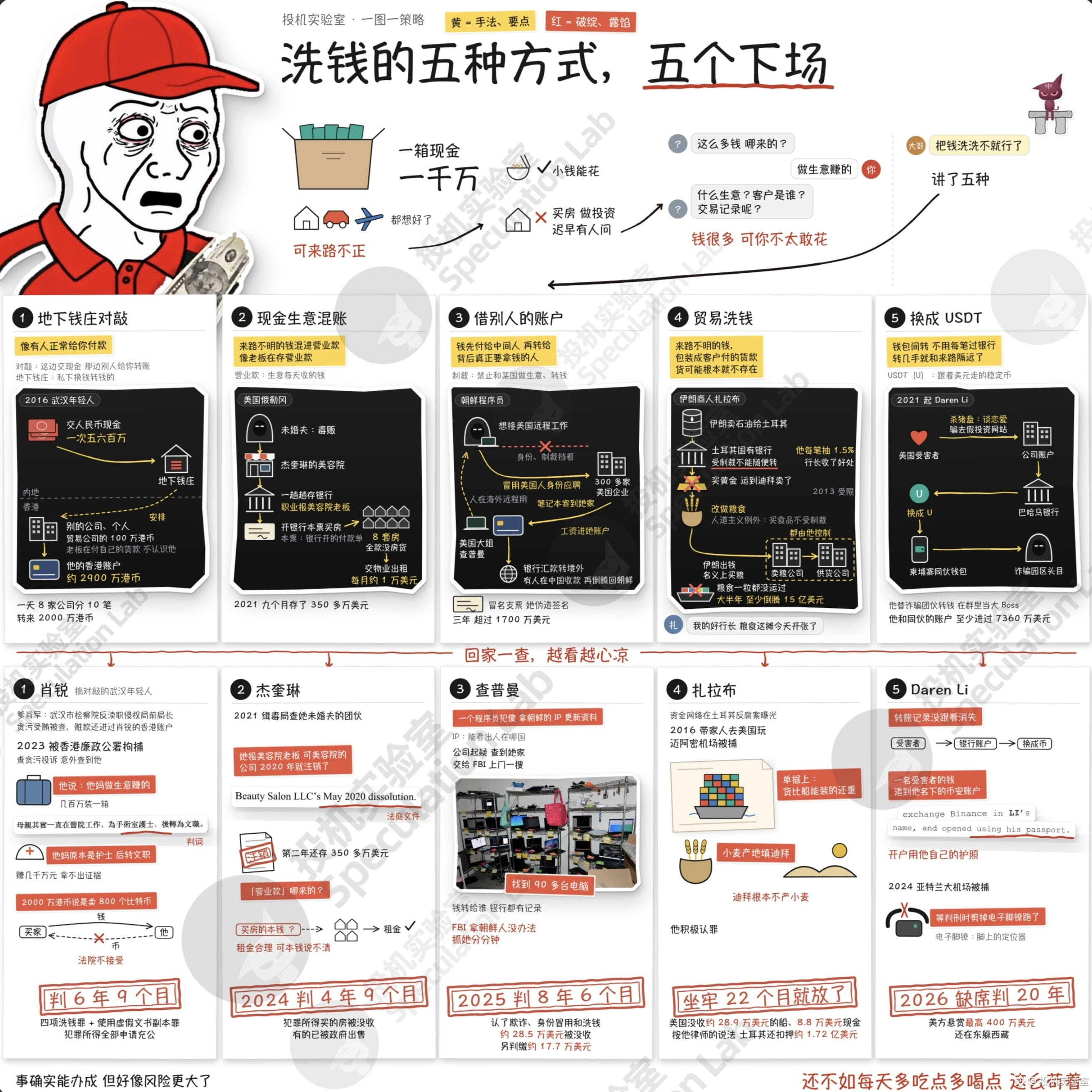

There’s a box of cash at your place—$10 million—but it’s dirty money.
You can spend small amounts however you like, but if you use it to buy a house or make investments, especially overseas, you’ll probably run into all kinds of places asking you to prove where the money came from 😂
You could say you earned it in business—but what kind of business? Who were your clients? Where are the transaction records? You’ve got a lot of money, but you don’t really dare spend it. Then your big bro says, “Why not just launder it?” and tells you about five ways to do it. Each column in the picture shows one method: the top explains how the money was laundered, and the bottom shows how they were caught when investigators looked into it.
The first method: use an underground bank to make offsetting transfers.
You hand the cash over to the underground bank, which arranges for another company to transfer money to you. It looks like a normal payment. In 2016, a young man in Wuhan did this, and about 29 million Hong Kong dollars gradually flowed into his Hong Kong account.
The second method: mix the money in with cash-business revenue.
Jacqueline, from Oregon, had a beauty salon. Her fiancé was a drug dealer. She reported her cash deposits as salon income, depositing more than $3.5 million over nine months. Then she bought eight houses outright and rented them out.
The third method: use someone else’s account.
A North Korean programmer stole an American’s identity to get remote work. His laptop was sent to the home of an American woman named Chapman. His wages went into her account first, then were transferred overseas. Over three years, the total exceeded $17 million.
The fourth method: trade-based money laundering.
You pass off money of unknown origin as payment from customers for goods—goods that may not even exist. Iranian businessman Zarrab helped Iran move money from oil sales. At first, it went through gold; later, he switched to grain. Not a single grain was ever shipped, but in a little over six months, he moved at least $1.5 billion.
The fifth method: convert it to USDT and move it between wallets a few times to put distance between you and the money.
Daren Li moved money for a Cambodian scam gang. Money from pig-butchering scams passed through company accounts and a bank in the Bahamas, where it was converted into U. At least $73.6 million passed through the accounts involved.
You feel a lot more at ease. But when you get home and look up these five cases, the more you read, the more your heart sinks. I’ve put the cases in the picture—take a look and you’ll see. What your big bro said can indeed be done, but it seems the risks are even greater. Might as well just eat and drink a little more every day and keep laying low like this.