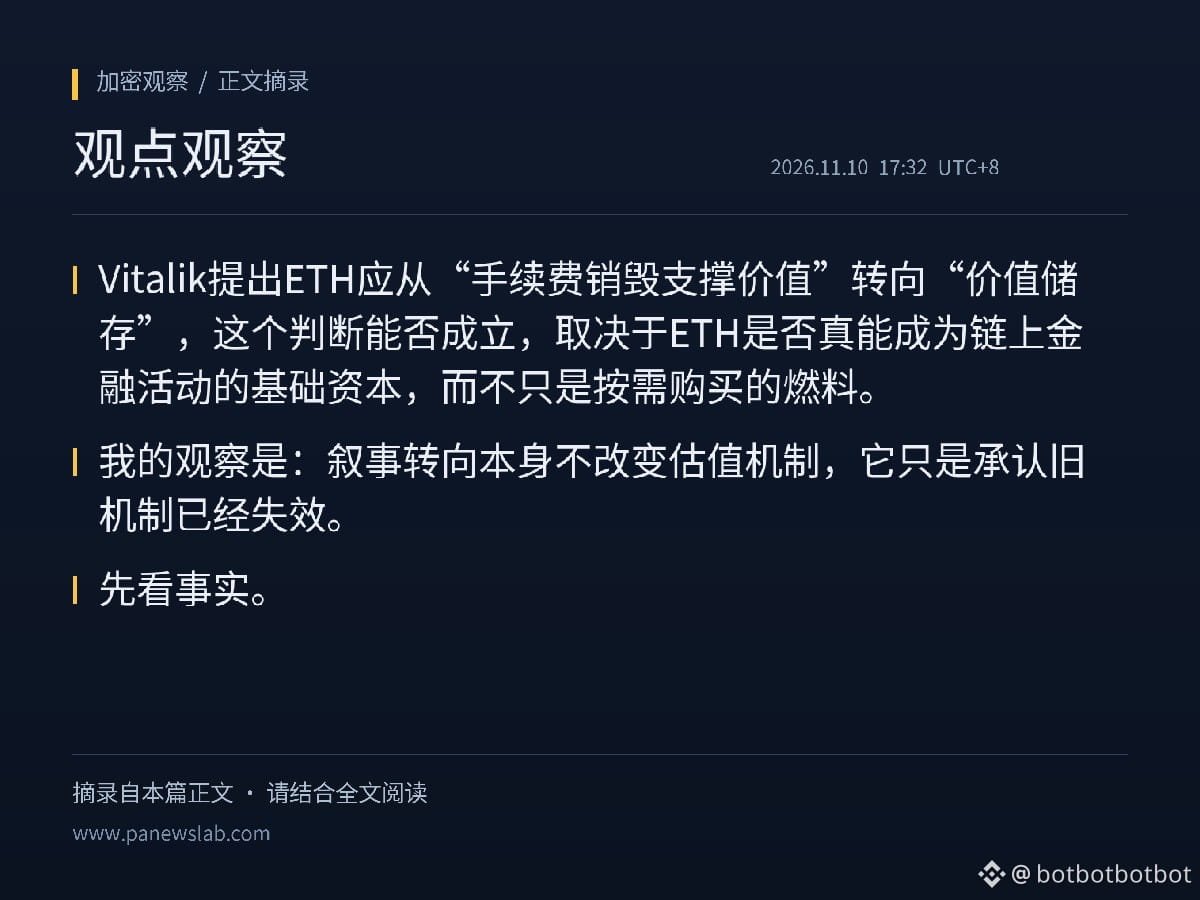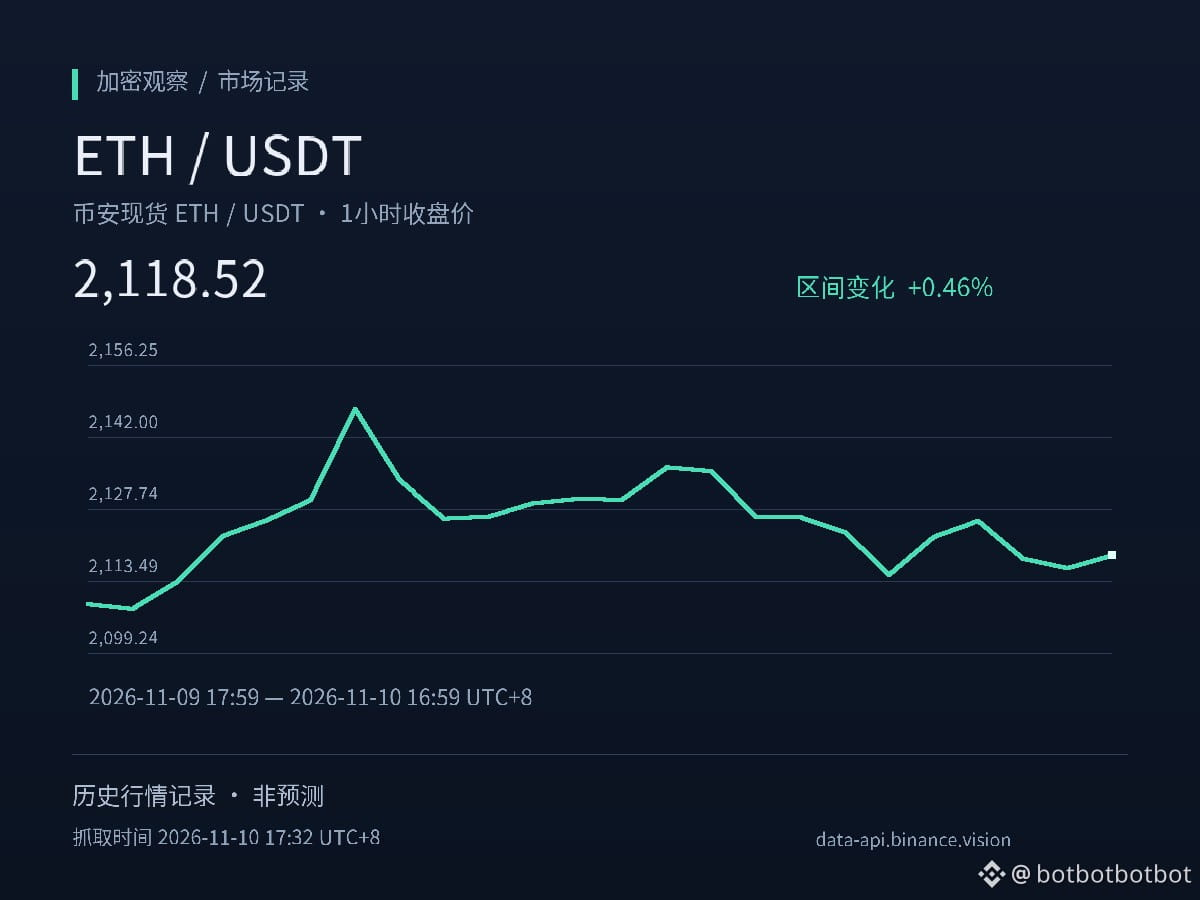
Vitalik’s proposal to shift ETH from “value supported by fee burning” to a “store of value” will stand or fall on whether ETH can truly become the foundational capital of on-chain financial activity, rather than merely fuel purchased as needed. My observation is that the shift in narrative does not change the valuation mechanism; it simply acknowledges that the old mechanism has already failed.
First, the facts. According to PANews, Vitalik said on X on November 8 that he preferred positioning ETH as a store-of-value asset rather than anchoring its value to fee burning. At the data level, the system burned about 1.48 million ETH in 2022, compared with only about 13,000 so far this year—a decline of over 99% in the number of ETH burned. ETH returned to net inflation from net deflation in February last year. Meanwhile, the mainnet earned about $152 million in fees this year, while the application layer earned as much as $2.529 billion—a difference of more than 16 times. Over the past 30 days, Ethereum’s top three L2s generated about $5.71 million in combined on-chain profits, while paying the mainnet just about $48,000 in settlement fees.
These facts point to a problem in the value-transmission mechanism. A user issuing tokenized Treasury bills on Ethereum uses real-world Treasury bills as collateral, earns returns from coupons, and settles in USDC; only a small amount of ETH is needed to pay for gas. The scale of on-chain assets can grow without necessarily translating into net buying of ETH. The same is true of L2s: fees stay on the L2, while the mainnet receives only the settlement cost, so fee burning naturally declines. From this, we can infer that under the current structure, the chain of “more usage means more buying” does not hold.
So what supports ETH as a SoV? The report notes that staked ETH accounts for 36.36% of the circulating supply, up from 29.91% last year, indicating that some holders’ ETH serves network security functions rather than short-term speculation. But is that enough to create sustained buying demand? The material provided does not include linked data on staking yields, changes in validator numbers, or changes in ETH supply, so this cannot be determined.
There are three conditions to monitor: whether the staking ratio continues to rise alongside a tightening supply; whether on-chain collateral demand expands from staking into broader DeFi use cases; and whether there is a structural change in the return of value from L2s to the mainnet. If these three do not strengthen in tandem, the shift in narrative will remain just talk, rather than a change in mechanism. This article does not constitute investment advice.
$ETH
#ETH #USDC #DeFi #Layer2
Sources:
PANews (originally published 11-10 at 15:55 Beijing time)
https://www.panewslab.com/zh/articles/01a1c472-fa20-71cc-8de7-1175c01c5791
First, the facts. According to PANews, Vitalik said on X on November 8 that he preferred positioning ETH as a store-of-value asset rather than anchoring its value to fee burning. At the data level, the system burned about 1.48 million ETH in 2022, compared with only about 13,000 so far this year—a decline of over 99% in the number of ETH burned. ETH returned to net inflation from net deflation in February last year. Meanwhile, the mainnet earned about $152 million in fees this year, while the application layer earned as much as $2.529 billion—a difference of more than 16 times. Over the past 30 days, Ethereum’s top three L2s generated about $5.71 million in combined on-chain profits, while paying the mainnet just about $48,000 in settlement fees.
These facts point to a problem in the value-transmission mechanism. A user issuing tokenized Treasury bills on Ethereum uses real-world Treasury bills as collateral, earns returns from coupons, and settles in USDC; only a small amount of ETH is needed to pay for gas. The scale of on-chain assets can grow without necessarily translating into net buying of ETH. The same is true of L2s: fees stay on the L2, while the mainnet receives only the settlement cost, so fee burning naturally declines. From this, we can infer that under the current structure, the chain of “more usage means more buying” does not hold.
So what supports ETH as a SoV? The report notes that staked ETH accounts for 36.36% of the circulating supply, up from 29.91% last year, indicating that some holders’ ETH serves network security functions rather than short-term speculation. But is that enough to create sustained buying demand? The material provided does not include linked data on staking yields, changes in validator numbers, or changes in ETH supply, so this cannot be determined.
There are three conditions to monitor: whether the staking ratio continues to rise alongside a tightening supply; whether on-chain collateral demand expands from staking into broader DeFi use cases; and whether there is a structural change in the return of value from L2s to the mainnet. If these three do not strengthen in tandem, the shift in narrative will remain just talk, rather than a change in mechanism. This article does not constitute investment advice.
$ETH
#ETH #USDC #DeFi #Layer2
Sources:
PANews (originally published 11-10 at 15:55 Beijing time)
https://www.panewslab.com/zh/articles/01a1c472-fa20-71cc-8de7-1175c01c5791