



Bitcoin spent all of October seesawing around $80,000 and is back at $80,950 today, with a 24-hour range of $79,506–$81,300. Ethereum is at $2,354, up less than 1%, but still 52% below its all-time high. The real headline events are still ahead: tonight’s Fed rate decision and the U.S. midterm elections in a week could both redefine the direction of the market.
◆ BTC’s technical levels: the lines are drawn on both sides
On-chain and institutional consensus levels paint a clear picture of the battle around $80,000.
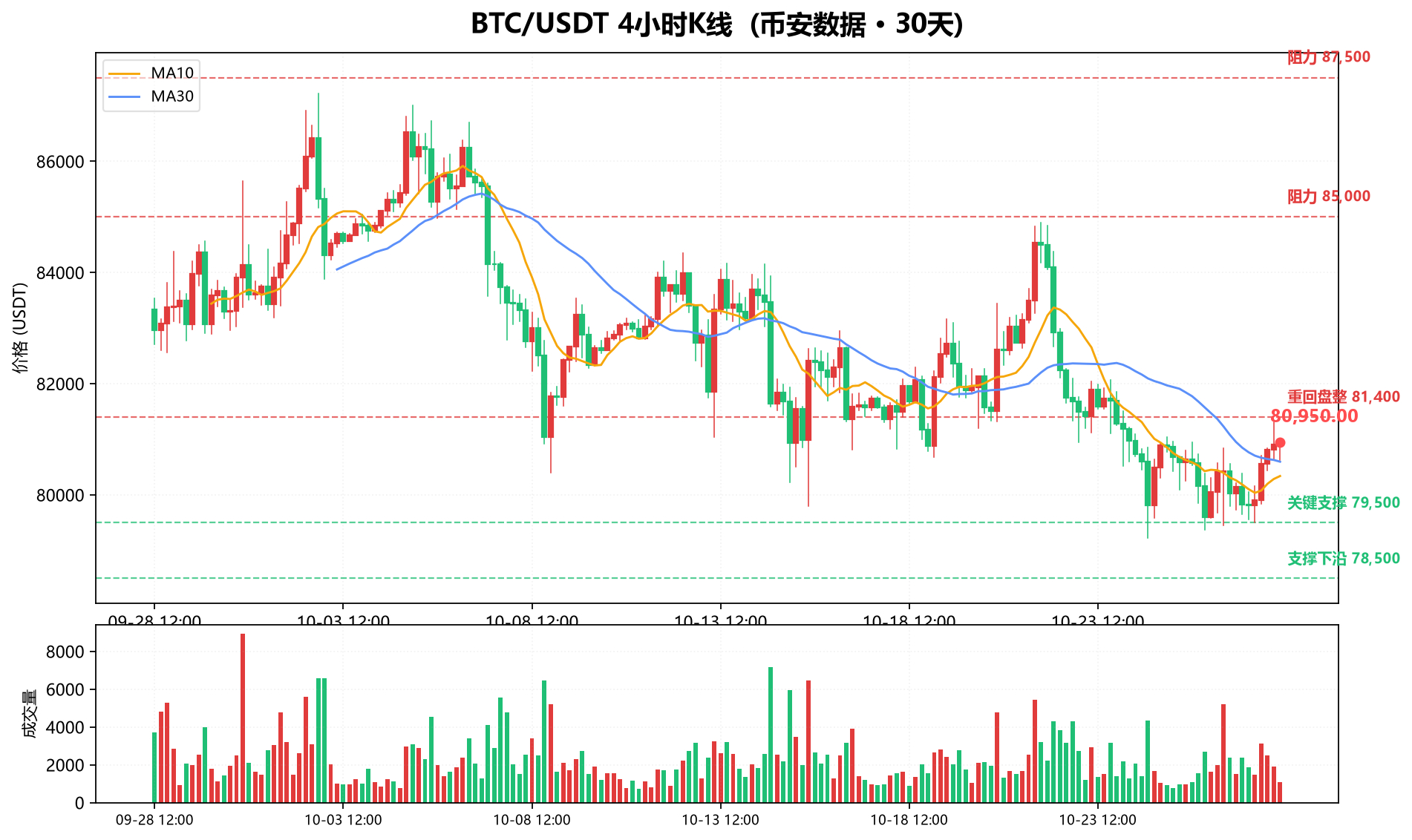
There are two support levels below. The first is the $78,500–$79,500 zone: this is the trendline from the recent consolidation, and it contains the true market average ($77,500–$78,000) after excluding long-dormant coins. It is being tested repeatedly. The second is $74,600, which corresponds to the average cost basis of short-term holders. Further down, $75,500 is a key structural dividing line. Professional analysts are clear: a decisive break below $75,500 would put the bullish structure established since the summer lows at risk of structural damage.
Overhead pressure is coming from ETF investors. The weighted average cost basis of U.S. spot Bitcoin ETFs is around $81,500. Every time the price rebounds to that level, it runs into a large number of investors waiting to break even and exit. A move back above $81,400 would put it back in the consolidation range. Above that, $85,000 and $87,500 are the two major resistance levels; only after breaking through them can we talk about $95,000 to $98,000.
One reassuring data point: around 70% of all coins across the network are still in profit, and long-term holders have an average cost basis of just $49,000, giving them a cushion of more than 30% from the current price. The short term is a tug-of-war, but the foundation hasn’t cracked.
◆ ETH: The perennial runner-up that follows BTC down but not up
Ethereum is at $2,354. On the 4-hour chart, the 30-day high is $2,800, while the low dipped below $2,300. Recently, it has been fluctuating just above the $2,300 level, with both the MA10 and MA30 trending down and acting as resistance. Overhead resistance lies at $2,800 (the 30-day high) and the $3,000 round-number level; support is at $2,300 and the previous low. Trading volume has expanded noticeably during declines and contracted during rebounds, which lack volume support.
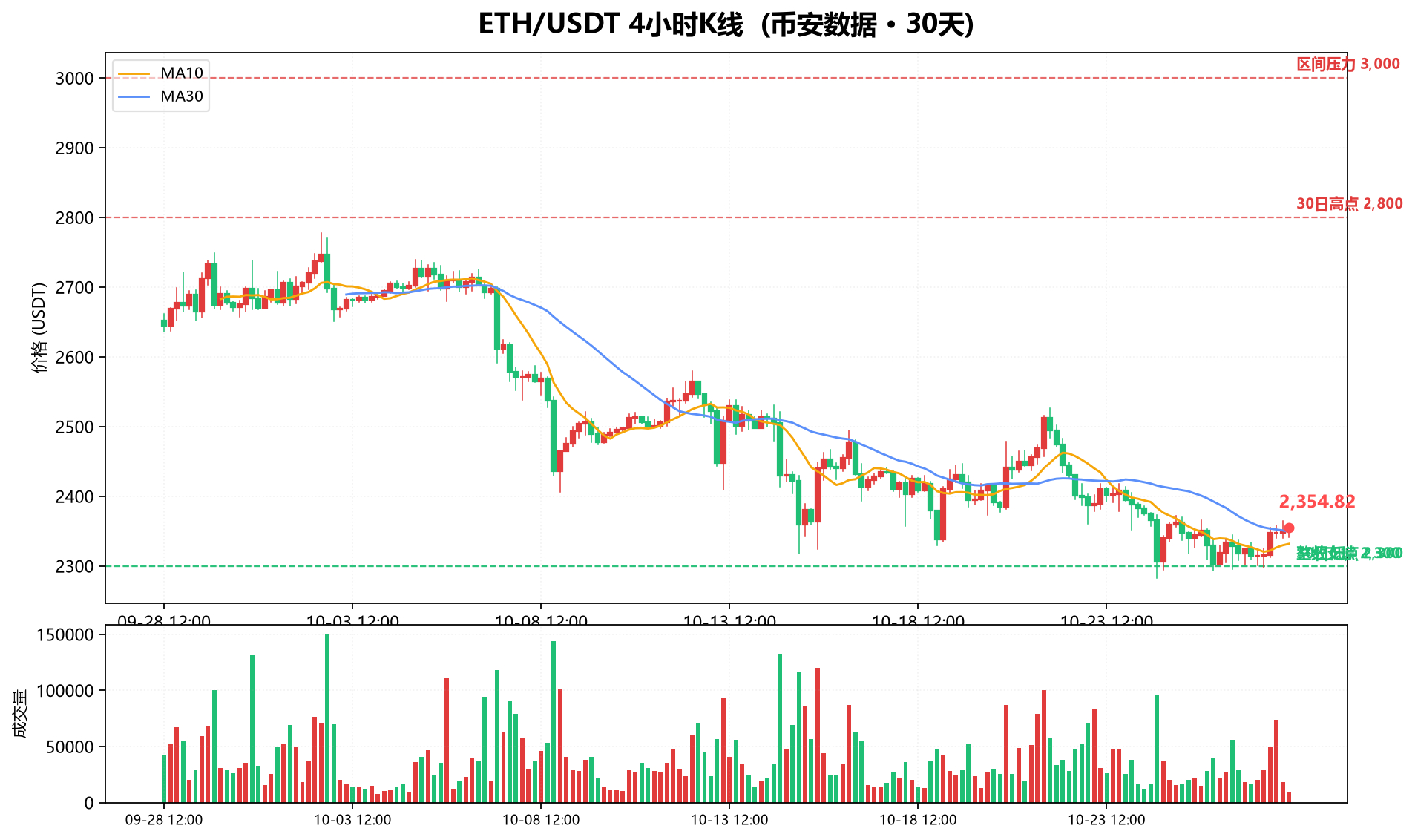
Ethereum is still 52% below its all-time high. It has rebounded 6.87% over the past 7 days, but remains down 27% over 90 days. The ETH/BTC ratio is 0.03, with investors preferring to stay in Bitcoin. In this cycle, ETH is still the same runner-up that follows BTC down but not up.
◆ Capital flows: Institutions are sharply divided around $80K
U.S. spot Bitcoin ETFs saw cumulative net outflows of $312 million in October. The past few days have been even more chaotic: BlackRock’s IBIT saw $665 million in net inflows on October 19, followed by another $528 million on October 21. Then, on October 22, the market as a whole saw $636 million in net outflows—the largest single-day redemption in nearly four months. Institutions are basically calling each other idiots around the $80K level.
The options market is even more telling: the Deribit Volatility Index has risen to 38, and implied volatility for put options is 44%, well above the 38% for calls with the same expiration. Hedging demand is clearly outweighing speculation.
Corporate buying is also slowing. Strategy didn’t buy a single Bitcoin last week, the first time in weeks; all its money went toward buying back STRC preferred shares. More concerning is MSCI’s new rule: it will announce the list on November 11, and Strategy could be removed from global indexes starting November 30. If passive funds exit, the company’s stock-funded Bitcoin-buying flywheel will slow down. One of the most consistent sources of marginal buying over the past two years is weakening.
◆ Two potential bombs: tonight and next week
The first is the FOMC. The rate decision will be announced at 2 a.m. Beijing time on October 29, followed by a press conference from Warsh. The market expects rates to hold steady, but September CPI came in above expectations at 3.7%, and the probability of a December rate hike has already surged to 90%. Even slightly hawkish language could send risk assets lower first.
The second is the U.S. midterm elections on November 4, now just a week away. The crypto industry has poured more than $100 million into political donations this cycle, and the election will directly affect the direction of regulation over the next four years. News flow is likely to keep markets volatile ahead of the election.
External factors are also weighing on markets: Brent crude briefly approached $117, with geopolitical risks still unresolved; Nvidia fell 8% this week and Meta fell 9%, as sentiment toward tech stocks weakened.
◆ My take
In the short term, BTC is in the safe zone as long as it holds $79,500–$80,000. If it breaks below that, the next level to watch is $75,500; a move back above $81,400 would signal stabilization. If ETH can’t get past $2,800, it will likely keep moving sideways—don’t expect it to lead the way.
In the medium term, tonight’s FOMC meeting and next week’s election are the triggers that will determine direction. Taking a heavy directional bet before these events is tantamount to putting your fate in Powell’s hands. My advice: wait until the events are over before acting. Volatility will increase, so position sizing is the first rule of survival.
How late will you be watching the FOMC tonight? Let’s talk in the comments.

