
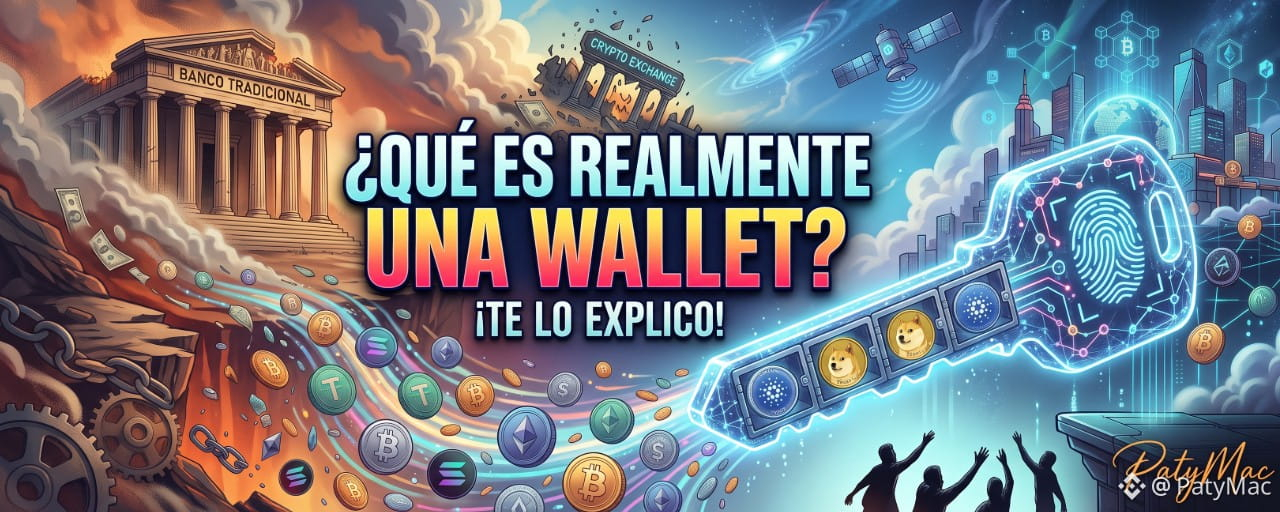

When someone starts with cryptocurrencies, one of the first things they hear is:
“You need a wallet.”
And then a seemingly simple question appears:
What is a wallet and where are my cryptocurrencies really?
The answer may surprise you:
👉 A wallet doesn’t work like a traditional wallet.
It’s not a digital box where your Bitcoins, your USDT, or your Ethereum are stored.
A wallet, in simple terms, is a tool that allows you to manage your keys and authorize movements of assets recorded on a blockchain.
And understanding this difference is fundamental for security.
🧩 So… where are my cryptocurrencies?
When you have Bitcoin, for example, what exists on the Bitcoin network is a record that a certain amount of BTC is associated with certain spending conditions.
The blockchain keeps that record.
Your wallet uses cryptographic information that allows you to prove you have authorization to move those funds.
That’s why one very important phrase in crypto is:
“Not your keys, not your coins”.
“Not your keys, not your coins”.
It doesn’t mean that cryptocurrencies disappear just because they’re on an exchange.
It means there’s a difference between:
having a balance on a platform that controls the keys, and
controlling the keys yourself that allow you to move the assets.
🔑 What does a wallet really control?
Basically, the cryptographic keys needed to interact with the blockchain.
And here are three concepts that many people often confuse:
1️⃣ Public address
It’s the information you can share to receive certain assets.
It’s similar to a bank address in the sense that other people can use it to send you funds.
But it’s not a password.
2️⃣ Private key
It’s cryptographic information that allows you to authorize certain operations.
It should never be shared.
Whoever gains control over a private key can, depending on the system, have the ability to move the associated assets.
3️⃣ Seed phrase
It’s the so-called recovery phrase, generally formed by a sequence of words.
It may allow you to recover the keys of a wallet.
That’s why:
your seed phrase is not information to send on WhatsApp, save in a screenshot, or enter on any page that asks for it.
🧊 Are all wallets the same?
No.
A fundamental classification is:
🔥 Hot wallet
It’s connected to the Internet and is usually used through an application, a browser extension, or a connected device.
It’s practical for operating, but exposure to the Internet introduces additional risks.
❄️ Cold wallet
Keeps the private keys in an environment designed to reduce their exposure to the Internet.
Hardware wallets are a well-known example.
But be careful:
“Cold wallet” does not mean “impossible to hack”.
Security also depends on how you protect your device, your seed phrase, and your recovery procedures.
🏦 And what happens when you have crypto on Binance or another exchange?
Here a fundamental difference appears.
On a custodial exchange, normally the platform manages the keys associated with the assets it keeps under its custody.
You see a balance in your account.
But that doesn’t necessarily mean you have the corresponding private keys in your possession.
This introduces a concept we’re going to develop later:
Counterparty risk.
If you rely on a company to custody your assets, you also rely on its infrastructure, security, operations, contractual terms, and legal situation.
That’s why the debate isn’t simply:
“Exchange or wallet?”
The real question is:
“Who controls the keys and what rights do I have over the assets?”
⚠️ The most dangerous beginner mistake
Thinking that having a wallet automatically means you’re protected.
No.
You can lose funds due to:
hand over your seed phrase;
install a malicious app;
sign a transaction you don’t understand;
connect to a fraudulent website;
send funds over the wrong network;
lose recovery credentials;
use the wrong address;
or compromise the device from which you manage the wallet.
Self-custody eliminates certain risks, but it also increases your responsibility.
🇵🇾 And what does this have to do with Paraguay?
A lot.
The Central Bank of Paraguay has stated that cryptocurrencies such as Bitcoin have no legal tender status, no mandatory power to extinguish debts in Paraguay, and do not have state backing.
Additionally, Paraguayan law includes virtual asset service providers within the framework for preventing money laundering.
This means that the Paraguayan user shouldn’t only think about:
“Where do I buy Bitcoin?”
You should also ask:
Who custodies my assets?
What entity am I using?
In which jurisdiction is it?
What happens if I lose access?
What happens if the platform stops operating?
🧠 THE IDEA I WANT YOU TO TAKE WITH YOU
A wallet isn’t simply a “digital wallet.”
It’s a tool for managing the cryptographic credentials that allow you to interact with assets recorded on a blockchain.
And the more you understand about:
wallet → address → private key → seed phrase → custody → blockchain
the harder it will be for someone to trick you.
Because in crypto, often the first line of defense is not the price of Bitcoin.
🔐 It means understanding who has the keys.
❓ INTERESTING QUESTIONS
Does a wallet physically hold my Bitcoins?
No. The assets are recorded on the blockchain; the wallet manages the keys needed to interact with them.
Can I share my public address?
Yes, normally it’s precisely the information used to receive funds. But remember that transactions can be publicly visible depending on the blockchain.
Can I share my private key?
No.
And my seed phrase?
Nor should it be. It must be treated as extremely sensitive information.
Does a cold wallet eliminate all risks?
No. It reduces certain risks related to exposing the keys, but it introduces custody and recovery responsibilities.
Having crypto on an exchange means it’s not mine?
The legal answer depends on the contractual structure, the jurisdiction, and the nature of the custody. That’s why “having a balance” and “controlling the keys” are not necessarily the same thing.
📌 Crypto Glossary #1
WALLET = a tool for managing cryptographic keys and interacting with assets recorded on a blockchain.
And if you understand this, you’re ready for the next term:
🔑 PRIVATE KEY
The information that can give you the power to move your assets… and that you should never hand over to someone else.



#GlosarioCripto #Wallet #CryptoSecurity #Blockchain #CryptoEducation