【CJ Market Making Notes 06/14】
After becoming an LP, the question changes from “Should I buy here?” to “How long can this range last?”
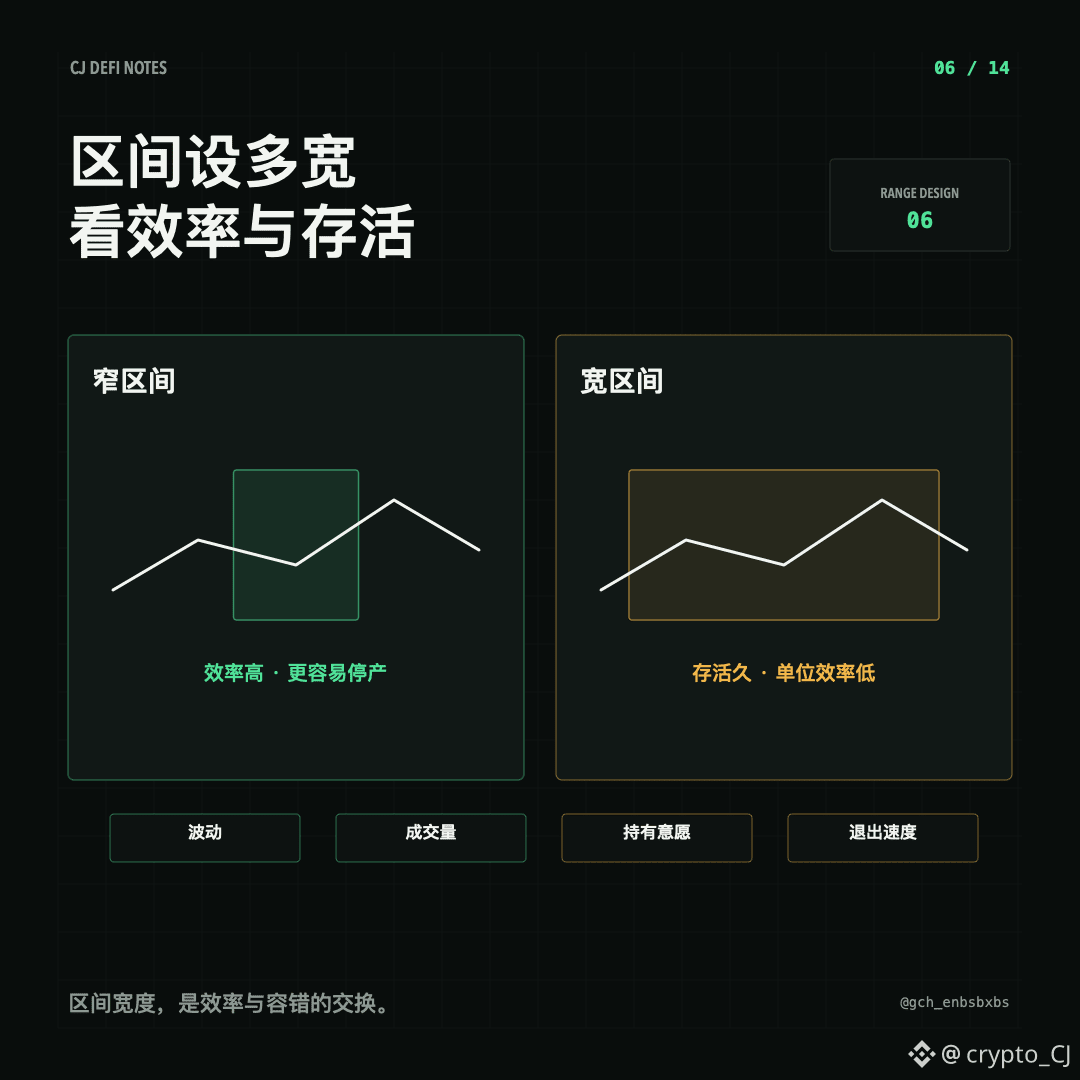
With a narrow range, capital is more concentrated. Under the same trading volume, capital efficiency and the Fee share may be higher. But if the price moves just a little farther, the pool will leave the range and stop generating fees. A wider range can better withstand volatility, but the capital is spread out more; the Fee earned per unit of capital often ends up lower. There’s no fixed answer for wide vs. narrow—they’re about trading off efficiency versus survival time.
When I set a range, I look at four things at the same time: how large the recent real volatility is, whether trading volume is sustained, which asset type I’m willing to hold, and how quickly I can tell the pool has stopped producing. In markets with high trading volume and slow-moving volatility, you can consider a more concentrated range. But when volatility is very high and trading volume is unstable, simply widening the range may not solve the problem—exiting that pool may be more reasonable.
A range must also include exit conditions. At what price level do you re-evaluate? After leaving the range for how long do you withdraw? What level of accumulated Fees is acceptable? These must be written clearly before you enter. Otherwise, so-called range management ultimately becomes on-the-spot guesswork about direction.
Next: How should an LP express bullish vs. bearish judgments?
#DeFi #LP区间
After becoming an LP, the question changes from “Should I buy here?” to “How long can this range last?”
With a narrow range, capital is more concentrated. Under the same trading volume, capital efficiency and the Fee share may be higher. But if the price moves just a little farther, the pool will leave the range and stop generating fees. A wider range can better withstand volatility, but the capital is spread out more; the Fee earned per unit of capital often ends up lower. There’s no fixed answer for wide vs. narrow—they’re about trading off efficiency versus survival time.
When I set a range, I look at four things at the same time: how large the recent real volatility is, whether trading volume is sustained, which asset type I’m willing to hold, and how quickly I can tell the pool has stopped producing. In markets with high trading volume and slow-moving volatility, you can consider a more concentrated range. But when volatility is very high and trading volume is unstable, simply widening the range may not solve the problem—exiting that pool may be more reasonable.
A range must also include exit conditions. At what price level do you re-evaluate? After leaving the range for how long do you withdraw? What level of accumulated Fees is acceptable? These must be written clearly before you enter. Otherwise, so-called range management ultimately becomes on-the-spot guesswork about direction.
Next: How should an LP express bullish vs. bearish judgments?
#DeFi #LP区间