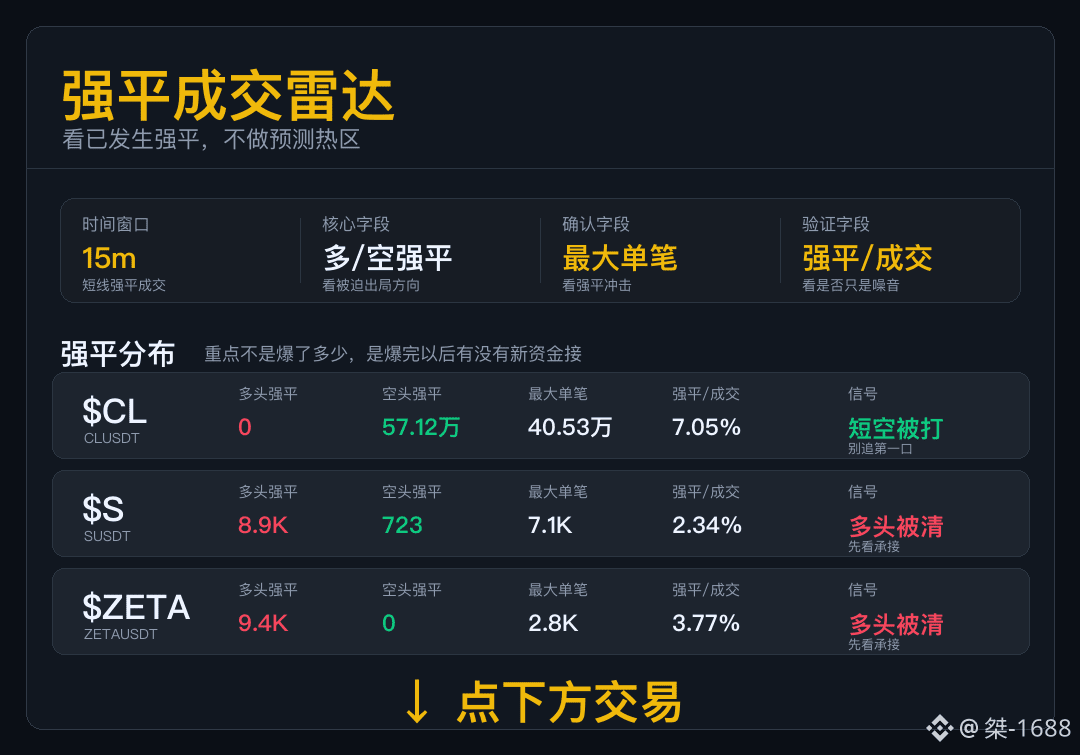

High-Position Forced Liquidation Radar
For data like “strong flat,” first see who is being forced out.
After the short position of $CL gets squeezed out, the first leg usually moves faster; the second leg depends on whether new buy orders are willing to follow.
$S 15m The longs being liquidated are clearly higher than the shorts—leveraged long positions are being forced to exit.
$ZETA This segment mainly reflects longs passively getting liquidated. Whether it can rebound after the drop depends on whether follow-up support comes in afterward.
When the forced-liquidation structure splits, the next step depends on how each side’s trading/repairs play out; it isn’t something that can be summarized in one sentence.
For data like “strong flat,” first see who is being forced out.
After the short position of $CL gets squeezed out, the first leg usually moves faster; the second leg depends on whether new buy orders are willing to follow.
$S 15m The longs being liquidated are clearly higher than the shorts—leveraged long positions are being forced to exit.
$ZETA This segment mainly reflects longs passively getting liquidated. Whether it can rebound after the drop depends on whether follow-up support comes in afterward.
When the forced-liquidation structure splits, the next step depends on how each side’s trading/repairs play out; it isn’t something that can be summarized in one sentence.