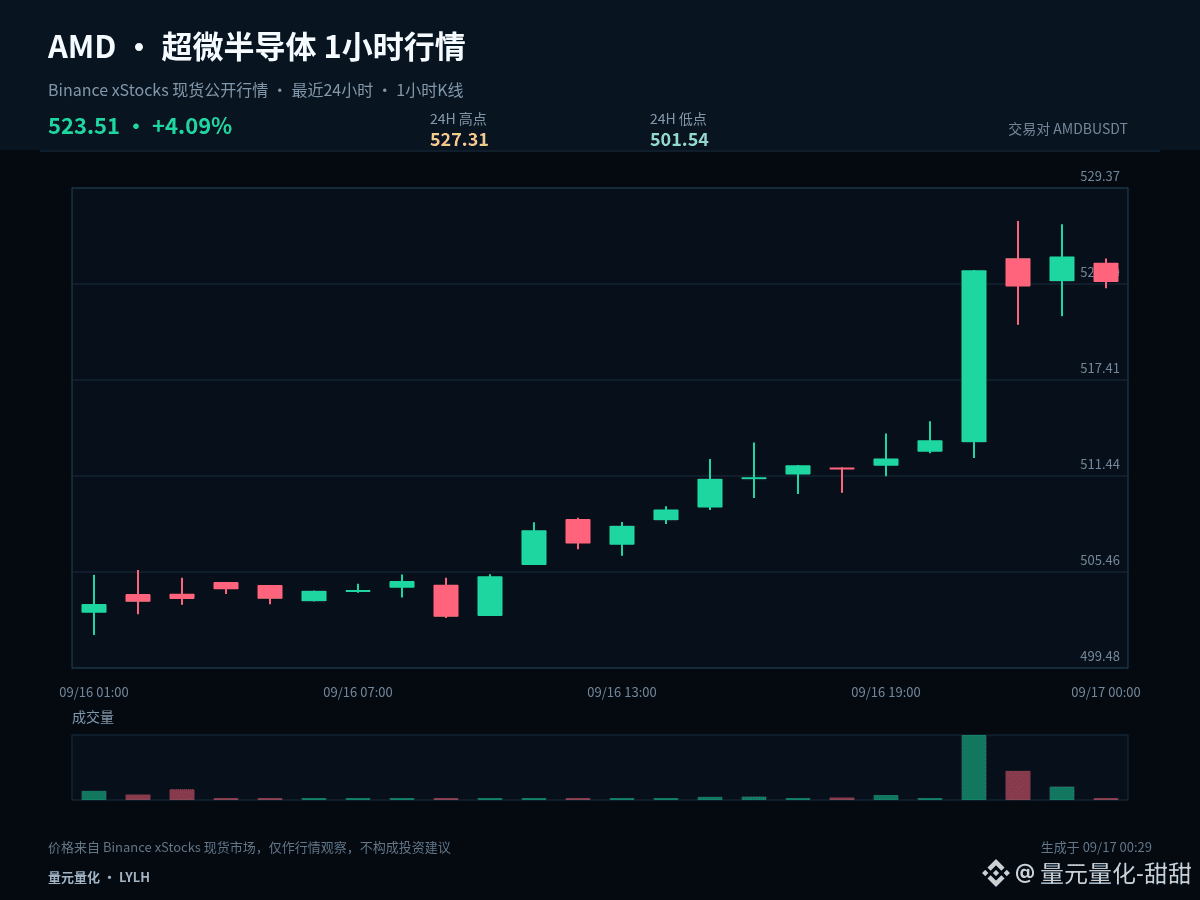
$AMDB #AMD Approaching the 24-hour high again. The closer it gets to the pressure zone, the more important the closing position and the subsequent retest become; breaking through during the session alone does not mean it’s really holding.
Current price is near the upper band of the last 24 hours’ fluctuation range: 1-hour -0.30%, 24-hour +4.07%. The most important thing at the high is to confirm the market’s acceptance after the breakout: if price can stay above the upper band, it shows the market recognizes a higher range. If it only briefly pierces through and then quickly pulls back, you need to guard against a false breakout.
For the short term, first watch whether 501.54 can form sustained support, then whether 514.425 can be reclaimed. The former determines whether the decline can slow down; the latter determines whether the rebound can strengthen. Until both are confirmed, it’s not advisable to judge opportunities based on drawdown magnitude alone.
There are three ways to handle the next path: if it effectively holds above 527.31, wait for a pullback that doesn’t break before reassessing continuation; if it breaks down below 501.54, prioritize controlling risk and wait for a new support level; if it keeps oscillating around 514.425, treat it as a range rotation and don’t chase a direction repeatedly in the middle of the range.
Existing positions can be managed in stages around key levels to avoid making all decisions at once. Those with no position should wait for confirmation of the breakout or for a pullback to stabilize. For US stocks, also note the volatility caused by session transitions. Let price conditions guide your plan—don’t let emotions replace execution.
The real divergence in this行情 is whether it will continue or revert to the range. Will you wait for breakout confirmation, or wait for a support pullback test? Share the price level you’re most focused on.
#FedRateWatch
Current price is near the upper band of the last 24 hours’ fluctuation range: 1-hour -0.30%, 24-hour +4.07%. The most important thing at the high is to confirm the market’s acceptance after the breakout: if price can stay above the upper band, it shows the market recognizes a higher range. If it only briefly pierces through and then quickly pulls back, you need to guard against a false breakout.
For the short term, first watch whether 501.54 can form sustained support, then whether 514.425 can be reclaimed. The former determines whether the decline can slow down; the latter determines whether the rebound can strengthen. Until both are confirmed, it’s not advisable to judge opportunities based on drawdown magnitude alone.
There are three ways to handle the next path: if it effectively holds above 527.31, wait for a pullback that doesn’t break before reassessing continuation; if it breaks down below 501.54, prioritize controlling risk and wait for a new support level; if it keeps oscillating around 514.425, treat it as a range rotation and don’t chase a direction repeatedly in the middle of the range.
Existing positions can be managed in stages around key levels to avoid making all decisions at once. Those with no position should wait for confirmation of the breakout or for a pullback to stabilize. For US stocks, also note the volatility caused by session transitions. Let price conditions guide your plan—don’t let emotions replace execution.
The real divergence in this行情 is whether it will continue or revert to the range. Will you wait for breakout confirmation, or wait for a support pullback test? Share the price level you’re most focused on.
#FedRateWatch