
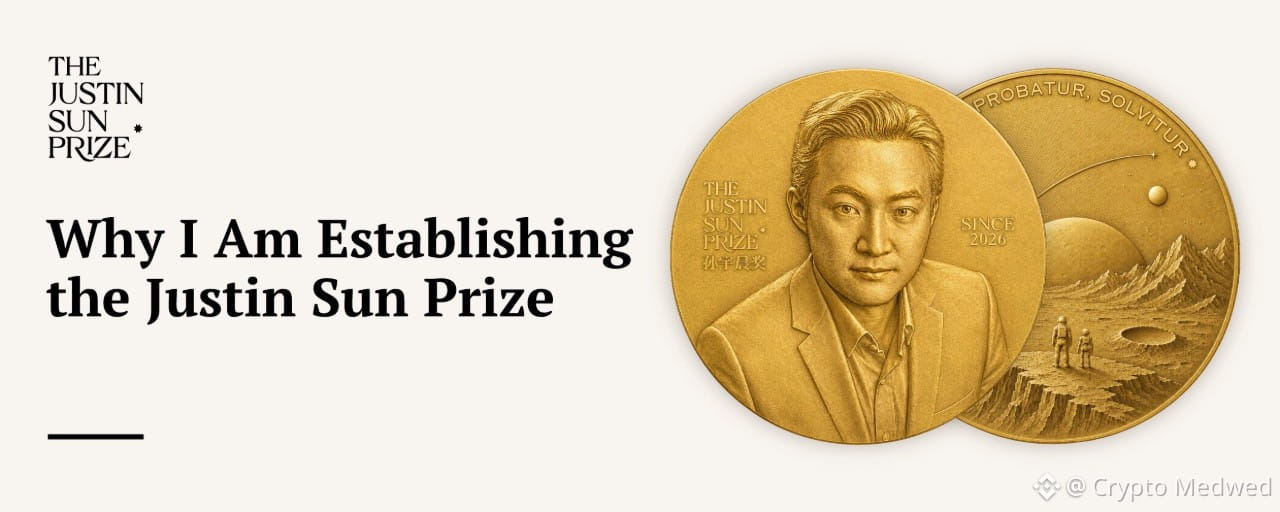

TRON founder Justin Sun announced the creation of the Justin Sun Prize, a new award for solving complex mathematical problems and formalizing proofs for machine verification.
The idea clearly differs from traditional scientific awards. There are no age restrictions, no annual ceremony, and no classic commission vote. The main requirement for receiving the prize is that the mathematical proof ultimately undergo complete machine verification without errors.
What’s especially interesting is that the prize rules initially take the new reality into account: people, artificial intelligence, or a person together with AI will be able to solve problems.
Two awards for one mathematical problem
Two separate roles are provided for each problem.
The first - prover, that is, the author of the mathematical proof.
Second - formalizer, a person or system that translates this proof into a rigorous form that allows a computer to verify every step.
One participant can play both roles, or entirely different people may. At the same time, Sun explicitly states that it doesn’t matter to him who obtained the result—whether it’s a person, AI, or a combination of them.
If the mathematical community recognizes the new proof as correct, the name of its author will be recorded immediately. But the money will remain locked with the status “Proved, pending formalization” until the formalization is completed and the proof is checked by machine.
It turns out to be an interesting model. Proving a theorem isn’t enough; the proof also has to be made fully understandable and verifiable for a machine.
Why Sun decided to create a mathematical prize
Justin Sun ties his motivation directly to the origins of the crypto industry. He notes that blockchain exists thanks to mathematics and cryptography: elliptic curves, hash functions, and other mathematical constructs.
According to him, a significant part of his fortune came from an industry built on these discoveries, so creating a prize could return part of what he received back into fundamental mathematics.
As a historical example, Sun recalls the mathematician Paul Erdős, who set his own monetary awards for solving open mathematical problems ranging from $25 to $10,000. In practice, the Justin Sun Prize carries this idea into the AI and blockchain era.
Why is artificial intelligence so important here
In Sana’s view, mathematics is entering a completely new era. AI is especially well suited for tasks related to logical reasoning and searching through a large number of possible solution paths. Therefore, the speed at which mathematical proofs appear and are checked could potentially increase significantly.
That’s why the prize won’t be held once every few years. Instead, a continuously updated registry of mathematical problems is created with predetermined rewards.
Sun retains the right to determine which problems appear in the list and how much their solution will cost. But once a problem is added, it cannot be removed, and the reward allocated for it cannot be returned to the sponsor.
Blockchain instead of trust in the organizer
Another unusual part of the Justin Sun Prize is the use of blockchain for the prize pool. According to Sun, the initial fund has already been placed on-chain, and its address and balance are publicly available. Sun himself retains only the ability to add new funds.
All payouts to winners must also remain on the blockchain, allowing the history of how prizes are distributed to be independently verified. Winning mathematical proofs are planned to be published openly.
Thus, Sun wants to minimize the need to trust him personally or a separate commission: the correctness of the formalized proof must be determined by mathematics and machine verification, and the movement of prize funds must be recorded on-chain.
The prize is not limited to people
Perhaps the most unusual feature of the Justin Sun Prize is exactly here. Traditional science prizes are designed to recognize the achievements of people. In the new system, the origin of the solution should not be of fundamental importance.
If AI finds a proof on its own, or a person obtains it jointly with AI, the result may be eligible for recognition under the same conditions. The main thing is the correctness of the proof and the ability to formally verify it. This turns the prize into an experiment at the intersection of mathematics, AI, and blockchain.
Why the prize was named after Justin Sun
Sun also separately explains the idea of naming the solution as a prize in his own name. He cites examples such as the Nobel Prize, Fields Medal, Abel Prize, and Turing Award, and believes that a personal name allows the initiative to exist independently of companies and institutions.
In addition, the 36-year-old Sun writes that the fortune he has already accumulated is enough for him, and he wants to determine its further purpose himself: capital obtained thanks to mathematics should be returned to mathematics.
Moreover, he says he intends to focus his further charitable efforts specifically on the Justin Sun Prize, because he believes this initiative is his potentially most significant contribution. As long as the prize is devoted exclusively to mathematics.
Conclusion
What’s most interesting about the Justin Sun Prize isn’t even the prize pool itself, but the attempt to create a new model of scientific remuneration for the age of artificial intelligence. Here, three areas come together at once: mathematics provides the problem, AI can take part in solving and formalizing it, and the blockchain ensures transparency of the reward.
Especially telling is the absence of any fundamental separation between a person and a machine. If AI truly starts solving serious mathematical problems on its own, the Justin Sun Prize could potentially become one of the experiments where such results are not just demonstrated, but formally verified, recorded, and given economic value.
Now the main question is which specific unsolved mathematical problems will appear in the official registry, and what amounts Sun will set for their solution.