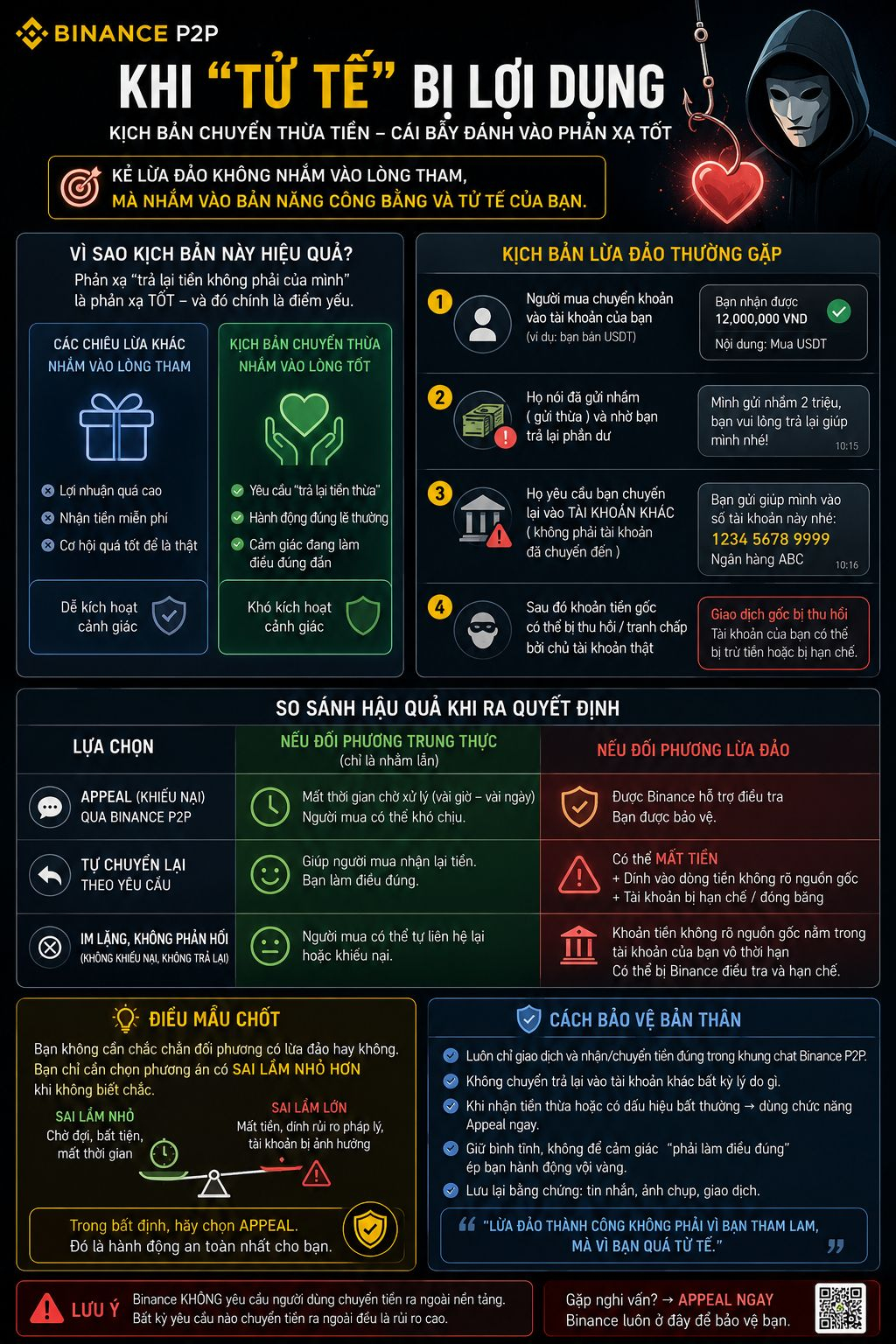
I notice a psychologically noteworthy detail in the context of transferring funds scams on Binance P2P: the scammer doesn’t prey on greed, but on the seller’s own instincts to be fair and kind—this is why this scenario is far more effective than scam tactics based on enticing offers of benefits.
With most other scams, people are taught to be vigilant when they see opportunities that are “too good to be true”—getting extra free money, abnormal profits. But here, the seller is not asked to keep the extra funds—instead, they’re instructed to return them. Their actions are completely consistent with common sense. Precisely because the reflex to “return money that isn’t yours” is a good one, this situation is easier to get past the psychological defenses that people often use to protect themselves from scams.
There are scams that exploit the very instinct to be kind, making the targeted person feel like they are doing the right thing while, in reality, they are being led into risky actions. The request to transfer to a different account—rather than refunding to the exact account the payment was sent to—is a small detail, but it’s the key deciding factor.
Self-reflection: recognizing this psychological mechanism doesn’t automatically make you immune to it in real life—knowing the theory and responding correctly under pressure are two different things, especially when the person making the request acts in a hurry or creates a sense of urgency.
I’m waiting to see whether Binance P2P will provide a specific warning for this kind of scam that takes advantage of the “kindness reflex,” because it is different enough that it may require its own explanation rather than relying on standard scam warnings.
#binancep2pantoan @Binance Vietnam $BTC
With most other scams, people are taught to be vigilant when they see opportunities that are “too good to be true”—getting extra free money, abnormal profits. But here, the seller is not asked to keep the extra funds—instead, they’re instructed to return them. Their actions are completely consistent with common sense. Precisely because the reflex to “return money that isn’t yours” is a good one, this situation is easier to get past the psychological defenses that people often use to protect themselves from scams.
There are scams that exploit the very instinct to be kind, making the targeted person feel like they are doing the right thing while, in reality, they are being led into risky actions. The request to transfer to a different account—rather than refunding to the exact account the payment was sent to—is a small detail, but it’s the key deciding factor.
Self-reflection: recognizing this psychological mechanism doesn’t automatically make you immune to it in real life—knowing the theory and responding correctly under pressure are two different things, especially when the person making the request acts in a hurry or creates a sense of urgency.
I’m waiting to see whether Binance P2P will provide a specific warning for this kind of scam that takes advantage of the “kindness reflex,” because it is different enough that it may require its own explanation rather than relying on standard scam warnings.
#binancep2pantoan @Binance Vietnam $BTC