

Author: Arthur Hayes, Co-founder of BitMEX
Compilation: ShenChao TechFlow
ShenChao Guide: The Japanese yen is brewing a “quake.” Arthur Hayes believes the yen is the most undervalued currency globally, and that U.S.-Japan authorities have already chosen an “official plan” to strengthen the yen: Japan’s Ministry of Finance will take its $1.373 trillion in U.S. Treasuries, “pledge” them to the Federal Reserve via the Fed’s FIMA repo facility to receive dollars, and then go to the foreign exchange market to buy yen. This setup doesn’t sell assets or move markets, yet it’s essentially the Fed quietly printing money to expand its balance sheet. Once implemented, global dollar liquidity will once again flood the system, and historical experience tells us: Fed balance sheet expansion = Bitcoin and gold take off. Hayes has already heavily positioned in Bitcoin, gold, and gold-mining stocks, and he has also laid out his next outlook for Ethereum and Ethena (ENA). This article breaks down this “FX backdoor” that mainstream attention has largely missed—and what it truly means for the crypto market.
An earthquake—and the yen’s “homecoming path”
Early March 2011, I was sitting at the trading desk of Deutsche Bank in the Hong Kong ICC building, making markets for a basket of ETFs for Hong Kong stocks and the Singapore Exchange. Suddenly, someone shouted across the room: a major earthquake has hit Japan. The office TVs switched to live footage from Tokyo—the picture was shaking. Then the news reported that a tsunami was rolling along the northeastern coast of Honshu. Fukushima was smoking, too. It was absolutely crazy.
The Nikkei index plunged almost 20% during the trading session. Meanwhile, USD/JPY collapsed all the way toward 70, and the yen soared to one of its strongest levels since World War II. I truly hate a strong yen. Last winter, I found Ni-se-ga-ya, but at an exchange rate of 80 yen per dollar it was ridiculously expensive.
All those MSCI Japan ETFs I bought, denominated in USD, naturally embed yen exposure. When the yen rises, it rises fast and hard—I don’t even have time to hedge the FX risk. Oh well. I just stubbornly hold the long USD/JPY exposure—because traders keep smashing my buy orders, and my ETF positions just keep getting larger. A veteran trader once said: When Japan faces a natural disaster (it sits on the Pacific Ring of Fire and gets hit more often than elsewhere), domestic institutions—especially insurance companies—will rush to bring overseas capital back home. That means selling overseas stocks and bonds, mainly U.S. ones—which matters a lot later: when the yen “goes home,” the currency strengthens.
The next day, the Nikkei kept opening lower. What the market feared most was a Chernobyl-style nuclear panic. The yen was still strengthening. My FX bets and aggressively wide quotes were making money. Later, the market rebounded, and I forgot the exact why—anyway, the situation calmed down. To rebuild the country and the financial markets, Shinzo Abe rolled out “Abenomics” in 2012—named after him—with a clear goal: weaken the yen. Let the Bank of Japan buy unlimited bonds under the YCC (yield curve control) framework, carry out aggressive fiscal expansion, and ultimately replace the leadership of Japan’s largest pension fund, GPIF, so it increases holdings of overseas stocks and bonds while suppressing domestic securities holdings. The result—this fallout is still tormenting the whole world today:
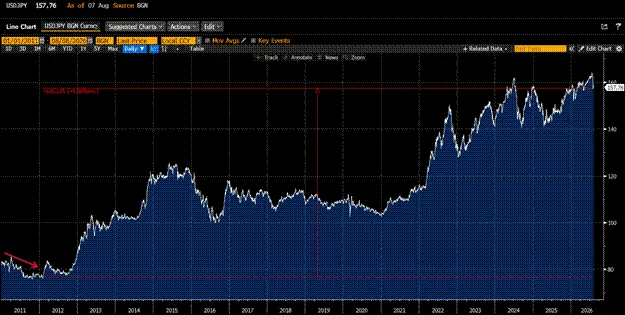
The yen has depreciated by more than half.
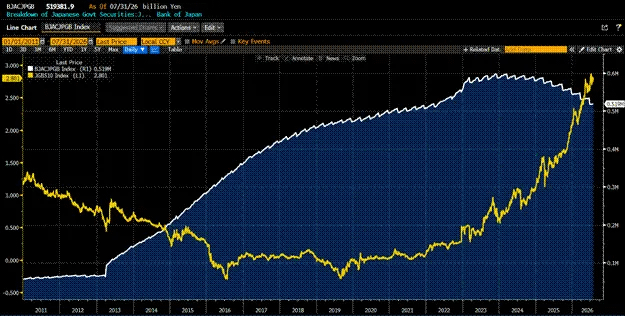
Chart: The Bank of Japan’s holdings of government bonds (white) show a steep upward trend, suppressing the yield on 10-year government bonds (gold).
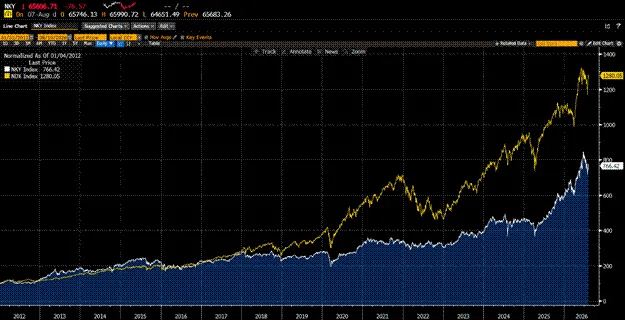
The collapse of the yen’s international purchasing power has undoubtedly been a huge success for global asset markets—the yen has effectively become a funding currency for companies and speculators. However, it also brings consequences. One of them is public anger. While there’s no direct link between the two, when you destroy workers’ dignity by distorting currency, something strange happens. Japanese people look docile and obedient on the surface, but in 2022, an attacker carrying a homemade gun assassinated Shinzo Abe, the prime minister who launched the yen depreciation frenzy, cold-bloodedly at a campaign rally. That’s the inflation version of “try it and see.”
Devaluation also breeds xenophobic sentiment. Last winter season, I often went to that off-piste ski resort. A Japanese guy yelled at me, saying I couldn’t “hustle” my way uphill on the slopes unless I bought a lift ticket. He didn’t know that the resort is actually owned by a Chinese conglomerate. Isn’t that ironic? He was furious at foreign skiers, and I really did see tons of Americans all over Hokkaido—because at an exchange rate of 160 yen per dollar, even after counting international flights, skiing in Japan is about half the price of North America.
For more than a decade, the weakest—and then the weakest of the weakest—yen has been nudged higher by global capital, pushing assets all the way up. But for wealthy people holding large amounts of financial assets, good things always come to an end. The yen is the most undervalued currency in the world, and it’s also a thorn in the flesh for both the United States and the two countries’ governments, as well as for ordinary Japanese voters. There are three ways to cut this “Gordian knot,” but the U.S. Treasury and Japanese politicians only like one of them.
I’ll first explain the mechanics behind each mechanism for strengthening the yen, and then explain why the authorities prefer the third option. Next, I’ll discuss how the third option can be implemented politically. Finally—also why you’re reading all these “human-speak” paragraphs from me—I’ll detail why, as dollar liquidity skyrockets, Bitcoin and crypto will take off.
The triple-knot trap: three options to strengthen the yen
The Bank of Japan’s aggressive rate hikes make the interest-rate differential for USD/JPY disappear (at least on the short end).
The government entices GPIF and other domestic and public institutions to modify their investment mandates, selling overseas assets and buying domestic ones.
[Official favorite] The U.S. Treasury swaps the U.S. Treasuries “repo” it holds with the Fed for dollars, then sells dollars and buys yen in the FX market.
Before getting into the details, crypto friends should ask: why talk about a strengthening yen specifically right now? Over the past decades, countless people have shouted that “now is the time—yen must be rising, and the global carry trade has to be unwound.” Two weeks ago, U.S.-Japan currency authorities carried out a joint act of currency manipulation; a more polite term is “intervention.” If you’re a regular person, it’s called collusion and conspiracy. If you’re a state, it’s just a different name. U.S. Treasury Secretary Bessent (nicknamed Buffalo Bill Bessent) claims he wants to raise the counterparty limit for the Fed’s FIMA repo facility so that the Treasury can use its massive asset reserves to defend the yen. The Treasury has also stated it is working alongside Americans to push USD/JPY down. Officials have told us directly: they’ve boarded the ship of global monetary relationship change, so we must listen.
Option one: The Bank of Japan hikes rates (dead end)
In carry trades based on interest-rate differentials, the dollar yield is 2.75% higher than Japan’s. Borrow yen, convert to dollars, and buy U.S. Treasuries—that’s positive carry. Therefore, no-arbitrage implies USD/JPY should rise—that is, the yen weakens relative to the dollar—to compensate for the interest differential. The simplest way to strengthen the yen against the dollar is for the Bank of Japan to hike rates to the same level as other major central banks (which all raised rates after the pandemic).
But to understand the difficulty of the Bank of Japan hiking rates, remember this: because of more than a decade of YCC, the Bank of Japan has become the biggest holder of those “crappy JGBs.” They print yen to buy bonds and cap the yield on 10-year government bonds. If interest rates rise, bond prices fall; the more violently bond prices fall, the larger the unrealized losses on the BOJ’s books. Unlike me as a reader, the Bank of Japan can lose infinitely in yen because it can print. But at some critical point, the world will lose confidence in the yen due to massive money printing and will no longer accept using yen to buy oil, food, or medicine. We’re not at that step yet, but the BOJ has to face this disastrous future. It’s exactly this fear of admitting losses that makes them hesitate—only doing small rate hikes, while watching the market dump the long end of JGBs. The yen keeps weakening, and import energy inflation tears apart the social fabric.
Politicians also don’t want the Bank of Japan to raise rates, because they rely on issuing JGBs to borrow money to fill the budget deficit. As yields rise, the interest cost rises, weakening their ability to buy votes with government “gifts” like consumption tax cuts.
Finally, if the Bank of Japan hikes quickly and the yen strengthens, it will push up the volatility of USD/JPY and force everyone who has used yen to leverage global stocks and bonds to close positions. Remember July 2024? In just a few days, USD/JPY surged from 160 down to 140. I wrote two articles then: (Spirited Away) (Aug 6, 2024) and (Water, Water, Everywhere) (Aug 12). The newly appointed BOJ governor Kazuo Ueda surprisingly hiked rates and hinted there would be more. The market panicked, and people who were short yen and long other assets all closed positions at once. Rumors spread that several hedge funds’ pod PMs were “shouldered out”—the same tactic as Kenny G eliminating Leopold, except here “shouldering out” is a workplace death sentence. When the yen touched 140, the Nasdaq dropped and the Nikkei fell more than 10%. The BOJ panicked: on Aug 12, when it announced that in assessing future rate hikes it would “consider market conditions,” it effectively meant the rate-hike pause was in place. After that statement, the yen weakened, stocks bottomed, and “up only” resumed.
The Bank of Japan doesn’t have the courage to withstand the acute market pressure caused by aggressive rate hikes—compared with its peers among other major central banks, its normalization steps are too slow.
Option two: Japanese companies sell overseas assets and bring the capital back home (also won’t work)
The “Japan Inc.” I define is companies that hold financial assets, along with the public sector. Albert Allettshouser once told an anecdote in (Nomura’s House): after the 1987 stock market crash, the Ministry of Finance instructed Nomura to buy U.S. stocks to stabilize the market. Nomura, as a private firm, had no obligation. But Japan is a conformist society—an “act together” culture. In many cases, maximizing shareholder returns isn’t the top goal; full employment and national glory are. If the government hints that private firms and individuals should dump overseas assets (mainly U.S. stocks and Treasuries), convert dollars back into the home currency, then Japan Inc. will comply.
The clearest signal to “bring the money back home” is the move by the nation’s biggest pension fund, GPIF. GPIF is run by a bureaucratic board appointed by provincial agencies. In 2014, to keep the money-printing binge of Abenomics going, the prime minister spent years replacing the GPIF directors with his people, so they could vote to increase their holdings of overseas stocks and bonds. This matters because GPIF manages a portfolio of $1 to $2 trillion. The authorization change in October 2014 kicked off an unstoppable train: they used yen to buy dollars and then bought U.S. stocks and U.S. Treasuries. This created a structural yen seller, comforting speculators that they could use cheap yen to lever up any financial asset without fear of having yen strengthen during rollovers or repayment dates.
I brought up GPIF because the top official at the finance ministry, Ichiro Katayama—recently said publicly that, in his view, it’s time to change GPIF’s mandate so it prefers domestic rather than overseas securities. GPIF’s paper officials disagree; they publicly say they’re only responsible to insured participants. Obviously, as believers in Abenomics, they won’t support changing the mandate to favor Japanese securities. Just like Prime Minister Takachi Hiichi manipulated the board game in 2012–2014, Prime Minister Takachi must do the same. For investors like us, the road signs are clear: GPIF’s mandate will change, forcing it to sell overseas securities worth hundreds of billions of dollars, and the returning capital will push up the yen. This will last for several years—but it will give Bessent a headache, because Japan Inc., as one of the largest holders of U.S. Treasuries, will shift from buyer to seller, destroying the stocks and bond markets that Pax Americana relies on to finance the empire. And precisely because Pax Americana backs Japan Inc. with security, Japan Inc. can’t sell its U.S. assets.
Everything written above isn’t news. Everyone admits the yen is cheap. Both the U.S. and Japan want the dollar to strengthen relative to the yen. But neither side dares to take on the loss if USD/JPY drops from 160 to 90 (about 90 under PPP purchasing power parity). Option three gives the green light the moment Warsh the Weasel—when he becomes Fed chair. The “U.S. Treasury–Fed agreement” for 2026 is doing just fine; except that instead of funding Bessent’s short-debt issuance through RMP and policy rates below nominal growth, Warsh also has the authority to implement option three once and for all—pinning USD/JPY at the level needed to rebuild the global economic system.
Option three: repo U.S. Treasuries to the Fed (official favorite)
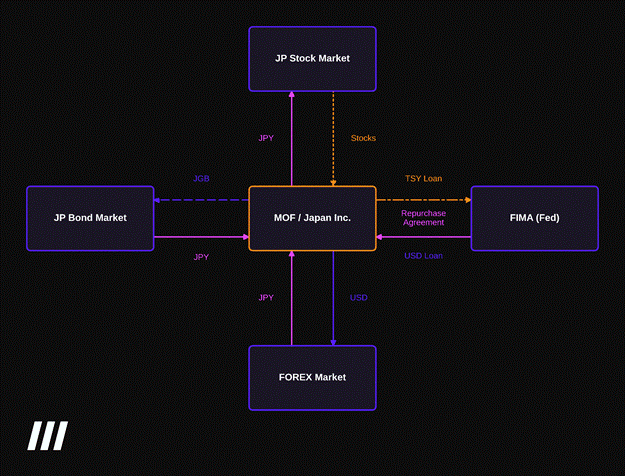
Chart: Schematic of the “box and arrow” capital flows under option three
When Bessent talks, you’d better prick up your ears and listen so you don’t get doused in water from the pipes again. And don’t argue back.
Bessent spelled it out in plain language: the Treasury and Japan Inc. shouldn’t sell U.S. Treasuries to raise funds to support the yen—they should use the FIMA plan to repo the U.S. Treasuries to the Fed, obtain dollar loans, and then use those dollars to buy yen. There’s a small snag in the plan, which I’ll explain later, but the box-and-arrows diagram above is exactly about this.
Go through the process again:
The Treasury sends out a U.S. Treasuries “repo,” and obtains dollar loans via the Fed’s FIMA program.
The Treasury sells dollars in the FX market and buys yen.
The Treasury brings the yen back domestically, buys JGBs and reinvests in stocks.
The meaning of this policy:
The Fed prints money to create the dollars and releases them through FIMA. Its balance sheet will expand in sync with the outstanding size of FIMA repos.
USD/JPY falls, meaning the yen strengthens.
Japanese bond yields fall as bonds are bought.
Japanese stocks rise as stocks are bought.
Who’s the sucker?
Japan owes money to U.S. taxpayers and, for political reasons, will never repay it. This is pure money printing, bringing financial and commodity inflation. The U.S. can’t force it to repay from a forward operating base in the Asia-Pacific against Russia and weaken its ability to rearm.
All people short yen. Once the direction is clear, they must close positions immediately. This isn’t a big problem, because USD/JPY volatility will drop, allowing the carry trade to unwind in an orderly way over many years.
Why hasn’t it happened yet?
Currently, the outstanding loan limit for each counterparty under FIMA convenience is $60 billion. The most recent U.S.-Japan currency “manipulation” used over $100 billion—pushing the yen up only about 5%, with a half-life of just a few trading days. To use FIMA, you’d have to completely eliminate the cap and expand eligible counterparties to large Japanese companies and semi-public investment vehicles (such as GPIF). Who controls FIMA?
During the pandemic, the FOMC delegated the power to change FIMA rules to an “FX subcommittee.” The voting members are Waller (FOMC chair), Williams (FOMC vice chair, president of the New York Fed), and Jefferson (vice chair of the board). The subcommittee can convene at any time, it doesn’t publish minutes and doesn’t publish voting records—we only hear the decision outcomes. Is the subcommittee listening to Bessent?
Of course. Trump and Warsh talk on the phone all the time. Since Bessent has laid out the cards needed to reconstruct USD/JPY, Trump will definitely back him. So Trump and Bessent will instruct Warsh. Warsh has already proven that he’s both a two-faced operator and a paper tiger. Under RMP (handled by Williams’ New York Fed), the balance sheet keeps expanding. Warsh says he “listens to the market” when setting policy—now the market clearly wants rate hikes, because the 2-year yield is more than 0.5% above the effective federal funds rate. Yet at the July meeting he refused to hike and instead created five working groups to “study” how the Fed should change. Before those working groups could come up with recommendations, God arrived first. In a short time, Warsh proved he’s just another partisan enforcer who will do whatever his boss wants. Just like his predecessor, cowardly beta Powell, and the one before that, the garden goblin Mrs. Yellen (who became a bad girl after being promoted to Treasury Secretary).
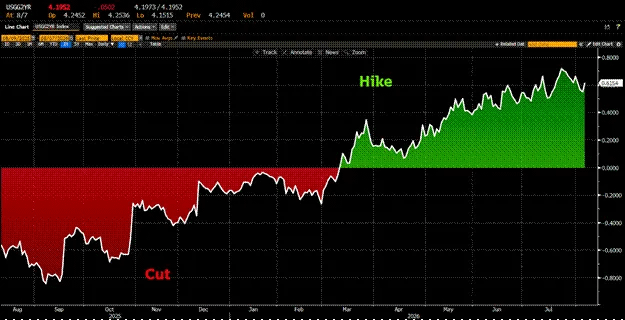
Chart: The 2-year U.S. Treasury yield minus the effective federal funds rate
I don’t know when Waller will convene the subcommittee and announce changes to FIMA that push USD/JPY down with unlimited money printing. But I won’t bet that it won’t happen. In fact, I bet it will happen, and I’ll keep adding to positions that reflect a renewed, large-scale expansion of the Fed’s balance sheet. These assets are Bitcoin, physical gold, and gold-mining stocks.
How big is it? $1.373 trillion
The more you print, the higher Bitcoin goes. So with this FIMA trick, is it enough to act like a faucet, pour in tens of trillions of dollars’ worth of “fake coins,” and pump up our positions?
Right now, we only care about U.S. Treasuries holdings, because only U.S. Treasuries are eligible collateral under FIMA. It may change in the future, but for now we go by existing assets. The two entities holding the most U.S. Treasuries are the Japanese government and GPIF.
U.S. Treasuries purchased by the Japanese government: $1.143 trillion
U.S. Treasuries held by GPIF: $230 billion
Total: $1.373 trillion
This figure isn’t far off. As a reference, during the pandemic the Fed printed roughly $4 trillion, and the expansion of its balance sheet from 2020 to the end of 2021 proves it.
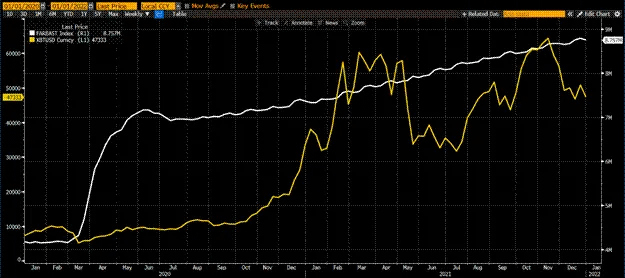
There’s a very clear link between the growth of the Fed’s balance sheet (white line) and the rise in Bitcoin’s price (gold line). In my previous piece, I assumed: AI infrastructure is entering a “capital waste” phase. This is key because the Trump administration wants this liquidity to feed America’s AI capital expenditures—not to pump crypto. But my argument is: lending money right now to AI companies whose capital returns have turned positive—name one real large firm that made money by burning money, or a U.S. AI lab that can profit from token prices in China—is a waste. And Bitcoin’s rise would reflect this kind of inefficient capital deployment. Gold has recently surged from local lows, telling me the market would rather pour the incoming fiat USD tsunami into money-like financial assets than hand the money to Sam Altman’s “burning machine” OpenAI or Musk’s mythic space-data centers.
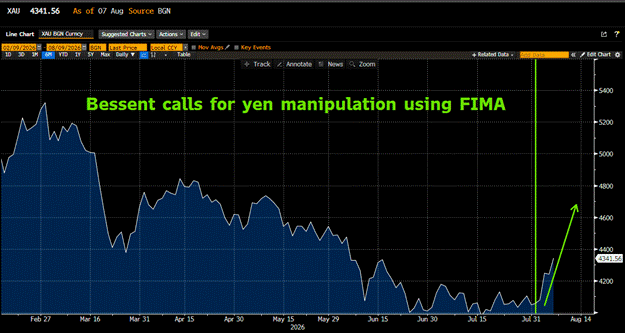
Chart: The Fed’s balance sheet (white line) is highly positively correlated with Bitcoin’s price (gold line)
Shitcoin season: where does the money go?
I know you just want to know what Maelstrom is up to. But context determines whether you dare to take a position. As mentioned earlier, I listen when Bessent speaks. And if there’s one thing he’s good at, it’s manipulating a currency. Go look up his brilliant track record with Soros—the guy who crushed the Bank of England in the pound FX market. Pulling off this kind of currency trick doesn’t require elected politicians to approve it, and it doesn’t require senators facing the end of their terms to nod along. Just get that dozing FX subcommittee to tweak the rules, and you can spray out freshly printed dollars.
When I saw the news headlines about Bessent calling for reforms to FIMA, I immediately felt bullish. Every macro analyst I follow thinks this signals a major turning point for the direction of USD/JPY. You have to position early, because they’re playing it straight this time. Printing money is a political decision to address tough economic realities. Politics is dirty, but this time the Trump administration wants you to log into your brokerage and buy financial assets. That’s why Bessent spelled it out clearly for anyone willing to listen: where the printed money will come from. I’m listening—and I’ll do my part… buying financial assets.
We’re already heavily positioned in Bitcoin, so the next question is: which horse moves fastest? This isn’t an AI stock investment blog, but if that’s your thing, pound the war drums. Leopold’s low point gives you a great entry opportunity for all AI assets. Switch to crypto: what’s undervalued in the overall market is Ethereum (Ether). Its narrative is: a handful of mainstream altcoins that didn’t make new all-time highs in 2025; plus, Ethereum will become the settlement layer for RWA. That’s huge.
Next up is an altcoin that drops to the bottom yet can easily surge 5–10x. That’s Ethena (ticker: ENA). The only problem with Ethena is it lacks buyback; but I’m willing to ignore it because it still ranks as the sixth largest stablecoin by circulating dollars. ENA’s problem is: when the coin price falls, the Bitcoin basis yield disappears, and the return on holding USDe is only slightly higher than U.S. Treasuries. Holding a synthetic dollar by targeting CEX counterparty risk and smart contract risk doesn’t really make sense. That’s why ENA has fallen 75% from its higher-circulation peak and its coin price is down over 90%. Even just a moderate increase in dollar liquidity pumping Bitcoin could blast the basis yield higher and trigger a large inflow into USDe. It doesn’t take much to lift ENA out of the mud—so it’s the small speculative 5x gamble I’m looking at for the next few months.
I haven’t yet “released all the guns” to push the USD balance down to the absolute minimum. We have to wait for Warsh to convene the subcommittee, and amend the FIMA rules. Stay vigilant; it might happen when nobody’s paying attention. But gold and USD/JPY should start moving before any official announcement. Even if there’s no other reason, there’s always someone with tight ties to the Trump administration and a heavy position who will front-run. Every asset class has seen this happen—so why would gold and FX be the exception?
The days of cheap yen are over. Great. There are so many foreigners in my magical Hokkaido volcano resort who are stepping on my snow tracks. And you skiers—damn you—when you come to the off-piste zones, give me the whole set of split boards.