
In the cryptocurrency industry, cross-chain has long been simply equated with 'asset migration'—moving ETH from Ethereum to Solana or transferring ATOM from Cosmos to Ethereum, completing a cross-chain transfer seems to achieve 'cross-chain interoperability'. However, for financial scenarios, this superficial asset transfer is far from sufficient: what users truly need is to directly participate in financial transactions on the target chain after cross-chain, rather than first completing asset exchanges and then re-entering. The emergence of Injective is rewriting this industry's understanding, advancing cross-chain from the 1.0 'asset transfer era' to the 2.0 'transaction interoperability era' with its 'financial-grade cross-chain' underlying design, laying a crucial foundation for global financial connectivity on-chain.
The limitations of traditional cross-chain 1.0 are particularly evident in financial scenarios. The core logic of early cross-chain bridges is 'asset mapping': users lock A chain assets in the bridge contract, and B chain generates corresponding mapped assets proportionally. After the transaction is completed, the assets are unlocked and exchanged back to the original assets. This model not only poses security risks of cross-chain bridges being attacked (from 2022 to 2024, losses from cross-chain bridge security incidents exceeded 2 billion USD), but also presents significant barriers to financial transactions — the mapped assets received on B chain often cannot directly participate in high-frequency derivative trading in the local ecosystem, nor can they serve as collateral for RWA asset mapping, which is equivalent to 'cross-chain, but not fully integrated into the ecosystem'. More critically, the asset transfer time of traditional cross-chain is generally between 10-30 minutes, which is tantamount to missing opportunities for financial traders who need to hedge risks quickly.
Injective's financial-grade cross-chain has fundamentally transcended the framework of 'asset mapping', focusing on 'native asset interoperability + direct trading connections'. Its interoperability layer is built on the IBC protocol and Ethereum light clients. On one hand, the IBC protocol allows Injective to achieve seamless circulation of native assets with all chains in the Cosmos ecosystem without the need for mapping; on the other hand, Ethereum light clients directly open asset channels with Ethereum, allowing users' native assets like ETH and USDC to directly cross-chain to Injective while maintaining their native properties throughout the process, without generating any mapping derivatives.
Even more revolutionary is that Injective has realized 'cross-chain assets directly participating in financial trading'. For example, users holding native USDC on the Solana chain can cross-chain to Injective through IBC without any intermediate exchanges, directly using it for derivative trading on Helix DEX, leverage speculation on Pre-IPO contracts, or investing in gold assets in the RWA market. Throughout the process, the assets do not change their native properties, the transaction confirmation time is only 0.8 seconds, the transaction fee is as low as 0.001 USD, and the transaction success rate remains stable at 99.7% — this means that cross-chain is no longer a 'preliminary step' in financial trading, but rather an 'essential capability' integrated throughout the trading process.
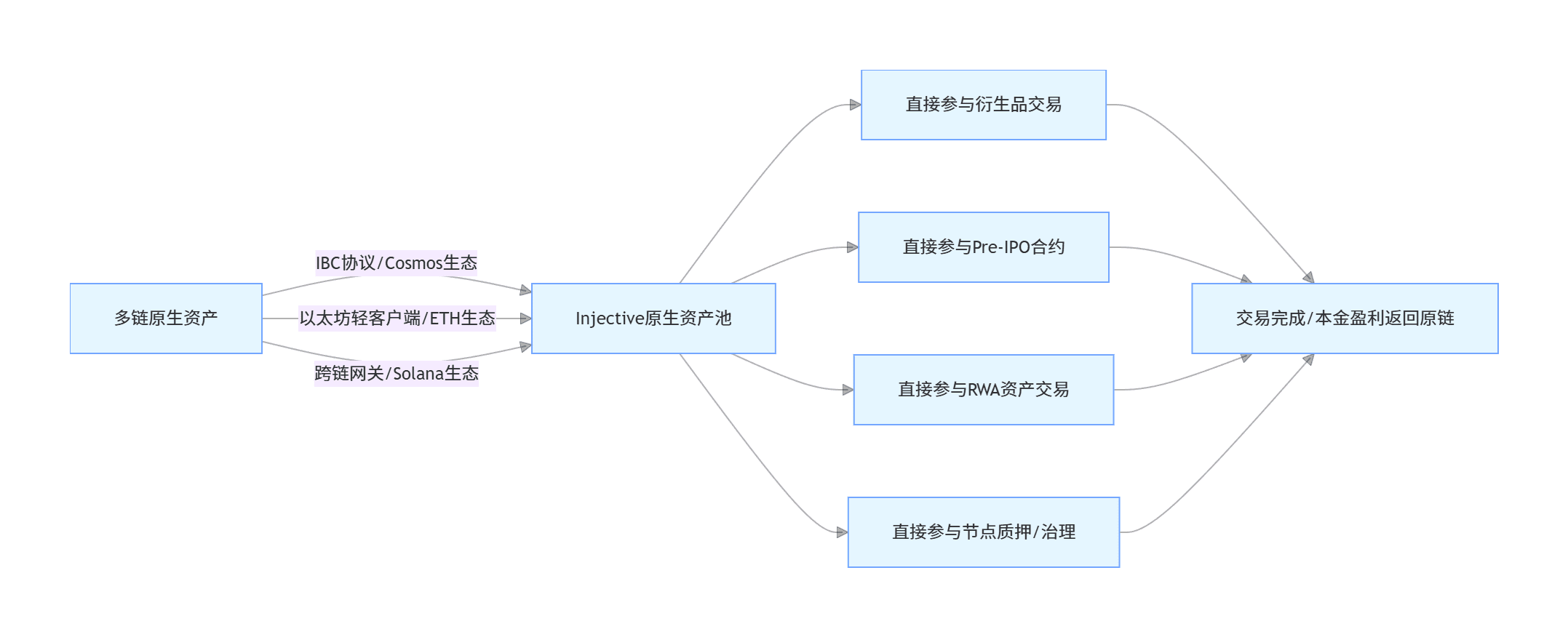
The value of this financial-grade cross-chain has been verified in actual ecological data. In Q3 2025, the cross-chain financial trading volume of Injective exceeded 5 billion USD, accounting for 38% of its total trading volume, far exceeding the industry average of 15%. Among them, users from Ethereum participated in Pre-IPO contract transactions through native USDC cross-chain, with the monthly transaction volume exceeding 2 million; users in the Solana ecosystem preferred to participate in RWA bulk commodity trading with native assets, and the related transaction volume grew by 45% month-on-month. On the security front, since the mainnet launch of Injective in 2020, there has never been an asset loss incident in the cross-chain module, thanks to its layered verification security design — the circulation of cross-chain assets will simultaneously undergo verification by IBC light nodes and confirmation by the Injective consensus layer, providing double protection to eliminate single point risks.
Injective's cross-chain practice has also provided a key insight for the industry: the core of a financial public chain's cross-chain capability is not 'how many chains can it cross', but 'what can be done after cross-chain'. The core metric of traditional cross-chain 1.0 is 'cross-chain asset scale', while the core metric of cross-chain 2.0 should be 'cross-chain financial trading scale'. The former merely completes the physical transfer of assets, while the latter truly realizes the interconnectedness of the financial ecosystem.
Now, Injective is still deepening its financial-grade cross-chain capabilities: partnering with Noble to integrate native USDC, addressing compliance issues for stablecoin cross-chain; integrating with Clustersxyz to unify cross-chain identity, allowing users to participate in multi-chain financial trading without repeatedly creating wallets; and plans to integrate more public chain native assets in the future, building a 'global on-chain financial asset hub'. When cross-chain is no longer a simple 'asset relocation', but can seamlessly participate in global on-chain financial trading, the 'borderless' vision of Web3 finance will truly have the possibility of landing.


