

Main points
Users can develop better risk management strategies by knowing the various scenarios in which positions may be forced to liquidate.
When trading on Binance Futures, liquidation is always performed at the mark price rather than the last price.
The liquidation price behaves differently in cross margin mode and isolated margin mode.
Binance Futures allows users to trade with leverage, meaning that users can open a position by providing an initial margin. While this feature is attractive, it also exposes users to the risk of forced liquidation.

To avoid losses, it is important to be aware of the various scenarios in which a position may be liquidated. These situations are often misunderstood when trading cryptocurrency contracts. This article will explain three common misconceptions about Forced Liquidation.
1. Execute forced liquidation at the marked price
When trading on Binance Futures, you may have come across two different prices: Last Price and Mark Price. Mark Price refers to the estimated fair value of a contract.
Users should pay attention to the gap between the mark price and the liquidation price, as liquidations are always performed at the mark price. Liquidations performed at the mark price can avoid price spikes and combat market manipulation. If liquidations are performed at the last price, even if the underlying asset has not yet reached the liquidation price, a slight price fluctuation on Binance can lead to unnecessary liquidations.
Users holding long positions must pay attention to whether the mark price of the contract is not lower than the liquidation price, otherwise their positions will be forced to be liquidated. Users holding short positions must pay attention to whether the mark price of the contract does not exceed the liquidation price, otherwise they will lose their margin.
Please switch from the last price to the mark price, or the mark price to the last price, via the Binance Mobile App as shown below.
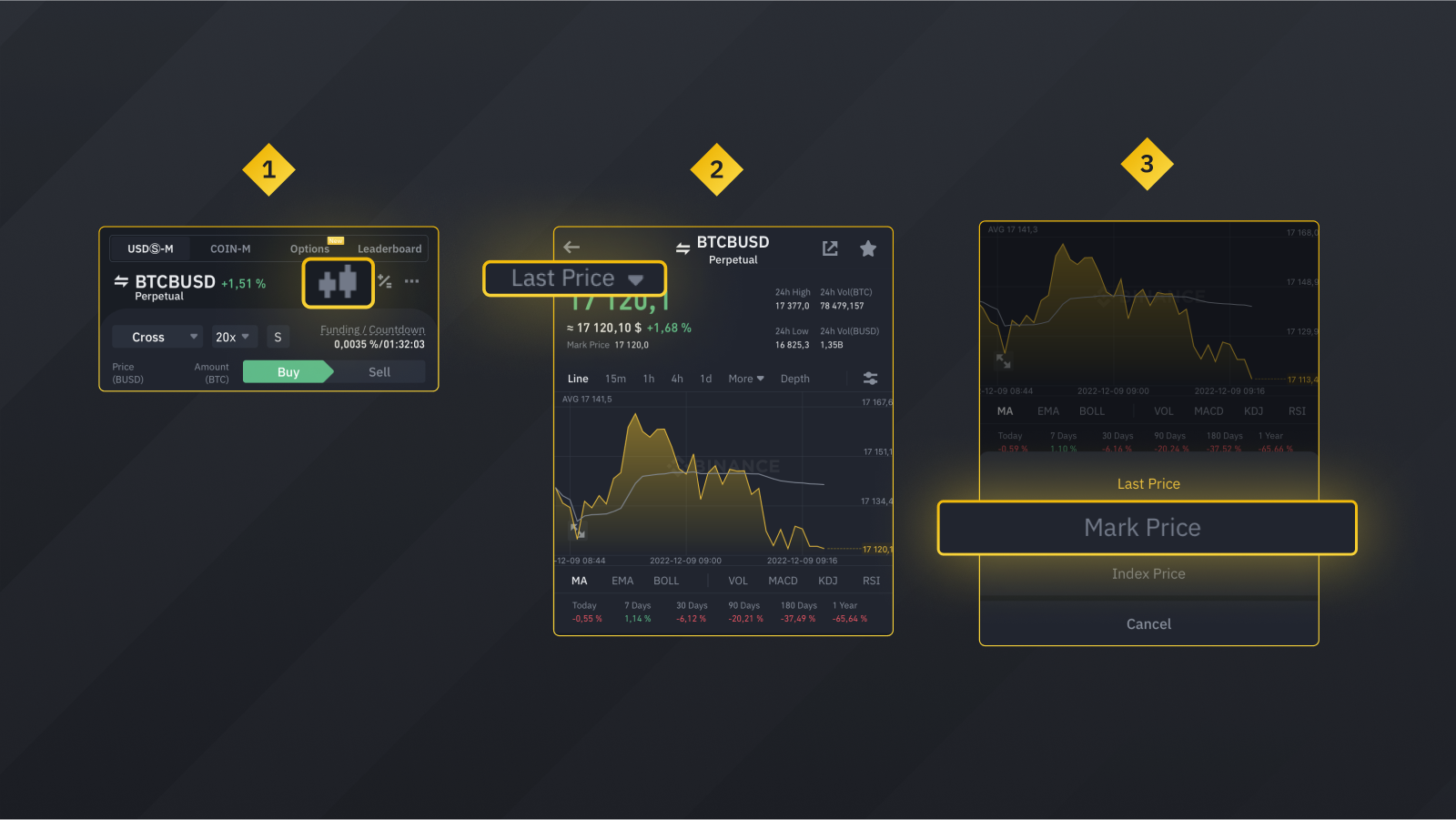
If you are using the desktop version, switch from last price to marked price, or marked price to last price, as shown below.

2. Forced liquidation price changes
Strictly speaking, the liquidation price of the position remains unchanged. However, due to the dynamic changes in the forced liquidation agreement, there are some exceptions to the liquidation price.
I. Full position and isolated position
The liquidation price of the contract is different under the cross position mode and Isolated position mode. Because these differences are often ignored in the contract market, users often find that the liquidation price has changed or that the Stop Loss Order failed to protect the position from liquidation.
In Cross Margin Mode, all open positions share the entire margin balance. If you hold multiple positions, the liquidation price will continue to change based on the performance of your positions. In order to understand more thoroughly, let us review the basic principles of the forced liquidation agreement, namely:
Maintenance Margin > Margin Balance
in
Margin balance = wallet balance + unrealized profit and loss
According to the above formula, when the margin balance is shared between multiple open positions in cross-margin mode, unrealized profit and loss will affect the margin balance. Therefore, the liquidation price will change continuously with the performance of the position.
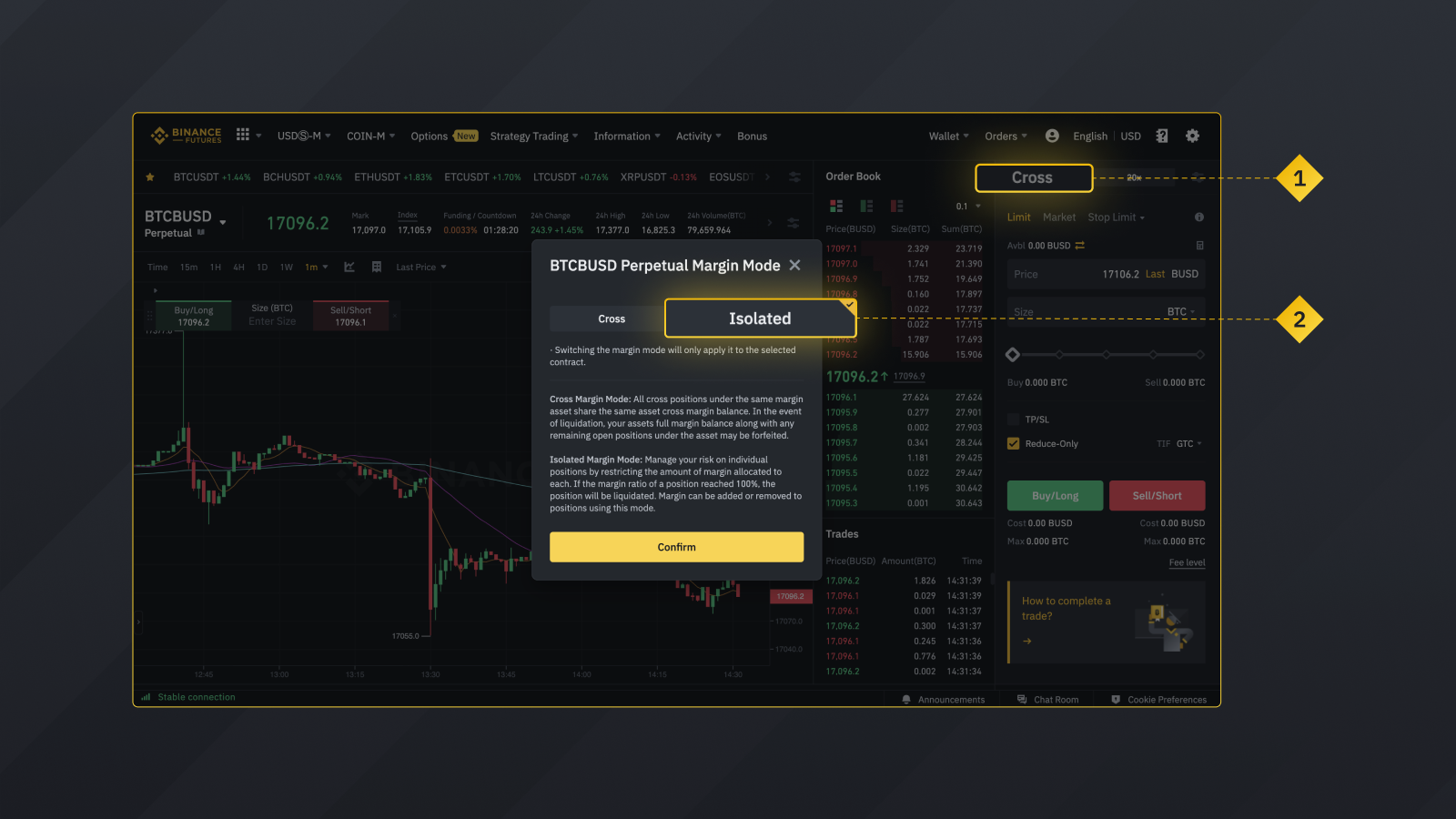
In the isolated position mode, the liquidation price remains unchanged. It is the margin balance allocated to a single position.
Please switch from Cross Margin mode to Isolated Margin mode via the Binance Mobile App as shown below.

Please switch from Cross Margin mode to Isolated Margin mode via Binance Desktop as shown below.
In cross margin mode, traders can avoid forced liquidation by paying close attention to the Margin Ratio. When the margin ratio reaches 100%, it means that some of your positions may be forced to be liquidated because the wallet balance is less than the maintenance margin. While cross margin allows you to spread risk across all positions, cross margin is generally more difficult to manage and puts all wallet funds at risk.
II. Funding rate
The liquidation price may also change due to Funding Rate. According to the forced liquidation formula, if the wallet balance changes, the margin balance may also be affected. Funding rates usually represent a small percentage of a position, but can become larger during times of volatility. Add it to your wallet balance or subtract it from your wallet balance, and the liquidation price will change.
Funding rate refers to the amount paid between users on each contract side (long and short) every 8 hours. Funding rates help maintain a balance between contract market prices and spot market prices. Binance does not make money through funding fees.
III. Changes in Margin Amount
In addition, if you increase or decrease your position by increasing or decreasing your margin, the liquidation price may change. Additionally, if you increase or decrease your positions to change the Maintenance Margin Ratio, the liquidation price may also change.
Please note: In the cross position mode, when the available balance of the account changes, the liquidation price of the position will also change. As long as you do not reduce your available balance, changing the leverage will not affect the liquidation price of the contract. In addition to the wallet balance, changing the position, opening price or risk amount of the position will also change the liquidation price.
3. Insurance liquidation costs
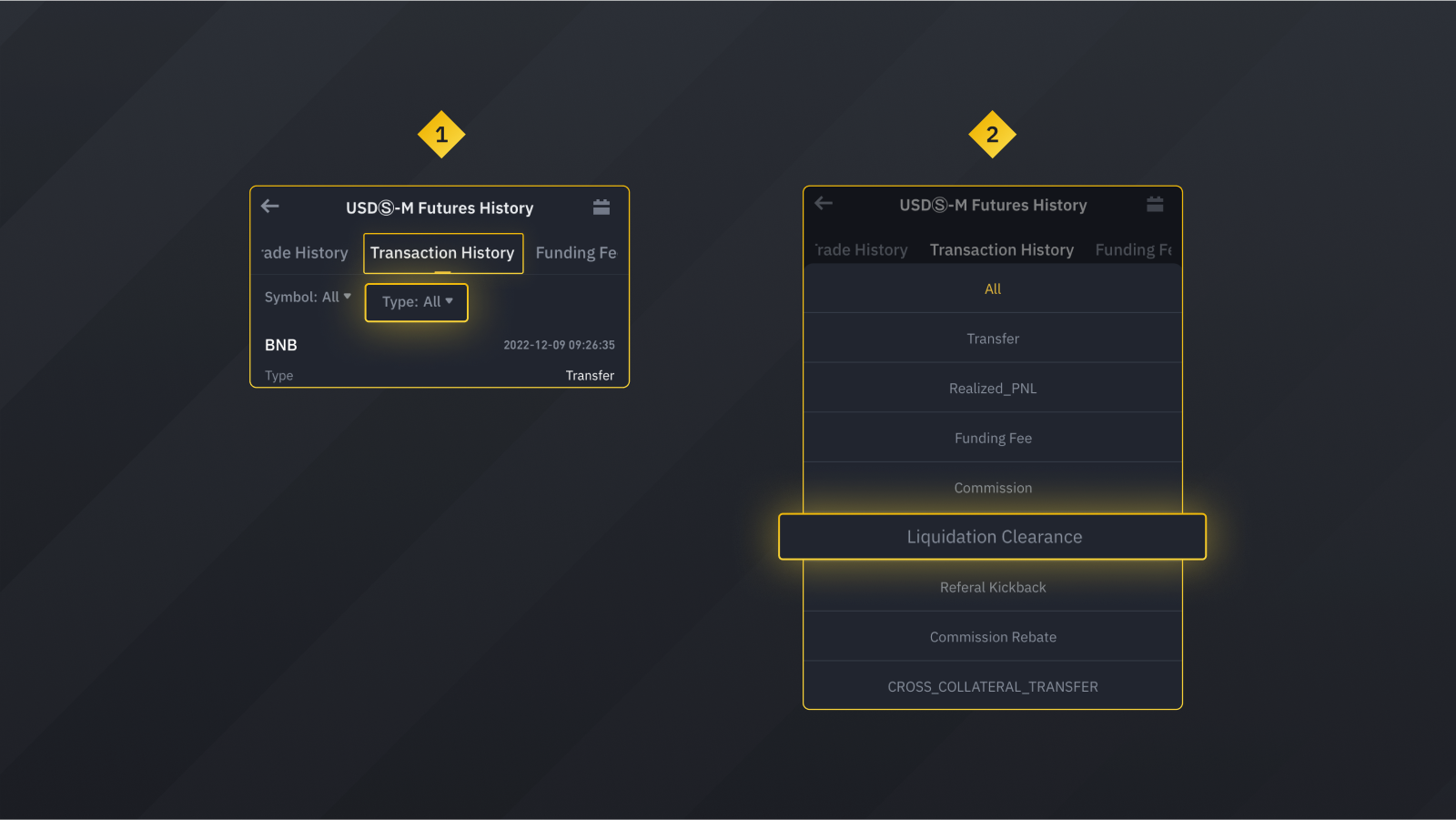
Users often report that losses exceed expectations when forced liquidation is executed. This is because after the contract position is forcibly closed, insurance liquidation fees will be charged and added to the Insurance Fund. The insurance fund liquidates negative balances in wallets and guarantees investment profits for all users.
Insurance liquidation fees are calculated as follows:
Insurance liquidation fee = position nominal value x Forced liquidation fee rate
To check whether you have paid the insurance liquidation fee, please go to Contract Transaction History and click Forced Liquidation.
Users can reduce the chance of forced liquidation through a variety of strategies, such as monitoring margin, using stop-loss orders, or reducing the amount of leverage.
Please read the following articles to learn more:
(Blog) Cryptocurrency Contract Basics: What is a Forced Liquidation and How to Avoid It?
(Blog) How to reduce the probability of forced liquidation
(Supporting article) Principle of forced liquidation of contract trading
(Supporting Article) Forced Liquidation Agreement