

Bear markets are for building, and Polygon Labs has been using these long months to do just that.
One of the most used blockchains with around 1.5 million weekly users, over 2.3 million transactions per day, and thousands of DApps, Polygon has faced increasing competition recently. While it remains the third most popular network in terms of transaction count and user base, the likes of Arbitrum, Optimism, Tron, and Base are growing rapidly and steadily, eating into Polygon’s market share.
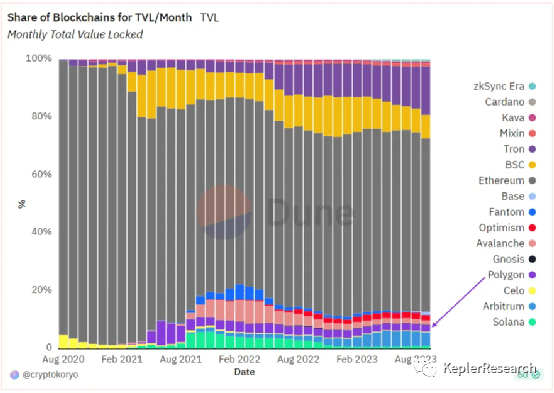
This process is particularly evident in TVL (total value locked), with Polygon’s share falling from 8.3% in 2021 to 2.2% currently.
Fortunately for the protocol, the brains behind it have already undergone a complete overhaul, introducing a series of major upgrades designed to return Polygon to the forefront of web3 and make it the foundation of the so-called “internet of value level.”
These changes include the zkEVM as a new transaction gateway, the vision of multiple sidechains working as a whole, a new governance structure, and the introduction of new tokens. In addition, Polygon continues to establish new partnerships and attract more and more web2 companies to join web3.
These changes within Polygon reflect the broader direction of the entire crypto space, so let’s see where exactly it’s headed.
Zero-knowledge proof: "A cryptographic method by which a prover can prove that they have access to a piece of information without revealing it."
Zkrollup is a layer 2 scaling solution for blockchains that bundles millions of transactions together, lightening the load on the base layer and spreading the cost of a transaction across many users. Aggregators process transactions, perform computations, and store data off-chain while keeping assets in on-chain smart contracts.
Polygon joined the Zk race by releasing zkEVM, its equivalent of the Ethereum Virtual Machine, which uses zk-rollups to execute smart contracts faster and cheaper while maintaining compatibility with Ethereum.
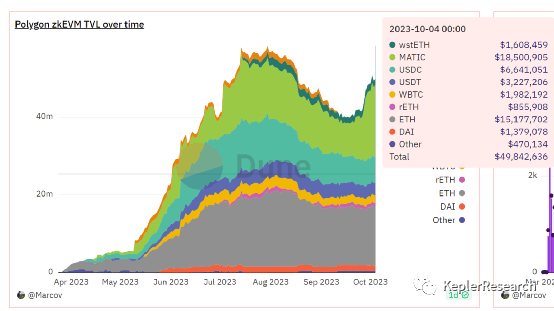
Polygon zkEVM, which launched as a separate blockchain in March, has registered over $136 million worth of deposits and over $49 million in TVL.
The successful introduction of zk-rollups certainly marks an intellectual breakthrough for the Polygon team as they decided to go all-in on ZK technology.
Currently, Polygon operates as a proof-of-stake chain secured by validators. The introduction of zk-rollups will bring additional security, leveraging Ethereum to cryptographically verify batches of transactions.
But publishing transaction data to Ethereum can be very expensive, Polygon designed their own zk-rollups hybrid called validium. They only publish lightweight validity proofs, while transaction data is provided off-chain, thereby reducing fees and improving scalability.
Importantly, these changes are designed to integrate seamlessly into the current user and developer experience, requiring only node operators and validators to update their software.
After the upgrade, Polygon PoS and Polygon zkEVM will still be the two public networks of the Polygon ecosystem, the former (based on validium) providing higher scalability, and the latter (based on zk-rollup) - higher security.
Launching new tokens
Polygon 2.0 is conceived as a larger structure than Polygon PoS, and it is logical for it to have its own currency.
The new token POL will replace MATIC as the native token for paying transaction fees in the Polygon ecosystem, and validators will be able to stake POL dollars on multiple Polygon chains.
What is the supply situation?
All 10 billion of MATIC’s tokens were issued when the chain was founded in 2019 and were released gradually until full vesting was reached last year.
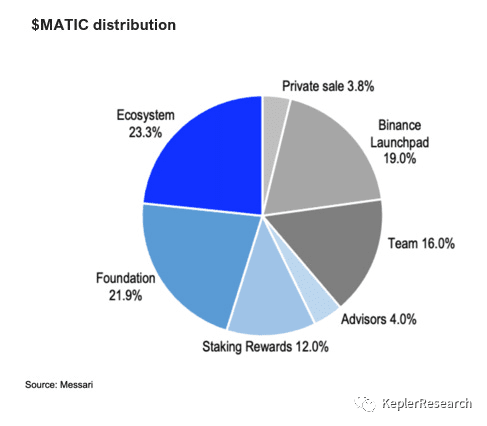
The new token $POL will allow for a one-to-one migration of SMATICs, so its starting supply will also be 10 billion. However, the token economics are different in that $POL will be issued an additional 2% per year, split between validator staking rewards (1%) and the community treasury (1%).
This inflation will effectively dilute the value of $MATIC . If the team's bet on Polygon 2.0 pays off, the additional business should compensate.
Partner
Polygon’s reputation is largely due to the partnerships it has secured. The company has made many headlines by bringing companies such as Starbucks, Disney, NFL, Nike, Mastercard, Reddit, Flipcart, Shopify, Deaftkings, Stripe, Adobe, Salesforce, Franklin Templeton, etc. to web3. Most of them utilize Polygon as the basis for NFTs or payment services.
The latest partnership with Google Cloud takes these ambitions a step further and represents a growing connection between institutions and blockchain.
#BTC #ETH #美联储是否加息? $BTC $MATIC
Note: All content represents the author's personal views only, is not investment advice, and should not be construed in any way as tax, accounting, legal, business, financial or regulatory advice. Before making any investment decision, you should seek independent legal and financial advice, including advice on tax consequences.
Agency: Kepler Research
For more information, please follow: KeplerResearch @kepler008