

#zano
zano
36,837 views
341 Discussing
Hot
Latest


·
--
Zano’s rollback fixed the abnormal supply, but it also put the privacy system’s auditable boundaries on full display.
【Verified facts】On October 1, the Zano team released a post-incident report stating that on September 25 it found a vulnerability in the Gateway Address implementation that could allow the generation of ZANO and fUSD. The team said user funds and privacy were not affected. The official follow-up response said the rollback removed the unauthorized supply and the network is back to its expected state. On October 3, AMBCrypto, citing the team’s report, disclosed that the attacker minted approximately 36.89 million ZANO and 18.45 million fUSD. The roughly $250 million valuation of the forged assets was converted based on the assumed ZANO price of about $7 at the time; it does not equal actual user losses or realized stolen funds.
The report explains that privacy transaction outputs and normal outputs cannot be distinguished on a per-transaction basis, so the team found it difficult to accurately identify which outputs originated from the illicit minting. Therefore, it chose to roll back about a month of chain history. The official recovery update on September 28 also said it was verifying affected activities with partners and working out a recovery plan, and that users do not need to take action for the time being; the status of wallets, services, and exchanges and any subsequent guidance still need to be announced.
【My judgment and market ripple effects】The core trade-off in this incident is that while a rollback can remove the illegal supply from the current chain state, it also forces users, wallets, and trading services to re-check history and balances. The impact on $ZANO is primarily on project credibility, exchange integrations, and user confidence—not on a token-demand change that can be directly inferred. Privacy itself is not a vulnerability; however, when the system can’t distinguish legitimate from illegitimate outputs, incident handling becomes more dependent on a full-network rollback, coordination among service providers, and transparent remediation processes. If Gateway Address is to be restarted afterward, code audits, supply-conservation checks, and independent verification will become especially important.
【Response and what to watch】If you hold ZANO or have used related wallets, first wait for the team to publish details on network height, wallet synchronization, and service recovery, and do not transfer or sign transactions based on social-media DMs claiming you can “recover assets.” Watch three things next: whether the team provides verifiable code fixes and supply-minting validation; whether wallets, services, and exchanges are all restored and provide a clear block height; and whether the recovery plan explains the scope of verification and the outcomes of handling affected activities. Only if independent re-verification confirms the fix is effective, major services are restored, and the handling rules are clear, can trust risk potentially narrow gradually. If supply verification remains opaque, service recovery keeps fluctuating, or the team’s explanation of affected activities is inconsistent over time, then this assessment fails.
Market note: In this round of query, Binance Spot’s exchangeInfo showed no active ZANO/USDT trading pairs, so it does not reference Binance spot trading-volume rankings, prices, or price-change percentages.
Source: Zano official post-incident report (2026-10-01, written by the team) https://x.com/i/article/2105641163805917184;Official report announcement post (2026-10-01) https://x.com/zano_project/status/2105648653876474358;Official recovery update (2026-09-28) https://x.com/zano_project/status/2104650308513144955;Official supply recovery response (2026-10-01) https://x.com/zano_project/status/2105653717156663399;AMBCrypto coverage of the post-incident report (2026-10-03) https://ambcrypto.com/privacy-working-as-intended-zano-details-1-month-rollback-after-250m-exploit/。
#ZANO #区块链安全 #privacy
Zano’s rollback fixed the abnormal supply, but it also put the privacy system’s auditable boundaries on full display.
【Verified facts】On October 1, the Zano team released a post-incident report stating that on September 25 it found a vulnerability in the Gateway Address implementation that could allow the generation of ZANO and fUSD. The team said user funds and privacy were not affected. The official follow-up response said the rollback removed the unauthorized supply and the network is back to its expected state. On October 3, AMBCrypto, citing the team’s report, disclosed that the attacker minted approximately 36.89 million ZANO and 18.45 million fUSD. The roughly $250 million valuation of the forged assets was converted based on the assumed ZANO price of about $7 at the time; it does not equal actual user losses or realized stolen funds.
The report explains that privacy transaction outputs and normal outputs cannot be distinguished on a per-transaction basis, so the team found it difficult to accurately identify which outputs originated from the illicit minting. Therefore, it chose to roll back about a month of chain history. The official recovery update on September 28 also said it was verifying affected activities with partners and working out a recovery plan, and that users do not need to take action for the time being; the status of wallets, services, and exchanges and any subsequent guidance still need to be announced.
【My judgment and market ripple effects】The core trade-off in this incident is that while a rollback can remove the illegal supply from the current chain state, it also forces users, wallets, and trading services to re-check history and balances. The impact on $ZANO is primarily on project credibility, exchange integrations, and user confidence—not on a token-demand change that can be directly inferred. Privacy itself is not a vulnerability; however, when the system can’t distinguish legitimate from illegitimate outputs, incident handling becomes more dependent on a full-network rollback, coordination among service providers, and transparent remediation processes. If Gateway Address is to be restarted afterward, code audits, supply-conservation checks, and independent verification will become especially important.
【Response and what to watch】If you hold ZANO or have used related wallets, first wait for the team to publish details on network height, wallet synchronization, and service recovery, and do not transfer or sign transactions based on social-media DMs claiming you can “recover assets.” Watch three things next: whether the team provides verifiable code fixes and supply-minting validation; whether wallets, services, and exchanges are all restored and provide a clear block height; and whether the recovery plan explains the scope of verification and the outcomes of handling affected activities. Only if independent re-verification confirms the fix is effective, major services are restored, and the handling rules are clear, can trust risk potentially narrow gradually. If supply verification remains opaque, service recovery keeps fluctuating, or the team’s explanation of affected activities is inconsistent over time, then this assessment fails.
Market note: In this round of query, Binance Spot’s exchangeInfo showed no active ZANO/USDT trading pairs, so it does not reference Binance spot trading-volume rankings, prices, or price-change percentages.
Source: Zano official post-incident report (2026-10-01, written by the team) https://x.com/i/article/2105641163805917184;Official report announcement post (2026-10-01) https://x.com/zano_project/status/2105648653876474358;Official recovery update (2026-09-28) https://x.com/zano_project/status/2104650308513144955;Official supply recovery response (2026-10-01) https://x.com/zano_project/status/2105653717156663399;AMBCrypto coverage of the post-incident report (2026-10-03) https://ambcrypto.com/privacy-working-as-intended-zano-details-1-month-rollback-after-250m-exploit/。
#ZANO #区块链安全 #privacy
【Verified facts】On October 1, the Zano team released a post-incident report stating that on September 25 it found a vulnerability in the Gateway Address implementation that could allow the generation of ZANO and fUSD. The team said user funds and privacy were not affected. The official follow-up response said the rollback removed the unauthorized supply and the network is back to its expected state. On October 3, AMBCrypto, citing the team’s report, disclosed that the attacker minted approximately 36.89 million ZANO and 18.45 million fUSD. The roughly $250 million valuation of the forged assets was converted based on the assumed ZANO price of about $7 at the time; it does not equal actual user losses or realized stolen funds.
The report explains that privacy transaction outputs and normal outputs cannot be distinguished on a per-transaction basis, so the team found it difficult to accurately identify which outputs originated from the illicit minting. Therefore, it chose to roll back about a month of chain history. The official recovery update on September 28 also said it was verifying affected activities with partners and working out a recovery plan, and that users do not need to take action for the time being; the status of wallets, services, and exchanges and any subsequent guidance still need to be announced.
【My judgment and market ripple effects】The core trade-off in this incident is that while a rollback can remove the illegal supply from the current chain state, it also forces users, wallets, and trading services to re-check history and balances. The impact on $ZANO is primarily on project credibility, exchange integrations, and user confidence—not on a token-demand change that can be directly inferred. Privacy itself is not a vulnerability; however, when the system can’t distinguish legitimate from illegitimate outputs, incident handling becomes more dependent on a full-network rollback, coordination among service providers, and transparent remediation processes. If Gateway Address is to be restarted afterward, code audits, supply-conservation checks, and independent verification will become especially important.
【Response and what to watch】If you hold ZANO or have used related wallets, first wait for the team to publish details on network height, wallet synchronization, and service recovery, and do not transfer or sign transactions based on social-media DMs claiming you can “recover assets.” Watch three things next: whether the team provides verifiable code fixes and supply-minting validation; whether wallets, services, and exchanges are all restored and provide a clear block height; and whether the recovery plan explains the scope of verification and the outcomes of handling affected activities. Only if independent re-verification confirms the fix is effective, major services are restored, and the handling rules are clear, can trust risk potentially narrow gradually. If supply verification remains opaque, service recovery keeps fluctuating, or the team’s explanation of affected activities is inconsistent over time, then this assessment fails.
Market note: In this round of query, Binance Spot’s exchangeInfo showed no active ZANO/USDT trading pairs, so it does not reference Binance spot trading-volume rankings, prices, or price-change percentages.
Source: Zano official post-incident report (2026-10-01, written by the team) https://x.com/i/article/2105641163805917184;Official report announcement post (2026-10-01) https://x.com/zano_project/status/2105648653876474358;Official recovery update (2026-09-28) https://x.com/zano_project/status/2104650308513144955;Official supply recovery response (2026-10-01) https://x.com/zano_project/status/2105653717156663399;AMBCrypto coverage of the post-incident report (2026-10-03) https://ambcrypto.com/privacy-working-as-intended-zano-details-1-month-rollback-after-250m-exploit/。
#ZANO #区块链安全 #privacy
3

Hacker gains 36.9 million $ZANO without needing a single cent of collateral—brothers, do you believe this basic flaw still keeps happening?
The cause is that the Gateway Addresses feature after Hard Fork 6 is missing an authentication step. The criminals only need to create a gateway, and then they can mint tokens: on August 29, they minted 18.4 million $ZANO; by September 25, they minted an additional 18.4 million $ZANO along with the fUSD token.
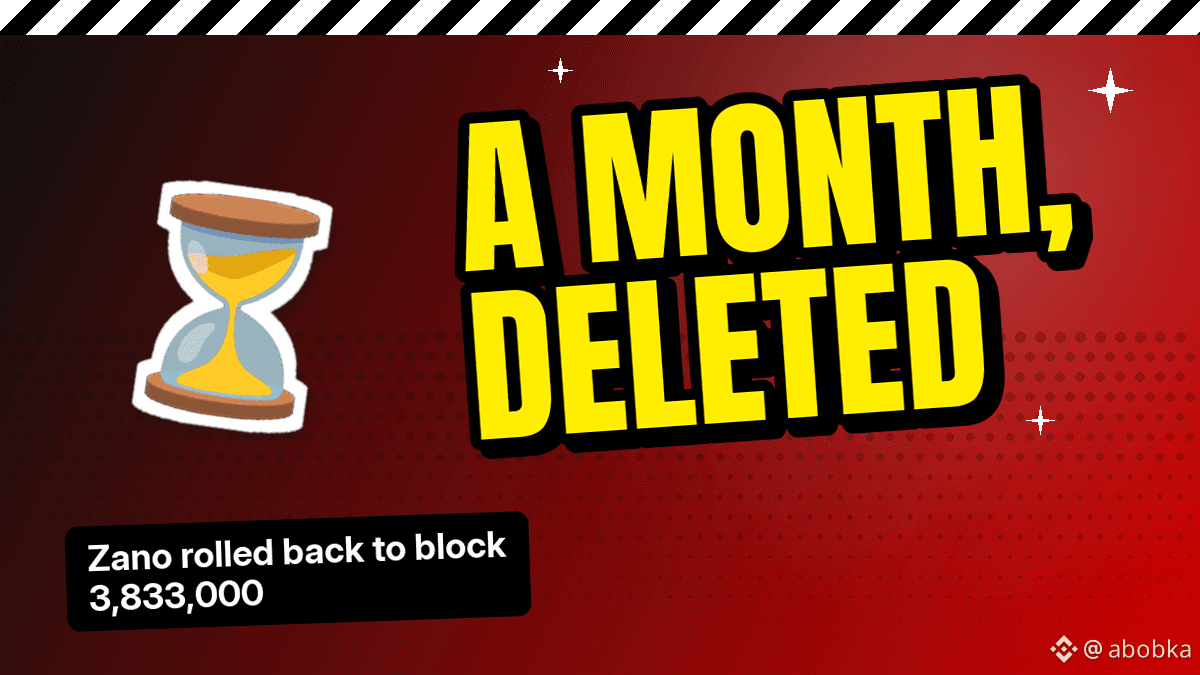
Ironically, because Zano’s anonymity mechanism fully mixes the fake tokens into normal transactions, it’s impossible to blacklist or freeze them. The team had no choice but to take the most painful measure: rolling back the blockchain by 30 days to block 3,833,000.
Deleting a month of the ledger is a double shock—hurting liquidity while also raising questions about decentralization. My take: the technical foundation has been damaged at the core layer, and with no clear recovery signals yet, I haven’t stepped in. I’m waiting to see how the team handles the on-chain audit before considering re-entry.
Have you already taken a position in $ZANO, or are you still on the sidelines watching? Click $ZANO below to check the candlesticks! 👇
#BaoMat #Altcoin #ZANO #Blockchain
Hacker gains 36.9 million $ZANO without needing a single cent of collateral—brothers, do you believe this basic flaw still keeps happening?
The cause is that the Gateway Addresses feature after Hard Fork 6 is missing an authentication step. The criminals only need to create a gateway, and then they can mint tokens: on August 29, they minted 18.4 million $ZANO; by September 25, they minted an additional 18.4 million $ZANO along with the fUSD token.
Ironically, because Zano’s anonymity mechanism fully mixes the fake tokens into normal transactions, it’s impossible to blacklist or freeze them. The team had no choice but to take the most painful measure: rolling back the blockchain by 30 days to block 3,833,000.
Deleting a month of the ledger is a double shock—hurting liquidity while also raising questions about decentralization. My take: the technical foundation has been damaged at the core layer, and with no clear recovery signals yet, I haven’t stepped in. I’m waiting to see how the team handles the on-chain audit before considering re-entry.
Have you already taken a position in $ZANO, or are you still on the sidelines watching? Click $ZANO below to check the candlesticks! 👇
#BaoMat #Altcoin #ZANO #Blockchain
The cause is that the Gateway Addresses feature after Hard Fork 6 is missing an authentication step. The criminals only need to create a gateway, and then they can mint tokens: on August 29, they minted 18.4 million $ZANO; by September 25, they minted an additional 18.4 million $ZANO along with the fUSD token.
Ironically, because Zano’s anonymity mechanism fully mixes the fake tokens into normal transactions, it’s impossible to blacklist or freeze them. The team had no choice but to take the most painful measure: rolling back the blockchain by 30 days to block 3,833,000.
Deleting a month of the ledger is a double shock—hurting liquidity while also raising questions about decentralization. My take: the technical foundation has been damaged at the core layer, and with no clear recovery signals yet, I haven’t stepped in. I’m waiting to see how the team handles the on-chain audit before considering re-entry.
Have you already taken a position in $ZANO, or are you still on the sidelines watching? Click $ZANO below to check the candlesticks! 👇
#BaoMat #Altcoin #ZANO #Blockchain

181

Zano exploiters created 36.9 million illegal ZANO before the blockchain rollback
- The attackers created 36.9 million illegal ZANO that cannot be distinguished from legitimate coins
- The Zano team was forced to roll back the blockchain to remove the illicit coins
- The RSS source has not yet provided any further details on the timing, impact, or mining method
#BinanceSquare #CryptoNews #ZANO #BlockchainSecurity
$zano
#vlikevn Titanbot
Source: CoinTelegraph
Zano exploiters created 36.9 million illegal ZANO before the blockchain rollback
- The attackers created 36.9 million illegal ZANO that cannot be distinguished from legitimate coins
- The Zano team was forced to roll back the blockchain to remove the illicit coins
- The RSS source has not yet provided any further details on the timing, impact, or mining method
#BinanceSquare #CryptoNews #ZANO #BlockchainSecurity
$zano
#vlikevn Titanbot
Source: CoinTelegraph
- The attackers created 36.9 million illegal ZANO that cannot be distinguished from legitimate coins
- The Zano team was forced to roll back the blockchain to remove the illicit coins
- The RSS source has not yet provided any further details on the timing, impact, or mining method
#BinanceSquare #CryptoNews #ZANO #BlockchainSecurity
$zano
#vlikevn Titanbot
Source: CoinTelegraph
3

·
--
Zano just rolled back a month of transactions! 🚨 The team is using personal funds for recovery, but claims rules remain a mystery. Is this a transparent fix or a major red flag for DeFi? $BTC #Zano #CryptoNews
Zano just rolled back a month of transactions! 🚨 The team is using personal funds for recovery, but claims rules remain a mystery. Is this a transparent fix or a major red flag for DeFi? $BTC #Zano #CryptoNews
16

·
--
Bearish
a blockchain just deleted about a month of its own history. on purpose
Zano restarted from block 3,833,000, right before Hard Fork 6
a Gateway Address bug let unauthorized ZANO and fUSD into circulation
how much got minted? nobody has said. no technical write-up yet
reimbursement comes from the development fund, team and large holders
no new ZANO issued, at least that part is honest)
a rollback isn't an undo though
anything already swapped to USDT or DAI on other networks stays out of reach
their own head of marketing: "The team can't roll back Zano"
miners, stakers, nodes and exchanges have to choose to run release 2.2.3.600
a month of history, now up to the people running nodes
#ZANO #Hacked
a blockchain just deleted about a month of its own history. on purpose
Zano restarted from block 3,833,000, right before Hard Fork 6
a Gateway Address bug let unauthorized ZANO and fUSD into circulation
how much got minted? nobody has said. no technical write-up yet
reimbursement comes from the development fund, team and large holders
no new ZANO issued, at least that part is honest)
a rollback isn't an undo though
anything already swapped to USDT or DAI on other networks stays out of reach
their own head of marketing: "The team can't roll back Zano"
miners, stakers, nodes and exchanges have to choose to run release 2.2.3.600
a month of history, now up to the people running nodes
#ZANO #Hacked
Zano restarted from block 3,833,000, right before Hard Fork 6
a Gateway Address bug let unauthorized ZANO and fUSD into circulation
how much got minted? nobody has said. no technical write-up yet
reimbursement comes from the development fund, team and large holders
no new ZANO issued, at least that part is honest)
a rollback isn't an undo though
anything already swapped to USDT or DAI on other networks stays out of reach
their own head of marketing: "The team can't roll back Zano"
miners, stakers, nodes and exchanges have to choose to run release 2.2.3.600
a month of history, now up to the people running nodes
#ZANO #Hacked
1
37

Zano just pulled off a drastic move, rolling its entire blockchain back by a month following a critical Gateway Address exploit tied to Hard Fork 6. While extreme, chain rollbacks are sometimes the only way developers can neutralize heavy exploits and protect user funds from total loss. It highlights the brutal trade-offs between decentralization and emergency intervention when core code fails. The big test now is restoring community trust and ensuring a smoother redeployment. $ZANO #Zano #CryptoSecurity #Blockchain
Zano just pulled off a drastic move, rolling its entire blockchain back by a month following a critical Gateway Address exploit tied to Hard Fork 6. While extreme, chain rollbacks are sometimes the only way developers can neutralize heavy exploits and protect user funds from total loss. It highlights the brutal trade-offs between decentralization and emergency intervention when core code fails. The big test now is restoring community trust and ensuring a smoother redeployment. $ZANO #Zano #CryptoSecurity #Blockchain
45

·
--
Zano rolls back one month of blocks to fix a gateway vulnerability—what is the cost of the repair?
Zano has just completed a fairly rare on-chain operation: according to Cointelegraph, the Zano blockchain was rolled back to the block height before the introduction of the Gateway Address feature included in Hard Fork 6, and restarted from there as the new beginning. The rollback span was about one month, and the direct trigger was a security vulnerability that exploited the gateway address mechanism.
Why is this worth noting? Not because of Zano itself, but because it demonstrates the “heaviest” kind of repair a decentralized network can perform when a protocol-layer flaw is discovered: not a patch, not a soft fork—but tearing down an entire segment of historical blocks and rebuilding it. For coin holders, this means the transaction states from the past month have been reset. Wallet balances, unconfirmed transactions, and the states of derivatives or cross-chain bridges that depend on that chain may all be affected, requiring users to double-check everything.
From a technical perspective, gateway addresses are how Zano connects external assets or enables cross-chain interactions. Once exploited, the risk is often not that a single transaction gets stolen, but that the asset-mapping relationship is tampered with. Such vulnerabilities are difficult to “cover over” with subsequent blocks, making rollback to before the feature was introduced the cleanest approach. The cost is also straightforward: the computational power of one month’s worth of blocks, node synchronization, and—most importantly—user trust all need to be rebuilt. The community also needs to explain why it chose rollback rather than other options, and how similar issues will be avoided in the future.
On the market side, Zano’s market cap is relatively small, so the event is unlikely to have a major short-term impact on the mainstream crypto market. However, it could still lead some holders to question the consensus mechanism and governance capabilities, especially if node synchronization problems or inconsistent asset states occur during the rollback. For broader DeFi and cross-chain projects, this is also a reminder: the importance of security audits and a gradual (gray-scale) rollout process before introducing new protocol functionality is just as critical as the functionality itself.
Next, what needs to be watched is: whether the on-chain state remains stable after the rollback, whether the community can reach consensus on subsequent security upgrades quickly, and whether other projects that rely on Zano gateway addresses trigger any chain reactions.
#Zano #CryptoSecurity
The above is an information compilation and personal analysis, and does not constitute investment advice.
Zano rolls back one month of blocks to fix a gateway vulnerability—what is the cost of the repair?
Zano has just completed a fairly rare on-chain operation: according to Cointelegraph, the Zano blockchain was rolled back to the block height before the introduction of the Gateway Address feature included in Hard Fork 6, and restarted from there as the new beginning. The rollback span was about one month, and the direct trigger was a security vulnerability that exploited the gateway address mechanism.
Why is this worth noting? Not because of Zano itself, but because it demonstrates the “heaviest” kind of repair a decentralized network can perform when a protocol-layer flaw is discovered: not a patch, not a soft fork—but tearing down an entire segment of historical blocks and rebuilding it. For coin holders, this means the transaction states from the past month have been reset. Wallet balances, unconfirmed transactions, and the states of derivatives or cross-chain bridges that depend on that chain may all be affected, requiring users to double-check everything.
From a technical perspective, gateway addresses are how Zano connects external assets or enables cross-chain interactions. Once exploited, the risk is often not that a single transaction gets stolen, but that the asset-mapping relationship is tampered with. Such vulnerabilities are difficult to “cover over” with subsequent blocks, making rollback to before the feature was introduced the cleanest approach. The cost is also straightforward: the computational power of one month’s worth of blocks, node synchronization, and—most importantly—user trust all need to be rebuilt. The community also needs to explain why it chose rollback rather than other options, and how similar issues will be avoided in the future.
On the market side, Zano’s market cap is relatively small, so the event is unlikely to have a major short-term impact on the mainstream crypto market. However, it could still lead some holders to question the consensus mechanism and governance capabilities, especially if node synchronization problems or inconsistent asset states occur during the rollback. For broader DeFi and cross-chain projects, this is also a reminder: the importance of security audits and a gradual (gray-scale) rollout process before introducing new protocol functionality is just as critical as the functionality itself.
Next, what needs to be watched is: whether the on-chain state remains stable after the rollback, whether the community can reach consensus on subsequent security upgrades quickly, and whether other projects that rely on Zano gateway addresses trigger any chain reactions.
#Zano #CryptoSecurity
The above is an information compilation and personal analysis, and does not constitute investment advice.
Zano has just completed a fairly rare on-chain operation: according to Cointelegraph, the Zano blockchain was rolled back to the block height before the introduction of the Gateway Address feature included in Hard Fork 6, and restarted from there as the new beginning. The rollback span was about one month, and the direct trigger was a security vulnerability that exploited the gateway address mechanism.
Why is this worth noting? Not because of Zano itself, but because it demonstrates the “heaviest” kind of repair a decentralized network can perform when a protocol-layer flaw is discovered: not a patch, not a soft fork—but tearing down an entire segment of historical blocks and rebuilding it. For coin holders, this means the transaction states from the past month have been reset. Wallet balances, unconfirmed transactions, and the states of derivatives or cross-chain bridges that depend on that chain may all be affected, requiring users to double-check everything.
From a technical perspective, gateway addresses are how Zano connects external assets or enables cross-chain interactions. Once exploited, the risk is often not that a single transaction gets stolen, but that the asset-mapping relationship is tampered with. Such vulnerabilities are difficult to “cover over” with subsequent blocks, making rollback to before the feature was introduced the cleanest approach. The cost is also straightforward: the computational power of one month’s worth of blocks, node synchronization, and—most importantly—user trust all need to be rebuilt. The community also needs to explain why it chose rollback rather than other options, and how similar issues will be avoided in the future.
On the market side, Zano’s market cap is relatively small, so the event is unlikely to have a major short-term impact on the mainstream crypto market. However, it could still lead some holders to question the consensus mechanism and governance capabilities, especially if node synchronization problems or inconsistent asset states occur during the rollback. For broader DeFi and cross-chain projects, this is also a reminder: the importance of security audits and a gradual (gray-scale) rollout process before introducing new protocol functionality is just as critical as the functionality itself.
Next, what needs to be watched is: whether the on-chain state remains stable after the rollback, whether the community can reach consensus on subsequent security upgrades quickly, and whether other projects that rely on Zano gateway addresses trigger any chain reactions.
#Zano #CryptoSecurity
The above is an information compilation and personal analysis, and does not constitute investment advice.

50
Purge a month of transaction history on the blockchain—bro, do you dare believe a project would actually hit the button to rewind time like that?
Zano decided to roll back the chain to block 3,833,000 to address a vulnerability involving illicit token minting of $ZANO and fUSD—an actual major shock. When a network agrees to invalidate all transactions for 30 days to save the tokenomics from the threat of reckless inflation, decentralization effectively has to give in completely to the survival problem.
For battle-tested traders, this is a signal to stay away, not a chance to catch the bottom. Exchanges are forced to temporarily pause deposits and withdrawals to audit their ledgers; $ZANO liquidity freezes—this is an ideal environment for whales to unload into the hands of panicked buyers. The overall market, like $BTC đ, is currently hovering around 84.071 USD; there’s no reason to take on extra risk from a chain that has just been deeply intervened in the ledger.
So, brothers—do you think Zano’s rollback move is an opportunity or a risk? Check the $ZANO chart below! 👇
#ZANO #Bảomật #Altcoin #Crypto
Purge a month of transaction history on the blockchain—bro, do you dare believe a project would actually hit the button to rewind time like that?
Zano decided to roll back the chain to block 3,833,000 to address a vulnerability involving illicit token minting of $ZANO and fUSD—an actual major shock. When a network agrees to invalidate all transactions for 30 days to save the tokenomics from the threat of reckless inflation, decentralization effectively has to give in completely to the survival problem.
For battle-tested traders, this is a signal to stay away, not a chance to catch the bottom. Exchanges are forced to temporarily pause deposits and withdrawals to audit their ledgers; $ZANO liquidity freezes—this is an ideal environment for whales to unload into the hands of panicked buyers. The overall market, like $BTC đ, is currently hovering around 84.071 USD; there’s no reason to take on extra risk from a chain that has just been deeply intervened in the ledger.
So, brothers—do you think Zano’s rollback move is an opportunity or a risk? Check the $ZANO chart below! 👇
#ZANO #Bảomật #Altcoin #Crypto
Zano decided to roll back the chain to block 3,833,000 to address a vulnerability involving illicit token minting of $ZANO and fUSD—an actual major shock. When a network agrees to invalidate all transactions for 30 days to save the tokenomics from the threat of reckless inflation, decentralization effectively has to give in completely to the survival problem.
For battle-tested traders, this is a signal to stay away, not a chance to catch the bottom. Exchanges are forced to temporarily pause deposits and withdrawals to audit their ledgers; $ZANO liquidity freezes—this is an ideal environment for whales to unload into the hands of panicked buyers. The overall market, like $BTC đ, is currently hovering around 84.071 USD; there’s no reason to take on extra risk from a chain that has just been deeply intervened in the ledger.
So, brothers—do you think Zano’s rollback move is an opportunity or a risk? Check the $ZANO chart below! 👇
#ZANO #Bảomật #Altcoin #Crypto

357
Zano rolls back the blockchain one month after the Gateway Address vulnerability
- Zano restarted the blockchain at the block height immediately before Hard Fork 6.
- Hard Fork 6 introduced the Gateway Address feature.
- The rollback occurred after a vulnerability related to the Gateway Address was discovered.
- The RSS feed does not provide further details.
#BinanceSquare #CryptoNews #ZANO
$zano
#vlikevn #Titanbot
Source: CoinTelegraph
Zano rolls back the blockchain one month after the Gateway Address vulnerability
- Zano restarted the blockchain at the block height immediately before Hard Fork 6.
- Hard Fork 6 introduced the Gateway Address feature.
- The rollback occurred after a vulnerability related to the Gateway Address was discovered.
- The RSS feed does not provide further details.
#BinanceSquare #CryptoNews #ZANO
$zano
#vlikevn #Titanbot
Source: CoinTelegraph
- Zano restarted the blockchain at the block height immediately before Hard Fork 6.
- Hard Fork 6 introduced the Gateway Address feature.
- The rollback occurred after a vulnerability related to the Gateway Address was discovered.
- The RSS feed does not provide further details.
#BinanceSquare #CryptoNews #ZANO
$zano
#vlikevn #Titanbot
Source: CoinTelegraph
1

·
--
#Zano $ZANO If a chain has to roll back about a month earlier in order to erase an anomaly involving excessive issuance, once the fix succeeds, from where should the count start? Restoring supply is only the first step. Payments, transactions, and cross-chain settlements that occurred during that period cannot be made to automatically balance out just because the new chain has started producing blocks again. This is the contradiction I think the latest incident most needs to focus on.
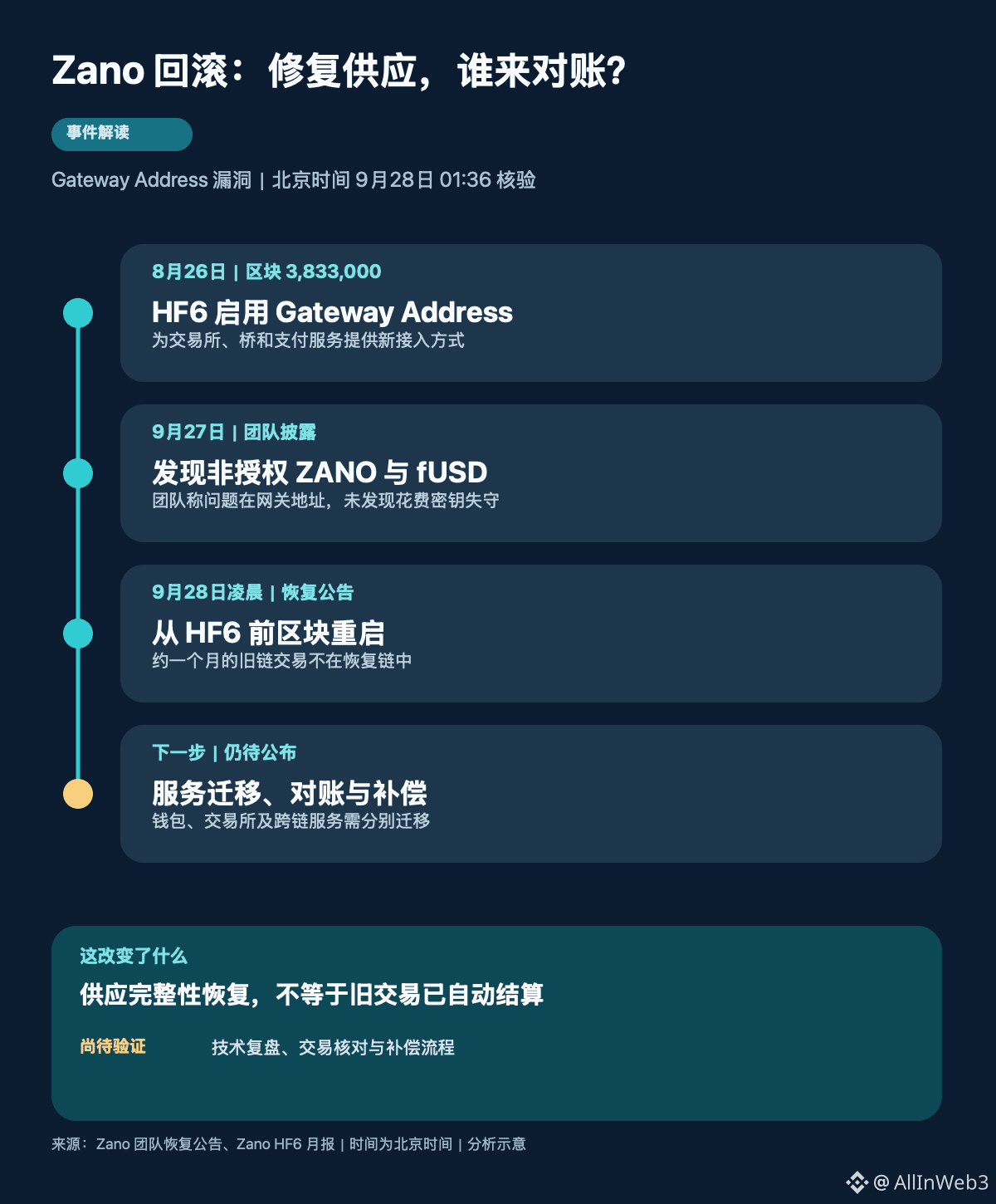
First, separate the timeline. Zano’s official monthly report confirms that the Aug 26 hard fork 6 was activated at block 3,833,000, and the Gateway Address was a new connection method designed for exchanges, bridges, and payment services. After that, the team disclosed that addresses of this type have vulnerabilities that can affect asset issuance, allowing unauthorized ZANO and privacy stablecoin fUSD to enter circulation. The team also stated that they found no compromise of ordinary transaction privacy and wallet spending keys; these two statements cannot substitute for each other: the keys not being lost does not mean the asset supply was not distorted.
The latest restoration explanation makes the handling more explicit: the chain was restarted from 3,833,000—that is, before hard fork 6—impacting about a month of history. Transactions confirmed on the old chain during that period are not part of the restoration chain. Nodes, miners, stakers, and service providers all need to adopt the updates. The team’s mobile wallet nodes and wrapped-asset services are restoring one by one, while third-party wallets and exchanges also need to migrate separately. It also explicitly points out that payments already settled on another chain, such as USDT and DAI, will not disappear due to the Zano rollback.
My view is that what this incident truly tests is not whether “a rollback is possible,” but whether on-chain supply repair and off-chain creditor claim reconciliation can be completed at the same time. For a project that treats the Gateway Address as an external entry point, after records on the old chain are removed, exchanges’ accounting entries, bridge-side mint/burn operations, fUSD redemption, and real matched trades between users all require auditable corresponding methods. The team says it will calculate losses with affected parties and publish the claims process, compensation, and technical post-incident review; but so far these results have not been published. Therefore, it’s too early to say that “users have been fully compensated” or that “the losses are already confirmed.”
Next, I’ll look at three verifiable areas: whether each service clearly confirms it has switched to the restoration chain; whether the team can provide a verification standard for valid transactions on the old chain; and whether the compensation process explains its scope, evidence, and timeline. If these elements are transparent and executed smoothly, my assessment of recovery capability will improve. But if the chain runs first and reconciliation remains suspended for a long time, then even if the supply numbers are restored, users’ trust in finality will still not be restored. Do you think the acceptance criteria for an emergency rollback should be based on on-chain supply, or on whether affected users can complete reconciliation?
#Zano $ZANO If a chain has to roll back about a month earlier in order to erase an anomaly involving excessive issuance, once the fix succeeds, from where should the count start? Restoring supply is only the first step. Payments, transactions, and cross-chain settlements that occurred during that period cannot be made to automatically balance out just because the new chain has started producing blocks again. This is the contradiction I think the latest incident most needs to focus on.
First, separate the timeline. Zano’s official monthly report confirms that the Aug 26 hard fork 6 was activated at block 3,833,000, and the Gateway Address was a new connection method designed for exchanges, bridges, and payment services. After that, the team disclosed that addresses of this type have vulnerabilities that can affect asset issuance, allowing unauthorized ZANO and privacy stablecoin fUSD to enter circulation. The team also stated that they found no compromise of ordinary transaction privacy and wallet spending keys; these two statements cannot substitute for each other: the keys not being lost does not mean the asset supply was not distorted.
The latest restoration explanation makes the handling more explicit: the chain was restarted from 3,833,000—that is, before hard fork 6—impacting about a month of history. Transactions confirmed on the old chain during that period are not part of the restoration chain. Nodes, miners, stakers, and service providers all need to adopt the updates. The team’s mobile wallet nodes and wrapped-asset services are restoring one by one, while third-party wallets and exchanges also need to migrate separately. It also explicitly points out that payments already settled on another chain, such as USDT and DAI, will not disappear due to the Zano rollback.
My view is that what this incident truly tests is not whether “a rollback is possible,” but whether on-chain supply repair and off-chain creditor claim reconciliation can be completed at the same time. For a project that treats the Gateway Address as an external entry point, after records on the old chain are removed, exchanges’ accounting entries, bridge-side mint/burn operations, fUSD redemption, and real matched trades between users all require auditable corresponding methods. The team says it will calculate losses with affected parties and publish the claims process, compensation, and technical post-incident review; but so far these results have not been published. Therefore, it’s too early to say that “users have been fully compensated” or that “the losses are already confirmed.”
Next, I’ll look at three verifiable areas: whether each service clearly confirms it has switched to the restoration chain; whether the team can provide a verification standard for valid transactions on the old chain; and whether the compensation process explains its scope, evidence, and timeline. If these elements are transparent and executed smoothly, my assessment of recovery capability will improve. But if the chain runs first and reconciliation remains suspended for a long time, then even if the supply numbers are restored, users’ trust in finality will still not be restored. Do you think the acceptance criteria for an emergency rollback should be based on on-chain supply, or on whether affected users can complete reconciliation?
First, separate the timeline. Zano’s official monthly report confirms that the Aug 26 hard fork 6 was activated at block 3,833,000, and the Gateway Address was a new connection method designed for exchanges, bridges, and payment services. After that, the team disclosed that addresses of this type have vulnerabilities that can affect asset issuance, allowing unauthorized ZANO and privacy stablecoin fUSD to enter circulation. The team also stated that they found no compromise of ordinary transaction privacy and wallet spending keys; these two statements cannot substitute for each other: the keys not being lost does not mean the asset supply was not distorted.
The latest restoration explanation makes the handling more explicit: the chain was restarted from 3,833,000—that is, before hard fork 6—impacting about a month of history. Transactions confirmed on the old chain during that period are not part of the restoration chain. Nodes, miners, stakers, and service providers all need to adopt the updates. The team’s mobile wallet nodes and wrapped-asset services are restoring one by one, while third-party wallets and exchanges also need to migrate separately. It also explicitly points out that payments already settled on another chain, such as USDT and DAI, will not disappear due to the Zano rollback.
My view is that what this incident truly tests is not whether “a rollback is possible,” but whether on-chain supply repair and off-chain creditor claim reconciliation can be completed at the same time. For a project that treats the Gateway Address as an external entry point, after records on the old chain are removed, exchanges’ accounting entries, bridge-side mint/burn operations, fUSD redemption, and real matched trades between users all require auditable corresponding methods. The team says it will calculate losses with affected parties and publish the claims process, compensation, and technical post-incident review; but so far these results have not been published. Therefore, it’s too early to say that “users have been fully compensated” or that “the losses are already confirmed.”
Next, I’ll look at three verifiable areas: whether each service clearly confirms it has switched to the restoration chain; whether the team can provide a verification standard for valid transactions on the old chain; and whether the compensation process explains its scope, evidence, and timeline. If these elements are transparent and executed smoothly, my assessment of recovery capability will improve. But if the chain runs first and reconciliation remains suspended for a long time, then even if the supply numbers are restored, users’ trust in finality will still not be restored. Do you think the acceptance criteria for an emergency rollback should be based on on-chain supply, or on whether affected users can complete reconciliation?
1
1

·
--
🎯 Privacy coins quietly dominated the trending searches
📰 FIRO and ZANO took the top three spots on the trends. ZANO surged 119% in a single day and +35% over the week. Meanwhile, the big pie at 85.9K rose 5.8%—only serving as a backdrop
💬 This doesn’t look like chasing a rise; it looks more like funds directly targeting the privacy track. When regulation tightens, anonymous demand suddenly comes up. With such a strong move in a small-cap, think clearly before buying—figure out who’s pulling the strings, and don’t get carried away
🏷️ #隐私币 #ZANO #FIRO #altcoin abnormal movement
🎯 Privacy coins quietly dominated the trending searches
📰 FIRO and ZANO took the top three spots on the trends. ZANO surged 119% in a single day and +35% over the week. Meanwhile, the big pie at 85.9K rose 5.8%—only serving as a backdrop
💬 This doesn’t look like chasing a rise; it looks more like funds directly targeting the privacy track. When regulation tightens, anonymous demand suddenly comes up. With such a strong move in a small-cap, think clearly before buying—figure out who’s pulling the strings, and don’t get carried away
🏷️ #隐私币 #ZANO #FIRO #altcoin abnormal movement
📰 FIRO and ZANO took the top three spots on the trends. ZANO surged 119% in a single day and +35% over the week. Meanwhile, the big pie at 85.9K rose 5.8%—only serving as a backdrop
💬 This doesn’t look like chasing a rise; it looks more like funds directly targeting the privacy track. When regulation tightens, anonymous demand suddenly comes up. With such a strong move in a small-cap, think clearly before buying—figure out who’s pulling the strings, and don’t get carried away
🏷️ #隐私币 #ZANO #FIRO #altcoin abnormal movement
15

Zano is up 8.3% in the last 24 hours, but the more crucial figure is the volume.
At just $1.98M — with a market cap of $159M, the volume/market cap ratio is extremely low. Thin liquidity means that a few large orders could easily push the price unusually, and the average exit size is much tougher than it appears.
Privacy coins are experiencing a revival; Zano once hit 22% in a single day. However, the current price of $10.37 is still 46% lower than its ATH of ~$17.81. The 2026 roadmap mentions cross-chain compliance, but the execution details are still unclear.
If the privacy narrative cools off and volume doesn't improve → the price could quickly retest $9.48 sooner than expected.
What data are you prioritizing when evaluating $ZANO?
DYOR
#ZANO $ZANO #Crypto #
Zano is up 8.3% in the last 24 hours, but the more crucial figure is the volume.
At just $1.98M — with a market cap of $159M, the volume/market cap ratio is extremely low. Thin liquidity means that a few large orders could easily push the price unusually, and the average exit size is much tougher than it appears.
Privacy coins are experiencing a revival; Zano once hit 22% in a single day. However, the current price of $10.37 is still 46% lower than its ATH of ~$17.81. The 2026 roadmap mentions cross-chain compliance, but the execution details are still unclear.
If the privacy narrative cools off and volume doesn't improve → the price could quickly retest $9.48 sooner than expected.
What data are you prioritizing when evaluating $ZANO?
DYOR
#ZANO $ZANO #Crypto #
At just $1.98M — with a market cap of $159M, the volume/market cap ratio is extremely low. Thin liquidity means that a few large orders could easily push the price unusually, and the average exit size is much tougher than it appears.
Privacy coins are experiencing a revival; Zano once hit 22% in a single day. However, the current price of $10.37 is still 46% lower than its ATH of ~$17.81. The 2026 roadmap mentions cross-chain compliance, but the execution details are still unclear.
If the privacy narrative cools off and volume doesn't improve → the price could quickly retest $9.48 sooner than expected.
What data are you prioritizing when evaluating $ZANO?
DYOR
#ZANO $ZANO #Crypto #
58

·
--
Bitcoin Exchange-Traded Fund sees significant net outflow in a day, ZANO tops the search charts—capital is shifting directions
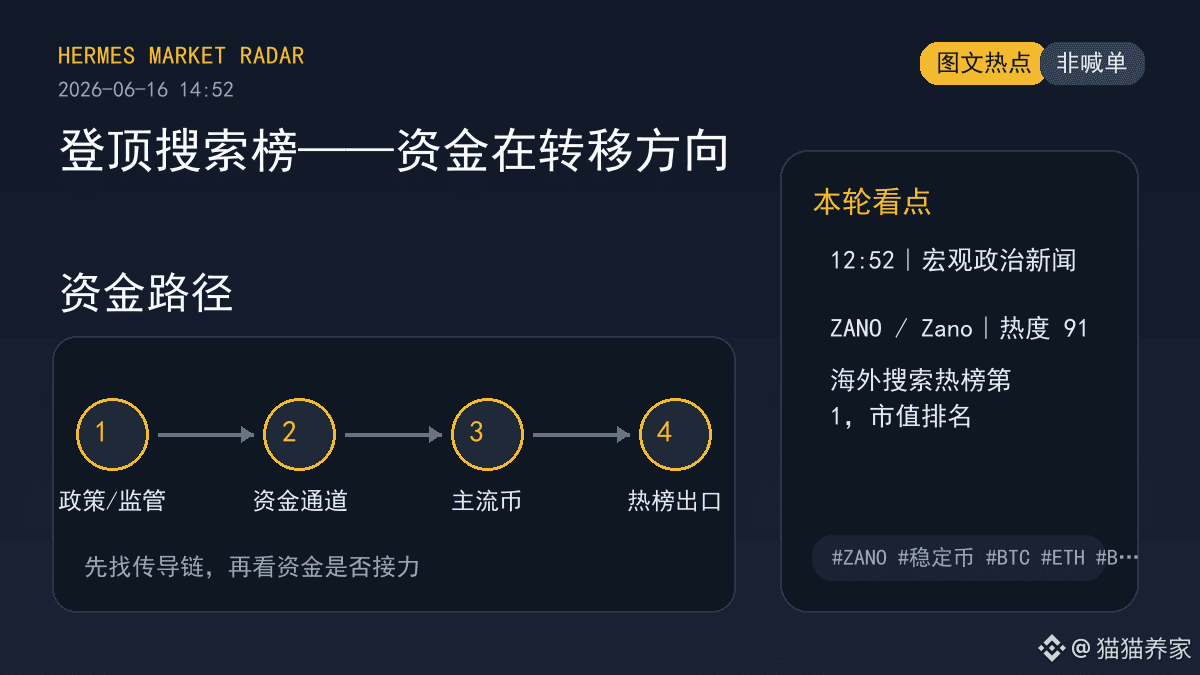
On Monday, we saw an interesting divergence: the Bitcoin Exchange-Traded Fund recorded a net outflow, while other crypto ETFs overall saw net inflows during the same period. Meanwhile, ZANO surged to the top of global search trends—it's a project ranked 205 by market cap, surpassing the search interest of HYPE (top ten by market cap) and SIREN. At the same time, stablecoin (XAUT) launched a dedicated options market on Bybit.
My first reaction is that this isn't capital exiting; it's just funds looking for their next spot to land.
The logic behind Bitcoin facing downward pressure isn’t hard to grasp. The $67,000 mark is being tested repeatedly, expectations of policy reversals under Trump, the risk aversion stemming from the situation in Iran, and Kevin Warsh chairing his first Fed meeting—all contribute to an overall cautious sentiment on risk assets. However, outflows from the Bitcoin Exchange-Traded Fund don’t equate to the entire crypto market bleeding. The net inflow in other ETF categories shows that capital isn't going far, just being redistributed.
ZANO climbing the hot search list in this context is worth noting, but it's not a buy signal just yet. Trending topics signal attention, not fundamentals. The key is to watch the trading volume and on-chain discussions over the next 24 hours to see if they can keep up with the search interest—many trending coins fade within 48 hours; the real test is sustainability.
The detail of stablecoin Gold launching options can easily be overlooked, but in the context of rising geopolitical risks, it’s worth a closer look. The emergence of a product combining stablecoins and gold indicates that the market is actively building a risk-hedging channel, suggesting capital has a place to go. This isn't news that will directly pump prices, but it will alter the choices available for on-chain funds.
Right now, I’m keeping an eye on three things. First, tomorrow’s flow data for the Bitcoin Exchange-Traded Fund—if it continues to see net outflows, short-term sentiment will further weaken. Second, ZANO's average daily trading volume and changes in wallet addresses to assess whether the hype has translated into actual buying. Third, the synchronized movement of the dollar index and oil prices—under geopolitical risks, the correlation between Bitcoin and traditional risk assets is increasing; we can’t just look at data from within the crypto space.
The confirmation signals for this trend are: the Bitcoin Exchange-Traded Fund ends its net outflows, ZANO shows increased trading volume, and stablecoin market cap stabilizes. If all three occur simultaneously, it indicates that capital has completed the cycle from Bitcoin as a safe haven to new asset acquisition.
#ZANO #稳定币 #BTC #ETH #BNB
Bitcoin Exchange-Traded Fund sees significant net outflow in a day, ZANO tops the search charts—capital is shifting directions
On Monday, we saw an interesting divergence: the Bitcoin Exchange-Traded Fund recorded a net outflow, while other crypto ETFs overall saw net inflows during the same period. Meanwhile, ZANO surged to the top of global search trends—it's a project ranked 205 by market cap, surpassing the search interest of HYPE (top ten by market cap) and SIREN. At the same time, stablecoin (XAUT) launched a dedicated options market on Bybit.
My first reaction is that this isn't capital exiting; it's just funds looking for their next spot to land.
The logic behind Bitcoin facing downward pressure isn’t hard to grasp. The $67,000 mark is being tested repeatedly, expectations of policy reversals under Trump, the risk aversion stemming from the situation in Iran, and Kevin Warsh chairing his first Fed meeting—all contribute to an overall cautious sentiment on risk assets. However, outflows from the Bitcoin Exchange-Traded Fund don’t equate to the entire crypto market bleeding. The net inflow in other ETF categories shows that capital isn't going far, just being redistributed.
ZANO climbing the hot search list in this context is worth noting, but it's not a buy signal just yet. Trending topics signal attention, not fundamentals. The key is to watch the trading volume and on-chain discussions over the next 24 hours to see if they can keep up with the search interest—many trending coins fade within 48 hours; the real test is sustainability.
The detail of stablecoin Gold launching options can easily be overlooked, but in the context of rising geopolitical risks, it’s worth a closer look. The emergence of a product combining stablecoins and gold indicates that the market is actively building a risk-hedging channel, suggesting capital has a place to go. This isn't news that will directly pump prices, but it will alter the choices available for on-chain funds.
Right now, I’m keeping an eye on three things. First, tomorrow’s flow data for the Bitcoin Exchange-Traded Fund—if it continues to see net outflows, short-term sentiment will further weaken. Second, ZANO's average daily trading volume and changes in wallet addresses to assess whether the hype has translated into actual buying. Third, the synchronized movement of the dollar index and oil prices—under geopolitical risks, the correlation between Bitcoin and traditional risk assets is increasing; we can’t just look at data from within the crypto space.
The confirmation signals for this trend are: the Bitcoin Exchange-Traded Fund ends its net outflows, ZANO shows increased trading volume, and stablecoin market cap stabilizes. If all three occur simultaneously, it indicates that capital has completed the cycle from Bitcoin as a safe haven to new asset acquisition.
#ZANO #稳定币 #BTC #ETH #BNB
On Monday, we saw an interesting divergence: the Bitcoin Exchange-Traded Fund recorded a net outflow, while other crypto ETFs overall saw net inflows during the same period. Meanwhile, ZANO surged to the top of global search trends—it's a project ranked 205 by market cap, surpassing the search interest of HYPE (top ten by market cap) and SIREN. At the same time, stablecoin (XAUT) launched a dedicated options market on Bybit.
My first reaction is that this isn't capital exiting; it's just funds looking for their next spot to land.
The logic behind Bitcoin facing downward pressure isn’t hard to grasp. The $67,000 mark is being tested repeatedly, expectations of policy reversals under Trump, the risk aversion stemming from the situation in Iran, and Kevin Warsh chairing his first Fed meeting—all contribute to an overall cautious sentiment on risk assets. However, outflows from the Bitcoin Exchange-Traded Fund don’t equate to the entire crypto market bleeding. The net inflow in other ETF categories shows that capital isn't going far, just being redistributed.
ZANO climbing the hot search list in this context is worth noting, but it's not a buy signal just yet. Trending topics signal attention, not fundamentals. The key is to watch the trading volume and on-chain discussions over the next 24 hours to see if they can keep up with the search interest—many trending coins fade within 48 hours; the real test is sustainability.
The detail of stablecoin Gold launching options can easily be overlooked, but in the context of rising geopolitical risks, it’s worth a closer look. The emergence of a product combining stablecoins and gold indicates that the market is actively building a risk-hedging channel, suggesting capital has a place to go. This isn't news that will directly pump prices, but it will alter the choices available for on-chain funds.
Right now, I’m keeping an eye on three things. First, tomorrow’s flow data for the Bitcoin Exchange-Traded Fund—if it continues to see net outflows, short-term sentiment will further weaken. Second, ZANO's average daily trading volume and changes in wallet addresses to assess whether the hype has translated into actual buying. Third, the synchronized movement of the dollar index and oil prices—under geopolitical risks, the correlation between Bitcoin and traditional risk assets is increasing; we can’t just look at data from within the crypto space.
The confirmation signals for this trend are: the Bitcoin Exchange-Traded Fund ends its net outflows, ZANO shows increased trading volume, and stablecoin market cap stabilizes. If all three occur simultaneously, it indicates that capital has completed the cycle from Bitcoin as a safe haven to new asset acquisition.
#ZANO #稳定币 #BTC #ETH #BNB
250

·
--
Zano just surged over 13% in 24 hours — here is why privacy coins are turning heads again.
Zano (ZANO) is a privacy-first blockchain launched in 2019 that makes transactions completely untraceable. Think of it like sending cash in a sealed envelope instead of a postcard. It uses advanced tech called ring signatures and stealth addresses to hide the sender, receiver, and amount automatically. No extra steps, no optional settings — privacy is the default. With a market cap around $160 million and growing volume, traders are watching this low-cap gem closely as the narrative around financial privacy heats up globally. It is not just about hiding; it is about owning your financial data.
If you are new to crypto, Zano offers a simple way to explore how privacy tech works without needing a PhD in cryptography.
#Zano #PrivacyCoins
Do you think privacy-by-default blockchains will become the standard, or will regulation push them to the fringes?
Zano just surged over 13% in 24 hours — here is why privacy coins are turning heads again.
Zano (ZANO) is a privacy-first blockchain launched in 2019 that makes transactions completely untraceable. Think of it like sending cash in a sealed envelope instead of a postcard. It uses advanced tech called ring signatures and stealth addresses to hide the sender, receiver, and amount automatically. No extra steps, no optional settings — privacy is the default. With a market cap around $160 million and growing volume, traders are watching this low-cap gem closely as the narrative around financial privacy heats up globally. It is not just about hiding; it is about owning your financial data.
If you are new to crypto, Zano offers a simple way to explore how privacy tech works without needing a PhD in cryptography.
#Zano #PrivacyCoins
Do you think privacy-by-default blockchains will become the standard, or will regulation push them to the fringes?
Zano (ZANO) is a privacy-first blockchain launched in 2019 that makes transactions completely untraceable. Think of it like sending cash in a sealed envelope instead of a postcard. It uses advanced tech called ring signatures and stealth addresses to hide the sender, receiver, and amount automatically. No extra steps, no optional settings — privacy is the default. With a market cap around $160 million and growing volume, traders are watching this low-cap gem closely as the narrative around financial privacy heats up globally. It is not just about hiding; it is about owning your financial data.
If you are new to crypto, Zano offers a simple way to explore how privacy tech works without needing a PhD in cryptography.
#Zano #PrivacyCoins
Do you think privacy-by-default blockchains will become the standard, or will regulation push them to the fringes?
60

·
--
Verified
🚨 Zano’s Hard Fork 6 is live, enabling non-custodial bridging of ZANO to Ethereum, Solana, and TON. This privacy chain upgrade expands interoperability, potentially increasing utility and demand for cross-chain privacy tools. As ETH serves as a key bridge destination, watch for inflows into privacy-linked assets via Ethereum rails. Could this spark renewed interest in privacy-focused DeFi on ETH?
#Zano #ETHBridge
$ETH #TradingSignal #CryptoAnalysis
🚨 Zano’s Hard Fork 6 is live, enabling non-custodial bridging of ZANO to Ethereum, Solana, and TON. This privacy chain upgrade expands interoperability, potentially increasing utility and demand for cross-chain privacy tools. As ETH serves as a key bridge destination, watch for inflows into privacy-linked assets via Ethereum rails. Could this spark renewed interest in privacy-focused DeFi on ETH?
#Zano #ETHBridge
$ETH #TradingSignal #CryptoAnalysis
#Zano #ETHBridge
$ETH #TradingSignal #CryptoAnalysis

10
·
--
Ever wondered which crypto projects actually keep your financial history a secret? 🤫
Meet Zano (ZANO), a Layer 1 blockchain launched in 2019 that puts privacy first by default. Unlike Bitcoin where anyone can trace your wallet, Zano uses Ring Signatures and Stealth Addresses to make transactions completely untraceable and unlinkable. Think of it like sending cash in an unmarked envelope — no sender, receiver, or amount visible on the public ledger.
Beyond simple transfers, Zano supports confidential assets and ionic swaps, letting you trade privately across chains without a centralized exchange. With a market cap around $153M and a 3.5% gain today, it’s a sleeper project gaining traction among privacy advocates.
Privacy isn't a crime; it's a right. Zano is building the infrastructure to make that right digital.
#Zano #PrivacyFirst
Do you think regulatory pressure will eventually kill privacy coins, or will demand for financial privacy only grow stronger?
Ever wondered which crypto projects actually keep your financial history a secret? 🤫
Meet Zano (ZANO), a Layer 1 blockchain launched in 2019 that puts privacy first by default. Unlike Bitcoin where anyone can trace your wallet, Zano uses Ring Signatures and Stealth Addresses to make transactions completely untraceable and unlinkable. Think of it like sending cash in an unmarked envelope — no sender, receiver, or amount visible on the public ledger.
Beyond simple transfers, Zano supports confidential assets and ionic swaps, letting you trade privately across chains without a centralized exchange. With a market cap around $153M and a 3.5% gain today, it’s a sleeper project gaining traction among privacy advocates.
Privacy isn't a crime; it's a right. Zano is building the infrastructure to make that right digital.
#Zano #PrivacyFirst
Do you think regulatory pressure will eventually kill privacy coins, or will demand for financial privacy only grow stronger?
Meet Zano (ZANO), a Layer 1 blockchain launched in 2019 that puts privacy first by default. Unlike Bitcoin where anyone can trace your wallet, Zano uses Ring Signatures and Stealth Addresses to make transactions completely untraceable and unlinkable. Think of it like sending cash in an unmarked envelope — no sender, receiver, or amount visible on the public ledger.
Beyond simple transfers, Zano supports confidential assets and ionic swaps, letting you trade privately across chains without a centralized exchange. With a market cap around $153M and a 3.5% gain today, it’s a sleeper project gaining traction among privacy advocates.
Privacy isn't a crime; it's a right. Zano is building the infrastructure to make that right digital.
#Zano #PrivacyFirst
Do you think regulatory pressure will eventually kill privacy coins, or will demand for financial privacy only grow stronger?
46

·
--
Opened trending this morning and $ZANO was sitting at the top — while the rest of the board feels heavy. No neat green gainer list to explain it either. Soft day all around, $BTC down about 2%, and somehow $ZANO is still the ticker people keep bumping into.
Blunt take: red days don’t make people smarter. They make people chase whatever still feels alive. Right now that chase has a name, and it’s $ZANO.
#ZANO #Privacy #Trending
Opened trending this morning and $ZANO was sitting at the top — while the rest of the board feels heavy. No neat green gainer list to explain it either. Soft day all around, $BTC down about 2%, and somehow $ZANO is still the ticker people keep bumping into.
Blunt take: red days don’t make people smarter. They make people chase whatever still feels alive. Right now that chase has a name, and it’s $ZANO.
#ZANO #Privacy #Trending
Blunt take: red days don’t make people smarter. They make people chase whatever still feels alive. Right now that chase has a name, and it’s $ZANO.
#ZANO #Privacy #Trending
57

·
--
$9.4 million in market cap growth over the last 30 days proves $ZANO is building a fortress while others rot. Stop chasing ghost chains that haven't delivered a single real-world transaction since 2021.
Privacy isn't a feature; it’s the only way to survive the coming regulatory crackdown. $ZANO is lightyears ahead of every other privacy project currently choking on its own failed governance.
Retail is busy losing their shirts on memecoins while the smart money is quietly securing $BTC and $UB at bargain prices. They are blinded by noise, completely missing the absolute utility monster right in front of them.
If you aren't holding $ZANO, you’re just providing exit liquidity for people who actually know how to read a ledger. Stop betting on hype cycles and start betting on code that actually functions under pressure.
History favors the builders, not the gamblers. Pick a side before the next breakout leaves you staring at the charts from the sidelines.
#ZANO #BTC #UB
$9.4 million in market cap growth over the last 30 days proves $ZANO is building a fortress while others rot. Stop chasing ghost chains that haven't delivered a single real-world transaction since 2021.
Privacy isn't a feature; it’s the only way to survive the coming regulatory crackdown. $ZANO is lightyears ahead of every other privacy project currently choking on its own failed governance.
Retail is busy losing their shirts on memecoins while the smart money is quietly securing $BTC and $UB at bargain prices. They are blinded by noise, completely missing the absolute utility monster right in front of them.
If you aren't holding $ZANO, you’re just providing exit liquidity for people who actually know how to read a ledger. Stop betting on hype cycles and start betting on code that actually functions under pressure.
History favors the builders, not the gamblers. Pick a side before the next breakout leaves you staring at the charts from the sidelines.
#ZANO #BTC #UB
Privacy isn't a feature; it’s the only way to survive the coming regulatory crackdown. $ZANO is lightyears ahead of every other privacy project currently choking on its own failed governance.
Retail is busy losing their shirts on memecoins while the smart money is quietly securing $BTC and $UB at bargain prices. They are blinded by noise, completely missing the absolute utility monster right in front of them.
If you aren't holding $ZANO, you’re just providing exit liquidity for people who actually know how to read a ledger. Stop betting on hype cycles and start betting on code that actually functions under pressure.
History favors the builders, not the gamblers. Pick a side before the next breakout leaves you staring at the charts from the sidelines.
#ZANO #BTC #UB
123
·
--
92% of the circulating supply of $ZANO is already locked in privacy-focused nodes, effectively strangling the available float. This isn’t a dip; it is a calculated supply squeeze designed to incinerate leveraged bears who think they can front-run the inevitable.
While mid-wit traders dump their bags because of a minor price wiggle, the order books tell a different story. The liquidity on $ZANO is drying up, and once the buy-side pressure hits, there won't be enough coins to cover the shorts.
Retail investors are too busy chasing noise in $IOTA to notice the foundation shifting. They love to trade volatility, but they lack the vision to hold an asset that is systematically removing itself from the exchange casino.
Stop listening to the influencers shilling inflationary garbage. Real wealth is being consolidated in $ETH by those who understand the pivot from transparency to true on-chain sovereignty.
The exit door is closing. Stop asking for permission to be early.
#ZANO #IOTA #ETH
92% of the circulating supply of $ZANO is already locked in privacy-focused nodes, effectively strangling the available float. This isn’t a dip; it is a calculated supply squeeze designed to incinerate leveraged bears who think they can front-run the inevitable.
While mid-wit traders dump their bags because of a minor price wiggle, the order books tell a different story. The liquidity on $ZANO is drying up, and once the buy-side pressure hits, there won't be enough coins to cover the shorts.
Retail investors are too busy chasing noise in $IOTA to notice the foundation shifting. They love to trade volatility, but they lack the vision to hold an asset that is systematically removing itself from the exchange casino.
Stop listening to the influencers shilling inflationary garbage. Real wealth is being consolidated in $ETH by those who understand the pivot from transparency to true on-chain sovereignty.
The exit door is closing. Stop asking for permission to be early.
#ZANO #IOTA #ETH
While mid-wit traders dump their bags because of a minor price wiggle, the order books tell a different story. The liquidity on $ZANO is drying up, and once the buy-side pressure hits, there won't be enough coins to cover the shorts.
Retail investors are too busy chasing noise in $IOTA to notice the foundation shifting. They love to trade volatility, but they lack the vision to hold an asset that is systematically removing itself from the exchange casino.
Stop listening to the influencers shilling inflationary garbage. Real wealth is being consolidated in $ETH by those who understand the pivot from transparency to true on-chain sovereignty.
The exit door is closing. Stop asking for permission to be early.
#ZANO #IOTA #ETH
66
Log in to explore more content
Join global crypto users on Binance Square
⚡️ Get latest and useful information about crypto.
💬 Trusted by the world’s largest crypto exchange.
👍 Discover real insights from verified creators.
Email / Phone number
Trending Topics
1
#BNBSurpasses$790
10,124 views
83 Discussing
2
#ZamaRises15.99%ToIntradayHigh$0.09
4,512 views
72 Discussing
3
#BitcoinSpotETFsDraw$6.34BInflowsInQ3
3,534 views
57 Discussing
4
#EthereumValidatorExitQueueJumps392%
54,910 views
672 Discussing
5
#IMFApprovesElSalvador$138MWithBitcoinWaiver
7,259 views
40 Discussing
6
#SECHaltsCryptoETFReviewsAmidFundingLapse
207,300 views
1,573 Discussing
7
#ZcashETFPostsFirstWeeklyOutflow$93.6M
88,053 views
244 Discussing
8
#GreekPoliceBustCryptoScamRingArrest17
333,955 views
2,240 Discussing
9
#BitcoinRejectedAt$87K
204,636 views
304 Discussing
10
#FedOctoberRateHikeOddsFallTo17%
331,947 views
2,361 Discussing