
#ves
ves
129,706 views
135 Discussing
Hot
Latest

Partly True
🇻🇪 The BCV surprises by selling up to $5,000 per person in cash through Banesco, but they must go withdraw it in Caracas within a deadline that can take up to 30 days. In this way, they aim to collect liquidity while they print Bs in abundance to fund themselves. ¡Delicious!. #venezuela #VES
🇻🇪 The BCV surprises by selling up to $5,000 per person in cash through Banesco, but they must go withdraw it in Caracas within a deadline that can take up to 30 days. In this way, they aim to collect liquidity while they print Bs in abundance to fund themselves. ¡Delicious!. #venezuela #VES

9
4
9
8.1k

·
--
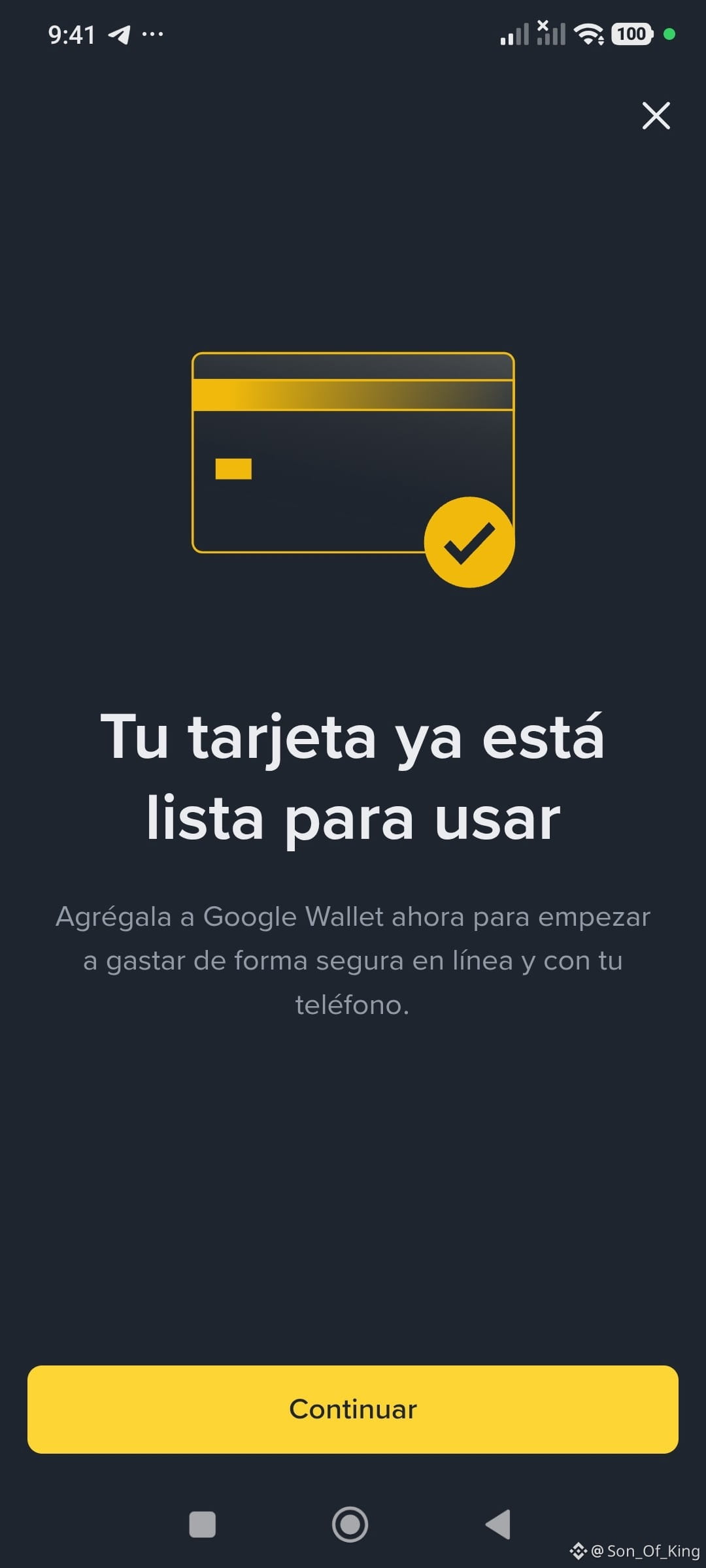
Done. I am now part of the community of Venezuelans who have the opportunity to use this financial instrument. #binanceCard The question now will be whether the exchange rate is viable...!
to be continue🤔💭 #USDT #VES
Done. I am now part of the community of Venezuelans who have the opportunity to use this financial instrument. #binanceCard The question now will be whether the exchange rate is viable...!
to be continue🤔💭 #USDT #VES
to be continue🤔💭 #USDT #VES
360

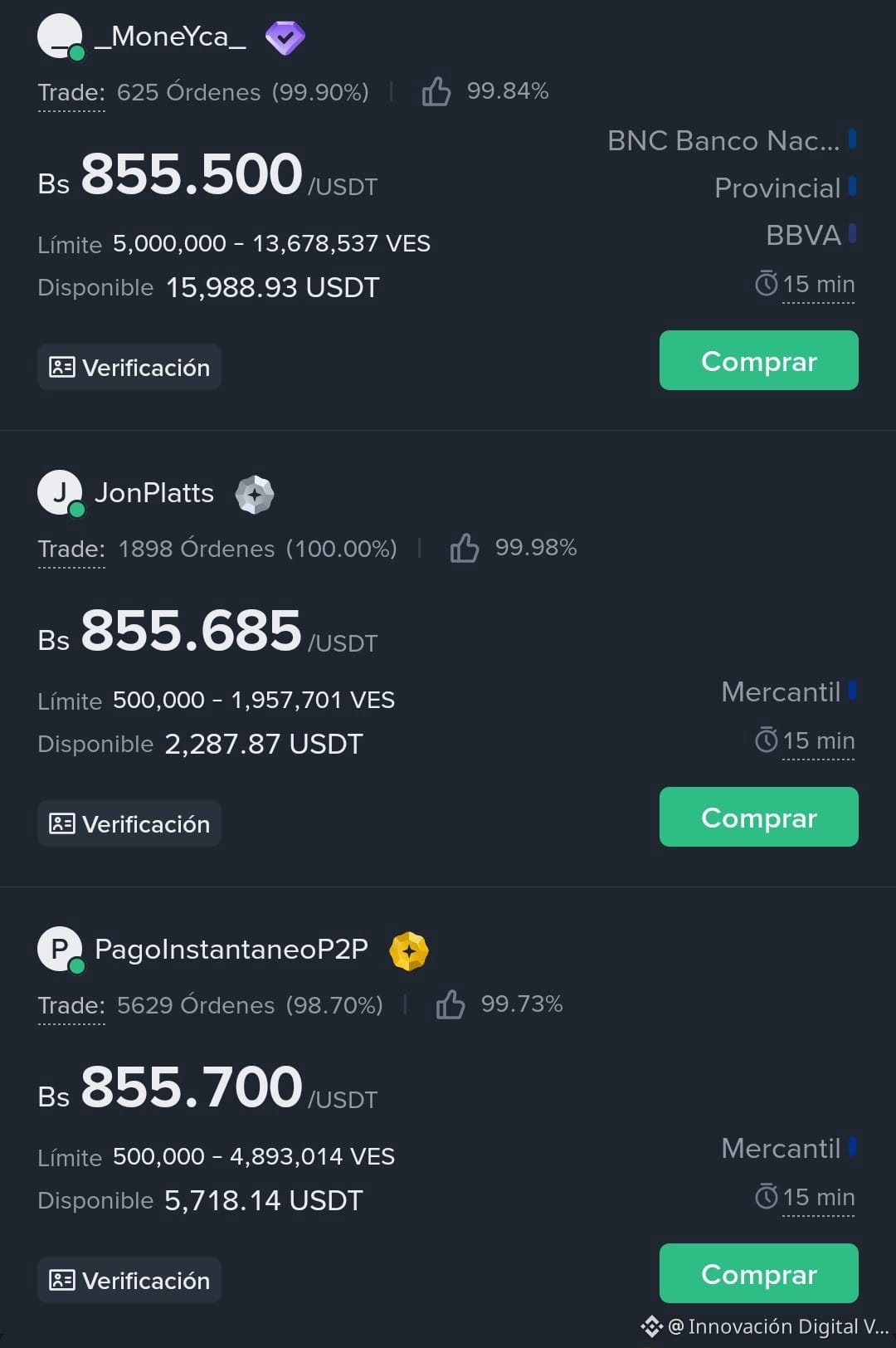
🇻🇪 💥The token $USDT of the P2P system sets a new all-time high of Bs.855. #P2PVenezuela #VES
🇻🇪 💥The token $USDT of the P2P system sets a new all-time high of Bs.855. #P2PVenezuela #VES
3
505
🇻🇪 💥 Economist Alejandro Grisanti estimated that in Venezuela, between June 11 and July 13, at least 1.389 million $USDT were traded, which means an average close to 44 million USDT per day 🚀. #VES
🇻🇪 💥 Economist Alejandro Grisanti estimated that in Venezuela, between June 11 and July 13, at least 1.389 million $USDT were traded, which means an average close to 44 million USDT per day 🚀. #VES
1
113


·
--
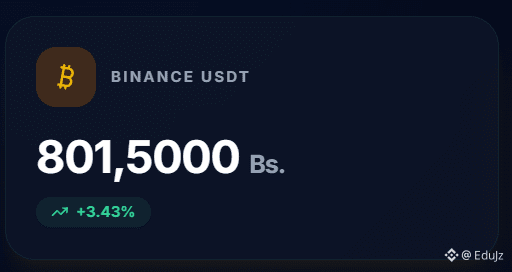
🚨 Bullish rally for the VES/USDT pair. 📈💥
Currently sitting at 801.50 bs
#VES #USDT #P2P #Trading #BinanceSquare
$USDC
🚨 Bullish rally for the VES/USDT pair. 📈💥
Currently sitting at 801.50 bs
#VES #USDT #P2P #Trading #BinanceSquare
$USDC
Currently sitting at 801.50 bs
#VES #USDT #P2P #Trading #BinanceSquare
$USDC
136

·
--
🇻🇪📉 Real gap or manipulation? The USDT vs. BCV dilemma
Every time the BCV tries to cool off the market by injecting dollars into the banks, USDT in the P2P scene holds its breath, but the reality for the average trader is different. For many, the real price of the economy isn't dictated by a decree, but by the immediate liquidity that Binance offers.
What do you prefer: waiting for cheap but scarce bank dollars, or resolving instantly with USDT at the real market price? 👇
#venezuela #P2PVenezuela #USDT #VES
🇻🇪📉 Real gap or manipulation? The USDT vs. BCV dilemma
Every time the BCV tries to cool off the market by injecting dollars into the banks, USDT in the P2P scene holds its breath, but the reality for the average trader is different. For many, the real price of the economy isn't dictated by a decree, but by the immediate liquidity that Binance offers.
What do you prefer: waiting for cheap but scarce bank dollars, or resolving instantly with USDT at the real market price? 👇
#venezuela #P2PVenezuela #USDT #VES
Every time the BCV tries to cool off the market by injecting dollars into the banks, USDT in the P2P scene holds its breath, but the reality for the average trader is different. For many, the real price of the economy isn't dictated by a decree, but by the immediate liquidity that Binance offers.
What do you prefer: waiting for cheap but scarce bank dollars, or resolving instantly with USDT at the real market price? 👇
#venezuela #P2PVenezuela #USDT #VES
226

·
--
Article
Radar spread vs order book: two numbers, two uses in USDT/VES Live P2P Radar Capture: 18/9/2026, 8:00:13 a. m.
USDT/VES reference Bs. 958.88
Buy USDT Bs. 958.88
Buy USDT Bs. 922.34
BCV Bs. 848.55
Premium vs BCV 13%
P2P spread 3.96%
Observed offers 181
Check current data on P2P Radar
The P2P radar publishes an aggregated spread of Bs. 36,54 (3,96%) for USDT/VES. The order book, read in the same snapshot, shows a spread of Bs. 0,20 (0,02%). They don't contradict each other: they measure different things. The first summarizes the distance between the aggregated buy price and the sell price within a broad universe of offers. The second measures the distance between the best available bid and the best available ask in the book at a specific instant.
Radar spread vs order book: two numbers, two uses in USDT/VES
Live P2P Radar Capture: 18/9/2026, 8:00:13 a. m.
USDT/VES reference Bs. 958.88
Buy USDT Bs. 958.88
Buy USDT Bs. 922.34
BCV Bs. 848.55
Premium vs BCV 13%
P2P spread 3.96%
Observed offers 181
Check current data on P2P Radar
The P2P radar publishes an aggregated spread of Bs. 36,54 (3,96%) for USDT/VES. The order book, read in the same snapshot, shows a spread of Bs. 0,20 (0,02%). They don't contradict each other: they measure different things. The first summarizes the distance between the aggregated buy price and the sell price within a broad universe of offers. The second measures the distance between the best available bid and the best available ask in the book at a specific instant.
USDT/VES reference Bs. 958.88
Buy USDT Bs. 958.88
Buy USDT Bs. 922.34
BCV Bs. 848.55
Premium vs BCV 13%
P2P spread 3.96%
Observed offers 181
Check current data on P2P Radar
The P2P radar publishes an aggregated spread of Bs. 36,54 (3,96%) for USDT/VES. The order book, read in the same snapshot, shows a spread of Bs. 0,20 (0,02%). They don't contradict each other: they measure different things. The first summarizes the distance between the aggregated buy price and the sell price within a broad universe of offers. The second measures the distance between the best available bid and the best available ask in the book at a specific instant.
4
·
--
Article
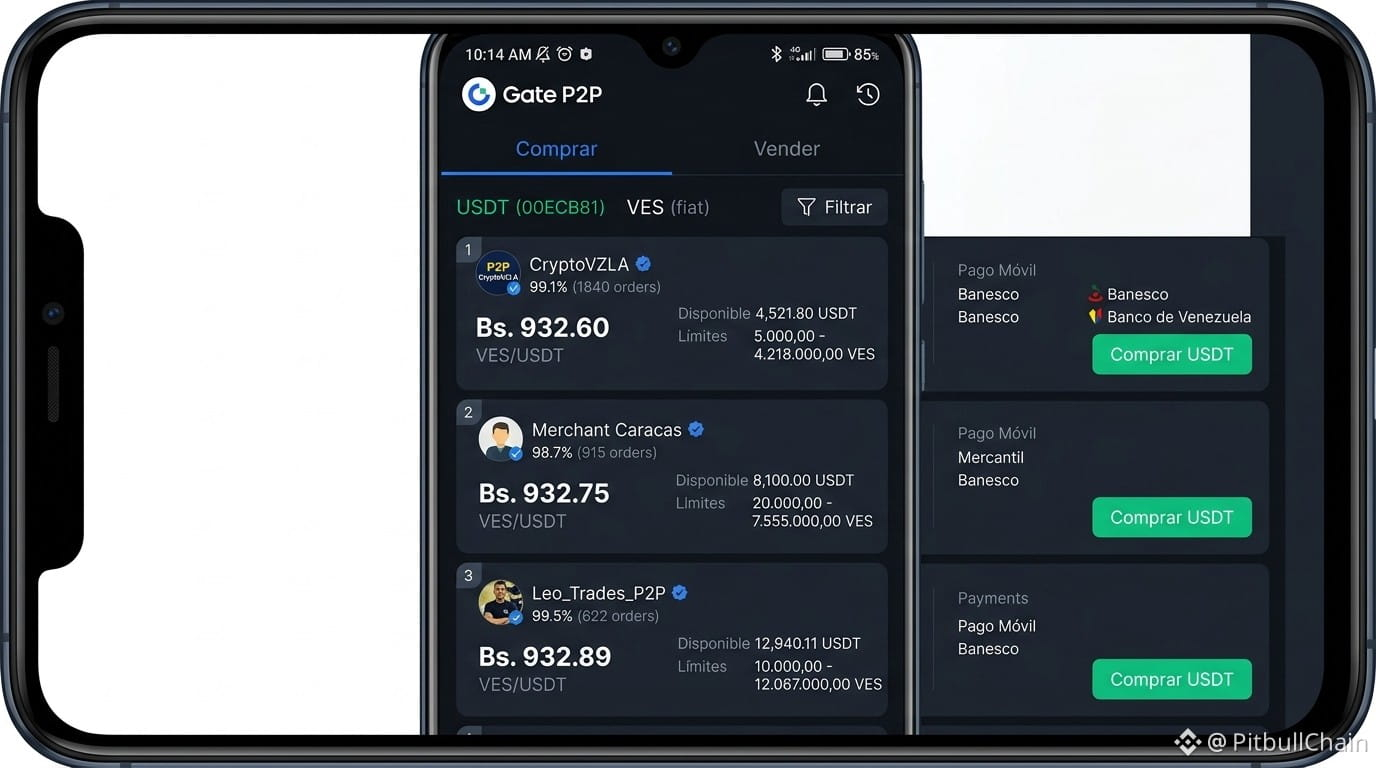
P2P Spread USDT/VES: why the 4.2% is misleading and the real one is 0.04% Live P2P Radar Capture: 28/8/2026, 1:30:16 p. m.
USDT/VES reference Bs. 941.71
Buy USDT Bs. 941.71
USDT Sale Bs. 903.46
BCV Bs. 791.67
Premium vs BCV 18.95%
P2P Spread 4.23%
Observed offers 262
Verify current data in Radar P2P
In the Venezuelan P2P market, not all prices are the same. While the P2P Radar shows an average spread of 4.23% between buying and selling USDT, the order book on Binance and other platforms reveals a real spread of just 0.04%. We analyze why this difference happens and which banks offer the best prices, with the premium over BCV as the backdrop.
P2P Spread USDT/VES: why the 4.2% is misleading and the real one is 0.04%
Live P2P Radar Capture: 28/8/2026, 1:30:16 p. m.
USDT/VES reference Bs. 941.71
Buy USDT Bs. 941.71
USDT Sale Bs. 903.46
BCV Bs. 791.67
Premium vs BCV 18.95%
P2P Spread 4.23%
Observed offers 262
Verify current data in Radar P2P
In the Venezuelan P2P market, not all prices are the same. While the P2P Radar shows an average spread of 4.23% between buying and selling USDT, the order book on Binance and other platforms reveals a real spread of just 0.04%. We analyze why this difference happens and which banks offer the best prices, with the premium over BCV as the backdrop.
USDT/VES reference Bs. 941.71
Buy USDT Bs. 941.71
USDT Sale Bs. 903.46
BCV Bs. 791.67
Premium vs BCV 18.95%
P2P Spread 4.23%
Observed offers 262
Verify current data in Radar P2P
In the Venezuelan P2P market, not all prices are the same. While the P2P Radar shows an average spread of 4.23% between buying and selling USDT, the order book on Binance and other platforms reveals a real spread of just 0.04%. We analyze why this difference happens and which banks offer the best prices, with the premium over BCV as the backdrop.
2
·
--
Article
7 Protocols to Validate P2P Offers in Markets with High Spread (2026 Guide) Live P2P Radar Capture: 28/8/2026, 7:30:15 p. m.
USDT/VES reference Bs. 946.38
Buy USDT Bs. 946.38
Buy USDT Bs. 915.47
BCV Bs. 794.99
Premium vs BCV 19.04%
P2P Spread 3.38%
Observed offers 246
Check current data on Radar P2P
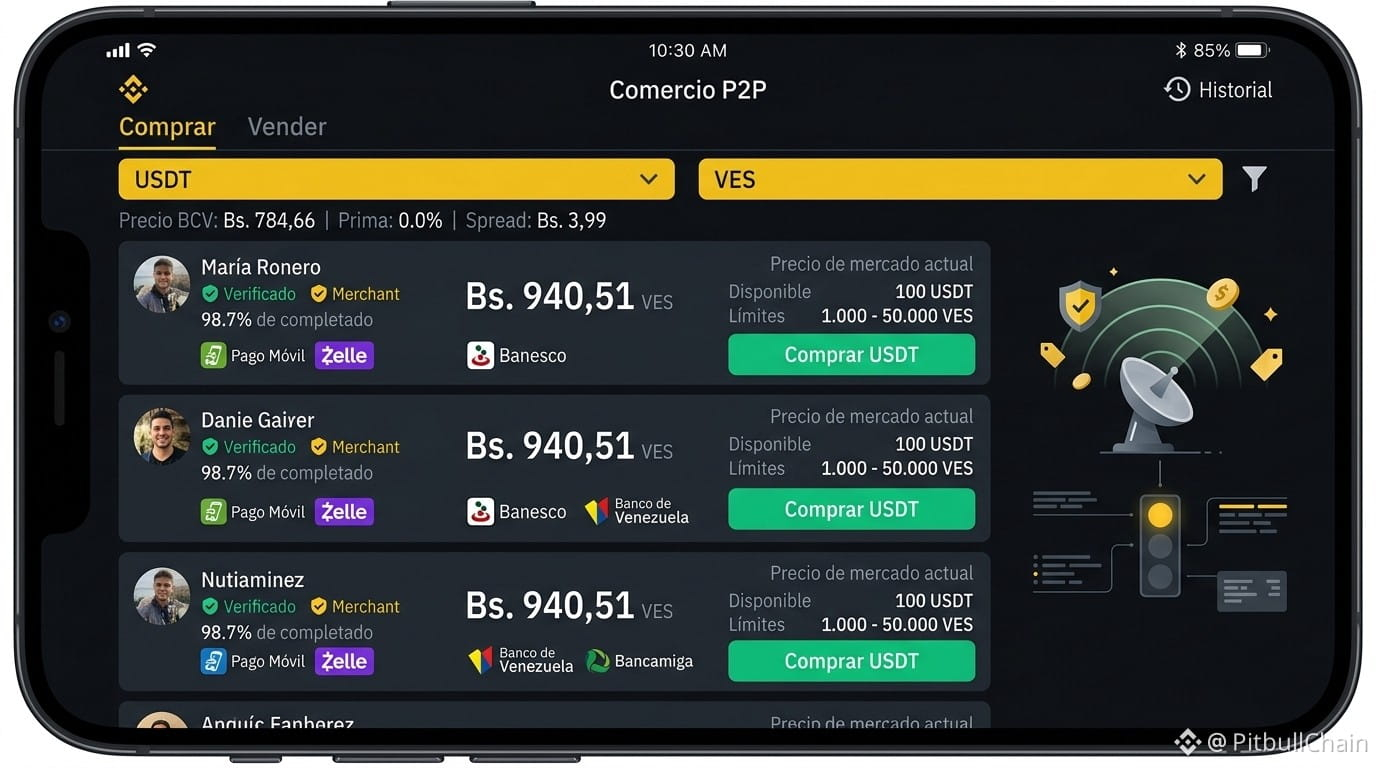
The P2P market in Venezuela shows conditions that require caution. According to the PitbullChain P2P Radar, captured on August 28, 2026 at 23:30 UTC, the spread between buying and selling USDT is 3.38% (Bs. 30.91). The traffic light is yellow with a score of 69: there is enough liquidity (246 active offers), but the elevated spread and warning signs require verifying each counterparty before transferring.
7 Protocols to Validate P2P Offers in Markets with High Spread (2026 Guide)
Live P2P Radar Capture: 28/8/2026, 7:30:15 p. m.
USDT/VES reference Bs. 946.38
Buy USDT Bs. 946.38
Buy USDT Bs. 915.47
BCV Bs. 794.99
Premium vs BCV 19.04%
P2P Spread 3.38%
Observed offers 246
Check current data on Radar P2P
The P2P market in Venezuela shows conditions that require caution. According to the PitbullChain P2P Radar, captured on August 28, 2026 at 23:30 UTC, the spread between buying and selling USDT is 3.38% (Bs. 30.91). The traffic light is yellow with a score of 69: there is enough liquidity (246 active offers), but the elevated spread and warning signs require verifying each counterparty before transferring.
USDT/VES reference Bs. 946.38
Buy USDT Bs. 946.38
Buy USDT Bs. 915.47
BCV Bs. 794.99
Premium vs BCV 19.04%
P2P Spread 3.38%
Observed offers 246
Check current data on Radar P2P
The P2P market in Venezuela shows conditions that require caution. According to the PitbullChain P2P Radar, captured on August 28, 2026 at 23:30 UTC, the spread between buying and selling USDT is 3.38% (Bs. 30.91). The traffic light is yellow with a score of 69: there is enough liquidity (246 active offers), but the elevated spread and warning signs require verifying each counterparty before transferring.
4
·
--
Article
Spreads and liquidity by bank in the USDT/VES P2P: where is it best to trade today? Live Radar P2P Capture: 15/9/2026, 10:00:13 a. m.
USDT/VES reference Bs. 959.46
Buy USDT Bs. 959.46
USDT sale Bs. 928.94
BCV Bs. 842.21
Premium vs BCV 13.92%
P2P spread 3.29%
Observed offers 194
Check current data on Radar P2P
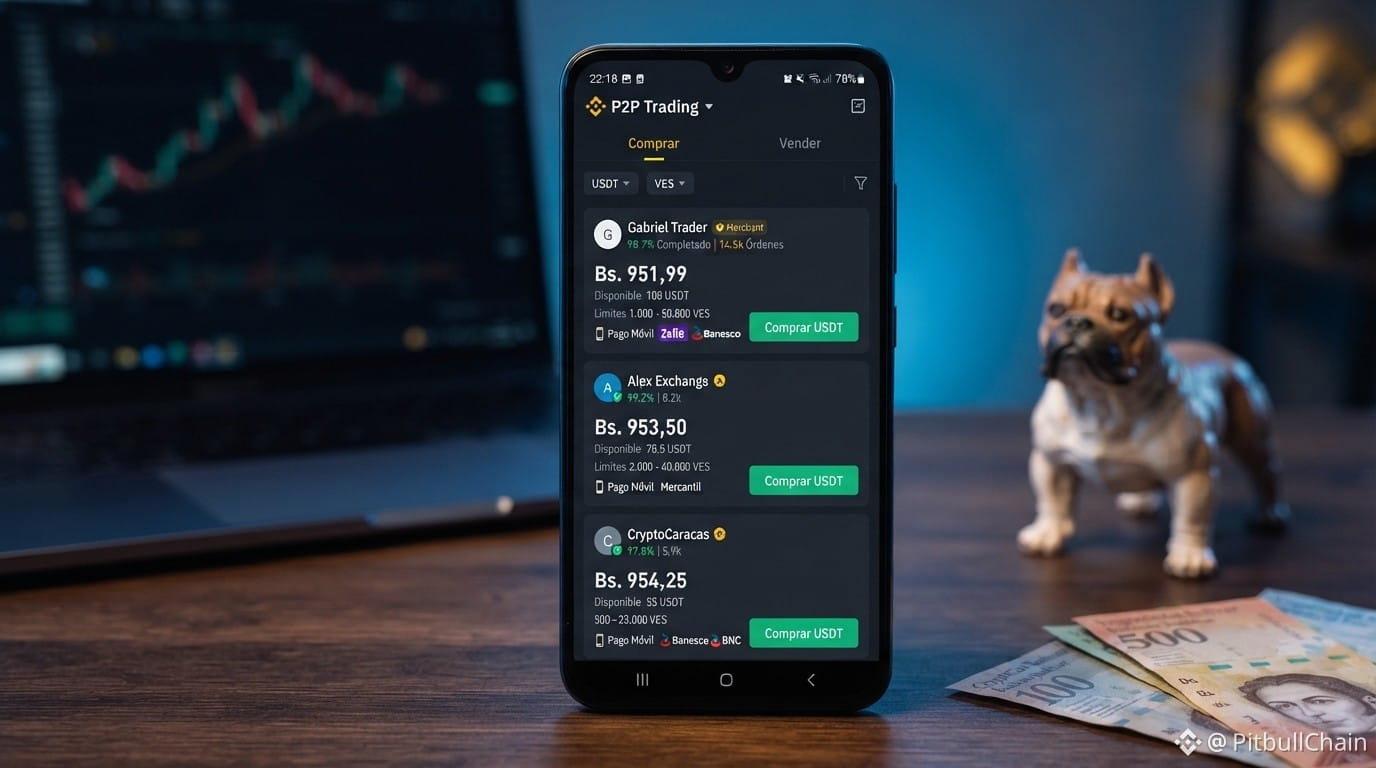
The P2P for USDT/VES kicks off the day on September 15, 2026 with a familiar picture: abundant supply, spreads that don’t forgive, and a yellow traffic light that asks you to think twice before moving bolivars. The useful question is not whether the market is overpriced or underpriced, but **which bank is best to trade with based on each user’s amount and urgency**. These are the verified data that answer that question.
Spreads and liquidity by bank in the USDT/VES P2P: where is it best to trade today?
Live Radar P2P Capture: 15/9/2026, 10:00:13 a. m.
USDT/VES reference Bs. 959.46
Buy USDT Bs. 959.46
USDT sale Bs. 928.94
BCV Bs. 842.21
Premium vs BCV 13.92%
P2P spread 3.29%
Observed offers 194
Check current data on Radar P2P
The P2P for USDT/VES kicks off the day on September 15, 2026 with a familiar picture: abundant supply, spreads that don’t forgive, and a yellow traffic light that asks you to think twice before moving bolivars. The useful question is not whether the market is overpriced or underpriced, but **which bank is best to trade with based on each user’s amount and urgency**. These are the verified data that answer that question.
USDT/VES reference Bs. 959.46
Buy USDT Bs. 959.46
USDT sale Bs. 928.94
BCV Bs. 842.21
Premium vs BCV 13.92%
P2P spread 3.29%
Observed offers 194
Check current data on Radar P2P
The P2P for USDT/VES kicks off the day on September 15, 2026 with a familiar picture: abundant supply, spreads that don’t forgive, and a yellow traffic light that asks you to think twice before moving bolivars. The useful question is not whether the market is overpriced or underpriced, but **which bank is best to trade with based on each user’s amount and urgency**. These are the verified data that answer that question.
6
·
--
Article
P2P Radar: 70% Buy Imbalance in the USDT/VES Order Book Live P2P Radar Capture: 30/8/2026, 8:00:18 p. m.
USDT/VES reference Bs. 940.03
Buy USDT Bs. 940.03
Sell USDT Bs. 907.91
BCV Bs. 794.99
Premium vs BCV 18.24%
P2P spread 3.54%
Observed offers 223
Check current data on P2P Radar
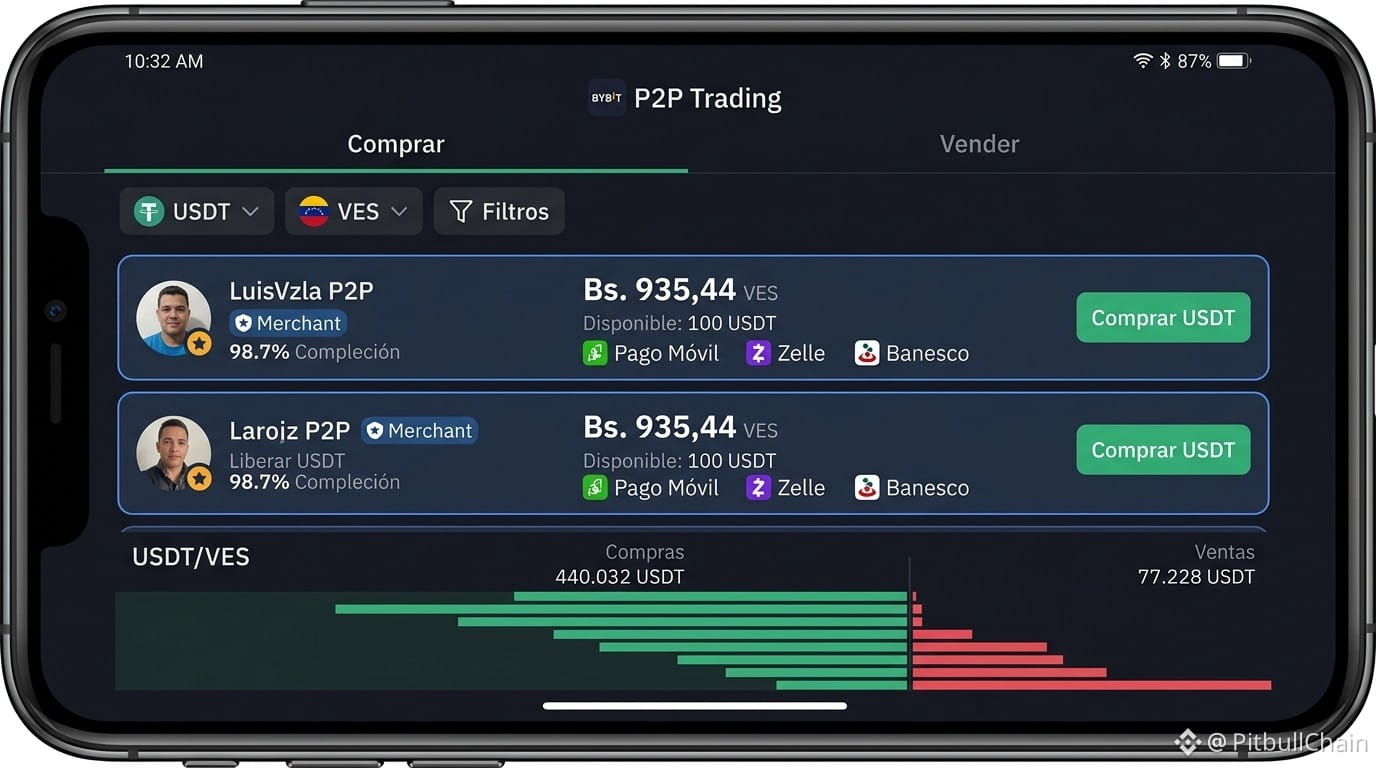
The USDT/VES P2P market in Venezuela starts the day with a clear signal: demand for stablecoins continues to dominate the supply. According to the live data captured on August 31, 2026 at 00:00 UTC, the order book shows **440.032 USDT in buy orders** versus only **77.228 USDT in sell orders**, a **70.14%** imbalance. This buying pressure coexists with an average spread of **3.54%** and a yellow traffic light, outlining a scenario of ample liquidity, but with price frictions that require caution when trading.
P2P Radar: 70% Buy Imbalance in the USDT/VES Order Book
Live P2P Radar Capture: 30/8/2026, 8:00:18 p. m.
USDT/VES reference Bs. 940.03
Buy USDT Bs. 940.03
Sell USDT Bs. 907.91
BCV Bs. 794.99
Premium vs BCV 18.24%
P2P spread 3.54%
Observed offers 223
Check current data on P2P Radar
The USDT/VES P2P market in Venezuela starts the day with a clear signal: demand for stablecoins continues to dominate the supply. According to the live data captured on August 31, 2026 at 00:00 UTC, the order book shows **440.032 USDT in buy orders** versus only **77.228 USDT in sell orders**, a **70.14%** imbalance. This buying pressure coexists with an average spread of **3.54%** and a yellow traffic light, outlining a scenario of ample liquidity, but with price frictions that require caution when trading.
USDT/VES reference Bs. 940.03
Buy USDT Bs. 940.03
Sell USDT Bs. 907.91
BCV Bs. 794.99
Premium vs BCV 18.24%
P2P spread 3.54%
Observed offers 223
Check current data on P2P Radar
The USDT/VES P2P market in Venezuela starts the day with a clear signal: demand for stablecoins continues to dominate the supply. According to the live data captured on August 31, 2026 at 00:00 UTC, the order book shows **440.032 USDT in buy orders** versus only **77.228 USDT in sell orders**, a **70.14%** imbalance. This buying pressure coexists with an average spread of **3.54%** and a yellow traffic light, outlining a scenario of ample liquidity, but with price frictions that require caution when trading.
6

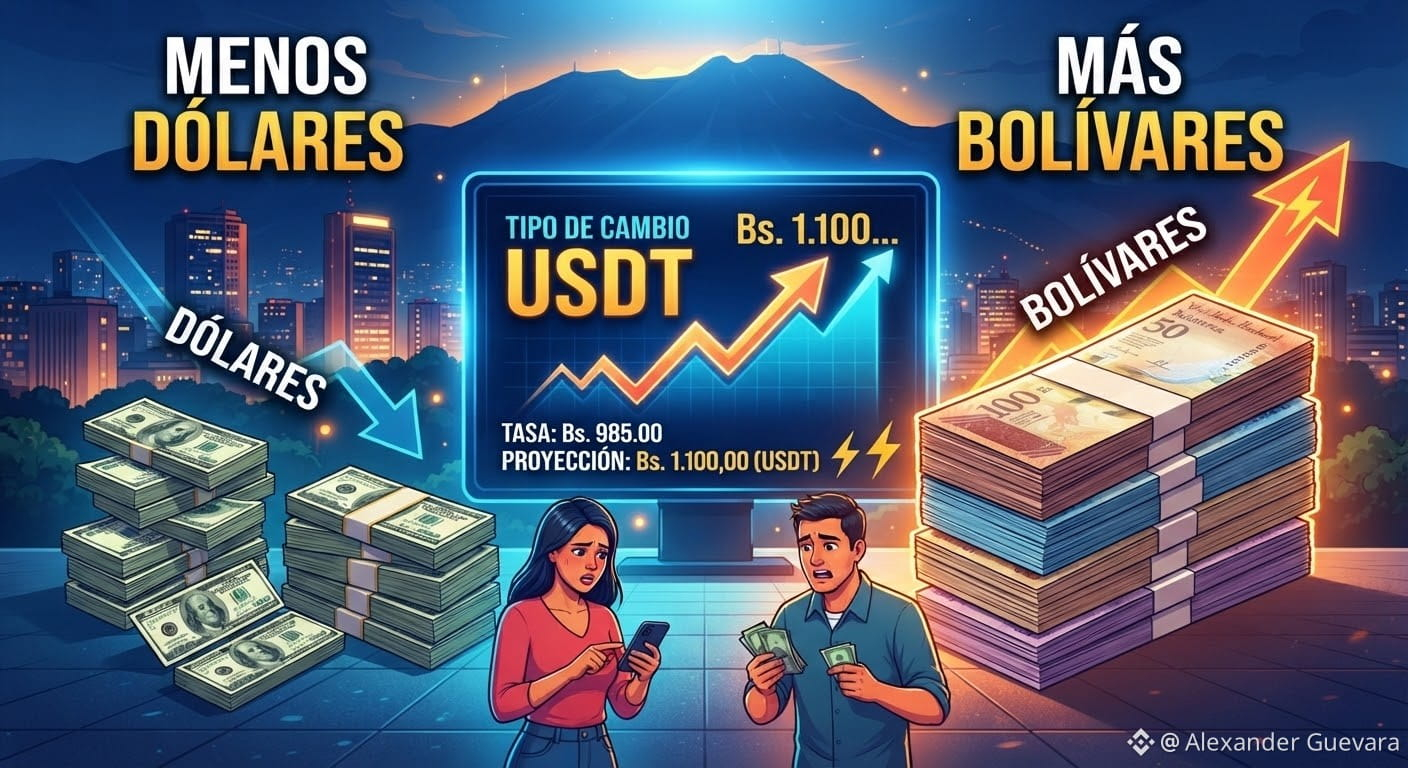
Less dollars and more Bolivars, that’s what the dynamics will be in the last months of the year—USDT heading toward Bs. 1,100...⚡️
The assertion about a “less dollars and more bolivars” dynamic, along with a projection of USDT approaching 1,100 Bs., reflects the constant exchange-rate volatility and liquidity pressures in Venezuela’s foreign-exchange market.
The key economic factors influencing this trend are:
* Expansion of monetary liquidity: The increase in the issuance of bolivars to cover public spending, payment of year-end bonuses (aguinaldos), and bonuses toward the last quarter of the year usually boosts demand for safe-haven assets.
* Pressure on the P2P market: With the official exchange rate from the Central Bank of Venezuela lagging behind and parallel rates and USDT trading fluctuating around 950 - 990 bolivars, any jump in demand for foreign currency pushes the currency premium upward.
* Restriction of foreign-currency supply: The exchange-rate intervention by the issuing authority aims to contain the gap, but a shortage of foreign-currency cash flow weakens the ability to defend the official rate.
* Informal indexation: In anticipation of devaluation, businesses and economic agents adjust their cost structures as a precaution, accelerating the circulation speed of the bolívar before it loses purchasing power.
#USDT #VES #dolar #venezuela #P2P $BTC
Less dollars and more Bolivars, that’s what the dynamics will be in the last months of the year—USDT heading toward Bs. 1,100...⚡️
The assertion about a “less dollars and more bolivars” dynamic, along with a projection of USDT approaching 1,100 Bs., reflects the constant exchange-rate volatility and liquidity pressures in Venezuela’s foreign-exchange market.
The key economic factors influencing this trend are:
* Expansion of monetary liquidity: The increase in the issuance of bolivars to cover public spending, payment of year-end bonuses (aguinaldos), and bonuses toward the last quarter of the year usually boosts demand for safe-haven assets.
* Pressure on the P2P market: With the official exchange rate from the Central Bank of Venezuela lagging behind and parallel rates and USDT trading fluctuating around 950 - 990 bolivars, any jump in demand for foreign currency pushes the currency premium upward.
* Restriction of foreign-currency supply: The exchange-rate intervention by the issuing authority aims to contain the gap, but a shortage of foreign-currency cash flow weakens the ability to defend the official rate.
* Informal indexation: In anticipation of devaluation, businesses and economic agents adjust their cost structures as a precaution, accelerating the circulation speed of the bolívar before it loses purchasing power.
#USDT #VES #dolar #venezuela #P2P $BTC
The assertion about a “less dollars and more bolivars” dynamic, along with a projection of USDT approaching 1,100 Bs., reflects the constant exchange-rate volatility and liquidity pressures in Venezuela’s foreign-exchange market.
The key economic factors influencing this trend are:
* Expansion of monetary liquidity: The increase in the issuance of bolivars to cover public spending, payment of year-end bonuses (aguinaldos), and bonuses toward the last quarter of the year usually boosts demand for safe-haven assets.
* Pressure on the P2P market: With the official exchange rate from the Central Bank of Venezuela lagging behind and parallel rates and USDT trading fluctuating around 950 - 990 bolivars, any jump in demand for foreign currency pushes the currency premium upward.
* Restriction of foreign-currency supply: The exchange-rate intervention by the issuing authority aims to contain the gap, but a shortage of foreign-currency cash flow weakens the ability to defend the official rate.
* Informal indexation: In anticipation of devaluation, businesses and economic agents adjust their cost structures as a precaution, accelerating the circulation speed of the bolívar before it loses purchasing power.
#USDT #VES #dolar #venezuela #P2P $BTC
49
·
--
Article
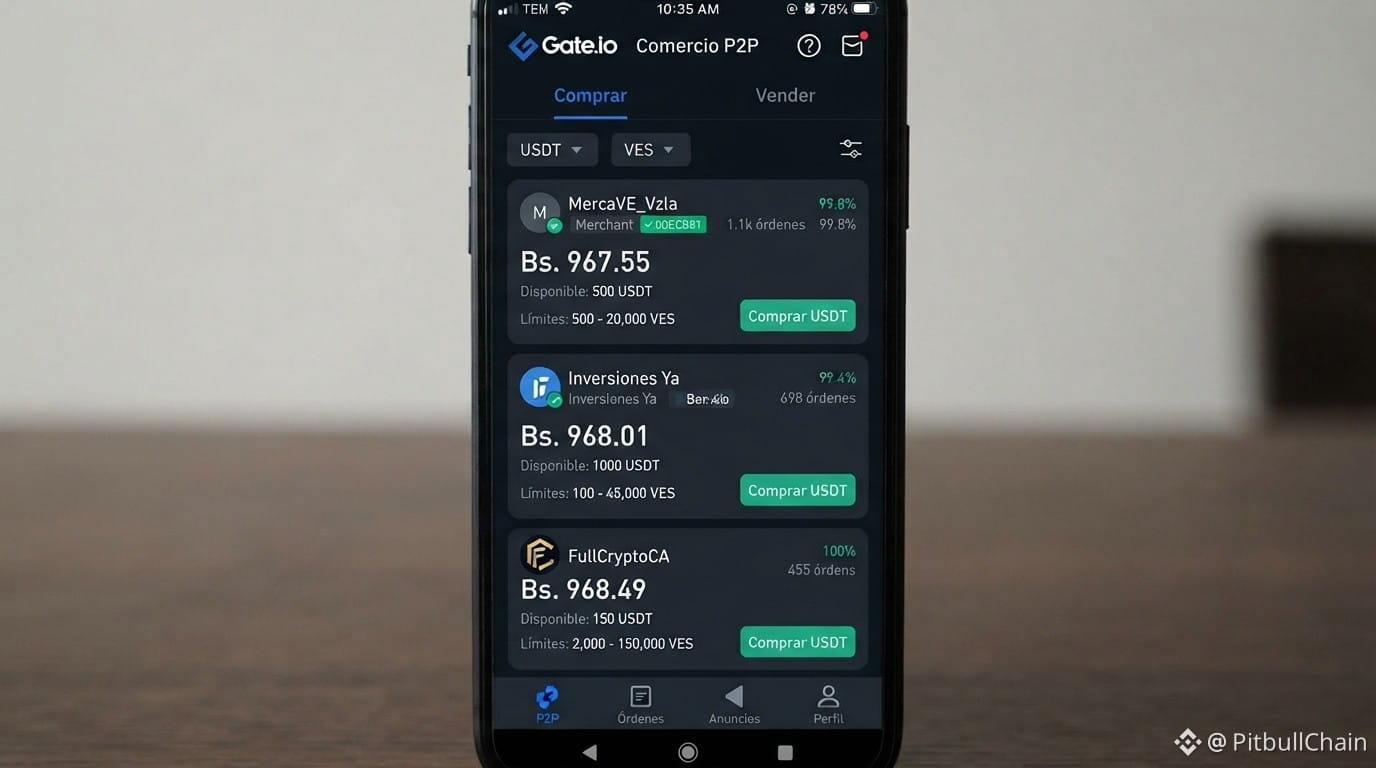
The spread of P2P USDT: a thermometer of the Venezuelan economy Live P2P Radar Capture: 9/9/2026, 12:00:16 a. m.
USDT/VES reference Bs. 978.71
Buy USDT Bs. 978.71
Sell USDT Bs. 938.07
BCV Bs. 820.10
Premium vs BCV 19.34%
P2P Spread 4.33%
Observed offers 194
Verify current data on Radar P2P
On the morning of September 9, 2026, the Venezuelan P2P market showed a revealing snapshot: USDT was traded at 978.71 bolívares for buy and at 938.07 for sell, while the BCV official rate stood at 820.10 bolívares per dollar. The premium between the two reached 19.34%, and the P2P internal spread came to 4.33%. Behind these figures there isn’t a simple arbitrage opportunity: there’s a thermometer of trust, liquidity, and fragmentation that affects millions of people who use digital dollars for their day-to-day lives.
The spread of P2P USDT: a thermometer of the Venezuelan economy
Live P2P Radar Capture: 9/9/2026, 12:00:16 a. m.
USDT/VES reference Bs. 978.71
Buy USDT Bs. 978.71
Sell USDT Bs. 938.07
BCV Bs. 820.10
Premium vs BCV 19.34%
P2P Spread 4.33%
Observed offers 194
Verify current data on Radar P2P
On the morning of September 9, 2026, the Venezuelan P2P market showed a revealing snapshot: USDT was traded at 978.71 bolívares for buy and at 938.07 for sell, while the BCV official rate stood at 820.10 bolívares per dollar. The premium between the two reached 19.34%, and the P2P internal spread came to 4.33%. Behind these figures there isn’t a simple arbitrage opportunity: there’s a thermometer of trust, liquidity, and fragmentation that affects millions of people who use digital dollars for their day-to-day lives.
USDT/VES reference Bs. 978.71
Buy USDT Bs. 978.71
Sell USDT Bs. 938.07
BCV Bs. 820.10
Premium vs BCV 19.34%
P2P Spread 4.33%
Observed offers 194
Verify current data on Radar P2P
On the morning of September 9, 2026, the Venezuelan P2P market showed a revealing snapshot: USDT was traded at 978.71 bolívares for buy and at 938.07 for sell, while the BCV official rate stood at 820.10 bolívares per dollar. The premium between the two reached 19.34%, and the P2P internal spread came to 4.33%. Behind these figures there isn’t a simple arbitrage opportunity: there’s a thermometer of trust, liquidity, and fragmentation that affects millions of people who use digital dollars for their day-to-day lives.
12
·
--
Article
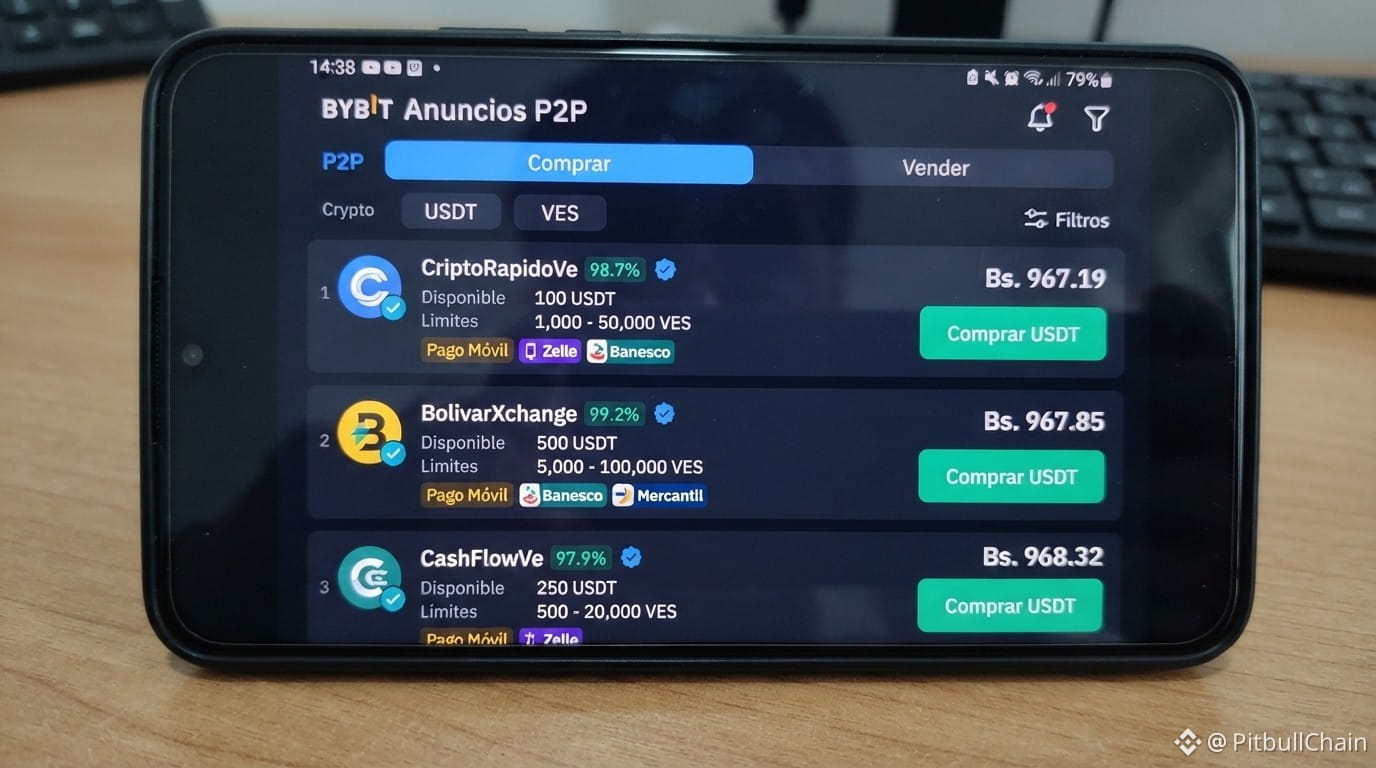
USDT/VES spread exceeds 3% and P2P traffic light turns yellow alert Live P2P Radar Capture: 8/9/2026, 10:00:14 p. m.
USDT/VES reference Bs. 974.70
Buy USDT Bs. 974.70
USDT Sale Bs. 943.41
BCV Bs. 820.10
Premium vs BCV 18.85%
P2P Spread 3.32%
Observed offers 226
Verify current data on P2P Radar
📊 **Alert in the Venezuelan P2P market:** the USDT/Bolívar spread (USDT/VES) exceeded 3% on average, according to data from the PitbullChain P2P Radar captured at 02:00 UTC on September 9, 2026. However, a look at the order book shows there are still offers with a real differential of just 0.29 Bs. This discrepancy is a clear signal: _comparing before trading was never so necessary_.
USDT/VES spread exceeds 3% and P2P traffic light turns yellow alert
Live P2P Radar Capture: 8/9/2026, 10:00:14 p. m.
USDT/VES reference Bs. 974.70
Buy USDT Bs. 974.70
USDT Sale Bs. 943.41
BCV Bs. 820.10
Premium vs BCV 18.85%
P2P Spread 3.32%
Observed offers 226
Verify current data on P2P Radar
📊 **Alert in the Venezuelan P2P market:** the USDT/Bolívar spread (USDT/VES) exceeded 3% on average, according to data from the PitbullChain P2P Radar captured at 02:00 UTC on September 9, 2026. However, a look at the order book shows there are still offers with a real differential of just 0.29 Bs. This discrepancy is a clear signal: _comparing before trading was never so necessary_.
USDT/VES reference Bs. 974.70
Buy USDT Bs. 974.70
USDT Sale Bs. 943.41
BCV Bs. 820.10
Premium vs BCV 18.85%
P2P Spread 3.32%
Observed offers 226
Verify current data on P2P Radar
📊 **Alert in the Venezuelan P2P market:** the USDT/Bolívar spread (USDT/VES) exceeded 3% on average, according to data from the PitbullChain P2P Radar captured at 02:00 UTC on September 9, 2026. However, a look at the order book shows there are still offers with a real differential of just 0.29 Bs. This discrepancy is a clear signal: _comparing before trading was never so necessary_.
8
🇻🇪 The BCV dollar stands at US$ Bs.820,10 ⏫️ 🚀, $USDT 967,16 Bs Exchange Rate Gap USDT ♻️ BCV 18,2% 🔻 #Bitcoin US$78.000 🔻#Ethereum
US$2.400 #BNB US$750 🔻. $ experiences an increase of 5,41 Bs. #VES
🇻🇪 The BCV dollar stands at US$ Bs.820,10 ⏫️ 🚀, $USDT 967,16 Bs Exchange Rate Gap USDT ♻️ BCV 18,2% 🔻 #Bitcoin US$78.000 🔻#Ethereum
US$2.400 #BNB US$750 🔻. $ experiences an increase of 5,41 Bs. #VES
US$2.400 #BNB US$750 🔻. $ experiences an increase of 5,41 Bs. #VES

1
94
·
--
Article
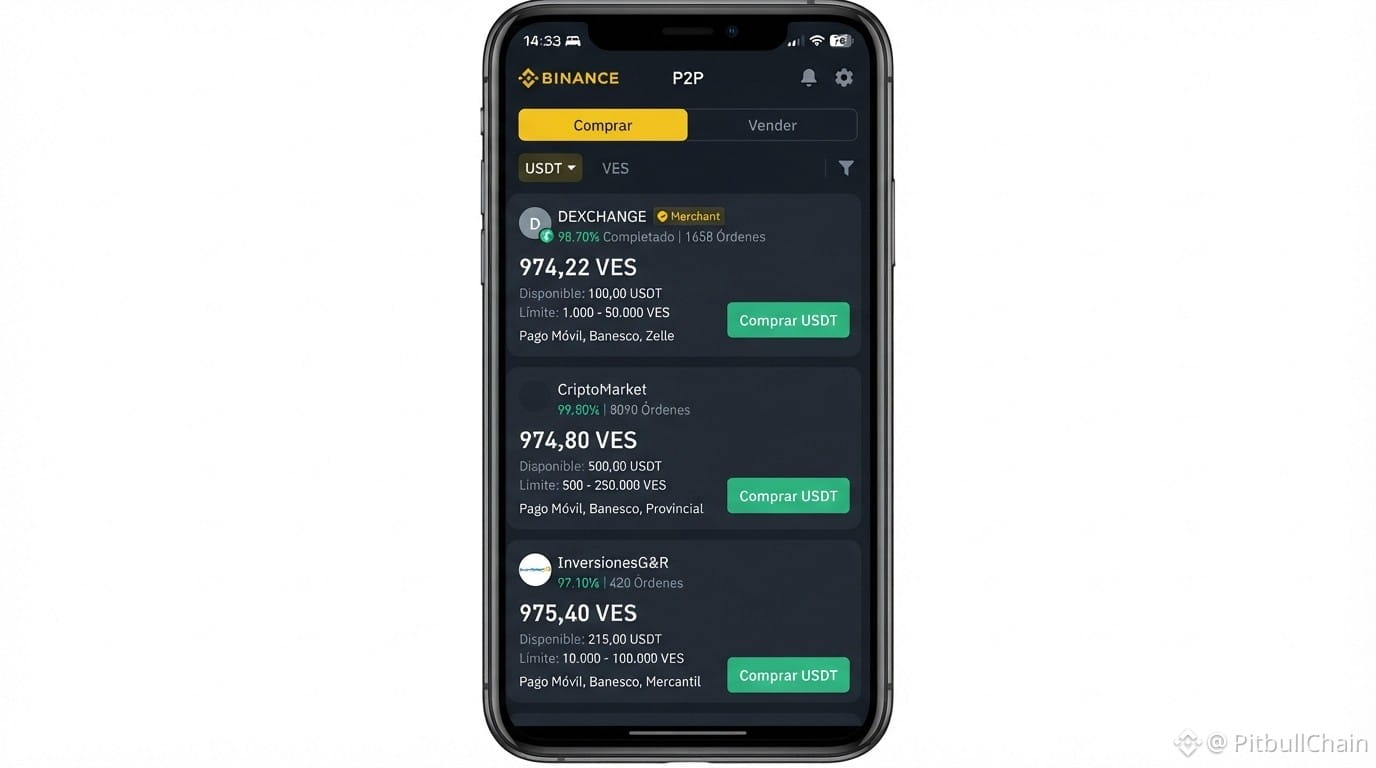
P2P order book: USDT demand pushes the premium vs the BCVThe over-the-counter crypto market in Venezuela, particularly USDT, is operating under clear buying pressure. According to Radar P2P data, the USDT quotation reached 992.59 bolívares for purchase, representing a premium of 21.84% versus the BCV official exchange rate (814.69 VES). This article analyzes the structure of the order book, the spread width, and differences by bank to understand what lies behind this imbalance. The order book snapshot: demand triples supply At the close of the capture on September 8, 2026 at 10:00 a.m., the P2P order book for USDT/VES showed a buy order volume of 379,129.78 USDT, versus only 87,372.10 USDT in sell orders. The imbalance reaches 62.54%: this is a market where buyers compete aggressively to acquire stablecoins, but sellers do not match that intensity. At the deepest level of the book, buyers are seen willing to take USDT at 962 bolívares (an order of 119,062 USDT on other platforms), while the sell side shows offers from 972 bolívares with smaller amounts. This asymmetry explains why the premium holds: more liquidity is demanding than offering. Premium of 21.8% vs the BCV: a reflection of de facto dollarization The BCV official dollar was set at 814.69 bolívares, while the average P2P USDT purchase price was 992.59 bolívares, leaving a premium of 21.84%. This gap is even higher than that of the parallel dollar (970.25 bolívares), indicating that USDT has become the preferred asset to hedge against the bolívar’s loss of value. It’s important to clarify that the premium is not a new phenomenon: in recent months it has ranged between 15% and 25%, depending on the availability of foreign currency and political news. However, the current level reflects sustained demand that is not finding enough of a counterparty. Wide spread: the friction of an imbalanced market The average spread between buying and selling USDT was 63.76 bolívares, equivalent to 6.86%. This margin is significantly higher than the technical spread of 3 bolívares seen between the best offer (972) and the best bid (969) in the order book. Why is the difference so large? The answer lies in price dispersion: while some sellers offer USDT at 973, others do so at 1000, depending on the payment method and urgency. For example, USDT sale announcements with Pago Móvil on other platforms average 996.79 bolívares, while on Binance with Banco de Venezuela it is quoted at 975.50. That difference of more than 20 bolívares is what buyers end up paying when they do not compare across platforms. Banks: where better liquidity and a lower spread can be found The bank-by-bank analysis shows that not all channels offer the same conditions. Banco de Venezuela and BANK present the smallest spread (0.85%), thanks to having both buy and sell ads with nearby prices. BNC also shows a low margin (0.47%), although with only two listings. By contrast, Pago Móvil and 'Other method' have spreads above 7%, reflecting a more expensive market for the end user. In terms of liquidity, 'Other method' concentrates 30.2% of the orders, followed by Pago Móvil (20.8%) and Banesco (19.5%). Banesco, for its part, offers a moderate spread of 2.95%, making it a balanced option between availability and cost. Implications for those trading in Venezuelan P2P The current scenario recommends comparing prices carefully before executing any transaction. A user who sells USDT can get between 925 and 967 bolívares depending on the bank, while someone buying must pay between 972 and 1000. That 7% difference is not small and can translate into savings if the right channel is chosen. We recommend using tools such as the P2P calculator and the bank comparison available on Radar P2P to verify the best conditions in real time. In addition, it is essential to validate the counterparty’s reputation and transaction limits. The order book will continue to be the main barometer of market pressure. If demand for USDT continues to exceed supply, the premium versus the BCV is likely to remain at elevated levels, and the spread will keep compensating for counterparty risk.
P2P order book: USDT demand pushes the premium vs the BCV
The over-the-counter crypto market in Venezuela, particularly USDT, is operating under clear buying pressure. According to Radar P2P data, the USDT quotation reached 992.59 bolívares for purchase, representing a premium of 21.84% versus the BCV official exchange rate (814.69 VES). This article analyzes the structure of the order book, the spread width, and differences by bank to understand what lies behind this imbalance. The order book snapshot: demand triples supply At the close of the capture on September 8, 2026 at 10:00 a.m., the P2P order book for USDT/VES showed a buy order volume of 379,129.78 USDT, versus only 87,372.10 USDT in sell orders. The imbalance reaches 62.54%: this is a market where buyers compete aggressively to acquire stablecoins, but sellers do not match that intensity. At the deepest level of the book, buyers are seen willing to take USDT at 962 bolívares (an order of 119,062 USDT on other platforms), while the sell side shows offers from 972 bolívares with smaller amounts. This asymmetry explains why the premium holds: more liquidity is demanding than offering. Premium of 21.8% vs the BCV: a reflection of de facto dollarization The BCV official dollar was set at 814.69 bolívares, while the average P2P USDT purchase price was 992.59 bolívares, leaving a premium of 21.84%. This gap is even higher than that of the parallel dollar (970.25 bolívares), indicating that USDT has become the preferred asset to hedge against the bolívar’s loss of value. It’s important to clarify that the premium is not a new phenomenon: in recent months it has ranged between 15% and 25%, depending on the availability of foreign currency and political news. However, the current level reflects sustained demand that is not finding enough of a counterparty. Wide spread: the friction of an imbalanced market The average spread between buying and selling USDT was 63.76 bolívares, equivalent to 6.86%. This margin is significantly higher than the technical spread of 3 bolívares seen between the best offer (972) and the best bid (969) in the order book. Why is the difference so large? The answer lies in price dispersion: while some sellers offer USDT at 973, others do so at 1000, depending on the payment method and urgency. For example, USDT sale announcements with Pago Móvil on other platforms average 996.79 bolívares, while on Binance with Banco de Venezuela it is quoted at 975.50. That difference of more than 20 bolívares is what buyers end up paying when they do not compare across platforms. Banks: where better liquidity and a lower spread can be found The bank-by-bank analysis shows that not all channels offer the same conditions. Banco de Venezuela and BANK present the smallest spread (0.85%), thanks to having both buy and sell ads with nearby prices. BNC also shows a low margin (0.47%), although with only two listings. By contrast, Pago Móvil and 'Other method' have spreads above 7%, reflecting a more expensive market for the end user. In terms of liquidity, 'Other method' concentrates 30.2% of the orders, followed by Pago Móvil (20.8%) and Banesco (19.5%). Banesco, for its part, offers a moderate spread of 2.95%, making it a balanced option between availability and cost. Implications for those trading in Venezuelan P2P The current scenario recommends comparing prices carefully before executing any transaction. A user who sells USDT can get between 925 and 967 bolívares depending on the bank, while someone buying must pay between 972 and 1000. That 7% difference is not small and can translate into savings if the right channel is chosen. We recommend using tools such as the P2P calculator and the bank comparison available on Radar P2P to verify the best conditions in real time. In addition, it is essential to validate the counterparty’s reputation and transaction limits. The order book will continue to be the main barometer of market pressure. If demand for USDT continues to exceed supply, the premium versus the BCV is likely to remain at elevated levels, and the spread will keep compensating for counterparty risk.
4
·
--
Article
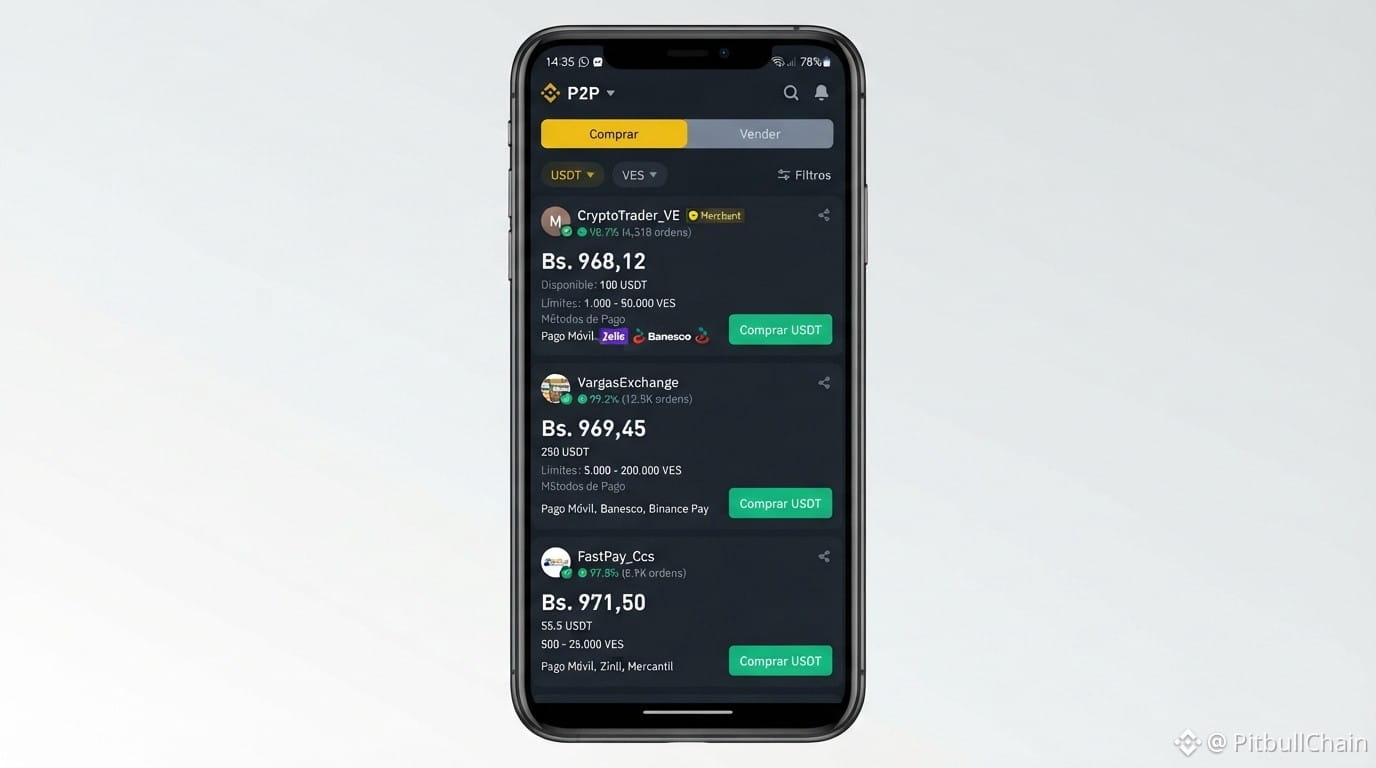
87% imbalance in P2P: Order book and bank liquidity x-rayA simple view, the USDT/VES peer-to-peer (P2P) market in Venezuela shows consistent volume and a sufficient presence of active ads on major platforms such as Binance, other platforms, and other platforms. However, when inspecting the internal layers of the order book, real-time data reveals a structural asymmetry: there is a marked imbalance between the liquidity accumulated on the buy side and the available depth on the sell side. According to Radar P2P monitoring captured on September 7, 2026, the depth imbalance (imbalance) stands at 87.03%. While the accumulated buy volume in the bid books totals 862,774.20 USDT across 42 open orders, the sell volume barely reaches 59,823.29 USDT spread across 40 offers. This difference conditions execution speed and the price friction users face depending on which side of the market they trade on. The illusion of liquidity: USDT/VES order book X-ray A frequent mistake when evaluating Venezuelan P2P is assuming that a high count of active traders equals balanced liquidity in both directions. The granular analysis of the order levels disproves this premise: Dominant buyer volume: Demand to convert bolívares into digital assets concentrates 93.5% of the total visible capital at the analyzed tips (862,774.20 USDT), with significant walls such as the 965.00 VES level (374,997.34 USDT across 5 orders) and 967.00 VES (78,080.98 USDT). Atomized and shallow selling: The orders to sell USDT and obtain bolívares total less than 60,000 USDT overall. The individual orders at the first levels range from 50 to 1,500 USDT, meaning medium or large placements can quickly consume the most competitive quotes and generate slippage. Market “traffic light” signals: The PitbullChain indicator shows a score of 69/100 (yellow status / moderate caution). Although the bank availability score (95) and overall liquidity (95) are solid, the depth metric drops to 45/100 and the spread score to 20/100, confirming the tightness of the sell book. Real spread and FX premium versus the official rate The average P2P buy price is 968.54 VES per digital dollar, while the average selling rate falls to 941.17 VES. This gap creates a gross spread of 27.37 VES (2.91%) in the overall Radar P2P consolidation, though within the competitive books between the best bid (972.90 VES) and best ask (949.44 VES), the direct spread is around 23.46 VES (2.41%). When these values are compared with the exchange rate of the Central Bank of Venezuela (BCV), set at 813.74 VES, the P2P market premium is established at 19.02%. Meanwhile, the parallel dollar reference reports 965.97 VES with a more compressed spread of 0.45% (buy at 968.14 VES vs. sell at 963.80 VES). The distance of nearly 155 bolívares per dollar between the BCV and the P2P ecosystem keeps constant pressure on demand for synthetic FX in bolívares. Performance by financial entity: Where is it executed with less friction? The banking channel used determines both counterparty availability and the price differential. The recorded data shows clear fragmentation in the conditions of each gateway: Mobile Payment (Volume leader): It groups 22.1% of total liquidity with 27 active ads. It presents an average buy price of 966.74 VES and selling at 962.79 VES, with a narrow spread of 3.95 VES (0.41%) and an execution score of 89/100. Banesco (Highest overall score): It captures 19.7% of liquidity with 24 ads. Its average buy price is 967.91 VES versus 962.70 VES for selling, yielding a spread of 5.21 VES (0.54%) and the best overall balance (score 93/100). Bank of Venezuela: It concentrates 13.9% of liquidity with 17 ads. It records average buying at 968.04 VES and selling at 964.64 VES, achieving one of the system’s lowest spreads: 3.39 VES (0.35%). Bancamiga: Although it contributes a smaller share of liquidity (4.9% and 6 ads), it offers the lowest differential between buy (967.39 VES) and sell (965.61 VES), with only 1.78 VES (0.18%) of spread. Mercantile and direct PagoMovil: They show active buy quotes (967.56 VES and 967.25 VES respectively), but with an absence of direct sell orders in the main sampling, reflecting one-sided liquidity. Practical calculations for immediate conversion To gauge the impact of these levels on everyday operations: Settlement of 100 USDT to bolívares: At the effective selling rate of 941.1685 VES, the user receives 94,116.85 VES. If accessing competitive books in Banesco or Bank of Venezuela around 964.50 VES, the effective return rises to approximately 96,450.00 VES. Acquisition of USDT with 1,000,000 VES: Using the reference buy rate of 941.17 VES, one million bolívares yields 1,062.51 USDT on the selling end, while at the taker rate of 968.54 VES the amount decreases to 1,032.48 USDT. Operational considerations for P2P users Given an 87% asymmetry scenario and an elevated spread in the overall market, participants should prioritize execution management before placing orders: Filter by specific banking channel: Trading through methods with spreads lower than 0.50% (such as Bancamiga, Bank of Venezuela, or Mobile Payment) significantly reduces friction loss compared with the overall average of 2.91%. Review minimum and maximum limits: Selling depth is fragmented. When selling amounts above 500 USDT, it is essential to verify whether the trader covers the full amount or whether they will split the order across multiple tranches. Monitor the FX premium: With a 19.02% gap versus the official dollar, changes in BCV FX intervention or adjustments to banking liquidity can quickly alter rates on Binance and other platforms.
87% imbalance in P2P: Order book and bank liquidity x-ray
A simple view, the USDT/VES peer-to-peer (P2P) market in Venezuela shows consistent volume and a sufficient presence of active ads on major platforms such as Binance, other platforms, and other platforms. However, when inspecting the internal layers of the order book, real-time data reveals a structural asymmetry: there is a marked imbalance between the liquidity accumulated on the buy side and the available depth on the sell side. According to Radar P2P monitoring captured on September 7, 2026, the depth imbalance (imbalance) stands at 87.03%. While the accumulated buy volume in the bid books totals 862,774.20 USDT across 42 open orders, the sell volume barely reaches 59,823.29 USDT spread across 40 offers. This difference conditions execution speed and the price friction users face depending on which side of the market they trade on. The illusion of liquidity: USDT/VES order book X-ray A frequent mistake when evaluating Venezuelan P2P is assuming that a high count of active traders equals balanced liquidity in both directions. The granular analysis of the order levels disproves this premise: Dominant buyer volume: Demand to convert bolívares into digital assets concentrates 93.5% of the total visible capital at the analyzed tips (862,774.20 USDT), with significant walls such as the 965.00 VES level (374,997.34 USDT across 5 orders) and 967.00 VES (78,080.98 USDT). Atomized and shallow selling: The orders to sell USDT and obtain bolívares total less than 60,000 USDT overall. The individual orders at the first levels range from 50 to 1,500 USDT, meaning medium or large placements can quickly consume the most competitive quotes and generate slippage. Market “traffic light” signals: The PitbullChain indicator shows a score of 69/100 (yellow status / moderate caution). Although the bank availability score (95) and overall liquidity (95) are solid, the depth metric drops to 45/100 and the spread score to 20/100, confirming the tightness of the sell book. Real spread and FX premium versus the official rate The average P2P buy price is 968.54 VES per digital dollar, while the average selling rate falls to 941.17 VES. This gap creates a gross spread of 27.37 VES (2.91%) in the overall Radar P2P consolidation, though within the competitive books between the best bid (972.90 VES) and best ask (949.44 VES), the direct spread is around 23.46 VES (2.41%). When these values are compared with the exchange rate of the Central Bank of Venezuela (BCV), set at 813.74 VES, the P2P market premium is established at 19.02%. Meanwhile, the parallel dollar reference reports 965.97 VES with a more compressed spread of 0.45% (buy at 968.14 VES vs. sell at 963.80 VES). The distance of nearly 155 bolívares per dollar between the BCV and the P2P ecosystem keeps constant pressure on demand for synthetic FX in bolívares. Performance by financial entity: Where is it executed with less friction? The banking channel used determines both counterparty availability and the price differential. The recorded data shows clear fragmentation in the conditions of each gateway: Mobile Payment (Volume leader): It groups 22.1% of total liquidity with 27 active ads. It presents an average buy price of 966.74 VES and selling at 962.79 VES, with a narrow spread of 3.95 VES (0.41%) and an execution score of 89/100. Banesco (Highest overall score): It captures 19.7% of liquidity with 24 ads. Its average buy price is 967.91 VES versus 962.70 VES for selling, yielding a spread of 5.21 VES (0.54%) and the best overall balance (score 93/100). Bank of Venezuela: It concentrates 13.9% of liquidity with 17 ads. It records average buying at 968.04 VES and selling at 964.64 VES, achieving one of the system’s lowest spreads: 3.39 VES (0.35%). Bancamiga: Although it contributes a smaller share of liquidity (4.9% and 6 ads), it offers the lowest differential between buy (967.39 VES) and sell (965.61 VES), with only 1.78 VES (0.18%) of spread. Mercantile and direct PagoMovil: They show active buy quotes (967.56 VES and 967.25 VES respectively), but with an absence of direct sell orders in the main sampling, reflecting one-sided liquidity. Practical calculations for immediate conversion To gauge the impact of these levels on everyday operations: Settlement of 100 USDT to bolívares: At the effective selling rate of 941.1685 VES, the user receives 94,116.85 VES. If accessing competitive books in Banesco or Bank of Venezuela around 964.50 VES, the effective return rises to approximately 96,450.00 VES. Acquisition of USDT with 1,000,000 VES: Using the reference buy rate of 941.17 VES, one million bolívares yields 1,062.51 USDT on the selling end, while at the taker rate of 968.54 VES the amount decreases to 1,032.48 USDT. Operational considerations for P2P users Given an 87% asymmetry scenario and an elevated spread in the overall market, participants should prioritize execution management before placing orders: Filter by specific banking channel: Trading through methods with spreads lower than 0.50% (such as Bancamiga, Bank of Venezuela, or Mobile Payment) significantly reduces friction loss compared with the overall average of 2.91%. Review minimum and maximum limits: Selling depth is fragmented. When selling amounts above 500 USDT, it is essential to verify whether the trader covers the full amount or whether they will split the order across multiple tranches. Monitor the FX premium: With a 19.02% gap versus the official dollar, changes in BCV FX intervention or adjustments to banking liquidity can quickly alter rates on Binance and other platforms.
12
·
--
Article
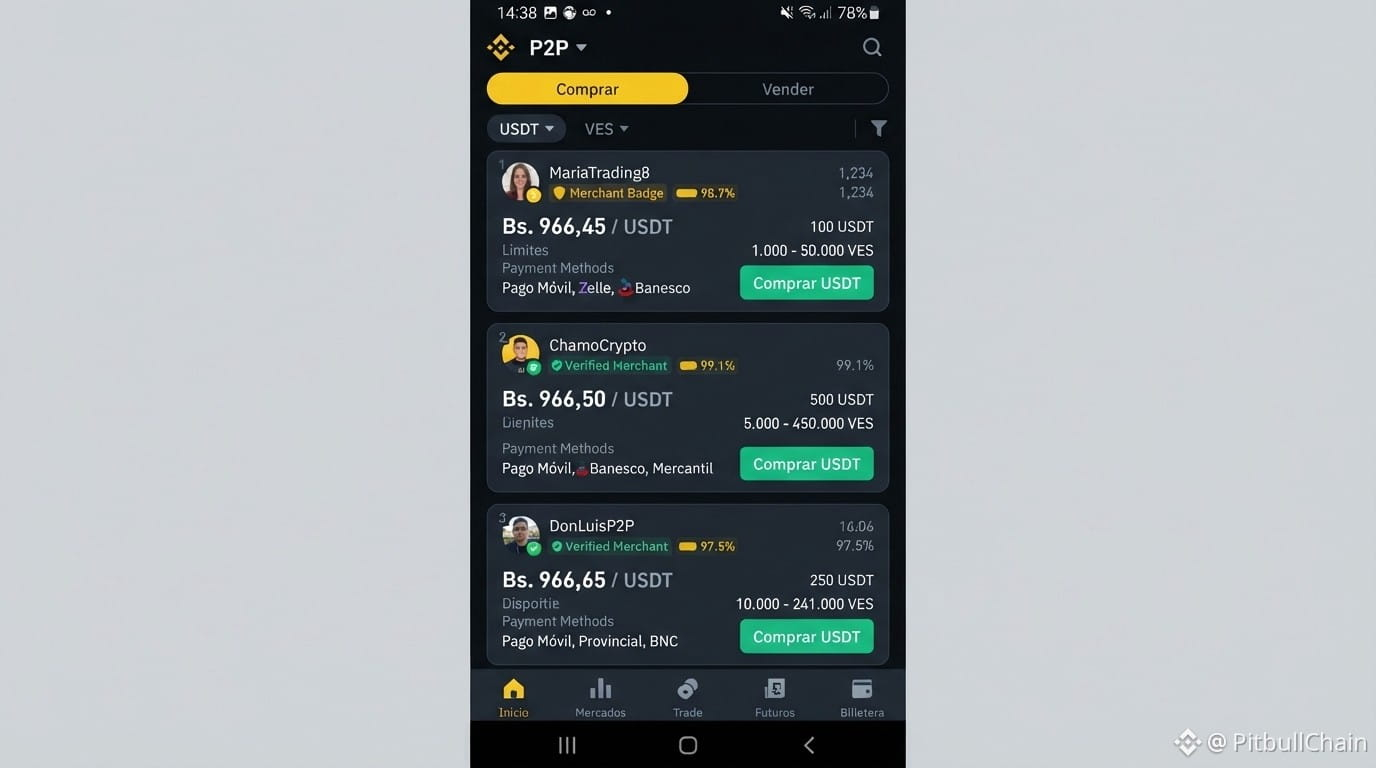
USDT premium versus BCV exceeds 19% today: spread and liquidity analysisToday, Monday, September 7, 2026, the USDT premium versus the dollar at BCV stands at 19.24%, and the spread in the Venezuelan P2P market reaches 3.46%. This is reflected in PitbullChain’s P2P Radar, which at 10:00 a.m. (local time) captured an average purchase price of 970.2881 VES and a sale price of 937.8789 VES per USDT. The figure far exceeds the official quotation from Venezuela’s Central Bank (BCV), which for this date stands at 813.7361 VES/USD. The radar’s own liquidity-and-risk traffic light appears in yellow (score 71), with a clear warning: “elevated spread, compare prices before trading.” Premium of 19.24%: buying pressure or just a reference? The premium is calculated over the BCV official rate. If we take the P2P USDT purchase price (970.2881 VES) and compare it with the official dollar (813.7361 VES), the difference is 156.5520 VES per unit—exactly that 19.24% surcharge. This gap is not new. In June 2026, reports like BeInCrypto’s pointed out that the “bolívar crisis boosts demand for USDT in Binance P2P.” The trend continues: when the bolívar loses purchasing power, many Venezuelans look for refuge in dollarized cryptocurrencies, and that demand pushes the USDT price above the official rate. The BCV price, for its part, has been climbing gradually. According to El Estímulo, on September 4 the quote surpassed 807 bolívars; today it is 813.7. It’s a slow rise, but P2P moves faster because it responds to real-time supply and demand. Spread of 3.45%: the cost of entering and exiting the market The spread represents the difference between the highest price a buyer is willing to pay (to acquire USDT) and the lowest price a seller is willing to sell at. In PitbullChain’s P2P Radar, buying is at 970.27 VES and selling at 937.88 VES—a spread range of 32.41 VES. In percentage terms, the spread is 3.4556%. This means that if a user buys and sells USDT back-to-back, they lose approximately 3.45 bolívars for every 100 invested. It’s a high cost compared with the informal parallel rate, which at the same time shows a spread of only 0.29%. To put it in context: if you sell 100 USDT at the average selling price (937.8789 VES), you’ll receive 93,787.89 bolívars. If instead you decide to buy 100 USDT, you’ll have to pay out 97,028.81 bolívars. That gap of more than 3,000 bolívars per 100 USDT is what makes the difference in large transactions. PitbullChain’s traffic light assigns 20 points to the spread (on a scale where 0 is very high and 100 is low). That’s why it insists on “comparing prices across exchanges before trading.” This is not a market to rush into. Order book under the microscope: buy offers dominate the book The aggregated order book of Binance, other platforms, and other platforms—also captured by PitbullChain—shows a significant imbalance in favor of demand. The buy order volume (bid) reaches 377,043.50 USDT, while the sell orders (ask) add up to just 66,244.44 USDT. In other words, buying pressure is 5.7 times greater than the available supply. This imbalance explains the premium: more people want to buy USDT than sellers are willing to offer it. Market depth, however, has nuances. Even though offers appear at very low prices (for example, one at 918.64 VES on other platforms), they are for limited amounts and may not be available to all users or banks. The sell offers with real size are concentrated between 952 and 966 VES, while the buys with higher volume are located between 955 and 966 VES. This suggests that the market’s “fair price” right now is around 960–965 VES, but the consolidated indicators—which weight by volume—produce a higher buy price. According to the order book data itself, the best bid is at 966.00 VES, and the best ask is at 918.64 VES. The difference between them is 47.36 VES, which in relative terms corresponds to a 4.9% spread. That’s the real cost if you want to execute an immediate trade, without waiting for orders to cross. Dominant banks: where is there more liquidity and a better price? Not all banks offer the same conditions. PitbullChain’s analysis groups ads by financial institution and shows a clear difference in behavior: Banesco: the bank with the highest number of ads (35.7% of the total) and a liquidity score of 99/100. Its average purchase price is 965.63 VES and its selling price is 961.22 VES, leaving a spread of just 0.46%. Pago Móvil: concentrates 24.5% of the ads, with a score of 72. Its spread rises to 0.73%. Bancamiga and PagoMovil (binance): next, at 5.1% each, though with lower offer volume. Banco de Venezuela and BANK: show a moderate spread of 0.29% and 0.33%, respectively, but they account for only 5.1% and 4.1% of the market. The traffic light also emphasizes that bank availability is high (score 95), but order-book depth is low (score 45). That means there are many posts, but for small amounts. For institutional operations, liquidity per bank may be limited; for retail trades, it’s sufficient. If you’re selling USDT, you should check which bank has the best buy offer. If you’re buying, it’s the opposite. It’s not the same to trade with Banesco as with a bank that has fewer ads, because price and execution speed can vary substantially. Risks and recommendations to navigate the market PitbullChain’s traffic light is yellow, with mixed signals: on the one hand, there is “sufficient liquidity across multiple banks”; on the other, the elevated spread and low depth at certain levels generate warnings. Perceived volatility is high (score 95), meaning the price can move quickly. This highlights the importance of using tools such as the P2P Calculator, the Bank Comparator, and the real-time Order Book that PitbullChain offers in its tools section. Before executing, verify: The buy and sell price on the specific exchange you’ll use. The advertiser’s reputation and their minimum/maximum limits. Whether your bank is enabled in that ad. The trend over the last few minutes (up or down). In a market with a premium of >19%, not all transactions are the same. A small oversight in the spread can turn a good rate into a loss. That’s why PitbullChain’s data helps you keep an objective pulse—not to promise profits or make decisions blindly. The dynamics of Venezuelan P2P respond to the real supply and demand for currency. Understanding the premium, the spread, and liquidity per bank will allow you to trade with better criteria. The yellow traffic light says it: there are good opportunities, but they require comparison and analysis.
USDT premium versus BCV exceeds 19% today: spread and liquidity analysis
Today, Monday, September 7, 2026, the USDT premium versus the dollar at BCV stands at 19.24%, and the spread in the Venezuelan P2P market reaches 3.46%. This is reflected in PitbullChain’s P2P Radar, which at 10:00 a.m. (local time) captured an average purchase price of 970.2881 VES and a sale price of 937.8789 VES per USDT. The figure far exceeds the official quotation from Venezuela’s Central Bank (BCV), which for this date stands at 813.7361 VES/USD. The radar’s own liquidity-and-risk traffic light appears in yellow (score 71), with a clear warning: “elevated spread, compare prices before trading.” Premium of 19.24%: buying pressure or just a reference? The premium is calculated over the BCV official rate. If we take the P2P USDT purchase price (970.2881 VES) and compare it with the official dollar (813.7361 VES), the difference is 156.5520 VES per unit—exactly that 19.24% surcharge. This gap is not new. In June 2026, reports like BeInCrypto’s pointed out that the “bolívar crisis boosts demand for USDT in Binance P2P.” The trend continues: when the bolívar loses purchasing power, many Venezuelans look for refuge in dollarized cryptocurrencies, and that demand pushes the USDT price above the official rate. The BCV price, for its part, has been climbing gradually. According to El Estímulo, on September 4 the quote surpassed 807 bolívars; today it is 813.7. It’s a slow rise, but P2P moves faster because it responds to real-time supply and demand. Spread of 3.45%: the cost of entering and exiting the market The spread represents the difference between the highest price a buyer is willing to pay (to acquire USDT) and the lowest price a seller is willing to sell at. In PitbullChain’s P2P Radar, buying is at 970.27 VES and selling at 937.88 VES—a spread range of 32.41 VES. In percentage terms, the spread is 3.4556%. This means that if a user buys and sells USDT back-to-back, they lose approximately 3.45 bolívars for every 100 invested. It’s a high cost compared with the informal parallel rate, which at the same time shows a spread of only 0.29%. To put it in context: if you sell 100 USDT at the average selling price (937.8789 VES), you’ll receive 93,787.89 bolívars. If instead you decide to buy 100 USDT, you’ll have to pay out 97,028.81 bolívars. That gap of more than 3,000 bolívars per 100 USDT is what makes the difference in large transactions. PitbullChain’s traffic light assigns 20 points to the spread (on a scale where 0 is very high and 100 is low). That’s why it insists on “comparing prices across exchanges before trading.” This is not a market to rush into. Order book under the microscope: buy offers dominate the book The aggregated order book of Binance, other platforms, and other platforms—also captured by PitbullChain—shows a significant imbalance in favor of demand. The buy order volume (bid) reaches 377,043.50 USDT, while the sell orders (ask) add up to just 66,244.44 USDT. In other words, buying pressure is 5.7 times greater than the available supply. This imbalance explains the premium: more people want to buy USDT than sellers are willing to offer it. Market depth, however, has nuances. Even though offers appear at very low prices (for example, one at 918.64 VES on other platforms), they are for limited amounts and may not be available to all users or banks. The sell offers with real size are concentrated between 952 and 966 VES, while the buys with higher volume are located between 955 and 966 VES. This suggests that the market’s “fair price” right now is around 960–965 VES, but the consolidated indicators—which weight by volume—produce a higher buy price. According to the order book data itself, the best bid is at 966.00 VES, and the best ask is at 918.64 VES. The difference between them is 47.36 VES, which in relative terms corresponds to a 4.9% spread. That’s the real cost if you want to execute an immediate trade, without waiting for orders to cross. Dominant banks: where is there more liquidity and a better price? Not all banks offer the same conditions. PitbullChain’s analysis groups ads by financial institution and shows a clear difference in behavior: Banesco: the bank with the highest number of ads (35.7% of the total) and a liquidity score of 99/100. Its average purchase price is 965.63 VES and its selling price is 961.22 VES, leaving a spread of just 0.46%. Pago Móvil: concentrates 24.5% of the ads, with a score of 72. Its spread rises to 0.73%. Bancamiga and PagoMovil (binance): next, at 5.1% each, though with lower offer volume. Banco de Venezuela and BANK: show a moderate spread of 0.29% and 0.33%, respectively, but they account for only 5.1% and 4.1% of the market. The traffic light also emphasizes that bank availability is high (score 95), but order-book depth is low (score 45). That means there are many posts, but for small amounts. For institutional operations, liquidity per bank may be limited; for retail trades, it’s sufficient. If you’re selling USDT, you should check which bank has the best buy offer. If you’re buying, it’s the opposite. It’s not the same to trade with Banesco as with a bank that has fewer ads, because price and execution speed can vary substantially. Risks and recommendations to navigate the market PitbullChain’s traffic light is yellow, with mixed signals: on the one hand, there is “sufficient liquidity across multiple banks”; on the other, the elevated spread and low depth at certain levels generate warnings. Perceived volatility is high (score 95), meaning the price can move quickly. This highlights the importance of using tools such as the P2P Calculator, the Bank Comparator, and the real-time Order Book that PitbullChain offers in its tools section. Before executing, verify: The buy and sell price on the specific exchange you’ll use. The advertiser’s reputation and their minimum/maximum limits. Whether your bank is enabled in that ad. The trend over the last few minutes (up or down). In a market with a premium of >19%, not all transactions are the same. A small oversight in the spread can turn a good rate into a loss. That’s why PitbullChain’s data helps you keep an objective pulse—not to promise profits or make decisions blindly. The dynamics of Venezuelan P2P respond to the real supply and demand for currency. Understanding the premium, the spread, and liquidity per bank will allow you to trade with better criteria. The yellow traffic light says it: there are good opportunities, but they require comparison and analysis.
25
Log in to explore more content
Join global crypto users on Binance Square
⚡️ Get latest and useful information about crypto.
💬 Trusted by the world’s largest crypto exchange.
👍 Discover real insights from verified creators.
Email / Phone number
Trending Topics
1
#BTCBreaks80K
12,279 views
405 Discussing
2
#比特币突破8万
19,400 views
71 Discussing
3
#BuffettBecomesBerkshireChairmanEmeritus
163 views
51 Discussing
4
#ZcashSpotETFTops$230MMonthlyInflow
318 views
29 Discussing
5
#HYPEJumpsOver11%
22,120 views
662 Discussing
6
#ZcashDevelopersTargetNU7MainnetActivationNov5
6,972 views
247 Discussing
7
#BitcoinSpotETFsNetInflow$159M
6,165 views
87 Discussing
8
#HKMAPlansWholesaleCBDCByYearEnd
24,273 views
694 Discussing
9
#NEARSurges26%Past$3.45
15,000 views
137 Discussing
10
#BOJHikesRatesTo31YearHigh
44,501 views
1,031 Discussing