
#russiancrypto
russiancrypto
842 views
15 Discussing
Hot
Latest

How are Russian corporations using digital financial assets (DFAs) for corporate borrowingRussian corporations and major financial institutions have increasingly utilized Digital Financial Assets (DFAs) to bypass traditional credit friction, navigate high domestic interest rates, and streamline complex business transactions.
Operating under specialized platforms authorized by the Central Bank (such as Sber’s platform, Atomyze, and Lighthouse), DFAs have transformed from an experimental legal framework into a core instrument for corporate finance.
1. Alternative Corporate Borrowing & Debt Issuance
High benchmark interest rates and restrictions on accessing international capital markets have driven Russian companies to turn to domestic DFAs for agile corporate fundraising.
Speed and Lower Administrative Overhead: Traditional bond issuances or syndicated loans involve lengthy regulatory disclosures, underwriting syndicates, and heavy administrative costs. DFA issuances are tokenized on permissioned ledgers, drastically reducing time-to-market. Companies can launch commercial paper, short-term digital bonds, and monetary claims in a matter of days.Flexible Yields and Maturities: Corporations frequently issue short-term DFAs (ranging from 1 to 12 months) with tailored structures—such as monthly coupon payments or yields tied to specific asset performance—allowing them to attract targeted liquidity directly from institutional portfolios and qualified retail investors without going through traditional exchange listing hurdles.Fractionalized Debt: DFAs enable companies to split massive corporate debt requirements into small, highly divisible digital tokens, broadening the investor base and speeding up subscription periods.
2. Supply Chain Financing & Factoring
Supply chain operations and B2B settlements have historically suffered from payment delays, trapped working capital, and traditional factoring bottlenecks. DFAs have modernized these flows:
Tokenized Monetary Claims (Digital Factoring): When a supplier delivers goods to a major enterprise buyer, the payment is often deferred for 60 to 90 days. Instead of waiting or paying high fees to traditional commercial factors, the supplier can convert their right of monetary claim (an invoice equivalent) into a DFA.Instant Liquidity and Transferability: This digital invoice token can be sold instantly on-chain to banks or other liquidity providers. The supplier receives immediate working capital, while the purchasing corporation settles the obligation at maturity on-chain.Smart-Contract Automation: Utilizing programmable smart contracts embedded in DFA platforms, obligations, discounts for early payment, and final settlements execute automatically upon fulfillment confirmation, eliminating manual reconciliation overhead and reducing counterparty risk.
3. Asset-Backed and Hybrid Financing
Beyond traditional corporate debt, Russian firms are leveraging DFAs to monetize balance-sheet assets directly:
Commodity-Backed Instruments: Mining, energy, and agricultural firms issue DFAs legally pegged to physical commodities or precious metals. This allows corporations to borrow against future production or pre-sell goods directly to industrial partners.Cross-Border Supply Chain Bridges: With traditional Western banking channels restricted, companies are increasingly exploring tokenized digital rights and Russian-issued stablecoin/DFA mechanisms to settle cross-border supply chain obligations with friendly trading partners.
#RussianCrypto #SberbankBTC #USD
How are Russian corporations using digital financial assets (DFAs) for corporate borrowing
Russian corporations and major financial institutions have increasingly utilized Digital Financial Assets (DFAs) to bypass traditional credit friction, navigate high domestic interest rates, and streamline complex business transactions.
Operating under specialized platforms authorized by the Central Bank (such as Sber’s platform, Atomyze, and Lighthouse), DFAs have transformed from an experimental legal framework into a core instrument for corporate finance.
1. Alternative Corporate Borrowing & Debt Issuance
High benchmark interest rates and restrictions on accessing international capital markets have driven Russian companies to turn to domestic DFAs for agile corporate fundraising.
Speed and Lower Administrative Overhead: Traditional bond issuances or syndicated loans involve lengthy regulatory disclosures, underwriting syndicates, and heavy administrative costs. DFA issuances are tokenized on permissioned ledgers, drastically reducing time-to-market. Companies can launch commercial paper, short-term digital bonds, and monetary claims in a matter of days.Flexible Yields and Maturities: Corporations frequently issue short-term DFAs (ranging from 1 to 12 months) with tailored structures—such as monthly coupon payments or yields tied to specific asset performance—allowing them to attract targeted liquidity directly from institutional portfolios and qualified retail investors without going through traditional exchange listing hurdles.Fractionalized Debt: DFAs enable companies to split massive corporate debt requirements into small, highly divisible digital tokens, broadening the investor base and speeding up subscription periods.
2. Supply Chain Financing & Factoring
Supply chain operations and B2B settlements have historically suffered from payment delays, trapped working capital, and traditional factoring bottlenecks. DFAs have modernized these flows:
Tokenized Monetary Claims (Digital Factoring): When a supplier delivers goods to a major enterprise buyer, the payment is often deferred for 60 to 90 days. Instead of waiting or paying high fees to traditional commercial factors, the supplier can convert their right of monetary claim (an invoice equivalent) into a DFA.Instant Liquidity and Transferability: This digital invoice token can be sold instantly on-chain to banks or other liquidity providers. The supplier receives immediate working capital, while the purchasing corporation settles the obligation at maturity on-chain.Smart-Contract Automation: Utilizing programmable smart contracts embedded in DFA platforms, obligations, discounts for early payment, and final settlements execute automatically upon fulfillment confirmation, eliminating manual reconciliation overhead and reducing counterparty risk.
3. Asset-Backed and Hybrid Financing
Beyond traditional corporate debt, Russian firms are leveraging DFAs to monetize balance-sheet assets directly:
Commodity-Backed Instruments: Mining, energy, and agricultural firms issue DFAs legally pegged to physical commodities or precious metals. This allows corporations to borrow against future production or pre-sell goods directly to industrial partners.Cross-Border Supply Chain Bridges: With traditional Western banking channels restricted, companies are increasingly exploring tokenized digital rights and Russian-issued stablecoin/DFA mechanisms to settle cross-border supply chain obligations with friendly trading partners.
#RussianCrypto #SberbankBTC #USD
1

Russia has registered its first crypto exchanges and custodians, with Sberbank launching crypto products in December.
#RussianCrypto #Sberbank
Russia has registered its first crypto exchanges and custodians, with Sberbank launching crypto products in December.
#RussianCrypto #Sberbank
#RussianCrypto #Sberbank
5

·
--
Bearish
🐻 **THE RUSSIAN BEAR OPENS THE DOOR TO CRYPTO – BUT YOU STILL HAVE TO QUEUE!** 🇷🇺
Breaking news from the land of birch trees! The Central Bank of Russia has added three names—BTC, ETH, and USDT—to its list of crypto assets approved for trading by non-professional investors.
🚀 This is a noteworthy signal in the process of legalizing and regulating Russia’s crypto market.
But hold on before you celebrate! The Russian Bear is still holding a ruler:
- Maximum purchase limit of 300,000 RUB per year at each intermediary.
- Investors must pass a knowledge and risk assessment.
- Qualified investors can access a wider range of assets.
🎯 **What should traders do?**
Keep an eye on money flows and liquidity for BTC, ETH, and USDT. This could be a positive signal for crypto adoption, but don’t rush into FOMO. The Russian Bear has given the green light, but that doesn’t mean prices will shoot through the roof! 😂
⚠️ This is not financial advice.
👇 Trade below to support me ❤️
$BTC
{spot}(BTCUSDT)
$ETH
{spot}(ETHUSDT)
$UAI
{future}(UAIUSDT)
#RussianCentralBankNamesBTCETHUSDTForNonQualifiedInvestors #RussianCrypto #Bitcoin #Ethereum #CryptoRegulation #VINHTOCDO #CryptoAdoption
🐻 **THE RUSSIAN BEAR OPENS THE DOOR TO CRYPTO – BUT YOU STILL HAVE TO QUEUE!** 🇷🇺
Breaking news from the land of birch trees! The Central Bank of Russia has added three names—BTC, ETH, and USDT—to its list of crypto assets approved for trading by non-professional investors.
🚀 This is a noteworthy signal in the process of legalizing and regulating Russia’s crypto market.
But hold on before you celebrate! The Russian Bear is still holding a ruler:
- Maximum purchase limit of 300,000 RUB per year at each intermediary.
- Investors must pass a knowledge and risk assessment.
- Qualified investors can access a wider range of assets.
🎯 **What should traders do?**
Keep an eye on money flows and liquidity for BTC, ETH, and USDT. This could be a positive signal for crypto adoption, but don’t rush into FOMO. The Russian Bear has given the green light, but that doesn’t mean prices will shoot through the roof! 😂
⚠️ This is not financial advice.
👇 Trade below to support me ❤️
$BTC
$ETH
$UAI
#RussianCentralBankNamesBTCETHUSDTForNonQualifiedInvestors #RussianCrypto #Bitcoin #Ethereum #CryptoRegulation #VINHTOCDO #CryptoAdoption

2
751

·
--
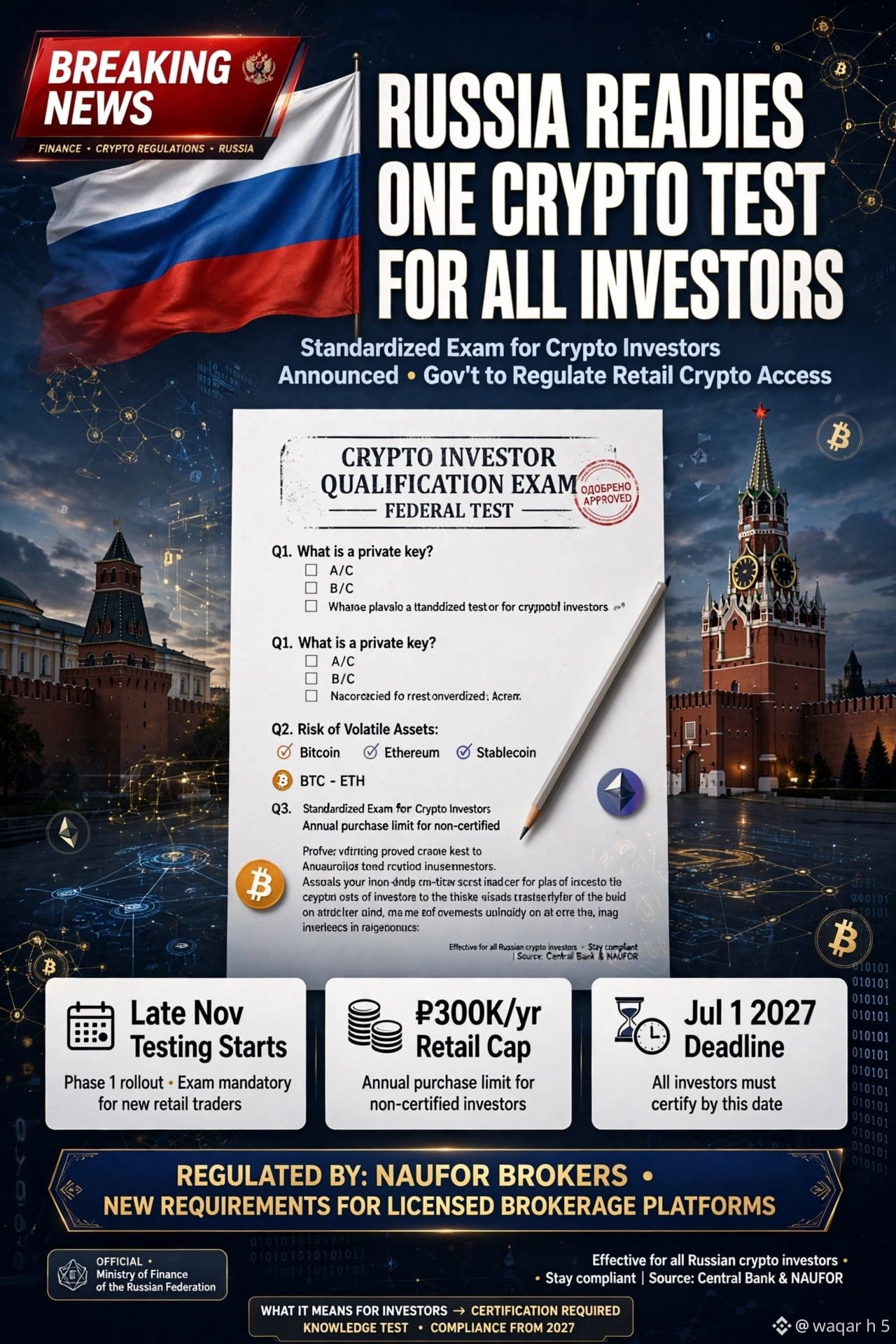
#RussiaPlansStandardizedTestForCryptoInvestors 🚨 BREAKING: RUSSIA READIES ONE CRYPTO TEST FOR ALL INVESTORS
🇷🇺 Russia plans standardized test for crypto investors!
NAUFOR says brokers could soon require every retail investor to pass a Crypto Qualification Exam.
*Key Details:*
📅 Late Nov - Testing Starts (Phase 1)
💰 ₽300K/yr Retail Cap for non-certified investors
🪙 Assets: BTC, ETH under new rules
⏰ Jul 1, 2027 - Full Compliance Deadline
What it means: No test = limited crypto access. Pass the test = unlimited trading.
Is Russia making crypto safer or just harder to access?
Bullish or Bearish for adoption? Comment below 👇
#Russia #CryptoNews $BTC $ETH #breakingnews #CryptoRegulation #NAUFOR #RussianCrypto
1
1
129
Log in to explore more content
Join global crypto users on Binance Square
⚡️ Get latest and useful information about crypto.
💬 Trusted by the world’s largest crypto exchange.
👍 Discover real insights from verified creators.
Email / Phone number
Trending Topics
1
#NVDASoarsOnJensenReturn
1,852 views
74 Discussing
2
#Bitcoin'sReboundFadesBelow$60K
13,333 views
160 Discussing
3
#NVIDIAReinstatesJensenHuangasCEO
280,274 views
1,822 Discussing
4
#WillMarketsStageAThanksgivingReliefRally?
351,038 views
2,528 Discussing
5
#WillOctCorePCEShiftFedHikeExpectations?
127,807 views
1,258 Discussing
6
#EvolveAtBinanceBlockchainWeek
249,869 views
1,575 Discussing
7
#SouthKoreaBeginsCryptoProviderShareholderReviews
6,573 views
139 Discussing
8
#USAddsMegaspeedToEntityList
13,565 views
218 Discussing
9
#GrayscaleLaunches2xLeveragedZcashETF
7,233 views
137 Discussing
10
#StrategyValueFallsBelowItsBitcoinHoldings
6,278 views
138 Discussing