

#l2
l2
598,426 views
2,519 Discussing
Hot
Latest

·
--
L2 BOUNCED HARDEST TODAY BUT ARB STILL SITS 13 PERCENT DOWN ON THE WEEK
Do not call this a trend flip yet
Layer 2 names bounced hardest at noon in Cairo with the shelf up 2 percent in 24 hours while Bitcoin sat flat near 80200
That bounce lands inside an ugly week and that is exactly why it matters
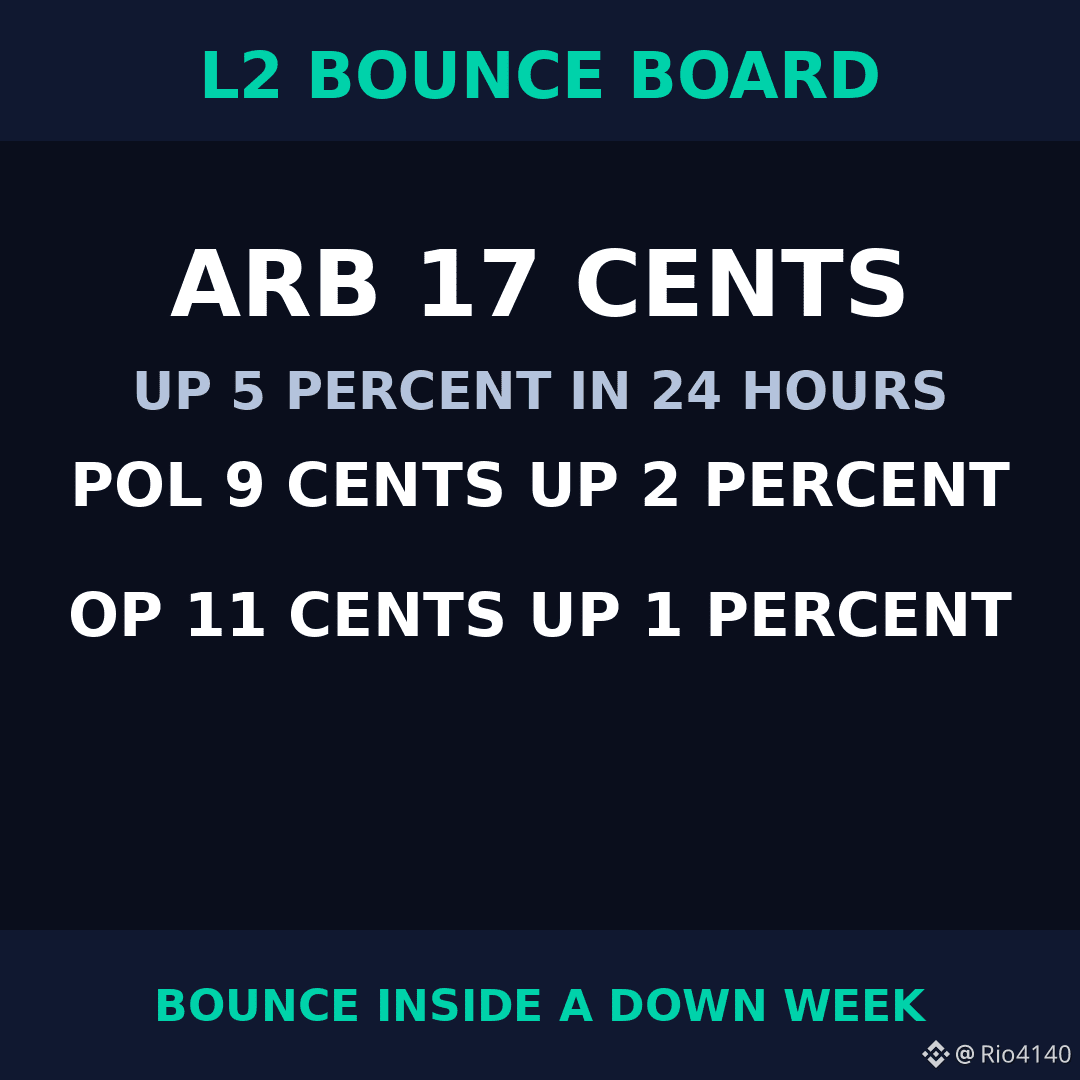
$ARB leads the bounce at 17 cents after a 5 percent jump in 24 hours and it is still down 13 percent on the week
$POL trades at 9 cents after a 2 percent gain and it is down 4 percent on the week
OP trades at 11 cents after a 1 percent gain and it is still down 13 percent on the week
So which is it
A dead cat bounce inside a downtrend or the first green shoot of a real bottom
Here is how I am playing the leader and I am playing it as a bounce trade only
Entry zone 16 to 17 cents right around the morning range
Target one 18 cents and target two 19 cents where the 50 day average and the old trendline meet
Stop on a daily close below 16 cents because that opens the door to a deeper slide
My take as an analyst
I weight the week over the morning
A 5 percent bounce after a 13 percent week down is a trade not a marriage and I am not holding it like one
Bounces pay traders who respect the stop and punish everyone who falls in love with them
#BinanceSquare #WriteToEarn #Crypto #Bitcoin #L2
L2 BOUNCED HARDEST TODAY BUT ARB STILL SITS 13 PERCENT DOWN ON THE WEEK
Do not call this a trend flip yet
Layer 2 names bounced hardest at noon in Cairo with the shelf up 2 percent in 24 hours while Bitcoin sat flat near 80200
That bounce lands inside an ugly week and that is exactly why it matters
$ARB leads the bounce at 17 cents after a 5 percent jump in 24 hours and it is still down 13 percent on the week
$POL trades at 9 cents after a 2 percent gain and it is down 4 percent on the week
OP trades at 11 cents after a 1 percent gain and it is still down 13 percent on the week
So which is it
A dead cat bounce inside a downtrend or the first green shoot of a real bottom
Here is how I am playing the leader and I am playing it as a bounce trade only
Entry zone 16 to 17 cents right around the morning range
Target one 18 cents and target two 19 cents where the 50 day average and the old trendline meet
Stop on a daily close below 16 cents because that opens the door to a deeper slide
My take as an analyst
I weight the week over the morning
A 5 percent bounce after a 13 percent week down is a trade not a marriage and I am not holding it like one
Bounces pay traders who respect the stop and punish everyone who falls in love with them
#BinanceSquare #WriteToEarn #Crypto #Bitcoin #L2
Do not call this a trend flip yet
Layer 2 names bounced hardest at noon in Cairo with the shelf up 2 percent in 24 hours while Bitcoin sat flat near 80200
That bounce lands inside an ugly week and that is exactly why it matters
$ARB leads the bounce at 17 cents after a 5 percent jump in 24 hours and it is still down 13 percent on the week
$POL trades at 9 cents after a 2 percent gain and it is down 4 percent on the week
OP trades at 11 cents after a 1 percent gain and it is still down 13 percent on the week
So which is it
A dead cat bounce inside a downtrend or the first green shoot of a real bottom
Here is how I am playing the leader and I am playing it as a bounce trade only
Entry zone 16 to 17 cents right around the morning range
Target one 18 cents and target two 19 cents where the 50 day average and the old trendline meet
Stop on a daily close below 16 cents because that opens the door to a deeper slide
My take as an analyst
I weight the week over the morning
A 5 percent bounce after a 13 percent week down is a trade not a marriage and I am not holding it like one
Bounces pay traders who respect the stop and punish everyone who falls in love with them
#BinanceSquare #WriteToEarn #Crypto #Bitcoin #L2
8

·
--
Another day, another $ARB "breakout" narrative. Bulls are ecstatic about a few percentage points, while the token unlocks keep flowing like fine wine. 💅 Even with AI projects migrating and network activity hitting "90-day highs", some still wonder where the actual price action is. Bears are just standing there, looking confused. 🤡 So, are we actually going somewhere, or is this just another masterclass in sideways trading? 📉 #Arbitrum #L2
Another day, another $ARB "breakout" narrative. Bulls are ecstatic about a few percentage points, while the token unlocks keep flowing like fine wine. 💅 Even with AI projects migrating and network activity hitting "90-day highs", some still wonder where the actual price action is. Bears are just standing there, looking confused. 🤡 So, are we actually going somewhere, or is this just another masterclass in sideways trading? 📉 #Arbitrum #L2
1
565

·
--
The L2 exit saga has reached the “the interface is gone, but the money is still in the bridge” chapter.
According to reports from PANews and others, Blast’s official withdrawal interface expired on October 26, while roughly $40.4 million in assets had yet to be transferred out of the cross-chain bridge. The official position is that users must interact directly with the contract to complete withdrawals, and a withdrawal guide has been published. The interface going offline does not mean the assets are gone, but it does significantly raise the bar for withdrawing them.
How to read this: When an “official UI expires,” first check three things—the contract address comes from an official source, the withdrawal steps can be signed with a browser wallet, and the remaining amount in the bridge is still decreasing. Don’t just take “you can still withdraw” at face value; check whether you can actually follow the guide to retrieve your assets. Fake links are especially easy to fall for when interactions get complicated.
#Blast #跨链桥 #提现 #L2
The L2 exit saga has reached the “the interface is gone, but the money is still in the bridge” chapter.
According to reports from PANews and others, Blast’s official withdrawal interface expired on October 26, while roughly $40.4 million in assets had yet to be transferred out of the cross-chain bridge. The official position is that users must interact directly with the contract to complete withdrawals, and a withdrawal guide has been published. The interface going offline does not mean the assets are gone, but it does significantly raise the bar for withdrawing them.
How to read this: When an “official UI expires,” first check three things—the contract address comes from an official source, the withdrawal steps can be signed with a browser wallet, and the remaining amount in the bridge is still decreasing. Don’t just take “you can still withdraw” at face value; check whether you can actually follow the guide to retrieve your assets. Fake links are especially easy to fall for when interactions get complicated.
#Blast #跨链桥 #提现 #L2
According to reports from PANews and others, Blast’s official withdrawal interface expired on October 26, while roughly $40.4 million in assets had yet to be transferred out of the cross-chain bridge. The official position is that users must interact directly with the contract to complete withdrawals, and a withdrawal guide has been published. The interface going offline does not mean the assets are gone, but it does significantly raise the bar for withdrawing them.
How to read this: When an “official UI expires,” first check three things—the contract address comes from an official source, the withdrawal steps can be signed with a browser wallet, and the remaining amount in the bridge is still decreasing. Don’t just take “you can still withdraw” at face value; check whether you can actually follow the guide to retrieve your assets. Fake links are especially easy to fall for when interactions get complicated.
#Blast #跨链桥 #提现 #L2
9

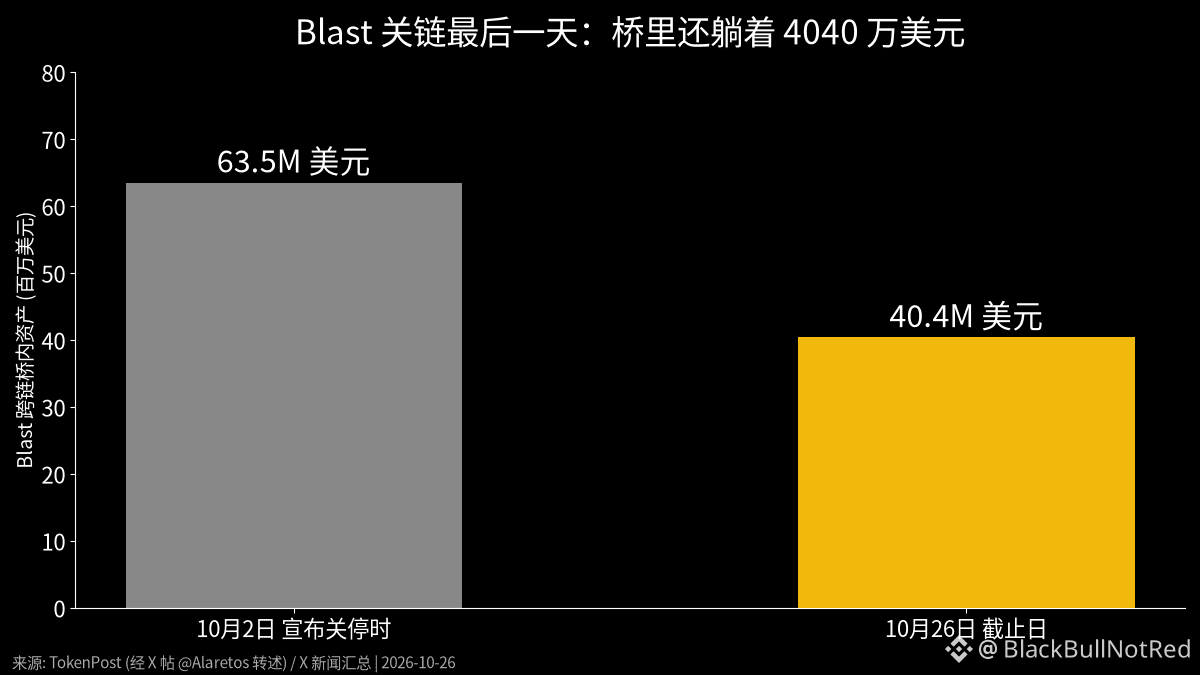
Today is the last day to withdraw through Blast’s official withdrawal page, and there’s still about $40.4 million sitting in the bridge.
When they announced the shutdown on October 2, there was $63.5 million. In 24 days, only a little over a third has been withdrawn. The rest is either forgotten, too small to be worth the hassle, or sitting in wallets from people who farmed points back then and have long since moved on.
Honestly, this chain was a points farming scheme from start to finish. At its peak, more than $2 billion was locked up. How many people were really there for the chain itself? Everyone bought into the “native yield + points + airdrop” story. Once the story ended, the money and users left together. The official explanation was pretty candid too: operating costs exceeded revenue, and they couldn’t see a sustainable path forward.
So stop saying “TVL proves demand.” TVL built on incentives looks like this as soon as the incentives stop.
If you still have funds in there, withdraw through the website today. It takes about a day. After today, you’ll have to interact with the bridge contract on Ethereum yourself, submit a proof, and then wait another day. For beginners, the barrier to entry is now sky-high.
When the next L2 comes along offering points in exchange for locking up your funds, remember Blast first.
#Blast #L2
Today is the last day to withdraw through Blast’s official withdrawal page, and there’s still about $40.4 million sitting in the bridge.
When they announced the shutdown on October 2, there was $63.5 million. In 24 days, only a little over a third has been withdrawn. The rest is either forgotten, too small to be worth the hassle, or sitting in wallets from people who farmed points back then and have long since moved on.
Honestly, this chain was a points farming scheme from start to finish. At its peak, more than $2 billion was locked up. How many people were really there for the chain itself? Everyone bought into the “native yield + points + airdrop” story. Once the story ended, the money and users left together. The official explanation was pretty candid too: operating costs exceeded revenue, and they couldn’t see a sustainable path forward.
So stop saying “TVL proves demand.” TVL built on incentives looks like this as soon as the incentives stop.
If you still have funds in there, withdraw through the website today. It takes about a day. After today, you’ll have to interact with the bridge contract on Ethereum yourself, submit a proof, and then wait another day. For beginners, the barrier to entry is now sky-high.
When the next L2 comes along offering points in exchange for locking up your funds, remember Blast first.
#Blast #L2
When they announced the shutdown on October 2, there was $63.5 million. In 24 days, only a little over a third has been withdrawn. The rest is either forgotten, too small to be worth the hassle, or sitting in wallets from people who farmed points back then and have long since moved on.
Honestly, this chain was a points farming scheme from start to finish. At its peak, more than $2 billion was locked up. How many people were really there for the chain itself? Everyone bought into the “native yield + points + airdrop” story. Once the story ended, the money and users left together. The official explanation was pretty candid too: operating costs exceeded revenue, and they couldn’t see a sustainable path forward.
So stop saying “TVL proves demand.” TVL built on incentives looks like this as soon as the incentives stop.
If you still have funds in there, withdraw through the website today. It takes about a day. After today, you’ll have to interact with the bridge contract on Ethereum yourself, submit a proof, and then wait another day. For beginners, the barrier to entry is now sky-high.
When the next L2 comes along offering points in exchange for locking up your funds, remember Blast first.
#Blast #L2
3

·
--
Regular withdrawals close today: about $40 million still sitting in the Blast bridgeToday (October 26) is the last day to use Blast’s regular withdrawal interface.
The money isn’t gone—the team says assets can still be withdrawn after the deadline, but users will have to interact directly with the bridge contracts on Ethereum L1: initiate the process on Blast, submit proof on Ethereum, wait through a one-day challenge period, then finalize. USDB, the stablecoin, requires one more step to claim DAI. And some users really haven’t moved their funds yet: TokenPost reports that about $40.41 million remains in the bridge, down from about $63.5 million when the shutdown was announced on October 2.
Blast put it plainly on October 2: operating costs outweighed L2 revenue, there was no viable path to sustainability, so they were shutting down the chain. The withdrawal delay was cut to about 24 hours; during the initial shutdown, they also had to unwind the Lido position first, and withdrawals were briefly unavailable during that period. The official bridge page still says, “Please bridge back to Ethereum as soon as possible.”
Regular withdrawals close today: about $40 million still sitting in the Blast bridge
Today (October 26) is the last day to use Blast’s regular withdrawal interface.
The money isn’t gone—the team says assets can still be withdrawn after the deadline, but users will have to interact directly with the bridge contracts on Ethereum L1: initiate the process on Blast, submit proof on Ethereum, wait through a one-day challenge period, then finalize. USDB, the stablecoin, requires one more step to claim DAI. And some users really haven’t moved their funds yet: TokenPost reports that about $40.41 million remains in the bridge, down from about $63.5 million when the shutdown was announced on October 2.
Blast put it plainly on October 2: operating costs outweighed L2 revenue, there was no viable path to sustainability, so they were shutting down the chain. The withdrawal delay was cut to about 24 hours; during the initial shutdown, they also had to unwind the Lido position first, and withdrawals were briefly unavailable during that period. The official bridge page still says, “Please bridge back to Ethereum as soon as possible.”
The money isn’t gone—the team says assets can still be withdrawn after the deadline, but users will have to interact directly with the bridge contracts on Ethereum L1: initiate the process on Blast, submit proof on Ethereum, wait through a one-day challenge period, then finalize. USDB, the stablecoin, requires one more step to claim DAI. And some users really haven’t moved their funds yet: TokenPost reports that about $40.41 million remains in the bridge, down from about $63.5 million when the shutdown was announced on October 2.
Blast put it plainly on October 2: operating costs outweighed L2 revenue, there was no viable path to sustainability, so they were shutting down the chain. The withdrawal delay was cut to about 24 hours; during the initial shutdown, they also had to unwind the Lido position first, and withdrawals were briefly unavailable during that period. The official bridge page still says, “Please bridge back to Ethereum as soon as possible.”
190

·
--
⚡ Today’s money-making signal · ARB +4.87% in one day
🟢 Long: Strong consolidation; could make another move after turnover.
Aggressive 0.1722 (enter at market)|Stop-loss 0.1624|Take-profit 0.1928
Conservative 0.1671 (buy on a pullback)|Stop-loss 0.1575|Take-profit 0.1928
Limit order 0.1619 (place a buy order lower)|Stop-loss 0.1527|Take-profit 0.1928
📌 It only counts as a continuation if it holds above 0.1808; otherwise, it’s a bull trap.
Rationale:
💵 +4.87% over 24h, trading volume 59.1M U, current price 0.1722.
Funding rate +0.0006%/8h (longs and shorts are roughly balanced)
RSI 63 (bullish bias)
Large-player net inflow: -12.7K USDT Strength: -0.2%
1h net flow: -17.0K USDT
4h net flow: +136.9K USDT
24h net flow: -12.7K USDT
💬 At this price, would you add to your ARB position or get out first?
🎉 Wishing you all financial freedom three years ahead of schedule 🗓️
$ARB #L2 🔥
Investing involves risk. For reference only; this is not investment advice. Please do your own research and learning.
⚡ Today’s money-making signal · ARB +4.87% in one day
🟢 Long: Strong consolidation; could make another move after turnover.
Aggressive 0.1722 (enter at market)|Stop-loss 0.1624|Take-profit 0.1928
Conservative 0.1671 (buy on a pullback)|Stop-loss 0.1575|Take-profit 0.1928
Limit order 0.1619 (place a buy order lower)|Stop-loss 0.1527|Take-profit 0.1928
📌 It only counts as a continuation if it holds above 0.1808; otherwise, it’s a bull trap.
Rationale:
💵 +4.87% over 24h, trading volume 59.1M U, current price 0.1722.
Funding rate +0.0006%/8h (longs and shorts are roughly balanced)
RSI 63 (bullish bias)
Large-player net inflow: -12.7K USDT Strength: -0.2%
1h net flow: -17.0K USDT
4h net flow: +136.9K USDT
24h net flow: -12.7K USDT
💬 At this price, would you add to your ARB position or get out first?
🎉 Wishing you all financial freedom three years ahead of schedule 🗓️
$ARB #L2 🔥
Investing involves risk. For reference only; this is not investment advice. Please do your own research and learning.
🟢 Long: Strong consolidation; could make another move after turnover.
Aggressive 0.1722 (enter at market)|Stop-loss 0.1624|Take-profit 0.1928
Conservative 0.1671 (buy on a pullback)|Stop-loss 0.1575|Take-profit 0.1928
Limit order 0.1619 (place a buy order lower)|Stop-loss 0.1527|Take-profit 0.1928
📌 It only counts as a continuation if it holds above 0.1808; otherwise, it’s a bull trap.
Rationale:
💵 +4.87% over 24h, trading volume 59.1M U, current price 0.1722.
Funding rate +0.0006%/8h (longs and shorts are roughly balanced)
RSI 63 (bullish bias)
Large-player net inflow: -12.7K USDT Strength: -0.2%
1h net flow: -17.0K USDT
4h net flow: +136.9K USDT
24h net flow: -12.7K USDT
💬 At this price, would you add to your ARB position or get out first?
🎉 Wishing you all financial freedom three years ahead of schedule 🗓️
$ARB #L2 🔥
Investing involves risk. For reference only; this is not investment advice. Please do your own research and learning.

10
·
--
STRK down about 4%: L2 sentiment is lukewarm; watch the broader market firstSTRK is down about 4.1% over the past 24 hours, currently around 0.04559, with trading volume of about 5.24 million USDT. L2-related sentiment hasn’t exactly been euphoric lately, and prices are following risk appetite more closely. That may be a good thing—or it could mean there’s less room for a rebound.
A 4% drop isn’t a crash, but combined with weakness across altcoins, it can lead to a slow grind downward that wears on your patience. The most frustrating part of a slow decline is that you keep thinking, “If I just wait a little longer, it’ll bounce back,” only to find that the cost in time is greater than the price loss. Time is part of your position, too.
Trading volume is just over 5 million, and market depth is average. Large orders should watch out for slippage. If you trade, do it in small increments—don’t go all in. The outcome of going all in is usually written in the headline of the next crash.
STRK down about 4%: L2 sentiment is lukewarm; watch the broader market first
STRK is down about 4.1% over the past 24 hours, currently around 0.04559, with trading volume of about 5.24 million USDT. L2-related sentiment hasn’t exactly been euphoric lately, and prices are following risk appetite more closely. That may be a good thing—or it could mean there’s less room for a rebound.
A 4% drop isn’t a crash, but combined with weakness across altcoins, it can lead to a slow grind downward that wears on your patience. The most frustrating part of a slow decline is that you keep thinking, “If I just wait a little longer, it’ll bounce back,” only to find that the cost in time is greater than the price loss. Time is part of your position, too.
Trading volume is just over 5 million, and market depth is average. Large orders should watch out for slippage. If you trade, do it in small increments—don’t go all in. The outcome of going all in is usually written in the headline of the next crash.
A 4% drop isn’t a crash, but combined with weakness across altcoins, it can lead to a slow grind downward that wears on your patience. The most frustrating part of a slow decline is that you keep thinking, “If I just wait a little longer, it’ll bounce back,” only to find that the cost in time is greater than the price loss. Time is part of your position, too.
Trading volume is just over 5 million, and market depth is average. Large orders should watch out for slippage. If you trade, do it in small increments—don’t go all in. The outcome of going all in is usually written in the headline of the next crash.
263
·
--
Another “shutdown” reminder has appeared on the L2 calendar.
According to reports, the Blast project announced it would gradually wind down operations and advised users to withdraw their assets to Ethereum mainnet by around October 26, Beijing time. Withdrawal delays have been reduced to about 24 hours to make it easier for users to exit. There are also reports that Upbit, Coinbase, and others have scheduled or announced the delisting of BLAST-related trading, so the liquidity window will narrow first.
How to read this: winding down does not mean funds automatically disappear, but “waiting until the last day” is the easiest way to run into congestion, withdrawal queues, and fake customer-support phishing scams. First verify the official withdrawal portal and contract address, then withdraw in batches. On the exchange side, check first whether trading and withdrawals are still available. Treat announcements like this as operational-risk events: prioritize protecting your principal and keeping on-chain receipts, and don’t chase the endgame narrative.
#Blast #L2 #提现 #Ethereum
Another “shutdown” reminder has appeared on the L2 calendar.
According to reports, the Blast project announced it would gradually wind down operations and advised users to withdraw their assets to Ethereum mainnet by around October 26, Beijing time. Withdrawal delays have been reduced to about 24 hours to make it easier for users to exit. There are also reports that Upbit, Coinbase, and others have scheduled or announced the delisting of BLAST-related trading, so the liquidity window will narrow first.
How to read this: winding down does not mean funds automatically disappear, but “waiting until the last day” is the easiest way to run into congestion, withdrawal queues, and fake customer-support phishing scams. First verify the official withdrawal portal and contract address, then withdraw in batches. On the exchange side, check first whether trading and withdrawals are still available. Treat announcements like this as operational-risk events: prioritize protecting your principal and keeping on-chain receipts, and don’t chase the endgame narrative.
#Blast #L2 #提现 #Ethereum
According to reports, the Blast project announced it would gradually wind down operations and advised users to withdraw their assets to Ethereum mainnet by around October 26, Beijing time. Withdrawal delays have been reduced to about 24 hours to make it easier for users to exit. There are also reports that Upbit, Coinbase, and others have scheduled or announced the delisting of BLAST-related trading, so the liquidity window will narrow first.
How to read this: winding down does not mean funds automatically disappear, but “waiting until the last day” is the easiest way to run into congestion, withdrawal queues, and fake customer-support phishing scams. First verify the official withdrawal portal and contract address, then withdraw in batches. On the exchange side, check first whether trading and withdrawals are still available. Treat announcements like this as operational-risk events: prioritize protecting your principal and keeping on-chain receipts, and don’t chase the endgame narrative.
#Blast #L2 #提现 #Ethereum
5

·
--
$OP humming at $0.118, the only L2 with any real bounce while $JTO limps near flat at $0.461. ETH up 1.16%, but the bulk of the market’s just grinding sideways. Oil still spiking, gold bleeding, dollar holding up—nothing weird in macro to back this crypto chop.
My read: if OP can’t break $0.13 soon, the L2 trade fades again. $JTO stuck in a narrow range; not enough conviction to call a bottom.
#Alpha #L2 #Macro
$OP humming at $0.118, the only L2 with any real bounce while $JTO limps near flat at $0.461. ETH up 1.16%, but the bulk of the market’s just grinding sideways. Oil still spiking, gold bleeding, dollar holding up—nothing weird in macro to back this crypto chop.
My read: if OP can’t break $0.13 soon, the L2 trade fades again. $JTO stuck in a narrow range; not enough conviction to call a bottom.
#Alpha #L2 #Macro
My read: if OP can’t break $0.13 soon, the L2 trade fades again. $JTO stuck in a narrow range; not enough conviction to call a bottom.
#Alpha #L2 #Macro
9
·
--
A very “future-facing” vote has appeared in L2 circles.
About 93.5% of votes in Starknet’s community governance poll supported “researching” the possibility of becoming an independent post-quantum L1. The official team stressed that this is not a binding decision; Starknet remains an Ethereum L2 for now. Any actual migration would require another binding vote. StarkWare says it will draft a white paper.
Research ≠ decoupling. But the community’s willingness to put an “independent post-quantum chain” on the agenda shows that the narrative has already moved beyond scaling to long-term security architecture.
#Starknet #以太坊 #L2 #PostQuantum
A very “future-facing” vote has appeared in L2 circles.
About 93.5% of votes in Starknet’s community governance poll supported “researching” the possibility of becoming an independent post-quantum L1. The official team stressed that this is not a binding decision; Starknet remains an Ethereum L2 for now. Any actual migration would require another binding vote. StarkWare says it will draft a white paper.
Research ≠ decoupling. But the community’s willingness to put an “independent post-quantum chain” on the agenda shows that the narrative has already moved beyond scaling to long-term security architecture.
#Starknet #以太坊 #L2 #PostQuantum
About 93.5% of votes in Starknet’s community governance poll supported “researching” the possibility of becoming an independent post-quantum L1. The official team stressed that this is not a binding decision; Starknet remains an Ethereum L2 for now. Any actual migration would require another binding vote. StarkWare says it will draft a white paper.
Research ≠ decoupling. But the community’s willingness to put an “independent post-quantum chain” on the agenda shows that the narrative has already moved beyond scaling to long-term security architecture.
#Starknet #以太坊 #L2 #PostQuantum
7
·
--
⚡ Today's Wealth Code · ARB 1 day +0.60%
🟢 Long: Moving averages are still below price; the trend hasn't turned against us.
Aggressive 0.1835 (enter at the current price)|Stop-loss 0.1735|Take-profit 0.2045
Conservative 0.1791 (buy on a pullback)|Stop-loss 0.1693|Take-profit 0.2045
Limit order 0.1746 (buy the dip)|Stop-loss 0.1651|Take-profit 0.2045
📌 It only counts as a continuation if price holds above 0.1927; otherwise, it's a bull trap.
Why:
💵 24h +0.60%, trading volume 89.7M U, current price 0.1835.
Funding rate -0.0077%/8h (longs and shorts are roughly balanced)
RSI 50 (neutral, ranging)
Whale inflow -211.7K USDT Strength -1.7%
1h net flow +12.3K USDT
4h net flow +74.4K USDT
24h net flow -211.7K USDT
💬 Holding ARB? Hold or reduce today?
🎉 Wishing everyone profits through discipline, not luck—and sound sleep 🛏️
$ARB #L2 🔥
Investing involves risk. For reference only; this is not investment advice. Please do your own research.
⚡ Today's Wealth Code · ARB 1 day +0.60%
🟢 Long: Moving averages are still below price; the trend hasn't turned against us.
Aggressive 0.1835 (enter at the current price)|Stop-loss 0.1735|Take-profit 0.2045
Conservative 0.1791 (buy on a pullback)|Stop-loss 0.1693|Take-profit 0.2045
Limit order 0.1746 (buy the dip)|Stop-loss 0.1651|Take-profit 0.2045
📌 It only counts as a continuation if price holds above 0.1927; otherwise, it's a bull trap.
Why:
💵 24h +0.60%, trading volume 89.7M U, current price 0.1835.
Funding rate -0.0077%/8h (longs and shorts are roughly balanced)
RSI 50 (neutral, ranging)
Whale inflow -211.7K USDT Strength -1.7%
1h net flow +12.3K USDT
4h net flow +74.4K USDT
24h net flow -211.7K USDT
💬 Holding ARB? Hold or reduce today?
🎉 Wishing everyone profits through discipline, not luck—and sound sleep 🛏️
$ARB #L2 🔥
Investing involves risk. For reference only; this is not investment advice. Please do your own research.
🟢 Long: Moving averages are still below price; the trend hasn't turned against us.
Aggressive 0.1835 (enter at the current price)|Stop-loss 0.1735|Take-profit 0.2045
Conservative 0.1791 (buy on a pullback)|Stop-loss 0.1693|Take-profit 0.2045
Limit order 0.1746 (buy the dip)|Stop-loss 0.1651|Take-profit 0.2045
📌 It only counts as a continuation if price holds above 0.1927; otherwise, it's a bull trap.
Why:
💵 24h +0.60%, trading volume 89.7M U, current price 0.1835.
Funding rate -0.0077%/8h (longs and shorts are roughly balanced)
RSI 50 (neutral, ranging)
Whale inflow -211.7K USDT Strength -1.7%
1h net flow +12.3K USDT
4h net flow +74.4K USDT
24h net flow -211.7K USDT
💬 Holding ARB? Hold or reduce today?
🎉 Wishing everyone profits through discipline, not luck—and sound sleep 🛏️
$ARB #L2 🔥
Investing involves risk. For reference only; this is not investment advice. Please do your own research.
1
·
--
Yo degens! I'm seeing *major* alpha for $ARB. That stablecoin growth program is sending it, and institutional bags are bidding hard. We just passed 2.4B transactions. Don't fade the recovery play. This thing is a gem. 🔥🚀💎 Are your bags ready for the next leg up? #ARB #L2
Yo degens! I'm seeing *major* alpha for $ARB . That stablecoin growth program is sending it, and institutional bags are bidding hard. We just passed 2.4B transactions. Don't fade the recovery play. This thing is a gem. 🔥🚀💎 Are your bags ready for the next leg up? #ARB #L2
342
🟦 Base Meme Summit Returns: The Official Platforming Memes—A Signal or Just Hype?
On October 20, Base officially announced that its community-led Meme Summit is back, describing it as “a community event for meme coins on Base.”
🔹 Time: October 22 at 15:30 UTC (23:30 Beijing time on October 22), livestreaming on X
🔹 Agenda: Interviews with meme project leads, announcements from the Base team, and community Q&A
🔹 The official post currently has about 377 likes and 119 replies. Quite a few people are showing off pixel-art “attendee cards” generated at hello.base.org/meme-summit
🔹 Some projects are already riding the wave: one team claims that more than 20 Base projects are joining forces to release 10,000 “lucky bags,” with minting set to begin on summit day. They’re also touting a whitelist at half price.
My take: An L2’s official team dedicating a livestream to memes shows that blockchains are competing not just for developers, but also for “attention” and community sentiment. But providing a platform doesn’t mean an official endorsement. What’s really worth listening to is what the Base team announces—not whoever shouts the loudest on stage.
One more reminder: “limited-time whitelists,” collaborative lucky bags, and phishing links tend to pop up around events like this. Double-check official accounts before minting, and don’t click unfamiliar links when emotions are running high.
Would you stay up late to catch the livestream? Do you think it’s a good thing for L2s to embrace memes, or does it just fuel speculation?
#Base #Meme币 #L2 #CryptoCommunity
🟦 Base Meme Summit Returns: The Official Platforming Memes—A Signal or Just Hype?
On October 20, Base officially announced that its community-led Meme Summit is back, describing it as “a community event for meme coins on Base.”
🔹 Time: October 22 at 15:30 UTC (23:30 Beijing time on October 22), livestreaming on X
🔹 Agenda: Interviews with meme project leads, announcements from the Base team, and community Q&A
🔹 The official post currently has about 377 likes and 119 replies. Quite a few people are showing off pixel-art “attendee cards” generated at hello.base.org/meme-summit
🔹 Some projects are already riding the wave: one team claims that more than 20 Base projects are joining forces to release 10,000 “lucky bags,” with minting set to begin on summit day. They’re also touting a whitelist at half price.
My take: An L2’s official team dedicating a livestream to memes shows that blockchains are competing not just for developers, but also for “attention” and community sentiment. But providing a platform doesn’t mean an official endorsement. What’s really worth listening to is what the Base team announces—not whoever shouts the loudest on stage.
One more reminder: “limited-time whitelists,” collaborative lucky bags, and phishing links tend to pop up around events like this. Double-check official accounts before minting, and don’t click unfamiliar links when emotions are running high.
Would you stay up late to catch the livestream? Do you think it’s a good thing for L2s to embrace memes, or does it just fuel speculation?
#Base #Meme币 #L2 #CryptoCommunity
On October 20, Base officially announced that its community-led Meme Summit is back, describing it as “a community event for meme coins on Base.”
🔹 Time: October 22 at 15:30 UTC (23:30 Beijing time on October 22), livestreaming on X
🔹 Agenda: Interviews with meme project leads, announcements from the Base team, and community Q&A
🔹 The official post currently has about 377 likes and 119 replies. Quite a few people are showing off pixel-art “attendee cards” generated at hello.base.org/meme-summit
🔹 Some projects are already riding the wave: one team claims that more than 20 Base projects are joining forces to release 10,000 “lucky bags,” with minting set to begin on summit day. They’re also touting a whitelist at half price.
My take: An L2’s official team dedicating a livestream to memes shows that blockchains are competing not just for developers, but also for “attention” and community sentiment. But providing a platform doesn’t mean an official endorsement. What’s really worth listening to is what the Base team announces—not whoever shouts the loudest on stage.
One more reminder: “limited-time whitelists,” collaborative lucky bags, and phishing links tend to pop up around events like this. Double-check official accounts before minting, and don’t click unfamiliar links when emotions are running high.
Would you stay up late to catch the livestream? Do you think it’s a good thing for L2s to embrace memes, or does it just fuel speculation?
#Base #Meme币 #L2 #CryptoCommunity
1
⏳ An L2 is shutting down. Are your assets still on it?
Igloo Inc., the parent company of Pudgy Penguins, announced on October 6 that its Ethereum L2, Abstract, will cease operations on December 15, 2026.
The chain ran for 18 months, with the community reporting around 400,000 users and 300 million transactions. It also partnered with Disney and Red Bull Racing. In the end, CEO Luca Netz chose not to launch a token and redirected resources to Pudgy NFTs, merchandise, and $PENGU.
Following the announcement, roughly $47 million to $76 million in assets gradually bridged out.
One of the smoother recent examples is the NFT project Bearish:
🔹 Claims opened on Ethereum mainnet starting October 20
🔹 Original bear IDs, BURR balances, and unclaimed rewards were all preserved
🔹 The team covered migration gas fees
🔹 500 limited-edition bears for Abstract users, priced at 0.015 ETH each, sold out in a few hours, with all 7.5 ETH added to the BURR/ETH liquidity pool
My take: A chain may shut down, but a good project's community doesn't necessarily have to fall apart. The real test of a team isn't what it launches during a bull market, but whether it can move users' assets over intact when it's time to exit.
If you still have assets on Abstract, don't wait until December. Check your project's migration plan in advance, and verify the official links again before bridging to avoid phishing scams.
Have you ever encountered a chain or project you've used that suddenly announced it was shutting down? Did you manage to get your assets back?
#Abstract #NFT #L2 #OnchainSecurity
⏳ An L2 is shutting down. Are your assets still on it?
Igloo Inc., the parent company of Pudgy Penguins, announced on October 6 that its Ethereum L2, Abstract, will cease operations on December 15, 2026.
The chain ran for 18 months, with the community reporting around 400,000 users and 300 million transactions. It also partnered with Disney and Red Bull Racing. In the end, CEO Luca Netz chose not to launch a token and redirected resources to Pudgy NFTs, merchandise, and $PENGU .
Following the announcement, roughly $47 million to $76 million in assets gradually bridged out.
One of the smoother recent examples is the NFT project Bearish:
🔹 Claims opened on Ethereum mainnet starting October 20
🔹 Original bear IDs, BURR balances, and unclaimed rewards were all preserved
🔹 The team covered migration gas fees
🔹 500 limited-edition bears for Abstract users, priced at 0.015 ETH each, sold out in a few hours, with all 7.5 ETH added to the BURR/ETH liquidity pool
My take: A chain may shut down, but a good project's community doesn't necessarily have to fall apart. The real test of a team isn't what it launches during a bull market, but whether it can move users' assets over intact when it's time to exit.
If you still have assets on Abstract, don't wait until December. Check your project's migration plan in advance, and verify the official links again before bridging to avoid phishing scams.
Have you ever encountered a chain or project you've used that suddenly announced it was shutting down? Did you manage to get your assets back?
#Abstract #NFT #L2 #OnchainSecurity
Igloo Inc., the parent company of Pudgy Penguins, announced on October 6 that its Ethereum L2, Abstract, will cease operations on December 15, 2026.
The chain ran for 18 months, with the community reporting around 400,000 users and 300 million transactions. It also partnered with Disney and Red Bull Racing. In the end, CEO Luca Netz chose not to launch a token and redirected resources to Pudgy NFTs, merchandise, and $PENGU .
Following the announcement, roughly $47 million to $76 million in assets gradually bridged out.
One of the smoother recent examples is the NFT project Bearish:
🔹 Claims opened on Ethereum mainnet starting October 20
🔹 Original bear IDs, BURR balances, and unclaimed rewards were all preserved
🔹 The team covered migration gas fees
🔹 500 limited-edition bears for Abstract users, priced at 0.015 ETH each, sold out in a few hours, with all 7.5 ETH added to the BURR/ETH liquidity pool
My take: A chain may shut down, but a good project's community doesn't necessarily have to fall apart. The real test of a team isn't what it launches during a bull market, but whether it can move users' assets over intact when it's time to exit.
If you still have assets on Abstract, don't wait until December. Check your project's migration plan in advance, and verify the official links again before bridging to avoid phishing scams.
Have you ever encountered a chain or project you've used that suddenly announced it was shutting down? Did you manage to get your assets back?
#Abstract #NFT #L2 #OnchainSecurity
258

·
--
Someone spent nearly $4 million buying a project token whose revenue has fallen by 80%. That’s worth a closer look.
Arkham data shows that a whale accumulated 3 million OP over the past two weeks, with a position worth approximately $3.855 million and an average purchase price of $1.285. OP is currently trading at just $0.1246, still down slightly over the period, with a high of $0.1294 and a low of $0.1186. The gap between the average cost and the current price is clear, suggesting the accumulation began well before the current market conditions—and the unrealized loss is substantial.
Meanwhile, the fundamentals don’t look good. With 2026 nearing its end, Optimism’s revenue for the year is only slightly above $3 million, down approximately 83.3% year over year. The revenue decline directly limits available funds, and an OP buyback plan that had already been approved has yet to be carried out. Buybacks are one of the support measures holders care about most. When one is approved but not implemented, the market will naturally reassess the timeline for its execution.
Taken together, the whale’s move looks more like a bet on a cyclical reversal in the L2 sector than a bet on Optimism’s quarterly earnings. The problem is that a sector recovery requires on-chain activity and fee revenue to rebound first. For now, revenue is still trending down, and the buyback is stalled by funding constraints. A single large accumulation can buoy sentiment, but it can’t prop up the fundamentals. The next things to watch are clear: whether revenue can stop falling, and when the buyback will begin.
$OP #Optimism #L2
#On-chainData
Someone spent nearly $4 million buying a project token whose revenue has fallen by 80%. That’s worth a closer look.
Arkham data shows that a whale accumulated 3 million OP over the past two weeks, with a position worth approximately $3.855 million and an average purchase price of $1.285. OP is currently trading at just $0.1246, still down slightly over the period, with a high of $0.1294 and a low of $0.1186. The gap between the average cost and the current price is clear, suggesting the accumulation began well before the current market conditions—and the unrealized loss is substantial.
Meanwhile, the fundamentals don’t look good. With 2026 nearing its end, Optimism’s revenue for the year is only slightly above $3 million, down approximately 83.3% year over year. The revenue decline directly limits available funds, and an OP buyback plan that had already been approved has yet to be carried out. Buybacks are one of the support measures holders care about most. When one is approved but not implemented, the market will naturally reassess the timeline for its execution.
Taken together, the whale’s move looks more like a bet on a cyclical reversal in the L2 sector than a bet on Optimism’s quarterly earnings. The problem is that a sector recovery requires on-chain activity and fee revenue to rebound first. For now, revenue is still trending down, and the buyback is stalled by funding constraints. A single large accumulation can buoy sentiment, but it can’t prop up the fundamentals. The next things to watch are clear: whether revenue can stop falling, and when the buyback will begin.
$OP #Optimism #L2
#On-chainData
Arkham data shows that a whale accumulated 3 million OP over the past two weeks, with a position worth approximately $3.855 million and an average purchase price of $1.285. OP is currently trading at just $0.1246, still down slightly over the period, with a high of $0.1294 and a low of $0.1186. The gap between the average cost and the current price is clear, suggesting the accumulation began well before the current market conditions—and the unrealized loss is substantial.
Meanwhile, the fundamentals don’t look good. With 2026 nearing its end, Optimism’s revenue for the year is only slightly above $3 million, down approximately 83.3% year over year. The revenue decline directly limits available funds, and an OP buyback plan that had already been approved has yet to be carried out. Buybacks are one of the support measures holders care about most. When one is approved but not implemented, the market will naturally reassess the timeline for its execution.
Taken together, the whale’s move looks more like a bet on a cyclical reversal in the L2 sector than a bet on Optimism’s quarterly earnings. The problem is that a sector recovery requires on-chain activity and fee revenue to rebound first. For now, revenue is still trending down, and the buyback is stalled by funding constraints. A single large accumulation can buoy sentiment, but it can’t prop up the fundamentals. The next things to watch are clear: whether revenue can stop falling, and when the buyback will begin.
$OP #Optimism #L2
#On-chainData
6
·
--
Well, look at $ARB. March's 'all-time low' was just a warm-up act, apparently. Now we're bracing for another dip, according to the oracles. The 'Fear' index is having a field day, and the bears are doing their happy dance 📉. Don't mind the 30-day pump, it's just a distraction from the inevitable. With unlocks hitting, who's still pretending this is a growth story? 🤡💅 #Arbitrum #L2
Well, look at $ARB . March's 'all-time low' was just a warm-up act, apparently. Now we're bracing for another dip, according to the oracles. The 'Fear' index is having a field day, and the bears are doing their happy dance 📉. Don't mind the 30-day pump, it's just a distraction from the inevitable. With unlocks hitting, who's still pretending this is a growth story? 🤡💅 #Arbitrum #L2
196

·
--
0.1291: $OP is still getting sold.
Down 6.52% in 24h, with $6.26M traded. The 4h move is -5.6%, but volume is only 0.4x the 20d average. That matters.
RSI at 38 says weak, not fully washed out. Funding is -0.007%, so shorts are paying while the chart chops around mixed MAs. Bearish pressure, but not a clean panic flush yet. ⚠️
$0.13 is the level I care about. If $OP can't reclaim it, I stay patient. If it does, the tape gets interesting. $SOL is holding up better, which makes this weakness stand out. @OptimismFND needs to show demand, not just noise. 👀
Who else is watching this?
#Optimism #Layer2 #L2
0.1291: $OP is still getting sold.
Down 6.52% in 24h, with $6.26M traded. The 4h move is -5.6%, but volume is only 0.4x the 20d average. That matters.
RSI at 38 says weak, not fully washed out. Funding is -0.007%, so shorts are paying while the chart chops around mixed MAs. Bearish pressure, but not a clean panic flush yet. ⚠️
$0.13 is the level I care about. If $OP can't reclaim it, I stay patient. If it does, the tape gets interesting. $SOL is holding up better, which makes this weakness stand out. @OptimismFND needs to show demand, not just noise. 👀
Who else is watching this?
#Optimism #Layer2 #L2
Down 6.52% in 24h, with $6.26M traded. The 4h move is -5.6%, but volume is only 0.4x the 20d average. That matters.
RSI at 38 says weak, not fully washed out. Funding is -0.007%, so shorts are paying while the chart chops around mixed MAs. Bearish pressure, but not a clean panic flush yet. ⚠️
$0.13 is the level I care about. If $OP can't reclaim it, I stay patient. If it does, the tape gets interesting. $SOL is holding up better, which makes this weakness stand out. @OptimismFND needs to show demand, not just noise. 👀
Who else is watching this?
#Optimism #Layer2 #L2
8

·
--
🎯 TIA is number one on the trending searches; BTC has slipped back to 81K and is grinding sideways
📰 The top three on Binance’s hot list are TIA, STRK, and NEAR—all familiar names in modular tech and L2. Not a single compelling new narrative has emerged in the past 24 hours
💬 Honestly, this lineup says a lot. The money isn’t chasing new stories; it’s all parked at lower levels, revisiting old names and picking up familiar faces. This feels more like a bottom than a continuation—if you’re itching to chase the rally, take a breather
🏷️ #TIA #模块化 #L2 #Trending
🎯 TIA is number one on the trending searches; BTC has slipped back to 81K and is grinding sideways
📰 The top three on Binance’s hot list are TIA, STRK, and NEAR—all familiar names in modular tech and L2. Not a single compelling new narrative has emerged in the past 24 hours
💬 Honestly, this lineup says a lot. The money isn’t chasing new stories; it’s all parked at lower levels, revisiting old names and picking up familiar faces. This feels more like a bottom than a continuation—if you’re itching to chase the rally, take a breather
🏷️ #TIA #模块化 #L2 #Trending
📰 The top three on Binance’s hot list are TIA, STRK, and NEAR—all familiar names in modular tech and L2. Not a single compelling new narrative has emerged in the past 24 hours
💬 Honestly, this lineup says a lot. The money isn’t chasing new stories; it’s all parked at lower levels, revisiting old names and picking up familiar faces. This feels more like a bottom than a continuation—if you’re itching to chase the rally, take a breather
🏷️ #TIA #模块化 #L2 #Trending
511
·
--
STRK pulls back about 16% as Layer 2 sentiment coolsOver the past 24 hours (as of 2026-10-17 08:52 Asia/Shanghai), $STRK was trading at around $0.07251, down about 16.0%, with trading volume of approximately 28.9M USDT. Starknet has been moving in step with shifts in risk appetite.
The Layer 2 narrative has been repriced repeatedly this year. When market risk appetite declines, high-beta infrastructure tokens are often among the first to be cut. It’s not that the project suddenly disappears; it’s that capital’s risk budget has shrunk.
How should you handle it? If you believe in the medium- to long-term thesis, keep your core position and trim satellite holdings. If you’re in purely for the short term, admit you were wrong—don’t fight the price chart. Keep an eye on ETH and BTC too; it’s hard for STRK to dance solo against the broader market for long.
STRK pulls back about 16% as Layer 2 sentiment cools
Over the past 24 hours (as of 2026-10-17 08:52 Asia/Shanghai), $STRK was trading at around $0.07251, down about 16.0%, with trading volume of approximately 28.9M USDT. Starknet has been moving in step with shifts in risk appetite.
The Layer 2 narrative has been repriced repeatedly this year. When market risk appetite declines, high-beta infrastructure tokens are often among the first to be cut. It’s not that the project suddenly disappears; it’s that capital’s risk budget has shrunk.
How should you handle it? If you believe in the medium- to long-term thesis, keep your core position and trim satellite holdings. If you’re in purely for the short term, admit you were wrong—don’t fight the price chart. Keep an eye on ETH and BTC too; it’s hard for STRK to dance solo against the broader market for long.
The Layer 2 narrative has been repriced repeatedly this year. When market risk appetite declines, high-beta infrastructure tokens are often among the first to be cut. It’s not that the project suddenly disappears; it’s that capital’s risk budget has shrunk.
How should you handle it? If you believe in the medium- to long-term thesis, keep your core position and trim satellite holdings. If you’re in purely for the short term, admit you were wrong—don’t fight the price chart. Keep an eye on ETH and BTC too; it’s hard for STRK to dance solo against the broader market for long.
15

·
--
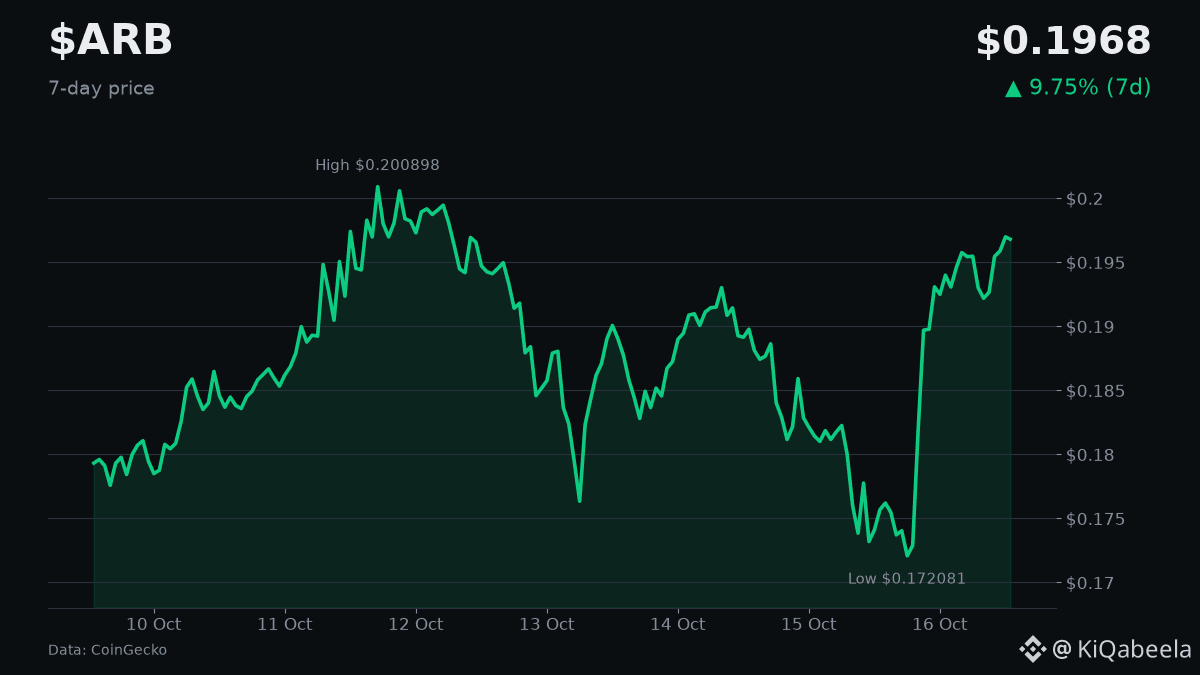
Arbitrum jumps 9.9% to $0.1938 in the last 24 hours
📌 What happened
Arbitrum (ARB) rose to $0.193777, up 9.93% over the past day, reaching a high of $0.196438.
🔍 Why it matters
• The surge pushes ARB into a greener market sentiment, with the Fear & Greed index at 63.
• Volume spiked to $236.8 M, indicating strong trader participation.
• A near‑10% move in a single day can attract short‑term interest from speculative traders.
👀 What to watch
• Continued volume trends – a drop could signal the rally losing steam.
• Competing Layer‑2 solutions gaining traction, which may cap ARB’s upside.
💬 Bullish, bearish or waiting? One word.
$ARB
#Arbitrum #L2 #Crypto
Arbitrum jumps 9.9% to $0.1938 in the last 24 hours
📌 What happened
Arbitrum (ARB) rose to $0.193777, up 9.93% over the past day, reaching a high of $0.196438.
🔍 Why it matters
• The surge pushes ARB into a greener market sentiment, with the Fear & Greed index at 63.
• Volume spiked to $236.8 M, indicating strong trader participation.
• A near‑10% move in a single day can attract short‑term interest from speculative traders.
👀 What to watch
• Continued volume trends – a drop could signal the rally losing steam.
• Competing Layer‑2 solutions gaining traction, which may cap ARB’s upside.
💬 Bullish, bearish or waiting? One word.
$ARB
#Arbitrum #L2 #Crypto
📌 What happened
Arbitrum (ARB) rose to $0.193777, up 9.93% over the past day, reaching a high of $0.196438.
🔍 Why it matters
• The surge pushes ARB into a greener market sentiment, with the Fear & Greed index at 63.
• Volume spiked to $236.8 M, indicating strong trader participation.
• A near‑10% move in a single day can attract short‑term interest from speculative traders.
👀 What to watch
• Continued volume trends – a drop could signal the rally losing steam.
• Competing Layer‑2 solutions gaining traction, which may cap ARB’s upside.
💬 Bullish, bearish or waiting? One word.
$ARB
#Arbitrum #L2 #Crypto
12
Log in to explore more content
Join global crypto users on Binance Square
⚡️ Get latest and useful information about crypto.
💬 Trusted by the world’s largest crypto exchange.
👍 Discover real insights from verified creators.
Email / Phone number
Trending Topics
1
#BinancePick
3M views
152,357 Discussing
2
#EarningsSeason
5.3M views
25,899 Discussing
3
#AnthropicTTMRevenueGrewAbout1200%
25,481 views
376 Discussing
4
#AnthropicS1ExpectedToday
23,997 views
316 Discussing
5
#SouthKoreaReportedlyWeighsFourthCryptoTaxDelay
28,653 views
439 Discussing
6
#FranklinTempletonFilesForTwoDividendToBitcoinETFs
37,732 views
521 Discussing
7
#StrategyMSTRSurpassesNasdaqInMarketCap
28,370 views
377 Discussing
8
#CanadaProposesStablecoinRedemptionWithin3BusinessDays
1,266 views
36 Discussing
9
#ElectrumWalletBugLetRogueServersStealFunds
29,769 views
455 Discussing
10
#ArgentineCourtDismissesLIBRACaseAgainstMilei
44,714 views
560 Discussing