Binance Square
#ethereumlayer2

ethereumlayer2

41,310 views
130 Discussing
CryptosNewss
·
--
Article
Ethereum Layer-2 TVL Reaches $37.4 Billion as Base, Arbitrum, and Optimism Drive Scaling BoomEthereum's long-term scaling strategy is showing measurable progress as Layer-2 (L2) networks collectively hold $37.41 billion in Total Value Locked (TVL) while transaction activity continues to reach new highs. The latest on-chain data suggests that recent protocol upgrades are helping the network process significantly more activity without increasing user costs. The milestone comes after Ethereum aligned its Layer-1 and Layer-2 development into a unified scaling roadmap. Upgrades including Pectra and Fusaka were designed to improve data availability and increase throughput, allowing rollups to process more transactions while settling securely on the Ethereum mainnet. Record Activity Meets Record-Low Transaction Costs One of the clearest indicators of Ethereum's scaling progress is the widening gap between network usage and transaction fees. Weekly transaction volume recently climbed to 1.8 million, while total activity briefly touched 21 million transactions, representing the highest levels recorded on the network. Monthly transaction volume also increased by approximately 15%, reflecting continued user engagement across Ethereum's ecosystem. Despite the surge in activity, the median transaction fee dropped to just $0.008, marking an all-time low. Normally, rising demand pushes network costs higher, but the opposite trend suggests Ethereum's scaling infrastructure is successfully absorbing increased traffic. For users, developers, and decentralized applications, lower fees improve accessibility while maintaining Ethereum's security through Layer-1 settlement. Proto-Danksharding Adoption Continues to Expand Additional blockchain data reinforces the trend. According to Dune Analytics, cumulative blob fees have reached approximately 1.492 million ETH, highlighting growing adoption of proto-danksharding, the technology that enables Layer-2 networks to publish compressed transaction data more efficiently. Blobs reduce storage requirements and lower operating costs for rollups, making high-volume transactions significantly cheaper without compromising Ethereum's settlement layer. This shift reflects Ethereum's broader strategy of moving execution to Layer-2 while preserving Layer-1 as the network's decentralized security foundation. Base Remains the Largest Ethereum Layer-2 by TVL Among Ethereum's scaling networks, Base continues to lead in capital inflows. The Coinbase-backed Layer-2 currently holds approximately $11.86 billion in Total Value Locked, increasing by 1.04% over the measured period. Base also processed roughly 248.3 million transactions, accounting for 29.1% of all Layer-2 activity. Other major ecosystems also recorded healthy growth. Arbitrum One (ARB) posted a 22.2% increase in transaction activity, while Optimism (OP) expanded by 19.2%. ZKsync remained among the largest Layer-2 networks by TVL, although it was the only major platform in the group to record a decline during the reporting period. Combined, Ethereum Layer-2 networks now secure $37.41 billion in locked assets—nearly half of the capital currently secured on Ethereum's mainnet. Robinhood Chain Emerges as the Fastest-Growing Network While Base dominates overall transaction volume, Robinhood Chain delivered the strongest growth rate. The newly launched Layer-2 recorded an extraordinary 30,922% monthly increase in transactions, representing 13.9% of total Layer-2 transaction activity during the period. Its rapid expansion demonstrates how new Ethereum-compatible networks can scale quickly by leveraging existing developer tools, decentralized infrastructure, and EVM compatibility. Although the network remains newer than Base, Arbitrum, and Optimism, its early adoption highlights increasing competition across Ethereum's Layer-2 ecosystem. More Users and Capital Continue Entering Ethereum Growth is not limited to transactions alone. Monthly active users across Ethereum increased 2.9%, reaching approximately 8.3 million addresses. Rising user participation alongside growing TVL suggests that both retail participants and institutional capital continue interacting with Ethereum-based applications. Market observers often view these metrics together because increasing users, rising liquidity, and sustained developer activity typically indicate strengthening network fundamentals rather than isolated speculative interest. Why the Scaling Data Matters Ethereum's roadmap has increasingly focused on making Layer-2 networks the primary destination for everyday transactions while Layer-1 functions as the settlement and security layer. The latest data suggests that objective is gradually materializing. Higher transaction throughput, historically low fees, expanding TVL, and growing user activity indicate that recent protocol upgrades are improving network efficiency without sacrificing decentralization. As additional scaling improvements roll out and Layer-2 adoption continues expanding, metrics such as active users, capital inflows, transaction volumes, and developer participation will remain key indicators of Ethereum's evolving infrastructure. The post first featured on CryptosNewss.com #EthereumLayer2 $ETH

Ethereum Layer-2 TVL Reaches $37.4 Billion as Base, Arbitrum, and Optimism Drive Scaling Boom

Ethereum's long-term scaling strategy is showing measurable progress as Layer-2 (L2) networks collectively hold $37.41 billion in Total Value Locked (TVL) while transaction activity continues to reach new highs. The latest on-chain data suggests that recent protocol upgrades are helping the network process significantly more activity without increasing user costs.
The milestone comes after Ethereum aligned its Layer-1 and Layer-2 development into a unified scaling roadmap. Upgrades including Pectra and Fusaka were designed to improve data availability and increase throughput, allowing rollups to process more transactions while settling securely on the Ethereum mainnet.
Record Activity Meets Record-Low Transaction Costs
One of the clearest indicators of Ethereum's scaling progress is the widening gap between network usage and transaction fees.
Weekly transaction volume recently climbed to 1.8 million, while total activity briefly touched 21 million transactions, representing the highest levels recorded on the network. Monthly transaction volume also increased by approximately 15%, reflecting continued user engagement across Ethereum's ecosystem.
Despite the surge in activity, the median transaction fee dropped to just $0.008, marking an all-time low. Normally, rising demand pushes network costs higher, but the opposite trend suggests Ethereum's scaling infrastructure is successfully absorbing increased traffic.
For users, developers, and decentralized applications, lower fees improve accessibility while maintaining Ethereum's security through Layer-1 settlement.
Proto-Danksharding Adoption Continues to Expand
Additional blockchain data reinforces the trend.
According to Dune Analytics, cumulative blob fees have reached approximately 1.492 million ETH, highlighting growing adoption of proto-danksharding, the technology that enables Layer-2 networks to publish compressed transaction data more efficiently.
Blobs reduce storage requirements and lower operating costs for rollups, making high-volume transactions significantly cheaper without compromising Ethereum's settlement layer.
This shift reflects Ethereum's broader strategy of moving execution to Layer-2 while preserving Layer-1 as the network's decentralized security foundation.
Base Remains the Largest Ethereum Layer-2 by TVL
Among Ethereum's scaling networks, Base continues to lead in capital inflows.
The Coinbase-backed Layer-2 currently holds approximately $11.86 billion in Total Value Locked, increasing by 1.04% over the measured period. Base also processed roughly 248.3 million transactions, accounting for 29.1% of all Layer-2 activity.
Other major ecosystems also recorded healthy growth.
Arbitrum One (ARB) posted a 22.2% increase in transaction activity, while Optimism (OP) expanded by 19.2%. ZKsync remained among the largest Layer-2 networks by TVL, although it was the only major platform in the group to record a decline during the reporting period.
Combined, Ethereum Layer-2 networks now secure $37.41 billion in locked assets—nearly half of the capital currently secured on Ethereum's mainnet.
Robinhood Chain Emerges as the Fastest-Growing Network
While Base dominates overall transaction volume, Robinhood Chain delivered the strongest growth rate.
The newly launched Layer-2 recorded an extraordinary 30,922% monthly increase in transactions, representing 13.9% of total Layer-2 transaction activity during the period.
Its rapid expansion demonstrates how new Ethereum-compatible networks can scale quickly by leveraging existing developer tools, decentralized infrastructure, and EVM compatibility.
Although the network remains newer than Base, Arbitrum, and Optimism, its early adoption highlights increasing competition across Ethereum's Layer-2 ecosystem.
More Users and Capital Continue Entering Ethereum
Growth is not limited to transactions alone.
Monthly active users across Ethereum increased 2.9%, reaching approximately 8.3 million addresses. Rising user participation alongside growing TVL suggests that both retail participants and institutional capital continue interacting with Ethereum-based applications.
Market observers often view these metrics together because increasing users, rising liquidity, and sustained developer activity typically indicate strengthening network fundamentals rather than isolated speculative interest.
Why the Scaling Data Matters
Ethereum's roadmap has increasingly focused on making Layer-2 networks the primary destination for everyday transactions while Layer-1 functions as the settlement and security layer.
The latest data suggests that objective is gradually materializing. Higher transaction throughput, historically low fees, expanding TVL, and growing user activity indicate that recent protocol upgrades are improving network efficiency without sacrificing decentralization.
As additional scaling improvements roll out and Layer-2 adoption continues expanding, metrics such as active users, capital inflows, transaction volumes, and developer participation will remain key indicators of Ethereum's evolving infrastructure.
The post first featured on CryptosNewss.com
#EthereumLayer2 $ETH
🚀 STRK Coin on the Rise — A Top Performer with Strong Profit Potential! 💎 $STRK {spot}(STRKUSDT) has recently become one of the top-rated coins in the market, showing powerful momentum and investor confidence. 🔥 Compared to its past rate, STRK has seen massive growth, turning early holders into strong gainers. 📈 Its current performance reflects rising demand for Layer-2 scaling solutions and faster blockchain transactions — making it a key player in the Ethereum ecosystem. From its earlier launch phase, when the price hovered near $0.80–$1.00, STRK has now climbed impressively, showing how real utility and adoption can fuel profits. 🚀 With increasing volume and community trust, many traders see STRK as a potential long-term gem for both short-term profits and future growth. 🌟 #STRK #CryptoTrading #Profit #Blockchain #EthereumLayer2
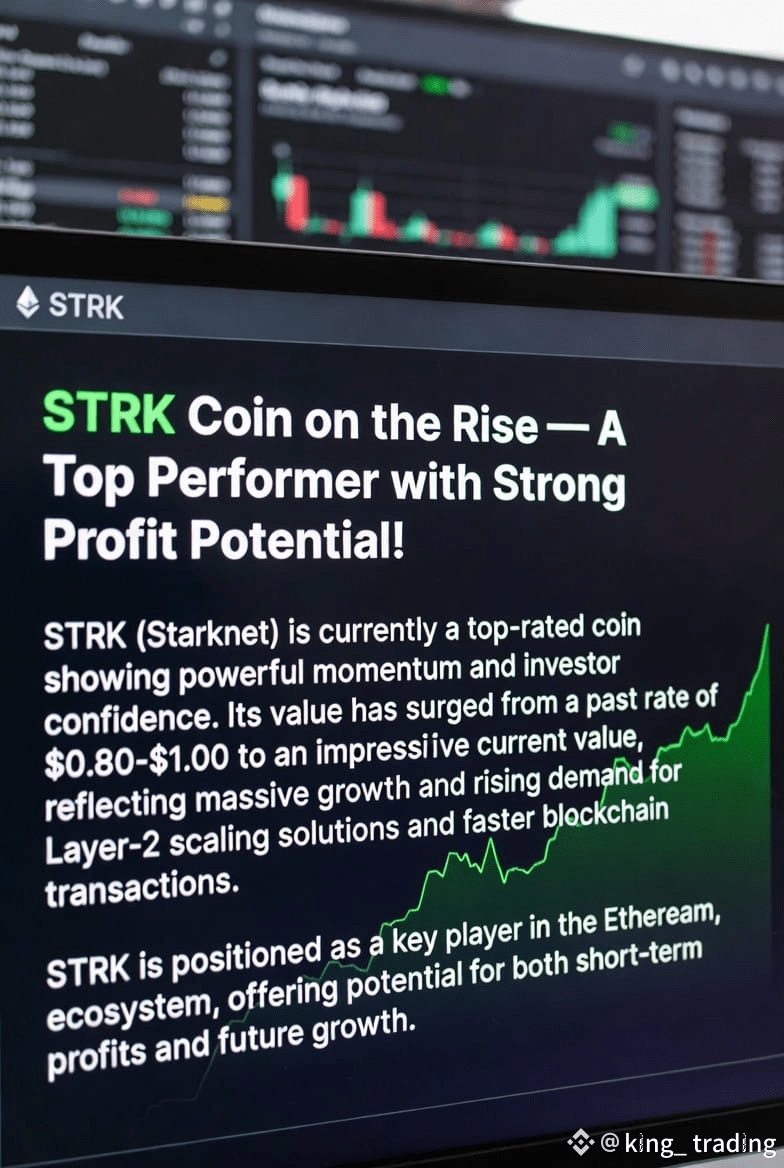
🚀 STRK Coin on the Rise — A Top Performer with Strong Profit Potential! 💎
$STRK
has recently become one of the top-rated coins in the market, showing powerful momentum and investor confidence. 🔥 Compared to its past rate, STRK has seen massive growth, turning early holders into strong gainers. 📈 Its current performance reflects rising demand for Layer-2 scaling solutions and faster blockchain transactions — making it a key player in the Ethereum ecosystem.
From its earlier launch phase, when the price hovered near $0.80–$1.00, STRK has now climbed impressively, showing how real utility and adoption can fuel profits. 🚀 With increasing volume and community trust, many traders see STRK as a potential long-term gem for both short-term profits and future growth. 🌟
#STRK #CryptoTrading #Profit #Blockchain #EthereumLayer2
·
--
Bullish
Linking the Galaxy, Riding the New Wave — Caldera's Modular Prophecy @Calderaxyz #Caldera 1. Congestion and Breakthrough: Bottlenecks and New Paths Do you remember when Ethereum's gas fees exceeded 50 million dollars in a single day? The network was like a traffic jam, with NFTs, DeFi, and GameFi all waiting at the red light. The emergence of Layer 2 separated execution, settlement, and data, increasing TPS to over 5000 and reducing fees by 90%, allowing blockchain to enter the fast lane. 2. Caldera Vision: The Internet of Rollups Caldera is not an island but a high-speed hub. It enables Rollups to interconnect, modularize, and customize, building chains like assembling Legos. Developers don’t need to reinvent the wheel, allowing applications to land smoothly. 3. Performance Leap: Powered by EigenDA Caldera collaborates with EigenCloud to embed EigenDA V2 into its engine. The result is a throughput of 100 MB/s, upgrading from secondary roads to high-speed highways. Finance can settle in seconds, and gaming experiences are smooth and delay-free; this is not a vision, but a reality. 4. ERA Token: The Spark of Ecology The total supply of ERA is 1 billion, with an initial circulation of 148.5 million. In July, Binance airdropped 20 million ERA, accounting for 2% of the total supply. ERA has launched trading pairs with BNB, USDT, and USDC, injecting momentum into the ecosystem. 5. Future Three Lines: Expand · Interconnect · Customize Execution chain clusters: Deeply optimized for industries; Cross-chain interoperability: Breaking down value silos; Enterprise custom chains: Promoting large-scale implementations. Caldera has simplified complex processes into one-click activation, allowing old chains to switch smoothly, truly lowering the development threshold. Conclusion: The Prelude to Multichain Dance When will blockchain be as smooth as the Internet? Caldera is providing the answer: Rollups are no longer fighting alone but are interconnected like the galaxy. The future is not dominated by one chain, but rather thousands of chains standing side by side. Friend, do you think multichain interconnectivity is a transition or the final stage? If it were you, where would you place the first chain? @Calderaxyz #Caldera #RollupInternet #EthereumLayer2

Linking the Galaxy, Riding the New Wave — Caldera's Modular Prophecy

@Calderaxyz #Caldera

1. Congestion and Breakthrough: Bottlenecks and New Paths

Do you remember when Ethereum's gas fees exceeded 50 million dollars in a single day?

The network was like a traffic jam, with NFTs, DeFi, and GameFi all waiting at the red light.

The emergence of Layer 2 separated execution, settlement, and data, increasing TPS to over 5000 and reducing fees by 90%, allowing blockchain to enter the fast lane.

2. Caldera Vision: The Internet of Rollups

Caldera is not an island but a high-speed hub.

It enables Rollups to interconnect, modularize, and customize, building chains like assembling Legos.

Developers don’t need to reinvent the wheel, allowing applications to land smoothly.

3. Performance Leap: Powered by EigenDA

Caldera collaborates with EigenCloud to embed EigenDA V2 into its engine.

The result is a throughput of 100 MB/s, upgrading from secondary roads to high-speed highways.

Finance can settle in seconds, and gaming experiences are smooth and delay-free; this is not a vision, but a reality.

4. ERA Token: The Spark of Ecology

The total supply of ERA is 1 billion, with an initial circulation of 148.5 million.

In July, Binance airdropped 20 million ERA, accounting for 2% of the total supply.

ERA has launched trading pairs with BNB, USDT, and USDC, injecting momentum into the ecosystem.

5. Future Three Lines: Expand · Interconnect · Customize

Execution chain clusters: Deeply optimized for industries;

Cross-chain interoperability: Breaking down value silos;

Enterprise custom chains: Promoting large-scale implementations.

Caldera has simplified complex processes into one-click activation, allowing old chains to switch smoothly, truly lowering the development threshold.

Conclusion: The Prelude to Multichain Dance

When will blockchain be as smooth as the Internet?

Caldera is providing the answer:

Rollups are no longer fighting alone but are interconnected like the galaxy.

The future is not dominated by one chain, but rather thousands of chains standing side by side.

Friend, do you think multichain interconnectivity is a transition or the final stage?

If it were you, where would you place the first chain?

@Calderaxyz #Caldera #RollupInternet #EthereumLayer2
Log in to explore more content
Join global crypto users on Binance Square
⚡️ Get latest and useful information about crypto.
💬 Trusted by the world’s largest crypto exchange.
👍 Discover real insights from verified creators.
Email / Phone number