

#defisecurity
defisecurity
127,938 views
654 Discussing
Hot
Latest

LayerZero is facing severe pressure as a massive $292M lawsuit challenges its core security design following the KelpDAO rsETH exploit. With nearly $15B exiting the protocol and mounting reputational damage, the legal battle goes beyond a financial dispute—it puts omnichain trust on trial. Cross-chain infra must prioritize bulletproof validation, or user capital will keep fleeing. Security is everything in DeFi. #LayerZero #DeFiSecurity #CryptoNews
LayerZero is facing severe pressure as a massive $292M lawsuit challenges its core security design following the KelpDAO rsETH exploit. With nearly $15B exiting the protocol and mounting reputational damage, the legal battle goes beyond a financial dispute—it puts omnichain trust on trial. Cross-chain infra must prioritize bulletproof validation, or user capital will keep fleeing. Security is everything in DeFi. #LayerZero #DeFiSecurity #CryptoNews

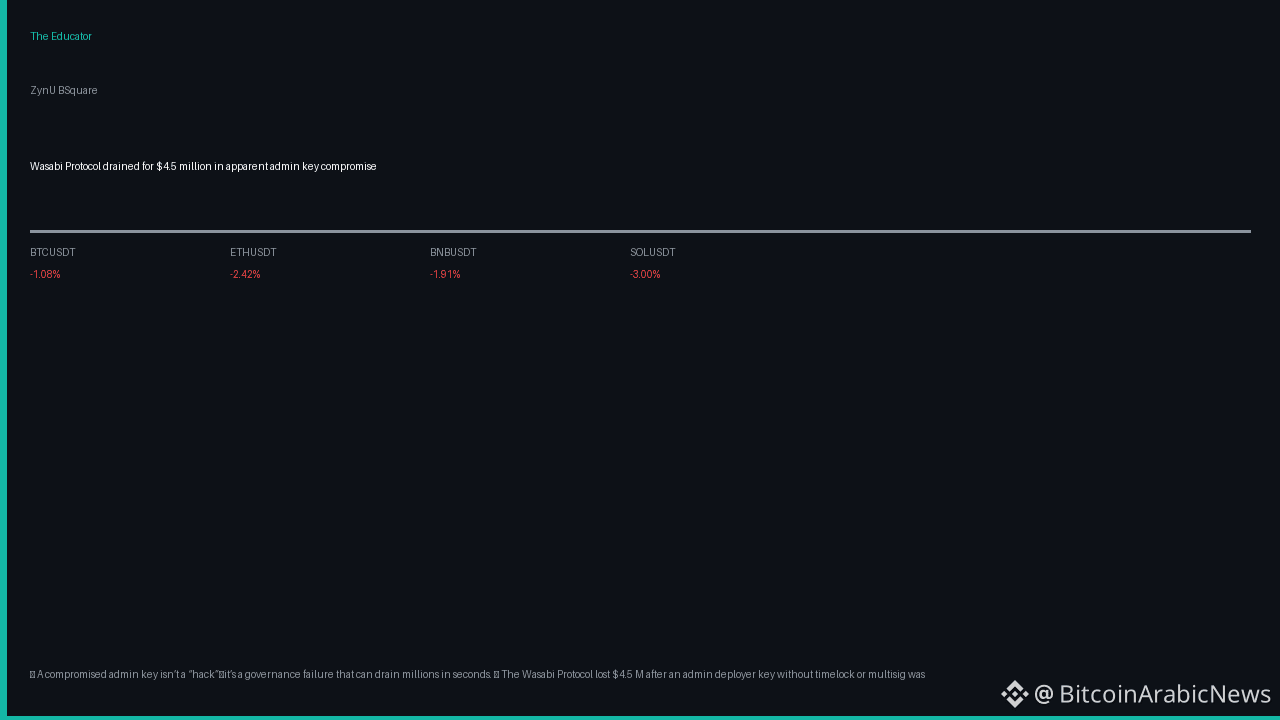
🔥 A compromised admin key isn’t a “hack”—it’s a governance failure that can drain millions in seconds.
📊 The Wasabi Protocol lost $4.5 M after an admin deployer key without timelock or multisig was seized, echoing Drift’s $285 M breach earlier this week #DeFiSecurity #SmartContractRisk.
💡 With #Bitcoin trading at $80,416, RSI 61.2 and open interest $8.76 B, the market shows bullish confidence (funding +0.0100% longs paying), yet governance lapses still bite, underscoring why #CryptoSafety will separate resilient projects from the rest.
📌 Practical move: audit any protocol you stake in for multisig controls and timelocks; prioritize platforms that publish transparent governance dashboards before allocating capital.
❓ How do you vet a project’s contract security—relying on community audits, formal verification, or on‑chain monitoring tools?
🔥 A compromised admin key isn’t a “hack”—it’s a governance failure that can drain millions in seconds.
📊 The Wasabi Protocol lost $4.5 M after an admin deployer key without timelock or multisig was seized, echoing Drift’s $285 M breach earlier this week #DeFiSecurity #SmartContractRisk.
💡 With #Bitcoin trading at $80,416, RSI 61.2 and open interest $8.76 B, the market shows bullish confidence (funding +0.0100% longs paying), yet governance lapses still bite, underscoring why #CryptoSafety will separate resilient projects from the rest.
📌 Practical move: audit any protocol you stake in for multisig controls and timelocks; prioritize platforms that publish transparent governance dashboards before allocating capital.
❓ How do you vet a project’s contract security—relying on community audits, formal verification, or on‑chain monitoring tools?
📊 The Wasabi Protocol lost $4.5 M after an admin deployer key without timelock or multisig was seized, echoing Drift’s $285 M breach earlier this week #DeFiSecurity #SmartContractRisk.
💡 With #Bitcoin trading at $80,416, RSI 61.2 and open interest $8.76 B, the market shows bullish confidence (funding +0.0100% longs paying), yet governance lapses still bite, underscoring why #CryptoSafety will separate resilient projects from the rest.
📌 Practical move: audit any protocol you stake in for multisig controls and timelocks; prioritize platforms that publish transparent governance dashboards before allocating capital.
❓ How do you vet a project’s contract security—relying on community audits, formal verification, or on‑chain monitoring tools?
58

·
--
Chinese Version:
MEV bot is too awesome! A hacker tried to cause trouble by exploiting a custom Safe module and steal $7.7M worth of rsETH, but the "Yoink" bot struck first, intercepting the stolen funds. Kelp quickly froze the receiving address. This shows DeFi security mechanisms are evolving, squeezing out room for hackers. In the short term, the rsETH price may fluctuate due to the news, but in the long run, these positive events actually strengthen market confidence. #DeFiSecurity #MEVProtection $rsETH $ETH
English Version:
MEV bot just pulled off the ultimate flex! A hacker tried exploiting a custom Safe module to steal $7.7M in rsETH, but the "Yoink" bot front-ran the attack and snatched the funds before Kelp froze the receiving address. This shows DeFi security is evolving fast, squeezing hackers out. Short-term rsETH price might see volatility, but long-term, these positive events actually boost market confidence. #DeFiSecurity #MEVProtection $rsETH $ETH
Chinese Version:
MEV bot is too awesome! A hacker tried to cause trouble by exploiting a custom Safe module and steal $7.7M worth of rsETH, but the "Yoink" bot struck first, intercepting the stolen funds. Kelp quickly froze the receiving address. This shows DeFi security mechanisms are evolving, squeezing out room for hackers. In the short term, the rsETH price may fluctuate due to the news, but in the long run, these positive events actually strengthen market confidence. #DeFiSecurity #MEVProtection $rsETH $ETH
English Version:
MEV bot just pulled off the ultimate flex! A hacker tried exploiting a custom Safe module to steal $7.7M in rsETH, but the "Yoink" bot front-ran the attack and snatched the funds before Kelp froze the receiving address. This shows DeFi security is evolving fast, squeezing hackers out. Short-term rsETH price might see volatility, but long-term, these positive events actually boost market confidence. #DeFiSecurity #MEVProtection $rsETH $ETH
MEV bot is too awesome! A hacker tried to cause trouble by exploiting a custom Safe module and steal $7.7M worth of rsETH, but the "Yoink" bot struck first, intercepting the stolen funds. Kelp quickly froze the receiving address. This shows DeFi security mechanisms are evolving, squeezing out room for hackers. In the short term, the rsETH price may fluctuate due to the news, but in the long run, these positive events actually strengthen market confidence. #DeFiSecurity #MEVProtection $rsETH $ETH
English Version:
MEV bot just pulled off the ultimate flex! A hacker tried exploiting a custom Safe module to steal $7.7M in rsETH, but the "Yoink" bot front-ran the attack and snatched the funds before Kelp froze the receiving address. This shows DeFi security is evolving fast, squeezing hackers out. Short-term rsETH price might see volatility, but long-term, these positive events actually boost market confidence. #DeFiSecurity #MEVProtection $rsETH $ETH
169

·
--

Article
Symbiosis Recovered 15 BTC After Bridge Exploit, Offers 20% BountyMost traders watch price. Smart money watches the recovery rate of stolen assets.
The latest shockwave in the DeFi security arena came from Symbiosis, the cross‑chain bridge that recently fell victim to a sophisticated exploit. Blockaid, a leading blockchain security firm, confirmed that the attacker managed to mint a staggering 46.1 billion syBTC—an equivalent of roughly $336,000 in proceeds. Yet, what’s truly eye‑opening is that Symbiosis has already recovered 15 BTC (about $450,000) from the stolen pool and has dangled a 20 % bounty to any party that can help locate the remaining assets.
#DeFiSecurity #BridgeExploit #CryptoRecovery
Why does this matter for $BTC and the broader market? First, the sheer scale of the minting—46.1 billion syBTC—highlights how vulnerable cross‑chain bridges remain, even for projects with robust security audits. Second, the rapid recovery of 15 BTC indicates that Symbiosis’ incident response team is not only vigilant but also actively collaborating with the community. A 20 % bounty is a clear signal that the project is willing to pay handsomely for any leads, which could accelerate the return of the remaining funds. For traders, this means that the bridge’s liquidity and user confidence are likely to rebound faster than the typical 3‑4 month recovery cycle seen in past incidents.
Watch the following: the movement of the recovered 15 BTC on the blockchain. If you see a sudden influx into a single address or a pattern of clustering, it could be a hint that the attacker is consolidating assets before moving them. Keep an eye on the address that received the bounty payout—if it starts receiving additional inflows, that might signal the attacker’s next move.
What will the next 30 days reveal about the resilience of cross‑chain bridges, and how will this incident reshape the risk appetite of institutional investors?
Symbiosis Recovered 15 BTC After Bridge Exploit, Offers 20% Bounty
Most traders watch price. Smart money watches the recovery rate of stolen assets.
The latest shockwave in the DeFi security arena came from Symbiosis, the cross‑chain bridge that recently fell victim to a sophisticated exploit. Blockaid, a leading blockchain security firm, confirmed that the attacker managed to mint a staggering 46.1 billion syBTC—an equivalent of roughly $336,000 in proceeds. Yet, what’s truly eye‑opening is that Symbiosis has already recovered 15 BTC (about $450,000) from the stolen pool and has dangled a 20 % bounty to any party that can help locate the remaining assets.
#DeFiSecurity #BridgeExploit #CryptoRecovery
Why does this matter for $BTC and the broader market? First, the sheer scale of the minting—46.1 billion syBTC—highlights how vulnerable cross‑chain bridges remain, even for projects with robust security audits. Second, the rapid recovery of 15 BTC indicates that Symbiosis’ incident response team is not only vigilant but also actively collaborating with the community. A 20 % bounty is a clear signal that the project is willing to pay handsomely for any leads, which could accelerate the return of the remaining funds. For traders, this means that the bridge’s liquidity and user confidence are likely to rebound faster than the typical 3‑4 month recovery cycle seen in past incidents.
Watch the following: the movement of the recovered 15 BTC on the blockchain. If you see a sudden influx into a single address or a pattern of clustering, it could be a hint that the attacker is consolidating assets before moving them. Keep an eye on the address that received the bounty payout—if it starts receiving additional inflows, that might signal the attacker’s next move.
What will the next 30 days reveal about the resilience of cross‑chain bridges, and how will this incident reshape the risk appetite of institutional investors?
The latest shockwave in the DeFi security arena came from Symbiosis, the cross‑chain bridge that recently fell victim to a sophisticated exploit. Blockaid, a leading blockchain security firm, confirmed that the attacker managed to mint a staggering 46.1 billion syBTC—an equivalent of roughly $336,000 in proceeds. Yet, what’s truly eye‑opening is that Symbiosis has already recovered 15 BTC (about $450,000) from the stolen pool and has dangled a 20 % bounty to any party that can help locate the remaining assets.
#DeFiSecurity #BridgeExploit #CryptoRecovery
Why does this matter for $BTC and the broader market? First, the sheer scale of the minting—46.1 billion syBTC—highlights how vulnerable cross‑chain bridges remain, even for projects with robust security audits. Second, the rapid recovery of 15 BTC indicates that Symbiosis’ incident response team is not only vigilant but also actively collaborating with the community. A 20 % bounty is a clear signal that the project is willing to pay handsomely for any leads, which could accelerate the return of the remaining funds. For traders, this means that the bridge’s liquidity and user confidence are likely to rebound faster than the typical 3‑4 month recovery cycle seen in past incidents.
Watch the following: the movement of the recovered 15 BTC on the blockchain. If you see a sudden influx into a single address or a pattern of clustering, it could be a hint that the attacker is consolidating assets before moving them. Keep an eye on the address that received the bounty payout—if it starts receiving additional inflows, that might signal the attacker’s next move.
What will the next 30 days reveal about the resilience of cross‑chain bridges, and how will this incident reshape the risk appetite of institutional investors?
16

🚨 $BTX LIQUIDITY DRAINED AS FLASH LOAN EXPLOIT EXPOSES ORACLE VULNERABILITY ⚠️
🔍 BeatSwap ($BTX ) suffered a contract exploit draining roughly $77.5K (2.98M $BTX ) through spot price manipulation. The attacker deployed a 6M $BTX flash loan into a DEX pool to artificially crush spot pricing metrics before calling deposit functions to mint skewed LP positions.
📊 This attack vector succeeded by exploiting a missing Time-Weighted Average Price (TWAP) implementation and lacking price deviation safeguards. When smart contracts rely solely on instantaneous spot prices, massive temporary liquidity shifts can easily distort structural mechanics for immediate extraction.
💬 Should DEX protocols mandate TWAP filters before launching LP conversion contracts? 👇
⚠️ Not financial advice. Always manage your risk. 🛡️
🏷️ #BTX #DeFiSecurity #SmartMoney #CryptoAnalysis
🔍 🛡️
🚨 $BTX LIQUIDITY DRAINED AS FLASH LOAN EXPLOIT EXPOSES ORACLE VULNERABILITY ⚠️
🔍 BeatSwap ($BTX ) suffered a contract exploit draining roughly $77.5K (2.98M $BTX ) through spot price manipulation. The attacker deployed a 6M $BTX flash loan into a DEX pool to artificially crush spot pricing metrics before calling deposit functions to mint skewed LP positions.
📊 This attack vector succeeded by exploiting a missing Time-Weighted Average Price (TWAP) implementation and lacking price deviation safeguards. When smart contracts rely solely on instantaneous spot prices, massive temporary liquidity shifts can easily distort structural mechanics for immediate extraction.
💬 Should DEX protocols mandate TWAP filters before launching LP conversion contracts? 👇
⚠️ Not financial advice. Always manage your risk. 🛡️
🏷️ #BTX #DeFiSecurity #SmartMoney #CryptoAnalysis
🔍 🛡️
🔍 BeatSwap ($BTX ) suffered a contract exploit draining roughly $77.5K (2.98M $BTX ) through spot price manipulation. The attacker deployed a 6M $BTX flash loan into a DEX pool to artificially crush spot pricing metrics before calling deposit functions to mint skewed LP positions.
📊 This attack vector succeeded by exploiting a missing Time-Weighted Average Price (TWAP) implementation and lacking price deviation safeguards. When smart contracts rely solely on instantaneous spot prices, massive temporary liquidity shifts can easily distort structural mechanics for immediate extraction.
💬 Should DEX protocols mandate TWAP filters before launching LP conversion contracts? 👇
⚠️ Not financial advice. Always manage your risk. 🛡️
🏷️ #BTX #DeFiSecurity #SmartMoney #CryptoAnalysis
🔍 🛡️
40

🚨 Depletion of lending reserve of $9.3 million from the More Markets platform
Blockaid, a blockchain security company, reported that an attacker used Ankr’s liquid staking token and the E-mode pattern to exploit the More Markets lending protocol. The attack resulted in the withdrawal of approximately $9.3 million worth of WFLOW from the platform’s lending reserve.
━━━━━━━━━━━━━━
📊 Impact: 📈 High
🏷️ DEFI
#DeFiSecurity #Exploit #MoreMarkets #Blockchain
📰 Source: cointelegraph.com
🚨 Depletion of lending reserve of $9.3 million from the More Markets platform
Blockaid, a blockchain security company, reported that an attacker used Ankr’s liquid staking token and the E-mode pattern to exploit the More Markets lending protocol. The attack resulted in the withdrawal of approximately $9.3 million worth of WFLOW from the platform’s lending reserve.
━━━━━━━━━━━━━━
📊 Impact: 📈 High
🏷️ DEFI
#DeFiSecurity #Exploit #MoreMarkets #Blockchain
📰 Source: cointelegraph.com
Blockaid, a blockchain security company, reported that an attacker used Ankr’s liquid staking token and the E-mode pattern to exploit the More Markets lending protocol. The attack resulted in the withdrawal of approximately $9.3 million worth of WFLOW from the platform’s lending reserve.
━━━━━━━━━━━━━━
📊 Impact: 📈 High
🏷️ DEFI
#DeFiSecurity #Exploit #MoreMarkets #Blockchain
📰 Source: cointelegraph.com
20

·
--
🚨 Crypto.com’s Cronos blockchain halted after a $75M exploit on Tectonic, with ~$6M bridged to Ethereum before validators froze the chain.
The incident highlights cross-chain vulnerability risks, especially for assets moving between Cronos and Ethereum.
Ethereum remains operational, but the event may trigger short-term caution around wrapped assets and bridge usage.
Market participants are watching for potential ripple effects on DeFi protocols reliant on Cronos liquidity.
How will this affect trust in cross-chain bridges moving forward?
#Cronos #DeFiSecurity
$ETH #TradingSignal #CryptoAnalysis
🚨 Crypto.com’s Cronos blockchain halted after a $75M exploit on Tectonic, with ~$6M bridged to Ethereum before validators froze the chain.
The incident highlights cross-chain vulnerability risks, especially for assets moving between Cronos and Ethereum.
Ethereum remains operational, but the event may trigger short-term caution around wrapped assets and bridge usage.
Market participants are watching for potential ripple effects on DeFi protocols reliant on Cronos liquidity.
How will this affect trust in cross-chain bridges moving forward?
#Cronos #DeFiSecurity
$ETH #TradingSignal #CryptoAnalysis
The incident highlights cross-chain vulnerability risks, especially for assets moving between Cronos and Ethereum.
Ethereum remains operational, but the event may trigger short-term caution around wrapped assets and bridge usage.
Market participants are watching for potential ripple effects on DeFi protocols reliant on Cronos liquidity.
How will this affect trust in cross-chain bridges moving forward?
#Cronos #DeFiSecurity
$ETH #TradingSignal #CryptoAnalysis

29

·
--
Most traders are worried about the latest Cosmos hack. Smart money is looking at what it means for the broader DeFi ecosystem.
THE SIGNAL: A recent exploit targeting the Cosmos EVM, leading to roughly $5.72 million in stolen assets across multiple chains like MANTRA, TAC, and KiiChain. This happened between Aug 20th and Aug 25th. #CosmosHack #DeFiSecurity
THE INTERPRETATION: While this is a clear setback for the affected projects, it highlights the ongoing security challenges in cross-chain interoperability. For the informed investor, this isn't a reason to panic sell everything. Instead, it’s a critical reminder to focus on projects with robust security audits and a proven track record of defending against sophisticated attacks. We’ve seen this movie before; vulnerabilities get patched, and resilient projects emerge stronger. This also puts a spotlight on the need for better insurance protocols within DeFi.
THE WATCH LIST: Keep a close eye on how quickly other Cosmos-based projects implement enhanced security measures in response. #SecurityFirst
This incident underscores the importance of due diligence. What are you doing to protect your portfolio from these kinds of emergent risks?
Most traders are worried about the latest Cosmos hack. Smart money is looking at what it means for the broader DeFi ecosystem.
THE SIGNAL: A recent exploit targeting the Cosmos EVM, leading to roughly $5.72 million in stolen assets across multiple chains like MANTRA, TAC, and KiiChain. This happened between Aug 20th and Aug 25th. #CosmosHack #DeFiSecurity
THE INTERPRETATION: While this is a clear setback for the affected projects, it highlights the ongoing security challenges in cross-chain interoperability. For the informed investor, this isn't a reason to panic sell everything. Instead, it’s a critical reminder to focus on projects with robust security audits and a proven track record of defending against sophisticated attacks. We’ve seen this movie before; vulnerabilities get patched, and resilient projects emerge stronger. This also puts a spotlight on the need for better insurance protocols within DeFi.
THE WATCH LIST: Keep a close eye on how quickly other Cosmos-based projects implement enhanced security measures in response. #SecurityFirst
This incident underscores the importance of due diligence. What are you doing to protect your portfolio from these kinds of emergent risks?
THE SIGNAL: A recent exploit targeting the Cosmos EVM, leading to roughly $5.72 million in stolen assets across multiple chains like MANTRA, TAC, and KiiChain. This happened between Aug 20th and Aug 25th. #CosmosHack #DeFiSecurity
THE INTERPRETATION: While this is a clear setback for the affected projects, it highlights the ongoing security challenges in cross-chain interoperability. For the informed investor, this isn't a reason to panic sell everything. Instead, it’s a critical reminder to focus on projects with robust security audits and a proven track record of defending against sophisticated attacks. We’ve seen this movie before; vulnerabilities get patched, and resilient projects emerge stronger. This also puts a spotlight on the need for better insurance protocols within DeFi.
THE WATCH LIST: Keep a close eye on how quickly other Cosmos-based projects implement enhanced security measures in response. #SecurityFirst
This incident underscores the importance of due diligence. What are you doing to protect your portfolio from these kinds of emergent risks?
46

·
--
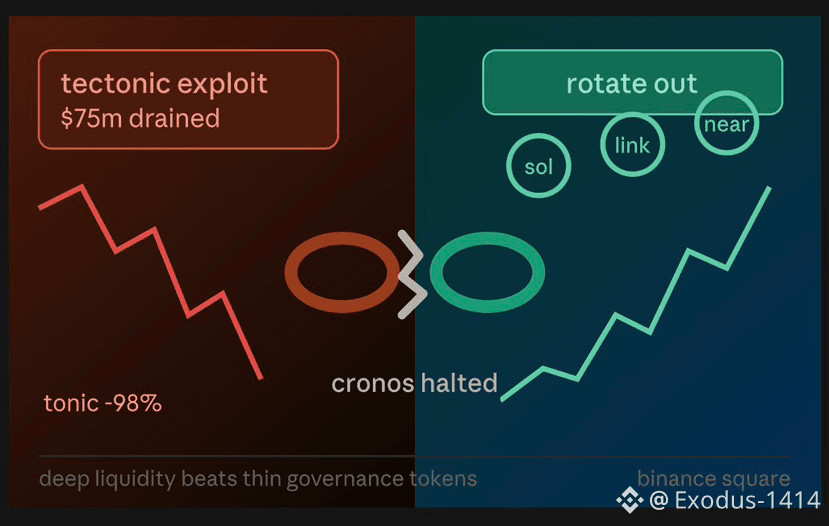
🚨 Cronos halted after $75M Tectonic exploit — here’s the risk
Cronos ($CRO) froze block production after an attacker manipulated the price of Tectonic’s illiquid $TONIC governance token ~100x in just 20 minutes, then borrowed against the inflated collateral to drain an estimated $66–75M from the chain’s largest lending protocol. Validators halted the entire chain to stop the bleeding, with only ~$6M reaching Ethereum before the freeze . Crypto.com’s exchange and app itself were unaffected — this hit DeFi infrastructure on Cronos, not custodial funds.
This is a classic Mango Markets-style oracle exploit: thin liquidity + collateral-backed borrowing = a token that can be pumped and used as fake-value collateral. It’s a reminder that chain security is only as strong as the weakest liquidity pool sitting on top of it.
Why rotate to $SOL / $NEAR / $LINK instead:
•Deeper, more battle-tested DeFi liquidity — harder for a single actor to manipulate an oracle price 100x in minutes
•Larger, more decentralized validator sets vs. Cronos’s capped ~100-validator Tendermint setup
•Established track record without a governance-token collateral vulnerability like this
DYOR — this isn’t financial advice, just a reminder that chain-level halts like this are a real tail risk worth pricing in. 🧵
#Cronos #DeFiSecurity #Exploit #solana #NEARProtocol
🚨 Cronos halted after $75M Tectonic exploit — here’s the risk
Cronos ($CRO) froze block production after an attacker manipulated the price of Tectonic’s illiquid $TONIC governance token ~100x in just 20 minutes, then borrowed against the inflated collateral to drain an estimated $66–75M from the chain’s largest lending protocol. Validators halted the entire chain to stop the bleeding, with only ~$6M reaching Ethereum before the freeze . Crypto.com’s exchange and app itself were unaffected — this hit DeFi infrastructure on Cronos, not custodial funds.
This is a classic Mango Markets-style oracle exploit: thin liquidity + collateral-backed borrowing = a token that can be pumped and used as fake-value collateral. It’s a reminder that chain security is only as strong as the weakest liquidity pool sitting on top of it.
Why rotate to $SOL / $NEAR / $LINK instead:
•Deeper, more battle-tested DeFi liquidity — harder for a single actor to manipulate an oracle price 100x in minutes
•Larger, more decentralized validator sets vs. Cronos’s capped ~100-validator Tendermint setup
•Established track record without a governance-token collateral vulnerability like this
DYOR — this isn’t financial advice, just a reminder that chain-level halts like this are a real tail risk worth pricing in. 🧵
#Cronos #DeFiSecurity #Exploit #solana #NEARProtocol
Cronos ($CRO) froze block production after an attacker manipulated the price of Tectonic’s illiquid $TONIC governance token ~100x in just 20 minutes, then borrowed against the inflated collateral to drain an estimated $66–75M from the chain’s largest lending protocol. Validators halted the entire chain to stop the bleeding, with only ~$6M reaching Ethereum before the freeze . Crypto.com’s exchange and app itself were unaffected — this hit DeFi infrastructure on Cronos, not custodial funds.
This is a classic Mango Markets-style oracle exploit: thin liquidity + collateral-backed borrowing = a token that can be pumped and used as fake-value collateral. It’s a reminder that chain security is only as strong as the weakest liquidity pool sitting on top of it.
Why rotate to $SOL / $NEAR / $LINK instead:
•Deeper, more battle-tested DeFi liquidity — harder for a single actor to manipulate an oracle price 100x in minutes
•Larger, more decentralized validator sets vs. Cronos’s capped ~100-validator Tendermint setup
•Established track record without a governance-token collateral vulnerability like this
DYOR — this isn’t financial advice, just a reminder that chain-level halts like this are a real tail risk worth pricing in. 🧵
#Cronos #DeFiSecurity #Exploit #solana #NEARProtocol
197

Article
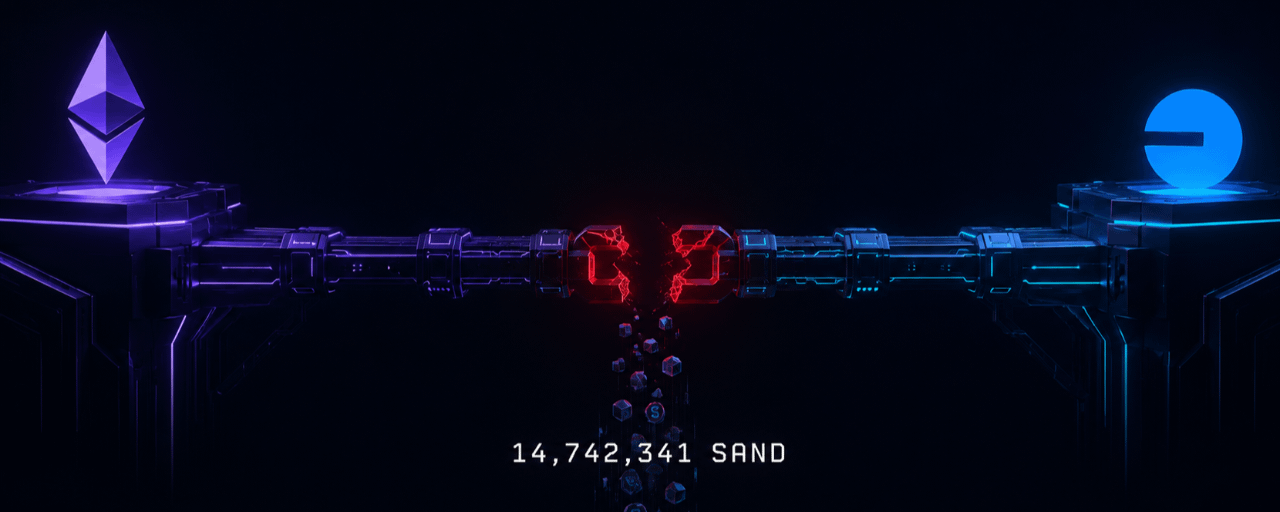
The Sandbox lost 14.7M SAND. The flaw was in the bridge.On August 22, 2026.
An attacker drained 14,742,341 SAND
from The Sandbox’s Ethereum vault.
Via a configuration flaw in their Base/BSC bridge.
Ethereum and Polygon were never affected, just the bridge.
It’s the same attack vector we’ve been seeing
repeat for 2 years.
And most farmers still ignore it.
📌 Step 1: Identify the target (the bridge)
The Sandbox confirmed that an attacker drained 14,742,341.84 SAND, 0.5% of the maximum supply, and did so from its Ethereum vault via a bridge configuration vulnerability on Base/BSC.
The Sandbox lost 14.7M SAND. The flaw was in the bridge.
On August 22, 2026.
An attacker drained 14,742,341 SAND
from The Sandbox’s Ethereum vault.
Via a configuration flaw in their Base/BSC bridge.
Ethereum and Polygon were never affected, just the bridge.
It’s the same attack vector we’ve been seeing
repeat for 2 years.
And most farmers still ignore it.
📌 Step 1: Identify the target (the bridge)
The Sandbox confirmed that an attacker drained 14,742,341.84 SAND, 0.5% of the maximum supply, and did so from its Ethereum vault via a bridge configuration vulnerability on Base/BSC.
An attacker drained 14,742,341 SAND
from The Sandbox’s Ethereum vault.
Via a configuration flaw in their Base/BSC bridge.
Ethereum and Polygon were never affected, just the bridge.
It’s the same attack vector we’ve been seeing
repeat for 2 years.
And most farmers still ignore it.
📌 Step 1: Identify the target (the bridge)
The Sandbox confirmed that an attacker drained 14,742,341.84 SAND, 0.5% of the maximum supply, and did so from its Ethereum vault via a bridge configuration vulnerability on Base/BSC.
1
378

·
--
EVM ecosystem "the underlying vulnerability = full network shutdown" script—this time it’s MANTRA’s turn.
Once the chain goes down, it’s over 30 hours. The coin price gets directly smashed into a 9% drop. For DeFi projects, the most fatal issue has never been market volatility—it’s instead this: "I can’t confirm whether the transaction on my chain is still there." The longer the downtime window, the lower institutional users’ and liquidity providers’ tolerance becomes. The 9% is just an emotional reaction; the real cost is whether, after the chain restarts, they can retrieve trust.
For retail users, the signals from events like this are actually very clear:
1. An EVM chain downtime of 30+ hours is basically not a "temporary hiccup"—it’s a patch-level security incident. Going forward, you’ll very likely see TVL outflows and pressure on staking redemptions.
2. Short-term price recovery often relies on deterministic information like "the patch is already live" and "the audit has been reviewed," not on emotional reversals. So don’t rush to bottom-fish—first look at the complete timeline in the official announcements.
3. The value of diversified holdings is truly validated at moments like this: one chain is down, another chain keeps running—that’s the real risk-resilient structure.
Security is never a question of "whether you have it," but whether you can hold up for 30 hours when something goes wrong. #MANTRA #DeFiSecurity
EVM ecosystem "the underlying vulnerability = full network shutdown" script—this time it’s MANTRA’s turn.
Once the chain goes down, it’s over 30 hours. The coin price gets directly smashed into a 9% drop. For DeFi projects, the most fatal issue has never been market volatility—it’s instead this: "I can’t confirm whether the transaction on my chain is still there." The longer the downtime window, the lower institutional users’ and liquidity providers’ tolerance becomes. The 9% is just an emotional reaction; the real cost is whether, after the chain restarts, they can retrieve trust.
For retail users, the signals from events like this are actually very clear:
1. An EVM chain downtime of 30+ hours is basically not a "temporary hiccup"—it’s a patch-level security incident. Going forward, you’ll very likely see TVL outflows and pressure on staking redemptions.
2. Short-term price recovery often relies on deterministic information like "the patch is already live" and "the audit has been reviewed," not on emotional reversals. So don’t rush to bottom-fish—first look at the complete timeline in the official announcements.
3. The value of diversified holdings is truly validated at moments like this: one chain is down, another chain keeps running—that’s the real risk-resilient structure.
Security is never a question of "whether you have it," but whether you can hold up for 30 hours when something goes wrong. #MANTRA #DeFiSecurity
Once the chain goes down, it’s over 30 hours. The coin price gets directly smashed into a 9% drop. For DeFi projects, the most fatal issue has never been market volatility—it’s instead this: "I can’t confirm whether the transaction on my chain is still there." The longer the downtime window, the lower institutional users’ and liquidity providers’ tolerance becomes. The 9% is just an emotional reaction; the real cost is whether, after the chain restarts, they can retrieve trust.
For retail users, the signals from events like this are actually very clear:
1. An EVM chain downtime of 30+ hours is basically not a "temporary hiccup"—it’s a patch-level security incident. Going forward, you’ll very likely see TVL outflows and pressure on staking redemptions.
2. Short-term price recovery often relies on deterministic information like "the patch is already live" and "the audit has been reviewed," not on emotional reversals. So don’t rush to bottom-fish—first look at the complete timeline in the official announcements.
3. The value of diversified holdings is truly validated at moments like this: one chain is down, another chain keeps running—that’s the real risk-resilient structure.
Security is never a question of "whether you have it," but whether you can hold up for 30 hours when something goes wrong. #MANTRA #DeFiSecurity
169
·
--
Ajna v2 suffered a liquidation accounting manipulation attack, resulting in losses of approximately $775,000.
The official X post has issued a warning: users must immediately withdraw all funds, repay loans, and pause any interaction with the protocol. According to Defimon Alerts monitoring, multiple liquidity pools—including syrupUSDC, wstETH, rETH, cbETH, WBTC, WETH/USDC, and sDAI—have been affected.
This attack path focuses on the accounting calculation logic in the liquidation module, showing that even audited protocols may still have uncovered attack surfaces in edge-case execution paths. Security audits are not the endpoint—continuous monitoring and incident response are the baseline.
#DeFiSecurity
Ajna v2 suffered a liquidation accounting manipulation attack, resulting in losses of approximately $775,000.
The official X post has issued a warning: users must immediately withdraw all funds, repay loans, and pause any interaction with the protocol. According to Defimon Alerts monitoring, multiple liquidity pools—including syrupUSDC, wstETH, rETH, cbETH, WBTC, WETH/USDC, and sDAI—have been affected.
This attack path focuses on the accounting calculation logic in the liquidation module, showing that even audited protocols may still have uncovered attack surfaces in edge-case execution paths. Security audits are not the endpoint—continuous monitoring and incident response are the baseline.
#DeFiSecurity
The official X post has issued a warning: users must immediately withdraw all funds, repay loans, and pause any interaction with the protocol. According to Defimon Alerts monitoring, multiple liquidity pools—including syrupUSDC, wstETH, rETH, cbETH, WBTC, WETH/USDC, and sDAI—have been affected.
This attack path focuses on the accounting calculation logic in the liquidation module, showing that even audited protocols may still have uncovered attack surfaces in edge-case execution paths. Security audits are not the endpoint—continuous monitoring and incident response are the baseline.
#DeFiSecurity
54

·
--
🚨 $AVICI PROTOCOL SUFFERS $1.02M ON-CHAIN EXPLOIT AS FUNDS FLOW TO MIXERS 🔻
On-chain tracking reveals a critical exploit within the $AVICI framework, draining approximately $1.02M in liquidity. 🔍 The malicious actor routed 10,000 $SOL through stablecoins before executing a cross-chain swap into 418 $ETH .
The stolen capital has officially entered privacy protocols, confirming institutional capital flight and rapid washing mechanisms. 📉 Smart money dynamics always demand strict risk parameters when fundamental protocols experience severe structural breaches. 💬 How do you evaluate security risk before placing capital into emerging project vaults? 👇
⚠️ Not financial advice. Always manage your risk. 🛡️
🏷️ #AVICI #DeFiSecurity #OnChainAnalysis #CryptoExploit
🚨 🛡️
🚨 $AVICI PROTOCOL SUFFERS $1.02M ON-CHAIN EXPLOIT AS FUNDS FLOW TO MIXERS 🔻
On-chain tracking reveals a critical exploit within the $AVICI framework, draining approximately $1.02M in liquidity. 🔍 The malicious actor routed 10,000 $SOL through stablecoins before executing a cross-chain swap into 418 $ETH .
The stolen capital has officially entered privacy protocols, confirming institutional capital flight and rapid washing mechanisms. 📉 Smart money dynamics always demand strict risk parameters when fundamental protocols experience severe structural breaches. 💬 How do you evaluate security risk before placing capital into emerging project vaults? 👇
⚠️ Not financial advice. Always manage your risk. 🛡️
🏷️ #AVICI #DeFiSecurity #OnChainAnalysis #CryptoExploit
🚨 🛡️
On-chain tracking reveals a critical exploit within the $AVICI framework, draining approximately $1.02M in liquidity. 🔍 The malicious actor routed 10,000 $SOL through stablecoins before executing a cross-chain swap into 418 $ETH .
The stolen capital has officially entered privacy protocols, confirming institutional capital flight and rapid washing mechanisms. 📉 Smart money dynamics always demand strict risk parameters when fundamental protocols experience severe structural breaches. 💬 How do you evaluate security risk before placing capital into emerging project vaults? 👇
⚠️ Not financial advice. Always manage your risk. 🛡️
🏷️ #AVICI #DeFiSecurity #OnChainAnalysis #CryptoExploit
🚨 🛡️
32
·
--
🚨 The Sandbox pledges 1:1 repayment for $700K bridge exploit, issuing Ethereum-based SAND from treasury to eligible Base and BNB Chain holders. Claims open in ~2 weeks. This restores user trust without market dilution—treasury-funded, not token inflation. Smart money may view this as responsible risk management, reducing long-term sell pressure. Will holders trust the bridge again?
#DeFiSecurity
$SAND #TradingSignal #CryptoAnalysis
🚨 The Sandbox pledges 1:1 repayment for $700K bridge exploit, issuing Ethereum-based SAND from treasury to eligible Base and BNB Chain holders. Claims open in ~2 weeks. This restores user trust without market dilution—treasury-funded, not token inflation. Smart money may view this as responsible risk management, reducing long-term sell pressure. Will holders trust the bridge again?
#DeFiSecurity
$SAND #TradingSignal #CryptoAnalysis
#DeFiSecurity
$SAND #TradingSignal #CryptoAnalysis

42

Verified
🚨 BREAKING !!!
NORTH KOREAN HACKER LAUNDERED A WHOPPING $220 MILLION FROM KELP DAO HACK — RECOVERY WINDOW NEARLY CLOSED 💀
On-chain data confirms the hacker group TraderTraitor (linked to North Korea) has laundered almost the entire $220 million through high-security channels like THORChain, Wasabi, Tornado Cash, and Umbra 🛠
Only about $1.7 million remains in the hacker's original wallet — most of the transaction trails have been wiped clean, making the chances of tracing and recovering the assets nearly zero 📊
This is one of the most organized crypto laundering operations to date, showcasing the increasingly sophisticated technical capabilities of state-sponsored hacker groups ⚠️
$220 million has vanished completely. This incident again raises questions about the limits of on-chain tracing tools when faced with mixers and intentional cross-chain bridges.
#CryptoHack #DeFiSecurity
$ETH $BTC $LAB
🚨 BREAKING !!!
NORTH KOREAN HACKER LAUNDERED A WHOPPING $220 MILLION FROM KELP DAO HACK — RECOVERY WINDOW NEARLY CLOSED 💀
On-chain data confirms the hacker group TraderTraitor (linked to North Korea) has laundered almost the entire $220 million through high-security channels like THORChain, Wasabi, Tornado Cash, and Umbra 🛠
Only about $1.7 million remains in the hacker's original wallet — most of the transaction trails have been wiped clean, making the chances of tracing and recovering the assets nearly zero 📊
This is one of the most organized crypto laundering operations to date, showcasing the increasingly sophisticated technical capabilities of state-sponsored hacker groups ⚠️
$220 million has vanished completely. This incident again raises questions about the limits of on-chain tracing tools when faced with mixers and intentional cross-chain bridges.
#CryptoHack #DeFiSecurity
$ETH $BTC $LAB
NORTH KOREAN HACKER LAUNDERED A WHOPPING $220 MILLION FROM KELP DAO HACK — RECOVERY WINDOW NEARLY CLOSED 💀
On-chain data confirms the hacker group TraderTraitor (linked to North Korea) has laundered almost the entire $220 million through high-security channels like THORChain, Wasabi, Tornado Cash, and Umbra 🛠
Only about $1.7 million remains in the hacker's original wallet — most of the transaction trails have been wiped clean, making the chances of tracing and recovering the assets nearly zero 📊
This is one of the most organized crypto laundering operations to date, showcasing the increasingly sophisticated technical capabilities of state-sponsored hacker groups ⚠️
$220 million has vanished completely. This incident again raises questions about the limits of on-chain tracing tools when faced with mixers and intentional cross-chain bridges.
#CryptoHack #DeFiSecurity
$ETH $BTC $LAB
584

XRP Ledger Says "No Flash Loans Here"
A new XRPL Upgrade proposal includes a blunt note: flash loan attacks can't happen on XRP Ledger because transactions can't chain multiple actions together. One transaction, one action. Done.
Ethereum DeFi has lost billions to flash loan exploits. XRPL's design kills that attack vector outright. The catch is you also lose flash loans for arbitrage and quick liquidations. With over $3B n tokenized assets already on XRPL, some teams are betting security beats speed.
Banks are stepping in, geopolitics is heating up, betting markets are exploding, and blockchains are making hard design choices. Intitutions want safety. Traders want options. Builders are picking sides.
#XRPledger #XRP #Flashloans #DeFiSecurity #AMM
XRP Ledger Says "No Flash Loans Here"
A new XRPL Upgrade proposal includes a blunt note: flash loan attacks can't happen on XRP Ledger because transactions can't chain multiple actions together. One transaction, one action. Done.
Ethereum DeFi has lost billions to flash loan exploits. XRPL's design kills that attack vector outright. The catch is you also lose flash loans for arbitrage and quick liquidations. With over $3B n tokenized assets already on XRPL, some teams are betting security beats speed.
Banks are stepping in, geopolitics is heating up, betting markets are exploding, and blockchains are making hard design choices. Intitutions want safety. Traders want options. Builders are picking sides.
#XRPledger #XRP #Flashloans #DeFiSecurity #AMM
A new XRPL Upgrade proposal includes a blunt note: flash loan attacks can't happen on XRP Ledger because transactions can't chain multiple actions together. One transaction, one action. Done.
Ethereum DeFi has lost billions to flash loan exploits. XRPL's design kills that attack vector outright. The catch is you also lose flash loans for arbitrage and quick liquidations. With over $3B n tokenized assets already on XRPL, some teams are betting security beats speed.
Banks are stepping in, geopolitics is heating up, betting markets are exploding, and blockchains are making hard design choices. Intitutions want safety. Traders want options. Builders are picking sides.
#XRPledger #XRP #Flashloans #DeFiSecurity #AMM
140
·
--
"Sandwich bot drama and the importance of reading receipts, folks. The infamous Jaredfromsubway.eth got got for a cool $7.5 million in a rather ironic exploit, as an attacker tricked him into approving fake trading routes using Blockaid (1). Essentially, the attacker used Jared's own approvals to drain his WETH, USDC and USDT holdings (2). Guess you could say this is a recipe for disaster - a sandwich of trust and greed, if you will (3). What's your go-to protocol for verifying trading routes in this wild west of DeFi? Stay vigilant, squad!" #EthereumExploit #DeFiSecurity #MemeLordAlert
"Sandwich bot drama and the importance of reading receipts, folks. The infamous Jaredfromsubway.eth got got for a cool $7.5 million in a rather ironic exploit, as an attacker tricked him into approving fake trading routes using Blockaid (1). Essentially, the attacker used Jared's own approvals to drain his WETH, USDC and USDT holdings (2). Guess you could say this is a recipe for disaster - a sandwich of trust and greed, if you will (3). What's your go-to protocol for verifying trading routes in this wild west of DeFi? Stay vigilant, squad!" #EthereumExploit #DeFiSecurity #MemeLordAlert
14
🚨 BREAKING !!!
CIRCLE FREEZES $12.6 MILLION cUSDC FROM ZAMA SECURITY PROTOCOL 🔴
ZachXBT reveals that Circle might have blacklisted the cUSDC contract address of Zama on Ethereum, freezing around $12.6 million of user funds 💸
The frozen address previously participated in a governance vote for Overnight Finance regarding fund allocation 🛠
Zama apparently didn't receive any notice before the freeze was implemented, while some users are accusing the project team of a rug pull 📊
ZachXBT points out that the plaintiff in the civil lawsuit involved — Patagon Management — has a history of attacking DAOs and siphoning protocols. There are still many unknowns to clarify in this incident.
#DeFiSecurity #Stablecoin
$ETH $BTC $HEI
🚨 BREAKING !!!
CIRCLE FREEZES $12.6 MILLION cUSDC FROM ZAMA SECURITY PROTOCOL 🔴
ZachXBT reveals that Circle might have blacklisted the cUSDC contract address of Zama on Ethereum, freezing around $12.6 million of user funds 💸
The frozen address previously participated in a governance vote for Overnight Finance regarding fund allocation 🛠
Zama apparently didn't receive any notice before the freeze was implemented, while some users are accusing the project team of a rug pull 📊
ZachXBT points out that the plaintiff in the civil lawsuit involved — Patagon Management — has a history of attacking DAOs and siphoning protocols. There are still many unknowns to clarify in this incident.
#DeFiSecurity #Stablecoin
$ETH $BTC $HEI
CIRCLE FREEZES $12.6 MILLION cUSDC FROM ZAMA SECURITY PROTOCOL 🔴
ZachXBT reveals that Circle might have blacklisted the cUSDC contract address of Zama on Ethereum, freezing around $12.6 million of user funds 💸
The frozen address previously participated in a governance vote for Overnight Finance regarding fund allocation 🛠
Zama apparently didn't receive any notice before the freeze was implemented, while some users are accusing the project team of a rug pull 📊
ZachXBT points out that the plaintiff in the civil lawsuit involved — Patagon Management — has a history of attacking DAOs and siphoning protocols. There are still many unknowns to clarify in this incident.
#DeFiSecurity #Stablecoin
$ETH $BTC $HEI
207

·
--
Thetanuts exploit update puts $ETH security flows in focus 🛡️
Folks, Thetanuts Finance is suspected to have faced an attack with early losses estimated near $2.1 million. The cleaner detail is that around $2 million in options tokens were reportedly recovered through a white-hat route, which softens the hit but does not erase the risk signal.
The key takeaway is simple: DeFi security remains the real battleground while everyone chases candles. Until an official recap or vulnerability report lands, smart money stays patient, avoids panic narratives, and watches whether confidence returns or weak hands get shaken out.
Not financial advice. Manage your risk.
#ETH #DeFiSecurity #CryptoNews #RiskManagement
🫡
Thetanuts exploit update puts $ETH security flows in focus 🛡️
Folks, Thetanuts Finance is suspected to have faced an attack with early losses estimated near $2.1 million. The cleaner detail is that around $2 million in options tokens were reportedly recovered through a white-hat route, which softens the hit but does not erase the risk signal.
The key takeaway is simple: DeFi security remains the real battleground while everyone chases candles. Until an official recap or vulnerability report lands, smart money stays patient, avoids panic narratives, and watches whether confidence returns or weak hands get shaken out.
Not financial advice. Manage your risk.
#ETH #DeFiSecurity #CryptoNews #RiskManagement
🫡
Folks, Thetanuts Finance is suspected to have faced an attack with early losses estimated near $2.1 million. The cleaner detail is that around $2 million in options tokens were reportedly recovered through a white-hat route, which softens the hit but does not erase the risk signal.
The key takeaway is simple: DeFi security remains the real battleground while everyone chases candles. Until an official recap or vulnerability report lands, smart money stays patient, avoids panic narratives, and watches whether confidence returns or weak hands get shaken out.
Not financial advice. Manage your risk.
#ETH #DeFiSecurity #CryptoNews #RiskManagement
🫡
11
·
--
$NEWT IS REWRITING DEFI SECURITY WITH PRE-TRANSACTION ENFORCEMENT 🔥
Entry: Not provided
Most security tools start work after funds are gone. Newton Mainnet Beta flips that — it validates every transaction against active policies (OFAC compliance, identity, real-time threat blocking, oracle health) before a single coin moves. Magic Labs, the team behind embedded wallets, already uses it to shift from wallet security to transaction authorization. This is infrastructure, not airdrop hype.
DeFi has never had a layer that enforces rules before execution, on-chain, cross-chain. Are you building something that could benefit from a policy engine that acts before the damage is done?
Not financial advice. Always manage your risk.
#NEWT #DeFiSecurity #Infrastructure #Web3
🔥
$NEWT IS REWRITING DEFI SECURITY WITH PRE-TRANSACTION ENFORCEMENT 🔥
Entry: Not provided
Most security tools start work after funds are gone. Newton Mainnet Beta flips that — it validates every transaction against active policies (OFAC compliance, identity, real-time threat blocking, oracle health) before a single coin moves. Magic Labs, the team behind embedded wallets, already uses it to shift from wallet security to transaction authorization. This is infrastructure, not airdrop hype.
DeFi has never had a layer that enforces rules before execution, on-chain, cross-chain. Are you building something that could benefit from a policy engine that acts before the damage is done?
Not financial advice. Always manage your risk.
#NEWT #DeFiSecurity #Infrastructure #Web3
🔥
Entry: Not provided
Most security tools start work after funds are gone. Newton Mainnet Beta flips that — it validates every transaction against active policies (OFAC compliance, identity, real-time threat blocking, oracle health) before a single coin moves. Magic Labs, the team behind embedded wallets, already uses it to shift from wallet security to transaction authorization. This is infrastructure, not airdrop hype.
DeFi has never had a layer that enforces rules before execution, on-chain, cross-chain. Are you building something that could benefit from a policy engine that acts before the damage is done?
Not financial advice. Always manage your risk.
#NEWT #DeFiSecurity #Infrastructure #Web3
🔥
2
24
Log in to explore more content
Join global crypto users on Binance Square
⚡️ Get latest and useful information about crypto.
💬 Trusted by the world’s largest crypto exchange.
👍 Discover real insights from verified creators.
Email / Phone number
Trending Topics
1
#CircleMints500MUSDCOnSolana
78,043 views
1,802 Discussing
2
#PolymarketBankFailureBetsDrawFDICConcern
84,072 views
1,679 Discussing
3
#BlackRockBuildsTokenizedPortfoliosForOndo
74,548 views
1,193 Discussing
4
#BitwiseFilesToListNEARETFOnNYSEArca
62,602 views
977 Discussing
5
#SECCommissionerPeirceToLeaveOct2
61,073 views
795 Discussing
6
#SECSaysBuybacksUpgradesDontMakeTokenSecurity
50,691 views
596 Discussing
7
#StrategyProposesDailyDividendsForPreferreds
11,035 views
218 Discussing
8
#CircleTetherFreezeBitgetHackerWallet
12,459 views
133 Discussing
9
#CoinMarketCapCompletesCoinglassAcquisition
12,564 views
168 Discussing
10
#QNTRises39%
112,266 views
1,667 Discussing