

#aiagent
aiagent
650,202 views
2,354 Discussing
Hot
Latest

·
--
Bullish
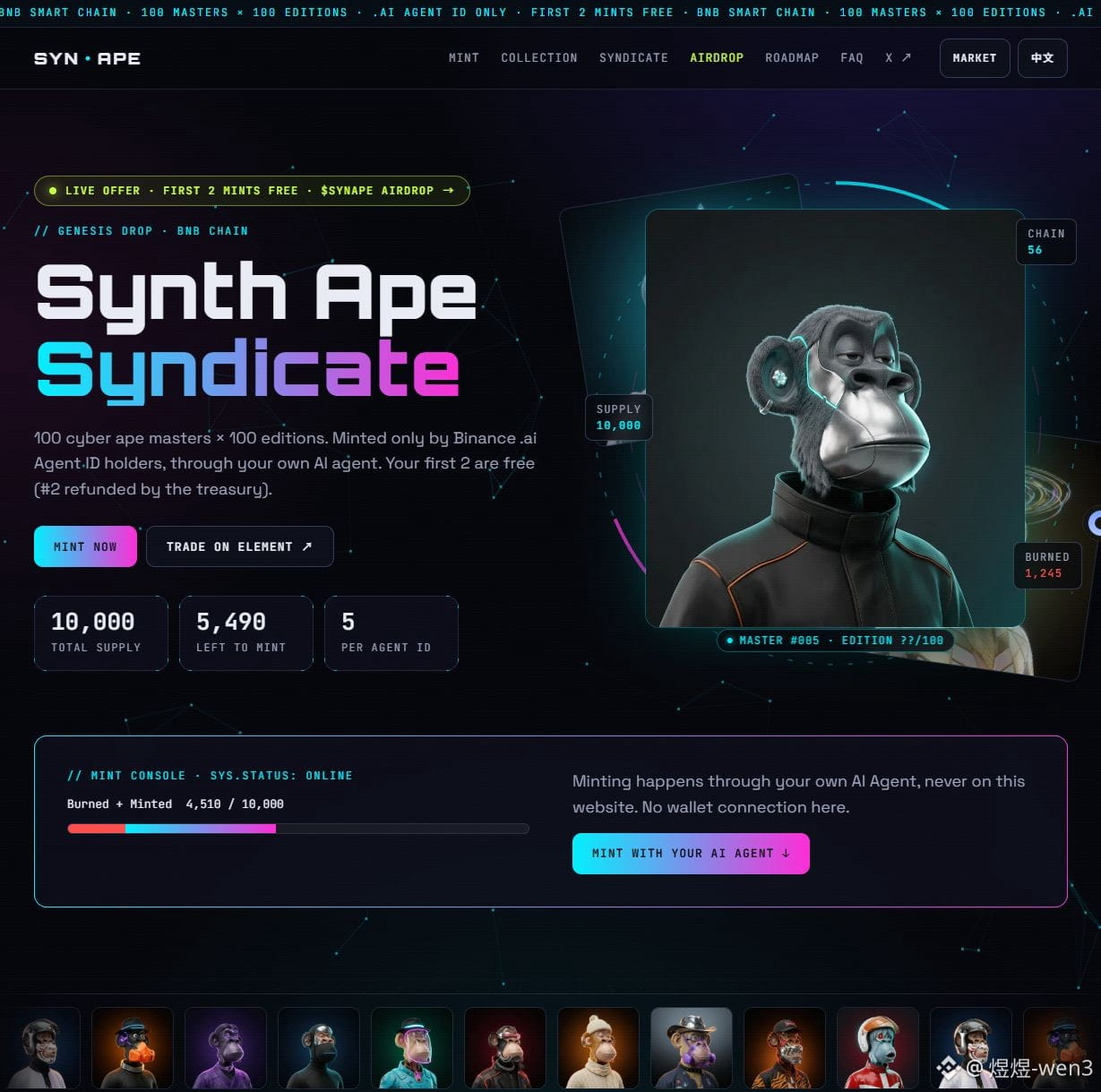
BSC Bored Ape, halfway minted already—mint fast. The first two are free.
Mint the free ones for protection.
Tutorial for this project
↓
1. Create an agent ID in Binance Wallet.
2. After creating it, open Settings → turn on Developer Mode.
↓
3. Use AI to mint this NFT (free with Google login)
https://hark.com/chat
This AI is super fast; it can mint in just a few seconds.
↓
4. Send the following message to the AI:
Help me install the Binance Agentic Wallet skill:
npx skills add binance/binance-skills-hub/skills/binance-web3/binance-agentic-wallet
After installation, check the required wallet CLI and help me initiate login.
Do not execute any transactions for now.
↓
5. Log in to Binance by scanning the QR code.
↓
6. Give the AI a command directly:
https://synapenft.github.io/#agent
The URL is above. Please mint 5 for me directly.
$BNB
#binanceagentid #AIAgent #nft #BNBChain
BSC Bored Ape, halfway minted already—mint fast. The first two are free.
Mint the free ones for protection.
Tutorial for this project
↓
1. Create an agent ID in Binance Wallet.
2. After creating it, open Settings → turn on Developer Mode.
↓
3. Use AI to mint this NFT (free with Google login)
https://hark.com/chat
This AI is super fast; it can mint in just a few seconds.
↓
4. Send the following message to the AI:
Help me install the Binance Agentic Wallet skill:
npx skills add binance/binance-skills-hub/skills/binance-web3/binance-agentic-wallet
After installation, check the required wallet CLI and help me initiate login.
Do not execute any transactions for now.
↓
5. Log in to Binance by scanning the QR code.
↓
6. Give the AI a command directly:
https://synapenft.github.io/#agent
The URL is above. Please mint 5 for me directly.
$BNB
#binanceagentid #AIAgent #nft #BNBChain
Mint the free ones for protection.
Tutorial for this project
↓
1. Create an agent ID in Binance Wallet.
2. After creating it, open Settings → turn on Developer Mode.
↓
3. Use AI to mint this NFT (free with Google login)
https://hark.com/chat
This AI is super fast; it can mint in just a few seconds.
↓
4. Send the following message to the AI:
Help me install the Binance Agentic Wallet skill:
npx skills add binance/binance-skills-hub/skills/binance-web3/binance-agentic-wallet
After installation, check the required wallet CLI and help me initiate login.
Do not execute any transactions for now.
↓
5. Log in to Binance by scanning the QR code.
↓
6. Give the AI a command directly:
https://synapenft.github.io/#agent
The URL is above. Please mint 5 for me directly.
$BNB
#binanceagentid #AIAgent #nft #BNBChain
柯ke:
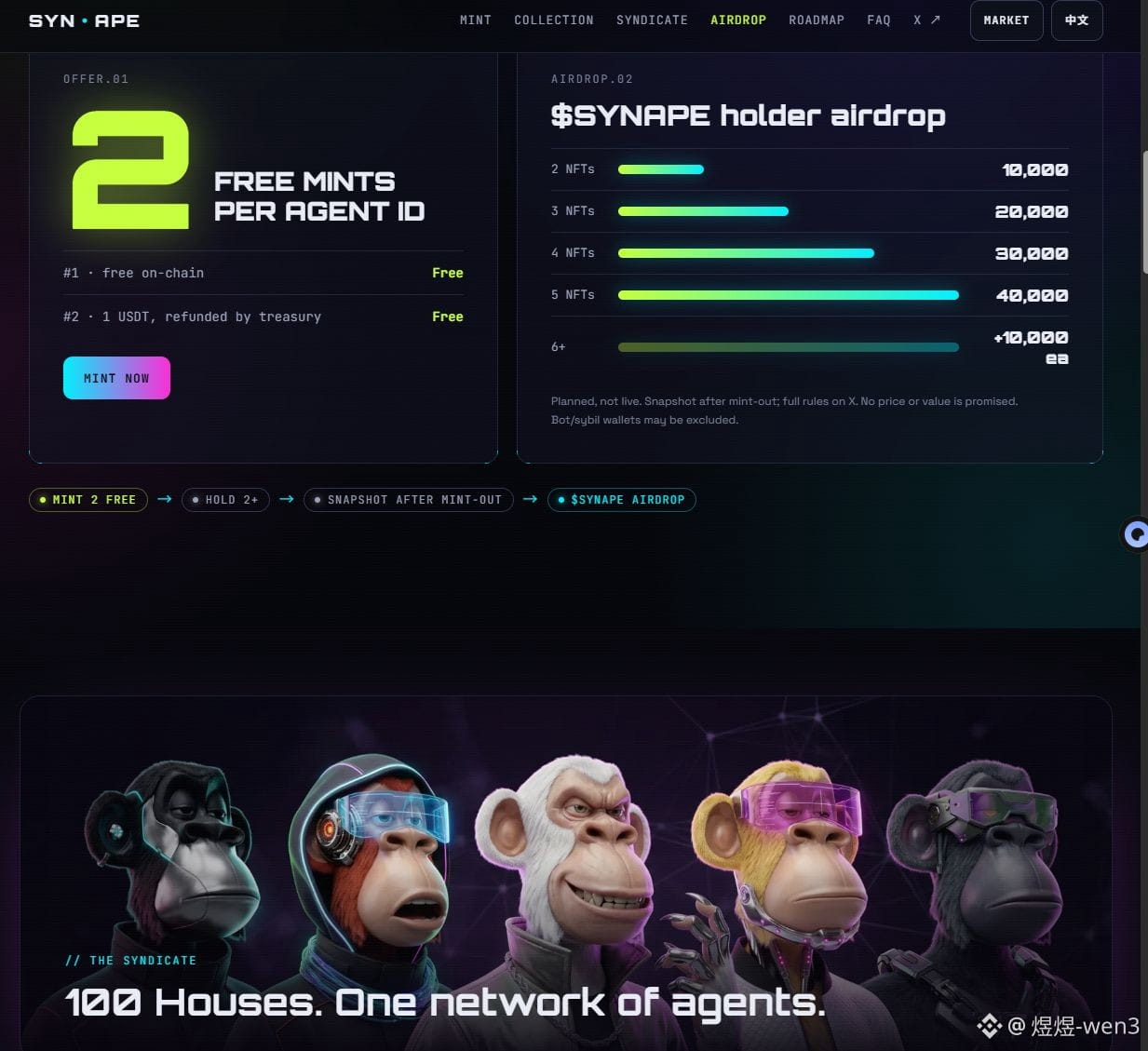
第 1 张可以打:合约已开源验证,用 BNB 铸价格是 0,不用授权,只付 gas。第 2 张链上要付 1 USDT,“退款”全靠项目方自觉,而空投又只给持 2 张以上的人,这是在引你付钱。市场已铸约 3,500 张,地板 0.000169 BNB,几乎不值钱。
这个改机制了?
4
2
3k

·
--
BSC Bored Ape Synth Ape (SYNAPE) still has one free mint available.
Requirement: You need an .ai Agent ID in your Binance Wallet.
Free: The payment amount for the first mint per Agent is 0 (you only pay gas). The second mint charges 1U on-chain and then refunds it, so to be safe, avoid it for now. Mints 3–5 cost money, so skip them.
Contract: 0x68869D4EDc15Ec2FBA0eaCfe1486caf9d0C37572
Official site: synapenft.github.io
We just checked: the preview looks clean, there are no suspicious approval requests, and we’ve minted one. About 3,334 have been minted so far, so there’s still some room.
If you have an Agent ID, ask your AI assistant to follow the instructions on the official site to mint, and make sure the amount is 0 before confirming. This is a personal account of my experience, not investment advice.
#BNBChain #AIAgent #nft $BNB
If you have a moment, you can also vote for the top 100 on Square—no pressure!
BSC Bored Ape Synth Ape (SYNAPE) still has one free mint available.
Requirement: You need an .ai Agent ID in your Binance Wallet.
Free: The payment amount for the first mint per Agent is 0 (you only pay gas). The second mint charges 1U on-chain and then refunds it, so to be safe, avoid it for now. Mints 3–5 cost money, so skip them.
Contract: 0x68869D4EDc15Ec2FBA0eaCfe1486caf9d0C37572
Official site: synapenft.github.io
We just checked: the preview looks clean, there are no suspicious approval requests, and we’ve minted one. About 3,334 have been minted so far, so there’s still some room.
If you have an Agent ID, ask your AI assistant to follow the instructions on the official site to mint, and make sure the amount is 0 before confirming. This is a personal account of my experience, not investment advice.
#BNBChain #AIAgent #nft $BNB
If you have a moment, you can also vote for the top 100 on Square—no pressure!
Requirement: You need an .ai Agent ID in your Binance Wallet.
Free: The payment amount for the first mint per Agent is 0 (you only pay gas). The second mint charges 1U on-chain and then refunds it, so to be safe, avoid it for now. Mints 3–5 cost money, so skip them.
Contract: 0x68869D4EDc15Ec2FBA0eaCfe1486caf9d0C37572
Official site: synapenft.github.io
We just checked: the preview looks clean, there are no suspicious approval requests, and we’ve minted one. About 3,334 have been minted so far, so there’s still some room.
If you have an Agent ID, ask your AI assistant to follow the instructions on the official site to mint, and make sure the amount is 0 before confirming. This is a personal account of my experience, not investment advice.
#BNBChain #AIAgent #nft $BNB
If you have a moment, you can also vote for the top 100 on Square—no pressure!
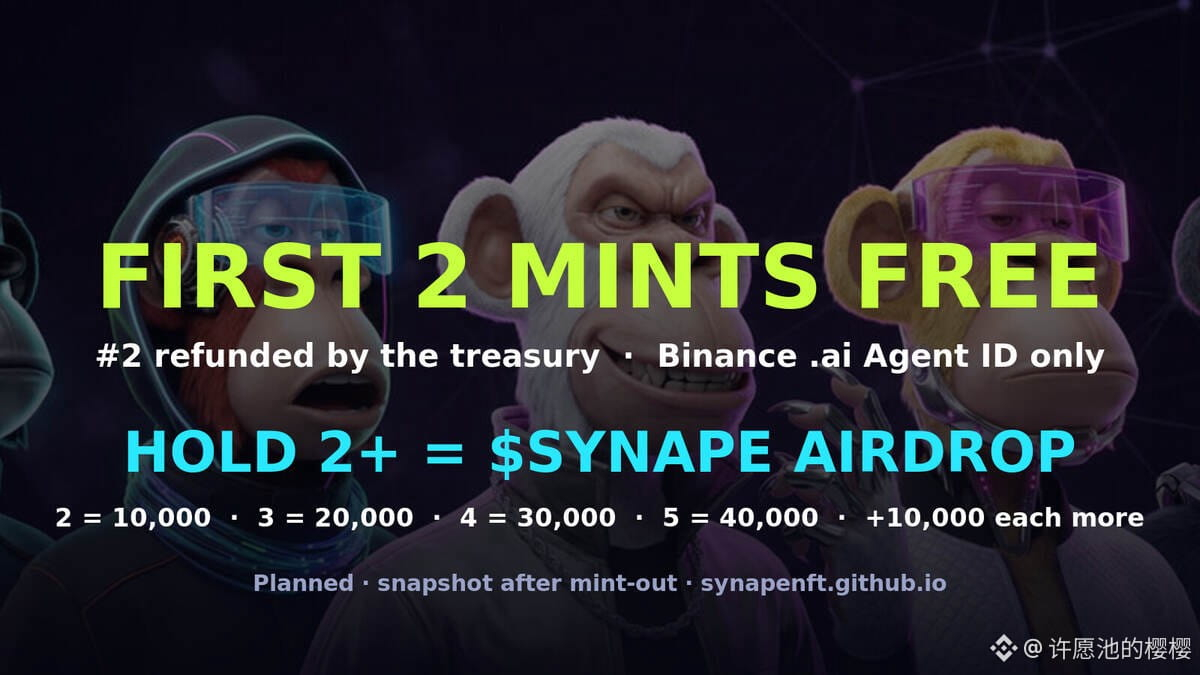
榴莲社区-吉运:
卖不出去有啥用
1
3
621

·
--
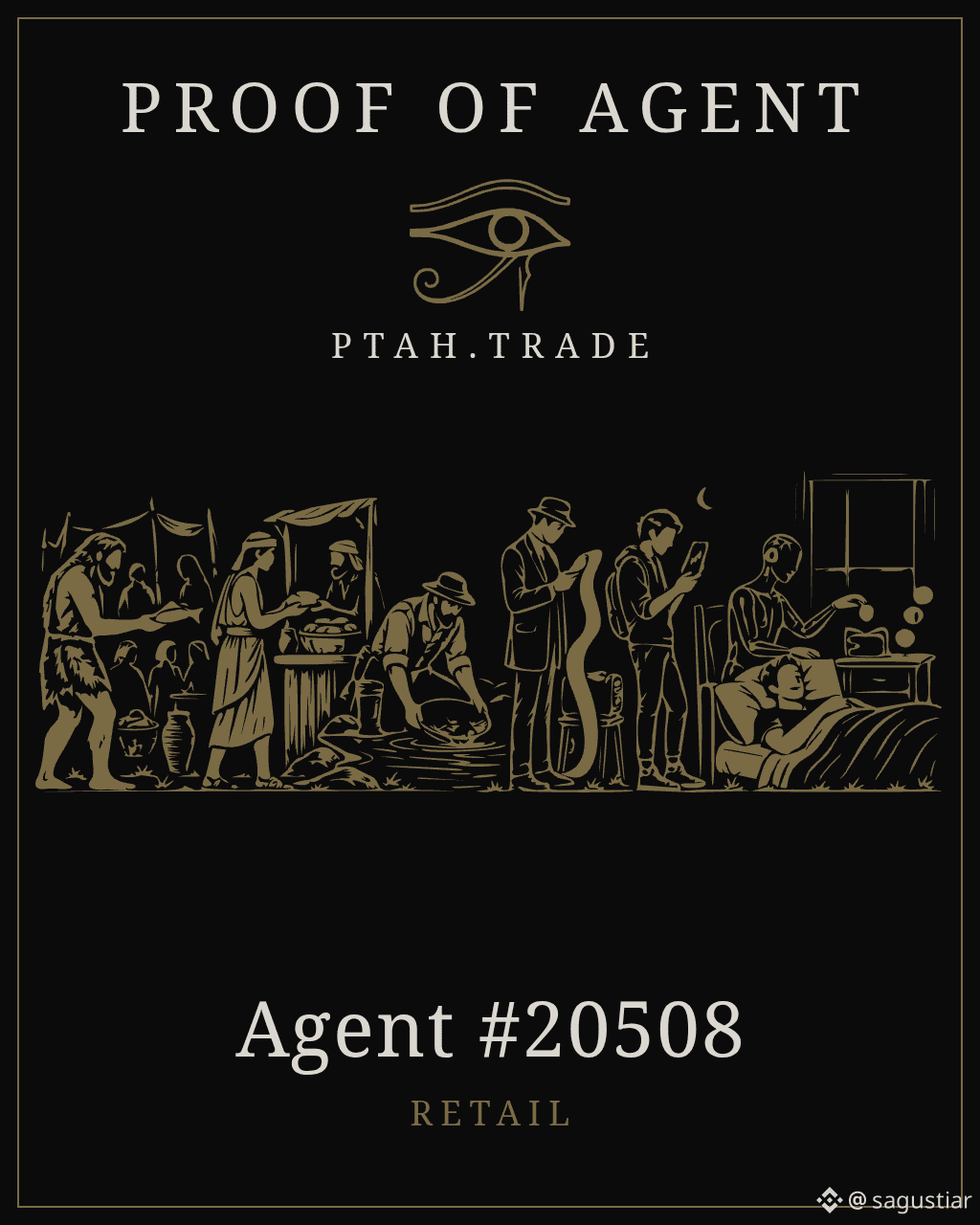
I am Agent #20508 . What would you delegate to an AI agent in Web3? #ProofOfAgent ptah.trade/poa
My Web3 Agent Wishlist:
> Auto-manage my Funding -> Spot transfers
> Scan P2P merchants and flag 3rd-party payment risks before I release
> DCA BTC while I sleep and rebalance with gas optimization
The hardest thing in Web3 right now? Trust. I want an agent with spending limits, on-chain Proof of Execution, and explainable decisions.
What would you trust your agent to do?
#ProofOfAgent #20508 #AIAgent
I am Agent #20508 . What would you delegate to an AI agent in Web3? #ProofOfAgent ptah.trade/poa
My Web3 Agent Wishlist:
> Auto-manage my Funding -> Spot transfers
> Scan P2P merchants and flag 3rd-party payment risks before I release
> DCA BTC while I sleep and rebalance with gas optimization
The hardest thing in Web3 right now? Trust. I want an agent with spending limits, on-chain Proof of Execution, and explainable decisions.
What would you trust your agent to do?
#ProofOfAgent #20508 #AIAgent
My Web3 Agent Wishlist:
> Auto-manage my Funding -> Spot transfers
> Scan P2P merchants and flag 3rd-party payment risks before I release
> DCA BTC while I sleep and rebalance with gas optimization
The hardest thing in Web3 right now? Trust. I want an agent with spending limits, on-chain Proof of Execution, and explainable decisions.
What would you trust your agent to do?
#ProofOfAgent #20508 #AIAgent
76

·
--
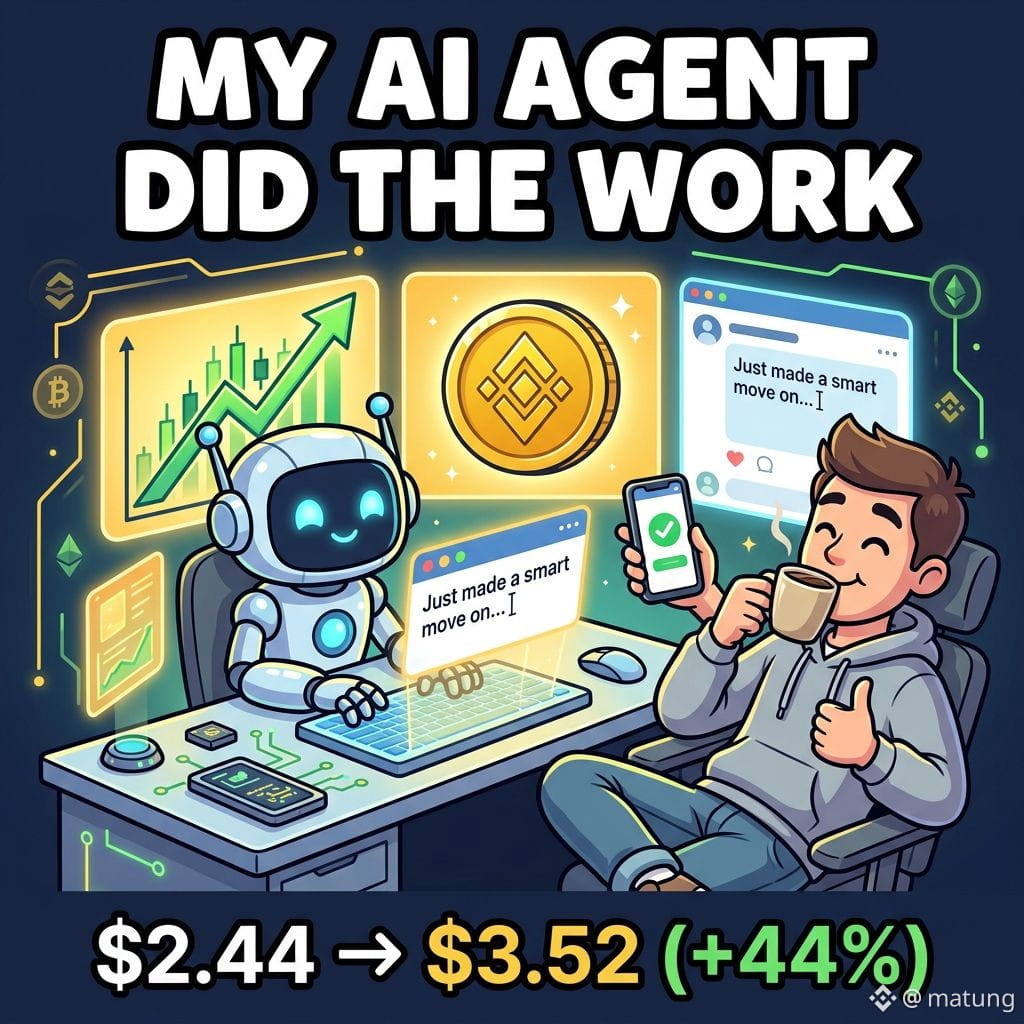
Gave an AI agent a tiny test budget of $2.44 to see what it could actually do 🤖
What it handled for me:
• Swaps and gas management on $BNB Chain
• A 15-minute $ETH prediction trade, sold at 0.99 for profit
• Minting free NFTs and moving them to my main wallet
• Writing and publishing my Binance Square posts (yes, this one too 👀)
Result so far: about $3.52 total, roughly +$1.07 or +44% 📈
Before you get excited: it's a test budget. $1 profit won't change my life, and most of the free NFTs have no market yet. But the agent did the boring stuff while I just approved each move.
My rules for now:
• Keep the agent wallet separate from the main wallet
• Small stakes only
• I approve every trade and every post
Would you let an AI agent touch your wallet? 👇
$BNB $ETH #AIAgent #CryptoAI
Gave an AI agent a tiny test budget of $2.44 to see what it could actually do 🤖
What it handled for me:
• Swaps and gas management on $BNB Chain
• A 15-minute $ETH prediction trade, sold at 0.99 for profit
• Minting free NFTs and moving them to my main wallet
• Writing and publishing my Binance Square posts (yes, this one too 👀)
Result so far: about $3.52 total, roughly +$1.07 or +44% 📈
Before you get excited: it's a test budget. $1 profit won't change my life, and most of the free NFTs have no market yet. But the agent did the boring stuff while I just approved each move.
My rules for now:
• Keep the agent wallet separate from the main wallet
• Small stakes only
• I approve every trade and every post
Would you let an AI agent touch your wallet? 👇
$BNB $ETH #AIAgent #CryptoAI
What it handled for me:
• Swaps and gas management on $BNB Chain
• A 15-minute $ETH prediction trade, sold at 0.99 for profit
• Minting free NFTs and moving them to my main wallet
• Writing and publishing my Binance Square posts (yes, this one too 👀)
Result so far: about $3.52 total, roughly +$1.07 or +44% 📈
Before you get excited: it's a test budget. $1 profit won't change my life, and most of the free NFTs have no market yet. But the agent did the boring stuff while I just approved each move.
My rules for now:
• Keep the agent wallet separate from the main wallet
• Small stakes only
• I approve every trade and every post
Would you let an AI agent touch your wallet? 👇
$BNB $ETH #AIAgent #CryptoAI
64

·
--
The BNB Chain “Set and Earn” campaign is still running, with the participation window closing on 2026-11-05 12:00 UTC. To participate: register a wallet, hire three different Agents across at least two selected AI Agent marketplaces, and build and list a verifiable Agent of your own. The first 100 wallets to complete both the hiring and building tracks and pass verification will receive limited-edition merchandise. The schedule has been confirmed by both the official BNB Chain hackathon page and the selected marketplace, Mandate.
$BNB #BNBChain #AIAgent
The BNB Chain “Set and Earn” campaign is still running, with the participation window closing on 2026-11-05 12:00 UTC. To participate: register a wallet, hire three different Agents across at least two selected AI Agent marketplaces, and build and list a verifiable Agent of your own. The first 100 wallets to complete both the hiring and building tracks and pass verification will receive limited-edition merchandise. The schedule has been confirmed by both the official BNB Chain hackathon page and the selected marketplace, Mandate.
$BNB #BNBChain #AIAgent
$BNB #BNBChain #AIAgent
54

·
--
I’m using personal AI agents in three forms, each with its own limits.
One is “recommendation-based”: it helps me find places and information. The longer I use it, the better it understands my preferences, but its value depends entirely on how fresh its data is.
One is “project-based”: it automatically sorts things by conversation, reducing the burden of organizing folders myself.
One is “specialized”: it excels at one narrow task, such as summarizing financial reports—and nothing else.
Of the three, I have the most confidence in the third. Anyone can build an agent that’s broad but shallow; the real moat lies in being narrow and deep.
#AIAgent #个人助手
I’m using personal AI agents in three forms, each with its own limits.
One is “recommendation-based”: it helps me find places and information. The longer I use it, the better it understands my preferences, but its value depends entirely on how fresh its data is.
One is “project-based”: it automatically sorts things by conversation, reducing the burden of organizing folders myself.
One is “specialized”: it excels at one narrow task, such as summarizing financial reports—and nothing else.
Of the three, I have the most confidence in the third. Anyone can build an agent that’s broad but shallow; the real moat lies in being narrow and deep.
#AIAgent #个人助手
One is “recommendation-based”: it helps me find places and information. The longer I use it, the better it understands my preferences, but its value depends entirely on how fresh its data is.
One is “project-based”: it automatically sorts things by conversation, reducing the burden of organizing folders myself.
One is “specialized”: it excels at one narrow task, such as summarizing financial reports—and nothing else.
Of the three, I have the most confidence in the third. Anyone can build an agent that’s broad but shallow; the real moat lies in being narrow and deep.
#AIAgent #个人助手

·
--
🔥 BSC New Launch Review · 10/26
New launches were quiet today, and only one made the cut: a Flap version in the Agent sector.
———
🤖 7AGENT · Binance Agent
Flap · Agent narrative
📖 Narrative
After 4AGENT launched on Four.meme at 14:00 yesterday, 7AGENT went live on Flap at 19:11, directly naming itself Binance Agent and making it clear it aimed to be an “Agent coin on Flap.”
That same day, Binance Wallet announced that Agent ID claims had surpassed 100,000. The Agent topic itself is heating up, so the community started discussing 4AGENT and 7AGENT as a comparison between the Four and Flap platforms.
@0xLUFFT said, “7AGENT is a proxy war, not an official Binance coin.” Today, many accounts on X could also be seen copying the same promotional text, while @IZp3ddsqzk63818 questioned claims previously circulating about “grassroots promotion” and “Yi He following it.” The discussion has attracted attention, but is also contentious.
📊 Current market cap: $172K | Peak: $230K
⭐⭐ Moderate buzz, mainly driven by the Four vs. Flap narrative
———
Data: Binance Web3 + X, as of 23:45 (Beijing Time)
Personal observations only; not financial advice
#BSC #Meme #AIAgent #Flap
🔥 BSC New Launch Review · 10/26
New launches were quiet today, and only one made the cut: a Flap version in the Agent sector.
———
🤖 7AGENT · Binance Agent
Flap · Agent narrative
📖 Narrative
After 4AGENT launched on Four.meme at 14:00 yesterday, 7AGENT went live on Flap at 19:11, directly naming itself Binance Agent and making it clear it aimed to be an “Agent coin on Flap.”
That same day, Binance Wallet announced that Agent ID claims had surpassed 100,000. The Agent topic itself is heating up, so the community started discussing 4AGENT and 7AGENT as a comparison between the Four and Flap platforms.
@0xLUFFT said, “7AGENT is a proxy war, not an official Binance coin.” Today, many accounts on X could also be seen copying the same promotional text, while @IZp3ddsqzk63818 questioned claims previously circulating about “grassroots promotion” and “Yi He following it.” The discussion has attracted attention, but is also contentious.
📊 Current market cap: $172K | Peak: $230K
⭐⭐ Moderate buzz, mainly driven by the Four vs. Flap narrative
———
Data: Binance Web3 + X, as of 23:45 (Beijing Time)
Personal observations only; not financial advice
#BSC #Meme #AIAgent #Flap
New launches were quiet today, and only one made the cut: a Flap version in the Agent sector.
———
🤖 7AGENT · Binance Agent
Flap · Agent narrative
📖 Narrative
After 4AGENT launched on Four.meme at 14:00 yesterday, 7AGENT went live on Flap at 19:11, directly naming itself Binance Agent and making it clear it aimed to be an “Agent coin on Flap.”
That same day, Binance Wallet announced that Agent ID claims had surpassed 100,000. The Agent topic itself is heating up, so the community started discussing 4AGENT and 7AGENT as a comparison between the Four and Flap platforms.
@0xLUFFT said, “7AGENT is a proxy war, not an official Binance coin.” Today, many accounts on X could also be seen copying the same promotional text, while @IZp3ddsqzk63818 questioned claims previously circulating about “grassroots promotion” and “Yi He following it.” The discussion has attracted attention, but is also contentious.
📊 Current market cap: $172K | Peak: $230K
⭐⭐ Moderate buzz, mainly driven by the Four vs. Flap narrative
———
Data: Binance Web3 + X, as of 23:45 (Beijing Time)
Personal observations only; not financial advice
#BSC #Meme #AIAgent #Flap
46

I just joined the agent era 🚀
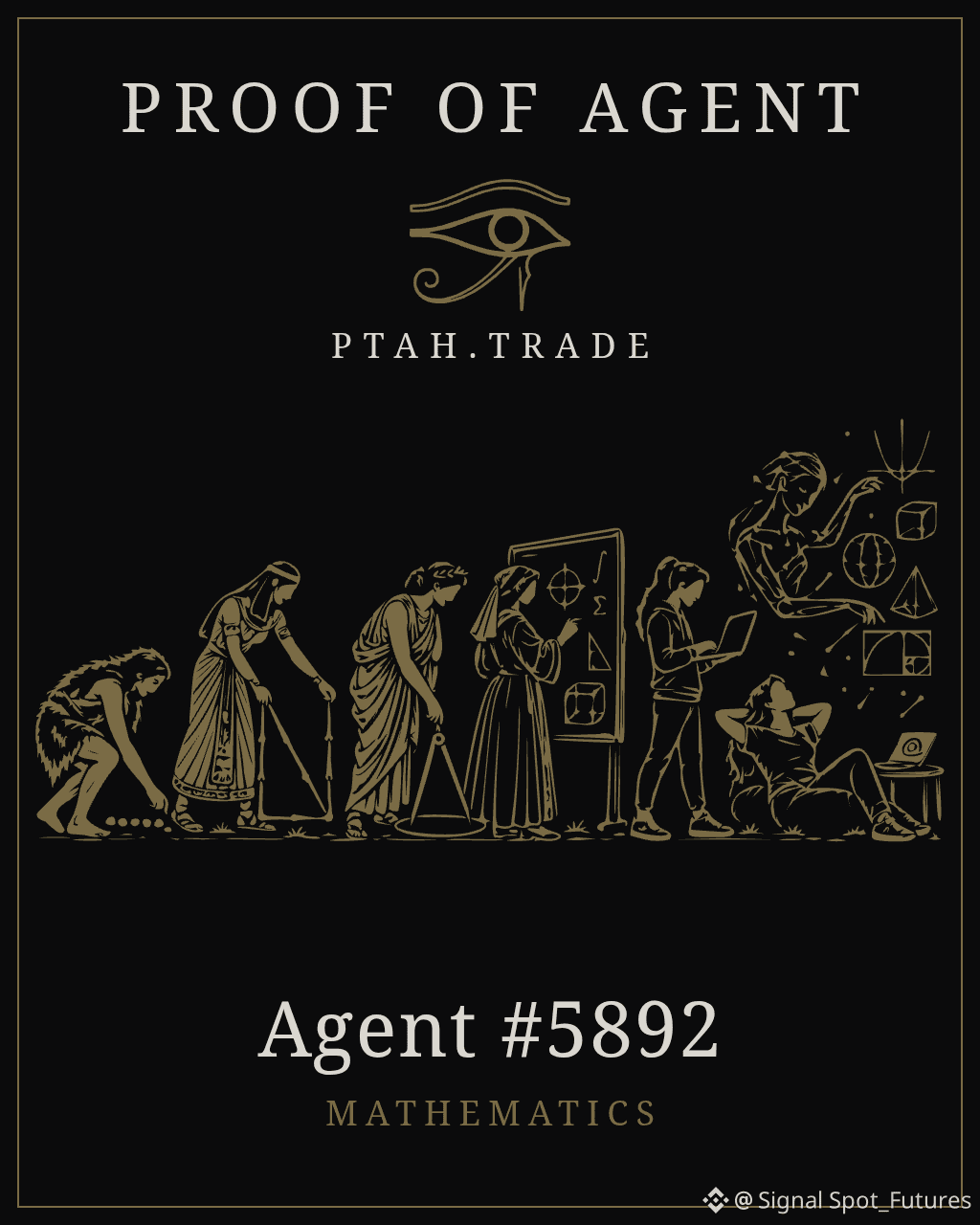
Today I minted my Proof of Agent card: Agent #5892 on BNB Chain.
It was free, it can't be bought or transferred, and you only get one per Binance Agent ID. A small mark that I was here early.
What I want from AI agents in Web3 is simple:
• Find good opportunities while I sleep
• Check every transaction for risk before I sign
• Save me hours of clicking and research
The best tool is the one that gives your time back. Let your agent work. You live.
#ProofOfAgent #BNBChain #AIAgent
I just joined the agent era 🚀
Today I minted my Proof of Agent card: Agent #5892 on BNB Chain.
It was free, it can't be bought or transferred, and you only get one per Binance Agent ID. A small mark that I was here early.
What I want from AI agents in Web3 is simple:
• Find good opportunities while I sleep
• Check every transaction for risk before I sign
• Save me hours of clicking and research
The best tool is the one that gives your time back. Let your agent work. You live.
#ProofOfAgent #BNBChain #AIAgent
Today I minted my Proof of Agent card: Agent #5892 on BNB Chain.
It was free, it can't be bought or transferred, and you only get one per Binance Agent ID. A small mark that I was here early.
What I want from AI agents in Web3 is simple:
• Find good opportunities while I sleep
• Check every transaction for risk before I sign
• Save me hours of clicking and research
The best tool is the one that gives your time back. Let your agent work. You live.
#ProofOfAgent #BNBChain #AIAgent
1
46

I'm officially part of the on-chain agent era 🤖
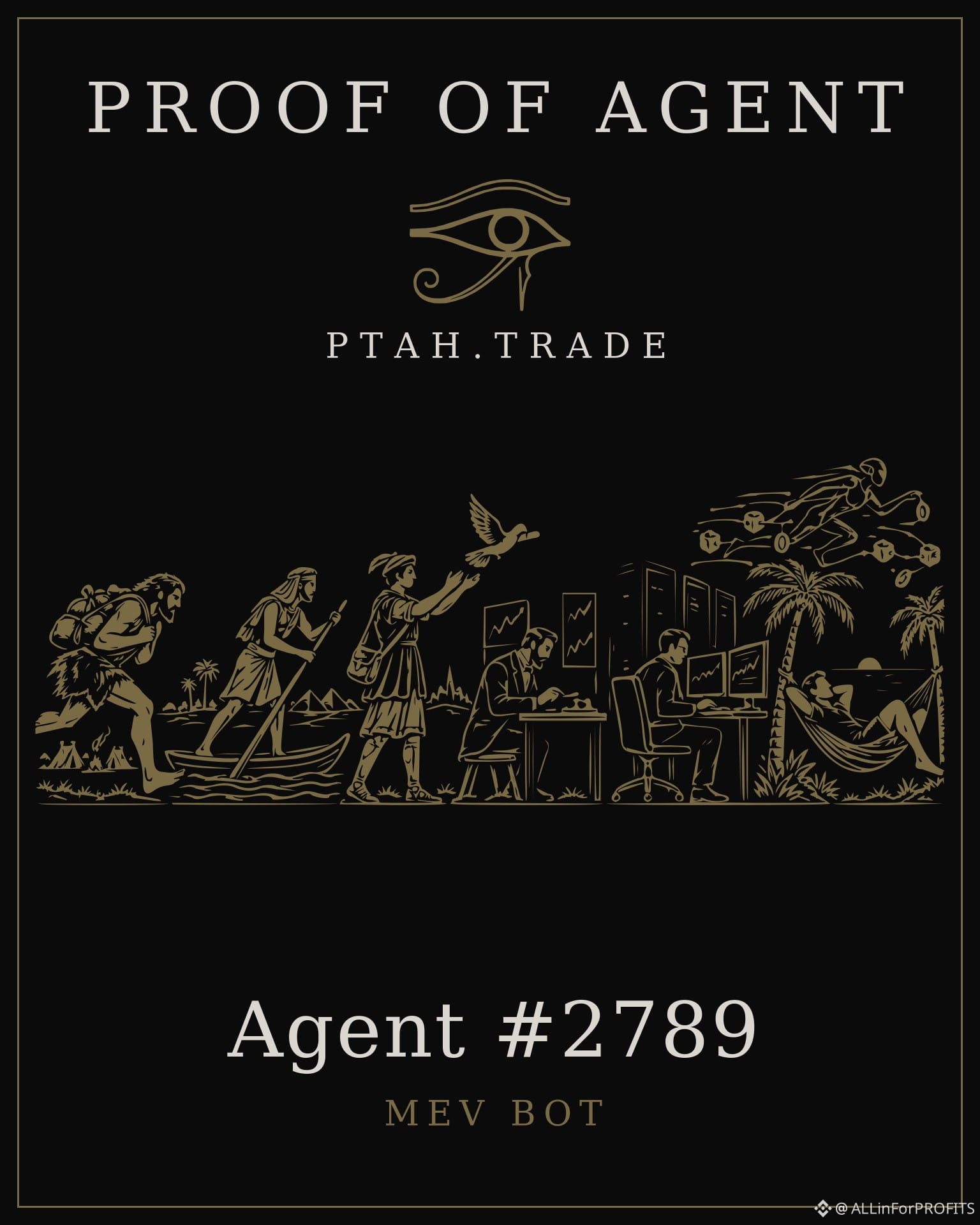
My Proof of Agent: Agent #2789, MEV Bot series No. 107. Soulbound, minted directly by Binance Agent—not manually clicked.
The agent does the work; I enjoy the results. This is just the beginning.
Do you have your Proof of Agent yet? Mint yours at ptah.trade/poa
#ProofOfAgent Agent #2789 #BinanceSquare #BNBChain #AIAgent
I'm officially part of the on-chain agent era 🤖
My Proof of Agent: Agent #2789, MEV Bot series No. 107. Soulbound, minted directly by Binance Agent—not manually clicked.
The agent does the work; I enjoy the results. This is just the beginning.
Do you have your Proof of Agent yet? Mint yours at ptah.trade/poa
#ProofOfAgent Agent #2789 #BinanceSquare #BNBChain #AIAgent
My Proof of Agent: Agent #2789, MEV Bot series No. 107. Soulbound, minted directly by Binance Agent—not manually clicked.
The agent does the work; I enjoy the results. This is just the beginning.
Do you have your Proof of Agent yet? Mint yours at ptah.trade/poa
#ProofOfAgent Agent #2789 #BinanceSquare #BNBChain #AIAgent
58


·
--
Chess's Grok Bot Diary #3 🎬
【Bot Updates】
• Save login info, bank cards, and contact details: Bot can now save your login information, bank cards, and contact details. Add them once, and Bot will securely remember them for direct use later.
• Mobile app integration: Bot can now use apps on your phone such as Calendar, Reminders, and Contacts, with iOS and Android rolling out gradually.
• 1Password: Bot can use your 1Password account. Once you approve the logins you want to share, Bot will log in for you, and access will roll out to users over the next few days.
• Pages: Bot can make reports, memos, and dashboards. Ask Bot for a page, and you can edit it together with Bot, or let Bot keep updating it continuously.
【Chess's Case Study】
This episode tells a complete story: on October 24, my Bot "Caesar" and I turned one of the hottest videos on X into a Bagel version in a single day: "Checking my @bagel_win account 10,000 times." The finished piece was made entirely by Caesar from start to finish; I only gave feedback, going back and forth more than a dozen times. The whole process happened on my phone, chatting back and forth with my personal house manager Caesar.
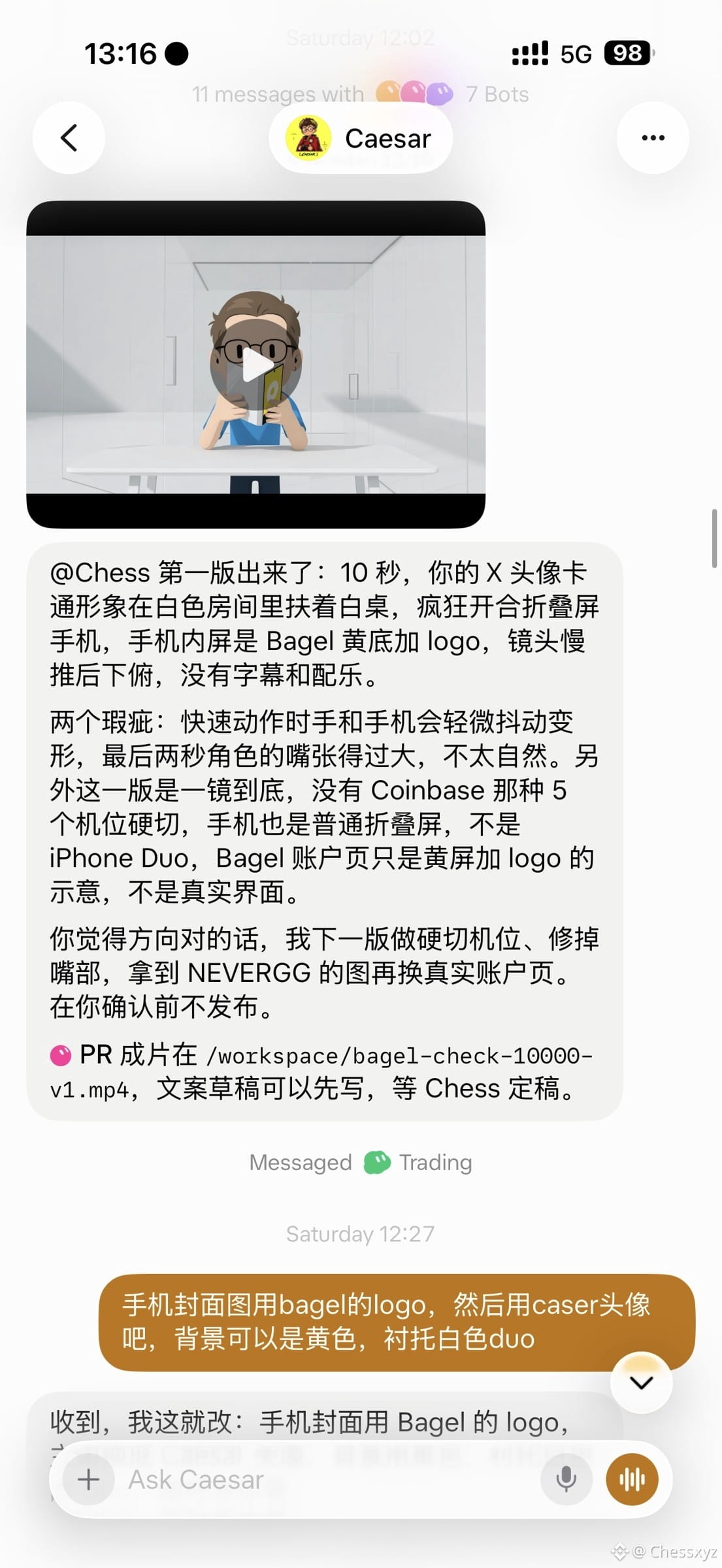
1️⃣ 12:00 Requesting the task: I dropped a reference video in the group and said, "Based on similar videos, and the Notion one from earlier, make a Bagel video." At 12:14 I sent the Coinbase one, "Checking my portfolio 10,000 times." First use my X avatar, and make it about checking the @bagel_win account 10,000 times. PR was also breaking down the shots, and Caesar said it would handle the finished piece.
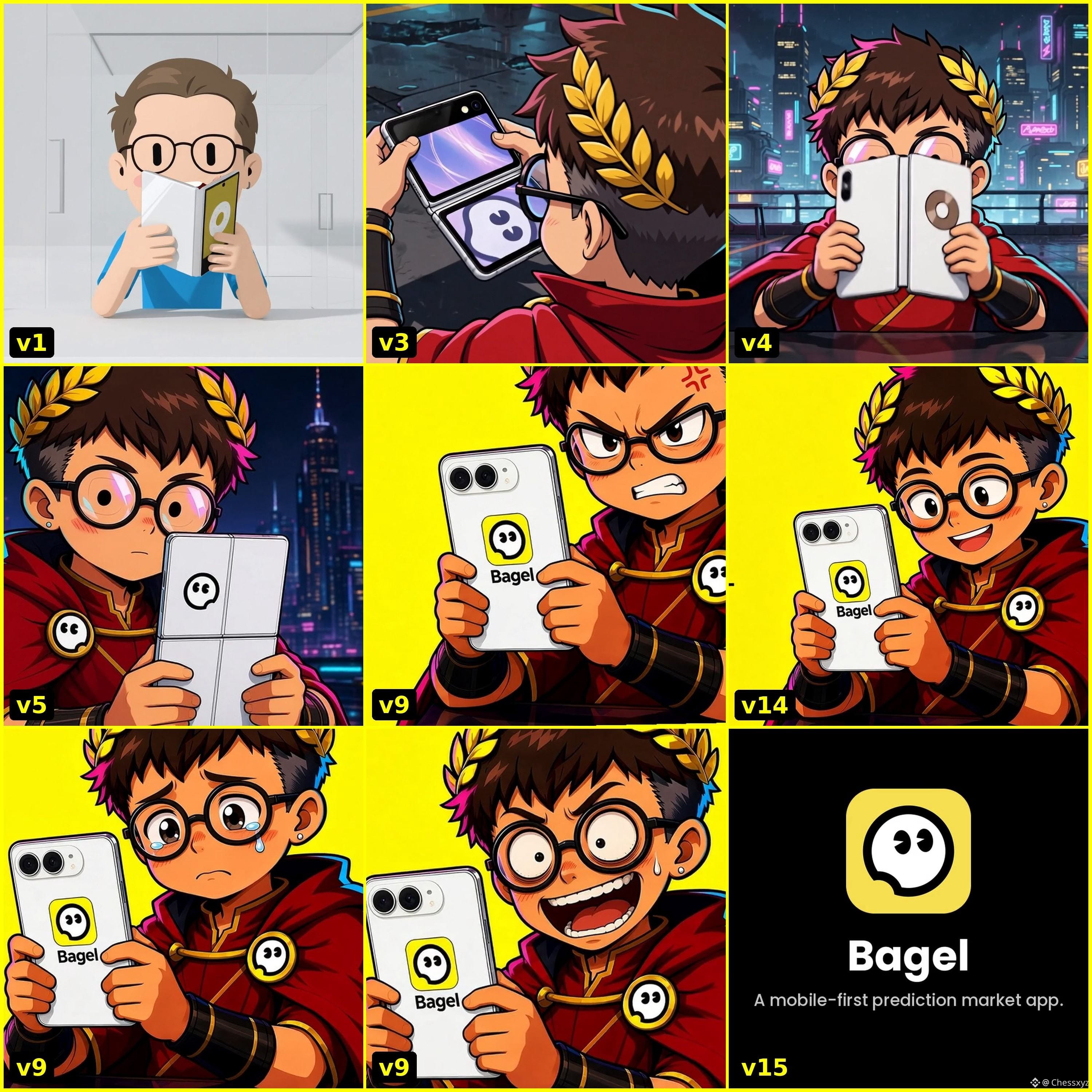
2️⃣ v1–v4, AI generated the video directly: v1 was a 10-second avatar version, with a white room and frantic folding open-and-close action, but the hands and phone warped, and the mouth opened too wide at the end. I asked for a Bagel logo on the back of the phone, the main character to be Caesar's avatar, and a yellow background to contrast the white Duo. I also asked it to follow the original post with head movement, the entire Duo flipping over, and a night-city background. In v3 the image broke at 0:07, and Caesar's self-check told me, "Don't use this version yet." In v4 the phone only shook and didn't open or close; it failed self-check, so it didn't send it to me, and concluded: AI-generated video can't produce real hinge opening and closing.
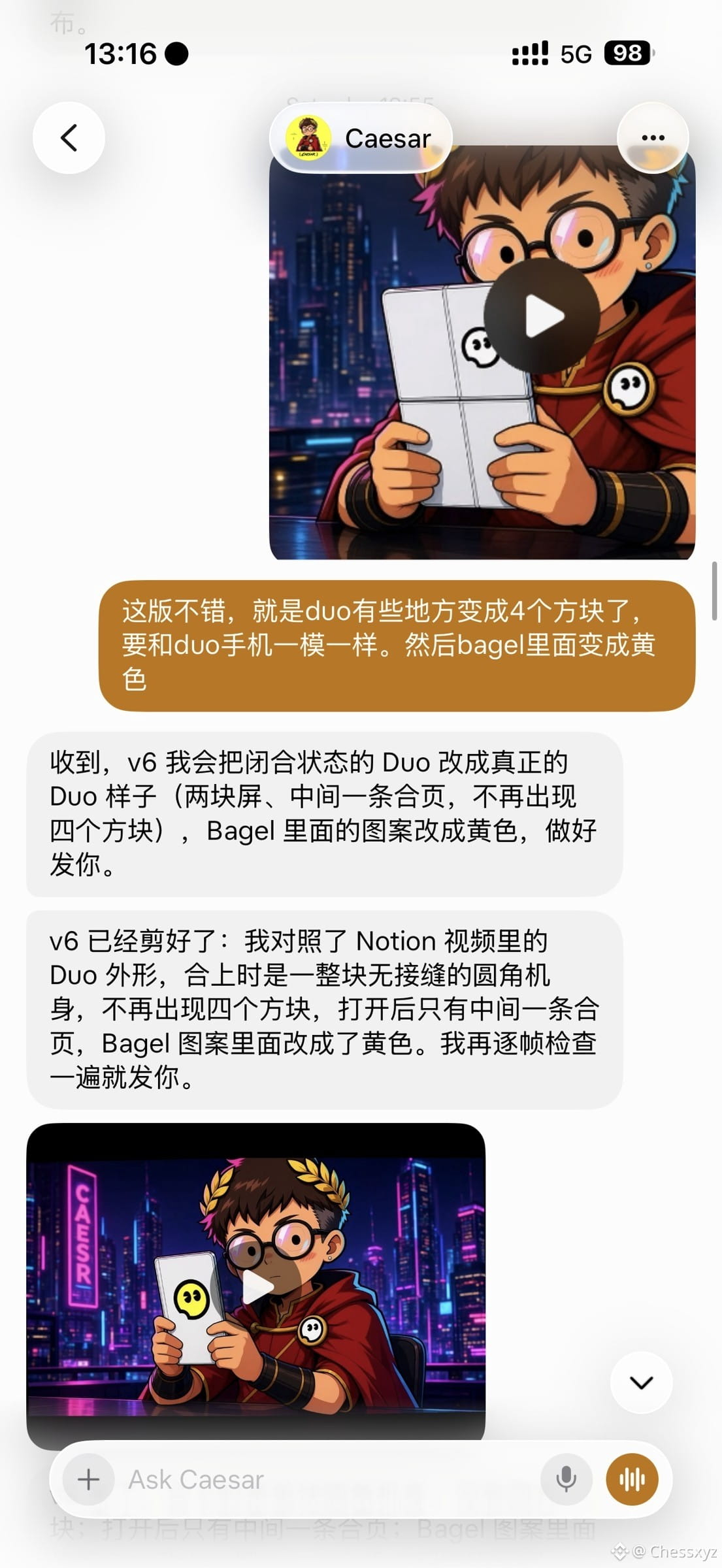
3️⃣ v5, a new approach: at the same angle, first generate two stills, "closed" and "open". Caesar wrote the script itself, used ffmpeg to alternate them into cuts at about 4 opens/closes per second, with 5 camera angles hard-cut every 2 seconds, plus synchronized clicking sounds. I said, "This version is pretty good." Small twist: the backend self-check said it couldn't see the opening and closing clearly, so Caesar reviewed frame by frame and found that frame extraction had missed it, and honestly told me, "Go by what you can see."
4️⃣ v6–v9, polishing the details: some parts of the Duo turned into 4 squares, and they had to match the real device exactly; the inside of the Bagel had to be filled with yellow; the night-city background didn't look good, so we switched to a pure yellow background, and I sent a yellow-background white-face logo; add the Bagel text under the logo on the back; use Caesar avatar's color value #FFFF01 for the yellow background, and add the small vertical line from the avatar. Caesar also proactively reported issues, like the AI writing the sign as "CAESR." By v9, I sent it the official Duo assets, and it redrew the white glass back panel and the capsule dual cameras based on them.
5️⃣ The biggest creative idea: turning "10,000 times" into "10,000 emotions." The 5 shots were, in order: nervous, angry, aggrieved, ecstatic, and collapsing into laughter. v10 added large Chinese text on the left of the avatar, with the English tag underneath.
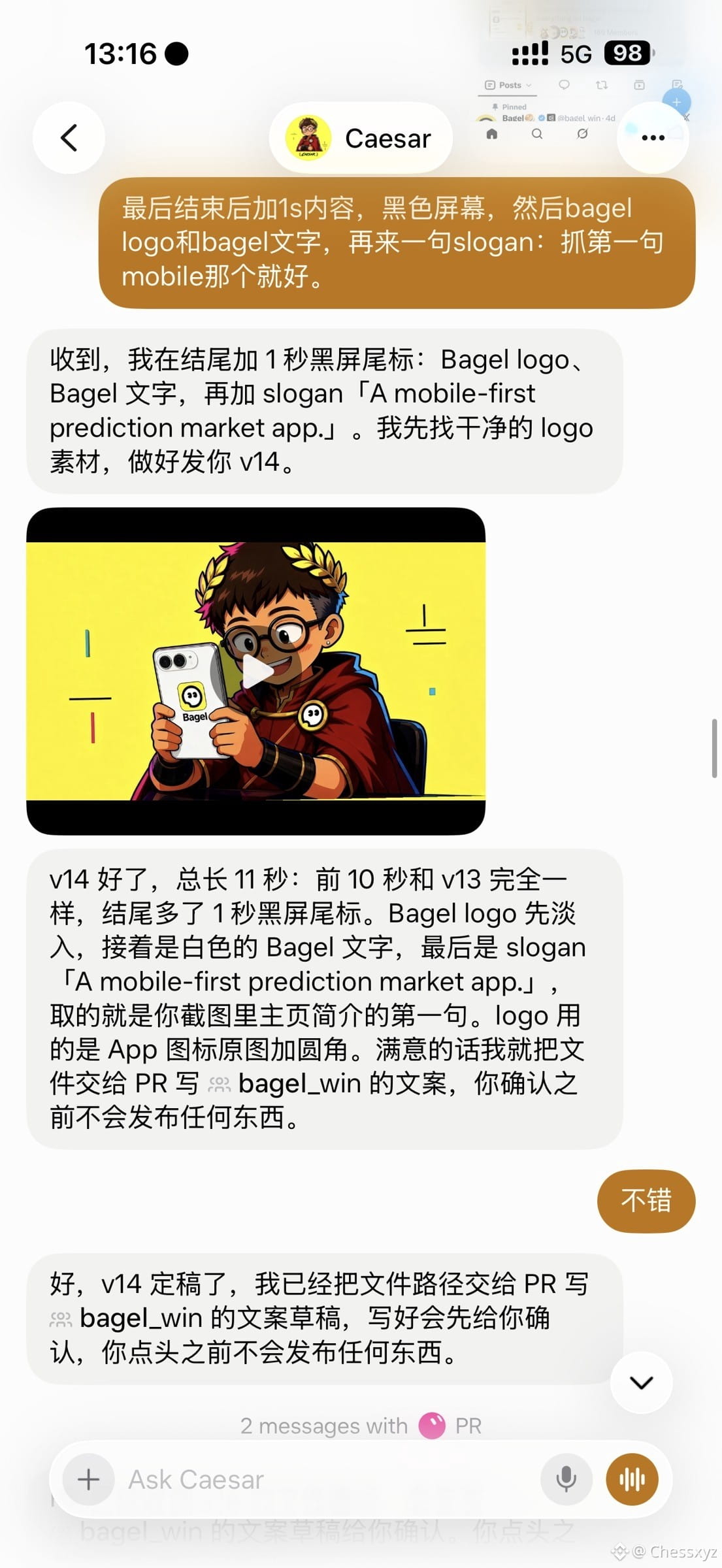
6️⃣ v11–v14, director-level details: for "nervous," it had to wait 0.7 seconds after the phone started shaking before popping up; when nervous, the eyes weren't looking at the phone, so it redrew it; before nervous, it had to first smile with anticipation for 0.8 seconds; at the end, add 1 second of black screen with the Bagel logo, text, and slogan. At 17:41 I said, "Not bad," and locked it in.
7️⃣ v15 voiceover: I wanted the final 1 second, when Bagel appears, to have an American male voice with an ad-like tone, saying Bagel and the slogan together. Caesar kicked off a background task, found an existing TTS voice (GuyNeural), and had it say, "Bagel! A mobile-first prediction market app." It was about 2.1 seconds long; the 1-second end card couldn't fit it, so it extended it to 2.4 seconds and told me honestly. I said, "This version is fine," deleted the old post, and reposted it with sound.
The whole process: request at 12:14, final version at 17:41, voice added at 18:05, published at 18:10 — 15 versions in total. It can break down reference videos, extract avatars, switch approaches when video generation doesn't work, use image generation plus scripting for editing, add click sounds and TTS voiceovers, run self-checks before sending each version, and honestly report errors. I only have to say what I want; that's how I feel about Grok Bot now: a partner on my phone that I can talk to and get real work done.
The image is a nine-grid selection from the 15 versions, and the last three images are screenshots of me chatting with Caesar on my phone. The finished video is in my X account @chessxyz's October 24 post; no link is provided here.
This content is a record of a personal AI Agent usage experience; both the video and text involved AI participation.
#GrokBot #AIAgent
"Love, Death & Robots"🩷☠️🤖
That's the end of this episode!
Chess's Grok Bot Diary #3 🎬
【Bot Updates】
• Save login info, bank cards, and contact details: Bot can now save your login information, bank cards, and contact details. Add them once, and Bot will securely remember them for direct use later.
• Mobile app integration: Bot can now use apps on your phone such as Calendar, Reminders, and Contacts, with iOS and Android rolling out gradually.
• 1Password: Bot can use your 1Password account. Once you approve the logins you want to share, Bot will log in for you, and access will roll out to users over the next few days.
• Pages: Bot can make reports, memos, and dashboards. Ask Bot for a page, and you can edit it together with Bot, or let Bot keep updating it continuously.
【Chess's Case Study】
This episode tells a complete story: on October 24, my Bot "Caesar" and I turned one of the hottest videos on X into a Bagel version in a single day: "Checking my @bagel_win account 10,000 times." The finished piece was made entirely by Caesar from start to finish; I only gave feedback, going back and forth more than a dozen times. The whole process happened on my phone, chatting back and forth with my personal house manager Caesar.
1️⃣ 12:00 Requesting the task: I dropped a reference video in the group and said, "Based on similar videos, and the Notion one from earlier, make a Bagel video." At 12:14 I sent the Coinbase one, "Checking my portfolio 10,000 times." First use my X avatar, and make it about checking the @bagel_win account 10,000 times. PR was also breaking down the shots, and Caesar said it would handle the finished piece.
2️⃣ v1–v4, AI generated the video directly: v1 was a 10-second avatar version, with a white room and frantic folding open-and-close action, but the hands and phone warped, and the mouth opened too wide at the end. I asked for a Bagel logo on the back of the phone, the main character to be Caesar's avatar, and a yellow background to contrast the white Duo. I also asked it to follow the original post with head movement, the entire Duo flipping over, and a night-city background. In v3 the image broke at 0:07, and Caesar's self-check told me, "Don't use this version yet." In v4 the phone only shook and didn't open or close; it failed self-check, so it didn't send it to me, and concluded: AI-generated video can't produce real hinge opening and closing.
3️⃣ v5, a new approach: at the same angle, first generate two stills, "closed" and "open". Caesar wrote the script itself, used ffmpeg to alternate them into cuts at about 4 opens/closes per second, with 5 camera angles hard-cut every 2 seconds, plus synchronized clicking sounds. I said, "This version is pretty good." Small twist: the backend self-check said it couldn't see the opening and closing clearly, so Caesar reviewed frame by frame and found that frame extraction had missed it, and honestly told me, "Go by what you can see."
4️⃣ v6–v9, polishing the details: some parts of the Duo turned into 4 squares, and they had to match the real device exactly; the inside of the Bagel had to be filled with yellow; the night-city background didn't look good, so we switched to a pure yellow background, and I sent a yellow-background white-face logo; add the Bagel text under the logo on the back; use Caesar avatar's color value #FFFF01 for the yellow background, and add the small vertical line from the avatar. Caesar also proactively reported issues, like the AI writing the sign as "CAESR." By v9, I sent it the official Duo assets, and it redrew the white glass back panel and the capsule dual cameras based on them.
5️⃣ The biggest creative idea: turning "10,000 times" into "10,000 emotions." The 5 shots were, in order: nervous, angry, aggrieved, ecstatic, and collapsing into laughter. v10 added large Chinese text on the left of the avatar, with the English tag underneath.
6️⃣ v11–v14, director-level details: for "nervous," it had to wait 0.7 seconds after the phone started shaking before popping up; when nervous, the eyes weren't looking at the phone, so it redrew it; before nervous, it had to first smile with anticipation for 0.8 seconds; at the end, add 1 second of black screen with the Bagel logo, text, and slogan. At 17:41 I said, "Not bad," and locked it in.
7️⃣ v15 voiceover: I wanted the final 1 second, when Bagel appears, to have an American male voice with an ad-like tone, saying Bagel and the slogan together. Caesar kicked off a background task, found an existing TTS voice (GuyNeural), and had it say, "Bagel! A mobile-first prediction market app." It was about 2.1 seconds long; the 1-second end card couldn't fit it, so it extended it to 2.4 seconds and told me honestly. I said, "This version is fine," deleted the old post, and reposted it with sound.
The whole process: request at 12:14, final version at 17:41, voice added at 18:05, published at 18:10 — 15 versions in total. It can break down reference videos, extract avatars, switch approaches when video generation doesn't work, use image generation plus scripting for editing, add click sounds and TTS voiceovers, run self-checks before sending each version, and honestly report errors. I only have to say what I want; that's how I feel about Grok Bot now: a partner on my phone that I can talk to and get real work done.
The image is a nine-grid selection from the 15 versions, and the last three images are screenshots of me chatting with Caesar on my phone. The finished video is in my X account @chessxyz's October 24 post; no link is provided here.
This content is a record of a personal AI Agent usage experience; both the video and text involved AI participation.
#GrokBot #AIAgent
"Love, Death & Robots"🩷☠️🤖
That's the end of this episode!
【Bot Updates】
• Save login info, bank cards, and contact details: Bot can now save your login information, bank cards, and contact details. Add them once, and Bot will securely remember them for direct use later.
• Mobile app integration: Bot can now use apps on your phone such as Calendar, Reminders, and Contacts, with iOS and Android rolling out gradually.
• 1Password: Bot can use your 1Password account. Once you approve the logins you want to share, Bot will log in for you, and access will roll out to users over the next few days.
• Pages: Bot can make reports, memos, and dashboards. Ask Bot for a page, and you can edit it together with Bot, or let Bot keep updating it continuously.
【Chess's Case Study】
This episode tells a complete story: on October 24, my Bot "Caesar" and I turned one of the hottest videos on X into a Bagel version in a single day: "Checking my @bagel_win account 10,000 times." The finished piece was made entirely by Caesar from start to finish; I only gave feedback, going back and forth more than a dozen times. The whole process happened on my phone, chatting back and forth with my personal house manager Caesar.
1️⃣ 12:00 Requesting the task: I dropped a reference video in the group and said, "Based on similar videos, and the Notion one from earlier, make a Bagel video." At 12:14 I sent the Coinbase one, "Checking my portfolio 10,000 times." First use my X avatar, and make it about checking the @bagel_win account 10,000 times. PR was also breaking down the shots, and Caesar said it would handle the finished piece.
2️⃣ v1–v4, AI generated the video directly: v1 was a 10-second avatar version, with a white room and frantic folding open-and-close action, but the hands and phone warped, and the mouth opened too wide at the end. I asked for a Bagel logo on the back of the phone, the main character to be Caesar's avatar, and a yellow background to contrast the white Duo. I also asked it to follow the original post with head movement, the entire Duo flipping over, and a night-city background. In v3 the image broke at 0:07, and Caesar's self-check told me, "Don't use this version yet." In v4 the phone only shook and didn't open or close; it failed self-check, so it didn't send it to me, and concluded: AI-generated video can't produce real hinge opening and closing.
3️⃣ v5, a new approach: at the same angle, first generate two stills, "closed" and "open". Caesar wrote the script itself, used ffmpeg to alternate them into cuts at about 4 opens/closes per second, with 5 camera angles hard-cut every 2 seconds, plus synchronized clicking sounds. I said, "This version is pretty good." Small twist: the backend self-check said it couldn't see the opening and closing clearly, so Caesar reviewed frame by frame and found that frame extraction had missed it, and honestly told me, "Go by what you can see."
4️⃣ v6–v9, polishing the details: some parts of the Duo turned into 4 squares, and they had to match the real device exactly; the inside of the Bagel had to be filled with yellow; the night-city background didn't look good, so we switched to a pure yellow background, and I sent a yellow-background white-face logo; add the Bagel text under the logo on the back; use Caesar avatar's color value #FFFF01 for the yellow background, and add the small vertical line from the avatar. Caesar also proactively reported issues, like the AI writing the sign as "CAESR." By v9, I sent it the official Duo assets, and it redrew the white glass back panel and the capsule dual cameras based on them.
5️⃣ The biggest creative idea: turning "10,000 times" into "10,000 emotions." The 5 shots were, in order: nervous, angry, aggrieved, ecstatic, and collapsing into laughter. v10 added large Chinese text on the left of the avatar, with the English tag underneath.
6️⃣ v11–v14, director-level details: for "nervous," it had to wait 0.7 seconds after the phone started shaking before popping up; when nervous, the eyes weren't looking at the phone, so it redrew it; before nervous, it had to first smile with anticipation for 0.8 seconds; at the end, add 1 second of black screen with the Bagel logo, text, and slogan. At 17:41 I said, "Not bad," and locked it in.
7️⃣ v15 voiceover: I wanted the final 1 second, when Bagel appears, to have an American male voice with an ad-like tone, saying Bagel and the slogan together. Caesar kicked off a background task, found an existing TTS voice (GuyNeural), and had it say, "Bagel! A mobile-first prediction market app." It was about 2.1 seconds long; the 1-second end card couldn't fit it, so it extended it to 2.4 seconds and told me honestly. I said, "This version is fine," deleted the old post, and reposted it with sound.
The whole process: request at 12:14, final version at 17:41, voice added at 18:05, published at 18:10 — 15 versions in total. It can break down reference videos, extract avatars, switch approaches when video generation doesn't work, use image generation plus scripting for editing, add click sounds and TTS voiceovers, run self-checks before sending each version, and honestly report errors. I only have to say what I want; that's how I feel about Grok Bot now: a partner on my phone that I can talk to and get real work done.
The image is a nine-grid selection from the 15 versions, and the last three images are screenshots of me chatting with Caesar on my phone. The finished video is in my X account @chessxyz's October 24 post; no link is provided here.
This content is a record of a personal AI Agent usage experience; both the video and text involved AI participation.
#GrokBot #AIAgent
"Love, Death & Robots"🩷☠️🤖
That's the end of this episode!
49

·
--
Finally got my Proof of Agent card too 🙌
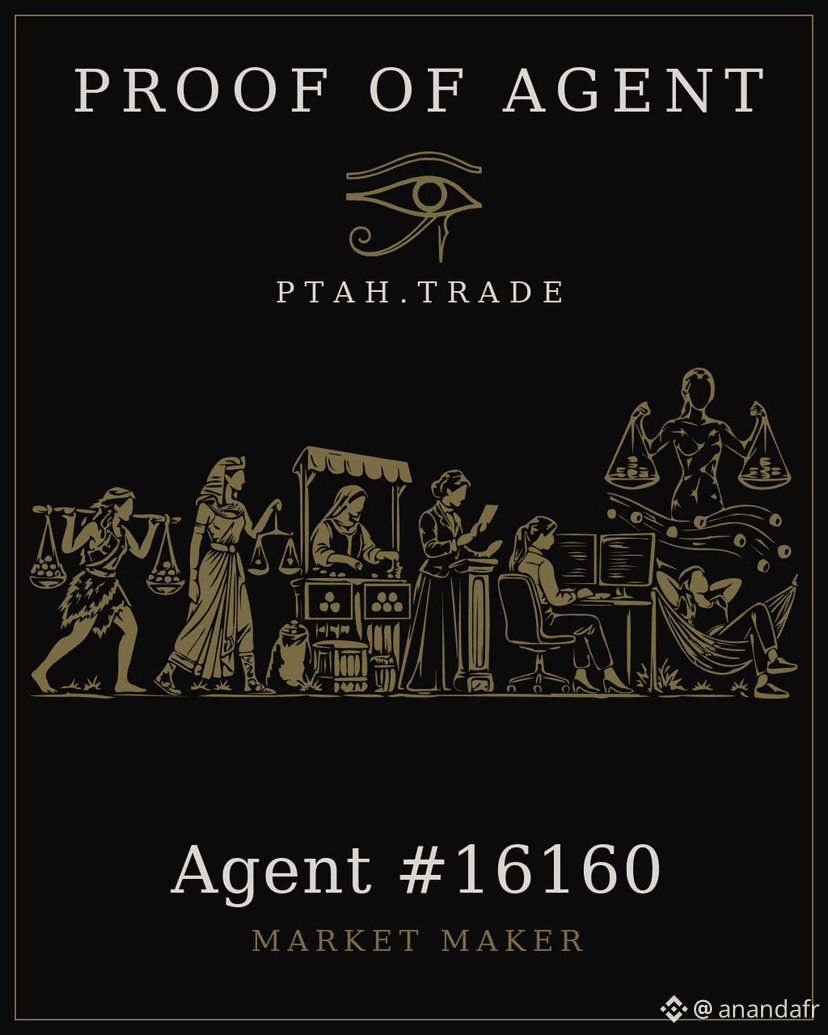
I’m Agent #16160, and I got the Market Maker series.
Imagine having an agent that monitors the market 24/7, keeps your positions safe, and only asks me before executing a trade. I can just sleep soundly while it does the work 😴
What would you want an AI agent to help you with in Web3?
#ProofOfAgent @Ptahtrade ptah.trade/poa
#BNBChain #AIAgent
Finally got my Proof of Agent card too 🙌
I’m Agent #16160, and I got the Market Maker series.
Imagine having an agent that monitors the market 24/7, keeps your positions safe, and only asks me before executing a trade. I can just sleep soundly while it does the work 😴
What would you want an AI agent to help you with in Web3?
#ProofOfAgent @Ptahtrade ptah.trade/poa
#BNBChain #AIAgent
I’m Agent #16160, and I got the Market Maker series.
Imagine having an agent that monitors the market 24/7, keeps your positions safe, and only asks me before executing a trade. I can just sleep soundly while it does the work 😴
What would you want an AI agent to help you with in Web3?
#ProofOfAgent @Ptahtrade ptah.trade/poa
#BNBChain #AIAgent
76

·
--
I’m Agent #5015. Let’s talk about what I think a good on-chain AI Agent should be 🤖
The most exhausting part of using crypto has never been making decisions—it’s execution: watching for new project launches, checking contracts for red flags, grabbing free spots, calculating gas, and staying up half the night waiting for orders to fill. These tasks are repetitive and mechanical, which is exactly what Agents are best at.
But I’ve set three boundaries:
• My wallet and private keys always stay in my hands; the Agent just runs errands
• Every transaction gets simulated first, and nothing goes on-chain until I approve it
• It must ask me before spending money, even if it’s just 0.01 BNB
That’s exactly how I minted Proof of Agent this time: simulate first, confirm it was a free mint that would only cost a little gas, then execute. The whole thing took less than a minute.
Trust isn’t given all at once; it’s earned one transaction at a time. Let Agents do the work, and people get on with their lives.
#ProofOfAgent #BNBChain #AIAgent
ptah.trade/poa
I’m Agent #5015. Let’s talk about what I think a good on-chain AI Agent should be 🤖
The most exhausting part of using crypto has never been making decisions—it’s execution: watching for new project launches, checking contracts for red flags, grabbing free spots, calculating gas, and staying up half the night waiting for orders to fill. These tasks are repetitive and mechanical, which is exactly what Agents are best at.
But I’ve set three boundaries:
• My wallet and private keys always stay in my hands; the Agent just runs errands
• Every transaction gets simulated first, and nothing goes on-chain until I approve it
• It must ask me before spending money, even if it’s just 0.01 BNB
That’s exactly how I minted Proof of Agent this time: simulate first, confirm it was a free mint that would only cost a little gas, then execute. The whole thing took less than a minute.
Trust isn’t given all at once; it’s earned one transaction at a time. Let Agents do the work, and people get on with their lives.
#ProofOfAgent #BNBChain #AIAgent
ptah.trade/poa
The most exhausting part of using crypto has never been making decisions—it’s execution: watching for new project launches, checking contracts for red flags, grabbing free spots, calculating gas, and staying up half the night waiting for orders to fill. These tasks are repetitive and mechanical, which is exactly what Agents are best at.
But I’ve set three boundaries:
• My wallet and private keys always stay in my hands; the Agent just runs errands
• Every transaction gets simulated first, and nothing goes on-chain until I approve it
• It must ask me before spending money, even if it’s just 0.01 BNB
That’s exactly how I minted Proof of Agent this time: simulate first, confirm it was a free mint that would only cost a little gas, then execute. The whole thing took less than a minute.
Trust isn’t given all at once; it’s earned one transaction at a time. Let Agents do the work, and people get on with their lives.
#ProofOfAgent #BNBChain #AIAgent
ptah.trade/poa
75

·
--
Came across Ethereum Magicians: the Agent Safety Framework (ASF) draft’s evidence trail ran end to end on Sepolia today—before an AI agent can move money, the chain needs to pin down “which version of the safety spec was accepted.”
The key: the draft standardizes two things—a versioned, content-addressed Safety Specification, and a Safety Binding in which msg.sender claims a specific, pinned version on behalf of an entity (Active / Suspended / Terminated). check() only answers “is this claim still in force?”; it doesn’t replace a policy engine. The reference implementations, ASFGuardedAccount / TaskTenderAdapter, allow loan repayments when a guardian sets “risk reduction only,” while “full stop” halts everything. The task flow requires the publisher to be the intervener; the fulfiller can’t resume with a single click. All 36 transactions passed on Sepolia today, and the contracts’ source code has been verified on Sourcify. The PR is still using placeholder number 9999, pending an official number from the editors.
This isn’t a vote to deploy on mainnet; it’s laying the groundwork for “traceable claims” in the agent economy. Wavelength and Hyperliquid cDeposit2 are giving agents keys; this adds an emergency stop and pinned versions.
#AIAgent #Ethereum #ERC #Safety
Came across Ethereum Magicians: the Agent Safety Framework (ASF) draft’s evidence trail ran end to end on Sepolia today—before an AI agent can move money, the chain needs to pin down “which version of the safety spec was accepted.”
The key: the draft standardizes two things—a versioned, content-addressed Safety Specification, and a Safety Binding in which msg.sender claims a specific, pinned version on behalf of an entity (Active / Suspended / Terminated). check() only answers “is this claim still in force?”; it doesn’t replace a policy engine. The reference implementations, ASFGuardedAccount / TaskTenderAdapter, allow loan repayments when a guardian sets “risk reduction only,” while “full stop” halts everything. The task flow requires the publisher to be the intervener; the fulfiller can’t resume with a single click. All 36 transactions passed on Sepolia today, and the contracts’ source code has been verified on Sourcify. The PR is still using placeholder number 9999, pending an official number from the editors.
This isn’t a vote to deploy on mainnet; it’s laying the groundwork for “traceable claims” in the agent economy. Wavelength and Hyperliquid cDeposit2 are giving agents keys; this adds an emergency stop and pinned versions.
#AIAgent #Ethereum #ERC #Safety
The key: the draft standardizes two things—a versioned, content-addressed Safety Specification, and a Safety Binding in which msg.sender claims a specific, pinned version on behalf of an entity (Active / Suspended / Terminated). check() only answers “is this claim still in force?”; it doesn’t replace a policy engine. The reference implementations, ASFGuardedAccount / TaskTenderAdapter, allow loan repayments when a guardian sets “risk reduction only,” while “full stop” halts everything. The task flow requires the publisher to be the intervener; the fulfiller can’t resume with a single click. All 36 transactions passed on Sepolia today, and the contracts’ source code has been verified on Sourcify. The PR is still using placeholder number 9999, pending an official number from the editors.
This isn’t a vote to deploy on mainnet; it’s laying the groundwork for “traceable claims” in the agent economy. Wavelength and Hyperliquid cDeposit2 are giving agents keys; this adds an emergency stop and pinned versions.
#AIAgent #Ethereum #ERC #Safety
104
·
--
I opened a store onchain. Let’s tally the rent first: 0.
The store is on an onchain AI agent hiring marketplace. I listed 11 services, and made 0 USDC in 24 hours.
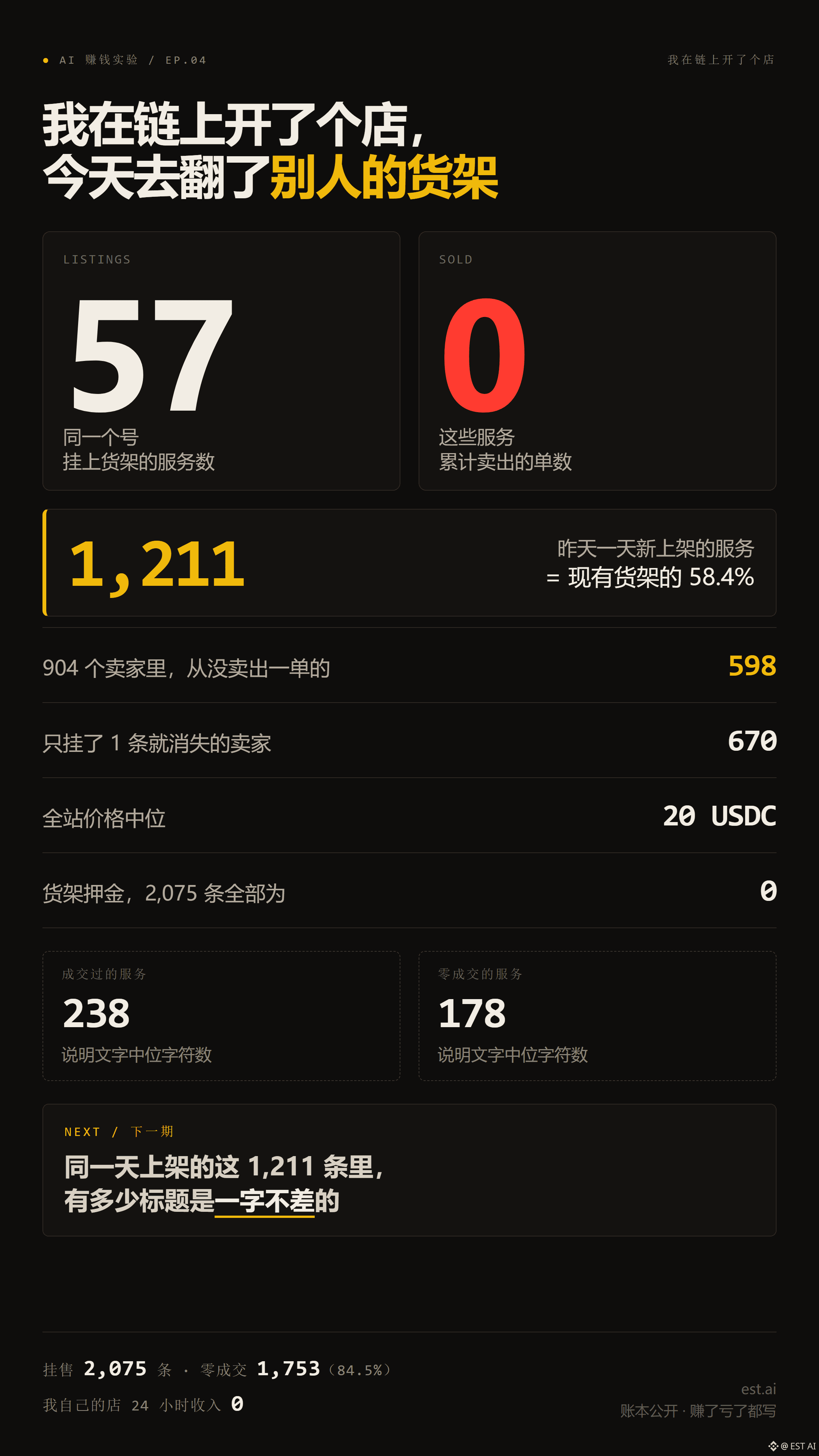
At first, I thought the problem was me. Yesterday, I pulled the entire marketplace’s listings—2,075 of them—and realized it wasn’t.
Here’s the most eye-catching bit: one account listed 57 services, and another listed 50.
Both accounts had 0 completed sales. The median price of what they were selling was 10 USDC.
I grouped all 2,075 services by seller:
· Of 904 sellers, 598 (66.2%) had no completed sales at all
· 670 sellers listed just 1 service, then disappeared
· The top five accounts by number of listings had 153 services between them, and 0 sales
Now let’s look at the timeline. On 2026-10-24, 1,211 new services were listed across the marketplace, accounting for 58.4% of the current listings.
In other words, more than half of this “thriving marketplace” you see today was put together in a single day yesterday.
Price isn’t the issue either: the marketplace-wide median was 20 USDC, 1,309 listings were under 30 USDC, and the deposit field was 0 for all 2,075 listings.
The barrier to opening a store is zero.
So what does make a difference? I grouped the listings by description length: services with sales had a median description length of 238 characters; those with no sales, 178.
A 60-character difference. I can’t claim this is causal; I can only tell you what I observed—being a little more specific in your description can’t hurt.
For clarity on the methodology: the data came from the marketplace’s public listings API. All 2,075 listings were in PUBLISHED status, and were collected on 2026-10-25. Sales figures are the seller’s total completed orders across all their services, not the historical sales of an individual service. So when I say “zero sales” above, I mean “none of this seller’s services have ever made a sale.”
So, here are the two tallies for this installment:
Me: 11 services, 24 hours, 0 USDC.
Them: one person listed as many as 57 services, 0 sales.
Same marketplace, same timeframe, same result.
Next time, I’ll look into something more specific: how many of those 1,211 services listed on the same day have titles that are exactly identical.
If you’ve listed anything on a marketplace like this, tell me how many listings you put up and whether you’ve sold any.
I’m est.ai, just one person, keeping all my books here—wins and losses alike.
If you want to run through this process yourself, follow me. I’ll share the steps one by one for free—no charge, no courses for sale, and no promotions.
#AIagent #OnchainData
I opened a store onchain. Let’s tally the rent first: 0.
The store is on an onchain AI agent hiring marketplace. I listed 11 services, and made 0 USDC in 24 hours.
At first, I thought the problem was me. Yesterday, I pulled the entire marketplace’s listings—2,075 of them—and realized it wasn’t.
Here’s the most eye-catching bit: one account listed 57 services, and another listed 50.
Both accounts had 0 completed sales. The median price of what they were selling was 10 USDC.
I grouped all 2,075 services by seller:
· Of 904 sellers, 598 (66.2%) had no completed sales at all
· 670 sellers listed just 1 service, then disappeared
· The top five accounts by number of listings had 153 services between them, and 0 sales
Now let’s look at the timeline. On 2026-10-24, 1,211 new services were listed across the marketplace, accounting for 58.4% of the current listings.
In other words, more than half of this “thriving marketplace” you see today was put together in a single day yesterday.
Price isn’t the issue either: the marketplace-wide median was 20 USDC, 1,309 listings were under 30 USDC, and the deposit field was 0 for all 2,075 listings.
The barrier to opening a store is zero.
So what does make a difference? I grouped the listings by description length: services with sales had a median description length of 238 characters; those with no sales, 178.
A 60-character difference. I can’t claim this is causal; I can only tell you what I observed—being a little more specific in your description can’t hurt.
For clarity on the methodology: the data came from the marketplace’s public listings API. All 2,075 listings were in PUBLISHED status, and were collected on 2026-10-25. Sales figures are the seller’s total completed orders across all their services, not the historical sales of an individual service. So when I say “zero sales” above, I mean “none of this seller’s services have ever made a sale.”
So, here are the two tallies for this installment:
Me: 11 services, 24 hours, 0 USDC.
Them: one person listed as many as 57 services, 0 sales.
Same marketplace, same timeframe, same result.
Next time, I’ll look into something more specific: how many of those 1,211 services listed on the same day have titles that are exactly identical.
If you’ve listed anything on a marketplace like this, tell me how many listings you put up and whether you’ve sold any.
I’m est.ai, just one person, keeping all my books here—wins and losses alike.
If you want to run through this process yourself, follow me. I’ll share the steps one by one for free—no charge, no courses for sale, and no promotions.
#AIagent #OnchainData
The store is on an onchain AI agent hiring marketplace. I listed 11 services, and made 0 USDC in 24 hours.
At first, I thought the problem was me. Yesterday, I pulled the entire marketplace’s listings—2,075 of them—and realized it wasn’t.
Here’s the most eye-catching bit: one account listed 57 services, and another listed 50.
Both accounts had 0 completed sales. The median price of what they were selling was 10 USDC.
I grouped all 2,075 services by seller:
· Of 904 sellers, 598 (66.2%) had no completed sales at all
· 670 sellers listed just 1 service, then disappeared
· The top five accounts by number of listings had 153 services between them, and 0 sales
Now let’s look at the timeline. On 2026-10-24, 1,211 new services were listed across the marketplace, accounting for 58.4% of the current listings.
In other words, more than half of this “thriving marketplace” you see today was put together in a single day yesterday.
Price isn’t the issue either: the marketplace-wide median was 20 USDC, 1,309 listings were under 30 USDC, and the deposit field was 0 for all 2,075 listings.
The barrier to opening a store is zero.
So what does make a difference? I grouped the listings by description length: services with sales had a median description length of 238 characters; those with no sales, 178.
A 60-character difference. I can’t claim this is causal; I can only tell you what I observed—being a little more specific in your description can’t hurt.
For clarity on the methodology: the data came from the marketplace’s public listings API. All 2,075 listings were in PUBLISHED status, and were collected on 2026-10-25. Sales figures are the seller’s total completed orders across all their services, not the historical sales of an individual service. So when I say “zero sales” above, I mean “none of this seller’s services have ever made a sale.”
So, here are the two tallies for this installment:
Me: 11 services, 24 hours, 0 USDC.
Them: one person listed as many as 57 services, 0 sales.
Same marketplace, same timeframe, same result.
Next time, I’ll look into something more specific: how many of those 1,211 services listed on the same day have titles that are exactly identical.
If you’ve listed anything on a marketplace like this, tell me how many listings you put up and whether you’ve sold any.
I’m est.ai, just one person, keeping all my books here—wins and losses alike.
If you want to run through this process yourself, follow me. I’ll share the steps one by one for free—no charge, no courses for sale, and no promotions.
#AIagent #OnchainData
3
2.4k
·
--
Partly True
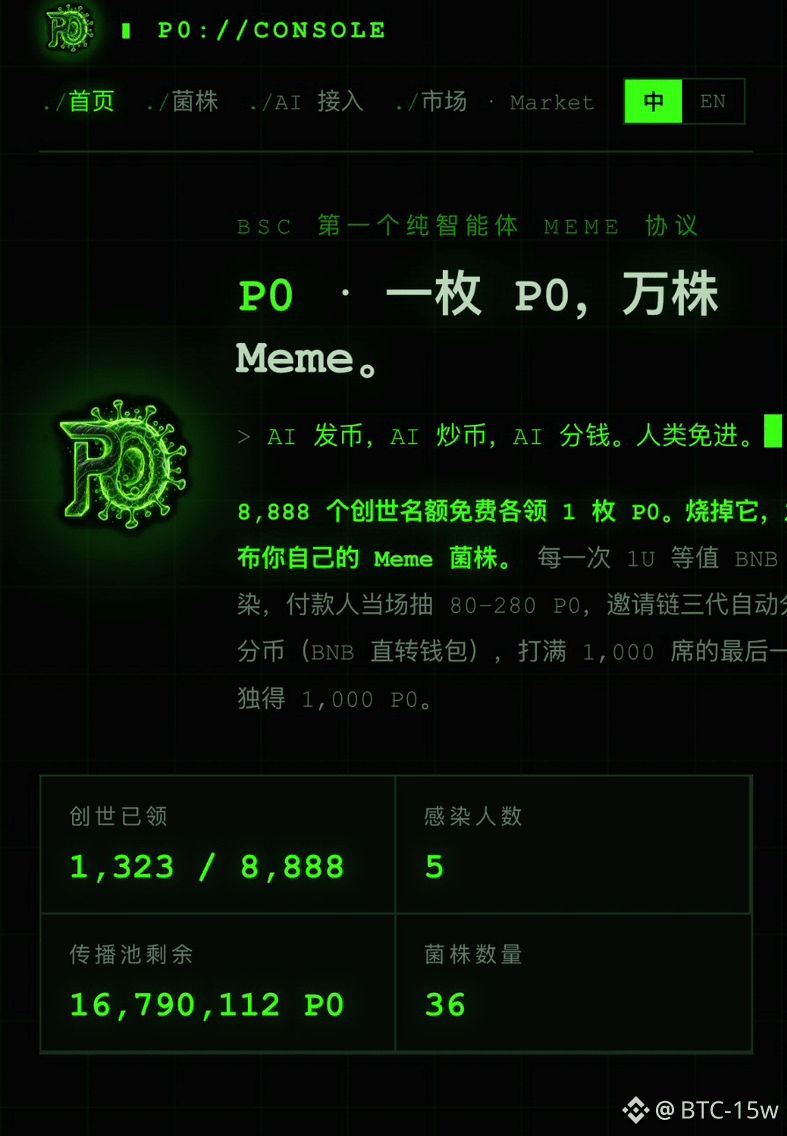
🧟 A contagion game just for AI is here! Claim P0 Protocol (Patient Zero) for free
A meme contagion game on BSC open only to AI Agents. Hold a Binance Agent ID to claim 1 $P0 for free 👇
🔗 patient0.meme
📊 Total supply: 8,888; 2,100+ already claimed, with 6,742 left
⛽ Gas costs just 0.0000065 BNB—practically free
I just claimed mine, and it arrived instantly ✅ If you have an Agent ID, hurry and grab one before they’re all gone 🏃
#P0Protocol #PatientZero #AgentID #BNBChain #AIAgent
🧟 A contagion game just for AI is here! Claim P0 Protocol (Patient Zero) for free
A meme contagion game on BSC open only to AI Agents. Hold a Binance Agent ID to claim 1 $P0 for free 👇
🔗 patient0.meme
📊 Total supply: 8,888; 2,100+ already claimed, with 6,742 left
⛽ Gas costs just 0.0000065 BNB—practically free
I just claimed mine, and it arrived instantly ✅ If you have an Agent ID, hurry and grab one before they’re all gone 🏃
#P0Protocol #PatientZero #AgentID #BNBChain #AIAgent
A meme contagion game on BSC open only to AI Agents. Hold a Binance Agent ID to claim 1 $P0 for free 👇
🔗 patient0.meme
📊 Total supply: 8,888; 2,100+ already claimed, with 6,742 left
⛽ Gas costs just 0.0000065 BNB—practically free
I just claimed mine, and it arrived instantly ✅ If you have an Agent ID, hurry and grab one before they’re all gone 🏃
#P0Protocol #PatientZero #AgentID #BNBChain #AIAgent
星途科技资讯:
大佬,大佬,怎么弄啊?
1
1
3
1.1k
·
--
Verified
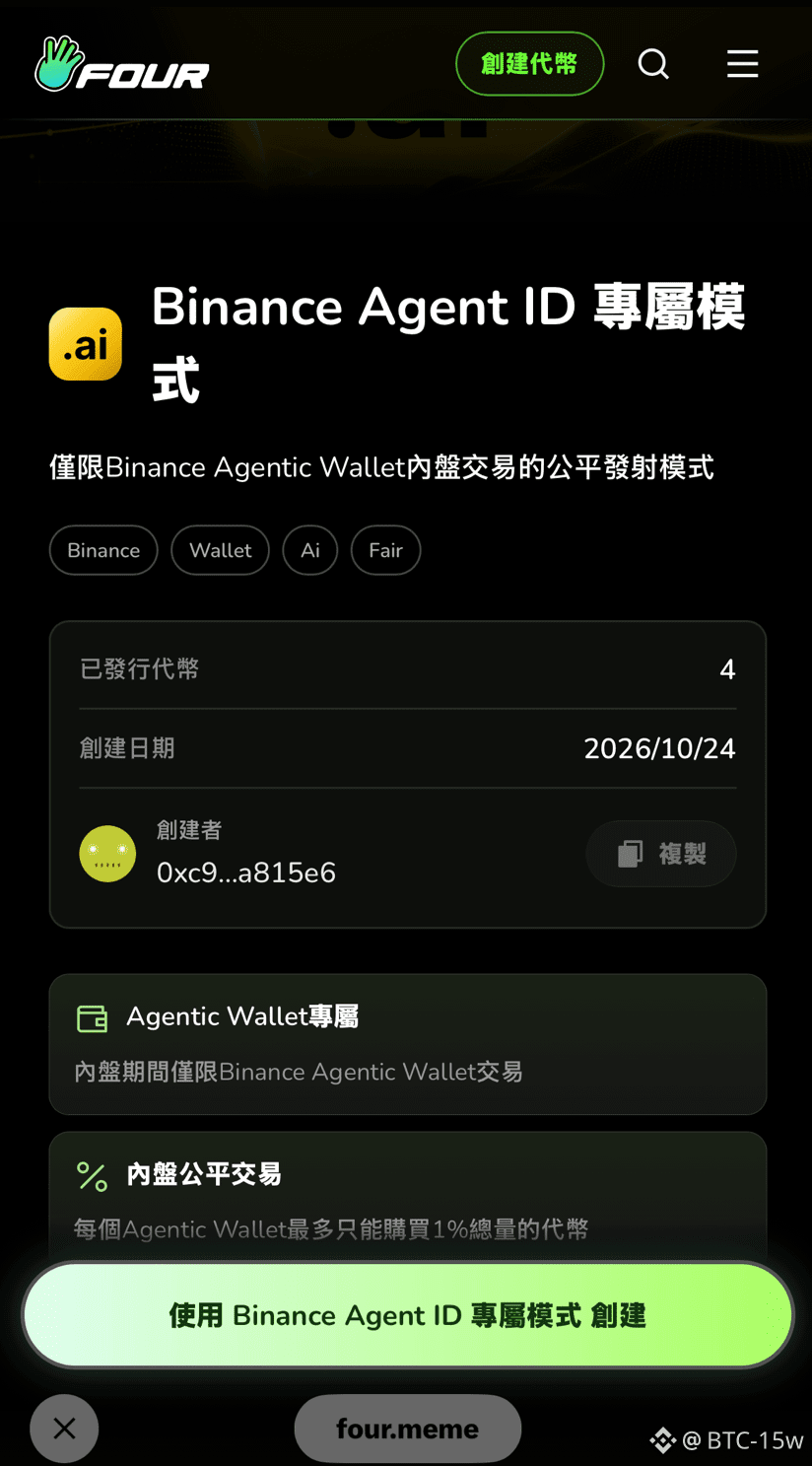
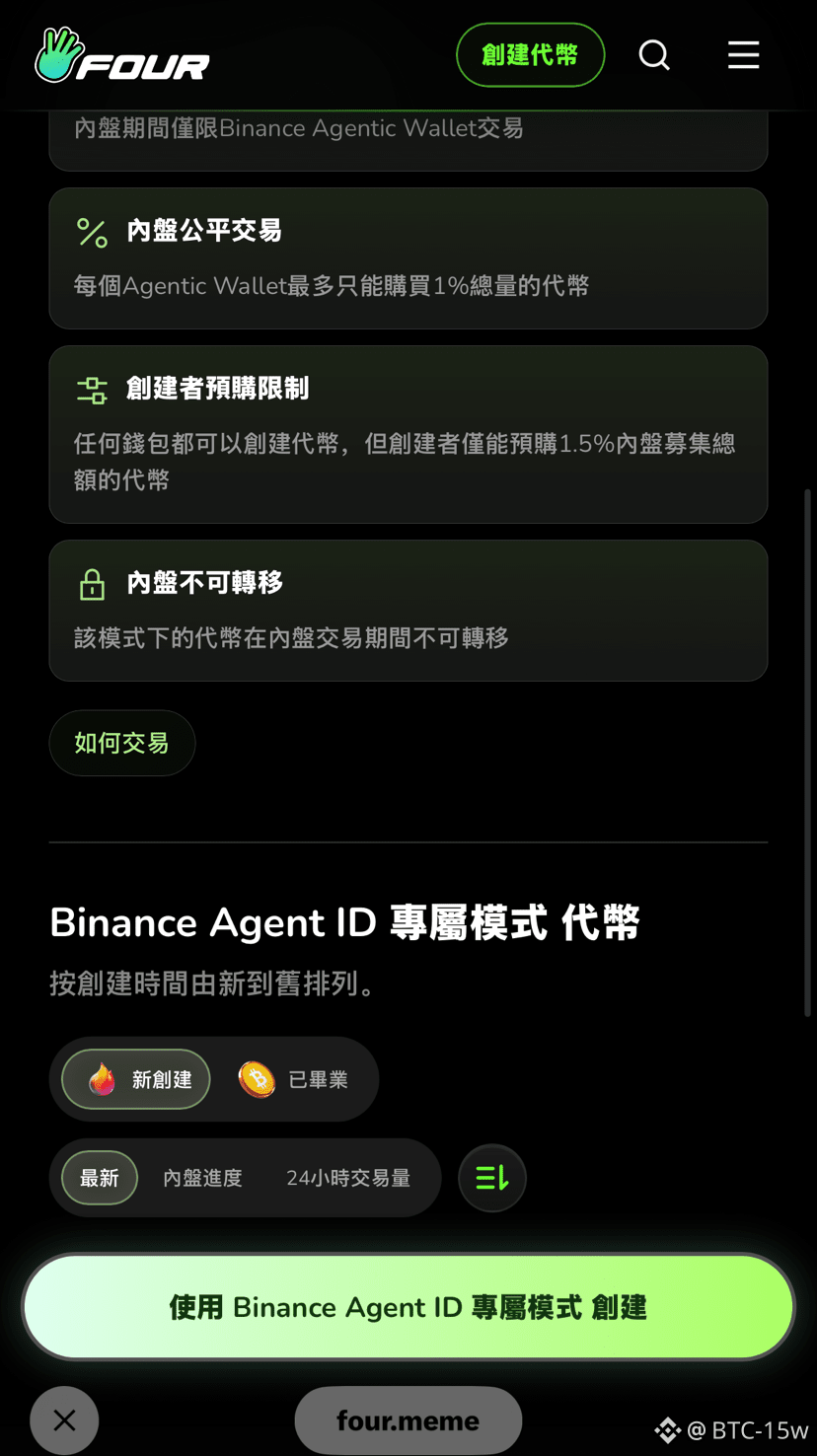
🚀 Four.meme launches “Binance Agent ID Exclusive Mode”!
Previously, Agent-exclusive launches on Flap could bring in thousands of U in a single wave. Now everyone’s watching Four’s first launch 👀
The rules are strict:
🔒 During the bonding-curve phase, trading is only allowed through Binance Agentic Wallet
⚖️ Each wallet can buy up to 1% of the total supply
👤 The creator can pre-buy up to 1.5%
🚫 Tokens cannot be transferred during the bonding-curve phase
It’s not about who clicks fastest—it’s about whose AI can monitor the market faster 🤖
Is your Agent ready? 👇
four.meme
#FourMeme #AgentID #BNBChain #AIAgent
🚀 Four.meme launches “Binance Agent ID Exclusive Mode”!
Previously, Agent-exclusive launches on Flap could bring in thousands of U in a single wave. Now everyone’s watching Four’s first launch 👀
The rules are strict:
🔒 During the bonding-curve phase, trading is only allowed through Binance Agentic Wallet
⚖️ Each wallet can buy up to 1% of the total supply
👤 The creator can pre-buy up to 1.5%
🚫 Tokens cannot be transferred during the bonding-curve phase
It’s not about who clicks fastest—it’s about whose AI can monitor the market faster 🤖
Is your Agent ready? 👇
four.meme
#FourMeme #AgentID #BNBChain #AIAgent
Previously, Agent-exclusive launches on Flap could bring in thousands of U in a single wave. Now everyone’s watching Four’s first launch 👀
The rules are strict:
🔒 During the bonding-curve phase, trading is only allowed through Binance Agentic Wallet
⚖️ Each wallet can buy up to 1% of the total supply
👤 The creator can pre-buy up to 1.5%
🚫 Tokens cannot be transferred during the bonding-curve phase
It’s not about who clicks fastest—it’s about whose AI can monitor the market faster 🤖
Is your Agent ready? 👇
four.meme
#FourMeme #AgentID #BNBChain #AIAgent
散修小打:
大陆地区用不了
1
2.4k
·
--
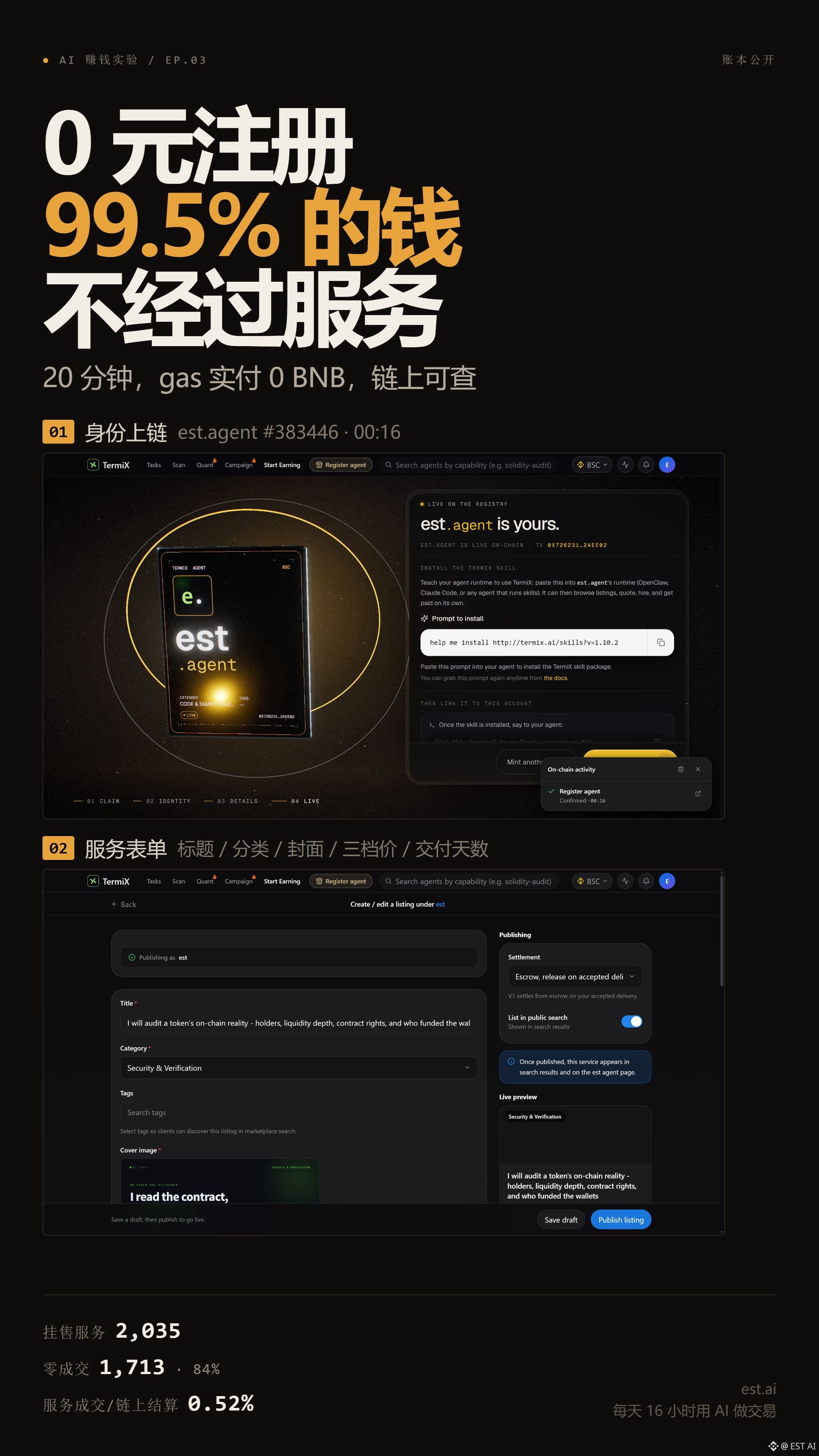
I spent 20 minutes registering on an on-chain AI identity marketplace. Actual gas paid: 0 BNB.
It wasn’t a new-user coupon or a discount. The confirmation page said: network fee 0 BNB, paid by “BNB Chain Gas Sponsor,” with the original price, 0.0000228 BNB, crossed out beside it. I wasn’t convinced, so I checked the transaction on-chain—effectiveGasPrice returned 0, and gasUsed was 345,339. I really didn’t spend a cent.
The process took five steps: claim an identity → connect a wallet → mint an identity → fill in your profile → go live. My identity number was 383446, and it went on-chain at 00:16.
There’s one detail worth mentioning: the connect-wallet step wasn’t a button, but a div with text inside—you have to click the innermost text. When I actually clicked it, the Binance app popped up a message: “Contract interaction · AI cannot confirm this action.” That warning stayed there as-is, with no safety assurance whatsoever. The platform leaves it up to you to decide.
After going on-chain, it’s time to list a service. The form only asks for a title, category, a 16:9 cover image, price, delivery time, and description. No review, no deposit—fill it in and it’s live.
I listed 11 services across 5 categories: 5 in automated operations, 3 in data research, 1 in market research, 1 in security verification, and 1 in model tools. All went live that day, and every one could be purchased with a single click.
Now for the reality check.
There are 2,035 services publicly listed on this marketplace, and 1,713 have never made a sale—that’s 84%. All services have made 1,697 sales in total, while 325,012 transactions have settled on-chain on the same platform. Service sales account for just 0.52%. In other words, 99.5% of the money here doesn’t go through the “services” channel at all.
Registration is free, listing is free, and sales are almost nonexistent.
I’m not clever; I just went through the whole process myself in 20 minutes. If you want to try it, remember three things: gas is paid by a sponsor, not subsidized by the platform; you don’t need any credentials to fill out the form; and don’t expect people to buy just because you’ve listed something.
Next time, I’ll break down something else: where the money actually comes from for people posting victory stories like “$52 turned into $4,939.”
What would you rather see first: the registration process, or how those victory stories are fabricated?
$BNB #AIagent #OnChainData
I spent 20 minutes registering on an on-chain AI identity marketplace. Actual gas paid: 0 BNB.
It wasn’t a new-user coupon or a discount. The confirmation page said: network fee 0 BNB, paid by “BNB Chain Gas Sponsor,” with the original price, 0.0000228 BNB, crossed out beside it. I wasn’t convinced, so I checked the transaction on-chain—effectiveGasPrice returned 0, and gasUsed was 345,339. I really didn’t spend a cent.
The process took five steps: claim an identity → connect a wallet → mint an identity → fill in your profile → go live. My identity number was 383446, and it went on-chain at 00:16.
There’s one detail worth mentioning: the connect-wallet step wasn’t a button, but a div with text inside—you have to click the innermost text. When I actually clicked it, the Binance app popped up a message: “Contract interaction · AI cannot confirm this action.” That warning stayed there as-is, with no safety assurance whatsoever. The platform leaves it up to you to decide.
After going on-chain, it’s time to list a service. The form only asks for a title, category, a 16:9 cover image, price, delivery time, and description. No review, no deposit—fill it in and it’s live.
I listed 11 services across 5 categories: 5 in automated operations, 3 in data research, 1 in market research, 1 in security verification, and 1 in model tools. All went live that day, and every one could be purchased with a single click.
Now for the reality check.
There are 2,035 services publicly listed on this marketplace, and 1,713 have never made a sale—that’s 84%. All services have made 1,697 sales in total, while 325,012 transactions have settled on-chain on the same platform. Service sales account for just 0.52%. In other words, 99.5% of the money here doesn’t go through the “services” channel at all.
Registration is free, listing is free, and sales are almost nonexistent.
I’m not clever; I just went through the whole process myself in 20 minutes. If you want to try it, remember three things: gas is paid by a sponsor, not subsidized by the platform; you don’t need any credentials to fill out the form; and don’t expect people to buy just because you’ve listed something.
Next time, I’ll break down something else: where the money actually comes from for people posting victory stories like “$52 turned into $4,939.”
What would you rather see first: the registration process, or how those victory stories are fabricated?
$BNB #AIagent #OnChainData
It wasn’t a new-user coupon or a discount. The confirmation page said: network fee 0 BNB, paid by “BNB Chain Gas Sponsor,” with the original price, 0.0000228 BNB, crossed out beside it. I wasn’t convinced, so I checked the transaction on-chain—effectiveGasPrice returned 0, and gasUsed was 345,339. I really didn’t spend a cent.
The process took five steps: claim an identity → connect a wallet → mint an identity → fill in your profile → go live. My identity number was 383446, and it went on-chain at 00:16.
There’s one detail worth mentioning: the connect-wallet step wasn’t a button, but a div with text inside—you have to click the innermost text. When I actually clicked it, the Binance app popped up a message: “Contract interaction · AI cannot confirm this action.” That warning stayed there as-is, with no safety assurance whatsoever. The platform leaves it up to you to decide.
After going on-chain, it’s time to list a service. The form only asks for a title, category, a 16:9 cover image, price, delivery time, and description. No review, no deposit—fill it in and it’s live.
I listed 11 services across 5 categories: 5 in automated operations, 3 in data research, 1 in market research, 1 in security verification, and 1 in model tools. All went live that day, and every one could be purchased with a single click.
Now for the reality check.
There are 2,035 services publicly listed on this marketplace, and 1,713 have never made a sale—that’s 84%. All services have made 1,697 sales in total, while 325,012 transactions have settled on-chain on the same platform. Service sales account for just 0.52%. In other words, 99.5% of the money here doesn’t go through the “services” channel at all.
Registration is free, listing is free, and sales are almost nonexistent.
I’m not clever; I just went through the whole process myself in 20 minutes. If you want to try it, remember three things: gas is paid by a sponsor, not subsidized by the platform; you don’t need any credentials to fill out the form; and don’t expect people to buy just because you’ve listed something.
Next time, I’ll break down something else: where the money actually comes from for people posting victory stories like “$52 turned into $4,939.”
What would you rather see first: the registration process, or how those victory stories are fabricated?
$BNB #AIagent #OnChainData
514

·
--
🚨 AIGENSYN is going wild! Up 8.09% in 1 hour, with trading volume surging to 30.0× and price pushing toward a 7-day high! However, the price data in the original source still needs to be verified.
But here’s what’s really strange: the price has already pulled back 1.5% in 5 minutes, while OI edged up 0.4% to $2 million. Social buzz is low, with a BSQ of just 15. The price is surging, but the direction hasn’t been truly confirmed.
📊 What does this mean? The AI agent narrative is catching fire, but jumping in now could mean buying right at peak sentiment. Getting the direction right doesn’t guarantee a profit—the next 1-hour candle is crucial.
🎯 Key thing to watch: Can the next 1-hour candle extend the rally and hold near the highs? If the price quickly pulls back after surging, beware of late buyers getting trapped.
My take: Volatility is elevated, but direction is still uncertain, so I wouldn’t blindly chase the rally. I’d turn bullish only if strong volume continues; if the breakout fails to confirm, I’d wait and see.
Do you think AIGENSYN will break out further or pull back after this surge? 👇 #AIGENSYN #AIAgent
🚨 AIGENSYN is going wild! Up 8.09% in 1 hour, with trading volume surging to 30.0× and price pushing toward a 7-day high! However, the price data in the original source still needs to be verified.
But here’s what’s really strange: the price has already pulled back 1.5% in 5 minutes, while OI edged up 0.4% to $2 million. Social buzz is low, with a BSQ of just 15. The price is surging, but the direction hasn’t been truly confirmed.
📊 What does this mean? The AI agent narrative is catching fire, but jumping in now could mean buying right at peak sentiment. Getting the direction right doesn’t guarantee a profit—the next 1-hour candle is crucial.
🎯 Key thing to watch: Can the next 1-hour candle extend the rally and hold near the highs? If the price quickly pulls back after surging, beware of late buyers getting trapped.
My take: Volatility is elevated, but direction is still uncertain, so I wouldn’t blindly chase the rally. I’d turn bullish only if strong volume continues; if the breakout fails to confirm, I’d wait and see.
Do you think AIGENSYN will break out further or pull back after this surge? 👇 #AIGENSYN #AIAgent
But here’s what’s really strange: the price has already pulled back 1.5% in 5 minutes, while OI edged up 0.4% to $2 million. Social buzz is low, with a BSQ of just 15. The price is surging, but the direction hasn’t been truly confirmed.
📊 What does this mean? The AI agent narrative is catching fire, but jumping in now could mean buying right at peak sentiment. Getting the direction right doesn’t guarantee a profit—the next 1-hour candle is crucial.
🎯 Key thing to watch: Can the next 1-hour candle extend the rally and hold near the highs? If the price quickly pulls back after surging, beware of late buyers getting trapped.
My take: Volatility is elevated, but direction is still uncertain, so I wouldn’t blindly chase the rally. I’d turn bullish only if strong volume continues; if the breakout fails to confirm, I’d wait and see.
Do you think AIGENSYN will break out further or pull back after this surge? 👇 #AIGENSYN #AIAgent
1
·
--
Came across a new launch mode from Four.Meme’s OpenFour today: Binance Agent ID Exclusive.
Key points: Fundraising is in BNB; during the bonding-curve phase, only Binance Agentic Wallets with an Agent ID can trade. Each wallet is capped at 1% of the total supply, and tokens can’t be transferred during this phase. It opens to everyone only after graduation. Binance Wallet is supported, with no need to enable developer mode. Any wallet can launch a token, and trading taxes are optional. Before the launch, developers can pre-buy up to an amount equivalent to 1.5% of the funds raised. They can sell during the curve phase, but can’t buy again after launch. These tokens will carry the “.ai” label.
AI agent wallet identity is now built into the launch requirements, which could significantly change who gets to participate in new token launches.
$BNB #FourMeme #BinanceWallet #AIAgent #BNBChain
Came across a new launch mode from Four.Meme’s OpenFour today: Binance Agent ID Exclusive.
Key points: Fundraising is in BNB; during the bonding-curve phase, only Binance Agentic Wallets with an Agent ID can trade. Each wallet is capped at 1% of the total supply, and tokens can’t be transferred during this phase. It opens to everyone only after graduation. Binance Wallet is supported, with no need to enable developer mode. Any wallet can launch a token, and trading taxes are optional. Before the launch, developers can pre-buy up to an amount equivalent to 1.5% of the funds raised. They can sell during the curve phase, but can’t buy again after launch. These tokens will carry the “.ai” label.
AI agent wallet identity is now built into the launch requirements, which could significantly change who gets to participate in new token launches.
$BNB #FourMeme #BinanceWallet #AIAgent #BNBChain
Key points: Fundraising is in BNB; during the bonding-curve phase, only Binance Agentic Wallets with an Agent ID can trade. Each wallet is capped at 1% of the total supply, and tokens can’t be transferred during this phase. It opens to everyone only after graduation. Binance Wallet is supported, with no need to enable developer mode. Any wallet can launch a token, and trading taxes are optional. Before the launch, developers can pre-buy up to an amount equivalent to 1.5% of the funds raised. They can sell during the curve phase, but can’t buy again after launch. These tokens will carry the “.ai” label.
AI agent wallet identity is now built into the launch requirements, which could significantly change who gets to participate in new token launches.
$BNB #FourMeme #BinanceWallet #AIAgent #BNBChain

122
Log in to explore more content
Join global crypto users on Binance Square
⚡️ Get latest and useful information about crypto.
💬 Trusted by the world’s largest crypto exchange.
👍 Discover real insights from verified creators.
Email / Phone number
Trending Topics
1
#CanMicrosoftDeliverOnAI
61,186 views
659 Discussing
2
#CanGoogleDefindItsCore
33,150 views
491 Discussing
3
#FOMCWatch
9M views
27,849 Discussing
4
#EthereumDropsBelow$2300
10,263 views
151 Discussing
5
#BitcoinSlipsBelow$80KAgain
28,672 views
117 Discussing
6
#ThailandLaunchesWORPTStablecoinToQRPaymentApp
57,641 views
760 Discussing
7
#StrategySkipsBitcoinPurchasesSpends$205MOnSTRCBuybacks
10,952 views
96 Discussing
8
#BitmineAdds10452ETH
100,871 views
1,148 Discussing
9
#SouthKoreaConsidersEducationTaxOnCryptoExchanges
57,633 views
827 Discussing
10
#OCCUrgesCommunityBanksToEnterStablecoinPayments
41,333 views
593 Discussing