
#celo
celo
713,166 views
4,016 Discussing
Hot
Latest


·
--
Article
Celo: 20M Wallets, a $0.059 Token and the Gap Between ThemCelo says it has 20 million wallets. The token trades at $0.059, about 6% above its all-time low. Both facts are true, and that is the story.
I think Celo's usage is real. But the token only wins when that usage turns into fees and buybacks. Until then, users are happy and holders are waiting.
I spent days in Celo's docs, its governance forum and live market data. This article is part explainer and part field notes from that research.
Celo in One Minute
The simplest way I can put it: Celo is a blockchain built for payments from a phone. It began in 2020 as its own chain. On 26 March 2025 it became a Layer 2 on Ethereum.
A Layer 2 is a faster, cheaper chain that borrows Ethereum's security. Celo's target users are people who want digital dollars or local currency.
How Celo Is Built
I break it into four layers:
Apps and wallets, like MiniPay.Celo L2, which runs Ethereum-style smart contracts with a block every 1 second.EigenDA, which stores transaction data cheaply.Ethereum, which does the final settlement.
The result is a typical fee under one cent.
What Happens When Someone Sends Money
This is the flow I traced:
The user holds a stablecoin.The user pays the fee in that same coin. No CELO needed.The sequencer puts the payment in a block in about a second.The data goes to EigenDA and Ethereum seals it.
One honest note. A single sequencer orders transactions today. Celo says decentralized sequencing is planned, not live.
Mento: Where Local Coins Come From
The part I found most useful to understand is Mento, Celo's own stablecoin protocol. It mints 15 stablecoins, and the dollar one, USDm, is about 86% of supply. Celo as a whole has 30+ fiat-linked coins.
Mento's reserve holds other issuers' stablecoins plus CELO, stETH and ETH. Those last three are 28.9% of holdings (DIA, 2 October 2026).
The CELO Token
Here is how I read the token:
Max supply is fixed at 1 billion. About 610M circulates.400M is released over time as epoch rewards.It has four jobs: governance, lock and vote, default gas, and reserve collateral.
The catch: users do not need CELO to use Celo.
Where the Fees Go
So the token needs another reason to be bought. That reason is CELOccelerate, approved in 2026 with about 97% of votes.
Net sequencer revenue buys CELO on the open market.That CELO goes to a Community Fund run by holders.Holders vote to hold, reinvest or burn it.
Burning is not automatic. A forum post says a vote to burn the first year's 1.749M CELO was rejected.
My Real Numbers
Here is the data I tracked on 20 and 21 November, with nothing rounded up.
Price about $0.059, market cap about $36MFully diluted value about $59M, circulating supply 610M7-day move: down 9.7%All-time low $0.0557, all-time high $9.82Value locked about $8.3MReported buybacks: about 9.1M CELO by 10 October, around 1.5% of circulating supply
What the Chart Did
On 14 November CELO fell 10.7% in one day, from about $0.0662 to $0.0591. It has not touched $0.066 since. Every bounce stalled near $0.061.
Spot is thin. Binance CELO/USDT spot did about $172K in 24 hours when I checked. Perps volume is around 25 times spot. So futures push this chart.
The Gap: Usage vs Token
This is the gap I keep coming back to. The story is loud: MiniPay is moving 20M+ wallets to Stripe's Privy, Tether's USAT is live, and agent payments are coming. The token is quiet: $36M market cap and $8.3M locked.
The reported buyback pace was 600K CELO in a week. At $0.059 that is about $35K.
Who Celo Helps
Users: sub-cent fees, 1-second payments, local currency, no seed phrase in MiniPay.Builders: Ethereum code runs here, and MiniPay brings an audience.Ethereum: a payments L2 with real users.CELO holders: a vote, staking rewards, and buybacks if they scale.
What Surprised Me, and What Could Be Better
What surprised me:
You never need CELO to use Celo.20M activated wallets against about 700K daily users (December 2025).How small the buyback is next to the story.
What could be better:
Regular, public buyback reports. A forum thread already asks for them.A date for decentralized sequencing.Clear active-user numbers.
None of these break the idea. They are gaps I only saw after reading closely.
Risks I Take Seriously
One sequencer. A single party orders blocks today.Opera. 160M CELO was approved. That is 16% of max supply, about $9.4M at today's price. Its voting power is capped at 10% of staked CELO.Weak token demand. Buybacks are tiny next to the market cap.Reserve exposure. Mento's reserve holds volatile assets, including CELO.Unlock on 28 November. I could not confirm its size.
Three Paths From $0.059
Here are the levels I am watching:
Bull: reclaim $0.0660, +12%, market cap about $40M. Next is $0.0677, +15%.Range: $0.0569 to $0.0610 while spot stays thin.Bear: lose $0.0557, the all-time low, 6% away. There is no chart history below it.{future}(CELOUSDT)
Quick FAQ
Do I need CELO to use Celo? No. Fees can be paid in stablecoins.Is Celo its own chain? No. It has been an Ethereum L2 since March 2025.Does the token burn? Not automatically. Holders vote.Are the user numbers verified? No. Celo and Opera report them.
Why I Trust These Numbers
Every number here comes from public sources: Celo's docs and forum, CoinGecko, DIA, MiniPay's Q2 2026 update and The Block. Nothing is estimated or rounded up to look better.
User counts are self-reported by Celo and Opera, and I say so. Market numbers are snapshots and can move 10% in a day.
Celo proves people will use stablecoins on a phone. Whether that makes the token worth more is still open.
Do not judge a chain by its wallet count. Judge it by what its token earns.
If you hold CELO or use MiniPay, tell me in the comments how you see it.
This is my personal research and not financial advice. No price predictions, no trading signals.
#Celo #CELOUSDT $CELO @Binance_Square_Official @celo
Celo: 20M Wallets, a $0.059 Token and the Gap Between Them
Celo says it has 20 million wallets. The token trades at $0.059, about 6% above its all-time low. Both facts are true, and that is the story.
I think Celo's usage is real. But the token only wins when that usage turns into fees and buybacks. Until then, users are happy and holders are waiting.
I spent days in Celo's docs, its governance forum and live market data. This article is part explainer and part field notes from that research.
Celo in One Minute
The simplest way I can put it: Celo is a blockchain built for payments from a phone. It began in 2020 as its own chain. On 26 March 2025 it became a Layer 2 on Ethereum.
A Layer 2 is a faster, cheaper chain that borrows Ethereum's security. Celo's target users are people who want digital dollars or local currency.
How Celo Is Built
I break it into four layers:
Apps and wallets, like MiniPay.Celo L2, which runs Ethereum-style smart contracts with a block every 1 second.EigenDA, which stores transaction data cheaply.Ethereum, which does the final settlement.
The result is a typical fee under one cent.
What Happens When Someone Sends Money
This is the flow I traced:
The user holds a stablecoin.The user pays the fee in that same coin. No CELO needed.The sequencer puts the payment in a block in about a second.The data goes to EigenDA and Ethereum seals it.
One honest note. A single sequencer orders transactions today. Celo says decentralized sequencing is planned, not live.
Mento: Where Local Coins Come From
The part I found most useful to understand is Mento, Celo's own stablecoin protocol. It mints 15 stablecoins, and the dollar one, USDm, is about 86% of supply. Celo as a whole has 30+ fiat-linked coins.
Mento's reserve holds other issuers' stablecoins plus CELO, stETH and ETH. Those last three are 28.9% of holdings (DIA, 2 October 2026).
The CELO Token
Here is how I read the token:
Max supply is fixed at 1 billion. About 610M circulates.400M is released over time as epoch rewards.It has four jobs: governance, lock and vote, default gas, and reserve collateral.
The catch: users do not need CELO to use Celo.
Where the Fees Go
So the token needs another reason to be bought. That reason is CELOccelerate, approved in 2026 with about 97% of votes.
Net sequencer revenue buys CELO on the open market.That CELO goes to a Community Fund run by holders.Holders vote to hold, reinvest or burn it.
Burning is not automatic. A forum post says a vote to burn the first year's 1.749M CELO was rejected.
My Real Numbers
Here is the data I tracked on 20 and 21 November, with nothing rounded up.
Price about $0.059, market cap about $36MFully diluted value about $59M, circulating supply 610M7-day move: down 9.7%All-time low $0.0557, all-time high $9.82Value locked about $8.3MReported buybacks: about 9.1M CELO by 10 October, around 1.5% of circulating supply
What the Chart Did
On 14 November CELO fell 10.7% in one day, from about $0.0662 to $0.0591. It has not touched $0.066 since. Every bounce stalled near $0.061.
Spot is thin. Binance CELO/USDT spot did about $172K in 24 hours when I checked. Perps volume is around 25 times spot. So futures push this chart.
The Gap: Usage vs Token
This is the gap I keep coming back to. The story is loud: MiniPay is moving 20M+ wallets to Stripe's Privy, Tether's USAT is live, and agent payments are coming. The token is quiet: $36M market cap and $8.3M locked.
The reported buyback pace was 600K CELO in a week. At $0.059 that is about $35K.
Who Celo Helps
Users: sub-cent fees, 1-second payments, local currency, no seed phrase in MiniPay.Builders: Ethereum code runs here, and MiniPay brings an audience.Ethereum: a payments L2 with real users.CELO holders: a vote, staking rewards, and buybacks if they scale.
What Surprised Me, and What Could Be Better
What surprised me:
You never need CELO to use Celo.20M activated wallets against about 700K daily users (December 2025).How small the buyback is next to the story.
What could be better:
Regular, public buyback reports. A forum thread already asks for them.A date for decentralized sequencing.Clear active-user numbers.
None of these break the idea. They are gaps I only saw after reading closely.
Risks I Take Seriously
One sequencer. A single party orders blocks today.Opera. 160M CELO was approved. That is 16% of max supply, about $9.4M at today's price. Its voting power is capped at 10% of staked CELO.Weak token demand. Buybacks are tiny next to the market cap.Reserve exposure. Mento's reserve holds volatile assets, including CELO.Unlock on 28 November. I could not confirm its size.
Three Paths From $0.059
Here are the levels I am watching:
Bull: reclaim $0.0660, +12%, market cap about $40M. Next is $0.0677, +15%.Range: $0.0569 to $0.0610 while spot stays thin.Bear: lose $0.0557, the all-time low, 6% away. There is no chart history below it.Quick FAQ
Do I need CELO to use Celo? No. Fees can be paid in stablecoins.Is Celo its own chain? No. It has been an Ethereum L2 since March 2025.Does the token burn? Not automatically. Holders vote.Are the user numbers verified? No. Celo and Opera report them.
Why I Trust These Numbers
Every number here comes from public sources: Celo's docs and forum, CoinGecko, DIA, MiniPay's Q2 2026 update and The Block. Nothing is estimated or rounded up to look better.
User counts are self-reported by Celo and Opera, and I say so. Market numbers are snapshots and can move 10% in a day.
Celo proves people will use stablecoins on a phone. Whether that makes the token worth more is still open.
Do not judge a chain by its wallet count. Judge it by what its token earns.
If you hold CELO or use MiniPay, tell me in the comments how you see it.
This is my personal research and not financial advice. No price predictions, no trading signals.
#Celo #CELOUSDT $CELO @Binance Square Official @celo
x mee:
celo token holder is only 3
3
1
19
3.8k

·
--

Article
Celo Doesn't Have a Tech Problem. It Has a Distribution Problem. Here's Why That's Good News.Ask most people what makes a blockchain win, and they will say speed, low fees or high TPS.
Celo's story points to something different: the chain that wins is the one that puts crypto where people already are.
With the CELO Trading Festival 2026 running from November 20 to December 20, it is a good time to look at Celo beyond the price chart and ask a simple question: what is this network actually trying to become?
1. The problem Celo started with
Most blockchains were built by crypto people for crypto people. To use them, you need a desktop wallet, a long hex address, a native token for gas, and a fair amount of patience.
Celo started from the opposite end. Founded in 2017 by Rene Reinsberg, Marek Olszewski and Sep Kamvar, the project asked a simple question: what if a smartphone was all anyone needed to access financial services?
That question shaped three ideas that still define the network: financial inclusion, mobile-first accessibility, and affordable global payments.
It is not the most exciting pitch in a bull market. But it is one of the few that is aimed at billions of potential users instead of millions of traders.
2. Stablecoins first, not as an afterthought
Celo launched its mainnet on April 22, 2020 as an independent Layer 1 with Proof of Stake. Just two months later, in June 2020, it introduced cUSD, a dollar-pegged stablecoin.
That order matters. Many chains launch first and look for use cases later. Celo launched with a clear use case: digital dollars that regular people can send without worrying about price swings.
The stablecoin line kept growing:
- April 2021: cEUR, a euro-denominated stablecoin, arrived. Around the same time, Deutsche Telekom's T-Systems MMS joined as a validator.
- January 2022: cREAL, a Brazilian real stablecoin, launched.
The pattern is clear. Celo kept building money for different regions, not just another dollar token. For anyone who earns, saves or sends money in a local currency, that is a far more practical idea than "buy this token and wait."
3. The big shift: from Layer 1 to Ethereum Layer 2
In July 2023, cLabs proposed moving Celo from its own Layer 1 to an Ethereum Layer 2. The reasoning was straightforward. Ethereum had built the deepest ecosystem of developers, applications, liquidity and tooling. Competing alone meant rebuilding all of that. Joining it meant inheriting it.
The community approved the move in 2024. The architecture was built on the OP Stack, with EigenDA selected for data availability.
On March 26, 2025, Celo officially became an Ethereum Layer 2. The migration kept the existing network state and transaction history, so the ecosystem did not have to start from zero.
Why this matters: Celo no longer has to prove it can be fast or cheap on its own. It can focus on what it was always about, which is payments and real usage, while leaning on Ethereum for security and ecosystem depth.
4. Fee abstraction: the quiet feature that removes the biggest wall
Anyone who has onboarded a friend into crypto knows the first wall: "You need to buy the native token before you can do anything."
Celo supports fee abstraction, which lets users pay eligible transaction fees with supported stablecoins and other approved assets. For a new user holding digital dollars, that means one less confusing step before their first transaction.
It sounds small. In practice, onboarding friction is where most new users quit. Removing a step there is worth more than another speed benchmark.
5. MiniPay: crypto inside an app people already trust
One of the strongest examples of Celo's approach is MiniPay, a self-custodial stablecoin wallet developed by Opera.
The key idea is distribution. Instead of asking people to download a crypto app and learn a new world, MiniPay lives inside a product people already use and trust. Stablecoin payments simply appear as a feature.
That is the real lesson. Crypto adoption rarely comes from people "entering crypto." It comes from crypto quietly showing up inside something familiar.
6. Where the CELO token fits
It is important to understand the token correctly:
- Governance: CELO holders can take part in network governance through the applicable mechanisms.
- Staking and security: CELO has played a role in staking and validator economics, and these roles evolved after the Layer 2 migration.
- Network fees: CELO can be used for transaction fees, while fee abstraction also allows supported stablecoins.
One more point that new users often miss: CELO is a volatile asset. It is not the same as cUSD or any other stablecoin. Mixing the two up is a common beginner mistake.
7. The honest bear case
No project deserves a one-sided story, so here are the real challenges:
- Adoption is hard to prove. Payments and remittances are a slow business, and growth does not always show up as loud headlines.
- Competition is intense. Many chains and wallets are chasing stablecoin payments and emerging markets.
- Layer 2 is crowded. Being part of Ethereum's ecosystem gives Celo benefits, but it also puts it in a crowded field.
- The vision must become habit. A mobile-first design only matters if people actually use it every week.
Celo's future depends on ecosystem adoption, developer activity, stablecoin usage and its ability to deliver useful financial applications. That is the honest scorecard.
8. What I'm watching
Instead of price alone, I am tracking:
- Stablecoin activity on Celo
- MiniPay adoption across new markets
- Real apps, not just wallets, building on the Layer 2
- Developer growth after the migration
If these numbers keep improving, the thesis gets stronger. If they stall, no amount of narrative will save it.
My take
Most chains compete for traders and developers. Celo is betting on everyday users who want to send, save and spend digital dollars from a phone. That is a slower game and it is harder to show on a chart.
But if blockchain really reaches billions of people, it probably will not happen through the chain with the best benchmark. It will happen through the one that makes crypto feel invisible.
That is why I see Celo less as a "trading story" and more as a distribution experiment. The CELO Trading Festival is a good reason to study it. Just remember that trading volume is not profit, and every trade carries risk.
Risk check: This post is for educational purposes only and is not financial advice. Always do your own research and verify details on the official campaign page.
Question for you: if you never had to buy a gas token to use crypto, would you use it every day? Tell me in the comments. 👇
$CELO #CELO #CeloEcosystem #Binance #CELOTradingFestival #Web3
Celo Doesn't Have a Tech Problem. It Has a Distribution Problem. Here's Why That's Good News.
Ask most people what makes a blockchain win, and they will say speed, low fees or high TPS.
Celo's story points to something different: the chain that wins is the one that puts crypto where people already are.
With the CELO Trading Festival 2026 running from November 20 to December 20, it is a good time to look at Celo beyond the price chart and ask a simple question: what is this network actually trying to become?
1. The problem Celo started with
Most blockchains were built by crypto people for crypto people. To use them, you need a desktop wallet, a long hex address, a native token for gas, and a fair amount of patience.
Celo started from the opposite end. Founded in 2017 by Rene Reinsberg, Marek Olszewski and Sep Kamvar, the project asked a simple question: what if a smartphone was all anyone needed to access financial services?
That question shaped three ideas that still define the network: financial inclusion, mobile-first accessibility, and affordable global payments.
It is not the most exciting pitch in a bull market. But it is one of the few that is aimed at billions of potential users instead of millions of traders.
2. Stablecoins first, not as an afterthought
Celo launched its mainnet on April 22, 2020 as an independent Layer 1 with Proof of Stake. Just two months later, in June 2020, it introduced cUSD, a dollar-pegged stablecoin.
That order matters. Many chains launch first and look for use cases later. Celo launched with a clear use case: digital dollars that regular people can send without worrying about price swings.
The stablecoin line kept growing:
- April 2021: cEUR, a euro-denominated stablecoin, arrived. Around the same time, Deutsche Telekom's T-Systems MMS joined as a validator.
- January 2022: cREAL, a Brazilian real stablecoin, launched.
The pattern is clear. Celo kept building money for different regions, not just another dollar token. For anyone who earns, saves or sends money in a local currency, that is a far more practical idea than "buy this token and wait."
3. The big shift: from Layer 1 to Ethereum Layer 2
In July 2023, cLabs proposed moving Celo from its own Layer 1 to an Ethereum Layer 2. The reasoning was straightforward. Ethereum had built the deepest ecosystem of developers, applications, liquidity and tooling. Competing alone meant rebuilding all of that. Joining it meant inheriting it.
The community approved the move in 2024. The architecture was built on the OP Stack, with EigenDA selected for data availability.
On March 26, 2025, Celo officially became an Ethereum Layer 2. The migration kept the existing network state and transaction history, so the ecosystem did not have to start from zero.
Why this matters: Celo no longer has to prove it can be fast or cheap on its own. It can focus on what it was always about, which is payments and real usage, while leaning on Ethereum for security and ecosystem depth.
4. Fee abstraction: the quiet feature that removes the biggest wall
Anyone who has onboarded a friend into crypto knows the first wall: "You need to buy the native token before you can do anything."
Celo supports fee abstraction, which lets users pay eligible transaction fees with supported stablecoins and other approved assets. For a new user holding digital dollars, that means one less confusing step before their first transaction.
It sounds small. In practice, onboarding friction is where most new users quit. Removing a step there is worth more than another speed benchmark.
5. MiniPay: crypto inside an app people already trust
One of the strongest examples of Celo's approach is MiniPay, a self-custodial stablecoin wallet developed by Opera.
The key idea is distribution. Instead of asking people to download a crypto app and learn a new world, MiniPay lives inside a product people already use and trust. Stablecoin payments simply appear as a feature.
That is the real lesson. Crypto adoption rarely comes from people "entering crypto." It comes from crypto quietly showing up inside something familiar.
6. Where the CELO token fits
It is important to understand the token correctly:
- Governance: CELO holders can take part in network governance through the applicable mechanisms.
- Staking and security: CELO has played a role in staking and validator economics, and these roles evolved after the Layer 2 migration.
- Network fees: CELO can be used for transaction fees, while fee abstraction also allows supported stablecoins.
One more point that new users often miss: CELO is a volatile asset. It is not the same as cUSD or any other stablecoin. Mixing the two up is a common beginner mistake.
7. The honest bear case
No project deserves a one-sided story, so here are the real challenges:
- Adoption is hard to prove. Payments and remittances are a slow business, and growth does not always show up as loud headlines.
- Competition is intense. Many chains and wallets are chasing stablecoin payments and emerging markets.
- Layer 2 is crowded. Being part of Ethereum's ecosystem gives Celo benefits, but it also puts it in a crowded field.
- The vision must become habit. A mobile-first design only matters if people actually use it every week.
Celo's future depends on ecosystem adoption, developer activity, stablecoin usage and its ability to deliver useful financial applications. That is the honest scorecard.
8. What I'm watching
Instead of price alone, I am tracking:
- Stablecoin activity on Celo
- MiniPay adoption across new markets
- Real apps, not just wallets, building on the Layer 2
- Developer growth after the migration
If these numbers keep improving, the thesis gets stronger. If they stall, no amount of narrative will save it.
My take
Most chains compete for traders and developers. Celo is betting on everyday users who want to send, save and spend digital dollars from a phone. That is a slower game and it is harder to show on a chart.
But if blockchain really reaches billions of people, it probably will not happen through the chain with the best benchmark. It will happen through the one that makes crypto feel invisible.
That is why I see Celo less as a "trading story" and more as a distribution experiment. The CELO Trading Festival is a good reason to study it. Just remember that trading volume is not profit, and every trade carries risk.
Risk check: This post is for educational purposes only and is not financial advice. Always do your own research and verify details on the official campaign page.
Question for you: if you never had to buy a gas token to use crypto, would you use it every day? Tell me in the comments. 👇
$CELO #CELO #CeloEcosystem #Binance #CELOTradingFestival #Web3
61

·
--
Verified
Article
CELO: The Complete Journey – From a Mobile-First Blockchain to Ethereum Layer 2Why was Celo created, what problem does it solve, and why did it move to Ethereum? Let's understand the technology behind this project.
Imagine a worker living in Africa who wants to receive money from Europe. Traditional international transfers can involve banks, intermediaries, conversion fees and waiting periods.
Now imagine sending digital dollars directly through a smartphone, with low transaction costs and without complicated banking infrastructure.
This is the kind of problem Celo was designed to address.
But Celo's story is much bigger than just sending cryptocurrency.
1. The Beginning: Why was Celo created?
Celo's journey began in 2017, with founders Rene Reinsberg, Marek Olszewski and Sep Kamvar.
At that time, blockchain technology was gaining attention, but everyday adoption remained difficult.
Bitcoin introduced decentralized digital money, while Ethereum introduced programmable blockchain applications. However, making these technologies accessible to ordinary smartphone users was still a challenge.
Celo wanted to approach this problem differently.
Its original vision was built around three important ideas:
1. Financial inclusion.
2. Mobile-first blockchain accessibility.
3. Affordable global payments.
The team wanted to create financial infrastructure that could work for people who might not have access to traditional banking services.
The main idea was simple: Your smartphone should be enough to access digital financial services.
2. 2020: Celo Mainnet officially launched
On April 22, 2020, Celo launched its mainnet as an independent Layer 1 blockchain.
It introduced a Proof of Stake consensus mechanism and an architecture designed for fast, affordable transactions.
But why was this important?
Because Celo was not trying to become another Bitcoin.
It wanted to make blockchain useful for everyday financial activities.
In June 2020, Celo introduced cUSD, also known as Celo Dollar.
This was a dollar-pegged stablecoin designed to reduce the price volatility associated with cryptocurrencies.
For example:
If someone wanted to transfer approximately $100 digitally, using a dollar-pegged stablecoin could be more predictable than sending a volatile asset like BTC.
This became one of the foundations of Celo's payment-focused ecosystem.
3. 2021–2022: Expansion beyond the US dollar
Celo understood that financial inclusion could not depend on a single currency.
Different countries have different financial systems and local currencies.
So its ecosystem expanded.
cEUR: A euro-pegged stablecoin introduced in 2021.
cREAL: A Brazilian real-pegged stablecoin introduced in 2022.
This was an important development because it showed that Celo was thinking beyond cryptocurrency trading.
Its objective was to support local-currency digital payments and financial applications.
The broader vision was to make digital money accessible across different economies.
4. Understanding Celo's Technology
Let's understand what makes Celo different.
A. Proof of Stake
Celo originally used Proof of Stake to secure its Layer 1 blockchain.
Instead of relying on energy-intensive mining, validators participate in securing the network through a staking-based consensus mechanism.
B. EVM Compatibility
Celo supports Ethereum Virtual Machine compatibility.
This allows developers familiar with Ethereum tools and smart contracts to build applications in the Celo ecosystem.
C. Low-cost transactions
Payment networks need transactions to be affordable.
Imagine paying $2 for a small digital service but spending another $3 on network fees.
That would make everyday payments impractical.
Celo focuses on keeping transaction costs low, making smaller payments more realistic.
D. Mobile-first architecture
Celo's original design emphasized smartphone accessibility, including user-friendly wallet experiences and easier payment interactions.
These features reflect its original mission of bringing financial services to more people.
5. 2023–2024: Why did Celo decide to become Ethereum Layer 2?
This is probably the most important chapter in Celo's history.
Initially, Celo operated as an independent Layer 1 blockchain.
However, operating an independent blockchain also meant maintaining its own infrastructure, security arrangements and developer ecosystem.
Celo recognized an opportunity to become more closely integrated with Ethereum.
In July 2023, the Layer 2 migration proposal was introduced.
In May 2024, the Celo community approved the transition.
But what exactly is Layer 2?
Think about Ethereum as a major financial infrastructure network.
When too many transactions compete for limited blockspace, fees and congestion can become challenges.
Layer 2 networks process transactions through additional infrastructure while connecting back to Ethereum for important security and settlement functions.
This can help expand transaction capacity without requiring every transaction to be processed directly on Ethereum Layer 1.
Why did Celo make this move?
- Stronger alignment with Ethereum.
- Access to a larger developer ecosystem.
- Better interoperability opportunities.
- Improved scalability.
- Continued focus on affordable payments.
It was a strategic decision to combine Celo's payment-focused vision with Ethereum's growing Layer 2 ecosystem.
6. March 26, 2025: Celo officially became Ethereum Layer 2
Celo completed its migration on March 26, 2025.
It adopted the Optimism OP Stack and integrated EigenDA for data availability.
This was not simply a new branding exercise.
It was a major technical transformation.
The migration preserved the existing network state and ecosystem while changing the underlying architecture.
The network also introduced important improvements:
- Approximately one-second block times.
- Ethereum interoperability.
- New bridging infrastructure.
- Fee abstraction.
- Support for paying network fees using supported ERC-20 assets.
One particularly interesting feature is fee abstraction.
Traditionally, blockchain users often need to hold a network's native token to pay transaction fees.
Celo's architecture allows supported stablecoins and other ERC-20 assets to be used for gas payments.
This reduces friction for ordinary users.
Important: Becoming an Ethereum Layer 2 does not mean Celo is identical to Ethereum. It has its own architecture, execution environment and ecosystem.
7. MiniPay: Connecting blockchain with real people
Now let's discuss one of the most interesting parts of the Celo ecosystem.
MiniPay is a stablecoin wallet developed by Opera and built on Celo.
It launched in 2023, initially targeting smartphone users in Africa.
Why is MiniPay important?
Because blockchain adoption does not happen simply because a network has good technology.
People need applications they can actually use.
MiniPay focuses on:
- Sending and receiving stablecoins.
- Mobile-friendly wallet access.
- Everyday digital payments.
- Access to third-party financial services.
- Easier onboarding.
A major November 19, 2026 update:
MiniPay announced an upgrade of its 20 million activated wallets to Privy wallet infrastructure, owned by Stripe.
According to the announcement, MiniPay had also processed over 600 million transactions across more than 70 countries.
These are wallet activation figures, not necessarily 20 million unique active users.
This is an important distinction when evaluating adoption.
8. 2026: Celo's next direction – AI Agent Payments
Here is where the story becomes particularly interesting.
AI agents are evolving beyond answering questions.
In the future, they may independently purchase services, access data, pay for APIs and complete digital tasks on behalf of their users.
But there is a problem.
How can an AI agent pay for a service without requiring a human to manually complete every transaction?
This is where stablecoin payment infrastructure becomes interesting.
Celo introduced its native x402 facilitator in July 2026.
The x402 payment standard enables internet services to request payments through HTTP payment flows.
For example:
Imagine an AI agent that needs access to a paid data API.
1. The agent requests the service.
2. The service requests payment.
3. The agent authorizes a stablecoin payment.
4. The payment is settled onchain.
5. The agent receives access to the service.
Celo is building infrastructure to support these types of transactions.
In September 2026, its x402 facilitator added support for local-currency agent payments, including Argentine Peso, Brazilian Real and Colombian Peso stablecoins.
In October 2026, Celo also launched the buy marketplace, where agents can purchase more than 700 services using supported stablecoins.
This means Celo is exploring two major financial markets:
Human-to-human payments and machine-to-machine payments.
That is a significant development to watch.
9. What is the actual utility of the CELO token?
Now comes the most important question for crypto investors.
If the Celo ecosystem grows, does that automatically mean the CELO token price will increase?
Not necessarily.
We must understand the difference between network adoption and token value.
CELO is the native asset of the network.
Its important roles include:
- Governance participation.
- Staking and validator economics.
- Network-level utility.
- Participation in the broader Celo ecosystem.
However, Celo also allows users to pay transaction fees using supported stablecoins.
This means network activity does not automatically translate into direct demand for CELO for every transaction.
Investors should therefore examine token supply, distribution, staking economics, governance and actual value capture rather than assuming that more transactions always mean a higher token price.
10. What could drive Celo's future growth?
I see five areas worth monitoring.
1. Stablecoin adoption
If more people use digital dollars and local-currency stablecoins for everyday payments, Celo could benefit from its payment-focused infrastructure.
2. MiniPay expansion
Wallet adoption, repeat usage, transaction activity and successful financial integrations will be important indicators.
3. Ethereum ecosystem
Its Layer 2 positioning gives Celo opportunities to connect with Ethereum developers, applications and liquidity.
4. AI Agent Economy
Automated payments could become an emerging use case. Celo's x402 and MPP infrastructure is positioning the ecosystem for this opportunity.
5. Global financial applications
Remittances, onchain foreign exchange, DeFi and local-currency payment applications could create additional demand for its infrastructure.
11. Risks investors should not ignore
Every blockchain project faces challenges.
Celo must compete with Ethereum Layer 2 networks, Solana and other payment-focused blockchain ecosystems.
Other risks include:
- Stablecoin regulatory uncertainty.
- Competition from traditional payment providers.
- Dependence on real-world user adoption.
- Liquidity and stablecoin issuer risks.
- Smart contract and bridge vulnerabilities.
- Token value capture and supply-related risks.
A growing ecosystem does not guarantee a profitable investment.
My Final Research Perspective
When I look at Celo's complete journey, I see a project that has evolved significantly.
It started with a mobile-first financial inclusion vision.
It launched an independent Layer 1 blockchain.
It expanded into stablecoins and local-currency payments.
It then transitioned into an Ethereum Layer 2.
Now it is exploring stablecoin payments, global financial applications and AI-agent transactions.
But I believe the most important question is not how many features a blockchain announces.
It is how many people actually use its infrastructure, how frequently they use it and whether that activity creates sustainable economic value.
The future of blockchain may not be determined only by speculation. It may also be determined by how useful the technology becomes in everyday life.
Let's discuss:
1. Can Celo become an important global stablecoin payment network?
2. Will MiniPay help bring millions of new users into Web3?
3. Can AI-agent payments become a meaningful source of blockchain activity?
4. Does Celo's Layer 2 transformation give it a stronger long-term position?
What is your opinion about Celo's future?
$CELO
{future}(CELOUSDT)
#CELO @celo
CELO: The Complete Journey – From a Mobile-First Blockchain to Ethereum Layer 2
Why was Celo created, what problem does it solve, and why did it move to Ethereum? Let's understand the technology behind this project.
Imagine a worker living in Africa who wants to receive money from Europe. Traditional international transfers can involve banks, intermediaries, conversion fees and waiting periods.
Now imagine sending digital dollars directly through a smartphone, with low transaction costs and without complicated banking infrastructure.
This is the kind of problem Celo was designed to address.
But Celo's story is much bigger than just sending cryptocurrency.
1. The Beginning: Why was Celo created?
Celo's journey began in 2017, with founders Rene Reinsberg, Marek Olszewski and Sep Kamvar.
At that time, blockchain technology was gaining attention, but everyday adoption remained difficult.
Bitcoin introduced decentralized digital money, while Ethereum introduced programmable blockchain applications. However, making these technologies accessible to ordinary smartphone users was still a challenge.
Celo wanted to approach this problem differently.
Its original vision was built around three important ideas:
1. Financial inclusion.
2. Mobile-first blockchain accessibility.
3. Affordable global payments.
The team wanted to create financial infrastructure that could work for people who might not have access to traditional banking services.
The main idea was simple: Your smartphone should be enough to access digital financial services.
2. 2020: Celo Mainnet officially launched
On April 22, 2020, Celo launched its mainnet as an independent Layer 1 blockchain.
It introduced a Proof of Stake consensus mechanism and an architecture designed for fast, affordable transactions.
But why was this important?
Because Celo was not trying to become another Bitcoin.
It wanted to make blockchain useful for everyday financial activities.
In June 2020, Celo introduced cUSD, also known as Celo Dollar.
This was a dollar-pegged stablecoin designed to reduce the price volatility associated with cryptocurrencies.
For example:
If someone wanted to transfer approximately $100 digitally, using a dollar-pegged stablecoin could be more predictable than sending a volatile asset like BTC.
This became one of the foundations of Celo's payment-focused ecosystem.
3. 2021–2022: Expansion beyond the US dollar
Celo understood that financial inclusion could not depend on a single currency.
Different countries have different financial systems and local currencies.
So its ecosystem expanded.
cEUR: A euro-pegged stablecoin introduced in 2021.
cREAL: A Brazilian real-pegged stablecoin introduced in 2022.
This was an important development because it showed that Celo was thinking beyond cryptocurrency trading.
Its objective was to support local-currency digital payments and financial applications.
The broader vision was to make digital money accessible across different economies.
4. Understanding Celo's Technology
Let's understand what makes Celo different.
A. Proof of Stake
Celo originally used Proof of Stake to secure its Layer 1 blockchain.
Instead of relying on energy-intensive mining, validators participate in securing the network through a staking-based consensus mechanism.
B. EVM Compatibility
Celo supports Ethereum Virtual Machine compatibility.
This allows developers familiar with Ethereum tools and smart contracts to build applications in the Celo ecosystem.
C. Low-cost transactions
Payment networks need transactions to be affordable.
Imagine paying $2 for a small digital service but spending another $3 on network fees.
That would make everyday payments impractical.
Celo focuses on keeping transaction costs low, making smaller payments more realistic.
D. Mobile-first architecture
Celo's original design emphasized smartphone accessibility, including user-friendly wallet experiences and easier payment interactions.
These features reflect its original mission of bringing financial services to more people.
5. 2023–2024: Why did Celo decide to become Ethereum Layer 2?
This is probably the most important chapter in Celo's history.
Initially, Celo operated as an independent Layer 1 blockchain.
However, operating an independent blockchain also meant maintaining its own infrastructure, security arrangements and developer ecosystem.
Celo recognized an opportunity to become more closely integrated with Ethereum.
In July 2023, the Layer 2 migration proposal was introduced.
In May 2024, the Celo community approved the transition.
But what exactly is Layer 2?
Think about Ethereum as a major financial infrastructure network.
When too many transactions compete for limited blockspace, fees and congestion can become challenges.
Layer 2 networks process transactions through additional infrastructure while connecting back to Ethereum for important security and settlement functions.
This can help expand transaction capacity without requiring every transaction to be processed directly on Ethereum Layer 1.
Why did Celo make this move?
- Stronger alignment with Ethereum.
- Access to a larger developer ecosystem.
- Better interoperability opportunities.
- Improved scalability.
- Continued focus on affordable payments.
It was a strategic decision to combine Celo's payment-focused vision with Ethereum's growing Layer 2 ecosystem.
6. March 26, 2025: Celo officially became Ethereum Layer 2
Celo completed its migration on March 26, 2025.
It adopted the Optimism OP Stack and integrated EigenDA for data availability.
This was not simply a new branding exercise.
It was a major technical transformation.
The migration preserved the existing network state and ecosystem while changing the underlying architecture.
The network also introduced important improvements:
- Approximately one-second block times.
- Ethereum interoperability.
- New bridging infrastructure.
- Fee abstraction.
- Support for paying network fees using supported ERC-20 assets.
One particularly interesting feature is fee abstraction.
Traditionally, blockchain users often need to hold a network's native token to pay transaction fees.
Celo's architecture allows supported stablecoins and other ERC-20 assets to be used for gas payments.
This reduces friction for ordinary users.
Important: Becoming an Ethereum Layer 2 does not mean Celo is identical to Ethereum. It has its own architecture, execution environment and ecosystem.
7. MiniPay: Connecting blockchain with real people
Now let's discuss one of the most interesting parts of the Celo ecosystem.
MiniPay is a stablecoin wallet developed by Opera and built on Celo.
It launched in 2023, initially targeting smartphone users in Africa.
Why is MiniPay important?
Because blockchain adoption does not happen simply because a network has good technology.
People need applications they can actually use.
MiniPay focuses on:
- Sending and receiving stablecoins.
- Mobile-friendly wallet access.
- Everyday digital payments.
- Access to third-party financial services.
- Easier onboarding.
A major November 19, 2026 update:
MiniPay announced an upgrade of its 20 million activated wallets to Privy wallet infrastructure, owned by Stripe.
According to the announcement, MiniPay had also processed over 600 million transactions across more than 70 countries.
These are wallet activation figures, not necessarily 20 million unique active users.
This is an important distinction when evaluating adoption.
8. 2026: Celo's next direction – AI Agent Payments
Here is where the story becomes particularly interesting.
AI agents are evolving beyond answering questions.
In the future, they may independently purchase services, access data, pay for APIs and complete digital tasks on behalf of their users.
But there is a problem.
How can an AI agent pay for a service without requiring a human to manually complete every transaction?
This is where stablecoin payment infrastructure becomes interesting.
Celo introduced its native x402 facilitator in July 2026.
The x402 payment standard enables internet services to request payments through HTTP payment flows.
For example:
Imagine an AI agent that needs access to a paid data API.
1. The agent requests the service.
2. The service requests payment.
3. The agent authorizes a stablecoin payment.
4. The payment is settled onchain.
5. The agent receives access to the service.
Celo is building infrastructure to support these types of transactions.
In September 2026, its x402 facilitator added support for local-currency agent payments, including Argentine Peso, Brazilian Real and Colombian Peso stablecoins.
In October 2026, Celo also launched the buy marketplace, where agents can purchase more than 700 services using supported stablecoins.
This means Celo is exploring two major financial markets:
Human-to-human payments and machine-to-machine payments.
That is a significant development to watch.
9. What is the actual utility of the CELO token?
Now comes the most important question for crypto investors.
If the Celo ecosystem grows, does that automatically mean the CELO token price will increase?
Not necessarily.
We must understand the difference between network adoption and token value.
CELO is the native asset of the network.
Its important roles include:
- Governance participation.
- Staking and validator economics.
- Network-level utility.
- Participation in the broader Celo ecosystem.
However, Celo also allows users to pay transaction fees using supported stablecoins.
This means network activity does not automatically translate into direct demand for CELO for every transaction.
Investors should therefore examine token supply, distribution, staking economics, governance and actual value capture rather than assuming that more transactions always mean a higher token price.
10. What could drive Celo's future growth?
I see five areas worth monitoring.
1. Stablecoin adoption
If more people use digital dollars and local-currency stablecoins for everyday payments, Celo could benefit from its payment-focused infrastructure.
2. MiniPay expansion
Wallet adoption, repeat usage, transaction activity and successful financial integrations will be important indicators.
3. Ethereum ecosystem
Its Layer 2 positioning gives Celo opportunities to connect with Ethereum developers, applications and liquidity.
4. AI Agent Economy
Automated payments could become an emerging use case. Celo's x402 and MPP infrastructure is positioning the ecosystem for this opportunity.
5. Global financial applications
Remittances, onchain foreign exchange, DeFi and local-currency payment applications could create additional demand for its infrastructure.
11. Risks investors should not ignore
Every blockchain project faces challenges.
Celo must compete with Ethereum Layer 2 networks, Solana and other payment-focused blockchain ecosystems.
Other risks include:
- Stablecoin regulatory uncertainty.
- Competition from traditional payment providers.
- Dependence on real-world user adoption.
- Liquidity and stablecoin issuer risks.
- Smart contract and bridge vulnerabilities.
- Token value capture and supply-related risks.
A growing ecosystem does not guarantee a profitable investment.
My Final Research Perspective
When I look at Celo's complete journey, I see a project that has evolved significantly.
It started with a mobile-first financial inclusion vision.
It launched an independent Layer 1 blockchain.
It expanded into stablecoins and local-currency payments.
It then transitioned into an Ethereum Layer 2.
Now it is exploring stablecoin payments, global financial applications and AI-agent transactions.
But I believe the most important question is not how many features a blockchain announces.
It is how many people actually use its infrastructure, how frequently they use it and whether that activity creates sustainable economic value.
The future of blockchain may not be determined only by speculation. It may also be determined by how useful the technology becomes in everyday life.
Let's discuss:
1. Can Celo become an important global stablecoin payment network?
2. Will MiniPay help bring millions of new users into Web3?
3. Can AI-agent payments become a meaningful source of blockchain activity?
4. Does Celo's Layer 2 transformation give it a stronger long-term position?
What is your opinion about Celo's future?
$CELO
#CELO @celo
Ali Ansari fx:
Celo is making crypto more accessible by focusing on real-world payments. Low fees, fast transfers, and smartphone-based access can help people send money across borders more easily. 🚀
13
1
19
388

·
--
Article
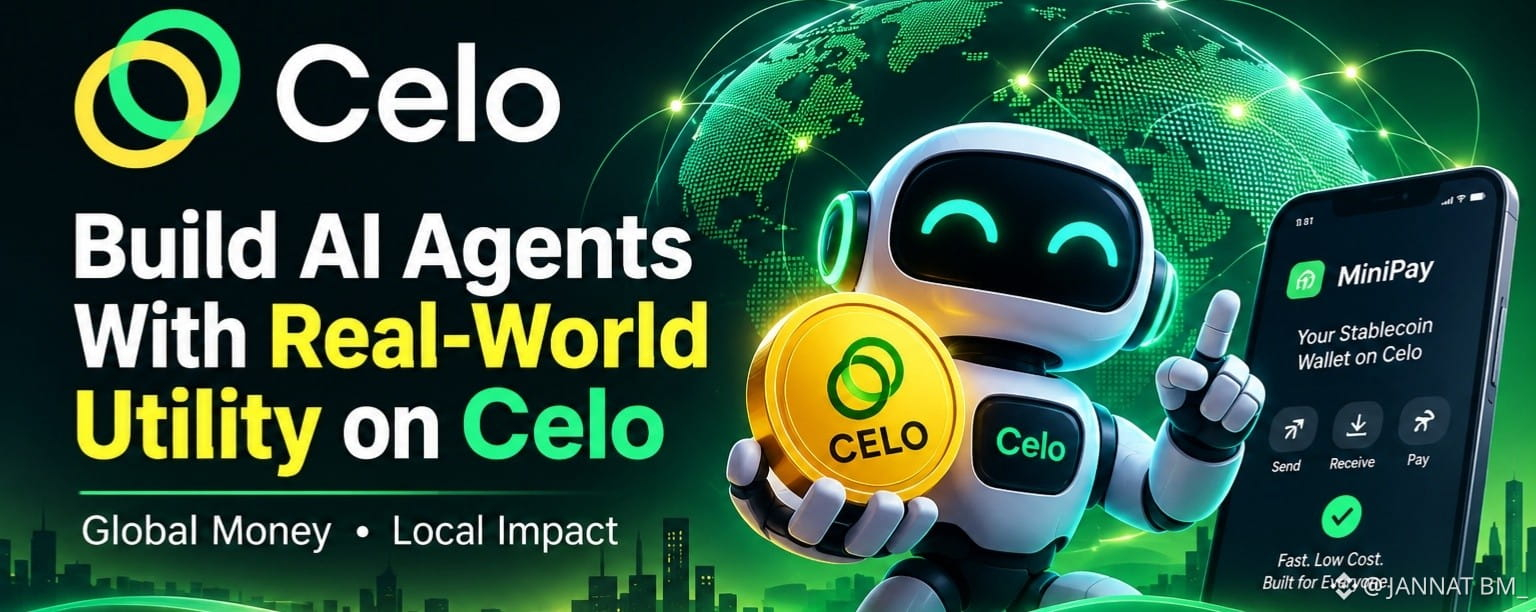
BUILD AI AGENTS WITH REALWORLD UTILITY ON CELOHmm Really, what makes an AI agent genuinely useful in crypto?
I think that’s becoming a more important question than simply asking how intelligent an agent is or how many tasks it can automate. An agent that can answer questions is useful, sure, but an agent that can actually move money, pay for services, interact with applications, and operate without someone manually approving every small step could change how people use blockchain.
This is where Celo caught my attention.
Celo seems to be positioning itself around something much more practical than just being another blockchain competing for attention. Its focus is connecting global money with local markets, financial platforms, currencies, and payment services. That idea becomes even more interesting when you look at it through the lens of AI agents. of crose, Most AI agents today still feel disconnected from the financial world. They can process information, make decisions, and automate workflows, but the moment a task requires an actual payment or an onchain transaction, things get more complicated. You need wallets, permissions, transaction infrastructure, gas, and a system that can operate reliably without making every interaction unnecessarily expensive.
And honestly, this is one area where blockchain infrastructure could make a difference🤔
Celo is an Ethereum Layer 2 built on the OP Stack, with average block times around one second and typical transaction fees below $0.01 according to its documentation. The website also lists an average gas fee of around $0.0002. If those costs remain consistently low, it makes small automated transactions far more practical. An AI agent paying for an API request, completing a task, sending a small payment, or interacting with another service doesn't need to worry about expensive transaction overhead every time it does something.
ability to pay gas using stablecoins is another part I find interesting. Celo supports gas payments using tokens such as USDT, USDC, USA₮ and USDm. For someone building AI agents, that removes an unnecessary layer of complexity. Instead of having to understand a separate gas token just to execute an operation, an agent could work with the same stablecoin balance it already uses for payments.
That might sound like a small improvement, but small friction points become significant when an automated system performs hundreds or thousands of operations. hmm, infrastructure behind Celo is also worth looking at. Its stack includes OP Stack technology, EigenDA v2 for data availability, and zkEVM capbilities through Succinct SP1. These aren't just names to put on a technical page. They address different parts of the system, including scaling, data availability, and verifiable execution. The real question is how effectively these components work together as applications and agent activity grow. Really, numbers on Celo's ecosystem also caught my eye. The information provided lists more than 1.5 billion total transactions, around 443K daily active users, $6.2 billion in monthly stablecoin volume, approximately 156 million CELO holders, and $261 million in total value secured. Those figures suggest the network is being used beyond a purely speculative environment, particularly around stablecoin activity and payments. Of course, transaction numbers alone don't tell us how many users are genuinely active or how much activity is sustainable, but they do give some context for the infrastructure agents could potentially use.
And then there is MiniPay.
A wallet with over 20 million wallet activations creates a different opportunity for developers. Instead of building an AI agent that only works for crypto-native users, developers could potentially create tools connected to payment experiences that are already familiar to people. The recent updates mentioned on Celo's website, including MiniPay's move toward Privy wallet infrastructure and stablecoin purchases using Link by Stripe for users in Europe and the US, are particularly interesting in this context.
It makes me wonder whether the next wave of AI adoption in crypto will actually come from agents that people barely notice. An agent that helps someone manage payments, purchase services, handle repetitive financial tasks, or interact with local payment systems might be more useful than another chatbot with a complicated dashboard.
Celo's documentation is already pointing builders toward agent wallets, x402 and MPP payment protocols, and ERC-8004 onchain identities. That combination starts to make the idea of autonomous ecnomic agents feel less abstract. An agent could potentially have an identity, hold funds, pay for resources, and interact with other services through programmable infrastructure.
Still, there is a lot to prove. Giving an AI access to a wallet introduces real risks around permissions, mistakes, security, and financial accountability. Low fees and fast transactions solve only part of the problem. The agent itself needs reliable safeguards, and users need a clear way to control what it can and cannot do. That is probably where I would focus most of my attention as this ecosystem develops.
Celo doesn't need every AI agent to become some futuristic autonomous machine. The more interesting outcome might be much simpler: agents that quietly handle useful financial tasks, make small payments, connect services, and save people time without making blockchain feel like another thing they have to learn. If Celo can make that experience reliable, accessible, and affordable, then building AI agents with realworld utility might become more than just another narrative in the crypto market. It could become an actual use case people return to every day.
And that's the part I think is worth watching. Not how many AI agents get launched, but how many actually become useful enough that people keep using them...🤔
@celo #CELO $CELO
{future}(CELOUSDT)
@BinanceTG
BUILD AI AGENTS WITH REALWORLD UTILITY ON CELO
Hmm Really, what makes an AI agent genuinely useful in crypto?
I think that’s becoming a more important question than simply asking how intelligent an agent is or how many tasks it can automate. An agent that can answer questions is useful, sure, but an agent that can actually move money, pay for services, interact with applications, and operate without someone manually approving every small step could change how people use blockchain.
This is where Celo caught my attention.
Celo seems to be positioning itself around something much more practical than just being another blockchain competing for attention. Its focus is connecting global money with local markets, financial platforms, currencies, and payment services. That idea becomes even more interesting when you look at it through the lens of AI agents. of crose, Most AI agents today still feel disconnected from the financial world. They can process information, make decisions, and automate workflows, but the moment a task requires an actual payment or an onchain transaction, things get more complicated. You need wallets, permissions, transaction infrastructure, gas, and a system that can operate reliably without making every interaction unnecessarily expensive.
And honestly, this is one area where blockchain infrastructure could make a difference🤔
Celo is an Ethereum Layer 2 built on the OP Stack, with average block times around one second and typical transaction fees below $0.01 according to its documentation. The website also lists an average gas fee of around $0.0002. If those costs remain consistently low, it makes small automated transactions far more practical. An AI agent paying for an API request, completing a task, sending a small payment, or interacting with another service doesn't need to worry about expensive transaction overhead every time it does something.
ability to pay gas using stablecoins is another part I find interesting. Celo supports gas payments using tokens such as USDT, USDC, USA₮ and USDm. For someone building AI agents, that removes an unnecessary layer of complexity. Instead of having to understand a separate gas token just to execute an operation, an agent could work with the same stablecoin balance it already uses for payments.
That might sound like a small improvement, but small friction points become significant when an automated system performs hundreds or thousands of operations. hmm, infrastructure behind Celo is also worth looking at. Its stack includes OP Stack technology, EigenDA v2 for data availability, and zkEVM capbilities through Succinct SP1. These aren't just names to put on a technical page. They address different parts of the system, including scaling, data availability, and verifiable execution. The real question is how effectively these components work together as applications and agent activity grow. Really, numbers on Celo's ecosystem also caught my eye. The information provided lists more than 1.5 billion total transactions, around 443K daily active users, $6.2 billion in monthly stablecoin volume, approximately 156 million CELO holders, and $261 million in total value secured. Those figures suggest the network is being used beyond a purely speculative environment, particularly around stablecoin activity and payments. Of course, transaction numbers alone don't tell us how many users are genuinely active or how much activity is sustainable, but they do give some context for the infrastructure agents could potentially use.
And then there is MiniPay.
A wallet with over 20 million wallet activations creates a different opportunity for developers. Instead of building an AI agent that only works for crypto-native users, developers could potentially create tools connected to payment experiences that are already familiar to people. The recent updates mentioned on Celo's website, including MiniPay's move toward Privy wallet infrastructure and stablecoin purchases using Link by Stripe for users in Europe and the US, are particularly interesting in this context.
It makes me wonder whether the next wave of AI adoption in crypto will actually come from agents that people barely notice. An agent that helps someone manage payments, purchase services, handle repetitive financial tasks, or interact with local payment systems might be more useful than another chatbot with a complicated dashboard.
Celo's documentation is already pointing builders toward agent wallets, x402 and MPP payment protocols, and ERC-8004 onchain identities. That combination starts to make the idea of autonomous ecnomic agents feel less abstract. An agent could potentially have an identity, hold funds, pay for resources, and interact with other services through programmable infrastructure.
Still, there is a lot to prove. Giving an AI access to a wallet introduces real risks around permissions, mistakes, security, and financial accountability. Low fees and fast transactions solve only part of the problem. The agent itself needs reliable safeguards, and users need a clear way to control what it can and cannot do. That is probably where I would focus most of my attention as this ecosystem develops.
Celo doesn't need every AI agent to become some futuristic autonomous machine. The more interesting outcome might be much simpler: agents that quietly handle useful financial tasks, make small payments, connect services, and save people time without making blockchain feel like another thing they have to learn. If Celo can make that experience reliable, accessible, and affordable, then building AI agents with realworld utility might become more than just another narrative in the crypto market. It could become an actual use case people return to every day.
And that's the part I think is worth watching. Not how many AI agents get launched, but how many actually become useful enough that people keep using them...🤔
@celo #CELO $CELO
@Binance TG Community
1
71

·
--
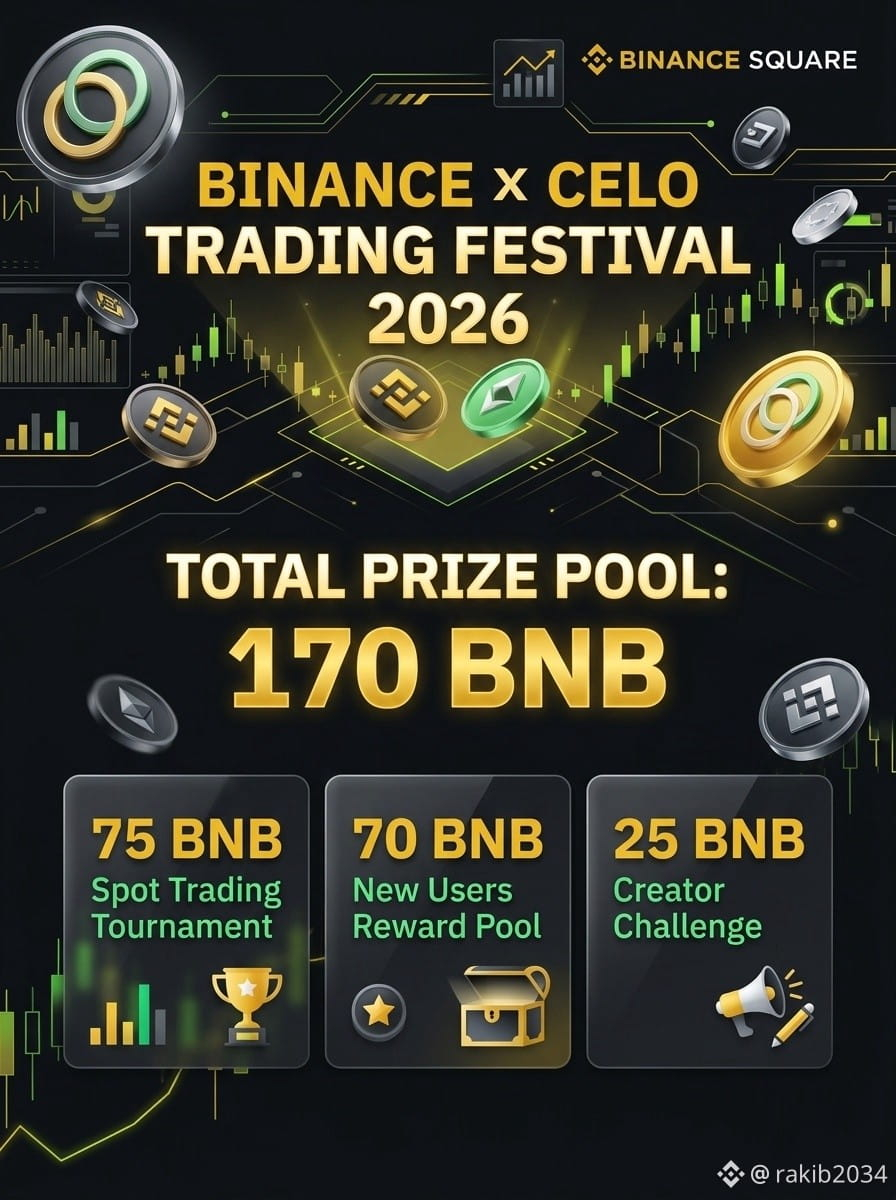
🚀 The Binance x Celo Trading Festival 2026 is Live! Grab Your Share of 170 BNB! 💰🔥
Binance and Celo ($CELO) have teamed up to bring an exciting trading campaign with massive rewards for traders, new users, and content creators!
🎁 Total Prize Pool: 170 BNB
🔹 75 BNB (Spot Trading Tournament): Compete on the leaderboard by trading $CELO on Spot and climb the ranks.
🔹 70 BNB (New Users Reward Pool): Special welcome rewards for new Binance users who register and start trading.
🔹 25 BNB (Creator Challenge): Create engaging content on Binance Square and social media to win from the creator pool!
✅ How to Participate:
1️⃣ Visit the official event page and click [Register / Join Now] before you start trading.
2️⃣ Trade the CELO/USDT pair on Binance Spot to boost your trading volume.
3️⃣ Share quality posts about $CELO and this festival to participate in the Creator Challenge!
👉 Join the Event Here: [Insert Your Referral / Event Link Here]
Don't miss out on this golden opportunity! Who else is joining the tournament? Drop your thoughts in the comments below! 👇
CELO BNB #Binance #CELO #TradingCompetitions #BinanceSquare #CryptoRewards
(Disclaimer: Cryptocurrency trading is subject to high market risk. Please review the official terms and conditions before participating. DYOR.)
1
427

·
--
🚨 Honestly, $CELO is one of those coins I keep coming back to.
Tether's USAT just went live on it, and Ripio launched stablecoins with free on/off-ramps. Real payments, real users.
840K daily actives isn't small either.
Everyone's busy chasing memes while this keeps building quietly. 👀
Do you think $CELO is underrated right now, or am I just being biased? Tell me below 👇
#CELO #CryptoTrading @celo
DYOR | NFA
1
326

·
--
170 BNB Prize Pool Up for Grabs!
Binance is running a massive $CELO campaign right now! Whether you're trading $CELO on Spot, just joining Binance, or creating content as an affiliate, there's a share of 170 $BNB waiting.
Don't forget to register before trading! Who's joining this one? 👇
#Binance #CELO #BNB
Binance is running a massive $CELO campaign right now! Whether you're trading $CELO on Spot, just joining Binance, or creating content as an affiliate, there's a share of 170 $BNB waiting.
Don't forget to register before trading! Who's joining this one? 👇
#Binance #CELO #BNB


Binance TG Community
·
--
CELO x Binance – CELO Trading Festival | Up to 170 BNB in Rewards!
Binance is teaming up with the Celo Foundation for a special campaign with 3 ways to participate and earn BNB rewards! https://www.binance.com/en/activity/trading-competition/ExCELOTradingFestival2026
Join here
📅 Campaign Period: November 20, 2026, 10:00 UTC – December 20, 2026, 10:00 UTC.
🔥 PROMO A – Trade & Earn | Up to 75 BNB Trade CELO/USDT on Binance Spot, reach at least 500 USDT in trading volume and compete for a share of the dynamic prize pool. Registration required!
🎁 PROMO B – Welcome Rewards | 70 BNB New Binance users can earn up to 0.0171 BNB by completing KYC, purchasing the required amount of CELO and holding it in Simple Earn for 3 full days.
⭐️ PROMO C – Creator Challenge | 25 BNB Create original content about Celo and get rewarded!
Top 50 creators: 0.34 BNB each.
All qualified affiliates: Share an additional 8 BNB pool equally.
Who can join? Registered Binance Affiliates with at least 5,000 followers in eligible regions.
📝 Ready to participate? Publish your content and submit it here
📌 Important: Campaign eligibility and regional restrictions apply. Rewards are distributed as BNB token vouchers. Full terms and conditions apply.
🔥 Trade CELO. Welcome new users. Create content. Share up to 170 BNB!
If you are not a Binance Affiliate yet, but you have a community over 5K users , drop us a comment in this comment section on Binance square if you are interested to join our affiliate program.
$CELO @celo

120

#Celo is building a real-world payments ecosystem aimed at billions of smartphone users.
Currently, users in many countries, especially in Africa, can use Celo's system to pay for everyday expenses such as coffee, breakfast, and groceries, with extremely low transaction fees.
If this project succeeds, Celo could be nothing less than a transcontinental bank with hundreds of millions of people making daily payments.
A project with such a long-term vision and real value, yet with a market capitalization of just over $30M—could it be undervalued?
Is this a great opportunity or a source of fear in this era??
Do your own research before making an investment decision $CELO .
116

·
--
Bullish
🚀 CELO: ecosystem developments and price conditions
Celo focuses on digital payments and stablecoin use. The latest news comes from MiniPay, a stablecoin wallet on the Celo network with more than 20 million activations. MiniPay announced an upgrade to its wallet infrastructure using Stripe-owned Privy. The rollout will be gradual.
However, an increase in the number of wallets does not necessarily lead to an immediate rise in demand for the CELO token. It remains to be seen whether network and stablecoin usage will also increase.
📊 According to a Binance snapshot on November 21 at 04:59 UTC, CELO was trading at around $0.0525, down 6.7% over 24 hours. Keep an eye on price movements, network activity, and liquidity—crypto assets remain risky and volatile.
Do you think MiniPay’s growth could drive sustained use of Celo?
$CELO
#CELO #Celo #Crypto #Altcoin #Binance #AMCx
98
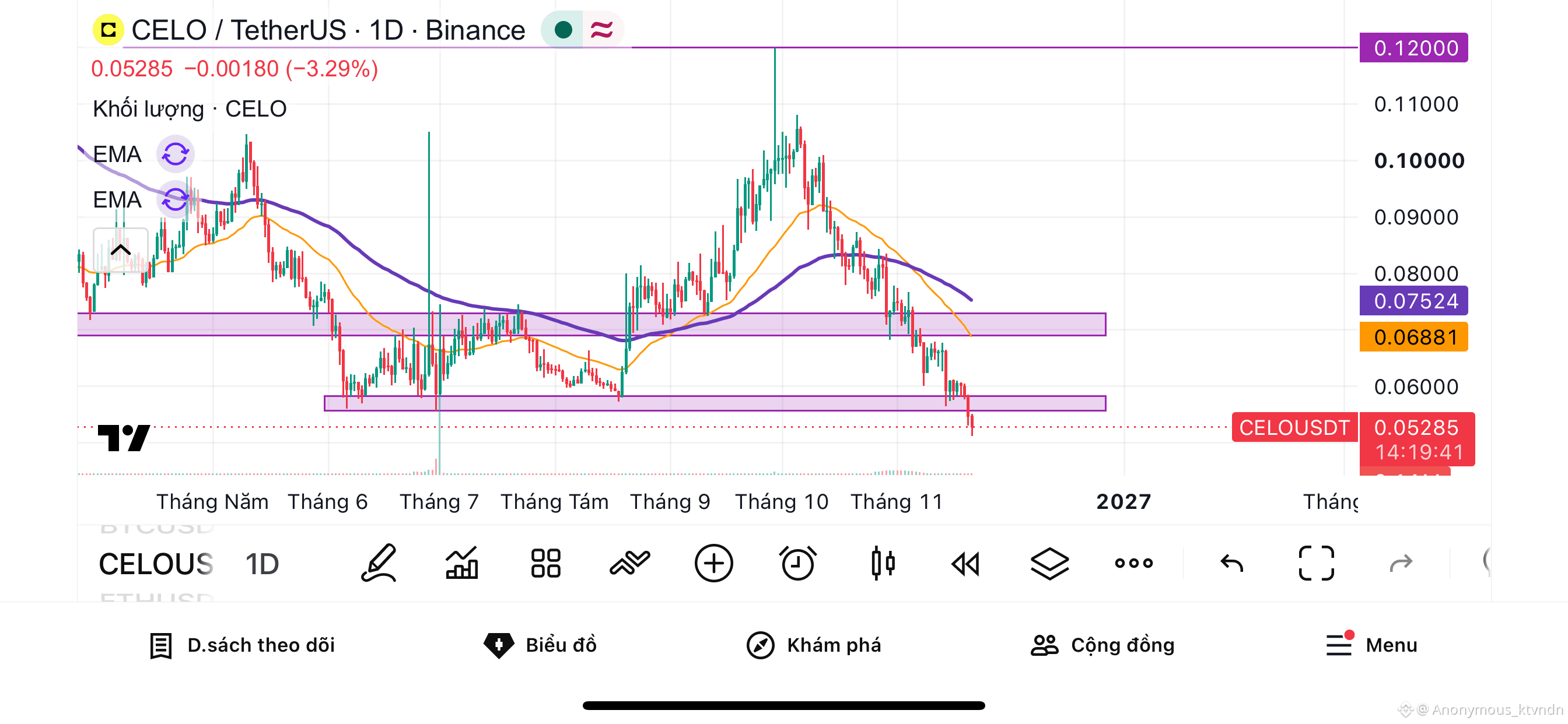
After such a long decline, there’s a very high chance $CELO will make a fake breakout and rebound to EMA34.
This rebound could reach the 0.06x area.
If I were trading, I’d watch this area for an entry, but as a long-term holder, I’ll just keep an eye out for an opportunity to accumulate more.
This is my personal opinion, not investment advice. Please do your own research before investing.
#celo
This rebound could reach the 0.06x area.
If I were trading, I’d watch this area for an entry, but as a long-term holder, I’ll just keep an eye out for an opportunity to accumulate more.
This is my personal opinion, not investment advice. Please do your own research before investing.
#celo
298

·
--

Article
79.2K new stablecoin holders in a single day puts Celo at the top across all chains! Its stablecoin “吸引效应” is intensifying79.2K new stablecoin holders in a single day puts Celo at the top across all chains! Its stablecoin “吸引效应” is intensifying
While the broader crypto market remains gripped by extreme fear and tightening liquidity, Celo is stepping on the gas with its on-chain fundamentals.
According to the latest Token Terminal data cited by the RWA Foundation, the Celo network added 79,200 stablecoin holders in the past 24 hours, ranking first across all chains! This figure not only far outpaces established payment networks (BNB Chain +51.1K, Tron, and others), but also leaves Ethereum (+16.4K) and Solana (+21.2K) behind.
79.2K new stablecoin holders in a single day puts Celo at the top across all chains! Its stablecoin “吸引效应” is intensifying
79.2K new stablecoin holders in a single day puts Celo at the top across all chains! Its stablecoin “吸引效应” is intensifying
While the broader crypto market remains gripped by extreme fear and tightening liquidity, Celo is stepping on the gas with its on-chain fundamentals.
According to the latest Token Terminal data cited by the RWA Foundation, the Celo network added 79,200 stablecoin holders in the past 24 hours, ranking first across all chains! This figure not only far outpaces established payment networks (BNB Chain +51.1K, Tron, and others), but also leaves Ethereum (+16.4K) and Solana (+21.2K) behind.
255
·
--
Verified
Article
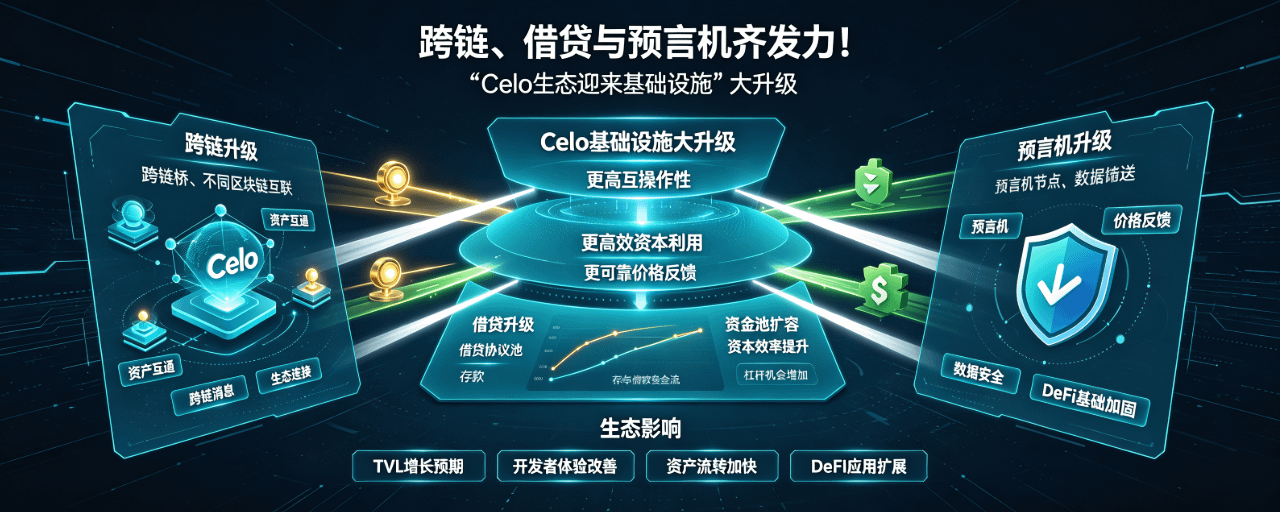
Cross-chain, lending, and oracles join forces! Celo’s ecosystem gets a major infrastructure upgradeWhile token prices fluctuate near the bottom, infrastructure development across the Celo ecosystem is entering a period of rapid growth. Three major developments have recently gone live, quietly laying a solid foundation for the network’s long-term prosperity.
First, the Aave V3 deployment proposal is now open, with a massive influx of liquidity on the horizon.
The Aave community has officially opened voting on an ARFC proposal to deploy Aave V3 on Celo. If approved, the proposal will support assets such as CELO, USDC, and USDT as collateral. Even more notably, the Celo Foundation and ecosystem partners have pledged up to $3 million in incentives, which will undoubtedly greatly enrich Celo’s DeFi lending ecosystem.
Cross-chain, lending, and oracles join forces! Celo’s ecosystem gets a major infrastructure upgrade
While token prices fluctuate near the bottom, infrastructure development across the Celo ecosystem is entering a period of rapid growth. Three major developments have recently gone live, quietly laying a solid foundation for the network’s long-term prosperity.
First, the Aave V3 deployment proposal is now open, with a massive influx of liquidity on the horizon.
The Aave community has officially opened voting on an ARFC proposal to deploy Aave V3 on Celo. If approved, the proposal will support assets such as CELO, USDC, and USDT as collateral. Even more notably, the Celo Foundation and ecosystem partners have pledged up to $3 million in incentives, which will undoubtedly greatly enrich Celo’s DeFi lending ecosystem.
1
716

·
--
🔍 $CELO — Can Buyers Build Momentum?
$CELO is a token worth keeping on the watchlist as market participants look for signs of a stronger recovery.
The key thing to watch is whether buyers can maintain momentum and push the price above nearby resistance levels.
A strong breakout with increasing volume could improve the bullish outlook, while rejection may lead to another period of consolidation.
Personally, I'd rather wait for confirmation than chase a sudden move.
What do you think about $CELO right now?
#CELO #CryptoMarket #Altcoins
1
2
255
·
--
Verified
Article
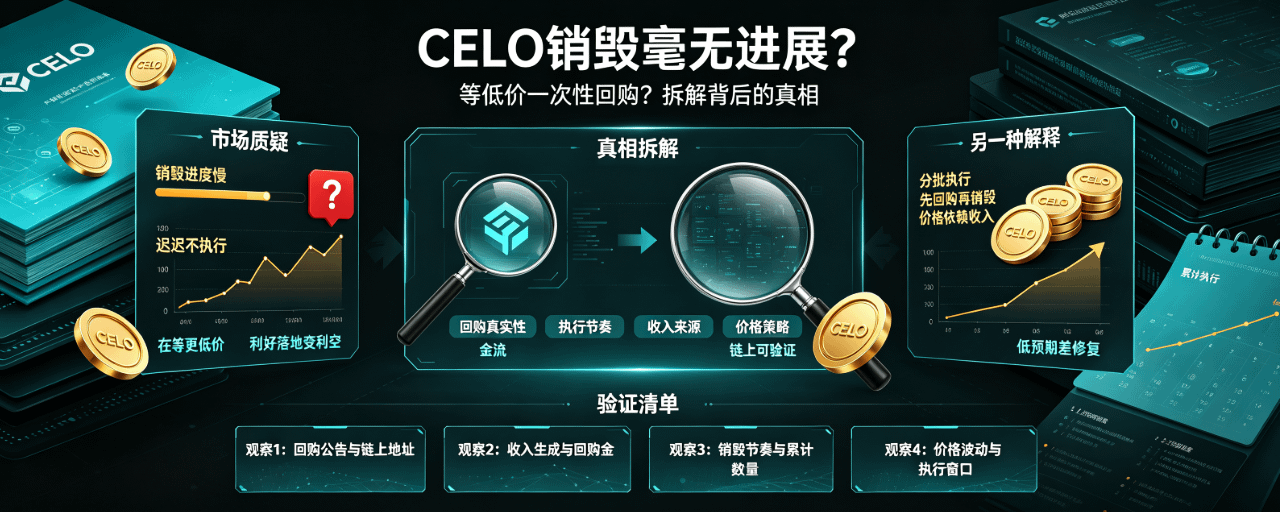
Has CELO Made No Progress on Burns? Is It Waiting for Lower Prices to Buy Back All at Once? Unpacking the TruthRecently, a question has been circulating in the community: Have CELO buybacks and burns stalled? Is the project team deliberately keeping things under wraps, waiting for the price to fall further so they can buy the dip all at once? As observers who follow on-chain data, we need to clearly distinguish between “buybacks” and “burns.”
First, buybacks have not stalled; they are actively taking place.
After the CELOccelerate mechanism was implemented, the protocol began programmatically using 100% of its net sequencer revenue and stablecoin gas fees to buy back CELO on the open market. The data is transparent: cumulative buybacks have now reached approximately 9.1 million tokens, and purchases continued over the past week, totaling around 600,000 tokens. So there is simply no truth to claims of “zero progress” or “deliberately not buying.” The buyback engine has been running all along; it’s just that, with current on-chain fees averaging only a few thousand dollars a day, the absolute volume is still relatively small.
Has CELO Made No Progress on Burns? Is It Waiting for Lower Prices to Buy Back All at Once? Unpacking the Truth
Recently, a question has been circulating in the community: Have CELO buybacks and burns stalled? Is the project team deliberately keeping things under wraps, waiting for the price to fall further so they can buy the dip all at once? As observers who follow on-chain data, we need to clearly distinguish between “buybacks” and “burns.”
First, buybacks have not stalled; they are actively taking place.
After the CELOccelerate mechanism was implemented, the protocol began programmatically using 100% of its net sequencer revenue and stablecoin gas fees to buy back CELO on the open market. The data is transparent: cumulative buybacks have now reached approximately 9.1 million tokens, and purchases continued over the past week, totaling around 600,000 tokens. So there is simply no truth to claims of “zero progress” or “deliberately not buying.” The buyback engine has been running all along; it’s just that, with current on-chain fees averaging only a few thousand dollars a day, the absolute volume is still relatively small.
737

·
--
🚨 CELO: IS $CELO SHOWING SIGNS OF LIFE? 👀🔥
What if one of the most overlooked altcoins is quietly preparing for its next big move?
Look at the monthly chart! 📊
After years of declining from its historic highs, CELO is trading around $0.059, and recent volume activity is catching my attention.
Could this be the early stage of accumulation before the next major market cycle?
🐋 Is smart money positioning early?
📈 Is CELO preparing for a long-term recovery?
💎 Or is this another false signal?
I'm watching the volume, moving averages, and key breakout levels closely.
Drop your prediction👇
#CELO $CELO
{spot}(CELOUSDT)
🚨 CELO: IS $CELO SHOWING SIGNS OF LIFE? 👀🔥
What if one of the most overlooked altcoins is quietly preparing for its next big move?
Look at the monthly chart! 📊
After years of declining from its historic highs, CELO is trading around $0.059, and recent volume activity is catching my attention.
Could this be the early stage of accumulation before the next major market cycle?
🐋 Is smart money positioning early?
📈 Is CELO preparing for a long-term recovery?
💎 Or is this another false signal?
I'm watching the volume, moving averages, and key breakout levels closely.
Drop your prediction👇
#CELO $CELO
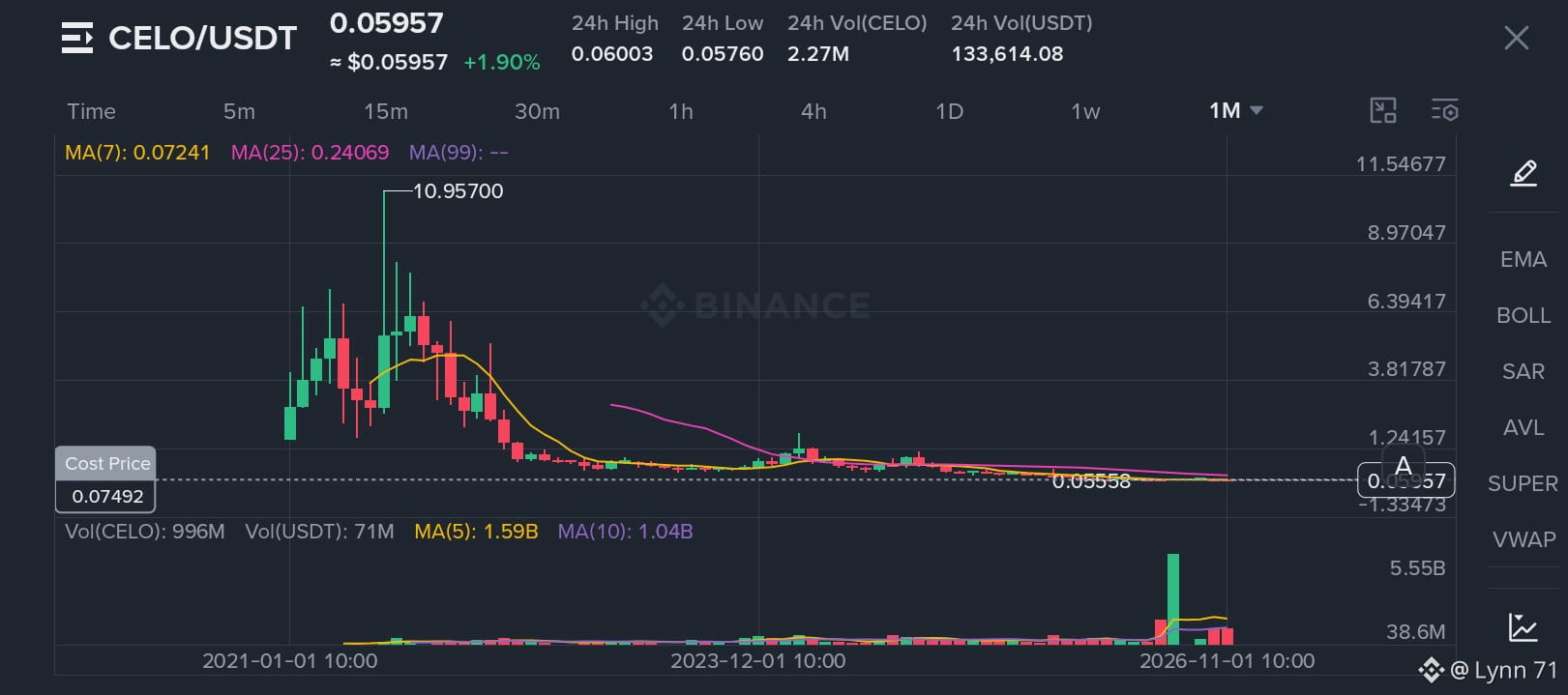
130

·
--
$CELO This setup looks interesting.
Buyers have been aggressively taking orders for the past hour, and the price is still hovering near the two-day low.
Worth noting: it has pulled back a bit over the past 15 minutes, and volume hasn’t come in yet, so enter with one-third now and leave the rest as a limit order at 0.05905.
Exit if it breaks below 0.05122; take 30% off the table at 0.06629.
#CELO #山寨币 #Futures contract
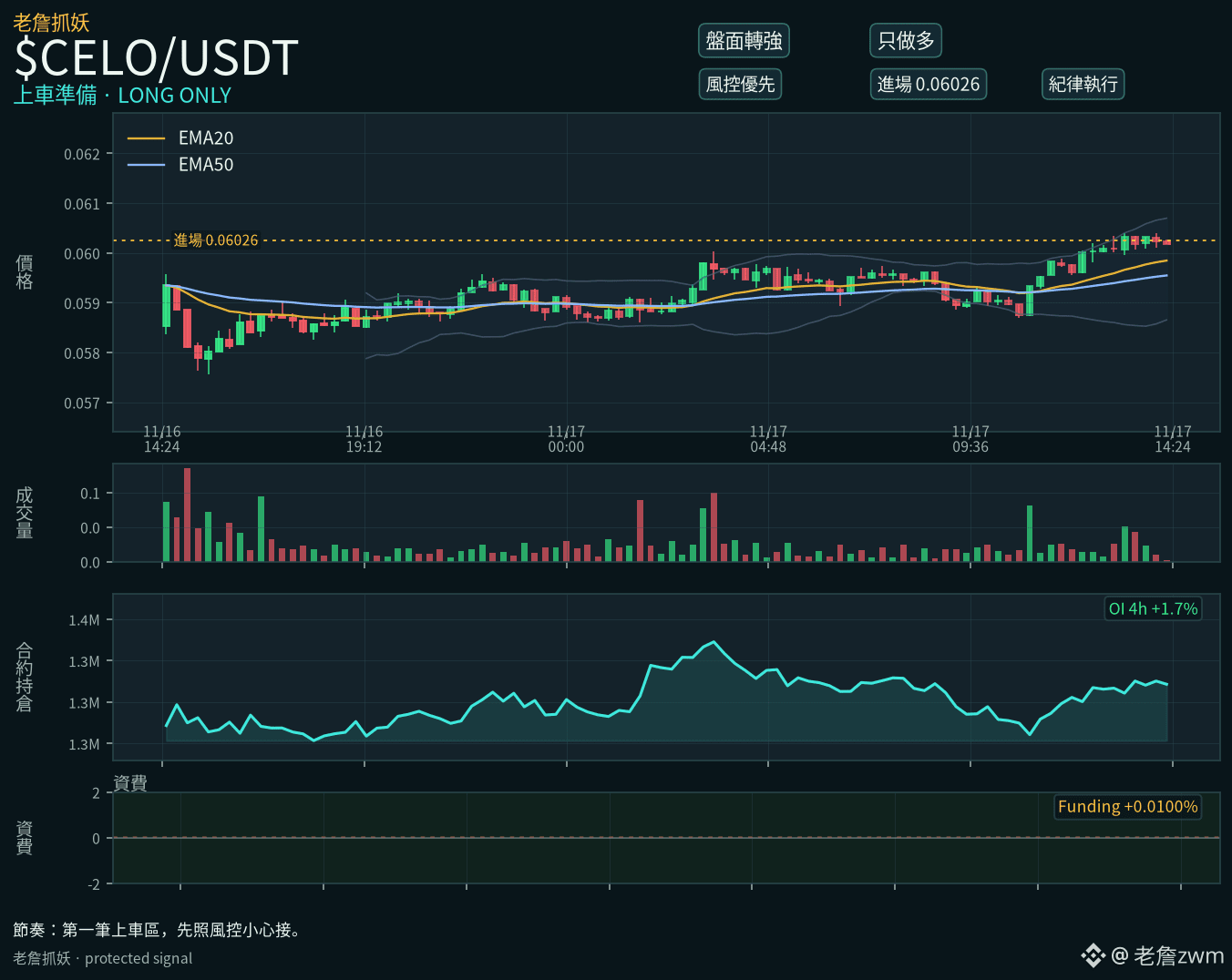
25
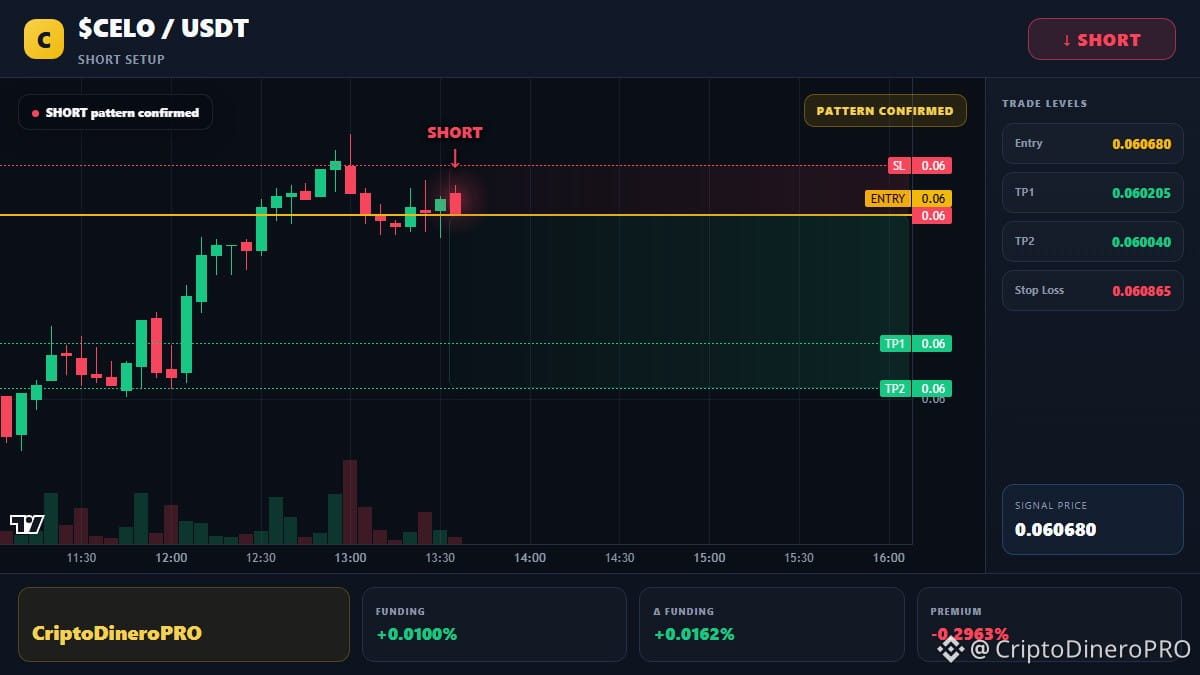

·
--
Bullish
$CELO is showing strength from support, with buyers gradually taking control and momentum building for a potential continuation move.
Entry: 0.06620–0.06680
TP1: 0.06776
TP2: 0.06802
TP3: 0.06950
SL: 0.06462
Buy and Trade $FIL
#CELO $ZEC
{future}(ZECUSDT)
{future}(FILUSDT)
{future}(CELOUSDT)
$CELO is showing strength from support, with buyers gradually taking control and momentum building for a potential continuation move.
Entry: 0.06620–0.06680
TP1: 0.06776
TP2: 0.06802
TP3: 0.06950
SL: 0.06462
Buy and Trade $FIL
#CELO $ZEC
Entry: 0.06620–0.06680
TP1: 0.06776
TP2: 0.06802
TP3: 0.06950
SL: 0.06462
Buy and Trade $FIL
#CELO $ZEC
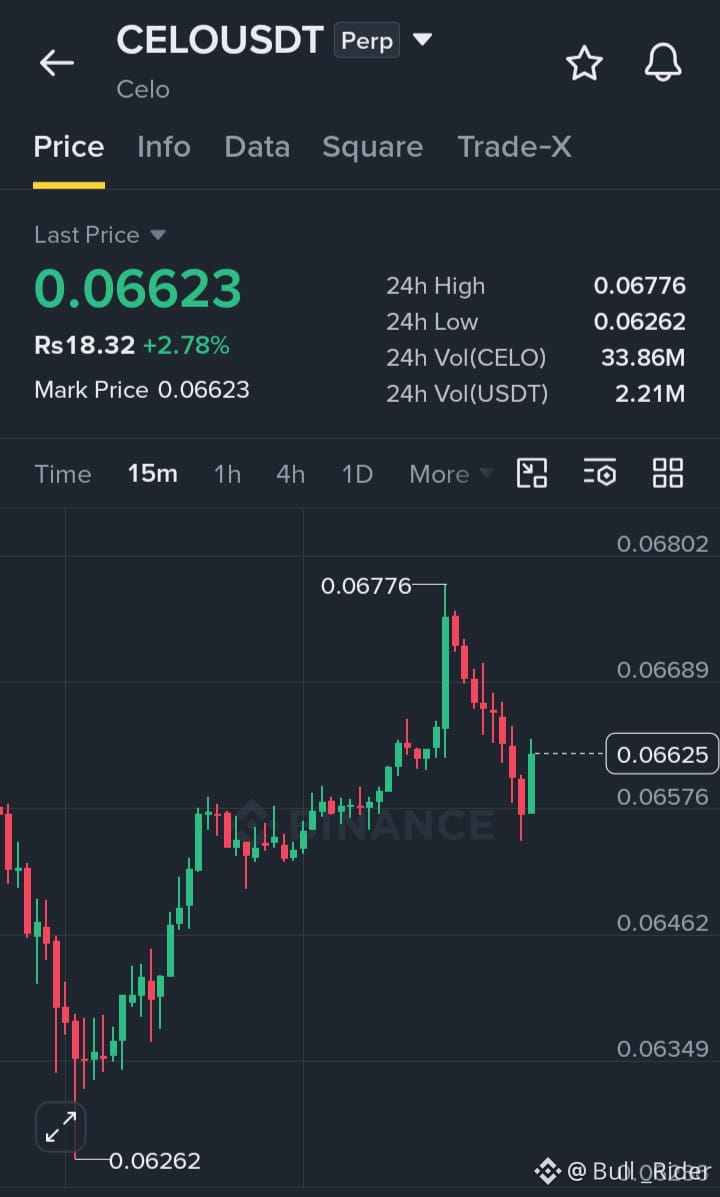
1
99

CELO: the chain built for a billion phones is now worth 6 cents. 📱😅
Spot: $CELO $0.065, -3.4% today, -29% this month, -70% over the last year. RSI 34.6 — weak zone, sitting right on support $0.0647. Resistance $0.0672.
The funny part? Celo actually works — it's an Ethereum L2 now, with $175M in stablecoins on-chain. The tech showed up. The price didn't.
$BTC isn't helping either: $71,800, -3.3% today, below its 200-day average, 5th straight day of ETF outflows.
Verdict: spot watchlist only — wait for $0.0647 to hold before touching it.
Not financial advice. DYOR.
#CELO #Crypto #Altcoins
91

·
--
$CELO 🌍 CELO ECOSYSTEM PULSE: Buybacks, AI Services, & Navigating Market Shocks! ⚡📊
Binancians, let's zoom in on what’s happening with $CELO as the broader crypto market navigates a cautious sentiment phase! While macro conditions bring short-term friction, structural changes and ecosystem utility are keeping the community talking. Here is the latest deep-dive breakdown:
🔄 Tokenomics & Buybacks in Play:
Revenue Driven: Celo’s network upgrade model channels net sequencer revenue and stablecoin gas fees directly toward ongoing $CELO repurchases, acting as a structural counterweight during broader market pullbacks. 🛡️
Supply & Demand Balance: With millions of tokens repurchased since the overhaul, holders are closely tracking how network growth impacts long-term token value capture.
🤖 Real-World & AI Utility Expansion:
AI Services Marketplace: The integration of services tailored for AI agents settling in stablecoins marks a strategic push into emerging Web3 infrastructure.
The Adoption Equation: While stablecoin transactions drive active network utility, the core focus remains on how on-chain activity translates into sustained fee-capture for the ecosystem.
📉 Technical Outlook & Market Context:
Key Zones: Trading near local ranges around the $0.065 – $0.066 zone, CELO is experiencing a period of high-alert observation as traders watch macro market conditions and crucial support levels.
Rebound Potential: Analysts are eyeing whether ongoing buybacks and increasing marketplace traction can ignite a bullish reversal toward key overhead resistance levels.
Are you accumulating it for the long-term Web3 and AI narrative, or watching from the sidelines for confirmation? Drop your thoughts below! 👇💬✨
{spot}(CELOUSDT)
#CELO #Binance #CryptoAnalysis #Web3 #BinanceSquare
$CELO 🌍 CELO ECOSYSTEM PULSE: Buybacks, AI Services, & Navigating Market Shocks! ⚡📊
Binancians, let's zoom in on what’s happening with $CELO as the broader crypto market navigates a cautious sentiment phase! While macro conditions bring short-term friction, structural changes and ecosystem utility are keeping the community talking. Here is the latest deep-dive breakdown:
🔄 Tokenomics & Buybacks in Play:
Revenue Driven: Celo’s network upgrade model channels net sequencer revenue and stablecoin gas fees directly toward ongoing $CELO repurchases, acting as a structural counterweight during broader market pullbacks. 🛡️
Supply & Demand Balance: With millions of tokens repurchased since the overhaul, holders are closely tracking how network growth impacts long-term token value capture.
🤖 Real-World & AI Utility Expansion:
AI Services Marketplace: The integration of services tailored for AI agents settling in stablecoins marks a strategic push into emerging Web3 infrastructure.
The Adoption Equation: While stablecoin transactions drive active network utility, the core focus remains on how on-chain activity translates into sustained fee-capture for the ecosystem.
📉 Technical Outlook & Market Context:
Key Zones: Trading near local ranges around the $0.065 – $0.066 zone, CELO is experiencing a period of high-alert observation as traders watch macro market conditions and crucial support levels.
Rebound Potential: Analysts are eyeing whether ongoing buybacks and increasing marketplace traction can ignite a bullish reversal toward key overhead resistance levels.
Are you accumulating it for the long-term Web3 and AI narrative, or watching from the sidelines for confirmation? Drop your thoughts below! 👇💬✨
#CELO #Binance #CryptoAnalysis #Web3 #BinanceSquare
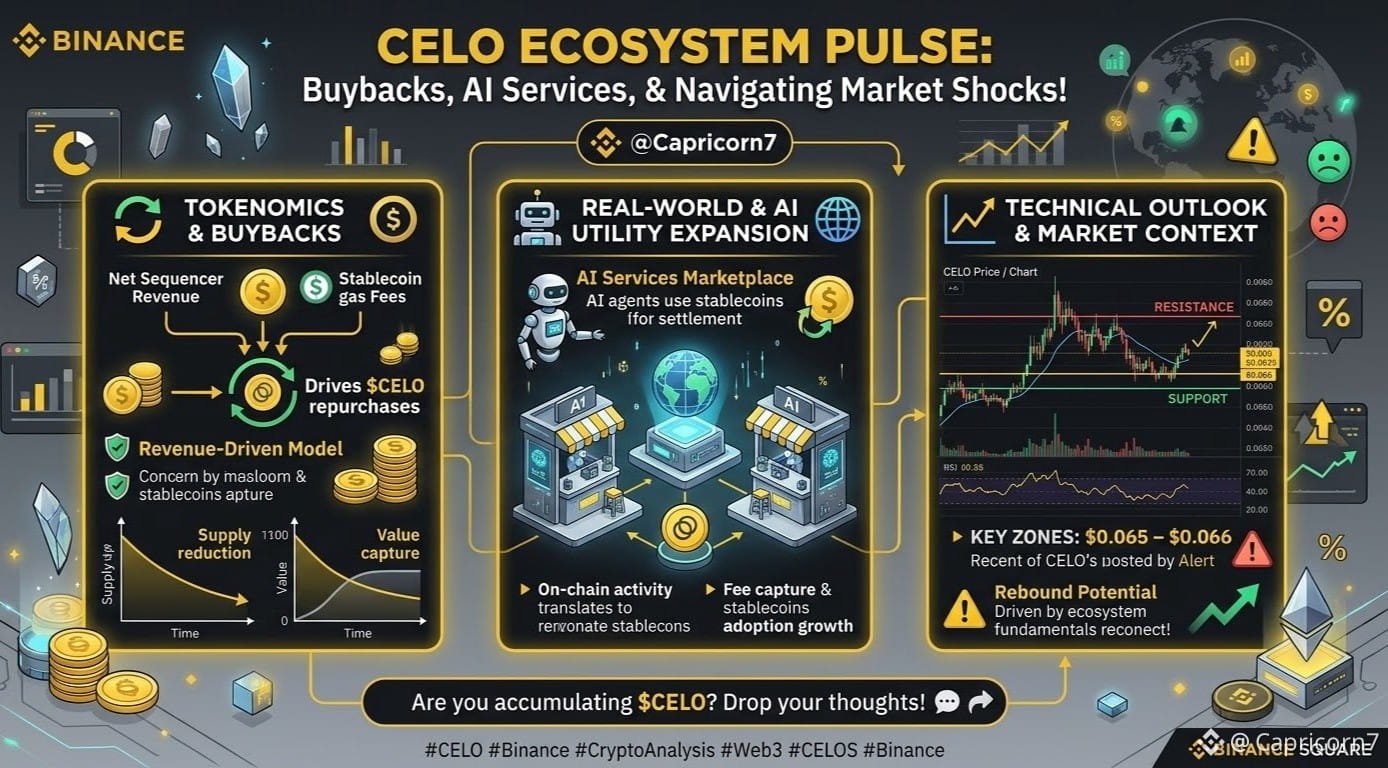
1
2
8
457
Log in to explore more content
Join global crypto users on Binance Square
⚡️ Get latest and useful information about crypto.
💬 Trusted by the world’s largest crypto exchange.
👍 Discover real insights from verified creators.
Email / Phone number
Trending Topics
1
#NvidiaLoses$2.7TrillionInMonthAndAHalf
8,880 views
89 Discussing
2
#CanBTCReboundAfterFallingBelow60K?
647,612 views
2,756 Discussing
3
#GlobalStocksFaceLongestLosingStreakSince2023
230,023 views
1,876 Discussing
4
#BlackRockIBITPostsRecord$541MSingleDayOutflow
23,715 views
74 Discussing
5
#AnthropicPlungesTowardIPOPriceonDay2
114,507 views
1,120 Discussing
6
#TwentyOneCapitalAdds172.25BTC
49,919 views
596 Discussing
7
#HKBillWouldExcludeTokenizedDepositsFromVirtualAssets
5,756 views
48 Discussing
8
#BNBDropsBelow540USDTWith8.46%DailyDecline
64,750 views
586 Discussing
9
#HKBillProposesHK$100KFineForUnauthorizedCryptoTitles
2,196 views
21 Discussing
10
#BitMineFaces$10.1BUnrealizedETHLoss
4,443 views
25 Discussing