

#bitcoincore32.1raisespeerconnectionlimit
bitcoincore32.1raisespeerconnectionlimit
47,484 views
517 Discussing
Hot
Latest

#bitcoincore32.1raisespeerconnectionlimit
🚨 BITCOIN JUST GOT UNBREAKABLE: CORE RAISES LIMIT 125 → 200! 🚨
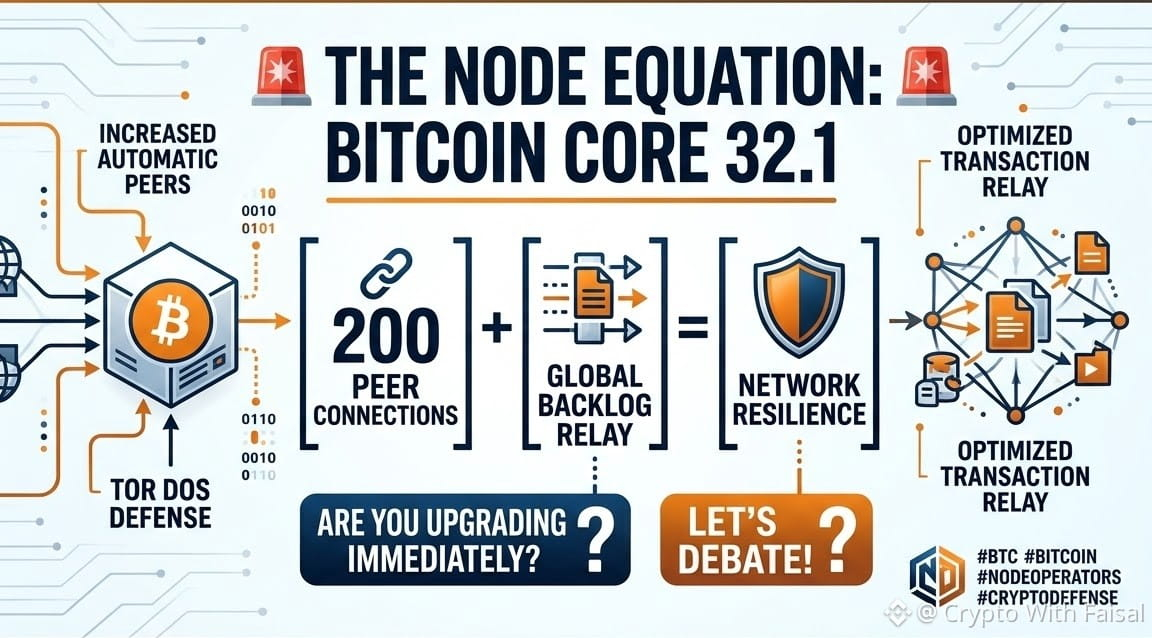
THE NODE EQUATION: BITCOIN CORE 32.1
Everyone is talking about price, but smart money is watching THIS upgrade! Let's break down why Bitcoin just became unstoppable using pure math 🧮👇
(200 Peer Connections) + (Global Backlog Relay) + (PoW Defense) = MAXIMUM Network Resilience 🛡️
Here is the exact formula driving this pump in network health:
The Expansion:
(200 Connections) - (125 Old Limit) = +60% More Power. The largest capacity haul in YEARS!
The Defense:
(Tor PoW Shield) = DoS Attacks DEAD. Nodes are now protected from malicious floods.
The Efficiency:
(Per-Peer Queue ❌) → (Global Backlog ✅) = Memory Leak FIXED + CPU Saved.
The Breakdown:
On Oct 27, Bitcoin Core dropped v32.1. While retail was panicking, devs quietly made the network 60% bigger, faster, and safer. This is how you build a network that lasts 100 years.
Wall Street wants ETF, but Bitcoin wants STRONG NODES. And it just got them.
Is your node updated for the 200-connection era? Or are you still stuck at 125? Let's debate below! 👇
$BTC
#Bitcoin #BTC #BlackRock #CryptoNews

3
357

Verified
#bitcoincore32.1raisespeerconnectionlimit
🚨 THE NODE EQUATION: BITCOIN CORE 32.1 🚨
A critical upgrade just dropped for Bitcoin full nodes, and it’s a massive win for network health! Let’s break down the new release using pure math 🧮👇
(200 Peer Connections) + (Global Backlog Relay) = Network Resilience 🛡️
Here is the exact formula driving the Bitcoin network update today:
The Upgrade Breakdown:
(The Input) = Bitcoin Core has released version 32.1.
The Expansion: It increases the default maximum number of automatic peer connections from 125 to 200 .
The Defense: It adds proof-of-work defenses for Tor hidden services to fight DoS attacks.
The Efficiency: It utilizes a "global-backlog" approach to transaction relay rate limiting, optimizing memory and CPU use.
The Breakdown:
Fewer peers means slower block and transaction propagation. By boosting connections and securing Tor nodes, Bitcoin Core 32.1 significantly hardens the network against censorship and DoS attempts while lowering resource requirements for node operators.
If you are a node operator, are you upgrading immediately, or waiting to test? Let's debate! 👇💬
$BTC
{future}(BTCUSDT)
$ETH
{future}(ETHUSDT)
$BNB
{future}(BNBUSDT)
#Bitcoin #CryptoSecurity #NodeOperators #BinanceSquare
#bitcoincore32.1raisespeerconnectionlimit
🚨 THE NODE EQUATION: BITCOIN CORE 32.1 🚨
A critical upgrade just dropped for Bitcoin full nodes, and it’s a massive win for network health! Let’s break down the new release using pure math 🧮👇
(200 Peer Connections) + (Global Backlog Relay) = Network Resilience 🛡️
Here is the exact formula driving the Bitcoin network update today:
The Upgrade Breakdown:
(The Input) = Bitcoin Core has released version 32.1.
The Expansion: It increases the default maximum number of automatic peer connections from 125 to 200 .
The Defense: It adds proof-of-work defenses for Tor hidden services to fight DoS attacks.
The Efficiency: It utilizes a "global-backlog" approach to transaction relay rate limiting, optimizing memory and CPU use.
The Breakdown:
Fewer peers means slower block and transaction propagation. By boosting connections and securing Tor nodes, Bitcoin Core 32.1 significantly hardens the network against censorship and DoS attempts while lowering resource requirements for node operators.
If you are a node operator, are you upgrading immediately, or waiting to test? Let's debate! 👇💬
$BTC
$ETH
$BNB
#Bitcoin #CryptoSecurity #NodeOperators #BinanceSquare
Tim Berners-Lee WorldWideWeb The World Archie EFF ARPANET:
@Square-Creator-6081246fb8a9 Este incremento no es un simple capricho de ancho de banda. Al elevar el límite de conexiones automáticas, los desarrolladores buscan reforzar la topología de la red global de Bitcoin, haciéndola mucho más densa y resistente ante posibles ataques de eclipse o intentos de aislamiento de nodos.
2
2
870

·
--
Bullish
#bitcoincore32.1raisespeerconnectionlimit 🚨 BITCOIN CORE 32.1 IS HERE — A NETWORK SECURITY & PERFORMANCE UPDATE! ₿🛡️
Bitcoin Core has officially released version 32.1, bringing important improvements to peer connectivity, transaction relay, and privacy-related protections.
🔗 1. PEER CONNECTION LIMIT INCREASED
The default maximum number of automatic peer connections has increased from 125 to 200, providing additional inbound capacity for block-relay-only peers. Automatic outbound connections remain unchanged.
🛡️ 2. TOR SECURITY IMPROVEMENTS
Automatically created Tor hidden services can now use proof-of-work defenses, provided the Tor daemon supports them. This helps defend against certain denial-of-service attacks.
⚡ 3. MORE EFFICIENT TRANSACTION RELAY
Bitcoin Core has changed outgoing transaction relay rate-limiting to use a global backlog instead of managing it separately for each peer. The goal is to reduce memory and CPU usage during periods of high transaction volume.
🔐 4. PRIVATE BROADCAST FIX
The release also addresses a potential IP-address privacy leak involving certain sendrawtransaction RPC configurations with private broadcasting enabled. <Cite refs={["turn595663search0","turn595663search1"]}/>
💡 MY TAKE
This is a meaningful infrastructure update for Bitcoin node operators. Better resource management, additional inbound peer capacity, and stronger Tor protections can help improve node operations and network resilience.
However, these changes do not guarantee a BTC price rally. Bitcoin's market price still depends on liquidity, demand, macroeconomic conditions, and investor sentiment.
₿ WATCHLIST: $BTC $ETH $BNB
Are you running your own Bitcoin node, and will you upgrade to Core 32.1?
#Bitcoin #BitcoinCore #CryptoSecurity #NodeOperators #CryptoNews #BinanceSquare


·
--
#bitcoincore32.1raisespeerconnectionlimit #bnb
🚨 BITCOIN CORE 32.1: STRONGER NETWORK, BETTER EFFICIENCY! 🛡️
Bitcoin Core 32.1 brings key upgrades for full-node operators:
🔹 Default automatic peer connections increase from 125 to 200.
🔹 Proof-of-work defenses help protect Tor hidden services against DoS attacks.
🔹 Improved transaction relay rate limiting helps optimize CPU and memory usage.
⚡ The Goal: Better network resilience, security, and efficiency.
💬 Are you upgrading your Bitcoin node or waiting to test first?."CLICK ON THE BELOW YELLOW COIN TAG TO GO TO DESIRED TRADING PAGE TO GET BENEFIT TRADE"$BNB $BTC $ETH
{spot}(ETHUSDT)
{spot}(BTCUSDT)
{spot}(BNBUSDT)
#BitcoinCore #NODE
#bitcoincore32.1raisespeerconnectionlimit #bnb
🚨 BITCOIN CORE 32.1: STRONGER NETWORK, BETTER EFFICIENCY! 🛡️
Bitcoin Core 32.1 brings key upgrades for full-node operators:
🔹 Default automatic peer connections increase from 125 to 200.
🔹 Proof-of-work defenses help protect Tor hidden services against DoS attacks.
🔹 Improved transaction relay rate limiting helps optimize CPU and memory usage.
⚡ The Goal: Better network resilience, security, and efficiency.
💬 Are you upgrading your Bitcoin node or waiting to test first?."CLICK ON THE BELOW YELLOW COIN TAG TO GO TO DESIRED TRADING PAGE TO GET BENEFIT TRADE"$BNB $BTC $ETH
#BitcoinCore #NODE

1
10

#BitcoinCore32.1RaisesPeerConnectionLimit
Bitcoin Core 32.1 and the peer connection limit: what node operators should check
The #BitcoinCore32.1RaisesPeerConnectionLimit chatter is worth a closer look. Before you change anything:
• Read the official release notes first, since the exact change matters
• More peers means more bandwidth, memory, and CPU use
• More connections isn't automatically better. Peer diversity (network types, ASNs) matters more for resisting eclipse attacks than raw peer count
• Most operators are fine on defaults
Running a node? Review your -maxconnections setting and monitor resource use after upgrading.
Verify details at bitcoincore.org.
$BTC #bitcoin #BitcoinCore #Node
57

·
--
#BitcoinCore32.1RaisesPeerConnectionLimit 🚨 BITCOIN JUST GOT A NETWORK UPGRADE! ₿⚡
Have you heard? 👀
Bitcoin Core 32.1 has officially been released!
One of the biggest changes? The default maximum number of peer connections has increased from 125 to 200. 🔥
But what does this actually mean? 🤔
🌐 1. More Peer Connections
Bitcoin nodes can now accept more incoming connections by default, creating additional capacity for block-relay-only peers.
⚡ 2. Improved Network Efficiency
The update introduces changes to transaction relay rate-limiting designed to reduce memory and CPU usage during periods of high transaction volume.
🔐 3. Better Privacy Protections
The release fixes a potential IP address leak involving certain private transaction broadcasts through Tor.
🛠️ 4. Bug Fixes and Performance Improvements
The release also includes other technical improvements to Bitcoin Core.
📌 THE BIG TAKEAWAY:
This is a network-level improvement, not a Bitcoin price catalyst by itself.
It strengthens aspects of how Bitcoin nodes communicate and relay transactions, but it does not automatically mean BTC's price will rise.
Bitcoin's infrastructure continues to evolve. 🚀
💬 What do you think? Are network upgrades like this underrated in the crypto space?
#Bitcoin #BTC #BitcoinCore #CryptoNews #Binance
1
1
3

·
--
#BitcoinCore32.1RaisesPeerConnectionLimit
Bitcoin Core has officially released version 32.1, a critical security and maintenance update that significantly strengthens the peer-to-peer (P2P) network architecture. The most notable adjustment under the hood is an increase in the default maximum number of automatic peer connections from 125 to 200. [1, 2, 3]
This version was deployed as a swift technical response alongside the disclosure of three "easily discoverable" vulnerabilities, including a bug that could allow a malicious peer to crash Windows, macOS, and BSD-based nodes. [1, 2]
$ACT
{future}(ACTUSDT)
$BANK
{future}(BANKUSDT)
$DOGE
{future}(DOGEUSDT)
#BitcoinCore32EntersFinalTesting
#BitcoinCore32
#BitcoinWarnings
#BitcoinCore32.1RaisesPeerConnectionLimit
Bitcoin Core has officially released version 32.1, a critical security and maintenance update that significantly strengthens the peer-to-peer (P2P) network architecture. The most notable adjustment under the hood is an increase in the default maximum number of automatic peer connections from 125 to 200. [1, 2, 3]
This version was deployed as a swift technical response alongside the disclosure of three "easily discoverable" vulnerabilities, including a bug that could allow a malicious peer to crash Windows, macOS, and BSD-based nodes. [1, 2]
$ACT
$BANK
$DOGE
#BitcoinCore32EntersFinalTesting
#BitcoinCore32
#BitcoinWarnings


157

·
--
#bitcoincore32.1raisespeerconnectionlimit
Bitcoin Core 32.1: Bigger Peer Limit, Not a Price Catalyst
Bitcoin Core 32.1 raises the default max peer connections from 125 to 200. Outbound connections stay at 11, so the extra room is mostly inbound: roughly 114 → 189 slots.
Why it matters
The change makes room for more block-relay-only peers, which share blocks but not transactions. That can make the network harder to partition or eclipse and gives new nodes more peers to sync from. By default, tx-relaying peers use at most 50% of inbound slots.
The trade-off
More connections use more memory, bandwidth and CPU, so operators on small VPS plans should check their settings. A bigger number also doesn't guarantee diversity if peers share the same hosting providers.
Market view
This is infrastructure, not a trade signal. $BTC trades near $80K, and price still follows macro and liquidity more than node settings.
Will you run the new 200 default or cap it lower? 👇
Not financial advice.
#Bitcoin #BitcoinCore #NodeOperators
$BTC
{future}(BTCUSDT)
#bitcoincore32.1raisespeerconnectionlimit
Bitcoin Core 32.1: Bigger Peer Limit, Not a Price Catalyst
Bitcoin Core 32.1 raises the default max peer connections from 125 to 200. Outbound connections stay at 11, so the extra room is mostly inbound: roughly 114 → 189 slots.
Why it matters
The change makes room for more block-relay-only peers, which share blocks but not transactions. That can make the network harder to partition or eclipse and gives new nodes more peers to sync from. By default, tx-relaying peers use at most 50% of inbound slots.
The trade-off
More connections use more memory, bandwidth and CPU, so operators on small VPS plans should check their settings. A bigger number also doesn't guarantee diversity if peers share the same hosting providers.
Market view
This is infrastructure, not a trade signal. $BTC trades near $80K, and price still follows macro and liquidity more than node settings.
Will you run the new 200 default or cap it lower? 👇
Not financial advice.
#Bitcoin #BitcoinCore #NodeOperators
$BTC

270

·
--
#BitcoinCore32.1RaisesPeerConnectionLimit
🚀 $BTC Core 32.1 just raised the default peer connection limit from 125 to 200!
More inbound slots reserved for block-relay-only peers — stronger network resilience and better decentralization without extra resource strain.
Quiet but powerful upgrades like this keep $BTC ’s backbone rock-solid. Node runners, time to update!
$BTC
#Bitcoin #BTC #BitcoinCore #NodeOperators
{spot}(BTCUSDT)
#BitcoinCore32.1RaisesPeerConnectionLimit
🚀 $BTC Core 32.1 just raised the default peer connection limit from 125 to 200!
More inbound slots reserved for block-relay-only peers — stronger network resilience and better decentralization without extra resource strain.
Quiet but powerful upgrades like this keep $BTC ’s backbone rock-solid. Node runners, time to update!
$BTC
#Bitcoin #BTC #BitcoinCore #NodeOperators

72

·
--
Bearish
#bitcoincore32.1raisespeerconnectionlimit Bitcoin network fundamentals just received a significant upgrade. The release of Bitcoin Core 32.1 introduces a higher peer connection limit for node operators, a technical shift carrying meaningful implications for network resilience and decentralization.
What changed? By raising the maximum number of peer connections, the update allows nodes to communicate with a broader network segment simultaneously. This reduces partitioning risks and improves transaction propagation speed.
Why does this matter? While protocol upgrades do not directly dictate short-term price action, they strengthen the underlying security model. A highly connected network is harder to censor and resists outages, reinforcing Bitcoin’s value as a trustless settlement layer.
Market sentiment often fixates on immediate price catalysts, but long-term viability relies on continuous infrastructural improvements. This update signals that core developers remain focused on optimizing network health over speculative features.
What should traders watch next? Monitor node adoption metrics to see how quickly the network integrates this change. Additionally, track macroeconomic liquidity and institutional inflows, which will remain the primary drivers of near-term price volatility. Network fundamentals build the floor, but macro liquidity drives the ceiling.
#Bitcoin #CryptoNews #NetworkUpgrade #BTC
$BTC $ETH $SOL
{future}(SOLUSDT)
{future}(ETHUSDT)
{future}(BTCUSDT)
#bitcoincore32.1raisespeerconnectionlimit Bitcoin network fundamentals just received a significant upgrade. The release of Bitcoin Core 32.1 introduces a higher peer connection limit for node operators, a technical shift carrying meaningful implications for network resilience and decentralization.
What changed? By raising the maximum number of peer connections, the update allows nodes to communicate with a broader network segment simultaneously. This reduces partitioning risks and improves transaction propagation speed.
Why does this matter? While protocol upgrades do not directly dictate short-term price action, they strengthen the underlying security model. A highly connected network is harder to censor and resists outages, reinforcing Bitcoin’s value as a trustless settlement layer.
Market sentiment often fixates on immediate price catalysts, but long-term viability relies on continuous infrastructural improvements. This update signals that core developers remain focused on optimizing network health over speculative features.
What should traders watch next? Monitor node adoption metrics to see how quickly the network integrates this change. Additionally, track macroeconomic liquidity and institutional inflows, which will remain the primary drivers of near-term price volatility. Network fundamentals build the floor, but macro liquidity drives the ceiling.
#Bitcoin #CryptoNews #NetworkUpgrade #BTC
$BTC $ETH $SOL

295


#bitcoincore32.1raisespeerconnectionlimit
🚀 $BITCOIN Core 32.1 Raises Peer Connection Limit: Is Bitcoin’s Network Getting Stronger? 🔥
Sometimes, the biggest upgrades happen where most people never look. Beneath every Bitcoin transaction, a global network quietly works to keep the system connected.
Bitcoin Core 32.1, released on October 27, increases the default maximum number of automatic peer connections from 125 to 200. It also introduces a configurable inbound transaction-relay limit, set to 50% by default.
Why does this matter? Bitcoin nodes communicate with peers to share network information. More inbound connection capacity can help accommodate additional block-relay-only peers, strengthening the infrastructure that supports Bitcoin’s decentralized operation.
My Take: This is an infrastructure improvement, not a direct price catalyst. Bitcoin’s long-term resilience depends not only on adoption and market demand, but also on independent nodes maintaining reliable connections and exchanging information effectively.
One important detail: the number of automatic outbound connections remains unchanged. The upgrade does not magically make Bitcoin faster in every situation, nor does a higher connection limit guarantee greater security on its own.
The real story is what happens beneath the price chart: Bitcoin’s software continues evolving to support a distributed network without relying on a central authority.
A stronger network is built one carefully engineered improvement at a time.
Do you think Bitcoin’s network infrastructure deserves as much attention as its price movements?
Disclaimer: Educational content only. Not financial advice.
#Bitcoin #BitcoinCore #GrowWithSAC $BTC $WENB
#BitcoinCore32.1RaisesPeerConnectionLimit

175

·
--
#BitcoinCore32.1RaisesPeerConnectionLimit
Title: Network Upgrade: Bitcoin Core 32.1 Raises Peer Connection Limits
A new update is making waves in the dev community. Bitcoin Core 32.1 has officially raised the peer connection limit.
While this might sound highly technical, it’s a massive win for network resilience. By allowing nodes to connect to more peers, the network becomes more robust against certain types of attacks, improves block propagation times, and enhances overall node stability. This is especially relevant following recent disclosures regarding node vulnerabilities.
The Trader's Take:
Fundamentals matter. A healthier, more resilient base layer is always a long-term bullish signal for $BTC. While this won't cause an instant price pump, it strengthens the foundation of the asset you hold.
Stay updated, run the latest software, and secure your nodes! ⚙️

1
60

·
--
#BitcoinCore32.1RaisesPeerConnectionLimit
🚀 Bitcoin Core 32.1: A Stronger Foundation for the Bitcoin Network! ₿
A significant update has arrived for Bitcoin Core! 🔥
The new Bitcoin Core 32.1 release increases the default maximum number of automatic peer connections from 125 to 200, creating more capacity for inbound connections and supporting Bitcoin's peer-to-peer network.
💡 Why does this matter?
🔹 More connection capacity: The default limit rises to 200 connections.
🔹 Network improvements: Updated transaction-relay controls help reduce memory and CPU usage during periods of high transaction volume.
🔹 Continued development: Bug fixes and performance improvements help strengthen Bitcoin Core.
📌 Important: The increase does not automatically mean Bitcoin's price will rise. It is a technical improvement to the network software, not a direct price catalyst.
💬 What do you think? Will continued technical development help make Bitcoin's network more resilient in the long run?
Share your thoughts below! 👇
#BitcoinCore32.1 #Bitcoin #BTC #BitcoinDevelopment #Blockchain #CryptoNews #BinanceSquare

59

·
--
#BitcoinCore32.1RaisesPeerConnectionLimit
Bitcoin Core 32.1 Raises the Default Peer Limit to 200: What It Means for the Network
$BTC
{spot}(BTCUSDT)
Bitcoin Core 32.1, published on October 27, raises the default maximum number of automatic peer connections from 125 to 200. The extra capacity is for inbound block-relay-only peers, since the number of automatic outbound connections is unchanged. By default, transaction-relaying peers can use at most 50% of inbound slots, and the new -inboundrelaypercent option lets operators change that. Anyone who wants the old behavior can set -maxconnections=125 -inboundrelaypercent=100, and values above 2,000 are now clamped with a warning. The release follows the cancelled 32.0, which was tagged but never fully announced because of last-minute issues, and 32.1 is also among the versions carrying this week's security fixes.
My take: this is a quiet but useful network-health change. Block-relay-only connections don't relay transactions, which developers argue makes the network graph harder to map and improves resistance to partitioning. Adding 75 more slots, all inbound, lets reachable nodes serve more peers without transaction relay crowding them out. The trade-off falls on operators, since every connection uses memory and bandwidth, so anyone on limited hardware or a capped connection should check their settings. This has no direct price impact, but infrastructure upgrades like this are part of what keeps Bitcoin decentralized and resilient.
Will you run the new default of 200 connections or cap it lower? Let me know below 👇
This is my analysis, not financial advice.
Follow me for more trading content and market updates.
#bitcoin #BTC #BinanceSquare
#BitcoinCore32.1RaisesPeerConnectionLimit
Bitcoin Core 32.1 Raises the Default Peer Limit to 200: What It Means for the Network
$BTC
Bitcoin Core 32.1, published on October 27, raises the default maximum number of automatic peer connections from 125 to 200. The extra capacity is for inbound block-relay-only peers, since the number of automatic outbound connections is unchanged. By default, transaction-relaying peers can use at most 50% of inbound slots, and the new -inboundrelaypercent option lets operators change that. Anyone who wants the old behavior can set -maxconnections=125 -inboundrelaypercent=100, and values above 2,000 are now clamped with a warning. The release follows the cancelled 32.0, which was tagged but never fully announced because of last-minute issues, and 32.1 is also among the versions carrying this week's security fixes.
My take: this is a quiet but useful network-health change. Block-relay-only connections don't relay transactions, which developers argue makes the network graph harder to map and improves resistance to partitioning. Adding 75 more slots, all inbound, lets reachable nodes serve more peers without transaction relay crowding them out. The trade-off falls on operators, since every connection uses memory and bandwidth, so anyone on limited hardware or a capped connection should check their settings. This has no direct price impact, but infrastructure upgrades like this are part of what keeps Bitcoin decentralized and resilient.
Will you run the new default of 200 connections or cap it lower? Let me know below 👇
This is my analysis, not financial advice.
Follow me for more trading content and market updates.
#bitcoin #BTC #BinanceSquare
1
119

·
--

Article
Bitcoin Core 32.1 Exposes the Hard Trade-Off Between Network Resilience and the Cost of DecentralizaCrypto conversations usually go straight to price. @bitcoin is up, Bitcoin is down, transaction fees are rising, or another upgrade is making headlines. But honestly, there's a whole side of Bitcoin that rarely gets the attention it deserves: the infrastructure quietly keeping the network connected. Sometimes, that's where the biggest engineering questions begin.
Bitcoin Core 32.1 raises the default maximum number of automatic peer connections from 125 to 200. Sounds simple enough. But there's a detail worth noticing: the number of automatic outbound connections stays the same. The extra capacity mainly creates more room for inbound connections, particularly block-relay-only peers. These peers help spread blocks across the network without participating in ordinary transaction relay. It's a targeted change, not a command telling every node to connect to 200 peers. Actual connections still depend on configuration, network conditions, and available resources.
More connections don't automatically mean a stronger Bitcoin network.
Look, the real question is who those connections lead to. A node might connect to 200 peers and still rely heavily on a handful of hosting providers or interconnected networks. On paper, that looks like plenty of redundancy. In reality, several connections can share the same underlying weaknesses. If many peers depend on similar infrastructure, a single disruption could affect more of them than their individual connection counts suggest. That's the problem with measuring resilience by numbers alone.
An eclipse attack makes this issue even more interesting. The goal is to isolate a node or manipulate the view of the network it receives. An attacker doesn't need to control Bitcoin as a whole to create problems for an individual node. More connection slots can give that node additional opportunities to maintain independent communication paths. But opportunities aren't guarantees. Peer selection, address discovery, connection churn, and the actual distribution of network infrastructure all matter.
A node needs independent paths, not just a longer contact list.
So, what does this extra connectivity cost? Every additional peer can consume memory, bandwidth, CPU time, socket resources, and file descriptors. The exact impact depends on how those peers behave and how much traffic they generate. Block-relay-only connections can reduce exposure to ordinary transaction-relay traffic, but they're not free. They still exchange protocol messages and require resources to maintain. For someone operating a node on modest hardware or a tightly constrained hosting plan, that overhead matters. There's a practical limit to how much additional connectivity can be supported comfortably.
Bitcoin Core also uses connection-allocation rules to balance different networking needs. The default inbound relay percentage setting limits transaction-relaying peers to 50% of inbound connection slots, preserving capacity for other inbound connections, including block-relay-only peers. With a default maximum of 200 connections and 11 automatic outbound connections, the nominal inbound capacity is 189, subject to other connection-management constraints. Under the default allocation, transaction-relaying peers can occupy roughly half of those inbound slots. But this isn't a guarantee of network diversity. It simply controls how connection capacity is allocated.
Bitcoin can make room for diversity. It can't guarantee it.
Honestly, the configuration details are easy to overlook. Operators who have explicitly configured their maximum connection count shouldn't assume their chosen value automatically increases with the new default. Bitcoin Core 32.1 also clamps values above 2,000 and issues a warning, reflecting the risks associated with extremely high connection counts. Pushing that limit higher doesn't necessarily improve anything. Without enough memory, bandwidth, or operating-system resources, additional connections can create more operational pressure than practical benefit. Sometimes, more really is just more.
It's also important to understand what this update doesn't change. There's no new zero-knowledge proof system, no new consensus rule, and no change to Bitcoin's smart-contract execution model. The focus is peer-to-peer networking and the practical conditions needed to keep independent nodes connected. Any compliance implications are indirect, involving areas such as hosting arrangements, availability, and infrastructure monitoring. This is a networking adjustment, not a new privacy or regulatory-compliance feature.
So, how should its impact be judged? Start with the actual data. Are nodes maintaining more diverse peer connections? Is connection churn changing? What happens to bandwidth, memory usage, and CPU load? Do blocks continue propagating reliably when several peers disappear or parts of the network become unavailable? Those measurements tell us far more than the maximum connection count ever could. A configured limit shows what's permitted, not what happens in practice.
The real win would be better network resilience without making independent nodes harder to operate.
That's the trade-off worth watching with Bitcoin Core 32.1. Raising the default limit from 125 to 200 creates more room for connections, particularly block-relay-only peers. Whether that translates into stronger resilience depends on how operators use that capacity and whether their connections genuinely improve network diversity. A node isn't more independent just because it has more peers. It becomes more resilient when those peers provide reliable, genuinely independent paths for receiving and verifying information.
And that's the bigger point. Bitcoin's decentralization doesn't come from a single setting or a bigger number on a configuration screen. It depends on whether ordinary participants can keep running their own nodes, maintain useful connections, and verify the network without relying entirely on someone else's infrastructure. More connectivity is useful. Independent connectivity is what really counts.
#BitcoinCore32.1RaisesPeerConnectionLimit $BTC
{future}(BTCUSDT)
Bitcoin Core 32.1 Exposes the Hard Trade-Off Between Network Resilience and the Cost of Decentraliza
Crypto conversations usually go straight to price. @Bitcoin is up, Bitcoin is down, transaction fees are rising, or another upgrade is making headlines. But honestly, there's a whole side of Bitcoin that rarely gets the attention it deserves: the infrastructure quietly keeping the network connected. Sometimes, that's where the biggest engineering questions begin.
Bitcoin Core 32.1 raises the default maximum number of automatic peer connections from 125 to 200. Sounds simple enough. But there's a detail worth noticing: the number of automatic outbound connections stays the same. The extra capacity mainly creates more room for inbound connections, particularly block-relay-only peers. These peers help spread blocks across the network without participating in ordinary transaction relay. It's a targeted change, not a command telling every node to connect to 200 peers. Actual connections still depend on configuration, network conditions, and available resources.
More connections don't automatically mean a stronger Bitcoin network.
Look, the real question is who those connections lead to. A node might connect to 200 peers and still rely heavily on a handful of hosting providers or interconnected networks. On paper, that looks like plenty of redundancy. In reality, several connections can share the same underlying weaknesses. If many peers depend on similar infrastructure, a single disruption could affect more of them than their individual connection counts suggest. That's the problem with measuring resilience by numbers alone.
An eclipse attack makes this issue even more interesting. The goal is to isolate a node or manipulate the view of the network it receives. An attacker doesn't need to control Bitcoin as a whole to create problems for an individual node. More connection slots can give that node additional opportunities to maintain independent communication paths. But opportunities aren't guarantees. Peer selection, address discovery, connection churn, and the actual distribution of network infrastructure all matter.
A node needs independent paths, not just a longer contact list.
So, what does this extra connectivity cost? Every additional peer can consume memory, bandwidth, CPU time, socket resources, and file descriptors. The exact impact depends on how those peers behave and how much traffic they generate. Block-relay-only connections can reduce exposure to ordinary transaction-relay traffic, but they're not free. They still exchange protocol messages and require resources to maintain. For someone operating a node on modest hardware or a tightly constrained hosting plan, that overhead matters. There's a practical limit to how much additional connectivity can be supported comfortably.
Bitcoin Core also uses connection-allocation rules to balance different networking needs. The default inbound relay percentage setting limits transaction-relaying peers to 50% of inbound connection slots, preserving capacity for other inbound connections, including block-relay-only peers. With a default maximum of 200 connections and 11 automatic outbound connections, the nominal inbound capacity is 189, subject to other connection-management constraints. Under the default allocation, transaction-relaying peers can occupy roughly half of those inbound slots. But this isn't a guarantee of network diversity. It simply controls how connection capacity is allocated.
Bitcoin can make room for diversity. It can't guarantee it.
Honestly, the configuration details are easy to overlook. Operators who have explicitly configured their maximum connection count shouldn't assume their chosen value automatically increases with the new default. Bitcoin Core 32.1 also clamps values above 2,000 and issues a warning, reflecting the risks associated with extremely high connection counts. Pushing that limit higher doesn't necessarily improve anything. Without enough memory, bandwidth, or operating-system resources, additional connections can create more operational pressure than practical benefit. Sometimes, more really is just more.
It's also important to understand what this update doesn't change. There's no new zero-knowledge proof system, no new consensus rule, and no change to Bitcoin's smart-contract execution model. The focus is peer-to-peer networking and the practical conditions needed to keep independent nodes connected. Any compliance implications are indirect, involving areas such as hosting arrangements, availability, and infrastructure monitoring. This is a networking adjustment, not a new privacy or regulatory-compliance feature.
So, how should its impact be judged? Start with the actual data. Are nodes maintaining more diverse peer connections? Is connection churn changing? What happens to bandwidth, memory usage, and CPU load? Do blocks continue propagating reliably when several peers disappear or parts of the network become unavailable? Those measurements tell us far more than the maximum connection count ever could. A configured limit shows what's permitted, not what happens in practice.
The real win would be better network resilience without making independent nodes harder to operate.
That's the trade-off worth watching with Bitcoin Core 32.1. Raising the default limit from 125 to 200 creates more room for connections, particularly block-relay-only peers. Whether that translates into stronger resilience depends on how operators use that capacity and whether their connections genuinely improve network diversity. A node isn't more independent just because it has more peers. It becomes more resilient when those peers provide reliable, genuinely independent paths for receiving and verifying information.
And that's the bigger point. Bitcoin's decentralization doesn't come from a single setting or a bigger number on a configuration screen. It depends on whether ordinary participants can keep running their own nodes, maintain useful connections, and verify the network without relying entirely on someone else's infrastructure. More connectivity is useful. Independent connectivity is what really counts.
#BitcoinCore32.1RaisesPeerConnectionLimit $BTC
86

·
--
Bearish
#bitcoincore32.1raisespeerconnectionlimit Bitcoin Core 32.1 introduces a notable network upgrade by raising the default peer connection limit for nodes. This technical adjustment directly impacts how the decentralized network propagates data globally. By allowing individual nodes to maintain more simultaneous connections, the update aims to significantly enhance transaction relay speeds and overall network resilience against localized congestion.
For node operators, this means increased bandwidth and memory utilization, which could slightly raise the barrier to entry for running a standard node on lower-end hardware. However, for the broader ecosystem, a more densely connected peer-to-peer topology fundamentally strengthens Bitcoin’s censorship resistance and ensures much faster block propagation during periods of intense on-chain activity.
From a market perspective, protocol-level upgrades rarely trigger immediate price action, but they undeniably reinforce the underlying fundamental investment thesis. Traders should not expect sudden spot volatility based solely on this backend release. Instead, this signals continued developer optimization focused on long-term scalability and network security. Watch for network hash rate stability and global node count metrics over the coming weeks to accurately gauge the upgrade's real-world adoption.
#Bitcoin #BTC #CryptoNews #Blockchain
$BTC $ETH $SOL
{future}(SOLUSDT)
{future}(ETHUSDT)
{future}(BTCUSDT)
#bitcoincore32.1raisespeerconnectionlimit Bitcoin Core 32.1 introduces a notable network upgrade by raising the default peer connection limit for nodes. This technical adjustment directly impacts how the decentralized network propagates data globally. By allowing individual nodes to maintain more simultaneous connections, the update aims to significantly enhance transaction relay speeds and overall network resilience against localized congestion.
For node operators, this means increased bandwidth and memory utilization, which could slightly raise the barrier to entry for running a standard node on lower-end hardware. However, for the broader ecosystem, a more densely connected peer-to-peer topology fundamentally strengthens Bitcoin’s censorship resistance and ensures much faster block propagation during periods of intense on-chain activity.
From a market perspective, protocol-level upgrades rarely trigger immediate price action, but they undeniably reinforce the underlying fundamental investment thesis. Traders should not expect sudden spot volatility based solely on this backend release. Instead, this signals continued developer optimization focused on long-term scalability and network security. Watch for network hash rate stability and global node count metrics over the coming weeks to accurately gauge the upgrade's real-world adoption.
#Bitcoin #BTC #CryptoNews #Blockchain
$BTC $ETH $SOL

205

#bitcoincore32.1raisespeerconnectionlimit
Bitcoin Core has just been updated to version 32.1, with the connection limit raised from 125 to 200, folks.
The network now looks like a fondue buffet: the more of us there are, the more fun we have, and transactions are smooth without any risk of overloading the CPU!
But beware, this update comes with three critical vulnerabilities. Malicious people could use “magic tricks” to crash nodes on Windows/macOS or “devour” all their memory. Linux users can sleep soundly; the rest, get ready... for a midnight outage.
What should traders do? It’s simple: update immediately to the latest version to fix the flaws, avoid using Windows/Mac to run a node whenever possible, and above all, buckle up: the volatility storm is coming!
This does not constitute financial advice.
$HYPE
{future}(HYPEUSDT)
$APR
{future}(APRUSDT)
$IDOL
{future}(IDOLUSDT)
#bitcoincore32.1raisespeerconnectionlimit
Bitcoin Core has just been updated to version 32.1, with the connection limit raised from 125 to 200, folks.
The network now looks like a fondue buffet: the more of us there are, the more fun we have, and transactions are smooth without any risk of overloading the CPU!
But beware, this update comes with three critical vulnerabilities. Malicious people could use “magic tricks” to crash nodes on Windows/macOS or “devour” all their memory. Linux users can sleep soundly; the rest, get ready... for a midnight outage.
What should traders do? It’s simple: update immediately to the latest version to fix the flaws, avoid using Windows/Mac to run a node whenever possible, and above all, buckle up: the volatility storm is coming!
This does not constitute financial advice.
$HYPE
$APR
$IDOL

1
4.8k

·
--
Verified
#bitcoincore32.1raisespeerconnectionlimit
🚨 BITCOIN HAS BECOME UNSTOPPABLE: CORE RAISES THE LIMIT FROM 125 TO 200! 🚨
THE NODE EQUATION: BITCOIN CORE 32.1
Everyone talks about the price, but savvy investors are watching THIS upgrade! Let’s see why Bitcoin has become unstoppable thanks to pure math 🧮👇
(200 peer connections) + (Global queue relay) + (PoW defense) = MAXIMUM network resilience 🛡️
Here’s the exact formula that explains this improvement in network health:
The expansion:
(200 connections) - (previous limit of 125) = +60% capacity. The biggest increase in YEARS!
The defense:
(Tor’s PoW shield) = Denial-of-service attacks ELIMINATED. Nodes are now protected against malicious flooding.
The efficiency:
(Per-peer queue ❌) → (Global queue ✅) = Memory leak FIXED + CPU saved.
The summary:
On October 27, Bitcoin Core released version 32.1. While retail investors panicked, developers quietly made the network 60% bigger, faster, and safer. That’s how you build a network that can last 100 years.
Wall Street wants ETFs, but Bitcoin wants ROBUST NODES. And it just got them.
Is your node up to date for the era of 200 connections? Or are you still stuck at 125? Let’s discuss in the comments! 👇
$APR
{future}(APRUSDT)
$IDOL
{future}(IDOLUSDT)
$BEAT
{future}(BEATUSDT)
#bitcoincore32.1raisespeerconnectionlimit
🚨 BITCOIN HAS BECOME UNSTOPPABLE: CORE RAISES THE LIMIT FROM 125 TO 200! 🚨
THE NODE EQUATION: BITCOIN CORE 32.1
Everyone talks about the price, but savvy investors are watching THIS upgrade! Let’s see why Bitcoin has become unstoppable thanks to pure math 🧮👇
(200 peer connections) + (Global queue relay) + (PoW defense) = MAXIMUM network resilience 🛡️
Here’s the exact formula that explains this improvement in network health:
The expansion:
(200 connections) - (previous limit of 125) = +60% capacity. The biggest increase in YEARS!
The defense:
(Tor’s PoW shield) = Denial-of-service attacks ELIMINATED. Nodes are now protected against malicious flooding.
The efficiency:
(Per-peer queue ❌) → (Global queue ✅) = Memory leak FIXED + CPU saved.
The summary:
On October 27, Bitcoin Core released version 32.1. While retail investors panicked, developers quietly made the network 60% bigger, faster, and safer. That’s how you build a network that can last 100 years.
Wall Street wants ETFs, but Bitcoin wants ROBUST NODES. And it just got them.
Is your node up to date for the era of 200 connections? Or are you still stuck at 125? Let’s discuss in the comments! 👇
$APR
$IDOL
$BEAT

Abu Fahadأ:
💛
2
2
2.2k

·
--
#BitcoinCore32.1RaisesPeerConnectionLimit* Bitcoin Core 32.1:
What does raising the peer connection limit actually mean? ...
Bitcoin Core 32.1 was released on October 27, 2026. It is the latest major release available, after version 32.0 was not officially released due to issues that emerged at the last minute. The update does not change Bitcoin’s consensus rules, the number of coins, or the mining mechanism; instead, it focuses on node operation, network efficiency, and privacy. (bitcoincore.org)
#BitcoinCore32.1RaisesPeerConnectionLimit
* Bitcoin Core 32.1:
What does raising the peer connection limit actually mean? ...
Bitcoin Core 32.1 was released on October 27, 2026. It is the latest major release available, after version 32.0 was not officially released due to issues that emerged at the last minute. The update does not change Bitcoin’s consensus rules, the number of coins, or the mining mechanism; instead, it focuses on node operation, network efficiency, and privacy. (bitcoincore.org)
34


Article
The Wave of Infrastructure Upgrades & Bitcoin’s Enduring Vitality: A Technical Perspective for Long-Term Investors#bitcoincore32.1raisespeerconnectionlimit
In the world of decentralized finance, prices reflect short-term sentiment, but technology and infrastructure are what determine an asset’s survival. As institutional capital increasingly demands greater security and stability, quiet improvements at the base protocol layer—such as the Bitcoin Core 32.1 upgrade, which expands the peer connection limit to 200—mark a milestone affirming the network’s longevity and capacity for self-improvement.
The Wave of Infrastructure Upgrades & Bitcoin’s Enduring Vitality: A Technical Perspective for Long-Term Investors
#bitcoincore32.1raisespeerconnectionlimit
In the world of decentralized finance, prices reflect short-term sentiment, but technology and infrastructure are what determine an asset’s survival. As institutional capital increasingly demands greater security and stability, quiet improvements at the base protocol layer—such as the Bitcoin Core 32.1 upgrade, which expands the peer connection limit to 200—mark a milestone affirming the network’s longevity and capacity for self-improvement.
In the world of decentralized finance, prices reflect short-term sentiment, but technology and infrastructure are what determine an asset’s survival. As institutional capital increasingly demands greater security and stability, quiet improvements at the base protocol layer—such as the Bitcoin Core 32.1 upgrade, which expands the peer connection limit to 200—mark a milestone affirming the network’s longevity and capacity for self-improvement.
117
Log in to explore more content
Join global crypto users on Binance Square
⚡️ Get latest and useful information about crypto.
💬 Trusted by the world’s largest crypto exchange.
👍 Discover real insights from verified creators.
Email / Phone number
Trending Topics
1
#FedWatch
16.2M views
38,898 Discussing
2
#EarningsSeason
6.3M views
31,612 Discussing
3
#USMidtermElections
13,272 views
376 Discussing
4
#BitcoinDropsBelow$80K
13,373 views
75 Discussing
5
#比特币跌破8万美元
165,487 views
80 Discussing
6
#BoEOpensConsultationOnTokenizedCollateralForClearing
96 views
9 Discussing
7
#BrazilCryptoExchangesMustApplyForLicensesByFriday
8,582 views
314 Discussing
8
#ICEPartnersWithTradeXYZToBringPerpetualContractsToUS
574 views
12 Discussing
9
#SolidusLabsReportsSuspected$170MSpoofingOnHyperliquidOilContracts
1,200 views
23 Discussing
10
#StanDruckenmillerBecomesInvestorInTradeXYZ
8,829 views
298 Discussing