
#binancehack
binancehack
150,417 views
386 Discussing
Hot
Latest

·
--
Article
Binance won a $6.5B court order — but 137,602 stolen ETH just moved againBinance won a $6.5B court order — but 137,602 stolen ETH just moved again
Binance won a $6.5B court order on 18 Nov — and the thieves answered within hours by moving another $248M of stolen $ETH. The order is real. The gap in it is real too, and ETH holders sit in it.
What happened: the Abu Dhabi Global Market Courts granted Binance a $6.5B worldwide freezing injunction on 18 Nov against the unidentified attackers behind the 29 Oct theft of ~$6.34B (Binance statement, reported by Reuters and Cointelegraph). The order covers ~26,000 wallet addresses on a living list, tells 18 firms — Circle and World Liberty Financial among them — to keep stolen tokens frozen, and can even be served through the blockchain. A further hearing is set for 1 Dec.
The catch the headlines skip: $6.5B is the ceiling the order covers, not money recovered. About $2.85B — 45% — was already frozen before the judge signed anything. And the order cannot reach $BTC or ETH directly — neither has an issuer a court can tell to freeze it.
The thieves know that. On 19 Nov between 06:51 and 07:07 UTC, a wallet Etherscan labels "Binance Hot Wallet Exploiter 19" sent 137,602 ETH (~$248.23M) in 12 transfers — eleven of 12,000 ETH and one of 5,602 — to 12 brand-new wallets (Lookonchain, confirmed against Etherscan). At 11:57 UTC those 12 wallets still held every coin: wallet-to-wallet moves, not sales — yet. It is the third day running: 74,880 ETH on 17 Nov, 78,415 on 18 Nov, now 137,602. Three days, 290,898 ETH, ~$527M. The stolen 18,270 BTC still sits untouched.
Why it matters for your money: that ETH is an overhang hanging over every ETH holder. The moment any of those 12 wallets deposits to an exchange, the market has to absorb supply nobody planned for. The backdrop is brutal — Fear & Greed sits at 10, its 7th straight Extreme Fear day, and the Fed's October minutes show nearly all officials seeing more hikes ahead, with a December hike priced near 95%.
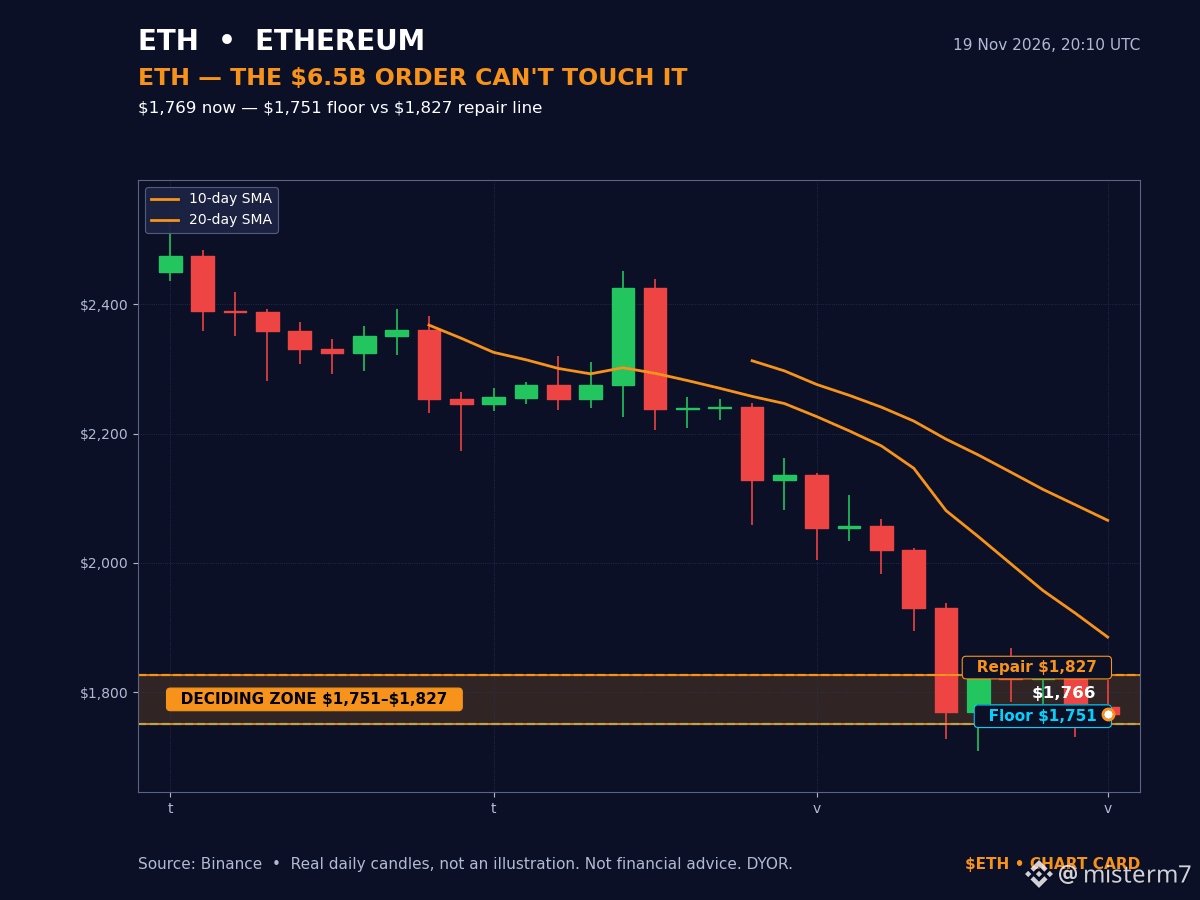
Both ETH lines I watched all week just got tested again. Yesterday's high, $1,826.58, touched the repair line to the cent and got rejected — 18 Nov closed $1,777.19. Today's low dipped $0.76 under the $1,751.39 floor from 17 Nov, then bounced back above it. ETH now $1,768.78 (Binance, 20:00 UTC; CoinGecko $1,764.56 — same picture). $BTC sits at $62,262.85, $257 above its $62,006 line — no help coming from there. $BNB barely moved on its own court win — $582.25, +0.53%.
My read: leaning bearish until a daily close above $1,826.58 proves the sellers are done — and I say leaning, not strong, because the 12 wallets have not sold anything yet; the fear is the overhang, not a dump. If $1,751.39 breaks on a daily close, $1,711.08 — the 15 Nov low — is next, and the hacker wallets become what every trader watches. If it holds and the wallets stay quiet, the repair toward $1,845 opens up.
What would prove me wrong: a daily close above $1,826.58 with the 12 wallets still untouched, or Binance announcing an actual ETH recovery — either kills the overhang story fast.
My next update triggers on the daily close against $1,826.58 or $1,751.39 — or the first exchange deposit from any of those 12 wallets. Whichever comes first, I will post it.
So the court order is a win, but it cannot touch the ETH. Does $1,751.39 hold through the weekend, or does the next wallet move break it? Drop your number.
Not financial advice. DYOR.
#ETH #BinanceHack #CryptoNews
Binance won a $6.5B court order — but 137,602 stolen ETH just moved again
Binance won a $6.5B court order — but 137,602 stolen ETH just moved again
Binance won a $6.5B court order on 18 Nov — and the thieves answered within hours by moving another $248M of stolen $ETH . The order is real. The gap in it is real too, and ETH holders sit in it.
What happened: the Abu Dhabi Global Market Courts granted Binance a $6.5B worldwide freezing injunction on 18 Nov against the unidentified attackers behind the 29 Oct theft of ~$6.34B (Binance statement, reported by Reuters and Cointelegraph). The order covers ~26,000 wallet addresses on a living list, tells 18 firms — Circle and World Liberty Financial among them — to keep stolen tokens frozen, and can even be served through the blockchain. A further hearing is set for 1 Dec.
The catch the headlines skip: $6.5B is the ceiling the order covers, not money recovered. About $2.85B — 45% — was already frozen before the judge signed anything. And the order cannot reach $BTC or ETH directly — neither has an issuer a court can tell to freeze it.
The thieves know that. On 19 Nov between 06:51 and 07:07 UTC, a wallet Etherscan labels "Binance Hot Wallet Exploiter 19" sent 137,602 ETH (~$248.23M) in 12 transfers — eleven of 12,000 ETH and one of 5,602 — to 12 brand-new wallets (Lookonchain, confirmed against Etherscan). At 11:57 UTC those 12 wallets still held every coin: wallet-to-wallet moves, not sales — yet. It is the third day running: 74,880 ETH on 17 Nov, 78,415 on 18 Nov, now 137,602. Three days, 290,898 ETH, ~$527M. The stolen 18,270 BTC still sits untouched.
Why it matters for your money: that ETH is an overhang hanging over every ETH holder. The moment any of those 12 wallets deposits to an exchange, the market has to absorb supply nobody planned for. The backdrop is brutal — Fear & Greed sits at 10, its 7th straight Extreme Fear day, and the Fed's October minutes show nearly all officials seeing more hikes ahead, with a December hike priced near 95%.
Both ETH lines I watched all week just got tested again. Yesterday's high, $1,826.58, touched the repair line to the cent and got rejected — 18 Nov closed $1,777.19. Today's low dipped $0.76 under the $1,751.39 floor from 17 Nov, then bounced back above it. ETH now $1,768.78 (Binance, 20:00 UTC; CoinGecko $1,764.56 — same picture). $BTC sits at $62,262.85, $257 above its $62,006 line — no help coming from there. $BNB barely moved on its own court win — $582.25, +0.53%.
My read: leaning bearish until a daily close above $1,826.58 proves the sellers are done — and I say leaning, not strong, because the 12 wallets have not sold anything yet; the fear is the overhang, not a dump. If $1,751.39 breaks on a daily close, $1,711.08 — the 15 Nov low — is next, and the hacker wallets become what every trader watches. If it holds and the wallets stay quiet, the repair toward $1,845 opens up.
What would prove me wrong: a daily close above $1,826.58 with the 12 wallets still untouched, or Binance announcing an actual ETH recovery — either kills the overhang story fast.
My next update triggers on the daily close against $1,826.58 or $1,751.39 — or the first exchange deposit from any of those 12 wallets. Whichever comes first, I will post it.
So the court order is a win, but it cannot touch the ETH. Does $1,751.39 hold through the weekend, or does the next wallet move break it? Drop your number.
Not financial advice. DYOR.
#ETH #BinanceHack #CryptoNews

New court filings expose the full scale of the recent Binance exploit with $6.3B stolen across 11 networks and $3.46B in stablecoins targeted.
#BinanceHack #CyberSecurity
New court filings expose the full scale of the recent Binance exploit with $6.3B stolen across 11 networks and $3.46B in stablecoins targeted.
#BinanceHack #CyberSecurity
#BinanceHack #CyberSecurity
30

·
--
🚨 $ETH PANIC: BINANCE THIEF MOVES $142M IN 30 MINUTES
The hacker behind the $6,300M Binance heist made another move today: 78,415 ETH left their wallet after two weeks of silence. To me, this isn’t just another move—it’s the start of serious laundering, and they’re doing it in broad daylight.
Look at the detail nobody’s noticing:
→ In just 30 minutes, they split 78,415.24 ETH (~$142M) across 7 wallets: 6 new ones with 12,000 ETH each and 1 they’d used before, with 6,415.24 ETH.
→ They still have 602,402 ETH (~$1,090M), and have already started swapping it for BTC via THORChain: 14,655 ETH (~$26.5M) arrived there requesting Bitcoin.
→ The DOJ has already attributed the heist to North Korea and frozen more than $2,700M of the $6,300M stolen, but this is the first major move since that announcement: the rest, about 55%, appears to be entering the laundering phase.
Do you think the hacker will manage to launder it all before it gets frozen? 👇
$ETH $BTC $BNB
#BinanceHack #Ethereum #CryptoSecurity

Jelesma :
ya lo habra convertido a PEPE y a DOGE.
eso es lo mas seguro
3
10
18.5k

·
--
New disclosures in Binance hack case: 192 tokens across 11 chains, including $3.46 billion in stablecoins
Court documents have revealed, for the first time, a breakdown of the assets stolen in the Binance hack, offering a new quantitative perspective on a security controversy that has persisted for years. According to Cointelegraph, the hackers stole 192 tokens across 11 blockchains, with the total value reaching $6.3 billion, including as much as $3.46 billion in stablecoins.
The significance of this data point is that it turns the previously vague notion of a “massive theft” into a concrete, analyzable asset breakdown. Stablecoins accounted for more than half of the stolen funds, suggesting that the hackers relied heavily on fiat-pegged assets such as USDT and USDC to move and launder funds, rather than simply holding highly volatile native tokens. This also echoes recent accounts of North Korean hackers’ money-laundering networks: thanks to their liquidity and convertibility, stablecoins have long been a primary vehicle for the movement of crypto crime proceeds.
From a technical perspective, the presence of 192 tokens across 11 chains indicates that the attack was not aimed at a single protocol, but involved systematic theft across multiple chains and asset types. The hackers also took memecoins and other tokens, further underscoring their pattern of diversifying holdings and moving assets across chains. This kind of asset structure makes on-chain tracing and asset freezing more challenging.
For the market, this is an old case with new disclosures, not an unexpected negative catalyst, so its short-term impact on prices overall is likely to be limited. However, the security narrative may continue to gain traction amid the high proportion of stablecoins, potentially prompting some investors to reassess custody security and regulated stablecoins. One thing to watch is whether these disclosures will lead regulators to impose further requirements on stablecoin reserves and on-chain transparency.
A counterpoint is that the case spans a long period, and market attention has already been diluted several times. Although $6.3 billion is a large sum, its marginal impact is limited relative to Binance’s overall scale and the crypto market’s average daily trading volume. In addition, the high share of stablecoins could be interpreted as showing that the hackers prioritized liquidity over long-term accumulation, which may in turn weaken speculation about “long-term selling pressure.”
What to watch next: Pay close attention to whether future court documents reveal more details about the flow of funds, and to the responses from stablecoin issuers and regulators. If you are following related assets, in the short term it may be more useful to watch whether the market is overpricing its reaction to this kind of security incident than to trade on a single news item.
#BinanceHack #Stablecoin #CryptoSecurity
The above is a compilation of information and personal analysis, and does not constitute investment advice.
I will continue to follow and share updates if there are any significant developments.
45

·
--
Binance-Linked Wallets Stir After $137 Million Theft Two Weeks Ago; Institutions Accelerate Withdrawals from Exchanges
Binance-linked wallets that had been almost silent for the past two weeks have recently moved large amounts of ETH across chains. This signals both the transfer of stolen funds and institutional withdrawals from exchanges, warranting a fresh look at the situation from a capital-flow perspective.
According to Decrypt, wallets linked to Binance’s record-breaking theft in October this year transferred approximately $63 million worth of ETH after remaining dormant for about two weeks. Analysts later noted that even larger fund movements had taken place. The total amount stolen has reached approximately $137 million. This activity occurred after a relatively quiet period following the disclosure of the incident. On-chain activity suddenly picked up, bringing the issue back into the market spotlight.
From a capital-flow perspective, this signal is significant because it involves two developments: the movement of funds by the thieves and changes in the amount of ETH held on exchanges. Moving stolen funds across chains in the form of ETH could create selling pressure in the short term, but the funds could also be moved to off-chain custody. The long-term demand implications remain unclear. For ETH, this is a mixed signal—not purely bearish, but not clearly bullish either.
In terms of data, the confirmed transfer of $63 million and the cumulative theft of $137 million are the two key figures cited in the report. It is worth noting that large on-chain transfers do not necessarily indicate panic-driven withdrawals. Routine transfers by market makers or custodians can look similar, so there is a risk of misinterpreting a single on-chain signal.
The market’s reaction may depend on where the funds ultimately end up. If the transferred funds reach exchanges and are sold, they will put short-term pressure on ETH prices. If they are moved to cold wallets or institutional custody, that would reflect stronger holder confidence, with liquidity shifting from trading venues to storage. These two paths have very different implications for the market.
One counterpoint is that the current signal is still preliminary, and the actions of the thieves could be mistaken for institutional activity. Historical experience shows that it is not unusual for hacker wallets to resume transfers after a period of dormancy. Their motive may be to consolidate funds rather than sell them, so this should not be overinterpreted as a systemic exodus.
The key things to watch next are where the transferred funds ultimately go and whether subsequent trading volumes continue to increase. If you are following $ETH, it is more important at the trading level to wait for confirmation of the fund flows than to make a judgment based on a single on-chain anomaly.
$ETH #BinanceHack #OnChainData #CryptoSecurity
The above is a compilation of information and personal analysis, and does not constitute investment advice.
Follow me for ongoing coverage of key market developments and data.
Binance-Linked Wallets Stir After $137 Million Theft Two Weeks Ago; Institutions Accelerate Withdrawals from Exchanges
Binance-linked wallets that had been almost silent for the past two weeks have recently moved large amounts of ETH across chains. This signals both the transfer of stolen funds and institutional withdrawals from exchanges, warranting a fresh look at the situation from a capital-flow perspective.
According to Decrypt, wallets linked to Binance’s record-breaking theft in October this year transferred approximately $63 million worth of ETH after remaining dormant for about two weeks. Analysts later noted that even larger fund movements had taken place. The total amount stolen has reached approximately $137 million. This activity occurred after a relatively quiet period following the disclosure of the incident. On-chain activity suddenly picked up, bringing the issue back into the market spotlight.
From a capital-flow perspective, this signal is significant because it involves two developments: the movement of funds by the thieves and changes in the amount of ETH held on exchanges. Moving stolen funds across chains in the form of ETH could create selling pressure in the short term, but the funds could also be moved to off-chain custody. The long-term demand implications remain unclear. For ETH, this is a mixed signal—not purely bearish, but not clearly bullish either.
In terms of data, the confirmed transfer of $63 million and the cumulative theft of $137 million are the two key figures cited in the report. It is worth noting that large on-chain transfers do not necessarily indicate panic-driven withdrawals. Routine transfers by market makers or custodians can look similar, so there is a risk of misinterpreting a single on-chain signal.
The market’s reaction may depend on where the funds ultimately end up. If the transferred funds reach exchanges and are sold, they will put short-term pressure on ETH prices. If they are moved to cold wallets or institutional custody, that would reflect stronger holder confidence, with liquidity shifting from trading venues to storage. These two paths have very different implications for the market.
One counterpoint is that the current signal is still preliminary, and the actions of the thieves could be mistaken for institutional activity. Historical experience shows that it is not unusual for hacker wallets to resume transfers after a period of dormancy. Their motive may be to consolidate funds rather than sell them, so this should not be overinterpreted as a systemic exodus.
The key things to watch next are where the transferred funds ultimately go and whether subsequent trading volumes continue to increase. If you are following $ETH , it is more important at the trading level to wait for confirmation of the fund flows than to make a judgment based on a single on-chain anomaly.
$ETH #BinanceHack #OnChainData #CryptoSecurity
The above is a compilation of information and personal analysis, and does not constitute investment advice.
Follow me for ongoing coverage of key market developments and data.
121
·
--
🚨 $ETH BETRAYAL: THE BINANCE HACKER MOVED AGAIN
To me, this is the most worrying thing of the whole day: after 18 days of silence, the wallet from the $6,300M Binance heist woke up early this morning and moved 34,279.66 ETH, about $63M, to three new wallets. It’s not a sale yet, but when the biggest crypto heist in history starts moving again, nobody feels at ease.
Look at the detail nobody is noticing:
→ The three wallets are new: 12,000 ETH, 12,000 ETH, and 10,279.66 ETH, and so far they aren’t linked to any exchange or laundering services, so the money is still sitting there.
→ The hacker still has more than 527,000 ETH in their possession, about $953M, and according to Elliptic, the attackers control ~$3,280M spread across more than 950 wallets.
→ The FBI attributes the theft to the North Korean group TraderTraitor, and last week the DOJ obtained court authorization to seize or restrict more than $1,200M, but these $63M were moved anyway.
Do you think this is the start of a massive ETH sell-off, or are they just moving the pieces around? 👇
$ETH $BNB
#BinanceHack #Ethereum #CryptoSecurity
19
33.3k

Shock! The wallet of the biggest Binance hack in history has stirred after weeks of dormancy!
A wallet linked to the $6.3 billion Binance hack unexpectedly became active again on 17/11, after lying dormant since 30/10. It transferred 34,279.66 $ETH, worth $63 million, to three brand-new wallets.
Although the funds have not moved again or gone to an exchange, suggesting there are no immediate signs of a sell-off, this is still a warning. Recall that the hackers previously used THORChain to turn $ETH into $BTC to conceal it.
While $2.85 billion has been frozen or seized, the attackers still control around $3.28 billion across more than 950 wallets. $63 million $ETH is just a small fraction of that.
Every small movement of hacked funds could cause major market volatility!
What do you think the hacking group will do next with this $63 million $ETH ?
#Crypto #BinanceHack
$ETH
Shock! The wallet of the biggest Binance hack in history has stirred after weeks of dormancy!
A wallet linked to the $6.3 billion Binance hack unexpectedly became active again on 17/11, after lying dormant since 30/10. It transferred 34,279.66 $ETH , worth $63 million, to three brand-new wallets.
Although the funds have not moved again or gone to an exchange, suggesting there are no immediate signs of a sell-off, this is still a warning. Recall that the hackers previously used THORChain to turn $ETH into $BTC to conceal it.
While $2.85 billion has been frozen or seized, the attackers still control around $3.28 billion across more than 950 wallets. $63 million $ETH is just a small fraction of that.
Every small movement of hacked funds could cause major market volatility!
What do you think the hacking group will do next with this $63 million $ETH ?
#Crypto #BinanceHack
$ETH
111

🔥 BINANCE IS BACK - 17 NOV 🔥
Everyone Was Asking: Why Was Binance Down?
Now The Truth Is Out!
On 29 October, Binance Faced The Biggest Hack In History
$6.3 Billion Was Stolen!
That Is Why Binance Paused Withdrawals
To Keep Your Money Safe!
NOW GOOD NEWS 👇
✅ Withdrawals Reopened For 87 Networks
✅ 95% Of Funds Already Recovered
✅ Everything Will Be Normal By This Week
✅ Binance Said - Everyone Will Get Full Refund
No Need To Panic
Your Money Is Safe!
Did You Sell In Fear Or Did You HOLD?
Tell Me Honestly In Comments 👇
#Binance #CryptoNews #BinanceHack #crypto
15
·
--
Aftermath of Binance hack: Institutional funds accelerate withdrawals from exchanges and shift to off-exchange custody
The fallout from the Binance hack is quietly rippling through the structure of capital in the crypto market. According to Cointelegraph, Joshua Lim, an executive at institutional custody platform FalconX, said the hack could prompt institutions to move crypto assets off exchanges and change how large funds custody their assets.
From the perspective of capital flows, this statement touches on a deeper structural shift in the industry. Over the past few years, many institutional funds have tended to keep assets on exchanges for the sake of trading convenience and liquidity. But when the security risks of the exchanges themselves come into sharper focus, “where to keep the money” is no longer merely an operational choice; it becomes a central question of asset allocation.
As a provider of custody and liquidity services for institutions, FalconX merits attention when one of its executives speaks publicly on the matter. This is more than a simple comment on an incident; it reflects a genuine shift in how institutions assess risk. When an exchange changes from “infrastructure” into “risk exposure,” the natural flow of capital will be redistributed.
It is worth emphasizing that this remains an aftereffect of the incident, rather than a clearly established new development. Based on the information available, the scale and pace of any actual institutional migration remain unclear, and there is often a gap between statements and action. Large-scale shifts by major funds typically depend on whether more similar incidents occur, how fully the regulatory framework develops, and how mature off-exchange custody infrastructure becomes.
From a macro liquidity perspective, if institutional funds continue to flow out of exchanges and into off-exchange custody, this could theoretically change the way assets are concentrated on exchanges, potentially affecting the overall distribution of market liquidity and trading depth. However, whether this transmission effect will materialize, and on what scale, still needs to be confirmed with more data.
Countervailing factors should not be overlooked. Exchange custody still has advantages in terms of convenience and regulatory compliance, and some funds may not migrate on a large scale. The impact of a single incident also tends to fade over time, as market attention quickly shifts elsewhere.
What is worth watching next is whether more institutions announce changes to their custody structures, and whether the scale of off-exchange custody actually changes. From the perspective of capital flows, the key question is whether this paradigm shift will evolve from a short-term, event-driven reaction into a structural, long-term trend.
#BinanceHack #CryptoCustody #InstitutionalCrypto
The above is a summary of information and personal analysis, and does not constitute investment advice.
Follow me for ongoing coverage of key market developments and data.
5

·
--
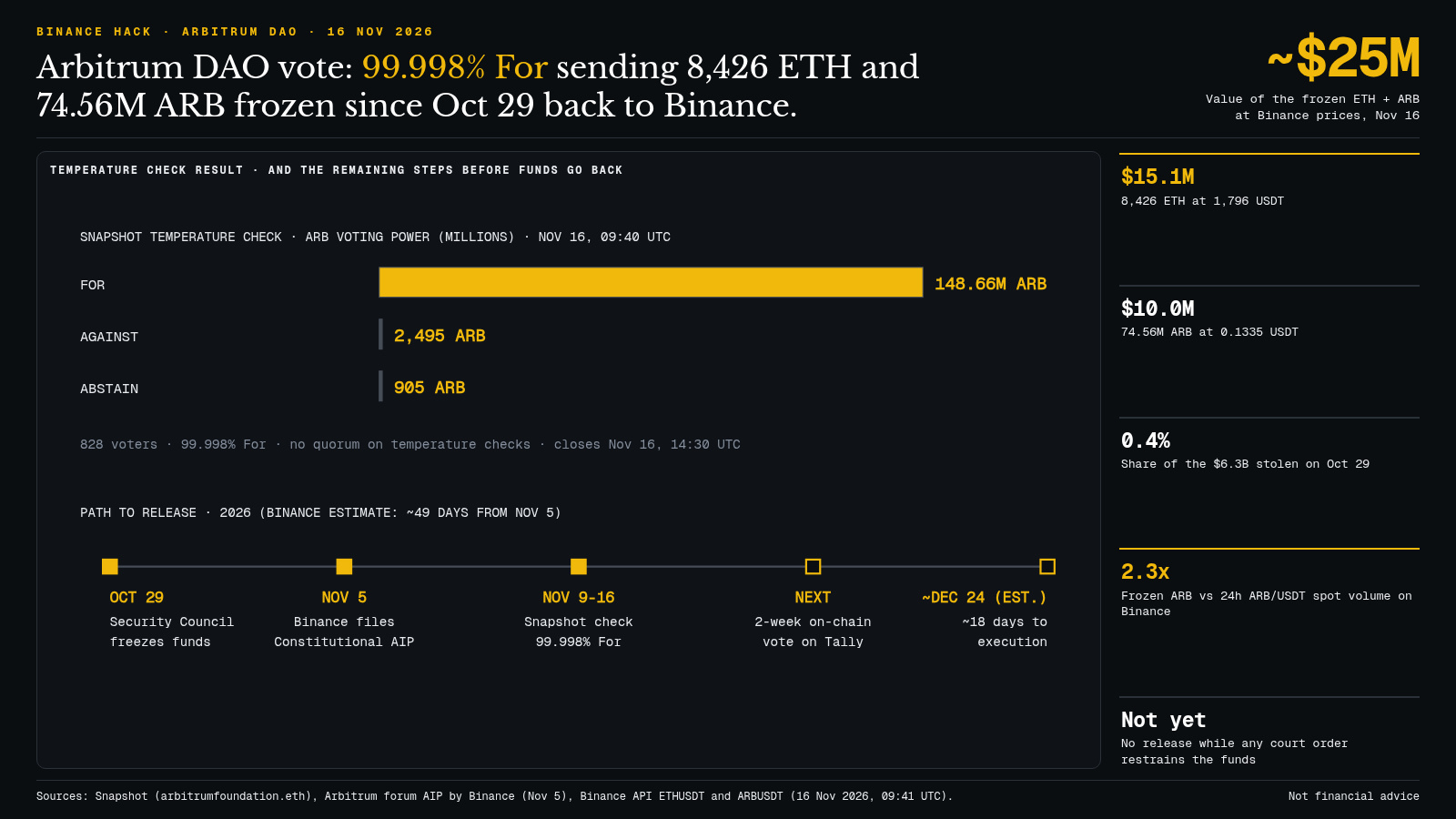
Will the funds from the Binance hack frozen on Arbitrum be returned? The Arbitrum DAO poll says yes by 99.998%, but not just yet.
Since 29/10, 8 426 $ETH and 74.56 million $ARB stolen funds have been frozen by Arbitrum's Security Council.
On 05/11, Binance submitted a constitutional proposal (AIP) on the Arbitrum forum to recover everything. The Snapshot poll closes this Monday, 16/11, at 14:30 UTC. At around 09:40 UTC: 148.66 million ARB in favor, 2,495 against, 828 voters.
In value, that's about $25M at this morning's Binance prices ($15.1M in ETH, $10M in ARB at 0.1335 USDT). That's 0.4% of the $6.3B stolen. Small compared with the total, but it would set a precedent: a DAO returning frozen funds to an exchange.
And the conditions matter. According to Binance's text, a two-week on-chain vote on Tally remains, followed by about 18 days before execution: around 49 days from 05/11, so late December at the earliest. Binance must also sign indemnity agreements with the Arbitrum Foundation, Offchain Labs, and the Security Council members. And nothing will be released while a court order keeps these funds frozen.
My take: the poll was a foregone conclusion; the real unknown is the legal situation. One detail to watch for ARB: 74.56M ARB is 2.3 times the ARB/USDT spot volume over the past 24 hours on Binance.
Two possible outcomes by the end of December: the Tally vote passes and the funds are returned, or the timeline is delayed by legal proceedings. Does this precedent reassure you about L2s, or does it mainly show that a Security Council can freeze everything?
#BinanceHack #Arbitrum
Sources: Snapshot arbitrumfoundation.eth (16/11, 09:40 UTC), Binance AIP on forum.arbitrum.foundation (05/11), Binance ETHUSDT and ARBUSDT APIs (16/11, 09:41 UTC). Not financial advice.
522

·
--
🚔 $2.7B OF THE BINANCE HACK IS ALREADY FROZEN
The US Justice Department just put numbers on the Oct 29 heist, which it pins on North Korea's "TraderTraitor" hackers.
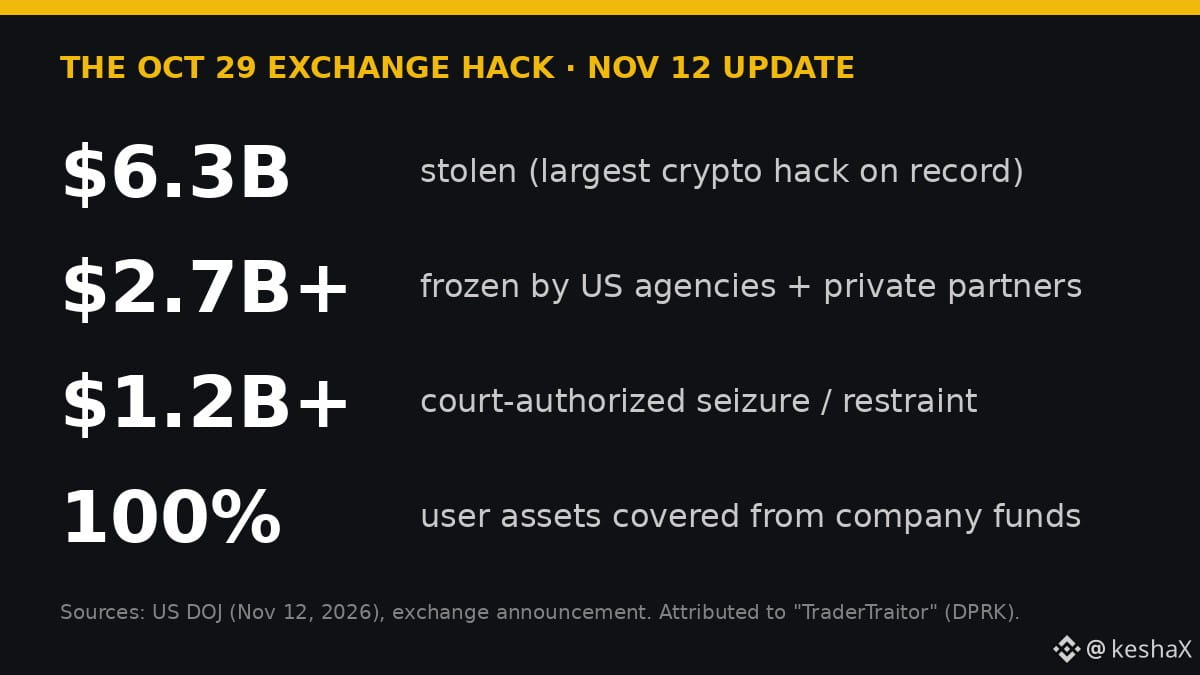
$6B+ stolen. More than $2.7B frozen by US agencies and private partners. Over $1.2B cleared by courts for seizure or restraint.
The same day, Binance said it has fully covered every affected user asset from its own money: SAFU, part of the futures insurance fund and the corporate treasury. Its new Proof of Reserves snapshot covers 198 tokens, up from 10 right after the hack. The zero-knowledge proof for 1:1 verification takes about 40–50 hours to generate.
Users are made whole. About half of the loot is stuck. The other half is still moving through bridges and mixers.
How much of the $6.3B gets recovered in the end: under half or over half? $BNB
#Binance #BinanceHack #NorthKorea #CryptoNews
1
371
·
--
Traders on X are passing around the DOJ's latest update on the Binance hack: over $1.2B in stolen crypto is now under court-authorized seizure or restraint. (WatcherGuru, 1,003 likes)
📊 What happened
The US Department of Justice announced coordinated actions on Nov 12 against North Korea's crypto theft schemes. On Oct 29, North Korean military hackers, the FBI calls them "TraderTraitor," stole more than $6B in virtual assets from Binance. More than $2.7B has been frozen so far, and the DOJ has now obtained court authorization to seize or restrain over $1.2B of that pool. The DOJ also took down "FaceStealer" infrastructure, a fake video-meeting scam behind $400M+ in thefts.
🔥 Why it matters
This is the first official, court-backed number attached to the recovery. Binance said in its Nov 3 report that about $2.85B had been frozen or intercepted. The DOJ now puts the frozen pool at over $2.7B, with $1.2B+ locked behind court orders. That still leaves roughly half the $6B+ haul outside the freeze, so the recovery is real but partial. Second-order effect: Binance targets restoring withdrawals for six tokens plus five networks by Nov 13, and each court order makes that timeline more credible.
⚠️ Seized or restrained is not the same as returned. The $1.2B sits under court authorization and the $2.7B is frozen, and neither means the funds are back in Binance's hands yet. Do not add the two numbers together.
👀 What to watch: forfeiture proceedings on the $1.2B+, whether the frozen pool grows past $2.7B, and Binance's Nov 13 withdrawal target.
$BTC sits at $71,533, down 3.97% in 24h (Binance spot), under the $75,600 short-term holder cost basis for a 4th straight day.
Does a $1.2B seizure change how safe you feel keeping funds on a big exchange, or does the $3B+ still missing matter more? 👇
Educational content only. Not financial advice. DYOR.
#BinanceHack #CryptoNews
29

·
--
Six throwaway meme coins on $NEAR, about $90 each to launch, had one job: moving stolen Binance funds.
That's from Elliptic's November 9 report on the laundering of the October 29 hack, the theft Binance put at $6.3B and the FBI tied to North Korea's TraderTraitor.
The trick: mint a token, pair it with NEAR in a DEX pool, buy it with stolen NEAR from one set of wallets, sell it from another. No direct transfer between them. About 117,000 NEAR (around $430K) went through between November 5 and 7, and none of the six tokens has traded since November 8.
Solana saw a variant on November 3: stolen $SOL swapped through existing thinly traded tokens, then into USDC.
Why a $NEAR holder should care: Elliptic counts about 11.8M stolen NEAR ($43.7M) still unmoved. That's roughly half of the last 24 hours' $91M in volume, and every hop shows up on-chain 👀
NEAR sits at $3.665 today, up 1.61% in 24 hours, with Fear & Greed at 29.
The side lesson: a brand-new NEAR meme coin with big volume and only a wallet or two on each side may not be a market at all.
Would you still ape into a fresh meme coin pool after seeing how these were used?
#NEAR #BinanceHack #MemeCoins
Six throwaway meme coins on $NEAR , about $90 each to launch, had one job: moving stolen Binance funds.
That's from Elliptic's November 9 report on the laundering of the October 29 hack, the theft Binance put at $6.3B and the FBI tied to North Korea's TraderTraitor.
The trick: mint a token, pair it with NEAR in a DEX pool, buy it with stolen NEAR from one set of wallets, sell it from another. No direct transfer between them. About 117,000 NEAR (around $430K) went through between November 5 and 7, and none of the six tokens has traded since November 8.
Solana saw a variant on November 3: stolen $SOL swapped through existing thinly traded tokens, then into USDC.
Why a $NEAR holder should care: Elliptic counts about 11.8M stolen NEAR ($43.7M) still unmoved. That's roughly half of the last 24 hours' $91M in volume, and every hop shows up on-chain 👀
NEAR sits at $3.665 today, up 1.61% in 24 hours, with Fear & Greed at 29.
The side lesson: a brand-new NEAR meme coin with big volume and only a wallet or two on each side may not be a market at all.
Would you still ape into a fresh meme coin pool after seeing how these were used?
#NEAR #BinanceHack #MemeCoins
162
This is WILD — and scary.
North Korean hackers are reportedly creating their OWN memecoins to launder proceeds from the $6.3 BILLION Binance hack.
According to Elliptic analysis:
📉 Hackers transferred 117,000 NEAR tokens (∼$430,000) through 6 memecoins created between Nov 5-7
📉 They generate FAKE trade volumes to legitimise their gains
📉 One token even uses a picture of Elon Musk
A Spanish report Nov 11 said hackers are now trying to use memecoins because they are being hunted and cannot move the crypto into the formal financial system. Some reports now put the hack figure at $8 BILLION.
This is why you MUST check memecoins before you buy:
❌ Who created it?
❌ Is volume real or wash trading?
❌ Is the Elon / celebrity pic just bait?
If a new memecoin pumps 1000% overnight with no real community — RUN.
Share this. Someone in your feed is about to buy one of these.
#BinanceHack #NorthKorea #Memecoin #CryptoScam #CryptoNews $NEAR

12
Hackers Deploy Custom Meme Coins to Launder Binance Funds
Forensic analysis reveals attackers are minting bespoke meme coins featuring Elon Musk and animal logos to obfuscate the $6.4B Binance exploit proceeds through liquidity pools.
#BinanceHack #BlockchainForensics
Hackers Deploy Custom Meme Coins to Launder Binance Funds
Forensic analysis reveals attackers are minting bespoke meme coins featuring Elon Musk and animal logos to obfuscate the $6.4B Binance exploit proceeds through liquidity pools.
#BinanceHack #BlockchainForensics
Forensic analysis reveals attackers are minting bespoke meme coins featuring Elon Musk and animal logos to obfuscate the $6.4B Binance exploit proceeds through liquidity pools.
#BinanceHack #BlockchainForensics
11

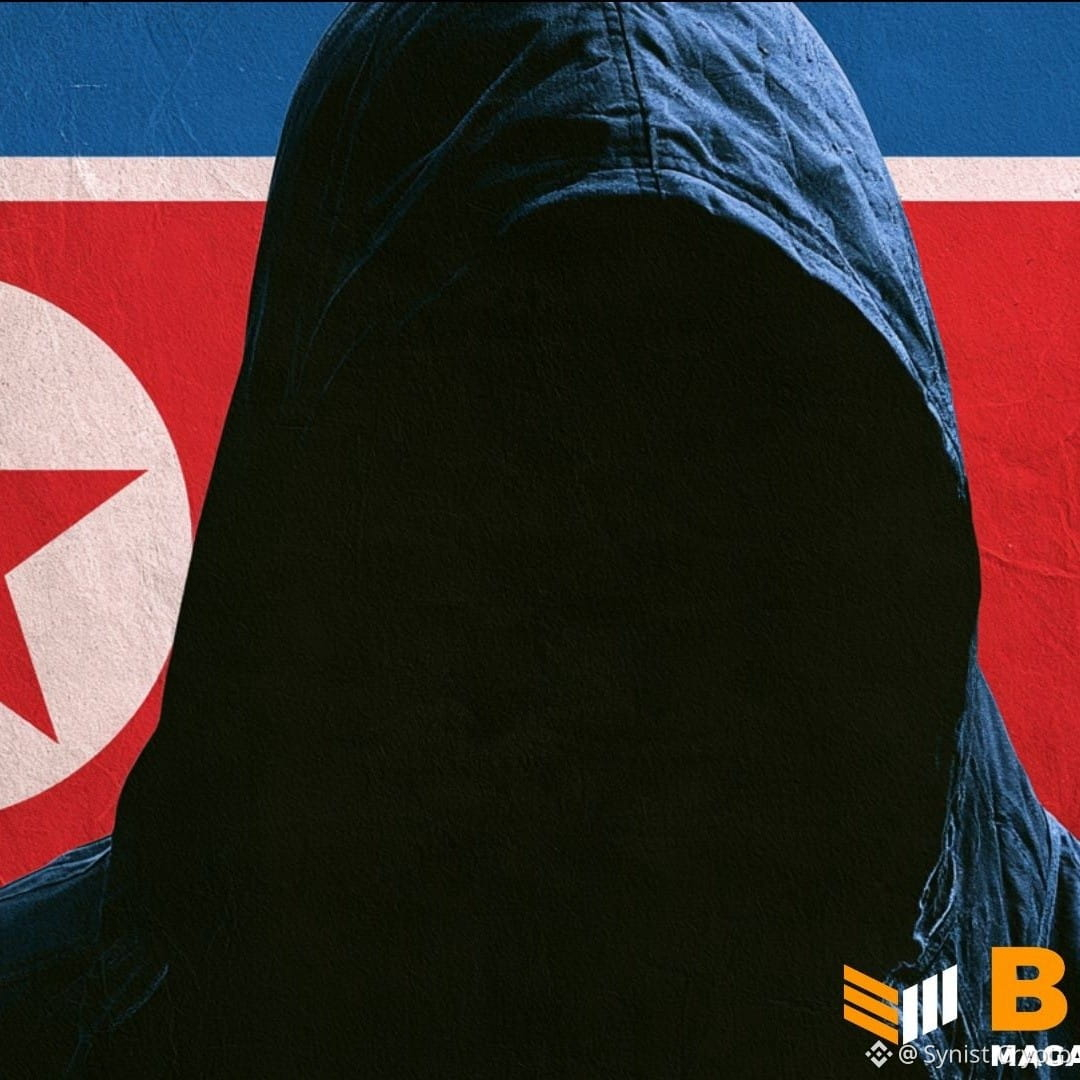
🚨🚨 BREAKING: NORTH KOREA MINTS MEMECOINS TO WASH BINANCE LOOT. 👀
The $6.3B Binance hackers now mint memecoins to wash the loot.
Elliptic caught 6 on NEAR, Nov 5–7, $90 each, $430,000 already through.
One coin shows Elon Musk under an 'Elon 2028 President' banner.
Tiny so far — under 0.01% of the loot.
$BTC $NEAR — would you trust a memecoin you just met? #NorthKoreaHackers #BinanceHack #CryptoNews

119
State sponsored actors are exploiting memecoin liquidity to wash $6.3B stolen from the Binance exploit. This represents a massive escalation in sophisticated laundering tactics within the DeFi ecosystem.
#BinanceHack #CyberSecurity
State sponsored actors are exploiting memecoin liquidity to wash $6.3B stolen from the Binance exploit. This represents a massive escalation in sophisticated laundering tactics within the DeFi ecosystem.
#BinanceHack #CyberSecurity
#BinanceHack #CyberSecurity
12
The $2.85B Binance Hack Triggers UK Regulatory Pressure
The massive $2.85B Binance hack highlights critical gaps in stablecoin freeze protocols and will likely drive aggressive regulatory action in the UK.
#BinanceHack #StablecoinRegulation
The $2.85B Binance Hack Triggers UK Regulatory Pressure
The massive $2.85B Binance hack highlights critical gaps in stablecoin freeze protocols and will likely drive aggressive regulatory action in the UK.
#BinanceHack #StablecoinRegulation
The massive $2.85B Binance hack highlights critical gaps in stablecoin freeze protocols and will likely drive aggressive regulatory action in the UK.
#BinanceHack #StablecoinRegulation
7
·
--
Binance’s $630 Million Hack Exposed an 8-Week Intrusion Period; AI-Assisted Attacks Pose a Systemic Threat
Security firm SEAL disclosed that in the approximately $630 million theft from Binance, hackers had an intrusion window of up to 8 weeks before the funds were transferred. This period far exceeds the typical response timeline for security incidents at exchanges, and means the attackers had ample time to carry out a multistage intrusion.
According to Cointelegraph, SEAL noted that the intrusion pattern in this case was not an isolated incident. The attackers used a multistage approach, remaining undetected for an extended period as they gradually penetrated deeper, before transferring the funds. SEAL linked this pattern to several recent major cryptocurrency thefts, suggesting they may all belong to the same category of systemic, AI-assisted attacks.
This assessment is significant because it shifts the focus from a “single vulnerability” to an “attack methodology.” If multiple incidents do indeed share the same intrusion tactics, the problem is no longer a technical flaw at one exchange, but a common blind spot across the industry in hot wallet risk management. Attackers’ use of lengthy intrusion windows to evade detection is precisely why traditional threshold-based alert systems struggle to identify them in time.
The figures are striking: an 8-week intrusion window alongside $630 million in stolen funds. The longer the period, the more it suggests that internal signing mechanisms and anomalous behavior detection were significantly delayed. However, it should be noted that Binance has not yet responded, and some conclusions still rely on third-party on-chain analysis. The specific details of its internal signing mechanisms remain unclear, and the risk posed by this information asymmetry is real.
At the market level, security incidents of this kind typically affect risk appetite across the sector in the short term. However, no clear price correlation has emerged so far, and the impact has been more on sentiment and confidence. If further cases are confirmed to share the same attack pattern, a reassessment of hot wallet security across the industry could become a key theme.
Countervailing considerations include the possibility that the attribution of a single incident is inaccurate, that more evidence is needed to classify the attacks as AI-assisted, and that Binance’s scale means its actual fund security mechanisms may be more complex than public analyses suggest.
What to watch next: whether Binance responds, whether SEAL can disclose more technical details, and whether additional cases are included in the same analytical framework.
#BinanceHack #CryptoSecurity
The above is a compilation of information and personal analysis, and does not constitute investment advice.
I will continue to monitor key data and technological developments.
94

·
--
What I Learned From The Binance $6.3B Hack - 5 Lessons For Every Crypto User
$BTC $BNB $ETH $SOL $XRP
The Binance incident on Oct 29 changed how I think about safety. Over $6.3B was stolen in what the FBI attributed to North Korea's TraderTraitor group. It was the largest crypto theft on record.
Here are 5 lessons:
1. Never Keep 100% On One Exchange
If your portfolio is on one CEX, you have a single point of risk. Always diversify.
2. Check Proof-of-Reserves, Not Rumors
Binance released a ZK Proof for its Oct 31 snapshot. 10 tokens - BTC, ETH, USDT, BNB, SOL, USDC, XRP, USD1, RLUSD, ZEC - are backed at least 1:1.
3. Do NOT Panic Withdraw
Phase 1 started Nov 1, Phase 2 on Nov 3 reopened 100+ pairs across 9 networks - BSC, ETH, SOL, XRP, TRON, Arbitrum, Optimism, SUI, Base. Gas fees were very high during panic.
4. Enable ALL Security
Passkey + 2FA + Anti-Phishing Code + Whitelist Address. It takes 5 minutes and can save your portfolio.
5. How Binance Covered The Loss
Binance set aside $6.34B from its own funds. By Oct 31, 90% replenished, by Nov 1 around 95%. Users will not bear the loss.
My Takeaway: Security is about having a system, not a perfect exchange.
What did you do? Panic withdraw or hold? Comment 👇
Is your fund 100% SAFU now?
#BinanceHack #BinanceSecurity #CryptoSafety #Bangladesh #SAFU🙏 #Write2Earn #CryptoNews #BTC

1
2
346
Log in to explore more content
Join global crypto users on Binance Square
⚡️ Get latest and useful information about crypto.
💬 Trusted by the world’s largest crypto exchange.
👍 Discover real insights from verified creators.
Email / Phone number
Trending Topics
1
#IsAnthropic’s$1.5TMarketCapJustified?
13,004 views
108 Discussing
2
#BTCRemainsUnderPressureAfterHawkishFOMCMinutes
264,000 views
2,144 Discussing
3
#NvidiaBoardReportedlySplitOverHuang’sReturn
129,269 views
1,162 Discussing
4
#StrategySTRCPreferredSlips3.65%Below$100Par
8,907 views
88 Discussing
5
#MASToUpgradeSGDTestnetToSGDigitalLedger
25,528 views
285 Discussing
6
#CanGTA6'sLaunchLiftTTWOShares?
94,570 views
837 Discussing
7
#Solana2027RoadmapTargetsDoubleComputeCapacity
10,974 views
151 Discussing
8
#InjectiveTokenizedRealEstateMortgagesTop$1.5B
1,257 views
29 Discussing
9
#TetherMakesStrategicInvestmentInSCRYPT
8,441 views
114 Discussing
10
#CapitalGroupAdds1264500StrategyShares
34,617 views
247 Discussing