

CryptoMC20
676 Beiträge
CryptoMC20
Melden
Nutzer blockieren
Trade eröffnen
Hochfrequenz-Trader
2.5 Jahre
37 Following
168 Follower
1.0K+ Like gegeben
Beiträge
Portfolio
Alle
Zitierungen
Videos
·
--
Das QNT/USDT-Handelspaar steht für Quant-Token, bewertet in Tether. Quant wird bei etwa 173,39 USDT gehandelt, was auf einen starken Aufwärtstrend und ein aktives Marktvolumen hinweist. Es bildet die Grundlage für das Overledger-Betriebssystem und verbindet mehrere Blockchains für unternehmensweite Interoperabilität. Beobachten Sie die Charts stets genau, bevor Sie Trades ausführen.
$RAY $QNT $SUI
Das QNT/USDT-Handelspaar steht für Quant-Token, bewertet in Tether. Quant wird bei etwa 173,39 USDT gehandelt, was auf einen starken Aufwärtstrend und ein aktives Marktvolumen hinweist. Es bildet die Grundlage für das Overledger-Betriebssystem und verbindet mehrere Blockchains für unternehmensweite Interoperabilität. Beobachten Sie die Charts stets genau, bevor Sie Trades ausführen.
$RAY $QNT $SUI
$RAY $QNT $SUI
1
187
·
--
Mubarak (MUBARAK) ist eine community-getriebene Memecoin, die auf der BNB Chain gestartet wurde. Inspiriert von islamischen Traditionen bedeutet sein Name auf Arabisch „gesegnet“. Nachdem er durch einen Social-Media-Beitrag von Binance-Gründer Changpeng Zhao (CZ) an Popularität gewonnen hat, funktioniert er vollständig über dezentrale Community-Unterstützung, ohne offizielle Roadmap.
$MUBARAK $ACE $ZEC
Mubarak (MUBARAK) ist eine community-getriebene Memecoin, die auf der BNB Chain gestartet wurde. Inspiriert von islamischen Traditionen bedeutet sein Name auf Arabisch „gesegnet“. Nachdem er durch einen Social-Media-Beitrag von Binance-Gründer Changpeng Zhao (CZ) an Popularität gewonnen hat, funktioniert er vollständig über dezentrale Community-Unterstützung, ohne offizielle Roadmap.
$MUBARAK $ACE $ZEC
$MUBARAK $ACE $ZEC
71
·
--
Übersetzung ansehen
ZEC Coin sky🚀🚀🚀
Zcash (ZEC) is a decentralized, privacy-focused cryptocurrency launched in 2016. Sharing a fixed 21 million supply limit with Bitcoin, it uniquely utilizes advanced zero-knowledge proofs (zk-SNARKs). This allows users to choose between public transparent transactions or fully shielded, private transfers that conceal sender, recipient, and amount details.
$SYN
$ZEC
$DASH
ZEC Coin sky🚀🚀🚀
Zcash (ZEC) is a decentralized, privacy-focused cryptocurrency launched in 2016. Sharing a fixed 21 million supply limit with Bitcoin, it uniquely utilizes advanced zero-knowledge proofs (zk-SNARKs). This allows users to choose between public transparent transactions or fully shielded, private transfers that conceal sender, recipient, and amount details.
$SYN
$ZEC
$DASH
Zcash (ZEC) is a decentralized, privacy-focused cryptocurrency launched in 2016. Sharing a fixed 21 million supply limit with Bitcoin, it uniquely utilizes advanced zero-knowledge proofs (zk-SNARKs). This allows users to choose between public transparent transactions or fully shielded, private transfers that conceal sender, recipient, and amount details.
$SYN
$ZEC
$DASH
59
·
--
Übersetzung ansehen
Exploring the integration of fixed-rate markets and real-world assets (RWAs) in decentralized finance highlights why @TermMax is building essential infrastructure for predictable on-chain yields. By eliminating variable rate anxiety and enabling secure, institutional-grade borrowing and lending options, @TermMax brings much-needed financial certainty to the digital asset ecosystem. Excited to see how this next-generation loan AMM continues to drive capital efficiency and reshape DeFi! #TermMax
#termmax @termmax
Exploring the integration of fixed-rate markets and real-world assets (RWAs) in decentralized finance highlights why @TermMax is building essential infrastructure for predictable on-chain yields. By eliminating variable rate anxiety and enabling secure, institutional-grade borrowing and lending options, @TermMax brings much-needed financial certainty to the digital asset ecosystem. Excited to see how this next-generation loan AMM continues to drive capital efficiency and reshape DeFi! #TermMax
#termmax @TermMax
#termmax @TermMax
1
1
61
·
--
Übersetzung ansehen
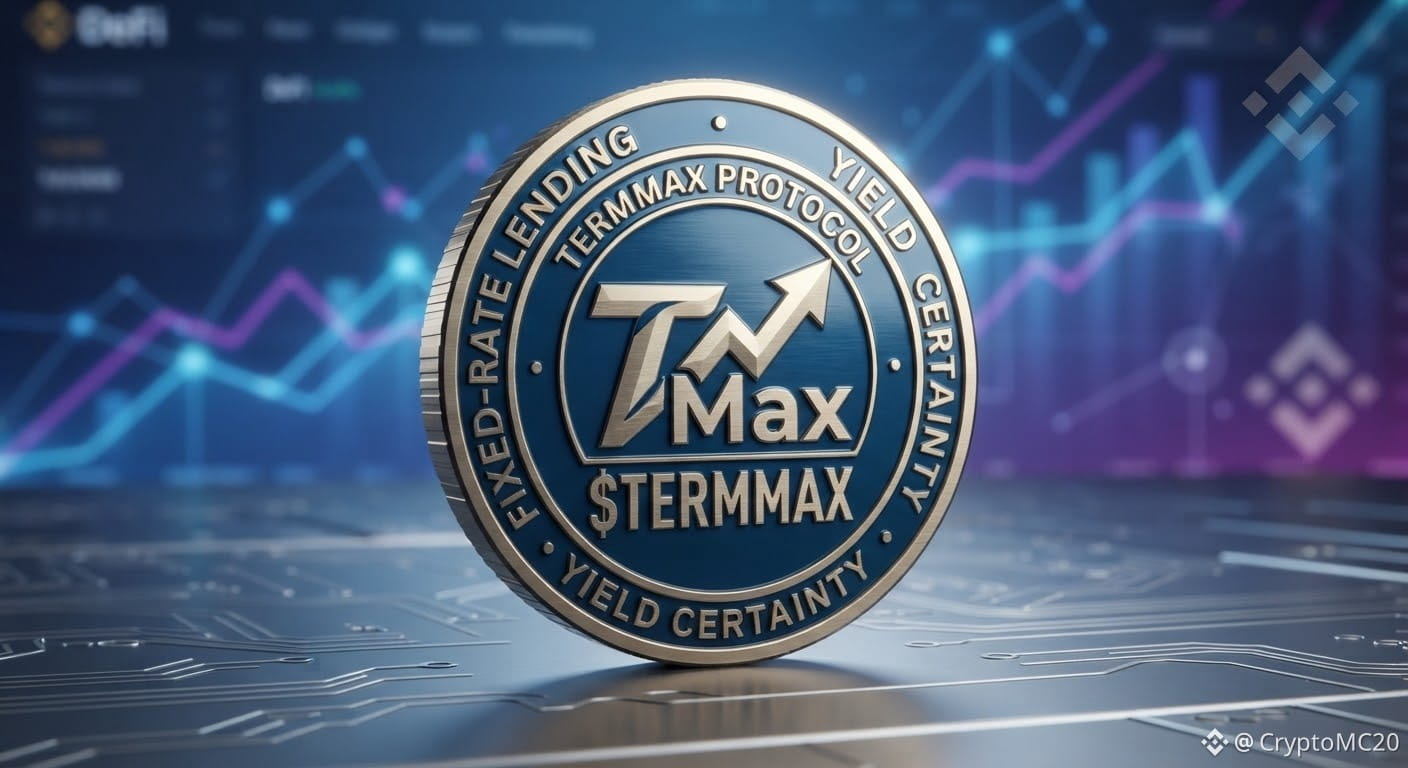
Exploring the innovative fixed-rate borrowing and lending mechanisms on @TermMax! By bringing yield certainty and a customizable interest rate order book to decentralized finance, #TermMax is truly transforming how we approach predictable returns and capital efficiency. Excited to see what's next for the ecosystem!
#termmax @termmax
Exploring the innovative fixed-rate borrowing and lending mechanisms on @TermMax! By bringing yield certainty and a customizable interest rate order book to decentralized finance, #TermMax is truly transforming how we approach predictable returns and capital efficiency. Excited to see what's next for the ecosystem!
#termmax @TermMax
#termmax @TermMax
2
2
73
·
--
Übersetzung ansehen
Exploring how @BabylonLabs_io is reshaping BTCFi through Trustless Bitcoin Vaults (TBV)! By allowing native Bitcoin to be utilized as collateral without wrapping, bridging, or sacrificing self-custody, TBV shifts the paradigm from trusting intermediaries to relying on verifiable cryptography and native network security. This unlocks massive liquidity potential for the $BABY ecosystem while preserving the core tenets of decentralization. A major step forward for Bitcoin utility! #baby
#baby $BABY
Exploring how @BabylonLabs_io is reshaping BTCFi through Trustless Bitcoin Vaults (TBV)! By allowing native Bitcoin to be utilized as collateral without wrapping, bridging, or sacrificing self-custody, TBV shifts the paradigm from trusting intermediaries to relying on verifiable cryptography and native network security. This unlocks massive liquidity potential for the $BABY ecosystem while preserving the core tenets of decentralization. A major step forward for Bitcoin utility! #baby
#baby $BABY
#baby $BABY
5
8
122
·
--
Übersetzung ansehen
Unlock the true potential of native Bitcoin without compromising on security or decentralization! @BabylonLabs_io is transforming the crypto landscape with Trustless Bitcoin Vaults (TBV), allowing holders to utilize BTC as collateral in DeFi applications like Aave v4 without wrapping, bridging, or giving up self-custody. By replacing traditional third-party trust assumptions with robust cryptographic verification, assets remain secure in co-signed Bitcoin scripts while unlocking immense capital efficiency. The $BABY token plays a vital governance and utility role in fueling this expanding ecosystem, driving a truly Bitcoin-charged economy. #baby $BABY @BabylonLabs_io
#baby $BABY
Unlock the true potential of native Bitcoin without compromising on security or decentralization! @BabylonLabs_io is transforming the crypto landscape with Trustless Bitcoin Vaults (TBV), allowing holders to utilize BTC as collateral in DeFi applications like Aave v4 without wrapping, bridging, or giving up self-custody. By replacing traditional third-party trust assumptions with robust cryptographic verification, assets remain secure in co-signed Bitcoin scripts while unlocking immense capital efficiency. The $BABY token plays a vital governance and utility role in fueling this expanding ecosystem, driving a truly Bitcoin-charged economy. #baby $BABY @BabylonLabs_io
#baby $BABY
#baby $BABY
20
20
144
·
--
Übersetzung ansehen
Unlocking the true potential of native Bitcoin in decentralized finance without relying on wrapped tokens, cross-chain bridges, or third-party custodians has always been the ultimate goal for holders. With Trustless Bitcoin Vaults (TBV) by @BabylonLabs_io, native BTC can finally be securely utilized as collateral in applications like Aave v4 while maintaining complete self-custody and relying purely on cryptographic verification between Bitcoin and Ethereum. This paradigm shift moves trust entirely from intermediaries to robust computation, paving the way for a massive expansion of utility for the $BABY ecosystem and the broader Bitcoin economy. #baby
#baby $BABY
Unlocking the true potential of native Bitcoin in decentralized finance without relying on wrapped tokens, cross-chain bridges, or third-party custodians has always been the ultimate goal for holders. With Trustless Bitcoin Vaults (TBV) by @BabylonLabs_io, native BTC can finally be securely utilized as collateral in applications like Aave v4 while maintaining complete self-custody and relying purely on cryptographic verification between Bitcoin and Ethereum. This paradigm shift moves trust entirely from intermediaries to robust computation, paving the way for a massive expansion of utility for the $BABY ecosystem and the broader Bitcoin economy. #baby
#baby $BABY
#baby $BABY

13
12
160
·
--
Übersetzung ansehen
The introduction of Trustless Bitcoin Vaults (TBV) by @BabylonLabs_io marks a massive paradigm shift for BTCFi. By locking native Bitcoin on the base layer into Taproot-based vaults, holders can seamlessly unlock utility and use their assets as productive collateral across decentralized finance without ever relying on risky cross-chain bridges or synthetic wrapped tokens. This means true self-custody remains intact while your Bitcoin finally goes to work. Keep an eye on $BABY and the broader ecosystem as we move toward a truly trustless, Bitcoin-secured financial future! #baby
#baby $BABY $BTC
The introduction of Trustless Bitcoin Vaults (TBV) by @BabylonLabs_io marks a massive paradigm shift for BTCFi. By locking native Bitcoin on the base layer into Taproot-based vaults, holders can seamlessly unlock utility and use their assets as productive collateral across decentralized finance without ever relying on risky cross-chain bridges or synthetic wrapped tokens. This means true self-custody remains intact while your Bitcoin finally goes to work. Keep an eye on $BABY and the broader ecosystem as we move toward a truly trustless, Bitcoin-secured financial future! #baby
#baby $BABY $BTC
#baby $BABY $BTC
6
7
116
·
--
Übersetzung ansehen
The evolution of Bitcoin utility is reaching new heights with @BabylonLabs_io and their groundbreaking Trustless Bitcoin Vaults (TBV). By leveraging cryptographic proofs and on-chain intelligence, users can now utilize native Bitcoin as collateral within decentralized finance ecosystems—such as lending protocols like Aave v4—without ever relinquishing custody or relying on traditional bridges and wrapped assets. This mechanism creates an entirely trustless environment where BTC holders can maintain absolute self-custody while unlocking immense liquidity and participating securely in broader DeFi markets. The synergy between Babylon's security layer and scalable borrowing capabilities is reshaping how the trillion-dollar Bitcoin economy interacts with multi-chain environments. Dive into the future of decentralized capital efficiency and discover how $BABY and the #baby ecosystem are driving true native interoperability forward.
#baby $BABY $BTC
The evolution of Bitcoin utility is reaching new heights with @BabylonLabs_io and their groundbreaking Trustless Bitcoin Vaults (TBV). By leveraging cryptographic proofs and on-chain intelligence, users can now utilize native Bitcoin as collateral within decentralized finance ecosystems—such as lending protocols like Aave v4—without ever relinquishing custody or relying on traditional bridges and wrapped assets. This mechanism creates an entirely trustless environment where BTC holders can maintain absolute self-custody while unlocking immense liquidity and participating securely in broader DeFi markets. The synergy between Babylon's security layer and scalable borrowing capabilities is reshaping how the trillion-dollar Bitcoin economy interacts with multi-chain environments. Dive into the future of decentralized capital efficiency and discover how $BABY and the #baby ecosystem are driving true native interoperability forward.
#baby $BABY $BTC
#baby $BABY $BTC
34
36
177
·
--
Übersetzung ansehen
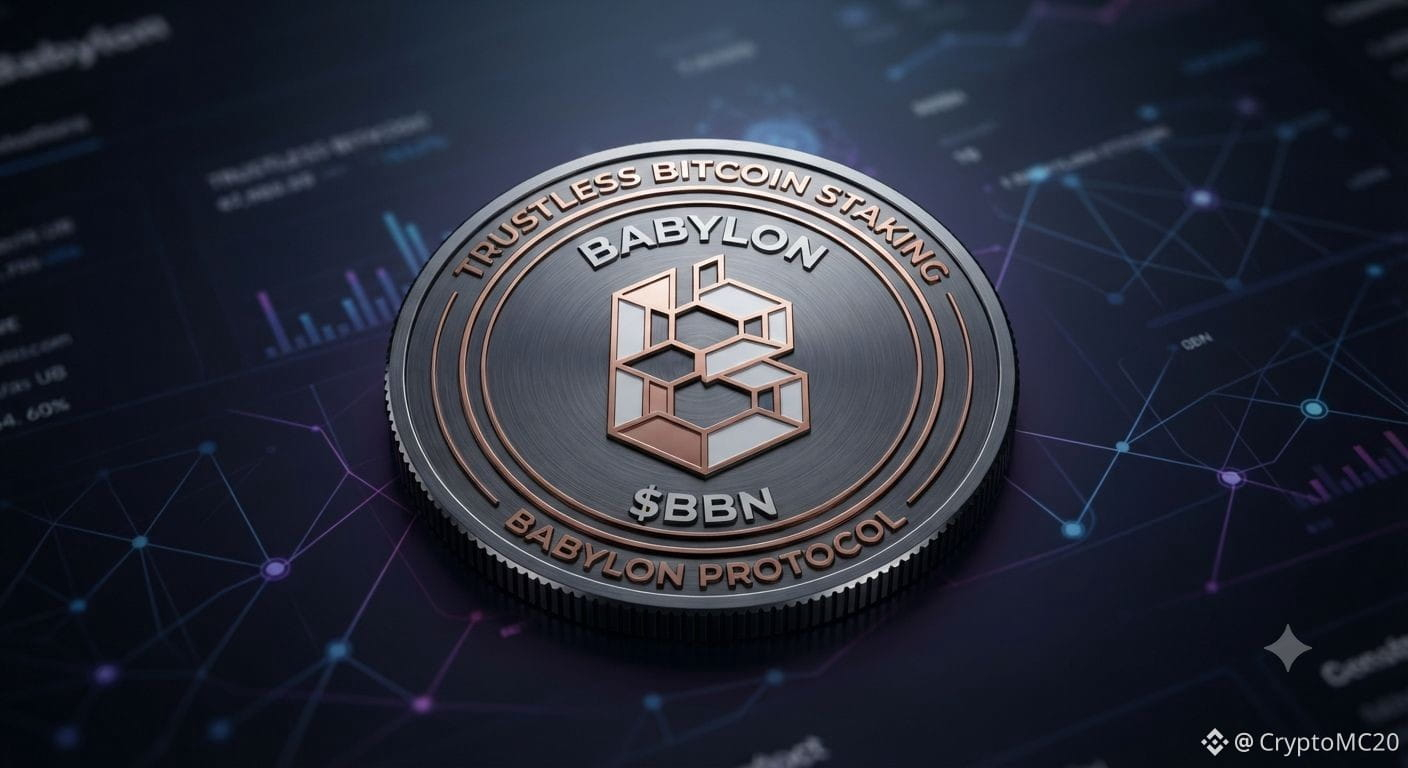
Unlock the true potential of native Bitcoin without risking custody or wrapping tokens! @BabylonLabs_io is redefining decentralized finance through Trustless Bitcoin Vaults (TBV), allowing BTC to act as secure collateral directly across multi-chain ecosystems. By leveraging cryptographic proofs and advanced light-client verification, users keep full self-custody while opening up massive utility for lending and staking. Dive into the future of Bitcoin-native infrastructure with $BABY and be part of the next evolution in Web3 security!
#baby $BABY
Unlock the true potential of native Bitcoin without risking custody or wrapping tokens! @BabylonLabs_io is redefining decentralized finance through Trustless Bitcoin Vaults (TBV), allowing BTC to act as secure collateral directly across multi-chain ecosystems. By leveraging cryptographic proofs and advanced light-client verification, users keep full self-custody while opening up massive utility for lending and staking. Dive into the future of Bitcoin-native infrastructure with $BABY and be part of the next evolution in Web3 security!
#baby $BABY
#baby $BABY
31
31
178
·
--
Verifiziert
Übersetzung ansehen
Explore how Babylon's Trustless Bitcoin Vaults (TBV) protocol unlocks the true power of native Bitcoin. By utilizing secure Taproot scripts and cryptographic proofs rather than risky bridges or wrapped assets, users can seamlessly use BTC as collateral in DeFi applications like Aave v4 while keeping complete self-custody.
The ecosystem continues to expand alongside $BABY, driving next-gen capital efficiency and security across chains. Check out @BabylonLabs_io to learn more about how native Bitcoin DeFi is evolving! #baby
#baby $BABY
Explore how Babylon's Trustless Bitcoin Vaults (TBV) protocol unlocks the true power of native Bitcoin. By utilizing secure Taproot scripts and cryptographic proofs rather than risky bridges or wrapped assets, users can seamlessly use BTC as collateral in DeFi applications like Aave v4 while keeping complete self-custody.
The ecosystem continues to expand alongside $BABY , driving next-gen capital efficiency and security across chains. Check out @BabylonLabs_io to learn more about how native Bitcoin DeFi is evolving! #baby
#baby $BABY
The ecosystem continues to expand alongside $BABY , driving next-gen capital efficiency and security across chains. Check out @BabylonLabs_io to learn more about how native Bitcoin DeFi is evolving! #baby
#baby $BABY
38
38
208
·
--
Verifiziert
Übersetzung ansehen
Unlocking the full potential of native Bitcoin in DeFi without giving up custody or relying on risky bridges is a massive leap forward. Thanks to @BabylonLabs_io and their groundbreaking Trustless Bitcoin Vaults (TBV), BTC holders can finally use their assets securely as collateral. By moving trust from intermediaries to advanced cryptography—such as SNARKs and pre-signed scripts—TBV ensures assets remain segregated and non-rehypothecated. Excited to see how $BABY and the #baby ecosystem continue shaping the future of trustless BTCFi!
#baby $BABY $SOL
Unlocking the full potential of native Bitcoin in DeFi without giving up custody or relying on risky bridges is a massive leap forward. Thanks to @BabylonLabs_io and their groundbreaking Trustless Bitcoin Vaults (TBV), BTC holders can finally use their assets securely as collateral. By moving trust from intermediaries to advanced cryptography—such as SNARKs and pre-signed scripts—TBV ensures assets remain segregated and non-rehypothecated. Excited to see how $BABY and the #baby ecosystem continue shaping the future of trustless BTCFi!
#baby $BABY $SOL
#baby $BABY $SOL
33
33
143
·
--
Übersetzung ansehen
Unlocking the massive potential of Bitcoin without compromising on security or decentralization has always been the ultimate crypto puzzle. With @BabylonLabs_io and their innovative Trustless Bitcoin Vaults (TBV), we are finally seeing a paradigm shift.
Instead of relying on risky cross-chain bridges, wrapping mechanisms, or centralized custodians, TBV enables native Bitcoin utilization through self-custodial, co-signed Taproot scripts. Your BTC stays protected on the Bitcoin network while securely interacting with decentralized finance ecosystems. This architecture bridges the gap between idle capital and true cryptographic security.
As the ecosystem evolves, $BABY is playing a vital role in powering this multi-chain security revolution. Are you ready to see native Bitcoin become the secure backbone of Web3?
#baby $BABY
Unlocking the massive potential of Bitcoin without compromising on security or decentralization has always been the ultimate crypto puzzle. With @BabylonLabs_io and their innovative Trustless Bitcoin Vaults (TBV), we are finally seeing a paradigm shift.
Instead of relying on risky cross-chain bridges, wrapping mechanisms, or centralized custodians, TBV enables native Bitcoin utilization through self-custodial, co-signed Taproot scripts. Your BTC stays protected on the Bitcoin network while securely interacting with decentralized finance ecosystems. This architecture bridges the gap between idle capital and true cryptographic security.
As the ecosystem evolves, $BABY is playing a vital role in powering this multi-chain security revolution. Are you ready to see native Bitcoin become the secure backbone of Web3?
#baby $BABY
Instead of relying on risky cross-chain bridges, wrapping mechanisms, or centralized custodians, TBV enables native Bitcoin utilization through self-custodial, co-signed Taproot scripts. Your BTC stays protected on the Bitcoin network while securely interacting with decentralized finance ecosystems. This architecture bridges the gap between idle capital and true cryptographic security.
As the ecosystem evolves, $BABY is playing a vital role in powering this multi-chain security revolution. Are you ready to see native Bitcoin become the secure backbone of Web3?
#baby $BABY
10
12
164
·
--
Übersetzung ansehen
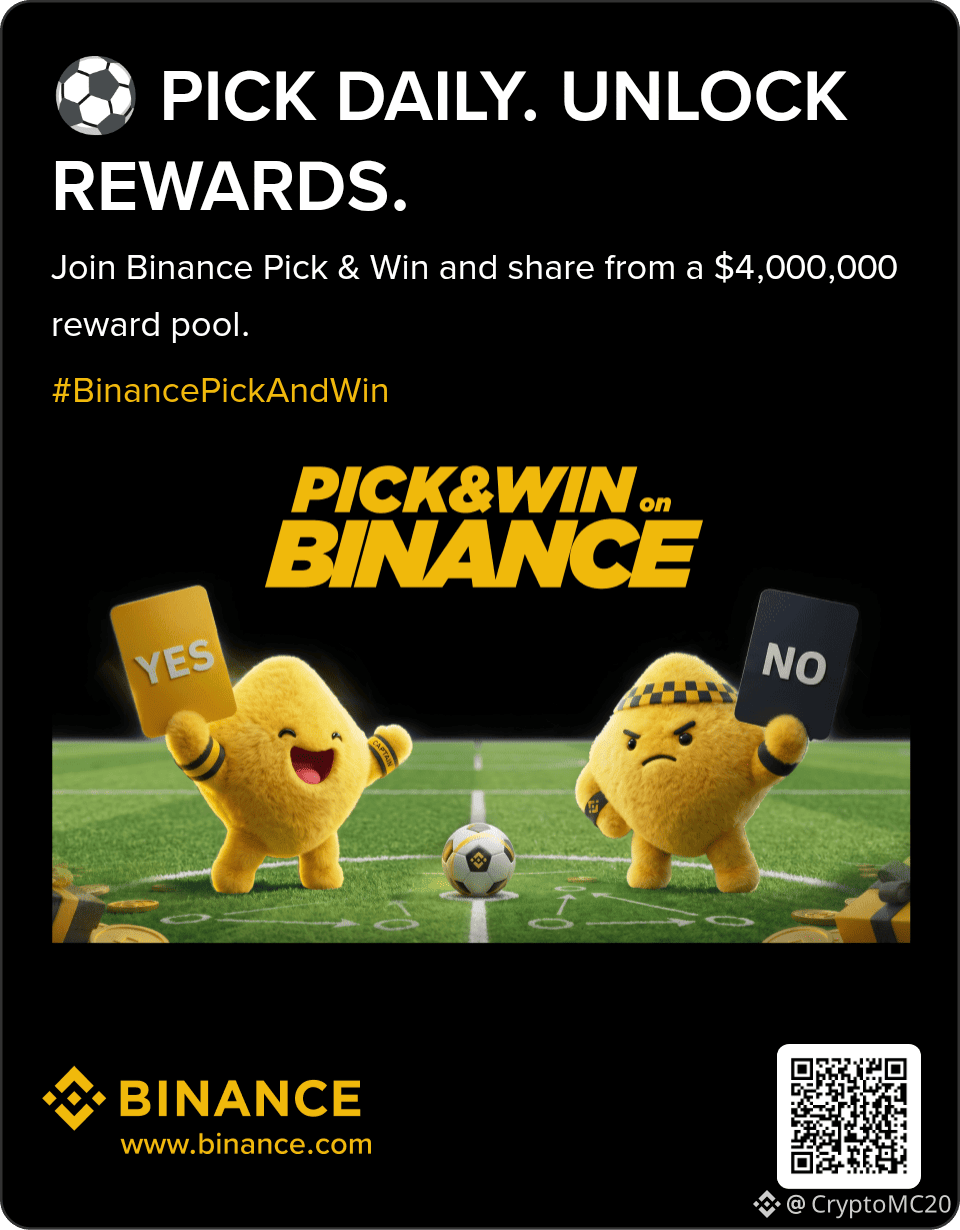
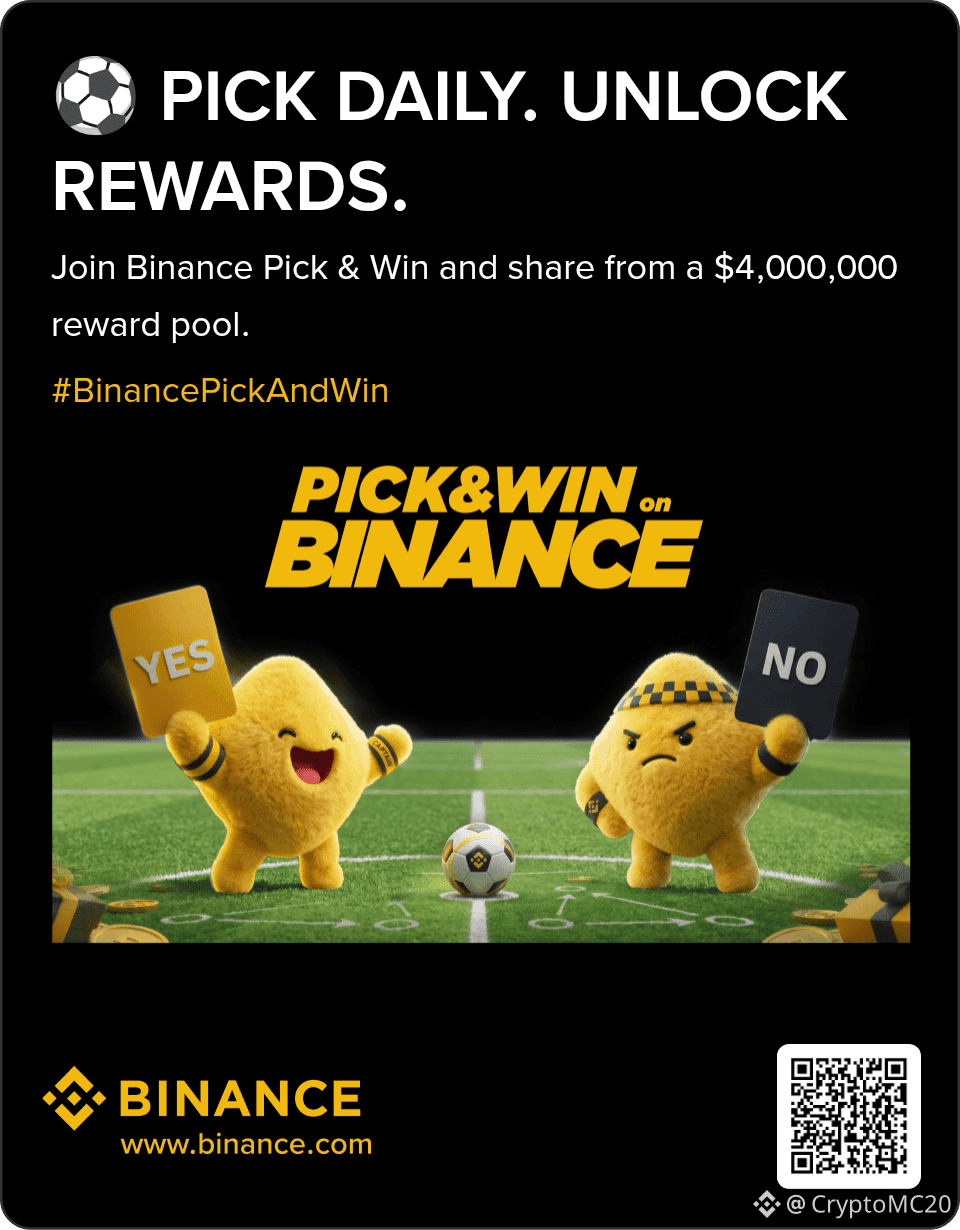
The 2026 Football Challenge is heating up, and it’s time to put your sports knowledge to the test! With a massive $4,000,000 prize pool up for grabs, Binance Pick & Win is the perfect way to turn your predictions into rewards. Whether you’re backing the favorites or cheering on an underdog, every daily match prediction counts. It’s quick, free to join, and easy to play—just select your picks and unlock your Reward Boxes. Don’t miss out on your chance to win tokens, vouchers, and exclusive merchandise. Join the action today and make every matchday matter!
#BinancePickAndWin
The 2026 Football Challenge is heating up, and it’s time to put your sports knowledge to the test! With a massive $4,000,000 prize pool up for grabs, Binance Pick & Win is the perfect way to turn your predictions into rewards. Whether you’re backing the favorites or cheering on an underdog, every daily match prediction counts. It’s quick, free to join, and easy to play—just select your picks and unlock your Reward Boxes. Don’t miss out on your chance to win tokens, vouchers, and exclusive merchandise. Join the action today and make every matchday matter!
#BinancePickAndWin
#BinancePickAndWin
3
113
·
--
Übersetzung ansehen
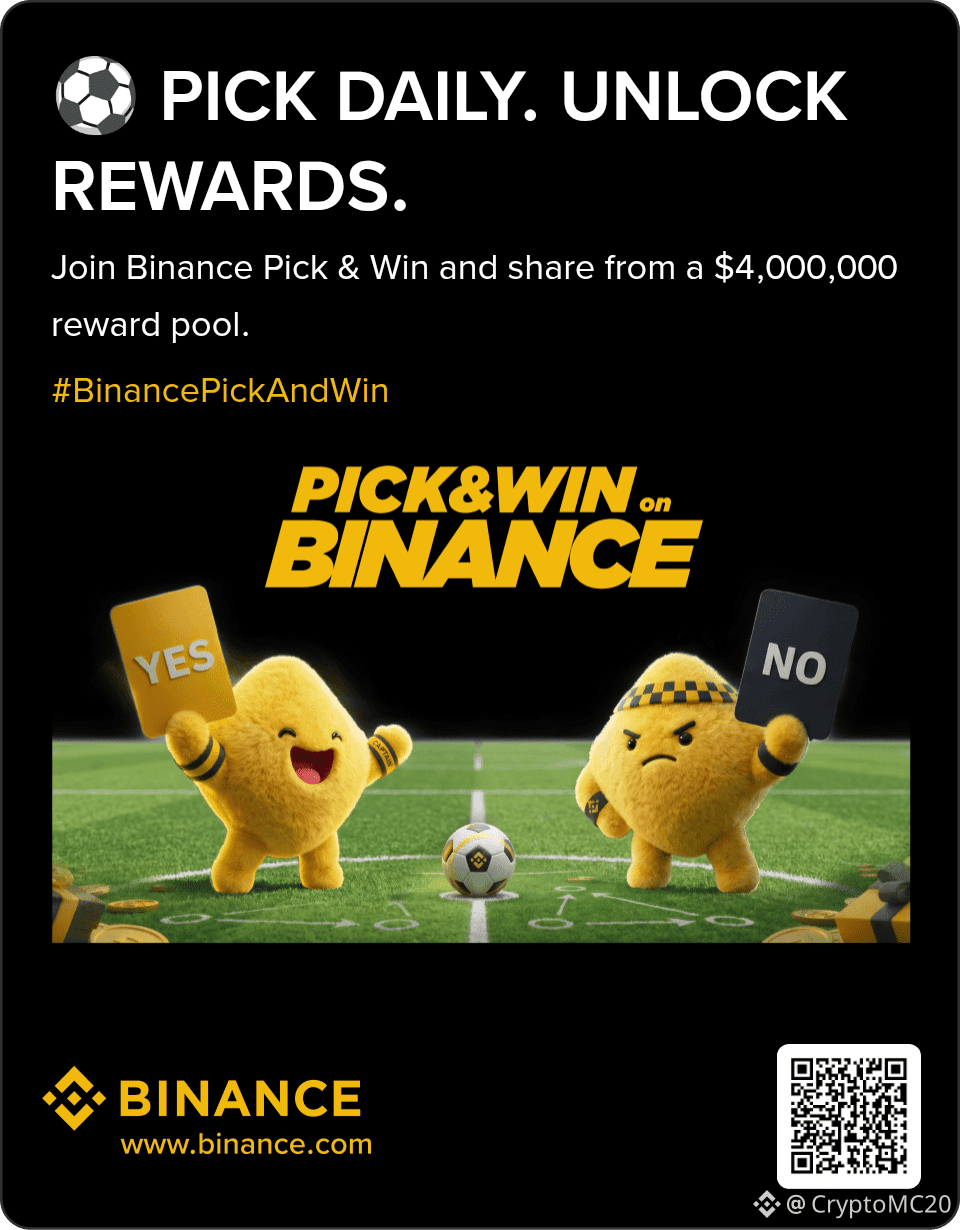
The Binance Pick & Win event (part of the 2026 Football Challenge) is an interactive prediction game where users can earn rewards by predicting match outcomes. Running from June 10 to July 19, 2026, it features a massive $4,000,000 prize pool.
To participate, visit the official activity page to submit daily "Yes/No" predictions. You can increase your chances by completing daily tasks—such as posting on Binance Square with the hashtag #BinancePickAndWin (minimum 100 characters) or referring friends. Correct predictions and active participation help you unlock Reward Boxes containing tokens, merchandise, and more.
#BinancePickAndWin
The Binance Pick & Win event (part of the 2026 Football Challenge) is an interactive prediction game where users can earn rewards by predicting match outcomes. Running from June 10 to July 19, 2026, it features a massive $4,000,000 prize pool.
To participate, visit the official activity page to submit daily "Yes/No" predictions. You can increase your chances by completing daily tasks—such as posting on Binance Square with the hashtag #BinancePickAndWin (minimum 100 characters) or referring friends. Correct predictions and active participation help you unlock Reward Boxes containing tokens, merchandise, and more.
#BinancePickAndWin
To participate, visit the official activity page to submit daily "Yes/No" predictions. You can increase your chances by completing daily tasks—such as posting on Binance Square with the hashtag #BinancePickAndWin (minimum 100 characters) or referring friends. Correct predictions and active participation help you unlock Reward Boxes containing tokens, merchandise, and more.
#BinancePickAndWin
1
1
94
·
--
Übersetzung ansehen
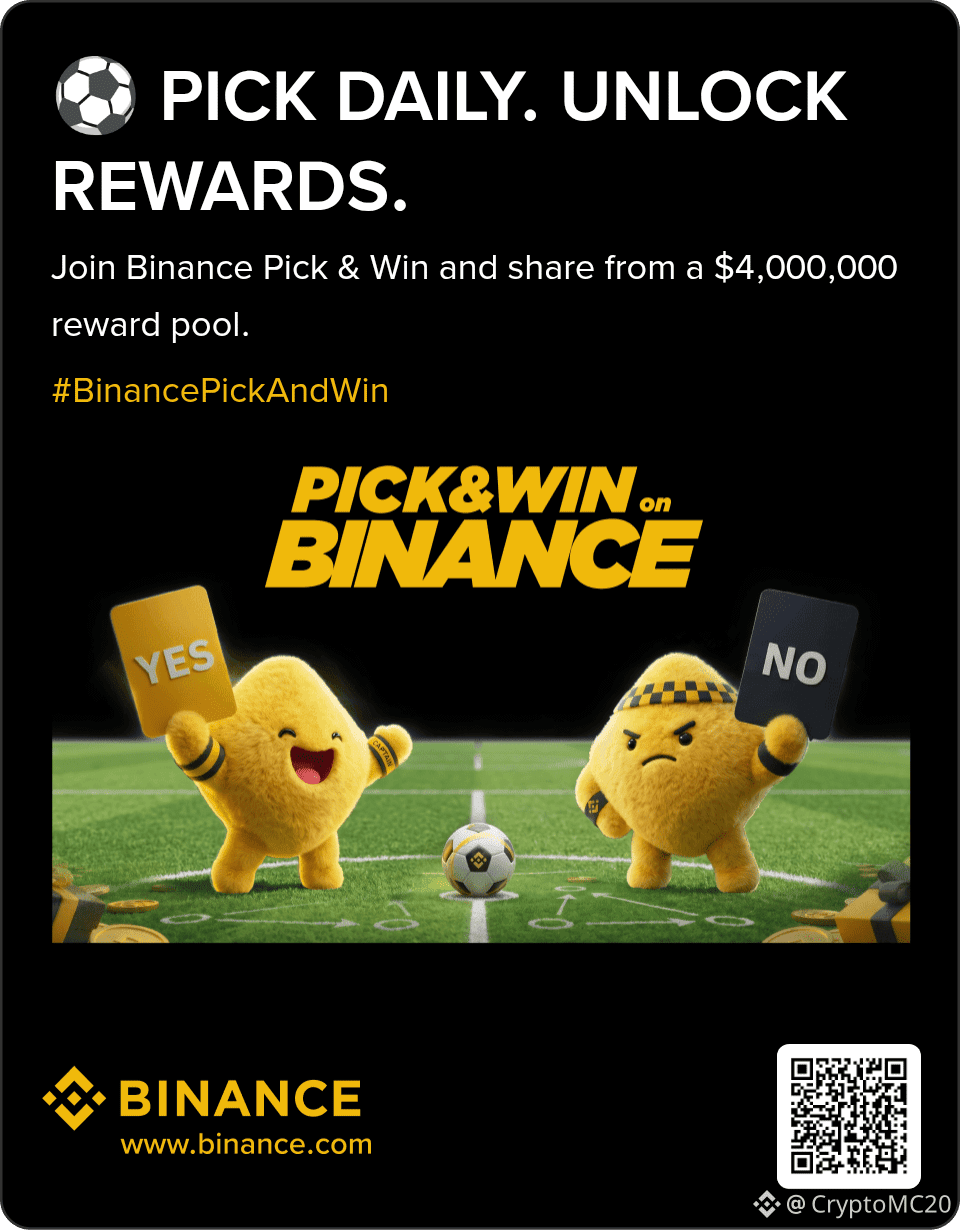
The **Binance "Pick & Win"** campaign is an interactive challenge where users predict outcomes of sports events, such as football matches, to win rewards from a multi-million dollar prize pool.
To participate, navigate to the official **Binance Football Challenge** page on the app or website. You use "Pick Attempts" to predict match results, scores, or statistics. You can earn additional attempts daily by completing tasks like social sharing, trading on Spot/Futures, or inviting friends. Successful predictions help you unlock Reward Boxes containing tokens, vouchers, or merchandise. Always ensure your account is KYC-verified to remain eligible for these prizes.
#BinancePickAndWin
The **Binance "Pick & Win"** campaign is an interactive challenge where users predict outcomes of sports events, such as football matches, to win rewards from a multi-million dollar prize pool.
To participate, navigate to the official **Binance Football Challenge** page on the app or website. You use "Pick Attempts" to predict match results, scores, or statistics. You can earn additional attempts daily by completing tasks like social sharing, trading on Spot/Futures, or inviting friends. Successful predictions help you unlock Reward Boxes containing tokens, vouchers, or merchandise. Always ensure your account is KYC-verified to remain eligible for these prizes.
#BinancePickAndWin
To participate, navigate to the official **Binance Football Challenge** page on the app or website. You use "Pick Attempts" to predict match results, scores, or statistics. You can earn additional attempts daily by completing tasks like social sharing, trading on Spot/Futures, or inviting friends. Successful predictions help you unlock Reward Boxes containing tokens, vouchers, or merchandise. Always ensure your account is KYC-verified to remain eligible for these prizes.
#BinancePickAndWin
1
1
89
·
--
Übersetzung ansehen
Celebrating nine years of innovation, Binance honors the community that built this journey. Together, we continue shaping the future of finance.
#BinanceTurns9
Binance Turns 9 - Built By You
Celebrating nine years of innovation, Binance honors the community that built this journey. Together, we continue shaping the future of finance.
#BinanceTurns9
Binance Turns 9 - Built By You
#BinanceTurns9
Binance Turns 9 - Built By You

3
·
--
Übersetzung ansehen
The Binance "Pick & Win" campaign is an engaging football-themed prediction challenge running through July 2026. Users test their sports knowledge by predicting outcomes for daily matches—typically choosing "Yes" or "No"—to unlock Reward Boxes from a massive $4,000,000 prize pool.
To participate, navigate to the Binance Football Challenge page in the app. You can earn extra "pick attempts" by completing daily tasks, such as trading on Spot/Futures, sharing, or inviting friends. Rewards include token vouchers, official merchandise, and more. Ensure your account is KYC-verified to remain eligible.
#BinancePickAndWin
$SPCXB $SOL $GRAM
The Binance "Pick & Win" campaign is an engaging football-themed prediction challenge running through July 2026. Users test their sports knowledge by predicting outcomes for daily matches—typically choosing "Yes" or "No"—to unlock Reward Boxes from a massive $4,000,000 prize pool.
To participate, navigate to the Binance Football Challenge page in the app. You can earn extra "pick attempts" by completing daily tasks, such as trading on Spot/Futures, sharing, or inviting friends. Rewards include token vouchers, official merchandise, and more. Ensure your account is KYC-verified to remain eligible.
#BinancePickAndWin
$SPCXB $SOL $GRAM
To participate, navigate to the Binance Football Challenge page in the app. You can earn extra "pick attempts" by completing daily tasks, such as trading on Spot/Futures, sharing, or inviting friends. Rewards include token vouchers, official merchandise, and more. Ensure your account is KYC-verified to remain eligible.
#BinancePickAndWin
$SPCXB $SOL $GRAM
1
1
70
Anmelden und weiter Inhalte entdecken
Krypto-Nutzer weltweit auf Binance Square kennenlernen
⚡️ Bleib in Sachen Krypto stets am Puls.
💬 Die weltgrößte Kryptobörse vertraut darauf.
👍 Erhalte verlässliche Einblicke von verifizierten Creators.
E-Mail-Adresse/Telefonnummer
Trendthemen
BitwiseFilesFinalNEARSpotETFProspectus
76,994 Aufrufe
1,317 Kommentare
#bitwisefilesfinalnearspotetfprospectus
Kann $NEAR WIRKLICH $562 mit einer ETF-Zulassung erreichen? 🚀
Der Kryptomarkt brodelt, während Bitwise seinen finalen Prospekt für einen Spot NEAR ETF einreicht (Ticker: NRR an der NYSE Arca)! 📊🔥
Geht institutionelles Geld gleich daran, den größten Pump in der Geschichte von NEAR zu entfachen? Analysten werfen mit atemberaubenden Kurszielen um sich:
🎯 Zwischenziel: $155
🎯 2030 Langfrist-Ziel: $562
💡 Rechnen wir kurz:
Bei $562 würde $NEAR bei ungefähr einer Marktkapitalisierung von 680 Milliarden US-Dollar liegen – also ganz nahe an die mögliche Bewertung von Ethereum heran. Da NEAR die Story von Chain Abstraction & AI im Krypto-Bereich anführt, klingt das vielleicht gar nicht so verrückt, wie es sich anhört!
Während die SEC-Vorschriften kryptofreundlicher werden und Wall Street an die Tür klopft: Sammelt ihr oder haltet ihr?
👇 Hinterlass in den Kommentaren eure realistische Kurserwartung für $NEAR ! 👇
#BitwiseFilesFinalNEARSpotETFProspectus #Altcoins #CryptoNews #ETF
Doomsday-Trader
·6 Likes
·3.6k Aufrufe
BitgetHackerMoves$83MStolenXRP
30,829 Aufrufe
158 Kommentare
SOLSpotETFWeeklyInflow$188M
20,060 Aufrufe
129 Kommentare