Binance Square
Crypto_Zenith7
4.5k Beiträge

Crypto_Zenith7

Trade eröffnen
Regelmäßiger Trader
10.1 Monate
157 Following
15.0K+ Follower
4.0K+ Like gegeben
Beiträge
Portfolio
·
--
Bullisch
Übersetzung ansehen
At first, I honestly thought Newton Protocol (NEWT) was going to be another AI + crypto project riding the latest narrative. We've seen the cycle too many times—huge hype, users farming incentives, token launch, early selling, and then the excitement slowly disappears. But after reading more about it, I think Newton is trying to solve a different problem. Instead of building "just another AI agent," it's focused on making AI safe enough to interact with onchain assets. The idea is that users set clear permissions, developers build AI strategies, and operators execute them while the protocol verifies that everything stays within the rules. That feels more practical than simply promising smarter AI. The NEWT token also has a role beyond speculation. It's used for staking, governance, paying protocol fees, and as collateral for operators. My first reaction was that it sounded like the usual long list of token utilities, but most of them are actually tied to securing the network. What I like most is the incentive design. Developers benefit when their AI models are genuinely used, operators have something to lose if they misbehave, and users don't have to give AI unlimited control over their wallets. That creates incentives for real participation rather than pure reward farming. Of course, none of this guarantees success. Building good infrastructure is one thing; getting people to use it is another. Adoption will ultimately decide whether Newton becomes meaningful or just another well-designed protocol with little activity. For now, I see Newton Protocol as an interesting experiment. It feels more thoughtful than most AI projects, but execution and real user demand will determine whether it's actually different. Until then, I'm staying cautiously optimistic. @NewtonProtocol #newt $NEWT
At first, I honestly thought Newton Protocol (NEWT) was going to be another AI + crypto project riding the latest narrative. We've seen the cycle too many times—huge hype, users farming incentives, token launch, early selling, and then the excitement slowly disappears.

But after reading more about it, I think Newton is trying to solve a different problem.

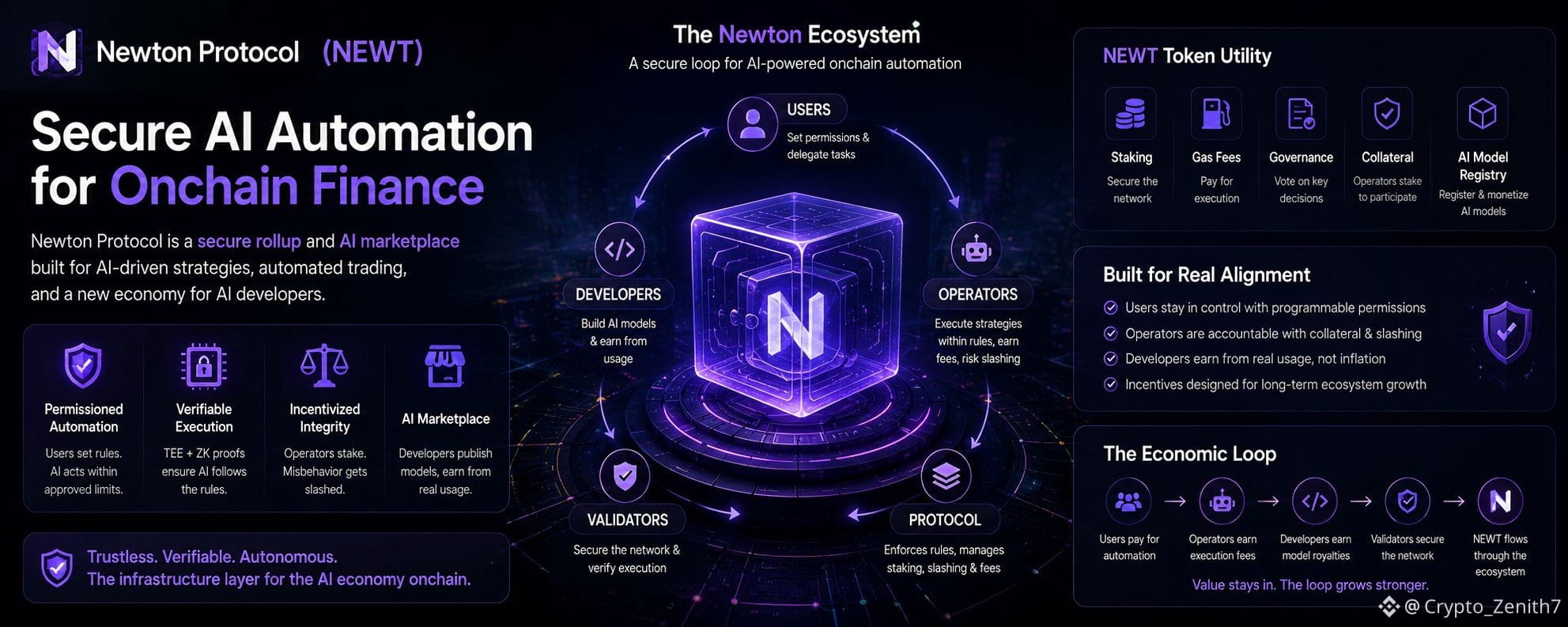
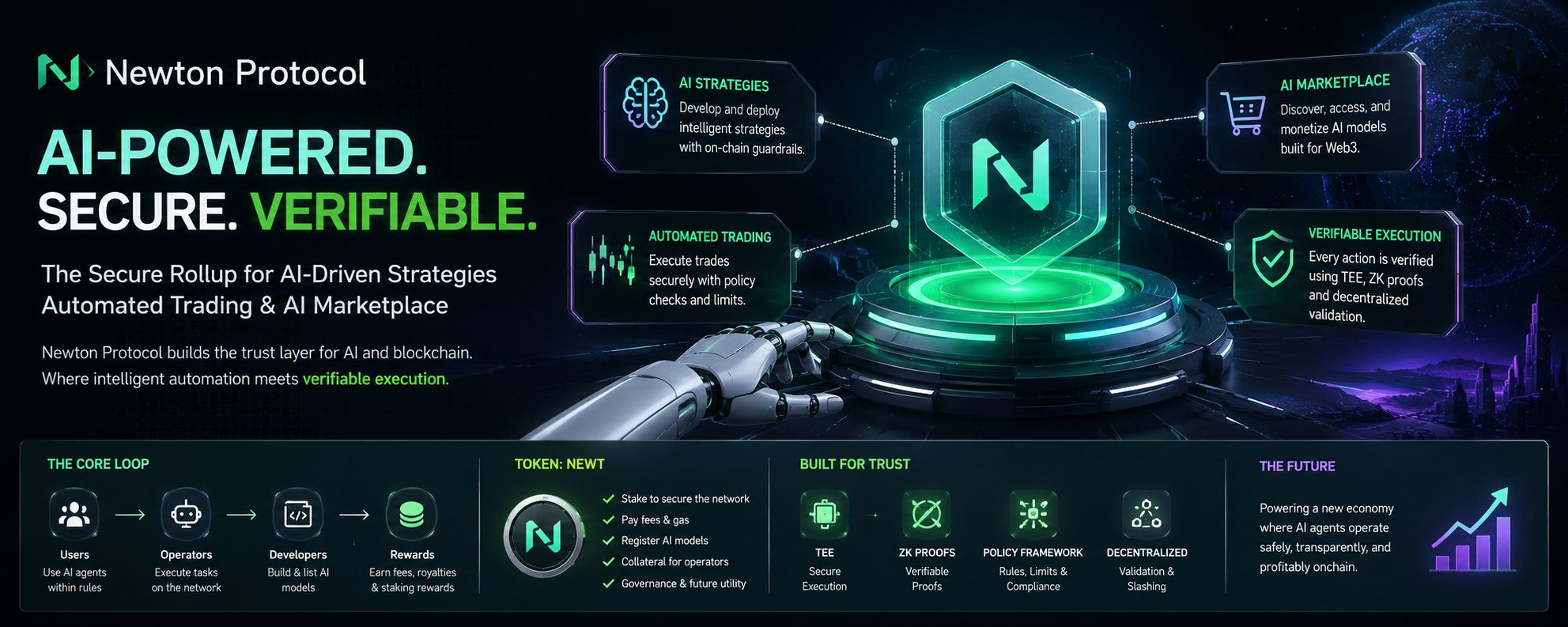
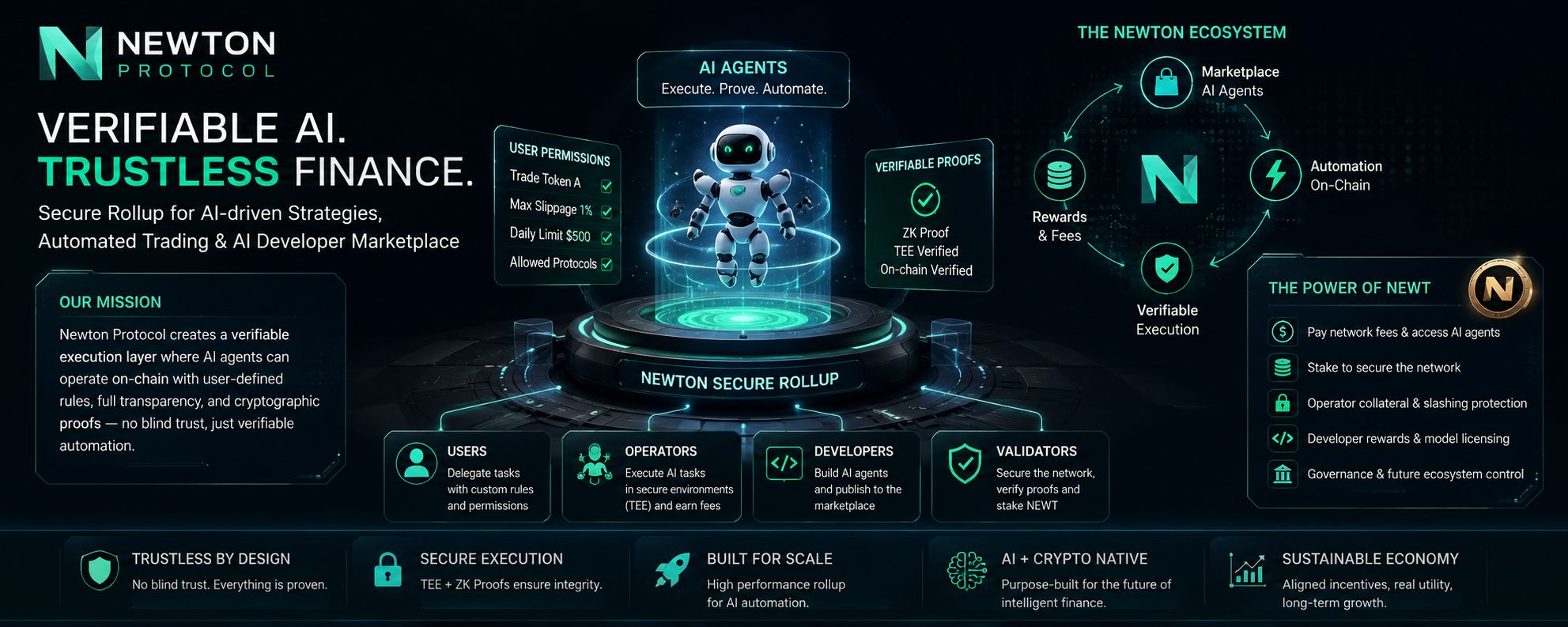
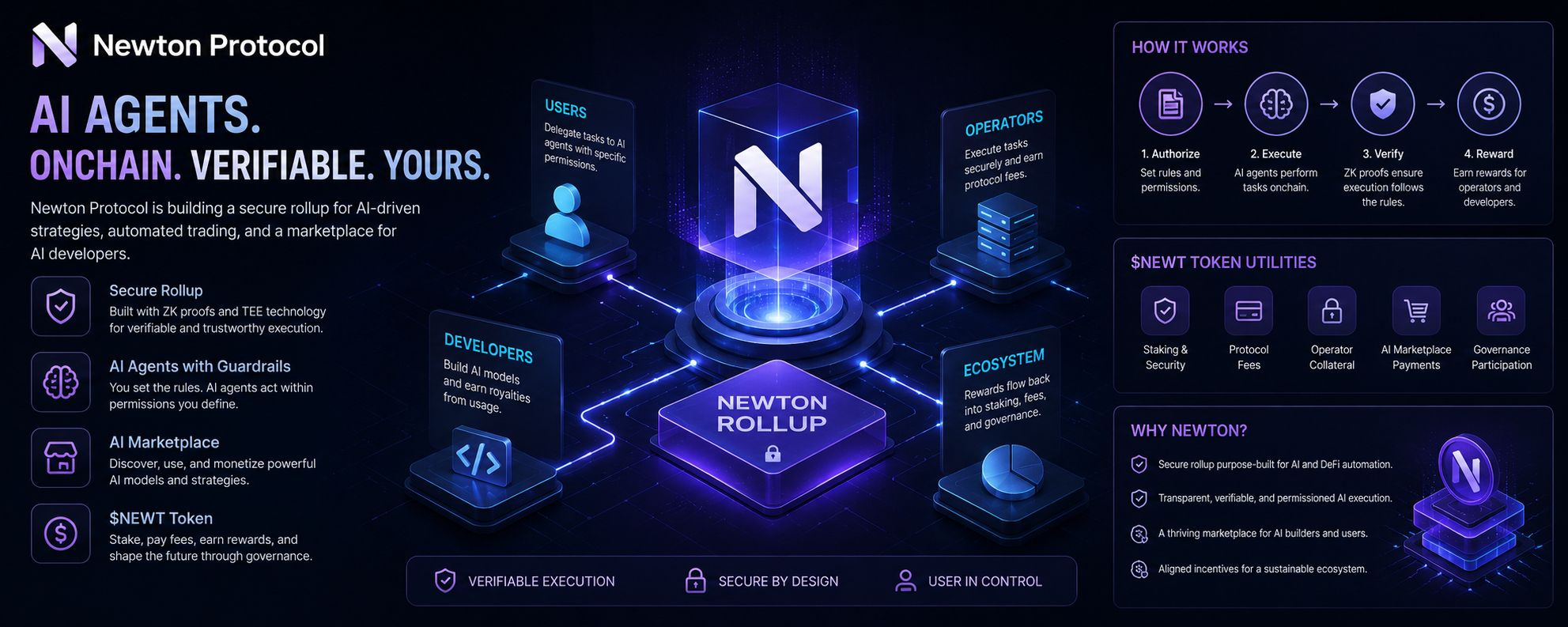
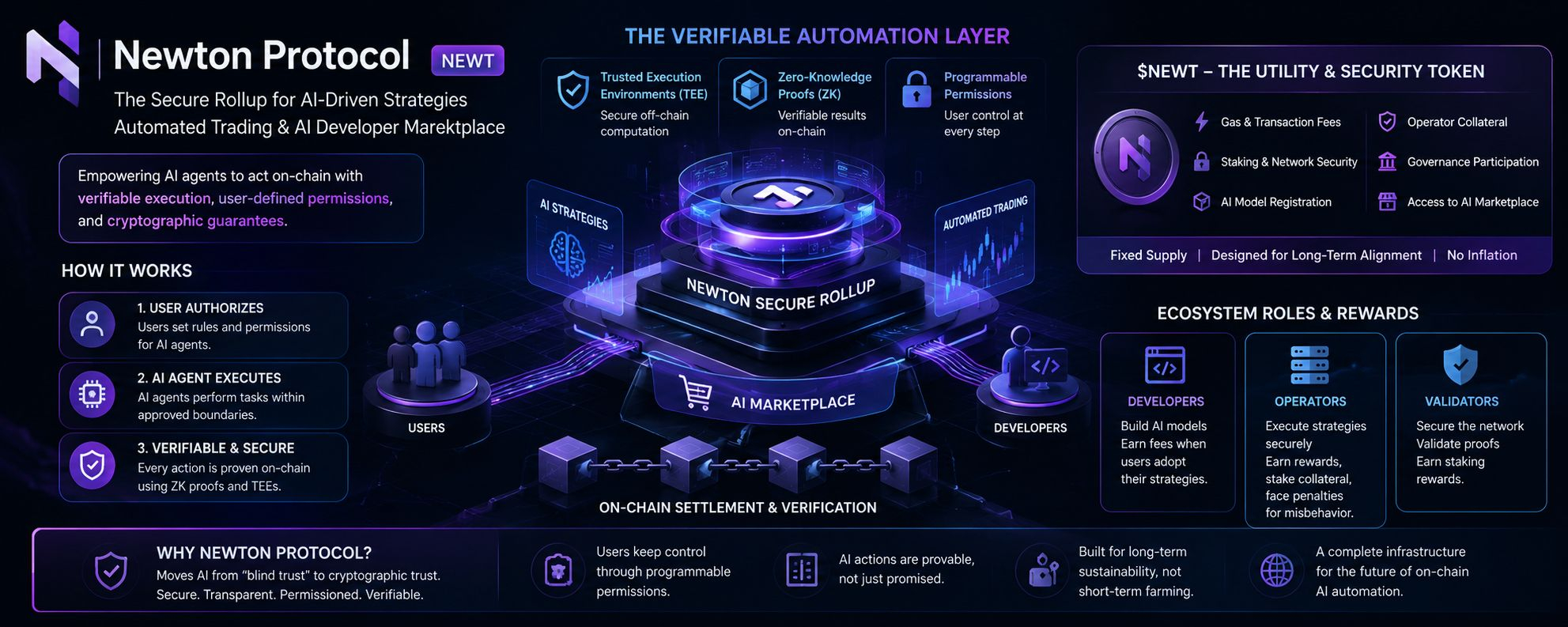
Instead of building "just another AI agent," it's focused on making AI safe enough to interact with onchain assets. The idea is that users set clear permissions, developers build AI strategies, and operators execute them while the protocol verifies that everything stays within the rules. That feels more practical than simply promising smarter AI.

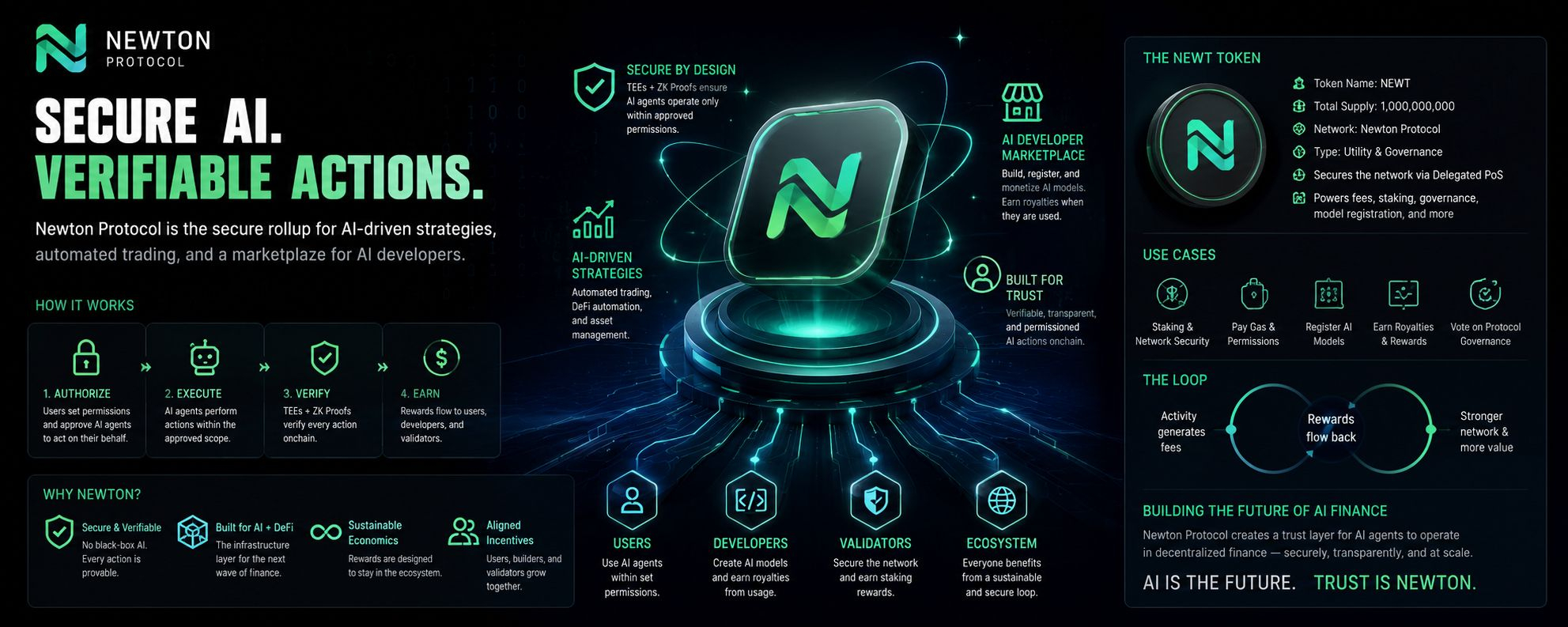
The NEWT token also has a role beyond speculation. It's used for staking, governance, paying protocol fees, and as collateral for operators. My first reaction was that it sounded like the usual long list of token utilities, but most of them are actually tied to securing the network.

What I like most is the incentive design. Developers benefit when their AI models are genuinely used, operators have something to lose if they misbehave, and users don't have to give AI unlimited control over their wallets. That creates incentives for real participation rather than pure reward farming.

Of course, none of this guarantees success. Building good infrastructure is one thing; getting people to use it is another. Adoption will ultimately decide whether Newton becomes meaningful or just another well-designed protocol with little activity.

For now, I see Newton Protocol as an interesting experiment. It feels more thoughtful than most AI projects, but execution and real user demand will determine whether it's actually different. Until then, I'm staying cautiously optimistic.

@NewtonProtocol #newt $NEWT
Artikel
Übersetzung ansehen
Newton Protocol (NEWT): I Expected Another AI Crypto Hype Cycle… But This One Made Me PauseWhen I first came across Newton Protocol (NEWT), my reaction was almost automatic. Another AI project. Another token. Another promise that artificial intelligence is about to transform crypto forever. Maybe I've been around this space for too long, but it's hard not to become skeptical. We've watched this movie countless times. A project captures everyone's attention, launches an attractive farming campaign, influencers flood social media with excitement, the token goes live, early participants rush for the exit, and within a few months the conversation quietly disappears. The technology often ends up being far less important than the marketing. Because of that history, I opened Newton Protocol expecting more of the same. Surprisingly, after spending time understanding what it's actually trying to build, I walked away with a different impression. Not because I suddenly became convinced it's destined to succeed, but because it appears to be solving a problem that many AI blockchain projects barely acknowledge. Most AI crypto projects focus on making AI agents smarter. Newton Protocol seems more interested in making them trustworthy. That distinction matters. The idea behind the protocol isn't simply creating AI-powered trading bots or automated strategies. The bigger vision is building an infrastructure where AI can perform real blockchain actions while operating within strict, verifiable rules. Instead of asking users to blindly trust an algorithm with their assets, Newton wants every action to happen under predefined policies that can be checked before anything is executed. That's a much more practical challenge than simply saying, "Our AI can trade for you." The ecosystem itself revolves around a fairly intuitive cycle. Developers create AI models and automated strategies that other people can use. Users interact with those tools to automate trading, portfolio management, or other blockchain activities. Operators execute those tasks across the network, while validators help secure the system. Every participant contributes something different, and ideally every participant has a reason to stay involved instead of simply collecting rewards and leaving. That part caught my attention because too many Web3 ecosystems are built around temporary incentives rather than long-term participation. The reward system also reflects that philosophy. Operators earn fees for performing useful work. Developers receive value when their AI models are adopted through the marketplace. Validators secure the network through staking. Users gain access to automation that hopefully saves time or improves decision-making. The protocol isn't encouraging everyone to chase free tokens for a few weeks. Instead, it's attempting to create an economy where value flows between builders, operators, and users through actual usage. Of course, that's much easier to describe than it is to achieve. One feature I found particularly interesting is the emphasis on programmable security policies. AI is incredibly powerful, but it's also unpredictable. Giving autonomous software permission to move assets or execute financial strategies creates obvious risks. Newton's answer is to limit what AI is allowed to do before it ever touches a wallet. Spending limits, approval conditions, compliance checks, and verifiable execution all become part of the process rather than relying entirely on trust. If that system works as intended, it addresses one of the biggest weaknesses surrounding AI automation in crypto today. The technology stack reflects that ambition as well. By combining trusted execution environments, cryptographic verification, and zero-knowledge proofs, Newton is trying to create evidence that AI followed the rules it was given. That's a very different conversation from simply claiming an AI agent is intelligent. Intelligence without accountability doesn't solve much in financial systems. Then there's the NEWT token itself. Initially, I assumed it would be another governance token with vague utility attached after launch. Looking deeper, the token actually sits at several important points inside the ecosystem. It secures the network through staking, pays protocol fees, supports marketplace interactions, provides collateral for operators, and plays a role in governance. More importantly, operators can be penalized through slashing if they fail to behave honestly, introducing real economic consequences instead of relying on reputation alone. That doesn't automatically make the token valuable, but it does make its purpose clearer than many AI-related cryptocurrencies currently on the market. Something else stood out while reading through the protocol's design. Newton seems to be encouraging productive behavior instead of speculative behavior. Developers are rewarded for creating useful AI models. Operators only earn by successfully completing tasks. Validators secure the network because they have something at stake. Users receive ongoing value by continuing to use automation rather than simply farming incentives. Whether people actually behave that way once the network grows is impossible to know today, but at least the incentive structure appears to be pointing in that direction. Economically, the project is attempting to create a relatively closed ecosystem. Users pay for automation. Those payments compensate operators. Developers earn from their contributions. Validators secure the infrastructure through staking. The token circulates inside that activity rather than existing only as something people hope will increase in price. That's generally healthier than systems that depend entirely on attracting new buyers to support older holders. Still, this is where my skepticism returns. Good architecture has never guaranteed adoption. Crypto is filled with technically impressive projects that nobody ended up using. Building secure infrastructure is only one side of the equation. Newton also needs developers willing to build AI applications, operators willing to maintain the network, and users confident enough to trust AI with meaningful financial decisions. Those are difficult challenges that can't be solved with elegant tokenomics alone. Another concern is complexity. Every additional security layer, verification process, and incentive mechanism improves safety, but it also makes the system harder for average users to understand. The protocol has to balance sophisticated infrastructure with a user experience simple enough that people actually want to use it. That's often where ambitious blockchain projects struggle. After looking beyond the headlines, I don't think Newton Protocol is trying to win by simply attaching "AI" to a cryptocurrency. It seems to be building the infrastructure required for AI to interact with blockchains in a way that's transparent, verifiable, and economically accountable. Whether that vision succeeds depends far more on execution than marketing. At this stage, I don't see Newton Protocol as a guaranteed success, and I certainly don't see it as something that deserves blind optimism. But I also don't think it belongs in the same category as many short-lived AI narratives that exist primarily to capture attention during the next market cycle. For me, that's what makes it interesting. Not because it's perfect. Not because it's proven. But because it's asking a better question. Instead of asking, "How do we put AI on the blockchain?" Newton is asking, "How do we make AI trustworthy enough to operate on the blockchain?" That's a far more difficult problem to solve, and if the team can execute on that vision while attracting genuine developers and real users, the project could become much more significant than another AI token riding a temporary trend. For now, though, that's exactly how I think it should be viewed: not as a finished product, not as a guaranteed winner, but as an ambitious experiment whose future will be determined by execution, adoption, and whether people truly find value in the ecosystem it is trying to build.I'm interested enough to keep watching, but experienced enough not to confuse potential with proof. @NewtonProtocol #Newt $NEWT {future}(NEWTUSDT)

Newton Protocol (NEWT): I Expected Another AI Crypto Hype Cycle… But This One Made Me Pause

When I first came across Newton Protocol (NEWT), my reaction was almost automatic. Another AI project. Another token. Another promise that artificial intelligence is about to transform crypto forever. Maybe I've been around this space for too long, but it's hard not to become skeptical. We've watched this movie countless times. A project captures everyone's attention, launches an attractive farming campaign, influencers flood social media with excitement, the token goes live, early participants rush for the exit, and within a few months the conversation quietly disappears. The technology often ends up being far less important than the marketing.
Because of that history, I opened Newton Protocol expecting more of the same.
Surprisingly, after spending time understanding what it's actually trying to build, I walked away with a different impression. Not because I suddenly became convinced it's destined to succeed, but because it appears to be solving a problem that many AI blockchain projects barely acknowledge.
Most AI crypto projects focus on making AI agents smarter. Newton Protocol seems more interested in making them trustworthy.
That distinction matters.
The idea behind the protocol isn't simply creating AI-powered trading bots or automated strategies. The bigger vision is building an infrastructure where AI can perform real blockchain actions while operating within strict, verifiable rules. Instead of asking users to blindly trust an algorithm with their assets, Newton wants every action to happen under predefined policies that can be checked before anything is executed.
That's a much more practical challenge than simply saying, "Our AI can trade for you."
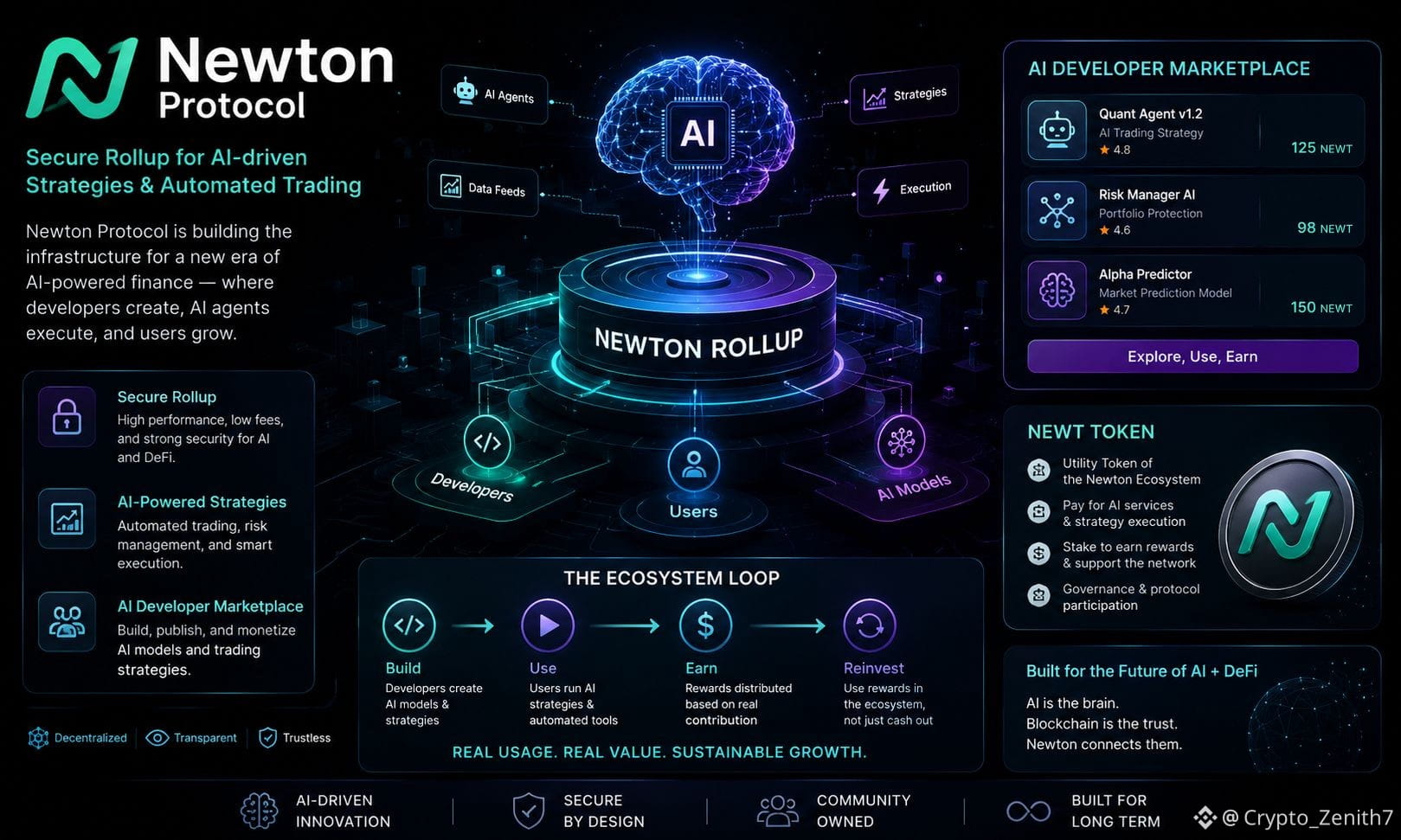
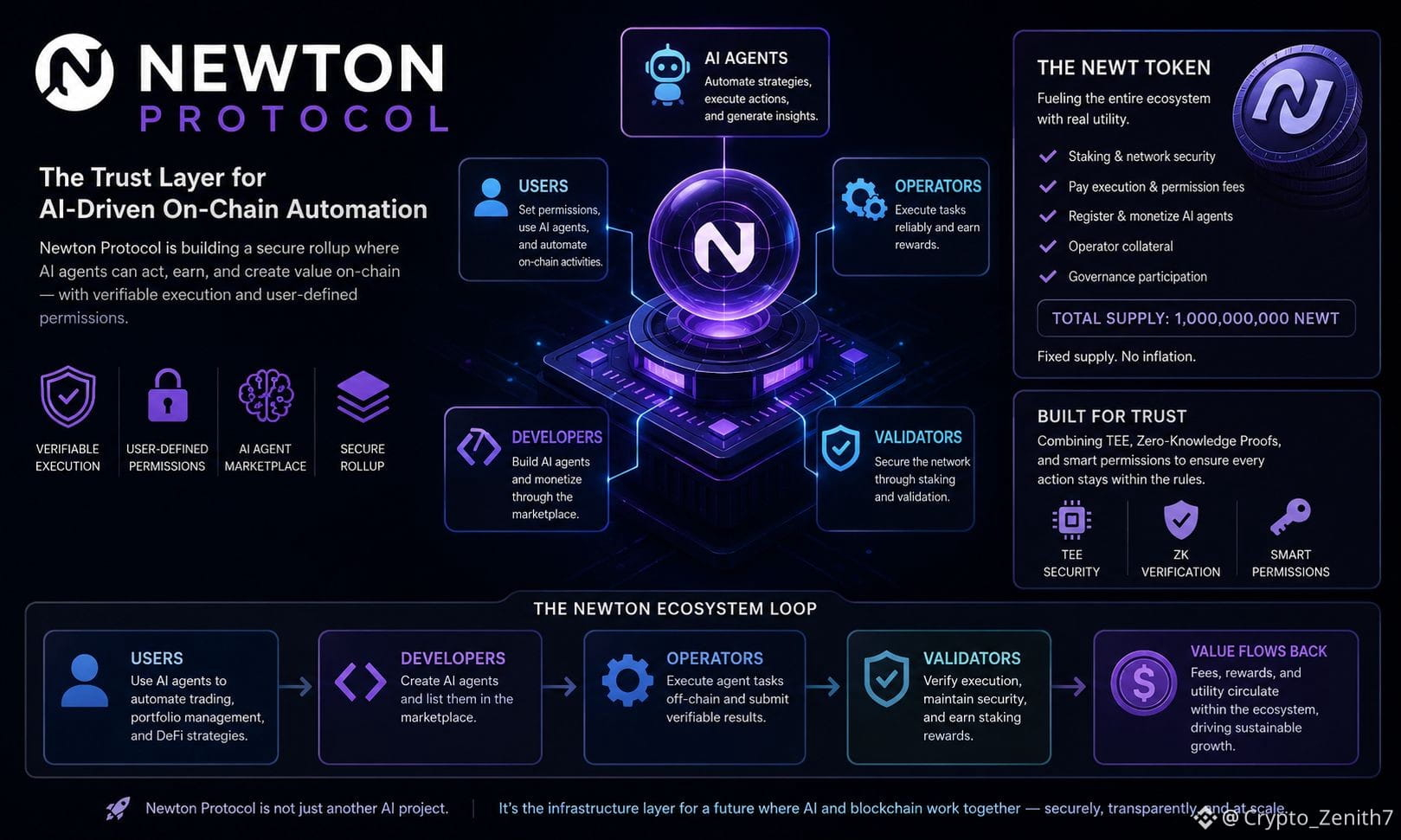
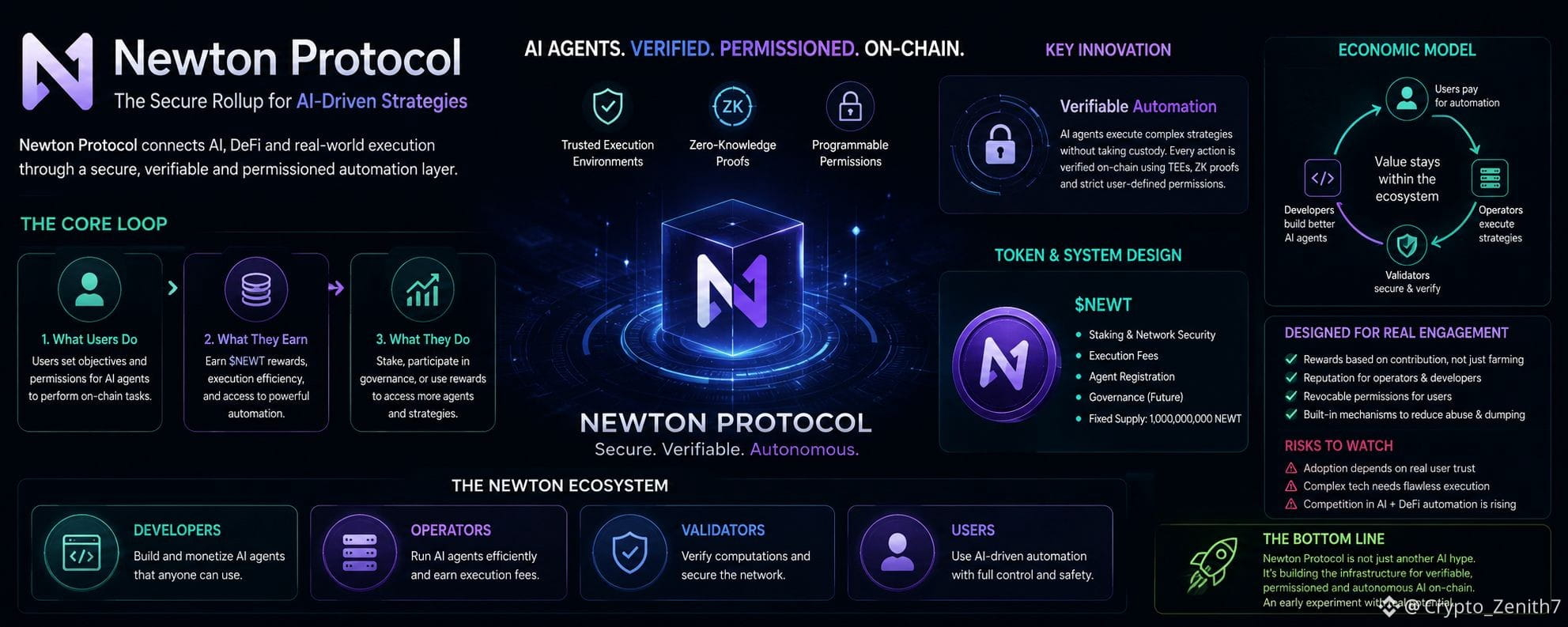
The ecosystem itself revolves around a fairly intuitive cycle. Developers create AI models and automated strategies that other people can use. Users interact with those tools to automate trading, portfolio management, or other blockchain activities. Operators execute those tasks across the network, while validators help secure the system. Every participant contributes something different, and ideally every participant has a reason to stay involved instead of simply collecting rewards and leaving.
That part caught my attention because too many Web3 ecosystems are built around temporary incentives rather than long-term participation.
The reward system also reflects that philosophy. Operators earn fees for performing useful work. Developers receive value when their AI models are adopted through the marketplace. Validators secure the network through staking. Users gain access to automation that hopefully saves time or improves decision-making. The protocol isn't encouraging everyone to chase free tokens for a few weeks. Instead, it's attempting to create an economy where value flows between builders, operators, and users through actual usage.
Of course, that's much easier to describe than it is to achieve.
One feature I found particularly interesting is the emphasis on programmable security policies. AI is incredibly powerful, but it's also unpredictable. Giving autonomous software permission to move assets or execute financial strategies creates obvious risks. Newton's answer is to limit what AI is allowed to do before it ever touches a wallet. Spending limits, approval conditions, compliance checks, and verifiable execution all become part of the process rather than relying entirely on trust.
If that system works as intended, it addresses one of the biggest weaknesses surrounding AI automation in crypto today.
The technology stack reflects that ambition as well. By combining trusted execution environments, cryptographic verification, and zero-knowledge proofs, Newton is trying to create evidence that AI followed the rules it was given. That's a very different conversation from simply claiming an AI agent is intelligent. Intelligence without accountability doesn't solve much in financial systems.
Then there's the NEWT token itself.
Initially, I assumed it would be another governance token with vague utility attached after launch. Looking deeper, the token actually sits at several important points inside the ecosystem. It secures the network through staking, pays protocol fees, supports marketplace interactions, provides collateral for operators, and plays a role in governance. More importantly, operators can be penalized through slashing if they fail to behave honestly, introducing real economic consequences instead of relying on reputation alone.
That doesn't automatically make the token valuable, but it does make its purpose clearer than many AI-related cryptocurrencies currently on the market.
Something else stood out while reading through the protocol's design. Newton seems to be encouraging productive behavior instead of speculative behavior. Developers are rewarded for creating useful AI models. Operators only earn by successfully completing tasks. Validators secure the network because they have something at stake. Users receive ongoing value by continuing to use automation rather than simply farming incentives.
Whether people actually behave that way once the network grows is impossible to know today, but at least the incentive structure appears to be pointing in that direction.
Economically, the project is attempting to create a relatively closed ecosystem. Users pay for automation. Those payments compensate operators. Developers earn from their contributions. Validators secure the infrastructure through staking. The token circulates inside that activity rather than existing only as something people hope will increase in price.
That's generally healthier than systems that depend entirely on attracting new buyers to support older holders.
Still, this is where my skepticism returns.
Good architecture has never guaranteed adoption.
Crypto is filled with technically impressive projects that nobody ended up using. Building secure infrastructure is only one side of the equation. Newton also needs developers willing to build AI applications, operators willing to maintain the network, and users confident enough to trust AI with meaningful financial decisions. Those are difficult challenges that can't be solved with elegant tokenomics alone.
Another concern is complexity. Every additional security layer, verification process, and incentive mechanism improves safety, but it also makes the system harder for average users to understand. The protocol has to balance sophisticated infrastructure with a user experience simple enough that people actually want to use it.
That's often where ambitious blockchain projects struggle.
After looking beyond the headlines, I don't think Newton Protocol is trying to win by simply attaching "AI" to a cryptocurrency. It seems to be building the infrastructure required for AI to interact with blockchains in a way that's transparent, verifiable, and economically accountable. Whether that vision succeeds depends far more on execution than marketing.
At this stage, I don't see Newton Protocol as a guaranteed success, and I certainly don't see it as something that deserves blind optimism. But I also don't think it belongs in the same category as many short-lived AI narratives that exist primarily to capture attention during the next market cycle.
For me, that's what makes it interesting.
Not because it's perfect.
Not because it's proven.
But because it's asking a better question.
Instead of asking, "How do we put AI on the blockchain?" Newton is asking, "How do we make AI trustworthy enough to operate on the blockchain?"
That's a far more difficult problem to solve, and if the team can execute on that vision while attracting genuine developers and real users, the project could become much more significant than another AI token riding a temporary trend.
For now, though, that's exactly how I think it should be viewed: not as a finished product, not as a guaranteed winner, but as an ambitious experiment whose future will be determined by execution, adoption, and whether people truly find value in the ecosystem it is trying to build.I'm interested enough to keep watching, but experienced enough not to confuse potential with proof.
@NewtonProtocol #Newt $NEWT
·
--
Bullisch
Übersetzung ansehen
When I first came across Newton Protocol (NEWT), I honestly expected another AI + crypto project following the same familiar script: grab attention, launch incentives, attract farmers, watch the token get dumped, then slowly disappear once the hype fades. But after digging a little deeper, I found myself more curious than skeptical. Newton Protocol isn't just trying to build AI agents—it wants to create a secure layer where AI can actually execute on-chain strategies with clear permissions and verifiable actions. Users authorize what an AI can do, developers build the agents, and operators run them while earning fees. What stood out to me is the incentive design. NEWT isn't only a reward token. It's used for staking, paying protocol fees, registering AI models, securing the network, and serving as collateral for operators. If operators fail or act maliciously, they can lose part of their stake. That's a stronger accountability model than simply rewarding activity and hoping people stick around. The economic loop also feels more intentional. Instead of encouraging everyone to farm and sell immediately, the protocol creates reasons to keep participating within the ecosystem. Whether that actually works depends on real adoption, not tokenomics alone. That said, this is still an ambitious experiment. Building secure infrastructure is one thing; attracting developers, operators, and users is another challenge entirely. Without meaningful usage, even well-designed systems struggle. For now, Newton Protocol feels different because it's focused on trust and verification rather than AI buzzwords. That's enough to keep it on my watchlist—but not enough to call it a winner yet. Cautiously optimistic. Watching the execution, not the hype. @NewtonProtocol #newt $NEWT
When I first came across Newton Protocol (NEWT), I honestly expected another AI + crypto project following the same familiar script: grab attention, launch incentives, attract farmers, watch the token get dumped, then slowly disappear once the hype fades.

But after digging a little deeper, I found myself more curious than skeptical.

Newton Protocol isn't just trying to build AI agents—it wants to create a secure layer where AI can actually execute on-chain strategies with clear permissions and verifiable actions. Users authorize what an AI can do, developers build the agents, and operators run them while earning fees.

What stood out to me is the incentive design. NEWT isn't only a reward token. It's used for staking, paying protocol fees, registering AI models, securing the network, and serving as collateral for operators. If operators fail or act maliciously, they can lose part of their stake. That's a stronger accountability model than simply rewarding activity and hoping people stick around.

The economic loop also feels more intentional. Instead of encouraging everyone to farm and sell immediately, the protocol creates reasons to keep participating within the ecosystem. Whether that actually works depends on real adoption, not tokenomics alone.

That said, this is still an ambitious experiment. Building secure infrastructure is one thing; attracting developers, operators, and users is another challenge entirely. Without meaningful usage, even well-designed systems struggle.

For now, Newton Protocol feels different because it's focused on trust and verification rather than AI buzzwords. That's enough to keep it on my watchlist—but not enough to call it a winner yet.

Cautiously optimistic. Watching the execution, not the hype.

@NewtonProtocol #newt $NEWT
Artikel
Übersetzung ansehen
Why Newton Protocol Is One of the Few AI Crypto Projects That Made Me Pause Instead of Scrolling PasThe first thing that came to my mind when I heard about Newton Protocol was, "Here we go again." Over the past few years, the crypto industry has become incredibly good at creating narratives that capture attention. One month it's metaverse, then GameFi, then DePIN, and now almost everything seems to have an AI label attached to it. The pattern is usually predictable. A project launches with exciting promises, the community rushes in to collect points or farm rewards, influencers amplify the hype, a token eventually goes live, early participants take profits, and before long the excitement disappears as everyone moves on to the next trend. After watching that cycle repeat more times than I can count, I've become naturally skeptical whenever a new AI project starts making headlines. That was exactly my mindset when I came across Newton Protocol. I expected another platform using artificial intelligence as a marketing buzzword without solving any meaningful problem. But after spending some time understanding what the team is actually trying to build, I found myself becoming less dismissive and more curious. It doesn't automatically mean Newton Protocol will succeed, but I do think it's asking a more interesting question than most projects in this space. Instead of simply creating another AI application on the blockchain, Newton Protocol is focused on something much deeper. The idea is centered around allowing AI agents to perform financial actions on behalf of users while making those actions verifiable rather than blindly trusted. That distinction may sound technical at first, but it changes the entire conversation. Most AI systems today require users to trust that the software is behaving correctly. Newton is attempting to build an environment where an AI agent can actually prove that it followed the rules and permissions set by the user before completing an action. If that vision becomes reality, it could solve one of the biggest concerns surrounding AI automation in finance: trust. The overall experience is surprisingly straightforward despite the complexity underneath. Users can authorize AI agents to carry out specific on-chain tasks such as managing portfolios, executing trading strategies, making scheduled transactions, or automating repetitive financial decisions. Developers can build these AI agents and publish them to a marketplace where other users can access them. Operators are responsible for running these agents, while the protocol verifies that everything happens according to predefined rules. If the system works as intended, everyone involved has a reason to participate. Users gain automation without giving away complete control, developers earn when their AI agents provide value, and operators receive rewards for maintaining the network and executing tasks honestly. What really caught my attention wasn't the marketplace itself because we've seen plenty of marketplaces in crypto before. The interesting part is the infrastructure underneath. Newton Protocol isn't trying to convince people that AI is magical. Instead, it's building mechanisms that assume AI can make mistakes or even be manipulated, which is a much healthier starting point. Rather than saying, "Trust our AI," the protocol is effectively saying, "Verify everything the AI does." That philosophy feels much more realistic, especially as AI becomes increasingly involved in financial decisions where mistakes can have serious consequences. When I first looked at the NEWT token, I honestly expected another long list of utilities that looked impressive on paper but didn't actually matter in practice. Crypto has a habit of assigning ten different use cases to a token simply to justify its existence. However, after reading further, the role of NEWT appears to be more integrated into the protocol itself. The token is used for staking, paying network fees, securing the system, supporting validators, enabling operators to participate, and eventually contributing to governance. More importantly, operators are required to put value at risk, meaning dishonest behavior can result in penalties. That creates accountability instead of relying purely on good intentions. This is also where Newton Protocol starts to separate itself from projects that revolve entirely around farming incentives. Too many ecosystems attract users whose only goal is collecting rewards before leaving as soon as the incentives disappear. Newton seems to be encouraging behavior that creates actual utility. Developers only benefit if people genuinely use their AI agents. Operators have financial incentives to behave honestly because they have collateral on the line. Users retain control over what their AI agents are allowed to do instead of handing over unrestricted access. None of these mechanisms completely eliminate abuse, but they do suggest that the team has spent time thinking about incentive alignment rather than simply maximizing short-term growth numbers. The economic design also deserves attention because sustainability has become one of the biggest challenges facing blockchain projects. A large number of protocols distribute rewards without generating meaningful activity, creating systems where value constantly leaks out as participants sell their tokens. Newton appears to be aiming for something closer to a circular economy. Users pay for automation, operators earn by executing those tasks, developers receive revenue when their AI agents are used, validators secure the network through staking, and the token remains connected to activity across the ecosystem. In theory, this creates a healthier feedback loop where usage supports the network instead of relying entirely on speculation. Of course, theory and reality are often very different things. And that's probably where my skepticism still remains. Building sophisticated technology is only one piece of the puzzle. Convincing people to trust AI with financial decisions is another challenge entirely. Developers need reasons to build useful AI agents instead of experimental demos. Users need confidence that the automation genuinely improves their experience. Operators need enough economic incentive to remain active over the long term. Every part of the ecosystem depends on the others, and if one piece struggles, the entire system becomes much harder to sustain. History has shown us that technically impressive crypto projects can still fail because they never reach meaningful adoption. Great architecture doesn't automatically create great products, and innovative token design doesn't guarantee lasting demand. Newton Protocol will ultimately be judged not by its whitepaper or technical diagrams, but by whether real users continue relying on its AI infrastructure months and years after the initial excitement fades. Still, I have to admit that Newton Protocol left a different impression on me than most recent AI blockchain projects. It feels less focused on chasing the latest narrative and more focused on building infrastructure that could remain useful regardless of market cycles. The emphasis on verification instead of blind trust is a subtle but important difference, and if executed properly, it could become the project's strongest competitive advantage. I'm not ready to call Newton Protocol the future of AI and blockchain, and I certainly don't think anyone should assume success is inevitable. There are too many variables, too many technical challenges, and too much competition to make that kind of prediction. But I also don't think it deserves to be dismissed as just another hype-driven launch. It's an experiment attempting to solve a real problem, and that's already more than can be said for many projects entering the market today. For now, my view remains balanced. Newton Protocol has an ambitious vision, a more thoughtful design than I initially expected, and an approach that feels genuinely different in several important ways. Whether those ideas translate into a thriving ecosystem will depend entirely on execution, developer adoption, and whether users find enough value to keep coming back after the excitement of launch has passed. Until then, I think it deserves cautious optimism rather than blind enthusiasm, because in crypto, the projects that truly matter are rarely the ones making the loudest noise—they're the ones quietly building something people actually end up using. @NewtonProtocol #Newt $NEWT {future}(NEWTUSDT)

Why Newton Protocol Is One of the Few AI Crypto Projects That Made Me Pause Instead of Scrolling Pas

The first thing that came to my mind when I heard about Newton Protocol was, "Here we go again." Over the past few years, the crypto industry has become incredibly good at creating narratives that capture attention. One month it's metaverse, then GameFi, then DePIN, and now almost everything seems to have an AI label attached to it. The pattern is usually predictable. A project launches with exciting promises, the community rushes in to collect points or farm rewards, influencers amplify the hype, a token eventually goes live, early participants take profits, and before long the excitement disappears as everyone moves on to the next trend. After watching that cycle repeat more times than I can count, I've become naturally skeptical whenever a new AI project starts making headlines.
That was exactly my mindset when I came across Newton Protocol. I expected another platform using artificial intelligence as a marketing buzzword without solving any meaningful problem. But after spending some time understanding what the team is actually trying to build, I found myself becoming less dismissive and more curious. It doesn't automatically mean Newton Protocol will succeed, but I do think it's asking a more interesting question than most projects in this space.
Instead of simply creating another AI application on the blockchain, Newton Protocol is focused on something much deeper. The idea is centered around allowing AI agents to perform financial actions on behalf of users while making those actions verifiable rather than blindly trusted. That distinction may sound technical at first, but it changes the entire conversation. Most AI systems today require users to trust that the software is behaving correctly. Newton is attempting to build an environment where an AI agent can actually prove that it followed the rules and permissions set by the user before completing an action. If that vision becomes reality, it could solve one of the biggest concerns surrounding AI automation in finance: trust.
The overall experience is surprisingly straightforward despite the complexity underneath. Users can authorize AI agents to carry out specific on-chain tasks such as managing portfolios, executing trading strategies, making scheduled transactions, or automating repetitive financial decisions. Developers can build these AI agents and publish them to a marketplace where other users can access them. Operators are responsible for running these agents, while the protocol verifies that everything happens according to predefined rules. If the system works as intended, everyone involved has a reason to participate. Users gain automation without giving away complete control, developers earn when their AI agents provide value, and operators receive rewards for maintaining the network and executing tasks honestly.
What really caught my attention wasn't the marketplace itself because we've seen plenty of marketplaces in crypto before. The interesting part is the infrastructure underneath. Newton Protocol isn't trying to convince people that AI is magical. Instead, it's building mechanisms that assume AI can make mistakes or even be manipulated, which is a much healthier starting point. Rather than saying, "Trust our AI," the protocol is effectively saying, "Verify everything the AI does." That philosophy feels much more realistic, especially as AI becomes increasingly involved in financial decisions where mistakes can have serious consequences.
When I first looked at the NEWT token, I honestly expected another long list of utilities that looked impressive on paper but didn't actually matter in practice. Crypto has a habit of assigning ten different use cases to a token simply to justify its existence. However, after reading further, the role of NEWT appears to be more integrated into the protocol itself. The token is used for staking, paying network fees, securing the system, supporting validators, enabling operators to participate, and eventually contributing to governance. More importantly, operators are required to put value at risk, meaning dishonest behavior can result in penalties. That creates accountability instead of relying purely on good intentions.
This is also where Newton Protocol starts to separate itself from projects that revolve entirely around farming incentives. Too many ecosystems attract users whose only goal is collecting rewards before leaving as soon as the incentives disappear. Newton seems to be encouraging behavior that creates actual utility. Developers only benefit if people genuinely use their AI agents. Operators have financial incentives to behave honestly because they have collateral on the line. Users retain control over what their AI agents are allowed to do instead of handing over unrestricted access. None of these mechanisms completely eliminate abuse, but they do suggest that the team has spent time thinking about incentive alignment rather than simply maximizing short-term growth numbers.
The economic design also deserves attention because sustainability has become one of the biggest challenges facing blockchain projects. A large number of protocols distribute rewards without generating meaningful activity, creating systems where value constantly leaks out as participants sell their tokens. Newton appears to be aiming for something closer to a circular economy. Users pay for automation, operators earn by executing those tasks, developers receive revenue when their AI agents are used, validators secure the network through staking, and the token remains connected to activity across the ecosystem. In theory, this creates a healthier feedback loop where usage supports the network instead of relying entirely on speculation. Of course, theory and reality are often very different things.
And that's probably where my skepticism still remains. Building sophisticated technology is only one piece of the puzzle. Convincing people to trust AI with financial decisions is another challenge entirely. Developers need reasons to build useful AI agents instead of experimental demos. Users need confidence that the automation genuinely improves their experience. Operators need enough economic incentive to remain active over the long term. Every part of the ecosystem depends on the others, and if one piece struggles, the entire system becomes much harder to sustain.
History has shown us that technically impressive crypto projects can still fail because they never reach meaningful adoption. Great architecture doesn't automatically create great products, and innovative token design doesn't guarantee lasting demand. Newton Protocol will ultimately be judged not by its whitepaper or technical diagrams, but by whether real users continue relying on its AI infrastructure months and years after the initial excitement fades.
Still, I have to admit that Newton Protocol left a different impression on me than most recent AI blockchain projects. It feels less focused on chasing the latest narrative and more focused on building infrastructure that could remain useful regardless of market cycles. The emphasis on verification instead of blind trust is a subtle but important difference, and if executed properly, it could become the project's strongest competitive advantage.
I'm not ready to call Newton Protocol the future of AI and blockchain, and I certainly don't think anyone should assume success is inevitable. There are too many variables, too many technical challenges, and too much competition to make that kind of prediction. But I also don't think it deserves to be dismissed as just another hype-driven launch. It's an experiment attempting to solve a real problem, and that's already more than can be said for many projects entering the market today.
For now, my view remains balanced. Newton Protocol has an ambitious vision, a more thoughtful design than I initially expected, and an approach that feels genuinely different in several important ways. Whether those ideas translate into a thriving ecosystem will depend entirely on execution, developer adoption, and whether users find enough value to keep coming back after the excitement of launch has passed. Until then, I think it deserves cautious optimism rather than blind enthusiasm, because in crypto, the projects that truly matter are rarely the ones making the loudest noise—they're the ones quietly building something people actually end up using.
@NewtonProtocol #Newt $NEWT
·
--
Bullisch
Übersetzung ansehen
Honestly, my first thought when I saw Newton Protocol (NEWT) was, "Here comes another AI + crypto hype project." We've seen the cycle too many times—big promises, reward farming, token launch, early dumping, then everyone moves on. So I went in with low expectations. But after reading more, I think Newton might be trying something a little different. The project is building a secure rollup for AI-powered strategies, automated trading, and a marketplace where developers can create AI applications. Instead of asking users to simply farm points, the goal is to build an ecosystem where AI tools are actually used. The loop is simple: developers build AI apps, users interact with them, and both sides can earn rewards. More importantly, those rewards are meant to have utility inside the ecosystem rather than existing only to be sold. That was the first thing that caught my attention. The NEWT token isn't just presented as another governance token. It's designed to support activity across the network and align incentives between users, developers, and the protocol. Whether that works depends entirely on adoption. I also like that the project appears to encourage meaningful participation over pure farming. If users stay because the AI tools are genuinely useful—not just because rewards exist—that's a much healthier model. Of course, the hard part is execution. Building secure AI infrastructure and attracting real developers is far more difficult than writing a roadmap. For now, I don't see Newton Protocol as a guaranteed winner. I see it as an interesting experiment. If the team delivers and real users stick around, it could stand out. Until then, I'm staying cautiously optimistic. @NewtonProtocol #newt $NEWT
Honestly, my first thought when I saw Newton Protocol (NEWT) was, "Here comes another AI + crypto hype project." We've seen the cycle too many times—big promises, reward farming, token launch, early dumping, then everyone moves on. So I went in with low expectations.
But after reading more, I think Newton might be trying something a little different.
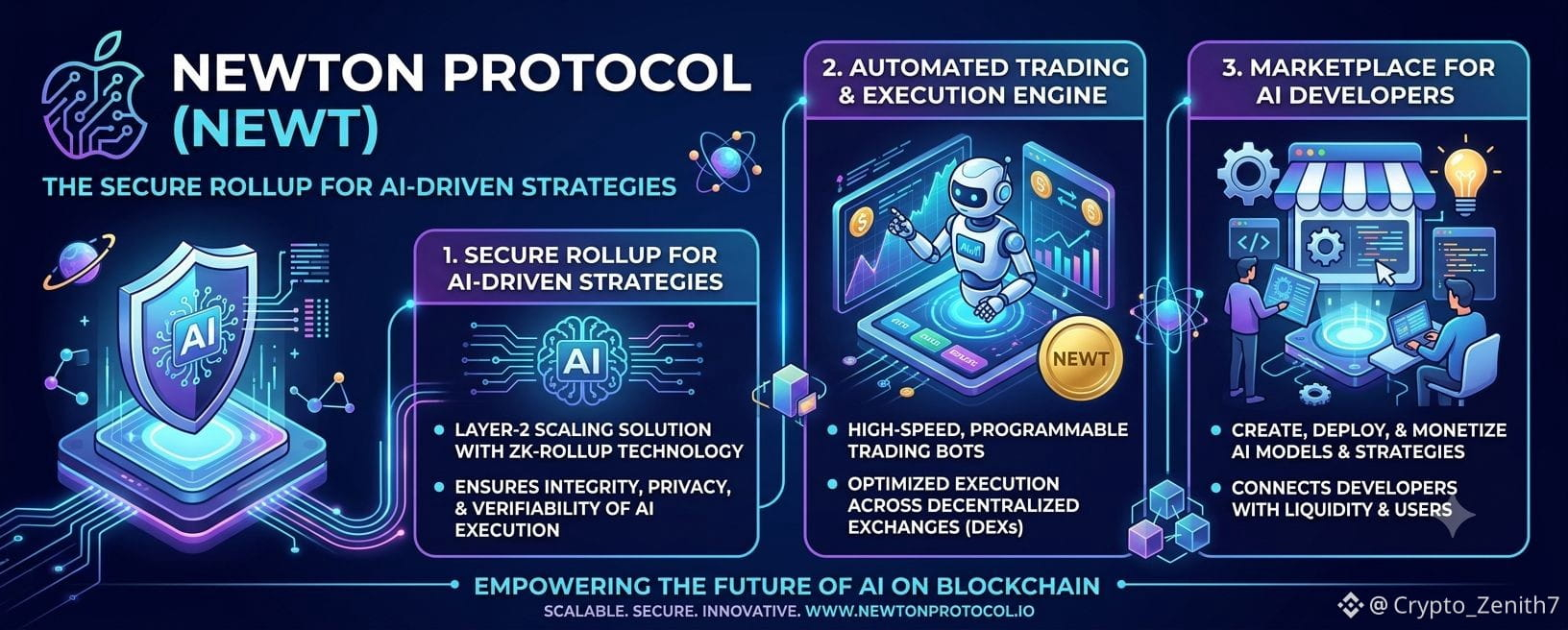
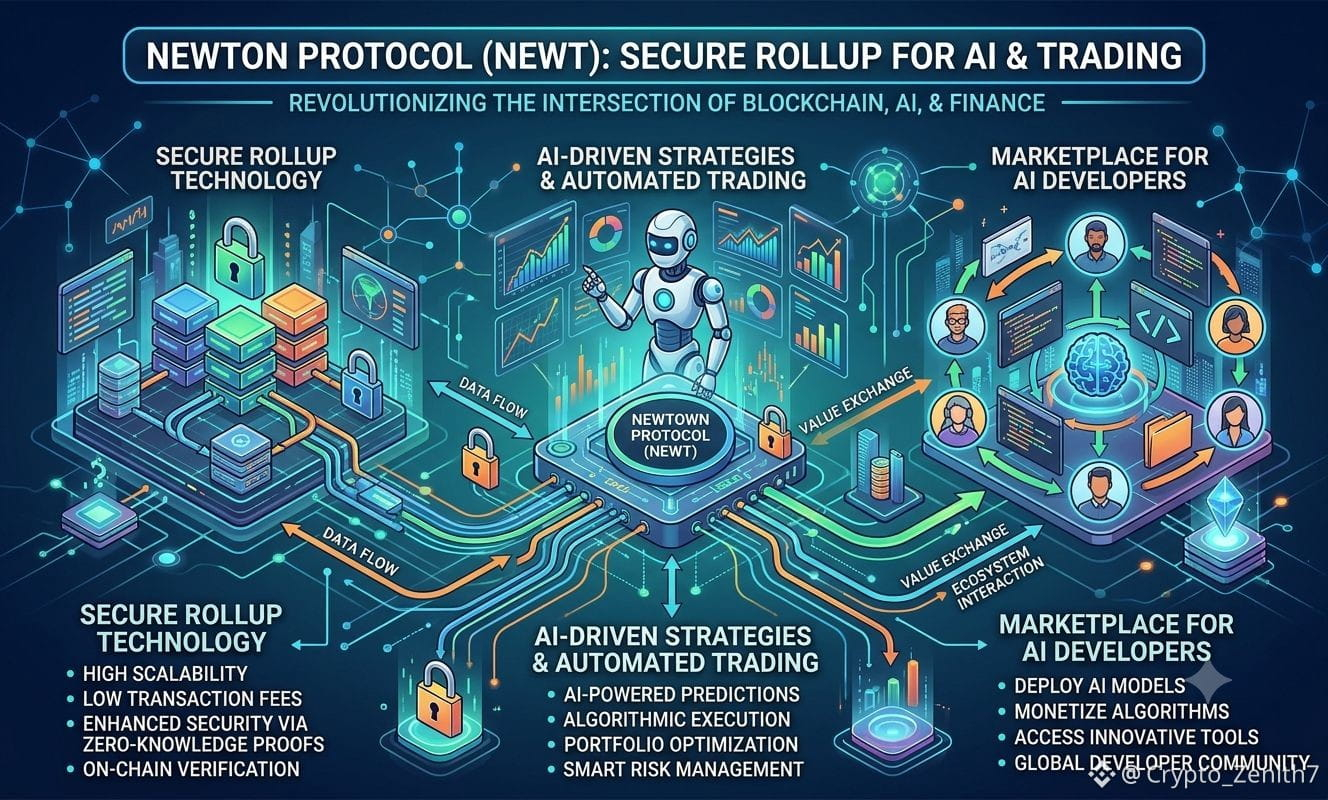
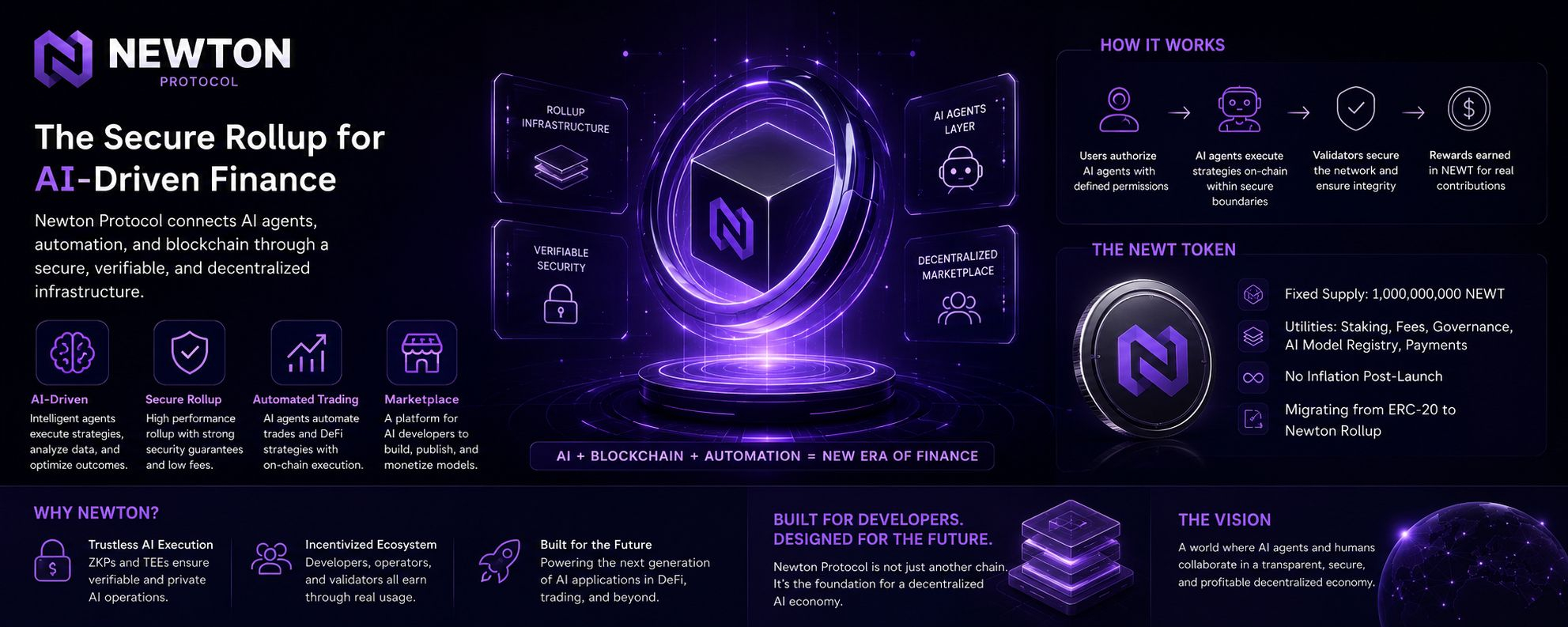
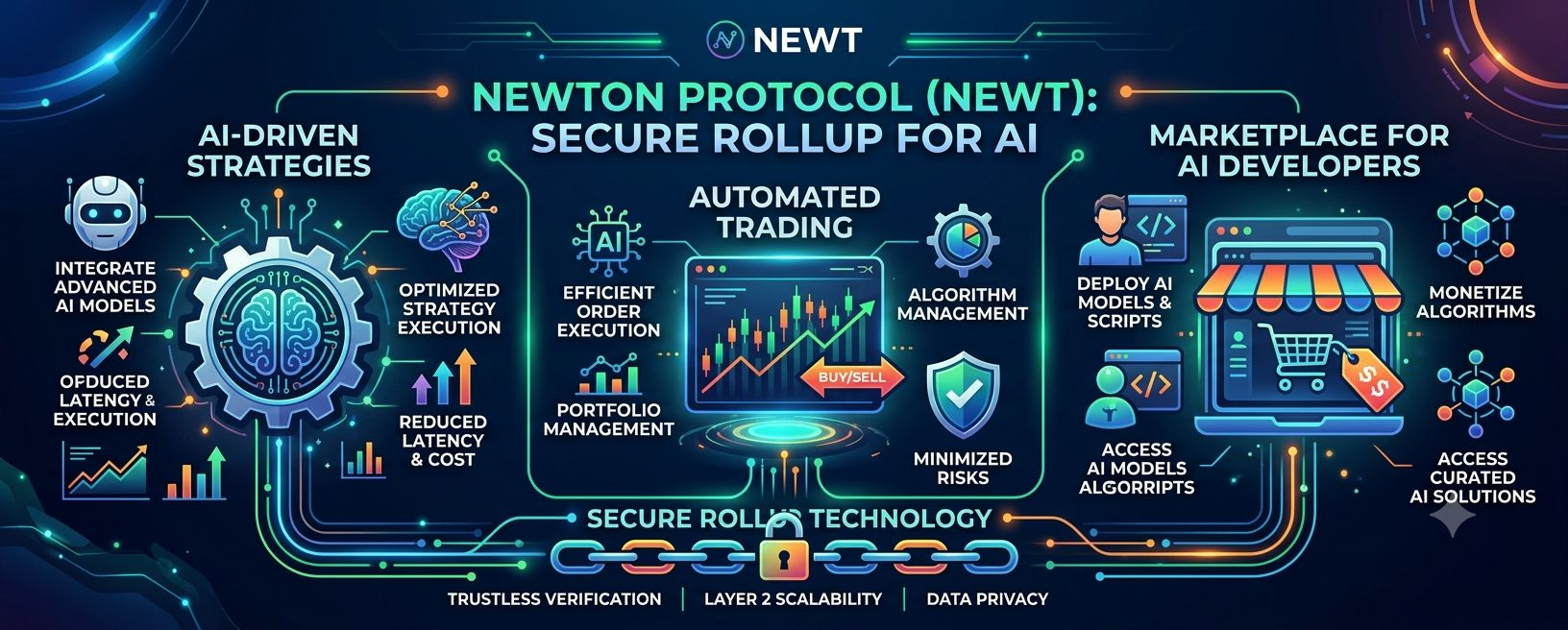
The project is building a secure rollup for AI-powered strategies, automated trading, and a marketplace where developers can create AI applications. Instead of asking users to simply farm points, the goal is to build an ecosystem where AI tools are actually used.
The loop is simple: developers build AI apps, users interact with them, and both sides can earn rewards. More importantly, those rewards are meant to have utility inside the ecosystem rather than existing only to be sold.
That was the first thing that caught my attention.
The NEWT token isn't just presented as another governance token. It's designed to support activity across the network and align incentives between users, developers, and the protocol. Whether that works depends entirely on adoption.
I also like that the project appears to encourage meaningful participation over pure farming. If users stay because the AI tools are genuinely useful—not just because rewards exist—that's a much healthier model.
Of course, the hard part is execution. Building secure AI infrastructure and attracting real developers is far more difficult than writing a roadmap.
For now, I don't see Newton Protocol as a guaranteed winner. I see it as an interesting experiment. If the team delivers and real users stick around, it could stand out. Until then, I'm staying cautiously optimistic.

@NewtonProtocol #newt $NEWT
Artikel
Übersetzung ansehen
Newton Protocol (NEWT): Just Another AI Crypto Narrative… or One of the Few Actually Solving the TruFast forward a few years in crypto, and it's hard not to become skeptical whenever a new project combines the words AI, automation, and blockchain. We've watched the same story unfold over and over again. A project captures attention with a compelling narrative, launches an incentive campaign, attracts thousands of users farming rewards, lists its token, experiences a short-lived surge of excitement, and then slowly fades as people move on to the next trend. After seeing that cycle repeat so many times, my first reaction to Newton Protocol (NEWT) was honestly no different. I expected another polished website, ambitious promises, and an AI buzzword wrapped around a token economy that would eventually depend more on speculation than real usage. But the more time I spent reading about the project, the more I realized Newton Protocol might be trying to solve a much deeper problem than simply adding AI to crypto. Instead of focusing on building the smartest trading bot or the most advanced autonomous agent, the team seems to be asking a much more practical question: How can people safely allow AI to manage assets and execute transactions without blindly trusting the AI itself? That question immediately caught my attention because it addresses something that most AI projects conveniently ignore. The idea behind Newton Protocol is surprisingly straightforward once you strip away the technical language. Rather than asking users to hand complete control over to an AI, the protocol is designed so that users define clear rules, permissions, and limits before an AI agent can perform any action. Every automated task is expected to stay inside those boundaries, while cryptographic verification helps prove that the execution followed the user's instructions. That may sound like a small design choice, but it fundamentally changes the relationship between humans and autonomous software. Instead of replacing trust with hype, Newton is attempting to replace trust with verification. What makes the ecosystem even more interesting is the way participants interact with it. Users don't simply connect a wallet and hope the token appreciates. They can authorize AI agents to perform tasks such as executing trading strategies or managing predefined on-chain actions while remaining within strict permissions. Developers are encouraged to build useful AI models that others can actually use through the protocol's marketplace, and operators are responsible for executing these automated tasks across the network. If those services prove valuable, each participant earns according to the role they play, creating an ecosystem where rewards are tied more closely to useful activity than to passive speculation. Initially, I assumed the NEWT token would follow the familiar formula we've seen countless times before—a governance token with a long list of utilities that sound impressive on paper but rarely matter in practice. After looking deeper, the token appears to play a more central role in securing and operating the protocol itself. It is designed for staking, paying protocol fees, providing collateral for operators, rewarding contributors, participating in governance, and supporting the AI marketplace. None of these features automatically guarantee long-term value, but they do suggest the token was integrated into the protocol from the beginning rather than added later simply to satisfy market expectations. One aspect that deserves credit is how Newton appears to think about incentives. Many crypto projects unintentionally reward the behavior they later complain about. They encourage users to farm rewards aggressively, only to criticize them when those same users immediately sell their tokens after launch. Newton seems to recognize this contradiction. Operators are expected to stake collateral that can be penalized if they fail to perform honestly, developers only benefit if their AI tools are genuinely useful, and users retain control over what their agents are allowed to do. That creates stronger incentives around reliability instead of simply maximizing short-term participation numbers. Whether those mechanisms are enough to prevent excessive farming or rapid selling remains an open question. Crypto markets have repeatedly demonstrated that even well-designed incentive systems can be overwhelmed by speculation if enough participants are focused only on extracting value. No amount of clever token engineering completely removes that reality. The difference is that Newton at least appears to acknowledge the problem and attempts to design around it instead of pretending it doesn't exist. From an economic perspective, the protocol also seems to pursue something more sustainable than many projects in the AI sector. Rather than depending entirely on continuous token emissions to keep people engaged, Newton attempts to create an internal economy where users pay for valuable automated services, developers earn from their software being used, operators receive compensation for secure execution, and the token supports multiple functions across that ecosystem. In theory, this creates a more circular flow of value instead of relying exclusively on attracting new buyers. Whether that loop becomes self-sustaining ultimately depends on one thing that no whitepaper can manufacture: genuine demand. And that's where I think the real challenge begins. Building secure infrastructure is often much harder than creating excitement. Users need to trust the system enough to delegate meaningful financial activity to AI agents. Developers need compelling reasons to build applications instead of choosing competing ecosystems. Operators must consistently deliver reliable execution while accepting the economic risks associated with staking collateral. If any of those pieces fail to gain traction, the elegant economic model becomes much less meaningful. Another reality is that AI itself remains unpredictable. Even if the protocol successfully verifies execution, the quality of decisions still depends on the underlying models and strategies people choose to deploy. Verification can prove that an agent followed instructions, but it cannot guarantee those instructions produce profitable outcomes. That's an important distinction because many people tend to confuse trustworthy execution with successful investing. Newton can potentially solve one problem without solving the other. Still, I think the most refreshing part of Newton Protocol isn't the AI narrative itself. It's the recognition that autonomous finance requires accountability, not just intelligence. Most projects compete by promising smarter algorithms. Newton appears more interested in ensuring those algorithms operate within transparent, verifiable, and user-controlled boundaries. That feels like a more mature way of thinking about where AI and blockchain intersect. Of course, none of this means Newton Protocol is destined to succeed. The crypto industry has no shortage of technically impressive projects that failed because they couldn't attract users, developers, or sustainable demand. Strong architecture is only one piece of a much larger puzzle. Real adoption, consistent execution, and continuous developer activity will ultimately determine whether Newton becomes meaningful infrastructure or simply another ambitious experiment. For now, that's exactly how I view it—an experiment worth paying attention to. Not because it promises unrealistic returns or because it follows the latest AI trend, but because it's trying to solve a problem that genuinely matters if autonomous finance is going to become part of everyday blockchain activity. That's a more interesting challenge than launching another token with an AI label attached. I'm not ready to call Newton Protocol the future of AI-powered crypto, and I don't think anyone should. But after looking beyond the headlines, I also don't think it's fair to dismiss it as just another hype-driven project. There is a thoughtful idea underneath the marketing, and if the team can execute on that vision while attracting real users and developers, Newton could end up standing apart from many projects that came before it. For now, cautious optimism feels like the right approach. The vision is compelling, the design is more thoughtful than I initially expected, and the problems it's attempting to solve are real. Whether those ideas translate into a thriving ecosystem is something only time—and actual adoption—can answer. @NewtonProtocol #Newt $NEWT {future}(NEWTUSDT)

Newton Protocol (NEWT): Just Another AI Crypto Narrative… or One of the Few Actually Solving the Tru

Fast forward a few years in crypto, and it's hard not to become skeptical whenever a new project combines the words AI, automation, and blockchain. We've watched the same story unfold over and over again. A project captures attention with a compelling narrative, launches an incentive campaign, attracts thousands of users farming rewards, lists its token, experiences a short-lived surge of excitement, and then slowly fades as people move on to the next trend. After seeing that cycle repeat so many times, my first reaction to Newton Protocol (NEWT) was honestly no different. I expected another polished website, ambitious promises, and an AI buzzword wrapped around a token economy that would eventually depend more on speculation than real usage.
But the more time I spent reading about the project, the more I realized Newton Protocol might be trying to solve a much deeper problem than simply adding AI to crypto. Instead of focusing on building the smartest trading bot or the most advanced autonomous agent, the team seems to be asking a much more practical question: How can people safely allow AI to manage assets and execute transactions without blindly trusting the AI itself? That question immediately caught my attention because it addresses something that most AI projects conveniently ignore.
The idea behind Newton Protocol is surprisingly straightforward once you strip away the technical language. Rather than asking users to hand complete control over to an AI, the protocol is designed so that users define clear rules, permissions, and limits before an AI agent can perform any action. Every automated task is expected to stay inside those boundaries, while cryptographic verification helps prove that the execution followed the user's instructions. That may sound like a small design choice, but it fundamentally changes the relationship between humans and autonomous software. Instead of replacing trust with hype, Newton is attempting to replace trust with verification.
What makes the ecosystem even more interesting is the way participants interact with it. Users don't simply connect a wallet and hope the token appreciates. They can authorize AI agents to perform tasks such as executing trading strategies or managing predefined on-chain actions while remaining within strict permissions. Developers are encouraged to build useful AI models that others can actually use through the protocol's marketplace, and operators are responsible for executing these automated tasks across the network. If those services prove valuable, each participant earns according to the role they play, creating an ecosystem where rewards are tied more closely to useful activity than to passive speculation.
Initially, I assumed the NEWT token would follow the familiar formula we've seen countless times before—a governance token with a long list of utilities that sound impressive on paper but rarely matter in practice. After looking deeper, the token appears to play a more central role in securing and operating the protocol itself. It is designed for staking, paying protocol fees, providing collateral for operators, rewarding contributors, participating in governance, and supporting the AI marketplace. None of these features automatically guarantee long-term value, but they do suggest the token was integrated into the protocol from the beginning rather than added later simply to satisfy market expectations.
One aspect that deserves credit is how Newton appears to think about incentives. Many crypto projects unintentionally reward the behavior they later complain about. They encourage users to farm rewards aggressively, only to criticize them when those same users immediately sell their tokens after launch. Newton seems to recognize this contradiction. Operators are expected to stake collateral that can be penalized if they fail to perform honestly, developers only benefit if their AI tools are genuinely useful, and users retain control over what their agents are allowed to do. That creates stronger incentives around reliability instead of simply maximizing short-term participation numbers.
Whether those mechanisms are enough to prevent excessive farming or rapid selling remains an open question. Crypto markets have repeatedly demonstrated that even well-designed incentive systems can be overwhelmed by speculation if enough participants are focused only on extracting value. No amount of clever token engineering completely removes that reality. The difference is that Newton at least appears to acknowledge the problem and attempts to design around it instead of pretending it doesn't exist.
From an economic perspective, the protocol also seems to pursue something more sustainable than many projects in the AI sector. Rather than depending entirely on continuous token emissions to keep people engaged, Newton attempts to create an internal economy where users pay for valuable automated services, developers earn from their software being used, operators receive compensation for secure execution, and the token supports multiple functions across that ecosystem. In theory, this creates a more circular flow of value instead of relying exclusively on attracting new buyers. Whether that loop becomes self-sustaining ultimately depends on one thing that no whitepaper can manufacture: genuine demand.
And that's where I think the real challenge begins.
Building secure infrastructure is often much harder than creating excitement. Users need to trust the system enough to delegate meaningful financial activity to AI agents. Developers need compelling reasons to build applications instead of choosing competing ecosystems. Operators must consistently deliver reliable execution while accepting the economic risks associated with staking collateral. If any of those pieces fail to gain traction, the elegant economic model becomes much less meaningful.
Another reality is that AI itself remains unpredictable. Even if the protocol successfully verifies execution, the quality of decisions still depends on the underlying models and strategies people choose to deploy. Verification can prove that an agent followed instructions, but it cannot guarantee those instructions produce profitable outcomes. That's an important distinction because many people tend to confuse trustworthy execution with successful investing. Newton can potentially solve one problem without solving the other.
Still, I think the most refreshing part of Newton Protocol isn't the AI narrative itself. It's the recognition that autonomous finance requires accountability, not just intelligence. Most projects compete by promising smarter algorithms. Newton appears more interested in ensuring those algorithms operate within transparent, verifiable, and user-controlled boundaries. That feels like a more mature way of thinking about where AI and blockchain intersect.
Of course, none of this means Newton Protocol is destined to succeed. The crypto industry has no shortage of technically impressive projects that failed because they couldn't attract users, developers, or sustainable demand. Strong architecture is only one piece of a much larger puzzle. Real adoption, consistent execution, and continuous developer activity will ultimately determine whether Newton becomes meaningful infrastructure or simply another ambitious experiment.
For now, that's exactly how I view it—an experiment worth paying attention to. Not because it promises unrealistic returns or because it follows the latest AI trend, but because it's trying to solve a problem that genuinely matters if autonomous finance is going to become part of everyday blockchain activity. That's a more interesting challenge than launching another token with an AI label attached.
I'm not ready to call Newton Protocol the future of AI-powered crypto, and I don't think anyone should. But after looking beyond the headlines, I also don't think it's fair to dismiss it as just another hype-driven project. There is a thoughtful idea underneath the marketing, and if the team can execute on that vision while attracting real users and developers, Newton could end up standing apart from many projects that came before it.
For now, cautious optimism feels like the right approach. The vision is compelling, the design is more thoughtful than I initially expected, and the problems it's attempting to solve are real. Whether those ideas translate into a thriving ecosystem is something only time—and actual adoption—can answer.
@NewtonProtocol #Newt $NEWT
·
--
Bullisch
Zuerst dachte ich ehrlich, dass @NewtonProtocol (NEWT) nur wieder eine bekannte Krypto-Geschichte werden würde – große AI-Story, früher Hype, Reward-Farming, Token-Launch, dann der übliche schnelle Ausstieg. Den Kreislauf haben wir schon zu oft gesehen, um ihn zu ignorieren. Aber nachdem ich mehr gelesen habe, wurde ich wirklich neugierig. Newton versucht nicht nur, KI für Marketingzwecke in Krypto zu integrieren. Es geht darum, ein sicheres Rollup aufzubauen, in dem KI-Agenten Strategien ausführen, das Trading automatisieren und über einen Marktplatz, der für Entwickler entwickelt wurde, miteinander interagieren können. Die Grundlogik ist unkompliziert. Was meine Aufmerksamkeit geweckt hat, ist, dass der Fokus nicht nur darauf liegt, Rewards zu verteilen. Das Protokoll versucht, eine Umgebung zu schaffen, in der KI-Anwendungen tatsächlich die Infrastruktur haben, um sicher zu arbeiten. Das ist ein spannenderes Ziel als schon wieder eine Points-Kampagne. Meine erste Reaktion war Skepsis gegenüber dem Token. Wenn man tiefer gräbt, wirkt NEWT eher als Utility-Asset, das an die Teilnahme am Netzwerk gekoppelt ist, statt nur reine Spekulation zu sein. Ob das funktioniert, hängt komplett davon ab, ob Menschen die Plattform wirklich nutzen. Theoretisch ist es der richtige Weg, nützliche Aktivitäten zu belohnen statt nur reines Farming. In der Praxis ist die Umsetzung alles. Wenn sich das Engagement in anreizgetriebene Aktivitäten ohne echte Nachfrage verwandelt, kommen die alten Probleme wieder. Für jetzt sehe ich das Newton Protocol als ein Experiment, das man im Blick behalten sollte – nicht weil ein Erfolg garantiert ist, sondern weil es versucht, ein anderes Problem zu lösen. Ich bin vorsichtig optimistisch, aber ich lasse Adoption – nicht Hype – über das Ergebnis entscheiden. @NewtonProtocol #newton #XPIN #star #beat #RussiaBansDieselExports $XPIN {future}(XPINUSDT) $STAR {future}(STARUSDT) $BEAT {alpha}(560xcf3232b85b43bca90e51d38cc06cc8bb8c8a3e36)
Zuerst dachte ich ehrlich, dass @NewtonProtocol (NEWT) nur wieder eine bekannte Krypto-Geschichte werden würde – große AI-Story, früher Hype, Reward-Farming, Token-Launch, dann der übliche schnelle Ausstieg. Den Kreislauf haben wir schon zu oft gesehen, um ihn zu ignorieren.

Aber nachdem ich mehr gelesen habe, wurde ich wirklich neugierig. Newton versucht nicht nur, KI für Marketingzwecke in Krypto zu integrieren. Es geht darum, ein sicheres Rollup aufzubauen, in dem KI-Agenten Strategien ausführen, das Trading automatisieren und über einen Marktplatz, der für Entwickler entwickelt wurde, miteinander interagieren können.

Die Grundlogik ist unkompliziert.
Was meine Aufmerksamkeit geweckt hat, ist, dass der Fokus nicht nur darauf liegt, Rewards zu verteilen. Das Protokoll versucht, eine Umgebung zu schaffen, in der KI-Anwendungen tatsächlich die Infrastruktur haben, um sicher zu arbeiten. Das ist ein spannenderes Ziel als schon wieder eine Points-Kampagne.

Meine erste Reaktion war Skepsis gegenüber dem Token. Wenn man tiefer gräbt, wirkt NEWT eher als Utility-Asset, das an die Teilnahme am Netzwerk gekoppelt ist, statt nur reine Spekulation zu sein. Ob das funktioniert, hängt komplett davon ab, ob Menschen die Plattform wirklich nutzen.

Theoretisch ist es der richtige Weg, nützliche Aktivitäten zu belohnen statt nur reines Farming. In der Praxis ist die Umsetzung alles. Wenn sich das Engagement in anreizgetriebene Aktivitäten ohne echte Nachfrage verwandelt, kommen die alten Probleme wieder.

Für jetzt sehe ich das Newton Protocol als ein Experiment, das man im Blick behalten sollte – nicht weil ein Erfolg garantiert ist, sondern weil es versucht, ein anderes Problem zu lösen. Ich bin vorsichtig optimistisch, aber ich lasse Adoption – nicht Hype – über das Ergebnis entscheiden.

@NewtonProtocol
#newton #XPIN #star #beat #RussiaBansDieselExports
$XPIN
$STAR
$BEAT
Selling the bottom 📉
86%
Buying the top 📈
0%
Calling every coin 🚀
14%
Buy the dip... again." 🤡
0%
7 Stimmen • Abstimmung beendet
Artikel
Übersetzung ansehen
Newton Protocol (NEWT): Another AI Crypto Narrative… Or One of the Few Projects Actually Trying to FIf I'm being completely honest, my first reaction to Newton Protocol wasn't excitement—it was skepticism. Maybe that's because the crypto industry has conditioned many of us to react that way whenever a new project combines the words AI, automation, and blockchain. We've watched the same story unfold over and over again. A flashy announcement grabs everyone's attention, an incentive campaign attracts thousands of users, points begin to accumulate, speculation takes over social media, a token eventually launches, early participants rush for the exit, and within a few months the excitement disappears almost as quickly as it arrived. After seeing that cycle repeat so many times, it's difficult not to approach every new AI protocol with caution. Hype is cheap. Building something people actually continue using long after the rewards fade is incredibly difficult. That was exactly the mindset I had when I started reading about Newton Protocol. The surprising part wasn't that the project talks about AI. Almost every new protocol does that today. What caught my attention was that Newton isn't really trying to build another AI assistant or another chatbot wrapped inside a token economy. Instead, it seems to be asking a much more important question. How can people safely allow AI to perform real financial actions on-chain without blindly trusting the AI itself? That feels like a much more interesting problem to solve. The more I looked into the protocol, the more I realized that Newton is positioning itself as infrastructure rather than an application. Instead of competing to build the smartest AI model, it wants to become the secure layer that allows AI agents to execute trades, manage portfolios, automate DeFi strategies, and interact with blockchain applications while remaining inside strict permission boundaries defined by users. In other words, the AI doesn't simply receive unlimited access to your assets. Every action is supposed to operate within rules that you approve beforehand. That's a subtle difference, but it completely changes the conversation. Rather than asking users to trust artificial intelligence, Newton is trying to make AI behavior verifiable. That idea immediately feels more practical than many of the AI narratives currently dominating the market. When you simplify the entire ecosystem, the user journey is surprisingly easy to understand. Users allow AI agents to perform predefined tasks on their behalf, whether that's executing investment strategies, managing assets, or carrying out automated transactions. Developers contribute by building AI models that others can use within the ecosystem, while validators secure the network and help maintain the protocol itself. Everyone involved has an incentive to participate. Users gain access to automation that could potentially save time and execute strategies more efficiently than manual interaction. Developers are rewarded when their AI models are actually used instead of simply existing as open-source experiments. Validators receive rewards for maintaining network security. More importantly, those rewards aren't designed to immediately leave the ecosystem. Many of them cycle back into staking, governance, transaction fees, protocol participation, and model registration, creating an economy where activity is intended to reinforce itself instead of encouraging constant extraction. This is where Newton begins to separate itself from many projects that rely almost entirely on speculation. Too often, crypto incentives encourage one simple behavior: collect rewards as quickly as possible and sell them immediately. That's great for short-term user numbers but terrible for long-term sustainability. Newton appears to be attempting something different by designing incentives that reward continued participation rather than immediate exits. Whether that actually works in practice is another question, but at least the intention is visible. The token itself also became more interesting the deeper I looked. Initially, NEWT looked like another utility token searching for a purpose. Crypto has no shortage of those. Every protocol claims its token powers governance, staking, fees, incentives, and ecosystem growth. After reading further, however, it became clear that NEWT isn't just attached to the protocol—it sits at the center of almost every important interaction. The token secures the network through delegated proof-of-stake, pays for protocol operations, allows developers to register AI models, distributes royalties when those models are used, supports governance, and serves as the economic backbone connecting users, developers, and validators together. That doesn't automatically make the token valuable, but it does mean the protocol isn't treating it like an afterthought. The utility feels connected to actual network activity instead of existing purely for speculation. Another aspect that deserves attention is how Newton approaches user behavior. Many crypto ecosystems unintentionally reward farming over genuine engagement. People aren't participating because they believe in the product—they're participating because they're chasing the next airdrop. Once rewards disappear, so do the users. Newton appears to recognize this problem. Developers only benefit if people continue using their AI models. Validators benefit by keeping the network secure over time. Users benefit because automation itself has value beyond token incentives. Instead of rewarding repetitive clicks or meaningless activity, the protocol attempts to align incentives around useful contributions. Again, that's the theory. Reality is always more complicated. Building secure infrastructure is only one part of the equation. Convincing developers to build high-quality AI applications is another challenge entirely. Even if the technology performs exactly as promised, success ultimately depends on whether developers see enough opportunity to build on Newton instead of somewhere else. User adoption presents an equally significant challenge. People may love the idea of AI managing financial decisions until real money is involved. Trust remains one of the hardest problems in decentralized finance. Permission systems and cryptographic verification certainly help, but changing human behavior takes much longer than deploying technology. Competition shouldn't be underestimated either. Every week seems to introduce another AI-focused blockchain project claiming to revolutionize decentralized automation. Many of them will fail simply because there isn't enough demand to support all of them. Newton's technical architecture may be impressive, but technology alone rarely guarantees adoption. History has shown us that superior infrastructure doesn't always win. Sometimes the simplest product with the strongest community captures the market instead. Despite those concerns, I keep coming back to one reason why Newton feels different. It isn't trying to convince me that AI itself is revolutionary. It's assuming AI will continue advancing regardless and asking how blockchain should prepare for that future. That shift in perspective feels far more mature than simply adding "AI-powered" to a marketing campaign. If intelligent agents become increasingly responsible for managing digital assets, executing trades, coordinating financial strategies, or interacting with decentralized applications, then secure permission systems become incredibly important. Newton is attempting to build that missing layer before demand fully arrives. Maybe the market is ready for it. Maybe it's still too early. Only time will answer that. At this stage, I don't see Newton Protocol as a guaranteed success, nor do I see it as another obvious cash grab. I see it as an ambitious experiment that understands a genuine problem and proposes a thoughtful solution. That's already more interesting than many projects chasing temporary narratives. The architecture appears well considered, the economic model attempts to keep value circulating within the ecosystem instead of constantly leaking out, and the incentive design encourages participation that extends beyond simple farming. None of those things guarantee success, but they do suggest that the team is thinking beyond the first few months after launch. Ultimately, execution will matter far more than whitepapers, roadmaps, or tokenomics. The strongest technology in the world means very little if developers don't build, users don't trust the system, and meaningful activity never materializes. For now, Newton Protocol remains exactly what every early-stage crypto project should be viewed as: an experiment. It's an experiment with an interesting vision, a practical use case, and a more thoughtful approach than I initially expected. Whether it becomes foundational infrastructure for AI-powered finance or simply another promising idea that couldn't reach critical adoption will depend on real users solving real problems—not marketing campaigns or speculative excitement. That's why I'm watching it with cautious optimism. Not because I believe it's destined to succeed, but because it's one of the few AI crypto projects that seems focused on building the foundation instead of chasing the spotlight. @NewtonProtocol #Newt $NEWT {future}(NEWTUSDT)

Newton Protocol (NEWT): Another AI Crypto Narrative… Or One of the Few Projects Actually Trying to F

If I'm being completely honest, my first reaction to Newton Protocol wasn't excitement—it was skepticism.
Maybe that's because the crypto industry has conditioned many of us to react that way whenever a new project combines the words AI, automation, and blockchain. We've watched the same story unfold over and over again. A flashy announcement grabs everyone's attention, an incentive campaign attracts thousands of users, points begin to accumulate, speculation takes over social media, a token eventually launches, early participants rush for the exit, and within a few months the excitement disappears almost as quickly as it arrived.
After seeing that cycle repeat so many times, it's difficult not to approach every new AI protocol with caution. Hype is cheap. Building something people actually continue using long after the rewards fade is incredibly difficult.
That was exactly the mindset I had when I started reading about Newton Protocol.
The surprising part wasn't that the project talks about AI. Almost every new protocol does that today. What caught my attention was that Newton isn't really trying to build another AI assistant or another chatbot wrapped inside a token economy. Instead, it seems to be asking a much more important question.
How can people safely allow AI to perform real financial actions on-chain without blindly trusting the AI itself?
That feels like a much more interesting problem to solve.
The more I looked into the protocol, the more I realized that Newton is positioning itself as infrastructure rather than an application. Instead of competing to build the smartest AI model, it wants to become the secure layer that allows AI agents to execute trades, manage portfolios, automate DeFi strategies, and interact with blockchain applications while remaining inside strict permission boundaries defined by users.
In other words, the AI doesn't simply receive unlimited access to your assets. Every action is supposed to operate within rules that you approve beforehand. That's a subtle difference, but it completely changes the conversation. Rather than asking users to trust artificial intelligence, Newton is trying to make AI behavior verifiable.
That idea immediately feels more practical than many of the AI narratives currently dominating the market.
When you simplify the entire ecosystem, the user journey is surprisingly easy to understand. Users allow AI agents to perform predefined tasks on their behalf, whether that's executing investment strategies, managing assets, or carrying out automated transactions. Developers contribute by building AI models that others can use within the ecosystem, while validators secure the network and help maintain the protocol itself.
Everyone involved has an incentive to participate. Users gain access to automation that could potentially save time and execute strategies more efficiently than manual interaction. Developers are rewarded when their AI models are actually used instead of simply existing as open-source experiments. Validators receive rewards for maintaining network security. More importantly, those rewards aren't designed to immediately leave the ecosystem. Many of them cycle back into staking, governance, transaction fees, protocol participation, and model registration, creating an economy where activity is intended to reinforce itself instead of encouraging constant extraction.
This is where Newton begins to separate itself from many projects that rely almost entirely on speculation.
Too often, crypto incentives encourage one simple behavior: collect rewards as quickly as possible and sell them immediately. That's great for short-term user numbers but terrible for long-term sustainability. Newton appears to be attempting something different by designing incentives that reward continued participation rather than immediate exits.
Whether that actually works in practice is another question, but at least the intention is visible.
The token itself also became more interesting the deeper I looked.
Initially, NEWT looked like another utility token searching for a purpose. Crypto has no shortage of those. Every protocol claims its token powers governance, staking, fees, incentives, and ecosystem growth. After reading further, however, it became clear that NEWT isn't just attached to the protocol—it sits at the center of almost every important interaction.
The token secures the network through delegated proof-of-stake, pays for protocol operations, allows developers to register AI models, distributes royalties when those models are used, supports governance, and serves as the economic backbone connecting users, developers, and validators together.
That doesn't automatically make the token valuable, but it does mean the protocol isn't treating it like an afterthought. The utility feels connected to actual network activity instead of existing purely for speculation.
Another aspect that deserves attention is how Newton approaches user behavior.
Many crypto ecosystems unintentionally reward farming over genuine engagement. People aren't participating because they believe in the product—they're participating because they're chasing the next airdrop. Once rewards disappear, so do the users.
Newton appears to recognize this problem.
Developers only benefit if people continue using their AI models. Validators benefit by keeping the network secure over time. Users benefit because automation itself has value beyond token incentives. Instead of rewarding repetitive clicks or meaningless activity, the protocol attempts to align incentives around useful contributions.
Again, that's the theory.
Reality is always more complicated.
Building secure infrastructure is only one part of the equation. Convincing developers to build high-quality AI applications is another challenge entirely. Even if the technology performs exactly as promised, success ultimately depends on whether developers see enough opportunity to build on Newton instead of somewhere else.
User adoption presents an equally significant challenge.
People may love the idea of AI managing financial decisions until real money is involved. Trust remains one of the hardest problems in decentralized finance. Permission systems and cryptographic verification certainly help, but changing human behavior takes much longer than deploying technology.
Competition shouldn't be underestimated either.
Every week seems to introduce another AI-focused blockchain project claiming to revolutionize decentralized automation. Many of them will fail simply because there isn't enough demand to support all of them. Newton's technical architecture may be impressive, but technology alone rarely guarantees adoption.
History has shown us that superior infrastructure doesn't always win.
Sometimes the simplest product with the strongest community captures the market instead.
Despite those concerns, I keep coming back to one reason why Newton feels different.
It isn't trying to convince me that AI itself is revolutionary.
It's assuming AI will continue advancing regardless and asking how blockchain should prepare for that future.
That shift in perspective feels far more mature than simply adding "AI-powered" to a marketing campaign.
If intelligent agents become increasingly responsible for managing digital assets, executing trades, coordinating financial strategies, or interacting with decentralized applications, then secure permission systems become incredibly important. Newton is attempting to build that missing layer before demand fully arrives.
Maybe the market is ready for it.
Maybe it's still too early.
Only time will answer that.
At this stage, I don't see Newton Protocol as a guaranteed success, nor do I see it as another obvious cash grab. I see it as an ambitious experiment that understands a genuine problem and proposes a thoughtful solution. That's already more interesting than many projects chasing temporary narratives.
The architecture appears well considered, the economic model attempts to keep value circulating within the ecosystem instead of constantly leaking out, and the incentive design encourages participation that extends beyond simple farming. None of those things guarantee success, but they do suggest that the team is thinking beyond the first few months after launch.
Ultimately, execution will matter far more than whitepapers, roadmaps, or tokenomics. The strongest technology in the world means very little if developers don't build, users don't trust the system, and meaningful activity never materializes.
For now, Newton Protocol remains exactly what every early-stage crypto project should be viewed as: an experiment.
It's an experiment with an interesting vision, a practical use case, and a more thoughtful approach than I initially expected. Whether it becomes foundational infrastructure for AI-powered finance or simply another promising idea that couldn't reach critical adoption will depend on real users solving real problems—not marketing campaigns or speculative excitement.
That's why I'm watching it with cautious optimism. Not because I believe it's destined to succeed, but because it's one of the few AI crypto projects that seems focused on building the foundation instead of chasing the spotlight.
@NewtonProtocol #Newt $NEWT
·
--
Bullisch
Übersetzung ansehen
Honestly, when I first saw Newton Protocol (NEWT), I expected the usual AI + crypto story. A flashy narrative, a farming campaign, a token launch, early holders taking profits, and then the hype slowly fading away. We've seen that playbook too many times to get excited immediately. But after spending some time reading about it, I think Newton Protocol deserves a closer look. What caught my attention is that it isn't trying to build "another AI trading bot." Instead, it's focused on creating a secure infrastructure where AI agents can perform on-chain tasks while users stay in control. Rather than giving an AI unlimited access to your wallet, users define clear permissions, and the protocol is designed to make sure those rules are followed. The ecosystem is fairly simple. Users automate strategies, developers build AI agents, operators execute those tasks and earn fees, while validators secure the network. The NEWT token ties the system together through staking, fees, governance, and operator accountability. What I like is the incentive design. Rewards seem connected to actual participation instead of pure farming. Developers benefit when people genuinely use their agents, and operators have something to lose if they don't behave honestly. That's a healthier approach than rewarding short-term speculation. That said, good ideas are easy to describe and much harder to execute. The technology sounds promising, but success will depend on whether developers build useful agents and whether users trust AI with real financial activity. For now, I don't see Newton Protocol as the next guaranteed winner. I see it as an interesting experiment with a stronger foundation than many AI projects. It's worth watching—but it still has plenty to prove. @NewtonProtocol #newt $NEWT
Honestly, when I first saw Newton Protocol (NEWT), I expected the usual AI + crypto story. A flashy narrative, a farming campaign, a token launch, early holders taking profits, and then the hype slowly fading away. We've seen that playbook too many times to get excited immediately.

But after spending some time reading about it, I think Newton Protocol deserves a closer look.

What caught my attention is that it isn't trying to build "another AI trading bot." Instead, it's focused on creating a secure infrastructure where AI agents can perform on-chain tasks while users stay in control. Rather than giving an AI unlimited access to your wallet, users define clear permissions, and the protocol is designed to make sure those rules are followed.

The ecosystem is fairly simple. Users automate strategies, developers build AI agents, operators execute those tasks and earn fees, while validators secure the network. The NEWT token ties the system together through staking, fees, governance, and operator accountability.

What I like is the incentive design. Rewards seem connected to actual participation instead of pure farming. Developers benefit when people genuinely use their agents, and operators have something to lose if they don't behave honestly. That's a healthier approach than rewarding short-term speculation.

That said, good ideas are easy to describe and much harder to execute. The technology sounds promising, but success will depend on whether developers build useful agents and whether users trust AI with real financial activity.

For now, I don't see Newton Protocol as the next guaranteed winner. I see it as an interesting experiment with a stronger foundation than many AI projects. It's worth watching—but it still has plenty to prove.

@NewtonProtocol #newt $NEWT
Artikel
Übersetzung ansehen
Newton Protocol (NEWT): The AI Crypto Project That Made Me Pause Before Judging ItThe more time I spend in crypto, the more I realize that most new projects follow a script we've all seen countless times. A bold narrative appears, social media gets flooded with excitement, people rush to farm rewards, the token launches, early holders sell into the hype, and within a few months the conversation quietly moves on to the next "revolutionary" idea. AI has become the latest trend, and almost every week another project claims it will change everything by combining artificial intelligence with blockchain. After seeing this cycle repeat so many times, I've become naturally skeptical whenever a new AI protocol starts getting attention. That was exactly my first reaction when I came across Newton Protocol (NEWT). I assumed it would be another project using AI as a marketing buzzword while offering little that actually solves a meaningful problem. I expected another flashy roadmap, another farming campaign, and another token designed to capture attention before fading away. But after spending more time understanding what Newton is actually trying to build, I found myself becoming more curious than dismissive. That doesn't mean I'm convinced it will succeed, but it does mean the project seems to be asking a more interesting question than most of its competitors. Instead of trying to build yet another AI chatbot or another trading assistant, Newton Protocol is attempting to create the infrastructure that allows AI agents to safely interact with blockchain networks. That's an important distinction. The protocol is focused on giving AI systems the ability to execute actions such as automated trading, DeFi strategies, and other on-chain tasks while keeping users in control through cryptographic permissions and verifiable security mechanisms. Rather than asking people to blindly trust an AI with their assets, Newton wants those actions to happen within clearly defined rules that can be verified instead of simply believed. What makes this particularly interesting is the way the ecosystem is designed to function. Users can authorize AI agents to perform specific tasks without handing over unlimited control. Developers are encouraged to build AI models that can operate inside the protocol, while validators help secure the network itself. Instead of rewards existing purely as promotional incentives, the ecosystem is designed so that participants earn value through actual activity. Developers receive compensation when their models are used, validators earn for helping secure the network, and users benefit from automation that hopefully saves time or improves decision-making. Those rewards are then expected to circulate back into the system through staking, governance, service payments, and protocol participation rather than immediately flowing toward the nearest exchange. That circular design immediately caught my attention because it feels different from the usual "farm and dump" mentality that dominates many token launches today. Too many crypto ecosystems depend almost entirely on attracting new buyers while existing participants constantly look for exit liquidity. Newton appears to be trying to create an environment where the token has reasons to remain inside the ecosystem because it powers multiple parts of the protocol instead of serving only as a speculative asset. The NEWT token itself reflects that philosophy. On the surface it looks like another utility token with a long list of use cases, something we've heard many times before. My initial reaction was honestly to dismiss those claims because almost every whitepaper promises endless utility. But looking deeper, the design begins to make more sense. NEWT is intended to support staking, governance, transaction fees, AI model registration, validator participation, and payments for services within the protocol. Those functions are directly connected to how the network operates rather than existing simply to justify the token's existence. Whether that eventually creates sustainable demand is impossible to know today, but at least the economic logic feels more coherent than many projects that simply invent token utilities after the fact. Another detail that stood out to me is how Newton approaches user behavior. The protocol doesn't appear to reward participation simply because someone showed up during an incentive campaign. Developers only earn when their AI models are actually useful and adopted. Validators have to stake assets to secure the network and face penalties if they behave dishonestly. Operators providing AI services also have responsibilities backed by economic consequences rather than empty promises. These mechanisms don't eliminate abuse completely, but they do encourage participants to contribute genuine value instead of maximizing short-term extraction. That brings me to what I think is the most interesting part of the entire project. Newton Protocol isn't really selling AI as the product. It's selling trust as the product. The protocol is trying to answer one of the biggest questions surrounding autonomous AI systems: how can people safely allow software to make decisions involving real financial assets without giving up complete control? That's a much harder challenge than building another AI interface, and it's also one that could become increasingly important as AI agents become more capable over the next several years. Of course, this is exactly where reality becomes much more difficult than theory. Designing secure infrastructure is one thing. Convincing developers to build on it is another. Convincing users to trust AI agents with real money is an even bigger challenge. Crypto history is filled with technically impressive projects that never reached meaningful adoption because they solved problems that few people actually cared about. Newton could have elegant architecture, thoughtful tokenomics, and sophisticated security while still struggling if developers don't build compelling applications or if users simply aren't ready for autonomous financial agents. The economic model also deserves cautious consideration. In theory, Newton is attempting to create a relatively closed ecosystem where value circulates between users, developers, validators, and service providers instead of constantly leaking outward. If people genuinely use AI agents for productive tasks, fees generated by that activity can support the participants securing and improving the network. That's a far healthier model than relying exclusively on speculation. However, every closed-loop economy ultimately depends on one critical factor: real demand. Without sustained usage, even the best-designed token economy eventually loses momentum. This is why I don't think Newton Protocol should be viewed as a guaranteed success or dismissed as another passing trend. It sits somewhere between those two extremes. The project appears to understand many of the weaknesses that have hurt previous AI and crypto experiments, and it is trying to design around them rather than ignoring them. Whether those solutions actually work will depend entirely on execution, developer adoption, user trust, and the quality of the applications that emerge over time. My first impression of Newton Protocol was skepticism, and I think that skepticism was justified given how often this industry repeats the same mistakes. But after looking beyond the headlines, I found a project that at least seems to be thinking more deeply about the long-term role of AI in decentralized systems. It isn't promising overnight transformation or relying entirely on hype. Instead, it's attempting to build the underlying infrastructure that could make AI-driven blockchain applications safer and more practical if the ecosystem matures. That doesn't make Newton Protocol a finished success story. Far from it. At this stage, it's still an experiment, and experiments can fail no matter how promising they look on paper. The ideas are compelling, but ideas alone never guarantee adoption. If developers embrace the platform, if users find genuine value in AI-powered automation, and if the protocol proves it can deliver secure and reliable execution, Newton could become one of the more meaningful AI infrastructure projects in Web3. If those pieces never come together, it risks following the same path as many ambitious projects before it. For now, I think Newton Protocol deserves something that is becoming increasingly rare in crypto discussions: genuine curiosity mixed with healthy skepticism. It hasn't earned blind optimism, but it also hasn't earned immediate dismissal. Sometimes the most interesting projects are the ones that quietly focus on solving difficult problems instead of chasing the loudest narrative. Whether Newton ultimately becomes one of those projects is a question that only time, execution, and real users can answer. @NewtonProtocol #Newt $NEWT {future}(NEWTUSDT)

Newton Protocol (NEWT): The AI Crypto Project That Made Me Pause Before Judging It

The more time I spend in crypto, the more I realize that most new projects follow a script we've all seen countless times. A bold narrative appears, social media gets flooded with excitement, people rush to farm rewards, the token launches, early holders sell into the hype, and within a few months the conversation quietly moves on to the next "revolutionary" idea. AI has become the latest trend, and almost every week another project claims it will change everything by combining artificial intelligence with blockchain. After seeing this cycle repeat so many times, I've become naturally skeptical whenever a new AI protocol starts getting attention.
That was exactly my first reaction when I came across Newton Protocol (NEWT). I assumed it would be another project using AI as a marketing buzzword while offering little that actually solves a meaningful problem. I expected another flashy roadmap, another farming campaign, and another token designed to capture attention before fading away. But after spending more time understanding what Newton is actually trying to build, I found myself becoming more curious than dismissive. That doesn't mean I'm convinced it will succeed, but it does mean the project seems to be asking a more interesting question than most of its competitors.
Instead of trying to build yet another AI chatbot or another trading assistant, Newton Protocol is attempting to create the infrastructure that allows AI agents to safely interact with blockchain networks. That's an important distinction. The protocol is focused on giving AI systems the ability to execute actions such as automated trading, DeFi strategies, and other on-chain tasks while keeping users in control through cryptographic permissions and verifiable security mechanisms. Rather than asking people to blindly trust an AI with their assets, Newton wants those actions to happen within clearly defined rules that can be verified instead of simply believed.
What makes this particularly interesting is the way the ecosystem is designed to function. Users can authorize AI agents to perform specific tasks without handing over unlimited control. Developers are encouraged to build AI models that can operate inside the protocol, while validators help secure the network itself. Instead of rewards existing purely as promotional incentives, the ecosystem is designed so that participants earn value through actual activity. Developers receive compensation when their models are used, validators earn for helping secure the network, and users benefit from automation that hopefully saves time or improves decision-making. Those rewards are then expected to circulate back into the system through staking, governance, service payments, and protocol participation rather than immediately flowing toward the nearest exchange.
That circular design immediately caught my attention because it feels different from the usual "farm and dump" mentality that dominates many token launches today. Too many crypto ecosystems depend almost entirely on attracting new buyers while existing participants constantly look for exit liquidity. Newton appears to be trying to create an environment where the token has reasons to remain inside the ecosystem because it powers multiple parts of the protocol instead of serving only as a speculative asset.
The NEWT token itself reflects that philosophy. On the surface it looks like another utility token with a long list of use cases, something we've heard many times before. My initial reaction was honestly to dismiss those claims because almost every whitepaper promises endless utility. But looking deeper, the design begins to make more sense. NEWT is intended to support staking, governance, transaction fees, AI model registration, validator participation, and payments for services within the protocol. Those functions are directly connected to how the network operates rather than existing simply to justify the token's existence. Whether that eventually creates sustainable demand is impossible to know today, but at least the economic logic feels more coherent than many projects that simply invent token utilities after the fact.
Another detail that stood out to me is how Newton approaches user behavior. The protocol doesn't appear to reward participation simply because someone showed up during an incentive campaign. Developers only earn when their AI models are actually useful and adopted. Validators have to stake assets to secure the network and face penalties if they behave dishonestly. Operators providing AI services also have responsibilities backed by economic consequences rather than empty promises. These mechanisms don't eliminate abuse completely, but they do encourage participants to contribute genuine value instead of maximizing short-term extraction.
That brings me to what I think is the most interesting part of the entire project. Newton Protocol isn't really selling AI as the product. It's selling trust as the product. The protocol is trying to answer one of the biggest questions surrounding autonomous AI systems: how can people safely allow software to make decisions involving real financial assets without giving up complete control? That's a much harder challenge than building another AI interface, and it's also one that could become increasingly important as AI agents become more capable over the next several years.
Of course, this is exactly where reality becomes much more difficult than theory. Designing secure infrastructure is one thing. Convincing developers to build on it is another. Convincing users to trust AI agents with real money is an even bigger challenge. Crypto history is filled with technically impressive projects that never reached meaningful adoption because they solved problems that few people actually cared about. Newton could have elegant architecture, thoughtful tokenomics, and sophisticated security while still struggling if developers don't build compelling applications or if users simply aren't ready for autonomous financial agents.
The economic model also deserves cautious consideration. In theory, Newton is attempting to create a relatively closed ecosystem where value circulates between users, developers, validators, and service providers instead of constantly leaking outward. If people genuinely use AI agents for productive tasks, fees generated by that activity can support the participants securing and improving the network. That's a far healthier model than relying exclusively on speculation. However, every closed-loop economy ultimately depends on one critical factor: real demand. Without sustained usage, even the best-designed token economy eventually loses momentum.
This is why I don't think Newton Protocol should be viewed as a guaranteed success or dismissed as another passing trend. It sits somewhere between those two extremes. The project appears to understand many of the weaknesses that have hurt previous AI and crypto experiments, and it is trying to design around them rather than ignoring them. Whether those solutions actually work will depend entirely on execution, developer adoption, user trust, and the quality of the applications that emerge over time.
My first impression of Newton Protocol was skepticism, and I think that skepticism was justified given how often this industry repeats the same mistakes. But after looking beyond the headlines, I found a project that at least seems to be thinking more deeply about the long-term role of AI in decentralized systems. It isn't promising overnight transformation or relying entirely on hype. Instead, it's attempting to build the underlying infrastructure that could make AI-driven blockchain applications safer and more practical if the ecosystem matures.
That doesn't make Newton Protocol a finished success story. Far from it. At this stage, it's still an experiment, and experiments can fail no matter how promising they look on paper. The ideas are compelling, but ideas alone never guarantee adoption. If developers embrace the platform, if users find genuine value in AI-powered automation, and if the protocol proves it can deliver secure and reliable execution, Newton could become one of the more meaningful AI infrastructure projects in Web3. If those pieces never come together, it risks following the same path as many ambitious projects before it.
For now, I think Newton Protocol deserves something that is becoming increasingly rare in crypto discussions: genuine curiosity mixed with healthy skepticism. It hasn't earned blind optimism, but it also hasn't earned immediate dismissal. Sometimes the most interesting projects are the ones that quietly focus on solving difficult problems instead of chasing the loudest narrative. Whether Newton ultimately becomes one of those projects is a question that only time, execution, and real users can answer.
@NewtonProtocol #Newt $NEWT
·
--
Bullisch
Übersetzung ansehen
Honestly, when I first saw Newton Protocol (NEWT), I assumed it was another AI + crypto project riding the latest trend. We've seen this movie before: huge hype, users rush in to farm rewards, the token launches, early holders sell, and the excitement fades. That's why I didn't expect much. But after reading more, I think Newton is at least trying to solve a different problem. Instead of simply launching another AI trading bot, Newton is building infrastructure that lets AI agents execute on-chain actions with strict user-defined permissions. The idea is simple: users choose what an AI can do, developers build those AI strategies, validators verify everything, and the network rewards participants who help keep the system running. What I found most interesting is that the focus isn't just on making AI smarter—it's on making AI trustworthy. That's a much harder problem, and if they can pull it off, it could be more valuable than another flashy AI token. The NEWT token isn't only there for speculation either. It's meant for staking, governance, network security, and paying for services across the ecosystem. That gives it a clearer purpose, although real utility will ultimately depend on whether people actually use the protocol. Of course, none of this guarantees success. Good ideas fail all the time because adoption never comes. Building secure infrastructure is one challenge; getting developers and users to trust it is another. For now, I don't see Newton Protocol as a finished product. I see it as an experiment that's asking a more interesting question than most AI projects. Whether it becomes something meaningful depends on execution—not marketing. That's enough to keep me watching, but not enough to become blindly bullish. @NewtonProtocol #newt $NEWT
Honestly, when I first saw Newton Protocol (NEWT), I assumed it was another AI + crypto project riding the latest trend. We've seen this movie before: huge hype, users rush in to farm rewards, the token launches, early holders sell, and the excitement fades. That's why I didn't expect much.
But after reading more, I think Newton is at least trying to solve a different problem.
Instead of simply launching another AI trading bot, Newton is building infrastructure that lets AI agents execute on-chain actions with strict user-defined permissions. The idea is simple: users choose what an AI can do, developers build those AI strategies, validators verify everything, and the network rewards participants who help keep the system running.
What I found most interesting is that the focus isn't just on making AI smarter—it's on making AI trustworthy. That's a much harder problem, and if they can pull it off, it could be more valuable than another flashy AI token.
The NEWT token isn't only there for speculation either. It's meant for staking, governance, network security, and paying for services across the ecosystem. That gives it a clearer purpose, although real utility will ultimately depend on whether people actually use the protocol.
Of course, none of this guarantees success. Good ideas fail all the time because adoption never comes. Building secure infrastructure is one challenge; getting developers and users to trust it is another.
For now, I don't see Newton Protocol as a finished product. I see it as an experiment that's asking a more interesting question than most AI projects. Whether it becomes something meaningful depends on execution—not marketing. That's enough to keep me watching, but not enough to become blindly bullish.

@NewtonProtocol #newt $NEWT
Artikel
Übersetzung ansehen
Newton Protocol (NEWT): Another AI Crypto Narrative… or One of the Few Projects Trying to Solve theThe first time I came across Newton Protocol (NEWT), my reaction was probably the same as many people who have been around crypto for a while: here we go again. Every cycle seems to introduce a new trend that promises to change everything. First it was DeFi, then NFTs, then GameFi, then SocialFi, and now AI has become the latest buzzword that almost every new project wants attached to its name. After seeing countless launches follow the same predictable path—massive excitement, aggressive farming campaigns, token launch, early profit-taking, and eventually fading attention—it's difficult not to become skeptical whenever another AI-focused protocol appears. That initial skepticism wasn't because AI and blockchain can't work together. Quite the opposite. The combination has enormous potential. The problem is that most projects stop at the narrative. They talk about artificial intelligence without ever explaining why blockchain actually makes the AI better or why decentralization is even necessary. Too often, "AI" becomes a marketing strategy instead of a technological advantage. That's why Newton Protocol slowly became more interesting the deeper I looked into it. Rather than trying to build another AI chatbot or another platform promising impossible trading returns, Newton seems to be focused on a much more practical question. If AI agents are eventually going to execute transactions, manage portfolios, interact with decentralized applications, and perform financial tasks on behalf of users, how do you allow that to happen without asking people to completely trust the AI or surrender control of their wallets? That is a far more important problem than simply building another AI application. The entire concept behind Newton Protocol revolves around creating an environment where AI agents can operate with clearly defined permissions instead of unlimited authority. Instead of handing over private keys or giving an automated system unrestricted access, users create rules that determine exactly what an AI can and cannot do. The protocol is designed so that these actions can be verified rather than blindly trusted, which immediately makes the idea feel more grounded than many AI crypto narratives we've seen over the past year. When you simplify everything, the ecosystem creates a fairly logical cycle. Users interact with AI agents that automate different on-chain activities. Developers build those agents and publish them so others can use them. Operators execute the computational work needed to keep these agents functioning, while validators secure the network itself. Each participant has a role that contributes to the overall system instead of simply existing to collect incentives. What makes that interesting is that everyone is encouraged to remain active within the ecosystem rather than immediately extracting value from it. Developers can monetize successful AI strategies. Operators receive rewards for reliable execution. Validators secure the protocol through staking, while users gain access to automation that ideally saves time and improves efficiency. At least on paper, the incentives appear connected to actual utility instead of temporary speculation. That distinction matters. Crypto has become very good at rewarding activity without necessarily rewarding usefulness. We've all seen protocols where the only objective becomes accumulating points as quickly as possible because everyone knows an airdrop is coming. Once rewards disappear, so does the community. Newton seems to be attempting something different. Instead of designing participation around farming, the protocol tries to make participation itself valuable. Developers only succeed if people actually use their AI agents. Operators earn by providing reliable infrastructure rather than clicking buttons to generate volume. Users benefit because automation solves a real problem instead of existing purely to generate protocol statistics. Whether that vision succeeds is another question entirely. One aspect I found genuinely interesting is the project's focus on verifiable execution. Trust has always been one of the biggest obstacles for AI automation in finance. People may enjoy using AI for writing emails or generating images, but allowing an algorithm to move assets across multiple protocols is a completely different level of responsibility. Newton addresses that concern by combining technologies like Trusted Execution Environments and cryptographic verification to ensure AI agents remain within predefined boundaries. Instead of saying, "Trust the AI," the protocol is effectively trying to say, "Trust the rules." That's a subtle but very meaningful difference. If the technology performs as intended, users don't need to constantly wonder whether an AI agent might suddenly perform an unexpected transaction because every action must remain within permissions established beforehand. In theory, this transforms AI automation from something that feels risky into something that becomes measurable and verifiable. Of course, theory and reality often live very different lives in crypto. The NEWT token itself also deserves attention because it appears to serve multiple functions beyond simple speculation. It plays a role in staking, governance, execution fees, validator participation, operator collateral, and developer registration. The protocol has chosen a fixed supply model, avoiding continuous inflation, which many investors will likely appreciate. Still, I've learned over the years that token utility on paper doesn't automatically translate into sustainable demand. Many projects have beautifully designed tokenomics that ultimately fail because very few people actually use the product. A token becomes valuable when real economic activity naturally requires it—not because a whitepaper lists ten different utilities. This is where execution becomes everything. If developers genuinely build useful AI agents that attract users, demand for NEWT could emerge naturally through protocol usage. If developer activity slows or user adoption never reaches meaningful levels, then even the most carefully designed token economy won't matter. Another thing I appreciate is that Newton appears to introduce more friction against abuse than the average incentive-driven ecosystem. Operators are expected to provide collateral. Developers have costs associated with publishing agents. Validators contribute security. These requirements create responsibilities instead of simply distributing rewards to anyone willing to interact with the protocol for five minutes. That doesn't completely eliminate farming, because no crypto project has solved that problem perfectly, but it does encourage participants to think beyond immediate extraction. Economically, the protocol seems to be aiming for something closer to a circular system than an emissions-based one. Users pay for automation services. Those payments flow toward operators and developers. Validators secure the infrastructure while staking supports network security. Ideally, value continues circulating within the ecosystem because participants are providing services to one another instead of depending exclusively on newly issued tokens. It's an attractive model. The challenge, however, is whether sufficient demand actually exists. This entire ecosystem depends on one fundamental assumption: that individuals and institutions will eventually become comfortable allowing AI agents to perform increasingly sophisticated financial tasks on their behalf. Personally, I think that future is possible. I'm simply not convinced we're already there. Human psychology changes more slowly than technology. People may appreciate automation, but trusting autonomous systems with meaningful financial decisions requires confidence that takes years—not months—to build. Newton may have the technical foundation to support that transition, but technology alone has rarely been enough to guarantee adoption. That's ultimately why I find Newton Protocol more interesting than exciting. Excitement is easy. Interesting projects force you to think about problems that genuinely need solving. Newton isn't trying to convince people that AI exists. Everyone already knows that. Instead, it's asking whether decentralized infrastructure can make AI agents trustworthy enough to become part of everyday financial activity. That's a far more ambitious objective. Will it succeed? I honestly don't know. The architecture is thoughtful. The incentive design appears more mature than many competitors. The emphasis on verification instead of blind trust feels like the right direction. But crypto history reminds us that excellent ideas don't always become successful products. Adoption, developer activity, ecosystem growth, and user confidence will determine whether Newton becomes foundational infrastructure or simply another technically impressive protocol that never reaches critical mass. For now, I see Newton Protocol exactly as it should be viewed: not as a guaranteed winner, but as an experiment worth paying attention to. In an industry overflowing with recycled narratives, it at least feels like one of the few projects attempting to solve a problem that will actually matter if AI becomes a permanent part of on-chain finance. That doesn't make success inevitable, but it does make Newton Protocol considerably more interesting than another project chasing hype. And in today's market, simply trying to build something genuinely useful is already a refreshing place to start. @NewtonProtocol #Newt $NEWT {future}(NEWTUSDT)

Newton Protocol (NEWT): Another AI Crypto Narrative… or One of the Few Projects Trying to Solve the

The first time I came across Newton Protocol (NEWT), my reaction was probably the same as many people who have been around crypto for a while: here we go again. Every cycle seems to introduce a new trend that promises to change everything. First it was DeFi, then NFTs, then GameFi, then SocialFi, and now AI has become the latest buzzword that almost every new project wants attached to its name. After seeing countless launches follow the same predictable path—massive excitement, aggressive farming campaigns, token launch, early profit-taking, and eventually fading attention—it's difficult not to become skeptical whenever another AI-focused protocol appears.
That initial skepticism wasn't because AI and blockchain can't work together. Quite the opposite. The combination has enormous potential. The problem is that most projects stop at the narrative. They talk about artificial intelligence without ever explaining why blockchain actually makes the AI better or why decentralization is even necessary. Too often, "AI" becomes a marketing strategy instead of a technological advantage.
That's why Newton Protocol slowly became more interesting the deeper I looked into it.
Rather than trying to build another AI chatbot or another platform promising impossible trading returns, Newton seems to be focused on a much more practical question. If AI agents are eventually going to execute transactions, manage portfolios, interact with decentralized applications, and perform financial tasks on behalf of users, how do you allow that to happen without asking people to completely trust the AI or surrender control of their wallets?
That is a far more important problem than simply building another AI application.
The entire concept behind Newton Protocol revolves around creating an environment where AI agents can operate with clearly defined permissions instead of unlimited authority. Instead of handing over private keys or giving an automated system unrestricted access, users create rules that determine exactly what an AI can and cannot do. The protocol is designed so that these actions can be verified rather than blindly trusted, which immediately makes the idea feel more grounded than many AI crypto narratives we've seen over the past year.
When you simplify everything, the ecosystem creates a fairly logical cycle.
Users interact with AI agents that automate different on-chain activities. Developers build those agents and publish them so others can use them. Operators execute the computational work needed to keep these agents functioning, while validators secure the network itself. Each participant has a role that contributes to the overall system instead of simply existing to collect incentives.
What makes that interesting is that everyone is encouraged to remain active within the ecosystem rather than immediately extracting value from it. Developers can monetize successful AI strategies. Operators receive rewards for reliable execution. Validators secure the protocol through staking, while users gain access to automation that ideally saves time and improves efficiency. At least on paper, the incentives appear connected to actual utility instead of temporary speculation.
That distinction matters.
Crypto has become very good at rewarding activity without necessarily rewarding usefulness. We've all seen protocols where the only objective becomes accumulating points as quickly as possible because everyone knows an airdrop is coming. Once rewards disappear, so does the community.
Newton seems to be attempting something different.
Instead of designing participation around farming, the protocol tries to make participation itself valuable. Developers only succeed if people actually use their AI agents. Operators earn by providing reliable infrastructure rather than clicking buttons to generate volume. Users benefit because automation solves a real problem instead of existing purely to generate protocol statistics.
Whether that vision succeeds is another question entirely.
One aspect I found genuinely interesting is the project's focus on verifiable execution. Trust has always been one of the biggest obstacles for AI automation in finance. People may enjoy using AI for writing emails or generating images, but allowing an algorithm to move assets across multiple protocols is a completely different level of responsibility.
Newton addresses that concern by combining technologies like Trusted Execution Environments and cryptographic verification to ensure AI agents remain within predefined boundaries. Instead of saying, "Trust the AI," the protocol is effectively trying to say, "Trust the rules."
That's a subtle but very meaningful difference.
If the technology performs as intended, users don't need to constantly wonder whether an AI agent might suddenly perform an unexpected transaction because every action must remain within permissions established beforehand. In theory, this transforms AI automation from something that feels risky into something that becomes measurable and verifiable.
Of course, theory and reality often live very different lives in crypto.
The NEWT token itself also deserves attention because it appears to serve multiple functions beyond simple speculation. It plays a role in staking, governance, execution fees, validator participation, operator collateral, and developer registration. The protocol has chosen a fixed supply model, avoiding continuous inflation, which many investors will likely appreciate.
Still, I've learned over the years that token utility on paper doesn't automatically translate into sustainable demand.
Many projects have beautifully designed tokenomics that ultimately fail because very few people actually use the product. A token becomes valuable when real economic activity naturally requires it—not because a whitepaper lists ten different utilities.
This is where execution becomes everything.
If developers genuinely build useful AI agents that attract users, demand for NEWT could emerge naturally through protocol usage. If developer activity slows or user adoption never reaches meaningful levels, then even the most carefully designed token economy won't matter.
Another thing I appreciate is that Newton appears to introduce more friction against abuse than the average incentive-driven ecosystem. Operators are expected to provide collateral. Developers have costs associated with publishing agents. Validators contribute security. These requirements create responsibilities instead of simply distributing rewards to anyone willing to interact with the protocol for five minutes.
That doesn't completely eliminate farming, because no crypto project has solved that problem perfectly, but it does encourage participants to think beyond immediate extraction.
Economically, the protocol seems to be aiming for something closer to a circular system than an emissions-based one. Users pay for automation services. Those payments flow toward operators and developers. Validators secure the infrastructure while staking supports network security. Ideally, value continues circulating within the ecosystem because participants are providing services to one another instead of depending exclusively on newly issued tokens.
It's an attractive model.
The challenge, however, is whether sufficient demand actually exists.
This entire ecosystem depends on one fundamental assumption: that individuals and institutions will eventually become comfortable allowing AI agents to perform increasingly sophisticated financial tasks on their behalf.
Personally, I think that future is possible.
I'm simply not convinced we're already there.
Human psychology changes more slowly than technology. People may appreciate automation, but trusting autonomous systems with meaningful financial decisions requires confidence that takes years—not months—to build. Newton may have the technical foundation to support that transition, but technology alone has rarely been enough to guarantee adoption.
That's ultimately why I find Newton Protocol more interesting than exciting.
Excitement is easy.
Interesting projects force you to think about problems that genuinely need solving.
Newton isn't trying to convince people that AI exists. Everyone already knows that. Instead, it's asking whether decentralized infrastructure can make AI agents trustworthy enough to become part of everyday financial activity.
That's a far more ambitious objective.
Will it succeed?
I honestly don't know.
The architecture is thoughtful. The incentive design appears more mature than many competitors. The emphasis on verification instead of blind trust feels like the right direction. But crypto history reminds us that excellent ideas don't always become successful products. Adoption, developer activity, ecosystem growth, and user confidence will determine whether Newton becomes foundational infrastructure or simply another technically impressive protocol that never reaches critical mass.
For now, I see Newton Protocol exactly as it should be viewed: not as a guaranteed winner, but as an experiment worth paying attention to.
In an industry overflowing with recycled narratives, it at least feels like one of the few projects attempting to solve a problem that will actually matter if AI becomes a permanent part of on-chain finance. That doesn't make success inevitable, but it does make Newton Protocol considerably more interesting than another project chasing hype.
And in today's market, simply trying to build something genuinely useful is already a refreshing place to start.
@NewtonProtocol #Newt $NEWT
·
--
Bullisch
Übersetzung ansehen
Honestly, when I first heard about Newton Protocol ($NEWT), I expected the usual crypto pattern. A flashy AI narrative, a wave of excitement, people farming rewards, early holders taking profits, and then the hype slowly fading away. We've watched that cycle repeat enough times to be careful. But after spending some time understanding what Newton is actually building, I think it's worth paying attention. The idea is simple. Users can automate on-chain actions like trading or portfolio management using AI agents. Instead of giving those agents unlimited control, they operate within permissions set by the user, and their actions can be verified. That feels like a smarter approach than simply asking users to trust a bot. The ecosystem is built around different participants. Developers create AI agents, operators run them, validators help secure the network, and users benefit from automation. Each group has a role, and the NEWT token is used for staking, paying execution fees, securing the protocol, and governance. At first I assumed it was just another utility token, but it seems more integrated into the system than I expected. What interests me most is that the project appears to reward useful participation instead of pure farming. If the incentives work as intended, contributors are encouraged to keep building and maintaining the ecosystem rather than simply collecting rewards and leaving. Of course, none of this guarantees success. Good ideas fail all the time if adoption never comes. Newton Protocol isn't a finished success story yet—it's an experiment. If the team executes well and real users find value in it, this could become something genuinely different. Until then, I'm staying curious and cautiously optimistic. @NewtonProtocol #newt $NEWT
Honestly, when I first heard about Newton Protocol ($NEWT ), I expected the usual crypto pattern. A flashy AI narrative, a wave of excitement, people farming rewards, early holders taking profits, and then the hype slowly fading away. We've watched that cycle repeat enough times to be careful.
But after spending some time understanding what Newton is actually building, I think it's worth paying attention.
The idea is simple. Users can automate on-chain actions like trading or portfolio management using AI agents. Instead of giving those agents unlimited control, they operate within permissions set by the user, and their actions can be verified. That feels like a smarter approach than simply asking users to trust a bot.
The ecosystem is built around different participants. Developers create AI agents, operators run them, validators help secure the network, and users benefit from automation. Each group has a role, and the NEWT token is used for staking, paying execution fees, securing the protocol, and governance. At first I assumed it was just another utility token, but it seems more integrated into the system than I expected.
What interests me most is that the project appears to reward useful participation instead of pure farming. If the incentives work as intended, contributors are encouraged to keep building and maintaining the ecosystem rather than simply collecting rewards and leaving.
Of course, none of this guarantees success. Good ideas fail all the time if adoption never comes.
Newton Protocol isn't a finished success story yet—it's an experiment. If the team executes well and real users find value in it, this could become something genuinely different. Until then, I'm staying curious and cautiously optimistic.

@NewtonProtocol #newt $NEWT
Artikel
Übersetzung ansehen
Newton Protocol (NEWT): I Expected Another AI Crypto Hype Story… But This One Made Me Stop and ThinkI'll admit it—I rolled my eyes the first time I came across Newton Protocol. Not because the idea sounded bad, but because I've watched this industry repeat the same script over and over again. A new narrative appears, everyone rushes in, influencers start calling it "the future," people farm rewards as aggressively as possible, the token launches, early holders cash out, and within a few months the excitement disappears. Whether it's GameFi, NFTs, SocialFi, or now AI, the pattern rarely changes. So when I saw another project combining artificial intelligence with blockchain, my first reaction wasn't excitement. It was skepticism. The words "AI-powered" have become some of the most overused marketing phrases in crypto. Every project claims it will revolutionize automation, trading, or decentralized finance, but very few explain why their technology actually needs blockchain or how their token fits into the system beyond speculation. That's why I wasn't expecting much from Newton Protocol either. But after spending time understanding what the team is actually trying to build, my opinion shifted—not into blind optimism, but into genuine curiosity. What caught my attention is that Newton Protocol isn't really trying to build another AI trading bot or another chatbot wrapped in a crypto token. Instead, it focuses on a much deeper problem: how do you allow AI to act on behalf of users without forcing those users to blindly trust it? That question sounds simple until you think about it. If an AI agent can move your assets, execute trades, rebalance your portfolio, or interact with smart contracts, then trust becomes the biggest issue. Giving an AI unlimited wallet access is obviously dangerous, yet requiring manual approval for every single action defeats the purpose of automation. Newton Protocol is trying to solve this by creating an infrastructure where AI agents operate within clearly defined permissions that users control. Instead of asking people to trust an algorithm, the protocol aims to let users verify that every action taken by an AI stays inside the rules they approved beforehand. That may not sound as flashy as promising impossible trading profits, but it's actually a far more meaningful problem to solve. The more I explored the project, the more I realized its ecosystem revolves around creating a complete automation loop rather than simply issuing another token. Users can authorize AI agents to perform specific on-chain activities such as automated investing, recurring transactions, portfolio management, or executing predefined strategies. Developers can build these AI models and publish them into an open marketplace where others can use them. Behind the scenes, network operators execute these automated tasks while producing cryptographic proof that the AI respected the permissions given by users. That last part is probably the most interesting piece. In most systems today, you simply trust that software behaves correctly. Newton wants software to prove that it behaved correctly. That difference may seem technical, but it's potentially huge if decentralized AI ever becomes mainstream. The reward structure also feels more connected to actual participation than many recent AI projects. Developers can earn when their AI models are adopted by users. Infrastructure operators earn by providing reliable execution services while locking collateral that can be penalized for dishonest behavior. Validators participate in securing the network, and users benefit from automation without surrendering complete control over their assets. What surprised me even more was the role of the NEWT token. Initially, I assumed it would serve the same purpose as hundreds of other governance tokens that rarely do much beyond voting and speculation. Looking deeper, its utility appears significantly broader. NEWT is intended to pay network fees, secure the protocol through staking, support governance, register AI models, provide collateral for operators, and participate in the broader economic activity inside the ecosystem. That doesn't automatically make the token valuable, of course. Many projects have long lists of token utilities that never translate into real demand. The difference here is that the protocol appears designed so multiple participants actually need the token to keep the network functioning. Developers need it, operators need it, validators need it, and users indirectly interact with it through network activity. If adoption grows, those utility layers become meaningful. If adoption never arrives, the utility remains mostly theoretical. That's where I think Newton Protocol deserves both praise and caution. On paper, the economic design looks more sustainable than the classic "reward users until emissions run out" approach that has hurt countless crypto ecosystems. Instead of relying entirely on inflationary rewards, the protocol attempts to create a circular economy where users pay for automation, developers earn from creating valuable AI models, operators receive compensation for secure execution, and validators secure the network. Value ideally circulates inside the ecosystem rather than constantly leaking out through speculative farming. The challenge, however, is obvious. Circular economies only work if people actually use the product. Without developers building useful AI agents and without users trusting automated on-chain execution, the entire system risks becoming another technically impressive protocol with very little real-world activity. That concern hasn't disappeared for me. Crypto has produced countless elegant infrastructures that solved problems nobody was asking to solve. Great engineering alone has never guaranteed adoption. At the same time, I think Newton Protocol is asking a more important question than many AI crypto projects currently on the market. Instead of asking, "How can we put AI into crypto?" it seems to be asking, "How can AI safely interact with blockchain without forcing users to give up control?" That feels like a much stronger foundation. Another thing I appreciate is that the project doesn't appear to rely solely on encouraging endless farming behavior. Operators are expected to maintain honest performance because poor execution carries consequences. Developers are rewarded only if people genuinely find their AI models useful. Users maintain permission boundaries rather than handing over unrestricted access to autonomous agents. None of these mechanisms completely eliminate abuse, but they do encourage participation that creates actual value instead of rewarding activity for its own sake. Whether that design works in practice remains to be seen. Building secure infrastructure is difficult. Convincing developers to build on top of it is even harder. Convincing everyday users to trust AI with financial decisions is probably the hardest challenge of all. That's why I don't see Newton Protocol as a guaranteed winner, but I also don't dismiss it as another short-lived AI narrative. For me, the most compelling part isn't the token, the marketplace, or even the automation itself. It's the attempt to make AI actions verifiable rather than blindly trusted. If that vision becomes reality, Newton Protocol could occupy a genuinely important place in the future of decentralized AI. If execution falls short, it could join the long list of ambitious crypto infrastructure projects that were technically impressive but commercially forgotten. Right now, Newton Protocol is neither a success story nor a failure. It's an experiment—one that is trying to solve a real problem instead of simply chasing the latest trend. Whether it ultimately succeeds will depend less on marketing and far more on execution, developer adoption, and whether users truly find value in letting AI safely operate on-chain. For now, I'm watching it with cautious optimism. Not because I believe every promise the project makes, but because, for the first time in a while, an AI-focused crypto protocol made me pause long enough to think that maybe this one is trying to build something that actually matters. @NewtonProtocol #Newt $NEWT {future}(NEWTUSDT)

Newton Protocol (NEWT): I Expected Another AI Crypto Hype Story… But This One Made Me Stop and Think

I'll admit it—I rolled my eyes the first time I came across Newton Protocol.
Not because the idea sounded bad, but because I've watched this industry repeat the same script over and over again. A new narrative appears, everyone rushes in, influencers start calling it "the future," people farm rewards as aggressively as possible, the token launches, early holders cash out, and within a few months the excitement disappears. Whether it's GameFi, NFTs, SocialFi, or now AI, the pattern rarely changes. So when I saw another project combining artificial intelligence with blockchain, my first reaction wasn't excitement. It was skepticism.
The words "AI-powered" have become some of the most overused marketing phrases in crypto. Every project claims it will revolutionize automation, trading, or decentralized finance, but very few explain why their technology actually needs blockchain or how their token fits into the system beyond speculation. That's why I wasn't expecting much from Newton Protocol either.
But after spending time understanding what the team is actually trying to build, my opinion shifted—not into blind optimism, but into genuine curiosity.
What caught my attention is that Newton Protocol isn't really trying to build another AI trading bot or another chatbot wrapped in a crypto token. Instead, it focuses on a much deeper problem: how do you allow AI to act on behalf of users without forcing those users to blindly trust it?
That question sounds simple until you think about it. If an AI agent can move your assets, execute trades, rebalance your portfolio, or interact with smart contracts, then trust becomes the biggest issue. Giving an AI unlimited wallet access is obviously dangerous, yet requiring manual approval for every single action defeats the purpose of automation.
Newton Protocol is trying to solve this by creating an infrastructure where AI agents operate within clearly defined permissions that users control. Instead of asking people to trust an algorithm, the protocol aims to let users verify that every action taken by an AI stays inside the rules they approved beforehand. That may not sound as flashy as promising impossible trading profits, but it's actually a far more meaningful problem to solve.
The more I explored the project, the more I realized its ecosystem revolves around creating a complete automation loop rather than simply issuing another token.
Users can authorize AI agents to perform specific on-chain activities such as automated investing, recurring transactions, portfolio management, or executing predefined strategies. Developers can build these AI models and publish them into an open marketplace where others can use them. Behind the scenes, network operators execute these automated tasks while producing cryptographic proof that the AI respected the permissions given by users.
That last part is probably the most interesting piece.
In most systems today, you simply trust that software behaves correctly.
Newton wants software to prove that it behaved correctly.
That difference may seem technical, but it's potentially huge if decentralized AI ever becomes mainstream.
The reward structure also feels more connected to actual participation than many recent AI projects. Developers can earn when their AI models are adopted by users. Infrastructure operators earn by providing reliable execution services while locking collateral that can be penalized for dishonest behavior. Validators participate in securing the network, and users benefit from automation without surrendering complete control over their assets.
What surprised me even more was the role of the NEWT token.
Initially, I assumed it would serve the same purpose as hundreds of other governance tokens that rarely do much beyond voting and speculation. Looking deeper, its utility appears significantly broader. NEWT is intended to pay network fees, secure the protocol through staking, support governance, register AI models, provide collateral for operators, and participate in the broader economic activity inside the ecosystem.
That doesn't automatically make the token valuable, of course.
Many projects have long lists of token utilities that never translate into real demand.
The difference here is that the protocol appears designed so multiple participants actually need the token to keep the network functioning. Developers need it, operators need it, validators need it, and users indirectly interact with it through network activity. If adoption grows, those utility layers become meaningful. If adoption never arrives, the utility remains mostly theoretical.
That's where I think Newton Protocol deserves both praise and caution.
On paper, the economic design looks more sustainable than the classic "reward users until emissions run out" approach that has hurt countless crypto ecosystems. Instead of relying entirely on inflationary rewards, the protocol attempts to create a circular economy where users pay for automation, developers earn from creating valuable AI models, operators receive compensation for secure execution, and validators secure the network. Value ideally circulates inside the ecosystem rather than constantly leaking out through speculative farming.
The challenge, however, is obvious.
Circular economies only work if people actually use the product.
Without developers building useful AI agents and without users trusting automated on-chain execution, the entire system risks becoming another technically impressive protocol with very little real-world activity.
That concern hasn't disappeared for me.
Crypto has produced countless elegant infrastructures that solved problems nobody was asking to solve. Great engineering alone has never guaranteed adoption.
At the same time, I think Newton Protocol is asking a more important question than many AI crypto projects currently on the market. Instead of asking, "How can we put AI into crypto?" it seems to be asking, "How can AI safely interact with blockchain without forcing users to give up control?"
That feels like a much stronger foundation.
Another thing I appreciate is that the project doesn't appear to rely solely on encouraging endless farming behavior. Operators are expected to maintain honest performance because poor execution carries consequences. Developers are rewarded only if people genuinely find their AI models useful. Users maintain permission boundaries rather than handing over unrestricted access to autonomous agents. None of these mechanisms completely eliminate abuse, but they do encourage participation that creates actual value instead of rewarding activity for its own sake.
Whether that design works in practice remains to be seen.
Building secure infrastructure is difficult.
Convincing developers to build on top of it is even harder.
Convincing everyday users to trust AI with financial decisions is probably the hardest challenge of all.
That's why I don't see Newton Protocol as a guaranteed winner, but I also don't dismiss it as another short-lived AI narrative.
For me, the most compelling part isn't the token, the marketplace, or even the automation itself.
It's the attempt to make AI actions verifiable rather than blindly trusted.
If that vision becomes reality, Newton Protocol could occupy a genuinely important place in the future of decentralized AI. If execution falls short, it could join the long list of ambitious crypto infrastructure projects that were technically impressive but commercially forgotten.
Right now, Newton Protocol is neither a success story nor a failure.
It's an experiment—one that is trying to solve a real problem instead of simply chasing the latest trend. Whether it ultimately succeeds will depend less on marketing and far more on execution, developer adoption, and whether users truly find value in letting AI safely operate on-chain.
For now, I'm watching it with cautious optimism. Not because I believe every promise the project makes, but because, for the first time in a while, an AI-focused crypto protocol made me pause long enough to think that maybe this one is trying to build something that actually matters.
@NewtonProtocol #Newt $NEWT
Anmelden und weiter Inhalte entdecken
Krypto-Nutzer weltweit auf Binance Square kennenlernen
⚡️ Bleib in Sachen Krypto stets am Puls.
💬 Die weltgrößte Kryptobörse vertraut darauf.
👍 Erhalte verlässliche Einblicke von verifizierten Creators.
E-Mail-Adresse/Telefonnummer
Sitemap
Cookie-Präferenzen
Nutzungsbedingungen der Plattform