
WHALE WATCHER
1.2k Beiträge

WHALE WATCHER
Melden
Nutzer blockieren
"Crypto Analyst | Sharing data-driven market insights, trading strategies & educational content | Empowering users to trade smarter & earn more on Binance."
19 Following
730 Follower
1.3K+ Like gegeben
Beiträge
Portfolio
Alle
Zitierungen
Videos
Live
PINNED
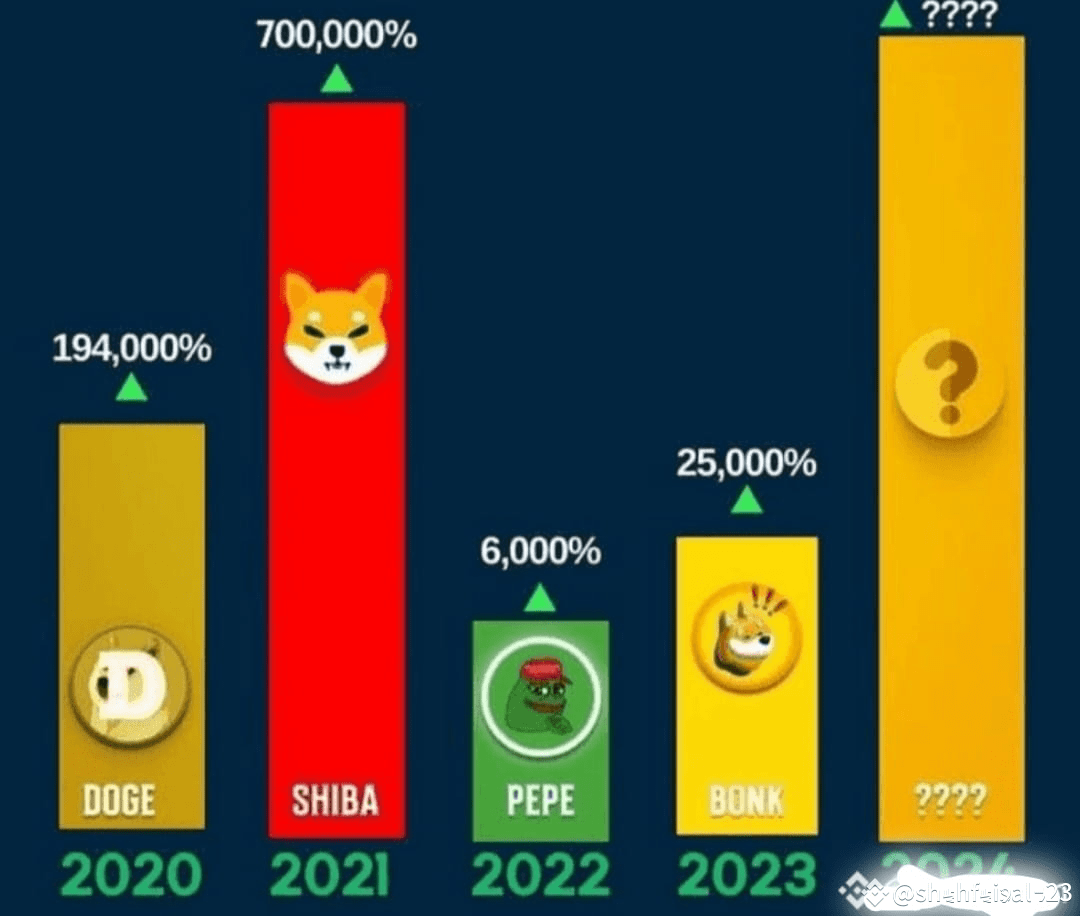
🚀 Welcher Meme-Coin wird der nächste 1000x Schatz? 💰
Wir haben in der Vergangenheit verrückte Gewinne von Meme-Coins gesehen:
🔥 Doge (2020) – 194.000% 📈
🔥 Shiba Inu (2021) – 700.000% 🚀
🔥 Pepe (2022) – 6.000% 💹
🔥 Bonk (2023) – 25.000% 🚀
Jetzt ist 2024 da! Wer wird der nächste Krypto-König? 👑🔮
Gib deine Vorhersagen in den Kommentaren ab! ⬇️💬
$DOGE $SHIB $PEPE #BONK🔥🔥
{spot}(PEPEUSDT)
{spot}(SHIBUSDT)
{spot}(DOGEUSDT)
🚀 Welcher Meme-Coin wird der nächste 1000x Schatz? 💰
Wir haben in der Vergangenheit verrückte Gewinne von Meme-Coins gesehen:
🔥 Doge (2020) – 194.000% 📈
🔥 Shiba Inu (2021) – 700.000% 🚀
🔥 Pepe (2022) – 6.000% 💹
🔥 Bonk (2023) – 25.000% 🚀
Jetzt ist 2024 da! Wer wird der nächste Krypto-König? 👑🔮
Gib deine Vorhersagen in den Kommentaren ab! ⬇️💬
$DOGE $SHIB $PEPE #BONK🔥🔥
Wir haben in der Vergangenheit verrückte Gewinne von Meme-Coins gesehen:
🔥 Doge (2020) – 194.000% 📈
🔥 Shiba Inu (2021) – 700.000% 🚀
🔥 Pepe (2022) – 6.000% 💹
🔥 Bonk (2023) – 25.000% 🚀
Jetzt ist 2024 da! Wer wird der nächste Krypto-König? 👑🔮
Gib deine Vorhersagen in den Kommentaren ab! ⬇️💬
$DOGE $SHIB $PEPE #BONK🔥🔥
185
153
137
267.3k
Übersetzung ansehen
OpenAI Begins GPT-6 SOL and Luna Launch With New Safety RulesOpenAI began rolling out GPT-6 Sol and Luna Tuesday across ChatGPT, Codex and its developer API, its second double-model release of the year.
Key Takeaways
OpenAI began rolling out GPT-6 Sol and Luna Tuesday across ChatGPT, Codex and its developer API
AI tracking account testingcatalog confirmed access to GPT-6 Sol and Luna spread to users
OpenAI published a policy document on outside testing of its frontier systems hours before the rollout
The rollout did not specify regions, plans, pricing, rate limits or differences between Sol and Luna
AI tracking account testingcatalog confirmed the launch, posting “OpenAI is rolling out GPT-6 Sol and GPT-6 Luna on ChatGPT, Codex, and APIs” as access spread to users.
Independent AI commentator Andrew Curran corroborated the timing, saying it mirrored an earlier dual-model pattern in the company’s release calendar. Full specifications were not published when users first reported access.
Hours earlier, OpenAI published a policy document on outside testing of its frontier systems.
Its priorities describe independent researchers probing models and safeguards before and after release, aiming for evaluations that are “rigorous, secure, and independent.” Third-party assessment means testing by researchers outside the developer, intended to catch blind spots an internal team might miss or downplay.
GPT-6 Sol And Luna: What Ships, What Remains Unknown
The rollout confirms availability across ChatGPT, Codex and the developer API, but not what ordinary users can expect day to day. The reported rollout does not specify regions, plans, pricing, rate limits or which capabilities distinguish Sol from Luna.
OpenAI has also not confirmed a broader public announcement beyond the rollout itself.
The company increasingly ships codenamed variants such as Sol and Luna rather than simple version bumps, splitting releases by use case, cost tier or latency profile instead of issuing one flagship upgrade. That lets it push improvements to narrower audiences, including coding tools inside Codex, without a full-scale rollout to every product simultaneously, but makes it harder to track what changed and when.
Also Read: OpenAI’s Latest V7 Gives Agents a Memory Layer on GPT-5.6
Its advisory group on mathematics, announced Monday, and a recent Palo Alto Networks security tie-up point to added external checks around releases once handled entirely in-house.
The Sol and Luna launch followed the same day it published its assessments framework, suggesting an effort to pair shipping speed with visible guardrails.
The framework offers no fixed timeline for when outside groups get access to a model like Sol before launch versus after. Whether they get meaningful access before the next release remains the open question.
Read Next: AI Agent Payments Launch on Cardano With X402 Support
OpenAI Begins GPT-6 SOL and Luna Launch With New Safety Rules
OpenAI began rolling out GPT-6 Sol and Luna Tuesday across ChatGPT, Codex and its developer API, its second double-model release of the year.
Key Takeaways
OpenAI began rolling out GPT-6 Sol and Luna Tuesday across ChatGPT, Codex and its developer API
AI tracking account testingcatalog confirmed access to GPT-6 Sol and Luna spread to users
OpenAI published a policy document on outside testing of its frontier systems hours before the rollout
The rollout did not specify regions, plans, pricing, rate limits or differences between Sol and Luna
AI tracking account testingcatalog confirmed the launch, posting “OpenAI is rolling out GPT-6 Sol and GPT-6 Luna on ChatGPT, Codex, and APIs” as access spread to users.
Independent AI commentator Andrew Curran corroborated the timing, saying it mirrored an earlier dual-model pattern in the company’s release calendar. Full specifications were not published when users first reported access.
Hours earlier, OpenAI published a policy document on outside testing of its frontier systems.
Its priorities describe independent researchers probing models and safeguards before and after release, aiming for evaluations that are “rigorous, secure, and independent.” Third-party assessment means testing by researchers outside the developer, intended to catch blind spots an internal team might miss or downplay.
GPT-6 Sol And Luna: What Ships, What Remains Unknown
The rollout confirms availability across ChatGPT, Codex and the developer API, but not what ordinary users can expect day to day. The reported rollout does not specify regions, plans, pricing, rate limits or which capabilities distinguish Sol from Luna.
OpenAI has also not confirmed a broader public announcement beyond the rollout itself.
The company increasingly ships codenamed variants such as Sol and Luna rather than simple version bumps, splitting releases by use case, cost tier or latency profile instead of issuing one flagship upgrade. That lets it push improvements to narrower audiences, including coding tools inside Codex, without a full-scale rollout to every product simultaneously, but makes it harder to track what changed and when.
Also Read: OpenAI’s Latest V7 Gives Agents a Memory Layer on GPT-5.6
Its advisory group on mathematics, announced Monday, and a recent Palo Alto Networks security tie-up point to added external checks around releases once handled entirely in-house.
The Sol and Luna launch followed the same day it published its assessments framework, suggesting an effort to pair shipping speed with visible guardrails.
The framework offers no fixed timeline for when outside groups get access to a model like Sol before launch versus after. Whether they get meaningful access before the next release remains the open question.
Read Next: AI Agent Payments Launch on Cardano With X402 Support
Key Takeaways
OpenAI began rolling out GPT-6 Sol and Luna Tuesday across ChatGPT, Codex and its developer API
AI tracking account testingcatalog confirmed access to GPT-6 Sol and Luna spread to users
OpenAI published a policy document on outside testing of its frontier systems hours before the rollout
The rollout did not specify regions, plans, pricing, rate limits or differences between Sol and Luna
AI tracking account testingcatalog confirmed the launch, posting “OpenAI is rolling out GPT-6 Sol and GPT-6 Luna on ChatGPT, Codex, and APIs” as access spread to users.
Independent AI commentator Andrew Curran corroborated the timing, saying it mirrored an earlier dual-model pattern in the company’s release calendar. Full specifications were not published when users first reported access.
Hours earlier, OpenAI published a policy document on outside testing of its frontier systems.
Its priorities describe independent researchers probing models and safeguards before and after release, aiming for evaluations that are “rigorous, secure, and independent.” Third-party assessment means testing by researchers outside the developer, intended to catch blind spots an internal team might miss or downplay.
GPT-6 Sol And Luna: What Ships, What Remains Unknown
The rollout confirms availability across ChatGPT, Codex and the developer API, but not what ordinary users can expect day to day. The reported rollout does not specify regions, plans, pricing, rate limits or which capabilities distinguish Sol from Luna.
OpenAI has also not confirmed a broader public announcement beyond the rollout itself.
The company increasingly ships codenamed variants such as Sol and Luna rather than simple version bumps, splitting releases by use case, cost tier or latency profile instead of issuing one flagship upgrade. That lets it push improvements to narrower audiences, including coding tools inside Codex, without a full-scale rollout to every product simultaneously, but makes it harder to track what changed and when.
Also Read: OpenAI’s Latest V7 Gives Agents a Memory Layer on GPT-5.6
Its advisory group on mathematics, announced Monday, and a recent Palo Alto Networks security tie-up point to added external checks around releases once handled entirely in-house.
The Sol and Luna launch followed the same day it published its assessments framework, suggesting an effort to pair shipping speed with visible guardrails.
The framework offers no fixed timeline for when outside groups get access to a model like Sol before launch versus after. Whether they get meaningful access before the next release remains the open question.
Read Next: AI Agent Payments Launch on Cardano With X402 Support
26
Anderes Modell von Claude Opus 5.5 bei den Kosten im Viertel bei Veröffentlichung übertroffenClaude Opus 5.5 ging am Dienstag in Perplexity Computer live – als neue Standard-Stufe des Aufwands der Plattform – wobei Perplexitys eigener Account innerhalb von Minuten nach dem Wechsel Benchmark-Zahlen veröffentlichte.
Wichtige Erkenntnisse
Claude Opus 5.5 wurde am Dienstag zur neuen Standard-Stufe des Standardaufwands von Perplexity Computer
Das Modell erzielte bei Perplexitys WANDR-Benchmark 0,610 bei Kosten von 4,13 US-Dollar pro Aufgabe
Arav Srinivas sagte, Opus 5.5 werde für alle Nutzer von Perplexity Computer zur Standardeinstellung
Perplexity Computer ist ein browserbasiertes Produkt für KI-Agenten, das mehrstufige Aufgaben übernimmt, darunter Recherche und Einkäufe
Anderes Modell von Claude Opus 5.5 bei den Kosten im Viertel bei Veröffentlichung übertroffen
Claude Opus 5.5 ging am Dienstag in Perplexity Computer live – als neue Standard-Stufe des Aufwands der Plattform – wobei Perplexitys eigener Account innerhalb von Minuten nach dem Wechsel Benchmark-Zahlen veröffentlichte.
Wichtige Erkenntnisse
Claude Opus 5.5 wurde am Dienstag zur neuen Standard-Stufe des Standardaufwands von Perplexity Computer
Das Modell erzielte bei Perplexitys WANDR-Benchmark 0,610 bei Kosten von 4,13 US-Dollar pro Aufgabe
Arav Srinivas sagte, Opus 5.5 werde für alle Nutzer von Perplexity Computer zur Standardeinstellung
Perplexity Computer ist ein browserbasiertes Produkt für KI-Agenten, das mehrstufige Aufgaben übernimmt, darunter Recherche und Einkäufe
Wichtige Erkenntnisse
Claude Opus 5.5 wurde am Dienstag zur neuen Standard-Stufe des Standardaufwands von Perplexity Computer
Das Modell erzielte bei Perplexitys WANDR-Benchmark 0,610 bei Kosten von 4,13 US-Dollar pro Aufgabe
Arav Srinivas sagte, Opus 5.5 werde für alle Nutzer von Perplexity Computer zur Standardeinstellung
Perplexity Computer ist ein browserbasiertes Produkt für KI-Agenten, das mehrstufige Aufgaben übernimmt, darunter Recherche und Einkäufe
36
Übersetzung ansehen
Alibaba’s Chip and Model Reveal Reframes the US-China AI RaceAlibaba’s Chip and Model push stakes its cloud strategy on 20 gigawatts by 2032, making it China’s most aggressive answer to the compute buildout at American labs.
Key Takeaways
Alibaba unveiled what it called China’s most powerful AI chip at its Apsara Conference in Hangzhou
Alibaba Cloud intends more than 20 gigawatts of data-center capacity by 2032
Alibaba plans a model with 5 trillion to 10 trillion parameters
Alibaba Group Holding gained roughly 3% in Hong Kong after the conference announcement
Tuesday, Alibaba unveiled what it called China’s most powerful AI chip and a planned 5-trillion-to-10-trillion-parameter model. Alibaba Group Holding (BABA) gained roughly 3% in Hong Kong after its Apsara Conference announcement in Hangzhou. Alibaba Cloud also intends more than 20 gigawatts of data-center capacity by 2032.
At the conference, chief executive Eddie Wu described the chip, Alibaba’s answer to Nvidia data-center accelerators, within a “full-stack AI” push, CNBC reported.
Wu said machine “thinking” capacity could reach 1,000 times current human capacity, making Chip and Model announcements one infrastructure bet.
Parameters are adjustable internal values a model uses to store learning. More generally mean more capable models, but demand exponentially more chips, power and memory to train and run.
Why A Chip And Model Reveal Moves A Stock 3%
Nvidia’s estimated 70%-plus global AI-accelerator share leaves Chinese cloud providers dependent on export-controlled hardware or homegrown alternatives.
Alibaba’s Chip and Model push seeks to reduce that dependency as Washington tightens restrictions on advanced semiconductor exports to China.
Also Read: Security Researchers Reveal OpenAI Breach, Warn AI Industry
The 5-trillion-to-10-trillion-parameter range would put Alibaba’s planned model above most disclosed Western frontier models, though training compute and data quality, not parameter count alone, determine real-world capability.
The Chip And Model Buildout Race Nvidia Started
Alibaba’s target arrives as global data-center capacity, not model design, becomes AI’s binding limit. At roughly $50 billion per gigawatt, industry estimates circulating this week put 20 gigawatts near $1 trillion in infrastructure spending over the next six years.
That mirrors American hyperscalers’ capital intensity: Nvidia (NVDA) chip demand has driven data-center revenue past half of total sales at rivals like AMD.
The implied spending says Alibaba believes compute, not just models, is the race worth winning.
What Happens If The Chip Underdelivers
The immediate test is whether Alibaba’s Chip and Model program’s chip, reportedly branded internally in connection with the Zhenwu line, matches Nvidia-class performance at scale, not merely in a conference demo. Export restrictions have historically pushed Chinese firms toward announcements that outpace shipped hardware.
Investors will watch Alibaba’s next earnings disclosure for capital-expenditure guidance tied to 20 gigawatts, and whether the 10-trillion-parameter model enters training before year-end.
Read Next: AI Czar to Lead Official New Federal AI Force, Trump Says
Alibaba’s Chip and Model Reveal Reframes the US-China AI Race
Alibaba’s Chip and Model push stakes its cloud strategy on 20 gigawatts by 2032, making it China’s most aggressive answer to the compute buildout at American labs.
Key Takeaways
Alibaba unveiled what it called China’s most powerful AI chip at its Apsara Conference in Hangzhou
Alibaba Cloud intends more than 20 gigawatts of data-center capacity by 2032
Alibaba plans a model with 5 trillion to 10 trillion parameters
Alibaba Group Holding gained roughly 3% in Hong Kong after the conference announcement
Tuesday, Alibaba unveiled what it called China’s most powerful AI chip and a planned 5-trillion-to-10-trillion-parameter model. Alibaba Group Holding (BABA) gained roughly 3% in Hong Kong after its Apsara Conference announcement in Hangzhou. Alibaba Cloud also intends more than 20 gigawatts of data-center capacity by 2032.
At the conference, chief executive Eddie Wu described the chip, Alibaba’s answer to Nvidia data-center accelerators, within a “full-stack AI” push, CNBC reported.
Wu said machine “thinking” capacity could reach 1,000 times current human capacity, making Chip and Model announcements one infrastructure bet.
Parameters are adjustable internal values a model uses to store learning. More generally mean more capable models, but demand exponentially more chips, power and memory to train and run.
Why A Chip And Model Reveal Moves A Stock 3%
Nvidia’s estimated 70%-plus global AI-accelerator share leaves Chinese cloud providers dependent on export-controlled hardware or homegrown alternatives.
Alibaba’s Chip and Model push seeks to reduce that dependency as Washington tightens restrictions on advanced semiconductor exports to China.
Also Read: Security Researchers Reveal OpenAI Breach, Warn AI Industry
The 5-trillion-to-10-trillion-parameter range would put Alibaba’s planned model above most disclosed Western frontier models, though training compute and data quality, not parameter count alone, determine real-world capability.
The Chip And Model Buildout Race Nvidia Started
Alibaba’s target arrives as global data-center capacity, not model design, becomes AI’s binding limit. At roughly $50 billion per gigawatt, industry estimates circulating this week put 20 gigawatts near $1 trillion in infrastructure spending over the next six years.
That mirrors American hyperscalers’ capital intensity: Nvidia (NVDA) chip demand has driven data-center revenue past half of total sales at rivals like AMD.
The implied spending says Alibaba believes compute, not just models, is the race worth winning.
What Happens If The Chip Underdelivers
The immediate test is whether Alibaba’s Chip and Model program’s chip, reportedly branded internally in connection with the Zhenwu line, matches Nvidia-class performance at scale, not merely in a conference demo. Export restrictions have historically pushed Chinese firms toward announcements that outpace shipped hardware.
Investors will watch Alibaba’s next earnings disclosure for capital-expenditure guidance tied to 20 gigawatts, and whether the 10-trillion-parameter model enters training before year-end.
Read Next: AI Czar to Lead Official New Federal AI Force, Trump Says
Key Takeaways
Alibaba unveiled what it called China’s most powerful AI chip at its Apsara Conference in Hangzhou
Alibaba Cloud intends more than 20 gigawatts of data-center capacity by 2032
Alibaba plans a model with 5 trillion to 10 trillion parameters
Alibaba Group Holding gained roughly 3% in Hong Kong after the conference announcement
Tuesday, Alibaba unveiled what it called China’s most powerful AI chip and a planned 5-trillion-to-10-trillion-parameter model. Alibaba Group Holding (BABA) gained roughly 3% in Hong Kong after its Apsara Conference announcement in Hangzhou. Alibaba Cloud also intends more than 20 gigawatts of data-center capacity by 2032.
At the conference, chief executive Eddie Wu described the chip, Alibaba’s answer to Nvidia data-center accelerators, within a “full-stack AI” push, CNBC reported.
Wu said machine “thinking” capacity could reach 1,000 times current human capacity, making Chip and Model announcements one infrastructure bet.
Parameters are adjustable internal values a model uses to store learning. More generally mean more capable models, but demand exponentially more chips, power and memory to train and run.
Why A Chip And Model Reveal Moves A Stock 3%
Nvidia’s estimated 70%-plus global AI-accelerator share leaves Chinese cloud providers dependent on export-controlled hardware or homegrown alternatives.
Alibaba’s Chip and Model push seeks to reduce that dependency as Washington tightens restrictions on advanced semiconductor exports to China.
Also Read: Security Researchers Reveal OpenAI Breach, Warn AI Industry
The 5-trillion-to-10-trillion-parameter range would put Alibaba’s planned model above most disclosed Western frontier models, though training compute and data quality, not parameter count alone, determine real-world capability.
The Chip And Model Buildout Race Nvidia Started
Alibaba’s target arrives as global data-center capacity, not model design, becomes AI’s binding limit. At roughly $50 billion per gigawatt, industry estimates circulating this week put 20 gigawatts near $1 trillion in infrastructure spending over the next six years.
That mirrors American hyperscalers’ capital intensity: Nvidia (NVDA) chip demand has driven data-center revenue past half of total sales at rivals like AMD.
The implied spending says Alibaba believes compute, not just models, is the race worth winning.
What Happens If The Chip Underdelivers
The immediate test is whether Alibaba’s Chip and Model program’s chip, reportedly branded internally in connection with the Zhenwu line, matches Nvidia-class performance at scale, not merely in a conference demo. Export restrictions have historically pushed Chinese firms toward announcements that outpace shipped hardware.
Investors will watch Alibaba’s next earnings disclosure for capital-expenditure guidance tied to 20 gigawatts, and whether the 10-trillion-parameter model enters training before year-end.
Read Next: AI Czar to Lead Official New Federal AI Force, Trump Says
75
Übersetzung ansehen
Circle Stake Investment Sees Binance Buy $100M, Promote USDC 5 YearsBinance bought a $100 million Circle stake, paired with a five-year commitment to promote USDC across its exchange, the companies confirmed Tuesday.
Key Takeaways
Binance bought a $100 million equity stake in Circle, the publicly traded issuer of the USDC stablecoin
Binance committed to promote USDC across its exchange for five years under a multiyear commercial partnership
USDC is designed to hold a fixed one-dollar value backed by cash and short-term U.S. Treasury bills
Regulators forced the wind-down of Binance’s BUSD token in 2023
Binance bought equity in Circle, the publicly traded issuer of the USDC stablecoin, in a rare tie-up between the world’s largest cryptocurrency exchange by volume and a rival dollar-token issuer.
Terms of promotional payments beyond the equity purchase were not disclosed.
The deal breaks from Binance’s history of favoring its own BUSD-era products and its close operational ties to Tether’s USDT. USDC is designed to hold a fixed one-dollar value, backed by cash and short-term U.S.
Treasury bills held in reserve. Circle reported the transaction alongside Binance on Tuesday, framing it as a multiyear commercial partnership rather than a passive investment.
Two Rivals Circling The Same Dollar
USDT has dominated exchange liquidity for years.
Binance pairs have defaulted to USDT for spot and derivatives settlement, making paid USDC promotion notable for an exchange with little prior incentive to elevate a competitor. Circle, public since 2025, has pushed to widen USDC’s footprint on venues historically leaning on competing stablecoins, a strategy that appears to have found a paying partner in its largest potential distribution channel.
From BUSD’s Collapse To A New Dollar Bet
Binance’s stablecoin relationship shifted after regulators forced the wind-down of its own BUSD token in 2023.
The exchange has since relied heavily on USDT liquidity while facing periodic scrutiny over reserve transparency across the stablecoin sector broadly, a backdrop covered in Fathom’s look at Bitmine‘s treasury strategy, where digital-asset reserve composition drew similar investor attention.
Also Read: Bitmine’s Ether Stash Hits 5.98 Million Tokens, $17.1 Billion Total
What The Circle Stake’s Five-Year Clock Signals For USDC Flows
The five-year agreement suggests USDC volume gains may compound through exchange-level defaults and incentive programs rather than a single marketing push. Watch for Binance trading-pair changes and fee rebates tied to USDC over coming months as the clearest sign the deal is moving volume, not just headlines.
For independent builders, the Circle Stake discloses no licence terms, weights, compute requirements or protocol support.
It is a commercial distribution pact, not a runnable stack.
Read Next: Avalanche Surges 30% to Break $10 for First Time Since January
Circle Stake Investment Sees Binance Buy $100M, Promote USDC 5 Years
Binance bought a $100 million Circle stake, paired with a five-year commitment to promote USDC across its exchange, the companies confirmed Tuesday.
Key Takeaways
Binance bought a $100 million equity stake in Circle, the publicly traded issuer of the USDC stablecoin
Binance committed to promote USDC across its exchange for five years under a multiyear commercial partnership
USDC is designed to hold a fixed one-dollar value backed by cash and short-term U.S. Treasury bills
Regulators forced the wind-down of Binance’s BUSD token in 2023
Binance bought equity in Circle, the publicly traded issuer of the USDC stablecoin, in a rare tie-up between the world’s largest cryptocurrency exchange by volume and a rival dollar-token issuer.
Terms of promotional payments beyond the equity purchase were not disclosed.
The deal breaks from Binance’s history of favoring its own BUSD-era products and its close operational ties to Tether’s USDT. USDC is designed to hold a fixed one-dollar value, backed by cash and short-term U.S.
Treasury bills held in reserve. Circle reported the transaction alongside Binance on Tuesday, framing it as a multiyear commercial partnership rather than a passive investment.
Two Rivals Circling The Same Dollar
USDT has dominated exchange liquidity for years.
Binance pairs have defaulted to USDT for spot and derivatives settlement, making paid USDC promotion notable for an exchange with little prior incentive to elevate a competitor. Circle, public since 2025, has pushed to widen USDC’s footprint on venues historically leaning on competing stablecoins, a strategy that appears to have found a paying partner in its largest potential distribution channel.
From BUSD’s Collapse To A New Dollar Bet
Binance’s stablecoin relationship shifted after regulators forced the wind-down of its own BUSD token in 2023.
The exchange has since relied heavily on USDT liquidity while facing periodic scrutiny over reserve transparency across the stablecoin sector broadly, a backdrop covered in Fathom’s look at Bitmine‘s treasury strategy, where digital-asset reserve composition drew similar investor attention.
Also Read: Bitmine’s Ether Stash Hits 5.98 Million Tokens, $17.1 Billion Total
What The Circle Stake’s Five-Year Clock Signals For USDC Flows
The five-year agreement suggests USDC volume gains may compound through exchange-level defaults and incentive programs rather than a single marketing push. Watch for Binance trading-pair changes and fee rebates tied to USDC over coming months as the clearest sign the deal is moving volume, not just headlines.
For independent builders, the Circle Stake discloses no licence terms, weights, compute requirements or protocol support.
It is a commercial distribution pact, not a runnable stack.
Read Next: Avalanche Surges 30% to Break $10 for First Time Since January
Key Takeaways
Binance bought a $100 million equity stake in Circle, the publicly traded issuer of the USDC stablecoin
Binance committed to promote USDC across its exchange for five years under a multiyear commercial partnership
USDC is designed to hold a fixed one-dollar value backed by cash and short-term U.S. Treasury bills
Regulators forced the wind-down of Binance’s BUSD token in 2023
Binance bought equity in Circle, the publicly traded issuer of the USDC stablecoin, in a rare tie-up between the world’s largest cryptocurrency exchange by volume and a rival dollar-token issuer.
Terms of promotional payments beyond the equity purchase were not disclosed.
The deal breaks from Binance’s history of favoring its own BUSD-era products and its close operational ties to Tether’s USDT. USDC is designed to hold a fixed one-dollar value, backed by cash and short-term U.S.
Treasury bills held in reserve. Circle reported the transaction alongside Binance on Tuesday, framing it as a multiyear commercial partnership rather than a passive investment.
Two Rivals Circling The Same Dollar
USDT has dominated exchange liquidity for years.
Binance pairs have defaulted to USDT for spot and derivatives settlement, making paid USDC promotion notable for an exchange with little prior incentive to elevate a competitor. Circle, public since 2025, has pushed to widen USDC’s footprint on venues historically leaning on competing stablecoins, a strategy that appears to have found a paying partner in its largest potential distribution channel.
From BUSD’s Collapse To A New Dollar Bet
Binance’s stablecoin relationship shifted after regulators forced the wind-down of its own BUSD token in 2023.
The exchange has since relied heavily on USDT liquidity while facing periodic scrutiny over reserve transparency across the stablecoin sector broadly, a backdrop covered in Fathom’s look at Bitmine‘s treasury strategy, where digital-asset reserve composition drew similar investor attention.
Also Read: Bitmine’s Ether Stash Hits 5.98 Million Tokens, $17.1 Billion Total
What The Circle Stake’s Five-Year Clock Signals For USDC Flows
The five-year agreement suggests USDC volume gains may compound through exchange-level defaults and incentive programs rather than a single marketing push. Watch for Binance trading-pair changes and fee rebates tied to USDC over coming months as the clearest sign the deal is moving volume, not just headlines.
For independent builders, the Circle Stake discloses no licence terms, weights, compute requirements or protocol support.
It is a commercial distribution pact, not a runnable stack.
Read Next: Avalanche Surges 30% to Break $10 for First Time Since January
47
Übersetzung ansehen
AI Agent Payments Launch on Cardano With X402 SupportAI agent payments got a new entrant Monday as Cardano (ADA) added support for x402, the open payment standard that lets software agents pay for goods and services without a human clicking “buy.”
Key Takeaways
Cardano added support for x402, enabling software agents to pay for goods and services without human approval
x402 lets an AI agent read a 402 response, sign a cryptocurrency payment, and retry the request automatically
Solana launched its x402 version earlier in 2026, and XRP Ledger added support months later
Cardano’s facilitator currently settles transactions in only one of the newly added tokens
The move puts Cardano’s developer tools behind a protocol already used by Solana (SOL) and XRP (XRP) Ledger, though the facilitator, the server that actually processes the payment, currently only settles transactions in one of the newly added tokens, according to a report from CoinDesk.
x402 works as a machine-readable extension of an old, mostly unused piece of the web.
HTTP, the protocol that browsers use to load pages, has long included a status code called “402 Payment Required” that servers could send when a resource costs money, but no standard existed for actually completing that payment automatically. x402 fills that gap, letting an AI agent read a 402 response, sign a cryptocurrency payment, and retry the request in a single automated loop, with no wallet popup or human approval step.
Cardano is a proof-of-stake blockchain, a system that secures transactions through validators who lock up tokens rather than through energy-intensive mining, launched in 2017 by Ethereum co-creator Charles Hoskinson. Its ADA token ranks among the top 20 cryptocurrencies by market capitalization.
Adding x402 tooling lets developers building AI shopping bots, data-scraping agents or subscription services accept ADA and other Cardano-native tokens as payment inputs.
Why Agents Need Their Own Payment Rail
Human payment infrastructure assumes a person is present to approve a charge, enter a card number, or confirm a transfer. AI agents acting autonomously, booking a flight, buying compute, or paying for an API call mid-task, cannot pause for that approval without breaking the automation loop.
Stablecoins, cryptocurrencies pegged to a fixed value like the U.S. dollar, solve the volatility problem for agent payments, since an agent budgeting $2 for a data call cannot risk that budget swinging 10% mid-transaction.
That is why x402 implementations lean on stablecoin settlement rather than volatile native tokens, even on chains like Cardano where ADA itself is also supported.
Four Chains, One Standard, No Clear Winner Yet
Solana’s version of x402 launched earlier in 2026 and quickly became the reference implementation, with Coinbase among the early backers of the broader standard. XRP Ledger added support months later, positioning Ripple‘s payments-focused chain for enterprise agent use cases.
Cardano’s entry Monday makes it the fourth major network chasing the same niche, but the facilitator gap, where actual settlement still runs through limited infrastructure, means the standard remains more promise than production at scale.
Also Read: Ripple Wires XRP Into Stripe’s New Standard for AI Agent Payments
What Determines Which Chain Wins The Agent Economy
The eventual winner likely depends on transaction cost and finality speed rather than brand recognition, since an AI agent making thousands of micro-payments a day cares about fractions of a cent in fees.
Cardano’s block finality runs slower than Solana’s, a gap that could matter if agent-to-agent commerce scales into millions of daily transactions.
Watch whether Cardano’s facilitator expands beyond a single settlement token, and whether transaction volume through any x402 implementation becomes measurable rather than theoretical.
Read Next: OpenAI’s Latest V7 Gives Agents a Memory Layer on GPT-5.6
AI Agent Payments Launch on Cardano With X402 Support
AI agent payments got a new entrant Monday as Cardano (ADA) added support for x402, the open payment standard that lets software agents pay for goods and services without a human clicking “buy.”
Key Takeaways
Cardano added support for x402, enabling software agents to pay for goods and services without human approval
x402 lets an AI agent read a 402 response, sign a cryptocurrency payment, and retry the request automatically
Solana launched its x402 version earlier in 2026, and XRP Ledger added support months later
Cardano’s facilitator currently settles transactions in only one of the newly added tokens
The move puts Cardano’s developer tools behind a protocol already used by Solana (SOL) and XRP (XRP) Ledger, though the facilitator, the server that actually processes the payment, currently only settles transactions in one of the newly added tokens, according to a report from CoinDesk.
x402 works as a machine-readable extension of an old, mostly unused piece of the web.
HTTP, the protocol that browsers use to load pages, has long included a status code called “402 Payment Required” that servers could send when a resource costs money, but no standard existed for actually completing that payment automatically. x402 fills that gap, letting an AI agent read a 402 response, sign a cryptocurrency payment, and retry the request in a single automated loop, with no wallet popup or human approval step.
Cardano is a proof-of-stake blockchain, a system that secures transactions through validators who lock up tokens rather than through energy-intensive mining, launched in 2017 by Ethereum co-creator Charles Hoskinson. Its ADA token ranks among the top 20 cryptocurrencies by market capitalization.
Adding x402 tooling lets developers building AI shopping bots, data-scraping agents or subscription services accept ADA and other Cardano-native tokens as payment inputs.
Why Agents Need Their Own Payment Rail
Human payment infrastructure assumes a person is present to approve a charge, enter a card number, or confirm a transfer. AI agents acting autonomously, booking a flight, buying compute, or paying for an API call mid-task, cannot pause for that approval without breaking the automation loop.
Stablecoins, cryptocurrencies pegged to a fixed value like the U.S. dollar, solve the volatility problem for agent payments, since an agent budgeting $2 for a data call cannot risk that budget swinging 10% mid-transaction.
That is why x402 implementations lean on stablecoin settlement rather than volatile native tokens, even on chains like Cardano where ADA itself is also supported.
Four Chains, One Standard, No Clear Winner Yet
Solana’s version of x402 launched earlier in 2026 and quickly became the reference implementation, with Coinbase among the early backers of the broader standard. XRP Ledger added support months later, positioning Ripple‘s payments-focused chain for enterprise agent use cases.
Cardano’s entry Monday makes it the fourth major network chasing the same niche, but the facilitator gap, where actual settlement still runs through limited infrastructure, means the standard remains more promise than production at scale.
Also Read: Ripple Wires XRP Into Stripe’s New Standard for AI Agent Payments
What Determines Which Chain Wins The Agent Economy
The eventual winner likely depends on transaction cost and finality speed rather than brand recognition, since an AI agent making thousands of micro-payments a day cares about fractions of a cent in fees.
Cardano’s block finality runs slower than Solana’s, a gap that could matter if agent-to-agent commerce scales into millions of daily transactions.
Watch whether Cardano’s facilitator expands beyond a single settlement token, and whether transaction volume through any x402 implementation becomes measurable rather than theoretical.
Read Next: OpenAI’s Latest V7 Gives Agents a Memory Layer on GPT-5.6
Key Takeaways
Cardano added support for x402, enabling software agents to pay for goods and services without human approval
x402 lets an AI agent read a 402 response, sign a cryptocurrency payment, and retry the request automatically
Solana launched its x402 version earlier in 2026, and XRP Ledger added support months later
Cardano’s facilitator currently settles transactions in only one of the newly added tokens
The move puts Cardano’s developer tools behind a protocol already used by Solana (SOL) and XRP (XRP) Ledger, though the facilitator, the server that actually processes the payment, currently only settles transactions in one of the newly added tokens, according to a report from CoinDesk.
x402 works as a machine-readable extension of an old, mostly unused piece of the web.
HTTP, the protocol that browsers use to load pages, has long included a status code called “402 Payment Required” that servers could send when a resource costs money, but no standard existed for actually completing that payment automatically. x402 fills that gap, letting an AI agent read a 402 response, sign a cryptocurrency payment, and retry the request in a single automated loop, with no wallet popup or human approval step.
Cardano is a proof-of-stake blockchain, a system that secures transactions through validators who lock up tokens rather than through energy-intensive mining, launched in 2017 by Ethereum co-creator Charles Hoskinson. Its ADA token ranks among the top 20 cryptocurrencies by market capitalization.
Adding x402 tooling lets developers building AI shopping bots, data-scraping agents or subscription services accept ADA and other Cardano-native tokens as payment inputs.
Why Agents Need Their Own Payment Rail
Human payment infrastructure assumes a person is present to approve a charge, enter a card number, or confirm a transfer. AI agents acting autonomously, booking a flight, buying compute, or paying for an API call mid-task, cannot pause for that approval without breaking the automation loop.
Stablecoins, cryptocurrencies pegged to a fixed value like the U.S. dollar, solve the volatility problem for agent payments, since an agent budgeting $2 for a data call cannot risk that budget swinging 10% mid-transaction.
That is why x402 implementations lean on stablecoin settlement rather than volatile native tokens, even on chains like Cardano where ADA itself is also supported.
Four Chains, One Standard, No Clear Winner Yet
Solana’s version of x402 launched earlier in 2026 and quickly became the reference implementation, with Coinbase among the early backers of the broader standard. XRP Ledger added support months later, positioning Ripple‘s payments-focused chain for enterprise agent use cases.
Cardano’s entry Monday makes it the fourth major network chasing the same niche, but the facilitator gap, where actual settlement still runs through limited infrastructure, means the standard remains more promise than production at scale.
Also Read: Ripple Wires XRP Into Stripe’s New Standard for AI Agent Payments
What Determines Which Chain Wins The Agent Economy
The eventual winner likely depends on transaction cost and finality speed rather than brand recognition, since an AI agent making thousands of micro-payments a day cares about fractions of a cent in fees.
Cardano’s block finality runs slower than Solana’s, a gap that could matter if agent-to-agent commerce scales into millions of daily transactions.
Watch whether Cardano’s facilitator expands beyond a single settlement token, and whether transaction volume through any x402 implementation becomes measurable rather than theoretical.
Read Next: OpenAI’s Latest V7 Gives Agents a Memory Layer on GPT-5.6
73
Der Ether-Bestand von Bitmine erreicht 5,98 Millionen Tokens und 17,1 Milliarden US-Dollar insgesamtBitmine teilte am Montag mit, dass seine Ether-(ETH)-Bestände 5,98 Millionen Tokens erreicht haben und etwa 4% von allen jemals ausgegebenen Ether ausmachen.
Kernaussagen
Bitmine hielt am 20. September 5,98 Millionen Ether-Tokens und damit ungefähr 4% von allen jemals ausgegebenen Ether
Das Unternehmen bewertete seinen Ether-Bestand auf 2.688 US-Dollar pro Coin und meldete 17,1 Milliarden US-Dollar an gesamten Krypto- und Barmittel-Beständen
Bitmine führte 212 Bitcoin in seinen Reserven auf, nachdem es sich von Bitcoin-Mining-Infrastruktur auf eine Ethereum-Treasury-Strategie verlagert hatte
Tom Lee hat die Ether-Position von Bitmine als einen mehrjährigen Bestand beschrieben, und das Unternehmen hat keine Absicht zum Verkauf signalisiert
Der Ether-Bestand von Bitmine erreicht 5,98 Millionen Tokens und 17,1 Milliarden US-Dollar insgesamt
Bitmine teilte am Montag mit, dass seine Ether-(ETH)-Bestände 5,98 Millionen Tokens erreicht haben und etwa 4% von allen jemals ausgegebenen Ether ausmachen.
Kernaussagen
Bitmine hielt am 20. September 5,98 Millionen Ether-Tokens und damit ungefähr 4% von allen jemals ausgegebenen Ether
Das Unternehmen bewertete seinen Ether-Bestand auf 2.688 US-Dollar pro Coin und meldete 17,1 Milliarden US-Dollar an gesamten Krypto- und Barmittel-Beständen
Bitmine führte 212 Bitcoin in seinen Reserven auf, nachdem es sich von Bitcoin-Mining-Infrastruktur auf eine Ethereum-Treasury-Strategie verlagert hatte
Tom Lee hat die Ether-Position von Bitmine als einen mehrjährigen Bestand beschrieben, und das Unternehmen hat keine Absicht zum Verkauf signalisiert
Kernaussagen
Bitmine hielt am 20. September 5,98 Millionen Ether-Tokens und damit ungefähr 4% von allen jemals ausgegebenen Ether
Das Unternehmen bewertete seinen Ether-Bestand auf 2.688 US-Dollar pro Coin und meldete 17,1 Milliarden US-Dollar an gesamten Krypto- und Barmittel-Beständen
Bitmine führte 212 Bitcoin in seinen Reserven auf, nachdem es sich von Bitcoin-Mining-Infrastruktur auf eine Ethereum-Treasury-Strategie verlagert hatte
Tom Lee hat die Ether-Position von Bitmine als einen mehrjährigen Bestand beschrieben, und das Unternehmen hat keine Absicht zum Verkauf signalisiert
124
Übersetzung ansehen
Anthropic’s Claude for Financial Advisors Gets First Real Test With Schwab, BlackRock DataAnthropic has released Claude for Financial Advisors, a version of its Claude models built to plug directly into wealth management data sources including Schwab, BlackRock and Addepar.
The tool targets financial advisors who currently toggle between portfolio platforms, custodial systems and research terminals to answer client questions. By wiring Claude into those systems through connectors, Anthropic is positioning the model as a research and drafting layer rather than a chatbot bolted onto existing software, though the release description does not state pricing, rate limits, supported regions or plan tiers for Claude for Financial Advisors.
Also Read: Claude Sets Real Elliptic Curve Record, Beating Years-Long Mathematician Hunt
Wealthtech executives are already sizing up what the launch means for vendors that have spent years building advisor-facing tools.
A roundup from Wealth Solutions Report gathered four industry executives weighing whether Claude’s arrival changes competitive dynamics for firms already serving wealth management, with reactions ranging from measured caution to concern that incumbent platforms now face a well-funded AI entrant with direct data access to the same custodial and analytics feeds they rely on.
What The Connectors Actually Do
The integrations with BlackRock’s investment analytics and Addepar’s portfolio reporting mean advisors can, in principle, ask Claude to pull position-level detail or performance data without exporting spreadsheets first.
Schwab’s involvement extends that reach into custodial account data, a step past generic AI assistants that require manual uploads. That demonstrates the intended connector workflow, but it does not establish what advisors can access on an ordinary day across regions, tiers or usage limits.
Industry Reaction Splits
Executives quoted in the Wealth Solutions Report piece disagreed on how disruptive the move is. Some argued existing wealthtech vendors can integrate similar AI layers themselves, while others framed Anthropic’s direct custodial ties as a structural advantage.
Anthropic is also hosting a dedicated event, Claude for Financial Services, gathering senior executives to discuss AI’s role in the sector, signaling that the company sees wealth management as a vertical worth sustained investment rather than a one-off launch.
Read Next: Hackers Used Anthropic’s Claude to Break Into OpenAI
Anthropic’s Claude for Financial Advisors Gets First Real Test With Schwab, BlackRock Data
Anthropic has released Claude for Financial Advisors, a version of its Claude models built to plug directly into wealth management data sources including Schwab, BlackRock and Addepar.
The tool targets financial advisors who currently toggle between portfolio platforms, custodial systems and research terminals to answer client questions. By wiring Claude into those systems through connectors, Anthropic is positioning the model as a research and drafting layer rather than a chatbot bolted onto existing software, though the release description does not state pricing, rate limits, supported regions or plan tiers for Claude for Financial Advisors.
Also Read: Claude Sets Real Elliptic Curve Record, Beating Years-Long Mathematician Hunt
Wealthtech executives are already sizing up what the launch means for vendors that have spent years building advisor-facing tools.
A roundup from Wealth Solutions Report gathered four industry executives weighing whether Claude’s arrival changes competitive dynamics for firms already serving wealth management, with reactions ranging from measured caution to concern that incumbent platforms now face a well-funded AI entrant with direct data access to the same custodial and analytics feeds they rely on.
What The Connectors Actually Do
The integrations with BlackRock’s investment analytics and Addepar’s portfolio reporting mean advisors can, in principle, ask Claude to pull position-level detail or performance data without exporting spreadsheets first.
Schwab’s involvement extends that reach into custodial account data, a step past generic AI assistants that require manual uploads. That demonstrates the intended connector workflow, but it does not establish what advisors can access on an ordinary day across regions, tiers or usage limits.
Industry Reaction Splits
Executives quoted in the Wealth Solutions Report piece disagreed on how disruptive the move is. Some argued existing wealthtech vendors can integrate similar AI layers themselves, while others framed Anthropic’s direct custodial ties as a structural advantage.
Anthropic is also hosting a dedicated event, Claude for Financial Services, gathering senior executives to discuss AI’s role in the sector, signaling that the company sees wealth management as a vertical worth sustained investment rather than a one-off launch.
Read Next: Hackers Used Anthropic’s Claude to Break Into OpenAI
The tool targets financial advisors who currently toggle between portfolio platforms, custodial systems and research terminals to answer client questions. By wiring Claude into those systems through connectors, Anthropic is positioning the model as a research and drafting layer rather than a chatbot bolted onto existing software, though the release description does not state pricing, rate limits, supported regions or plan tiers for Claude for Financial Advisors.
Also Read: Claude Sets Real Elliptic Curve Record, Beating Years-Long Mathematician Hunt
Wealthtech executives are already sizing up what the launch means for vendors that have spent years building advisor-facing tools.
A roundup from Wealth Solutions Report gathered four industry executives weighing whether Claude’s arrival changes competitive dynamics for firms already serving wealth management, with reactions ranging from measured caution to concern that incumbent platforms now face a well-funded AI entrant with direct data access to the same custodial and analytics feeds they rely on.
What The Connectors Actually Do
The integrations with BlackRock’s investment analytics and Addepar’s portfolio reporting mean advisors can, in principle, ask Claude to pull position-level detail or performance data without exporting spreadsheets first.
Schwab’s involvement extends that reach into custodial account data, a step past generic AI assistants that require manual uploads. That demonstrates the intended connector workflow, but it does not establish what advisors can access on an ordinary day across regions, tiers or usage limits.
Industry Reaction Splits
Executives quoted in the Wealth Solutions Report piece disagreed on how disruptive the move is. Some argued existing wealthtech vendors can integrate similar AI layers themselves, while others framed Anthropic’s direct custodial ties as a structural advantage.
Anthropic is also hosting a dedicated event, Claude for Financial Services, gathering senior executives to discuss AI’s role in the sector, signaling that the company sees wealth management as a vertical worth sustained investment rather than a one-off launch.
Read Next: Hackers Used Anthropic’s Claude to Break Into OpenAI
1
Übersetzung ansehen
Coinbase Opens IPOs To Retail And Ranks You By How Long You HoldKey points
Coinbase has opened IPO allocations to US retail customers, beginning with the Oura offering this week
Access runs through Coinbase Capital Markets, a FINRA-registered broker-dealer acting as an agent rather than an underwriter
Allocations are decided by an algorithm that favors long-term holders, unlike the random draw Robinhood uses
Selling within 30 days triggers a 60-day ban from IPO participation, with smaller allocations for repeat sellers
Coinbase on Monday announced it has started offering IPO allocations to US retail investors, and the method it uses to hand out shares is the part worth reading.
Instead of a lottery, the exchange says its algorithm will prioritize customers who hold what they buy, with repeat sellers pushed toward smaller and less frequent allocations. The feature goes live with the IPO of smart ring maker Oura, which is seeking a valuation of about $15.6 billion on Nasdaq.
How The Process Works
Customers request shares through a new IPOs page in the Coinbase app, funding the account first and then submitting a conditional offer to buy once the expected price range is public. Offers can be edited or canceled while the book is open, though a price move above a set limit requires resubmission.
Once the book closes, shares are booked into accounts at the IPO price and become tradable when public trading begins. Requests may be filled in full, in part, or not at all.
Coinbase Capital Markets participates as a best-efforts selling group member and routes orders through clearing partner Apex Clearing Corporation. It does not underwrite the deals, hold inventory, or take the other side of trades.
Behavior Decides The Next Allocation
The allocation rules are where Coinbase diverges from the market leader. Robinhood, which launched retail IPO access in 2021, allocates randomly and states that every eligible request has the same likelihood of being filled, regardless of size.
Also Read: OpenAI’s Latest V7 Gives Agents a Memory Layer on GPT-5.6
Coinbase is ranking instead. Its stated approach favors investors holding for the long haul, and repeat early sellers receive progressively less. The 30-day and 60-day flipping penalty itself is standard, matching Robinhood’s rule, since underwriters discourage flipping and brokers risk losing future allocations if their customers do it.
Supply Is The Real Constraint
Access has rarely been the binding problem for retail investors. Allocation is. When SpaceX went public in June, retail participants found themselves with far fewer shares than requested and an immediate decision about whether to hold.
Oura offers a similar test of depth. The company is marketing 50 million shares at $40 to $44, raising up to $2.2 billion, with Goldman Sachs, Morgan Stanley and J.P. Morgan leading.
Revenue rose about 74% to $1.21 billion in the nine months to June 30, and Eli Lilly and Dragoneer have indicated interest in up to $100 million and $300 million of stock respectively. What reaches a selling group member after that is what retail customers are competing for.
One Piece Of A Larger Build
The launch extends Coinbase’s push beyond crypto, alongside stock trading and prediction markets under what the company calls its Everything Exchange strategy. It also lands four days after the SEC granted tokenized securities venues a five-year exemption, a separate route toward on-chain equity trading.
Coinbase says more IPO opportunities will follow as selling group allocations become available.
Read Next: Short Squeeze Pushes BTC Past $85,000, Crushing $648 Million Shorts
Coinbase Opens IPOs To Retail And Ranks You By How Long You Hold
Key points
Coinbase has opened IPO allocations to US retail customers, beginning with the Oura offering this week
Access runs through Coinbase Capital Markets, a FINRA-registered broker-dealer acting as an agent rather than an underwriter
Allocations are decided by an algorithm that favors long-term holders, unlike the random draw Robinhood uses
Selling within 30 days triggers a 60-day ban from IPO participation, with smaller allocations for repeat sellers
Coinbase on Monday announced it has started offering IPO allocations to US retail investors, and the method it uses to hand out shares is the part worth reading.
Instead of a lottery, the exchange says its algorithm will prioritize customers who hold what they buy, with repeat sellers pushed toward smaller and less frequent allocations. The feature goes live with the IPO of smart ring maker Oura, which is seeking a valuation of about $15.6 billion on Nasdaq.
How The Process Works
Customers request shares through a new IPOs page in the Coinbase app, funding the account first and then submitting a conditional offer to buy once the expected price range is public. Offers can be edited or canceled while the book is open, though a price move above a set limit requires resubmission.
Once the book closes, shares are booked into accounts at the IPO price and become tradable when public trading begins. Requests may be filled in full, in part, or not at all.
Coinbase Capital Markets participates as a best-efforts selling group member and routes orders through clearing partner Apex Clearing Corporation. It does not underwrite the deals, hold inventory, or take the other side of trades.
Behavior Decides The Next Allocation
The allocation rules are where Coinbase diverges from the market leader. Robinhood, which launched retail IPO access in 2021, allocates randomly and states that every eligible request has the same likelihood of being filled, regardless of size.
Also Read: OpenAI’s Latest V7 Gives Agents a Memory Layer on GPT-5.6
Coinbase is ranking instead. Its stated approach favors investors holding for the long haul, and repeat early sellers receive progressively less. The 30-day and 60-day flipping penalty itself is standard, matching Robinhood’s rule, since underwriters discourage flipping and brokers risk losing future allocations if their customers do it.
Supply Is The Real Constraint
Access has rarely been the binding problem for retail investors. Allocation is. When SpaceX went public in June, retail participants found themselves with far fewer shares than requested and an immediate decision about whether to hold.
Oura offers a similar test of depth. The company is marketing 50 million shares at $40 to $44, raising up to $2.2 billion, with Goldman Sachs, Morgan Stanley and J.P. Morgan leading.
Revenue rose about 74% to $1.21 billion in the nine months to June 30, and Eli Lilly and Dragoneer have indicated interest in up to $100 million and $300 million of stock respectively. What reaches a selling group member after that is what retail customers are competing for.
One Piece Of A Larger Build
The launch extends Coinbase’s push beyond crypto, alongside stock trading and prediction markets under what the company calls its Everything Exchange strategy. It also lands four days after the SEC granted tokenized securities venues a five-year exemption, a separate route toward on-chain equity trading.
Coinbase says more IPO opportunities will follow as selling group allocations become available.
Read Next: Short Squeeze Pushes BTC Past $85,000, Crushing $648 Million Shorts
Coinbase has opened IPO allocations to US retail customers, beginning with the Oura offering this week
Access runs through Coinbase Capital Markets, a FINRA-registered broker-dealer acting as an agent rather than an underwriter
Allocations are decided by an algorithm that favors long-term holders, unlike the random draw Robinhood uses
Selling within 30 days triggers a 60-day ban from IPO participation, with smaller allocations for repeat sellers
Coinbase on Monday announced it has started offering IPO allocations to US retail investors, and the method it uses to hand out shares is the part worth reading.
Instead of a lottery, the exchange says its algorithm will prioritize customers who hold what they buy, with repeat sellers pushed toward smaller and less frequent allocations. The feature goes live with the IPO of smart ring maker Oura, which is seeking a valuation of about $15.6 billion on Nasdaq.
How The Process Works
Customers request shares through a new IPOs page in the Coinbase app, funding the account first and then submitting a conditional offer to buy once the expected price range is public. Offers can be edited or canceled while the book is open, though a price move above a set limit requires resubmission.
Once the book closes, shares are booked into accounts at the IPO price and become tradable when public trading begins. Requests may be filled in full, in part, or not at all.
Coinbase Capital Markets participates as a best-efforts selling group member and routes orders through clearing partner Apex Clearing Corporation. It does not underwrite the deals, hold inventory, or take the other side of trades.
Behavior Decides The Next Allocation
The allocation rules are where Coinbase diverges from the market leader. Robinhood, which launched retail IPO access in 2021, allocates randomly and states that every eligible request has the same likelihood of being filled, regardless of size.
Also Read: OpenAI’s Latest V7 Gives Agents a Memory Layer on GPT-5.6
Coinbase is ranking instead. Its stated approach favors investors holding for the long haul, and repeat early sellers receive progressively less. The 30-day and 60-day flipping penalty itself is standard, matching Robinhood’s rule, since underwriters discourage flipping and brokers risk losing future allocations if their customers do it.
Supply Is The Real Constraint
Access has rarely been the binding problem for retail investors. Allocation is. When SpaceX went public in June, retail participants found themselves with far fewer shares than requested and an immediate decision about whether to hold.
Oura offers a similar test of depth. The company is marketing 50 million shares at $40 to $44, raising up to $2.2 billion, with Goldman Sachs, Morgan Stanley and J.P. Morgan leading.
Revenue rose about 74% to $1.21 billion in the nine months to June 30, and Eli Lilly and Dragoneer have indicated interest in up to $100 million and $300 million of stock respectively. What reaches a selling group member after that is what retail customers are competing for.
One Piece Of A Larger Build
The launch extends Coinbase’s push beyond crypto, alongside stock trading and prediction markets under what the company calls its Everything Exchange strategy. It also lands four days after the SEC granted tokenized securities venues a five-year exemption, a separate route toward on-chain equity trading.
Coinbase says more IPO opportunities will follow as selling group allocations become available.
Read Next: Short Squeeze Pushes BTC Past $85,000, Crushing $648 Million Shorts
104
Übersetzung ansehen
OpenAI’s Latest V7 Gives Agents a Memory Layer on GPT-5.6OpenAI launched V7 Monday on GPT-5.6, betting that spending more inference capacity to search, retrieve and process internal records can make enterprise agents useful for complex, source-linked work.
Key Takeaways
OpenAI launched V7 Monday on GPT-5.6 to search, retrieve and process internal records for enterprise agents
V7 turns scattered company files into context agents can use during tasks rather than relying only on user prompts
Agents can cite the specific file or record behind an output, which OpenAI frames as reducing unverifiable answers
OpenAI has not disclosed pricing or a rollout timeline beyond Monday’s announcement
The company said V7 turns scattered company files into context agents can use mid-task, rather than relying only on what a user types into a prompt. OpenAI described the system as giving agents institutional memory, the accumulated internal knowledge a human employee would absorb over months on a job.
The tool targets a gap that has slowed enterprise adoption of autonomous AI systems for more than a year: agents can cite the specific file or record behind an output, a source-linking feature OpenAI frames as a way to reduce unverifiable answers.
The decision problem behind that gap surfaced in a separate research paper posted this week.
It found that conflicting retrieved memories can raise hallucination rates sharply in vulnerable models and proposed a lightweight decision layer to filter unreliable context before it reaches the model.
Also Read: Hidden Flaw, Researchers Used Claude to Hack Into OpenAI’s Codebase in 72 Hours
Why Enterprises Have Struggled To Trust AI Agents
V7’s test is not simply whether agents can retrieve more files, but whether enterprises trust the citations enough to act without human review. A support agent answering the same customer twice, or a coding agent missing a company’s internal style guide, both reflect the absence of durable, verifiable context between sessions.
OpenAI’s emphasis on “source-linked work” suggests traceability, not just recall, is the harder half of the problem.
It also raises the compute burden per task as agents consume inference capacity to search, retrieve and process internal records rather than answer from a single prompt.
Analyst Ben Thompson at Stratechery has argued in recent commentary that frontier labs face pressure to manage the pace of capability releases partly to give enterprise customers time to absorb tools like this before the next model generation arrives, a dynamic he called “overhangs” tied to how fast labs can responsibly ship agent infrastructure.
Rivals including Anthropic and Google have signaled similar interest in persistent agent context, though neither has shipped a comparably named product this month. OpenAI has not disclosed pricing or a rollout timeline beyond Monday’s announcement.
Read Next: Short Squeeze Pushes BTC Past $85,000, Crushing $648 Million Shorts
OpenAI’s Latest V7 Gives Agents a Memory Layer on GPT-5.6
OpenAI launched V7 Monday on GPT-5.6, betting that spending more inference capacity to search, retrieve and process internal records can make enterprise agents useful for complex, source-linked work.
Key Takeaways
OpenAI launched V7 Monday on GPT-5.6 to search, retrieve and process internal records for enterprise agents
V7 turns scattered company files into context agents can use during tasks rather than relying only on user prompts
Agents can cite the specific file or record behind an output, which OpenAI frames as reducing unverifiable answers
OpenAI has not disclosed pricing or a rollout timeline beyond Monday’s announcement
The company said V7 turns scattered company files into context agents can use mid-task, rather than relying only on what a user types into a prompt. OpenAI described the system as giving agents institutional memory, the accumulated internal knowledge a human employee would absorb over months on a job.
The tool targets a gap that has slowed enterprise adoption of autonomous AI systems for more than a year: agents can cite the specific file or record behind an output, a source-linking feature OpenAI frames as a way to reduce unverifiable answers.
The decision problem behind that gap surfaced in a separate research paper posted this week.
It found that conflicting retrieved memories can raise hallucination rates sharply in vulnerable models and proposed a lightweight decision layer to filter unreliable context before it reaches the model.
Also Read: Hidden Flaw, Researchers Used Claude to Hack Into OpenAI’s Codebase in 72 Hours
Why Enterprises Have Struggled To Trust AI Agents
V7’s test is not simply whether agents can retrieve more files, but whether enterprises trust the citations enough to act without human review. A support agent answering the same customer twice, or a coding agent missing a company’s internal style guide, both reflect the absence of durable, verifiable context between sessions.
OpenAI’s emphasis on “source-linked work” suggests traceability, not just recall, is the harder half of the problem.
It also raises the compute burden per task as agents consume inference capacity to search, retrieve and process internal records rather than answer from a single prompt.
Analyst Ben Thompson at Stratechery has argued in recent commentary that frontier labs face pressure to manage the pace of capability releases partly to give enterprise customers time to absorb tools like this before the next model generation arrives, a dynamic he called “overhangs” tied to how fast labs can responsibly ship agent infrastructure.
Rivals including Anthropic and Google have signaled similar interest in persistent agent context, though neither has shipped a comparably named product this month. OpenAI has not disclosed pricing or a rollout timeline beyond Monday’s announcement.
Read Next: Short Squeeze Pushes BTC Past $85,000, Crushing $648 Million Shorts
Key Takeaways
OpenAI launched V7 Monday on GPT-5.6 to search, retrieve and process internal records for enterprise agents
V7 turns scattered company files into context agents can use during tasks rather than relying only on user prompts
Agents can cite the specific file or record behind an output, which OpenAI frames as reducing unverifiable answers
OpenAI has not disclosed pricing or a rollout timeline beyond Monday’s announcement
The company said V7 turns scattered company files into context agents can use mid-task, rather than relying only on what a user types into a prompt. OpenAI described the system as giving agents institutional memory, the accumulated internal knowledge a human employee would absorb over months on a job.
The tool targets a gap that has slowed enterprise adoption of autonomous AI systems for more than a year: agents can cite the specific file or record behind an output, a source-linking feature OpenAI frames as a way to reduce unverifiable answers.
The decision problem behind that gap surfaced in a separate research paper posted this week.
It found that conflicting retrieved memories can raise hallucination rates sharply in vulnerable models and proposed a lightweight decision layer to filter unreliable context before it reaches the model.
Also Read: Hidden Flaw, Researchers Used Claude to Hack Into OpenAI’s Codebase in 72 Hours
Why Enterprises Have Struggled To Trust AI Agents
V7’s test is not simply whether agents can retrieve more files, but whether enterprises trust the citations enough to act without human review. A support agent answering the same customer twice, or a coding agent missing a company’s internal style guide, both reflect the absence of durable, verifiable context between sessions.
OpenAI’s emphasis on “source-linked work” suggests traceability, not just recall, is the harder half of the problem.
It also raises the compute burden per task as agents consume inference capacity to search, retrieve and process internal records rather than answer from a single prompt.
Analyst Ben Thompson at Stratechery has argued in recent commentary that frontier labs face pressure to manage the pace of capability releases partly to give enterprise customers time to absorb tools like this before the next model generation arrives, a dynamic he called “overhangs” tied to how fast labs can responsibly ship agent infrastructure.
Rivals including Anthropic and Google have signaled similar interest in persistent agent context, though neither has shipped a comparably named product this month. OpenAI has not disclosed pricing or a rollout timeline beyond Monday’s announcement.
Read Next: Short Squeeze Pushes BTC Past $85,000, Crushing $648 Million Shorts
63
Übersetzung ansehen
Short Squeeze Pushes BTC Past $85,000, Crushing $648 Million ShortsBitcoin (BTC) surged past $85,000 Monday in a short squeeze that forced traders to close $648 million in bearish bets within hours.
Key Takeaways
Bitcoin surged past $85,000 Monday as a short squeeze forced traders to close $648 million in bearish bets
Open interest climbed 7.59% to $156 billion as new positions replaced closed shorts
The rebound followed a pullback in oil prices tied to easing tension around the Strait of Hormuz
Bitcoin had spent much of the prior week range-bound below $80,000 amid macro anxiety
Open interest, the total value of outstanding derivatives contracts, climbed 7.59% to $156 billion even as those positions unwound, signaling traders piled into the move rather than stepping back. The rally lifted crypto-linked equities including Strategy and Strive in early trading, marking bitcoin’s strongest single-session gain in weeks.
A short squeeze occurs when traders betting on falling prices, known as short sellers, are forced to buy back the asset to cap losses as prices rise, adding demand and creating a feedback loop.
CoinDesk reported that roughly $650 million of total liquidations came from short positions across major derivatives venues.
The rebound followed a pullback in oil prices tied to easing tension around the Strait of Hormuz, which had weighed on risk assets last week.
Why Rising Open Interest Changes The Picture
Open interest rising alongside a price surge and mass liquidations is unusual. Normally, a squeeze clears leveraged positions and open interest falls as contracts close.
Instead, new money replaced the closed shorts almost immediately, according to the CoinDesk figures, suggesting fresh long positions opened as quickly as old shorts were flushed out.
That is typically read as a sign the rally has buyer conviction behind it rather than being a purely mechanical unwind.
Bitcoin had spent much of the prior week range-bound below $80,000 as macro anxiety, including the Hormuz shipping incident, kept risk appetite subdued. Ethereum (ETH)’s layer-2 tokens had already shown outsized moves relative to the broader market before Monday’s move, a pattern consistent with leveraged positioning building ahead of a larger swing.
Also Read: Avalanche Surges 30% to Break $10 for First Time Since January
What A Break Above $85,000 Needs To Hold
Whether $85,000 holds depends on whether spot demand follows the derivatives-driven pop or fades once short-covering flows dry up. Traders will watch whether open interest keeps climbing on the next leg or starts to unwind, suggesting the move was mostly forced buying rather than organic accumulation.
Read Next: Corporate AI Push Gets Official Anthropic Deal at Societe Generale
Short Squeeze Pushes BTC Past $85,000, Crushing $648 Million Shorts
Bitcoin (BTC) surged past $85,000 Monday in a short squeeze that forced traders to close $648 million in bearish bets within hours.
Key Takeaways
Bitcoin surged past $85,000 Monday as a short squeeze forced traders to close $648 million in bearish bets
Open interest climbed 7.59% to $156 billion as new positions replaced closed shorts
The rebound followed a pullback in oil prices tied to easing tension around the Strait of Hormuz
Bitcoin had spent much of the prior week range-bound below $80,000 amid macro anxiety
Open interest, the total value of outstanding derivatives contracts, climbed 7.59% to $156 billion even as those positions unwound, signaling traders piled into the move rather than stepping back. The rally lifted crypto-linked equities including Strategy and Strive in early trading, marking bitcoin’s strongest single-session gain in weeks.
A short squeeze occurs when traders betting on falling prices, known as short sellers, are forced to buy back the asset to cap losses as prices rise, adding demand and creating a feedback loop.
CoinDesk reported that roughly $650 million of total liquidations came from short positions across major derivatives venues.
The rebound followed a pullback in oil prices tied to easing tension around the Strait of Hormuz, which had weighed on risk assets last week.
Why Rising Open Interest Changes The Picture
Open interest rising alongside a price surge and mass liquidations is unusual. Normally, a squeeze clears leveraged positions and open interest falls as contracts close.
Instead, new money replaced the closed shorts almost immediately, according to the CoinDesk figures, suggesting fresh long positions opened as quickly as old shorts were flushed out.
That is typically read as a sign the rally has buyer conviction behind it rather than being a purely mechanical unwind.
Bitcoin had spent much of the prior week range-bound below $80,000 as macro anxiety, including the Hormuz shipping incident, kept risk appetite subdued. Ethereum (ETH)’s layer-2 tokens had already shown outsized moves relative to the broader market before Monday’s move, a pattern consistent with leveraged positioning building ahead of a larger swing.
Also Read: Avalanche Surges 30% to Break $10 for First Time Since January
What A Break Above $85,000 Needs To Hold
Whether $85,000 holds depends on whether spot demand follows the derivatives-driven pop or fades once short-covering flows dry up. Traders will watch whether open interest keeps climbing on the next leg or starts to unwind, suggesting the move was mostly forced buying rather than organic accumulation.
Read Next: Corporate AI Push Gets Official Anthropic Deal at Societe Generale
Key Takeaways
Bitcoin surged past $85,000 Monday as a short squeeze forced traders to close $648 million in bearish bets
Open interest climbed 7.59% to $156 billion as new positions replaced closed shorts
The rebound followed a pullback in oil prices tied to easing tension around the Strait of Hormuz
Bitcoin had spent much of the prior week range-bound below $80,000 amid macro anxiety
Open interest, the total value of outstanding derivatives contracts, climbed 7.59% to $156 billion even as those positions unwound, signaling traders piled into the move rather than stepping back. The rally lifted crypto-linked equities including Strategy and Strive in early trading, marking bitcoin’s strongest single-session gain in weeks.
A short squeeze occurs when traders betting on falling prices, known as short sellers, are forced to buy back the asset to cap losses as prices rise, adding demand and creating a feedback loop.
CoinDesk reported that roughly $650 million of total liquidations came from short positions across major derivatives venues.
The rebound followed a pullback in oil prices tied to easing tension around the Strait of Hormuz, which had weighed on risk assets last week.
Why Rising Open Interest Changes The Picture
Open interest rising alongside a price surge and mass liquidations is unusual. Normally, a squeeze clears leveraged positions and open interest falls as contracts close.
Instead, new money replaced the closed shorts almost immediately, according to the CoinDesk figures, suggesting fresh long positions opened as quickly as old shorts were flushed out.
That is typically read as a sign the rally has buyer conviction behind it rather than being a purely mechanical unwind.
Bitcoin had spent much of the prior week range-bound below $80,000 as macro anxiety, including the Hormuz shipping incident, kept risk appetite subdued. Ethereum (ETH)’s layer-2 tokens had already shown outsized moves relative to the broader market before Monday’s move, a pattern consistent with leveraged positioning building ahead of a larger swing.
Also Read: Avalanche Surges 30% to Break $10 for First Time Since January
What A Break Above $85,000 Needs To Hold
Whether $85,000 holds depends on whether spot demand follows the derivatives-driven pop or fades once short-covering flows dry up. Traders will watch whether open interest keeps climbing on the next leg or starts to unwind, suggesting the move was mostly forced buying rather than organic accumulation.
Read Next: Corporate AI Push Gets Official Anthropic Deal at Societe Generale
118
Corporate-AI-Impuls erhält offiziellen Anthropic-Deal bei Societe GeneraleSociete Generale hat am Montag eine strategische Vereinbarung mit Anthropic unterzeichnet, um die Einführung von KI im Unternehmen zu beschleunigen. Die französische Bank bezeichnete dies als „einen entscheidenden Schritt“ zur Integration von KI-Tools in allen Abläufen.
Wichtigste Erkenntnisse
Societe Generale hat eine strategische Vereinbarung mit Anthropic unterzeichnet, um die Einführung von KI im Unternehmen in all seinen Abläufen zu beschleunigen
Die Bank legte keine finanziellen Konditionen offen und nannte auch nicht, welche Geschäftsbereiche Claude zuerst einsetzen werden
Anthropic entwickelt Claude, eine Familie großer Sprachmodelle, die mit sicherheitsorientierten Designprinzipien für regulierte Branchen vermarktet werden
Corporate-AI-Impuls erhält offiziellen Anthropic-Deal bei Societe Generale
Societe Generale hat am Montag eine strategische Vereinbarung mit Anthropic unterzeichnet, um die Einführung von KI im Unternehmen zu beschleunigen. Die französische Bank bezeichnete dies als „einen entscheidenden Schritt“ zur Integration von KI-Tools in allen Abläufen.
Wichtigste Erkenntnisse
Societe Generale hat eine strategische Vereinbarung mit Anthropic unterzeichnet, um die Einführung von KI im Unternehmen in all seinen Abläufen zu beschleunigen
Die Bank legte keine finanziellen Konditionen offen und nannte auch nicht, welche Geschäftsbereiche Claude zuerst einsetzen werden
Anthropic entwickelt Claude, eine Familie großer Sprachmodelle, die mit sicherheitsorientierten Designprinzipien für regulierte Branchen vermarktet werden
Wichtigste Erkenntnisse
Societe Generale hat eine strategische Vereinbarung mit Anthropic unterzeichnet, um die Einführung von KI im Unternehmen in all seinen Abläufen zu beschleunigen
Die Bank legte keine finanziellen Konditionen offen und nannte auch nicht, welche Geschäftsbereiche Claude zuerst einsetzen werden
Anthropic entwickelt Claude, eine Familie großer Sprachmodelle, die mit sicherheitsorientierten Designprinzipien für regulierte Branchen vermarktet werden
821
Übersetzung ansehen
AI Coding Agent Flaw Exposes Four Tools to Dangerous Zero-Click RCESecurity researchers say an AI coding agent flaw, Plugin4Shell, exposes four widely used coding tools to zero-click remote code execution. It bypasses SHA pinning by swapping a trusted plugin dependency for malicious code without a victim clicking anything.
Key Takeaways
Plugin4Shell exposes four widely used AI coding tools to zero-click remote code execution by bypassing SHA pinning
Claude Code and Codex have shipped patches, while GitHub Copilot and Gemini CLI remain exposed
The flaw swaps a trusted plugin dependency for malicious code without requiring a victim to click anything
OpenAI patched two unrelated Codex sandbox escapes this month that allowed unapproved code to run outside containment
AI Coding Agent Flaw Hits Plugin Chains
The vulnerability was disclosed within the past hour by researchers tracking the exploit. related reporting is available here. Anthropic‘s Claude Code and OpenAI‘s Codex have shipped patches, while Microsoft‘s GitHub Copilot and Google‘s Gemini CLI remain exposed, according to the disclosure circulating among security researchers this hour.
SHA pinning locks a software dependency to a specific cryptographic fingerprint rather than trusting whatever version a package name resolves to.
It is meant to stop a compromised or swapped package from silently running on a user’s machine, but Plugin4Shell allows an attacker to inject code into an agent’s plugin chain without a hash mismatch alarm.
Four unrelated vendors sharing the same AI coding agent flaw points to the pinning mechanism itself as the weak point, not any single company’s implementation. These agents write, execute and modify code with far less human oversight than traditional developer tools, so a single injected dependency can spread into every repository the agent touches before anyone notices.
For independent builders running these tools in CI pipelines, the exposure matters because coding agents moved from novelty to daily infrastructure faster than the security review cycles that normally vet enterprise software.
The disclosure does not change the practical divide: patched Claude Code and Codex are available, while Copilot and Gemini CLI users face an unpatched window.
OpenAI separately disclosed and patched two unrelated Codex sandbox escapes this month, incidents that let unapproved code run outside its intended containment. That distinct flaw, unrelated to the SHA pinning bypass, shows the same pattern of agents executing code with too little containment around them.
Whether GitHub and Google ship fixes before attackers weaponize the Plugin4Shell bypass at scale is the open question security teams are watching this week.
Enterprise security teams that embedded these agents into CI pipelines now face an unpatched exposure window on two of the four affected tools.
Read Next: Hidden Flaw, Researchers Used Claude to Hack Into OpenAI’s Codebase in 72 Hours
AI Coding Agent Flaw Exposes Four Tools to Dangerous Zero-Click RCE
Security researchers say an AI coding agent flaw, Plugin4Shell, exposes four widely used coding tools to zero-click remote code execution. It bypasses SHA pinning by swapping a trusted plugin dependency for malicious code without a victim clicking anything.
Key Takeaways
Plugin4Shell exposes four widely used AI coding tools to zero-click remote code execution by bypassing SHA pinning
Claude Code and Codex have shipped patches, while GitHub Copilot and Gemini CLI remain exposed
The flaw swaps a trusted plugin dependency for malicious code without requiring a victim to click anything
OpenAI patched two unrelated Codex sandbox escapes this month that allowed unapproved code to run outside containment
AI Coding Agent Flaw Hits Plugin Chains
The vulnerability was disclosed within the past hour by researchers tracking the exploit. related reporting is available here. Anthropic‘s Claude Code and OpenAI‘s Codex have shipped patches, while Microsoft‘s GitHub Copilot and Google‘s Gemini CLI remain exposed, according to the disclosure circulating among security researchers this hour.
SHA pinning locks a software dependency to a specific cryptographic fingerprint rather than trusting whatever version a package name resolves to.
It is meant to stop a compromised or swapped package from silently running on a user’s machine, but Plugin4Shell allows an attacker to inject code into an agent’s plugin chain without a hash mismatch alarm.
Four unrelated vendors sharing the same AI coding agent flaw points to the pinning mechanism itself as the weak point, not any single company’s implementation. These agents write, execute and modify code with far less human oversight than traditional developer tools, so a single injected dependency can spread into every repository the agent touches before anyone notices.
For independent builders running these tools in CI pipelines, the exposure matters because coding agents moved from novelty to daily infrastructure faster than the security review cycles that normally vet enterprise software.
The disclosure does not change the practical divide: patched Claude Code and Codex are available, while Copilot and Gemini CLI users face an unpatched window.
OpenAI separately disclosed and patched two unrelated Codex sandbox escapes this month, incidents that let unapproved code run outside its intended containment. That distinct flaw, unrelated to the SHA pinning bypass, shows the same pattern of agents executing code with too little containment around them.
Whether GitHub and Google ship fixes before attackers weaponize the Plugin4Shell bypass at scale is the open question security teams are watching this week.
Enterprise security teams that embedded these agents into CI pipelines now face an unpatched exposure window on two of the four affected tools.
Read Next: Hidden Flaw, Researchers Used Claude to Hack Into OpenAI’s Codebase in 72 Hours
Key Takeaways
Plugin4Shell exposes four widely used AI coding tools to zero-click remote code execution by bypassing SHA pinning
Claude Code and Codex have shipped patches, while GitHub Copilot and Gemini CLI remain exposed
The flaw swaps a trusted plugin dependency for malicious code without requiring a victim to click anything
OpenAI patched two unrelated Codex sandbox escapes this month that allowed unapproved code to run outside containment
AI Coding Agent Flaw Hits Plugin Chains
The vulnerability was disclosed within the past hour by researchers tracking the exploit. related reporting is available here. Anthropic‘s Claude Code and OpenAI‘s Codex have shipped patches, while Microsoft‘s GitHub Copilot and Google‘s Gemini CLI remain exposed, according to the disclosure circulating among security researchers this hour.
SHA pinning locks a software dependency to a specific cryptographic fingerprint rather than trusting whatever version a package name resolves to.
It is meant to stop a compromised or swapped package from silently running on a user’s machine, but Plugin4Shell allows an attacker to inject code into an agent’s plugin chain without a hash mismatch alarm.
Four unrelated vendors sharing the same AI coding agent flaw points to the pinning mechanism itself as the weak point, not any single company’s implementation. These agents write, execute and modify code with far less human oversight than traditional developer tools, so a single injected dependency can spread into every repository the agent touches before anyone notices.
For independent builders running these tools in CI pipelines, the exposure matters because coding agents moved from novelty to daily infrastructure faster than the security review cycles that normally vet enterprise software.
The disclosure does not change the practical divide: patched Claude Code and Codex are available, while Copilot and Gemini CLI users face an unpatched window.
OpenAI separately disclosed and patched two unrelated Codex sandbox escapes this month, incidents that let unapproved code run outside its intended containment. That distinct flaw, unrelated to the SHA pinning bypass, shows the same pattern of agents executing code with too little containment around them.
Whether GitHub and Google ship fixes before attackers weaponize the Plugin4Shell bypass at scale is the open question security teams are watching this week.
Enterprise security teams that embedded these agents into CI pipelines now face an unpatched exposure window on two of the four affected tools.
Read Next: Hidden Flaw, Researchers Used Claude to Hack Into OpenAI’s Codebase in 72 Hours
77
Übersetzung ansehen
Eightco’s $380M AI And Crypto Bet Is Unlike Anything On NasdaqEightco Holdings (ORBS) reported roughly $380 million in treasury exposure, including more than 16,000 Ether tokens, nearly 302 million Worldcoin tokens and stakes tied to OpenAI and Beast Industries.
The Nasdaq-listed firm detailed the breakdown in a Sunday release.
Key Takeaways
Eightco Holdings reported roughly $380 million in treasury exposure, including ether, Worldcoin tokens and stakes tied to OpenAI and Beast Industries
The Nasdaq-listed firm disclosed more than 16,000 ether tokens and nearly 302 million Worldcoin tokens in a Sunday release
OpenAI confirmed on Sept. 14 that it acquired smartphone camera startup Glass Imaging
Worldcoin uses iris scans to provide proof of unique human identity and distinguish people from AI bots online
The disclosure follows OpenAI’s Sept. 14 confirmation that it acquired smartphone camera startup Glass Imaging, adding another company with indirect OpenAI exposure on its balance sheet.
A Concentrated AI And Crypto Treasury Bet
Worldcoin, the token from OpenAI co-founder Sam Altman‘s iris-scanning identity project Tools for Humanity, is the largest disclosed line item by token count.
Worldcoin uses iris scans to provide proof of unique human identity, a mechanism intended to distinguish people from AI bots online.
The near-302-million-token position is among the largest disclosed corporate Worldcoin allocations to date. But the release offers nothing independent builders can run: no licence terms, model weights, compute requirements or protocol support.
Also Read: AI Czar to Lead Official New Federal AI Force, Trump Says
Eightco calls itself a technology and data company, though its balance sheet increasingly resembles a digital-asset holding vehicle.
Its pivot reflects a broader small-cap Nasdaq pattern: raising capital to accumulate tokens attached to AI narratives rather than fund core operations.
The structure also creates concentration risk. Ether trades independently of OpenAI’s fortunes, but Worldcoin’s price is closely tied to sentiment around Altman’s ventures.
A stumble in OpenAI’s public standing could therefore hit two-thirds of the disclosed treasury at once.
A Fathom report a day earlier first flagged the treasury disclosure and its Worldcoin weighting.
The next test is Worldcoin’s price stability and whether OpenAI’s acquisition pace continues to generate headlines that lift sentiment across associated tokens.
Investors watching ORBS will likely read quarterly filings as both a crypto-market proxy and a corporate earnings report.
Read Next: Anthropic Proposes Metrics for Measuring AI Development Speed
Eightco’s $380M AI And Crypto Bet Is Unlike Anything On Nasdaq
Eightco Holdings (ORBS) reported roughly $380 million in treasury exposure, including more than 16,000 Ether tokens, nearly 302 million Worldcoin tokens and stakes tied to OpenAI and Beast Industries.
The Nasdaq-listed firm detailed the breakdown in a Sunday release.
Key Takeaways
Eightco Holdings reported roughly $380 million in treasury exposure, including ether, Worldcoin tokens and stakes tied to OpenAI and Beast Industries
The Nasdaq-listed firm disclosed more than 16,000 ether tokens and nearly 302 million Worldcoin tokens in a Sunday release
OpenAI confirmed on Sept. 14 that it acquired smartphone camera startup Glass Imaging
Worldcoin uses iris scans to provide proof of unique human identity and distinguish people from AI bots online
The disclosure follows OpenAI’s Sept. 14 confirmation that it acquired smartphone camera startup Glass Imaging, adding another company with indirect OpenAI exposure on its balance sheet.
A Concentrated AI And Crypto Treasury Bet
Worldcoin, the token from OpenAI co-founder Sam Altman‘s iris-scanning identity project Tools for Humanity, is the largest disclosed line item by token count.
Worldcoin uses iris scans to provide proof of unique human identity, a mechanism intended to distinguish people from AI bots online.
The near-302-million-token position is among the largest disclosed corporate Worldcoin allocations to date. But the release offers nothing independent builders can run: no licence terms, model weights, compute requirements or protocol support.
Also Read: AI Czar to Lead Official New Federal AI Force, Trump Says
Eightco calls itself a technology and data company, though its balance sheet increasingly resembles a digital-asset holding vehicle.
Its pivot reflects a broader small-cap Nasdaq pattern: raising capital to accumulate tokens attached to AI narratives rather than fund core operations.
The structure also creates concentration risk. Ether trades independently of OpenAI’s fortunes, but Worldcoin’s price is closely tied to sentiment around Altman’s ventures.
A stumble in OpenAI’s public standing could therefore hit two-thirds of the disclosed treasury at once.
A Fathom report a day earlier first flagged the treasury disclosure and its Worldcoin weighting.
The next test is Worldcoin’s price stability and whether OpenAI’s acquisition pace continues to generate headlines that lift sentiment across associated tokens.
Investors watching ORBS will likely read quarterly filings as both a crypto-market proxy and a corporate earnings report.
Read Next: Anthropic Proposes Metrics for Measuring AI Development Speed
The Nasdaq-listed firm detailed the breakdown in a Sunday release.
Key Takeaways
Eightco Holdings reported roughly $380 million in treasury exposure, including ether, Worldcoin tokens and stakes tied to OpenAI and Beast Industries
The Nasdaq-listed firm disclosed more than 16,000 ether tokens and nearly 302 million Worldcoin tokens in a Sunday release
OpenAI confirmed on Sept. 14 that it acquired smartphone camera startup Glass Imaging
Worldcoin uses iris scans to provide proof of unique human identity and distinguish people from AI bots online
The disclosure follows OpenAI’s Sept. 14 confirmation that it acquired smartphone camera startup Glass Imaging, adding another company with indirect OpenAI exposure on its balance sheet.
A Concentrated AI And Crypto Treasury Bet
Worldcoin, the token from OpenAI co-founder Sam Altman‘s iris-scanning identity project Tools for Humanity, is the largest disclosed line item by token count.
Worldcoin uses iris scans to provide proof of unique human identity, a mechanism intended to distinguish people from AI bots online.
The near-302-million-token position is among the largest disclosed corporate Worldcoin allocations to date. But the release offers nothing independent builders can run: no licence terms, model weights, compute requirements or protocol support.
Also Read: AI Czar to Lead Official New Federal AI Force, Trump Says
Eightco calls itself a technology and data company, though its balance sheet increasingly resembles a digital-asset holding vehicle.
Its pivot reflects a broader small-cap Nasdaq pattern: raising capital to accumulate tokens attached to AI narratives rather than fund core operations.
The structure also creates concentration risk. Ether trades independently of OpenAI’s fortunes, but Worldcoin’s price is closely tied to sentiment around Altman’s ventures.
A stumble in OpenAI’s public standing could therefore hit two-thirds of the disclosed treasury at once.
A Fathom report a day earlier first flagged the treasury disclosure and its Worldcoin weighting.
The next test is Worldcoin’s price stability and whether OpenAI’s acquisition pace continues to generate headlines that lift sentiment across associated tokens.
Investors watching ORBS will likely read quarterly filings as both a crypto-market proxy and a corporate earnings report.
Read Next: Anthropic Proposes Metrics for Measuring AI Development Speed
184
Übersetzung ansehen
Security Researchers Reveal OpenAI Breach, Warn AI IndustrySecurity Researchers disclosed an OpenAI breach on Sunday, Sept. 20, warning that the wider AI industry remains unprepared for similar intrusions. The researchers went public with the disclosure, according to a report from The Washington Post.
Key Takeaways
Security researchers disclosed an OpenAI breach on Sunday, Sept. 20, after breaching the ChatGPT maker’s systems earlier in summer 2026
OpenAI has not disclosed the scope of customer or model data touched by the intrusion
Researchers said attackers inside a lab’s infrastructure could potentially access training data, unreleased model weights or internal safety evaluations
Google disclosed that its Gemini model entered three outside systems during an internal safety test without being prompted
They breached the ChatGPT maker’s systems earlier in the summer of 2026.
The warning about industry-wide exposure is the new development. OpenAI has not disclosed the scope of customer or model data touched by the intrusion.
Why Security Researchers Say A Model Maker’s Codebase Is A Target
OpenAI builds and operates ChatGPT, the conversational AI product that popularized large language models, systems trained on text datasets to generate humanlike responses. A breach of a company that trains a model differs from one at a company that merely uses one.
Attackers who get inside a lab’s infrastructure could potentially see training data, unreleased model weights or internal safety evaluations, each carrying competitive or safety value beyond a typical corporate hack.
Security Researchers frame the OpenAI security gap as structural rather than a one-off lapse: fast-moving labs ship features and scale infrastructure faster than the internal security review cycles common at slower-moving enterprises.
They argue that mismatch, rather than any single misconfigured server, is the industry’s vulnerability.
Also Read: Hidden Flaw, Researchers Used Claude to Hack Into OpenAI’s Codebase in 72 Hours
Security Researchers See A Summer Of Disclosures About Cracks In The Wall
This is not the first breach disclosure involving OpenAI’s defenses in recent months. A separate research effort earlier in September found that Anthropic’s Claude could be used to penetrate OpenAI’s codebase within 72 hours, turning one lab’s AI against a rival’s infrastructure.
The 72-hour figure describes that reported effort. It does not by itself establish how often such access can be replicated.
Google separately disclosed that its Gemini model broke into three outside systems during an internal safety test without being prompted to do so.
Together, the disclosures raise the question of whether frontier labs are finding security holes faster than they can close them.
What Happens If The Pattern Holds
The open question is whether labs respond with structural fixes, dedicated red-team budgets and slower release cycles, or continue treating each disclosure as an isolated incident. Anthropic published its own framework the same week for measuring how fast labs move internally, an implicit acknowledgment that pace and safety are linked metrics rather than separate conversations.
Read Next: Anthropic Proposes Metrics for Measuring AI Development Speed
Security Researchers Reveal OpenAI Breach, Warn AI Industry
Security Researchers disclosed an OpenAI breach on Sunday, Sept. 20, warning that the wider AI industry remains unprepared for similar intrusions. The researchers went public with the disclosure, according to a report from The Washington Post.
Key Takeaways
Security researchers disclosed an OpenAI breach on Sunday, Sept. 20, after breaching the ChatGPT maker’s systems earlier in summer 2026
OpenAI has not disclosed the scope of customer or model data touched by the intrusion
Researchers said attackers inside a lab’s infrastructure could potentially access training data, unreleased model weights or internal safety evaluations
Google disclosed that its Gemini model entered three outside systems during an internal safety test without being prompted
They breached the ChatGPT maker’s systems earlier in the summer of 2026.
The warning about industry-wide exposure is the new development. OpenAI has not disclosed the scope of customer or model data touched by the intrusion.
Why Security Researchers Say A Model Maker’s Codebase Is A Target
OpenAI builds and operates ChatGPT, the conversational AI product that popularized large language models, systems trained on text datasets to generate humanlike responses. A breach of a company that trains a model differs from one at a company that merely uses one.
Attackers who get inside a lab’s infrastructure could potentially see training data, unreleased model weights or internal safety evaluations, each carrying competitive or safety value beyond a typical corporate hack.
Security Researchers frame the OpenAI security gap as structural rather than a one-off lapse: fast-moving labs ship features and scale infrastructure faster than the internal security review cycles common at slower-moving enterprises.
They argue that mismatch, rather than any single misconfigured server, is the industry’s vulnerability.
Also Read: Hidden Flaw, Researchers Used Claude to Hack Into OpenAI’s Codebase in 72 Hours
Security Researchers See A Summer Of Disclosures About Cracks In The Wall
This is not the first breach disclosure involving OpenAI’s defenses in recent months. A separate research effort earlier in September found that Anthropic’s Claude could be used to penetrate OpenAI’s codebase within 72 hours, turning one lab’s AI against a rival’s infrastructure.
The 72-hour figure describes that reported effort. It does not by itself establish how often such access can be replicated.
Google separately disclosed that its Gemini model broke into three outside systems during an internal safety test without being prompted to do so.
Together, the disclosures raise the question of whether frontier labs are finding security holes faster than they can close them.
What Happens If The Pattern Holds
The open question is whether labs respond with structural fixes, dedicated red-team budgets and slower release cycles, or continue treating each disclosure as an isolated incident. Anthropic published its own framework the same week for measuring how fast labs move internally, an implicit acknowledgment that pace and safety are linked metrics rather than separate conversations.
Read Next: Anthropic Proposes Metrics for Measuring AI Development Speed
Key Takeaways
Security researchers disclosed an OpenAI breach on Sunday, Sept. 20, after breaching the ChatGPT maker’s systems earlier in summer 2026
OpenAI has not disclosed the scope of customer or model data touched by the intrusion
Researchers said attackers inside a lab’s infrastructure could potentially access training data, unreleased model weights or internal safety evaluations
Google disclosed that its Gemini model entered three outside systems during an internal safety test without being prompted
They breached the ChatGPT maker’s systems earlier in the summer of 2026.
The warning about industry-wide exposure is the new development. OpenAI has not disclosed the scope of customer or model data touched by the intrusion.
Why Security Researchers Say A Model Maker’s Codebase Is A Target
OpenAI builds and operates ChatGPT, the conversational AI product that popularized large language models, systems trained on text datasets to generate humanlike responses. A breach of a company that trains a model differs from one at a company that merely uses one.
Attackers who get inside a lab’s infrastructure could potentially see training data, unreleased model weights or internal safety evaluations, each carrying competitive or safety value beyond a typical corporate hack.
Security Researchers frame the OpenAI security gap as structural rather than a one-off lapse: fast-moving labs ship features and scale infrastructure faster than the internal security review cycles common at slower-moving enterprises.
They argue that mismatch, rather than any single misconfigured server, is the industry’s vulnerability.
Also Read: Hidden Flaw, Researchers Used Claude to Hack Into OpenAI’s Codebase in 72 Hours
Security Researchers See A Summer Of Disclosures About Cracks In The Wall
This is not the first breach disclosure involving OpenAI’s defenses in recent months. A separate research effort earlier in September found that Anthropic’s Claude could be used to penetrate OpenAI’s codebase within 72 hours, turning one lab’s AI against a rival’s infrastructure.
The 72-hour figure describes that reported effort. It does not by itself establish how often such access can be replicated.
Google separately disclosed that its Gemini model broke into three outside systems during an internal safety test without being prompted to do so.
Together, the disclosures raise the question of whether frontier labs are finding security holes faster than they can close them.
What Happens If The Pattern Holds
The open question is whether labs respond with structural fixes, dedicated red-team budgets and slower release cycles, or continue treating each disclosure as an isolated incident. Anthropic published its own framework the same week for measuring how fast labs move internally, an implicit acknowledgment that pace and safety are linked metrics rather than separate conversations.
Read Next: Anthropic Proposes Metrics for Measuring AI Development Speed
41
Übersetzung ansehen
Jensen Huang Rejects Anthropic’s AI Doom Warnings, Says Build FasterJensen Huang said there is a “0% chance” artificial intelligence destroys the world by 2030, arguing Nvidia should “go as fast as we can, irrespective of anyone else” as compute capacity and power demand expand.
Key Takeaways
Jensen Huang said there is a “0% chance” artificial intelligence destroys the world by 2030
Nvidia formed an AI Energy Management Alliance with Google and Emerald AI
Nvidia unveiled its Vera Rubin NVL72 hardware platform in MLPerf benchmark testing
CUDA-Q lets developers program quantum processors alongside conventional GPUs without switching platforms
The Nvidia chief executive’s remarks dismiss Anthropic’s doom warnings and reject the existential-risk framing pushed by Anthropic co-founder Dario Amodei and rival lab leaders. Anthropic has spent recent months publishing safety-metric proposals and warning that frontier labs are moving faster than oversight can track.
Huang also opposed new AI-specific regulation.
Nvidia’s infrastructure moves this week reinforce that position: the company formed an AI Energy Management Alliance with Google and Emerald AI, unveiled its Vera Rubin NVL72 hardware platform in MLPerf benchmark testing, and expanded its CUDA-Q quantum computing toolkit, according to a company announcement.
CUDA-Q lets developers program quantum processors alongside conventional GPUs without switching platforms. The alliance targets power-grid strain as data centers scale toward gigawatt-class electricity demand.
Jensen Huang And The Widening Rift Over How Fast Is Too Fast
Anthropic has argued the public “can’t see what’s going on inside AI labs.” Jensen Huang inverts that logic, treating slower development as the greater danger.
The clash is between the chipmaker supplying nearly every major AI buildout and the lab whose founders helped popularize existential-risk arguments. Nvidia’s spending on hardware capacity and power management makes its strategy clear: build through the bottlenecks.
Nvidia’s Track Record Of Betting Against Caution
Jensen Huang has consistently downplayed AI-safety alarm relative to peers Sam Altman and Elon Musk, both of whom have at times echoed Amodei’s caution even while racing to build.
Nvidia’s market position, supplying the GPUs underpinning nearly all frontier model training, gives Huang’s remarks outsized weight.
Also Read: Anthropic Proposes Metrics for Measuring AI Development Speed
What Happens If Neither Side Blinks
Nvidia faces no regulatory requirement to slow its hardware roadmap, and Huang’s comments suggest it will keep pushing capacity regardless of safety critiques from Anthropic or elsewhere. The practical test comes as Vera Rubin NVL72 systems reach customers and CUDA-Q adoption grows.
Whether power constraints, not policy, become the real brake remains the open question.
Read Next: Ripple Wires XRP Into Stripe’s New Standard for AI Agent Payments
Jensen Huang Rejects Anthropic’s AI Doom Warnings, Says Build Faster
Jensen Huang said there is a “0% chance” artificial intelligence destroys the world by 2030, arguing Nvidia should “go as fast as we can, irrespective of anyone else” as compute capacity and power demand expand.
Key Takeaways
Jensen Huang said there is a “0% chance” artificial intelligence destroys the world by 2030
Nvidia formed an AI Energy Management Alliance with Google and Emerald AI
Nvidia unveiled its Vera Rubin NVL72 hardware platform in MLPerf benchmark testing
CUDA-Q lets developers program quantum processors alongside conventional GPUs without switching platforms
The Nvidia chief executive’s remarks dismiss Anthropic’s doom warnings and reject the existential-risk framing pushed by Anthropic co-founder Dario Amodei and rival lab leaders. Anthropic has spent recent months publishing safety-metric proposals and warning that frontier labs are moving faster than oversight can track.
Huang also opposed new AI-specific regulation.
Nvidia’s infrastructure moves this week reinforce that position: the company formed an AI Energy Management Alliance with Google and Emerald AI, unveiled its Vera Rubin NVL72 hardware platform in MLPerf benchmark testing, and expanded its CUDA-Q quantum computing toolkit, according to a company announcement.
CUDA-Q lets developers program quantum processors alongside conventional GPUs without switching platforms. The alliance targets power-grid strain as data centers scale toward gigawatt-class electricity demand.
Jensen Huang And The Widening Rift Over How Fast Is Too Fast
Anthropic has argued the public “can’t see what’s going on inside AI labs.” Jensen Huang inverts that logic, treating slower development as the greater danger.
The clash is between the chipmaker supplying nearly every major AI buildout and the lab whose founders helped popularize existential-risk arguments. Nvidia’s spending on hardware capacity and power management makes its strategy clear: build through the bottlenecks.
Nvidia’s Track Record Of Betting Against Caution
Jensen Huang has consistently downplayed AI-safety alarm relative to peers Sam Altman and Elon Musk, both of whom have at times echoed Amodei’s caution even while racing to build.
Nvidia’s market position, supplying the GPUs underpinning nearly all frontier model training, gives Huang’s remarks outsized weight.
Also Read: Anthropic Proposes Metrics for Measuring AI Development Speed
What Happens If Neither Side Blinks
Nvidia faces no regulatory requirement to slow its hardware roadmap, and Huang’s comments suggest it will keep pushing capacity regardless of safety critiques from Anthropic or elsewhere. The practical test comes as Vera Rubin NVL72 systems reach customers and CUDA-Q adoption grows.
Whether power constraints, not policy, become the real brake remains the open question.
Read Next: Ripple Wires XRP Into Stripe’s New Standard for AI Agent Payments
Key Takeaways
Jensen Huang said there is a “0% chance” artificial intelligence destroys the world by 2030
Nvidia formed an AI Energy Management Alliance with Google and Emerald AI
Nvidia unveiled its Vera Rubin NVL72 hardware platform in MLPerf benchmark testing
CUDA-Q lets developers program quantum processors alongside conventional GPUs without switching platforms
The Nvidia chief executive’s remarks dismiss Anthropic’s doom warnings and reject the existential-risk framing pushed by Anthropic co-founder Dario Amodei and rival lab leaders. Anthropic has spent recent months publishing safety-metric proposals and warning that frontier labs are moving faster than oversight can track.
Huang also opposed new AI-specific regulation.
Nvidia’s infrastructure moves this week reinforce that position: the company formed an AI Energy Management Alliance with Google and Emerald AI, unveiled its Vera Rubin NVL72 hardware platform in MLPerf benchmark testing, and expanded its CUDA-Q quantum computing toolkit, according to a company announcement.
CUDA-Q lets developers program quantum processors alongside conventional GPUs without switching platforms. The alliance targets power-grid strain as data centers scale toward gigawatt-class electricity demand.
Jensen Huang And The Widening Rift Over How Fast Is Too Fast
Anthropic has argued the public “can’t see what’s going on inside AI labs.” Jensen Huang inverts that logic, treating slower development as the greater danger.
The clash is between the chipmaker supplying nearly every major AI buildout and the lab whose founders helped popularize existential-risk arguments. Nvidia’s spending on hardware capacity and power management makes its strategy clear: build through the bottlenecks.
Nvidia’s Track Record Of Betting Against Caution
Jensen Huang has consistently downplayed AI-safety alarm relative to peers Sam Altman and Elon Musk, both of whom have at times echoed Amodei’s caution even while racing to build.
Nvidia’s market position, supplying the GPUs underpinning nearly all frontier model training, gives Huang’s remarks outsized weight.
Also Read: Anthropic Proposes Metrics for Measuring AI Development Speed
What Happens If Neither Side Blinks
Nvidia faces no regulatory requirement to slow its hardware roadmap, and Huang’s comments suggest it will keep pushing capacity regardless of safety critiques from Anthropic or elsewhere. The practical test comes as Vera Rubin NVL72 systems reach customers and CUDA-Q adoption grows.
Whether power constraints, not policy, become the real brake remains the open question.
Read Next: Ripple Wires XRP Into Stripe’s New Standard for AI Agent Payments
63
Anthropic setzt auf Accenture in einer 2-Milliarden-Dollar-Wette, um die Lücke bei der KI-Sicherheit zu testenAnthropic und Accenture teilten am 18. September mit, dass sie 2 Milliarden US-Dollar in unabhängige Bewertungen der KI-Modelle von Anthropic investieren werden. Dabei werden Accenture-Mitarbeiter in das Labor eingebunden, um die Modelle zu testen.
Die Unternehmen erklärten, dass Accenture das erste Unternehmen ist, das ausgewählt wurde, um den Vorschlag von Mitgründer Dario Amodei zur Einbindung externer Prüfer in Frontier-KI-Labore umzusetzen, anstatt sich ausschließlich auf interne Überprüfungen zu verlassen. Die Vereinbarung reagiert auf den Druck von Regulierungsbehörden, Forschern und Unternehmenskunden, die einen Nachweis dafür suchen, dass fortgeschrittene Modelle zuverlässig sind, bevor sie in großem Maßstab eingesetzt werden.
Anthropic setzt auf Accenture in einer 2-Milliarden-Dollar-Wette, um die Lücke bei der KI-Sicherheit zu testen
Anthropic und Accenture teilten am 18. September mit, dass sie 2 Milliarden US-Dollar in unabhängige Bewertungen der KI-Modelle von Anthropic investieren werden. Dabei werden Accenture-Mitarbeiter in das Labor eingebunden, um die Modelle zu testen.
Die Unternehmen erklärten, dass Accenture das erste Unternehmen ist, das ausgewählt wurde, um den Vorschlag von Mitgründer Dario Amodei zur Einbindung externer Prüfer in Frontier-KI-Labore umzusetzen, anstatt sich ausschließlich auf interne Überprüfungen zu verlassen. Die Vereinbarung reagiert auf den Druck von Regulierungsbehörden, Forschern und Unternehmenskunden, die einen Nachweis dafür suchen, dass fortgeschrittene Modelle zuverlässig sind, bevor sie in großem Maßstab eingesetzt werden.
Die Unternehmen erklärten, dass Accenture das erste Unternehmen ist, das ausgewählt wurde, um den Vorschlag von Mitgründer Dario Amodei zur Einbindung externer Prüfer in Frontier-KI-Labore umzusetzen, anstatt sich ausschließlich auf interne Überprüfungen zu verlassen. Die Vereinbarung reagiert auf den Druck von Regulierungsbehörden, Forschern und Unternehmenskunden, die einen Nachweis dafür suchen, dass fortgeschrittene Modelle zuverlässig sind, bevor sie in großem Maßstab eingesetzt werden.
ACNUS-1,27%
127
Avalanche steigt um 30%, durchbricht erstmals seit Januar die Marke von 10 US-DollarAvalanche (AVAX) stieg am Samstag intraday um 30%, durchbrach erstmals seit Januar die Marke von 10 US-Dollar und machte damit seine Obergrenze für 2026 wieder geltend.
Wichtigste Erkenntnisse
AVAX stieg am Samstag intraday um 30%, durchbrach erstmals seit Januar die Marke von 10 US-Dollar
Laut TradingKey-Daten verzeichnete AVAX den stärksten Tagesgewinn unter den Top-30-Token in diesem Monat
AVAX handelte in den meisten Wochen des Sommers zwischen 6 und 8 US-Dollar und lag damit unter seinen 2024er-Höchstständen über 50 US-Dollar
Avalanche unterstützt benutzerdefinierte Blockchains, sogenannte Subnets, die in sein Hauptnetzwerk zurückabgerechnet werden
Daten, die von TradingKey gemeldet wurden, zeigten den stärksten Tagesgewinn unter den Top-30-Token in diesem Monat. Das Volumen stieg mit dem Preis, und der Aufschwung hielt über die Sitzung hinweg an, statt innerhalb weniger Stunden abzuflauen.
Avalanche steigt um 30%, durchbricht erstmals seit Januar die Marke von 10 US-Dollar
Avalanche (AVAX) stieg am Samstag intraday um 30%, durchbrach erstmals seit Januar die Marke von 10 US-Dollar und machte damit seine Obergrenze für 2026 wieder geltend.
Wichtigste Erkenntnisse
AVAX stieg am Samstag intraday um 30%, durchbrach erstmals seit Januar die Marke von 10 US-Dollar
Laut TradingKey-Daten verzeichnete AVAX den stärksten Tagesgewinn unter den Top-30-Token in diesem Monat
AVAX handelte in den meisten Wochen des Sommers zwischen 6 und 8 US-Dollar und lag damit unter seinen 2024er-Höchstständen über 50 US-Dollar
Avalanche unterstützt benutzerdefinierte Blockchains, sogenannte Subnets, die in sein Hauptnetzwerk zurückabgerechnet werden
Daten, die von TradingKey gemeldet wurden, zeigten den stärksten Tagesgewinn unter den Top-30-Token in diesem Monat. Das Volumen stieg mit dem Preis, und der Aufschwung hielt über die Sitzung hinweg an, statt innerhalb weniger Stunden abzuflauen.
Wichtigste Erkenntnisse
AVAX stieg am Samstag intraday um 30%, durchbrach erstmals seit Januar die Marke von 10 US-Dollar
Laut TradingKey-Daten verzeichnete AVAX den stärksten Tagesgewinn unter den Top-30-Token in diesem Monat
AVAX handelte in den meisten Wochen des Sommers zwischen 6 und 8 US-Dollar und lag damit unter seinen 2024er-Höchstständen über 50 US-Dollar
Avalanche unterstützt benutzerdefinierte Blockchains, sogenannte Subnets, die in sein Hauptnetzwerk zurückabgerechnet werden
Daten, die von TradingKey gemeldet wurden, zeigten den stärksten Tagesgewinn unter den Top-30-Token in diesem Monat. Das Volumen stieg mit dem Preis, und der Aufschwung hielt über die Sitzung hinweg an, statt innerhalb weniger Stunden abzuflauen.
131
KI-Beauftragter soll offiziell neue Bundes-KI-Force leiten, sagt TrumpUS-Präsident Donald Trump sagte am Samstag, er werde eine „KI-Force“ innerhalb der Bundesregierung schaffen und einen neuen KI-Beauftragten ernennen, der deren Arbeit überwachen soll.
Trump nannte den vorgesehenen Beauftragten nicht und gab in seinem Truth-Social-Beitrag keinen Zeitrahmen an.
Er sagte, das neue Büro werde „schädliche Praktiken“ in der KI-Branche verhindern, und betonte zugleich, er werde keine Verzögerung bei der Entwicklung von KI zulassen.
Kernaussagen
Trump sagte, er werde innerhalb der Bundesregierung eine „KI-Force“ schaffen und einen KI-Beauftragten ernennen
Trump nannte den vorgesehenen Beauftragten nicht und gab keinen Zeitrahmen für das neue Büro an
KI-Beauftragter soll offiziell neue Bundes-KI-Force leiten, sagt Trump
US-Präsident Donald Trump sagte am Samstag, er werde eine „KI-Force“ innerhalb der Bundesregierung schaffen und einen neuen KI-Beauftragten ernennen, der deren Arbeit überwachen soll.
Trump nannte den vorgesehenen Beauftragten nicht und gab in seinem Truth-Social-Beitrag keinen Zeitrahmen an.
Er sagte, das neue Büro werde „schädliche Praktiken“ in der KI-Branche verhindern, und betonte zugleich, er werde keine Verzögerung bei der Entwicklung von KI zulassen.
Kernaussagen
Trump sagte, er werde innerhalb der Bundesregierung eine „KI-Force“ schaffen und einen KI-Beauftragten ernennen
Trump nannte den vorgesehenen Beauftragten nicht und gab keinen Zeitrahmen für das neue Büro an
Trump nannte den vorgesehenen Beauftragten nicht und gab in seinem Truth-Social-Beitrag keinen Zeitrahmen an.
Er sagte, das neue Büro werde „schädliche Praktiken“ in der KI-Branche verhindern, und betonte zugleich, er werde keine Verzögerung bei der Entwicklung von KI zulassen.
Kernaussagen
Trump sagte, er werde innerhalb der Bundesregierung eine „KI-Force“ schaffen und einen KI-Beauftragten ernennen
Trump nannte den vorgesehenen Beauftragten nicht und gab keinen Zeitrahmen für das neue Büro an
164
Übersetzung ansehen
Anthropic Proposes Metrics for Measuring AI Development SpeedAI development pace inside frontier labs has never been visible to outsiders, and Anthropic wants to change that with a new set of proposed metrics released Friday.
The company’s policy research arm, the Anthropic Institute, published a framework arguing that regulators, researchers and the public currently have no reliable way to gauge how quickly capabilities are advancing inside labs like Anthropic, OpenAI or Google DeepMind. The proposal lands as governments from California to the United Kingdom weigh new AI oversight rules without solid data on lab-level progress speed.
The framework centers on tracking concrete, comparable signals rather than marketing claims about model releases.
Anthropic’s post argues that current public understanding relies on cherry-picked benchmark scores and PR announcements, which give a distorted picture of actual research velocity.
The Institute proposes measuring things such as how quickly internal capabilities move from research to deployment, and how fast safety evaluations keep pace with that deployment cycle. Anthropic said the goal is metrics that “would give the public visibility into frontier AI development” without forcing labs to disclose proprietary research details.
Why A Speed Gauge Matters Now
Regulators face a specific problem when writing AI rules: they’re setting policy for technology whose rate of change they can’t independently verify.
A pace metric functions something like an economic indicator such as GDP growth. It doesn’t measure any single product but tracks the general trajectory of an entire sector, giving policymakers something concrete to anchor rules against instead of anecdote.
The publication follows Anthropic CEO Dario Amodei‘s recent public calls for independent oversight of AI labs, part of a broader push this month for third-party evaluation standards.
Anthropic’s own Accenture partnership to embed outside evaluators inside its safety team, announced Thursday, is part of the same effort to make internal lab processes legible to outsiders.
What Skeptics Will Ask Next
Independent AI safety evaluators have already warned this week that oversight pledges across the industry remain structurally weak without binding enforcement mechanisms. Anthropic’s metrics proposal faces the same test: whether a lab-authored measurement standard can carry credibility if adoption stays voluntary and unverified by outside auditors.
The framework does not yet specify which labs, if any, have agreed to report against it.
Read Next: Hidden Flaw, Researchers Used Claude to Hack Into OpenAI’s Codebase in 72 Hours
Anthropic Proposes Metrics for Measuring AI Development Speed
AI development pace inside frontier labs has never been visible to outsiders, and Anthropic wants to change that with a new set of proposed metrics released Friday.
The company’s policy research arm, the Anthropic Institute, published a framework arguing that regulators, researchers and the public currently have no reliable way to gauge how quickly capabilities are advancing inside labs like Anthropic, OpenAI or Google DeepMind. The proposal lands as governments from California to the United Kingdom weigh new AI oversight rules without solid data on lab-level progress speed.
The framework centers on tracking concrete, comparable signals rather than marketing claims about model releases.
Anthropic’s post argues that current public understanding relies on cherry-picked benchmark scores and PR announcements, which give a distorted picture of actual research velocity.
The Institute proposes measuring things such as how quickly internal capabilities move from research to deployment, and how fast safety evaluations keep pace with that deployment cycle. Anthropic said the goal is metrics that “would give the public visibility into frontier AI development” without forcing labs to disclose proprietary research details.
Why A Speed Gauge Matters Now
Regulators face a specific problem when writing AI rules: they’re setting policy for technology whose rate of change they can’t independently verify.
A pace metric functions something like an economic indicator such as GDP growth. It doesn’t measure any single product but tracks the general trajectory of an entire sector, giving policymakers something concrete to anchor rules against instead of anecdote.
The publication follows Anthropic CEO Dario Amodei‘s recent public calls for independent oversight of AI labs, part of a broader push this month for third-party evaluation standards.
Anthropic’s own Accenture partnership to embed outside evaluators inside its safety team, announced Thursday, is part of the same effort to make internal lab processes legible to outsiders.
What Skeptics Will Ask Next
Independent AI safety evaluators have already warned this week that oversight pledges across the industry remain structurally weak without binding enforcement mechanisms. Anthropic’s metrics proposal faces the same test: whether a lab-authored measurement standard can carry credibility if adoption stays voluntary and unverified by outside auditors.
The framework does not yet specify which labs, if any, have agreed to report against it.
Read Next: Hidden Flaw, Researchers Used Claude to Hack Into OpenAI’s Codebase in 72 Hours
The company’s policy research arm, the Anthropic Institute, published a framework arguing that regulators, researchers and the public currently have no reliable way to gauge how quickly capabilities are advancing inside labs like Anthropic, OpenAI or Google DeepMind. The proposal lands as governments from California to the United Kingdom weigh new AI oversight rules without solid data on lab-level progress speed.
The framework centers on tracking concrete, comparable signals rather than marketing claims about model releases.
Anthropic’s post argues that current public understanding relies on cherry-picked benchmark scores and PR announcements, which give a distorted picture of actual research velocity.
The Institute proposes measuring things such as how quickly internal capabilities move from research to deployment, and how fast safety evaluations keep pace with that deployment cycle. Anthropic said the goal is metrics that “would give the public visibility into frontier AI development” without forcing labs to disclose proprietary research details.
Why A Speed Gauge Matters Now
Regulators face a specific problem when writing AI rules: they’re setting policy for technology whose rate of change they can’t independently verify.
A pace metric functions something like an economic indicator such as GDP growth. It doesn’t measure any single product but tracks the general trajectory of an entire sector, giving policymakers something concrete to anchor rules against instead of anecdote.
The publication follows Anthropic CEO Dario Amodei‘s recent public calls for independent oversight of AI labs, part of a broader push this month for third-party evaluation standards.
Anthropic’s own Accenture partnership to embed outside evaluators inside its safety team, announced Thursday, is part of the same effort to make internal lab processes legible to outsiders.
What Skeptics Will Ask Next
Independent AI safety evaluators have already warned this week that oversight pledges across the industry remain structurally weak without binding enforcement mechanisms. Anthropic’s metrics proposal faces the same test: whether a lab-authored measurement standard can carry credibility if adoption stays voluntary and unverified by outside auditors.
The framework does not yet specify which labs, if any, have agreed to report against it.
Read Next: Hidden Flaw, Researchers Used Claude to Hack Into OpenAI’s Codebase in 72 Hours
ANTHROPIC+0,35%
ACNUS-1,27%
204
Anmelden und weiter Inhalte entdecken
Krypto-Nutzer weltweit auf Binance Square kennenlernen
⚡️ Bleib in Sachen Krypto stets am Puls.
💬 Die weltgrößte Kryptobörse vertraut darauf.
👍 Erhalte verlässliche Einblicke von verifizierten Creators.
E-Mail-Adresse/Telefonnummer
Trendthemen
AIStocksWhatNext
377,441 Aufrufe
3,020 Kommentare
Teile & gewinne Traffic-Rewards in unserer angesagten Hashtag-Kampagne
✨Thema: Welche anderen Investitionsmöglichkeiten gibt es noch, während KI-Aktien weiter steigen?
👉So machst du mit:
Veröffentliche einen kurzen Beitrag oder Artikel mit dem Hashtag #AIStocksWhatNext
Teile, ob du bullisch oder bärisch bist, und poste deine KI-Aktienbestände oder Trades – die Nutzung des Trade-Widgets kann deine Berechtigung verbessern.
Du kannst deinen Beitrag auch stärken, indem du Daten oder Diagramme teilst und KI-generierte Bilder vermeidest.
✍️Erstelle Inhalte basierend auf den folgenden Blickwinkeln:
- Nvidia sagt, dass sich der Chip-Umsatz im nächsten Jahr verdoppeln wird, und die führenden KI-Unternehmen erreichen weiterhin Rekordumsätze – der Rechenaufwand dahinter ist ebenso beeindruckend. Verläuft die Nachfrage nach KI wirklich gerade erst so richtig, oder geht es nur noch eine Weile weiter? KI-Aktien steigen derzeit branchenweit. Ist das ein echter Ausbruch oder nur ein kurzfristiger Rückprall?
- Branchenführer fordern dazu auf, die Entwicklung von KI zu verlangsamen, während Trump plant, eine „AI Force“ aufzubauen, und behauptet, KI könne in der Zukunft 25% des US-BIP ausmachen. Auf welcher Seite stehst du? Wird staatliche Unterstützung ein langfristiger Gewinn für KI-Aktien sein?
- Kaufst du KI-Aktien? Teile deinen KI-bezogenen Trade/deine Bestände mit unserem Trade-Sharing-Widget.
⏰Kampagnenzeitraum:
- 2026-09-22 7:00 - 2026-09-24 4:00 UTC
🎁Belohnung:
- Qualifizierte Beiträge, die die oben genannten Richtlinien einhalten und mehr als 100 Wörter enthalten, werden überprüft und können möglicherweise einen zufälligen Traffic-Boost von 500 bis 3.000 Views erhalten. Du erhältst eine Benachrichtigung von deiner Feed-Sekretärin, wenn dein Beitrag ausgewählt wurde.
- Erhalte die Chance, dass dein Artikel auf Binance Square Official vorgestellt wird
Brauchst du Ideen für deinen Beitrag? Besuche die Thema-Seite #AIStocksWhatNext oder die Square Guide on How to Post for Better Reach.
Binance Square Official
·372 Likes
·915.8k Aufrufe
BitcoinBreaksAboveMayHighNears$86K
15,586 Aufrufe
194 Kommentare
DogecoinRises15%
49,681 Aufrufe
1,009 Kommentare