
JoelTedim
15 Beiträge

JoelTedim
Melden
Nutzer blockieren
2 Following
19 Follower
26 Like gegeben
Beiträge
·
--
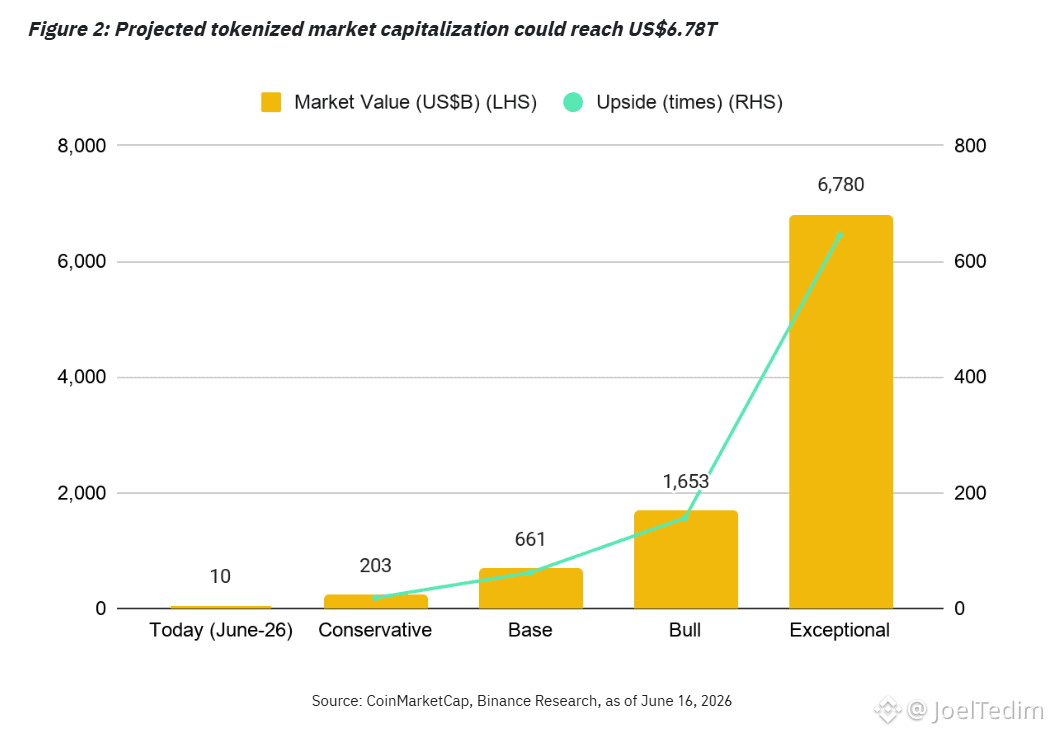
Der RWA-Markt (Real-World Assets) hält ein Potenzial in Höhe von mehreren Billionen Dollar.
Laut dem neuesten Binance-Research-Bericht könnte er im optimistischsten Szenario 6,78 Billionen US-Dollar erreichen.
Projekte, die Teil der Infrastruktur sind, welche dieses Wachstum und die Einführung unterstützt, dürften davon profitieren.
RedStone $RED macht in diese Richtung stetig Fortschritte.
Einige wichtige Punkte:
- RedStone hat sich von reinen Preis-Orakeln zu einer breiteren Infrastrukturebene für Daten, Risiko, Abwicklung (Settlement) und tokenisierte Assets entwickelt.
- Das Team führt diese Entwicklung auf einen marktgetriebenen Ansatz zurück: dem Feedback der Kunden zuzuhören und das zu bauen, was die Branche tatsächlich benötigt.
- Das Zusammentreffen von DeFi und Institutionen erfordert Brücken zwischen öffentlichen Blockchains, permissionierten Netzwerken und robusteren betrieblichen Standards.
- RedStone Settle zielt darauf ab, tokenisierte Assets in DeFi-Anwendungen besser nutzbar zu machen – insbesondere im Kontext von Sicherheiten (Collateral), Vaults und Settlement.
- Ratings wie von Credora können das DeFi-Risiko transparenter, besser vergleichbar und für institutionelle Allokatoren akzeptabler machen.
- Die Tokenisierung realer Vermögenswerte hängt weniger von Narrativen ab und mehr von einer zuverlässigen Infrastruktur: Preisgestaltung, Risikomanagement, Liquidität, Abwicklung und die Integration in Protokolle.
- Die nächste Phase von DeFi wird von Projekten aufgebaut werden, die Onchain-Daten, Risikomanagement und institutionelle Anforderungen kombinieren können, ohne dabei die Offenheit und Programmierbarkeit des Krypto-Ökosystems zu verlieren.
4
1
4
178
·
--
Übersetzung ansehen
Risk ratings in lending dApps are capital catalysts
Credora is presented as a key growth driver for lending dapps because it provides what marketing alone cannot: independent, standardized, and comparable risk transparency.
While yield is easy to communicate, serious allocators and institutions need a reliable way to assess the probability of loss before committing capital at scale.
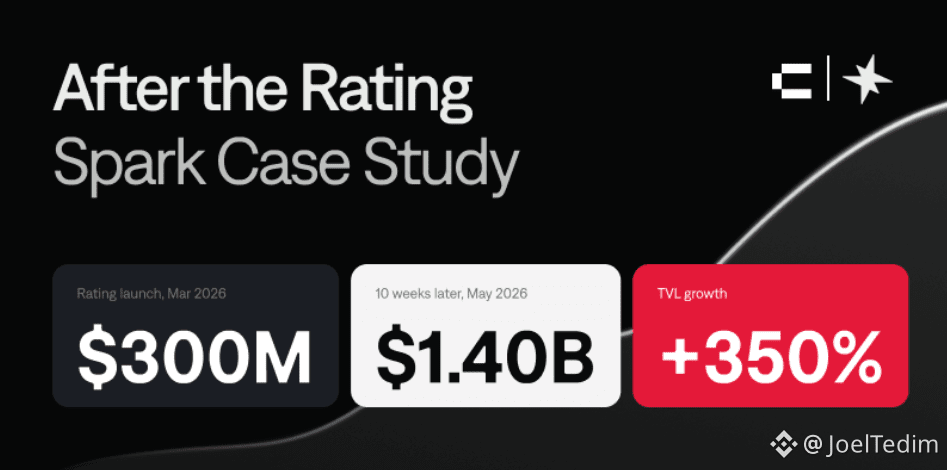
Credora’s PSL ratings turn opaque DeFi risk into a clear, simulation-based metric that can be benchmarked across vaults and protocols. The Spark Savings USDT vault can be used used as the main example: after Credora published its rating in March 2026, the vault’s TVL reportedly grew from around $300 million to approximately $1.4 billion in ten weeks, while comparable unrated vaults did not show the same acceleration.
There was also an evidence of institutional interest through report downloads, which exceeded 1,000 between March and May and spiked during the rsETH market event as allocators sought due diligence under live stress conditions. A similar pattern is described on Morpho, where Credora-rated vaults reportedly achieved faster deposit growth and stronger capital retention than unrated peers.
Overall, the central message is that independent risk ratings are becoming essential infrastructure for DeFi. By making risk legible, verifiable, and comparable, Credora helps remove a major barrier to institutional allocation, enabling larger and stickier capital flows.
The next wave of DeFi growth will belong to protocols that treat risk infrastructure as seriously as yield infrastructure, and Credora (a product by RedStone $RED ) will lead the sector.
1
113
·
--
Übersetzung ansehen
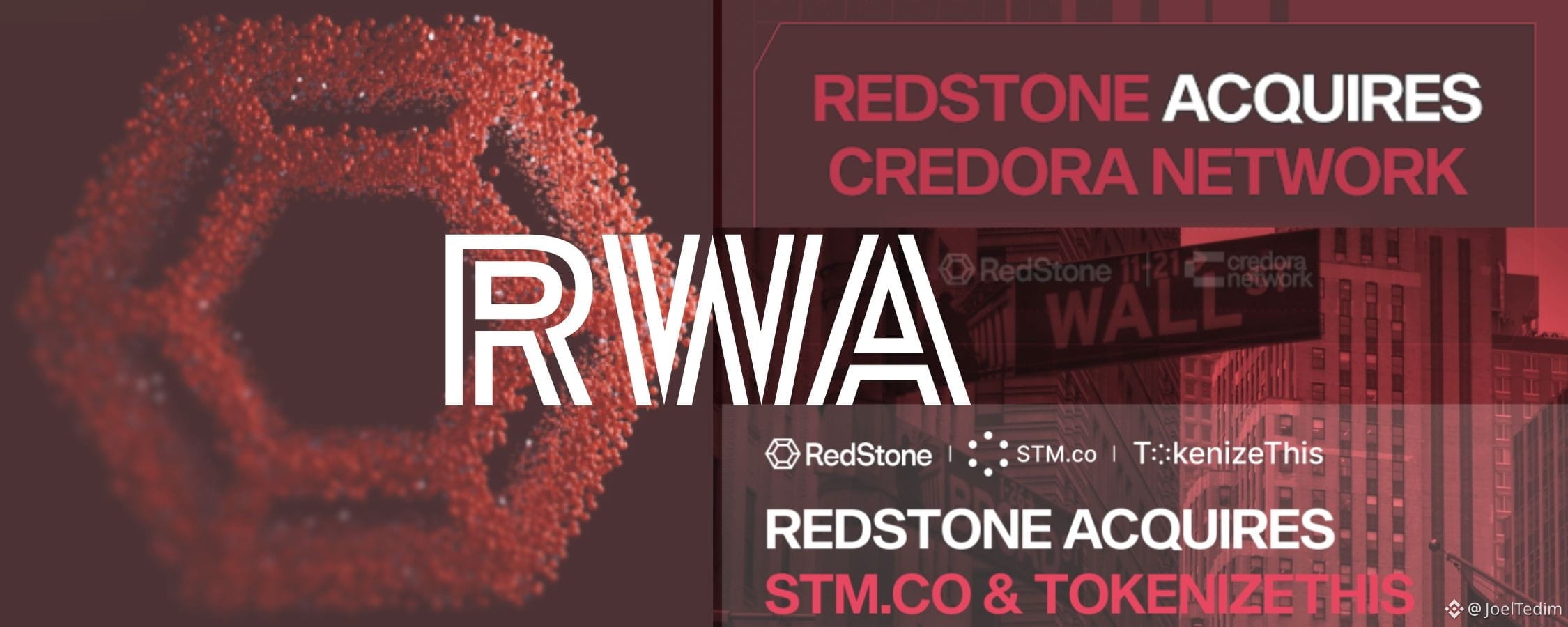
RedStone is becoming a key infrastructure player in the RWA sector by combining three essential pillars of tokenized finance: oracles, risk intelligence, and institutional market data.
Key highlights:
1. RedStone’s core role is to provide reliable, real-time oracle data for on-chain finance. This is especially important for RWAs such as real estate, bonds, commodities, and tokenized treasuries, which depend on accurate pricing to function efficiently in DeFi.
2. The acquisition of Credora strengthens RedStone’s offering by adding risk ratings and collateral intelligence. This gives protocols and institutions better tools to assess credit risk, liquidity risk, and smart contract exposure, making tokenized assets more trustworthy and easier to integrate into lending and investment decisions.
3. The acquisition of Security Token Market (STM) adds a major layer of institutional data and market visibility. STM contributes a large database of tokenized assets and stronger connections to Wall Street and traditional finance, helping RedStone expand its role in institutional adoption.
Together, RedStone + Credora + STM form the “perfect combo” for RWAs:
RedStone = price data and oracle infrastructure
Credora = risk assessment and transparency
STM = market intelligence and institutional access
This combination helps solve major challenges in the RWA space, including:
- fragmented data
- lack of transparent risk standards
- slow institutional adoption
We can expect a massive growth potential of the tokenization market. Estimates suggest tokenized assets could reach trillions of dollars by 2030, making infrastructure providers like RedStone well positioned to benefit from the expansion of on-chain finance.
RedStone is not just building oracle technology, it's building a full data and intelligence layer for tokenized finance. By combining pricing, risk analysis, and institutional market access, the company may become a major enabler of the next phase of RWA and DeFi growth.
$RED
2
4
337
·
--
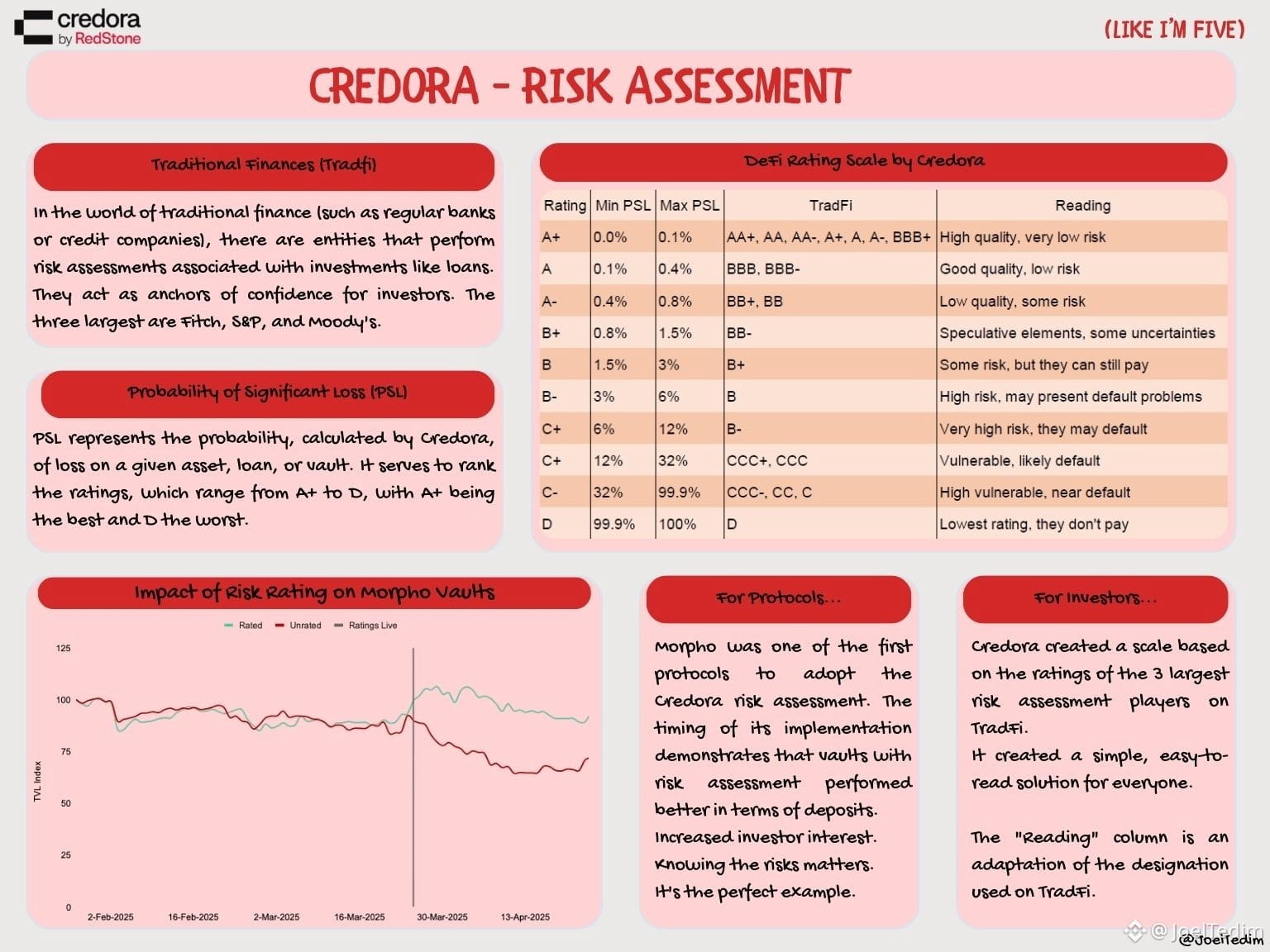
RedStone innoviert weiterhin im Oracle-Sektor mit seinen Produkten, die darauf abzielen, die Lücke zwischen TradFi und DeFi zu schließen.
Die Übernahme von Credora im Jahr 2025 ermöglichte es, in einen Bereich einzutauchen, der im Kryptomarkt noch sehr embryonal ist, aber in der traditionellen Finanzwelt grundlegend ausgereift ist, wie z.B. Risikobewertung.
Credora repräsentiert den neuen Standard in DeFi und orientiert sich an den hohen Maßstäben, die von traditionellen Ratingagenturen gesetzt werden.
Ein intuitives und sehr leicht verständliches System, mit nachgewiesenem Erfolg im Markt.
Die Zukunft kann für $RED nur glänzend sein.
1
2
251
·
--
Artikel
Übersetzung ansehen
Trusted Single Source Oracle (TSSO) by RedStoneTSSO is a new oracle model designed to securely bring Net Asset Value (NAV) data on-chain for tokenized funds and assets.
1. The Problem?
Traditional NAVs for private funds are calculated off-chain by a single fund administrator. This creates a trust issue in DeFi: verifying the authenticity of NAV data on-chain is challenging since there’s no market aggregation, relying on a single point of trust.
2. The Solution: TSSO
Marcin, co-founder of RedStone, introduced the TSSO concept at an exclusive event for developers in the RWA and oracle space in 2024.
However, the solution was brought to light in July 2025, in partnership with Securitize, announcing the collaboration to bridge TradFi and DeFi, being piloted with clients like BlackRock’s BUIDL fund and KKR’s Health Care Strategic Growth Fund II.
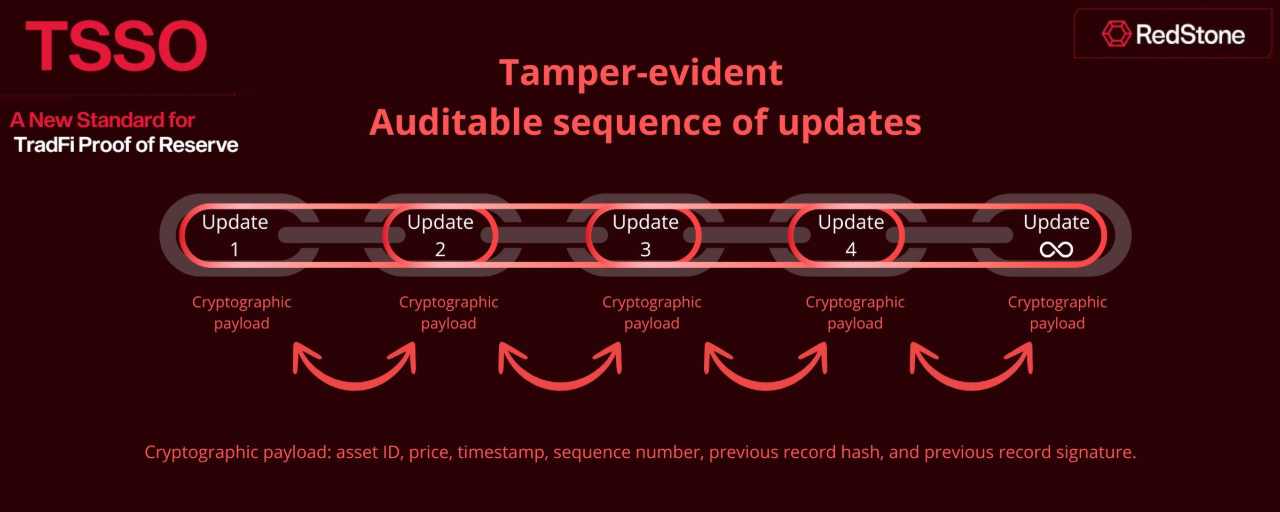
TSSO operates like Git for financial data. Each NAV update is a signed commit in a cryptographically linked chain, creating an auditable, tamper-proof history. This ensures trust without relying on the source’s goodwill, providing transparency and traceability.
TSSO enables institutional assets, such as private credit or real estate funds, to integrate with DeFi protocols by turning off-chain NAVs into verifiable on-chain data. This unlocks liquidity and programmability while maintaining TradFi’s control and compliance standards.
3. TSSO vs. Standard Oracles
Standard oracles aggregate data from multiple sources to prevent manipulation. Private fund NAVs, however, come from a single source, making aggregation infeasible.
TSSO ensures trust by cryptographically linking each NAV update to a trusted source, preventing tampering. Innovation!
4. Dual-Key Architecture
TSSO employs a Secure Root Key for major updates, such as fund structure changes, and a Derivative Chain Key for frequent NAV adjustments. This structure balances security and efficiency, ensuring every update is verifiable and linked to prior updates.
5. Key Use Cases
TSSO supports multiple applications:
✅Lending Vaults: NAVs as collateral for DeFi loans.
✅Structured Credit: Building on-chain private debt products.
✅Tokenized Funds: Real-time portfolio tracking.
✅Auditable Reporting: Transparent data for regulators and investors.
6. Importance for the future
TSSO provides TradFi with the control, traceability, and compliance needed to engage with DeFi confidently. By making NAVs usable on-chain, it enables a new era of programmable finance, bridging traditional and decentralized systems.
TSSO is used by major players like BlackRock and KKR. As adoption grows, expect increased tokenized funds, DeFi liquidity, and institutional-grade infrastructure reshaping finance.
TSSO is a critical step toward mainstream tokenized asset adoption. Trillions!
RedStone 🤝 RWA
Trusted Single Source Oracle (TSSO) by RedStone
TSSO is a new oracle model designed to securely bring Net Asset Value (NAV) data on-chain for tokenized funds and assets.
1. The Problem?
Traditional NAVs for private funds are calculated off-chain by a single fund administrator. This creates a trust issue in DeFi: verifying the authenticity of NAV data on-chain is challenging since there’s no market aggregation, relying on a single point of trust.
2. The Solution: TSSO
Marcin, co-founder of RedStone, introduced the TSSO concept at an exclusive event for developers in the RWA and oracle space in 2024.
However, the solution was brought to light in July 2025, in partnership with Securitize, announcing the collaboration to bridge TradFi and DeFi, being piloted with clients like BlackRock’s BUIDL fund and KKR’s Health Care Strategic Growth Fund II.
TSSO operates like Git for financial data. Each NAV update is a signed commit in a cryptographically linked chain, creating an auditable, tamper-proof history. This ensures trust without relying on the source’s goodwill, providing transparency and traceability.
TSSO enables institutional assets, such as private credit or real estate funds, to integrate with DeFi protocols by turning off-chain NAVs into verifiable on-chain data. This unlocks liquidity and programmability while maintaining TradFi’s control and compliance standards.
3. TSSO vs. Standard Oracles
Standard oracles aggregate data from multiple sources to prevent manipulation. Private fund NAVs, however, come from a single source, making aggregation infeasible.
TSSO ensures trust by cryptographically linking each NAV update to a trusted source, preventing tampering. Innovation!
4. Dual-Key Architecture
TSSO employs a Secure Root Key for major updates, such as fund structure changes, and a Derivative Chain Key for frequent NAV adjustments. This structure balances security and efficiency, ensuring every update is verifiable and linked to prior updates.
5. Key Use Cases
TSSO supports multiple applications:
✅Lending Vaults: NAVs as collateral for DeFi loans.
✅Structured Credit: Building on-chain private debt products.
✅Tokenized Funds: Real-time portfolio tracking.
✅Auditable Reporting: Transparent data for regulators and investors.
6. Importance for the future
TSSO provides TradFi with the control, traceability, and compliance needed to engage with DeFi confidently. By making NAVs usable on-chain, it enables a new era of programmable finance, bridging traditional and decentralized systems.
TSSO is used by major players like BlackRock and KKR. As adoption grows, expect increased tokenized funds, DeFi liquidity, and institutional-grade infrastructure reshaping finance.
TSSO is a critical step toward mainstream tokenized asset adoption. Trillions!
RedStone 🤝 RWA
2
211
·
--
Übersetzung ansehen
RedStone - Infrastructure to empower RWA and DeFi
Proof of Reserve (PoR) is a cryptographic process that lets crypto custodians, such as, exchanges, stablecoin issuers, wrapped token platforms, and tokenized fund managers, prove they control assets equal to or greater than the liabilities owed to token holders.
The idea gained urgency after the FTX collapse in November 2022, when customers discovered they had no independent way to confirm their deposits were actually backed.
Traditional PoR relies on periodic snapshots: custodians hash balances into a Merkle tree, publish the root onchain, and allow users to check their own inclusion. While an improvement, these reports are not full audits, can be timed or manipulated, and often hide risks like rehypothecation.
Oracle-based PoR works differently by operating continuously: an oracle network pulls live reserve data from wallets or custodians, compares it in real time to the circulating token supply, and publishes verifiable feeds.
Solutions like RedStone deliver frequent attestations, sometimes every 20 minutes, powering data for Bitcoin LSTs with roughly $1.5 billion in TVL, stablecoins, tokenized RWA, and dozens of DeFi protocols. Smart contracts can then automatically enforce safeguards, if reserves fall short, minting halts, borrowing pauses, or other protections activate. This programmable, always-on verification is seen as essential for scaling RWA.
Tokenized instruments like US Treasuries have already reached a $15 billion market, with major funds exceeding $2.5 billion, but they require constant proof that onchain supply matches offchain value to earn institutional trust.
Without reliable PoR, these assets risk repeating past solvency doubts. By turning verification into enforceable onchain infrastructure, continuous oracle solutions like RedStone remove a key barrier to mainstream tokenization and help convert offchain value into transparently backed digital markets.
It will be trillions, and RedStone will benefit from being a true data layer that serves as the infrastructure for everything!
$RED
81
·
--
Übersetzung ansehen
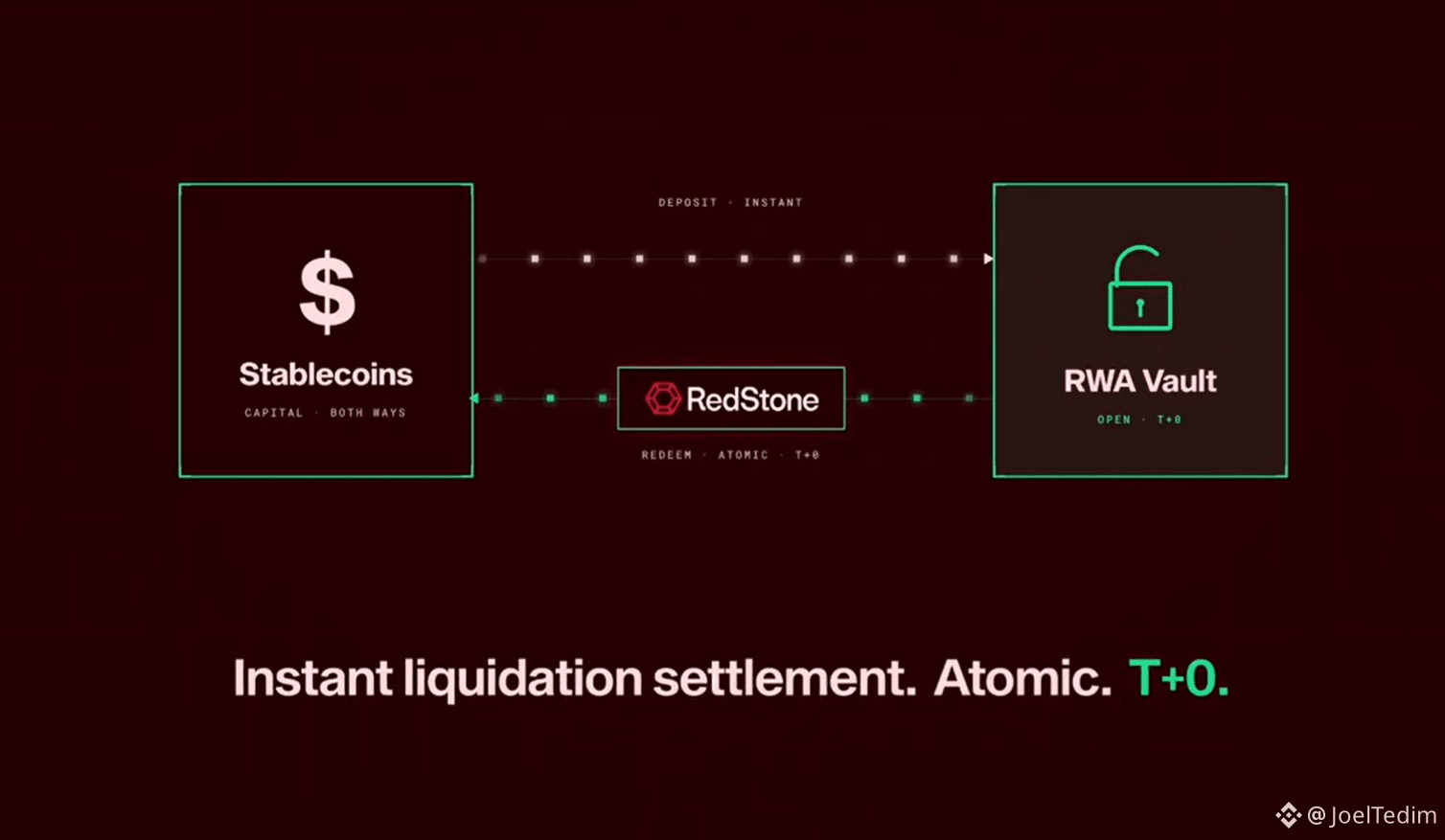
RedStone Settle introduces instant settlement for liquidations of tokenized RWA in DeFi lending protocols.
It addresses a critical barrier preventing RWAs from scaling as collateral. The main problem with RWAs like tokenized treasuries or private credit is liquidation reliability.
Shallow liquidity pools, strict compliance rules requiring KYC-verified addresses, and redemption periods of 60-180 days make it impossible for protocols to safely force exits during market stress.
RedStone Settle solves this with an on-demand auction system. When RWA collateral drops below the liquidation threshold, specialized KYC-verified solvers compete in real time. The winning solver settles the position atomically on-chain at T+0.
This builds directly on RedStone ATOM's auction system, the proven auction and oracle framework launched in July 2025. ATOM enables real-time auctions that settle in under 300 milliseconds across EVM chains with perfect reliability and no mispricing.
RedStone Settle extends this validated infrastructure by incorporating compliance measures such as solver whitelisting for specific RWA tokens and flexible auction timing suited for institutional capital.
By enabling trustworthy instant settlements inside lending vaults, RedStone Settle unlocks higher loan-to-value ratios, better composability, and makes RWA-backed lending viable at scale. It benefits protocols, solvers who capture spreads, and asset issuers seeking new collateral use cases.
$RED
6
157
Anmelden und weiter Inhalte entdecken
Krypto-Nutzer weltweit auf Binance Square kennenlernen
⚡️ Bleib in Sachen Krypto stets am Puls.
💬 Die weltgrößte Kryptobörse vertraut darauf.
👍 Erhalte verlässliche Einblicke von verifizierten Creators.
E-Mail-Adresse/Telefonnummer
Trendthemen
WhoWillSucceedJensenHuangatNvidia?
112,360 Aufrufe
1,352 Kommentare
Nvidia: Keine Gespräche über CEO-Nachfolge – Petition „Stand With Jensen“ erreicht mehr als 77.900 Unterschriften
Binance News
·29 Likes
·44.5k Aufrufe
WhatWillDriveCryptoandStocks’NextRebound?
490,348 Aufrufe
3,244 Kommentare
BitcoinActiveSupplyInProfitDropsBelow45%
43,464 Aufrufe
522 Kommentare