

Renesh_
142 Beiträge

Renesh_
Melden
Nutzer blockieren
Trade eröffnen
Regelmäßiger Trader
2.1 Jahre
36 Following
32 Follower
74 Like gegeben
Beiträge
Portfolio
Alle
Zitierungen
·
--
Übersetzung ansehen
#baby $BABY @babylonlabs_io
Being a student and a beginner in crypto, I enjoy discovering technologies that could shape the future. Babylon Labs impressed me because it connects Bitcoin with Proof-of-Stake networks, allowing Bitcoin's strong security to protect other blockchains through staking. I think this could become an important innovation if blockchain adoption continues to grow. Rather than investing based on trends, I prefer understanding the project's purpose, technology, and long-term vision. Learning about Babylon Labs has made me realize that Bitcoin is not only a store of value but can also become an important security layer for many blockchain ecosystems in the future.
#baby $BABY @BabylonLabs_io
Being a student and a beginner in crypto, I enjoy discovering technologies that could shape the future. Babylon Labs impressed me because it connects Bitcoin with Proof-of-Stake networks, allowing Bitcoin's strong security to protect other blockchains through staking. I think this could become an important innovation if blockchain adoption continues to grow. Rather than investing based on trends, I prefer understanding the project's purpose, technology, and long-term vision. Learning about Babylon Labs has made me realize that Bitcoin is not only a store of value but can also become an important security layer for many blockchain ecosystems in the future.
Being a student and a beginner in crypto, I enjoy discovering technologies that could shape the future. Babylon Labs impressed me because it connects Bitcoin with Proof-of-Stake networks, allowing Bitcoin's strong security to protect other blockchains through staking. I think this could become an important innovation if blockchain adoption continues to grow. Rather than investing based on trends, I prefer understanding the project's purpose, technology, and long-term vision. Learning about Babylon Labs has made me realize that Bitcoin is not only a store of value but can also become an important security layer for many blockchain ecosystems in the future.
86
·
--
Übersetzung ansehen
When I started learning about cryptocurrency, I realized that every successful investment begins with understanding the technology. Babylon Labs became one of the projects that genuinely interested me because it aims to extend Bitcoin's security to Proof-of-Stake blockchains using Bitcoin staking. This makes me think Bitcoin has much more potential than simply being a digital currency. As a student, I enjoy researching projects that focus on solving real blockchain challenges instead of creating hype. Whether I decide to invest or not, learning about Babylon Labs gives me confidence to understand crypto more deeply and build a stronger foundation for my future investment decisions.$BABY @babylonlabs_io #baby
When I started learning about cryptocurrency, I realized that every successful investment begins with understanding the technology. Babylon Labs became one of the projects that genuinely interested me because it aims to extend Bitcoin's security to Proof-of-Stake blockchains using Bitcoin staking. This makes me think Bitcoin has much more potential than simply being a digital currency. As a student, I enjoy researching projects that focus on solving real blockchain challenges instead of creating hype. Whether I decide to invest or not, learning about Babylon Labs gives me confidence to understand crypto more deeply and build a stronger foundation for my future investment decisions.$BABY @BabylonLabs_io #baby
82
·
--
Übersetzung ansehen
#baby $BABY @babylonlabs_io
As a new crypto learner, I believe knowledge is more valuable than rushing into investments. Babylon Labs stands out because it uses Bitcoin's trusted security to strengthen Proof-of-Stake blockchains through Bitcoin staking. I find this idea exciting because it shows how Bitcoin can support innovation beyond simple transactions. At the same time, I know every crypto project carries risks, so I prefer studying the technology, roadmap, and adoption before investing. For me, Babylon Labs is an opportunity to understand the future of blockchain security while improving my crypto knowledge. Learning first and investing wisely is the approach I want to follow.
#baby $BABY @BabylonLabs_io
As a new crypto learner, I believe knowledge is more valuable than rushing into investments. Babylon Labs stands out because it uses Bitcoin's trusted security to strengthen Proof-of-Stake blockchains through Bitcoin staking. I find this idea exciting because it shows how Bitcoin can support innovation beyond simple transactions. At the same time, I know every crypto project carries risks, so I prefer studying the technology, roadmap, and adoption before investing. For me, Babylon Labs is an opportunity to understand the future of blockchain security while improving my crypto knowledge. Learning first and investing wisely is the approach I want to follow.
As a new crypto learner, I believe knowledge is more valuable than rushing into investments. Babylon Labs stands out because it uses Bitcoin's trusted security to strengthen Proof-of-Stake blockchains through Bitcoin staking. I find this idea exciting because it shows how Bitcoin can support innovation beyond simple transactions. At the same time, I know every crypto project carries risks, so I prefer studying the technology, roadmap, and adoption before investing. For me, Babylon Labs is an opportunity to understand the future of blockchain security while improving my crypto knowledge. Learning first and investing wisely is the approach I want to follow.
71
·
--
Übersetzung ansehen
#baby
$BABY
@babylonlabs_io Babylon Labs is a blockchain infrastructure company that builds trustless, self-custodial Bitcoin staking and collateral protocols. Founded in 2022 by Stanford Professor David Tse and Dr. Mingchao "Fisher" Yu, it aims to scale the security of the decentralized economy by turning Bitcoin (BTC) into a productive, yield-bearing security asset.Core Technology & FeaturesTrustless Bitcoin Staking: It allows Bitcoin holders to stake their BTC to secure Proof-of-Stake (PoS) networks, Layer 2s, and rollups.Self-Custodial & No Bridges: Staked Bitcoin never leaves the native Bitcoin network. It eliminates the need for trusted third-party custodians, asset wrapping, or cross-chain bridges.Cryptographic Slashing: It leverages Bitcoin Taproot time-locked scripts, Schnorr signatures, and Extractable One-Time Signatures (EOTS). If a validator acts maliciously on a PoS network, their staked native Bitcoin can be slashed directly on the Bitcoin base layer.Trustless Bitcoin Vaults (BTCVaults): An infrastructure that enables users to post native Bitcoin as collateral and borrow assets natively without giving up custody.
#baby
$BABY
@BabylonLabs_io Babylon Labs is a blockchain infrastructure company that builds trustless, self-custodial Bitcoin staking and collateral protocols. Founded in 2022 by Stanford Professor David Tse and Dr. Mingchao "Fisher" Yu, it aims to scale the security of the decentralized economy by turning Bitcoin (BTC) into a productive, yield-bearing security asset.Core Technology & FeaturesTrustless Bitcoin Staking: It allows Bitcoin holders to stake their BTC to secure Proof-of-Stake (PoS) networks, Layer 2s, and rollups.Self-Custodial & No Bridges: Staked Bitcoin never leaves the native Bitcoin network. It eliminates the need for trusted third-party custodians, asset wrapping, or cross-chain bridges.Cryptographic Slashing: It leverages Bitcoin Taproot time-locked scripts, Schnorr signatures, and Extractable One-Time Signatures (EOTS). If a validator acts maliciously on a PoS network, their staked native Bitcoin can be slashed directly on the Bitcoin base layer.Trustless Bitcoin Vaults (BTCVaults): An infrastructure that enables users to post native Bitcoin as collateral and borrow assets natively without giving up custody.
$BABY
@BabylonLabs_io Babylon Labs is a blockchain infrastructure company that builds trustless, self-custodial Bitcoin staking and collateral protocols. Founded in 2022 by Stanford Professor David Tse and Dr. Mingchao "Fisher" Yu, it aims to scale the security of the decentralized economy by turning Bitcoin (BTC) into a productive, yield-bearing security asset.Core Technology & FeaturesTrustless Bitcoin Staking: It allows Bitcoin holders to stake their BTC to secure Proof-of-Stake (PoS) networks, Layer 2s, and rollups.Self-Custodial & No Bridges: Staked Bitcoin never leaves the native Bitcoin network. It eliminates the need for trusted third-party custodians, asset wrapping, or cross-chain bridges.Cryptographic Slashing: It leverages Bitcoin Taproot time-locked scripts, Schnorr signatures, and Extractable One-Time Signatures (EOTS). If a validator acts maliciously on a PoS network, their staked native Bitcoin can be slashed directly on the Bitcoin base layer.Trustless Bitcoin Vaults (BTCVaults): An infrastructure that enables users to post native Bitcoin as collateral and borrow assets natively without giving up custody.
2
1
92
·
--
Übersetzung ansehen
I almost gave up on my Bitcoin... but then I found a different way to look at it.
A few months ago, I was sitting there watching my BTC just stay untouched in my wallet. I believed in Bitcoin for the long term, but I also wondered... is there a safer way to make my BTC more useful without taking unnecessary risks?
I looked into different yield options, but honestly, many solutions required bridges, wrapped assets, or giving up some control. After seeing so many security issues in crypto, I wasn't comfortable taking those risks.
Then I discovered @Babylon.
What caught my attention was the idea of using native Bitcoin while keeping control of my own BTC. No need to rely on wrapped versions or complicated shortcuts.
And this is where BABY comes in.
BABY is not just a token name. It plays an important role in the Babylon ecosystem by supporting:
Network operations and transactions
Security through Bitcoin staking mechanisms
Community governance
BTC has always been known as a store of value, But what if it could become more useful while keeping its core principles?
That's the vision that makes @Babylon interesting to watch.
I'm curious to know:
Are you keeping your BTC only as a long-term hold, or do you believe Bitcoin can have more utility in the future?
Let's discuss
#baby #CLARITYActToReward WhiteHatHackers
$BABY
{spot}(BABYUSDT)
{alpha}(560x01bf3d77cd08b19bf3f2309972123a2cca0f6936)
{spot}(BTCUSDT)
@babylonlabs_io
$AA
I almost gave up on my Bitcoin... but then I found a different way to look at it.
A few months ago, I was sitting there watching my BTC just stay untouched in my wallet. I believed in Bitcoin for the long term, but I also wondered... is there a safer way to make my BTC more useful without taking unnecessary risks?
I looked into different yield options, but honestly, many solutions required bridges, wrapped assets, or giving up some control. After seeing so many security issues in crypto, I wasn't comfortable taking those risks.
Then I discovered @Babylon.
What caught my attention was the idea of using native Bitcoin while keeping control of my own BTC. No need to rely on wrapped versions or complicated shortcuts.
And this is where BABY comes in.
BABY is not just a token name. It plays an important role in the Babylon ecosystem by supporting:
Network operations and transactions
Security through Bitcoin staking mechanisms
Community governance
BTC has always been known as a store of value, But what if it could become more useful while keeping its core principles?
That's the vision that makes @Babylon interesting to watch.
I'm curious to know:
Are you keeping your BTC only as a long-term hold, or do you believe Bitcoin can have more utility in the future?
Let's discuss
#baby #CLARITYActToReward WhiteHatHackers
$BABY
@BabylonLabs_io
$AA
A few months ago, I was sitting there watching my BTC just stay untouched in my wallet. I believed in Bitcoin for the long term, but I also wondered... is there a safer way to make my BTC more useful without taking unnecessary risks?
I looked into different yield options, but honestly, many solutions required bridges, wrapped assets, or giving up some control. After seeing so many security issues in crypto, I wasn't comfortable taking those risks.
Then I discovered @Babylon.
What caught my attention was the idea of using native Bitcoin while keeping control of my own BTC. No need to rely on wrapped versions or complicated shortcuts.
And this is where BABY comes in.
BABY is not just a token name. It plays an important role in the Babylon ecosystem by supporting:
Network operations and transactions
Security through Bitcoin staking mechanisms
Community governance
BTC has always been known as a store of value, But what if it could become more useful while keeping its core principles?
That's the vision that makes @Babylon interesting to watch.
I'm curious to know:
Are you keeping your BTC only as a long-term hold, or do you believe Bitcoin can have more utility in the future?
Let's discuss
#baby #CLARITYActToReward WhiteHatHackers
$BABY
@BabylonLabs_io
$AA
1
80
·
--
Übersetzung ansehen
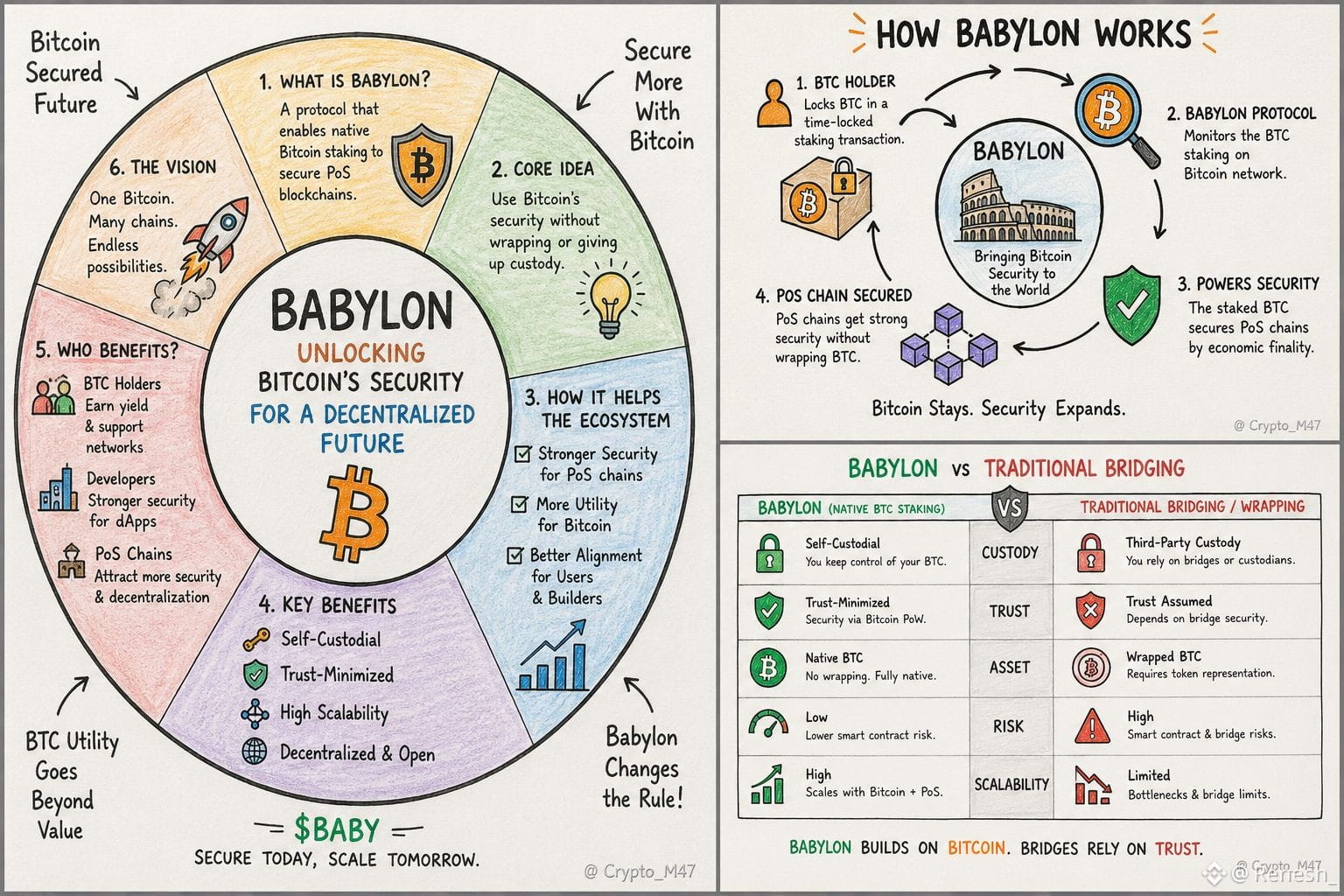
I've been learning about Babylon Labs, and here's what I think.
Babylon is trying to make Bitcoin useful beyond just holding it. Instead of keeping BTC only as a store of value, the project explores ways for Bitcoin to help improve the security of Proof-of-Stake blockchains while users keep control of their own coins. I like this idea because it gives Bitcoin another real use case. If more blockchains and users adopt this technology, Babylon could become an important part of the crypto ecosystem. That's one reason I'm following the BABY token. No one knows the future, but I believe projects with real technology and practical utility have a better chance of long-term growth. *(This is just my personal opinion, not financial advice.)*
@babylonlabs_io $BABY #baby
I've been learning about Babylon Labs, and here's what I think.
Babylon is trying to make Bitcoin useful beyond just holding it. Instead of keeping BTC only as a store of value, the project explores ways for Bitcoin to help improve the security of Proof-of-Stake blockchains while users keep control of their own coins. I like this idea because it gives Bitcoin another real use case. If more blockchains and users adopt this technology, Babylon could become an important part of the crypto ecosystem. That's one reason I'm following the BABY token. No one knows the future, but I believe projects with real technology and practical utility have a better chance of long-term growth. *(This is just my personal opinion, not financial advice.)*
@BabylonLabs_io $BABY #baby
Babylon is trying to make Bitcoin useful beyond just holding it. Instead of keeping BTC only as a store of value, the project explores ways for Bitcoin to help improve the security of Proof-of-Stake blockchains while users keep control of their own coins. I like this idea because it gives Bitcoin another real use case. If more blockchains and users adopt this technology, Babylon could become an important part of the crypto ecosystem. That's one reason I'm following the BABY token. No one knows the future, but I believe projects with real technology and practical utility have a better chance of long-term growth. *(This is just my personal opinion, not financial advice.)*
@BabylonLabs_io $BABY #baby
1
2
30
·
--
Übersetzung ansehen
I've been learning about Babylon over the past few days.
One thing I've realized is that a project's long-term success isn't determined only by its token price.
Community, developers, security, and real-world utility matter just as much.
It will be interesting to see how Babylon performs in these areas over the coming years.@babylonlabs_io
$BABY #baby
I've been learning about Babylon over the past few days.
One thing I've realized is that a project's long-term success isn't determined only by its token price.
Community, developers, security, and real-world utility matter just as much.
It will be interesting to see how Babylon performs in these areas over the coming years.@BabylonLabs_io
$BABY #baby
One thing I've realized is that a project's long-term success isn't determined only by its token price.
Community, developers, security, and real-world utility matter just as much.
It will be interesting to see how Babylon performs in these areas over the coming years.@BabylonLabs_io
$BABY #baby
📈 Utility matters most
50%
🔒 Security matters most
0%
👥 Community matters most
0%
💰 Price matters most
50%
2 Stimmen • Abstimmung beendet
2
51
·
--
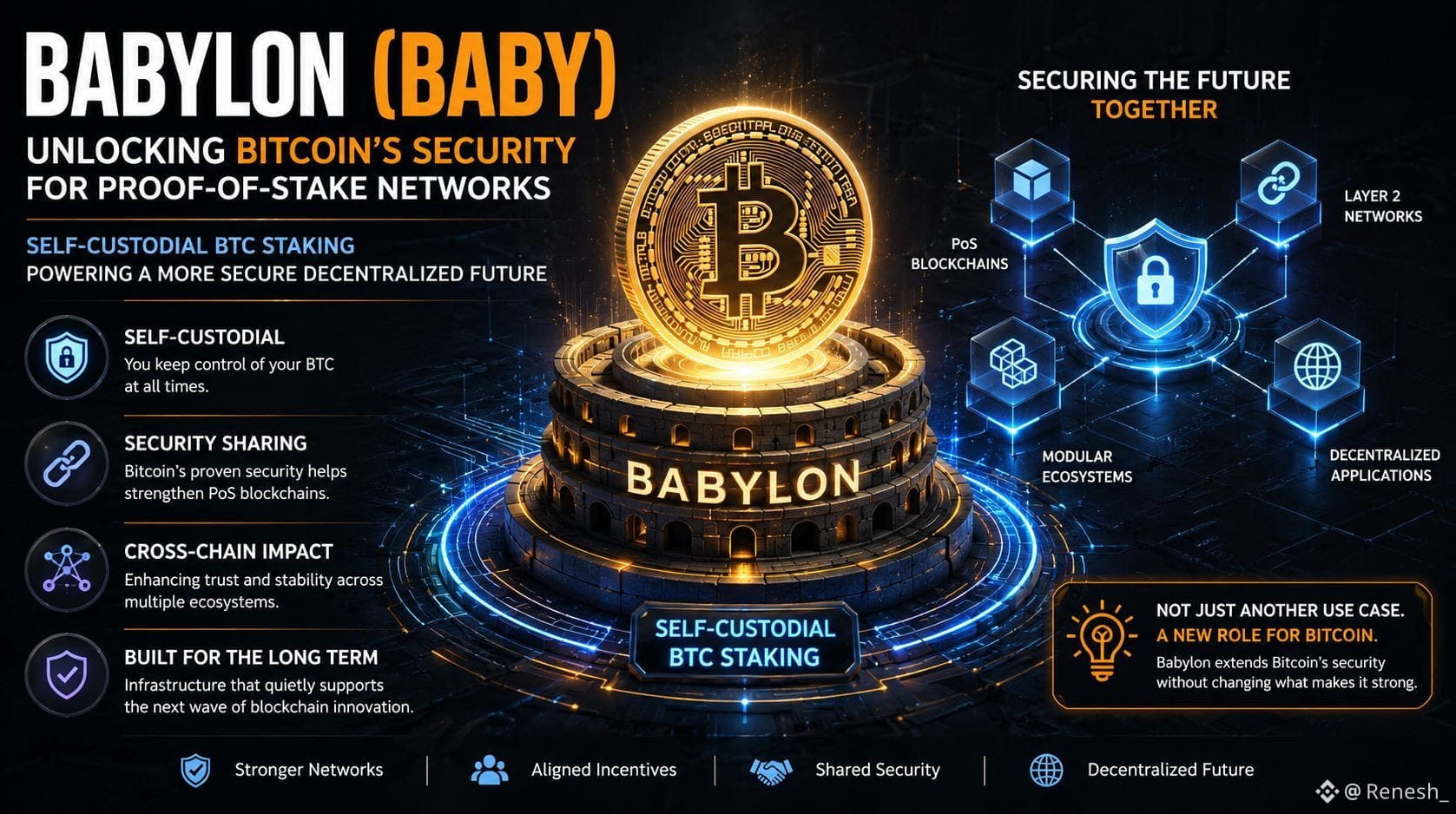
Glaubst du, dass Bitcoin zur Sicherheitsschicht für mehrere Blockchains werden kann?
Babylon arbeitet an dieser Vision und hält dabei BTC selbst in Verwahrung.
Teile deine Meinung unten mit! 👇
@babylonlabs_io $BABY #baby #CryptoDiscussions
Glaubst du, dass Bitcoin zur Sicherheitsschicht für mehrere Blockchains werden kann?
Babylon arbeitet an dieser Vision und hält dabei BTC selbst in Verwahrung.
Teile deine Meinung unten mit! 👇
@BabylonLabs_io $BABY #baby #CryptoDiscussions
Babylon arbeitet an dieser Vision und hält dabei BTC selbst in Verwahrung.
Teile deine Meinung unten mit! 👇
@BabylonLabs_io $BABY #baby #CryptoDiscussions
2
58
·
--
Übersetzung ansehen
#baby $BABY @babylonlabs_io
Babylon Labs is a blockchain infrastructure project that enables Bitcoin holders to stake their BTC without transferring it to another blockchain or custodian. Its Bitcoin staking protocol helps secure Proof-of-Stake (PoS) networks while allowing users to keep control of their Bitcoin. This approach aims to unlock Bitcoin's security and liquidity for the broader decentralized ecosystem. Babylon also focuses on Bitcoin timestamping and shared security to improve trust across multiple blockchains. The project is backed by well-known investors and has attracted strong interest in the crypto community. Its native token, BABY, supports governance, network incentives, and ecosystem participation as the protocol continues to expand.
#baby $BABY @BabylonLabs_io
Babylon Labs is a blockchain infrastructure project that enables Bitcoin holders to stake their BTC without transferring it to another blockchain or custodian. Its Bitcoin staking protocol helps secure Proof-of-Stake (PoS) networks while allowing users to keep control of their Bitcoin. This approach aims to unlock Bitcoin's security and liquidity for the broader decentralized ecosystem. Babylon also focuses on Bitcoin timestamping and shared security to improve trust across multiple blockchains. The project is backed by well-known investors and has attracted strong interest in the crypto community. Its native token, BABY, supports governance, network incentives, and ecosystem participation as the protocol continues to expand.
Babylon Labs is a blockchain infrastructure project that enables Bitcoin holders to stake their BTC without transferring it to another blockchain or custodian. Its Bitcoin staking protocol helps secure Proof-of-Stake (PoS) networks while allowing users to keep control of their Bitcoin. This approach aims to unlock Bitcoin's security and liquidity for the broader decentralized ecosystem. Babylon also focuses on Bitcoin timestamping and shared security to improve trust across multiple blockchains. The project is backed by well-known investors and has attracted strong interest in the crypto community. Its native token, BABY, supports governance, network incentives, and ecosystem participation as the protocol continues to expand.
2
79
·
--
Übersetzung ansehen
Babylon is a leading decentralized protocol that transforms Bitcoin from a passive store of value into an active security asset. It introduces native, non-custodial Bitcoin staking, allowing BTC holders to secure external Proof-of-Stake (PoS) blockchains and earn yields.
CoinMarketCap
Key Mechanics
No Bridges or Wrapping: Unlike traditional BTC-DeFi projects, users do not need to convert their assets into wrapped tokens (like wBTC) or bridge them to other networks. BTC remains securely inside the user’s self-custodial wallet on the native Bitcoin network.
Cryptographic Security: Babylon utilizes Bitcoin's native features—such as Taproot time-locked scripts and Extractable One-Time Signatures (EOTS)—to lock assets. If a validator acts maliciously, the protocol enforces strict accountability via automated slashing mechanics.
Hex Trust
The BABY Token: The network runs on its own Layer-1 control plane, Babylon Genesis. It features a dual-staking model powered by $BABY, its native utility token used for gas fees, governance, and securing the ecosystem alongside staked BTC.
By scaling Bitcoin’s multi-billion-dollar economic weight to secure the broader decentralized economy, Babylon positions itself as a foundational infrastructure layer for the evolving BTCFi ecosystem.
If you want to dive deeper, let me know:
Would you like a step-by-step guide on how to stake BTC?
Are you interested in the technical details of the EOTS slashing mechanism?
AI responses may include mistakes. For financial advice, consult a professional. Learn more
Bitcoin Is Reshaping Finance, Fintech, and Business In just over a decade, Bitcoin has evolved from a fringe idea into a global financial...
LinkedIn
AI Agents Could Quietly Become the Next Bitcoin Adoption Engine
20 Apr 2026 — Even if Bitcoin is not always the first point of interaction, it increasingly becomes the anchor asset that these systems integrate with over time,
#baby
$BABY
@babylonlabs_io
Babylon is a leading decentralized protocol that transforms Bitcoin from a passive store of value into an active security asset. It introduces native, non-custodial Bitcoin staking, allowing BTC holders to secure external Proof-of-Stake (PoS) blockchains and earn yields.
CoinMarketCap
Key Mechanics
No Bridges or Wrapping: Unlike traditional BTC-DeFi projects, users do not need to convert their assets into wrapped tokens (like wBTC) or bridge them to other networks. BTC remains securely inside the user’s self-custodial wallet on the native Bitcoin network.
Cryptographic Security: Babylon utilizes Bitcoin's native features—such as Taproot time-locked scripts and Extractable One-Time Signatures (EOTS)—to lock assets. If a validator acts maliciously, the protocol enforces strict accountability via automated slashing mechanics.
Hex Trust
The BABY Token: The network runs on its own Layer-1 control plane, Babylon Genesis. It features a dual-staking model powered by $BABY , its native utility token used for gas fees, governance, and securing the ecosystem alongside staked BTC.
By scaling Bitcoin’s multi-billion-dollar economic weight to secure the broader decentralized economy, Babylon positions itself as a foundational infrastructure layer for the evolving BTCFi ecosystem.
If you want to dive deeper, let me know:
Would you like a step-by-step guide on how to stake BTC?
Are you interested in the technical details of the EOTS slashing mechanism?
AI responses may include mistakes. For financial advice, consult a professional. Learn more
Bitcoin Is Reshaping Finance, Fintech, and Business In just over a decade, Bitcoin has evolved from a fringe idea into a global financial...
LinkedIn
AI Agents Could Quietly Become the Next Bitcoin Adoption Engine
20 Apr 2026 — Even if Bitcoin is not always the first point of interaction, it increasingly becomes the anchor asset that these systems integrate with over time,
#baby
$BABY
@BabylonLabs_io
CoinMarketCap
Key Mechanics
No Bridges or Wrapping: Unlike traditional BTC-DeFi projects, users do not need to convert their assets into wrapped tokens (like wBTC) or bridge them to other networks. BTC remains securely inside the user’s self-custodial wallet on the native Bitcoin network.
Cryptographic Security: Babylon utilizes Bitcoin's native features—such as Taproot time-locked scripts and Extractable One-Time Signatures (EOTS)—to lock assets. If a validator acts maliciously, the protocol enforces strict accountability via automated slashing mechanics.
Hex Trust
The BABY Token: The network runs on its own Layer-1 control plane, Babylon Genesis. It features a dual-staking model powered by $BABY , its native utility token used for gas fees, governance, and securing the ecosystem alongside staked BTC.
By scaling Bitcoin’s multi-billion-dollar economic weight to secure the broader decentralized economy, Babylon positions itself as a foundational infrastructure layer for the evolving BTCFi ecosystem.
If you want to dive deeper, let me know:
Would you like a step-by-step guide on how to stake BTC?
Are you interested in the technical details of the EOTS slashing mechanism?
AI responses may include mistakes. For financial advice, consult a professional. Learn more
Bitcoin Is Reshaping Finance, Fintech, and Business In just over a decade, Bitcoin has evolved from a fringe idea into a global financial...
AI Agents Could Quietly Become the Next Bitcoin Adoption Engine
20 Apr 2026 — Even if Bitcoin is not always the first point of interaction, it increasingly becomes the anchor asset that these systems integrate with over time,
#baby
$BABY
@BabylonLabs_io
2
28
·
--
Übersetzung ansehen
What is crypto ? a brief explanation 🐾AI Mode
All
Images
Videos
News
Maps
Shopping
Books
Flights
Finance
8 sites
Babylon is a leading decentralized protocol that transforms Bitcoin from a passive store of value into an active security asset. It introduces native, non-custodial Bitcoin staking, allowing BTC holders to secure external Proof-of-Stake (PoS) blockchains and earn yields.
CoinMarketCap
Key Mechanics
No Bridges or Wrapping: Unlike traditional BTC-DeFi projects, users do not need to convert their assets into wrapped tokens (like wBTC) or bridge them to other networks. BTC remains securely inside the user’s self-custodial wallet on the native Bitcoin network.
Cryptographic Security: Babylon utilizes Bitcoin's native features—such as Taproot time-locked scripts and Extractable One-Time Signatures (EOTS)—to lock assets. If a validator acts maliciously, the protocol enforces strict accountability via automated slashing mechanics.
Hex Trust
The BABY Token: The network runs on its own Layer-1 control plane, Babylon Genesis. It features a dual-staking model powered by $BABY, its native utility token used for gas fees, governance, and securing the ecosystem alongside staked BTC.
By scaling Bitcoin’s multi-billion-dollar economic weight to secure the broader decentralized economy, Babylon positions itself as a foundational infrastructure layer for the evolving BTCFi ecosystem.
If you want to dive deeper, let me know:
Would you like a step-by-step guide on how to stake BTC?
Are you interested in the technical details of the EOTS slashing mechanism?
AI responses may include mistakes. For financial advice, consult a professional. Learn more
43 sites
The rise of cryptocurrency has transformed how the world thinks about money, decentralization, and digital ownership. To understand where this landscape is heading, it is essential to look at the three foundational pillars that define its structure: cryptocurrency as a broader economic movement, Bitcoin as the ultimate store of value, and BNB as the premier utility asset driving modern ecosystem infrastructure.
The Architecture of Cryptocurrency
At its core, cryptocurrency is a shift away from centralized trust. For centuries, financial systems required a middleman—a bank, a government, or a clearinghouse—to verify transactions and maintain ledger books. Cryptocurrency replaces these institutions with decentralized networks governed by cryptography and code.
The Core Pillars
Decentralized Ledgers: Blockchains distribute data across thousands of independent nodes globally.
Immutability: Once recorded, transaction histories cannot be altered or deleted.
Financial Inclusion: Anyone with an internet connection can access global banking tools.
Self-Sovereignty: Users retain absolute control over their assets without relying on intermediaries.
This structural framework has shifted cryptocurrency from an experimental cypherpunk project into a legitimate, multi-trillion-dollar global asset class.
Bitcoin: The Sovereign Anchor
Launched in 2009 by an anonymous creator named Satoshi Nakamoto, Bitcoin (BTC) was designed to solve a fatal flaw in fiat currencies: infinite dilution. It operates as the foundational layer of the entire digital asset economy, functioning primarily as "digital gold."
┌─────────────────────────────────────────────────────────┐
│ THE BITCOIN LIFECYCLE │
└────────────────────────────┬────────────────────────────┘
│
┌────────────────┴────────────────┐
▼ ▼
[ FIXED HARD CAP ] [ HALVING PROTOCOL ]
• 21 Million Max Supply • Programmed every 4 years
• Absolute Scarcity • Cuts miner rewards in half
• Deflationary Hedge • Drives structural supply shocks
Monetary Policy and Scarcity
Bitcoin's monetary policy is immutable, hardcoded directly into its software protocol. There will only ever be 21 million Bitcoins in existence, making it the first asset in human history with absolute, unalterable scarcity.
Every four years, a programmed event called the "halving" cuts the issuance rate of new Bitcoins in half. This mechanism creates a structural supply shock that counteracts the inflationary nature of traditional fiat currencies, cementing BTC's status as a premier long-term hedge against purchasing power degradation.
Institutional Integration
Bitcoin has successfully transitioned from a fringe asset to a staple of institutional finance. The approval of spot Bitcoin Exchange-Traded Funds (ETFs) by global regulators unlocked massive liquidity from traditional hedge funds, corporate balance sheets, and pension funds.
Furthermore, corporate treasuries utilize Bitcoin as a primary reserve asset, while sovereign nations have adopted it as legal tender. This institutional framework solidifies Bitcoin as the permanent digital anchor of global finance.
BNB: The Velocity of Utility
While Bitcoin functions as an economic anchor, BNB represents the ultimate application of high-velocity token utility. Originally launched in 2017 as an ERC-20 token for transaction fee discounts on the Binance exchange, BNB has evolved into the operational gas powering the BNB Chain ecosystem.
┌─────────────────────────────────────────────────────────┐
│ THE BNB UTILITY ENGINE │
└────────────────────────────┬────────────────────────────┘
│
┌──────────────────────┼──────────────────────┐
▼ ▼ ▼
[ GAS ENGINE ] [ DISK ECONOMICS ] [ LAUNCHPADS ]
Powers BNB Chain Auto-burn reductions Staking access to
smart contracts of circulating token early-stage project
and dApp transactions supply every quarter token distributions
Structural Value Drivers
The economic framework of BNB relies on concrete, continuous utility across global decentralized applications (dApps) and centralized platforms:
Network Gas: Every transaction, smart contract execution, and interaction on the BNB Smart Chain requires BNB for gas fees.
Deflationary Auto-Burn: The protocol uses an automated, smart-contract-driven burn mechanism that destroys a portion of BNB every quarter based on on-chain activity, systematically decreasing the total supply over time.
Ecosystem Capital: Staking BNB provides retail and institutional users with direct access to early-stage project token distributions via Launchpool initiatives.
The Dual-Chain Paradigm
The technical architecture of the BNB Chain ecosystem balances speed, security, and low operational costs. It utilizes a dual-chain system comprising the BNB Beacon Chain (focusing on staking and governance) and the BNB Smart Chain (BSC), which delivers full smart-contract compatibility.
By offering transaction speeds and execution costs that are a fraction of legacy smart-contract networks, BNB has become the primary infrastructure hub for decentralized finance (DeFi), Web3 gaming, and high-frequency digital asset trading.
Comparative Evaluation
To build a balanced portfolio or understand market dynamics, investors must contrast how these assets function relative to one another:
Strategic Vector Bitcoin (BTC) BNB (BNB)
Primary Classification Decentralized Commodity Ecosystem Utility Token
Core Economic Role Macro Store of Value / Digital Gold Smart Contract Gas / Exchange Utility
Supply Dynamics Hard Cap at 21 Million / Halvings Deflationary Auto-Burn to 100 Million
Consensus Mechanism Proof-of-Work (PoW) Proof-of-Staked-Authority (PoSA)
Transaction Profiles Slower Settlement / High Value Secure Ultra-Fast Settlement / Low Cost
Macro Market Outlook
The interplay between Bitcoin and high-utility assets like BNB forms a structural ecosystem loop. During periods of macroeconomic uncertainty, capital tends to consolidate into Bitcoin as a flight to safety and pristine collateral. Conversely, when market confidence increases, capital flows downstream into utility assets like BNB to seek yield, power decentralized applications, and fund early-stage Web3 infrastructure.
As regulatory frameworks mature globally, the division between pure stores of value (Bitcoin) and highly functional ecosystem engines (BNB) will become even more pronounced. Understanding both components is essential for navigating the next generation of global digital finance.
If you want to build out your strategic analysis further, let me know:
Should we evaluate the regulatory differences impacting commodities versus utility tokens?
Do you want to examine historical price correlation trends between BTC and BNB during market cycles?
Would you like to map out a risk management model for allocating capital between stores of value and ecosystem tokens?
AI responses may include mistakes. For financial advice, consult a professional. Learn more
Crypto has transformed from a niche digital experiment into a global financial phenomenon, changing the way people think about money, investments, and online transactions. From Bitcoin’s rise to thousands of other cryptocurrencies and blockchain-based projects, the industry has attracted investors, businesses, and governments around the world. At the same time, crypto remains one of the most unpredictable markets, with massive price swings creating both opportunities and risks. As regulations evolve and technology advances, the future of crypto continues to be debated, with some seeing it as the future of finance, while others remain cautious about its volatility.
22 Jul 2026 — Crypto has transformed from a niche digital experiment into a global financial phenomenon, changing the way people think about money, investments, and online tr...
Instagram
Cryptocurrency: The Future of Money or Just a Bubble? | UPSC General Studies Notes | CUET Notes | Cryptocurrency
6 Jun 2025 — Whether you see it ( Cryptocurrency ) as the future of money or just a financial fad, one thing is certain: crypto has changed how we think about value, ownersh...
One Young India
Cryptocurrency Explained: Revolutionizing Money, Markets & Freedom
15 Oct 2025 — The future of cryptocurrency appears both promising and transformative, with the potential to reshape global finance, digital ownership, and the internet itself...
Research Nester
Hibachi: The Future of Exchanges is Provable, Transparent, and Built for Traders
7 Jun 2025 — Crypto was born to replace broken financial systems. But as the industry has evolved, some of its most critical pillars — like exchanges — have become less abou...
Medium
Yuval Noah Harari | When I say that Bitcoin is a currency of distrust, I’m just repeating what Bitcoin fans themselves say. There may be good reasons not to...
21 May 2024 — The quote: "... without the need for a trusted third party." — Bitcoin Whitepaper, 2008 ➔ The problem — every digital payment before Bitcoin required a trusted ...
Instagram
On Bitcoin: A Concise Explanation
As you read this and having gone through step-by-step explanation of Bitcoin prior to the statement above, you can almost visualize the long term target cryptoc...
Startup Grind
NOVA | Crypto Decoded | Season 49 | Episode 18
9 Nov 2022 — Cryptocurrencies may seem no different, but there's an important distinction. They aim to do away with the middlemen, like banks who may decide, fairly or unfai...
PBS
What is Bitcoin? A decentralized digital currency with a blockchain. | Bruce Ratner, PhD posted on the topic
19 Nov 2025 — Key Characteristics Digital & Decentralized: Exists only as code; no physical form and no central authority controls it. Cryptography: Uses complex algorithms t...
LinkedIn
Solved Bitcoin and other digital currencies are underpinned
25 Jul 2021 — The technology that underpins Bitcoin and other digital currencies is the distributed ledger, specifically the blockchain technology, which is a decentralized a...
Chegg
Bitcoin Presentation - CyberIsle
DECENTRALISATION Page 21 Once a transaction is recorded on the Bitcoin blockchain, it cannot be altered or deleted. This is because each block in a blockchain c...
Cyber Security Centre for the Isle of Man
Blockchain Forensics for Everyone: Tracing Crypto Trails with Explorers.
Immutability + Transparency = Traceability (For Better or Worse). Now, let's talk about why all this forensic stuff is even possible. Public blockchains are imm...
spektrumlab.io
"One of the cool things about crypto is that everything is instantaneously global, and that helps inform the valuations." Christopher Perkins is the Managing Partner and President of CoinFund. In this episode, we will be exploring the massive opportunities at the intersection of AI, crypto, and decentralised infrastructure: From empowering global access to financial services to building the next wave of unicorns, this is about reshaping the internet as we know it. Stay tuned for the full interview release on my YouTube channel today. #Crypto #AI #DeFi #FutureOfFinance #Web3 #DigitalAssets #Blockchain #VentureCapital #Innovation
28 Jul 2025 — One of the beautiful things around crypto is that anyone with an internet connection anywhere in the world can access financial services for the very first time...
Instagram
Bitcoin vs Traditional Banking — Pros and Cons | by Aleksandra K | The Capital
22 Nov 2023 — 2. Global Accessibility and Inclusion Bitcoin: Accessible to anyone with an internet connection, enabling financial participation for the unbanked and underbank...
Medium
Medium
25 Oct 2025 — From a conceptual idea in 2008 to a trillion-dollar ecosystem today, cryptocurrency has evolved into a new layer of the global financial system.
Medium
$BTC Bitcoin (BTC) – Explained in 200 Words Bitcoin (BTC) | parvej14367 on Binance Square
29 Apr 2025 — $BTC Bitcoin (BTC) is the first and most well-known cryptocurrency, created in 2009 by an anonymous individual or group using the name Satoshi Nakamoto. It is a...
Binance
‘Cryptocommunism’ by Mark Alizart reviewed by Matthew McKeever – Marx & Philosophy Society
30 Jul 2021 — The most famous cryptocurrency, Bitcoin, offers an alternative sort of hard money: digital gold, as it's often called, something that can't be manipulated by ve...
Marx & Philosophy Society
Bitcoin for Beginners: A Complete Guide to the World’s First Cryptocurrency
29 Apr 2023 — It ( Bitcoin (BTC ) remains the foundation of the digital asset market and continues to influence how new forms of value are created and moved across the world.
CoinJar
“In the next few years, depending on how quickly the technology evolves, the emergence of quantum computing at scale is an existential risk for Bitcoin and I would think if I owned any Bitcoin now, I'd be worried about it,” warns Rebecca Patterson. In this episode of The Spillover, cohosts Sebastian Mallaby and Rebecca Patterson engage in a friendly debate over so-called dollar alternatives, with Mallaby taking the side of Bitcoin and Patterson defending gold. Watch or listen to the latest episode wherever you get your podcasts or at the link in our bio.
14 Jul 2026 — It ( Bitcoin (BTC ) made Bitcoin the world's first provably scarce digital asset. So Bitcoin has a absolute scarcity of 21 million coins. And actually 20 millio...
Instagram
The Great Convergence: AI, Bitcoin, and the New Rules of Wealth
1 May 2026 — Bitcoin is engineered scarcity. There will only ever be 21 million Bitcoin in existence. This is not a policy decision that a committee somewhere can reverse. I...
Medium
What is Bitcoin? | Yan | swan.com (@skwp) on X
16 Jul 2026 — Bitcoin is the first digital system that enforces scarcity without any middlemen and is the first asset known to humanity whose unchangeable supply and schedule...
X
Five years ago, Bitcoin crossed 1 trillion USD in market cap for the first time. 19 February 2021 marked a turning point. What began in 2009 as a peer to peer experiment had reached a valuation once reserved for the world’s largest corporations. Crossing 1T was more than a number. It signaled institutional adoption accelerating. Corporate balance sheets adding BTC. ETFs gaining traction. And a shift in how digital value was perceived globally. Twelve years after launch, Bitcoin joined the trillion dollar club. A space traditionally dominated by tech giants and energy leaders. Markets evolve fast. Narratives even faster. What felt impossible once became reality. What milestone comes next?
20 Feb 2026 — And on top of that, every four years, something called a halving occurs, where the rate at which new Bitcoin is created gets cut in half. In April 2024, the mos...
Instagram
Bitcoin as alternative to traditional monetary systems
24 Jun 2026 — Hedge Against Inflation: With central banks engaging in unprecedented money printing and quantitative easing, concerns about fiat currency devaluation and infla...
Facebook
How AI and Crypto are rewriting the world | Bill Q. posted on the topic
1 Apr 2025 — The Bitcoin Effect How Bitcoin Is Reshaping Finance, Fintech, and Business In just over a decade, Bitcoin has evolved from a fringe idea into a global financial...
LinkedIn
AI Agents Could Quietly Become the Next Bitcoin Adoption Engine
20 Apr 2026 — Even if Bitcoin is not always the first point of interaction, it increasingly becomes the anchor asset that these systems integrate with over time, benefiting f...
Crossover Capital Advisors
NUFI | 5 Most Shocking Facts About BNB You Didn't Know
2 Oct 2024 — Humble beginnings: BNB started as an ERC-20 token on the Ethereum blockchain.
nu.fi
What Is BNB
17 Nov 2022 — BNB has come a long way since its humble beginnings in 2017. It has pushed past several barriers to emerge as one of the most popular tokens in 2022. Know more ...
ZebPay
How Binance and BNB Chain Use AI to Improve DeFi and Crypto
5 Sept 2025 — The launch of the Binance Coin (BNB), initially issued as an ERC-20 token on Ethereum, played a critical role in driving early adoption. By offering discounted ...
Binance
A Beginner’s Guide to BNB Chain: The Evolution of Binance Smart Chain
18 Mar 2023 — The BNB ( BNB on Binance ) token now stands for “Build and Build”. BNB ( BNB on Binance ) is the cryptocurrency that fuels the BNB Chain ecosystem and is the na...
Binance
What Is BNB and Why It Is Important in the Binance Ecosystem
30 Jan 2026 — BNB ( BNB in Binance ) is the fuel of the chain, meaning every transaction or smart contract execution requires a small amount of BNB ( BNB in Binance ) as “gas...
Binance
BNB is Explained A Living Asset at the Core of a Full Blockchain Economy
4 Feb 2026 — BNB Smart Chain is where most activity happens. Smart contracts DeFi protocols NFT platforms and on chain games all live here. Every action consumes gas paid in...
Binance
The Importance of Utility and the Role of Native Tokens
11 Nov 2022 — Burn BNB, Burn! Let's begin with the simple fact that BNB is indeed a deflationary token. Did you know that BNB's auto-burn system continues to consistently red...
BNB Chain
Binance Coin
Automated Burn Mechanism: BNB employs an auto-burn mechanism that systematically reduces its total supply. This deflationary measure aims to continuously manage...
Blockchain
What is Binance Coin (BNB) — and is it worth your investment?
10 Oct 2025 — BNB's tokenomics involve a limited supply and a coin-burning mechanism to maintain its value. The coin-burning mechanism involves Binance burning a portion of i...
Bybit
What Is BNB? | Binance Academy on Binance Square
4 Nov 2022 — Launchpool: Allows users to stake BNB ( BNB? | Binance ) and other tokens to farm new project tokens before they go live.
Binance
Binance Coin (BNB) — A Comprehensive Analysis | by PowerTrade/Polaris
16 Jul 2025 — Many users earn passive income with BNB: providing liquidity in BNB pairs, staking BNB in pools to earn other tokens (via Launchpool, which distributed
#baby
$BABY
@babylonlabs_io
What is crypto ? a brief explanation 🐾
AI Mode
All
Images
Videos
News
Maps
Shopping
Books
Flights
Finance
8 sites
Babylon is a leading decentralized protocol that transforms Bitcoin from a passive store of value into an active security asset. It introduces native, non-custodial Bitcoin staking, allowing BTC holders to secure external Proof-of-Stake (PoS) blockchains and earn yields.
CoinMarketCap
Key Mechanics
No Bridges or Wrapping: Unlike traditional BTC-DeFi projects, users do not need to convert their assets into wrapped tokens (like wBTC) or bridge them to other networks. BTC remains securely inside the user’s self-custodial wallet on the native Bitcoin network.
Cryptographic Security: Babylon utilizes Bitcoin's native features—such as Taproot time-locked scripts and Extractable One-Time Signatures (EOTS)—to lock assets. If a validator acts maliciously, the protocol enforces strict accountability via automated slashing mechanics.
Hex Trust
The BABY Token: The network runs on its own Layer-1 control plane, Babylon Genesis. It features a dual-staking model powered by $BABY , its native utility token used for gas fees, governance, and securing the ecosystem alongside staked BTC.
By scaling Bitcoin’s multi-billion-dollar economic weight to secure the broader decentralized economy, Babylon positions itself as a foundational infrastructure layer for the evolving BTCFi ecosystem.
If you want to dive deeper, let me know:
Would you like a step-by-step guide on how to stake BTC?
Are you interested in the technical details of the EOTS slashing mechanism?
AI responses may include mistakes. For financial advice, consult a professional. Learn more
43 sites
The rise of cryptocurrency has transformed how the world thinks about money, decentralization, and digital ownership. To understand where this landscape is heading, it is essential to look at the three foundational pillars that define its structure: cryptocurrency as a broader economic movement, Bitcoin as the ultimate store of value, and BNB as the premier utility asset driving modern ecosystem infrastructure.
The Architecture of Cryptocurrency
At its core, cryptocurrency is a shift away from centralized trust. For centuries, financial systems required a middleman—a bank, a government, or a clearinghouse—to verify transactions and maintain ledger books. Cryptocurrency replaces these institutions with decentralized networks governed by cryptography and code.
The Core Pillars
Decentralized Ledgers: Blockchains distribute data across thousands of independent nodes globally.
Immutability: Once recorded, transaction histories cannot be altered or deleted.
Financial Inclusion: Anyone with an internet connection can access global banking tools.
Self-Sovereignty: Users retain absolute control over their assets without relying on intermediaries.
This structural framework has shifted cryptocurrency from an experimental cypherpunk project into a legitimate, multi-trillion-dollar global asset class.
Bitcoin: The Sovereign Anchor
Launched in 2009 by an anonymous creator named Satoshi Nakamoto, Bitcoin (BTC) was designed to solve a fatal flaw in fiat currencies: infinite dilution. It operates as the foundational layer of the entire digital asset economy, functioning primarily as "digital gold."
┌─────────────────────────────────────────────────────────┐
│ THE BITCOIN LIFECYCLE │
└────────────────────────────┬────────────────────────────┘
│
┌────────────────┴────────────────┐
▼ ▼
[ FIXED HARD CAP ] [ HALVING PROTOCOL ]
• 21 Million Max Supply • Programmed every 4 years
• Absolute Scarcity • Cuts miner rewards in half
• Deflationary Hedge • Drives structural supply shocks
Monetary Policy and Scarcity
Bitcoin's monetary policy is immutable, hardcoded directly into its software protocol. There will only ever be 21 million Bitcoins in existence, making it the first asset in human history with absolute, unalterable scarcity.
Every four years, a programmed event called the "halving" cuts the issuance rate of new Bitcoins in half. This mechanism creates a structural supply shock that counteracts the inflationary nature of traditional fiat currencies, cementing BTC's status as a premier long-term hedge against purchasing power degradation.
Institutional Integration
Bitcoin has successfully transitioned from a fringe asset to a staple of institutional finance. The approval of spot Bitcoin Exchange-Traded Funds (ETFs) by global regulators unlocked massive liquidity from traditional hedge funds, corporate balance sheets, and pension funds.
Furthermore, corporate treasuries utilize Bitcoin as a primary reserve asset, while sovereign nations have adopted it as legal tender. This institutional framework solidifies Bitcoin as the permanent digital anchor of global finance.
BNB: The Velocity of Utility
While Bitcoin functions as an economic anchor, BNB represents the ultimate application of high-velocity token utility. Originally launched in 2017 as an ERC-20 token for transaction fee discounts on the Binance exchange, BNB has evolved into the operational gas powering the BNB Chain ecosystem.
┌─────────────────────────────────────────────────────────┐
│ THE BNB UTILITY ENGINE │
└────────────────────────────┬────────────────────────────┘
│
┌──────────────────────┼──────────────────────┐
▼ ▼ ▼
[ GAS ENGINE ] [ DISK ECONOMICS ] [ LAUNCHPADS ]
Powers BNB Chain Auto-burn reductions Staking access to
smart contracts of circulating token early-stage project
and dApp transactions supply every quarter token distributions
Structural Value Drivers
The economic framework of BNB relies on concrete, continuous utility across global decentralized applications (dApps) and centralized platforms:
Network Gas: Every transaction, smart contract execution, and interaction on the BNB Smart Chain requires BNB for gas fees.
Deflationary Auto-Burn: The protocol uses an automated, smart-contract-driven burn mechanism that destroys a portion of BNB every quarter based on on-chain activity, systematically decreasing the total supply over time.
Ecosystem Capital: Staking BNB provides retail and institutional users with direct access to early-stage project token distributions via Launchpool initiatives.
The Dual-Chain Paradigm
The technical architecture of the BNB Chain ecosystem balances speed, security, and low operational costs. It utilizes a dual-chain system comprising the BNB Beacon Chain (focusing on staking and governance) and the BNB Smart Chain (BSC), which delivers full smart-contract compatibility.
By offering transaction speeds and execution costs that are a fraction of legacy smart-contract networks, BNB has become the primary infrastructure hub for decentralized finance (DeFi), Web3 gaming, and high-frequency digital asset trading.
Comparative Evaluation
To build a balanced portfolio or understand market dynamics, investors must contrast how these assets function relative to one another:
Strategic Vector Bitcoin (BTC) BNB (BNB)
Primary Classification Decentralized Commodity Ecosystem Utility Token
Core Economic Role Macro Store of Value / Digital Gold Smart Contract Gas / Exchange Utility
Supply Dynamics Hard Cap at 21 Million / Halvings Deflationary Auto-Burn to 100 Million
Consensus Mechanism Proof-of-Work (PoW) Proof-of-Staked-Authority (PoSA)
Transaction Profiles Slower Settlement / High Value Secure Ultra-Fast Settlement / Low Cost
Macro Market Outlook
The interplay between Bitcoin and high-utility assets like BNB forms a structural ecosystem loop. During periods of macroeconomic uncertainty, capital tends to consolidate into Bitcoin as a flight to safety and pristine collateral. Conversely, when market confidence increases, capital flows downstream into utility assets like BNB to seek yield, power decentralized applications, and fund early-stage Web3 infrastructure.
As regulatory frameworks mature globally, the division between pure stores of value (Bitcoin) and highly functional ecosystem engines (BNB) will become even more pronounced. Understanding both components is essential for navigating the next generation of global digital finance.
If you want to build out your strategic analysis further, let me know:
Should we evaluate the regulatory differences impacting commodities versus utility tokens?
Do you want to examine historical price correlation trends between BTC and BNB during market cycles?
Would you like to map out a risk management model for allocating capital between stores of value and ecosystem tokens?
AI responses may include mistakes. For financial advice, consult a professional. Learn more
Crypto has transformed from a niche digital experiment into a global financial phenomenon, changing the way people think about money, investments, and online transactions. From Bitcoin’s rise to thousands of other cryptocurrencies and blockchain-based projects, the industry has attracted investors, businesses, and governments around the world. At the same time, crypto remains one of the most unpredictable markets, with massive price swings creating both opportunities and risks. As regulations evolve and technology advances, the future of crypto continues to be debated, with some seeing it as the future of finance, while others remain cautious about its volatility.
22 Jul 2026 — Crypto has transformed from a niche digital experiment into a global financial phenomenon, changing the way people think about money, investments, and online tr...
Instagram
Cryptocurrency: The Future of Money or Just a Bubble? | UPSC General Studies Notes | CUET Notes | Cryptocurrency
6 Jun 2025 — Whether you see it ( Cryptocurrency ) as the future of money or just a financial fad, one thing is certain: crypto has changed how we think about value, ownersh...
One Young India
Cryptocurrency Explained: Revolutionizing Money, Markets & Freedom
15 Oct 2025 — The future of cryptocurrency appears both promising and transformative, with the potential to reshape global finance, digital ownership, and the internet itself...
Research Nester
Hibachi: The Future of Exchanges is Provable, Transparent, and Built for Traders
7 Jun 2025 — Crypto was born to replace broken financial systems. But as the industry has evolved, some of its most critical pillars — like exchanges — have become less abou...
Medium
Yuval Noah Harari | When I say that Bitcoin is a currency of distrust, I’m just repeating what Bitcoin fans themselves say. There may be good reasons not to...
21 May 2024 — The quote: "... without the need for a trusted third party." — Bitcoin Whitepaper, 2008 ➔ The problem — every digital payment before Bitcoin required a trusted ...
Instagram
On Bitcoin: A Concise Explanation
As you read this and having gone through step-by-step explanation of Bitcoin prior to the statement above, you can almost visualize the long term target cryptoc...
Startup Grind
NOVA | Crypto Decoded | Season 49 | Episode 18
9 Nov 2022 — Cryptocurrencies may seem no different, but there's an important distinction. They aim to do away with the middlemen, like banks who may decide, fairly or unfai...
PBS
What is Bitcoin? A decentralized digital currency with a blockchain. | Bruce Ratner, PhD posted on the topic
19 Nov 2025 — Key Characteristics Digital & Decentralized: Exists only as code; no physical form and no central authority controls it. Cryptography: Uses complex algorithms t...
LinkedIn
Solved Bitcoin and other digital currencies are underpinned
25 Jul 2021 — The technology that underpins Bitcoin and other digital currencies is the distributed ledger, specifically the blockchain technology, which is a decentralized a...
Chegg
Bitcoin Presentation - CyberIsle
DECENTRALISATION Page 21 Once a transaction is recorded on the Bitcoin blockchain, it cannot be altered or deleted. This is because each block in a blockchain c...
Cyber Security Centre for the Isle of Man
Blockchain Forensics for Everyone: Tracing Crypto Trails with Explorers.
Immutability + Transparency = Traceability (For Better or Worse). Now, let's talk about why all this forensic stuff is even possible. Public blockchains are imm...
spektrumlab.io
"One of the cool things about crypto is that everything is instantaneously global, and that helps inform the valuations." Christopher Perkins is the Managing Partner and President of CoinFund. In this episode, we will be exploring the massive opportunities at the intersection of AI, crypto, and decentralised infrastructure: From empowering global access to financial services to building the next wave of unicorns, this is about reshaping the internet as we know it. Stay tuned for the full interview release on my YouTube channel today. #Crypto #AI #DeFi #FutureOfFinance #Web3 #DigitalAssets #Blockchain #VentureCapital #Innovation
28 Jul 2025 — One of the beautiful things around crypto is that anyone with an internet connection anywhere in the world can access financial services for the very first time...
Instagram
Bitcoin vs Traditional Banking — Pros and Cons | by Aleksandra K | The Capital
22 Nov 2023 — 2. Global Accessibility and Inclusion Bitcoin: Accessible to anyone with an internet connection, enabling financial participation for the unbanked and underbank...
Medium
Medium
25 Oct 2025 — From a conceptual idea in 2008 to a trillion-dollar ecosystem today, cryptocurrency has evolved into a new layer of the global financial system.
Medium
$BTC Bitcoin (BTC) – Explained in 200 Words Bitcoin (BTC) | parvej14367 on Binance Square
29 Apr 2025 — $BTC Bitcoin (BTC) is the first and most well-known cryptocurrency, created in 2009 by an anonymous individual or group using the name Satoshi Nakamoto. It is a...
Binance
‘Cryptocommunism’ by Mark Alizart reviewed by Matthew McKeever – Marx & Philosophy Society
30 Jul 2021 — The most famous cryptocurrency, Bitcoin, offers an alternative sort of hard money: digital gold, as it's often called, something that can't be manipulated by ve...
Marx & Philosophy Society
Bitcoin for Beginners: A Complete Guide to the World’s First Cryptocurrency
29 Apr 2023 — It ( Bitcoin (BTC ) remains the foundation of the digital asset market and continues to influence how new forms of value are created and moved across the world.
CoinJar
“In the next few years, depending on how quickly the technology evolves, the emergence of quantum computing at scale is an existential risk for Bitcoin and I would think if I owned any Bitcoin now, I'd be worried about it,” warns Rebecca Patterson. In this episode of The Spillover, cohosts Sebastian Mallaby and Rebecca Patterson engage in a friendly debate over so-called dollar alternatives, with Mallaby taking the side of Bitcoin and Patterson defending gold. Watch or listen to the latest episode wherever you get your podcasts or at the link in our bio.
14 Jul 2026 — It ( Bitcoin (BTC ) made Bitcoin the world's first provably scarce digital asset. So Bitcoin has a absolute scarcity of 21 million coins. And actually 20 millio...
Instagram
The Great Convergence: AI, Bitcoin, and the New Rules of Wealth
1 May 2026 — Bitcoin is engineered scarcity. There will only ever be 21 million Bitcoin in existence. This is not a policy decision that a committee somewhere can reverse. I...
Medium
What is Bitcoin? | Yan | swan.com (@skwp) on X
16 Jul 2026 — Bitcoin is the first digital system that enforces scarcity without any middlemen and is the first asset known to humanity whose unchangeable supply and schedule...
X
Five years ago, Bitcoin crossed 1 trillion USD in market cap for the first time. 19 February 2021 marked a turning point. What began in 2009 as a peer to peer experiment had reached a valuation once reserved for the world’s largest corporations. Crossing 1T was more than a number. It signaled institutional adoption accelerating. Corporate balance sheets adding BTC. ETFs gaining traction. And a shift in how digital value was perceived globally. Twelve years after launch, Bitcoin joined the trillion dollar club. A space traditionally dominated by tech giants and energy leaders. Markets evolve fast. Narratives even faster. What felt impossible once became reality. What milestone comes next?
20 Feb 2026 — And on top of that, every four years, something called a halving occurs, where the rate at which new Bitcoin is created gets cut in half. In April 2024, the mos...
Instagram
Bitcoin as alternative to traditional monetary systems
24 Jun 2026 — Hedge Against Inflation: With central banks engaging in unprecedented money printing and quantitative easing, concerns about fiat currency devaluation and infla...
Facebook
How AI and Crypto are rewriting the world | Bill Q. posted on the topic
1 Apr 2025 — The Bitcoin Effect How Bitcoin Is Reshaping Finance, Fintech, and Business In just over a decade, Bitcoin has evolved from a fringe idea into a global financial...
LinkedIn
AI Agents Could Quietly Become the Next Bitcoin Adoption Engine
20 Apr 2026 — Even if Bitcoin is not always the first point of interaction, it increasingly becomes the anchor asset that these systems integrate with over time, benefiting f...
Crossover Capital Advisors
NUFI | 5 Most Shocking Facts About BNB You Didn't Know
2 Oct 2024 — Humble beginnings: BNB started as an ERC-20 token on the Ethereum blockchain.
nu.fi
What Is BNB
17 Nov 2022 — BNB has come a long way since its humble beginnings in 2017. It has pushed past several barriers to emerge as one of the most popular tokens in 2022. Know more ...
ZebPay
How Binance and BNB Chain Use AI to Improve DeFi and Crypto
5 Sept 2025 — The launch of the Binance Coin (BNB), initially issued as an ERC-20 token on Ethereum, played a critical role in driving early adoption. By offering discounted ...
Binance
A Beginner’s Guide to BNB Chain: The Evolution of Binance Smart Chain
18 Mar 2023 — The BNB ( BNB on Binance ) token now stands for “Build and Build”. BNB ( BNB on Binance ) is the cryptocurrency that fuels the BNB Chain ecosystem and is the na...
Binance
What Is BNB and Why It Is Important in the Binance Ecosystem
30 Jan 2026 — BNB ( BNB in Binance ) is the fuel of the chain, meaning every transaction or smart contract execution requires a small amount of BNB ( BNB in Binance ) as “gas...
Binance
BNB is Explained A Living Asset at the Core of a Full Blockchain Economy
4 Feb 2026 — BNB Smart Chain is where most activity happens. Smart contracts DeFi protocols NFT platforms and on chain games all live here. Every action consumes gas paid in...
Binance
The Importance of Utility and the Role of Native Tokens
11 Nov 2022 — Burn BNB, Burn! Let's begin with the simple fact that BNB is indeed a deflationary token. Did you know that BNB's auto-burn system continues to consistently red...
BNB Chain
Binance Coin
Automated Burn Mechanism: BNB employs an auto-burn mechanism that systematically reduces its total supply. This deflationary measure aims to continuously manage...
Blockchain
What is Binance Coin (BNB) — and is it worth your investment?
10 Oct 2025 — BNB's tokenomics involve a limited supply and a coin-burning mechanism to maintain its value. The coin-burning mechanism involves Binance burning a portion of i...
Bybit
What Is BNB? | Binance Academy on Binance Square
4 Nov 2022 — Launchpool: Allows users to stake BNB ( BNB? | Binance ) and other tokens to farm new project tokens before they go live.
Binance
Binance Coin (BNB) — A Comprehensive Analysis | by PowerTrade/Polaris
16 Jul 2025 — Many users earn passive income with BNB: providing liquidity in BNB pairs, staking BNB in pools to earn other tokens (via Launchpool, which distributed
#baby
$BABY
@BabylonLabs_io
All
Images
Videos
News
Maps
Shopping
Books
Flights
Finance
8 sites
Babylon is a leading decentralized protocol that transforms Bitcoin from a passive store of value into an active security asset. It introduces native, non-custodial Bitcoin staking, allowing BTC holders to secure external Proof-of-Stake (PoS) blockchains and earn yields.
CoinMarketCap
Key Mechanics
No Bridges or Wrapping: Unlike traditional BTC-DeFi projects, users do not need to convert their assets into wrapped tokens (like wBTC) or bridge them to other networks. BTC remains securely inside the user’s self-custodial wallet on the native Bitcoin network.
Cryptographic Security: Babylon utilizes Bitcoin's native features—such as Taproot time-locked scripts and Extractable One-Time Signatures (EOTS)—to lock assets. If a validator acts maliciously, the protocol enforces strict accountability via automated slashing mechanics.
Hex Trust
The BABY Token: The network runs on its own Layer-1 control plane, Babylon Genesis. It features a dual-staking model powered by $BABY , its native utility token used for gas fees, governance, and securing the ecosystem alongside staked BTC.
By scaling Bitcoin’s multi-billion-dollar economic weight to secure the broader decentralized economy, Babylon positions itself as a foundational infrastructure layer for the evolving BTCFi ecosystem.
If you want to dive deeper, let me know:
Would you like a step-by-step guide on how to stake BTC?
Are you interested in the technical details of the EOTS slashing mechanism?
AI responses may include mistakes. For financial advice, consult a professional. Learn more
43 sites
The rise of cryptocurrency has transformed how the world thinks about money, decentralization, and digital ownership. To understand where this landscape is heading, it is essential to look at the three foundational pillars that define its structure: cryptocurrency as a broader economic movement, Bitcoin as the ultimate store of value, and BNB as the premier utility asset driving modern ecosystem infrastructure.
The Architecture of Cryptocurrency
At its core, cryptocurrency is a shift away from centralized trust. For centuries, financial systems required a middleman—a bank, a government, or a clearinghouse—to verify transactions and maintain ledger books. Cryptocurrency replaces these institutions with decentralized networks governed by cryptography and code.
The Core Pillars
Decentralized Ledgers: Blockchains distribute data across thousands of independent nodes globally.
Immutability: Once recorded, transaction histories cannot be altered or deleted.
Financial Inclusion: Anyone with an internet connection can access global banking tools.
Self-Sovereignty: Users retain absolute control over their assets without relying on intermediaries.
This structural framework has shifted cryptocurrency from an experimental cypherpunk project into a legitimate, multi-trillion-dollar global asset class.
Bitcoin: The Sovereign Anchor
Launched in 2009 by an anonymous creator named Satoshi Nakamoto, Bitcoin (BTC) was designed to solve a fatal flaw in fiat currencies: infinite dilution. It operates as the foundational layer of the entire digital asset economy, functioning primarily as "digital gold."
┌─────────────────────────────────────────────────────────┐
│ THE BITCOIN LIFECYCLE │
└────────────────────────────┬────────────────────────────┘
│
┌────────────────┴────────────────┐
▼ ▼
[ FIXED HARD CAP ] [ HALVING PROTOCOL ]
• 21 Million Max Supply • Programmed every 4 years
• Absolute Scarcity • Cuts miner rewards in half
• Deflationary Hedge • Drives structural supply shocks
Monetary Policy and Scarcity
Bitcoin's monetary policy is immutable, hardcoded directly into its software protocol. There will only ever be 21 million Bitcoins in existence, making it the first asset in human history with absolute, unalterable scarcity.
Every four years, a programmed event called the "halving" cuts the issuance rate of new Bitcoins in half. This mechanism creates a structural supply shock that counteracts the inflationary nature of traditional fiat currencies, cementing BTC's status as a premier long-term hedge against purchasing power degradation.
Institutional Integration
Bitcoin has successfully transitioned from a fringe asset to a staple of institutional finance. The approval of spot Bitcoin Exchange-Traded Funds (ETFs) by global regulators unlocked massive liquidity from traditional hedge funds, corporate balance sheets, and pension funds.
Furthermore, corporate treasuries utilize Bitcoin as a primary reserve asset, while sovereign nations have adopted it as legal tender. This institutional framework solidifies Bitcoin as the permanent digital anchor of global finance.
BNB: The Velocity of Utility
While Bitcoin functions as an economic anchor, BNB represents the ultimate application of high-velocity token utility. Originally launched in 2017 as an ERC-20 token for transaction fee discounts on the Binance exchange, BNB has evolved into the operational gas powering the BNB Chain ecosystem.
┌─────────────────────────────────────────────────────────┐
│ THE BNB UTILITY ENGINE │
└────────────────────────────┬────────────────────────────┘
│
┌──────────────────────┼──────────────────────┐
▼ ▼ ▼
[ GAS ENGINE ] [ DISK ECONOMICS ] [ LAUNCHPADS ]
Powers BNB Chain Auto-burn reductions Staking access to
smart contracts of circulating token early-stage project
and dApp transactions supply every quarter token distributions
Structural Value Drivers
The economic framework of BNB relies on concrete, continuous utility across global decentralized applications (dApps) and centralized platforms:
Network Gas: Every transaction, smart contract execution, and interaction on the BNB Smart Chain requires BNB for gas fees.
Deflationary Auto-Burn: The protocol uses an automated, smart-contract-driven burn mechanism that destroys a portion of BNB every quarter based on on-chain activity, systematically decreasing the total supply over time.
Ecosystem Capital: Staking BNB provides retail and institutional users with direct access to early-stage project token distributions via Launchpool initiatives.
The Dual-Chain Paradigm
The technical architecture of the BNB Chain ecosystem balances speed, security, and low operational costs. It utilizes a dual-chain system comprising the BNB Beacon Chain (focusing on staking and governance) and the BNB Smart Chain (BSC), which delivers full smart-contract compatibility.
By offering transaction speeds and execution costs that are a fraction of legacy smart-contract networks, BNB has become the primary infrastructure hub for decentralized finance (DeFi), Web3 gaming, and high-frequency digital asset trading.
Comparative Evaluation
To build a balanced portfolio or understand market dynamics, investors must contrast how these assets function relative to one another:
Strategic Vector Bitcoin (BTC) BNB (BNB)
Primary Classification Decentralized Commodity Ecosystem Utility Token
Core Economic Role Macro Store of Value / Digital Gold Smart Contract Gas / Exchange Utility
Supply Dynamics Hard Cap at 21 Million / Halvings Deflationary Auto-Burn to 100 Million
Consensus Mechanism Proof-of-Work (PoW) Proof-of-Staked-Authority (PoSA)
Transaction Profiles Slower Settlement / High Value Secure Ultra-Fast Settlement / Low Cost
Macro Market Outlook
The interplay between Bitcoin and high-utility assets like BNB forms a structural ecosystem loop. During periods of macroeconomic uncertainty, capital tends to consolidate into Bitcoin as a flight to safety and pristine collateral. Conversely, when market confidence increases, capital flows downstream into utility assets like BNB to seek yield, power decentralized applications, and fund early-stage Web3 infrastructure.
As regulatory frameworks mature globally, the division between pure stores of value (Bitcoin) and highly functional ecosystem engines (BNB) will become even more pronounced. Understanding both components is essential for navigating the next generation of global digital finance.
If you want to build out your strategic analysis further, let me know:
Should we evaluate the regulatory differences impacting commodities versus utility tokens?
Do you want to examine historical price correlation trends between BTC and BNB during market cycles?
Would you like to map out a risk management model for allocating capital between stores of value and ecosystem tokens?
AI responses may include mistakes. For financial advice, consult a professional. Learn more
Crypto has transformed from a niche digital experiment into a global financial phenomenon, changing the way people think about money, investments, and online transactions. From Bitcoin’s rise to thousands of other cryptocurrencies and blockchain-based projects, the industry has attracted investors, businesses, and governments around the world. At the same time, crypto remains one of the most unpredictable markets, with massive price swings creating both opportunities and risks. As regulations evolve and technology advances, the future of crypto continues to be debated, with some seeing it as the future of finance, while others remain cautious about its volatility.
22 Jul 2026 — Crypto has transformed from a niche digital experiment into a global financial phenomenon, changing the way people think about money, investments, and online tr...
Cryptocurrency: The Future of Money or Just a Bubble? | UPSC General Studies Notes | CUET Notes | Cryptocurrency
6 Jun 2025 — Whether you see it ( Cryptocurrency ) as the future of money or just a financial fad, one thing is certain: crypto has changed how we think about value, ownersh...
One Young India
Cryptocurrency Explained: Revolutionizing Money, Markets & Freedom
15 Oct 2025 — The future of cryptocurrency appears both promising and transformative, with the potential to reshape global finance, digital ownership, and the internet itself...
Research Nester
Hibachi: The Future of Exchanges is Provable, Transparent, and Built for Traders
7 Jun 2025 — Crypto was born to replace broken financial systems. But as the industry has evolved, some of its most critical pillars — like exchanges — have become less abou...
Medium
Yuval Noah Harari | When I say that Bitcoin is a currency of distrust, I’m just repeating what Bitcoin fans themselves say. There may be good reasons not to...
21 May 2024 — The quote: "... without the need for a trusted third party." — Bitcoin Whitepaper, 2008 ➔ The problem — every digital payment before Bitcoin required a trusted ...
On Bitcoin: A Concise Explanation
As you read this and having gone through step-by-step explanation of Bitcoin prior to the statement above, you can almost visualize the long term target cryptoc...
Startup Grind
NOVA | Crypto Decoded | Season 49 | Episode 18
9 Nov 2022 — Cryptocurrencies may seem no different, but there's an important distinction. They aim to do away with the middlemen, like banks who may decide, fairly or unfai...
PBS
What is Bitcoin? A decentralized digital currency with a blockchain. | Bruce Ratner, PhD posted on the topic
19 Nov 2025 — Key Characteristics Digital & Decentralized: Exists only as code; no physical form and no central authority controls it. Cryptography: Uses complex algorithms t...
Solved Bitcoin and other digital currencies are underpinned
25 Jul 2021 — The technology that underpins Bitcoin and other digital currencies is the distributed ledger, specifically the blockchain technology, which is a decentralized a...
Chegg
Bitcoin Presentation - CyberIsle
DECENTRALISATION Page 21 Once a transaction is recorded on the Bitcoin blockchain, it cannot be altered or deleted. This is because each block in a blockchain c...
Cyber Security Centre for the Isle of Man
Blockchain Forensics for Everyone: Tracing Crypto Trails with Explorers.
Immutability + Transparency = Traceability (For Better or Worse). Now, let's talk about why all this forensic stuff is even possible. Public blockchains are imm...
spektrumlab.io
"One of the cool things about crypto is that everything is instantaneously global, and that helps inform the valuations." Christopher Perkins is the Managing Partner and President of CoinFund. In this episode, we will be exploring the massive opportunities at the intersection of AI, crypto, and decentralised infrastructure: From empowering global access to financial services to building the next wave of unicorns, this is about reshaping the internet as we know it. Stay tuned for the full interview release on my YouTube channel today. #Crypto #AI #DeFi #FutureOfFinance #Web3 #DigitalAssets #Blockchain #VentureCapital #Innovation
28 Jul 2025 — One of the beautiful things around crypto is that anyone with an internet connection anywhere in the world can access financial services for the very first time...
Bitcoin vs Traditional Banking — Pros and Cons | by Aleksandra K | The Capital
22 Nov 2023 — 2. Global Accessibility and Inclusion Bitcoin: Accessible to anyone with an internet connection, enabling financial participation for the unbanked and underbank...
Medium
Medium
25 Oct 2025 — From a conceptual idea in 2008 to a trillion-dollar ecosystem today, cryptocurrency has evolved into a new layer of the global financial system.
Medium
$BTC Bitcoin (BTC) – Explained in 200 Words Bitcoin (BTC) | parvej14367 on Binance Square
29 Apr 2025 — $BTC Bitcoin (BTC) is the first and most well-known cryptocurrency, created in 2009 by an anonymous individual or group using the name Satoshi Nakamoto. It is a...
Binance
‘Cryptocommunism’ by Mark Alizart reviewed by Matthew McKeever – Marx & Philosophy Society
30 Jul 2021 — The most famous cryptocurrency, Bitcoin, offers an alternative sort of hard money: digital gold, as it's often called, something that can't be manipulated by ve...
Marx & Philosophy Society
Bitcoin for Beginners: A Complete Guide to the World’s First Cryptocurrency
29 Apr 2023 — It ( Bitcoin (BTC ) remains the foundation of the digital asset market and continues to influence how new forms of value are created and moved across the world.
CoinJar
“In the next few years, depending on how quickly the technology evolves, the emergence of quantum computing at scale is an existential risk for Bitcoin and I would think if I owned any Bitcoin now, I'd be worried about it,” warns Rebecca Patterson. In this episode of The Spillover, cohosts Sebastian Mallaby and Rebecca Patterson engage in a friendly debate over so-called dollar alternatives, with Mallaby taking the side of Bitcoin and Patterson defending gold. Watch or listen to the latest episode wherever you get your podcasts or at the link in our bio.
14 Jul 2026 — It ( Bitcoin (BTC ) made Bitcoin the world's first provably scarce digital asset. So Bitcoin has a absolute scarcity of 21 million coins. And actually 20 millio...
The Great Convergence: AI, Bitcoin, and the New Rules of Wealth
1 May 2026 — Bitcoin is engineered scarcity. There will only ever be 21 million Bitcoin in existence. This is not a policy decision that a committee somewhere can reverse. I...
Medium
What is Bitcoin? | Yan | swan.com (@skwp) on X
16 Jul 2026 — Bitcoin is the first digital system that enforces scarcity without any middlemen and is the first asset known to humanity whose unchangeable supply and schedule...
X
Five years ago, Bitcoin crossed 1 trillion USD in market cap for the first time. 19 February 2021 marked a turning point. What began in 2009 as a peer to peer experiment had reached a valuation once reserved for the world’s largest corporations. Crossing 1T was more than a number. It signaled institutional adoption accelerating. Corporate balance sheets adding BTC. ETFs gaining traction. And a shift in how digital value was perceived globally. Twelve years after launch, Bitcoin joined the trillion dollar club. A space traditionally dominated by tech giants and energy leaders. Markets evolve fast. Narratives even faster. What felt impossible once became reality. What milestone comes next?
20 Feb 2026 — And on top of that, every four years, something called a halving occurs, where the rate at which new Bitcoin is created gets cut in half. In April 2024, the mos...
Bitcoin as alternative to traditional monetary systems
24 Jun 2026 — Hedge Against Inflation: With central banks engaging in unprecedented money printing and quantitative easing, concerns about fiat currency devaluation and infla...
How AI and Crypto are rewriting the world | Bill Q. posted on the topic
1 Apr 2025 — The Bitcoin Effect How Bitcoin Is Reshaping Finance, Fintech, and Business In just over a decade, Bitcoin has evolved from a fringe idea into a global financial...
AI Agents Could Quietly Become the Next Bitcoin Adoption Engine
20 Apr 2026 — Even if Bitcoin is not always the first point of interaction, it increasingly becomes the anchor asset that these systems integrate with over time, benefiting f...
Crossover Capital Advisors
NUFI | 5 Most Shocking Facts About BNB You Didn't Know
2 Oct 2024 — Humble beginnings: BNB started as an ERC-20 token on the Ethereum blockchain.
nu.fi
What Is BNB
17 Nov 2022 — BNB has come a long way since its humble beginnings in 2017. It has pushed past several barriers to emerge as one of the most popular tokens in 2022. Know more ...
ZebPay
How Binance and BNB Chain Use AI to Improve DeFi and Crypto
5 Sept 2025 — The launch of the Binance Coin (BNB), initially issued as an ERC-20 token on Ethereum, played a critical role in driving early adoption. By offering discounted ...
Binance
A Beginner’s Guide to BNB Chain: The Evolution of Binance Smart Chain
18 Mar 2023 — The BNB ( BNB on Binance ) token now stands for “Build and Build”. BNB ( BNB on Binance ) is the cryptocurrency that fuels the BNB Chain ecosystem and is the na...
Binance
What Is BNB and Why It Is Important in the Binance Ecosystem
30 Jan 2026 — BNB ( BNB in Binance ) is the fuel of the chain, meaning every transaction or smart contract execution requires a small amount of BNB ( BNB in Binance ) as “gas...
Binance
BNB is Explained A Living Asset at the Core of a Full Blockchain Economy
4 Feb 2026 — BNB Smart Chain is where most activity happens. Smart contracts DeFi protocols NFT platforms and on chain games all live here. Every action consumes gas paid in...
Binance
The Importance of Utility and the Role of Native Tokens
11 Nov 2022 — Burn BNB, Burn! Let's begin with the simple fact that BNB is indeed a deflationary token. Did you know that BNB's auto-burn system continues to consistently red...
BNB Chain
Binance Coin
Automated Burn Mechanism: BNB employs an auto-burn mechanism that systematically reduces its total supply. This deflationary measure aims to continuously manage...
Blockchain
What is Binance Coin (BNB) — and is it worth your investment?
10 Oct 2025 — BNB's tokenomics involve a limited supply and a coin-burning mechanism to maintain its value. The coin-burning mechanism involves Binance burning a portion of i...
Bybit
What Is BNB? | Binance Academy on Binance Square
4 Nov 2022 — Launchpool: Allows users to stake BNB ( BNB? | Binance ) and other tokens to farm new project tokens before they go live.
Binance
Binance Coin (BNB) — A Comprehensive Analysis | by PowerTrade/Polaris
16 Jul 2025 — Many users earn passive income with BNB: providing liquidity in BNB pairs, staking BNB in pools to earn other tokens (via Launchpool, which distributed
#baby
$BABY
@BabylonLabs_io
1
1
52
·
--
Übersetzung ansehen
#baby $BABY @babylonlabs_io
Babylon is a leading decentralized protocol that transforms Bitcoin from a passive store of value into an active security asset. It introduces native, non-custodial Bitcoin staking, allowing BTC holders to secure external Proof-of-Stake (PoS) blockchains and earn yields.
CoinMarketCap
Key Mechanics
No Bridges or Wrapping: Unlike traditional BTC-DeFi projects, users do not need to convert their assets into wrapped tokens (like wBTC) or bridge them to other networks. BTC remains securely inside the user’s self-custodial wallet on the native Bitcoin network.
Cryptographic Security: Babylon utilizes Bitcoin's native features—such as Taproot time-locked scripts and Extractable One-Time Signatures (EOTS)—to lock assets. If a validator acts maliciously, the protocol enforces strict accountability via automated slashing mechanics.
Hex Trust
The BABY Token: The network runs on its own Layer-1 control plane, Babylon Genesis. It features a dual-staking model powered by $BABY, its native utility token used for gas fees, governance, and securing the ecosystem alongside staked BTC.
By scaling Bitcoin’s multi-billion-dollar economic weight to secure the broader decentralized economy, Babylon positions itself as a foundational infrastructure layer for the evolving BTCFi ecosystem.
#baby $BABY @BabylonLabs_io
Babylon is a leading decentralized protocol that transforms Bitcoin from a passive store of value into an active security asset. It introduces native, non-custodial Bitcoin staking, allowing BTC holders to secure external Proof-of-Stake (PoS) blockchains and earn yields.
CoinMarketCap
Key Mechanics
No Bridges or Wrapping: Unlike traditional BTC-DeFi projects, users do not need to convert their assets into wrapped tokens (like wBTC) or bridge them to other networks. BTC remains securely inside the user’s self-custodial wallet on the native Bitcoin network.
Cryptographic Security: Babylon utilizes Bitcoin's native features—such as Taproot time-locked scripts and Extractable One-Time Signatures (EOTS)—to lock assets. If a validator acts maliciously, the protocol enforces strict accountability via automated slashing mechanics.
Hex Trust
The BABY Token: The network runs on its own Layer-1 control plane, Babylon Genesis. It features a dual-staking model powered by $BABY , its native utility token used for gas fees, governance, and securing the ecosystem alongside staked BTC.
By scaling Bitcoin’s multi-billion-dollar economic weight to secure the broader decentralized economy, Babylon positions itself as a foundational infrastructure layer for the evolving BTCFi ecosystem.
Babylon is a leading decentralized protocol that transforms Bitcoin from a passive store of value into an active security asset. It introduces native, non-custodial Bitcoin staking, allowing BTC holders to secure external Proof-of-Stake (PoS) blockchains and earn yields.
CoinMarketCap
Key Mechanics
No Bridges or Wrapping: Unlike traditional BTC-DeFi projects, users do not need to convert their assets into wrapped tokens (like wBTC) or bridge them to other networks. BTC remains securely inside the user’s self-custodial wallet on the native Bitcoin network.
Cryptographic Security: Babylon utilizes Bitcoin's native features—such as Taproot time-locked scripts and Extractable One-Time Signatures (EOTS)—to lock assets. If a validator acts maliciously, the protocol enforces strict accountability via automated slashing mechanics.
Hex Trust
The BABY Token: The network runs on its own Layer-1 control plane, Babylon Genesis. It features a dual-staking model powered by $BABY , its native utility token used for gas fees, governance, and securing the ecosystem alongside staked BTC.
By scaling Bitcoin’s multi-billion-dollar economic weight to secure the broader decentralized economy, Babylon positions itself as a foundational infrastructure layer for the evolving BTCFi ecosystem.
2
56
·
--
Übersetzung ansehen
#baby $BABY @babylonlabs_io Babylon is a decentralized protocol that enables native Bitcoin holders to stake their BTC directly on the Bitcoin blockchain to secure external Proof-of-Stake (PoS) networks. Developed by Babylon Labs, this infrastructure transforms idle BTC into productive collateral, solving Bitcoin's capital inefficiency. Unlike traditional decentralized finance (DeFi) solutions, Babylon utilizes a trustless, non-custodial model. Users do not need to wrap their BTC into intermediate tokens or transfer assets across risky cross-chain bridges. Instead, Bitcoin stays locked securely on its native network via self-custodial scripts while earning staking rewards. The ecosystem operates via the Cosmos-based Babylon Genesis Layer-1 chain. It features a dual-staking model that uses both native Bitcoin and the protocol’s utility asset, the BABY token. The BABY token also handles network gas fees and governance, successfully scaling Bitcoin's security to protect the broader decentralized economy. If you want to dive deeper, let me know if you would like to explore:How the slashing mechanism works without smart contracts on Bitcoin.The exact steps to stake BTC or BABY using a self-custodial wallet.How external PoS chains integrate with Babylon to inherit Bitcoin's security.
#baby $BABY @BabylonLabs_io Babylon is a decentralized protocol that enables native Bitcoin holders to stake their BTC directly on the Bitcoin blockchain to secure external Proof-of-Stake (PoS) networks. Developed by Babylon Labs, this infrastructure transforms idle BTC into productive collateral, solving Bitcoin's capital inefficiency. Unlike traditional decentralized finance (DeFi) solutions, Babylon utilizes a trustless, non-custodial model. Users do not need to wrap their BTC into intermediate tokens or transfer assets across risky cross-chain bridges. Instead, Bitcoin stays locked securely on its native network via self-custodial scripts while earning staking rewards. The ecosystem operates via the Cosmos-based Babylon Genesis Layer-1 chain. It features a dual-staking model that uses both native Bitcoin and the protocol’s utility asset, the BABY token. The BABY token also handles network gas fees and governance, successfully scaling Bitcoin's security to protect the broader decentralized economy. If you want to dive deeper, let me know if you would like to explore:How the slashing mechanism works without smart contracts on Bitcoin.The exact steps to stake BTC or BABY using a self-custodial wallet.How external PoS chains integrate with Babylon to inherit Bitcoin's security.
1
2
51
·
--
Übersetzung ansehen
BEST campaign can earn upto 1000dollarss Go fastt!! and registerr
#baby $BABY @babylonlabs_io
Babylon Labs
Babylon Labs is a blockchain infrastructure project that enables Bitcoin holders to stake their BTC without transferring it to another blockchain or custodian. Its Bitcoin staking protocol helps secure Proof-of-Stake (PoS) networks while allowing users to keep control of their Bitcoin. This approach aims to unlock Bitcoin's security and liquidity for the broader decentralized ecosystem. Babylon also focuses on Bitcoin timestamping and shared security to improve trust across multiple blockchains. The project is backed by well-known investors and has attracted strong interest in the crypto community. Its native token, BABY, supports governance, network incentives, and ecosystem participation as the protocol continues to expand.
BEST campaign can earn upto 1000dollarss Go fastt!! and registerr
#baby $BABY @BabylonLabs_io
Babylon Labs
Babylon Labs is a blockchain infrastructure project that enables Bitcoin holders to stake their BTC without transferring it to another blockchain or custodian. Its Bitcoin staking protocol helps secure Proof-of-Stake (PoS) networks while allowing users to keep control of their Bitcoin. This approach aims to unlock Bitcoin's security and liquidity for the broader decentralized ecosystem. Babylon also focuses on Bitcoin timestamping and shared security to improve trust across multiple blockchains. The project is backed by well-known investors and has attracted strong interest in the crypto community. Its native token, BABY, supports governance, network incentives, and ecosystem participation as the protocol continues to expand.
#baby $BABY @BabylonLabs_io
Babylon Labs
Babylon Labs is a blockchain infrastructure project that enables Bitcoin holders to stake their BTC without transferring it to another blockchain or custodian. Its Bitcoin staking protocol helps secure Proof-of-Stake (PoS) networks while allowing users to keep control of their Bitcoin. This approach aims to unlock Bitcoin's security and liquidity for the broader decentralized ecosystem. Babylon also focuses on Bitcoin timestamping and shared security to improve trust across multiple blockchains. The project is backed by well-known investors and has attracted strong interest in the crypto community. Its native token, BABY, supports governance, network incentives, and ecosystem participation as the protocol continues to expand.
2
76
·
--
Übersetzung ansehen
#baby $BABY @babylonlabs_io
Babylon Labs
Babylon Labs is a blockchain infrastructure project that enables Bitcoin holders to stake their BTC without transferring it to another blockchain or custodian. Its Bitcoin staking protocol helps secure Proof-of-Stake (PoS) networks while allowing users to keep control of their Bitcoin. This approach aims to unlock Bitcoin's security and liquidity for the broader decentralized ecosystem. Babylon also focuses on Bitcoin timestamping and shared security to improve trust across multiple blockchains. The project is backed by well-known investors and has attracted strong interest in the crypto community. Its native token, BABY, supports governance, network incentives, and ecosystem participation as the protocol continues to expand.
#baby $BABY @BabylonLabs_io
Babylon Labs
Babylon Labs is a blockchain infrastructure project that enables Bitcoin holders to stake their BTC without transferring it to another blockchain or custodian. Its Bitcoin staking protocol helps secure Proof-of-Stake (PoS) networks while allowing users to keep control of their Bitcoin. This approach aims to unlock Bitcoin's security and liquidity for the broader decentralized ecosystem. Babylon also focuses on Bitcoin timestamping and shared security to improve trust across multiple blockchains. The project is backed by well-known investors and has attracted strong interest in the crypto community. Its native token, BABY, supports governance, network incentives, and ecosystem participation as the protocol continues to expand.
Babylon Labs
Babylon Labs is a blockchain infrastructure project that enables Bitcoin holders to stake their BTC without transferring it to another blockchain or custodian. Its Bitcoin staking protocol helps secure Proof-of-Stake (PoS) networks while allowing users to keep control of their Bitcoin. This approach aims to unlock Bitcoin's security and liquidity for the broader decentralized ecosystem. Babylon also focuses on Bitcoin timestamping and shared security to improve trust across multiple blockchains. The project is backed by well-known investors and has attracted strong interest in the crypto community. Its native token, BABY, supports governance, network incentives, and ecosystem participation as the protocol continues to expand.
2
72
·
--
Übersetzung ansehen
Newton Protocol@NewtonProtocol #newt $NEWT Newton Protocol is a decentralized protocol designed to enable secure, verifiable, and automated on-chain actions using artificial intelligence (AI), smart contracts, and trusted execution technologies. Its primary goal is to allow users to delegate repetitive blockchain tasks to AI-powered agents without giving up control of their digital assets. Instead of relying on centralized services or manually executing transactions, Newton Protocol enables users to create programmable rules that AI agents can follow while ensuring that every action remains transparent, verifiable, and secure.
The protocol focuses on solving one of the biggest challenges in decentralized finance (DeFi): automation with trust. Many blockchain users regularly perform repetitive tasks such as token swaps, yield farming, portfolio rebalancing, staking, and liquidity management. Newton Protocol allows these activities to be automated through intelligent agents that execute transactions according to predefined conditions. This saves time, reduces human error, and improves efficiency while maintaining user ownership of funds.
A key feature of Newton Protocol is its emphasis on security. AI agents never receive unrestricted access to a user's wallet. Instead, permissions are limited by programmable policies defined by the user. Every transaction must satisfy these rules before execution. This permission-based architecture minimizes the risk of unauthorized asset transfers and ensures that automation remains under the user's control.
Newton Protocol also incorporates cryptographic verification and trusted execution environments (TEEs) to improve trustworthiness. These technologies help prove that AI agents execute code exactly as intended without tampering. As a result, users can verify that automated actions were performed honestly and according to the established rules, increasing confidence in AI-driven blockchain applications.
Another important aspect of Newton Protocol is interoperability. The protocol is designed to work across multiple blockchain networks, allowing AI agents to interact with different decentralized applications (dApps), wallets, and DeFi ecosystems. This cross-chain capability expands the range of automated strategies available to users and developers.
The native token of Newton Protocol plays an important role within the ecosystem. It is generally used for paying transaction fees, staking, governance participation, and incentivizing network contributors. Token holders may participate in protocol governance by voting on upgrades, parameter changes, and ecosystem development proposals. This decentralized governance model allows the community to influence the future direction of the protocol.
For developers, Newton Protocol provides tools and infrastructure to build AI-powered decentralized applications. Developers can create intelligent agents capable of monitoring market conditions, managing digital assets, executing complex workflows, or interacting with smart contracts automatically. This opens opportunities for innovative applications in DeFi, gaming, digital identity, payments, and enterprise blockchain solutions.
Overall, Newton Protocol represents an important step toward combining artificial intelligence with blockchain technology. By enabling secure, transparent, and programmable AI automation, it aims to make decentralized applications more efficient and user-friendly. As AI adoption continues to grow, protocols like Newton Protocol have the potential to transform how users interact with blockchain networks by reducing manual effort while preserving decentralization, transparency, and security. Its long-term success will depend on developer adoption, ecosystem growth, community governance, and its ability to maintain strong security standards in an increasingly competitive Web3 landscape.
Newton Protocol
@NewtonProtocol #newt $NEWT Newton Protocol is a decentralized protocol designed to enable secure, verifiable, and automated on-chain actions using artificial intelligence (AI), smart contracts, and trusted execution technologies. Its primary goal is to allow users to delegate repetitive blockchain tasks to AI-powered agents without giving up control of their digital assets. Instead of relying on centralized services or manually executing transactions, Newton Protocol enables users to create programmable rules that AI agents can follow while ensuring that every action remains transparent, verifiable, and secure.
The protocol focuses on solving one of the biggest challenges in decentralized finance (DeFi): automation with trust. Many blockchain users regularly perform repetitive tasks such as token swaps, yield farming, portfolio rebalancing, staking, and liquidity management. Newton Protocol allows these activities to be automated through intelligent agents that execute transactions according to predefined conditions. This saves time, reduces human error, and improves efficiency while maintaining user ownership of funds.
A key feature of Newton Protocol is its emphasis on security. AI agents never receive unrestricted access to a user's wallet. Instead, permissions are limited by programmable policies defined by the user. Every transaction must satisfy these rules before execution. This permission-based architecture minimizes the risk of unauthorized asset transfers and ensures that automation remains under the user's control.
Newton Protocol also incorporates cryptographic verification and trusted execution environments (TEEs) to improve trustworthiness. These technologies help prove that AI agents execute code exactly as intended without tampering. As a result, users can verify that automated actions were performed honestly and according to the established rules, increasing confidence in AI-driven blockchain applications.
Another important aspect of Newton Protocol is interoperability. The protocol is designed to work across multiple blockchain networks, allowing AI agents to interact with different decentralized applications (dApps), wallets, and DeFi ecosystems. This cross-chain capability expands the range of automated strategies available to users and developers.
The native token of Newton Protocol plays an important role within the ecosystem. It is generally used for paying transaction fees, staking, governance participation, and incentivizing network contributors. Token holders may participate in protocol governance by voting on upgrades, parameter changes, and ecosystem development proposals. This decentralized governance model allows the community to influence the future direction of the protocol.
For developers, Newton Protocol provides tools and infrastructure to build AI-powered decentralized applications. Developers can create intelligent agents capable of monitoring market conditions, managing digital assets, executing complex workflows, or interacting with smart contracts automatically. This opens opportunities for innovative applications in DeFi, gaming, digital identity, payments, and enterprise blockchain solutions.
Overall, Newton Protocol represents an important step toward combining artificial intelligence with blockchain technology. By enabling secure, transparent, and programmable AI automation, it aims to make decentralized applications more efficient and user-friendly. As AI adoption continues to grow, protocols like Newton Protocol have the potential to transform how users interact with blockchain networks by reducing manual effort while preserving decentralization, transparency, and security. Its long-term success will depend on developer adoption, ecosystem growth, community governance, and its ability to maintain strong security standards in an increasingly competitive Web3 landscape.
The protocol focuses on solving one of the biggest challenges in decentralized finance (DeFi): automation with trust. Many blockchain users regularly perform repetitive tasks such as token swaps, yield farming, portfolio rebalancing, staking, and liquidity management. Newton Protocol allows these activities to be automated through intelligent agents that execute transactions according to predefined conditions. This saves time, reduces human error, and improves efficiency while maintaining user ownership of funds.
A key feature of Newton Protocol is its emphasis on security. AI agents never receive unrestricted access to a user's wallet. Instead, permissions are limited by programmable policies defined by the user. Every transaction must satisfy these rules before execution. This permission-based architecture minimizes the risk of unauthorized asset transfers and ensures that automation remains under the user's control.
Newton Protocol also incorporates cryptographic verification and trusted execution environments (TEEs) to improve trustworthiness. These technologies help prove that AI agents execute code exactly as intended without tampering. As a result, users can verify that automated actions were performed honestly and according to the established rules, increasing confidence in AI-driven blockchain applications.
Another important aspect of Newton Protocol is interoperability. The protocol is designed to work across multiple blockchain networks, allowing AI agents to interact with different decentralized applications (dApps), wallets, and DeFi ecosystems. This cross-chain capability expands the range of automated strategies available to users and developers.
The native token of Newton Protocol plays an important role within the ecosystem. It is generally used for paying transaction fees, staking, governance participation, and incentivizing network contributors. Token holders may participate in protocol governance by voting on upgrades, parameter changes, and ecosystem development proposals. This decentralized governance model allows the community to influence the future direction of the protocol.
For developers, Newton Protocol provides tools and infrastructure to build AI-powered decentralized applications. Developers can create intelligent agents capable of monitoring market conditions, managing digital assets, executing complex workflows, or interacting with smart contracts automatically. This opens opportunities for innovative applications in DeFi, gaming, digital identity, payments, and enterprise blockchain solutions.
Overall, Newton Protocol represents an important step toward combining artificial intelligence with blockchain technology. By enabling secure, transparent, and programmable AI automation, it aims to make decentralized applications more efficient and user-friendly. As AI adoption continues to grow, protocols like Newton Protocol have the potential to transform how users interact with blockchain networks by reducing manual effort while preserving decentralization, transparency, and security. Its long-term success will depend on developer adoption, ecosystem growth, community governance, and its ability to maintain strong security standards in an increasingly competitive Web3 landscape.
1
57
·
--
Übersetzung ansehen
#newt $NEWT @NewtonProtocol
Newton Protocol is a decentralized blockchain infrastructure designed to enable secure, programmable, and verifiable transaction authorization. It allows developers and organizations to create custom policies for blockchain operations, such as identity verification, compliance checks, spending limits, and automated approvals. By combining cryptographic proofs with trusted execution technologies, Newton Protocol ensures these policies are enforced without compromising user privacy. The network supports AI agents, decentralized applications, digital wallets, and tokenized assets, making blockchain interactions safer and more efficient. Its native NEWT token is used for transaction fees, staking, network security, and governance. Newton Protocol aims to simplify secure automation while encouraging wider institutional and enterprise adoption of blockchain technology.
#newt $NEWT @NewtonProtocol
Newton Protocol is a decentralized blockchain infrastructure designed to enable secure, programmable, and verifiable transaction authorization. It allows developers and organizations to create custom policies for blockchain operations, such as identity verification, compliance checks, spending limits, and automated approvals. By combining cryptographic proofs with trusted execution technologies, Newton Protocol ensures these policies are enforced without compromising user privacy. The network supports AI agents, decentralized applications, digital wallets, and tokenized assets, making blockchain interactions safer and more efficient. Its native NEWT token is used for transaction fees, staking, network security, and governance. Newton Protocol aims to simplify secure automation while encouraging wider institutional and enterprise adoption of blockchain technology.
Newton Protocol is a decentralized blockchain infrastructure designed to enable secure, programmable, and verifiable transaction authorization. It allows developers and organizations to create custom policies for blockchain operations, such as identity verification, compliance checks, spending limits, and automated approvals. By combining cryptographic proofs with trusted execution technologies, Newton Protocol ensures these policies are enforced without compromising user privacy. The network supports AI agents, decentralized applications, digital wallets, and tokenized assets, making blockchain interactions safer and more efficient. Its native NEWT token is used for transaction fees, staking, network security, and governance. Newton Protocol aims to simplify secure automation while encouraging wider institutional and enterprise adoption of blockchain technology.
1
74
·
--
Übersetzung ansehen
Newton Protocol#newt $NEWT @NewtonProtocol
Newton Protocol is a decentralized protocol designed to enable secure, verifiable, and automated on-chain actions using artificial intelligence (AI), smart contracts, and trusted execution technologies. Its primary goal is to allow users to delegate repetitive blockchain tasks to AI-powered agents without giving up control of their digital assets. Instead of relying on centralized services or manually executing transactions, Newton Protocol enables users to create programmable rules that AI agents can follow while ensuring that every action remains transparent, verifiable, and secure.
The protocol focuses on solving one of the biggest challenges in decentralized finance (DeFi): automation with trust. Many blockchain users regularly perform repetitive tasks such as token swaps, yield farming, portfolio rebalancing, staking, and liquidity management. Newton Protocol allows these activities to be automated through intelligent agents that execute transactions according to predefined conditions. This saves time, reduces human error, and improves efficiency while maintaining user ownership of funds.
A key feature of Newton Protocol is its emphasis on security. AI agents never receive unrestricted access to a user's wallet. Instead, permissions are limited by programmable policies defined by the user. Every transaction must satisfy these rules before execution. This permission-based architecture minimizes the risk of unauthorized asset transfers and ensures that automation remains under the user's control.
Newton Protocol also incorporates cryptographic verification and trusted execution environments (TEEs) to improve trustworthiness. These technologies help prove that AI agents execute code exactly as intended without tampering. As a result, users can verify that automated actions were performed honestly and according to the established rules, increasing confidence in AI-driven blockchain applications.
Another important aspect of Newton Protocol is interoperability. The protocol is designed to work across multiple blockchain networks, allowing AI agents to interact with different decentralized applications (dApps), wallets, and DeFi ecosystems. This cross-chain capability expands the range of automated strategies available to users and developers.
The native token of Newton Protocol plays an important role within the ecosystem. It is generally used for paying transaction fees, staking, governance participation, and incentivizing network contributors. Token holders may participate in protocol governance by voting on upgrades, parameter changes, and ecosystem development proposals. This decentralized governance model allows the community to influence the future direction of the protocol.
For developers, Newton Protocol provides tools and infrastructure to build AI-powered decentralized applications. Developers can create intelligent agents capable of monitoring market conditions, managing digital assets, executing complex workflows, or interacting with smart contracts automatically. This opens opportunities for innovative applications in DeFi, gaming, digital identity, payments, and enterprise blockchain solutions.
Overall, Newton Protocol represents an important step toward combining artificial intelligence with blockchain technology. By enabling secure, transparent, and programmable AI automation, it aims to make decentralized applications more efficient and user-friendly. As AI adoption continues to grow, protocols like Newton Protocol have the potential to transform how users interact with blockchain networks by reducing manual effort while preserving decentralization, transparency, and security. Its long-term success will depend on developer adoption, ecosystem growth, community governance, and its ability to maintain strong security standards in an increasingly competitive Web3 landscape.@NewtonProtocol
Newton Protocol
#newt $NEWT @NewtonProtocol
Newton Protocol is a decentralized protocol designed to enable secure, verifiable, and automated on-chain actions using artificial intelligence (AI), smart contracts, and trusted execution technologies. Its primary goal is to allow users to delegate repetitive blockchain tasks to AI-powered agents without giving up control of their digital assets. Instead of relying on centralized services or manually executing transactions, Newton Protocol enables users to create programmable rules that AI agents can follow while ensuring that every action remains transparent, verifiable, and secure.
The protocol focuses on solving one of the biggest challenges in decentralized finance (DeFi): automation with trust. Many blockchain users regularly perform repetitive tasks such as token swaps, yield farming, portfolio rebalancing, staking, and liquidity management. Newton Protocol allows these activities to be automated through intelligent agents that execute transactions according to predefined conditions. This saves time, reduces human error, and improves efficiency while maintaining user ownership of funds.
A key feature of Newton Protocol is its emphasis on security. AI agents never receive unrestricted access to a user's wallet. Instead, permissions are limited by programmable policies defined by the user. Every transaction must satisfy these rules before execution. This permission-based architecture minimizes the risk of unauthorized asset transfers and ensures that automation remains under the user's control.
Newton Protocol also incorporates cryptographic verification and trusted execution environments (TEEs) to improve trustworthiness. These technologies help prove that AI agents execute code exactly as intended without tampering. As a result, users can verify that automated actions were performed honestly and according to the established rules, increasing confidence in AI-driven blockchain applications.
Another important aspect of Newton Protocol is interoperability. The protocol is designed to work across multiple blockchain networks, allowing AI agents to interact with different decentralized applications (dApps), wallets, and DeFi ecosystems. This cross-chain capability expands the range of automated strategies available to users and developers.
The native token of Newton Protocol plays an important role within the ecosystem. It is generally used for paying transaction fees, staking, governance participation, and incentivizing network contributors. Token holders may participate in protocol governance by voting on upgrades, parameter changes, and ecosystem development proposals. This decentralized governance model allows the community to influence the future direction of the protocol.
For developers, Newton Protocol provides tools and infrastructure to build AI-powered decentralized applications. Developers can create intelligent agents capable of monitoring market conditions, managing digital assets, executing complex workflows, or interacting with smart contracts automatically. This opens opportunities for innovative applications in DeFi, gaming, digital identity, payments, and enterprise blockchain solutions.
Overall, Newton Protocol represents an important step toward combining artificial intelligence with blockchain technology. By enabling secure, transparent, and programmable AI automation, it aims to make decentralized applications more efficient and user-friendly. As AI adoption continues to grow, protocols like Newton Protocol have the potential to transform how users interact with blockchain networks by reducing manual effort while preserving decentralization, transparency, and security. Its long-term success will depend on developer adoption, ecosystem growth, community governance, and its ability to maintain strong security standards in an increasingly competitive Web3 landscape.@NewtonProtocol
Newton Protocol is a decentralized protocol designed to enable secure, verifiable, and automated on-chain actions using artificial intelligence (AI), smart contracts, and trusted execution technologies. Its primary goal is to allow users to delegate repetitive blockchain tasks to AI-powered agents without giving up control of their digital assets. Instead of relying on centralized services or manually executing transactions, Newton Protocol enables users to create programmable rules that AI agents can follow while ensuring that every action remains transparent, verifiable, and secure.
The protocol focuses on solving one of the biggest challenges in decentralized finance (DeFi): automation with trust. Many blockchain users regularly perform repetitive tasks such as token swaps, yield farming, portfolio rebalancing, staking, and liquidity management. Newton Protocol allows these activities to be automated through intelligent agents that execute transactions according to predefined conditions. This saves time, reduces human error, and improves efficiency while maintaining user ownership of funds.
A key feature of Newton Protocol is its emphasis on security. AI agents never receive unrestricted access to a user's wallet. Instead, permissions are limited by programmable policies defined by the user. Every transaction must satisfy these rules before execution. This permission-based architecture minimizes the risk of unauthorized asset transfers and ensures that automation remains under the user's control.
Newton Protocol also incorporates cryptographic verification and trusted execution environments (TEEs) to improve trustworthiness. These technologies help prove that AI agents execute code exactly as intended without tampering. As a result, users can verify that automated actions were performed honestly and according to the established rules, increasing confidence in AI-driven blockchain applications.
Another important aspect of Newton Protocol is interoperability. The protocol is designed to work across multiple blockchain networks, allowing AI agents to interact with different decentralized applications (dApps), wallets, and DeFi ecosystems. This cross-chain capability expands the range of automated strategies available to users and developers.
The native token of Newton Protocol plays an important role within the ecosystem. It is generally used for paying transaction fees, staking, governance participation, and incentivizing network contributors. Token holders may participate in protocol governance by voting on upgrades, parameter changes, and ecosystem development proposals. This decentralized governance model allows the community to influence the future direction of the protocol.
For developers, Newton Protocol provides tools and infrastructure to build AI-powered decentralized applications. Developers can create intelligent agents capable of monitoring market conditions, managing digital assets, executing complex workflows, or interacting with smart contracts automatically. This opens opportunities for innovative applications in DeFi, gaming, digital identity, payments, and enterprise blockchain solutions.
Overall, Newton Protocol represents an important step toward combining artificial intelligence with blockchain technology. By enabling secure, transparent, and programmable AI automation, it aims to make decentralized applications more efficient and user-friendly. As AI adoption continues to grow, protocols like Newton Protocol have the potential to transform how users interact with blockchain networks by reducing manual effort while preserving decentralization, transparency, and security. Its long-term success will depend on developer adoption, ecosystem growth, community governance, and its ability to maintain strong security standards in an increasingly competitive Web3 landscape.@NewtonProtocol
1
57
·
--
Übersetzung ansehen
#newt $NEWT @NewtonProtocol
Newton Protocol is a decentralized blockchain infrastructure designed to enable secure, programmable, and verifiable transaction authorization. It allows developers and organizations to create custom policies for blockchain operations, such as identity verification, compliance checks, spending limits, and automated approvals. By combining cryptographic proofs with trusted execution technologies, Newton Protocol ensures these policies are enforced without compromising user privacy. The network supports AI agents, decentralized applications, digital wallets, and tokenized assets, making blockchain interactions safer and more efficient. Its native NEWT token is used for transaction fees, staking, network security, and governance. Newton Protocol aims to simplify secure automation while encouraging wider institutional and enterprise adoption of blockchain technology.
#newt $NEWT @NewtonProtocol
Newton Protocol is a decentralized blockchain infrastructure designed to enable secure, programmable, and verifiable transaction authorization. It allows developers and organizations to create custom policies for blockchain operations, such as identity verification, compliance checks, spending limits, and automated approvals. By combining cryptographic proofs with trusted execution technologies, Newton Protocol ensures these policies are enforced without compromising user privacy. The network supports AI agents, decentralized applications, digital wallets, and tokenized assets, making blockchain interactions safer and more efficient. Its native NEWT token is used for transaction fees, staking, network security, and governance. Newton Protocol aims to simplify secure automation while encouraging wider institutional and enterprise adoption of blockchain technology.
Newton Protocol is a decentralized blockchain infrastructure designed to enable secure, programmable, and verifiable transaction authorization. It allows developers and organizations to create custom policies for blockchain operations, such as identity verification, compliance checks, spending limits, and automated approvals. By combining cryptographic proofs with trusted execution technologies, Newton Protocol ensures these policies are enforced without compromising user privacy. The network supports AI agents, decentralized applications, digital wallets, and tokenized assets, making blockchain interactions safer and more efficient. Its native NEWT token is used for transaction fees, staking, network security, and governance. Newton Protocol aims to simplify secure automation while encouraging wider institutional and enterprise adoption of blockchain technology.
2
69
·
--
Übersetzung ansehen
Newton Protocol@NewtonProtocol #Newt $NEWT Newton Protocol is a decentralized protocol designed to enable secure, verifiable, and automated on-chain actions using artificial intelligence (AI), smart contracts, and trusted execution technologies. Its primary goal is to allow users to delegate repetitive blockchain tasks to AI-powered agents without giving up control of their digital assets. Instead of relying on centralized services or manually executing transactions, Newton Protocol enables users to create programmable rules that AI agents can follow while ensuring that every action remains transparent, verifiable, and secure.
The protocol focuses on solving one of the biggest challenges in decentralized finance (DeFi): automation with trust. Many blockchain users regularly perform repetitive tasks such as token swaps, yield farming, portfolio rebalancing, staking, and liquidity management. Newton Protocol allows these activities to be automated through intelligent agents that execute transactions according to predefined conditions. This saves time, reduces human error, and improves efficiency while maintaining user ownership of funds.
A key feature of Newton Protocol is its emphasis on security. AI agents never receive unrestricted access to a user's wallet. Instead, permissions are limited by programmable policies defined by the user. Every transaction must satisfy these rules before execution. This permission-based architecture minimizes the risk of unauthorized asset transfers and ensures that automation remains under the user's control.
Newton Protocol also incorporates cryptographic verification and trusted execution environments (TEEs) to improve trustworthiness. These technologies help prove that AI agents execute code exactly as intended without tampering. As a result, users can verify that automated actions were performed honestly and according to the established rules, increasing confidence in AI-driven blockchain applications.
Another important aspect of Newton Protocol is interoperability. The protocol is designed to work across multiple blockchain networks, allowing AI agents to interact with different decentralized applications (dApps), wallets, and DeFi ecosystems. This cross-chain capability expands the range of automated strategies available to users and developers.
The native token of Newton Protocol plays an important role within the ecosystem. It is generally used for paying transaction fees, staking, governance participation, and incentivizing network contributors. Token holders may participate in protocol governance by voting on upgrades, parameter changes, and ecosystem development proposals. This decentralized governance model allows the community to influence the future direction of the protocol.
For developers, Newton Protocol provides tools and infrastructure to build AI-powered decentralized applications. Developers can create intelligent agents capable of monitoring market conditions, managing digital assets, executing complex workflows, or interacting with smart contracts automatically. This opens opportunities for innovative applications in DeFi, gaming, digital identity, payments, and enterprise blockchain solutions.
Overall, Newton Protocol represents an important step toward combining artificial intelligence with blockchain technology. By enabling secure, transparent, and programmable AI automation, it aims to make decentralized applications more efficient and user-friendly. As AI adoption continues to grow, protocols like Newton Protocol have the potential to transform how users interact with blockchain networks by reducing manual effort while preserving decentralization, transparency, and security. Its long-term success will depend on developer adoption, ecosystem growth, community governance, and its ability to maintain strong security standards in an increasingly competitive Web3 landscape.
Newton Protocol
@NewtonProtocol #Newt $NEWT Newton Protocol is a decentralized protocol designed to enable secure, verifiable, and automated on-chain actions using artificial intelligence (AI), smart contracts, and trusted execution technologies. Its primary goal is to allow users to delegate repetitive blockchain tasks to AI-powered agents without giving up control of their digital assets. Instead of relying on centralized services or manually executing transactions, Newton Protocol enables users to create programmable rules that AI agents can follow while ensuring that every action remains transparent, verifiable, and secure.
The protocol focuses on solving one of the biggest challenges in decentralized finance (DeFi): automation with trust. Many blockchain users regularly perform repetitive tasks such as token swaps, yield farming, portfolio rebalancing, staking, and liquidity management. Newton Protocol allows these activities to be automated through intelligent agents that execute transactions according to predefined conditions. This saves time, reduces human error, and improves efficiency while maintaining user ownership of funds.
A key feature of Newton Protocol is its emphasis on security. AI agents never receive unrestricted access to a user's wallet. Instead, permissions are limited by programmable policies defined by the user. Every transaction must satisfy these rules before execution. This permission-based architecture minimizes the risk of unauthorized asset transfers and ensures that automation remains under the user's control.
Newton Protocol also incorporates cryptographic verification and trusted execution environments (TEEs) to improve trustworthiness. These technologies help prove that AI agents execute code exactly as intended without tampering. As a result, users can verify that automated actions were performed honestly and according to the established rules, increasing confidence in AI-driven blockchain applications.
Another important aspect of Newton Protocol is interoperability. The protocol is designed to work across multiple blockchain networks, allowing AI agents to interact with different decentralized applications (dApps), wallets, and DeFi ecosystems. This cross-chain capability expands the range of automated strategies available to users and developers.
The native token of Newton Protocol plays an important role within the ecosystem. It is generally used for paying transaction fees, staking, governance participation, and incentivizing network contributors. Token holders may participate in protocol governance by voting on upgrades, parameter changes, and ecosystem development proposals. This decentralized governance model allows the community to influence the future direction of the protocol.
For developers, Newton Protocol provides tools and infrastructure to build AI-powered decentralized applications. Developers can create intelligent agents capable of monitoring market conditions, managing digital assets, executing complex workflows, or interacting with smart contracts automatically. This opens opportunities for innovative applications in DeFi, gaming, digital identity, payments, and enterprise blockchain solutions.
Overall, Newton Protocol represents an important step toward combining artificial intelligence with blockchain technology. By enabling secure, transparent, and programmable AI automation, it aims to make decentralized applications more efficient and user-friendly. As AI adoption continues to grow, protocols like Newton Protocol have the potential to transform how users interact with blockchain networks by reducing manual effort while preserving decentralization, transparency, and security. Its long-term success will depend on developer adoption, ecosystem growth, community governance, and its ability to maintain strong security standards in an increasingly competitive Web3 landscape.
The protocol focuses on solving one of the biggest challenges in decentralized finance (DeFi): automation with trust. Many blockchain users regularly perform repetitive tasks such as token swaps, yield farming, portfolio rebalancing, staking, and liquidity management. Newton Protocol allows these activities to be automated through intelligent agents that execute transactions according to predefined conditions. This saves time, reduces human error, and improves efficiency while maintaining user ownership of funds.
A key feature of Newton Protocol is its emphasis on security. AI agents never receive unrestricted access to a user's wallet. Instead, permissions are limited by programmable policies defined by the user. Every transaction must satisfy these rules before execution. This permission-based architecture minimizes the risk of unauthorized asset transfers and ensures that automation remains under the user's control.
Newton Protocol also incorporates cryptographic verification and trusted execution environments (TEEs) to improve trustworthiness. These technologies help prove that AI agents execute code exactly as intended without tampering. As a result, users can verify that automated actions were performed honestly and according to the established rules, increasing confidence in AI-driven blockchain applications.
Another important aspect of Newton Protocol is interoperability. The protocol is designed to work across multiple blockchain networks, allowing AI agents to interact with different decentralized applications (dApps), wallets, and DeFi ecosystems. This cross-chain capability expands the range of automated strategies available to users and developers.
The native token of Newton Protocol plays an important role within the ecosystem. It is generally used for paying transaction fees, staking, governance participation, and incentivizing network contributors. Token holders may participate in protocol governance by voting on upgrades, parameter changes, and ecosystem development proposals. This decentralized governance model allows the community to influence the future direction of the protocol.
For developers, Newton Protocol provides tools and infrastructure to build AI-powered decentralized applications. Developers can create intelligent agents capable of monitoring market conditions, managing digital assets, executing complex workflows, or interacting with smart contracts automatically. This opens opportunities for innovative applications in DeFi, gaming, digital identity, payments, and enterprise blockchain solutions.
Overall, Newton Protocol represents an important step toward combining artificial intelligence with blockchain technology. By enabling secure, transparent, and programmable AI automation, it aims to make decentralized applications more efficient and user-friendly. As AI adoption continues to grow, protocols like Newton Protocol have the potential to transform how users interact with blockchain networks by reducing manual effort while preserving decentralization, transparency, and security. Its long-term success will depend on developer adoption, ecosystem growth, community governance, and its ability to maintain strong security standards in an increasingly competitive Web3 landscape.
1
49
Anmelden und weiter Inhalte entdecken
Krypto-Nutzer weltweit auf Binance Square kennenlernen
⚡️ Bleib in Sachen Krypto stets am Puls.
💬 Die weltgrößte Kryptobörse vertraut darauf.
👍 Erhalte verlässliche Einblicke von verifizierten Creators.
E-Mail-Adresse/Telefonnummer