

Sid_iqb
42 Beiträge

Sid_iqb
Melden
Nutzer blockieren
4 Following
0 Follower
11 Like gegeben
Beiträge
·
--
Ich lerne Futures.
und das ist ein furchtsamer Anfang, $HYPE
Ich lerne Futures.
und das ist ein furchtsamer Anfang, $HYPE
und das ist ein furchtsamer Anfang, $HYPE
78
·
--
Übersetzung ansehen
Crypto and it's futureCrypto Market and Its Future
The cryptocurrency market remains one of the fastest-changing parts of the global financial system. As of September 2026, the total crypto market capitalization is around $3 trillion, with $BITCOIN representing nearly 57% of the market. Stablecoins have also grown significantly, reaching approximately $308 billion in total value.
The market remains highly volatile. During the first half of 2026, global crypto market capitalization experienced major declines, but blockchain activity remained relatively resilient. This suggests that cryptocurrency adoption is not entirely dependent on rising prices.
Bitcoin continues to be the dominant digital asset, while Ethereum, stablecoins, decentralized finance (DeFi), and tokenized real-world assets are expanding the broader ecosystem. Tokenization could become particularly important as traditional financial assets increasingly move onto blockchain networks.
Looking ahead, crypto's future will depend on regulation, institutional investment, interest rates, technological development, stablecoin adoption and real-world blockchain use.
The market still carries substantial risk, but its growing infrastructure and expanding financial applications suggest that cryptocurrency is becoming increasingly integrated with the global financial system. Past performance, however, does not guarantee future returns.
Crypto and it's future
Crypto Market and Its Future
The cryptocurrency market remains one of the fastest-changing parts of the global financial system. As of September 2026, the total crypto market capitalization is around $3 trillion, with $BITCOIN representing nearly 57% of the market. Stablecoins have also grown significantly, reaching approximately $308 billion in total value.
The market remains highly volatile. During the first half of 2026, global crypto market capitalization experienced major declines, but blockchain activity remained relatively resilient. This suggests that cryptocurrency adoption is not entirely dependent on rising prices.
Bitcoin continues to be the dominant digital asset, while Ethereum, stablecoins, decentralized finance (DeFi), and tokenized real-world assets are expanding the broader ecosystem. Tokenization could become particularly important as traditional financial assets increasingly move onto blockchain networks.
Looking ahead, crypto's future will depend on regulation, institutional investment, interest rates, technological development, stablecoin adoption and real-world blockchain use.
The market still carries substantial risk, but its growing infrastructure and expanding financial applications suggest that cryptocurrency is becoming increasingly integrated with the global financial system. Past performance, however, does not guarantee future returns.
The cryptocurrency market remains one of the fastest-changing parts of the global financial system. As of September 2026, the total crypto market capitalization is around $3 trillion, with $BITCOIN representing nearly 57% of the market. Stablecoins have also grown significantly, reaching approximately $308 billion in total value.
The market remains highly volatile. During the first half of 2026, global crypto market capitalization experienced major declines, but blockchain activity remained relatively resilient. This suggests that cryptocurrency adoption is not entirely dependent on rising prices.
Bitcoin continues to be the dominant digital asset, while Ethereum, stablecoins, decentralized finance (DeFi), and tokenized real-world assets are expanding the broader ecosystem. Tokenization could become particularly important as traditional financial assets increasingly move onto blockchain networks.
Looking ahead, crypto's future will depend on regulation, institutional investment, interest rates, technological development, stablecoin adoption and real-world blockchain use.
The market still carries substantial risk, but its growing infrastructure and expanding financial applications suggest that cryptocurrency is becoming increasingly integrated with the global financial system. Past performance, however, does not guarantee future returns.
76
·
--
Übersetzung ansehen
Dogecoin rises 15%$DOGE (DOGE) has once again captured the cryptocurrency market’s attention after rising roughly 15% in a sharp move that briefly pushed the coin above the psychologically important $0.10 level. The rally comes as the broader crypto market has strengthened, with Bitcoin also moving sharply higher.
One of the most important factors behind DOGE’s move appears to be a short squeeze. More than $1 billion in leveraged crypto positions were reportedly liquidated during the broader market rally, with short positions accounting for the majority. DOGE itself saw roughly $12.66 million in short positions liquidated. When short sellers are forced to close losing positions, their buying can add further upward pressure to an already-rising market.
Technical momentum has also played a role. $DOGE moved above a declining trend structure and reclaimed levels around its 200-day moving average, while trading activity increased significantly. One market report noted that spot trading volume jumped sharply alongside the breakout, suggesting substantially higher participation.
Another interesting element is the role of the wider crypto market. Bitcoin’s move above $85,000 helped create a more risk-on environment in which traders began rotating toward higher-volatility altcoins and meme coins. DOGE, with its large and highly active trading community, can experience particularly large moves when market momentum returns.
However, a 15% rise in a short period does not automatically mean the rally will continue. A significant portion of the move has been associated with leverage and forced buying, which can work in both directions. If DOGE fails to hold its breakout area, traders may see a pullback as short-term positions are closed. Some technical analysis has identified the $0.09–$0.093 area as an important zone to watch.
The bigger question is therefore not simply “How high can DOGE go?” but whether the current momentum can develop into sustained demand. For DOGE, continued strength in Bitcoin, healthy spot-market volume, and the ability to maintain levels above its recent breakout zone would provide important information about the durability of the move.
Dogecoin’s 15% surge is a reminder of how quickly sentiment, technical breakouts and derivatives positioning can combine to produce dramatic moves in crypto. The rally is significant, but the next phase of price action will be just as important as the initial breakout.
Dogecoin rises 15%
$DOGE (DOGE) has once again captured the cryptocurrency market’s attention after rising roughly 15% in a sharp move that briefly pushed the coin above the psychologically important $0.10 level. The rally comes as the broader crypto market has strengthened, with Bitcoin also moving sharply higher.
One of the most important factors behind DOGE’s move appears to be a short squeeze. More than $1 billion in leveraged crypto positions were reportedly liquidated during the broader market rally, with short positions accounting for the majority. DOGE itself saw roughly $12.66 million in short positions liquidated. When short sellers are forced to close losing positions, their buying can add further upward pressure to an already-rising market.
Technical momentum has also played a role. $DOGE moved above a declining trend structure and reclaimed levels around its 200-day moving average, while trading activity increased significantly. One market report noted that spot trading volume jumped sharply alongside the breakout, suggesting substantially higher participation.
Another interesting element is the role of the wider crypto market. Bitcoin’s move above $85,000 helped create a more risk-on environment in which traders began rotating toward higher-volatility altcoins and meme coins. DOGE, with its large and highly active trading community, can experience particularly large moves when market momentum returns.
However, a 15% rise in a short period does not automatically mean the rally will continue. A significant portion of the move has been associated with leverage and forced buying, which can work in both directions. If DOGE fails to hold its breakout area, traders may see a pullback as short-term positions are closed. Some technical analysis has identified the $0.09–$0.093 area as an important zone to watch.
The bigger question is therefore not simply “How high can DOGE go?” but whether the current momentum can develop into sustained demand. For DOGE, continued strength in Bitcoin, healthy spot-market volume, and the ability to maintain levels above its recent breakout zone would provide important information about the durability of the move.
Dogecoin’s 15% surge is a reminder of how quickly sentiment, technical breakouts and derivatives positioning can combine to produce dramatic moves in crypto. The rally is significant, but the next phase of price action will be just as important as the initial breakout.
One of the most important factors behind DOGE’s move appears to be a short squeeze. More than $1 billion in leveraged crypto positions were reportedly liquidated during the broader market rally, with short positions accounting for the majority. DOGE itself saw roughly $12.66 million in short positions liquidated. When short sellers are forced to close losing positions, their buying can add further upward pressure to an already-rising market.
Technical momentum has also played a role. $DOGE moved above a declining trend structure and reclaimed levels around its 200-day moving average, while trading activity increased significantly. One market report noted that spot trading volume jumped sharply alongside the breakout, suggesting substantially higher participation.
Another interesting element is the role of the wider crypto market. Bitcoin’s move above $85,000 helped create a more risk-on environment in which traders began rotating toward higher-volatility altcoins and meme coins. DOGE, with its large and highly active trading community, can experience particularly large moves when market momentum returns.
However, a 15% rise in a short period does not automatically mean the rally will continue. A significant portion of the move has been associated with leverage and forced buying, which can work in both directions. If DOGE fails to hold its breakout area, traders may see a pullback as short-term positions are closed. Some technical analysis has identified the $0.09–$0.093 area as an important zone to watch.
The bigger question is therefore not simply “How high can DOGE go?” but whether the current momentum can develop into sustained demand. For DOGE, continued strength in Bitcoin, healthy spot-market volume, and the ability to maintain levels above its recent breakout zone would provide important information about the durability of the move.
Dogecoin’s 15% surge is a reminder of how quickly sentiment, technical breakouts and derivatives positioning can combine to produce dramatic moves in crypto. The rally is significant, but the next phase of price action will be just as important as the initial breakout.
60
·
--
Übersetzung ansehen
can me become rich from this tiny level?
can me become rich from this tiny level?
186
·
--
Übersetzung ansehen
BTC could be hitting a new all time high$BITCOIN is once again turning heads across the crypto market. After strong price movements and renewed buying interest, the big question is: Could Bitcoin be preparing for another record-breaking move?
From a technical perspective, Bitcoin’s ability to break and hold above major resistance levels could be crucial. A breakout supported by strong trading volume may attract more buyers and create additional upward momentum. Traders are closely watching moving averages, RSI, trading volume, and key support and resistance zones for confirmation.
But the road to a new high may not be smooth. Bitcoin is well known for its volatility, and sharp corrections can occur even during a strong bullish trend. Profit-taking, changing interest rates, regulatory developments, and shifts in investor sentiment could all influence the next major move.
If bullish momentum continues and Bitcoin breaks important resistance with convincing volume, the cryptocurrency could enter another exciting phase of price discovery. The next major move may depend on whether buyers can maintain control of the market.
{alpha}(10x72e4f9f808c49a2a61de9c5896298920dc4eeea9)
BTC could be hitting a new all time high
$BITCOIN is once again turning heads across the crypto market. After strong price movements and renewed buying interest, the big question is: Could Bitcoin be preparing for another record-breaking move?
From a technical perspective, Bitcoin’s ability to break and hold above major resistance levels could be crucial. A breakout supported by strong trading volume may attract more buyers and create additional upward momentum. Traders are closely watching moving averages, RSI, trading volume, and key support and resistance zones for confirmation.
But the road to a new high may not be smooth. Bitcoin is well known for its volatility, and sharp corrections can occur even during a strong bullish trend. Profit-taking, changing interest rates, regulatory developments, and shifts in investor sentiment could all influence the next major move.
If bullish momentum continues and Bitcoin breaks important resistance with convincing volume, the cryptocurrency could enter another exciting phase of price discovery. The next major move may depend on whether buyers can maintain control of the market.
From a technical perspective, Bitcoin’s ability to break and hold above major resistance levels could be crucial. A breakout supported by strong trading volume may attract more buyers and create additional upward momentum. Traders are closely watching moving averages, RSI, trading volume, and key support and resistance zones for confirmation.
But the road to a new high may not be smooth. Bitcoin is well known for its volatility, and sharp corrections can occur even during a strong bullish trend. Profit-taking, changing interest rates, regulatory developments, and shifts in investor sentiment could all influence the next major move.
If bullish momentum continues and Bitcoin breaks important resistance with convincing volume, the cryptocurrency could enter another exciting phase of price discovery. The next major move may depend on whether buyers can maintain control of the market.
95
·
--
Übersetzung ansehen
BTC breaks 80k$BITCOIN Breaks $80,000: A Technical Shift in Market Structure
Bitcoin (BTC) has once again broken above the psychologically important $80,000 level, marking a significant development in its short-term market structure. The move came after BTC recovered from the $75,000 region, demonstrating renewed buying pressure and improving market momentum.
From a technical-analysis perspective, the $80,000 breakout is important because this area had previously acted as a major resistance zone. A sustained move above resistance can indicate that buyers are gaining control, although a breakout normally requires confirmation through continued price acceptance and trading volume.
One important level to monitor is approximately $82,300. Recent analysis identifies this region as a significant confirmation area above the $80,000 breakout. A strong daily close above this zone would provide additional evidence that the breakout is being sustained rather than representing a temporary bull trap.
Momentum indicators also deserve attention. The Relative Strength Index (RSI) measures the speed and magnitude of recent price movements, while moving averages help identify the broader trend. Earlier September analysis showed BTC's 50-day and 200-day exponential moving averages forming a golden-cross structure, although short-term momentum had previously weakened.
Another important factor is the liquidation cascade in the derivatives market. During the latest breakout, more than $183 million in short positions were liquidated within one hour, contributing to rapid upward price acceleration. This phenomenon is known as a short squeeze, where rising prices force leveraged short traders to close positions, creating additional buying pressure.
The next phase will depend on whether $BITCOIN can establish $80,000 as support rather than returning below it. If buyers successfully defend this level, market participants may focus on higher resistance zones. Conversely, a rejection and sustained move back below $80,000 would indicate that the breakout requires further confirmation.
Overall, the move above $80,000 represents an important technical event, but one price candle does not establish a complete trend. Traders typically monitor volume, RSI, moving averages, support/resistance, market structure, funding rates and open interest to determine whether a breakout has genuine strength.
$BITCOIN 's move therefore places the market at a technically important crossroads: $80,000 is now the key psychological level to watch, while the $82,300 region represents an important confirmation area.
{alpha}(10x72e4f9f808c49a2a61de9c5896298920dc4eeea9)
BTC breaks 80k
$BITCOIN Breaks $80,000: A Technical Shift in Market Structure
Bitcoin (BTC) has once again broken above the psychologically important $80,000 level, marking a significant development in its short-term market structure. The move came after BTC recovered from the $75,000 region, demonstrating renewed buying pressure and improving market momentum.
From a technical-analysis perspective, the $80,000 breakout is important because this area had previously acted as a major resistance zone. A sustained move above resistance can indicate that buyers are gaining control, although a breakout normally requires confirmation through continued price acceptance and trading volume.
One important level to monitor is approximately $82,300. Recent analysis identifies this region as a significant confirmation area above the $80,000 breakout. A strong daily close above this zone would provide additional evidence that the breakout is being sustained rather than representing a temporary bull trap.
Momentum indicators also deserve attention. The Relative Strength Index (RSI) measures the speed and magnitude of recent price movements, while moving averages help identify the broader trend. Earlier September analysis showed BTC's 50-day and 200-day exponential moving averages forming a golden-cross structure, although short-term momentum had previously weakened.
Another important factor is the liquidation cascade in the derivatives market. During the latest breakout, more than $183 million in short positions were liquidated within one hour, contributing to rapid upward price acceleration. This phenomenon is known as a short squeeze, where rising prices force leveraged short traders to close positions, creating additional buying pressure.
The next phase will depend on whether $BITCOIN can establish $80,000 as support rather than returning below it. If buyers successfully defend this level, market participants may focus on higher resistance zones. Conversely, a rejection and sustained move back below $80,000 would indicate that the breakout requires further confirmation.
Overall, the move above $80,000 represents an important technical event, but one price candle does not establish a complete trend. Traders typically monitor volume, RSI, moving averages, support/resistance, market structure, funding rates and open interest to determine whether a breakout has genuine strength.
$BITCOIN 's move therefore places the market at a technically important crossroads: $80,000 is now the key psychological level to watch, while the $82,300 region represents an important confirmation area.
Bitcoin (BTC) has once again broken above the psychologically important $80,000 level, marking a significant development in its short-term market structure. The move came after BTC recovered from the $75,000 region, demonstrating renewed buying pressure and improving market momentum.
From a technical-analysis perspective, the $80,000 breakout is important because this area had previously acted as a major resistance zone. A sustained move above resistance can indicate that buyers are gaining control, although a breakout normally requires confirmation through continued price acceptance and trading volume.
One important level to monitor is approximately $82,300. Recent analysis identifies this region as a significant confirmation area above the $80,000 breakout. A strong daily close above this zone would provide additional evidence that the breakout is being sustained rather than representing a temporary bull trap.
Momentum indicators also deserve attention. The Relative Strength Index (RSI) measures the speed and magnitude of recent price movements, while moving averages help identify the broader trend. Earlier September analysis showed BTC's 50-day and 200-day exponential moving averages forming a golden-cross structure, although short-term momentum had previously weakened.
Another important factor is the liquidation cascade in the derivatives market. During the latest breakout, more than $183 million in short positions were liquidated within one hour, contributing to rapid upward price acceleration. This phenomenon is known as a short squeeze, where rising prices force leveraged short traders to close positions, creating additional buying pressure.
The next phase will depend on whether $BITCOIN can establish $80,000 as support rather than returning below it. If buyers successfully defend this level, market participants may focus on higher resistance zones. Conversely, a rejection and sustained move back below $80,000 would indicate that the breakout requires further confirmation.
Overall, the move above $80,000 represents an important technical event, but one price candle does not establish a complete trend. Traders typically monitor volume, RSI, moving averages, support/resistance, market structure, funding rates and open interest to determine whether a breakout has genuine strength.
$BITCOIN 's move therefore places the market at a technically important crossroads: $80,000 is now the key psychological level to watch, while the $82,300 region represents an important confirmation area.
1
114
·
--
Übersetzung ansehen
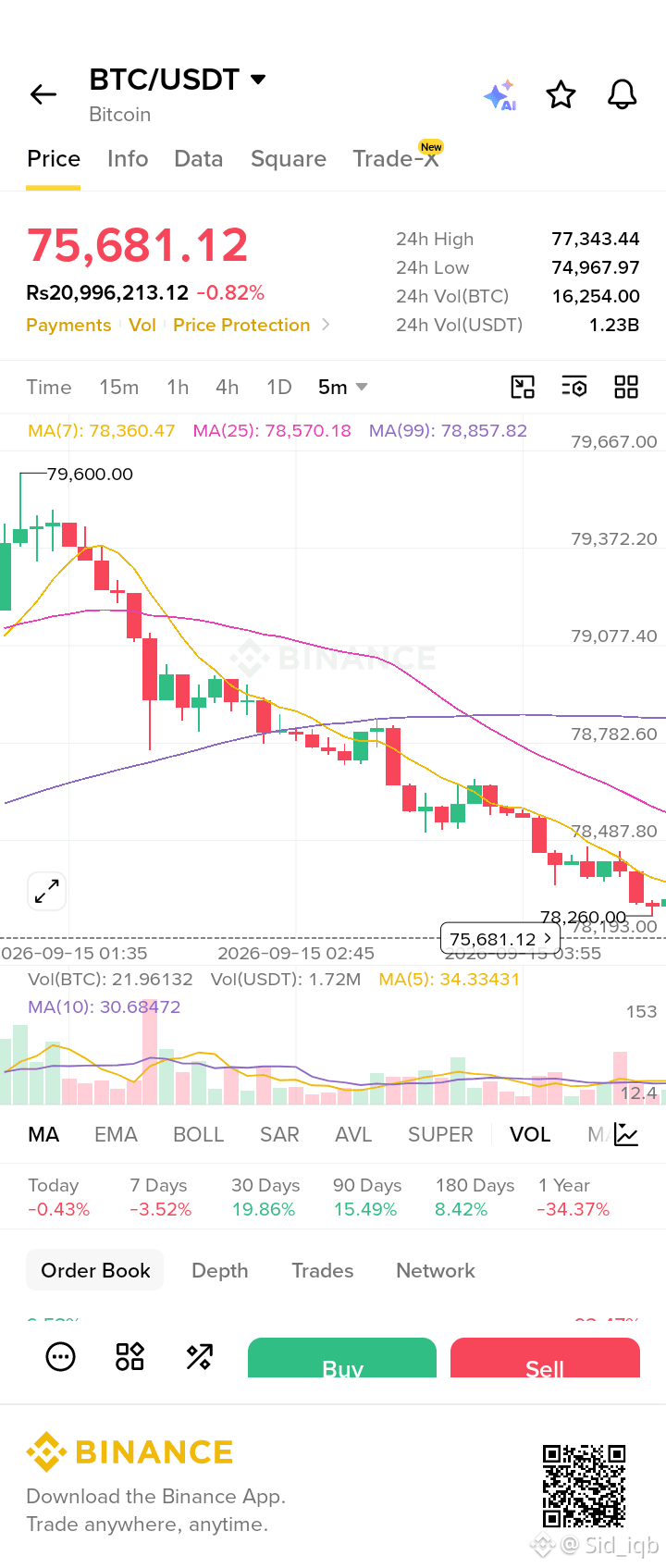
the market is so uncertain with $BITCOIN sharp rise and fall
{alpha}(10x72e4f9f808c49a2a61de9c5896298920dc4eeea9)
the market is so uncertain with $BITCOIN sharp rise and fall
70
·
--
Übersetzung ansehen
my buy was 0.0822 for $DOGE
Should I wait ..?
{future}(DOGEUSDT)
my buy was 0.0822 for $DOGE
Should I wait ..?
Should I wait ..?
38
·
--
Übersetzung ansehen
Bitcoin falls 4%$BITCOIN is the largest and most widely followed cryptocurrency in the market. When Bitcoin falls sharply, its movement can have a significant effect on other cryptocurrencies. A 4% decline in Bitcoin may create fear and uncertainty among investors, causing selling pressure across the wider crypto market.
Many altcoins, such as Ethereum , Cardano, XRP and Dogecoin, often move in the same general direction as Bitcoin. Therefore, when Bitcoin falls, these coins may also experience price declines. Smaller cryptocurrencies can sometimes experience even larger percentage movements because their markets are less liquid and more sensitive to changes in investor sentiment.
A Bitcoin decline can also affect trading volume. Some investors may move their money into stablecoins such as USDT while waiting for the market to become more stable. Others may see the decline as an opportunity to buy cryptocurrencies at lower prices.
However, $BITCOIN falling by 4% does not necessarily mean that all other cryptocurrencies will continue falling. Each coin can be affected by its own news, developments, market demand and technical conditions.
Overall, $BITCOIN plays an important role in the cryptocurrency market. Its price movements can influence market sentiment, but investors should examine each cryptocurrency separately rather than assuming that every coin will move exactly like Bitcoin.
{alpha}(10x72e4f9f808c49a2a61de9c5896298920dc4eeea9)
Bitcoin falls 4%
$BITCOIN is the largest and most widely followed cryptocurrency in the market. When Bitcoin falls sharply, its movement can have a significant effect on other cryptocurrencies. A 4% decline in Bitcoin may create fear and uncertainty among investors, causing selling pressure across the wider crypto market.
Many altcoins, such as Ethereum , Cardano, XRP and Dogecoin, often move in the same general direction as Bitcoin. Therefore, when Bitcoin falls, these coins may also experience price declines. Smaller cryptocurrencies can sometimes experience even larger percentage movements because their markets are less liquid and more sensitive to changes in investor sentiment.
A Bitcoin decline can also affect trading volume. Some investors may move their money into stablecoins such as USDT while waiting for the market to become more stable. Others may see the decline as an opportunity to buy cryptocurrencies at lower prices.
However, $BITCOIN falling by 4% does not necessarily mean that all other cryptocurrencies will continue falling. Each coin can be affected by its own news, developments, market demand and technical conditions.
Overall, $BITCOIN plays an important role in the cryptocurrency market. Its price movements can influence market sentiment, but investors should examine each cryptocurrency separately rather than assuming that every coin will move exactly like Bitcoin.
Many altcoins, such as Ethereum , Cardano, XRP and Dogecoin, often move in the same general direction as Bitcoin. Therefore, when Bitcoin falls, these coins may also experience price declines. Smaller cryptocurrencies can sometimes experience even larger percentage movements because their markets are less liquid and more sensitive to changes in investor sentiment.
A Bitcoin decline can also affect trading volume. Some investors may move their money into stablecoins such as USDT while waiting for the market to become more stable. Others may see the decline as an opportunity to buy cryptocurrencies at lower prices.
However, $BITCOIN falling by 4% does not necessarily mean that all other cryptocurrencies will continue falling. Each coin can be affected by its own news, developments, market demand and technical conditions.
Overall, $BITCOIN plays an important role in the cryptocurrency market. Its price movements can influence market sentiment, but investors should examine each cryptocurrency separately rather than assuming that every coin will move exactly like Bitcoin.
67
·
--
Übersetzung ansehen
Fundamental Strengths of DogeCoinA. Extremely strong brand recognition
DOGE has one of the strongest brands among meme-based cryptocurrencies.
B. Large and active community
Dogecoin has maintained a large user/community base for more than a decade.
C. High liquidity
$DOGE is widely traded and has significant market liquidity compared with most smaller cryptocurrencies.
D. Simple monetary design
There are no complicated token-unlock schedules or venture-capital allocations. New
DOGE is primarily generated through mining rewards.
E. Payment potential
$DOGE was originally designed as a payment currency rather than simply a speculative token. Its low-value payment/tipping identity remains one of its potential long-term use cases.
{spot}(DOGEUSDT)
Fundamental Strengths of DogeCoin
A. Extremely strong brand recognition
DOGE has one of the strongest brands among meme-based cryptocurrencies.
B. Large and active community
Dogecoin has maintained a large user/community base for more than a decade.
C. High liquidity
$DOGE is widely traded and has significant market liquidity compared with most smaller cryptocurrencies.
D. Simple monetary design
There are no complicated token-unlock schedules or venture-capital allocations. New
DOGE is primarily generated through mining rewards.
E. Payment potential
$DOGE was originally designed as a payment currency rather than simply a speculative token. Its low-value payment/tipping identity remains one of its potential long-term use cases.
DOGE has one of the strongest brands among meme-based cryptocurrencies.
B. Large and active community
Dogecoin has maintained a large user/community base for more than a decade.
C. High liquidity
$DOGE is widely traded and has significant market liquidity compared with most smaller cryptocurrencies.
D. Simple monetary design
There are no complicated token-unlock schedules or venture-capital allocations. New
DOGE is primarily generated through mining rewards.
E. Payment potential
$DOGE was originally designed as a payment currency rather than simply a speculative token. Its low-value payment/tipping identity remains one of its potential long-term use cases.
80
·
--
Übersetzung ansehen
1
1k
Anmelden und weiter Inhalte entdecken
Krypto-Nutzer weltweit auf Binance Square kennenlernen
⚡️ Bleib in Sachen Krypto stets am Puls.
💬 Die weltgrößte Kryptobörse vertraut darauf.
👍 Erhalte verlässliche Einblicke von verifizierten Creators.
E-Mail-Adresse/Telefonnummer