

SawJan
20 Beiträge

SawJan
Melden
Nutzer blockieren
Trade eröffnen

SOL Halter
Gelegenheitstrader
4.6 Jahre
8 Following
28 Follower
21 Like gegeben
Beiträge
Portfolio
·
--
📉 Krypto-Marktupdate: Bären leicht im Vorteil
Der Kryptomarkt steht leicht unter Abwärtsdruck. Die wichtigsten Assets notieren in den letzten 24 Stunden im Minus.
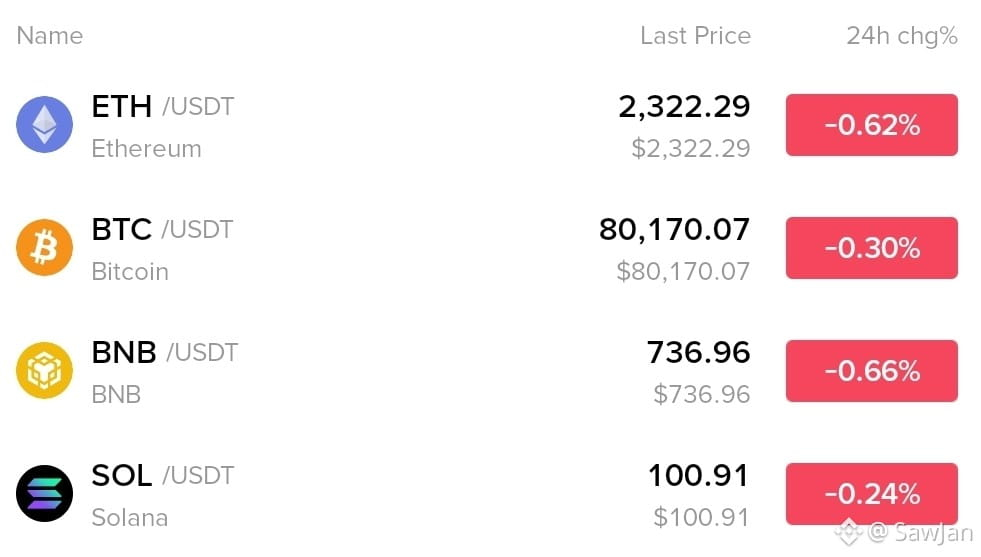
📊 Marktüberblick: 🔹 BTC: $80,170.07 | -0.30% 🔹 ETH: $2,322.29 | -0.62% 🔹 BNB: $736.96 | -0.66% 🔹 SOL: $100.91 | -0.24%
🔍 Was sagen uns die Daten?
• Bitcoin zeigt relative Stärke und verzeichnet unter diesen vier Assets den geringsten Rückgang. • Ethereum und BNB stehen unter etwas stärkerem Verkaufsdruck, wobei BNB den größten Rückgang verbucht. • Solana zeigt sich relativ widerstandsfähig und weist mit -0.24% den geringsten prozentualen Rückgang auf.
🧠 Mein Fazit:
Das sieht eher nach einem leichten Marktrücksetzer aus als nach einem klaren Anzeichen für eine größere Trendumkehr. Eine Momentaufnahme über 24 Stunden reicht jedoch nicht aus, um die nächste Bewegung vorherzusagen.
Als Nächstes sollte man vor allem auf die Preisstabilität von BTC, das Handelsvolumen und darauf achten, ob ETH, BNB und SOL ihre kurzfristigen Verluste wieder wettmachen können.
Die nächste Bewegung ist wichtiger als die derzeitigen roten Kerzen. 👀
Sehen wir eine gesunde Korrektur oder den Beginn eines stärkeren Rücksetzers?
#Bitcoin #Ethereum #BNB #Solana #CryptoMarket
57
·
--
📉 Krypto-Markt-Update: Bären leicht im Vorteil
Der Kryptomarkt steht leicht unter Abwärtsdruck. Die wichtigsten Assets notieren in den letzten 24 Stunden im Minus.
📊 Marktüberblick:
🔹 BTC: $80,170.07 | -0.30%
🔹 ETH: $2,322.29 | -0.62%
🔹 BNB: $736.96 | -0.66%
🔹 SOL: $100.91 | -0.24%
🔍 Was sagen uns die Daten?
• Bitcoin zeigt relative Stärke und verzeichnet unter diesen vier Assets den geringsten Rückgang.
• Ethereum und BNB stehen unter etwas stärkerem Verkaufsdruck. BNB verbucht dabei den größten Rückgang.
• Solana zeigt sich relativ widerstandsfähig und verzeichnet mit -0.24% den geringsten prozentualen Rückgang.
🧠 Mein Fazit:
Das sieht eher nach einem leichten Marktrücksetzer als nach einem klaren Anzeichen für eine größere Trendwende aus. Ein einzelner 24-Stunden-Schnappschuss reicht jedoch nicht aus, um die nächste Bewegung vorherzusagen.
Als Nächstes sollten wir vor allem die Preisstabilität von BTC, das Handelsvolumen und die Frage im Blick behalten, ob ETH, BNB und SOL ihre kurzfristigen Verluste wieder ausgleichen können.
Die nächste Bewegung ist wichtiger als die aktuellen roten Kerzen. 👀
Sehen wir eine gesunde Korrektur oder den Beginn eines stärkeren Rücksetzers?
#bitcoin #Ethereum #BNB #solana #CryptoMarket
81
·
--
Bärisch
Übersetzung ansehen
Instead of green, everything is red today 😬
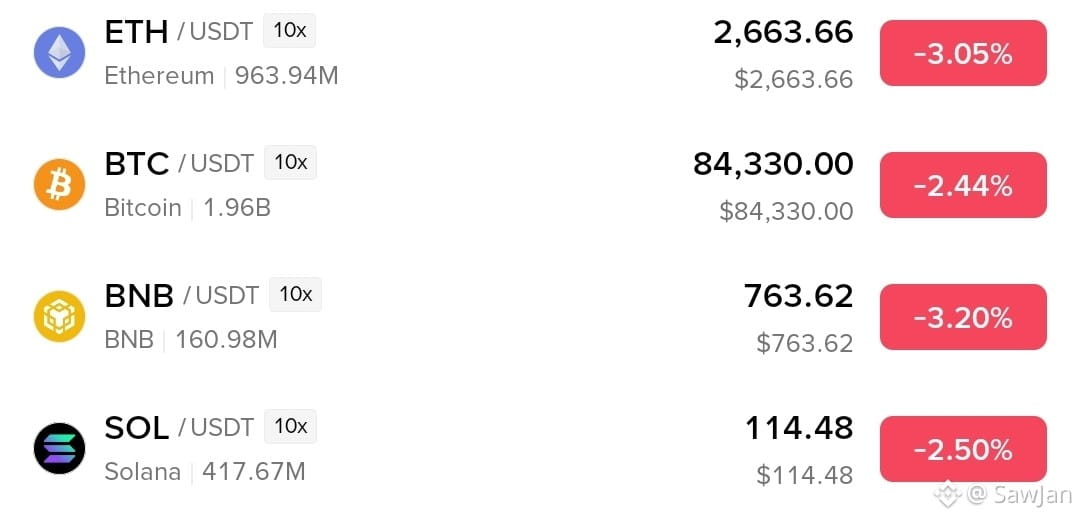
ETH -3.05% | BTC -2.44% | BNB -3.20% | SOL -2.50%
Every chart seems to be flashing red today 🔴
Looks like the bulls are taking a little break 🐂
Time to stay patient and watch the next move 👀
Let’s see where the market goes from here 📉
Instead of green, everything is red today 😬
ETH -3.05% | BTC -2.44% | BNB -3.20% | SOL -2.50%
Every chart seems to be flashing red today 🔴
Looks like the bulls are taking a little break 🐂
Time to stay patient and watch the next move 👀
Let’s see where the market goes from here 📉
ETH -3.05% | BTC -2.44% | BNB -3.20% | SOL -2.50%
Every chart seems to be flashing red today 🔴
Looks like the bulls are taking a little break 🐂
Time to stay patient and watch the next move 👀
Let’s see where the market goes from here 📉
116
·
--
Übersetzung ansehen
DeFi is evolving beyond chasing the highest APY.
@termmax is taking a different approach with fixed-rate lending and borrowing, giving users more predictability when managing capital on-chain.
That predictability can make a big difference. Borrowers can plan ahead, lenders can understand their expected returns, and capital can be allocated with a clearer strategy instead of constantly reacting to rate fluctuations.
With support for multi-chain markets, TermMax is building toward a DeFi experience where financial decisions can be made with more confidence.
Less uncertainty.
More structure.
Better capital planning.
That’s the direction DeFi needs.
#TermMax #DeFi #Web3
#termmax @termmax
DeFi is evolving beyond chasing the highest APY.
@TermMax is taking a different approach with fixed-rate lending and borrowing, giving users more predictability when managing capital on-chain.
That predictability can make a big difference. Borrowers can plan ahead, lenders can understand their expected returns, and capital can be allocated with a clearer strategy instead of constantly reacting to rate fluctuations.
With support for multi-chain markets, TermMax is building toward a DeFi experience where financial decisions can be made with more confidence.
Less uncertainty.
More structure.
Better capital planning.
That’s the direction DeFi needs.
#TermMax #DeFi #Web3
#termmax @TermMax
68
·
--
DeFi braucht mehr als Hype – es braucht bessere Tools für die Kapitalverwaltung.
@termmax entwickelt Märkte für Kredite und Darlehen mit festen Zinssätzen, die mehr Vorhersehbarkeit in die On-Chain-Finanzwelt bringen. Dank Multi-Chain-Unterstützung und einer klareren Kapitalallokation können Nutzer Kreditstrategien mit größerer Zuversicht verfolgen.
Die Möglichkeit, Zinssätze festzuschreiben, kann besonders nützlich sein, wenn die Märkte volatil werden und sich variable Kreditkosten schnell verändern.
Während sich DeFi weiterentwickelt, werden vorhersehbare Liquidität und effizientes Kapitalmanagement wichtiger denn je.
Deshalb ist #termmax ein Projekt, das man im Auge behalten sollte, während die nächste Generation der On-Chain-Finanzinfrastruktur Gestalt annimmt.
#termmax @termmax
DeFi braucht mehr als Hype – es braucht bessere Tools für die Kapitalverwaltung.
@TermMax entwickelt Märkte für Kredite und Darlehen mit festen Zinssätzen, die mehr Vorhersehbarkeit in die On-Chain-Finanzwelt bringen. Dank Multi-Chain-Unterstützung und einer klareren Kapitalallokation können Nutzer Kreditstrategien mit größerer Zuversicht verfolgen.
Die Möglichkeit, Zinssätze festzuschreiben, kann besonders nützlich sein, wenn die Märkte volatil werden und sich variable Kreditkosten schnell verändern.
Während sich DeFi weiterentwickelt, werden vorhersehbare Liquidität und effizientes Kapitalmanagement wichtiger denn je.
Deshalb ist #termmax ein Projekt, das man im Auge behalten sollte, während die nächste Generation der On-Chain-Finanzinfrastruktur Gestalt annimmt.
#termmax @TermMax
66
·
--
#TermMax @termmax
DeFi hat viele Kreditprotokolle, aber vorhersehbare Zinssätze werden noch immer unterschätzt.
Deshalb ist TermMax mir aufgefallen.
Kredite und Darlehen zu festen Zinssätzen machen die Kapitalplanung viel einfacher. Man kennt die Kosten im Voraus, statt ständig auf wechselnde Marktbedingungen reagieren zu müssen.
Auch die Multi-Chain-Ausrichtung gefällt mir. Mehr Märkte und Liquidität über verschiedene Ökosysteme hinweg können Festzinsprodukte mit der Zeit deutlich nützlicher machen.
Das große Ganze ist einfach: DeFi braucht Infrastruktur, die Nutzern hilft, ihr Kapital mit mehr Sicherheit zu verwalten.
TermMax entwickelt sich in diese Richtung, und ich bin gespannt, wie weit das Ökosystem wachsen kann. Es gibt einen Unterschied zwischen DeFi-Produkten, die nach Aufmerksamkeit streben, und Infrastruktur, die ein echtes Problem löst.
@termmax ist interessant, weil der Fokus auf etwas Praktischem liegt: vorhersehbare Kredite und Darlehen.
Feste Zinssätze können Nutzern mehr Kontrolle über die Kapitalallokation geben, besonders wenn die Märkte volatil werden.
Statt sich ständig zu fragen, wohin sich die Zinssätze als Nächstes bewegen könnten, können Nutzer Positionen auf Grundlage klarerer Kosten und Erwartungen strukturieren.
Der Multi-Chain-Ansatz eröffnet eine weitere Möglichkeit und könnte den Zugang zu mehr Liquidität und Märkten schaffen.
Für mich ist das die Art von DeFi-Infrastruktur, der man Beachtung schenken sollte.
Weniger Lärm. Mehr Nutzen.
#TermMax Eine Sache, die DeFi noch immer braucht, ist mehr Vorhersehbarkeit.
Hier setzt @termmax einen interessanten Akzent.
Kredite und Darlehen zu festen Zinssätzen können die Planung mit On-Chain-Kapital erleichtern. Ob man für eine Strategie einen Kredit aufnimmt oder Liquidität bereitstellt: Wenn man den Zinssatz im Voraus kennt, entfällt viel Unsicherheit.
Ich halte auch die Multi-Chain-Vision für wichtig.
Liquidität sollte nicht für immer in isolierten Ökosystemen gefangen sein.
Wenn TermMax weiterhin verlässliche Festzinsmärkte über mehrere Chains hinweg aufbauen kann, könnte die Plattform für eine viel größere Bandbreite von DeFi-Nutzern zu nützlicher Infrastruktur werden.
Die Botschaft ist einfach:
Vorhersehbare Zinssätze.
Bessere Kapitalplanung.
Effizienteres DeFi.
#termmax @termmax
#TermMax @termmax
DeFi hat viele Kreditprotokolle, aber vorhersehbare Zinssätze werden noch immer unterschätzt.
Deshalb ist TermMax mir aufgefallen.
Kredite und Darlehen zu festen Zinssätzen machen die Kapitalplanung viel einfacher. Man kennt die Kosten im Voraus, statt ständig auf wechselnde Marktbedingungen reagieren zu müssen.
Auch die Multi-Chain-Ausrichtung gefällt mir. Mehr Märkte und Liquidität über verschiedene Ökosysteme hinweg können Festzinsprodukte mit der Zeit deutlich nützlicher machen.
Das große Ganze ist einfach: DeFi braucht Infrastruktur, die Nutzern hilft, ihr Kapital mit mehr Sicherheit zu verwalten.
TermMax entwickelt sich in diese Richtung, und ich bin gespannt, wie weit das Ökosystem wachsen kann. Es gibt einen Unterschied zwischen DeFi-Produkten, die nach Aufmerksamkeit streben, und Infrastruktur, die ein echtes Problem löst.
@TermMax ist interessant, weil der Fokus auf etwas Praktischem liegt: vorhersehbare Kredite und Darlehen.
Feste Zinssätze können Nutzern mehr Kontrolle über die Kapitalallokation geben, besonders wenn die Märkte volatil werden.
Statt sich ständig zu fragen, wohin sich die Zinssätze als Nächstes bewegen könnten, können Nutzer Positionen auf Grundlage klarerer Kosten und Erwartungen strukturieren.
Der Multi-Chain-Ansatz eröffnet eine weitere Möglichkeit und könnte den Zugang zu mehr Liquidität und Märkten schaffen.
Für mich ist das die Art von DeFi-Infrastruktur, der man Beachtung schenken sollte.
Weniger Lärm. Mehr Nutzen.
#TermMax Eine Sache, die DeFi noch immer braucht, ist mehr Vorhersehbarkeit.
Hier setzt @TermMax einen interessanten Akzent.
Kredite und Darlehen zu festen Zinssätzen können die Planung mit On-Chain-Kapital erleichtern. Ob man für eine Strategie einen Kredit aufnimmt oder Liquidität bereitstellt: Wenn man den Zinssatz im Voraus kennt, entfällt viel Unsicherheit.
Ich halte auch die Multi-Chain-Vision für wichtig.
Liquidität sollte nicht für immer in isolierten Ökosystemen gefangen sein.
Wenn TermMax weiterhin verlässliche Festzinsmärkte über mehrere Chains hinweg aufbauen kann, könnte die Plattform für eine viel größere Bandbreite von DeFi-Nutzern zu nützlicher Infrastruktur werden.
Die Botschaft ist einfach:
Vorhersehbare Zinssätze.
Bessere Kapitalplanung.
Effizienteres DeFi.
#termmax @TermMax
77
·
--
Übersetzung ansehen
TermMax is making DeFi feel more predictable by bringing fixed-rate lending, borrowing, and leverage on-chain. Instead of dealing with constantly changing rates, users can lock in borrowing costs or expected yields until maturity. The protocol also supports managed vaults, multi-chain markets, and one-click leverage, making complex strategies easier to access. What stands out to me is the focus on predictable capital allocation rather than simply chasing short-term incentives. As DeFi matures, fixed-rate markets could become an important building block for both users and institutions. TermMax is definitely one protocol worth watching as this category develops. #termmax @termmax #termmax @termmax
TermMax is making DeFi feel more predictable by bringing fixed-rate lending, borrowing, and leverage on-chain. Instead of dealing with constantly changing rates, users can lock in borrowing costs or expected yields until maturity. The protocol also supports managed vaults, multi-chain markets, and one-click leverage, making complex strategies easier to access. What stands out to me is the focus on predictable capital allocation rather than simply chasing short-term incentives. As DeFi matures, fixed-rate markets could become an important building block for both users and institutions. TermMax is definitely one protocol worth watching as this category develops. #termmax @TermMax #termmax @TermMax
68
·
--
TermMax entwickelt einen flexibleren Zugang zu DeFi-Märkten mit fester Laufzeit und gibt Nutzern mehr Kontrolle über Rendite, Laufzeit und Kapitaleffizienz. Was mir an @TermMax besonders auffällt, ist der Fokus auf strukturierte Finanzprodukte mit fester Laufzeit, statt jede DeFi-Position als rein variabel zu behandeln. Mit der Weiterentwicklung von DeFi könnten vorhersehbare Laufzeiten und klarere Risiko-Rendite-Profile für Nutzer und Protokolle zunehmend an Bedeutung gewinnen. TermMax arbeitet daran, diese Märkte zugänglicher zu machen und gleichzeitig die Möglichkeiten der Onchain-Finanzierung mit fester Laufzeit auszubauen. Ich werde verfolgen, wie sich das Ökosystem entwickelt und wie Nutzer die wachsende Produktpalette einsetzen.
#termmax @termmax
TermMax entwickelt einen flexibleren Zugang zu DeFi-Märkten mit fester Laufzeit und gibt Nutzern mehr Kontrolle über Rendite, Laufzeit und Kapitaleffizienz. Was mir an @TermMax besonders auffällt, ist der Fokus auf strukturierte Finanzprodukte mit fester Laufzeit, statt jede DeFi-Position als rein variabel zu behandeln. Mit der Weiterentwicklung von DeFi könnten vorhersehbare Laufzeiten und klarere Risiko-Rendite-Profile für Nutzer und Protokolle zunehmend an Bedeutung gewinnen. TermMax arbeitet daran, diese Märkte zugänglicher zu machen und gleichzeitig die Möglichkeiten der Onchain-Finanzierung mit fester Laufzeit auszubauen. Ich werde verfolgen, wie sich das Ökosystem entwickelt und wie Nutzer die wachsende Produktpalette einsetzen.
#termmax @TermMax
#termmax @TermMax

68
·
--
Übersetzung ansehen
The future of trading isn't about choosing between earning yield and staying liquid—it's about having both in one seamless experience.
That's what makes GRVT stand out. By combining the speed and efficiency of a centralized exchange with the transparency and security of decentralized infrastructure, it creates a platform where users remain in control of their assets while accessing a smoother trading experience.
Whether you're trading crypto or real-world assets, your eligible balances don't have to sit idle. Instead, your capital can continue working in the background while remaining available for your next opportunity.
Self-custody, fast execution, and on-chain settlement aren't just technical features—they're building blocks for a more efficient financial system. As more users look for platforms that maximize both flexibility and capital efficiency, solutions like GRVT are becoming increasingly relevant.
The next generation of exchanges won't simply focus on lower fees or faster trades. They'll focus on making every asset more productive without compromising ownership or transparency.
GRVT is moving in that direction by bringing trading, earning, and self-custody together in a single unified experience. That's the kind of innovation that has the potential to reshape how we interact with digital and real-world assets.
@grvt_io #grvt
65
·
--
Bullisch
Übersetzung ansehen
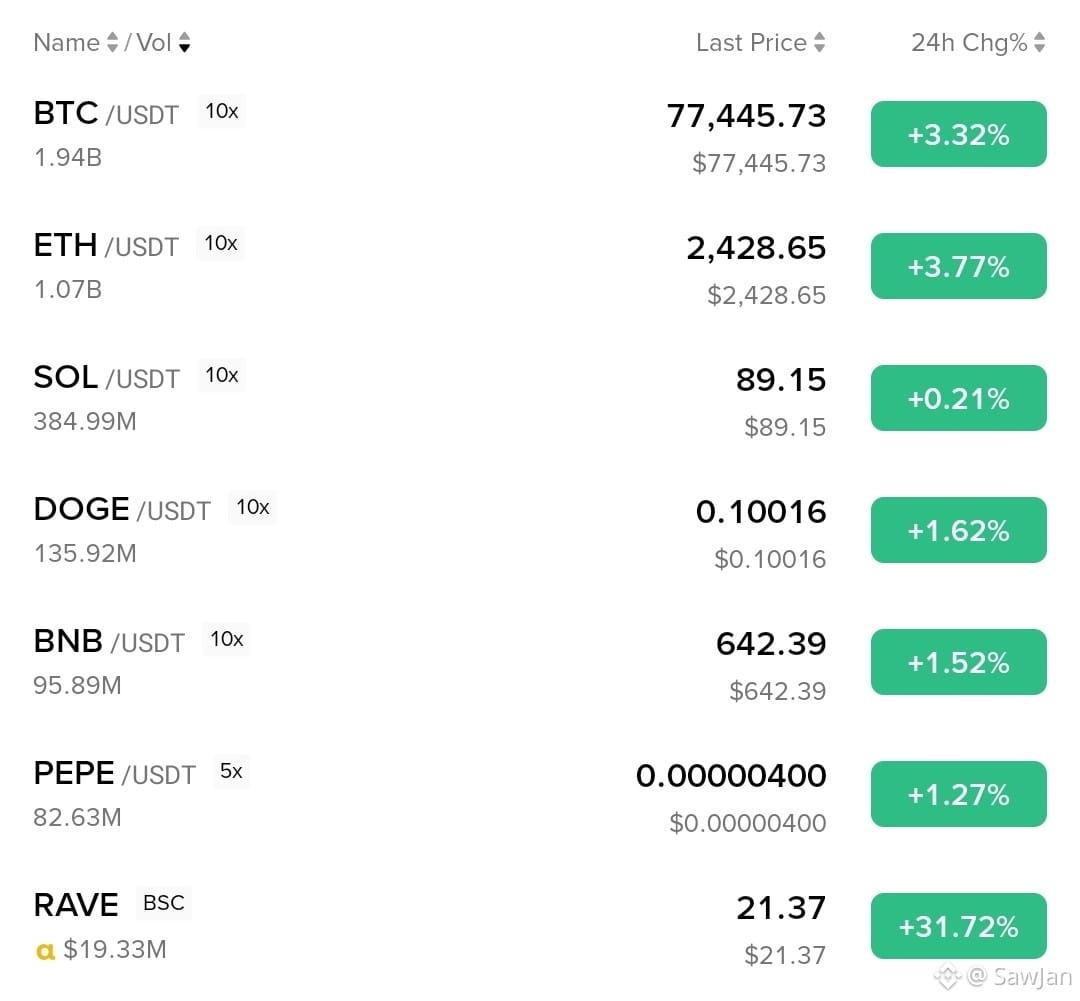
After long time the market is going to be green 💚 and $BTC , $ETH , $SOL and other coin going up start pump and i hope market going well a every coin gain they'res previous price.
After long time the market is going to be green 💚 and $BTC , $ETH , $SOL and other coin going up start pump and i hope market going well a every coin gain they'res previous price.
65
·
--

Artikel
Übersetzung ansehen
pixelThe evolution of @Pixels is becoming one of the most interesting case studies in web3 gaming right now. What started as a simple farming-style game has gradually transformed into a much deeper and more structured ecosystem through its Stacked approach. This shift is not just about adding features, but about creating a sustainable loop where players, creators, and the in-game economy all reinforce each other.
At the center of this system is $PIXEL. Instead of being just another in-game currency, it’s being positioned as the core layer that connects activity, rewards, and long-term participation. As more mechanics are introduced into the Stacked ecosystem, the role of $PIXEL becomes more meaningful, especially as utility expands across different parts of the platform.
One of the most important aspects of this evolution is how @Pixels is aligning incentives. Players are no longer just grinding for short-term rewards; they are contributing to a broader system that benefits from active participation. Creators, on the other hand, are becoming key drivers of growth by bringing attention, education, and narrative to the ecosystem. This combination creates a flywheel effect that is hard to replicate.
Another thing worth noting is the focus on scalability. Many web3 games struggle to maintain user interest over time, but the Stacked ecosystem appears designed to continuously introduce new layers of engagement. This keeps the experience fresh while also strengthening the value proposition of $PIXEL .
If this direction continues, @Pixels could set a strong example for how web3 gaming ecosystems should be built — not around short-term hype, but around long-term value creation. The integration of gameplay, economy, and community is what makes this model stand out.
Overall, the growth of @Pixels and its Stacked ecosystem shows that we are moving toward a more mature phase of web3 gaming. It’s no longer just about playing; it’s about participating in an evolving digital economy. And with $PIXEL at the center of it all, the foundation looks solid for future expansion.
pixel
The evolution of @Pixels is becoming one of the most interesting case studies in web3 gaming right now. What started as a simple farming-style game has gradually transformed into a much deeper and more structured ecosystem through its Stacked approach. This shift is not just about adding features, but about creating a sustainable loop where players, creators, and the in-game economy all reinforce each other.
At the center of this system is $PIXEL . Instead of being just another in-game currency, it’s being positioned as the core layer that connects activity, rewards, and long-term participation. As more mechanics are introduced into the Stacked ecosystem, the role of $PIXEL becomes more meaningful, especially as utility expands across different parts of the platform.
One of the most important aspects of this evolution is how @Pixels is aligning incentives. Players are no longer just grinding for short-term rewards; they are contributing to a broader system that benefits from active participation. Creators, on the other hand, are becoming key drivers of growth by bringing attention, education, and narrative to the ecosystem. This combination creates a flywheel effect that is hard to replicate.
Another thing worth noting is the focus on scalability. Many web3 games struggle to maintain user interest over time, but the Stacked ecosystem appears designed to continuously introduce new layers of engagement. This keeps the experience fresh while also strengthening the value proposition of $PIXEL .
If this direction continues, @Pixels could set a strong example for how web3 gaming ecosystems should be built — not around short-term hype, but around long-term value creation. The integration of gameplay, economy, and community is what makes this model stand out.
Overall, the growth of @Pixels and its Stacked ecosystem shows that we are moving toward a more mature phase of web3 gaming. It’s no longer just about playing; it’s about participating in an evolving digital economy. And with $PIXEL at the center of it all, the foundation looks solid for future expansion.
18
·
--
Übersetzung ansehen
pixelThe evolution of @Pixels is becoming one of the most interesting case studies in web3 gaming right now. What started as a simple farming-style game has gradually transformed into a much deeper and more structured ecosystem through its Stacked approach. This shift is not just about adding features, but about creating a sustainable loop where players, creators, and the in-game economy all reinforce each other.
At the center of this system is $PIXEL. Instead of being just another in-game currency, it’s being positioned as the core layer that connects activity, rewards, and long-term participation. As more mechanics are introduced into the Stacked ecosystem, the role of $PIXEL becomes more meaningful, especially as utility expands across different parts of the platform.
One of the most important aspects of this evolution is how @Pixels is aligning incentives. Players are no longer just grinding for short-term rewards; they are contributing to a broader system that benefits from active participation. Creators, on the other hand, are becoming key drivers of growth by bringing attention, education, and narrative to the ecosystem. This combination creates a flywheel effect that is hard to replicate.
Another thing worth noting is the focus on scalability. Many web3 games struggle to maintain user interest over time, but the Stacked ecosystem appears designed to continuously introduce new layers of engagement. This keeps the experience fresh while also strengthening the value proposition of $PIXEL.
If this direction continues, @Pixels could set a strong example for how web3 gaming ecosystems should be built — not around short-term hype, but around long-term value creation. The integration of gameplay, economy, and community is what makes this model stand out.
Overall, the growth of @Pixels and its Stacked ecosystem shows that we are moving toward a more mature phase of web3 gaming. It’s no longer just about playing; it’s about participating in an evolving digital economy. And with $PIXEL at the center of it all, the foundation looks solid for future expansion. #pixel
pixel
The evolution of @Pixels is becoming one of the most interesting case studies in web3 gaming right now. What started as a simple farming-style game has gradually transformed into a much deeper and more structured ecosystem through its Stacked approach. This shift is not just about adding features, but about creating a sustainable loop where players, creators, and the in-game economy all reinforce each other.
At the center of this system is $PIXEL. Instead of being just another in-game currency, it’s being positioned as the core layer that connects activity, rewards, and long-term participation. As more mechanics are introduced into the Stacked ecosystem, the role of $PIXEL becomes more meaningful, especially as utility expands across different parts of the platform.
One of the most important aspects of this evolution is how @Pixels is aligning incentives. Players are no longer just grinding for short-term rewards; they are contributing to a broader system that benefits from active participation. Creators, on the other hand, are becoming key drivers of growth by bringing attention, education, and narrative to the ecosystem. This combination creates a flywheel effect that is hard to replicate.
Another thing worth noting is the focus on scalability. Many web3 games struggle to maintain user interest over time, but the Stacked ecosystem appears designed to continuously introduce new layers of engagement. This keeps the experience fresh while also strengthening the value proposition of $PIXEL.
If this direction continues, @Pixels could set a strong example for how web3 gaming ecosystems should be built — not around short-term hype, but around long-term value creation. The integration of gameplay, economy, and community is what makes this model stand out.
Overall, the growth of @Pixels and its Stacked ecosystem shows that we are moving toward a more mature phase of web3 gaming. It’s no longer just about playing; it’s about participating in an evolving digital economy. And with $PIXEL at the center of it all, the foundation looks solid for future expansion. #pixel
18
·
--
Übersetzung ansehen
Seeing @Pixels grow into a full Stacked ecosystem is honestly impressive. What started as a simple web3 game is now evolving into something much bigger, where $PIXEL plays a key role in connecting gameplay, economy, and creators. The way they are building utility around the token shows long-term thinking rather than short-term hype. More players, more creators, and more use cases mean stronger network effects over time. If this momentum continues, Pixels could become a benchmark for how web3 gaming ecosystems should scale. Definitely worth paying attention to how this develops. #pixel
Seeing @Pixels grow into a full Stacked ecosystem is honestly impressive. What started as a simple web3 game is now evolving into something much bigger, where $PIXEL plays a key role in connecting gameplay, economy, and creators. The way they are building utility around the token shows long-term thinking rather than short-term hype. More players, more creators, and more use cases mean stronger network effects over time. If this momentum continues, Pixels could become a benchmark for how web3 gaming ecosystems should scale. Definitely worth paying attention to how this develops. #pixel
20
·
--
Übersetzung ansehen
Alpha Trading Competition you just see last day of events close no Trading Volume but you just start tarding then end event time . then see you are the last person never win event and Trading leaderboard is high 😂😂😂😂
Alpha Trading Competition you just see last day of events close no Trading Volume but you just start tarding then end event time . then see you are the last person never win event and Trading leaderboard is high 😂😂😂😂
2
·
--
Artikel
Übersetzung ansehen
Most DeFi is still stateless execution.Most DeFi is still stateless execution. @mira_network introduces persistent, context-aware agents that learn, adapt, and coordinate capital over time. By combining verifiable data, memory, and programmable liquidity, Mira enables continuous strategy evolution instead of isolated trades. $MIRA aligns data, execution, and incentives into one feedback loop, creating infrastructure for AI-native markets that compound intelligence and capital together. #Mira
Most DeFi is still stateless execution.
Most DeFi is still stateless execution. @mira_network introduces persistent, context-aware agents that learn, adapt, and coordinate capital over time. By combining verifiable data, memory, and programmable liquidity, Mira enables continuous strategy evolution instead of isolated trades. $MIRA aligns data, execution, and incentives into one feedback loop, creating infrastructure for AI-native markets that compound intelligence and capital together. #Mira
1
·
--
Übersetzung ansehen
Most DeFi is still stateless execution. @mira_network.Most DeFi is still stateless execution. @mira_network introduces persistent, context-aware agents that learn, adapt, and coordinate capital over time. By combining verifiable data, memory, and programmable liquidity, Mira enables continuous strategy evolution instead of isolated trades. $MIRA aligns data, execution, and incentives into one feedback loop, creating infrastructure for AI-native markets that compound intelligence and capital. #mira $MIRA
Most DeFi is still stateless execution. @mira_network.
Most DeFi is still stateless execution. @mira_network introduces persistent, context-aware agents that learn, adapt, and coordinate capital over time. By combining verifiable data, memory, and programmable liquidity, Mira enables continuous strategy evolution instead of isolated trades. $MIRA aligns data, execution, and incentives into one feedback loop, creating infrastructure for AI-native markets that compound intelligence and capital. #mira $MIRA
4
·
--
Übersetzung ansehen
Composable intelligence will define the next phase of onchain markets, and @mira_network is building the coordination layer for it. By enabling agents with persistent memory, verifiable data access, and programmable execution, Mira turns isolated smart contract calls into adaptive financial behavior. $MIRA aligns incentives across data providers, strategists, and liquidity venues, creating a feedback loop where strategies improve over time instead of resetting each transaction. This is infrastructure for AI-native DeFi—stateful, context-aware, and capital efficient by design. #mira $MIRA
Composable intelligence will define the next phase of onchain markets, and @mira_network is building the coordination layer for it. By enabling agents with persistent memory, verifiable data access, and programmable execution, Mira turns isolated smart contract calls into adaptive financial behavior. $MIRA aligns incentives across data providers, strategists, and liquidity venues, creating a feedback loop where strategies improve over time instead of resetting each transaction. This is infrastructure for AI-native DeFi—stateful, context-aware, and capital efficient by design. #mira $MIRA
3
·
--
Übersetzung ansehen
Autonomous agents need unified rails to manage data, memory, and capital without fragmentation.Autonomous agents need unified rails to manage data, memory, and capital without fragmentation. That’s the core of @mira_network—stateful AI actors executing on verifiable infrastructure with continuous context. $MIRA aligns incentives across data, liquidity, and execution, turning isolated transactions into adaptive financial behavior. This is coordination infrastructure for AI-native DeFi, where strategies learn, persist, and compound onchain. #Mira
Autonomous agents need unified rails to manage data, memory, and capital without fragmentation.
Autonomous agents need unified rails to manage data, memory, and capital without fragmentation. That’s the core of @mira_network—stateful AI actors executing on verifiable infrastructure with continuous context. $MIRA aligns incentives across data, liquidity, and execution, turning isolated transactions into adaptive financial behavior. This is coordination infrastructure for AI-native DeFi, where strategies learn, persist, and compound onchain. #Mira
6
12
·
--
Übersetzung ansehen
Liquidity, identity, and execution need to live in the same layer for AI-driven finance to scale. That’s the vision behind @mira_network—autonomous agents operating on unified rails with verifiable context and programmable capital. $MIRA isn’t just a token, it’s coordination infrastructure for the next machine economy.
#mira $MIRA
#mira $MIRA
10
22
·
--
Übersetzung ansehen
#BinanceTurns8 Join us in the #BinanceTurns8 celebration and win a share of up to $888,888 in BNB!
#BinanceTurns8 Join us in the #BinanceTurns8 celebration and win a share of up to $888,888 in BNB!
5
5
Anmelden und weiter Inhalte entdecken
Krypto-Nutzer weltweit auf Binance Square kennenlernen
⚡️ Bleib in Sachen Krypto stets am Puls.
💬 Die weltgrößte Kryptobörse vertraut darauf.
👍 Erhalte verlässliche Einblicke von verifizierten Creators.
E-Mail-Adresse/Telefonnummer
Trendthemen
EthereumDropsBelow$2300
2,232 Aufrufe
87 Kommentare
#EthereumDropsBelow$2300
Der ETH-Kapitän ist gerade leicht unter die Marke von 2.300 USDT getaucht. Ein Minus von 1,39 % in den letzten 24 Stunden – da werden die Leute ganz schön nervös!
Woher kommt der ganze Wirbel? Wie sich herausstellt, mussten die Devs dringend einen Fehler im Glamsterdam-Upgrade beheben, damit die Staking-Gelder der Validatoren nicht direkt in den Taschen der Builder landen. Und damit nicht genug: Der „Wal“ Machi Big Brother wurde teilweise aus seiner 25x-gehebelten Long-Position liquidiert. Der Liquidationspreis lag gerade mal 30 USD vom Marktpreis entfernt – kein Wunder, dass der Markt zittert!
Was sollten Trader jetzt tun? Wer auf Spiritualität setzt, zündet Räucherstäbchen an und betet, dass der Wal nicht in See sticht. Wer auf technische Analyse setzt, bleibt ruhig und beobachtet, ob der Patch stabil im Testnet läuft.
⚠️ Dies ist keine Finanzberatung.
Registriere dich über den Code VINHTOCDO oder den Link https://www.binance.com/register?ref=VINHTOCDO, um mich zu unterstützen.
#Ethereum #Crypto #Staking #Glamsterdam #VINHTOCDO
Klicke unten auf „Handeln“, um mich zu unterstützen:
$ETH
$BNB
$SOL
Vinhtocdo
·4 Likes
·209 Aufrufe
BitcoinSlipsBelow$80KAgain
6,223 Aufrufe
54 Kommentare
ThailandLaunchesWORPTStablecoinToQRPaymentApp
10,810 Aufrufe
276 Kommentare