

Babaalicrypto
10 Beiträge

Babaalicrypto
Melden
Nutzer blockieren
5 Following
0 Follower
6 Like gegeben
Beiträge
Übersetzung ansehen
DEFI SHOULD FEEL SIMPLE, NOT COMPLICATED.
Why should swapping assets require a long technical process?
STON.fi focuses on making the DeFi experience cleaner and easier to navigate.
Swap.
Explore liquidity.
Move across supported ecosystems.
The technology underneath can be complex — the user experience doesn’t have to be.
#STONfi
DEFI SHOULD FEEL SIMPLE, NOT COMPLICATED.
Why should swapping assets require a long technical process?
STON.fi focuses on making the DeFi experience cleaner and easier to navigate.
Swap.
Explore liquidity.
Move across supported ecosystems.
The technology underneath can be complex — the user experience doesn’t have to be.
#STONfi
Why should swapping assets require a long technical process?
STON.fi focuses on making the DeFi experience cleaner and easier to navigate.
Swap.
Explore liquidity.
Move across supported ecosystems.
The technology underneath can be complex — the user experience doesn’t have to be.
#STONfi
46
LIQUIDITÄT IST DIE ANTRIEBSKRAFT VON DEFI
Ein Token kann zwar auf der Blockchain existieren, aber ohne ausreichende Liquidität wird das Handeln schwierig.
Liquidität hilft Nutzern, Vermögenswerte effizient zu tauschen, und hält die Märkte in Bewegung.
Darum sind Liquiditätspools ein so wichtiger Bestandteil der DeFi-Infrastruktur.
STON.fi stellt Liquidität in den Mittelpunkt seines Ökosystems und verbindet Nutzer, Assets und dezentrales Trading.
Bessere Liquidität → reibungslosere Swaps → stärkere DeFi-Märkte.
LIQUIDITÄT IST DIE ANTRIEBSKRAFT VON DEFI
Ein Token kann zwar auf der Blockchain existieren, aber ohne ausreichende Liquidität wird das Handeln schwierig.
Liquidität hilft Nutzern, Vermögenswerte effizient zu tauschen, und hält die Märkte in Bewegung.
Darum sind Liquiditätspools ein so wichtiger Bestandteil der DeFi-Infrastruktur.
STON.fi stellt Liquidität in den Mittelpunkt seines Ökosystems und verbindet Nutzer, Assets und dezentrales Trading.
Bessere Liquidität → reibungslosere Swaps → stärkere DeFi-Märkte.
Ein Token kann zwar auf der Blockchain existieren, aber ohne ausreichende Liquidität wird das Handeln schwierig.
Liquidität hilft Nutzern, Vermögenswerte effizient zu tauschen, und hält die Märkte in Bewegung.
Darum sind Liquiditätspools ein so wichtiger Bestandteil der DeFi-Infrastruktur.
STON.fi stellt Liquidität in den Mittelpunkt seines Ökosystems und verbindet Nutzer, Assets und dezentrales Trading.
Bessere Liquidität → reibungslosere Swaps → stärkere DeFi-Märkte.
60
Übersetzung ansehen
"One Swap Across Chains" STON.fi’s Cross-Chain Update Is LIVE
STON.fi has launched its new “One Swap. Across Chains.” experience.
Users can now access cross-chain swaps across networks including:
🔹 TON
🔹 TRON
🔹 Ethereum
🔹 BNB Chain
🔹 Base
🔹 Arbitrum
🔹 Polygon
🔹 Avalanche
🔹 X Layer
🔹 Robinhood
The experience uses Omniston for atomic, non-custodial execution.
But there’s another layer: Miles
Users can earn Miles through cross-chain swaps, missions, referrals and ecosystem partner activities, with Miles contributing to Flight Classes and access to Flight Deals.
The campaign’s main phase runs until October 26, 2026.
The bigger question for DeFi users is no longer just how many chains exist.
It’s how easily users can move between them.
#STONfi #DeFi #Crypto #TON #CrossChain
"One Swap Across Chains"
STON.fi’s Cross-Chain Update Is LIVE
STON.fi has launched its new “One Swap. Across Chains.” experience.
Users can now access cross-chain swaps across networks including:
🔹 TON
🔹 TRON
🔹 Ethereum
🔹 BNB Chain
🔹 Base
🔹 Arbitrum
🔹 Polygon
🔹 Avalanche
🔹 X Layer
🔹 Robinhood
The experience uses Omniston for atomic, non-custodial execution.
But there’s another layer: Miles
Users can earn Miles through cross-chain swaps, missions, referrals and ecosystem partner activities, with Miles contributing to Flight Classes and access to Flight Deals.
The campaign’s main phase runs until October 26, 2026.
The bigger question for DeFi users is no longer just how many chains exist.
It’s how easily users can move between them.
#STONfi #DeFi #Crypto #TON #CrossChain
STON.fi has launched its new “One Swap. Across Chains.” experience.
Users can now access cross-chain swaps across networks including:
🔹 TON
🔹 TRON
🔹 Ethereum
🔹 BNB Chain
🔹 Base
🔹 Arbitrum
🔹 Polygon
🔹 Avalanche
🔹 X Layer
🔹 Robinhood
The experience uses Omniston for atomic, non-custodial execution.
But there’s another layer: Miles
Users can earn Miles through cross-chain swaps, missions, referrals and ecosystem partner activities, with Miles contributing to Flight Classes and access to Flight Deals.
The campaign’s main phase runs until October 26, 2026.
The bigger question for DeFi users is no longer just how many chains exist.
It’s how easily users can move between them.
#STONfi #DeFi #Crypto #TON #CrossChain
1
89
Artikel
Übersetzung ansehen
STON.fi for Beginners: What It Is and How Swapping WorksSTON.fi for Beginners: What It Is and How Swapping Works
If you are new to DeFi, one of the first things you will probably want to understand is how to swap one token for another without using a traditional centralized exchange.
This is where decentralized exchanges (DEXs) like STON.fi come in.
In this guide, I’ll explain what STON.fi is, how a swap works, what slippage means, and some things beginners should check before confirming a transaction.
What is STON.fi?
STON.fi is a decentralized exchange built on The Open Network (TON).
Instead of depositing your assets into a centralized exchange and letting the exchange hold them, you can connect a compatible wallet and swap tokens directly through the decentralized protocol.
The basic idea is simple:
Connect your wallet → Choose the tokens → Enter the amount → Review the swap → Confirm the transaction.
You remain in control of your wallet and approve the transaction yourself.
How does a swap work?
Imagine you have STON tokens and want to swap them for GRAM.
You would generally:
1. Connect your TON-compatible wallet to STON.fi.
2. Select STON as the token you want to sell.
3. Select GRAM as the token you want to receive.
4. Enter the amount you want to swap.
5. Review the estimated amount you will receive.
6. Check the price impact and slippage settings.
7. Confirm the transaction in your wallet.
After the transaction is processed on the network, the received tokens should appear in your wallet.
The exact amount you receive can change because token prices and liquidity can move while your transaction is being processed.
What is slippage?
Slippage is one of the most important concepts for beginners to understand.
The amount shown when you prepare a swap is an estimate. Between the time you submit the transaction and when it is executed, the market price can change.
For example, you might see an estimated amount of 100 GRAM, but the final amount could be slightly different.
Your slippage setting determines how much price movement you are willing to tolerate before the transaction is rejected.
A higher slippage tolerance does not mean you will automatically get a better price.
In fact, setting it unnecessarily high can expose you to a worse execution price.
So before confirming a swap, don't just look at the token amount. Check the slippage and minimum amount you are willing to receive.
What is price impact?
Price impact is another term beginners often confuse with slippage.
Price impact is related to the size of your trade compared with the available liquidity in the pool.
If a pool has limited liquidity and you make a relatively large swap, your trade can move the pool's price more significantly.
This means a large transaction in a low-liquidity pool may receive a less favorable price than a smaller transaction.
That's why liquidity matters when choosing a trading route.
Why use a DEX instead of a CEX?
A centralized exchange (CEX) and a decentralized exchange (DEX) work differently.
With a CEX, you normally deposit your funds into an exchange account and the platform manages the trading process.
With a DEX, you connect your own wallet and interact with the protocol directly.
This gives you more direct control over your assets, but it also means you are responsible for your wallet and transactions.
If you lose access to your wallet or send assets incorrectly, there may not be a customer-support team that can reverse the transaction for you.
Self-custody comes with responsibility.
What should beginners check before swapping?
Before pressing the confirmation button, take a few seconds to check:
- Are you using the correct token?
- Is the token contract/address correct?
- How much are you expected to receive?
- What is the price impact?
- What is your slippage tolerance?
- Do you have enough TON for network fees?
- Are you connected to the official STON.fi interface?
These small checks can prevent expensive mistakes.
Final thoughts
You don't need to understand every part of DeFi before making your first swap.
But you should understand the basics of what you are approving.
STON.fi makes token swapping on TON accessible, but the responsibility of checking the transaction still belongs to the user.
Always Dyor
STON.fi for Beginners: What It Is and How Swapping Works
STON.fi for Beginners: What It Is and How Swapping Works
If you are new to DeFi, one of the first things you will probably want to understand is how to swap one token for another without using a traditional centralized exchange.
This is where decentralized exchanges (DEXs) like STON.fi come in.
In this guide, I’ll explain what STON.fi is, how a swap works, what slippage means, and some things beginners should check before confirming a transaction.
What is STON.fi?
STON.fi is a decentralized exchange built on The Open Network (TON).
Instead of depositing your assets into a centralized exchange and letting the exchange hold them, you can connect a compatible wallet and swap tokens directly through the decentralized protocol.
The basic idea is simple:
Connect your wallet → Choose the tokens → Enter the amount → Review the swap → Confirm the transaction.
You remain in control of your wallet and approve the transaction yourself.
How does a swap work?
Imagine you have STON tokens and want to swap them for GRAM.
You would generally:
1. Connect your TON-compatible wallet to STON.fi.
2. Select STON as the token you want to sell.
3. Select GRAM as the token you want to receive.
4. Enter the amount you want to swap.
5. Review the estimated amount you will receive.
6. Check the price impact and slippage settings.
7. Confirm the transaction in your wallet.
After the transaction is processed on the network, the received tokens should appear in your wallet.
The exact amount you receive can change because token prices and liquidity can move while your transaction is being processed.
What is slippage?
Slippage is one of the most important concepts for beginners to understand.
The amount shown when you prepare a swap is an estimate. Between the time you submit the transaction and when it is executed, the market price can change.
For example, you might see an estimated amount of 100 GRAM, but the final amount could be slightly different.
Your slippage setting determines how much price movement you are willing to tolerate before the transaction is rejected.
A higher slippage tolerance does not mean you will automatically get a better price.
In fact, setting it unnecessarily high can expose you to a worse execution price.
So before confirming a swap, don't just look at the token amount. Check the slippage and minimum amount you are willing to receive.
What is price impact?
Price impact is another term beginners often confuse with slippage.
Price impact is related to the size of your trade compared with the available liquidity in the pool.
If a pool has limited liquidity and you make a relatively large swap, your trade can move the pool's price more significantly.
This means a large transaction in a low-liquidity pool may receive a less favorable price than a smaller transaction.
That's why liquidity matters when choosing a trading route.
Why use a DEX instead of a CEX?
A centralized exchange (CEX) and a decentralized exchange (DEX) work differently.
With a CEX, you normally deposit your funds into an exchange account and the platform manages the trading process.
With a DEX, you connect your own wallet and interact with the protocol directly.
This gives you more direct control over your assets, but it also means you are responsible for your wallet and transactions.
If you lose access to your wallet or send assets incorrectly, there may not be a customer-support team that can reverse the transaction for you.
Self-custody comes with responsibility.
What should beginners check before swapping?
Before pressing the confirmation button, take a few seconds to check:
- Are you using the correct token?
- Is the token contract/address correct?
- How much are you expected to receive?
- What is the price impact?
- What is your slippage tolerance?
- Do you have enough TON for network fees?
- Are you connected to the official STON.fi interface?
These small checks can prevent expensive mistakes.
Final thoughts
You don't need to understand every part of DeFi before making your first swap.
But you should understand the basics of what you are approving.
STON.fi makes token swapping on TON accessible, but the responsibility of checking the transaction still belongs to the user.
Always Dyor
If you are new to DeFi, one of the first things you will probably want to understand is how to swap one token for another without using a traditional centralized exchange.
This is where decentralized exchanges (DEXs) like STON.fi come in.
In this guide, I’ll explain what STON.fi is, how a swap works, what slippage means, and some things beginners should check before confirming a transaction.
What is STON.fi?
STON.fi is a decentralized exchange built on The Open Network (TON).
Instead of depositing your assets into a centralized exchange and letting the exchange hold them, you can connect a compatible wallet and swap tokens directly through the decentralized protocol.
The basic idea is simple:
Connect your wallet → Choose the tokens → Enter the amount → Review the swap → Confirm the transaction.
You remain in control of your wallet and approve the transaction yourself.
How does a swap work?
Imagine you have STON tokens and want to swap them for GRAM.
You would generally:
1. Connect your TON-compatible wallet to STON.fi.
2. Select STON as the token you want to sell.
3. Select GRAM as the token you want to receive.
4. Enter the amount you want to swap.
5. Review the estimated amount you will receive.
6. Check the price impact and slippage settings.
7. Confirm the transaction in your wallet.
After the transaction is processed on the network, the received tokens should appear in your wallet.
The exact amount you receive can change because token prices and liquidity can move while your transaction is being processed.
What is slippage?
Slippage is one of the most important concepts for beginners to understand.
The amount shown when you prepare a swap is an estimate. Between the time you submit the transaction and when it is executed, the market price can change.
For example, you might see an estimated amount of 100 GRAM, but the final amount could be slightly different.
Your slippage setting determines how much price movement you are willing to tolerate before the transaction is rejected.
A higher slippage tolerance does not mean you will automatically get a better price.
In fact, setting it unnecessarily high can expose you to a worse execution price.
So before confirming a swap, don't just look at the token amount. Check the slippage and minimum amount you are willing to receive.
What is price impact?
Price impact is another term beginners often confuse with slippage.
Price impact is related to the size of your trade compared with the available liquidity in the pool.
If a pool has limited liquidity and you make a relatively large swap, your trade can move the pool's price more significantly.
This means a large transaction in a low-liquidity pool may receive a less favorable price than a smaller transaction.
That's why liquidity matters when choosing a trading route.
Why use a DEX instead of a CEX?
A centralized exchange (CEX) and a decentralized exchange (DEX) work differently.
With a CEX, you normally deposit your funds into an exchange account and the platform manages the trading process.
With a DEX, you connect your own wallet and interact with the protocol directly.
This gives you more direct control over your assets, but it also means you are responsible for your wallet and transactions.
If you lose access to your wallet or send assets incorrectly, there may not be a customer-support team that can reverse the transaction for you.
Self-custody comes with responsibility.
What should beginners check before swapping?
Before pressing the confirmation button, take a few seconds to check:
- Are you using the correct token?
- Is the token contract/address correct?
- How much are you expected to receive?
- What is the price impact?
- What is your slippage tolerance?
- Do you have enough TON for network fees?
- Are you connected to the official STON.fi interface?
These small checks can prevent expensive mistakes.
Final thoughts
You don't need to understand every part of DeFi before making your first swap.
But you should understand the basics of what you are approving.
STON.fi makes token swapping on TON accessible, but the responsibility of checking the transaction still belongs to the user.
Always Dyor
1
339
1
1
Was genau ist STON.fi, und warum ist das für das TON-Ökosystem wichtig?
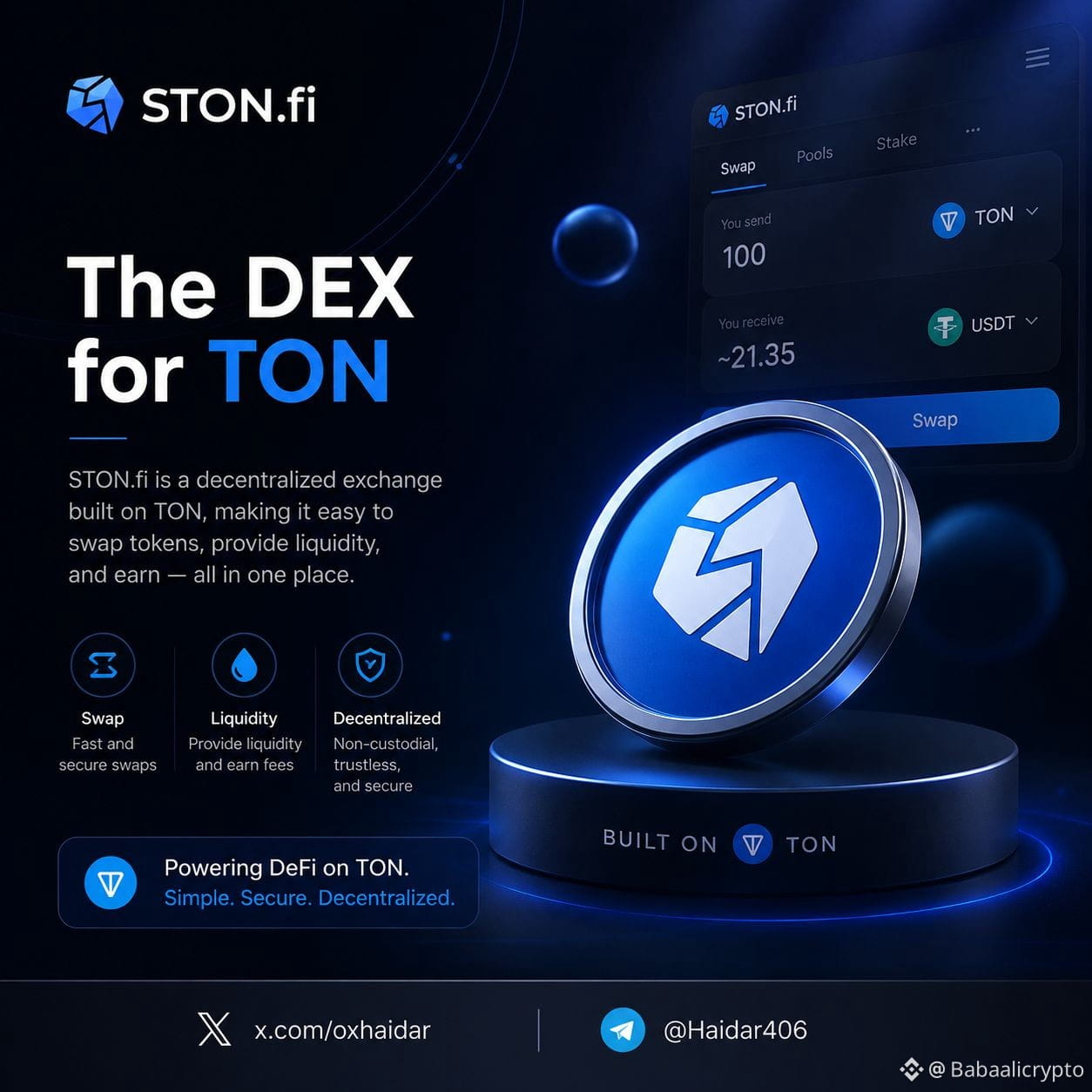
STON.fi ist eine dezentrale Börse (DEX), die auf TON basiert und es Nutzern ermöglicht, Token zu tauschen und mit Liquiditätspools zu interagieren, ohne auf eine zentrale Börse angewiesen zu sein.
Aber der wichtige Teil ist zu verstehen, was sich hinter der Oberfläche abspielt.
Liquiditätsanbieter stellen den Pools Assets zur Verfügung, während Nutzer mit diesen Pools interagieren, um Swaps auszuführen.
Das schafft einen wichtigen Baustein der DeFi-Infrastruktur für TON.
In meinen nächsten Beiträgen werde ich aufschlüsseln, wie STON.fi funktioniert, Liquiditätspools, das Swapping und die Risiken, die Nutzer verstehen sollten, bevor sie eine DEX verwenden.
#STON #TON #DEX
Was genau ist STON.fi, und warum ist das für das TON-Ökosystem wichtig?
STON.fi ist eine dezentrale Börse (DEX), die auf TON basiert und es Nutzern ermöglicht, Token zu tauschen und mit Liquiditätspools zu interagieren, ohne auf eine zentrale Börse angewiesen zu sein.
Aber der wichtige Teil ist zu verstehen, was sich hinter der Oberfläche abspielt.
Liquiditätsanbieter stellen den Pools Assets zur Verfügung, während Nutzer mit diesen Pools interagieren, um Swaps auszuführen.
Das schafft einen wichtigen Baustein der DeFi-Infrastruktur für TON.
In meinen nächsten Beiträgen werde ich aufschlüsseln, wie STON.fi funktioniert, Liquiditätspools, das Swapping und die Risiken, die Nutzer verstehen sollten, bevor sie eine DEX verwenden.
#STON #TON #DEX
STON.fi ist eine dezentrale Börse (DEX), die auf TON basiert und es Nutzern ermöglicht, Token zu tauschen und mit Liquiditätspools zu interagieren, ohne auf eine zentrale Börse angewiesen zu sein.
Aber der wichtige Teil ist zu verstehen, was sich hinter der Oberfläche abspielt.
Liquiditätsanbieter stellen den Pools Assets zur Verfügung, während Nutzer mit diesen Pools interagieren, um Swaps auszuführen.
Das schafft einen wichtigen Baustein der DeFi-Infrastruktur für TON.
In meinen nächsten Beiträgen werde ich aufschlüsseln, wie STON.fi funktioniert, Liquiditätspools, das Swapping und die Risiken, die Nutzer verstehen sollten, bevor sie eine DEX verwenden.
#STON #TON #DEX
1
80
$BABY Jeder Marktzyklus belohnt Projekte, die reale Probleme lösen – statt Trends hinterherzulaufen. Trustless Bitcoin-Vaults von @babylonlabs_io io konzentrieren sich darauf, Bitcoin durch transparente, vertrauensminimierte Gestaltung zu schützen. Nachhaltige Innovation wird sich immer gegen kurzfristigen Hype durchsetzen. $BABY #baby
$BABY Jeder Marktzyklus belohnt Projekte, die reale Probleme lösen – statt Trends hinterherzulaufen. Trustless Bitcoin-Vaults von @BabylonLabs_io io konzentrieren sich darauf, Bitcoin durch transparente, vertrauensminimierte Gestaltung zu schützen. Nachhaltige Innovation wird sich immer gegen kurzfristigen Hype durchsetzen. $BABY #baby
1
84
Anmelden und weiter Inhalte entdecken
Krypto-Nutzer weltweit auf Binance Square kennenlernen
⚡️ Bleib in Sachen Krypto stets am Puls.
💬 Die weltgrößte Kryptobörse vertraut darauf.
👍 Erhalte verlässliche Einblicke von verifizierten Creators.
E-Mail-Adresse/Telefonnummer
Trendthemen
QNTRises287%
1,281 Aufrufe
81 Kommentare
#QNTRises287%
🚀 QNT +287% — eine Bewegung, die Aufmerksamkeit verlangt.
Ein Anstieg dieser Schärfe kann einen plötzlichen Stimmungsumschwung im Markt, bei der Liquidität und im Handelsgeschehen widerspiegeln. Doch nach einem vertikalen Move kann die Volatilität schnell zunehmen.
Mein Fazit: Verfolge nicht einfach die Kerze—beobachte Volumen, Liquidität und ob QNT den Ausbruch durchhalten kann. 📊
#QNTRises287% #QNT #Crypto #Binance
$QNT
PALASH5
·0 Likes
·221 Aufrufe
TrumpRejectsAIRulesForVoluntaryAudits
5,366 Aufrufe
242 Kommentare
BitgetHotWalletBreachTiedToThirdPartySecurityFlaw
2,730 Aufrufe
182 Kommentare