

Dà Zǔ 大祖
2.3k Beiträge

Dà Zǔ 大祖
Melden
Nutzer blockieren
Crypto Trade Signals 📈 | BTC ETH SOL XRP | Futures Long & Short Setups | Market Structure & Smart Money Analysis
Trade eröffnen
Hochfrequenz-Trader
2.5 Jahre
350 Following
4.7K+ Follower
1.7K+ Like gegeben
Beiträge
Portfolio
Alle
Zitierungen
Videos
Live
·
--
Warum baut Dusk seinen eigenen finanziellen Vertragsstandard, statt einfach auf bestehende Smart-Contract-Modelle zurückzugreifen?
Zunächst dachte ich, die Antwort wäre recht einfach: Wenn Dusk Finanzanwendungen will, müssen Entwickler nur Smart Contracts mit besserem Datenschutz verwenden.
Doch mit Blick auf die Idee des „Confidential Security Contract“ glaube ich, dass sich dahinter eine tiefere Frage verbirgt.
Finanzielle Vermögenswerte verhalten sich nicht immer wie typische DeFi-Token. Eigentum, Übertragungen, Berechtigungen und Transaktionsdetails können Informationen umfassen, die nicht für jedermann auf einem öffentlichen Ledger sichtbar sein sollten.
Das verändert, was ein nützlicher Smart Contract überhaupt leisten können sollte.
Der spannende Teil von Dusks XSC-Ansatz ist, dass Vertraulichkeit nicht als etwas verstanden wird, das nur zusätzlich um die Anwendung herumgelegt wird. Sie ist Bestandteil des Vertragsmodells selbst.
Das bringt mich zu der Vermutung, dass XSC weniger darum geht, einen weiteren Smart-Contract-Standard zu schaffen, und mehr darum, zu definieren, wie finanzielle Verträge aussehen müssen, wenn Datenschutz und Verifikation zusammen funktionieren müssen.
Und genau diesen Aspekt finde ich besonders interessant, um ihn weiter zu beobachten.
Wenn regulierte Vermögenswerte onchain gehen, reicht es möglicherweise nicht aus, bestehende DeFi-Vertragsmuster einfach zu kopieren. Die größere Herausforderung könnte darin bestehen, Verträge so zu entwerfen, dass sie zu den Einschränkungen passen, die Finanzmärkte bereits haben.
Ich bin immer noch neugierig auf eine Sache: Kann XSC zu einem praktischen Standard werden, den Entwickler wirklich nutzen möchten, oder bleibt es vor allem eine spezialisierte Lösung für das finanzielle Ökosystem von Dusk?
Was könnte dazu führen, dass XSC am meisten Bedeutung bekommt? 👀
#dusk $DUSK @Dusk_Foundation
Warum baut Dusk seinen eigenen finanziellen Vertragsstandard, statt einfach auf bestehende Smart-Contract-Modelle zurückzugreifen?
Zunächst dachte ich, die Antwort wäre recht einfach: Wenn Dusk Finanzanwendungen will, müssen Entwickler nur Smart Contracts mit besserem Datenschutz verwenden.
Doch mit Blick auf die Idee des „Confidential Security Contract“ glaube ich, dass sich dahinter eine tiefere Frage verbirgt.
Finanzielle Vermögenswerte verhalten sich nicht immer wie typische DeFi-Token. Eigentum, Übertragungen, Berechtigungen und Transaktionsdetails können Informationen umfassen, die nicht für jedermann auf einem öffentlichen Ledger sichtbar sein sollten.
Das verändert, was ein nützlicher Smart Contract überhaupt leisten können sollte.
Der spannende Teil von Dusks XSC-Ansatz ist, dass Vertraulichkeit nicht als etwas verstanden wird, das nur zusätzlich um die Anwendung herumgelegt wird. Sie ist Bestandteil des Vertragsmodells selbst.
Das bringt mich zu der Vermutung, dass XSC weniger darum geht, einen weiteren Smart-Contract-Standard zu schaffen, und mehr darum, zu definieren, wie finanzielle Verträge aussehen müssen, wenn Datenschutz und Verifikation zusammen funktionieren müssen.
Und genau diesen Aspekt finde ich besonders interessant, um ihn weiter zu beobachten.
Wenn regulierte Vermögenswerte onchain gehen, reicht es möglicherweise nicht aus, bestehende DeFi-Vertragsmuster einfach zu kopieren. Die größere Herausforderung könnte darin bestehen, Verträge so zu entwerfen, dass sie zu den Einschränkungen passen, die Finanzmärkte bereits haben.
Ich bin immer noch neugierig auf eine Sache: Kann XSC zu einem praktischen Standard werden, den Entwickler wirklich nutzen möchten, oder bleibt es vor allem eine spezialisierte Lösung für das finanzielle Ökosystem von Dusk?
Was könnte dazu führen, dass XSC am meisten Bedeutung bekommt? 👀
#dusk $DUSK @Dusk
Zunächst dachte ich, die Antwort wäre recht einfach: Wenn Dusk Finanzanwendungen will, müssen Entwickler nur Smart Contracts mit besserem Datenschutz verwenden.
Doch mit Blick auf die Idee des „Confidential Security Contract“ glaube ich, dass sich dahinter eine tiefere Frage verbirgt.
Finanzielle Vermögenswerte verhalten sich nicht immer wie typische DeFi-Token. Eigentum, Übertragungen, Berechtigungen und Transaktionsdetails können Informationen umfassen, die nicht für jedermann auf einem öffentlichen Ledger sichtbar sein sollten.
Das verändert, was ein nützlicher Smart Contract überhaupt leisten können sollte.
Der spannende Teil von Dusks XSC-Ansatz ist, dass Vertraulichkeit nicht als etwas verstanden wird, das nur zusätzlich um die Anwendung herumgelegt wird. Sie ist Bestandteil des Vertragsmodells selbst.
Das bringt mich zu der Vermutung, dass XSC weniger darum geht, einen weiteren Smart-Contract-Standard zu schaffen, und mehr darum, zu definieren, wie finanzielle Verträge aussehen müssen, wenn Datenschutz und Verifikation zusammen funktionieren müssen.
Und genau diesen Aspekt finde ich besonders interessant, um ihn weiter zu beobachten.
Wenn regulierte Vermögenswerte onchain gehen, reicht es möglicherweise nicht aus, bestehende DeFi-Vertragsmuster einfach zu kopieren. Die größere Herausforderung könnte darin bestehen, Verträge so zu entwerfen, dass sie zu den Einschränkungen passen, die Finanzmärkte bereits haben.
Ich bin immer noch neugierig auf eine Sache: Kann XSC zu einem praktischen Standard werden, den Entwickler wirklich nutzen möchten, oder bleibt es vor allem eine spezialisierte Lösung für das finanzielle Ökosystem von Dusk?
Was könnte dazu führen, dass XSC am meisten Bedeutung bekommt? 👀
#dusk $DUSK @Dusk
🔐 Privacy
0%
🏦 Finance
100%
⚙️ Compliance
0%
🚀 Adoption
0%
1 Stimmen • Abstimmung beendet
11
2
100
·
--
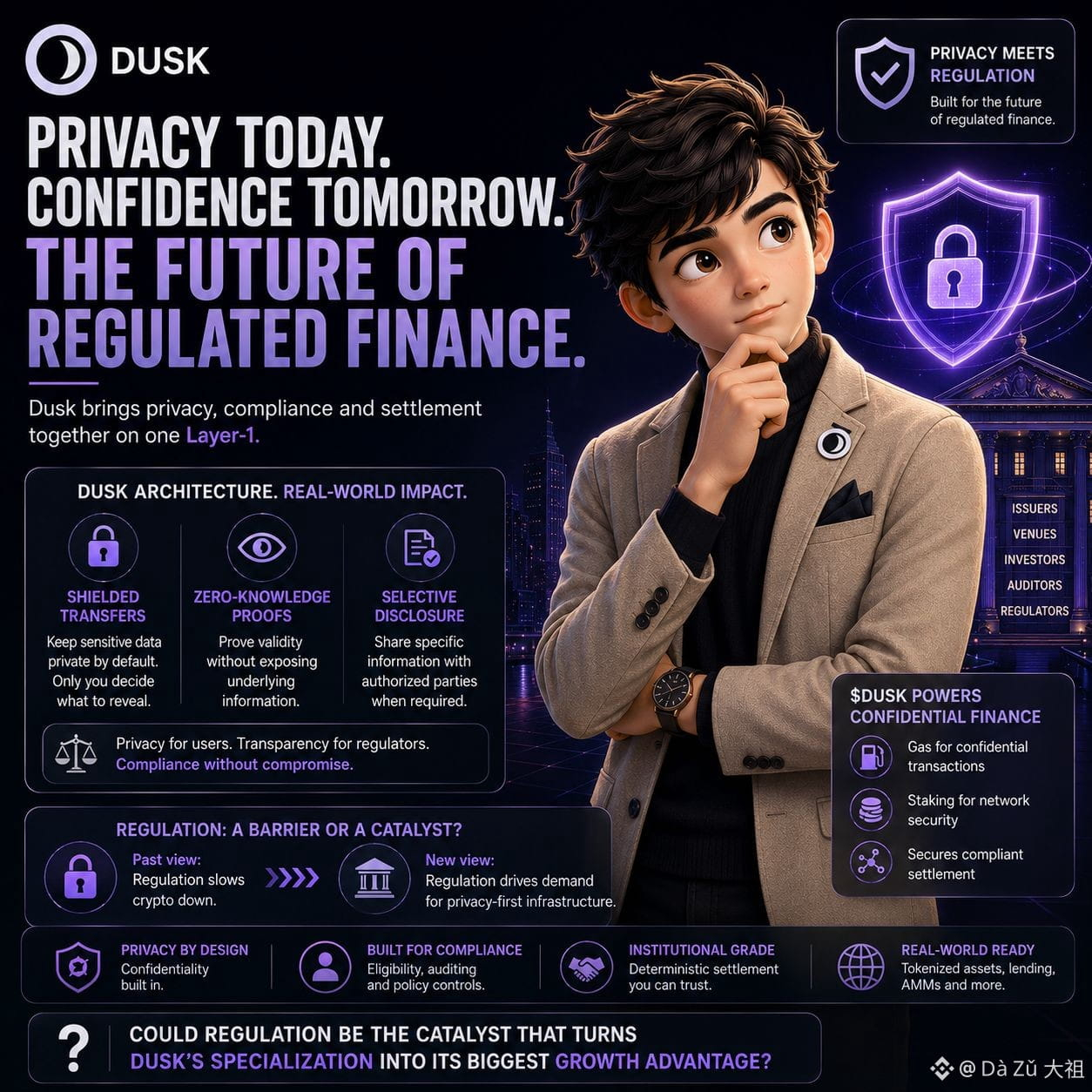
Früher dachte ich, dass Privatsphäre vor allem eine Krypto-Story ist.
Wenn man sich Dusk genauer ansieht, glaube ich, dass das den größeren Punkt verfehlt.
Für regulierte Finanzsysteme kann es zu einem operativen Problem werden, wenn jede Saldo-, Positions- und Transaktionsinformation auf ein öffentliches Ledger gestellt wird. Anleger benötigen möglicherweise Vertraulichkeit, während Emittenten, Handelsplätze und Prüfer weiterhin Zugriff auf bestimmte Informationen brauchen.
Das ist der spannende Teil an Dusk: Es kombiniert verschleierte Transaktionen, Zero-Knowledge-Proofs und selektive Offenlegung, sodass sensible Daten privat bleiben können, während autorisierte Parteien dennoch die Belege erhalten, die sie benötigen.
Und das verändert meine Sicht auf Regulierung.
Regulierung wird üblicherweise so dargestellt, als würde sie Krypto ausbremsen. Für Dusk könnten einige dieser Anforderungen sogar die Nachfrage nach Infrastruktur erzeugen, die auf Privatsphäre, Eignungskontrollen und konforme Abwicklung ausgerichtet ist.
Aber die richtige Architektur zu haben ist nicht dasselbe wie den Markt zu gewinnen.
Mein Eindruck: Dusk’s Vorteil liegt nicht einfach darin, eine „private Blockchain“ zu sein. Es geht darum, Privatsphäre mit der Art kompatibel zu machen, wie regulierte Märkte tatsächlich funktionieren.
Könnte Regulierung der Auslöser werden, der Dusk’s Spezialisierung in seinen größten Wachstumsvorteil verwandelt?
#dusk $DUSK @Dusk_Foundation
$PIVX $HEMI
Früher dachte ich, dass Privatsphäre vor allem eine Krypto-Story ist.
Wenn man sich Dusk genauer ansieht, glaube ich, dass das den größeren Punkt verfehlt.
Für regulierte Finanzsysteme kann es zu einem operativen Problem werden, wenn jede Saldo-, Positions- und Transaktionsinformation auf ein öffentliches Ledger gestellt wird. Anleger benötigen möglicherweise Vertraulichkeit, während Emittenten, Handelsplätze und Prüfer weiterhin Zugriff auf bestimmte Informationen brauchen.
Das ist der spannende Teil an Dusk: Es kombiniert verschleierte Transaktionen, Zero-Knowledge-Proofs und selektive Offenlegung, sodass sensible Daten privat bleiben können, während autorisierte Parteien dennoch die Belege erhalten, die sie benötigen.
Und das verändert meine Sicht auf Regulierung.
Regulierung wird üblicherweise so dargestellt, als würde sie Krypto ausbremsen. Für Dusk könnten einige dieser Anforderungen sogar die Nachfrage nach Infrastruktur erzeugen, die auf Privatsphäre, Eignungskontrollen und konforme Abwicklung ausgerichtet ist.
Aber die richtige Architektur zu haben ist nicht dasselbe wie den Markt zu gewinnen.
Mein Eindruck: Dusk’s Vorteil liegt nicht einfach darin, eine „private Blockchain“ zu sein. Es geht darum, Privatsphäre mit der Art kompatibel zu machen, wie regulierte Märkte tatsächlich funktionieren.
Könnte Regulierung der Auslöser werden, der Dusk’s Spezialisierung in seinen größten Wachstumsvorteil verwandelt?
#dusk $DUSK @Dusk
$PIVX $HEMI
Wenn man sich Dusk genauer ansieht, glaube ich, dass das den größeren Punkt verfehlt.
Für regulierte Finanzsysteme kann es zu einem operativen Problem werden, wenn jede Saldo-, Positions- und Transaktionsinformation auf ein öffentliches Ledger gestellt wird. Anleger benötigen möglicherweise Vertraulichkeit, während Emittenten, Handelsplätze und Prüfer weiterhin Zugriff auf bestimmte Informationen brauchen.
Das ist der spannende Teil an Dusk: Es kombiniert verschleierte Transaktionen, Zero-Knowledge-Proofs und selektive Offenlegung, sodass sensible Daten privat bleiben können, während autorisierte Parteien dennoch die Belege erhalten, die sie benötigen.
Und das verändert meine Sicht auf Regulierung.
Regulierung wird üblicherweise so dargestellt, als würde sie Krypto ausbremsen. Für Dusk könnten einige dieser Anforderungen sogar die Nachfrage nach Infrastruktur erzeugen, die auf Privatsphäre, Eignungskontrollen und konforme Abwicklung ausgerichtet ist.
Aber die richtige Architektur zu haben ist nicht dasselbe wie den Markt zu gewinnen.
Mein Eindruck: Dusk’s Vorteil liegt nicht einfach darin, eine „private Blockchain“ zu sein. Es geht darum, Privatsphäre mit der Art kompatibel zu machen, wie regulierte Märkte tatsächlich funktionieren.
Könnte Regulierung der Auslöser werden, der Dusk’s Spezialisierung in seinen größten Wachstumsvorteil verwandelt?
#dusk $DUSK @Dusk
$PIVX $HEMI
1
101
·
--
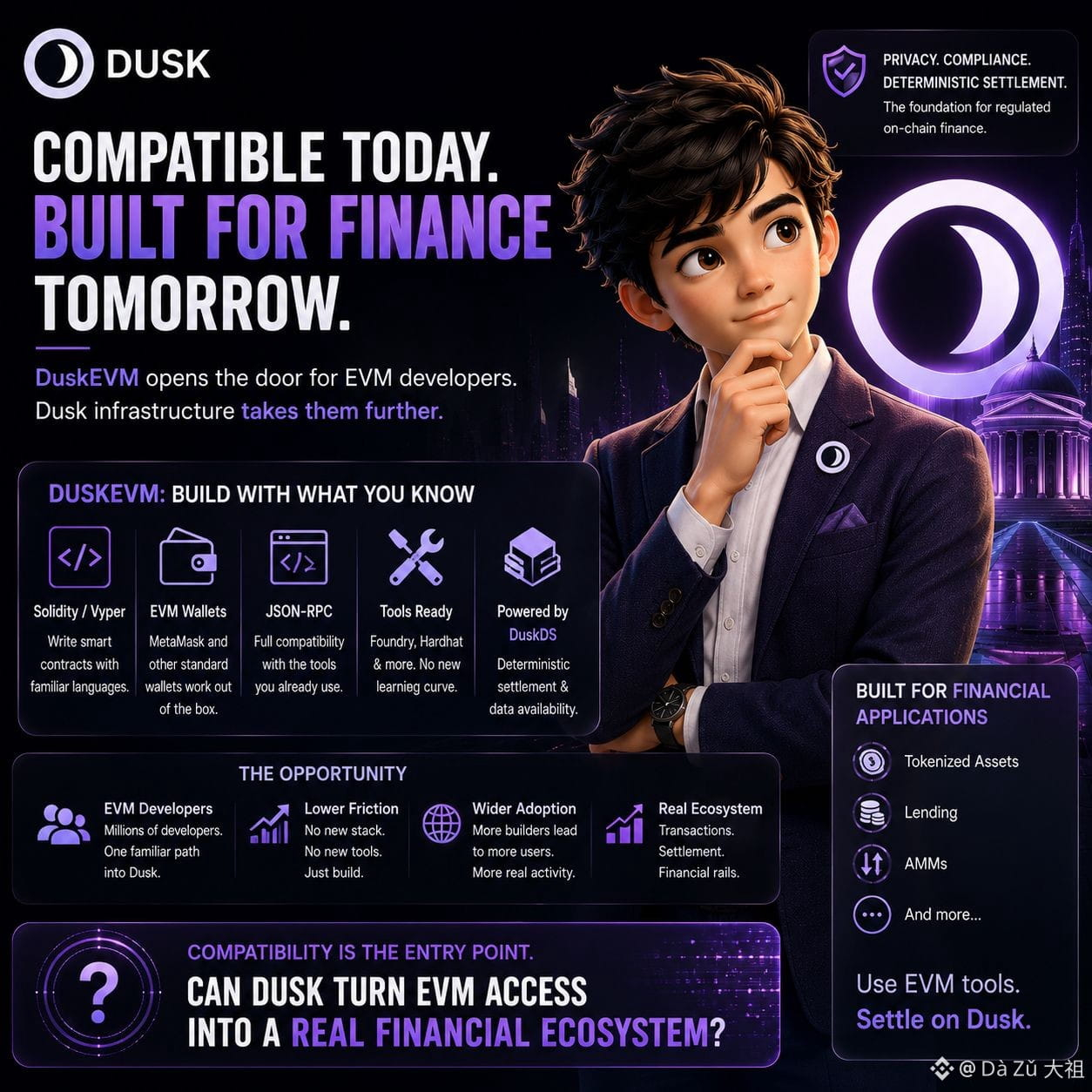
Ich kam immer wieder auf eine Frage zurück, mit $DUSK : Was passiert, wenn eine spezialisierte L1 eine der größten Hürden für Entwickler beseitigt?
Dusk EVM gibt Buildern eine vertraute Route ins Netzwerk: Solidity/Vyper, Standard-EVM-Wallets, JSON-RPC sowie Tools wie Foundry und Hardhat. Darunter übernimmt Dusk DS den Zahlungsverkehr und die Datenverfügbarkeit.
Das ist wichtig, weil Entwickler die EVM-Toolchain nicht aufgeben müssen, nur um mit Dusk' Finanzinfrastruktur zu experimentieren.
Und dabei geht es nicht nur darum, eine weitere Welle generischer dApps anzuziehen. Dusk verweist ganz konkret auf tokenisierte Assets, Lending, AMMs und andere Finanzanwendungen, die EVM-Tools nutzen können, während sie über Dusk abwickeln.
Aber Kompatibilität ist nur der Einstiegspunkt.
Der eigentliche Test ist, ob diese vertrauten Tools dazu führen, dass tatsächlich gebaut wird, dass Nutzer es tatsächlich verwenden und dass Transaktionen tatsächlich im Netzwerk abgewickelt werden.
Meine Einschätzung: DuskEVM könnte den Entwickler-Zulauf für Dusk deutlich vergrößern. Aber die größere Frage ist, ob EVM-Kompatibilität diesen Zugang in ein echtes Finanz-Ökosystem verwandelt.
Kann Dusk mehr sein als eine spezialisierte L1, indem es der bestehenden EVM-Welt leichter macht, auf seinen Schienen zu bauen?
#dusk @Dusk_Foundation
$CYS $COW
Ich kam immer wieder auf eine Frage zurück, mit $DUSK : Was passiert, wenn eine spezialisierte L1 eine der größten Hürden für Entwickler beseitigt?
Dusk EVM gibt Buildern eine vertraute Route ins Netzwerk: Solidity/Vyper, Standard-EVM-Wallets, JSON-RPC sowie Tools wie Foundry und Hardhat. Darunter übernimmt Dusk DS den Zahlungsverkehr und die Datenverfügbarkeit.
Das ist wichtig, weil Entwickler die EVM-Toolchain nicht aufgeben müssen, nur um mit Dusk' Finanzinfrastruktur zu experimentieren.
Und dabei geht es nicht nur darum, eine weitere Welle generischer dApps anzuziehen. Dusk verweist ganz konkret auf tokenisierte Assets, Lending, AMMs und andere Finanzanwendungen, die EVM-Tools nutzen können, während sie über Dusk abwickeln.
Aber Kompatibilität ist nur der Einstiegspunkt.
Der eigentliche Test ist, ob diese vertrauten Tools dazu führen, dass tatsächlich gebaut wird, dass Nutzer es tatsächlich verwenden und dass Transaktionen tatsächlich im Netzwerk abgewickelt werden.
Meine Einschätzung: DuskEVM könnte den Entwickler-Zulauf für Dusk deutlich vergrößern. Aber die größere Frage ist, ob EVM-Kompatibilität diesen Zugang in ein echtes Finanz-Ökosystem verwandelt.
Kann Dusk mehr sein als eine spezialisierte L1, indem es der bestehenden EVM-Welt leichter macht, auf seinen Schienen zu bauen?
#dusk @Dusk
$CYS $COW
Dusk EVM gibt Buildern eine vertraute Route ins Netzwerk: Solidity/Vyper, Standard-EVM-Wallets, JSON-RPC sowie Tools wie Foundry und Hardhat. Darunter übernimmt Dusk DS den Zahlungsverkehr und die Datenverfügbarkeit.
Das ist wichtig, weil Entwickler die EVM-Toolchain nicht aufgeben müssen, nur um mit Dusk' Finanzinfrastruktur zu experimentieren.
Und dabei geht es nicht nur darum, eine weitere Welle generischer dApps anzuziehen. Dusk verweist ganz konkret auf tokenisierte Assets, Lending, AMMs und andere Finanzanwendungen, die EVM-Tools nutzen können, während sie über Dusk abwickeln.
Aber Kompatibilität ist nur der Einstiegspunkt.
Der eigentliche Test ist, ob diese vertrauten Tools dazu führen, dass tatsächlich gebaut wird, dass Nutzer es tatsächlich verwenden und dass Transaktionen tatsächlich im Netzwerk abgewickelt werden.
Meine Einschätzung: DuskEVM könnte den Entwickler-Zulauf für Dusk deutlich vergrößern. Aber die größere Frage ist, ob EVM-Kompatibilität diesen Zugang in ein echtes Finanz-Ökosystem verwandelt.
Kann Dusk mehr sein als eine spezialisierte L1, indem es der bestehenden EVM-Welt leichter macht, auf seinen Schienen zu bauen?
#dusk @Dusk
$CYS $COW
2
1
94
·
--
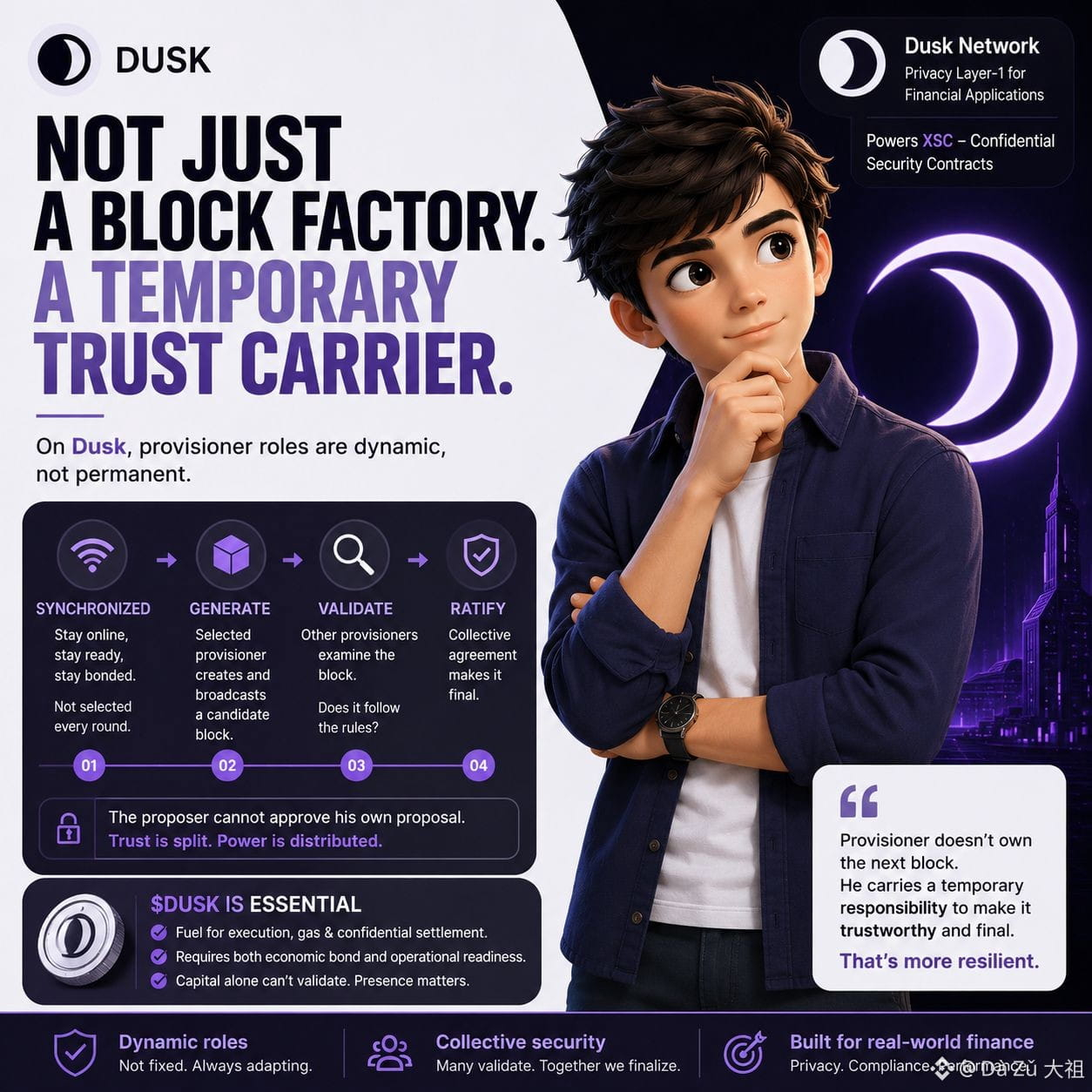
Für mich hat der Dämmerungs-Validator-Rolle endlich Bedeutung gegeben.
Auf den meisten Ketten gilt: Validator = Blockfabrik. Immer derselbe Job.
Bei Dusk ist der Provisioner nicht an eine dauerhafte Aufgabe gebunden. Du könntest eine ganze Runde damit verbringen, nur synchron zu bleiben, den Knoten online zu halten, bereit. In der nächsten Runde wählt das Protokoll dich aus, um beim Finalisieren des nächsten Blocks zu helfen.
Dieser Wandel ist wichtig.
Als Generator ist man nur vorübergehend im Einsatz. Ja, wenn man ausgewählt wird, erstellt und sendet man einen Kandidatenblock, aber das heißt nicht, dass man die Geschichte festlegt. Andere Provisioner müssen ihn prüfen. Das ist Validierung: Hält er sich an die Regeln? Dann die Ratifizierung: Stimmen wir darin überein, dass er endgültig ist?
Ich mag diese Trennung. Die Person, die den Vorschlag macht, darf ihren eigenen Vorschlag nicht genehmigen. Das Vertrauen wird aufgeteilt.
Also ist $DUSK hier kein passiver Staking-Asset. Dusk ist eine Privacy-Layer-1 für Finanzanwendungen, die das XSC-Standard-Ökosystem für vertrauliche Smart Contracts antreibt, und es braucht Teilnehmer, die sowohl wirtschaftlich gebunden als auch operativ bereit sind. Kapital allein kann nicht validieren, kann nicht zum richtigen Zeitpunkt senden.
Kurz gesagt: Der Provisioner besitzt den nächsten Block nicht. Er trägt nur die vorübergehende Verantwortung, ihn vertrauenswürdig und final zu machen. Ist das nicht widerstandsfähiger?
#dusk @Dusk_Foundation
$VELVET $AKE
Für mich hat der Dämmerungs-Validator-Rolle endlich Bedeutung gegeben.
Auf den meisten Ketten gilt: Validator = Blockfabrik. Immer derselbe Job.
Bei Dusk ist der Provisioner nicht an eine dauerhafte Aufgabe gebunden. Du könntest eine ganze Runde damit verbringen, nur synchron zu bleiben, den Knoten online zu halten, bereit. In der nächsten Runde wählt das Protokoll dich aus, um beim Finalisieren des nächsten Blocks zu helfen.
Dieser Wandel ist wichtig.
Als Generator ist man nur vorübergehend im Einsatz. Ja, wenn man ausgewählt wird, erstellt und sendet man einen Kandidatenblock, aber das heißt nicht, dass man die Geschichte festlegt. Andere Provisioner müssen ihn prüfen. Das ist Validierung: Hält er sich an die Regeln? Dann die Ratifizierung: Stimmen wir darin überein, dass er endgültig ist?
Ich mag diese Trennung. Die Person, die den Vorschlag macht, darf ihren eigenen Vorschlag nicht genehmigen. Das Vertrauen wird aufgeteilt.
Also ist $DUSK hier kein passiver Staking-Asset. Dusk ist eine Privacy-Layer-1 für Finanzanwendungen, die das XSC-Standard-Ökosystem für vertrauliche Smart Contracts antreibt, und es braucht Teilnehmer, die sowohl wirtschaftlich gebunden als auch operativ bereit sind. Kapital allein kann nicht validieren, kann nicht zum richtigen Zeitpunkt senden.
Kurz gesagt: Der Provisioner besitzt den nächsten Block nicht. Er trägt nur die vorübergehende Verantwortung, ihn vertrauenswürdig und final zu machen. Ist das nicht widerstandsfähiger?
#dusk @Dusk
$VELVET $AKE
Auf den meisten Ketten gilt: Validator = Blockfabrik. Immer derselbe Job.
Bei Dusk ist der Provisioner nicht an eine dauerhafte Aufgabe gebunden. Du könntest eine ganze Runde damit verbringen, nur synchron zu bleiben, den Knoten online zu halten, bereit. In der nächsten Runde wählt das Protokoll dich aus, um beim Finalisieren des nächsten Blocks zu helfen.
Dieser Wandel ist wichtig.
Als Generator ist man nur vorübergehend im Einsatz. Ja, wenn man ausgewählt wird, erstellt und sendet man einen Kandidatenblock, aber das heißt nicht, dass man die Geschichte festlegt. Andere Provisioner müssen ihn prüfen. Das ist Validierung: Hält er sich an die Regeln? Dann die Ratifizierung: Stimmen wir darin überein, dass er endgültig ist?
Ich mag diese Trennung. Die Person, die den Vorschlag macht, darf ihren eigenen Vorschlag nicht genehmigen. Das Vertrauen wird aufgeteilt.
Also ist $DUSK hier kein passiver Staking-Asset. Dusk ist eine Privacy-Layer-1 für Finanzanwendungen, die das XSC-Standard-Ökosystem für vertrauliche Smart Contracts antreibt, und es braucht Teilnehmer, die sowohl wirtschaftlich gebunden als auch operativ bereit sind. Kapital allein kann nicht validieren, kann nicht zum richtigen Zeitpunkt senden.
Kurz gesagt: Der Provisioner besitzt den nächsten Block nicht. Er trägt nur die vorübergehende Verantwortung, ihn vertrauenswürdig und final zu machen. Ist das nicht widerstandsfähiger?
#dusk @Dusk
$VELVET $AKE
3
365
·
--
Ich habe immer wieder gefragt, warum Privatsphäre im Onchain-Finanzbereich wichtig ist.
Die meisten Chains sind vollständig transparent. Super für DeFi-Degens, aber schlecht für ein Unternehmen, das eine Anleihe tokenisiert. Kein Institut möchte, dass Wettbewerber ihre Bilanzen und Positionen sehen.
Da hat es bei mir Klick gemacht: Dusk Network.🫣
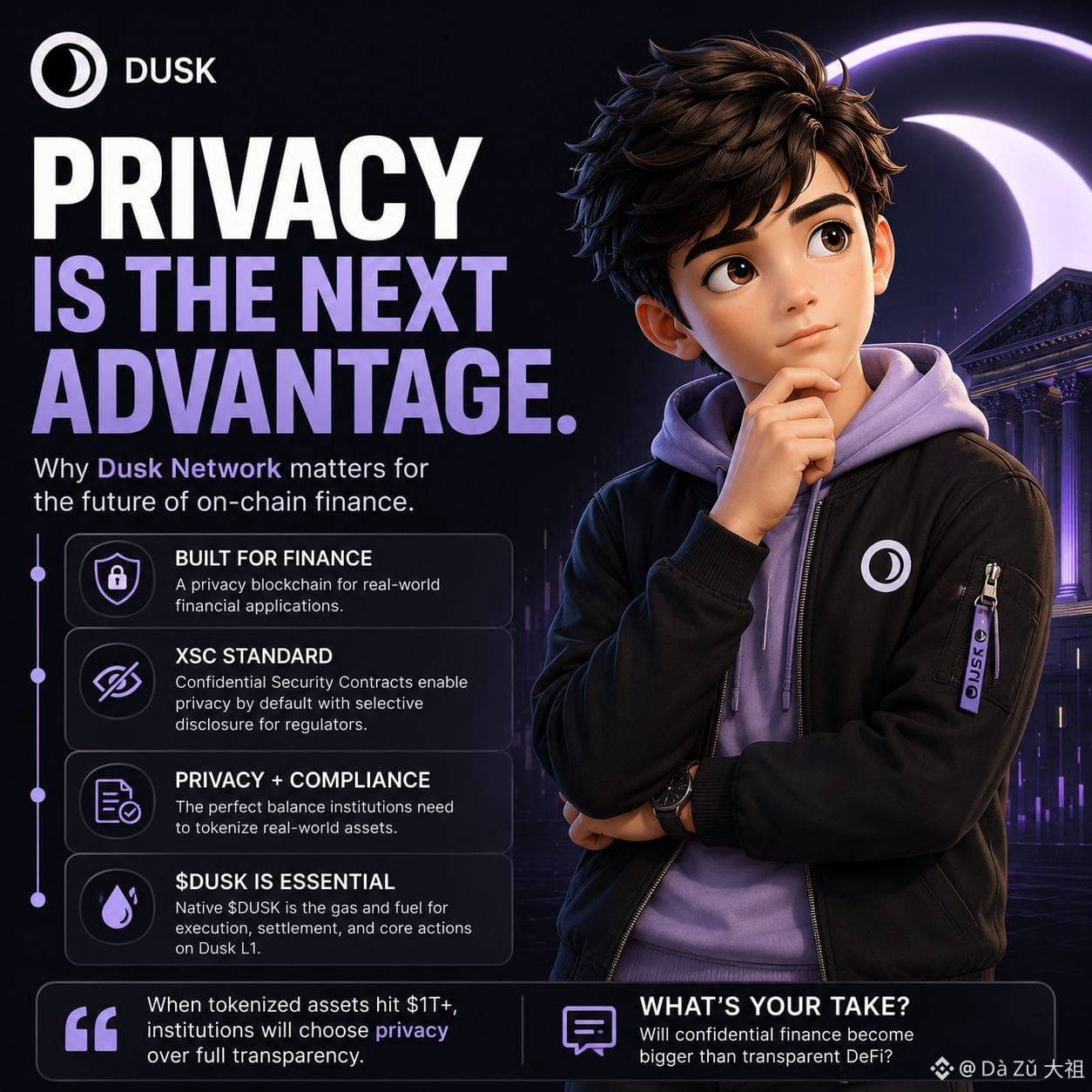
Dusk bezeichnet sich als Privacy-Blockchain, die für Finanzanwendungen gebaut wurde. Es ist eine Layer-1-Blockchain, die den Confidential Security Contract (XSC)-Standard antreibt und vertrauliche Smart Contracts unterstützt.
XSC ist clever. Es hält Transaktionen standardmäßig privat, ermöglicht aber eine selektive Offenlegung gegenüber Regulierungsbehörden, wenn sie benötigt wird. So bekommt man Privatsphäre UND Compliance zur gleichen Zeit. Genau diese Lücke stoppt Real-World-Assets.
Und $DUSK liegt mitten darin. Nicht als zusätzlicher Reward-Token. Sondern als Treibstoff für Ausführung, Gas und vertrauliche Abwicklung. Eine Version von DUSK auf einer anderen Chain mag denselben Preis haben, aber nur das native DUSK auf Dusk L1 wird vom Protokoll selbst für seine Kernaktionen anerkannt.
Für mich ist das der Unterschied zwischen einem Token, der nur gelistet ist, und einem Token, der tatsächlich gebraucht wird.
Ich glaube, dass Institutionen Privatsphäre der vollständigen Transparenz vorziehen werden, sobald tokenisierte Assets eine Billion überschreiten. Wie siehst du diesen Wandel?
Glaubst du, dass vertrauliche Finanzen größer werden als transparentes DeFi?
#dusk @Dusk_Foundation $SNXXB $COTI
Ich habe immer wieder gefragt, warum Privatsphäre im Onchain-Finanzbereich wichtig ist.
Die meisten Chains sind vollständig transparent. Super für DeFi-Degens, aber schlecht für ein Unternehmen, das eine Anleihe tokenisiert. Kein Institut möchte, dass Wettbewerber ihre Bilanzen und Positionen sehen.
Da hat es bei mir Klick gemacht: Dusk Network.🫣
Dusk bezeichnet sich als Privacy-Blockchain, die für Finanzanwendungen gebaut wurde. Es ist eine Layer-1-Blockchain, die den Confidential Security Contract (XSC)-Standard antreibt und vertrauliche Smart Contracts unterstützt.
XSC ist clever. Es hält Transaktionen standardmäßig privat, ermöglicht aber eine selektive Offenlegung gegenüber Regulierungsbehörden, wenn sie benötigt wird. So bekommt man Privatsphäre UND Compliance zur gleichen Zeit. Genau diese Lücke stoppt Real-World-Assets.
Und $DUSK liegt mitten darin. Nicht als zusätzlicher Reward-Token. Sondern als Treibstoff für Ausführung, Gas und vertrauliche Abwicklung. Eine Version von DUSK auf einer anderen Chain mag denselben Preis haben, aber nur das native DUSK auf Dusk L1 wird vom Protokoll selbst für seine Kernaktionen anerkannt.
Für mich ist das der Unterschied zwischen einem Token, der nur gelistet ist, und einem Token, der tatsächlich gebraucht wird.
Ich glaube, dass Institutionen Privatsphäre der vollständigen Transparenz vorziehen werden, sobald tokenisierte Assets eine Billion überschreiten. Wie siehst du diesen Wandel?
Glaubst du, dass vertrauliche Finanzen größer werden als transparentes DeFi?
#dusk @Dusk $SNXXB $COTI
Die meisten Chains sind vollständig transparent. Super für DeFi-Degens, aber schlecht für ein Unternehmen, das eine Anleihe tokenisiert. Kein Institut möchte, dass Wettbewerber ihre Bilanzen und Positionen sehen.
Da hat es bei mir Klick gemacht: Dusk Network.🫣
Dusk bezeichnet sich als Privacy-Blockchain, die für Finanzanwendungen gebaut wurde. Es ist eine Layer-1-Blockchain, die den Confidential Security Contract (XSC)-Standard antreibt und vertrauliche Smart Contracts unterstützt.
XSC ist clever. Es hält Transaktionen standardmäßig privat, ermöglicht aber eine selektive Offenlegung gegenüber Regulierungsbehörden, wenn sie benötigt wird. So bekommt man Privatsphäre UND Compliance zur gleichen Zeit. Genau diese Lücke stoppt Real-World-Assets.
Und $DUSK liegt mitten darin. Nicht als zusätzlicher Reward-Token. Sondern als Treibstoff für Ausführung, Gas und vertrauliche Abwicklung. Eine Version von DUSK auf einer anderen Chain mag denselben Preis haben, aber nur das native DUSK auf Dusk L1 wird vom Protokoll selbst für seine Kernaktionen anerkannt.
Für mich ist das der Unterschied zwischen einem Token, der nur gelistet ist, und einem Token, der tatsächlich gebraucht wird.
Ich glaube, dass Institutionen Privatsphäre der vollständigen Transparenz vorziehen werden, sobald tokenisierte Assets eine Billion überschreiten. Wie siehst du diesen Wandel?
Glaubst du, dass vertrauliche Finanzen größer werden als transparentes DeFi?
#dusk @Dusk $SNXXB $COTI
2
1
97
·
--
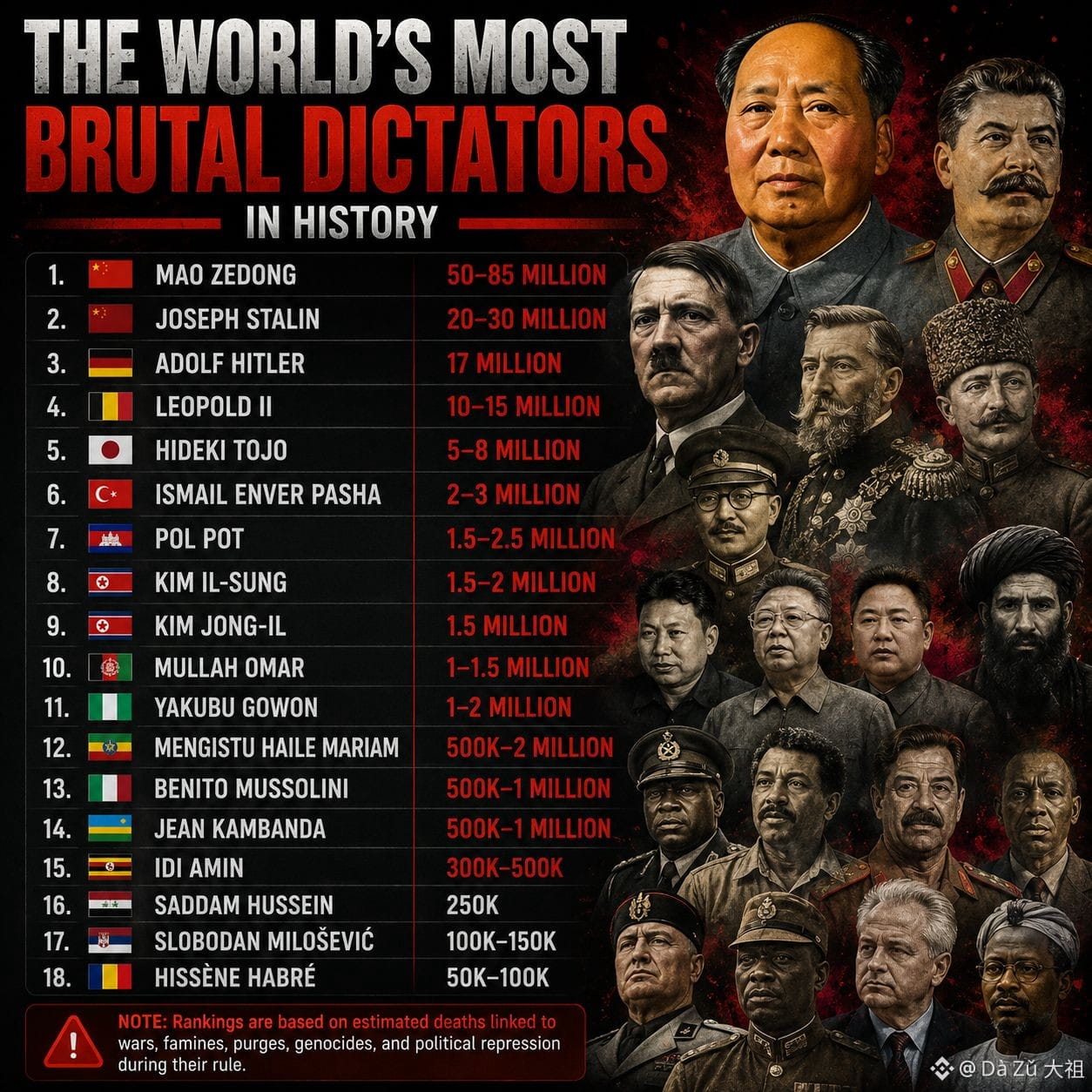
Die brutalsten Diktatoren der Welt in der Geschichte
1.
🇨🇳
Mao Zedong - 50–85 Millionen
2.
🇷🇺
Joseph Stalin - 20–30 Millionen
3.
🇩🇪
Adolf Hitler - 17 Millionen
4.
🇧🇪
Leopold II - 10–15 Millionen
5.
🇯🇵
Hideki Tojo - 5–8 Millionen
6.
🇹🇷
İsmail Enver Pascha - 2–3 Millionen
7.
🇰🇭
Pol Pot - 1,5–2,5 Millionen
8.
🇰🇵
Kim Il-sung - 1,5–2 Millionen
9.
🇰🇵
Kim Jong-il - 1,5 Millionen
10.
🇦🇫
Mullah Omar - 1–1,5 Millionen
11.
🇳🇬
Yakubu Gowon - 1–2 Millionen
12.
🇪🇹
Mengistu Haile Mariam - 500.000–2 Millionen
13.
🇮🇹
Benito Mussolini - 500.000–1 Million
14.
🇷🇼
Jean Kambanda - 500.000–1 Million
15.
🇺🇬
Idi Amin - 300.000–500.000
16.
🇮🇶
Saddam Hussein - 250.000
17.
🇷🇸
Slobodan Milošević - 100.000–150.000
18.
🇹🇩
Hissène Habré - 50.000–100.000
Hinweis: Die Rangliste basiert auf geschätzten Todesfällen, die mit Kriegen, Hungersnöten, Säuberungen, Völkermorden und politischer Repression während ihrer Herrschaft in Verbindung stehen.
$1000CAT #BIP110ForkSignalingExpectedThisWeekend #VIXFallsToJanuaryLow #IraqOilExportsFall75% #IraqOilExportsFall75% #ThuneFilesClarityActClotureMotion
Die brutalsten Diktatoren der Welt in der Geschichte
1.
🇨🇳
Mao Zedong - 50–85 Millionen
2.
🇷🇺
Joseph Stalin - 20–30 Millionen
3.
🇩🇪
Adolf Hitler - 17 Millionen
4.
🇧🇪
Leopold II - 10–15 Millionen
5.
🇯🇵
Hideki Tojo - 5–8 Millionen
6.
🇹🇷
İsmail Enver Pascha - 2–3 Millionen
7.
🇰🇭
Pol Pot - 1,5–2,5 Millionen
8.
🇰🇵
Kim Il-sung - 1,5–2 Millionen
9.
🇰🇵
Kim Jong-il - 1,5 Millionen
10.
🇦🇫
Mullah Omar - 1–1,5 Millionen
11.
🇳🇬
Yakubu Gowon - 1–2 Millionen
12.
🇪🇹
Mengistu Haile Mariam - 500.000–2 Millionen
13.
🇮🇹
Benito Mussolini - 500.000–1 Million
14.
🇷🇼
Jean Kambanda - 500.000–1 Million
15.
🇺🇬
Idi Amin - 300.000–500.000
16.
🇮🇶
Saddam Hussein - 250.000
17.
🇷🇸
Slobodan Milošević - 100.000–150.000
18.
🇹🇩
Hissène Habré - 50.000–100.000
Hinweis: Die Rangliste basiert auf geschätzten Todesfällen, die mit Kriegen, Hungersnöten, Säuberungen, Völkermorden und politischer Repression während ihrer Herrschaft in Verbindung stehen.
$1000CAT #BIP110ForkSignalingExpectedThisWeekend #VIXFallsToJanuaryLow #IraqOilExportsFall75% #IraqOilExportsFall75% #ThuneFilesClarityActClotureMotion
1.
🇨🇳
Mao Zedong - 50–85 Millionen
2.
🇷🇺
Joseph Stalin - 20–30 Millionen
3.
🇩🇪
Adolf Hitler - 17 Millionen
4.
🇧🇪
Leopold II - 10–15 Millionen
5.
🇯🇵
Hideki Tojo - 5–8 Millionen
6.
🇹🇷
İsmail Enver Pascha - 2–3 Millionen
7.
🇰🇭
Pol Pot - 1,5–2,5 Millionen
8.
🇰🇵
Kim Il-sung - 1,5–2 Millionen
9.
🇰🇵
Kim Jong-il - 1,5 Millionen
10.
🇦🇫
Mullah Omar - 1–1,5 Millionen
11.
🇳🇬
Yakubu Gowon - 1–2 Millionen
12.
🇪🇹
Mengistu Haile Mariam - 500.000–2 Millionen
13.
🇮🇹
Benito Mussolini - 500.000–1 Million
14.
🇷🇼
Jean Kambanda - 500.000–1 Million
15.
🇺🇬
Idi Amin - 300.000–500.000
16.
🇮🇶
Saddam Hussein - 250.000
17.
🇷🇸
Slobodan Milošević - 100.000–150.000
18.
🇹🇩
Hissène Habré - 50.000–100.000
Hinweis: Die Rangliste basiert auf geschätzten Todesfällen, die mit Kriegen, Hungersnöten, Säuberungen, Völkermorden und politischer Repression während ihrer Herrschaft in Verbindung stehen.
$1000CAT #BIP110ForkSignalingExpectedThisWeekend #VIXFallsToJanuaryLow #IraqOilExportsFall75% #IraqOilExportsFall75% #ThuneFilesClarityActClotureMotion
1
1
143
·
--
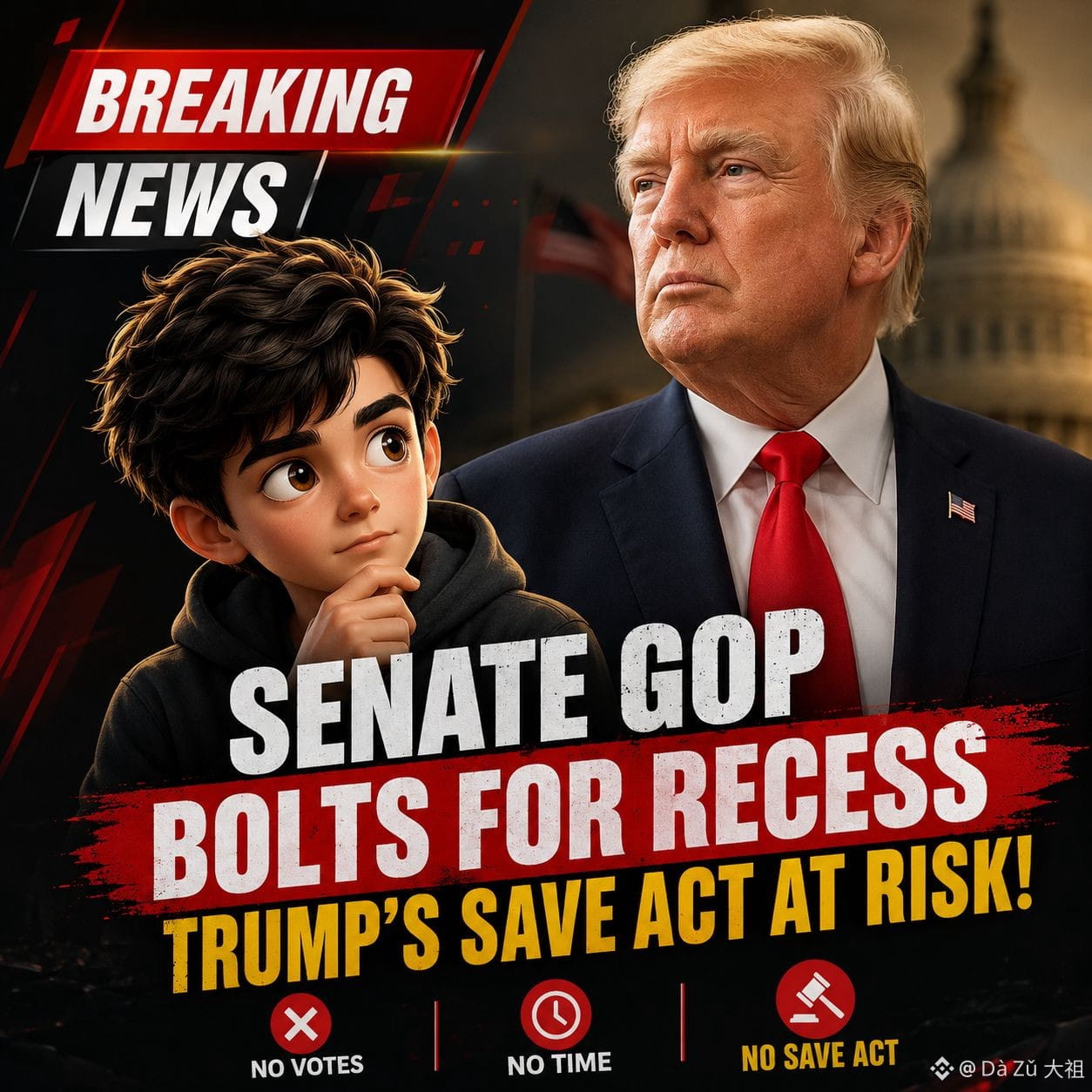
BREAKING: Der Senat hat Trumps wichtigsten Gesetzentwurf gerade aufgegeben und ist abgereist
Trumps eigene Partei hat gerade seinen größten Plan gekillt und ist in den Urlaub gegangen.
Senatsrepublikaner sind für die August-Pause aus Washington abgezogen - OHNE Trumps SAVE America Act zu verabschieden, das Gesetz zur Integrität der Wähler, das Trump seit Wochen fordert.
So ist es wirklich passiert:
1. Das Versprechen: Hardliner wie Sen. Mike Lee versprachen, den Abzug zu BLOCKIEREN, bis SAVE verabschiedet ist. Ergebnis? Jeder Koffer war gepackt, jeder Flug gebucht. Sie alle sind gegangen.
2. Die Verzögerung: Der Gesetzentwurf ist jetzt bis spätestens Mitte September tot. Und der Kalender ist noch schlimmer - eine weitere einmonatige Pause steht im Oktober an, direkt vor den Midterms. Die Zeit läuft ab.
3. Die 150-Milliarden-Dollar-Wendung: Republikaner haben außerdem eine Abstimmung zur Budget-Abstimmung per Versöhnung (reconciliation) im Wert von 150 Milliarden auf Eis gelegt. Warum? Trump selbst hat eingegriffen, weil er befürchtete, dass es im Plenum scheitern würde. Der ganze Plan war, reconciliation zu nutzen, um den Filibuster zu umgehen und SAVE zu verabschieden. Jetzt sind BEIDE Vorhaben auf unbestimmte Zeit verschoben.
Also gerade jetzt - Kein SAVE-Gesetz, keine Budget-Abstimmung, kein Senat in DC.
Ist das ein kluger Schachzug, um eine gescheiterte Abstimmung zu vermeiden, oder hat der Senat Trumps Agenda verraten?
Wird der SAVE America Act im September passieren oder ist er für immer tot?
Schreib YES, wenn du denkst, dass es durchgeht, NO, wenn du denkst, dass es vorbei ist.
$TUT $RE $1000CAT
#VIXFallsToJanuaryLow #BIP110ForkSignalingExpectedThisWeekend #ThuneFilesClarityActClotureMotion #FedSplitOnRateHikesDeepens
BREAKING: Der Senat hat Trumps wichtigsten Gesetzentwurf gerade aufgegeben und ist abgereist
Trumps eigene Partei hat gerade seinen größten Plan gekillt und ist in den Urlaub gegangen.
Senatsrepublikaner sind für die August-Pause aus Washington abgezogen - OHNE Trumps SAVE America Act zu verabschieden, das Gesetz zur Integrität der Wähler, das Trump seit Wochen fordert.
So ist es wirklich passiert:
1. Das Versprechen: Hardliner wie Sen. Mike Lee versprachen, den Abzug zu BLOCKIEREN, bis SAVE verabschiedet ist. Ergebnis? Jeder Koffer war gepackt, jeder Flug gebucht. Sie alle sind gegangen.
2. Die Verzögerung: Der Gesetzentwurf ist jetzt bis spätestens Mitte September tot. Und der Kalender ist noch schlimmer - eine weitere einmonatige Pause steht im Oktober an, direkt vor den Midterms. Die Zeit läuft ab.
3. Die 150-Milliarden-Dollar-Wendung: Republikaner haben außerdem eine Abstimmung zur Budget-Abstimmung per Versöhnung (reconciliation) im Wert von 150 Milliarden auf Eis gelegt. Warum? Trump selbst hat eingegriffen, weil er befürchtete, dass es im Plenum scheitern würde. Der ganze Plan war, reconciliation zu nutzen, um den Filibuster zu umgehen und SAVE zu verabschieden. Jetzt sind BEIDE Vorhaben auf unbestimmte Zeit verschoben.
Also gerade jetzt - Kein SAVE-Gesetz, keine Budget-Abstimmung, kein Senat in DC.
Ist das ein kluger Schachzug, um eine gescheiterte Abstimmung zu vermeiden, oder hat der Senat Trumps Agenda verraten?
Wird der SAVE America Act im September passieren oder ist er für immer tot?
Schreib YES, wenn du denkst, dass es durchgeht, NO, wenn du denkst, dass es vorbei ist.
$TUT $RE $1000CAT
#VIXFallsToJanuaryLow #BIP110ForkSignalingExpectedThisWeekend #ThuneFilesClarityActClotureMotion #FedSplitOnRateHikesDeepens
Trumps eigene Partei hat gerade seinen größten Plan gekillt und ist in den Urlaub gegangen.
Senatsrepublikaner sind für die August-Pause aus Washington abgezogen - OHNE Trumps SAVE America Act zu verabschieden, das Gesetz zur Integrität der Wähler, das Trump seit Wochen fordert.
So ist es wirklich passiert:
1. Das Versprechen: Hardliner wie Sen. Mike Lee versprachen, den Abzug zu BLOCKIEREN, bis SAVE verabschiedet ist. Ergebnis? Jeder Koffer war gepackt, jeder Flug gebucht. Sie alle sind gegangen.
2. Die Verzögerung: Der Gesetzentwurf ist jetzt bis spätestens Mitte September tot. Und der Kalender ist noch schlimmer - eine weitere einmonatige Pause steht im Oktober an, direkt vor den Midterms. Die Zeit läuft ab.
3. Die 150-Milliarden-Dollar-Wendung: Republikaner haben außerdem eine Abstimmung zur Budget-Abstimmung per Versöhnung (reconciliation) im Wert von 150 Milliarden auf Eis gelegt. Warum? Trump selbst hat eingegriffen, weil er befürchtete, dass es im Plenum scheitern würde. Der ganze Plan war, reconciliation zu nutzen, um den Filibuster zu umgehen und SAVE zu verabschieden. Jetzt sind BEIDE Vorhaben auf unbestimmte Zeit verschoben.
Also gerade jetzt - Kein SAVE-Gesetz, keine Budget-Abstimmung, kein Senat in DC.
Ist das ein kluger Schachzug, um eine gescheiterte Abstimmung zu vermeiden, oder hat der Senat Trumps Agenda verraten?
Wird der SAVE America Act im September passieren oder ist er für immer tot?
Schreib YES, wenn du denkst, dass es durchgeht, NO, wenn du denkst, dass es vorbei ist.
$TUT $RE $1000CAT
#VIXFallsToJanuaryLow #BIP110ForkSignalingExpectedThisWeekend #ThuneFilesClarityActClotureMotion #FedSplitOnRateHikesDeepens
1
368
·
--
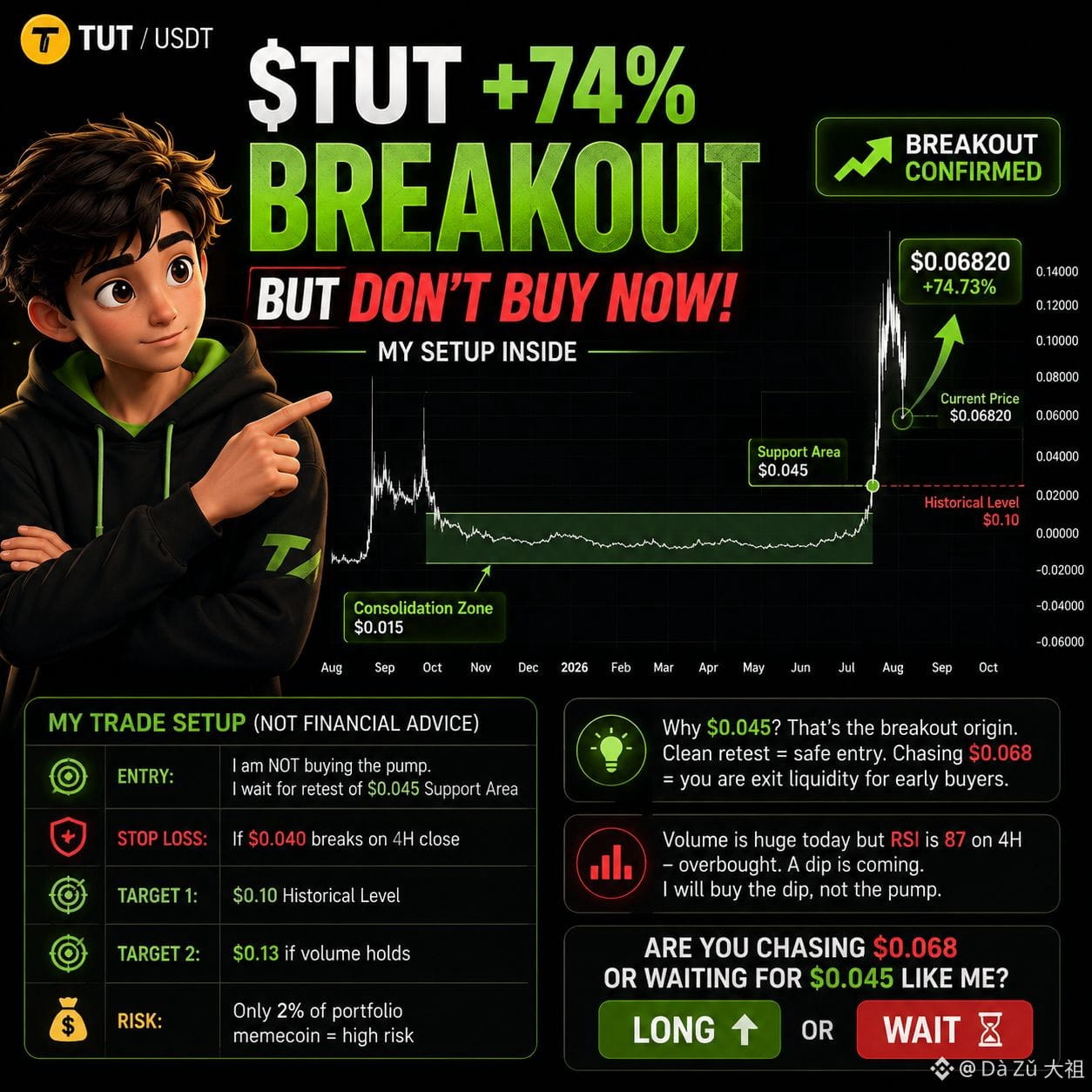
$TUT +74% BREAKOUT - Aber kauf jetzt nicht! Mein Setup innen
HÖR AUF ZU JAGEN! TUT ist nach 9 Monaten Schlaf gerade +74% gepumpt.
Schau dir diesen Chart an – 9 Monate Konsolidierung bei 0,015 $ und jetzt
BREAKOUT BESTÄTIGT auf 0,06820 $.
90% werden jetzt kaufen und sich fangen lassen. Hier ist mein Plan:
MEIN TRADING-SETUP (Keine Finanzberatung):
Einstieg: Ich kaufe NICHT den Pump. Ich warte auf den Retest des 0,045 $ Support-Bereichs
Stop Loss: Wenn 0,040 $ auf einem 4H-Closing bricht
Ziel 1: 0,10 $ Historisches Niveau
Ziel 2: 0,13 $, wenn das Volumen hält
Risiko: Nur 2% des Portfolios – Memecoin = hohes Risiko
Warum 0,045 $? Das ist der Ursprung des Breakouts. Sauberer Retest = sicherer Einstieg. 0,068 $ hinterherlaufen = du bist Exit Liquidity für die frühen Käufer.
Das Volumen ist heute riesig, aber RSI ist auf 87 im 4H – überkauft. Ein Dip kommt.
Ich kaufe den Dip, nicht den Pump.
Verfolgst du 0,068 $ oder wartest du auf 0,045 $ wie ich? Kommentiere
LONG oder WAIT
$RE $MMT
#BIP110ForkSignalingExpectedThisWeekend #VIXFallsToJanuaryLow #IraqOilExportsFall75%
$TUT +74% BREAKOUT - Aber kauf jetzt nicht! Mein Setup innen
HÖR AUF ZU JAGEN! TUT ist nach 9 Monaten Schlaf gerade +74% gepumpt.
Schau dir diesen Chart an – 9 Monate Konsolidierung bei 0,015 $ und jetzt
BREAKOUT BESTÄTIGT auf 0,06820 $.
90% werden jetzt kaufen und sich fangen lassen. Hier ist mein Plan:
MEIN TRADING-SETUP (Keine Finanzberatung):
Einstieg: Ich kaufe NICHT den Pump. Ich warte auf den Retest des 0,045 $ Support-Bereichs
Stop Loss: Wenn 0,040 $ auf einem 4H-Closing bricht
Ziel 1: 0,10 $ Historisches Niveau
Ziel 2: 0,13 $, wenn das Volumen hält
Risiko: Nur 2% des Portfolios – Memecoin = hohes Risiko
Warum 0,045 $? Das ist der Ursprung des Breakouts. Sauberer Retest = sicherer Einstieg. 0,068 $ hinterherlaufen = du bist Exit Liquidity für die frühen Käufer.
Das Volumen ist heute riesig, aber RSI ist auf 87 im 4H – überkauft. Ein Dip kommt.
Ich kaufe den Dip, nicht den Pump.
Verfolgst du 0,068 $ oder wartest du auf 0,045 $ wie ich? Kommentiere
LONG oder WAIT
$RE $MMT
#BIP110ForkSignalingExpectedThisWeekend #VIXFallsToJanuaryLow #IraqOilExportsFall75%
HÖR AUF ZU JAGEN! TUT ist nach 9 Monaten Schlaf gerade +74% gepumpt.
Schau dir diesen Chart an – 9 Monate Konsolidierung bei 0,015 $ und jetzt
BREAKOUT BESTÄTIGT auf 0,06820 $.
90% werden jetzt kaufen und sich fangen lassen. Hier ist mein Plan:
MEIN TRADING-SETUP (Keine Finanzberatung):
Einstieg: Ich kaufe NICHT den Pump. Ich warte auf den Retest des 0,045 $ Support-Bereichs
Stop Loss: Wenn 0,040 $ auf einem 4H-Closing bricht
Ziel 1: 0,10 $ Historisches Niveau
Ziel 2: 0,13 $, wenn das Volumen hält
Risiko: Nur 2% des Portfolios – Memecoin = hohes Risiko
Warum 0,045 $? Das ist der Ursprung des Breakouts. Sauberer Retest = sicherer Einstieg. 0,068 $ hinterherlaufen = du bist Exit Liquidity für die frühen Käufer.
Das Volumen ist heute riesig, aber RSI ist auf 87 im 4H – überkauft. Ein Dip kommt.
Ich kaufe den Dip, nicht den Pump.
Verfolgst du 0,068 $ oder wartest du auf 0,045 $ wie ich? Kommentiere
LONG oder WAIT
$RE $MMT
#BIP110ForkSignalingExpectedThisWeekend #VIXFallsToJanuaryLow #IraqOilExportsFall75%
296
·
--
Artikel
STOPP – Wenn du BTC hältst, wirst du in 48 Stunden Geld verlieren, wenn du das verpasstWenn du Bitcoin hältst, hör für 60 Sekunden auf zu scrollen. Dieser 4H-Chart wird dir helfen.
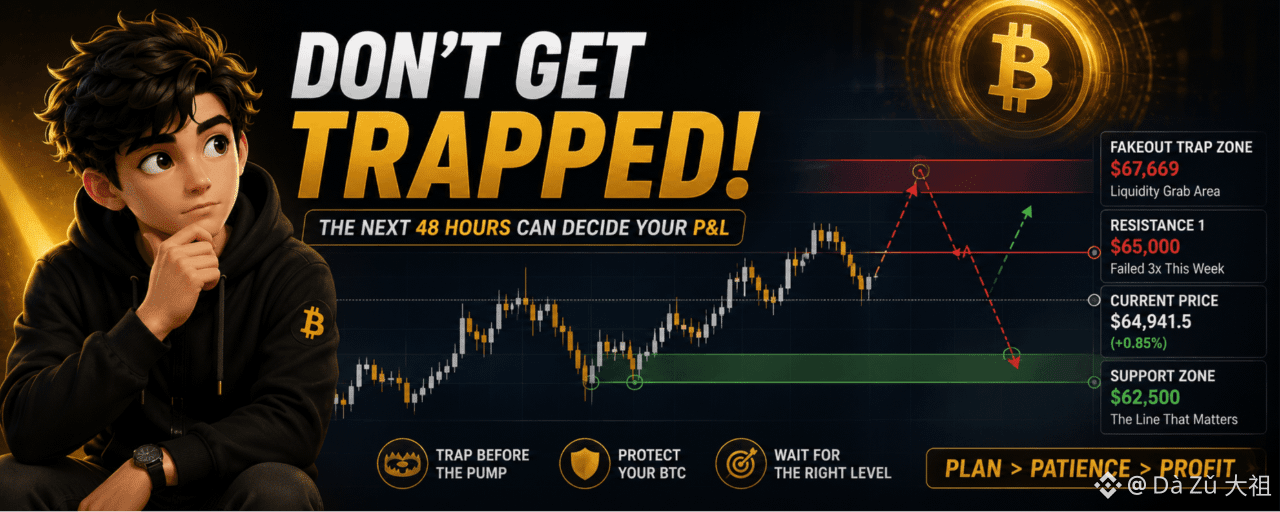
Alle denken, dass BTC direkt auf 70.000 $ von 64.941 $ zusteuert. Die Grafik sagt, dass sie gleich in eine Falle tappen.
Hier ist meine ausführliche Analyse für die nächste Woche:
Aktueller Preis: 64.941,5 $ (+0,85 %)
Die entscheidenden Levels:
Widerstand 1: 65.000 $ – BTC ist hier diese Woche bereits 3-mal gescheitert. Kein Volumen = kein Ausbruch.
Fakeout-Fallen-Zone: 67.669 $ – Schau dir meinen Chart an. Beim letzten Mal, als wir auf 67.669 $ gewischt haben, sind wir sofort um 5K abgetaucht. Das ist eine Liquidity-Grab-Zone, um Short-Positionen auszupressen.
STOPP – Wenn du BTC hältst, wirst du in 48 Stunden Geld verlieren, wenn du das verpasst
Wenn du Bitcoin hältst, hör für 60 Sekunden auf zu scrollen. Dieser 4H-Chart wird dir helfen.
Alle denken, dass BTC direkt auf 70.000 $ von 64.941 $ zusteuert. Die Grafik sagt, dass sie gleich in eine Falle tappen.
Hier ist meine ausführliche Analyse für die nächste Woche:
Aktueller Preis: 64.941,5 $ (+0,85 %)
Die entscheidenden Levels:
Widerstand 1: 65.000 $ – BTC ist hier diese Woche bereits 3-mal gescheitert. Kein Volumen = kein Ausbruch.
Fakeout-Fallen-Zone: 67.669 $ – Schau dir meinen Chart an. Beim letzten Mal, als wir auf 67.669 $ gewischt haben, sind wir sofort um 5K abgetaucht. Das ist eine Liquidity-Grab-Zone, um Short-Positionen auszupressen.
Alle denken, dass BTC direkt auf 70.000 $ von 64.941 $ zusteuert. Die Grafik sagt, dass sie gleich in eine Falle tappen.
Hier ist meine ausführliche Analyse für die nächste Woche:
Aktueller Preis: 64.941,5 $ (+0,85 %)
Die entscheidenden Levels:
Widerstand 1: 65.000 $ – BTC ist hier diese Woche bereits 3-mal gescheitert. Kein Volumen = kein Ausbruch.
Fakeout-Fallen-Zone: 67.669 $ – Schau dir meinen Chart an. Beim letzten Mal, als wir auf 67.669 $ gewischt haben, sind wir sofort um 5K abgetaucht. Das ist eine Liquidity-Grab-Zone, um Short-Positionen auszupressen.
105
·
--
Bullisch
Es hat mich diese Woche beim Tracking der Zahlen ehrlich gesagt wirklich getroffen: Zu sehen, wie Milliarden an Kapital in Babylon-Vaults fließen, ist schon verrückt, aber das eigentliche Gespräch geht nicht um den TVL-„Flex“—es geht um die stille Governance-Lücke. Wir feiern weiterhin, dass endlich Tausende von BTC aus dem Abseits kommen, als schwere wirtschaftliche Sicherheiten dienen und Finality-Provider für Rendite absichern. Aber als ich diese Daten nachverfolgt habe, ist mir ein seltsamer Widerspruch im Dual-Asset-Modell aufgefallen: Dein zugrunde liegendes Bitcoin liefert das rohe Sicherheits-Rückgrat, doch es hat null Stimmgewicht oder Mitbestimmung bei Protokoll-Parametern. Die gesamte eigentliche Entscheidungsmacht bleibt strikt im nativen Token-Ökosystem des $BABY -Speichers eingeschlossen. Das wirkt wie ein massiver Design-Kompromiss: Unser Kapital erledigt die ganze Schwerstarbeit, während das „Steuern“ des Protokolls komplett in fremden Händen liegt. Das lässt mich langfristig fragen—bekommt gestaktes BTC jemals wirklich eine Stimme, oder trennen wir Yield-Nützlichkeit dauerhaft von der Protokoll-Governance? Teile deine Gedanken dazu, wie sich die Tokenomics mit zwei Assets weiterentwickeln sollten! 👇
@babylonlabs_io #baby
Soll gestaktes Bitcoin in Babylon Protokoll-Stimmrechte erhalten?
Es hat mich diese Woche beim Tracking der Zahlen ehrlich gesagt wirklich getroffen: Zu sehen, wie Milliarden an Kapital in Babylon-Vaults fließen, ist schon verrückt, aber das eigentliche Gespräch geht nicht um den TVL-„Flex“—es geht um die stille Governance-Lücke. Wir feiern weiterhin, dass endlich Tausende von BTC aus dem Abseits kommen, als schwere wirtschaftliche Sicherheiten dienen und Finality-Provider für Rendite absichern. Aber als ich diese Daten nachverfolgt habe, ist mir ein seltsamer Widerspruch im Dual-Asset-Modell aufgefallen: Dein zugrunde liegendes Bitcoin liefert das rohe Sicherheits-Rückgrat, doch es hat null Stimmgewicht oder Mitbestimmung bei Protokoll-Parametern. Die gesamte eigentliche Entscheidungsmacht bleibt strikt im nativen Token-Ökosystem des $BABY -Speichers eingeschlossen. Das wirkt wie ein massiver Design-Kompromiss: Unser Kapital erledigt die ganze Schwerstarbeit, während das „Steuern“ des Protokolls komplett in fremden Händen liegt. Das lässt mich langfristig fragen—bekommt gestaktes BTC jemals wirklich eine Stimme, oder trennen wir Yield-Nützlichkeit dauerhaft von der Protokoll-Governance? Teile deine Gedanken dazu, wie sich die Tokenomics mit zwei Assets weiterentwickeln sollten! 👇
@BabylonLabs_io #baby
Soll gestaktes Bitcoin in Babylon Protokoll-Stimmrechte erhalten?
@BabylonLabs_io #baby
Soll gestaktes Bitcoin in Babylon Protokoll-Stimmrechte erhalten?
BTC
0%
BABY
0%
BOTH
0%
0 Stimmen • Abstimmung beendet
3
1
161
·
--
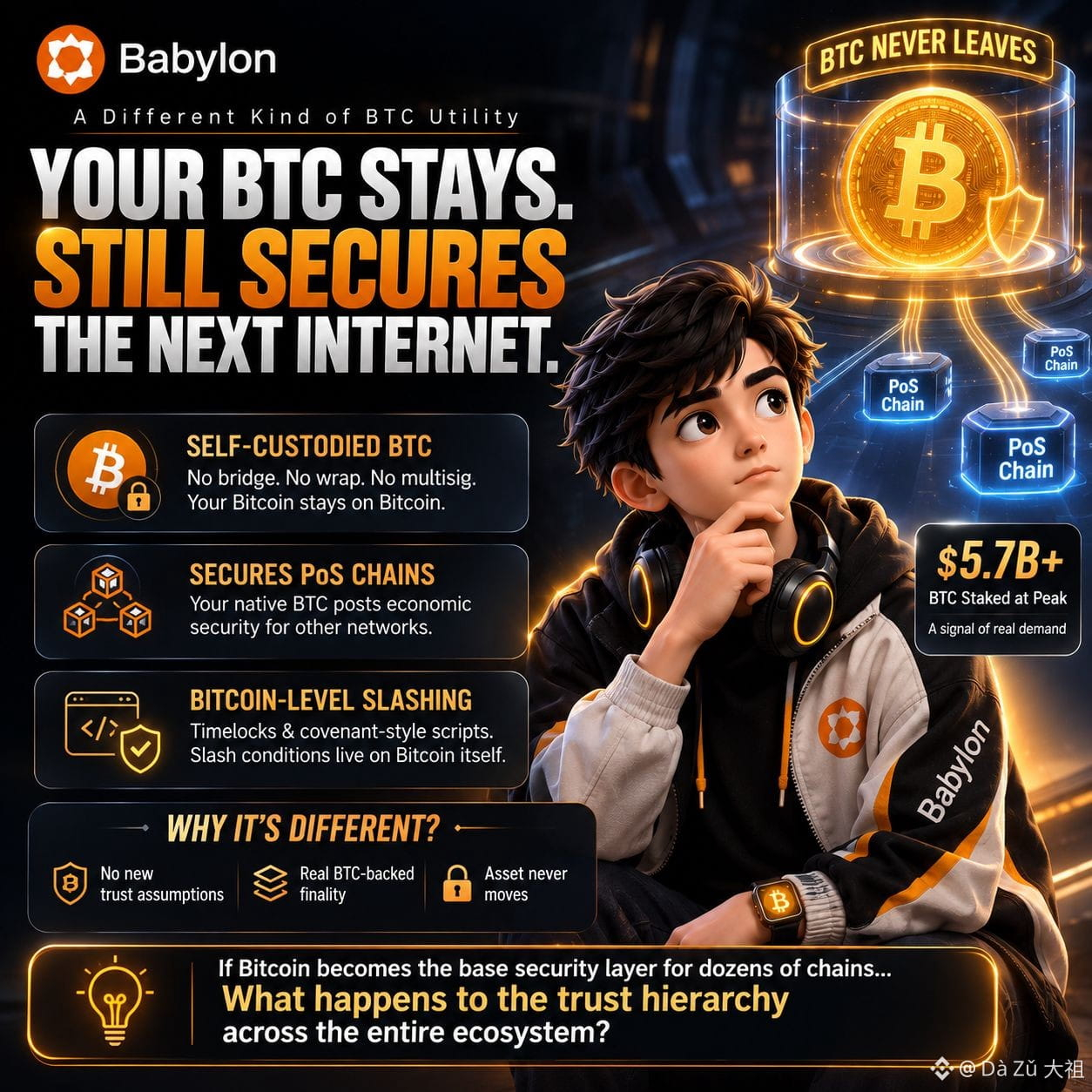
Ich bin heute wieder die Babylon-Thesis durchgegangen — nicht das Pitch-Deck, sondern den eigentlichen Mechanismus. $BABY fordert keine BTC-Holder dazu auf, zu brücken, zu tokenisieren (zu „wrapen“) oder Schlüssel an ein Multisig herauszugeben. Es ermöglicht, dass Bitcoin genau dort bleibt, wo er ist: on-chain, selbstverwahrt. Gleichzeitig dient genau dieser BTC als wirtschaftliche Sicherheitsgrundlage für PoS-Chains. Das Asset bewegt sich nie. Das Vertrauensannahme-Modell wird nie erweitert. Das ist wirklich ein anderes Design. Die meisten „BTC in DeFi“-Storys verlangen erst das Tokenisieren und dann das Vertrauen in die Bridge. Babylon überspringt diese Schicht komplett — die Slash-Bedingungen leben direkt auf Bitcoin selbst, über Timelocks und Covenant-ähnliche Scripts. Die PoS-Chain erhält echte, BTC-gestützte Finalität. Der Staker behält die Verwahrung durchgehend. $5.7B an gestaktem BTC beim Peak-Cap war nicht nur „number-go-up“. Es war ein Signal dafür, dass Holder bereit waren, natives BTC einzusetzen, ohne es zu wrappen. Diese Bereitschaft verschwindet nicht — sie sucht sich nur die richtigen Schienen. Die Frage, mit der ich mich immer wieder beschäftige, ist: Wenn Bitcoin zur Basisschicht der Sicherheit für Dutzende von PoS-Chains wird — was macht das mit der Vertrauenshierarchie im gesamten Ökosystem? Ich denke noch über die Zweitorder-Effekte dabei nach.
#baby @babylonlabs_io
$HOME $HYPER
#USToCancelIranAttackSubjectToDeal #GoldTradesAbove$4000 #BitcoinMiningDifficultyFalls14%FromYearHigh #SECPausesQBTCBitcoinOptionsApproval
Ich bin heute wieder die Babylon-Thesis durchgegangen — nicht das Pitch-Deck, sondern den eigentlichen Mechanismus. $BABY fordert keine BTC-Holder dazu auf, zu brücken, zu tokenisieren (zu „wrapen“) oder Schlüssel an ein Multisig herauszugeben. Es ermöglicht, dass Bitcoin genau dort bleibt, wo er ist: on-chain, selbstverwahrt. Gleichzeitig dient genau dieser BTC als wirtschaftliche Sicherheitsgrundlage für PoS-Chains. Das Asset bewegt sich nie. Das Vertrauensannahme-Modell wird nie erweitert. Das ist wirklich ein anderes Design. Die meisten „BTC in DeFi“-Storys verlangen erst das Tokenisieren und dann das Vertrauen in die Bridge. Babylon überspringt diese Schicht komplett — die Slash-Bedingungen leben direkt auf Bitcoin selbst, über Timelocks und Covenant-ähnliche Scripts. Die PoS-Chain erhält echte, BTC-gestützte Finalität. Der Staker behält die Verwahrung durchgehend. $5.7B an gestaktem BTC beim Peak-Cap war nicht nur „number-go-up“. Es war ein Signal dafür, dass Holder bereit waren, natives BTC einzusetzen, ohne es zu wrappen. Diese Bereitschaft verschwindet nicht — sie sucht sich nur die richtigen Schienen. Die Frage, mit der ich mich immer wieder beschäftige, ist: Wenn Bitcoin zur Basisschicht der Sicherheit für Dutzende von PoS-Chains wird — was macht das mit der Vertrauenshierarchie im gesamten Ökosystem? Ich denke noch über die Zweitorder-Effekte dabei nach.
#baby @BabylonLabs_io
$HOME $HYPER
#USToCancelIranAttackSubjectToDeal #GoldTradesAbove$4000 #BitcoinMiningDifficultyFalls14%FromYearHigh #SECPausesQBTCBitcoinOptionsApproval
#baby @BabylonLabs_io
$HOME $HYPER
#USToCancelIranAttackSubjectToDeal #GoldTradesAbove$4000 #BitcoinMiningDifficultyFalls14%FromYearHigh #SECPausesQBTCBitcoinOptionsApproval
2
1
145
·
--
Bitcoin hat jahrelang bewiesen, dass es das härteste Geld im Krypto-Universum sein kann.
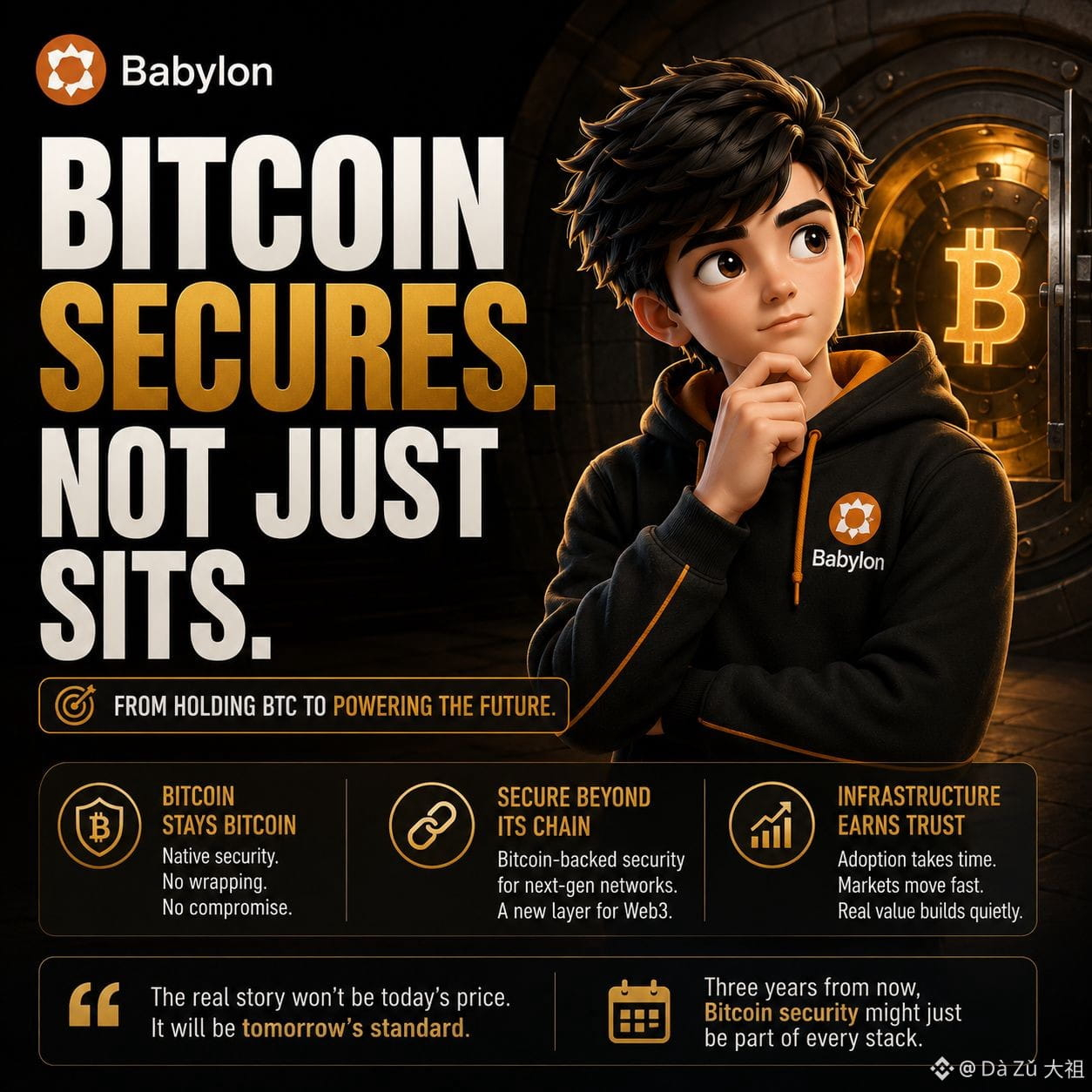
Die interessante Frage ist nun nicht, ob Bitcoin wertvoll ist. Sondern ob Bitcoin nützlich werden kann, ohne sein eigenes Sicherheitsmodell aufzugeben. Deshalb habe ich heute tatsächlich die Dokumentation von Babylon gelesen. Das Vault-Design hat mich angesprochen, aber nicht wegen der Technik an sich. Es brachte mich dazu, über einen größeren Wandel nachzudenken. Wenn Bitcoin dabei helfen kann, andere Netzwerke abzusichern und gleichzeitig auf seiner eigenen Kette zu bleiben, dann verschiebt sich die Diskussion von „BTC halten“ zu „BTC in Arbeit bringen“.
Ob Babylon zum Standard wird, hängt von etwas ab, das viel größer ist als der heutige Token-Preis. Entscheidend ist, ob Entwickler weiter rund um die von Bitcoin abgesicherte Sicherheit bauen, statt sie als Experiment zu behandeln. Infrastruktur schafft Vertrauen normalerweise nur langsam.
Märkte bewegen sich oft schneller als die Einführung. Die wahre Geschichte liegt vielleicht nicht im Kursdiagramm von heute. Vielleicht ist es die Frage, ob neue Ketten in drei Jahren einfach davon ausgehen, dass die Bitcoin-Sicherheit Teil des Stacks ist. Genau diesen Trend beobachte ich.
#baby $BABY @babylonlabs_io
$IDOL $BTW
Bitcoin hat jahrelang bewiesen, dass es das härteste Geld im Krypto-Universum sein kann.
Die interessante Frage ist nun nicht, ob Bitcoin wertvoll ist. Sondern ob Bitcoin nützlich werden kann, ohne sein eigenes Sicherheitsmodell aufzugeben. Deshalb habe ich heute tatsächlich die Dokumentation von Babylon gelesen. Das Vault-Design hat mich angesprochen, aber nicht wegen der Technik an sich. Es brachte mich dazu, über einen größeren Wandel nachzudenken. Wenn Bitcoin dabei helfen kann, andere Netzwerke abzusichern und gleichzeitig auf seiner eigenen Kette zu bleiben, dann verschiebt sich die Diskussion von „BTC halten“ zu „BTC in Arbeit bringen“.
Ob Babylon zum Standard wird, hängt von etwas ab, das viel größer ist als der heutige Token-Preis. Entscheidend ist, ob Entwickler weiter rund um die von Bitcoin abgesicherte Sicherheit bauen, statt sie als Experiment zu behandeln. Infrastruktur schafft Vertrauen normalerweise nur langsam.
Märkte bewegen sich oft schneller als die Einführung. Die wahre Geschichte liegt vielleicht nicht im Kursdiagramm von heute. Vielleicht ist es die Frage, ob neue Ketten in drei Jahren einfach davon ausgehen, dass die Bitcoin-Sicherheit Teil des Stacks ist. Genau diesen Trend beobachte ich.
#baby $BABY @BabylonLabs_io
$IDOL $BTW
Die interessante Frage ist nun nicht, ob Bitcoin wertvoll ist. Sondern ob Bitcoin nützlich werden kann, ohne sein eigenes Sicherheitsmodell aufzugeben. Deshalb habe ich heute tatsächlich die Dokumentation von Babylon gelesen. Das Vault-Design hat mich angesprochen, aber nicht wegen der Technik an sich. Es brachte mich dazu, über einen größeren Wandel nachzudenken. Wenn Bitcoin dabei helfen kann, andere Netzwerke abzusichern und gleichzeitig auf seiner eigenen Kette zu bleiben, dann verschiebt sich die Diskussion von „BTC halten“ zu „BTC in Arbeit bringen“.
Ob Babylon zum Standard wird, hängt von etwas ab, das viel größer ist als der heutige Token-Preis. Entscheidend ist, ob Entwickler weiter rund um die von Bitcoin abgesicherte Sicherheit bauen, statt sie als Experiment zu behandeln. Infrastruktur schafft Vertrauen normalerweise nur langsam.
Märkte bewegen sich oft schneller als die Einführung. Die wahre Geschichte liegt vielleicht nicht im Kursdiagramm von heute. Vielleicht ist es die Frage, ob neue Ketten in drei Jahren einfach davon ausgehen, dass die Bitcoin-Sicherheit Teil des Stacks ist. Genau diesen Trend beobachte ich.
#baby $BABY @BabylonLabs_io
$IDOL $BTW
1
1
83
·
--
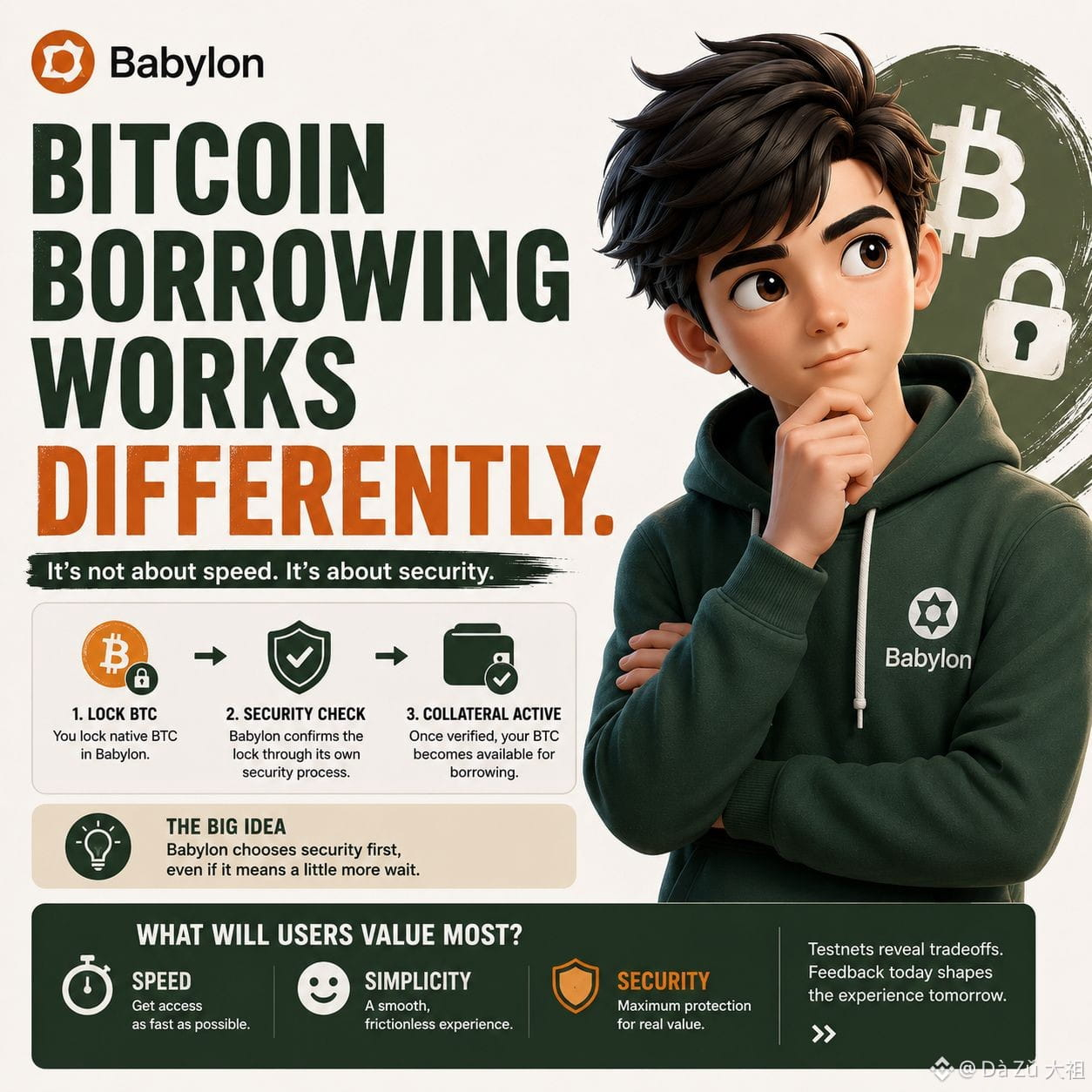
Eine Sache, die mir beim Erkunden des Babylon Native Bitcoin Backed Borrowing Testnet aufgefallen ist, ist, wie unterschiedlich Bitcoin dich dazu zwingt, über Kredite nachzudenken. In vielen DeFi-Produkten beurteilen Nutzer die Erfahrung danach, wie schnell sie sich nach dem Hinterlegen von Sicherheiten Geld leihen können. Das Design von Babylon scheint jedoch zunächst etwas anderes in den Vordergrund zu stellen: zu bestätigen, dass der Bitcoin-„Lock“ über seinen eigenen Sicherheitsprozess erkannt wird, bevor die Sicherheiten dem Kreditverleihsystem zur Verfügung stehen. Diese Designentscheidung wird nicht jedem gefallen. Manche Nutzer achten vielleicht auf die zusätzliche Wartezeit, während andere darin eine angemessene Abwägung sehen, um Bitcoin nativ zu behalten, statt auf verpackte Assets (wrapped assets) zu setzen.
Für mich ist der interessante Punkt nicht, ob der Ablauf sich schnell oder langsam anfühlt. Es geht darum, ob Nutzer bereit sind, für eine stärkere Sicherheitsannahme eine reibungslosere Erfahrung einzutauschen, wenn echte Werte auf dem Spiel stehen.
Testnets sind nützlich, weil sie diese Abwägungen sichtbar machen, bevor die Mainnet-Einführung beginnt. Das Feedback der Nutzer in dieser Phase kann am Ende genauso wichtig sein wie die zugrunde liegende Technologie selbst.
Wenn natives BTC-Leihen künftig häufiger wird: Welche Aspekte werden deiner Meinung nach für Nutzer am meisten zählen—Tempo, Einfachheit oder Sicherheit?
#baby $BABY @babylonlabs_io
$1000RATS $KOMA
Eine Sache, die mir beim Erkunden des Babylon Native Bitcoin Backed Borrowing Testnet aufgefallen ist, ist, wie unterschiedlich Bitcoin dich dazu zwingt, über Kredite nachzudenken. In vielen DeFi-Produkten beurteilen Nutzer die Erfahrung danach, wie schnell sie sich nach dem Hinterlegen von Sicherheiten Geld leihen können. Das Design von Babylon scheint jedoch zunächst etwas anderes in den Vordergrund zu stellen: zu bestätigen, dass der Bitcoin-„Lock“ über seinen eigenen Sicherheitsprozess erkannt wird, bevor die Sicherheiten dem Kreditverleihsystem zur Verfügung stehen. Diese Designentscheidung wird nicht jedem gefallen. Manche Nutzer achten vielleicht auf die zusätzliche Wartezeit, während andere darin eine angemessene Abwägung sehen, um Bitcoin nativ zu behalten, statt auf verpackte Assets (wrapped assets) zu setzen.
Für mich ist der interessante Punkt nicht, ob der Ablauf sich schnell oder langsam anfühlt. Es geht darum, ob Nutzer bereit sind, für eine stärkere Sicherheitsannahme eine reibungslosere Erfahrung einzutauschen, wenn echte Werte auf dem Spiel stehen.
Testnets sind nützlich, weil sie diese Abwägungen sichtbar machen, bevor die Mainnet-Einführung beginnt. Das Feedback der Nutzer in dieser Phase kann am Ende genauso wichtig sein wie die zugrunde liegende Technologie selbst.
Wenn natives BTC-Leihen künftig häufiger wird: Welche Aspekte werden deiner Meinung nach für Nutzer am meisten zählen—Tempo, Einfachheit oder Sicherheit?
#baby $BABY @BabylonLabs_io
$1000RATS $KOMA
Für mich ist der interessante Punkt nicht, ob der Ablauf sich schnell oder langsam anfühlt. Es geht darum, ob Nutzer bereit sind, für eine stärkere Sicherheitsannahme eine reibungslosere Erfahrung einzutauschen, wenn echte Werte auf dem Spiel stehen.
Testnets sind nützlich, weil sie diese Abwägungen sichtbar machen, bevor die Mainnet-Einführung beginnt. Das Feedback der Nutzer in dieser Phase kann am Ende genauso wichtig sein wie die zugrunde liegende Technologie selbst.
Wenn natives BTC-Leihen künftig häufiger wird: Welche Aspekte werden deiner Meinung nach für Nutzer am meisten zählen—Tempo, Einfachheit oder Sicherheit?
#baby $BABY @BabylonLabs_io
$1000RATS $KOMA
3
2
286
·
--
Einer Sache, der ich seit einiger Zeit mehr Aufmerksamkeit schenke, ist der Unterschied zwischen dem Ziel (Destination) eines Protokolls und seiner aktuellen Architektur.
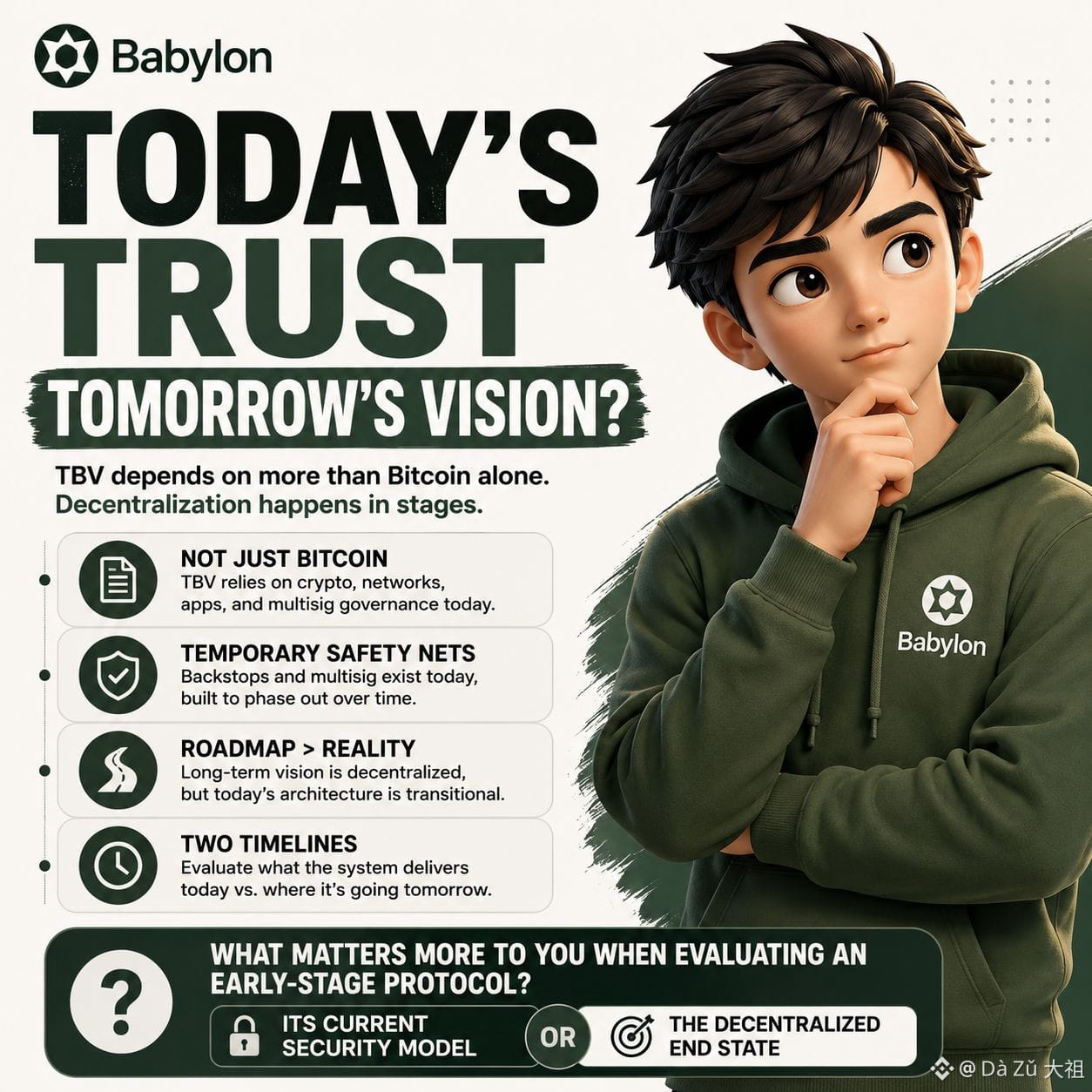
TBV wird oft im Hinblick auf „Bitcoin-native Trust“ diskutiert, aber die Dokumentation beschreibt ein System, das auch heute noch von mehreren operativen Ebenen abhängt, die zusammen funktionieren. Das schwächt das Protokoll nicht automatisch; es zeigt lediglich, dass Dezentralisierung in der Regel in Etappen erreicht wird, statt auf einmal.
Der Teil, den ich am interessantesten finde, ist nicht, ob es temporäre Governance-Schutzmaßnahmen gibt. Sondern wie sie kommuniziert werden. Nutzer hören oft zuerst die langfristige Vision, während die Dokumentation das Übergangsdesign viel detaillierter erklärt.
Das ist ein häufiges Muster in der Krypto-Welt. Teams arbeiten auf eine Minimierung des Vertrauens hin, doch operative Schutzmaßnahmen bleiben oft bestehen, während Infrastruktur, Liquidität und die Beteiligung am Netzwerk reifen. Die Roadmap mag auf eine stark dezentralisierte Zukunft hindeuten, obwohl die heutige Umsetzung noch Mechanismen enthält, die dafür ausgelegt sind, das operative Risiko zu reduzieren.
Aus diesem Grund denke ich, dass Protokolle auf zwei getrennten Zeitachsen bewertet werden sollten: Was die Architektur heute liefert und was die Roadmap anstrebt, morgen zu liefern. Diese Dinge zu vermischen kann Erwartungen erzeugen, die auf keiner Seite beabsichtigt sind.
Die spannendere Diskussion ist nicht, ob TBV sich in Richtung stärkerer Vertrauensminimierung bewegt. Sondern ob Nutzer klar verstehen, welche Vertrauensannahmen heute existieren – im Vergleich zu denen, die das Protokoll im Laufe der Zeit zu beseitigen hofft.
Wenn du ein Protokoll in einer frühen Phase bewertest: Was ist für dich wichtiger – sein aktuelles Sicherheitsmodell oder der dezentrale Endzustand, auf den es hinarbeitet?
#baby $BABY @babylonlabs_io
$ESP $RE
Einer Sache, der ich seit einiger Zeit mehr Aufmerksamkeit schenke, ist der Unterschied zwischen dem Ziel (Destination) eines Protokolls und seiner aktuellen Architektur.
TBV wird oft im Hinblick auf „Bitcoin-native Trust“ diskutiert, aber die Dokumentation beschreibt ein System, das auch heute noch von mehreren operativen Ebenen abhängt, die zusammen funktionieren. Das schwächt das Protokoll nicht automatisch; es zeigt lediglich, dass Dezentralisierung in der Regel in Etappen erreicht wird, statt auf einmal.
Der Teil, den ich am interessantesten finde, ist nicht, ob es temporäre Governance-Schutzmaßnahmen gibt. Sondern wie sie kommuniziert werden. Nutzer hören oft zuerst die langfristige Vision, während die Dokumentation das Übergangsdesign viel detaillierter erklärt.
Das ist ein häufiges Muster in der Krypto-Welt. Teams arbeiten auf eine Minimierung des Vertrauens hin, doch operative Schutzmaßnahmen bleiben oft bestehen, während Infrastruktur, Liquidität und die Beteiligung am Netzwerk reifen. Die Roadmap mag auf eine stark dezentralisierte Zukunft hindeuten, obwohl die heutige Umsetzung noch Mechanismen enthält, die dafür ausgelegt sind, das operative Risiko zu reduzieren.
Aus diesem Grund denke ich, dass Protokolle auf zwei getrennten Zeitachsen bewertet werden sollten: Was die Architektur heute liefert und was die Roadmap anstrebt, morgen zu liefern. Diese Dinge zu vermischen kann Erwartungen erzeugen, die auf keiner Seite beabsichtigt sind.
Die spannendere Diskussion ist nicht, ob TBV sich in Richtung stärkerer Vertrauensminimierung bewegt. Sondern ob Nutzer klar verstehen, welche Vertrauensannahmen heute existieren – im Vergleich zu denen, die das Protokoll im Laufe der Zeit zu beseitigen hofft.
Wenn du ein Protokoll in einer frühen Phase bewertest: Was ist für dich wichtiger – sein aktuelles Sicherheitsmodell oder der dezentrale Endzustand, auf den es hinarbeitet?
#baby $BABY @BabylonLabs_io
$ESP $RE
TBV wird oft im Hinblick auf „Bitcoin-native Trust“ diskutiert, aber die Dokumentation beschreibt ein System, das auch heute noch von mehreren operativen Ebenen abhängt, die zusammen funktionieren. Das schwächt das Protokoll nicht automatisch; es zeigt lediglich, dass Dezentralisierung in der Regel in Etappen erreicht wird, statt auf einmal.
Der Teil, den ich am interessantesten finde, ist nicht, ob es temporäre Governance-Schutzmaßnahmen gibt. Sondern wie sie kommuniziert werden. Nutzer hören oft zuerst die langfristige Vision, während die Dokumentation das Übergangsdesign viel detaillierter erklärt.
Das ist ein häufiges Muster in der Krypto-Welt. Teams arbeiten auf eine Minimierung des Vertrauens hin, doch operative Schutzmaßnahmen bleiben oft bestehen, während Infrastruktur, Liquidität und die Beteiligung am Netzwerk reifen. Die Roadmap mag auf eine stark dezentralisierte Zukunft hindeuten, obwohl die heutige Umsetzung noch Mechanismen enthält, die dafür ausgelegt sind, das operative Risiko zu reduzieren.
Aus diesem Grund denke ich, dass Protokolle auf zwei getrennten Zeitachsen bewertet werden sollten: Was die Architektur heute liefert und was die Roadmap anstrebt, morgen zu liefern. Diese Dinge zu vermischen kann Erwartungen erzeugen, die auf keiner Seite beabsichtigt sind.
Die spannendere Diskussion ist nicht, ob TBV sich in Richtung stärkerer Vertrauensminimierung bewegt. Sondern ob Nutzer klar verstehen, welche Vertrauensannahmen heute existieren – im Vergleich zu denen, die das Protokoll im Laufe der Zeit zu beseitigen hofft.
Wenn du ein Protokoll in einer frühen Phase bewertest: Was ist für dich wichtiger – sein aktuelles Sicherheitsmodell oder der dezentrale Endzustand, auf den es hinarbeitet?
#baby $BABY @BabylonLabs_io
$ESP $RE
5
2
227
·
--
Er hat kein Airdrop bekommen. Er ist immer noch die wertvollste Person in diesem Ökosystem.
Ich habe einen Freund. Er ist länger in Krypto als die meisten Leute, die ich kenne. Er ist nicht laut. Postet nicht viel. Er hält einfach den Kopf unten und nutzt die Protokolle, an die er glaubt, auch dann, wenn es nichts zu verdienen gibt.
Als der Airdrop rausging, hatte er nicht die Bedingungen für die oberste Stufe erfüllt.
Ich habe ihm ehrlich gesagt leid getan. All diese Zeit, all diese stille Beständigkeit – und die größeren Belohnungen gingen an Wallets, die Testnets wochenlang hart gefarmt haben, und dann verschwanden, sobald sie die Ansprüche geltend gemacht hatten.
Das hat mich gestört. Also habe ich angefangen zu graben.
Und was ich gefunden habe, hat mich noch mehr gestört.
Die Wallets, die die größten Zuteilungen abgegriffen haben, waren nicht die loyalsten. Sie waren nur die effizientesten darin, loyal auszusehen. Starke Aktivitätsschübe genau dann, wenn es darauf ankam. Und dann nichts. Weg. Das Protokoll hatte keine Ahnung, weil das Protokoll Verhalten gemessen hat – nicht Überzeugung.
Währenddessen? Das Wallet meines Freundes. Niedrigere Stufe. Geringere Belohnung. Aber immer noch aktiv. Immer noch im Austausch. Und da – durch diese langweiligen Monate, in denen es nichts zu farmen gab und niemand hinsah.
Hier ist die harte Wahrheit darüber, wie die meisten Belohnungssysteme gebaut sind:
Man kann jemanden dafür belohnen, dass er auftaucht. Das ist der leichte Teil – das sind nur Daten. Aber man kann keine Formel bauen, die erklärt, warum jemand geblieben ist, wenn das Bleiben ihm nichts gebracht hat. Man kann keine Zahl für stille Überzeugung festlegen.
Und genau diese Lücke wird jedes einzelne Mal ausgenutzt.
Also die Frage, zu der ich immer wieder zurückkomme, ist nicht: Wer hat den Airdrop gewonnen.
Sondern: Wer ist immer noch da, wenn die Belohnung weg ist – und ob die Systeme, die wir bauen, jemals lernen werden, den Unterschied zu erkennen.
#baby $BABY @babylonlabs_io
$EUL $FLOW
Er hat kein Airdrop bekommen. Er ist immer noch die wertvollste Person in diesem Ökosystem.
Ich habe einen Freund. Er ist länger in Krypto als die meisten Leute, die ich kenne. Er ist nicht laut. Postet nicht viel. Er hält einfach den Kopf unten und nutzt die Protokolle, an die er glaubt, auch dann, wenn es nichts zu verdienen gibt.
Als der Airdrop rausging, hatte er nicht die Bedingungen für die oberste Stufe erfüllt.
Ich habe ihm ehrlich gesagt leid getan. All diese Zeit, all diese stille Beständigkeit – und die größeren Belohnungen gingen an Wallets, die Testnets wochenlang hart gefarmt haben, und dann verschwanden, sobald sie die Ansprüche geltend gemacht hatten.
Das hat mich gestört. Also habe ich angefangen zu graben.
Und was ich gefunden habe, hat mich noch mehr gestört.
Die Wallets, die die größten Zuteilungen abgegriffen haben, waren nicht die loyalsten. Sie waren nur die effizientesten darin, loyal auszusehen. Starke Aktivitätsschübe genau dann, wenn es darauf ankam. Und dann nichts. Weg. Das Protokoll hatte keine Ahnung, weil das Protokoll Verhalten gemessen hat – nicht Überzeugung.
Währenddessen? Das Wallet meines Freundes. Niedrigere Stufe. Geringere Belohnung. Aber immer noch aktiv. Immer noch im Austausch. Und da – durch diese langweiligen Monate, in denen es nichts zu farmen gab und niemand hinsah.
Hier ist die harte Wahrheit darüber, wie die meisten Belohnungssysteme gebaut sind:
Man kann jemanden dafür belohnen, dass er auftaucht. Das ist der leichte Teil – das sind nur Daten. Aber man kann keine Formel bauen, die erklärt, warum jemand geblieben ist, wenn das Bleiben ihm nichts gebracht hat. Man kann keine Zahl für stille Überzeugung festlegen.
Und genau diese Lücke wird jedes einzelne Mal ausgenutzt.
Also die Frage, zu der ich immer wieder zurückkomme, ist nicht: Wer hat den Airdrop gewonnen.
Sondern: Wer ist immer noch da, wenn die Belohnung weg ist – und ob die Systeme, die wir bauen, jemals lernen werden, den Unterschied zu erkennen.
#baby $BABY @BabylonLabs_io
$EUL $FLOW
Ich habe einen Freund. Er ist länger in Krypto als die meisten Leute, die ich kenne. Er ist nicht laut. Postet nicht viel. Er hält einfach den Kopf unten und nutzt die Protokolle, an die er glaubt, auch dann, wenn es nichts zu verdienen gibt.
Als der Airdrop rausging, hatte er nicht die Bedingungen für die oberste Stufe erfüllt.
Ich habe ihm ehrlich gesagt leid getan. All diese Zeit, all diese stille Beständigkeit – und die größeren Belohnungen gingen an Wallets, die Testnets wochenlang hart gefarmt haben, und dann verschwanden, sobald sie die Ansprüche geltend gemacht hatten.
Das hat mich gestört. Also habe ich angefangen zu graben.
Und was ich gefunden habe, hat mich noch mehr gestört.
Die Wallets, die die größten Zuteilungen abgegriffen haben, waren nicht die loyalsten. Sie waren nur die effizientesten darin, loyal auszusehen. Starke Aktivitätsschübe genau dann, wenn es darauf ankam. Und dann nichts. Weg. Das Protokoll hatte keine Ahnung, weil das Protokoll Verhalten gemessen hat – nicht Überzeugung.
Währenddessen? Das Wallet meines Freundes. Niedrigere Stufe. Geringere Belohnung. Aber immer noch aktiv. Immer noch im Austausch. Und da – durch diese langweiligen Monate, in denen es nichts zu farmen gab und niemand hinsah.
Hier ist die harte Wahrheit darüber, wie die meisten Belohnungssysteme gebaut sind:
Man kann jemanden dafür belohnen, dass er auftaucht. Das ist der leichte Teil – das sind nur Daten. Aber man kann keine Formel bauen, die erklärt, warum jemand geblieben ist, wenn das Bleiben ihm nichts gebracht hat. Man kann keine Zahl für stille Überzeugung festlegen.
Und genau diese Lücke wird jedes einzelne Mal ausgenutzt.
Also die Frage, zu der ich immer wieder zurückkomme, ist nicht: Wer hat den Airdrop gewonnen.
Sondern: Wer ist immer noch da, wenn die Belohnung weg ist – und ob die Systeme, die wir bauen, jemals lernen werden, den Unterschied zu erkennen.
#baby $BABY @BabylonLabs_io
$EUL $FLOW

3
2
81
·
--
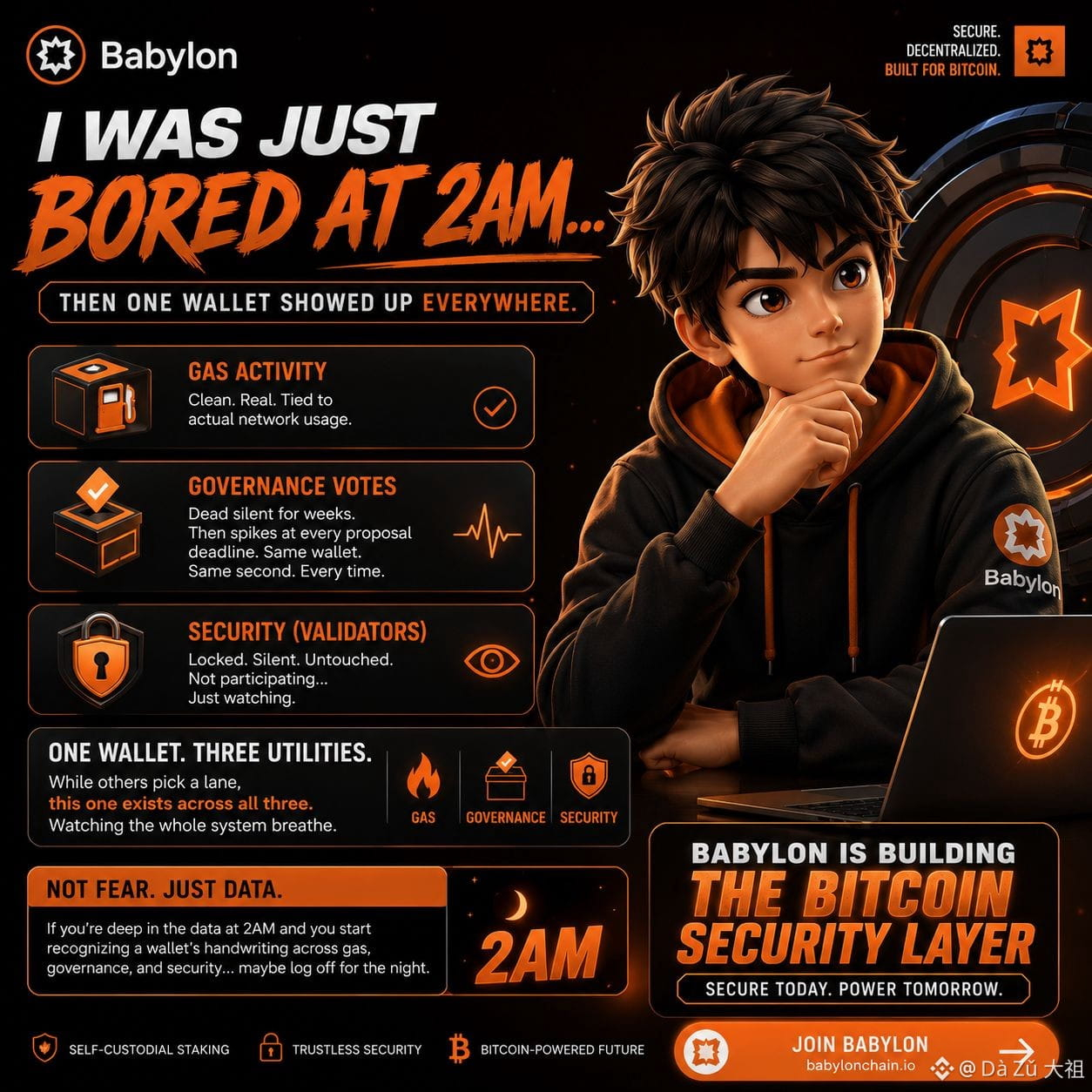
Ich wollte keinen tiefen Einblick. Ich war einfach um 2 Uhr nachts gelangweilt, Brieftasche offen, starrte auf meine <BABY>-Bestände und fing an, in der On-Chain-Gasnutzung, Governance-Voten und Security-Locks herumzustochern. Ich sagte mir, das sei nur müßige Neugier. War es nicht.
Die Gasaktivität war das Erste, was ich überprüfte. Sauber, mechanisch, direkt an die echte Netzwerk-Nutzung gekoppelt. Nichts Ungewöhnliches. Es fühlte sich sicher an. Dann rief ich Governance auf, und da wurde es seltsam. Fast keine Aktivität über Wochen, totstill – und dann tauchte genau diese eine Wallet auf, die bei jedem Proposal-Deadline-Punkt exakt im richtigen Moment hochschoss, wie ein Uhrwerk. Als würde nicht eine Person abstimmen, sondern etwas, das so geplant ist, dass es genau im richtigen Augenblick aufwacht. Ich saß da um 2 Uhr nachts und sah zu, wie die Zeitstempel perfekt zusammenpassten: drei Deadlines hintereinander, dieselbe Wallet, dieselbe Sekunde-nach-Sekunde-Präzision. Meine Haut hat sich dabei wirklich ein bisschen zusammengezogen.
Dann prüfte ich Security-Validatoren und gesperrte Tokens. Und diese Wallet tauchte dort auch wieder auf. Gesperrt, still, unberührt von Gas- oder Governance-Rauschen – einfach so da, als würde sie zusehen, statt teilzunehmen. Drei Utilities, und diese Adresse berührte alle drei, während fast sonst niemand überhaupt etwas tat. Alle anderen hatten ihre Spur. Diese eine nicht. Sie existierte einfach über alle drei hinweg, still.
Ich schloss meinen Laptop und habe an dem Abend wirklich schlecht geschlafen. Ich sagte mir, es sei wahrscheinlich nur ein Bot, eine Treasury-Wallet, irgendwas Langweiliges und Erklärbares. Wahrscheinlich. Aber das Muster lässt mich trotzdem komisch zurück. Die meisten Wallets sind Menschen, die sich auf einen Use Case festlegen und dort bleiben – und dann gibt es dieses eine Ding, das sich bewegt, als würde es zusehen, wie das ganze System atmet.
Jedenfalls. Nicht am Verkaufen, nicht um Angst zu machen, sondern nur: Wenn du um 2 Uhr nachts tief in den Daten bist und anfängst, die Handschrift einer Wallet über Gas, Governance und Security zu erkennen, als wäre es eine Person, der du in verschiedenen Zimmern dieses Hauses immer wieder begegnest … vielleicht meld dich für die Nacht ab. Das ist alles, was ich sagen will. <BABY> ❤️
#baby $BABY @babylonlabs_io
$AKE $NIL
#EtherApproaches$2000 #OilDropsAbout6% #CrudeBrieflyFallsBelow$90 #BrentCrudeFallsAbout6%
Ich wollte keinen tiefen Einblick. Ich war einfach um 2 Uhr nachts gelangweilt, Brieftasche offen, starrte auf meine <BABY>-Bestände und fing an, in der On-Chain-Gasnutzung, Governance-Voten und Security-Locks herumzustochern. Ich sagte mir, das sei nur müßige Neugier. War es nicht.
Die Gasaktivität war das Erste, was ich überprüfte. Sauber, mechanisch, direkt an die echte Netzwerk-Nutzung gekoppelt. Nichts Ungewöhnliches. Es fühlte sich sicher an. Dann rief ich Governance auf, und da wurde es seltsam. Fast keine Aktivität über Wochen, totstill – und dann tauchte genau diese eine Wallet auf, die bei jedem Proposal-Deadline-Punkt exakt im richtigen Moment hochschoss, wie ein Uhrwerk. Als würde nicht eine Person abstimmen, sondern etwas, das so geplant ist, dass es genau im richtigen Augenblick aufwacht. Ich saß da um 2 Uhr nachts und sah zu, wie die Zeitstempel perfekt zusammenpassten: drei Deadlines hintereinander, dieselbe Wallet, dieselbe Sekunde-nach-Sekunde-Präzision. Meine Haut hat sich dabei wirklich ein bisschen zusammengezogen.
Dann prüfte ich Security-Validatoren und gesperrte Tokens. Und diese Wallet tauchte dort auch wieder auf. Gesperrt, still, unberührt von Gas- oder Governance-Rauschen – einfach so da, als würde sie zusehen, statt teilzunehmen. Drei Utilities, und diese Adresse berührte alle drei, während fast sonst niemand überhaupt etwas tat. Alle anderen hatten ihre Spur. Diese eine nicht. Sie existierte einfach über alle drei hinweg, still.
Ich schloss meinen Laptop und habe an dem Abend wirklich schlecht geschlafen. Ich sagte mir, es sei wahrscheinlich nur ein Bot, eine Treasury-Wallet, irgendwas Langweiliges und Erklärbares. Wahrscheinlich. Aber das Muster lässt mich trotzdem komisch zurück. Die meisten Wallets sind Menschen, die sich auf einen Use Case festlegen und dort bleiben – und dann gibt es dieses eine Ding, das sich bewegt, als würde es zusehen, wie das ganze System atmet.
Jedenfalls. Nicht am Verkaufen, nicht um Angst zu machen, sondern nur: Wenn du um 2 Uhr nachts tief in den Daten bist und anfängst, die Handschrift einer Wallet über Gas, Governance und Security zu erkennen, als wäre es eine Person, der du in verschiedenen Zimmern dieses Hauses immer wieder begegnest … vielleicht meld dich für die Nacht ab. Das ist alles, was ich sagen will. <BABY> ❤️
#baby $BABY @BabylonLabs_io
$AKE $NIL
#EtherApproaches$2000 #OilDropsAbout6% #CrudeBrieflyFallsBelow$90 #BrentCrudeFallsAbout6%
Die Gasaktivität war das Erste, was ich überprüfte. Sauber, mechanisch, direkt an die echte Netzwerk-Nutzung gekoppelt. Nichts Ungewöhnliches. Es fühlte sich sicher an. Dann rief ich Governance auf, und da wurde es seltsam. Fast keine Aktivität über Wochen, totstill – und dann tauchte genau diese eine Wallet auf, die bei jedem Proposal-Deadline-Punkt exakt im richtigen Moment hochschoss, wie ein Uhrwerk. Als würde nicht eine Person abstimmen, sondern etwas, das so geplant ist, dass es genau im richtigen Augenblick aufwacht. Ich saß da um 2 Uhr nachts und sah zu, wie die Zeitstempel perfekt zusammenpassten: drei Deadlines hintereinander, dieselbe Wallet, dieselbe Sekunde-nach-Sekunde-Präzision. Meine Haut hat sich dabei wirklich ein bisschen zusammengezogen.
Dann prüfte ich Security-Validatoren und gesperrte Tokens. Und diese Wallet tauchte dort auch wieder auf. Gesperrt, still, unberührt von Gas- oder Governance-Rauschen – einfach so da, als würde sie zusehen, statt teilzunehmen. Drei Utilities, und diese Adresse berührte alle drei, während fast sonst niemand überhaupt etwas tat. Alle anderen hatten ihre Spur. Diese eine nicht. Sie existierte einfach über alle drei hinweg, still.
Ich schloss meinen Laptop und habe an dem Abend wirklich schlecht geschlafen. Ich sagte mir, es sei wahrscheinlich nur ein Bot, eine Treasury-Wallet, irgendwas Langweiliges und Erklärbares. Wahrscheinlich. Aber das Muster lässt mich trotzdem komisch zurück. Die meisten Wallets sind Menschen, die sich auf einen Use Case festlegen und dort bleiben – und dann gibt es dieses eine Ding, das sich bewegt, als würde es zusehen, wie das ganze System atmet.
Jedenfalls. Nicht am Verkaufen, nicht um Angst zu machen, sondern nur: Wenn du um 2 Uhr nachts tief in den Daten bist und anfängst, die Handschrift einer Wallet über Gas, Governance und Security zu erkennen, als wäre es eine Person, der du in verschiedenen Zimmern dieses Hauses immer wieder begegnest … vielleicht meld dich für die Nacht ab. Das ist alles, was ich sagen will. <BABY> ❤️
#baby $BABY @BabylonLabs_io
$AKE $NIL
#EtherApproaches$2000 #OilDropsAbout6% #CrudeBrieflyFallsBelow$90 #BrentCrudeFallsAbout6%
24
18
261
·
--
★ Bitcoin braucht Smart Contracts.
★ Das war meine Annahme jahrelang.
★ Ich glaubte daran ohne viel Zweifel.
➤ Keine Programmierbarkeit bedeutete, hinterherzuhinken.
➤ Mehr Komplexität bedeutete mehr Nutzen.
➤ Die Logik wirkte fast zu offensichtlich, um sie in Frage zu stellen.
➤ Aber ich hatte nie ernsthaft gefragt, was mit Bitcoin passiert, wenn es in ein anderes System gelangt.
✴︎ Eine Brücke
✴︎ Ein gewickeltes Token
✴︎ Ein Lending-Protocol.
♥︎ Das BTC mag gleich aussehen.
♥︎ Aber das Sicherheitsmodell ist jetzt das von jemand anderem.
♥︎ Die Annahmen verschieben sich in dem Moment, in dem es seine eigene Chain verlässt.
♥︎ Das muss nicht zwangsläufig fatal sein. Aber es ist auch nicht neutral.
Was @babylonlabs_io wert war, beachtet zu werden, war nicht eine Feature-Liste. Es war eine andere Ausgangsfrage. Nicht, wie man Bitcoin komplexer machen kann. Sondern ob die bestehende ökonomische Sicherheit von Bitcoin für andere Systeme nützlich werden kann, ohne dass Bitcoin zu einem grundsätzlich anderen System werden muss.
Nicht, was Bitcoin von anderen Chains ausleihen kann.
⚡︎ Aber was hat
⚡︎ Bitcoin bereits, was andere Chains möglicherweise tatsächlich brauchen?
⚡︎ Diese Neubetrachtung ist subtil.
⚡︎ Aber sie verändert komplett, was du überhaupt bewertest.
📌 Ich sage nicht, dass das Babylon risikofrei macht.
✘ Komplexität zu vermeiden heißt nicht automatisch, dass das Design besser ist.
✘ Aber die zugrunde liegende Prämisse ist schwerer abzutun, als ich erwartet hatte.
➤ Vielleicht ist die interessantere Frage für die Bitcoin-Zukunft nicht, was es noch nicht hat.
➤ Vielleicht ist es, ob das, was es bereits gut kann, mehr leisten kann, als wir bisher von ihm erwartet haben.
Glaubst du, dass der Wert von Bitcoin aus dem kommt, was es werden könnte, oder aus dem, was es beständig verweigert hat, sich zu verändern?
#baby $BABY
#BitMartToWindDownByJan2027 #SHIBSurges36% #CentralBanksWeighResponseAsOilNears$100 #USPausesIranStrikesSecondNight
$EUL $DIA
Die Zukunft von Bitcoin hängt davon ab?
★ Bitcoin braucht Smart Contracts.
★ Das war meine Annahme jahrelang.
★ Ich glaubte daran ohne viel Zweifel.
➤ Keine Programmierbarkeit bedeutete, hinterherzuhinken.
➤ Mehr Komplexität bedeutete mehr Nutzen.
➤ Die Logik wirkte fast zu offensichtlich, um sie in Frage zu stellen.
➤ Aber ich hatte nie ernsthaft gefragt, was mit Bitcoin passiert, wenn es in ein anderes System gelangt.
✴︎ Eine Brücke
✴︎ Ein gewickeltes Token
✴︎ Ein Lending-Protocol.
♥︎ Das BTC mag gleich aussehen.
♥︎ Aber das Sicherheitsmodell ist jetzt das von jemand anderem.
♥︎ Die Annahmen verschieben sich in dem Moment, in dem es seine eigene Chain verlässt.
♥︎ Das muss nicht zwangsläufig fatal sein. Aber es ist auch nicht neutral.
Was @BabylonLabs_io wert war, beachtet zu werden, war nicht eine Feature-Liste. Es war eine andere Ausgangsfrage. Nicht, wie man Bitcoin komplexer machen kann. Sondern ob die bestehende ökonomische Sicherheit von Bitcoin für andere Systeme nützlich werden kann, ohne dass Bitcoin zu einem grundsätzlich anderen System werden muss.
Nicht, was Bitcoin von anderen Chains ausleihen kann.
⚡︎ Aber was hat
⚡︎ Bitcoin bereits, was andere Chains möglicherweise tatsächlich brauchen?
⚡︎ Diese Neubetrachtung ist subtil.
⚡︎ Aber sie verändert komplett, was du überhaupt bewertest.
📌 Ich sage nicht, dass das Babylon risikofrei macht.
✘ Komplexität zu vermeiden heißt nicht automatisch, dass das Design besser ist.
✘ Aber die zugrunde liegende Prämisse ist schwerer abzutun, als ich erwartet hatte.
➤ Vielleicht ist die interessantere Frage für die Bitcoin-Zukunft nicht, was es noch nicht hat.
➤ Vielleicht ist es, ob das, was es bereits gut kann, mehr leisten kann, als wir bisher von ihm erwartet haben.
Glaubst du, dass der Wert von Bitcoin aus dem kommt, was es werden könnte, oder aus dem, was es beständig verweigert hat, sich zu verändern?
#baby $BABY
#BitMartToWindDownByJan2027 #SHIBSurges36% #CentralBanksWeighResponseAsOilNears$100 #USPausesIranStrikesSecondNight
$EUL $DIA
Die Zukunft von Bitcoin hängt davon ab?
★ Das war meine Annahme jahrelang.
★ Ich glaubte daran ohne viel Zweifel.
➤ Keine Programmierbarkeit bedeutete, hinterherzuhinken.
➤ Mehr Komplexität bedeutete mehr Nutzen.
➤ Die Logik wirkte fast zu offensichtlich, um sie in Frage zu stellen.
➤ Aber ich hatte nie ernsthaft gefragt, was mit Bitcoin passiert, wenn es in ein anderes System gelangt.
✴︎ Eine Brücke
✴︎ Ein gewickeltes Token
✴︎ Ein Lending-Protocol.
♥︎ Das BTC mag gleich aussehen.
♥︎ Aber das Sicherheitsmodell ist jetzt das von jemand anderem.
♥︎ Die Annahmen verschieben sich in dem Moment, in dem es seine eigene Chain verlässt.
♥︎ Das muss nicht zwangsläufig fatal sein. Aber es ist auch nicht neutral.
Was @BabylonLabs_io wert war, beachtet zu werden, war nicht eine Feature-Liste. Es war eine andere Ausgangsfrage. Nicht, wie man Bitcoin komplexer machen kann. Sondern ob die bestehende ökonomische Sicherheit von Bitcoin für andere Systeme nützlich werden kann, ohne dass Bitcoin zu einem grundsätzlich anderen System werden muss.
Nicht, was Bitcoin von anderen Chains ausleihen kann.
⚡︎ Aber was hat
⚡︎ Bitcoin bereits, was andere Chains möglicherweise tatsächlich brauchen?
⚡︎ Diese Neubetrachtung ist subtil.
⚡︎ Aber sie verändert komplett, was du überhaupt bewertest.
📌 Ich sage nicht, dass das Babylon risikofrei macht.
✘ Komplexität zu vermeiden heißt nicht automatisch, dass das Design besser ist.
✘ Aber die zugrunde liegende Prämisse ist schwerer abzutun, als ich erwartet hatte.
➤ Vielleicht ist die interessantere Frage für die Bitcoin-Zukunft nicht, was es noch nicht hat.
➤ Vielleicht ist es, ob das, was es bereits gut kann, mehr leisten kann, als wir bisher von ihm erwartet haben.
Glaubst du, dass der Wert von Bitcoin aus dem kommt, was es werden könnte, oder aus dem, was es beständig verweigert hat, sich zu verändern?
#baby $BABY
#BitMartToWindDownByJan2027 #SHIBSurges36% #CentralBanksWeighResponseAsOilNears$100 #USPausesIranStrikesSecondNight
$EUL $DIA
Die Zukunft von Bitcoin hängt davon ab?
🔴 Smart contracts
0%
⚫ Staying unchanged
0%
🟢 Protocols around it
100%
🔵 More programmability
0%
1 Stimmen • Abstimmung beendet
27
13
242
·
--
Verifiziert
Ich ging davon aus, dass „Slashing“ in Babylon so funktioniert wie bei den meisten Proof-of-Stake-Ketten: Eine nachträglich verhängte Sanktion, nachdem Fehlverhalten erkannt und verarbeitet wurde. Doch wenn man genauer betrachtet, wie EOTS tatsächlich funktioniert, zerbricht diese Annahme. Wenn ein Finality Provider doppelt signiert, wird der private Schlüssel nicht erst später zur Bestrafung markiert, sondern ist mathematisch sofort extrahierbar, sobald die zweite Signatur existiert. Es gibt kein Komitee, das Beweise prüft, und keine Verzögerung zwischen dem Fehlverhalten und der Konsequenz. Die Kryptografie selbst ist das Durchsetzungsmechanismus. Ich habe das anhand der Babylon-Dokumentation nachverfolgt und mit der üblichen Beschreibung von Slashing auf typischen PoS-Ketten verglichen, und der Unterschied ist nicht nur die Geschwindigkeit, sondern die Struktur. Die meisten Slashing-Fälle sind ein sozialer Prozess, der Code als Durchsetzung „trägt“. Das hier ist eher eine Falle, die zuschnappt, sobald die falsche Aktion ausgeführt wird. Das bringt mich dazu, etwas in Frage zu stellen, das ich zuvor nicht bedacht hatte.
Wenn eine Strafe automatisch durch Mathematik erfolgt, statt durch ein Validator-Set, das über Beweise abstimmt: Funktioniert sie dann noch als Abschreckung, oder ist sie nur zu einer physikalischen Eigenschaft des Systems geworden – eher wie die Schwerkraft als wie eine Bestrafung?
#baby $BABY @babylonlabs_io
$RE $LA
Ich ging davon aus, dass „Slashing“ in Babylon so funktioniert wie bei den meisten Proof-of-Stake-Ketten: Eine nachträglich verhängte Sanktion, nachdem Fehlverhalten erkannt und verarbeitet wurde. Doch wenn man genauer betrachtet, wie EOTS tatsächlich funktioniert, zerbricht diese Annahme. Wenn ein Finality Provider doppelt signiert, wird der private Schlüssel nicht erst später zur Bestrafung markiert, sondern ist mathematisch sofort extrahierbar, sobald die zweite Signatur existiert. Es gibt kein Komitee, das Beweise prüft, und keine Verzögerung zwischen dem Fehlverhalten und der Konsequenz. Die Kryptografie selbst ist das Durchsetzungsmechanismus. Ich habe das anhand der Babylon-Dokumentation nachverfolgt und mit der üblichen Beschreibung von Slashing auf typischen PoS-Ketten verglichen, und der Unterschied ist nicht nur die Geschwindigkeit, sondern die Struktur. Die meisten Slashing-Fälle sind ein sozialer Prozess, der Code als Durchsetzung „trägt“. Das hier ist eher eine Falle, die zuschnappt, sobald die falsche Aktion ausgeführt wird. Das bringt mich dazu, etwas in Frage zu stellen, das ich zuvor nicht bedacht hatte.
Wenn eine Strafe automatisch durch Mathematik erfolgt, statt durch ein Validator-Set, das über Beweise abstimmt: Funktioniert sie dann noch als Abschreckung, oder ist sie nur zu einer physikalischen Eigenschaft des Systems geworden – eher wie die Schwerkraft als wie eine Bestrafung?
#baby $BABY @BabylonLabs_io
$RE $LA
Wenn eine Strafe automatisch durch Mathematik erfolgt, statt durch ein Validator-Set, das über Beweise abstimmt: Funktioniert sie dann noch als Abschreckung, oder ist sie nur zu einer physikalischen Eigenschaft des Systems geworden – eher wie die Schwerkraft als wie eine Bestrafung?
#baby $BABY @BabylonLabs_io
$RE $LA
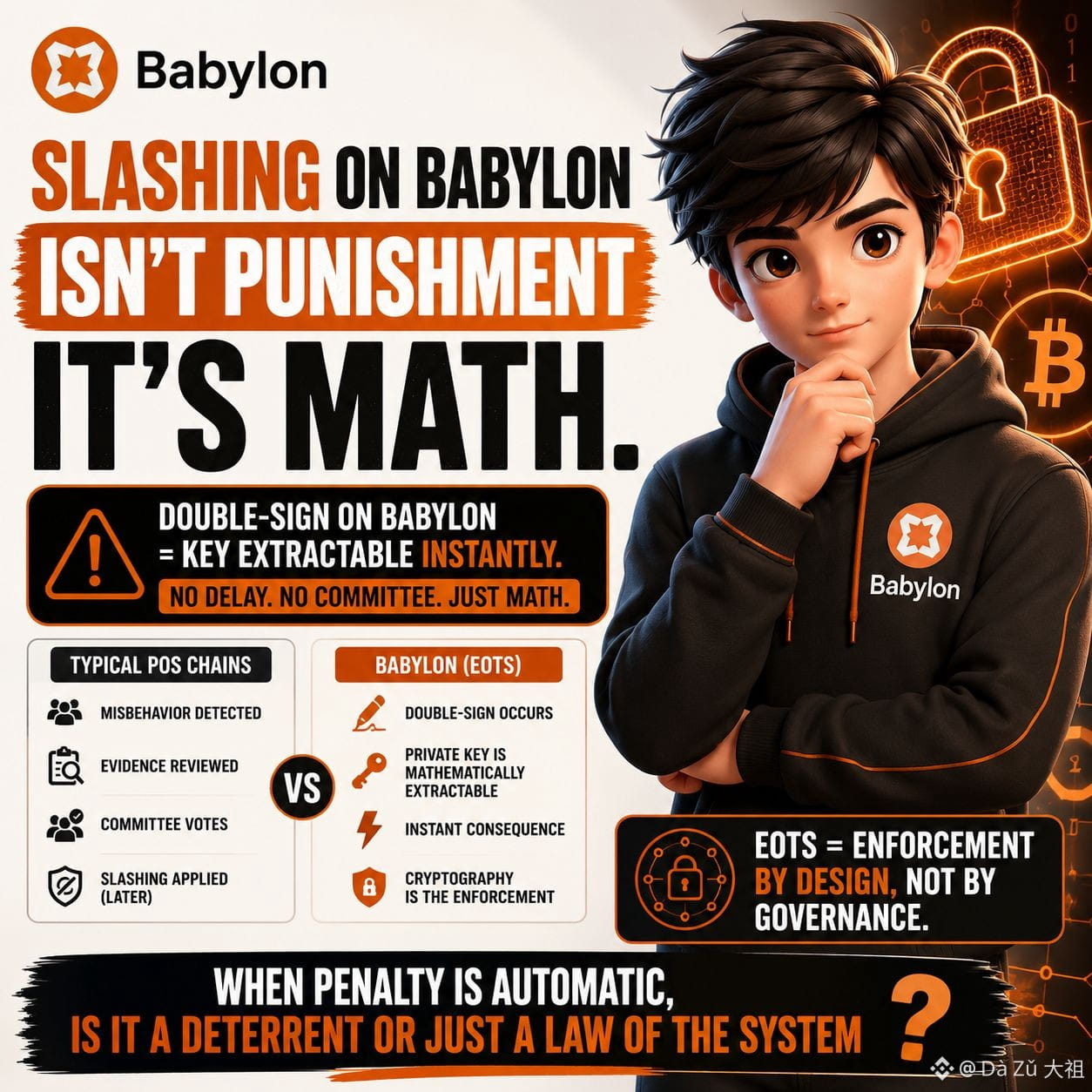
24
15
169
·
--
Alle reden über KI-Agenten. Niemand fragt, wer sie überhaupt stoppen darf
Jede Woche kommt ein neuer „KI-Agent“, der autonom handeln, tauschen und dein Wallet verwalten kann. Niemand stellt die langweilige Frage: Was hindert ihn daran, etwas zu tun, das du nicht autorisiert hast? Aktuell lautet die Antwort meistens „vertraue dem Code“ – und das ist kein Sicherheitsmodell, sondern eher Hoffnung.
Meine These: In der Krypto-Erzählung hat die KI die Reihenfolge vertauscht. Die Branche ist besessen davon, Agenten noch intelligenter zu machen, obwohl die eigentliche Lücke darin besteht, sie zur Rechenschaft zu ziehen, bevor sie handeln – nicht danach, wenn der Schaden bereits angerichtet ist.
Genau hier ist die tatsächliche Funktion von Newton Protocol wichtiger als sein Branding. Es ist kein weiterer KI-Coin, der einfach nur die Welle der Automatisierung reitet – es ist eine Berechtigungsschicht. Ausgabenlimits, Compliance-Checks, Betrugsregeln – alles wird erzwungen, bevor eine Transaktion ausgeführt wird, nicht erst im Nachhinein in einem Postmortem-Thread geprüft.
Das ist nicht aufregend. Genau darum geht es. Institutionen geben keinem autonomen System echtes Kapital, nur weil das System clever ist. Sie tun es, wenn es eine belastbare Audit-Spur gibt und eine Regel, die ein Agent physisch nicht brechen kann.
Also hier ist die echte Frage, mit der sich niemand im KI-Agent-Hype-Zyklus auseinandersetzen will: Würdest du heute tatsächlich zulassen, dass ein autonomer Bot dein Wallet berührt – oder vertraust du einfach darauf, dass es noch nicht versagt hat?
@NewtonProtocol #Newt $NEWT
$SYN $TOWNS
#BinanceTurns9 #SilverDown52%FromJanuaryRecordHigh #KospiStagesVShapedIntradayRebound #USMemoryStocksRisePremarket
Alle reden über KI-Agenten. Niemand fragt, wer sie überhaupt stoppen darf
Jede Woche kommt ein neuer „KI-Agent“, der autonom handeln, tauschen und dein Wallet verwalten kann. Niemand stellt die langweilige Frage: Was hindert ihn daran, etwas zu tun, das du nicht autorisiert hast? Aktuell lautet die Antwort meistens „vertraue dem Code“ – und das ist kein Sicherheitsmodell, sondern eher Hoffnung.
Meine These: In der Krypto-Erzählung hat die KI die Reihenfolge vertauscht. Die Branche ist besessen davon, Agenten noch intelligenter zu machen, obwohl die eigentliche Lücke darin besteht, sie zur Rechenschaft zu ziehen, bevor sie handeln – nicht danach, wenn der Schaden bereits angerichtet ist.
Genau hier ist die tatsächliche Funktion von Newton Protocol wichtiger als sein Branding. Es ist kein weiterer KI-Coin, der einfach nur die Welle der Automatisierung reitet – es ist eine Berechtigungsschicht. Ausgabenlimits, Compliance-Checks, Betrugsregeln – alles wird erzwungen, bevor eine Transaktion ausgeführt wird, nicht erst im Nachhinein in einem Postmortem-Thread geprüft.
Das ist nicht aufregend. Genau darum geht es. Institutionen geben keinem autonomen System echtes Kapital, nur weil das System clever ist. Sie tun es, wenn es eine belastbare Audit-Spur gibt und eine Regel, die ein Agent physisch nicht brechen kann.
Also hier ist die echte Frage, mit der sich niemand im KI-Agent-Hype-Zyklus auseinandersetzen will: Würdest du heute tatsächlich zulassen, dass ein autonomer Bot dein Wallet berührt – oder vertraust du einfach darauf, dass es noch nicht versagt hat?
@NewtonProtocol #Newt $NEWT
$SYN $TOWNS
#BinanceTurns9 #SilverDown52%FromJanuaryRecordHigh #KospiStagesVShapedIntradayRebound #USMemoryStocksRisePremarket
Jede Woche kommt ein neuer „KI-Agent“, der autonom handeln, tauschen und dein Wallet verwalten kann. Niemand stellt die langweilige Frage: Was hindert ihn daran, etwas zu tun, das du nicht autorisiert hast? Aktuell lautet die Antwort meistens „vertraue dem Code“ – und das ist kein Sicherheitsmodell, sondern eher Hoffnung.
Meine These: In der Krypto-Erzählung hat die KI die Reihenfolge vertauscht. Die Branche ist besessen davon, Agenten noch intelligenter zu machen, obwohl die eigentliche Lücke darin besteht, sie zur Rechenschaft zu ziehen, bevor sie handeln – nicht danach, wenn der Schaden bereits angerichtet ist.
Genau hier ist die tatsächliche Funktion von Newton Protocol wichtiger als sein Branding. Es ist kein weiterer KI-Coin, der einfach nur die Welle der Automatisierung reitet – es ist eine Berechtigungsschicht. Ausgabenlimits, Compliance-Checks, Betrugsregeln – alles wird erzwungen, bevor eine Transaktion ausgeführt wird, nicht erst im Nachhinein in einem Postmortem-Thread geprüft.
Das ist nicht aufregend. Genau darum geht es. Institutionen geben keinem autonomen System echtes Kapital, nur weil das System clever ist. Sie tun es, wenn es eine belastbare Audit-Spur gibt und eine Regel, die ein Agent physisch nicht brechen kann.
Also hier ist die echte Frage, mit der sich niemand im KI-Agent-Hype-Zyklus auseinandersetzen will: Würdest du heute tatsächlich zulassen, dass ein autonomer Bot dein Wallet berührt – oder vertraust du einfach darauf, dass es noch nicht versagt hat?
@NewtonProtocol #Newt $NEWT
$SYN $TOWNS
#BinanceTurns9 #SilverDown52%FromJanuaryRecordHigh #KospiStagesVShapedIntradayRebound #USMemoryStocksRisePremarket

17
6
182
·
--
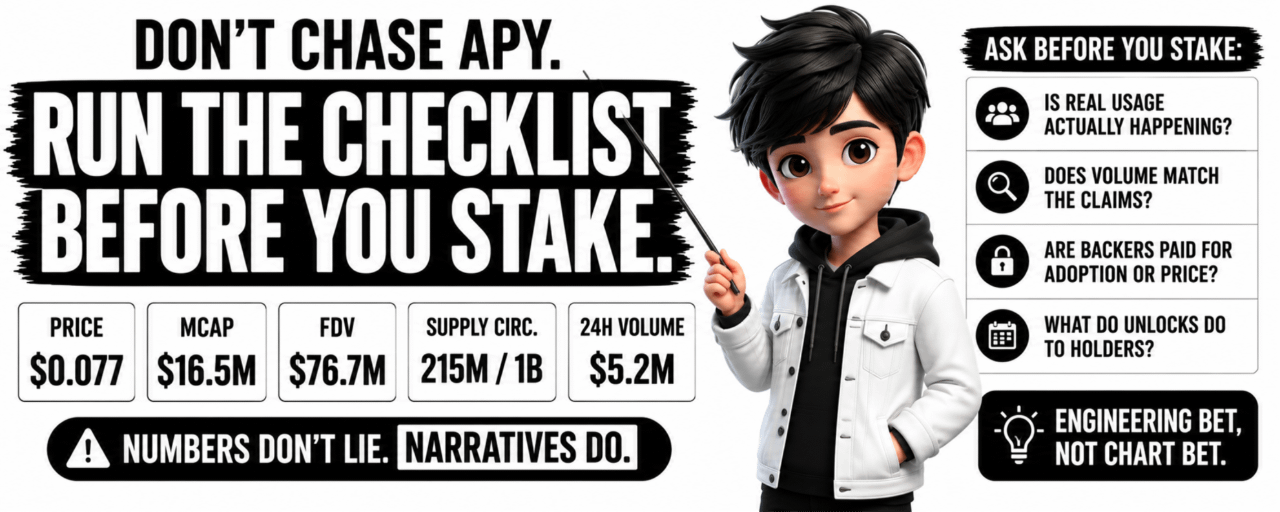
Artikel
Was mich ein Fake-90%-APY über das echte Zahlenlesen bei Newton Protocol gelehrt hatDa war dieser DEX, den ich früher jeden Morgen überprüft habe – damals, als ich noch dachte, Staking wäre kostenloses Geld. Eines Tages ist oben dieses Banner über die ganze Breite: hellgrün, 90% APY, bei irgendeinem Token, von dem ich eine Woche zuvor noch nie gehört hatte. Ich habe nicht geprüft, woher die Rendite kam, nicht die Liquiditätstiefe gecheckt, nicht den Vertrag geöffnet. Ich habe einfach gestaked, weil die Zahl sich zu groß anfühlte, um sie zu ignorieren. Die „Tiefe“ stellte sich als drei Wallets heraus, die dieselbe Liquidität hin- und herschieben, um die APY-Mathematik so aussehen zu lassen, als wäre sie ehrlich. Die Formel hat nicht gelogen: Emissions durch einen schrumpfenden Pool – das ergibt immer eine große Zahl. Ich hatte nur nicht realisiert, dass ich der Pool war.
Was mich ein Fake-90%-APY über das echte Zahlenlesen bei Newton Protocol gelehrt hat
Da war dieser DEX, den ich früher jeden Morgen überprüft habe – damals, als ich noch dachte, Staking wäre kostenloses Geld. Eines Tages ist oben dieses Banner über die ganze Breite: hellgrün, 90% APY, bei irgendeinem Token, von dem ich eine Woche zuvor noch nie gehört hatte. Ich habe nicht geprüft, woher die Rendite kam, nicht die Liquiditätstiefe gecheckt, nicht den Vertrag geöffnet. Ich habe einfach gestaked, weil die Zahl sich zu groß anfühlte, um sie zu ignorieren. Die „Tiefe“ stellte sich als drei Wallets heraus, die dieselbe Liquidität hin- und herschieben, um die APY-Mathematik so aussehen zu lassen, als wäre sie ehrlich. Die Formel hat nicht gelogen: Emissions durch einen schrumpfenden Pool – das ergibt immer eine große Zahl. Ich hatte nur nicht realisiert, dass ich der Pool war.
8
3
115
Anmelden und weiter Inhalte entdecken
Krypto-Nutzer weltweit auf Binance Square kennenlernen
⚡️ Bleib in Sachen Krypto stets am Puls.
💬 Die weltgrößte Kryptobörse vertraut darauf.
👍 Erhalte verlässliche Einblicke von verifizierten Creators.
E-Mail-Adresse/Telefonnummer
Trendthemen
FedMinutesFocusOnOctoberPause
189,208 Aufrufe
1,353 Kommentare
🚨 HOHE ALARMSTUFE ‼️ BITTE HANDELT IN DER NÄCHSTEN STUNDE NICHT BLIND 🚨
Leute, in weniger als einer Stunde werden die FOMC-Protokolle veröffentlicht.
Nach der Volatilität, die wir heute bereits erlebt haben, möchte ich wirklich nicht, dass jemand kurz vor der Veröffentlichung irgendwelche zufälligen Positionen mit hohem Hebel eröffnet.
Die stärkste Reaktion erwarte ich bei Gold (XAU), Silber (XAG), BTC und ETH. Coins wie SOL und andere stark gehebelte Altcoins mit mittlerer oder niedriger Marktkapitalisierung können jede Bewegung von BTC noch verstärken.
Gold und Silber reagieren heute Abend besonders empfindlich, weil der Markt bereits auf den US-Dollar und die Renditen von US-Staatsanleihen reagiert und beide Metalle vor der Veröffentlichung der Fed-Protokolle stark unter Druck standen.
Kurz gesagt:
📉 FOMC-Protokolle mit falkenhaftem Ton → Dollar und Renditen können steigen → Druck auf BTC, Krypto, Gold und Silber
📈 FOMC-Protokolle mit taubenhaftem Ton → Dollar und Renditen können nachgeben → BTC, Gold, Silber und andere Risikoanlagen können kräftig steigen.
Und bitte denkt daran: Die erste Kerze kann eine Falle sein. Es kann zunächst zu einem Pump kommen, dann zu einem sofortigen Dump, Liquidationen auf beiden Seiten und erst danach zur tatsächlichen Richtungsbewegung.
Schützt also vorerst eure Positionen, reduziert unnötigen Hebel und springt nicht aus FOMO auf die erste Bewegung auf.
Heute Abend beobachte ich zuerst $XAU , $XAG und $BTC . An ihnen werden wir sehr schnell erkennen, wie der Markt die Fed einschätzt.
Ich halte euch rechtzeitig auf dem Laufenden.
Folgt @Panda Traders und aktiviert jetzt eure Benachrichtigungen.
#FedMinutesFocusOnOctoberPause
Panda Traders
·19 Likes
·4.1k Aufrufe
BinanceLaunchesBinanceIntelligence
1.1M Aufrufe
6,555 Kommentare
EvernorthDelaysNasdaqDebutToOct12
16,208 Aufrufe
314 Kommentare