
Nova 加密货币
12.3k Beiträge

Nova 加密货币
Melden
Nutzer blockieren
Heart beat
Trade eröffnen
Regelmäßiger Trader
10.5 Monate
1.1K+ Following
27.8K+ Follower
11.7K+ Like gegeben
Beiträge
Portfolio
Alle
Zitierungen
Live
·
--
Ich bin schon lange genug im Krypto-Bereich, um mehrere Marktzyklen zu beobachten, und eine Sache, die sich dabei nie wirklich ändert, ist, wie schnell alle auf die Fed reagieren. Jeder Zyklus bringt einen neuen Grund, warum diesmal alles anders ist, doch der Markt wird immer noch emotional bei Themen wie Zinsen, Liquidität und Entscheidungen der Zentralbank.
Etwas an der aktuellen Fed-Diskussion hat meine Aufmerksamkeit erregt, weil Krypto offenbar zwei sehr unterschiedliche Kräfte ausbalanciert. Trader wollen eine lockere Politik und bessere Liquidität, aber niemand weiß wirklich, wie viel davon bereits eingepreist ist. Ich habe schon viele Projekte gesehen, die stark aussahen, nur weil das makroökonomische Umfeld unterstützend war – und dann an Dynamik verloren, als sich die Erwartungen änderten.
Deshalb versuche ich, mich nicht zu sehr von der Zins-Erzählung mitreißen zu lassen. Eine weichere Haltung könnte das Sentiment verbessern, aber die echte Reaktion kommt in der Regel daraus, wie Trader die Entscheidung interpretieren – nicht nur aus der Schlagzeile selbst.
Für mich ist FedRateWatch weniger das Vorhersagen des nächsten Schritts, sondern vielmehr das Bewusstbleiben dafür, wie schnell sich die Marktpsychologie ändern kann. Ich schaue weiterhin genau hin, denn im Krypto-Bereich können Erwartungen sich schneller bewegen als die Realität.
#FedRateWatch
$AKE
{future}(AKEUSDT)
$AIN
{future}(AINUSDT)
$POWER
{future}(POWERUSDT)
#fedratewatch
Ich bin schon lange genug im Krypto-Bereich, um mehrere Marktzyklen zu beobachten, und eine Sache, die sich dabei nie wirklich ändert, ist, wie schnell alle auf die Fed reagieren. Jeder Zyklus bringt einen neuen Grund, warum diesmal alles anders ist, doch der Markt wird immer noch emotional bei Themen wie Zinsen, Liquidität und Entscheidungen der Zentralbank.
Etwas an der aktuellen Fed-Diskussion hat meine Aufmerksamkeit erregt, weil Krypto offenbar zwei sehr unterschiedliche Kräfte ausbalanciert. Trader wollen eine lockere Politik und bessere Liquidität, aber niemand weiß wirklich, wie viel davon bereits eingepreist ist. Ich habe schon viele Projekte gesehen, die stark aussahen, nur weil das makroökonomische Umfeld unterstützend war – und dann an Dynamik verloren, als sich die Erwartungen änderten.
Deshalb versuche ich, mich nicht zu sehr von der Zins-Erzählung mitreißen zu lassen. Eine weichere Haltung könnte das Sentiment verbessern, aber die echte Reaktion kommt in der Regel daraus, wie Trader die Entscheidung interpretieren – nicht nur aus der Schlagzeile selbst.
Für mich ist FedRateWatch weniger das Vorhersagen des nächsten Schritts, sondern vielmehr das Bewusstbleiben dafür, wie schnell sich die Marktpsychologie ändern kann. Ich schaue weiterhin genau hin, denn im Krypto-Bereich können Erwartungen sich schneller bewegen als die Realität.
#FedRateWatch
$AKE
$AIN
$POWER
#fedratewatch
Etwas an der aktuellen Fed-Diskussion hat meine Aufmerksamkeit erregt, weil Krypto offenbar zwei sehr unterschiedliche Kräfte ausbalanciert. Trader wollen eine lockere Politik und bessere Liquidität, aber niemand weiß wirklich, wie viel davon bereits eingepreist ist. Ich habe schon viele Projekte gesehen, die stark aussahen, nur weil das makroökonomische Umfeld unterstützend war – und dann an Dynamik verloren, als sich die Erwartungen änderten.
Deshalb versuche ich, mich nicht zu sehr von der Zins-Erzählung mitreißen zu lassen. Eine weichere Haltung könnte das Sentiment verbessern, aber die echte Reaktion kommt in der Regel daraus, wie Trader die Entscheidung interpretieren – nicht nur aus der Schlagzeile selbst.
Für mich ist FedRateWatch weniger das Vorhersagen des nächsten Schritts, sondern vielmehr das Bewusstbleiben dafür, wie schnell sich die Marktpsychologie ändern kann. Ich schaue weiterhin genau hin, denn im Krypto-Bereich können Erwartungen sich schneller bewegen als die Realität.
#FedRateWatch
$AKE
$AIN
$POWER
#fedratewatch

2
626
·
--
Verifiziert
Der CPI entscheidet gleich, ob die Fed die Bremse tritt… oder weiter strafft.
Der neueste Bericht zu den Nonfarm Payrolls hat dem Markt bereits eine Überraschung beschert: Die US-Lohn- und Gehaltsdaten stiegen um 162.000 gegenüber den Erwartungen von rund 55.000. Diese Stärke macht eine Zinserhöhung deutlich schwerer zu ignorieren. Jetzt richtet sich alles auf den CPI.
Meine größte Frage ist ganz einfach: Wird die Inflation die Stärke der Wirtschaft bestätigen — oder der Fed endlich einen Grund geben, innezuhalten?
Ein heißerer CPI als erwartet könnte die Erwartungen an weitere Zinserhöhungen sogar noch weiter nach oben treiben. Das würde den Aktienmarkt unter Druck setzen, gleichzeitig aber möglicherweise den Dollar und die Renditen von US-Staatsanleihen stützen. Wenn die Inflation jedoch schwächer ausfällt, könnte der Markt schnell wieder auf einen Fed-Stop schwenken — und das könnte eine starke Erholungsbewegung bei riskanten Assets auslösen.
Für mich ist das nicht die Zeit, um blind grünen Kerzen hinterherzulaufen oder bei roten in Panik zu verkaufen. Ich beobachte die CPI-Zahl, die Kernkomponente und die Reaktion des Marktes in den ersten wenigen Minuten.
Bullisch oder bärisch?
Ich bleibe vorsichtig, bis die Daten sprechen. Ein CPI-Print kann das gesamte Setup verändern
#CPIWatch
$TFUEL
{spot}(TFUELUSDT)
$LSK
{future}(LSKUSDT)
$MET
{future}(METUSDT)
Der CPI entscheidet gleich, ob die Fed die Bremse tritt… oder weiter strafft.
Der neueste Bericht zu den Nonfarm Payrolls hat dem Markt bereits eine Überraschung beschert: Die US-Lohn- und Gehaltsdaten stiegen um 162.000 gegenüber den Erwartungen von rund 55.000. Diese Stärke macht eine Zinserhöhung deutlich schwerer zu ignorieren. Jetzt richtet sich alles auf den CPI.
Meine größte Frage ist ganz einfach: Wird die Inflation die Stärke der Wirtschaft bestätigen — oder der Fed endlich einen Grund geben, innezuhalten?
Ein heißerer CPI als erwartet könnte die Erwartungen an weitere Zinserhöhungen sogar noch weiter nach oben treiben. Das würde den Aktienmarkt unter Druck setzen, gleichzeitig aber möglicherweise den Dollar und die Renditen von US-Staatsanleihen stützen. Wenn die Inflation jedoch schwächer ausfällt, könnte der Markt schnell wieder auf einen Fed-Stop schwenken — und das könnte eine starke Erholungsbewegung bei riskanten Assets auslösen.
Für mich ist das nicht die Zeit, um blind grünen Kerzen hinterherzulaufen oder bei roten in Panik zu verkaufen. Ich beobachte die CPI-Zahl, die Kernkomponente und die Reaktion des Marktes in den ersten wenigen Minuten.
Bullisch oder bärisch?
Ich bleibe vorsichtig, bis die Daten sprechen. Ein CPI-Print kann das gesamte Setup verändern
#CPIWatch
$TFUEL
$LSK
$MET
Der neueste Bericht zu den Nonfarm Payrolls hat dem Markt bereits eine Überraschung beschert: Die US-Lohn- und Gehaltsdaten stiegen um 162.000 gegenüber den Erwartungen von rund 55.000. Diese Stärke macht eine Zinserhöhung deutlich schwerer zu ignorieren. Jetzt richtet sich alles auf den CPI.
Meine größte Frage ist ganz einfach: Wird die Inflation die Stärke der Wirtschaft bestätigen — oder der Fed endlich einen Grund geben, innezuhalten?
Ein heißerer CPI als erwartet könnte die Erwartungen an weitere Zinserhöhungen sogar noch weiter nach oben treiben. Das würde den Aktienmarkt unter Druck setzen, gleichzeitig aber möglicherweise den Dollar und die Renditen von US-Staatsanleihen stützen. Wenn die Inflation jedoch schwächer ausfällt, könnte der Markt schnell wieder auf einen Fed-Stop schwenken — und das könnte eine starke Erholungsbewegung bei riskanten Assets auslösen.
Für mich ist das nicht die Zeit, um blind grünen Kerzen hinterherzulaufen oder bei roten in Panik zu verkaufen. Ich beobachte die CPI-Zahl, die Kernkomponente und die Reaktion des Marktes in den ersten wenigen Minuten.
Bullisch oder bärisch?
Ich bleibe vorsichtig, bis die Daten sprechen. Ein CPI-Print kann das gesamte Setup verändern
#CPIWatch
$TFUEL
$LSK
$MET

8
8
1.4k
·
--
$XRP zeigt stärkeren Momentum als mehrere große Coins und handelt um 1,4226 $ mit einem Plus von 1,59 %. Die positive Tagesbewegung deutet darauf hin, dass Käufer aktiver werden.
Der Bereich um 1,40 $ ist nun eine wichtige psychologische Unterstützungszone. Wenn XRP weiterhin über 1,40 $ hält, könnten Käufer versuchen, den Kurs in Richtung 1,45 $ und anschließend 1,50 $ zu drücken. Ein Scheitern, 1,40 $ zu halten, könnte die kurzfristige Struktur schwächen und den Preis zurück in Richtung 1,35 $ bringen.
Marktansicht: Moderat bullisch.
Unterstützung: 1,40 $ / 1,35 $
Widerstand: 1,45 $ / 1,50 $
Bias: Positiv, solange über 1,40 $
$XRP
{spot}(XRPUSDT)
$XRP zeigt stärkeren Momentum als mehrere große Coins und handelt um 1,4226 $ mit einem Plus von 1,59 %. Die positive Tagesbewegung deutet darauf hin, dass Käufer aktiver werden.
Der Bereich um 1,40 $ ist nun eine wichtige psychologische Unterstützungszone. Wenn XRP weiterhin über 1,40 $ hält, könnten Käufer versuchen, den Kurs in Richtung 1,45 $ und anschließend 1,50 $ zu drücken. Ein Scheitern, 1,40 $ zu halten, könnte die kurzfristige Struktur schwächen und den Preis zurück in Richtung 1,35 $ bringen.
Marktansicht: Moderat bullisch.
Unterstützung: 1,40 $ / 1,35 $
Widerstand: 1,45 $ / 1,50 $
Bias: Positiv, solange über 1,40 $
$XRP
Der Bereich um 1,40 $ ist nun eine wichtige psychologische Unterstützungszone. Wenn XRP weiterhin über 1,40 $ hält, könnten Käufer versuchen, den Kurs in Richtung 1,45 $ und anschließend 1,50 $ zu drücken. Ein Scheitern, 1,40 $ zu halten, könnte die kurzfristige Struktur schwächen und den Preis zurück in Richtung 1,35 $ bringen.
Marktansicht: Moderat bullisch.
Unterstützung: 1,40 $ / 1,35 $
Widerstand: 1,45 $ / 1,50 $
Bias: Positiv, solange über 1,40 $
$XRP
1
489
·
--
$ZEC
Zcash gehört zu den stärksten Performern in deiner Liste und handelt derzeit bei rund 1.234,88 $ – mit einem beeindruckenden täglichen Plus von 7,87 %.
Diese Art von Bewegung zeigt starken Kaufdruck und macht ZEC zu einer der Münzen, die man besonders genau im Blick behalten sollte. Allerdings kann nach einem scharfen Anstieg die Gewinnmitnahme schnell einsetzen.
Händler sollten beobachten, ob sich ZEC oberhalb von 1.200 $ konsolidieren kann, statt die Bewegung sofort wieder abzugeben.
Ein nachhaltiger Anstieg über 1.250 $ könnte den Weg in Richtung 1.300 $ und darüber hinaus öffnen. Ein Bruch unter 1.200 $ würde die aktuelle bullische Struktur schwächen.
Markt-Ausblick: Starke bullische Dynamik, aber überdehnt.
Support: 1.200 $ / 1.150 $
Widerstand: 1.250 $ / 1.300 $
Tendenz: Bullisch oberhalb von 1.200 $.
$ZEC
{future}(ZECUSDT)
$ZEC
Zcash gehört zu den stärksten Performern in deiner Liste und handelt derzeit bei rund 1.234,88 $ – mit einem beeindruckenden täglichen Plus von 7,87 %.
Diese Art von Bewegung zeigt starken Kaufdruck und macht ZEC zu einer der Münzen, die man besonders genau im Blick behalten sollte. Allerdings kann nach einem scharfen Anstieg die Gewinnmitnahme schnell einsetzen.
Händler sollten beobachten, ob sich ZEC oberhalb von 1.200 $ konsolidieren kann, statt die Bewegung sofort wieder abzugeben.
Ein nachhaltiger Anstieg über 1.250 $ könnte den Weg in Richtung 1.300 $ und darüber hinaus öffnen. Ein Bruch unter 1.200 $ würde die aktuelle bullische Struktur schwächen.
Markt-Ausblick: Starke bullische Dynamik, aber überdehnt.
Support: 1.200 $ / 1.150 $
Widerstand: 1.250 $ / 1.300 $
Tendenz: Bullisch oberhalb von 1.200 $.
$ZEC
Zcash gehört zu den stärksten Performern in deiner Liste und handelt derzeit bei rund 1.234,88 $ – mit einem beeindruckenden täglichen Plus von 7,87 %.
Diese Art von Bewegung zeigt starken Kaufdruck und macht ZEC zu einer der Münzen, die man besonders genau im Blick behalten sollte. Allerdings kann nach einem scharfen Anstieg die Gewinnmitnahme schnell einsetzen.
Händler sollten beobachten, ob sich ZEC oberhalb von 1.200 $ konsolidieren kann, statt die Bewegung sofort wieder abzugeben.
Ein nachhaltiger Anstieg über 1.250 $ könnte den Weg in Richtung 1.300 $ und darüber hinaus öffnen. Ein Bruch unter 1.200 $ würde die aktuelle bullische Struktur schwächen.
Markt-Ausblick: Starke bullische Dynamik, aber überdehnt.
Support: 1.200 $ / 1.150 $
Widerstand: 1.250 $ / 1.300 $
Tendenz: Bullisch oberhalb von 1.200 $.
$ZEC
2
725
·
--
$PROM handelt nahe 5,908 US-Dollar, mit einem Plus von 3,58 % in 24 Stunden. Die positive Bewegung deutet darauf hin, dass Käufer nach der jüngsten Preisaktivität etwas mehr Kontrolle gewinnen.
Der erste große Test liegt bei etwa 6,00 US-Dollar – eine klare psychologische Widerstandsmarke. Ein Ausbruch und ein Halten über 6 könnte den Schwung in Richtung 6,20–6,50 verstärken. Wenn PROM um 6 abgelehnt wird, könnten Trader einen Rücksetzer in Richtung 5,70–5,50 sehen.
Marktansicht: Bullisch mit nahegelegenem Widerstand.
Unterstützung: 5,70 / 5,50
Widerstand: 6,00 / 6,20
Tendenz: Positiv über 5,70
$PROM
{future}(PROMUSDT)
$PROM handelt nahe 5,908 US-Dollar, mit einem Plus von 3,58 % in 24 Stunden. Die positive Bewegung deutet darauf hin, dass Käufer nach der jüngsten Preisaktivität etwas mehr Kontrolle gewinnen.
Der erste große Test liegt bei etwa 6,00 US-Dollar – eine klare psychologische Widerstandsmarke. Ein Ausbruch und ein Halten über 6 könnte den Schwung in Richtung 6,20–6,50 verstärken. Wenn PROM um 6 abgelehnt wird, könnten Trader einen Rücksetzer in Richtung 5,70–5,50 sehen.
Marktansicht: Bullisch mit nahegelegenem Widerstand.
Unterstützung: 5,70 / 5,50
Widerstand: 6,00 / 6,20
Tendenz: Positiv über 5,70
$PROM
Der erste große Test liegt bei etwa 6,00 US-Dollar – eine klare psychologische Widerstandsmarke. Ein Ausbruch und ein Halten über 6 könnte den Schwung in Richtung 6,20–6,50 verstärken. Wenn PROM um 6 abgelehnt wird, könnten Trader einen Rücksetzer in Richtung 5,70–5,50 sehen.
Marktansicht: Bullisch mit nahegelegenem Widerstand.
Unterstützung: 5,70 / 5,50
Widerstand: 6,00 / 6,20
Tendenz: Positiv über 5,70
$PROM
530
·
--
$NEAR zeigt einen gesunden Kursanstieg von 4,05 %, der bei etwa 2,440 $ gehandelt wird. Das platziert NEAR unter den stärkeren Gewinnern in der aktuellen Liste.
Der unmittelbare Fokus liegt darauf, ob Käufer die Marke von 2,50 $ durchbrechen können. Ein erfolgreicher Ausbruch könnte einen Bereich von 2,60–2,70 $ in den Blick rücken. Auf der Unterseite wird der Bereich 2,35–2,30 $ zu einer wichtigen Zone, um die derzeitige bullische Struktur aufrechtzuerhalten.
Marktmeinung: Bullischer Schwung.
Unterstützung: 2,35 / 2,30
Widerstand: 2,50 / 2,60
Tendenz: Bullisch über 2,35 $.
$NEAR
{future}(NEARUSDT)
$NEAR zeigt einen gesunden Kursanstieg von 4,05 %, der bei etwa 2,440 $ gehandelt wird. Das platziert NEAR unter den stärkeren Gewinnern in der aktuellen Liste.
Der unmittelbare Fokus liegt darauf, ob Käufer die Marke von 2,50 $ durchbrechen können. Ein erfolgreicher Ausbruch könnte einen Bereich von 2,60–2,70 $ in den Blick rücken. Auf der Unterseite wird der Bereich 2,35–2,30 $ zu einer wichtigen Zone, um die derzeitige bullische Struktur aufrechtzuerhalten.
Marktmeinung: Bullischer Schwung.
Unterstützung: 2,35 / 2,30
Widerstand: 2,50 / 2,60
Tendenz: Bullisch über 2,35 $.
$NEAR
Der unmittelbare Fokus liegt darauf, ob Käufer die Marke von 2,50 $ durchbrechen können. Ein erfolgreicher Ausbruch könnte einen Bereich von 2,60–2,70 $ in den Blick rücken. Auf der Unterseite wird der Bereich 2,35–2,30 $ zu einer wichtigen Zone, um die derzeitige bullische Struktur aufrechtzuerhalten.
Marktmeinung: Bullischer Schwung.
Unterstützung: 2,35 / 2,30
Widerstand: 2,50 / 2,60
Tendenz: Bullisch über 2,35 $.
$NEAR
418
·
--
$PEPE wird bei etwa 0,00000367 $ gehandelt und verzeichnet einen Anstieg von ungefähr 0,82 %. Die Bewegung ist positiv, jedoch relativ verhalten, was darauf hindeutet, dass PEPE derzeit konsolidiert und noch keinen großen Ausbruch startet.
Die nächste wichtige Marke liegt bei etwa 0,00000375–0,00000380 $. Ein Ausbruch über diesen Bereich könnte Momentum-Trader anziehen, während ein Scheitern, 0,00000360 $ zu halten, zu einem erneuten Test eines tieferen Supports führen könnte.
Marktmeinung: Leicht bullisch.
Support: 0,00000360 $ / 0,00000350 $
Widerstand: 0,00000375 $ / 0,00000390 $
Tendenz: Beobachte das Volumen um den Widerstand.
$PEPE
{spot}(PEPEUSDT)
$PEPE wird bei etwa 0,00000367 $ gehandelt und verzeichnet einen Anstieg von ungefähr 0,82 %. Die Bewegung ist positiv, jedoch relativ verhalten, was darauf hindeutet, dass PEPE derzeit konsolidiert und noch keinen großen Ausbruch startet.
Die nächste wichtige Marke liegt bei etwa 0,00000375–0,00000380 $. Ein Ausbruch über diesen Bereich könnte Momentum-Trader anziehen, während ein Scheitern, 0,00000360 $ zu halten, zu einem erneuten Test eines tieferen Supports führen könnte.
Marktmeinung: Leicht bullisch.
Support: 0,00000360 $ / 0,00000350 $
Widerstand: 0,00000375 $ / 0,00000390 $
Tendenz: Beobachte das Volumen um den Widerstand.
$PEPE
Die nächste wichtige Marke liegt bei etwa 0,00000375–0,00000380 $. Ein Ausbruch über diesen Bereich könnte Momentum-Trader anziehen, während ein Scheitern, 0,00000360 $ zu halten, zu einem erneuten Test eines tieferen Supports führen könnte.
Marktmeinung: Leicht bullisch.
Support: 0,00000360 $ / 0,00000350 $
Widerstand: 0,00000375 $ / 0,00000390 $
Tendenz: Beobachte das Volumen um den Widerstand.
$PEPE
346
·
--
$BNB handelt um $752,81 und verzeichnet einen leichten Rückgang von 0,35 % über die letzten 24 Stunden. Die Bewegung ist relativ moderat, was darauf hindeutet, dass Verkäufer noch keine starke Kontrolle gewonnen haben, trotz des kleinen Pullbacks. BNB bleibt eines der stärksten Large-Cap-Assets am Markt, und die aktuelle Position steht im Fokus der Frage, ob Käufer den Bereich um $750 verteidigen können.
Wenn BNB über $750 hält und das Kaufvolumen anzieht, wäre die nächste wichtige Hürde bei etwa $760–$770. Ein klarer Ausbruch über diese Zone könnte die kurzfristige bullische Dynamik wiederherstellen. Auf der Unterseite könnte der Verlust von $750 den Preis einem tieferen Korrekturbewegung Richtung $735–$740 aussetzen.
Marktansicht: Neutral bis leicht bullisch über $750.
Unterstützung: $750 / $740
Widerstand: $760 / $770
Tendenz: Auf einen Ausbruch achten, bevor man hinterherläuft.
BNB liegt derzeit bei rund $752–$753 über große Marktrackern hinweg.
{future}(BNBUSDT)
$BNB handelt um $752,81 und verzeichnet einen leichten Rückgang von 0,35 % über die letzten 24 Stunden. Die Bewegung ist relativ moderat, was darauf hindeutet, dass Verkäufer noch keine starke Kontrolle gewonnen haben, trotz des kleinen Pullbacks. BNB bleibt eines der stärksten Large-Cap-Assets am Markt, und die aktuelle Position steht im Fokus der Frage, ob Käufer den Bereich um $750 verteidigen können.
Wenn BNB über $750 hält und das Kaufvolumen anzieht, wäre die nächste wichtige Hürde bei etwa $760–$770. Ein klarer Ausbruch über diese Zone könnte die kurzfristige bullische Dynamik wiederherstellen. Auf der Unterseite könnte der Verlust von $750 den Preis einem tieferen Korrekturbewegung Richtung $735–$740 aussetzen.
Marktansicht: Neutral bis leicht bullisch über $750.
Unterstützung: $750 / $740
Widerstand: $760 / $770
Tendenz: Auf einen Ausbruch achten, bevor man hinterherläuft.
BNB liegt derzeit bei rund $752–$753 über große Marktrackern hinweg.
Wenn BNB über $750 hält und das Kaufvolumen anzieht, wäre die nächste wichtige Hürde bei etwa $760–$770. Ein klarer Ausbruch über diese Zone könnte die kurzfristige bullische Dynamik wiederherstellen. Auf der Unterseite könnte der Verlust von $750 den Preis einem tieferen Korrekturbewegung Richtung $735–$740 aussetzen.
Marktansicht: Neutral bis leicht bullisch über $750.
Unterstützung: $750 / $740
Widerstand: $760 / $770
Tendenz: Auf einen Ausbruch achten, bevor man hinterherläuft.
BNB liegt derzeit bei rund $752–$753 über große Marktrackern hinweg.
187
·
--
$BTC
Bitcoin wird bei etwa 79.053,59 US-Dollar gehandelt, etwa 0,39% im Plus. BTC hält sich nahe an der psychologisch wichtigen 79.000-Dollar-Region, was zeigt, dass Käufer den Markt trotz der breiteren Unsicherheit weiterhin verteidigen.
Die entscheidende Frage ist, ob Bitcoin die 80.000-Dollar-Marke zurückerobern und dort dauerhaft bleiben kann. Ein starker Anstieg über 80.000 US-Dollar könnte frischen Schwung anziehen und BTC möglicherweise in Richtung 81.000–82.000 US-Dollar treiben. Scheitert der Ausbruch nach oben, könnte es jedoch zu einer weiteren Konsolidierungsphase rund um 78.000–80.000 US-Dollar kommen.
Marktansicht: Vorsichtig bullisch.
Unterstützung: 78.000 $ / 77.000 $
Widerstand: 80.000 $ / 82.000 $
Tendenz: Bullisch, solange über 78.000 $.
Reuters berichtete, dass Bitcoin am 9. September nahe 79.009 gehandelt wurde und damit grob dem Niveau in Ihrem Snapshot entsprach.
$BTC
{future}(BTCUSDT)
$BTC
Bitcoin wird bei etwa 79.053,59 US-Dollar gehandelt, etwa 0,39% im Plus. BTC hält sich nahe an der psychologisch wichtigen 79.000-Dollar-Region, was zeigt, dass Käufer den Markt trotz der breiteren Unsicherheit weiterhin verteidigen.
Die entscheidende Frage ist, ob Bitcoin die 80.000-Dollar-Marke zurückerobern und dort dauerhaft bleiben kann. Ein starker Anstieg über 80.000 US-Dollar könnte frischen Schwung anziehen und BTC möglicherweise in Richtung 81.000–82.000 US-Dollar treiben. Scheitert der Ausbruch nach oben, könnte es jedoch zu einer weiteren Konsolidierungsphase rund um 78.000–80.000 US-Dollar kommen.
Marktansicht: Vorsichtig bullisch.
Unterstützung: 78.000 $ / 77.000 $
Widerstand: 80.000 $ / 82.000 $
Tendenz: Bullisch, solange über 78.000 $.
Reuters berichtete, dass Bitcoin am 9. September nahe 79.009 gehandelt wurde und damit grob dem Niveau in Ihrem Snapshot entsprach.
$BTC
Bitcoin wird bei etwa 79.053,59 US-Dollar gehandelt, etwa 0,39% im Plus. BTC hält sich nahe an der psychologisch wichtigen 79.000-Dollar-Region, was zeigt, dass Käufer den Markt trotz der breiteren Unsicherheit weiterhin verteidigen.
Die entscheidende Frage ist, ob Bitcoin die 80.000-Dollar-Marke zurückerobern und dort dauerhaft bleiben kann. Ein starker Anstieg über 80.000 US-Dollar könnte frischen Schwung anziehen und BTC möglicherweise in Richtung 81.000–82.000 US-Dollar treiben. Scheitert der Ausbruch nach oben, könnte es jedoch zu einer weiteren Konsolidierungsphase rund um 78.000–80.000 US-Dollar kommen.
Marktansicht: Vorsichtig bullisch.
Unterstützung: 78.000 $ / 77.000 $
Widerstand: 80.000 $ / 82.000 $
Tendenz: Bullisch, solange über 78.000 $.
Reuters berichtete, dass Bitcoin am 9. September nahe 79.009 gehandelt wurde und damit grob dem Niveau in Ihrem Snapshot entsprach.
$BTC
379
·
--
$ETH
Ethereum notiert derzeit bei ungefähr 2.495,34 $, nahezu unverändert mit einem Plus von 0,07 %. Dies ist ein klassisches Konsolidierungs-Setup: ETH liegt nahe an der psychologisch wichtigen Marke von 2.500 $.
Eine entscheidende Bewegung über 2.500 $ könnte dem Käufervertrauen Auftrieb geben und den Weg in Richtung 2.550–2.600 $ eröffnen. Andererseits könnte eine Zurückweisung um 2.500 $ ETH wieder in Richtung 2.450 $ oder tiefer drücken.
ETH zeigt derzeit weniger Dynamik als einige der stärker performenden Altcoins in deiner Liste. Daher wird das Volumen für die nächste große Bewegung entscheidend sein.
Markt-Ausblick: Neutral.
Unterstützung: 2.450 $ / 2.400 $
Widerstand: 2.500 $ / 2.550 $
Tendenz: Bestätigung für Ausbruch erforderlich.
Aktuelle Marktquellen vom 9. September ordnen ETH ebenfalls im Bereich um die 2.500 $ ein
$ETH
{future}(ETHUSDT)
$ETH
Ethereum notiert derzeit bei ungefähr 2.495,34 $, nahezu unverändert mit einem Plus von 0,07 %. Dies ist ein klassisches Konsolidierungs-Setup: ETH liegt nahe an der psychologisch wichtigen Marke von 2.500 $.
Eine entscheidende Bewegung über 2.500 $ könnte dem Käufervertrauen Auftrieb geben und den Weg in Richtung 2.550–2.600 $ eröffnen. Andererseits könnte eine Zurückweisung um 2.500 $ ETH wieder in Richtung 2.450 $ oder tiefer drücken.
ETH zeigt derzeit weniger Dynamik als einige der stärker performenden Altcoins in deiner Liste. Daher wird das Volumen für die nächste große Bewegung entscheidend sein.
Markt-Ausblick: Neutral.
Unterstützung: 2.450 $ / 2.400 $
Widerstand: 2.500 $ / 2.550 $
Tendenz: Bestätigung für Ausbruch erforderlich.
Aktuelle Marktquellen vom 9. September ordnen ETH ebenfalls im Bereich um die 2.500 $ ein
$ETH
Ethereum notiert derzeit bei ungefähr 2.495,34 $, nahezu unverändert mit einem Plus von 0,07 %. Dies ist ein klassisches Konsolidierungs-Setup: ETH liegt nahe an der psychologisch wichtigen Marke von 2.500 $.
Eine entscheidende Bewegung über 2.500 $ könnte dem Käufervertrauen Auftrieb geben und den Weg in Richtung 2.550–2.600 $ eröffnen. Andererseits könnte eine Zurückweisung um 2.500 $ ETH wieder in Richtung 2.450 $ oder tiefer drücken.
ETH zeigt derzeit weniger Dynamik als einige der stärker performenden Altcoins in deiner Liste. Daher wird das Volumen für die nächste große Bewegung entscheidend sein.
Markt-Ausblick: Neutral.
Unterstützung: 2.450 $ / 2.400 $
Widerstand: 2.500 $ / 2.550 $
Tendenz: Bestätigung für Ausbruch erforderlich.
Aktuelle Marktquellen vom 9. September ordnen ETH ebenfalls im Bereich um die 2.500 $ ein
$ETH
329
·
--
Dogecoin handelt bei etwa 0,09027 US-Dollar und ist praktisch unverändert, mit einem minimalen Plus von 0,02 %. $DOGE zeigt derzeit nur sehr wenig richtungsweisenden Schwung, was bedeutet, dass der Markt auf einen stärkeren Auslöser wartet.
Die Marke von 0,09 US-Dollar ist besonders wichtig, weil sie eine psychologische Zone darstellt. Wenn Käufer DOGE über 0,092–0,095 US-Dollar mit Volumen drücken können, könnte sich der Kursimpuls schnell verbessern. Wenn 0,09 US-Dollar scheitert, könnten Verkäufer das Niveau von 0,087–0,085 anpeilen.
Marktansicht: Neutral/Seitwärts.
Unterstützung: 0,090 / 0,087
Widerstand: 0,092 / 0,095
Tendenz: Abwarten, bis eine Bestätigung vorliegt.
{future}(DOGEUSDT)
Dogecoin handelt bei etwa 0,09027 US-Dollar und ist praktisch unverändert, mit einem minimalen Plus von 0,02 %. $DOGE zeigt derzeit nur sehr wenig richtungsweisenden Schwung, was bedeutet, dass der Markt auf einen stärkeren Auslöser wartet.
Die Marke von 0,09 US-Dollar ist besonders wichtig, weil sie eine psychologische Zone darstellt. Wenn Käufer DOGE über 0,092–0,095 US-Dollar mit Volumen drücken können, könnte sich der Kursimpuls schnell verbessern. Wenn 0,09 US-Dollar scheitert, könnten Verkäufer das Niveau von 0,087–0,085 anpeilen.
Marktansicht: Neutral/Seitwärts.
Unterstützung: 0,090 / 0,087
Widerstand: 0,092 / 0,095
Tendenz: Abwarten, bis eine Bestätigung vorliegt.
Die Marke von 0,09 US-Dollar ist besonders wichtig, weil sie eine psychologische Zone darstellt. Wenn Käufer DOGE über 0,092–0,095 US-Dollar mit Volumen drücken können, könnte sich der Kursimpuls schnell verbessern. Wenn 0,09 US-Dollar scheitert, könnten Verkäufer das Niveau von 0,087–0,085 anpeilen.
Marktansicht: Neutral/Seitwärts.
Unterstützung: 0,090 / 0,087
Widerstand: 0,092 / 0,095
Tendenz: Abwarten, bis eine Bestätigung vorliegt.
250
·
--
$SOL
Solana handelt bei etwa 103,57 US-Dollar, ein Minus von 0,13 %. Der Rückgang ist sehr gering, was darauf hindeutet, dass sich SOL derzeit eher konsolidiert als dass es zu starkem, aggressivem Verkauf kommt.
Der unmittelbare Kampf findet im Bereich von 100–105 US-Dollar statt. Wenn SOL über 100 US-Dollar bleibt, bleibt die Möglichkeit einer Erholung bestehen; ein Ausbruch über 105 US-Dollar könnte das bullische Setup weiter stärken und möglicherweise 110–115 in den Fokus rücken.
Wenn SOL jedoch die psychologische Marke von 100 US-Dollar mit starkem Volumen verliert, könnte der Markt defensiver werden.
Marktansicht: Neutral mit Potenzial zur Erholung.
Support: 100 / 97
Widerstand: 105 / 110
Bias: Bullisch erst nach einem bestätigten Ausbruch über 105
$SOL
{future}(SOLUSDT)
$SOL
Solana handelt bei etwa 103,57 US-Dollar, ein Minus von 0,13 %. Der Rückgang ist sehr gering, was darauf hindeutet, dass sich SOL derzeit eher konsolidiert als dass es zu starkem, aggressivem Verkauf kommt.
Der unmittelbare Kampf findet im Bereich von 100–105 US-Dollar statt. Wenn SOL über 100 US-Dollar bleibt, bleibt die Möglichkeit einer Erholung bestehen; ein Ausbruch über 105 US-Dollar könnte das bullische Setup weiter stärken und möglicherweise 110–115 in den Fokus rücken.
Wenn SOL jedoch die psychologische Marke von 100 US-Dollar mit starkem Volumen verliert, könnte der Markt defensiver werden.
Marktansicht: Neutral mit Potenzial zur Erholung.
Support: 100 / 97
Widerstand: 105 / 110
Bias: Bullisch erst nach einem bestätigten Ausbruch über 105
$SOL
Solana handelt bei etwa 103,57 US-Dollar, ein Minus von 0,13 %. Der Rückgang ist sehr gering, was darauf hindeutet, dass sich SOL derzeit eher konsolidiert als dass es zu starkem, aggressivem Verkauf kommt.
Der unmittelbare Kampf findet im Bereich von 100–105 US-Dollar statt. Wenn SOL über 100 US-Dollar bleibt, bleibt die Möglichkeit einer Erholung bestehen; ein Ausbruch über 105 US-Dollar könnte das bullische Setup weiter stärken und möglicherweise 110–115 in den Fokus rücken.
Wenn SOL jedoch die psychologische Marke von 100 US-Dollar mit starkem Volumen verliert, könnte der Markt defensiver werden.
Marktansicht: Neutral mit Potenzial zur Erholung.
Support: 100 / 97
Widerstand: 105 / 110
Bias: Bullisch erst nach einem bestätigten Ausbruch über 105
$SOL
507
·
--
$XLAB handelt um $0,074399 und verzeichnet in den letzten 24 Stunden einen beeindruckenden Anstieg von +71,60%. Eine solche Bewegung rückt den Token sofort in den Fokus, bedeutet aber auch, dass die Volatilität extrem hoch werden kann.
Der stärkste Punkt im Moment ist der Momentum-Effekt. Ein Anstieg von mehr als 70% innerhalb eines Tages zeigt aggressives Kaufinteresse und starke Aufmerksamkeit des Marktes im kurzfristigen Bereich. Wenn Käufer die aktuellen Kursniveaus weiterhin verteidigen, könnte $XLAB versuchen, die Rallye noch weiter auszudehnen.
Nach einem so starken Move kann jedoch die Gewinnmitnahme schnell einsetzen. Trader sollten beobachten, ob der Kurs sich oberhalb des jüngsten Ausbruchbereichs konsolidieren kann, statt einer plötzlichen vertikalen Kerze hinterherzulaufen.
Kurs: $0,074399
24H-Änderung: +71,60%
Markt-Ausblick: Starker bullischer Momentum, aber extrem volatil.
XLAB ist definitiv eine der Coins, die man genau im Blick behalten sollte, solange dieses Momentum aktiv bleibt.
$XLAB handelt um $0,074399 und verzeichnet in den letzten 24 Stunden einen beeindruckenden Anstieg von +71,60%. Eine solche Bewegung rückt den Token sofort in den Fokus, bedeutet aber auch, dass die Volatilität extrem hoch werden kann.
Der stärkste Punkt im Moment ist der Momentum-Effekt. Ein Anstieg von mehr als 70% innerhalb eines Tages zeigt aggressives Kaufinteresse und starke Aufmerksamkeit des Marktes im kurzfristigen Bereich. Wenn Käufer die aktuellen Kursniveaus weiterhin verteidigen, könnte $XLAB versuchen, die Rallye noch weiter auszudehnen.
Nach einem so starken Move kann jedoch die Gewinnmitnahme schnell einsetzen. Trader sollten beobachten, ob der Kurs sich oberhalb des jüngsten Ausbruchbereichs konsolidieren kann, statt einer plötzlichen vertikalen Kerze hinterherzulaufen.
Kurs: $0,074399
24H-Änderung: +71,60%
Markt-Ausblick: Starker bullischer Momentum, aber extrem volatil.
XLAB ist definitiv eine der Coins, die man genau im Blick behalten sollte, solange dieses Momentum aktiv bleibt.
Der stärkste Punkt im Moment ist der Momentum-Effekt. Ein Anstieg von mehr als 70% innerhalb eines Tages zeigt aggressives Kaufinteresse und starke Aufmerksamkeit des Marktes im kurzfristigen Bereich. Wenn Käufer die aktuellen Kursniveaus weiterhin verteidigen, könnte $XLAB versuchen, die Rallye noch weiter auszudehnen.
Nach einem so starken Move kann jedoch die Gewinnmitnahme schnell einsetzen. Trader sollten beobachten, ob der Kurs sich oberhalb des jüngsten Ausbruchbereichs konsolidieren kann, statt einer plötzlichen vertikalen Kerze hinterherzulaufen.
Kurs: $0,074399
24H-Änderung: +71,60%
Markt-Ausblick: Starker bullischer Momentum, aber extrem volatil.
XLAB ist definitiv eine der Coins, die man genau im Blick behalten sollte, solange dieses Momentum aktiv bleibt.
229
·
--
$ROUS.ETF liegt derzeit bei etwa $0.000105 und zeigt einen massiven Zuwachs von +66,82% innerhalb der letzten 24 Stunden. Die prozentuale Bewegung ist erheblich und deutet darauf hin, dass die Kaufnachfrage dramatisch gestiegen ist.
Die entscheidende Frage ist nun, ob $ROUS.ETF die neuen höheren Niveaus nach dieser explosiven Rallye halten kann. Wenn Käufer weiterhin bei Rücksetzern dazukommen, könnte sich die aktuelle Bewegung in einen stärkeren kurzfristigen Trend entwickeln.
Gleichzeitig bedeutet ein täglicher Anstieg von 66%, dass Händler mit großen Kerzen und schnellen Umkehrbewegungen rechnen sollten. Starker Aufwärtsdrang kann anhalten, doch scharfe Korrekturen sind nach einer Bewegung dieser Größenordnung ebenfalls normal.
Kurs: $0.0001051
24H-Veränderung: +66,82%
Marktüberblick: Stark bullischer Momentum mit erhöhter Volatilität.
ROUS.EYF steht heute im Fokus, und die nächste Phase hängt stark davon ab, ob Käufer die Kontrolle aufrechterhalten können.
{etf_us}(ROUS.ETF)
$ROUS.ETF liegt derzeit bei etwa $0.000105 und zeigt einen massiven Zuwachs von +66,82% innerhalb der letzten 24 Stunden. Die prozentuale Bewegung ist erheblich und deutet darauf hin, dass die Kaufnachfrage dramatisch gestiegen ist.
Die entscheidende Frage ist nun, ob $ROUS.ETF die neuen höheren Niveaus nach dieser explosiven Rallye halten kann. Wenn Käufer weiterhin bei Rücksetzern dazukommen, könnte sich die aktuelle Bewegung in einen stärkeren kurzfristigen Trend entwickeln.
Gleichzeitig bedeutet ein täglicher Anstieg von 66%, dass Händler mit großen Kerzen und schnellen Umkehrbewegungen rechnen sollten. Starker Aufwärtsdrang kann anhalten, doch scharfe Korrekturen sind nach einer Bewegung dieser Größenordnung ebenfalls normal.
Kurs: $0.0001051
24H-Veränderung: +66,82%
Marktüberblick: Stark bullischer Momentum mit erhöhter Volatilität.
ROUS.EYF steht heute im Fokus, und die nächste Phase hängt stark davon ab, ob Käufer die Kontrolle aufrechterhalten können.
Die entscheidende Frage ist nun, ob $ROUS.ETF die neuen höheren Niveaus nach dieser explosiven Rallye halten kann. Wenn Käufer weiterhin bei Rücksetzern dazukommen, könnte sich die aktuelle Bewegung in einen stärkeren kurzfristigen Trend entwickeln.
Gleichzeitig bedeutet ein täglicher Anstieg von 66%, dass Händler mit großen Kerzen und schnellen Umkehrbewegungen rechnen sollten. Starker Aufwärtsdrang kann anhalten, doch scharfe Korrekturen sind nach einer Bewegung dieser Größenordnung ebenfalls normal.
Kurs: $0.0001051
24H-Veränderung: +66,82%
Marktüberblick: Stark bullischer Momentum mit erhöhter Volatilität.
ROUS.EYF steht heute im Fokus, und die nächste Phase hängt stark davon ab, ob Käufer die Kontrolle aufrechterhalten können.
ROUSETF+0,00%
155
·
--
$NYM.ETF handelt nahe $0.02861 und verzeichnet einen starken +60,24% Anstieg innerhalb von 24 Stunden. Ein Anstieg von über 60% an einem Tag spiegelt eine große Veränderung der kurzfristigen Markteinschätzung wider.
Der Anstieg deutet darauf hin, dass Käufer aggressiv eingestiegen sind und NYM weit über seine vorherige Handelsrange hinaus gedrückt haben. Wenn das Token es schafft, Unterstützung auf dem neu erreichten Niveau zu etablieren, könnte die bullische Struktur für Momentum-Trader weiterhin interessant bleiben.
Doch nach so einem schnellen Anstieg steigt das Risiko, Gewinne mitzunehmen. Das Wichtigste ist zu beobachten, ob NYM seine Gewinne halten kann, anstatt einen großen Teil der Bewegung wieder abzugeben.
Kurs: $0.02862
24H Veränderung: +60,24%
Marktmeinung: Bullischer Momentum-Impuls, aber nach einem schnellen Rallye-Run mit hohem Risiko.
NYM ist eindeutig einer der stärksten Performer von heute, und die Fähigkeit, diese Niveaus zu halten, ist wichtiger als die Größe des anfänglichen Pumps.
{etf_us}(NYM.ETF)
$NYM.ETF handelt nahe $0.02861 und verzeichnet einen starken +60,24% Anstieg innerhalb von 24 Stunden. Ein Anstieg von über 60% an einem Tag spiegelt eine große Veränderung der kurzfristigen Markteinschätzung wider.
Der Anstieg deutet darauf hin, dass Käufer aggressiv eingestiegen sind und NYM weit über seine vorherige Handelsrange hinaus gedrückt haben. Wenn das Token es schafft, Unterstützung auf dem neu erreichten Niveau zu etablieren, könnte die bullische Struktur für Momentum-Trader weiterhin interessant bleiben.
Doch nach so einem schnellen Anstieg steigt das Risiko, Gewinne mitzunehmen. Das Wichtigste ist zu beobachten, ob NYM seine Gewinne halten kann, anstatt einen großen Teil der Bewegung wieder abzugeben.
Kurs: $0.02862
24H Veränderung: +60,24%
Marktmeinung: Bullischer Momentum-Impuls, aber nach einem schnellen Rallye-Run mit hohem Risiko.
NYM ist eindeutig einer der stärksten Performer von heute, und die Fähigkeit, diese Niveaus zu halten, ist wichtiger als die Größe des anfänglichen Pumps.
Der Anstieg deutet darauf hin, dass Käufer aggressiv eingestiegen sind und NYM weit über seine vorherige Handelsrange hinaus gedrückt haben. Wenn das Token es schafft, Unterstützung auf dem neu erreichten Niveau zu etablieren, könnte die bullische Struktur für Momentum-Trader weiterhin interessant bleiben.
Doch nach so einem schnellen Anstieg steigt das Risiko, Gewinne mitzunehmen. Das Wichtigste ist zu beobachten, ob NYM seine Gewinne halten kann, anstatt einen großen Teil der Bewegung wieder abzugeben.
Kurs: $0.02862
24H Veränderung: +60,24%
Marktmeinung: Bullischer Momentum-Impuls, aber nach einem schnellen Rallye-Run mit hohem Risiko.
NYM ist eindeutig einer der stärksten Performer von heute, und die Fähigkeit, diese Niveaus zu halten, ist wichtiger als die Größe des anfänglichen Pumps.
NYMETF+0,00%
171
·
--
$SWARMS wird derzeit um 0,1195 $ gehandelt, ein beeindruckender Anstieg von +56,19 % innerhalb der letzten 24 Stunden. Der starke prozentuale Gewinn zeigt, dass das Marktinteresse schnell gestiegen ist.
Der aktuelle Momentum-Impuls verleiht $SWARMS ein starkes kurzfristiges bullisches Setup. Wenn Käufer weiterhin den Token unterstützen und der Preis nach dem Rallye-Verlauf eine stabile Basis bildet, könnte ein weiterer Fortsetzungs-Move möglich werden.
Dennoch sollte ein Tagesanstieg von 56 % nicht als risikoarme Situation betrachtet werden. Rasche Rallyes ziehen oft sowohl neue Käufer als auch kurzfristige Gewinnmitnahmen an, was zu plötzlicher Volatilität führen kann.
Kurs: 0,11958 $
24H Veränderung: +56,19 %
Markt-Ausblick: Starker bullischer Momentum-Impuls mit erheblicher Volatilität.
SWARM verdient Aufmerksamkeit, solange Käufer aktiv bleiben, aber eine Bestätigung durch Konsolidierung und Unterstützung würde den Move deutlich gesünder machen.
{future}(SWARMSUSDT)
$SWARMS wird derzeit um 0,1195 $ gehandelt, ein beeindruckender Anstieg von +56,19 % innerhalb der letzten 24 Stunden. Der starke prozentuale Gewinn zeigt, dass das Marktinteresse schnell gestiegen ist.
Der aktuelle Momentum-Impuls verleiht $SWARMS ein starkes kurzfristiges bullisches Setup. Wenn Käufer weiterhin den Token unterstützen und der Preis nach dem Rallye-Verlauf eine stabile Basis bildet, könnte ein weiterer Fortsetzungs-Move möglich werden.
Dennoch sollte ein Tagesanstieg von 56 % nicht als risikoarme Situation betrachtet werden. Rasche Rallyes ziehen oft sowohl neue Käufer als auch kurzfristige Gewinnmitnahmen an, was zu plötzlicher Volatilität führen kann.
Kurs: 0,11958 $
24H Veränderung: +56,19 %
Markt-Ausblick: Starker bullischer Momentum-Impuls mit erheblicher Volatilität.
SWARM verdient Aufmerksamkeit, solange Käufer aktiv bleiben, aber eine Bestätigung durch Konsolidierung und Unterstützung würde den Move deutlich gesünder machen.
Der aktuelle Momentum-Impuls verleiht $SWARMS ein starkes kurzfristiges bullisches Setup. Wenn Käufer weiterhin den Token unterstützen und der Preis nach dem Rallye-Verlauf eine stabile Basis bildet, könnte ein weiterer Fortsetzungs-Move möglich werden.
Dennoch sollte ein Tagesanstieg von 56 % nicht als risikoarme Situation betrachtet werden. Rasche Rallyes ziehen oft sowohl neue Käufer als auch kurzfristige Gewinnmitnahmen an, was zu plötzlicher Volatilität führen kann.
Kurs: 0,11958 $
24H Veränderung: +56,19 %
Markt-Ausblick: Starker bullischer Momentum-Impuls mit erheblicher Volatilität.
SWARM verdient Aufmerksamkeit, solange Käufer aktiv bleiben, aber eine Bestätigung durch Konsolidierung und Unterstützung würde den Move deutlich gesünder machen.
301
·
--
$RAY handelt derzeit um $1.32, wobei dein Marktsnapshot eine enorme +55.30%-Bewegung in 24 Stunden zeigt. Raydium zieht starke Aufmerksamkeit auf sich, da die Aktivität rund um das Solana-DeFi-Ökosystem zunimmt. Aktuelle Marktkommentare heben zudem die Stärke des jüngsten Anstiegs hervor, warnen jedoch, dass eine starke Dynamik zu einer kurzfristigen Konsolidierung führen kann.
Technisch ist jetzt der entscheidende Punkt, ob RAY seinen Ausbruch halten kann, statt die neu gewonnenen Levels sofort wieder zu verlieren. Eine aktuelle Analyse hat Bereiche um $0.742 als wichtiges Unterstützungs-Referenzniveau identifiziert und $0.876 als vorherige Widerstandszone, obwohl sich der Markt seit der Analyse dieser Levels erheblich bewegt hat.
Bei dieser starken Dynamik könnte $RAY weiterhin eines der interessantesten Solana-bezogenen Tokens sein, das man im Blick behalten sollte. Doch nach einem Anstieg von über 50% an einem Tag ist das Hinterherjagen des Preises mit einem erheblichen Risiko verbunden.
Preis: $1.3247
24H-Veränderung: +55.30%
Marktmeinung: Extrem bullische Dynamik, aber Überdehnung und Risiko von Gewinnmitnahmen sind hoch.
RAY zeigt, dass sich der Preis extrem schnell bewegen kann, wenn die Dynamik zu einem großen DeFi-Token zurückkehrt. Der nächste Test ist, ob Käufer diese explosive Rallye in eine nachhaltige Stärke umwandeln können.
{spot}(RAYUSDT)
$RAY handelt derzeit um $1.32, wobei dein Marktsnapshot eine enorme +55.30%-Bewegung in 24 Stunden zeigt. Raydium zieht starke Aufmerksamkeit auf sich, da die Aktivität rund um das Solana-DeFi-Ökosystem zunimmt. Aktuelle Marktkommentare heben zudem die Stärke des jüngsten Anstiegs hervor, warnen jedoch, dass eine starke Dynamik zu einer kurzfristigen Konsolidierung führen kann.
Technisch ist jetzt der entscheidende Punkt, ob RAY seinen Ausbruch halten kann, statt die neu gewonnenen Levels sofort wieder zu verlieren. Eine aktuelle Analyse hat Bereiche um $0.742 als wichtiges Unterstützungs-Referenzniveau identifiziert und $0.876 als vorherige Widerstandszone, obwohl sich der Markt seit der Analyse dieser Levels erheblich bewegt hat.
Bei dieser starken Dynamik könnte $RAY weiterhin eines der interessantesten Solana-bezogenen Tokens sein, das man im Blick behalten sollte. Doch nach einem Anstieg von über 50% an einem Tag ist das Hinterherjagen des Preises mit einem erheblichen Risiko verbunden.
Preis: $1.3247
24H-Veränderung: +55.30%
Marktmeinung: Extrem bullische Dynamik, aber Überdehnung und Risiko von Gewinnmitnahmen sind hoch.
RAY zeigt, dass sich der Preis extrem schnell bewegen kann, wenn die Dynamik zu einem großen DeFi-Token zurückkehrt. Der nächste Test ist, ob Käufer diese explosive Rallye in eine nachhaltige Stärke umwandeln können.
Technisch ist jetzt der entscheidende Punkt, ob RAY seinen Ausbruch halten kann, statt die neu gewonnenen Levels sofort wieder zu verlieren. Eine aktuelle Analyse hat Bereiche um $0.742 als wichtiges Unterstützungs-Referenzniveau identifiziert und $0.876 als vorherige Widerstandszone, obwohl sich der Markt seit der Analyse dieser Levels erheblich bewegt hat.
Bei dieser starken Dynamik könnte $RAY weiterhin eines der interessantesten Solana-bezogenen Tokens sein, das man im Blick behalten sollte. Doch nach einem Anstieg von über 50% an einem Tag ist das Hinterherjagen des Preises mit einem erheblichen Risiko verbunden.
Preis: $1.3247
24H-Veränderung: +55.30%
Marktmeinung: Extrem bullische Dynamik, aber Überdehnung und Risiko von Gewinnmitnahmen sind hoch.
RAY zeigt, dass sich der Preis extrem schnell bewegen kann, wenn die Dynamik zu einem großen DeFi-Token zurückkehrt. Der nächste Test ist, ob Käufer diese explosive Rallye in eine nachhaltige Stärke umwandeln können.
187
·
--
Microsoft $MSFT — KI trifft Cloud-Computing
Microsoft wird bei etwa 500,513 $ gehandelt, mit einer Marktkapitalisierung von ungefähr 3,77 Bio. $. Die Aktie notiert derzeit 1,35 % im Minus.
Microsoft hat sich mit Cloud-Computing, Unternehmenssoftware und KI-Diensten ins Zentrum der KI-Transformation positioniert. Azure bleibt ein wichtiger Bestandteil seiner Wachstumsstrategie, während das breitere KI-Ökosystem von Microsoft dem Unternehmen Einblicke in eine zunehmende Unternehmensadoption verschafft.
Zum aktuellen Kurs beobachten Investoren besonders die Ausgaben im Zusammenhang mit KI, das Cloud-Wachstum, die Margen und die Frage, ob die enormen Investitionen von Microsoft in die KI weiterhin in starke finanzielle Renditen umgewandelt werden können.$MSFT
{future}(MSFTUSDT)
Microsoft $MSFT — KI trifft Cloud-Computing
Microsoft wird bei etwa 500,513 $ gehandelt, mit einer Marktkapitalisierung von ungefähr 3,77 Bio. $. Die Aktie notiert derzeit 1,35 % im Minus.
Microsoft hat sich mit Cloud-Computing, Unternehmenssoftware und KI-Diensten ins Zentrum der KI-Transformation positioniert. Azure bleibt ein wichtiger Bestandteil seiner Wachstumsstrategie, während das breitere KI-Ökosystem von Microsoft dem Unternehmen Einblicke in eine zunehmende Unternehmensadoption verschafft.
Zum aktuellen Kurs beobachten Investoren besonders die Ausgaben im Zusammenhang mit KI, das Cloud-Wachstum, die Margen und die Frage, ob die enormen Investitionen von Microsoft in die KI weiterhin in starke finanzielle Renditen umgewandelt werden können.$MSFT
Microsoft wird bei etwa 500,513 $ gehandelt, mit einer Marktkapitalisierung von ungefähr 3,77 Bio. $. Die Aktie notiert derzeit 1,35 % im Minus.
Microsoft hat sich mit Cloud-Computing, Unternehmenssoftware und KI-Diensten ins Zentrum der KI-Transformation positioniert. Azure bleibt ein wichtiger Bestandteil seiner Wachstumsstrategie, während das breitere KI-Ökosystem von Microsoft dem Unternehmen Einblicke in eine zunehmende Unternehmensadoption verschafft.
Zum aktuellen Kurs beobachten Investoren besonders die Ausgaben im Zusammenhang mit KI, das Cloud-Wachstum, die Margen und die Frage, ob die enormen Investitionen von Microsoft in die KI weiterhin in starke finanzielle Renditen umgewandelt werden können.$MSFT
1
136
·
--
$APP owerhouse
Apple wird derzeit um 326,004 US-Dollar gehandelt, mit einer Marktkapitalisierung von ungefähr 4,62 Bio. US-Dollar. Die Aktie zeigt eine starke kurzfristige Dynamik mit einem Plus von 2,92 % in 24 Stunden.
Apples Stärke beruht auf seinem riesigen globalen Ökosystem, das iPhone, Mac, iPad, Wearables und Services umfasst. Seine große installierte Nutzerbasis bildet zudem eine starke Grundlage für wiederkehrende Umsatzströme aus Services.
Der Markt konzentriert sich zunehmend auf Apples KI-Strategie und darauf, wie effektiv das Unternehmen KI in seine Geräte und sein Ökosystem integrieren kann. Apple hat außerdem kürzlich gezeigt, dass sich seine Bewertung schnell bewegen kann, wenn Anleger ihre Erwartungen bezüglich KI und des künftigen Wachstums ändern. �
Reuters
$APP owerhouse
Apple wird derzeit um 326,004 US-Dollar gehandelt, mit einer Marktkapitalisierung von ungefähr 4,62 Bio. US-Dollar. Die Aktie zeigt eine starke kurzfristige Dynamik mit einem Plus von 2,92 % in 24 Stunden.
Apples Stärke beruht auf seinem riesigen globalen Ökosystem, das iPhone, Mac, iPad, Wearables und Services umfasst. Seine große installierte Nutzerbasis bildet zudem eine starke Grundlage für wiederkehrende Umsatzströme aus Services.
Der Markt konzentriert sich zunehmend auf Apples KI-Strategie und darauf, wie effektiv das Unternehmen KI in seine Geräte und sein Ökosystem integrieren kann. Apple hat außerdem kürzlich gezeigt, dass sich seine Bewertung schnell bewegen kann, wenn Anleger ihre Erwartungen bezüglich KI und des künftigen Wachstums ändern. �
Reuters
Apple wird derzeit um 326,004 US-Dollar gehandelt, mit einer Marktkapitalisierung von ungefähr 4,62 Bio. US-Dollar. Die Aktie zeigt eine starke kurzfristige Dynamik mit einem Plus von 2,92 % in 24 Stunden.
Apples Stärke beruht auf seinem riesigen globalen Ökosystem, das iPhone, Mac, iPad, Wearables und Services umfasst. Seine große installierte Nutzerbasis bildet zudem eine starke Grundlage für wiederkehrende Umsatzströme aus Services.
Der Markt konzentriert sich zunehmend auf Apples KI-Strategie und darauf, wie effektiv das Unternehmen KI in seine Geräte und sein Ökosystem integrieren kann. Apple hat außerdem kürzlich gezeigt, dass sich seine Bewertung schnell bewegen kann, wenn Anleger ihre Erwartungen bezüglich KI und des künftigen Wachstums ändern. �
Reuters
196
·
--
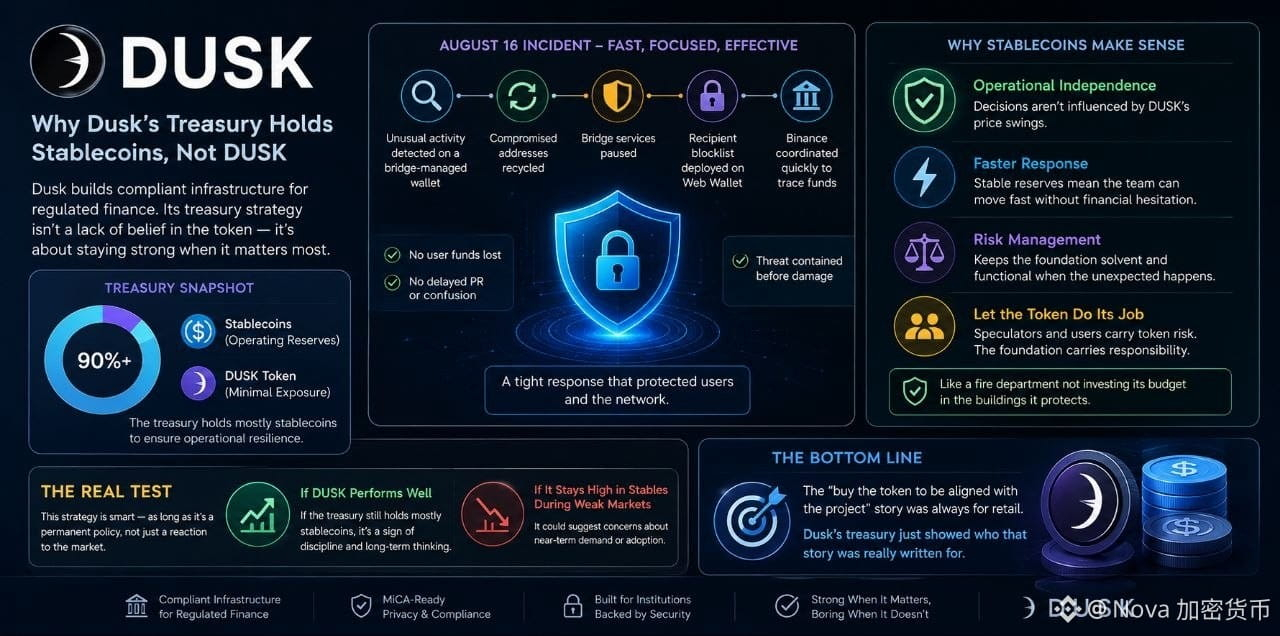
Dusk hat mich darüber nachdenken lassen, wie ich Projekt-Treasuries betrachte. Wenn Dusk Infrastruktur für regulierte Finanzen aufbaut, kann es tatsächlich mehr Sinn ergeben, den Großteil seiner operativen Rücklagen in Stablecoins zu halten, statt sie mit dem eigenen Token zu beladen.
Der Vorfall vom 16. August hat gezeigt, warum. Als bei der Brückensituation eine schnelle Reaktion nötig war, konnte sich das Team auf Eindämmung, Blocklisten und Koordination konzentrieren, ohne sich zusätzlich darum kümmern zu müssen, eine Treasury zu schützen, die stark den Preis von DUSK ausgesetzt ist.
Das ist nicht zwangsläufig ein Mangel an Vertrauen in Dusk. Wahrscheinlich ist es ein gesünderes Risikomanagement.
Der entscheidende Test ist, was passiert, wenn DUSK eine starke Phase hinlegt. Wenn die Treasury dann weiterhin den Großteil ihrer Rücklagen in stabilen Assets hält, ist ziemlich klar, dass es nicht um Marktbedingungen geht. Es ist einfach so, wie Dusk seine Fähigkeit schützt, weiter zu operieren, wenn es chaotisch wird.
Ich würde lieber sehen, dass ein Projekt im Hintergrund finanziell eher „langweilig“ bleibt, wenn das dazu beiträgt, dass es zuverlässig ist, wenn Nutzer es tatsächlich brauchen.
@Dusk_Foundation #dusk $DUSK
Dusk hat mich darüber nachdenken lassen, wie ich Projekt-Treasuries betrachte. Wenn Dusk Infrastruktur für regulierte Finanzen aufbaut, kann es tatsächlich mehr Sinn ergeben, den Großteil seiner operativen Rücklagen in Stablecoins zu halten, statt sie mit dem eigenen Token zu beladen.
Der Vorfall vom 16. August hat gezeigt, warum. Als bei der Brückensituation eine schnelle Reaktion nötig war, konnte sich das Team auf Eindämmung, Blocklisten und Koordination konzentrieren, ohne sich zusätzlich darum kümmern zu müssen, eine Treasury zu schützen, die stark den Preis von DUSK ausgesetzt ist.
Das ist nicht zwangsläufig ein Mangel an Vertrauen in Dusk. Wahrscheinlich ist es ein gesünderes Risikomanagement.
Der entscheidende Test ist, was passiert, wenn DUSK eine starke Phase hinlegt. Wenn die Treasury dann weiterhin den Großteil ihrer Rücklagen in stabilen Assets hält, ist ziemlich klar, dass es nicht um Marktbedingungen geht. Es ist einfach so, wie Dusk seine Fähigkeit schützt, weiter zu operieren, wenn es chaotisch wird.
Ich würde lieber sehen, dass ein Projekt im Hintergrund finanziell eher „langweilig“ bleibt, wenn das dazu beiträgt, dass es zuverlässig ist, wenn Nutzer es tatsächlich brauchen.
@Dusk #dusk $DUSK
Der Vorfall vom 16. August hat gezeigt, warum. Als bei der Brückensituation eine schnelle Reaktion nötig war, konnte sich das Team auf Eindämmung, Blocklisten und Koordination konzentrieren, ohne sich zusätzlich darum kümmern zu müssen, eine Treasury zu schützen, die stark den Preis von DUSK ausgesetzt ist.
Das ist nicht zwangsläufig ein Mangel an Vertrauen in Dusk. Wahrscheinlich ist es ein gesünderes Risikomanagement.
Der entscheidende Test ist, was passiert, wenn DUSK eine starke Phase hinlegt. Wenn die Treasury dann weiterhin den Großteil ihrer Rücklagen in stabilen Assets hält, ist ziemlich klar, dass es nicht um Marktbedingungen geht. Es ist einfach so, wie Dusk seine Fähigkeit schützt, weiter zu operieren, wenn es chaotisch wird.
Ich würde lieber sehen, dass ein Projekt im Hintergrund finanziell eher „langweilig“ bleibt, wenn das dazu beiträgt, dass es zuverlässig ist, wenn Nutzer es tatsächlich brauchen.
@Dusk #dusk $DUSK
6
10
540
Anmelden und weiter Inhalte entdecken
Krypto-Nutzer weltweit auf Binance Square kennenlernen
⚡️ Bleib in Sachen Krypto stets am Puls.
💬 Die weltgrößte Kryptobörse vertraut darauf.
👍 Erhalte verlässliche Einblicke von verifizierten Creators.
E-Mail-Adresse/Telefonnummer
Trendthemen
NEARRisesNearly80%InAWeek
20,933 Aufrufe
686 Kommentare
#nearrisesnearly80%inaweek
NEAR-Protokoll in absoluter Hochstimmung diese Woche – hier ist, was den Anstieg antreibt 🔥
Was für eine Woche für NEAR! 🚀 Gewinne von fast 80 % in nur 7 Tagen sind kein reiner Zufall; das deutet auf einen großen Momentum hin, der sich um NEARs Vision formt: die Kette zu entkoppeln und KI-Integration. Wenn technische Effizienz auf die Markthoffnung der Trader trifft, bekommen wir genau diese Art von Kursbewegung.
Hältst du NEAR langfristig, oder nimmst du Gewinne in diesem Bereich mit? Nenne deine Strategie unten! 👇
Bitte folgen Sie
$NEAR
#BitcoinHits$85K #Near #SolanaCutsTargetSlotTimeTo250ms
Shamika Metting
·2 Likes
·1.7k Aufrufe
MultiversXPlansHardForkRecovery
19,303 Aufrufe
529 Kommentare
CircleLaunchesInstitutionalBTCBackedBorrowing
19,147 Aufrufe
655 Kommentare